Benjamin Mako Hill: Diamond Clarity

I3 I2 I1 SI2 SI1 VS2 VS1 VVS2 VVS1 IF FLThe GIA diamond clarity scale, shown above, is rather opaque.
I3 I2 I1 SI2 SI1 VS2 VS1 VVS2 VVS1 IF FLThe GIA diamond clarity scale, shown above, is rather opaque.
The Setup is an awesome blog that posts of interviews with nerdy
people that ask the same four questions:
Since installing a whiteboard in our kitchen, conversations at the
Acetarium have been moving in new and interesting directions.
For example, Mika and I recently noticed that, when rotated correctly, the
skeletal formula for 2,3-dimethyl-2-butanol looks pretty friendly!
 This weekend, I launched an extremely ambitious effort to collect
evidence of extremely ambitious efforts. The result was a short
program that searched the web and revealed the:
As the free software and free culture movements have sat quietly by,
DRM is now well on its way to becoming the norm in the electronic book
publishing industry.
The free culture movement has failed to communicate the reality of
DRM and, as a result, millions of people are buying books that they
won't be able to read when they switch to a different model of ebook
reader in the future. They are buying books that will become
inaccessible when the DRM system that supports them is shut down -- as
we've already seen with music from companies including Wal*Mart,
Yahoo, and Microsoft. They are buying books that require that
readers use proprietary tools that lock them out from doing basic
things that have always been the right of a book owner.
Some anti-DRM advocates are, indirectly, part of this problem as they
buy these books and turn to shady methods of stripping the
DRM. Buying DRMed books is voting with your wallet for a system that
criminalizes those that insist on living in freedom and will screw us
all in the long run when DRM is the only choice we are offered and
removing the DRM is difficult, unsafe, and illegal.
Buying non-DRMed e-books is a more freedom-friendly alternative for
those that, like me, are excited about not lugging kilograms of paper
around our cities and the world. We can do this at "non-mainstream"
publishers like Smashwords who explicitly reject DRM. Of course,
the big ebook sellers like Amazon, and Barnes and Nobel, and Google
all offer non-DRMed books. But none of the major ebook retailers
explicitly reveal the DRM status of locked down books before
purchase.
On Amazon, there are some cryptic signs and signals that, if you
understand them, suggest the absence of DRM. Google and Barnes and
Nobel currently offer no way to know if a book is DRMed without buying
it first and questions in their support forums go
unanswered.
It's hard to support non-DRM alternatives when we can't recognize
them. It's hard to tell people to not buy DRM ebooks if we can't even
tell them apart. Getting this message through to book buyers -- and
perhaps even to ebook retailers -- seems like a critical first step.
 I roll my eyes a little when I think that Unhappy Birthday is the
document I have written that has been read by the most people. The
page -- basically a website encouraging people to rat on their friends
for copyright violation for singing Happy Birthday in public -- has
received millions of page views and has generated tons of its own
media (including a rather memorable interview of CBC's WireTap). At
the bottom of the page I am listed, by name and email, as the
"copyrighteous spokesman" for the initiative.
And since the page has been online, I have received hate mail about
it. Constantly.
Since the email only goes to me, I thought it might be fun to share
some of these publicly. All these messages are quoted verbatim but I
have not included the senders' names. Be warned: the language is often
salty.
This email is years old now but it is probably still my favorite:
Atrocity and strife run rampant in this world. Babies are abandoned in dumpsters. Teachers molest students. Impoverished Indonesians make sneakers for pennies while the spoiled jackhole in the 30-second commercial makes millions for sinking a three-pointer and smirking at the camera. Forms of religion are interpreted as to compel people to strap explosives to their chest and board buses full of innocents. Boss Tweeds embezzle and get severance pay while John Q. Workingman gets put out on the street when the corporation goes belly up. Out of all these indignities and countless others I haven't the time to mention, why do you make it your personal crusade to assist in the flagrant persecution of family restaurants for partaking in the time-honored tradition of singing "Happy Birthday"? God forbid these foul brigands bend copyright law in order to bring a smile to somebody's face. Food for thought...without the accompanying song.Many others strike a defiant, if less poetic, tone:
Good luck! There are millions of us who refuse to accept the ridiculous "copyright" on Happy Birthday. If Time Warner were an ethical company rather than a greedy megacorp they would do something truly special and release it into the public domain. There are some things in this world more important than money.Quite a few people notice that my last name is Hill and suspect that I must be related to the Hill sisters who originally penned the song. I'm not, to my knowledge, although since Time Warner bought the rights, it's not clear it would matter:
I am writing to just let you know how disappointed I am that a large corporation and others (like the HILL family) are making $2 million plus for a song that was created over 100 years ago with noone knowing who created the lyrics! None of us at our place of employment could believe this and we certainly won't encourage people to send money to ASCAP. It is a shame that ASCAP license fees aren't used to pay more to up-and-coming artists who I'm sure need this money alot more than Time Warner. We all plan to sing Happy Birthday MORE now in public places and if anyone asks if it is copyrighted we will say "of course not". Maybe this way the song will not die out completely as more and more other "birthday" songs are being sung. It would also be nice if your website cited whose opinion is writing the piece and your obvious conflict of interest.Or another:
Is it a coincidence that your last name is the same as the last name of the authors of the song "Happy Birthday?" You seem to have a personal monetary motive for your work with the "grassroots project" you call Unhappy Birthday, and if you do not, your concern is misplaced all the same. Whom do you imagine your campaign serves? And do you realize whom it harms? I do not question the illegality of performing the copyrighted song publicly. And you are correct that most of the public is not even aware that the song is under copyright. I think the harm done to Time Warner and its associates by such public performances is far outweighed by the joy created when the much-loved happy tune is shared. I urge you to ask yourself why you think the immortal Hill sisters wrote the song in the first place. It was not to put more money Time Warner's pocket. It was, I would argue, for the sake of the song itself and the happiness it brings when performed (publicly or otherwise). Please consider siding with the children and the artists; let the lawsuits alone.Some people suspect the site may be satire, but include insults and and attacks just in case it isn't:
I'm trying to figure out if your Unhappy Birthday site is meant to be in jest. If so Rofl, and congrats on a hilarious site. If you're actually serious, then fuck you Nazi cunts and your corporate butt buddies. Thank you for your time.Or these two alternatives (each were separate emails):
If this is a joke then it's rather funny. However if this website is serious then you're a fucking idiot. Get a life!!!! if it is a form of protest, then THANK YOU! if it is not, then screw you all!One memorable piece of mail was from someone who knew of me from my activities in the free software and free culture communities and had a hard time reconciling my work there with the high protectionist website:
I was quiet surprised to see your name and email address at the bottom of the home page of the site Unhappy Birthday. The site claims that you are their spokesman. Is this correct? I do not understand... You have all this Open Source/ Free Software background and then this site that defends one of the most controversial copyright issues??? Do you really mean this? Do you want to help Time Warner?I've also received probably half a dozen mails that offer some sort of support! For example, this person liked the website -- and even wanted to buy one of our t-shirts -- but objected to our logo:
I was going to buy one of your products from your Unhappy Birthday Shop at CafePress but there's a problem. I hate emblems that uses human skulls in them. Being a member of ASCAP I really do support your cause but I can't buy a product that I would never wear.And many people are simply confused asking something like this one:
So I saw the unhappy birthday site and I'm just a little confused. Is this a joke or a serious thing?I usually reply and explain that I have tried to ensure that the site describes the legal situation around Happy Birthday honestly and correctly. That said, the vast majority of messages I receive are unequivocal. Like this email that I received last week addressed to "you anti-free speech fascists":
         __
        /  \


 __  __      __
/  \/  \    /  \
                \

                 /
                 \
                  /
\                /
Find recent graduates of the program you are considering, and the faculty advisor(s) you are planning on working with, and look at where they are now. Are these ex-students doing the kind of work that you want to do? Are they at great programs at great universities? Chances are good that a PhD program and its faculty will prepare future students to be like, and do work like, the students they have trained in the past. Programs that consistently make good placements are preparing their students well, supporting them, making sure they have the resources necessary to do good work, and helping their students when they are on the job market. A program whose students do poorly, or just end doing work that isn't like the kind you want to do, will probably fail you too.
If recent graduates seem to be generally successful and doing the kind of work you want to do, find one who looks most like the kind of academic you want to become and talk to them about their experience. Chances are, your faculty advisors will overlap with theirs and your experience will be similar. Ex-students can tell you the strengths of weaknesses of the program you are considering and what to watch out for. If they had a horrible experience, there's a decent chance you will too, and they will tell you so.
Public Resource republishes many court documents. Although these
documents are all part of the public record and PR will not take them
down because someone finds their publication uncomfortable, PR will
evaluate and honor some requests to remove documents from search
engine results. Public Resources does so using a robots.txt file
or "robot exclusion protocol" which websites use to, among other
things, tell search engine's web crawling "robots" which pages they do
not want to be indexed and included in search results. Originally,
the files were mostly used to keep robots from abusing server
resources by walking through infinite lists of automatically generated
pages or to block search engines from including user-contributed
content that might include spam.
The result for Public Resource, however, is that PR is now publishing,
in the form of its robots.txt, a list of all of the cases that
people have successfully requested to be made less visible!
In Public Resource's case, this is is the result of a careful
decision; PR makes the arrangement clear in on their website. The
robots.txt home page also explains the situation saying, "the
/robots.txt file is a publicly available file. Anyone can see what
sections of your server you don't want robots to use,", and "don't try
to use /robots.txt to hide information."
That said, I've looked at a bunch of robots.txt files on websites I
have visited recently and, sadly, I've found many sites that use
robots.txt as a form of weak security. This is very dangerous.
Some poorly designed robots simply ignore the robots.txt file. But one
can also imagine an evil search engine that uses a web-crawler that
does the opposite of what it's told and only indexes these "hidden"
pages. This evil crawler might look for particular keywords or use
existing search engine data to check for incoming links in order to
construct a list of pages whose existence is only made public through
a file meant to keep people away.
Check your own robots.txt and ask yourself what it might reveal. By
advertising the existence and locations of your secrets, the act of
"hiding" might make your data even less private.
master:/srv/leader/news/bits-from-the-DPL.*
Kim Jong-Il is gone. That said, he continues to live on, looking at
things, on the popular blog Kim Jong-Il Looking At Things which
continues to be updated with new content from the archives.
It is now joined by Kim Jong-Un Looking At Things. I think I agree
with Jo o Rocha, creator of the original, that the younger Kim seems to
be missing some hard-to-pin-down quality that made the original work
well.
I've mentioned before that I compete every year in the MIT Mystery
Hunt -- an enormous, multi-day, round-the-clock puzzle
competition held in January at MIT each year.
Last year, my team Codex won the hunt. The reward (punishment?)
for winning is the responsibility to write the 100+ puzzles, (and
meta-puzzles, and meta-meta-puzzles, and theme, and events) and to
put on the whole event the following year.
So over the last year, I've worked with a huge group of folks to put
together this year's hunt which had a theme loosely based on The
Producers. My own role was small compared to many of my teammates:
I contributed to some puzzle writing and to a bunch of "test-solving"
of candidate puzzles to make sure they were solvable, not too easy,
fun, and well constructed. During the hunt, I visited competing teams,
verified answer submissions, and took advantage of my jet-lag from my
return from Japan on the day of the hunt to work the night shift
distributing items to teams.
To get an idea of what the hunt is like, you can check out a puzzle I
wrote for this years hunt. The solution is linked from the corner
of that page.
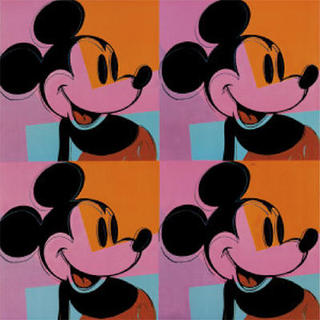 Back in 2007, Harpers Magazine published The Ecstasy of
Influence: a beautiful article by Jonathan Lethem on reuse in art
and literature. Like Lewis Hyde in The Gift (quite like
Hyde, as readers discover) Lethem blurs the line between plagiarism,
remix, and influence and points to his subject at the center of
artistic production. Lethem's gimmick, which most readers only
discover at the end, is that the article is constructed entirely out
of "reused" (i.e., plagiarized) quotations and paraphrases.
A couple months ago, I suggested to my friend Andr s
Monroy-Hern ndez a very similar project: a literature review on
academic work on remixing and remixing communities constructed
entirely of text lifted from existing research.
After some searching around, Andr s pointed out that Lethem had
essentially beaten us to the punch and linked me to his article. Only
after I visited the link did I remember that I had read Lethem's
article when it was published and loved the idea then. Over time, I'd
forgotten I read ever it.
Without knowing it, I had read, loved, forgotten, and then --
influenced, if unconsciously -- copied and reproduced the idea myself
in slightly modified form.
And I suppose that was the point.
<object data="https://upload.wikimedia.org/wikipedia/commons/d/de/Aspect-ratio-4x3.svg" type="image/svg+xml">
https://upload.wikimedia.org/wikipedia/commons/d/de/Aspect-ratio-4x3.svg</object>
<object data="https://upload.wikimedia.org/wikipedia/commons/f/f8/Aspect-ratio-16x9.svg" type="image/svg+xml">
https://upload.wikimedia.org/wikipedia/commons/f/f8/Aspect-ratio-16x9.svg</object>
It seems that nearly all computer monitors have now switched from a
4:3 aspect ratio popular several years ago to a "wide screen"
16:10 and now mostly to an even wider 16:9.
But screen sizes are usually measured by their diagonal length and
those sizes have not changed. For example, before I had my Thinkpad
X201, I had a X60 and a X35. They are similar laptops in the same
product line with 12.1" screens. But 12.1" describes the size along
the diagonal and the aspect ratio switched from 4:3 to 16:10 between
the X60 and the X201. As the screen stretched out but maintained the
same diagonal length, the area shrunk: from 453 square centimeters
to 425.
But screens are not only getting smaller, they are also getting less
useful. The switch to wider aspect ratios is done so that people can
watch wide screen movies while using a larger proportion of their
screens. Of course, the vast majority of people's time on their
laptops is not spent watching wide screen movies but in programs like
browsers, word processors, and editors. Because most of our writing
systems lay out documents from top to bottom, the tools we most
frequently use to display (and then scroll through) the things we read
primarily use vertical screen space -- the dimension that is
shrinking.
If you have a desktop monitor, you might rotate the whole thing 90
degrees and "solve" the problem. If you're on a laptop though (as I
usually am) this is clearly not an option.
I am not the first person to be annoyed by this trend. In fact, many
recent desktop UI changes are designed to work around this issue. In
the free software world, both Unity and GNOME 3 have made
efforts to hide, merge, or otherwise get ride of title bars, menu
bars, and panels that take up dwindling vertical space. I use
Awesome which I've mostly set up to do two side-by-side terminals
with very little in the way of menu bars.
 Applications are the worst offenders and the solutions for those
things that won't run in a terminal (or people that don't want to live
there) are still lacking. I have been using Firefox's Tree Style Tab
extension to move tabs to the side and hand-customized toolbars
that squeeze everything I need (i.e., back, forward, stop, refresh,
and URL bar) onto a single menu bar.
 But the situation still drives me crazy. I'd love to hear what others
are doing.

 Mika and I will be traveling this winter in the Seattle area and in
Japan. The current plan is to be in Seattle December 19 through 28 and
then in Japan from December 28 through January 12. After that, we
will fly back to Boston for the MIT Mystery Hunt where, as
punishment for winning last year, our team is running this year's
hunt.
We will be in Tokyo for New Years and then traveling around Japan for
much of the rest of the time. We hope to visit Hokkaido and Aomori and
to travel there from Tokyo along Japan's Western coast through
Kanazawa and Niigata.
We're still figuring out where we will visit and what we will do in
both places. If you are interested in meeting up for dinner or drinks
in either place (or in organizing a talk or meeting), please get in
touch and let's try to figure something out.
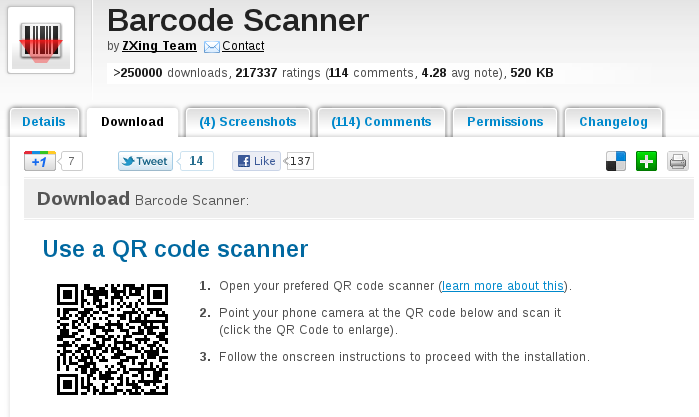
AndroidZoom, along with just about every other third-party interface
to the Android Market out there, provides 2D barcodes which aim to
make it easy to install Android applications that you find online on
a phone. Maybe this would be a nice feature for F-Droid?
Unfortunately, I found this feature when I was trying to help a friend
install the (free software) ZXing Barcode Scanner because they
wanted to read a 2D barcode.
 The Community Wellness team at MIT has a program on stress
reduction, mindfulness, and relaxation. Among their services is a
guided three-minute relaxation exercise recording (available at
extension 3-2256 or 617-253-CALM). It's a very relaxing message.
At the end of the recording, there's a revealing error where a
standard voicemail robo-voice say "no messages are waiting" before you
system hangs up on you. Turns out, the MIT wellness folks implemented
this using the normal MIT voicemail system.
This gave me a thought: What if my voicemail greeting included a
guided relaxation message as part of its greeting so that anyone who
left a message had the chance to relax a little bit first? Would
messages left for me be more positive after a window of serenity?
Would people ask less of me? Would my callers feel more relaxed and
happier during the rest of their day?
I just recorded a short version of the MIT message as my voicemail
greeting. I suppose I will find out.
I want to blog frequently but usually don't seem to find the time for
it. I'm not above tying myself to the mast if it means blogging
more.
Iron Blogger is a blogging and drinking club based on this
premise. The rules are pretty simple:
A few years ago, I ran into my friend Jay in the MIT Infinite
Corridor. He was looking for volunteers to have their pictures
taken and then added to the library of freely licensed and remixable
media that would ship with every version of Scratch -- the graphical
programming language built by Mitch Resnick's Lifelong
Kindergarten group that is designed to let kids create animations
and interactive games.
Jay suggested I make some emotive faces and I posed for three images
that made the final cut:


 But although I've spent quite a bit of time studying the Scratch
community in the last few years as it is grown to include millions of
participants and projects, I forgot about about Jay's photo shoot.
A couple months ago, Acetarium resident Andres Lombana
Bermudez pointed out that there was a mako tag on the Scratch
website and that a whole bunch of users had been publishing projects
using the pictures of me which, apparently, shipped in Scratch under
my name. For example, in this project in which I dance in front of
a enormous "MAKO" banner:
 That said, given the rather emotive nature of the pictures, I seem to
usually end up being blown up shot, shrunk, set on fire by
dragons, or meeting other similarly unfortunate ends.
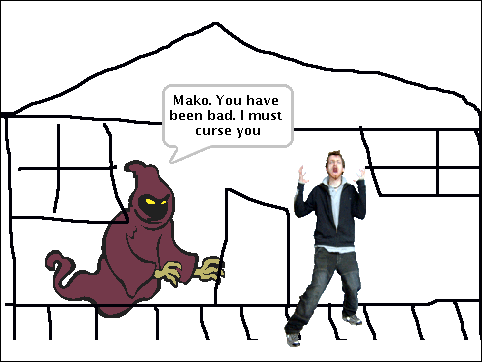
 There's quite many more entertaining examples under the tag and
many more elsewhere on the Scratch website although they are a
little trickier to track down.
Jonathan Zittrain likes to say that the best technologies are
generative in the sense that they encourage their users to make
things with them that the designer never forsaw or anticipated. I feel
generative.
I care a lot about free network services. Recently, I have been
given lots of reasons to be happy with the progress the free software
community has made in developing services that live up to my
standards. I have personally switched from a few proprietary
network services to alternative systems that respect my autonomy and
have been very happy both with the freedom I have gained and with the
no-longer-rudimentary feature sets that the free tools offer.
Although there is plenty left to do, here are four tools I'm using now
instead of the proprietary tools that many people use, or that I used
to use myself:
 After spotting an upload of mira, who in
turn spotted an upload of abe (the package, not an upload by
me aka abe@d.o), mira
(mirabilos aka tg@d.o) noticed that there are Debian packages
which have same name as some Debian Developers have as login name.
Of course I noticed a long time ago that there is a Debian package
with my login name abe . Another well-known Debian login and former
package name is amaya.
But since someone else came up with that thought, too, it was time for
finding the definite answer to the question which are the DD login
names which also exist as Debian package names.
My first try was based on the list of trusted GnuPG keys:
$ apt-cache policy $(gpg --keyring /etc/apt/trusted.gpg --list-keys 2>/dev/null   \
                     grep @debian.org   \
        	     awk -F'[<@]' ' print $2 '   \
                     sort -u) 2>/dev/null   \
                   egrep -o '^[^ :]*'
alex
tor
ed
bam
ng
But this was not satisfying as my own name didn t show up and gpg also
threw quite a lot of block reading errors (which is also the reason
for redirecting STDERR).
mira then had the idea of using the Ultimate Debian Database to answer this question
more properly:
udd=> SELECT login, name FROM carnivore_login, carnivore_names
      WHERE carnivore_login.id=carnivore_names.id AND login IN
      (SELECT package AS login FROM packages, active_dds
       WHERE packages.package=active_dds.login UNION
       SELECT source AS name FROM sources, active_dds
       WHERE sources.source=active_dds.login)
      ORDER BY login;
 login                   name
-------+---------------------------------------
 abe     Axel Beckert
 alex    Alexander List
 alex    Alexander M. List  4402020774 9332554
 and     Andrea Veri
 ash     Albert Huang
 bam     Brian May
 ed      Ed Boraas
 ed      Ed G. Boraas [RSA Compatibility Key]
 ed      Ed G. Boraas [RSA]
 eric    Eric Dorland
 gq      Alexander GQ Gerasiov
 iml     Ian Maclaine-cross
 lunar   J r my Bobbio
 mako    Benjamin Hill
 mako    Benjamin Mako Hill
 mbr     Markus Braun
 mlt     Marcela Tiznado
 nas     Neil A. Schemenauer
 nas     Neil Schemenauer
 opal    Ola Lundkvist
 opal    Ola Lundqvist
 paco    Francisco Moya
 paul    Paul Slootman
 pino    Pino Toscano
 pyro    Brian Nelson
 stone   Fredrik Steen
(26 rows)
Interestingly tor (Tor Slettnes) is missing in this list, so it s
not complete either
At least I m quite sure that nobody maintains a package with his own
login name as package name. :-)
We also have no packages ending in -guest , so there s no chance that
a package name matches an Alioth guest account either
Next.
