Search Results: "tim"

22 November 2026

Daniel Baumann: Debian: Modernizing iperf/iperf3 and introducing fireperf

Recently I spend some time on modernizing the packaging of the Internet Protocol bandwidth measuring tools iperf and iperf3 in Debian, as well as uploading fireperf to Debian.
Modernizing iperf

TL;DR: If you want to run your own iperf server,
run sudo apt install -yU iperf-server and you re done

Previously, src:iperf only built iperf. If you wanted to run an iperf server, you had to do it on your own, i.e. there was no systemd service for that. Apart from tidying the Debian package, src:iperf now builds the new iperf-client and iperf-server packages, the latter contains the systemd and ufw integration. iperf-server runs with a dynamic systemd user and systemd service hardening. The iperf package is now a transitional package, that also cleans up any leftovers from before the package split into iperf-client and iperf-server (e.g. when upgrading from trixie to forky). For historical reasons, iperf2 is packaged in debian as iperf, not iperf2. Now the iperf packages have provides for iperf2, iperf2-client, and iperf2-server respectively (so they can be installed by these names too). Updated iperf packages are available in sid, and backports for trixie are available at Debian Fast Forward. It might make sense in the future
  • given that iperf2 and iperf3 are completely different tools with different advantages and disadvantages depending on the use-case
  • therefore the one is not replacing the other (iperf2 in general is the better tool than iperf3, eventhough the common misconception is that iperf3 is supposedly better than iperf2 because the number 3 is greater than the number 2)
to maybe rename iperf to iperf2 to match both upstream naming and also to harmonize the packaging of iperf2 with other distributions.
Modernizing iperf3

TL;DR: If you want to run your own iperf3 server,
run sudo apt install -yU iperf3-server and you re done

Previously, src:iperf3 only built iperf3. If you wanted to run an iperf3 server, iperf3 had a debconf yes/no question which would then start one iperf3 server on the default port 5201. Apart from tidying the Debian package, src:iperf3 now builds the new iperf3-client and iperf3-server packages, the latter contains the systemd and ufw integration. iperf3-server runs with a dynamic systemd user instead of the previous local system account, and has systemd service hardening. Since iperf3 (contrary to iperf, also see here and here for iperv vs. iperf3) does not allow using multiple connections on the same port, you have to run multiple iperf3 servers, each on their own port, in order to serve more than one client at the time. The old debconf question for enabling a single iperf3 server has been removed as well as the obsolete sysvinit integration. In order to allow running multiple iperf3 servers at the same time (but on different ports), iperf3-server now contains a systemd service template so you can enable multiple iperf3 servers (e.g. 3 servers on subsequent port numbers, but you can run as many as you want on any ports you like) either manually with:

sudo systemctl enable --now iperf3-server@5201
sudo systemctl enable --now iperf3-server@5202
sudo systemctl enable --now iperf3-server@5203

or by using debconf interactively to do it automatically for you (which defaults to one instance on port 5201):

sudo dpkg-reconfigure -p low iperf3-server

or by using debconf non-interactively to do it automatically for you:

TMPFILE="$(mktemp)"
echo "iperf3 iperf3-server ports string 5201 5202 5203" > $ TMPFILE
cat "$ TMPFILE " sudo debconf-set-selections
dpkg-reconfigure -fnoninteractive -pcritical iperf3-server
rm -f "$ TMPFILE "

The iperf3 package is now a transitional package, that also cleans up any leftovers from before the package split into iperf3-client and iperf3-server. Updated iperf3 packages are available in sid, and backports for trixie are available at Debian Fast Forward.
Introducing fireperf

TL;DR: If you want a nicer iperf/iperf3 client,
run sudo apt install -yU fireperf-client

TL;DR: If you want to run your own fireperf server,
run sudo apt install -yU fireperf-server
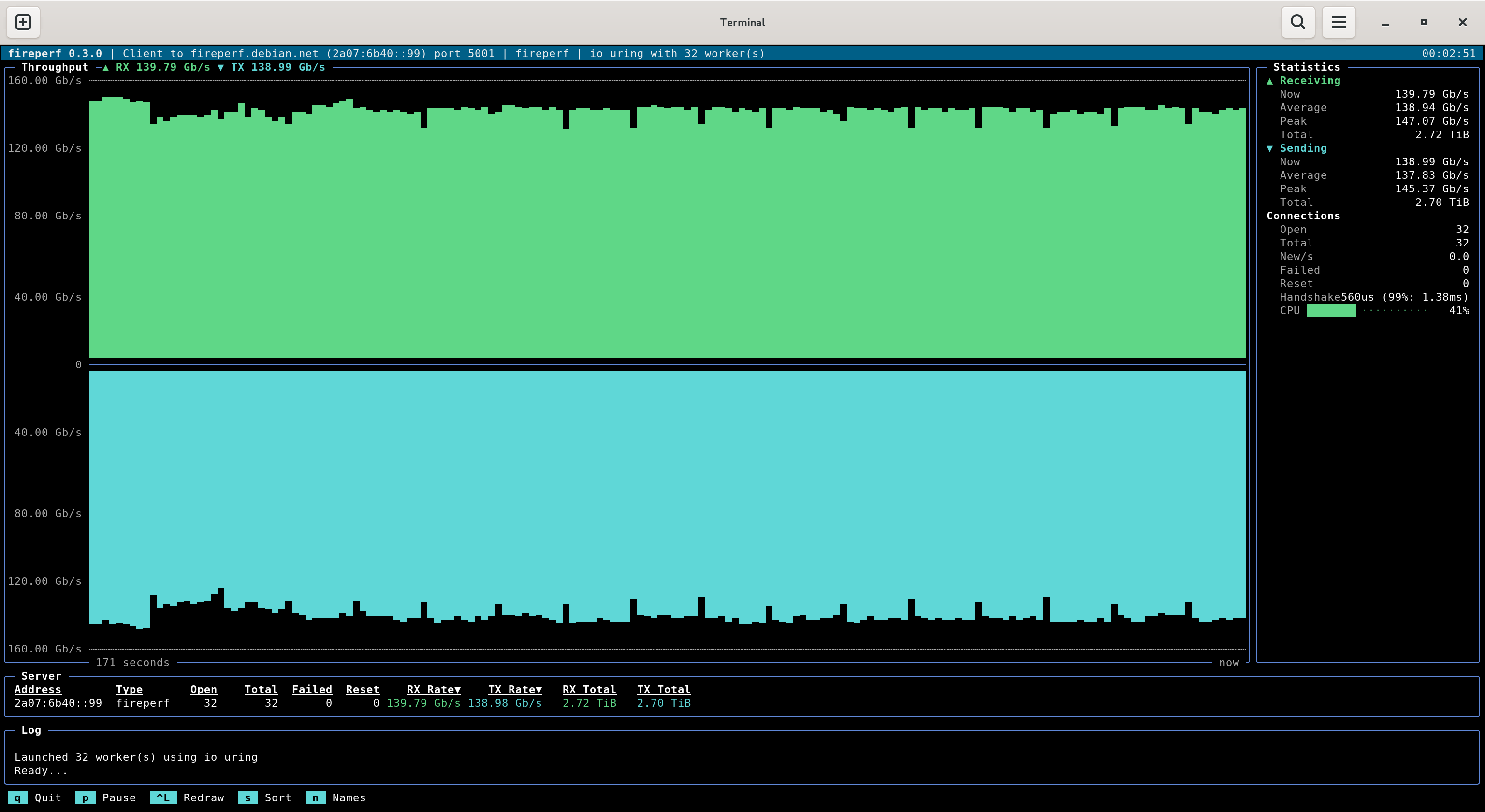
Introducing fireperf Image: fireperf interactive terminal interface
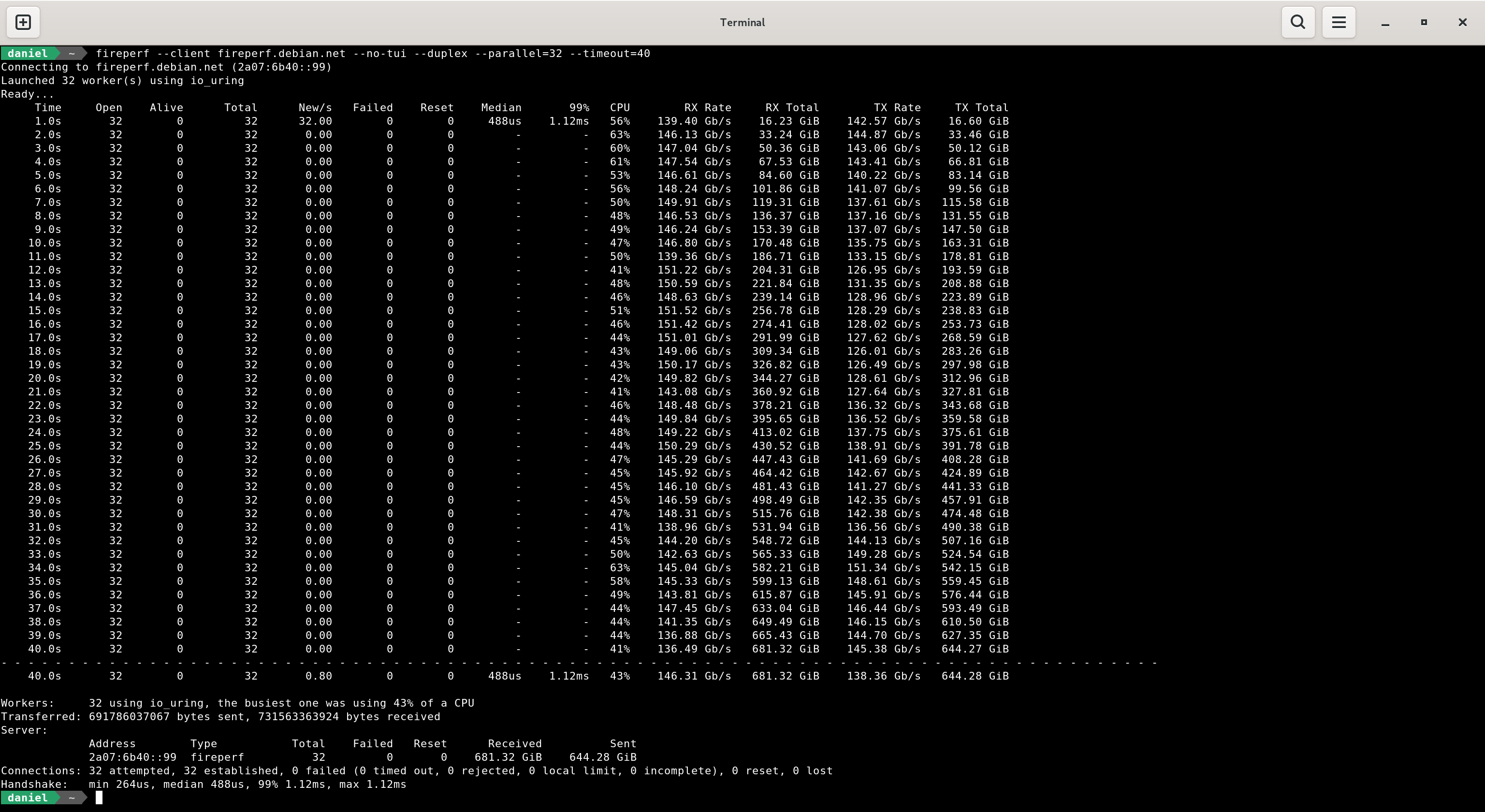
Introducing fireperf Image: fireperf non-interactive terminal interface
fireperf is a modern take on the iperf3 network performance and stress-testing tool under the IPFire project umbrella:
  • measures upload or download individually, or concurrent upload and download
  • allows to serve many clients in parallel (on the same port)
  • allows to use many workers in parallel (for maxing out bandwith of servers with LACP instead of ECMP)
  • allows to use and track many connection sessions in parallel (for maxing out firewalls)
  • can also be used as a client for both iperf and iperf3 (autodetecting the target)
  • can also be used as a iperf3 server
  • can output results in JSON
  • has a live graph (ncurses)
  • uses less CPU ressources on both the client and the server (io_uring, zerocopy, )
fireperf packages are in sid, and backports for trixie are available at Debian Fast Forward. Happy bandwidth measuring!

Russ Allbery: Review: Whalesong

Review: Whalesong, by Miles Cameron
Series: Arcana Imperii #3
Publisher: Saga Press
Copyright: 2025
Printing: August 2026
ISBN: 1-6682-1021-5
Format: Kindle
Pages: 362
Whalesong is a far-future semi-military science fiction novel and the third in the Arana Imperii series, not counting the story collection Beyond the Fringe. It did an adequate job of jogging my memory of previous events, but I kind of wish I had re-read the series before reading this entry. Artifact Space and Deep Black were closely linked, almost one novel in two volumes. Whalesong is not. There is a frame story featuring Nbaro and Dorcas and an introductory story featuring Nbaro's friend Qaqqaq, but the protagonist for most of the novel is a minor character from the earlier books: Thor Storkel. After Deep Black, Storkel mustered out of the DHC and purchased the captured New Texas ship Silver Star. An arrangement with Morosini involving secret reserve status let him keep a hidden weapon system. His plan was to become an independent trader, working for himself and going wherever he wanted. This did not go as smoothly has he planned. Keeping a ship running was expensive in numerous ways that had never previously been his problem, and the end of the Non-War meant a glut of ships and crews trying to do the same thing he was doing. His PTSD and associated paranoia from his time on the Athens didn't help. As Whalesong opens, Storkel is running the Silver Star by himself (a horrible idea), trying to find both cargo he can make money on and crew he can afford to hire. Also the antigravity is weirdly glitchy, and he's fairly sure the ship's sub-AI doesn't like him. Whalesong feels like an interlude in the larger series. Although there are important connections to the larger series plot, the advancement of that plot is limited and mostly happens in the background. Instead, this is more of a merchant adventure with some found family vibes, returning to military SF and larger political concerns only late in the book. It felt like Cameron needed to move pieces into place for the next major plot development and decided to use that interlude to tell a smaller character story. The appeal of this book is therefore going to depend on how much you like the characters. Storkel is an improviser and a tinkerer, the kind of person who sets up an elaborate set of tools and macros and alarms to partly automate his job without letting go of any piece of it. The primary tension in the story is Storkel's paranoia and the increasing evidence that it is justified, that there is something fundamentally wrong with his ship. By himself, Storkel is a little too intense. Thankfully, he gradually accumulates crew over the course of the story, and that settles him down and adds some enjoyable character interactions. Dorcas, when he shows up, is exactly like Dorcas in the previous books; if you liked him before, you'll still like him here. This is the kind of book that I enjoyed while reading and then promptly forgot most of as soon as I finished it. The details of Storkel's attempt to become an independent trader and how it is slowly hijacked by the series plot is competent, but not more than that (at least for me). The one real complaint that I have is that Nbaro, even when mostly off-camera, continues to be hypercompetent and central to DHC politics in a way that I found a bit unbelievable. Otherwise, the worst that I can say is that this book never grabbed me like Artifact Space did. I happily turned the pages, but I probably won't read it again. After reading this book, I re-read both Artifact Space and Deep Black and greatly enjoyed both of them. I haven't felt any similar desire to re-read this one. If you're following the series, there's no reason to skip Whalesong, but I doubt it will be your favorite. Followed by The Alien's War, which will hopefully have the sort of major plot advancements hinted at by the title. At the time I am writing this review, it is scheduled for publication in September of 2027 in the UK and does not yet have a publishing schedule in the US. Rating: 7 out of 10

21 November 2026

Andrew Cater: Back in Cambridge - this time for media testing / media release 20261121

I never did quite finish the blog posts for mini-DebConf Cambridge at ARM - sorry, but life got in the way. Videos are now available in the Debian video archives.

Back in Cambridge for release of Debian 13.8 - testing is going well. A couple of new bugs - speech install doesn't *depend* on a working screen but it surely does help as a sighted user :)

Six of us here, including Richard who is new to the process and pham who has helped with ARM v7 remotely.

All good - and glad to be here.

Abhijith PA: MiniDebCamp Kochi 2026 - Report

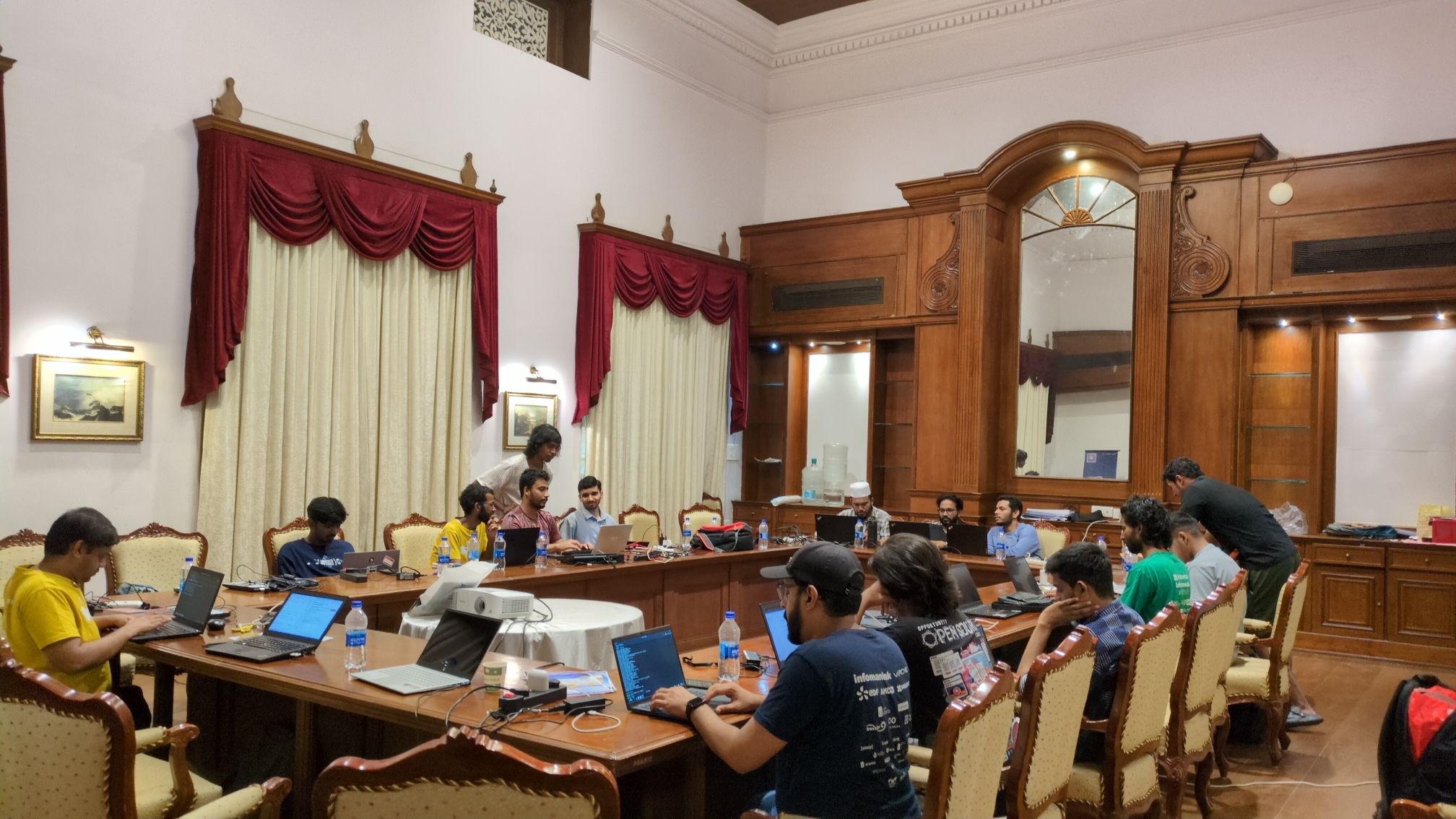
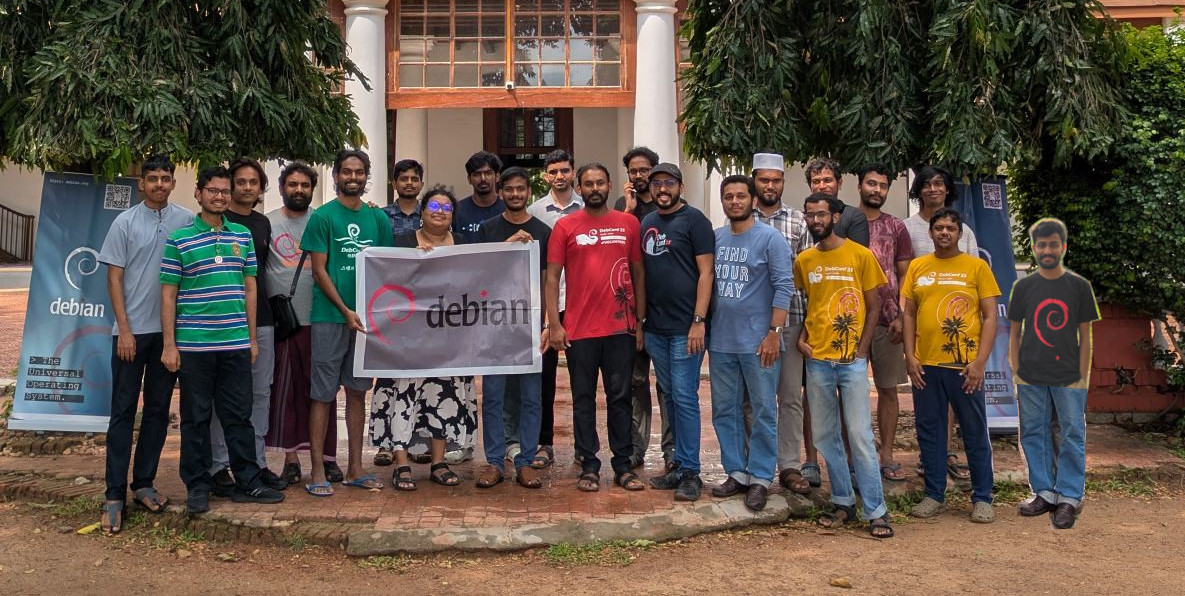
Event Logo On 22nd May 2026, we organized a MiniDebCamp at Bolgatty Palace, Kochi, Kerala. The actual discussion for this year s camp began when we had a small meetup at Urbec s place in Kochi. We decided to do a MiniCamp rather than MiniConfs which we were doing for quite some time. Also, We had already done a Bug Squashing Party last year with 4 people and we wanted to do a bigger one this time. Kiran(hacksk) was involved with organizing the camp initially. Later when we finalized the dates for the camp, he had to leave since it conflicted with another event he had to attend. Thanks to Aryan(spaciouscoder) for the event logo and designs. Due to his exam clashes, he also couldn t attend the event. Choosing venue wasn t hard this time. We were already in talk with Bolgatty Palace for a bigger event and we decided to conduct the camp here after couple of visits and negotiations on rates. Our booking was still with them due to the unfortunate event happened during the DebConf23. Our announcement and Wiki page We opened our registration via LiberaForms as we had decided on avoiding non free platforms for data collection and wanted to do it as private as possible. After exploring our options, we decided on LiberaForms. We prepared a data collection, retention and destruction policy for the event. We purposefully only asked for the required fields. We were so particular that we didn t even have a phone number filed but this backfired a little. Turns out many people don t check mail as frequent as we thought. Inspite of it, we managed to reach out with updates on the event successfully. In parallel, we also sent out some mails for sponsorships. Thanks to OnlyOffice and FOSSUNITED who generously sponsored our event and enabled us to accommodate more participants. Since its a camp and not just a BSP like last year, we welcomed new people to the event. Only office logo FOSSUNITED logo We started the event on Friday evening. We did a small orientation for new comers. Before the event, we shortlisted some bugs and tasks to share. All began hacking on stuffs that was interesting to them. Some did packaging, some did bug fixes and others worked on website fixes. There was even some fiddling done on beagleboard SBC and other boards. The venue was calm and serene. The weather was nice, notwithstanding the few downpours we experienced. Some people from Hyderabad (South eastern side) and Kolkata actually got amazed by the tropical greenery around the venue and Kochi in general. The food served to us through out the event was amazing and accommodation was also very nice. In terms of bug squashing statistics, we managed to touch 93 bugs \o/ and of which 82 bugs are resolved. Parallel to bug squashing, Subin (bin/su) and Muneer worked on revamping the Debian Project website. MRs Seeing the outcome, we are hopeful and thrilled to conduct this as an annual event. Couple of people had a brainstorm later and the current decision is to do similar event next year in Bengaluru, given it will be more accessible than Kochi. MiniDebCamp Kochi 2026 Group photo Staring at laptop

Russell Coker: WordPress Content Security Policies

The Problem Brian Krebs wrote an informative article about an attack on the Optimizely service that caused many web sites to push hostile Javascript [1]. This concerns me because I have a number of WordPress plugins running on my blog and it s not practical to track what they are all doing. What I Did I set a Content Security Policy as described in the Mozilla docs [2]. As I already had the Apache headers module installed I should have been able to set the policy with the following in /etc/wordpress/htaccess:
Header set Content-Security-Policy "default-src 'self'"
I used the program HEAD from the Debian package libwww-perl to see the headers that were being set and that wasn t in it. I don t know why it didn t work and would appreciate any comments making suggestions. I m not particularly bothered about this as I found a solution that is better for my needs, but the top Google results weren t helpful and it would be good if the information was out there if anyone already knows how to solve this. To set the header I put the following in /etc/wordpress/config-etbe.coker.com.au.php:
header("Content-Security-Policy: default-src 'self'");
I tested that with the HEAD command and it was set. I tested it by loading a blog post that had images sourced from www.coker.com.au and the images weren t loaded according to the policy. So then I changed the line in the configuration file to the following and it worked and allowed my images.
header("Content-Security-Policy: default-src 'self'; img-src 'self' www.coker.com.au secure.gravatar.com");
Did I Solve This?
find /usr/share/wordpress/wp-content -name "*.js" wc -l
Currently on my blog server the above command shows that there are 1299 Javascript files included in themes and plugins. If one of them has hostile code then it can just run things in the browser when someone visits my site. So if a hostile party gains access to release an update to one of the plugins or themes and I install the update then the code runs. A hostile party wants their code to be concealed and putting a large piece of malware in a package will be easier to spot. Also Krebs documented the malware authors as running A/B tests which also requires taking code from outside sources. The Content-Security-Policy header doesn t stop hostile code being run if it was installed on the server but it does prevent that code from calling out to other code from other servers. This means that it will be harder for attackers to hide code which is a benefit for defenders. If an attacker aims for the common case of this header not being used then their malware will work on most sites but not on mine which is a win for me. When protecting against large scale attacks you often only need to be slightly more secure than most sites. If most sites do this then attackers will include all the malware inline which means that my site will be vulnerable but also means that the malware will be easier to spot. So that is still a win for defenders. I don t think I have completely solved a problem, but I think I have improved things and that others will benefit from doing the same thing. Future Investigation The site securityheaders.com [3] is of a similar nature to the more well known ssltest [4] site. According to securityheaders.com my site only gets a C rating so there s work to do there. Is there a good way of using free software to automatically check Javascript for hostile code? A google search has turned up a few options but it will take some time to investigate them even after ruling one out for being non-free.

20 November 2026

Matthias Klumpp: Changes on freedesktop.org!

Today we launched a change that has been a long time in the making: The updated website for freedesktop.org, as well as the refreshed wiki.freedesktop.org are live now!

You can read the announcement here, this blog post elaborates a bit on it and on the background of the changes, as well as future plans.

Why change anything?

The freedesktop.org website has been a wiki for a long time, which definitely was the right call in its inception. A wiki is very much in spirit of Freedesktop s mission statement to foster collaboration between desktop environments and to be a place to create de-facto standards.

However, over the years, working with the wiki became a bit of an issue: Not only did we face multiple spam-apocalypses (which in part motivated the switch to IkiWiki in 2013 and resulted in us heavily restricting write access to the wiki), but it also meant that official project information, finished specifications, half-finished proposals and pages nobody had touched in fifteen years were all sitting next to each other.

Since 2000 when Freedesktop.org was started, the project has grown so much and has had so many associated projects and specifications over the decades that it is now very difficult for new people to get an overview what is current and what state the software projects and specifications hosted by Freedesktop.org are in.

Having only a wiki as a large and somewhat disorganized pile of information did not help with that issue, so I worked to split things up: We now have a website as well as a wiki, using different designs to distinguish the two, and serving different purposes.

Website & website plans

The website at www.freedesktop.org will be the place for official , or rather, more curated information. Now that the new website is live, its content is still largely that of the old wiki. Over the next weeks, I will be working on cleaning up its contents and listings. For example, I will clearly split active projects from archived ones, add missing ones, and also work towards synchronizing the specifications hosted on the former wiki / website with the ones listed on specifications.fd.o.

So, basically I will do an inventory check of Freedesktop. That work has already started, but until now, I could not make any public changes to not disrupt workflows or make my own future work harder by having diverging information in two places (website & wiki).

I also wanted to make it easier for people to find information on how to get involved with Freedesktop and associated projects, so the new website now has a more discoverable section for that.

The new website is a static site hosted via GitLab Pages and using Pelican. You can view its sources if you like.

Wiki changes

Of course, we also still want to keep the Wiki and all of its rich history around! It remains the easy-to-edit place for collaboration on upcoming projects and specifications.

Wiki edits must now happen through GitLab instead of the old IkiWiki web interface. While this sounds like an additional barrier to edit the wiki, it is significantly easier than requesting an account on annarchy to edit the old Wiki through the web interface. It also still allows us to keep the existing history as well as spam protection measures. In order to use the wiki with GitLab Pages and to keep the history easily accessible and readable, I rewrote the Git history of the wiki to make it pretend that all changes always happened in a content subdirectory. So, if commit signatures are missing and hashes are different: That is the only reason why. There have been no content changes or other metadata changes (and we still have a copy of the pristine wiki Git repository).

For the fd.o wiki, we are now also using Hari s IkiWiki template that is already in use on the X.org website and which is much easier on the eyes.

Next steps

At the moment, I am mostly concerned with ensuring that the change has not broken any existing links and all systems keep working. After that, the wiki website deduplication work will start and we can modernize both the content of the website and wiki.

If you find a broken link, an outdated page or anything else that looks wrong, please file an issue or, even better, open a merge request.
For the wiki, you are very welcome to just fix or otherwise update the page directly.

I did reach out to all wiki editors and projects impacted by this change in advance, but since there are so many people and projects involved, it is always possible to miss someone or something. If you found a bug, need edit permissions, or need help with anything, don t hesitate to ping me: You can find me as ximion in OFTC s #freedesktop IRC channel, in the very recently created #xdg-specs channel on the Freedesktop Matrix space, or you can email me.

Thank you!

I do want to echo the announcement news post here: None of Freedesktop.org would exist without the people who filled it with life over the years and who worked on cross-desktop collaborative projects. I have read through a lot of wiki history and old project pages over the recent months, and it feels amazing to know how much work and passion people have poured into the projects and collaborative efforts over the years no matter if they were successes in the end, or remained experiments. I am very thankful for all current, past and future editors of the website and wiki, as well as all project maintainers and contributors.

I also want to thank the Sovereign Tech Agency once more for supporting me in their fellowship program as a maintainer, which enabled me to work on this task among other things.

Thanks to all contributors, in whichever way you contribute to our free desktop ecosystem!

19 November 2026

Francesco Paolo Lovergine: Terramaster NASes with Debian, take three: scaling up.

As is often the case in scientific environments, IT solutions grow chaotically, often guided by available funds at the wrong moments, or transient choices for transient goals. Here at work, we are not an exception. Historically, since the birth of the Copernicus European project, the Earth Observation domain has become progressively more demanding about storage, due to the frequency and size of satellite acquisitions, available free of charge for research groups, free to access, but not without maintenance and processing costs, of course.As a result, we have progressively explored low-cost solutions for downloading and processing Sentinel constellation time series. Over a ten-year window, our needs moved from dozens of terabytes to hundreds of terabytes. We started with simple Synology-based solutions, very optimistically, only to discover that the optimism was not justified. When storage needs to scale up, there are no easy solutions.The only comparable IT environments are HPC clusters, which operate at a completely different order of magnitude in terms of funding. In that context, the Petabyte order of magnitude is generally achievable by using proprietary/FOSS distributed POSIX filesystems such as GPFS, Lustre, or even Ceph. None of them are exempt from problems from time to time. The sad reality is that maintaining a very large POSIX filesystem requires compromises, and no single solution fits all requirements, starting from cost to flexibility, scalability, and reliability. I wrote about the hidden costs of maintaining self-hosted storage solutions hereAlmost ten years ago, we chose GlusterFS as an acceptable compromise for a distributed POSIX filesystem. It is not object storage, but a pure POSIX filesystem with a simple architecture, which fits our environment, where most people rely on the folders-and-files abstraction to organize their data. All nodes and their bricks are equal (no dedicated metadata nodes) and can scale without major limitations with a reasonable number of nodes. In our experience, the real bottleneck is network speed, which can introduce high latency and cause cache issues.We are now finally moving our old Synology-based distributed filesystem to a pool of TerraMaster U12-500 Plus units, installed with Debian 13. Compared with TerraMaster SOHO products, these rack-mount units can run without any non-free firmware. You must manually enable the usual 9000 MTU jumbo frame for the 10Gb network, which is generally required on all connected hosts and also the switch (in our case, a MikroTik box) to properly manage full bandwidth. We measured average performance around 200MB/sec, which aligns with the average sequential speed of 6Gb SATA HDDs.Regarding using GlusterFS, the most obvious choice is to use it with XFS as the filesystem for the NAS bricks; this proved in practice to be the optimal configuration, after not-too-nice experiences with Btrfs on Synology DSM. Still, it requires some tuning for periodic checks across the various layers of the storage system. One is about short/long HDD testing, which I already covered in another post. A trickier aspect is managing possible bit rot in the brick filesystems from time to time. While Btrfs, with its COW management, can run low-impact scrubs on both metadata and data, XFS can only partially do the same for metadata through xfs_scrub, which is also, as clearly stated, an experimental feature to use at your own risk. In that regard, it is much better to run GlusterFS scrubbing instead.While xfs_scrub is as light as the SMART short self-test for HDDs, both RAID checks and GlusterFS bitrot scrub are heavy operations that should run rarely to avoid stressing HDDs and systems, and never at the same time. It is mandatory to avoid overlapping all such operations, and that s a good reason to use systemd timers and run the heavy checks in alternating months.One suboptimal aspect of our solution is the absence of direct LED control for HDDs, which is unfortunately available only under TOS with a proprietary driver. This is obviously required for disk replacement from time to time, when needed. On the other hand, software support is extended to the lifetime of the Debian distribution, with major upgrades every 3-4 years on average. Also, this is much more flexible and efficient than using pre-built custom OSes. Of course, if you prefer dashboards and the usual GUI candy, this isn't a viable choice; a better option would be TrueNAS, which has a much higher memory footprint, especially when paired with OpenZFS.

18 November 2026

John Goerzen: What is this AI slop bug report trying to achieve?

This morning, I opened up my inbox to find a report of a security bug in C-Kermit. That s great! , I thought. Someone else interested in C-Kermit found a bug. Well, as you can imagine from the title of this post, that s not the case at all. The bug report claimed that a recent security fix was incomplete for non-Unix platforms. It appeared to quote code that lacked hardening. However, the report had specifically deleted the hardening code from the section it quoted. Its suggested fix asked for hardening code of the exact same shape that is already in the tree, that the report had somehow excluded. Even if the hardening was omitted, from my understanding, the one non-Unix platform that people build C-Kermit on today, OpenVMS, doesn t have the same class of shell bugs that Unix does. So, the entire report was bunk. It bears every indication of being AI-generated. It arrived in an email with a plain text body, but was formatted Markdown. The writing bore many hallmarks of being AI generated. But it left me wondering: what is this person trying to achieve? And this is a bit of a mystery to me. The email I received concluded with:
## Request
I'd be grateful if you could:
1. confirm and fix this,
2. publish a GHSA and request a CVE ID,
3. credit "[REDACTED]" as the reporter.
I wonder what the end game is? Incidentally, there was no real name used in the report. Only a github username, which I am redacting in this post. It gets stranger. That person on Github appears to have a 3-year-old account, dormant until today, and created a bunch of repos consisting of logs of submitting reports to projects all of which happened today. Stranger, each of these repos contains enough information in the title for people to pretty much figure out what the bug is (if any of them are reporting actual bugs). Yet they claim to be a coordinated disclosure when all of this is public. (I got a more detailed report by email). If any of these are real bugs, this public exposure before a fix opens them up to harm. Their username is plastered all over things in unnecessary places: the report file, the description of the repo, etc. So, what is the point of all this? I don t get it. They targeted a bunch of, frankly rather obscure, projects with low effort, but with evidence of scripting in the Github interactions. Even if they had an LLM do all this for them why? I don t get it. Update 2026-11-19: I replied to the reporter s email, calling out the problems with it and calling it AI slop. I received a reply, which was extremely obviously AI written, apologizing profusely and claiming that the original had not been written by an AI. Also, all the repos that were on the account yesterday are gone today. I wonder how many times this pattern has repeated over the last 3 years.

16 November 2026

Russell Coker: After the AI Bust

The Crash Charles Stross wrote an interesting blog post about the latest developments in the AI bubble [1]. He predicts the imminent burst of the AI bubble because of Jensen Huang s out of control dick. The bubble was caused by out of control dicks (figuratively speaking) and now may be burst by an out of control dick (both literally and figuratively speaking). The end result of the AI related financial schemes is going to involve more than a few bankruptcies. The Rebuild I previously blogged about the fuss about AI [2] and concluded that the bust would be like the dot-com bust which paved the way for new profitable Internet developments. I am less positive towards the AI bubble now as it has gone a lot further than the dot-com bubble. The bankruptcies won t just affect the IT industry, a lot of money from pension funds and index tracker funds has gone into AI and the pain will be spread around. But I am confident that after the crash there will be new and interesting developments in Machine Learning (ML) technology that will benefit people. The Data Centers (DCs) that have been built at great expense will continue to be run and their services will for a while be offered at slightly above the cost of maintenance and power. A lot of home users (Free Software developers) who can t afford a GPU with 16G of RAM will find themselves able to rent time on systems with 48G or 96G of GPU compute to experiment with LLMs. Most such experiments won t achieve any useful output, but if someone can spend a few dollars and learn useful things about software engineering then that s a win for society. Also I think there will be some useful products developed as a result of this. The people who came of age when Linux was first released are now in their 50s and tend to have the reduction in vision and hearing expected in that age range so we can hope for some good developments in assistive technologies based on the cheap hardware. The current situation is that renting time on ML servers is cheap and often free while renting time on virtual servers with GPU access is expensive ($2 per hour for a not particularly high end VM) so people are learning how to use (or misuse) services like ChatGPT and not learning how to run their own LLM service and understand how it works. The future situation will involve renting VMs available for not much more than the cost of electricity at off-peak times and services like ChatGPT will need to have an operational profit so running your own LLM on rented hardware or hardware you own will be a better option. While corporate web sites are known for having rubbish chatbots using proprietary backend systems. While most of them suck badly and the idea of using them to replace staff is a really bad one the concept could work. If we increased the knowledge of such technology in the entire industry and if management was prepared to pay for it via increased budget for service improvements instead of trying to cut staff costs then it could give a good result. Other Computer Hardware The market for RAM for enterprise GPUs has been strong which reduced supply for consumer grade hardware. This caused prices to become unreasonably high. There s a general trend of software becoming bigger. Computers get bigger screens so media sources need higher resolution content which drives the demand for more storage and RAM for buffering things. Computers get more hardware features and more devices to connect to so all the software needs to be able to communicate with them. This makes the software bigger for everyone even people who aren t using the features. For example adapting the audio subsystem to deal with different Bluetooth devices with options for different encodings increases the memory requirements for all the computers that have audio hardware but don t have Bluetooth hardware. Perfectly reasonable decisions that make things work better for many people can have downsides for other people. RAM is one area that seems to have been repeatedly the subject of design trade-offs that resulted in systems with 16G of RAM performing the same tasks that systems with 16M of RAM did in the mid 90s but just at a higher resolution and with more features. The ongoing increase of RAM use by software combined with high prices caused by the AI companies has been bad for consumers. The PC RAM use issue isn t going to end. When I started editing the Debian Wiki page about Mobile Apps [3] I added a field for typical RSS of apps. Phones never have an option to increase RAM and the RAM is always limited. The largest RAM in commonly available phones in English speaking countries is 16G for the Pixel 11 Pro and the largest RAM for open Linux phones is 8G. When even relatively simple apps like an eBook reader take 500M of RAM it s obvious that 8G isn t enough. The phone and laptop design process is based on a cycle of about one year, so maybe 8 months after the AI crash we will see ultralight laptops with 64G of soldered RAM and phones like the Pixel 12 Pro with 32G of RAM. Looking at Officeworks (the chain store for cheap office supplies including laptops) the vast majority on sale currently have 16G or less and 16G of RAM performs really badly for Windows and has performance problems for heavy use on Linux. It would be nice if the minimum RAM for a laptop was 16G and it was a common and affordable option to have 32G or more and that is a likely result of the AI crash. Single Board Computers (SBCs) are currently expensive with reasonable amounts of RAM, when RAM prices drop significantly it will enable more uses of them for replacing desktop PCs and for developing other products. The Humane AI Pin [4] was an interesting research project but a poorly managed product, it would be interesting to have some free software research into that space and cheap SBCs with lots of RAM will facilitate it. Employment I expect that a lot of IT people will be looking for work in California soon. But for most of the world I don t think it will change much. Cheaper hardware decreases the cost of starting IT businesses but a market crash decreases confidence in investing in the sector. Maybe there will be an increase in startups and small companies, including small companies based around LLM operation. I don t expect any sort of catastrophic decrease in IT employment. Also a CEO sleeping with employees at his company creates a bad working environment, that sort of thing should be stopped. Sacking a CEO for such misbehaviour is a good thing even without all the financial fraud and possibly breaking laws about exports. Conclusion The sooner the crash happens the better things will be for everyone. As this bubble goes on the impending financial damage increases and the upsides of the crash are delayed.

14 November 2026

Junichi Uekawa: Time flies so fast.

Time flies so fast. It's November. Busiest time of the year?

13 November 2026

Reproducible Builds: Reproducible Builds in October 2026

Welcome to the October 2026 report from the Reproducible Builds project! In our reports, we try to outline the most important things that we have been up to over the past month. As a quick recap about what problem our project intends to solve, whilst anyone may inspect the source code of free software for malicious flaws, almost all software is distributed to end users as pre-compiled binaries. The motivation behind the reproducible builds effort is to ensure no flaws have been introduced during this compilation process by promising identical results are always generated from a given source, thus allowing multiple third parties to come to a consensus on whether a build was compromised or not. As ever, if you are interested in contributing to the project, please visit our Contribute page on our website. In this month s report, we cover:

  1. GNU tar sparse archive non-determinism reported
  2. Reproducible Builds at SeaGL 2026
  3. Tool and documentation development
  4. Distribution work
  5. SOURCE_DATE_EPOCH specification updates
  6. Mailing list news
  7. Patches


GNU tar sparse archive non-determinism reported Johannes Schauer Marin Rodrigues (josch) reported an issue to the GNU tar mailing list where creating PAX-format sparse tar archives produces unreproducible outputs. Specifically, when GNU tar generates a PAX archive containing a sparse file it embeds the process ID into the member filename path structure (e.g. ./GNUSparseFile.<pid>/<filename>). Because process IDs vary between build runs, however, archiving identical sparse input files yields different binary outputs. In his report, Johannes outlined potential workarounds, such as running tar inside an unshared PID namespace where the process ID is pinned to 1, and proposed that GNU tar either omit the PID by default or provide a command-line flag to suppress it. Full details can be found in the post itself, and Johannes also filed the bug in Debian for completeness.

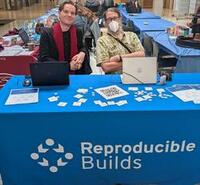
Reproducible Builds at SeaGL 2026 Reproducible Builds was present at SeaGL in Seattle, WA, on October 23rd & 24th. Thanks to everyone who attended and spoke with us! Members of the Reproducible Builds project attended SeaGL (the Seattle GNU/Linux Conference) in Seattle, WA, on October 23rd & 24th. It was a fantastic opportunity to connect with local community members, discuss software supply chain security and share updates on build verification tooling. Thanks to everyone who stopped by our sessions or spoke with us during the event. Founded in 2013, SeaGL is an annual free-as-in-freedom, grassroots technical summit dedicated to spreading awareness, community engagement and practical knowledge about free software, open hardware and libre culture.

Tool and documentation development diffoscope is our in-depth and content-aware diff utility that can locate and diagnose reproducibility issues. This month, Chris Lamb made a number of changes, including preparing and uploading versions 333, 334, 335 and 336 to Debian:
  • New features:
    • Support the dumppdf binary being called dumppdf.py on the host/runtime system. [ ]
  • Bug fixes:
    • Drop Recommends: guix from the diffoscope-minimal package as it is not minimal. (#1114739) [ ]
    • Fix a crash when using the latest version(s) of Androguard. Thanks, hc! [ ]
  • Codebase improvements:
    • Re-order various parts of the .tar file comparator to make it easier to progressively delve into its functionality. [ ]
    • Fix a silly prepend typo. [ ]
    • Reflect in the Python packaging that the use of the case-match language feature necessarily requires Python 3.10+. [ ]
  • Misc:
    • Update debian/tests/control. [ ]
    • Update copyright years. [ ]
In addition, Johannes Schauer Marin Rodrigues added support for POSIX.1-2001 PAX headers in the .tar file comparator [ ] and Vagrant Cascadian proposed an update in diffoscope in GNU Guix to version 335.

Distribution work In Debian this month, 20 reviews of Debian packages were added, 28 were updated and 27 were removed this month adding to our knowledge about identified issues. One issue type was updated to reflect that Debhelper compat level 14 is no longer experimental. [ ] In addition, Vagrant Cascadian performed a number of Non-Maintainer Uploads (NMUs) and Quality Assurance (QA) uploads in Debian for several packages with outstanding reproducibility issues. These included clhep, tea-cli, argparse-manpage, ruby-timers, mandos and cdebootstrap.
Lastly, Bernhard M. Wiedemann posted another openSUSE monthly update for their reproducibility work there.

SOURCE_DATE_EPOCH specification updates As announced in last month s report, further work has been done by Bernhard M. Wiedemann regarding updating the SOURCE_DATE_EPOCH specification following discussions at a project summit. Seven distinct proposed changes were originally submitted as merge requests on Salsa, and many of these have been approved or otherwise collapsed. Bernhard s proposed modifications were independent of one another, allowing for any combination to be merged depending on community feedback. Bernhard noted that one proposal may see the most debate, and could still benefit from further refinement before reaching consensus. Community members are invited to review and provide feedback on the individual merge requests; as Bernhard writes, The other MRs could still use feedback from more people before December . Input can be submitted via reactions or comments on Salsa, directly by email to Bernhard or the mailing list. The SOURCE_DATE_EPOCH specification was first published in 2015 and updated in 2017.

Mailing list news On our mailing list this month:

Patches The Reproducible Builds project detects, dissects and attempts to fix as many currently-unreproducible packages as possible. We endeavour to send all of our patches upstream where applicable or possible. This month, we wrote a large number of such patches, including: In addition, two build failure bugs were reported by Jochen Sprickerhof.

If you are interested in contributing to the Reproducible Builds project, please visit our Contribute page on our website. However, you can get in touch with us via:

Freexian Collaborators: Debian Contributions: Python 3.15 transition, OpenSSH GSS-API package split improvements and more! (by Anupa Ann Joseph)

Debian Contributions: 2026-10 Contributing to Debian is part of Freexian s mission. This article covers the latest achievements of Freexian and their collaborators. All of this is made possible by organizations subscribing to our Long Term Support contracts and consulting services.

Python 3.15 transition, by Stefano Rivera with a little help from Colin Watson Debian has started the transition to add Python 3.15 as a supported version alongside 3.14, which is still the default version. Stefano uploaded Python 3.15.0 final to unstable. Maximiliano Curia has been test-rebuilding the archive in Debusine with Python 3.15 as a supported version and prepared some patches to dh-python to smooth over some common failure points. Stefano reviewed these MRs, applying some and implementing alternative approaches for some of the issues. Debian only has multiple supported Python versions during the transition to a new version, and typically this shows up some bugs in packages. This time was no different, the common failure was many packages that installed intermediate build artifacts into the Python module tree. Some of these artifacts would differ between Python versions. We decided to detect both of these and fail the package build, rather than silently ship garbage in the binary packages. Colin helped to fix quite a bit of the build fallout from this.

OpenSSH GSS-API package split improvements, by Colin Watson The recent GSS-API package split has largely gone relatively smoothly, but there was a subtle problem for people switching from one variant to the other: installing the replacement packages followed by purging the old one would cause some configuration files to disappear. Colin fixed this, and also reviewed and merged some autopkgtest contributions from Andreas Hasenack to make sure that this doesn t regress in future.

Miscellaneous contributions
  • Carles, using check-relations, investigated and reported 52 bugs for packages which have Recommended packages that are not available in Debian anymore. Followed up bugs on the topic.
  • Carles added support to check-relations to detect Recommends that recommend a transitional package.
  • Carles submitted merge requests (MR89, MR90, MR91, MR92) to the Debian developers-reference to remove or update references to packages that are not available anymore, have their name changed, have typos, etc.
  • Carles investigated and opened bugs regarding notifications on LXDE (#1151954, #1151955) and added a section related to notifications on the Wiki.
  • Carles uploaded new python-ping3 upstream version. Fixed simplemonitor lintian bugs. Carles also investigated python-librosa documentation building. started preparing a new python-firebase-messaging version.
  • Helmut released asyncvarlink/0.3.3 to fix several bugs including connection robustness fixes by Alex Kiernan. Colin uploaded it to Debian.
  • Helmut uploaded guess-concurrency to improve behavior on riscv64 by taking swap into account thanks to Adrian Bunk and Aurelien Jarno.
  • Helmut sent patches for 55 cross build failures.
  • Emilio updated some X11 libraries that fixed security vulnerabilities.
  • Emilio managed various transitions.
  • Rapha l updated gnome-shell-extension-hamster to work with GNOME 51 that was uploaded to Debian unstable.
  • Stefano backported postsrsd 2.4.1 to Debian trixie.
  • Stefano installed security updates on debian.social infrastructure.
  • October saw a series of security releases for Python, due to the eMudhra key compromise incident. Stefano uploaded cPython 3.15.2, 3.14.10, and 3.13.18 which include blocks for the compromised intermediate CAs.
  • Stefano reviewed CVEs fixed in recent cPython releases.
  • Stefano spun up a VM for dragon.debian.net.
  • Stefano uploaded PyPy3 8.0.1 to unstable.
  • Stefano reviewed some of the wafer-debconf MRs that came in as part of Antonio s Outreachy project.
  • Stefano uploaded python-authlib, with many security updates. And started preparing a stable update with backports of these patches.
  • Stefano looked at the latest upstream version of munkres and submitted some 32-bit test failure fixes upstream. A new upstream maintainer has been very busy building out accelerated versions of the algorithms with AI assistance.
  • Thorsten was finally able to fix the autopkgtest of cups. Afterwards he uploaded the latest version of cups to unstable.
  • Santiago proposed a merge request for the Salsa CI pipeline to fix how logs were stored in the piuparts job.
  • Lucas reviewed and merged community contributions to Ruby 3.4 in Debian unstable.
  • Lucas coordinated with the security team and fixed multiple CVEs reported against Ruby 3.3 in Debian stable.
  • Colin did quite a bit of work on the Python 3.15 transition, fixing lots of build and test fallout.
  • Colin upgraded python-maturin from 1.9.4 to 1.16.0, helping with several Rust transitions; this involved more or less completely reworking our patch stack.
  • Colin improved the packaging of the Frescobaldi frontend to LilyPond to help with his amateur music typesetting work, fixing its missing desktop entry, icon, and translations based on a patch set by Joachim Wiedorn.
  • Anupa joined the Publicity team meeting to discuss upcoming events and activities of the Debian Publicity Team including on-boarding meeting for new contributors.
  • Antonio spent quite some time welcoming Outreachy applicants to the DebConf/MiniDebConf websites project, replying to questions, reviewing contributions, etc. One of them will be selected for an internship that will start in December.
  • Antonio spent some time investigating problems with Salsa background job processing, leading to an upstream bug report.
  • Antonio released debci 4.4.

11 November 2026

Colin Watson: Free software activity in October 2026

My Debian contributions this month were all sponsored by Freexian. You can also support my work directly via Liberapay or GitHub Sponsors. OpenSSH I upgraded both openssh and openssh-gssapi from 10.5p1 to 10.6p1, started generating MLDSA44-ED25519 host keys by default now that upstream no longer considers them experimental, and fixed a problem where switching between the normal and GSS-API variants followed by purging the old packages caused some configuration files to disappear. Python packaging New upstream versions: Other build/test failures: Since lots of Python modules use Rust extensions nowadays, we often have to help with upgrades of Rust packages. I did some of this: Other bugs: One of my hobbies is typesetting ( engraving ) music, sometimes for my own use, sometimes for teaching, and sometimes for my choir. I ve used LilyPond for a long time and have got pretty used to it. My workflow was a bit cumbersome, though, usually involving side-by-side editor and PDF viewer windows with some ad-hoc Makefiles and editor macros. I recently discovered the Frescobaldi frontend to LilyPond, and decided I liked it enough to switch over to it. It was already packaged in Debian, but it had a missing desktop entry and icon and missing translations; I fixed those based on a patch set by Joachim Wiedorn. My upload introduced a testing migration problem, which I also fixed. Rust packaging I upgraded rust-jiter and rust-smallvec to new upstream versions for a new version of pydantic-core. The rust-smallvec upgrade caused an FTBFS in rust-saphyr-parser-bw, which I fixed. I packaged rust-cargo-cyclonedx for a new version of python-maturin. This needed some porting to work with a new version of rust-cargo-metadata, which I contributed upstream. I improved the dev/list-rdeps.sh tool used by the Rust team to check build-depends too, which should make it easier for that team to remember Python packages in transitions. Code reviews

Russell Coker: Thinkpad T14

The Problems In mid 2025 I bought a Thinkpad X1 Carbon Gen 6 with 1440p display for $350 [1]. It has been working reasonably well for me, but my vision is diminishing so my current setup with the Kitty terminal emulator allows 4 terminals of 153/154 columns and 40/41 rows or 9 terminals of about 101*27. To have this much text I use the minimum font size I can see which is unreadable when I first wake up which is bad for the woken by network management system alert situations. Also 16G of RAM is a bit of a limit, the Thinkpad X1 Carbon has 4G of swap space and it s all used most of the time. While there s usually plenty of buffer/cache RAM it does sometimes get to an OOM situation. Another issue is that the battery is approaching it s end of life. The upower -d command reports the following which might imply that the battery should last more than 80% of the time when it was new, but testing shows that the time I can use it on battery is not much more than half what it was when I bought the laptop, maybe 1/3 of the battery life when new. I used to be able to consistently run the machine on battery for 7+ hours and still have plenty of charge left, now I can t even get 5 hours.
energy-full:         50.35 Wh
energy-full-design:  57.02 Wh
I could buy a new battery for about $70, but there are plenty of things I can do with that laptop for which 1/3 the designed battery life is more than enough. Also I have a couple of USB-C batteries that are capable of supplying 30W+ to power a Thinkpad X1 Carbon but they are inconvenient and I d rather have external batteries and an internal battery that will last most of a day. My Thinkpad History Below is a table summarising most of the Thinkpads I ve owned. I really like the Trackpoint on Thinkpads and have not considered buying a laptop without one. I skipped two laptops I bought in the 2000-2002 time period, that was an expensive laptop time for me. Fortunately by 2000 ebay was getting useful so I only ever had to buy one brand new Thinkpad.
Thinkpad Purchase Date Release Year Price Price 2025 money RAM CPU Display Replacement Reason
385XD Jul 1998 1998 $5800 $12268 96M Pentium MMX 233 800*600 weight screen resolution CPU and RAM
T41p 2003 2003 1.5G Pentium M 1400*1050 overheating and screen backlight
T61 Feb 2010 2007 $796 $1182 5G Core 2 Duo 1680*1050 overheating battery-life and PSU
T420 Oct 2013 2011 $306.35 $422 8G i5-2540M maybe 1600*900 lid hinge broken and generally old
X301 Dec 2017 2008 $0 $0 4G Core 2 Duo SU9400 1440*900 battery entirely died
X1 Carbon Gen 1 Feb 2018 2012 $289 $364 8G i7-3667U 1600*900 error on proprietary SSD lack of USB-C and screen resolution
X1 Carbon Gen 5 Jul 2022 2017 $575.25 $644 8G i5-6300U 1920*1080 screen resolution and wanted a 2in1
X1 Yoga Gen 3 Jan 2024 2018 $359.10 16G i5-8350U 2560*1440 crashed when on battery
X1 Carbon Gen 6 Jul 2025 2018 $350 16G i7-8550U 2560*1440 RAM and screen resolution
T14 Gen 1 Oct 2026 2020 $340 16G+ i7-10610U 3840*2160
So I ve spent $2675.70 on Thinkpads that I used from 2010 until now (not counting the one I just bought), so that s $160 per annum for the past 16 years and 9 months. When I convert that to 2025/2026 dollars that s $3,221 for 16 years 9 months or $198 per annum. So I just need to make this T14 last for 2 years to be spending less than usual. Some Generic Laptop Advice A while ago I was asked for advice on buying a laptop for an architect to use. I can give good advice for laptops used by programmers and for home use and students but I really don t know what an architect does and even a description wouldn t do it justice. The advice I gave was to buy or borrow a relatively low end laptop, something that costs $400 new or $300 second hand and give it a go. Using it will reveal that it doesn t do what is desired in some ways, whether it s screen resolution, RAM, CPU power, storage capacity, physical size/weight, or some combination of them is something you won t know until you try it. Then after having used a cheap laptop they could buy a laptop for $1500+ (for serious work use by people outside the IT industry buying a new laptop is recommended) knowing what features they really need. So I have gone through a similar process of buying different laptops and discovering the benefits which has arrived at the T14. The New Thinkpad Upsides I saw a Thinkpad T14 with 4K display and 16G of RAM on Facebook Marketplace advertised for $400 and they ended up selling it to me for $300 without the SSD and without the PSU. The seller has a business of selling used enterprise gear so he was happy to keep the SSD and PSU for sale with other laptops. I don t have a need for more laptop PSUs as I have most of the laptops in my fleet charged from 200W+ PSUs that charge multiple devices and I also have a collection of spare SSDs. $300 for a laptop with 4K display is a good deal. The T14 is significantly better than the T14s because it has one SODIMM socket while the T14s has soldered RAM, so I could expand the RAM to 48G at some future time but with current prices I bought an 8G SODIMM for $40 so 24G will have to do for now. That gives a total of $340 plus the value of a SSD. My first tests with the 4K display I set the display scaling to 150% (previously I had 100% which was a little small for some parts of the display). For my current favourite terminal emulator Kitty I had the Terminus font set to 10.5 point and now have it set to 9.0 point. This set of changes took the amount of text displayed in terminals from about 300*80 to about 330*100 while also increasing readability. This is a very significant improvement. If I knew that 4K in a 14 display would be so good I d have got it years ago! The T14 still fits in the pocked of my ScotteVest jacket [2]! Neutral The i7-10610U in my new Thinkpad scores only about 10% faster on Passmark than the i7-8550U in my previous one. That s disappointing given that Intel had another 3 years of research to develop it and it s running with faster RAM. The two CPUs have the same TDP so it s just a 10% performance gain over 3 years and no change anywhere else. If the new CPU had a lower TDP then the small performance increase would be understandable. When I first booted the system Chrome graphics were corrupted and system performance was bad, after installing the packages firmware-nvidia-graphics and firmware-sof-signed to deal with the kernel errors about not finding firmware the graphics display was correct and the system ran a lot faster. I had forgotten about the issues related to having NVidia and Intel GPUs on the same system that I had dealt with in previous T series Thinkpads. In the systemd-boot loader.conf file I added console-mode 0 to prevent the font being ridiculously small for the boot selection. The battery life seems like it might be a bit less than my previous laptop was when I got it, but it s definitely better than the previous laptop gives now. Downsides The screen is very shiny, I prefer the screens with matt finish to avoid seeing reflections. The anti glare screens for the T14 are for FullHD and worse while the glossy screen is the only option for 4K.. Maybe I should investigate one of those hoodie jackets with a hood that s large enough to cover the screen, they are being sold as a privacy feature but can also be used to avoid reflection. As an aside if you are in an environment with hostile parties then you really shouldn t block your vision of them. A problem I previously had with T series Thinkpads which contributed to the replacement of two of them is the screen hinges breaking. This laptop is significantly heavier and more solidly built than the X1 series I ve been using and opening and closing the screen takes a lot more force. I am now wondering if I ll be looking for a for parts condition Thinkpad on ebay in the future. It seems that cracking the screen is a much more common failure case than breaking the hinges so hopefully there will be spares available. But as my previous T series thinkpads lasted 7, 3, and 4 years this one could be expected to last until 2030 and maybe by then giving it to someone in Vietnam and buying a replacement would be the easiest option. Future Laptops I thought that going from 2560*1440 to 3840*2160 I would be hitting the diminishing returns range but it seems that there are still further gains to be found in screen resolution for my use, maybe the Apple people with their Retina displays are on to something. There are Thinkpad X1 Carbon models with 3840*2400 displays, so maybe that s something to move on to in a few years. The minimum model with 3840*2400 is the X1 Carbon Gen 9 and there s the X1 Yoga Gen 6 with an OLED 3840*2400. There s also the P series which has 16 3840*2400 displays which would allow more usable text with the caveat of being much less portable. It sucks that no-one seems to be making a laptop with more than 3840*2400 resolution. 5120*2160 desktop monitors are common and affordable nowadays. I m sure that even now I could use more than 3840*2400 in a 14 laptop and when I was younger I could have benefited from more than 3840*2400 in an 11 laptop if such hardware had been available.

10 November 2026

Louis-Philippe V ronneau: A good-looking Corsi-Rosenthal Box

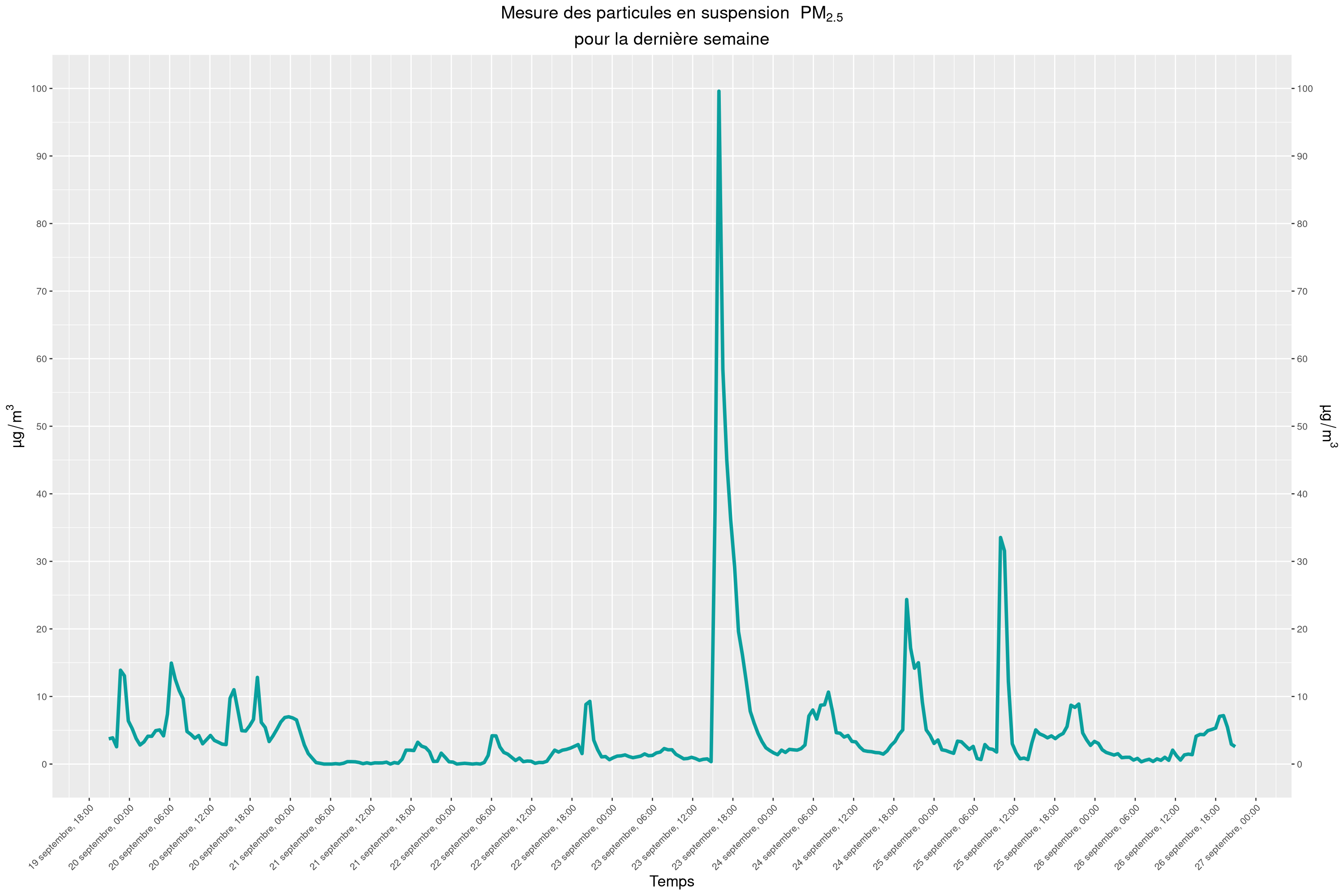
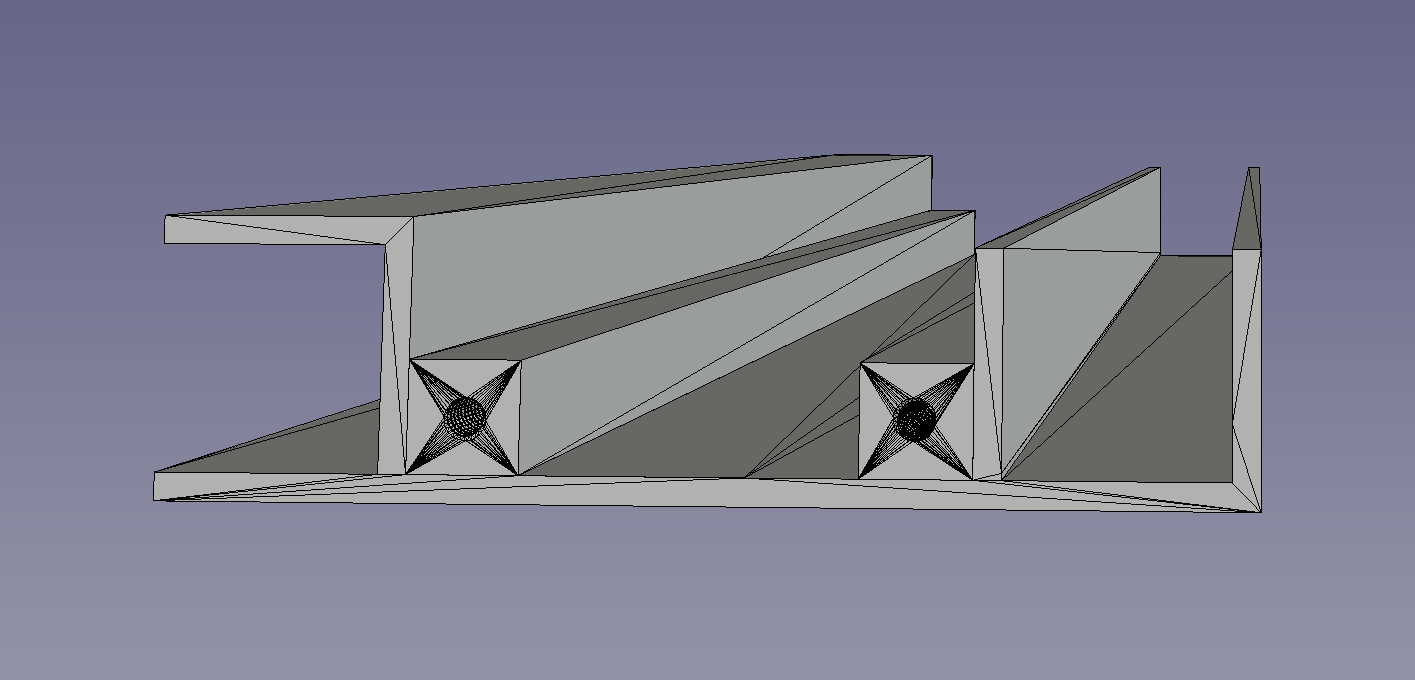
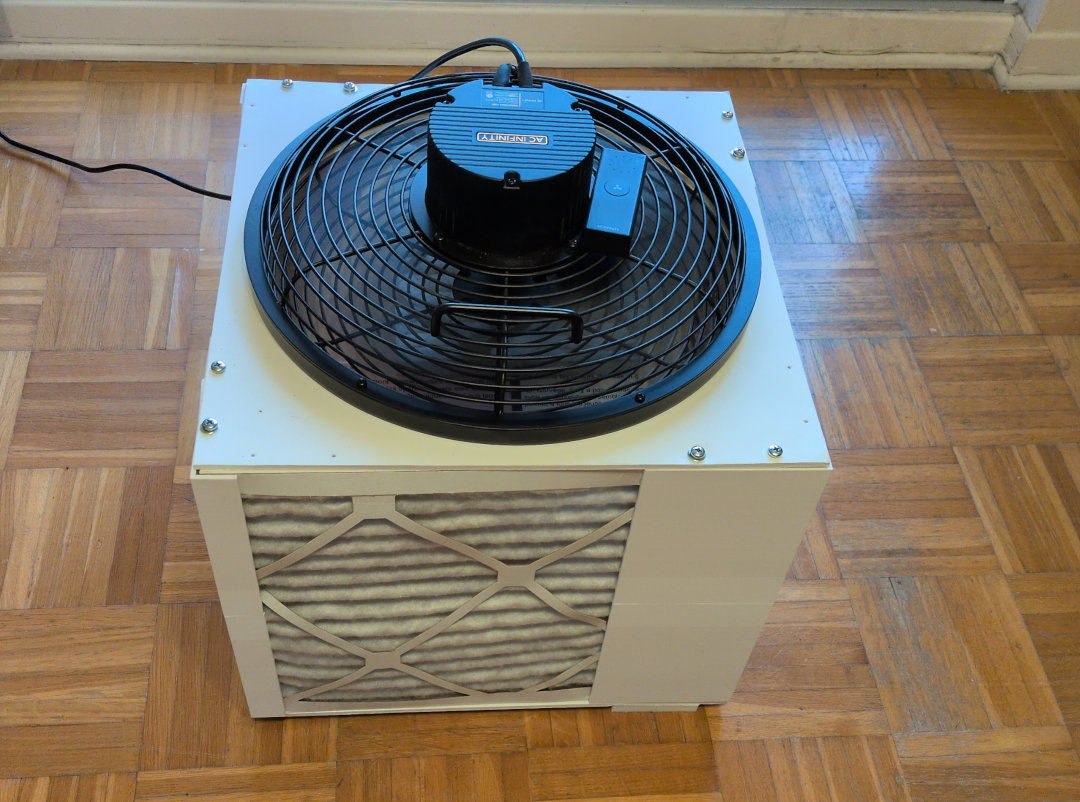
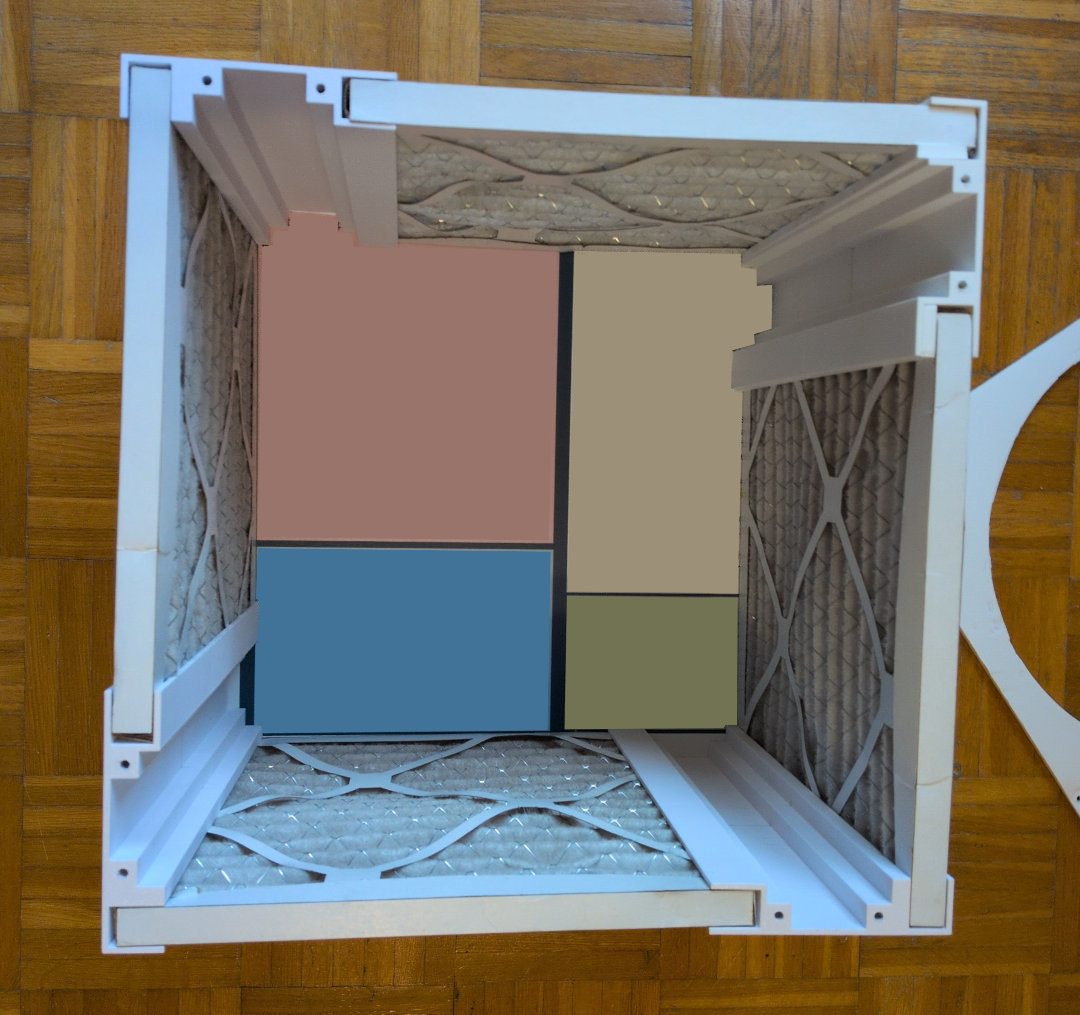
Ever since I built an AirGradient board back in 2023, I have been more and more conscientious about air quality. Pretty instantly after installing the board in my living room, I realised common habits like cooking can significantly increase the particulate levels in my entire apartment. Here is a good example of a pretty large (and long-lasting) PM2.5 spike on September 23rd after cooking a meal1: A graph showing a large PM 2.5 spike Isn't this crazy? Last time Montreal had such bad outdoor air quality, there were public broadcasts telling people not to go outside and to wear N95 face masks if we absolutely needed to. Inside my apartment though, no one ever told me cooking veggies in a little oil on medium-low2 could make the air I breathe unsafe. This of course is aggravated by the fact my apartment is pretty much as airtight as it can reasonably be, since winters here are very cold and air infiltrations are a major heat loss source. As such "opening my windows when I cook" is not a viable solution to this problem half of the year. I first tried solving this issue by tuning my HVAC system. Sadly, its controls don't offer much flexibility3, which means it is not the right tool to respond to short-lived spikes like these. Not only this, but the quality of the air outside is not always good either: Canada now has a forest fire season (we're all doomed) and my neighbors regularly smoke cigarettes right under my HVAC air intake4. A box, but nicer-looking Clearly, the solution to this particular issue was to buy an air purifier. Or at least, that's what a "normal" people would have done. Sadly, these units are expensive, use (expensive) proprietary filters, don't work very well and can be loud. One of the great inventions of the COVID-19 pandemic is the Corsi-Rosenthal box. Popularised in 2020 by Richard Corsi and Jim Rosenthal, the idea is to make a DIY air purifier by using a large fan to force air through cheap and readily available MERV13 air filters. The main downsides of regular CR boxes is they are pretty ugly, can be loud depending on the fan used and need to be rebuilt when the filters are changed (they are held using tape). That's when I stumbled on this amazing design for a silent and sleek CR box sold by The 3D Handyman. Clearly, with a bit of tinkering and a 3D printer, I could also design something sleek, silent and efficient! Since I was already using MERV13 air filters in my HVAC, I decided to design around 4 vertical "beams" where the filters would slot in. With tight enough tolerances, I figured I could get rid of the complex moving parts in The 3D Handyman's design. I also added M5 threads to screw the top and bottom panels and the TPU feet to elevate the box from the floor. One of the 'beams' on its side in FreeCAD The final result looks like this. I used some foamcore boards I had laying around at work for the top and bottom panels, but any somewhat rigid plastic panels (like coroplast) would also work: out' position" alt="The whole CR box assembled, with the fan in the 'in -> out' position"> View from the top, with the top panel removed. Disregard the bad GIMP job to remove the old text from a student's project! I ended up having to split the "beams" in two and joining them with dowels, as even the largest 3D printers I had access to couldn't print them in one piece. Costs Here's the cost breakdown for this project (shipping and taxes are included): Total: 502.19 CAD Yikes, expensive! But: All in all, I'm very happy with this project. Since finishing it, I have been able to consistently get the PM2.5 levels in my apartment down to zero and significantly reduce the time it takes to recover from a spike caused by cooking food. I certainly could have cut the cost of this project in half by choosing a cheaper fan, like the box fans used in the reference Corsi-Rosenthal instructions, but I decided to spend more for a more quiet and reliable option. 3D files Here are the STLs I used for this project. I certainly don't recommend just printing them as-is, since I am using the 12" x 12 " x "5 custom air filters from my HVAC and you should probably use something more standard. If you use these files as inspiration, your goal should be to make a box that is 16" wide, to fit the AC Infinity fan comfortably. I printed the "beams" in PETG at 100% infill and the feet in TPU 95: Future The next step in this project is to automate the fan speed based on the PM2.5 levels in my apartment. At the moment, I manage this manually and it is becoming a chore. This should be relatively easy to do with a Raspberry Pi Pico board, since AC Infinity sells a USB-C to Molex adapter for the fan.

  1. This was with my pretty good range hood running at a reasonable level. Without it, I've seen PM2.5 levels spike as much as 250 from cooking alone.
  2. To be clear, this spike was not the result of me burning the hell out of a piece of meat or something like that.
  3. The HVAC either runs in manual "low high" mode, or on a timed "20min ON 40min OFF" loop that can be tuned by fiddling with a hydrostat knob that triggers the "high" mode. This is pretty dumb and makes it so the HVAC runs even when the apartment is empty or doesn't run enough to keep CO2 levels low when multiple people are there. A future project of mine will be to hack the controls to tie them into my air quality monitoring and trigger the HVAC based on CO2 levels.
  4. I'm also working on another HVAC hack to fix this.
  5. Sold, of course, as as 1" thick filters...

John Goerzen: The Large Project Bias of CVEs

I recently discovered some vulnerabilities in C-Kermit, one dating back to 1984. I tried to do the reasonable thing: create advisories with CVEs. That turns out to be pretty difficult for a small independent project. Large projects have a way to self-assign CVE IDs. They are their own CVE Numbering Authority (CNA). There is a massive list of CNAs. Just looking at the first page of results, I see everyone from Airbus to 9front (the niche Plan 9 OS). The OpenKermit project is not a CNA. If you re a CNA, you can create and publish CVEs on your schedule. There is apparently no external review process. You can wait for months, or publish immediately. If you re not a CNA, you have to find someone that is. The general ones that are CNAs appear to be Github and MITRE. Since C-Kermit is hosted on Github, I thought I would go that route. I followed the documented procedure: created Github security advisories for C-Kermit, then clicked the request CVE button for each. The documentation states they will typically review within 72 hours. It s been a week and a half and no sign of a review yet. Apparently the real review time is more than a month. The other option for projects without a CNA is via MITRE. You have to use a strange and often broken web form, logging in with either Google or Gitlab. (It seems to be broken on Firefox). Then you submit your request and wait. How long do you wait on MITRE? It seems it could be anywhere from a day to several months. The first CVE I obtained for C-Kermit was CVE-2025-68920. At the time, I had not yet started the OpenKermit project. That issue was found and fixed in the context of my work maintaining C-Kermit for Debian, and Debian is a CNA. These were discovered while wearing my upstream C-Kermit maintainer hat. I m sure I could ask Debian for CVEs again, but that seems a bit cheating; not everyone that maintains a FLOSS project will have connections with a distro like I do. There are a lot of components of a modern OS and Internet ecosystem that are small projects without a large institution behind them. This bias towards large organizations when it comes to communicating security problems benefits nobody. It doesn t benefit users, and only serves to discourage timely communication. Not everyone is as persistent as I am, and when it is made so difficult to make announcements which seem to go into a giant black hole it s easy to say, why bother? By Microsoft s own admission, they are under-funding their CVE process on Github (which may also be poorly-designed). They blame it on increasing load due to LLMs a problem they helped create and predicted! Having a fiction about being able to communicate a security issue in a reasonable time is worse than not offering the path at all. Linux was once a student s experiment. Let s not pretend that quality only matters from large projects.

Vasudev Kamath: Experiment: Debian Cloud/VM Images using mkosi

Debian's Cloud Images for various public cloud platforms and VM environments are built using a tool called debian-cloud-images, an in-house utility developed and maintained by the Debian Cloud Team.
What? The debian-cloud-images tooling uses FAI (Fully Automatic Installation) to create custom VM images for public clouds like GCP, Azure, and AWS, along with the genericcloud class. I wanted to convert this into a fully declarative, mkosi-based image build where the entire image is described using INI-format configuration files, with only a few post-installation scripts to handle final customizations.
Why? I've been working with various image customization formats for a long time. In my previous company, I used to build customized industrial PC distributions based purely on Debian using multistrap and a bunch of shell scripts to stitch together raw image creation, bootloader installation, etc. I've also done custom installs using debootstrap on my own laptop with systemd-boot as the bootloader, but that was mostly hand-crafted and not automated. Once I came across mkosi, I was impressed by how a single utility can do everything and churn out a fully usable image without extra glue scripts for partitioning and image creation. You still need a few scripts to finalize some parts of the installation (via postinst hooks), but those are very minimal. So I decided: why not convert debian-cloud-images into mkosi's declarative format with a few architectural changes? My requirements were:
  1. Btrfs as the root filesystem: Partly because I like it, but primarily for the ability to use transparent compression (zstd:1), subvolumes, and snapshots for atomic rollbacks when things go wrong.

  2. systemd-boot and Unified Kernel Images (UKI): Primarily because systemd-boot is clean and minimal exactly what a modern bootloader should be. Combining it with UKIs and UEFI Secure Boot is bliss compared to the complexity of the GRUB2 world. Note: This intentionally drops legacy BIOS (MBR/CSM) partitioning support in favor of pure UEFI. Modern cloud platforms (AWS Nitro, Azure Gen2, GCP) support UEFI natively, and dropping BIOS allows shedding significant legacy bootloader baggage though it does make these images unsuitable for older, non-UEFI hypervisors.

Implementation Of course, the initial heavy lifting was done mostly using Antigravity (agy), along with debugging, tuning, and cleanup from my side. I pointed agy to a local copy of debian-cloud-images and laid out my requirements: preserve parity with the original packages and configurations, while enabling selective builds for each cloud via modular profiles. The resulting specification is documented here. The repository also includes a verification script that audits functional parity against official images produced by debian-cloud-images (verifying packages, APT deb822 sources, and systemd services, while accounting for the switch to Btrfs and systemd-boot). Initial verification was performed for all Trixie profiles, and the parity report is published here. I've also booted the genericcloud profile image under UEFI in a local VM to verify live bootability, bootctl status, network connectivity, and APT repository setup. This completes Phase 1 of the implementation. The remaining phases outlined in the specification include:
  1. Phase 2: Immutable Images with dm-verity: Configure Verity=hash in systemd-repart's 10-root.conf. Enable mkosi auto-signing for the verity root hash and pass the root hash into UKI kernel command lines automatically.
  2. Phase 3: Secure Boot & Signed UKIs: Integrate SecureBoot=yes with custom owner keys or ShimBootloader=signed using Microsoft Third-Party CA signed shim binaries.
  3. Phase 4: System Extensions (systemd-sysext): Decouple cloud vendor agents (AWS CLI, Azure waagent, GCP guest agent) into separate .raw system extensions. Maintain a single unified, signed base OS image across all cloud platforms.
  4. Phase 5: Btrfs Automated Rollbacks: Combine Btrfs @snapshots with systemd-boot snapshot boot entries for fail-safe OS upgrades.
Another advantage of this setup is that the same tooling can build images for physical laptops and bare-metal servers. For example, in an earlier post, I walked through live-booting with debootstrap and manually configuring systemd-boot for a custom UEFI installation. With mkosi, I can simply generate a customized image locally with UKIs ready to go, live-boot the target machine, and write the image directly to the root disk.
Conclusion This experiment is an exploration of the power of mkosi; I haven't discussed adoption with the Debian Cloud Team yet. For now, this will continue as my pet project. While I won't be hosting pre-built binary images, anyone interested is welcome to clone the repository and build the images locally. I will probably take some more time before tackling dm-verity images, as I want to understand the nuances thoroughly before experimenting with them. Until then, happy hacking! Please report any issues or suggestions on GitHub.

Utkarsh Gupta: FOSS Activities in October 2026

Here s my monthly but brief update about the activities I ve done in the FOSS world.

Debian
Whilst I didn t have much time, here are still a few things that I worked on:
  • Sponsored ubuntu-dev-tools/0.215 for Florent Skia Jacquet, so that seeded-in-ubuntu no longer crashes when distro-info-data is outdated.
  • Assisted a few folks in getting their patches submitted via Salsa.
  • Mentoring for newcomers.
  • Moderation of -project mailing list.

Ubuntu
I joined Canonical to work on Ubuntu full-time back in February 2021.
  • Released Ubuntu 26.10 (Stonking Stingray)! With my Release team hat on, I:
  • Approved the FFe for adsys 0.17.0, as it isn t seeded.
  • Sponsored libp11/0.4.12-1.1ubuntu2 for Guruprasad, an SRU to Noble which drops the workaround from the previous SRU that broke EAP-TLS Wi-Fi with TPM-backed PKCS#11 keys (LP: #2163152).
  • Proposed a fix for net-tools FTBFS in stonking - Linux 7.1 removed the amateur radio subsystem along with <linux/rose.h>, so ROSE support has to go: (MP).
  • Reviewed quite a lot of MPs and PRs - britney hints, ubuntu-cdimage, livecd-rootfs, ubuntu-seeds, ubuntu-dev-tools, a bunch of 26.10 release notes, and so on.
  • Did Archive Admin, DMB, and Release team duties as usual.

Debian (E)LTS
This month I have worked 3.50 hours on Debian Long Term Support (LTS) and on its sister Extended LTS project and did the following things:

Work in Progress
  • libpng1.6: Use-after-free of zlib input in png_read_end() after incomplete zTXt, iTXt, or iCCP decompression (CVE-2026-46675).
    • [ELTS]: The patch is ready but couldn t finish testing this month. The upstream fix that went into bookworm via DLA 4824-1 applies to all three ELTS suites as-is. Will roll out the fix in November.

Other Activities
  • [E/LTS] Monitored discussions on mailing lists, IRC, and all the documentation updates.
  • [E/LTS] Couldn t make it to the monthly LTS meeting live, but left my thoughts in the meeting notes on Beuc s proposal of offering help to the Release team with reviewing security SPUs - +1 for trying, as long as the Release team is on board with it and we don t end up doing the same work twice.

Until next time.
:wq for today.

9 November 2026

Amin Bandali: EmacsConf 2026 community panel - my comments

This is a recollection of my comments from the EmacsConf 2026 community panel recording session this past weekend, where the panellists took turns answering the proposed questions, one minute per question per panellist. In addition to the live Q&A session planned for Saturday 12 December 2026 during EmacsConf 2026, all Emacs users and community members are invited to share their thoughts on the panel questions or other questions before or after the conference. https://emacsconf.org/2026/talks/community/
1. What made you start using Emacs, and what kept you using it?
I started using Emacs during my bachelor's studies. I actually learned about Vim first and was a Vim user, but I'd always found the configuration language (VimScript) a little bit clunky. Not long after, I discovered Emacs, and really loved reading and writing Emacs Lisp, so I stuck around. In addition to reading and writing Elisp being fun and enjoyable for me, I love that Emacs has been a practical embodiment of software freedom, and I'm really fond of its surrounding culture of sharing freely. There's a lot to love and appreciate about Emacs, but as a practical personal example, I've been grateful for its excellent support for bidirectional text editing. It has empowered me to read and write in Persian, my mother tongue, with ease. (Persian has a right-to-left alphabet, like Arabic and Hebrew.)
2. What took you from using Emacs to actively contributing to the community - participating in forums, writing Elisp, organizing meetups, answering questions?
As I continued experimenting and writing bits and pieces of Elisp to scratch my own itches, I felt compelled to share them freely as a way of giving back to the community that gave me so much. For me, the community and the people that make it up are the main deal. Emacs wouldn't be where it is and what it is today without its people, so besides programming contributions, I've tried to contribute in that area as well, for instance by reviving EmacsConf with Sacha Chua back in 2019.
3. How does Emacs show up for you in real life - colleagues, meetups, friends? How did those connections form?
I don't physically have people near me who use Emacs, but I've connected with many folks in our online communities, often starting with an email or IRC message. Some of those relationships started as acquaintanceship and were developed into true friendship over time, and I'm grateful to have had those friends with me.
4. If you know other software communities, what's one thing Emacs could learn from them?
I would encourage Emacs, our community, to focus on the people. We're living in particularly difficult times, with various kinds of hardships and uncertainty in our lives. Let's strive to treat each other with kindness, empathy, and mindfulness as we continue working together. There are great examples of other free software communities whose members have banded together and are strengthening each other and their community, as well as cautionary ones where community members have been tiring and driving out their fellow members. We could learn valuable lessons from both in how to take care of our people and ourselves.
5. What's one concrete thing you wish existed in the Emacs community a year from now?
I echoed the sentiments of my fellow panellists Prot and Til about doing more of the same in terms of continuing to uphold the standards of excellence and perseverance. Also, drawing inspiration from what bashbunni said, to lower the barriers of entry for people, for example through organizing different kinds of events, and experimenting with ways to make people's lengthy, elaborate Emacs configurations more tangible and accessible to others, to share various workflows and demonstrate what's possible with Emacs. I look forward to your thoughts on these and other community-related questions. Take care, and so long for now.

Vincent Bernat: Performance evolution of route lookup on Linux

In previous articles, I explained how the Linux kernel implements IPv4 and IPv6 routing tables, and I showed the performance improvement of route lookups from Linux 2.6.32 to 4.16 for IPv4 including the impact of the Meltdown and Spectre mitigations as well as from Linux 2.6.39 to 4.18 for IPv6. This article updates the numbers through Linux 7.3 and investigates the perpetrator responsible for the performance regressions! I ran the following benchmarks on an AMD EPYC 8024P, a Zen 4c CPU, rented from Scaleway, running at 2.4 GHz with CPU boost disabled. I compiled the kernels with GCC 10.2: this version can compile older kernels as well as the current ones.

IPv6
Performance evolution of IPv6 route lookups from Linux 4.14 to 7.3
Performance evolution of IPv6 route lookups. Versions with an asterisk have SRSO mitigation disabled.
I tested four scenarios:
  • a recent full view with about 260,000 prefixes,
  • a full view from 2017 with about 40,000 prefixes,
  • a set of 40,000 /48 prefixes, such that 2 lookups out of 3 match, and
  • a set of 40,000 random /128 prefixes, such that 1 lookup out of 400 matches.
In Linux 4.15, Wei Wang improved the lookup performance by replacing the read-write lock with an RCU and a spinlock in commit 66f5d6ce53e6. In Linux 4.18, David Ahern improved the data structures used by route lookup. In Linux 5.9, Brian Vazquez removed expensive indirect calls in commit 55cced4f813b. The major 200 ns regression introduced in Linux 6.5 wiped out all these improvements. This version implements a mitigation for "Speculative Return Stack Overflow," a vulnerability affecting AMD processors, in commit fb3bd914b3ec. This mitigation adds about 20 cycles on each function return. It was backported to older kernels (5.10, 5.15, 6.1, and 6.4). To keep the results legible, I disabled the mitigation for these versions with spec_rstack_overflow=off on the kernel command-line. You can check the vulnerabilities impacting your CPU and their mitigations with lscpu. Some mitigations may depend on the microcode or on the firmware.1
$ lscpu   grep '^Vuln'
Vulnerability Gather data sampling:      Not affected
Vulnerability Indirect target selection: Not affected
Vulnerability Itlb multihit:             Not affected
Vulnerability L1tf:                      Not affected
Vulnerability Mds:                       Not affected
Vulnerability Meltdown:                  Not affected
Vulnerability Mmio stale data:           Not affected
Vulnerability Reg file data sampling:    Not affected
Vulnerability Retbleed:                  Not affected
Vulnerability Spec rstack overflow:      Mitigation; Safe RET
Vulnerability Spec store bypass:         Mitigation; Speculative Store Bypass disabled via prctl
Vulnerability Spectre v1:                Mitigation; usercopy/swapgs barriers and __user pointer sanitization
Vulnerability Spectre v2:                Mitigation; Retpolines; IBPB conditional; IBRS_FW; STIBP always-on; RSB filling; PBRSB-eIBRS Not affected; BHI Not affected
Vulnerability Srbds:                     Not affected
Vulnerability Tsa:                       Vulnerable: Clear CPU buffers attempted, no microcode
Vulnerability Tsx async abort:           Not affected
Vulnerability Vmscape:                   Mitigation; IBPB before exit to userspace

IPv4
Performance evolution of IPv4 route lookups from Linux 4.14 to 7.3
Performance evolution of IPv4 route lookups. Versions with an asterisk have SRSO mitigation disabled.
I tested three scenarios:
  • a recent full view with more than 1,000,000 prefixes,
  • a subset of a full view from 2017 with 500,000 prefixes, and
  • a set of 500,000 contiguous /32 prefixes.
The 30 ns impact of the mitigation for SRSO in Linux 6.5 is smaller than for IPv6 because IPv4 route lookups traverse fewer functions: around 4 function calls for IPv4 compared to 25 for IPv6. In Linux 5.11, I introduced a regression in commit c0c5a60f0f13 after fixing the behavior of net.ipv4.conf.all.ignore_routes_with_linkdown!2 As a result, the ip_ignore_linkdown() function spends around 5 additional cycles to return a result as it needs to follow three additional pointers. fib_lookup() eventually calls it in the following code:
if (ip_ignore_linkdown(nhc->nhc_dev) &&
    nhc->nhc_flags & RTNH_F_LINKDOWN &&
    !(fib_flags & FIB_LOOKUP_IGNORE_LINKSTATE))
    return false;
If we reorder the conditions, we avoid calling ip_ignore_linkdown() for the most common case where the link isn't down:
if (nhc->nhc_flags & RTNH_F_LINKDOWN &&
    !(fib_flags & FIB_LOOKUP_IGNORE_LINKSTATE) &&
    ip_ignore_linkdown(nhc->nhc_dev))
    return false;
Here's the distribution of lookup times before applying the patch on top of net-next:3
min=128 max=4657 count=994104 95th=134 90th=133 50th=132 mad=0
    value                                                        count
      128                                                          120
      129                                                         2232
      130                                                       25224
      131                                         264264
      132               516480
      133        126864
      134        21624
The lighter shade depicts the cumulative distribution function. After applying the patch, the median improved from 132 to 126 cycles:4
min=124 max=208839 count=994104 95th=128 90th=127 50th=126 mad=0
    value                                                        count
      124                                                          576
      125                                                      49440
      126                        584904
      127         284592
      128        45288

Impact of mitigations To reduce the impact of mitigations, you can disable all of them with mitigations=off, disable only a specific one like with spec_rstack_overflow=off, or protect against only some attack vectors with mitigations=auto,no_user_kernel, starting from Linux 6.17. The impact is also quite different depending on the CPU. For example, on a Xeon W-2295, an Intel desktop CPU from 2020, the impact of the mitigations is only a few cycles for IPv4, and less than 3% for IPv6. The main contributor is the mitigation for the Indirect Target Selection vulnerability, which is fixed since the Sapphire Rapids architecture.
If we set aside the regressions introduced by the mitigations against CPU attacks, the performance of IPv4 is declining slowly over time while IPv6 has improved in the past and is currently stable. If routing performance is important, you have several options: choose a different CPU like an AMD Zen 5 CPU, a fourth generation Xeon CPU, or maybe an ARM Neoverse V2; disable some or all the mitigations; bypass routing with XDP/eBPF;5 or offload routing to the network card.

Note Maytham Alsudany reviewed a first draft of this article. Any errors are still mine!


  1. The microcode was out of date on my machine as I forgot to install the amd64-microcode package. As it only impacts TSA, our benchmark is unaffected. Spectre v2 mitigation did not enable automatic IBRS, because of SEV-SNP being enabled in the firmware. With automatic IBRS, the impact of SRSO should be smaller.
  2. Despite ipvX in its title, the commit only changes the behavior of the IPv4 code. The IPv6 version overwrites the value of each device in addrconf_fixup_linkdown().
  3. Linux 7.5 will be the first stable release including this fix.
  4. At 2.4 GHz, one cycle is about 0.42 ns.
  5. This requires avoiding bpf_fib_lookup(), which relies on the same kernel lookup.

Next.