Search Results: "tg"

17 November 2026

Dirk Eddelbuettel: littler 0.3.24 on CRAN: Two new scripts

max-heap image The twentyfifth release of littler as a CRAN package landed on CRAN today, following in the now twenty-one year history (!!) as a (initially non-CRAN) package started by Jeff in 2006, and joined by me just a little later. littler is the first command-line interface for R as it predates Rscript. It allows for piping as well for shebang scripting via #!, uses command-line arguments more consistently and still starts faster. It also always loaded the methods package which Rscript only began to do in later years. littler lives on Linux and Unix, has its difficulties on macOS due to some-braindeadedness there (who ever thought case-insensitive filesystems as a default were a good idea?) and simply does not exist on Windows (yet the build system could be extended see RInside for an existence proof, and volunteers are welcome!). See the FAQ vignette on how to add it to your PATH. A few examples are highlighted at the Github repo:, as well as in the examples vignette. This release, the third this year, adds two new example scripts I already use a lot, reflects the updated build mechanism of the documentation website, and carries some small fixes and maintenance. The full change description follows.

Changes in littler version 0.3.24 (2026-11-17)
  • Changes in examples scripts
    • New script trox.r wrapping tinyrox
    • New script checktor.r wrapping checktor
    • Small edits and tweaks to two existing scripts
  • Changes in package
    • Continuous intgegration scripts received minor updates
    • Documentation website has been redone using altdoc as the driver of the 'material for mkdocs' framework used

My CRANberries service provides a comparison to the previous release. Full details for the littler release are provided as usual at the ChangeLog page, and also on the package docs website. The code is available via the GitHub repo, from tarballs and now of course also from its CRAN page and via install.packages("littler"). Binary packages are available directly in Debian as well as (in a day or two) Ubuntu binaries at CRAN thanks to the tireless Michael Rutter. Comments and suggestions are welcome at the GitHub repo.

This post by Dirk Eddelbuettel originated on his Thinking inside the box blog. If you like this or other open-source work I do, you can sponsor me at GitHub.

16 November 2026

Russell Coker: After the AI Bust

The Crash Charles Stross wrote an interesting blog post about the latest developments in the AI bubble [1]. He predicts the imminent burst of the AI bubble because of Jensen Huang s out of control dick. The bubble was caused by out of control dicks (figuratively speaking) and now may be burst by an out of control dick (both literally and figuratively speaking). The end result of the AI related financial schemes is going to involve more than a few bankruptcies. The Rebuild I previously blogged about the fuss about AI [2] and concluded that the bust would be like the dot-com bust which paved the way for new profitable Internet developments. I am less positive towards the AI bubble now as it has gone a lot further than the dot-com bubble. The bankruptcies won t just affect the IT industry, a lot of money from pension funds and index tracker funds has gone into AI and the pain will be spread around. But I am confident that after the crash there will be new and interesting developments in Machine Learning (ML) technology that will benefit people. The Data Centers (DCs) that have been built at great expense will continue to be run and their services will for a while be offered at slightly above the cost of maintenance and power. A lot of home users (Free Software developers) who can t afford a GPU with 16G of RAM will find themselves able to rent time on systems with 48G or 96G of GPU compute to experiment with LLMs. Most such experiments won t achieve any useful output, but if someone can spend a few dollars and learn useful things about software engineering then that s a win for society. Also I think there will be some useful products developed as a result of this. The people who came of age when Linux was first released are now in their 50s and tend to have the reduction in vision and hearing expected in that age range so we can hope for some good developments in assistive technologies based on the cheap hardware. The current situation is that renting time on ML servers is cheap and often free while renting time on virtual servers with GPU access is expensive ($2 per hour for a not particularly high end VM) so people are learning how to use (or misuse) services like ChatGPT and not learning how to run their own LLM service and understand how it works. The future situation will involve renting VMs available for not much more than the cost of electricity at off-peak times and services like ChatGPT will need to have an operational profit so running your own LLM on rented hardware or hardware you own will be a better option. While corporate web sites are known for having rubbish chatbots using proprietary backend systems. While most of them suck badly and the idea of using them to replace staff is a really bad one the concept could work. If we increased the knowledge of such technology in the entire industry and if management was prepared to pay for it via increased budget for service improvements instead of trying to cut staff costs then it could give a good result. Other Computer Hardware The market for RAM for enterprise GPUs has been strong which reduced supply for consumer grade hardware. This caused prices to become unreasonably high. There s a general trend of software becoming bigger. Computers get bigger screens so media sources need higher resolution content which drives the demand for more storage and RAM for buffering things. Computers get more hardware features and more devices to connect to so all the software needs to be able to communicate with them. This makes the software bigger for everyone even people who aren t using the features. For example adapting the audio subsystem to deal with different Bluetooth devices with options for different encodings increases the memory requirements for all the computers that have audio hardware but don t have Bluetooth hardware. Perfectly reasonable decisions that make things work better for many people can have downsides for other people. RAM is one area that seems to have been repeatedly the subject of design trade-offs that resulted in systems with 16G of RAM performing the same tasks that systems with 16M of RAM did in the mid 90s but just at a higher resolution and with more features. The ongoing increase of RAM use by software combined with high prices caused by the AI companies has been bad for consumers. The PC RAM use issue isn t going to end. When I started editing the Debian Wiki page about Mobile Apps [3] I added a field for typical RSS of apps. Phones never have an option to increase RAM and the RAM is always limited. The largest RAM in commonly available phones in English speaking countries is 16G for the Pixel 11 Pro and the largest RAM for open Linux phones is 8G. When even relatively simple apps like an eBook reader take 500M of RAM it s obvious that 8G isn t enough. The phone and laptop design process is based on a cycle of about one year, so maybe 8 months after the AI crash we will see ultralight laptops with 64G of soldered RAM and phones like the Pixel 12 Pro with 32G of RAM. Looking at Officeworks (the chain store for cheap office supplies including laptops) the vast majority on sale currently have 16G or less and 16G of RAM performs really badly for Windows and has performance problems for heavy use on Linux. It would be nice if the minimum RAM for a laptop was 16G and it was a common and affordable option to have 32G or more and that is a likely result of the AI crash. Single Board Computers (SBCs) are currently expensive with reasonable amounts of RAM, when RAM prices drop significantly it will enable more uses of them for replacing desktop PCs and for developing other products. The Humane AI Pin [4] was an interesting research project but a poorly managed product, it would be interesting to have some free software research into that space and cheap SBCs with lots of RAM will facilitate it. Employment I expect that a lot of IT people will be looking for work in California soon. But for most of the world I don t think it will change much. Cheaper hardware decreases the cost of starting IT businesses but a market crash decreases confidence in investing in the sector. Maybe there will be an increase in startups and small companies, including small companies based around LLM operation. I don t expect any sort of catastrophic decrease in IT employment. Also a CEO sleeping with employees at his company creates a bad working environment, that sort of thing should be stopped. Sacking a CEO for such misbehaviour is a good thing even without all the financial fraud and possibly breaking laws about exports. Conclusion The sooner the crash happens the better things will be for everyone. As this bubble goes on the impending financial damage increases and the upsides of the crash are delayed.

13 November 2026

Freexian Collaborators: Debian Contributions: Python 3.15 transition, OpenSSH GSS-API package split improvements and more! (by Anupa Ann Joseph)

Debian Contributions: 2026-10 Contributing to Debian is part of Freexian s mission. This article covers the latest achievements of Freexian and their collaborators. All of this is made possible by organizations subscribing to our Long Term Support contracts and consulting services.

Python 3.15 transition, by Stefano Rivera with a little help from Colin Watson Debian has started the transition to add Python 3.15 as a supported version alongside 3.14, which is still the default version. Stefano uploaded Python 3.15.0 final to unstable. Maximiliano Curia has been test-rebuilding the archive in Debusine with Python 3.15 as a supported version and prepared some patches to dh-python to smooth over some common failure points. Stefano reviewed these MRs, applying some and implementing alternative approaches for some of the issues. Debian only has multiple supported Python versions during the transition to a new version, and typically this shows up some bugs in packages. This time was no different, the common failure was many packages that installed intermediate build artifacts into the Python module tree. Some of these artifacts would differ between Python versions. We decided to detect both of these and fail the package build, rather than silently ship garbage in the binary packages. Colin helped to fix quite a bit of the build fallout from this.

OpenSSH GSS-API package split improvements, by Colin Watson The recent GSS-API package split has largely gone relatively smoothly, but there was a subtle problem for people switching from one variant to the other: installing the replacement packages followed by purging the old one would cause some configuration files to disappear. Colin fixed this, and also reviewed and merged some autopkgtest contributions from Andreas Hasenack to make sure that this doesn t regress in future.

Miscellaneous contributions
  • Carles, using check-relations, investigated and reported 52 bugs for packages which have Recommended packages that are not available in Debian anymore. Followed up bugs on the topic.
  • Carles added support to check-relations to detect Recommends that recommend a transitional package.
  • Carles submitted merge requests (MR89, MR90, MR91, MR92) to the Debian developers-reference to remove or update references to packages that are not available anymore, have their name changed, have typos, etc.
  • Carles investigated and opened bugs regarding notifications on LXDE (#1151954, #1151955) and added a section related to notifications on the Wiki.
  • Carles uploaded new python-ping3 upstream version. Fixed simplemonitor lintian bugs. Carles also investigated python-librosa documentation building. started preparing a new python-firebase-messaging version.
  • Helmut released asyncvarlink/0.3.3 to fix several bugs including connection robustness fixes by Alex Kiernan. Colin uploaded it to Debian.
  • Helmut uploaded guess-concurrency to improve behavior on riscv64 by taking swap into account thanks to Adrian Bunk and Aurelien Jarno.
  • Helmut sent patches for 55 cross build failures.
  • Emilio updated some X11 libraries that fixed security vulnerabilities.
  • Emilio managed various transitions.
  • Rapha l updated gnome-shell-extension-hamster to work with GNOME 51 that was uploaded to Debian unstable.
  • Stefano backported postsrsd 2.4.1 to Debian trixie.
  • Stefano installed security updates on debian.social infrastructure.
  • October saw a series of security releases for Python, due to the eMudhra key compromise incident. Stefano uploaded cPython 3.15.2, 3.14.10, and 3.13.18 which include blocks for the compromised intermediate CAs.
  • Stefano reviewed CVEs fixed in recent cPython releases.
  • Stefano spun up a VM for dragon.debian.net.
  • Stefano uploaded PyPy3 8.0.1 to unstable.
  • Stefano reviewed some of the wafer-debconf MRs that came in as part of Antonio s Outreachy project.
  • Stefano uploaded python-authlib, with many security updates. And started preparing a stable update with backports of these patches.
  • Stefano looked at the latest upstream version of munkres and submitted some 32-bit test failure fixes upstream. A new upstream maintainer has been very busy building out accelerated versions of the algorithms with AI assistance.
  • Thorsten was finally able to fix the autopkgtest of cups. Afterwards he uploaded the latest version of cups to unstable.
  • Santiago proposed a merge request for the Salsa CI pipeline to fix how logs were stored in the piuparts job.
  • Lucas reviewed and merged community contributions to Ruby 3.4 in Debian unstable.
  • Lucas coordinated with the security team and fixed multiple CVEs reported against Ruby 3.3 in Debian stable.
  • Colin did quite a bit of work on the Python 3.15 transition, fixing lots of build and test fallout.
  • Colin upgraded python-maturin from 1.9.4 to 1.16.0, helping with several Rust transitions; this involved more or less completely reworking our patch stack.
  • Colin improved the packaging of the Frescobaldi frontend to LilyPond to help with his amateur music typesetting work, fixing its missing desktop entry, icon, and translations based on a patch set by Joachim Wiedorn.
  • Anupa joined the Publicity team meeting to discuss upcoming events and activities of the Debian Publicity Team including on-boarding meeting for new contributors.
  • Antonio spent quite some time welcoming Outreachy applicants to the DebConf/MiniDebConf websites project, replying to questions, reviewing contributions, etc. One of them will be selected for an internship that will start in December.
  • Antonio spent some time investigating problems with Salsa background job processing, leading to an upstream bug report.
  • Antonio released debci 4.4.

11 November 2026

Colin Watson: Free software activity in October 2026

My Debian contributions this month were all sponsored by Freexian. You can also support my work directly via Liberapay or GitHub Sponsors. OpenSSH I upgraded both openssh and openssh-gssapi from 10.5p1 to 10.6p1, started generating MLDSA44-ED25519 host keys by default now that upstream no longer considers them experimental, and fixed a problem where switching between the normal and GSS-API variants followed by purging the old packages caused some configuration files to disappear. Python packaging New upstream versions: Other build/test failures: Since lots of Python modules use Rust extensions nowadays, we often have to help with upgrades of Rust packages. I did some of this: Other bugs: One of my hobbies is typesetting ( engraving ) music, sometimes for my own use, sometimes for teaching, and sometimes for my choir. I ve used LilyPond for a long time and have got pretty used to it. My workflow was a bit cumbersome, though, usually involving side-by-side editor and PDF viewer windows with some ad-hoc Makefiles and editor macros. I recently discovered the Frescobaldi frontend to LilyPond, and decided I liked it enough to switch over to it. It was already packaged in Debian, but it had a missing desktop entry and icon and missing translations; I fixed those based on a patch set by Joachim Wiedorn. My upload introduced a testing migration problem, which I also fixed. Rust packaging I upgraded rust-jiter and rust-smallvec to new upstream versions for a new version of pydantic-core. The rust-smallvec upgrade caused an FTBFS in rust-saphyr-parser-bw, which I fixed. I packaged rust-cargo-cyclonedx for a new version of python-maturin. This needed some porting to work with a new version of rust-cargo-metadata, which I contributed upstream. I improved the dev/list-rdeps.sh tool used by the Rust team to check build-depends too, which should make it easier for that team to remember Python packages in transitions. Code reviews

10 November 2026

Louis-Philippe V ronneau: A good-looking Corsi-Rosenthal Box

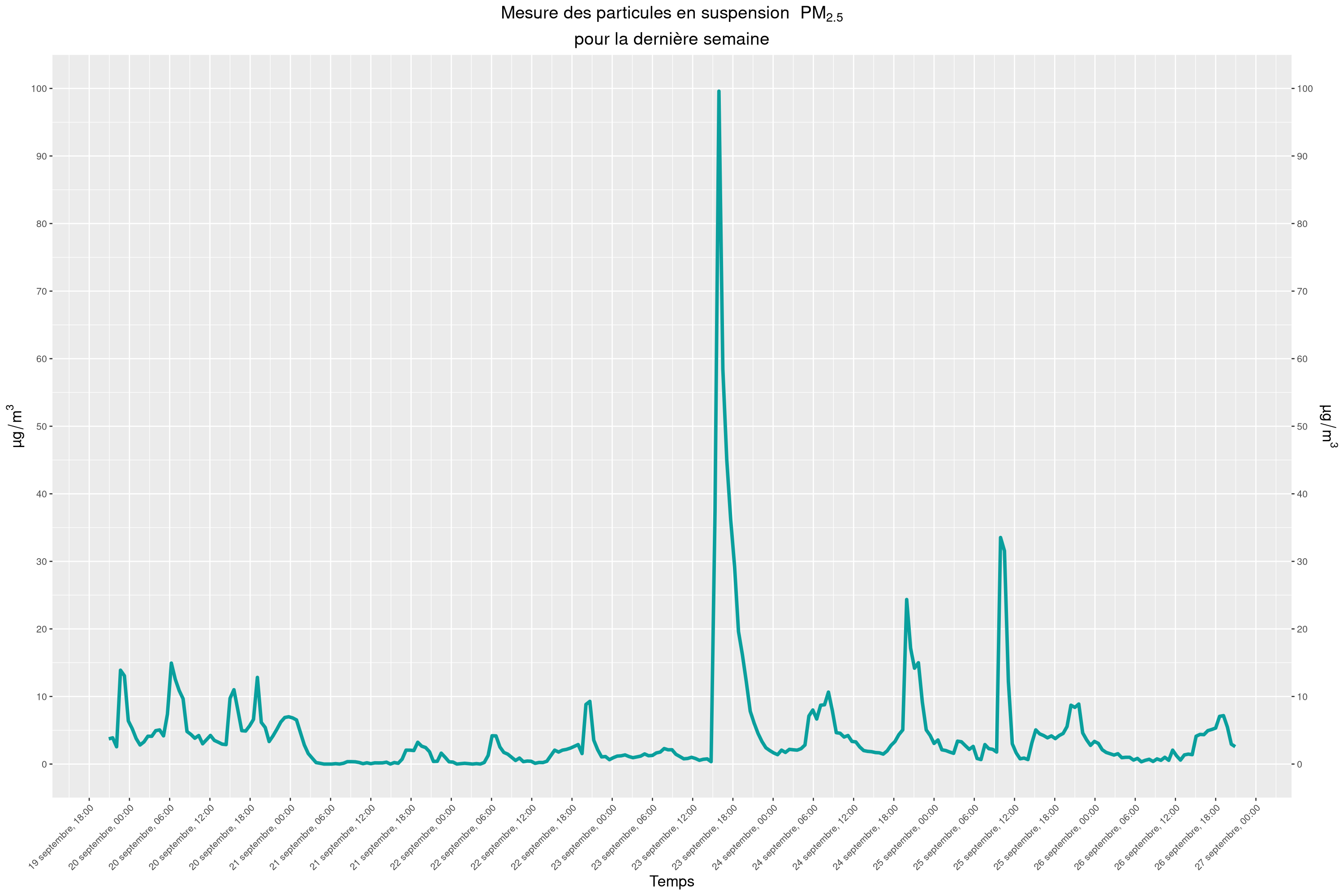
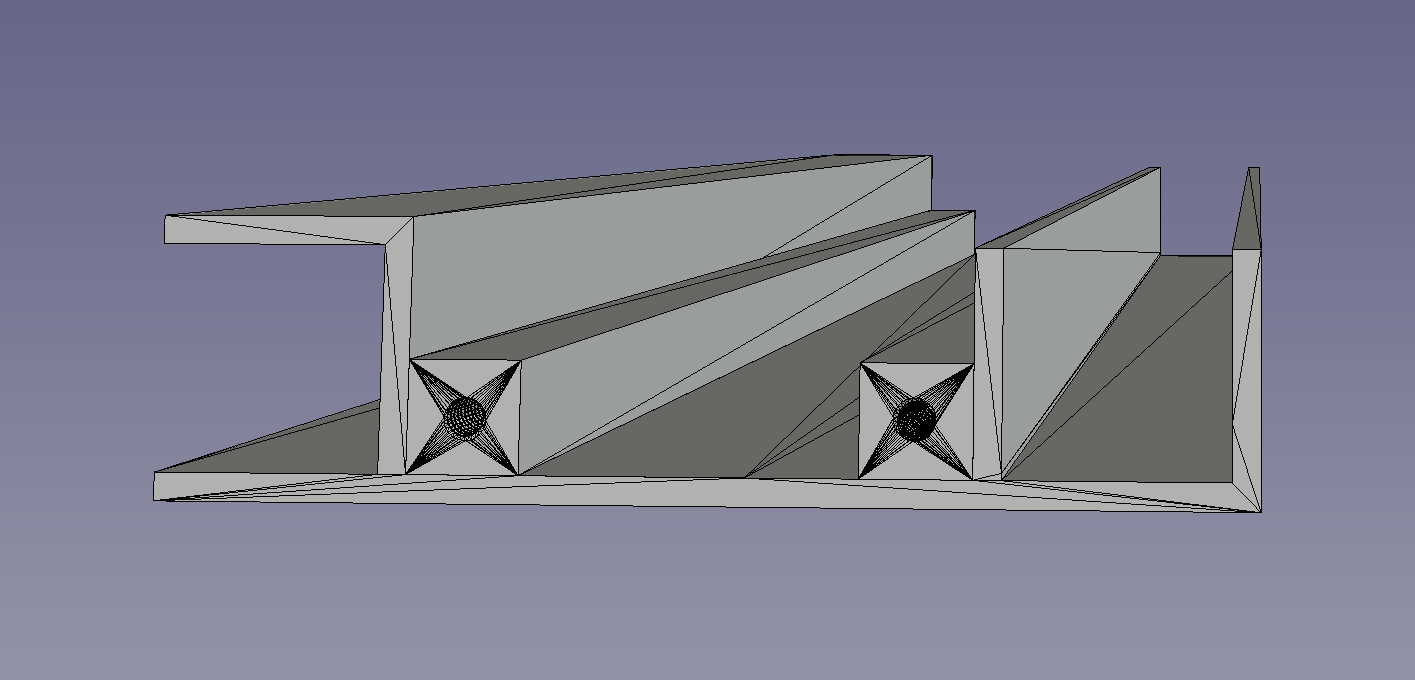
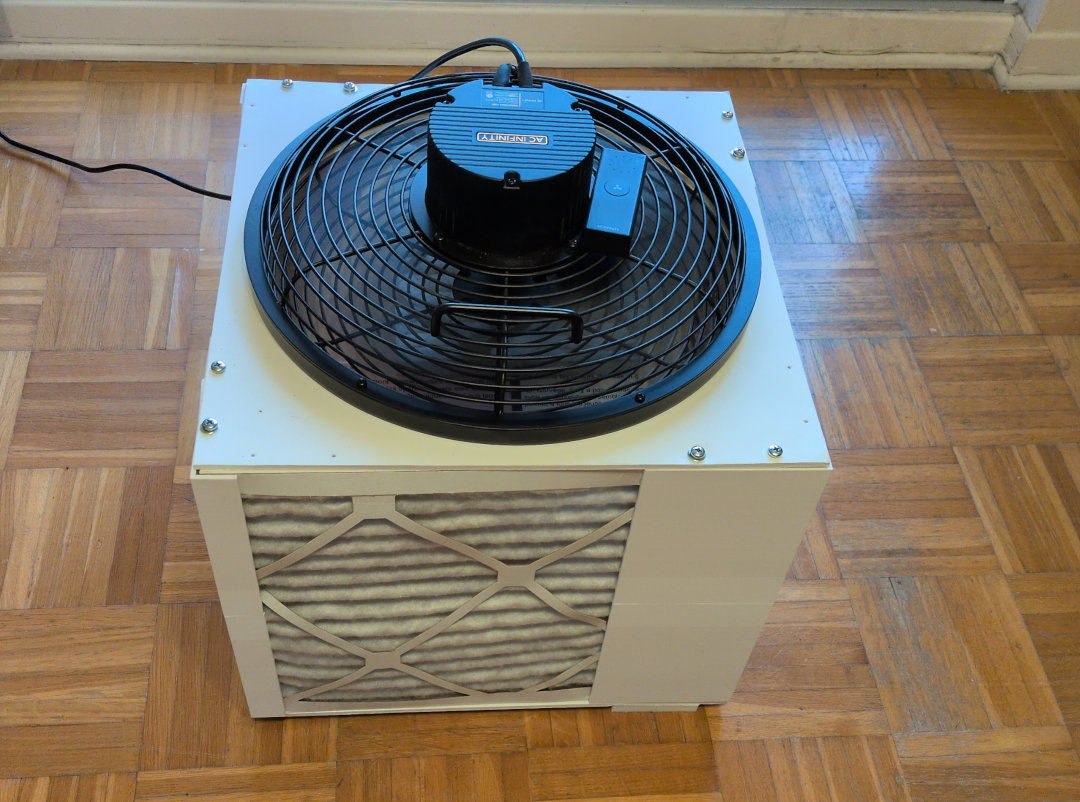
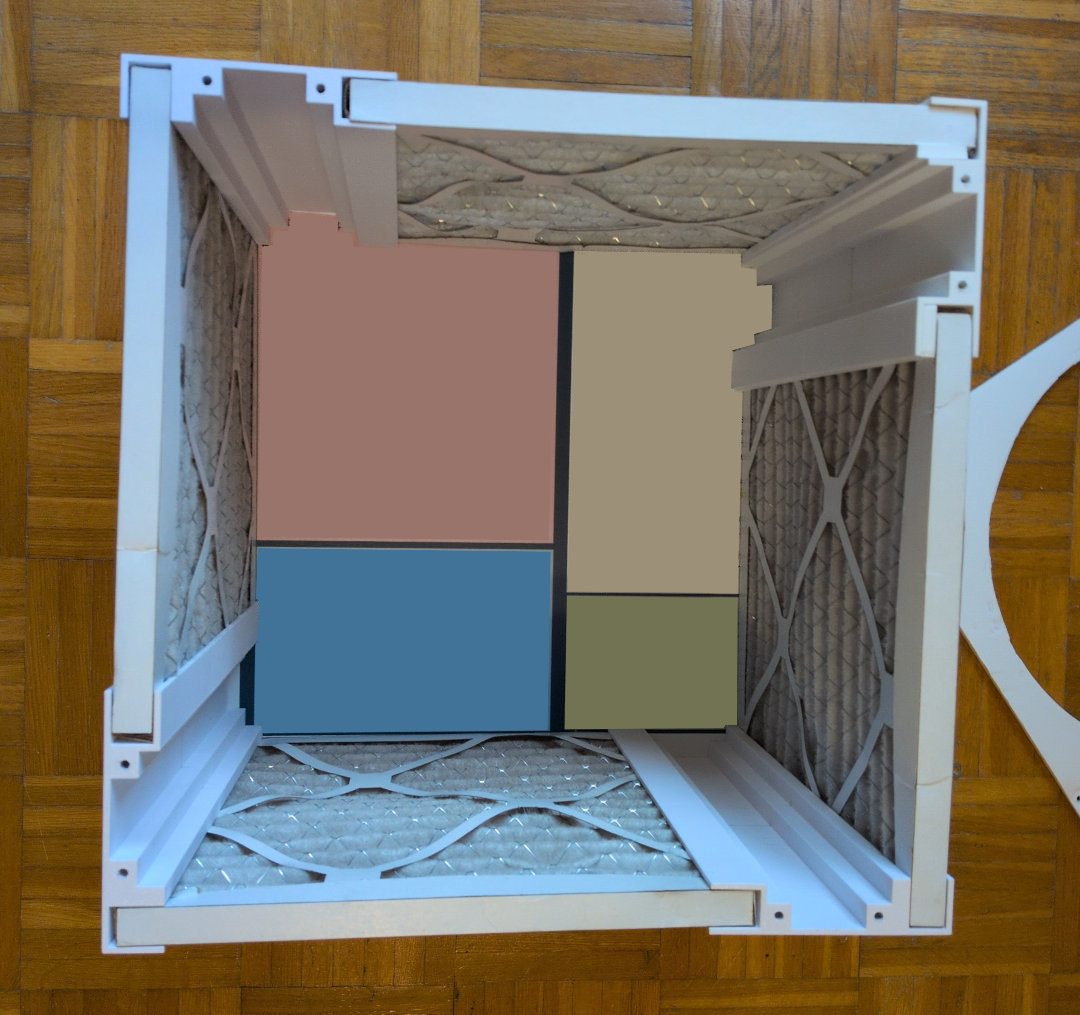
Ever since I built an AirGradient board back in 2023, I have been more and more conscientious about air quality. Pretty instantly after installing the board in my living room, I realised common habits like cooking can significantly increase the particulate levels in my entire apartment. Here is a good example of a pretty large (and long-lasting) PM2.5 spike on September 23rd after cooking a meal1: A graph showing a large PM 2.5 spike Isn't this crazy? Last time Montreal had such bad outdoor air quality, there were public broadcasts telling people not to go outside and to wear N95 face masks if we absolutely needed to. Inside my apartment though, no one ever told me cooking veggies in a little oil on medium-low2 could make the air I breathe unsafe. This of course is aggravated by the fact my apartment is pretty much as airtight as it can reasonably be, since winters here are very cold and air infiltrations are a major heat loss source. As such "opening my windows when I cook" is not a viable solution to this problem half of the year. I first tried solving this issue by tuning my HVAC system. Sadly, its controls don't offer much flexibility3, which means it is not the right tool to respond to short-lived spikes like these. Not only this, but the quality of the air outside is not always good either: Canada now has a forest fire season (we're all doomed) and my neighbors regularly smoke cigarettes right under my HVAC air intake4. A box, but nicer-looking Clearly, the solution to this particular issue was to buy an air purifier. Or at least, that's what a "normal" people would have done. Sadly, these units are expensive, use (expensive) proprietary filters, don't work very well and can be loud. One of the great inventions of the COVID-19 pandemic is the Corsi-Rosenthal box. Popularised in 2020 by Richard Corsi and Jim Rosenthal, the idea is to make a DIY air purifier by using a large fan to force air through cheap and readily available MERV13 air filters. The main downsides of regular CR boxes is they are pretty ugly, can be loud depending on the fan used and need to be rebuilt when the filters are changed (they are held using tape). That's when I stumbled on this amazing design for a silent and sleek CR box sold by The 3D Handyman. Clearly, with a bit of tinkering and a 3D printer, I could also design something sleek, silent and efficient! Since I was already using MERV13 air filters in my HVAC, I decided to design around 4 vertical "beams" where the filters would slot in. With tight enough tolerances, I figured I could get rid of the complex moving parts in The 3D Handyman's design. I also added M5 threads to screw the top and bottom panels and the TPU feet to elevate the box from the floor. One of the 'beams' on its side in FreeCAD The final result looks like this. I used some foamcore boards I had laying around at work for the top and bottom panels, but any somewhat rigid plastic panels (like coroplast) would also work: out' position" alt="The whole CR box assembled, with the fan in the 'in -> out' position"> View from the top, with the top panel removed. Disregard the bad GIMP job to remove the old text from a student's project! I ended up having to split the "beams" in two and joining them with dowels, as even the largest 3D printers I had access to couldn't print them in one piece. Costs Here's the cost breakdown for this project (shipping and taxes are included): Total: 502.19 CAD Yikes, expensive! But: All in all, I'm very happy with this project. Since finishing it, I have been able to consistently get the PM2.5 levels in my apartment down to zero and significantly reduce the time it takes to recover from a spike caused by cooking food. I certainly could have cut the cost of this project in half by choosing a cheaper fan, like the box fans used in the reference Corsi-Rosenthal instructions, but I decided to spend more for a more quiet and reliable option. 3D files Here are the STLs I used for this project. I certainly don't recommend just printing them as-is, since I am using the 12" x 12 " x "5 custom air filters from my HVAC and you should probably use something more standard. If you use these files as inspiration, your goal should be to make a box that is 16" wide, to fit the AC Infinity fan comfortably. I printed the "beams" in PETG at 100% infill and the feet in TPU 95: Future The next step in this project is to automate the fan speed based on the PM2.5 levels in my apartment. At the moment, I manage this manually and it is becoming a chore. This should be relatively easy to do with a Raspberry Pi Pico board, since AC Infinity sells a USB-C to Molex adapter for the fan.

  1. This was with my pretty good range hood running at a reasonable level. Without it, I've seen PM2.5 levels spike as much as 250 from cooking alone.
  2. To be clear, this spike was not the result of me burning the hell out of a piece of meat or something like that.
  3. The HVAC either runs in manual "low high" mode, or on a timed "20min ON 40min OFF" loop that can be tuned by fiddling with a hydrostat knob that triggers the "high" mode. This is pretty dumb and makes it so the HVAC runs even when the apartment is empty or doesn't run enough to keep CO2 levels low when multiple people are there. A future project of mine will be to hack the controls to tie them into my air quality monitoring and trigger the HVAC based on CO2 levels.
  4. I'm also working on another HVAC hack to fix this.
  5. Sold, of course, as as 1" thick filters...

3 November 2026

John Goerzen: Must we always use LLMs this way?

As with my last post on AI, let me open with a statement:
Just because most people hold AI a certain way, doesn t mean that we always must, either now or in the future.
As I noted in that piece, and my shades of gray post, I am well aware and agree with the notion that a lot of frontier AI models have disturbing ethical concerns that we shouldn t dismiss, including concentration of power and wealth, environmental concerns, unethical scraping and training, the financial bubble they seem to be creating, and more. The most poisonous of AI cheerleaders are accelerating enshittification while cutting quality all over the place. AI slop is also a real problem, which I ll discuss in a bit. Before I dive in, I need to mention that no AI assistance was used for writing this post, and I have been using em dashes correctly for years before LLMs did. Secondly, while popular discourse seems to use AI and LLM interchangeably, the AI field is much more broad and much more old than LLMs. I will, nonetheless, adopt the common AI jargon here, but be more specific when necessary to differentiate. In The Reverse Centaur s Guide to Life After AI by Cory Doctorow, he presented two ideas I particularly want to focus on here:
  1. The present and future of LLMs outside of the cloud-hosted frontier models
  2. What differentiates productive use of AI from slop
The two are related, in fact. Doctorow discussed how he never uses AI to write anything, but he sometimes uses it as an assistant to help him write. Is that contradictory? Not really. He gave this example: he remembered a quote from a podcast, which he wanted to cite and attribute correctly. But he couldn t remember which podcast or who said it. So he fired up Whisper, an open-weight model you can download and run locally, even on meagre hardware. Whisper is a speech-to-text model. Doctorow ran likely podcast episodes (from the target range and set of podcasts he listens to) through the model, and at that point it was a regular search. He found the quote, then went back and listened to the episode at that time spot to verify its accuracy. It would have taken so much time to do this without Whisper that he simply would not have done it otherwise. His writing was better because of AI. Not because AI wrote any words for him, but because it helped him find the right ideas and attributions. He didn t even have to trust its transcription; it pointed him at the right place, and then he could transcribe with precision. I too have used Whisper in much the same way. A little while back, I digitized many hours of old family audio recordings going back to the 1970s. Thanks to Whisper, which I ran locally primarily during hours of being fully solar-powered, I have a searchable index to these gems. A person I know recently asked me if I knew any way to transcribe some old family recordings he had. I told him I could run it through Whisper. It wouldn t have great punctuation, but most of the words would be there. This meant a lot to him and his family; what I did in 2 minutes would have taken him many days (I presume he is not a fast typist as well.) So we can start by naming: AI isn t just chatbots, and AI can help even if it isn t writing anything. Doctorow goes on to ask the question: what happens after the AI bubble bursts? I do believe it will, as Ed Zitron has carefully documented for us for a long time now. The environmental damage done by frontier training and inference in the last few years will, of course, be done. But as he points out, we ll be left with a plethora of surprisingly-capable open weight models, a community that has made significant strides running them on low-end devices (even phones), and a massive buildup of clean energy that hopefully will be finally able to offset some polluting energy once these heavy users drop off the grid. So then what? Will the world just throw away the likes of Whisper and Gemma? Obviously not. Doctorow imagines, credibly, a situation in which individuals and universities tinker with locally-run models, iterating on them and improving them with the more traditional scale of resources available to individuals and universities. In other words, this future sounds a lot like the earlier days of Open Source. As Ed Zitron has pointed out, the real costs of frontier AI have been hidden as these companies rack up fantastical losses. When the bubble bursts, the real costs of frontier AI are likely to be high enough that CEO s won t be able to ignore the poor ROI. But we ll be left with these artifacts, these open-weight starting points, that people can use. That brings me to my central thesis: a lot of anti-AI sentiment is focused on the real downsides of the hyped uses of AI, and fails to account for the more ethical advances being made now, and likely to come in the future. Varying quality of AI use We are all familiar with AI slop. I ve seen it, and have an increasingly skeptical eye when I see new projects announced in even places as niche as a BBS community (where I see things like new terminal emulators announced, written in shockingly-poor nodejs, and such). I ve seen documents that take many pages to say what amounts to nothing intelligble to a human, with perfect grammar. I ve seen pull requests that have a description that amounts to several pages of slop. I ve personally seen an AI agent do things like correctly detect passing an untrusted argument to a shell, then propose a broken quoting algorithm to fix it (rather than proper sanitization and exec() or, better yet, avoiding the call altogether.) I ve also seen AI tools very quickly and accurately identify bugs that had passed human review, even professional security reviews, for years. I ve seen them bring more joy to some people s jobs by handling the more drudgery parts of the jobs. One of my favorite podcasts, Oxide and Friends, had an episode called Engineering Rigor in the LLM age and credibly described ways in which careful use of LLMs can increase quality and safety. Yes, I said increase. (Oxide and Friends are not hype cheerleaders by any means; these are very serious people with solid technical chops, and I know some of them.) What accounts for this disconnect? We can point to many factors, but Doctorow asks a fundamental question: who is in charge? Is it the person or the computer? Does the AI service people, or do people service the AI? In some of the most ridiculously AI-first companies, it is very clearly the latter. Mandates from CEOs to increase AI usage lead to perverse outcomes that sacrifice quality. The AI is in charge. I ve never seen an AI be any good at design questions, and it s no wonder than all these vibe-coded apps have the same generic feeling of crappiness. But when the AI is used pragmatically as a junior research assistant, that s a different approach. Its output is greeted skeptically, its actions distrusted, and it s never asked to design something. These are the cases where I ve seen it make a meaningful difference. It s not black-and-white All this adds up to why I was opposed to the Debian proposals that would have banned LLM use. Those votes are hard to change. They would have left Debian in a vulnerable position of being unable to react to accurate security findings if they originated with an LLM, or left Debian unable to adopt ethical use of models. It would be akin to saying you should never buy a PC because Windows 11 is terrible. I agree Windows 11 is terrible, but saying something like that is so dismissive of all those that have invested decades of their time in building something better. So, I find AI hype to be uncredible and dangerous. I also find knee-jerk reactions to AI to be the same. They are actually a form of capitulation: they let the AI megacorps dictate the terms of the conversation to revolve around them. Case study: Debian s DFSG scanner For a long time, my two biggest annoyances with Debian have been the difficulty of packaging Rust and Go packages with their long dependency trees, and how long it takes a new package to get reviewed. About a year ago, the latter process was set on a path to reform, and it has gotten dramatically better. It also cuts off a potential connection with someone that hasn t yet heard of Linux. Some people may not jump from Windows 11 (or the ChatGPTs of the world) immediately, but pretending that it s ChatGPT or nothing does a disservice to all those that are trying to do research etchically. We should state at the outset that Debian takes compliance with the Debian Free Software Guidelines (DFSG) extremely seriously. Every new package gets a review, and these reviews often catch things that upstream repos and other distros don t. One common example would be a package that has a stated copyright and license, but then includes files that bear a different copyright and license. You can imagine reviewing packages at this level of detail isn t a fun task for people, and it s hard to find volunteers to do it. Perhaps the answer to this should be Debian should stop caring so much more than everyone else , and perhaps you re right (and perhaps you aren t). In any case, the DFSG team that reviews this added what amounts to an LLM-backed license linter. Its job is to produce an initial assessment that the license statements documented in debian/copyright are correct, thorough, and in compliance with DFSG. This report was not taken to be authoritative, but was designed to help with some initial assessments. There were some predictable reactions. People were angry that the DFSG team had added this tool without any communication about it (justifiably so, I d say). Many were angry just because of LLM. People made assumptions about what kind of model it used, what kind of quality it would produce, how definitive it would be in the project. It is worth noting here that Debian is uniquely decentralized. There is a central policy, but maintainers are free to maintain their packages how they like. They don t have to use a standard location for a Git repo, or even use Git. One person said essentially, it s fine for others to use whatever tool they want, but I shouldn t have to be exposed to LLM slop. The other perspective boiled down to, why should they keep the reports secret? If you want to proactively fix things, or flag false positives, why not? As Andreas Tille wrote, I have read the LLM reviews carefully, and in many cases their findings inspired additional commits to improve my packaging. In some cases, they even helped me catch mistakes that led me to reject an upload myself before human inspection. Joey Hess raises an interesting risk: that LLMs will remove the incentive for Debian to actually fix its cumbersome processes, by letting an LLM paper them over. I have seen this tendency in other contexts, both at work and at home, as well. It s a real risk, especially if Debian doesn t tackle the packaging problem for Rust and Go. The Mastodon post that prompted me to write this began a chain of events that started with Uploaders will be forced to address LLMs issues without human inspection. I don t believe that will be the case; it goes too far against the Debian ethos. I encourage everyone to take a deep breath. We are all getting used to a shifting landscape. We will all make missteps, myself included. The issues are complicated, the picture isn t black and white, and there is incredible hype around the ecosystem that can make finding nuance difficult. Let s be kind to each other, fellow humans. But, I do not care if you are kind to Claude.

30 October 2026

Matthew Garrett: Getting Google Cast on my Soundbar

I have a Samsung Q800A soundbar. It ships with built-in support for the Apple Airplay protocol, but I m not really an Apple kind of guy so that s never been particularly helpful for me. So, instead, I have a Chromecast Audio plugged into it via TOSLINK, and that works fine - except for the fact that there s no way to explicitly pick TOSLINK as the audio input. Instead, there s a Digital In option that refers to both the optical in and eARC input from a TV. Not inherently a problem, given I m unlikely to be watching TV while listening to music, but my TV is a Samsung Frame, a device that s intended to display art whenever someone is standing nearby, and which infuriatingly generates an eARC signal even if it s only in art mode and isn t going to make any noise. This switches the soundbar away from optical and I get sad. I could plug a video cast device into the HDMI port on the soundbar and cast audio to that, but then the art would get replaced with album covers whenever I m playing music, and again that s not quite the ambience I want. Still, none of this is that important. Until I learned that the Australian version of the soundbar does have Google Cast support. The firmware image was downloadable from Samsung support, so I grabbed that, but unfortunately found that it was encrypted. However, if I downloaded the firmware image for the US model, the encrypted blob was identical - there s no difference in the underlying firmware between the two of them. So, how come one has support, and the other doesn t? I d need an unencrypted copy of the firmware to have a real chance of figuring this out, and the easiest way to get one was to just run an ebay watch for a broken model of the same series. Once I had one in my hands I used hot air to remove the eMMC storage from the device, cleaned up the chip, and then stuck it in one of these adapters to read it on a local system. Samsung uses a weird in-house filesystem called VDFS4 on some of their devices and this was one of them, so I needed to cobble together a kernel that was compatible with their source dump for this device (not all VDFS drivers seem to be able to read all VDFS filesystems), but eventually I had it all extracted, and then I got distracted by other stuff, so let s fast forward to this week. Samsung makes use of a modified version of the Android Debug Bridge called sdb, which is included in the Tizen SDK. The firmware showed that this device had sdbd on it, and it would be executed if a network device called huart0 was plugged in. Samsung does, thankfully, provide the source code for their GPLed components, so I could dig through that to discover that drivers/net/usb/usbnet.c had a bunch of references to huart (which apparently stands for HyperUART ). If CONFIG_SAMSUNG_USBNET_HYPERUART_IFNAME is set, and if the ethernet device is using either the asix or ax88179_178a drivers, and if /opt/etc/HyperUART_IP_Addr 1 isn t just 0 , it sets the interface name to huart0 and in turn triggers sdbd startup. So now I just needed to figure out how to set /opt/etc/HyperUART_IP_Addr to something else. Some digging revealed a binary called wap-factory that referenced the file, which then led to /usr/share/mobile-mgr/jsons/com.samsung.audio.waapp-verification-test.json which mentioned a SetUartOnOff call, which brought me here2, which led me into a bit of a rabbit hole about the Samsung WAM protocol. Long story short, you connect to either port 55001 or 56001 and make two requests over the same connection:
1
2
3
4
5
6
7
8
9
GET /connect HTTP/1.1
Host: 192.168.87.126:56001
User-Agent: SamsungMultiroom/1.0
Connection: interactive

GET /UIC?cmd=%3Cname%3ESetUartOnOff%3C/name%3E%3Cp%20type%3D%22str%22%20name%3D%22uartOnOff%22%20val%3D%22on%22/%3E HTTP/1.1
Host: 192.168.87.126:56001
User-Agent: SamsungMultiroom/1.0
Connection: interactive
and then plug in an asix chipset ethernet adapter into the USB port (which on mine is micro-B, so I needed an OTG adapter), and suddenly it s sitting there on 192.168.250.250 and will speak sdb to you. sdb root on switches it into root mode, and sdb shell now gives you a root shell. I was in, and now I could investigate what was happening. First up, there was a process called com.samsung.audio.google-cast-control-app running, which seemed like a good start. Unfortunately it wasn t doing anything. After some tracing I found that it was making a call to Samsung at startup time, and getting back a response telling it that Cast support wasn t available. The request (which was helpfully dumped to stdout when I ran this by hand) included the country code, in my case US . Repeating the request by hand with curl and changing the code to AU told me it was supported, so now I needed to figure out how to get the soundbar to believe it was Australian. Some digging showed it was reading this from a config variable called db/comss/countrycode, and running
1
buxton2ctl set-string system db/comss/countrycode AU
got me past that gate. Now, however, it was complaining that it couldn t provision a key. /usr/apps/com.samsung.audio.google-cast-control-app/shared/res included a bunch of encrypted blobs and an app called teeStoreKey.elf, and tracing com.samsung.audio.google-cast-control-app showed it was trying to call that, but it seemed like it was failing with a permissions issue. Running com.samsung.audio.google-cast-control-ap directly as root triggered key provisioning successfully, and a few seconds later the rest of the Cast API came up and I could talk to port 8443 with standard Cast API calls. Unfortunately it still wasn t working as a Cast device, though - it wasn t advertising itself via mDNS and so nothing could see it. Querying the /setup/eureka_info endpoint gave me a clue - the tos_accepted field was false. Normally this would be set as part of initial device setup, but the Samsung app wasn t doing that because it didn t think the device had Cast support. It turns out that POSTing some json with tos_accepted : true to setup/set_eureka_info made it work, and suddenly there was an additional Cast device available to me. (Update: I realised I didn t mention anything about why it was doing key provisioning in the first place! The Cast protocol doesn t enforce cryptographic identity as such, but Google s reference client implementation which is what almost everything uses verifies that the device is presenting an identity that chains back to Google. Unsurprisingly they don t want the private key material to be easily extractable and used to produce clone devices, so it s all supposed to be encrypted and only accessible to some sort of trusted execution environment, which is why keys here need to be loaded into Trustzone and never be visible in the clear to the main OS) Mission accomplished. Unfortunately the device vanished from my Smartthings home aferwards, presumably because there s a mismatch between its reported country code and my account country. To get around that I d somehow need to get com.samsung.audio.google-cast-control-app to either change the query without changing the global device country, or to ignore the response from Samsung (it does this every 24 hours, ugh), and that s made more annoying by the fact that this thing will only execute signed binaries. Although, weirdly, one of the signed binaries shipped is a full Python interpreter, so if I cared enough I could probably cobble together enough Python to execute arbitrary binaries. I currently don t. More modern soundbars don t implement the listener on port 55001 or 56001. I don t know how you get sdb working on them.

  1. Yes, it reads a file directly from in-kernel
  2. Good god I hate reading this kind of slop

14 October 2026

Freexian Collaborators: Debian Contributions: New experimental backend for autopkgtest using pconr, DebConf site visit and more! (by Anupa Ann Joseph)

Debian Contributions: 2026-09 Contributing to Debian is part of Freexian s mission. This article covers the latest achievements of Freexian and their collaborators. All of this is made possible by organizations subscribing to our Long Term Support contracts and consulting services.

DebConf site visit, by Stefano Rivera In preparation for DebConf 27, Stefano Rivera, Nattie Mayer-Hutchings, and Jongmin Kim from the DebConf Committee visited Asahikawa Japan. A contingent of the local team gathered to tour the venues with us, discuss plans, and meet the local organizations assisting the event. We held a press conference at the city hall that got some coverage. A few potential day-trip options were explored. Photos from the site visit.

autopkgtest-virt-pconr, by Helmut Grohne Following the creation of the pconr module that provides a basis for unschroot and a more secure containment for mmdebstrap, an experimental autopkgtest backend autopkgtest-virt-pconr is now available. It fits a spot between autopkgtest-virt-unshare and more fully fledged containers as it does not require much infrastructure like setting up incus or lxc but still provides a containment running an initsystem. Due to the use of erofs as base image format, it boots and reverts quickly. This development also required fixing concurrency issues in asyncvarlink and even shed light on a matching bug in systemd that was promptly fixed upstream.

Miscellaneous contributions
  • Carles reviewed and submitted six Catalan po-debconf translations using po-debconf-manager. Improved po-debconf-manager s workflow for updating translations.
  • Carles reviewed, translated or updated webwml Catalan translations for security and CD pages. He also fixed issues that prevented building webwml, deleted orphaned translation pages, etc. and experimented with a more global HTML tidying up experiment.
  • Carles refactored check-relations adding capacity to ignore concrete from_package -> to_package specific relations and more flexibility around ignores. Detects unused ignore rules as well.
  • Carles improved some Wiki pages (LibreOffice, Framework amongst some other ones)
  • Thorsten did an hplip upload to replace an expired certificate of HP. This certificate is used to sign new upstream releases and modules that can be downloaded later. Afterwards work on a new upstream version started.
  • Thorsten also struggles with autopkgtest problems of the new upstream version of cups. Work is still ongoing.
  • Antonio loaded the video recording URLs into the MiniDebConf Winterthur 2026 website, and deployed the website for MiniDebConf Curitiba 2027 (still very early work in progress at this point).
  • Antonio uploaded debci 4.3, autodep8 0.31, gem2deb 2.2.10, ruby-sass 3.7.4-7, init-system-helpers 1.69+nmu2 and 1.69+nmu3.
  • Antonio worked on several topics around Debian CI maintenance, reliability and performance.
  • Stefano updated the autopkgtests for cPython packages in Debian to support setuptools 80.
  • Stefano uploaded pypy 8.
  • Stefano helped to get DebConf 26 reimbursement claims processed, and worked on some of the resulting issues in debian-reimbursements.
  • Emilio managed various transitions.
  • Emilio worked on the rustc-web/trixie bootstrap for armel, using the rustc 1.95 version from trixie-backports. This will be needed by the upcoming clamav security updates.
  • Helmut sent patches for 11 cross build failures.
  • Helmut introduced a new build profile to libcap-ng to keep architecture cross bootstrap working.
  • Helmut uploaded debvm_0.5.5 introducing support for Hurd thanks to a lot of work by Johannes Schauer Marin Rodrigues.
  • Colin worked with OpenSSH upstream to reduce the linkage of /usr/sbin/sshd, hardening it a little further.
  • Colin upgraded to new security releases of groff and parted.
  • Colin upgraded 50 Python packages to new upstream versions, and fixed over 40 RC bugs in the Python team.
  • Santiago continued mentoring Aryan Karamtoth with the GSoC project about introducing livepatching support for linux. This mentoring is done in collaboration with Emmanuel Arias. In particular, Santiago explored different requirements for providing binary modules for the same kernel packages used by Debian, that require a matching version number.
  • Anupa joined Jean-Pierre Giraud to prepare the files for point release announcement for Debian 13.7.

9 October 2026

Colin Watson: Free software activity in September 2026

My Debian contributions this month were all sponsored by Freexian. You can also support my work directly via Liberapay or GitHub Sponsors. OpenSSH I worked with upstream to remove libselinux linkage from /usr/sbin/sshd. I applied a fix from Mark Robillard Jr to fix reload logic when using sysvinit. groff I upgraded from 1.24.1 to 1.24.2, which fixed a few command injection security vulnerabilities. parted I upgraded from 3.7 to 3.8, which fixed CVE-2026-89085 and CVE-2026-89088. Python packaging New upstream versions: setuptools 84 is now in Debian and no longer contains pkg_resources. Removing uses of that module has been an ongoing project for a while now, but I did another batch of fixes this month: A new python-coverage version triggered several build regressions due to a known problem in pytest-cov. I worked around these by setting COVERAGE_CORE=ctrace: Other build/test failures: I investigated a build failure in python-proton-vpn-local-agent and proposed a fix upstream, but I m not comfortable applying this in Debian without review. If you re familiar with this code, please take a look. I fixed some other bugs: Rust packaging rust-derivre had an invalid Section field, which I cleaned up.

Russell Coker: Don t Anthromorphise LLMs

Greg KH gave a great lecture for Kernel Recipies 2026 about the use of LLMs to find and fix bugs in kernel code [1]. I recommend that everyone watch this and I also think it s important to note that hardly any of the lecture is really specific to kernel coding, it s just that the Linux kernel is one of the highest profile large free software projects so it gets more attention than most projects in both good and bad ways. One side note that Greg made at 20:30 is about the natural tendency to anthromorphise the entity sending bug reports, I think this deserves much wider appreciation. For the case of patches to source code the human sending the patch will have dedicated some time and effort to writing it, if it s their first patch then they will have probably checked it a lot and maybe sought advice from people they regard as skilled. If they have a history of sending patches for the project they will probably do fewer checks but the quality of their work would be higher. In every case there s some minimum level of quality that you can expect from a human who has gone to the effort of finding a bug and writing code to try and fix it. This doesn t mean that all code written by humans is good, I have written code that s objectively bad on many occasions and I have also written code that s good for my scenario but bad for others. For example the first patch I sent to the Linux kernel made all possible configuration settings of an ISA NE2000 network card be detected by the kernel (a clear benefit when using hardware I had available) but was rejected by Linus because it would break some ISA SCSI cards. So while being unsuitable for inclusion in the main kernel source tree the patch wasn t bad for everyone and the change was clear and easy to check. I had of course checked the code many times before submitting it because I didn t want to waste Linus time on rubbish code. When you receive something produced by a human you will consider that the work was done by someone who spent some effort on it and did it for a reason. It may be misguided or even hostile in some rare cases but it is definitely worth some consideration. If you think of the output of LLMs in the same way you will give them much more consideration than they deserve. I think that the output of a LLM should not be given any more consideration than the first hit from a web search engine, it might be good but it might also be ridiculously wrong. I think in many ways LLM output should be treated with less trust than the first result from a web search because LLMs are designed to be convincing as an answer to your question unlike the cases where a web page has the wrong answer and it s more obviously wrong. This is going to become more of an issue as LLMs give responses that are more human-like. Early LLMs would refuse to advise on crimes. Currently ChatGPT will deflect for example when asking about advice for writing a crime novel it recommends to have the action of finding an employee to bribe happen outside the plot and concentrate on interactions within the group. One recent model I tried gave a human style conversation about how it felt uncomfortable about discussing such things in a similar manner to a law abiding person being coerced into helping with a criminal plan. I expect that the attempts to appear human will increase and that this will become more of a problem. Possibly to the extent that we need to use something like the GPG web of trust to determine who is human.

20 September 2026

Freexian Collaborators: Monthly report about Debian Long Term Support, August 2026 (by Thorsten Alteholz)

The Debian LTS Team, funded by Freexian s Debian LTS offering, is pleased to report its activities for August.

Activity summary During the month of August, 19 contributors have been paid to work on Debian LTS (links to individual contributor reports are located below). The team released 58 DLAs fixing 1885 CVEs. Debian 11 ( bullseye ), which has reached the end of its Long Term Support on 31 August 2026, will now get security support from Freexian under the Extended LTS offer. The team published several notable updates:
  • chromium (DLA 4710-1), uploaded by Emilio, to fix 375 security flaws in bookworm, including issues that could lead to arbitrary code execution. Further DLA 4728-1, uploaded by Emilio as well, fixed additional 41 security issues in bookworm and DLA 4739-1 fixed 5 issues. Last but not least, DLA 4749-1 fixed another 15 issues and DLA 4758-1 fixed another 7 issues.
  • ruby2.7 (DLA 4716-1), uploaded by Abhijith, to fix four security flaws in bookworm, including issues that could lead to arbitrary code execution.
  • several DLAs (DLA 4717-1, DLA 4720-1, DLA 4723-1, DLA 4724-1, DLA 4745-1) have been uploaded by Ben and Emilio to fix myriad security flaws in different versions of the linux kernel (5.10.262-1, 6.1.180-1, 6.12.100-1~deb12u1, 6.12.101-1~deb12u1) in bullseye and bookworm.
  • 7zip (DLA 4718-1) and p7zip (DLA 4719-1), uploaded by Sylvain, to fix multiple security flaws in bookworm and bullseye, including issues that could yield to remote code execution.
  • ca-certificates (DLA 4726-1), uploaded by Bastien to add some new trusted certificates to bookworm and bullseye, but also remove some untrusted ones.
  • thunderbird (DLA 4727-1 and DLA 4754-1), uploaded by Emilio to fix 35 and 31 issues in bookworm and bullseye.
  • nss (DLA 4729-1), uploaded by Jochen to fix a vulnerability in bookworm and bullseye that could yield to arbitrary code execution.
  • libgd2 (DLA 4731-1), uploaded by Guilhem to fix a vulnerability in bookworm and bullseye that could yield to arbitrary code execution if a malformed GIF file is processed.
  • xorg-server (DLA 4737-1 and DLA 4738-1), uploaded by Arnaud to fix several vulnerabilities in bookworm and bullseye.
  • postgresql-15 (DLA 4740-1), uploaded by Carlos Henrique Lima Melara to fix 26 vulnerabilities in bookworm.
  • unzip (DLA 4741-1), uploaded by Andrej to fix a vulnerability in bookworm and bullseye that could yield to arbitrary code execution.
  • firefox-esr (DLA 4750-1), uploaded by Emilio to fix 31 vulnerabilities in bookworm and bullseye that could potentially result in arbitrary code execution, privilege escalation or information disclosure.
  • nvidia-graphics-drivers (DLA 4752-1 and DLA 4753-1), uploaded by Tobias to fix lots of vulnerabilities in bookworm and bullseye.
  • roundcube (DLA 4760-1), uploaded by Guilhem to fix ten vulnerabilities in bookworm and bullseye that could potentially result in remote code execution or information disclosure.
Contributions from outside the LTS Team: We are greatly thankful for the contributions from people outside the LTS Team:
  • Salvatore Bonaccorso released a libyaml-syck-perl security update (DLA 4730-1), to fix a denial of service and potentially arbitrary code execution.
  • Thomas Goirand released a neutron security update (DLA 4735-1).
  • Thomas Goirand released an ironic security update (DLA 4743-1).
  • Thomas Goirand released a designate security update (DLA 4751-1), to fix a denial of service or DNS hijacking.
The LTS Team has also contributed with updates to the latest Debian releases:
  • xrdp (DSA 6469-1), prepared by Abhijith to address privilege escalation and arbitrary code execution related flaws.
Other contributions: Besides the work on security updates, different documentation and tooling changes were needed. This work was mainly done by Sylvain.

Individual Debian LTS contributor reports

Thanks to our sponsors Sponsors that joined recently are in bold.

15 September 2026

Freexian Collaborators: Debian Contributions: Security-tracker git performance, OpenSSH GSS-API split, Incus replacing lxc in Debian CI and more! (by Anupa Ann Joseph)

Debian Contributions: 2026-08 Contributing to Debian is part of Freexian s mission. This article covers the latest achievements of Freexian and their collaborators. All of this is made possible by organizations subscribing to our Long Term Support contracts and consulting services.

Replacing lxc with Incus for Debian CI, by Antonio Terceiro At the beginning of this month, the default backend for tests was changed to incus-lxc, leaving only a few dozen packages explicitly configured to run as lxc. Those packages got bug reports filed and once those bugs are fixed they will be migrated over to incus-lxc. This marks an important milestone for Debian CI, as the low level of isolation between the worker host OS and the OS under test when using lxc was a significant source of instability in our platform. Common causes for test failures when comparing runs under plain lxc with runs with incus-lxc are documented in the wiki page linked from the bug reports.

security-tracker git performance, by Helmut Grohne Developers working with Debian s security-tracker have reported degrading performance for a while. The options for solving this are few with repository sizes now reaching 30GB for a repository whose working tree is a mere 60MB. While there have been a number of proposals for changing the storage layout, Helmut evaluated options not requiring such changes. Much of the problem hinges on the 50MB data/CVE/list file that is updated in most commits. Efficiency hinges on representing its content in git packs. Practically, git frequently fails to represent its content as a delta and stores a full copy that is typically compressed to 12MB. Add a few thousand 12MB full blobs and you quickly have a large repository. In particular, the copy at salsa.debian.org stores many such full blobs, so pulling from it consumes significant bandwidth. One might think that running git gc helps, but its utility is limited here. When git stores objects in packs, it stores the history in reverse. It starts with the current version and represents older objects as differences (deltas) to more recent objects. A delta effectively is a sequence of copying ranges from a base object and insertion of new content. Given that humans tend to add content over time, those additions are often represented as deletions. The crux here is finding that base object. Given that the data/CVE/list file is large, finding it involves comparing quite a few versions of it with each other. This requires both a significant amount of RAM and CPU time. How many objects git considers for this comparison is controlled with the --window option. It is beneficial if the base object does not come from a direct child commit but skips over commits. In doing so, long chains of deltas are avoided. The --depth option controls the maximum chain length. In this search, git combines all objects into a single window to facilitate file renames. As such, it tends to compare data/CVE/list with data/DSA/list, data/DLA/list and others. This is less than helpful and tends to evict all data/CVE/list versions from the comparison window such that a new full blob of it becomes required. Since the security-tracker repository rarely renames files, we can ask git to instead consider one window per filename via --path-walk. Once doing so, it becomes quite a bit better at finding suitable deltas. The technique is less applicable to older history (2025 and earlier), but given a lot of RAM and a bit of partitioning, git gc can shrink that as well. Combining these techniques, we can shrink the repository into 700MB and keep new growth somewhat under control. Temporarily, Helmut is providing a proof-of-concept mirror at git://git.subdivi.de/~helmut/security-tracker.git using these techniques. Avoid pulling from it directly as it does not provide a secure transport. While it does reduce the amount of data being downloaded, it does not resolve a number of related problems. After downloading, a git client will still expend considerable amounts of CPU on verifying received deltas and attempting to git blame data/CVE/list is not improved in any way. Still, there is work on integrating some of the improvements back into salsa.

OpenSSH GSS-API split, by Colin Watson In an option review Colin did in 2024, shortly after the xz-utils backdoor, he explained that having GSS-API authentication and key exchange support in the main OpenSSH packages is problematic. The key exchange patch is large and intrusive. Even linking to the necessary libraries isn t without risk: as the Ebury malware attack demonstrated way back in 2009, each extra library linked into security-critical daemons such as sshd (or nowadays into its privilege-separated helper programs) can modify the behaviour of the daemon even if you aren t doing anything that would involve calling into that library. Of course some of that risk remains, but as Damien Miller wrote, minimizing the number of libraries that end up in the address space of sshd and friends is still valuable. This split is now complete in testing. As of openssh 1:10.4p1-5, the OpenSSH client and server are built without GSS-API authentication and key exchange support. If you need those features, install openssh-client-gssapi or openssh-server-gssapi instead, as appropriate. Debian 13 (trixie) already has packages with those names that just depend on the regular openssh-client and openssh-server so that you can pre-emptively install them, as documented in the release notes. The new openssh-*-gssapi packages have relatively tight dependencies on openssh-common, in order for the testing migration system to ensure that we can t forget to keep them up to date. This will mean a bit more ongoing work on each new upstream version, but it should be manageable.

Catching up on DebConf video publication, by Stefano Rivera DebConf 25 videos suffered terribly from a bug in voctomix that stopped us from being able to publish the videos immediately after the conference. Ivo De Decker did some work on the videos earlier this year, fixing enough of the audio problems to make the videos at least intelligible. While at MiniDebConf Winterthur Stefano published all the videos from 2025 and 2026 to PeerTube and YouTube. DebConf 25 and DebConf 26 videos as well as all the videos from miniconfs that had got caught up in the backlog were published.

Miscellaneous contributions
  • Carles used po-debconf-manager to review and submit Catalan translations for six packages.
  • Carles prepared a prototype of building webwml and running tidy (linter) in Salsa.
  • Carles created different webwml merge requests with different fixes: invalid links to different architectures, 404s to external sites, fixed templates with invalid URL to favicon.ico, making USE_SAMPLE_FILES=1 to avoid fetching external files, typos in English, etc.
  • Carles updated the LibreOffice Wiki page.
  • Emilio managed several transitions, such as glibc 2.43, perl 5.42, kdepim, nginx, gnome-desktop 51, python3.14-only, and many others.
  • Emilio updated libxfont to 2.0.9, xorg-server to 21.1.24, xwayland to 24.1.13, and fixed a FTBFS bug in terminator.
  • Antonio deployed the website for MiniDebConf Beijing 2026, and archived the Hamburg 2026 and Kanpur 2026 MiniDebConf websites.
  • Antonio released auto-apt-proxy 18, adding new features and fixing bugs; that needed a followup 18.1 release to fix an issue identified in the testing migration tests.
  • Antonio did several Salsa maintenance tasks, including his first platform security update and investigating an issue that was causing the background tasks to be severely delayed, imparting the site usability.
  • Thorsten tried to fix some bugs in hplip and cups. Unfortunately this did not result in an upload this month, but stay tuned!
  • Helmut continued to report undeclared file conflicts and correspond about them.
  • Helmut reviewed and merged Johannes Schauer Marin Rodrigues work on adding hurd support to debvm.
  • Helmut fixed a pile of minor issues in the support libraries underpinning unschroot.
  • Helmut adapted rebootstrap to archive regressions and improved its handling of non-default gcc versions.
  • Helmut fixed the rendering of decompressed logs at crossqa.debian.net.
  • Helmut sent patches for two cross build failures.
  • Colin deployed the fix for Invalid link rel= canonical on bugs.debian.org. In the process he found a few bugs in recent undeployed code and fixed them.
  • Santiago continued helping Aryan Karamtoth with the GSoC project on introducing livepatching support for linux. Several challenges have been identified in the recent couple of months, and Santiago is trying to guide Aryan to address them and design the solution. The mentoring is done in collaboration with Emmanuel Arias.
  • Lucas onboarded a co-maintainer for Valkey.
  • Lucas has started to work on a draft for the Debian Outreach project for onboarding newcomers interested in Debian packaging via a video course.
  • Stefano worked on the after-math of DebConf 26, handling the bursary expense reimbursement process and winding down the conference finances.
  • Stefano uploaded Python 3.15 RC 1 to Debian unstable.
  • Stefano did some budgeting and travel planning for the DebConf 27 site-visit in Asahikawa, Japan. The DebConf committee sends a couple of members to meet with the local team and view the venue together, in advance of the next DebConf.

11 September 2026

Reproducible Builds: Reproducible Builds in August 2026

Welcome to the August 2026 report from the Reproducible Builds project! In our reports, we try to outline the most important things that we have been up to over the past month. As a quick recap about what problem our project intends to solve, whilst anyone may inspect the source code of free software for malicious flaws, almost all software is distributed to end users as pre-compiled binaries. The motivation behind the reproducible builds effort is to ensure no flaws have been introduced during this compilation process by promising identical results are always generated from a given source, thus allowing multiple third-parties to come to a consensus on whether a build was compromised or not. In this month s report, we cover:

  1. New updated SBOM specification from CISA.gov
  2. LWN on Bootstrappable builds at FOSSY 2026
  3. What s missing to have reproducible builds on PyPI?
  4. Distribution work
  5. Unreproducible builds under EROFS filesystem fixed
  6. Tool and documentation development
  7. Six new scholarly papers
  8. Patches

New updated SBOM specification from CISA.gov CISA, the Cybersecurity and Infrastructure Security Agency of the U.S. government published some the joint guidance entitled Minimum Elements for a Software Bill of Materials (SBOM), which updates and supersedes the baseline 2021 version covered in previous editions of these reports. Whilst the PDF is worth skimming, the interesting changes include that the specification now mandates standard cryptographic hashes: unlike earlier standards that allowed hash omission or manifest-only parsing, hashes must be computed from the output. This is is important for reproducible builds, as it ensures the recording of the metadata required to demonstrate the shipped software matches the build output precisely where applicable. In addition, where the top-level only dependency limitation that was present in the 2021 version has been removed in favour of complete coverage with no minimum depth. That is, SBOMs are expected to reflect all linked libraries, vendored dependencies and other build-time inclusions.

LWN on Bootstrappable builds at FOSSY 2026 In the Toolchains and Other Development Tools track at Software Freedom Conservancy s FOSSY 2026 in British Columbia, Canada, Timothy Sample gave a presentation on bootstrappable builds. This presentation was then covered in a Linux Weekly News article by Jake Edge entitled Bootstrappable builds: how and why, which serves as an excellent introduction to the concept:
The basic idea behind bootstrappable builds is to create a system that can be built without relying on pre-built artifacts. Can we go from zero to the modern day without having to just assume the existence of these already-built-for-us artifacts? The classic recipe for yogurt requires some yogurt to start the process, which is like how we normally build a C compiler today we start with an existing C compiler binary. You might think about making sourdough bread with your grandmother s starter brought over from the old country; we re basically making C compilers with Dennis Ritchie s starter carried over from Bell Labs .
The article, which goes on to cover GNU Mes and other projects that overlap with Reproducible Builds, also has a number of thought-provoking comments.

What s missing to have reproducible builds on PyPI? Core Python developer, Brett Cannon wrote an interesting blog post this month addressing What s missing to have reproducible builds on PyPI, the official public repository for third-party Python software packages:
The reason I like the idea of making reproducible builds work is that I think it can be done in such a way as to not require any work on the part of the producer of a distribution (which is a technical term for sdists or wheels, i.e., the people who upload stuff to PyPI), and thus make reproducible builds very low-friction for people to opt into supporting. [ ]
Brett goes on to outline What s missing from the specs and how reproducibility might be visible on PyPI to consumers:
Assuming all of this comes to pass and we record the where the source code is that went into a distribution and the software used to make the distribution, how do we make it useful to people? Does every person who cares about having a secure supply chain have to rebuild everything they use themselves? Is there some way for even people who don t care about this stuff to benefit? [ ]

Distribution work In Debian this month, 23 reviews of Debian packages were added, 28 were updated and 27 were removed this month adding to our knowledge about identified issues. A number of issue types have been updated as well, such as the addition of a new toolchain issue related to python-traitlets [ ], and the note for an existing issue related to texi2html was updated as well [ ]. Lastly, Bernhard M. Wiedemann posted another openSUSE monthly update for their reproducibility work there.

Unreproducible builds under EROFS filesystem fixed Martin Pitt reported on Fosstodon that they had identified an issue where the mkfs ( make filesystem ) command for the EROFS (Enhanced Read-Only File System) subsystem of the Linux kernel did not have sorted extended file attributes, leading to reproducible builds. Thankfully, Martin also reported that they had fixed this in a commit to the kernel which order[s] each inode s xattrs by name so that images stay reproducible . [ ]

Tool and documentation development diffoscope is our in-depth and content-aware diff utility that can locate and diagnose reproducibility issues. This month, Chris Lamb made a number of changes, including preparing and uploading versions 327, 328 and 329 to Debian. In particular, he ensured that diffoscope did not require python3-guestfs in the autopkgtests on 32-bit architectures in order to fix Debian bug (#1144372) [ ]. Colin Watson made an additional change, handling a potentially missing openssh-client package when running the autopkgtests [ ], and Jochen Sprickerhof made a similar change to cope with missing cpio and qemu-img functionality [ ] whilst also updating the XML comparator to be considered when comparing SVG images [ ].
Yet again, there were a number of improvements made to our website this month as well. For example:
  • Chris Lamb added draft for a Gothenburg summit-related news article. [ ][ ]
  • Holger Levsen then published the same article. [ ][ ]
  • Lastly, a large number of commits were pushed comprising an interview with Reproducible Builds developer Jochen Sprickerhof to be published within the next week. [ ][ ][ ][ ][ ][ ][ ]

Six new scholarly papers Jens Dietrich, Spencer Sun, Tim W. White and Behnaz Hassanshahi (the result of a collaboration between Victoria University of Wellington and Oracle Australia published a paper this month entitled No Snake Oil: Verifying Python Package Builds. Drawing on the metaphor of snake oil , that is, a fake or ineffective medicine or solution sold with exaggerated claims of curing or fixing everything, the authors write that
Two tools that are designed to automate [PyPI] rebuilds and run them at scale are macaron and oss-rebuild. We study 12,180 popular releases from PyPI and find that the byte-for-byte equivalence rate is generally low. We analyse the reasons why they produce different wheels, and find that equivalence between the original and rebuilt wheels can often still be established, preserving most of the guarantees users expect from rebuildable releases. We present and evaluate daleq4py, a tool to establish the equivalence of Python wheels through the kernel of a normalisation function that is based on provenance-preserving datalog rules. Experimental results show that daleq4py substantially expands the set of rebuilds that can be accepted as equivalent.
The full PDF of their paper can be viewed online, and Jens Dietrich to our mailing list to announce the availability of both the paper and the daleq4py tool itself.
Dimitri Kokkonis, Micha l Marcozzi and Stefano Zacchiroli published an article this month titled Not In My Git Yard: Catching Backdoors at Commit and Release Time on the topic of code-level backdoors that is, stealthy code changes that grant hidden privileges via secret triggers . These issues:
pose a persistent threat to opensource software. Known attempts to inject such backdoors into widely used projects through malicious commits, tampered release packages, or compromised third-party dependencies, were stopped only by luck and manual review. Existing Continuous Integration (CI) pipelines cannot detect these attacks, and downstream binary analysis tools require substantial manual effort. In this work, we present Lily, an automated approach that strengthens open-source development and release processes against backdoor injection. Lily integrates a backdoor detection mechanism into (1) CI pipelines to block malicious commits, and (2) release vetting workflows to prevent tampered releases or compromised dependencies from entering large ecosystems, such as Linux distributions.
The full PDF can be read online.
Ranindya Paramitha and Laurie Williams of North Carolina State University along with Christian K stner of Carnegie Mellon University published a paper this month with the title of The Software Supply Chain as a Market for Lemons: A Multivocal Review of Trust Signal Collapse. (A lemon in American English, is a vehicle that turns out to have several manufacturing defects .) Their abstract is as follows:
Practitioners evaluating open-source dependencies rely on cheap trust signals, e.g., stars, download counts, and contributor activity, as substitutes for direct code inspection, assuming those signals reflect genuine trustworthiness. Prior work has documented individual signal gaming, but the landscape of collapses across all dependency-adoption signals, as well as the ecosystem s response, remains unexplored. The goal of this study is to aid software practitioners in understanding the reliability of dependency adoption trust signals, such as download counts and contributor activity, by conducting a multivocal review of 252 Google Search sources and 870 Reddit threads.
Worryingly, after their review, the authors conclude that cheap trust signals collapse under three simultaneous forces: adversarial manipulation, gaming techniques indistinguishable from legitimate behavior, and non-adversarial AI-driven inflation. The full PDF of the paper is available online.
Julien Malka, Aman Sharma, Martin Monperrus, Stefano Zacchiroli and Th o Zimmermann published a paper this month on Trusting-Trust Attack against an Entire Linux Distribution through Binary Manipulation:
Ken Thompson s trusting-trust attack, in which a compromised compiler backdoors the programs it builds and reproduces the backdoor in subsequent rebuilds of itself, is widely regarded as a threat specific to compilers. We show that it is not. We construct a complete trusting-trust attack around GNU strip, an ordinary build utility that neither inspects nor generates source code, using only manipulations of finished ELF files.
Scarily, in the authors example, a single tampered strip in the binary seed implants a payload that propagates from one generation of strip to the next and survives into the final standard environment after the seed leaves the dependency closure [ ] without failures and backdoors . A full PDF of the paper is available for download online.
Mehdi Keshanimm, Amirhossein Rahmati, Mohammad Hossein Aref and Abbas Heydarnoori published a paper that is currently under review at Emperical Software Engineering titled AROMA+: A Study of Factors Affecting Reproducible Builds in the Maven Ecosystem. (Maven is a/the build automation tool used for Java projects.) In their paper, the authors note that
[ ] reusing external software in a project presents a security risk when the source of the component is unknown or the consistency of a component cannot be verified. The SolarWinds attack serves as a popular example in which the injection of malicious code into a library affected thousands of customers and caused a loss of billions of dollars. [ ] Our research aims to support [reproducibility] efforts in the Maven ecosystem through automation. We investigate the feasibility of automatically finding the source code of a library from its Maven release and recovering information about the original release environment. Our tool, AROMA+, can obtain this critical information from the artifact and the source repository through several heuristics and we use the results for reproduction attempts of packages on Maven Central.
The full PDF of their article can be downloaded online.
Lastly, Oreofe Solarin, Kelechi Kalu, James C. Davis and Paschal Amusuo published a paper this month titled Reproducibility is Not Enough: Artifact Verifiability in Decentralized-Build Package Ecosystems:
[A]rtifact verification requires more than deterministic builds: a verifier must also recover the source state, build environment, dependencies, and build instructions that produced the artifact. Decentralized-build ecosystems make this difficult because artifacts are produced through heterogeneous tools, maintainer-controlled workflows, and fragmented metadata. As a result, it remains unclear how often artifacts in these ecosystems can be independently verified. This paper studies artifact verifiability across four popular decentralized-build package ecosystems. We define an independent verifier model that relies only on registry-derivable metadata and an artifact comparison model with tiered equivalence levels. We implement these models in an Artifact Verification Pipeline and use it to measure artifact verifiability across the target ecosystems.
The authors conclude that beyond build determinism, verifiability is limited by missing source and build metadata, implicit release transformations, and unconventional build practices . A PDF of their paper can be reviewed online.

Patches The Reproducible Builds project detects, dissects and attempts to fix as many currently-unreproducible packages as possible. We endeavour to send all of our patches upstream where applicable or possible. This month, we wrote a large number of such patches, including:

If you are interested in contributing to the project, please visit our Contribute page on our website.

27 August 2026

Dirk Eddelbuettel: prrd 0.0.7 at CRAN: Maintenance

A new minor release of prrd arrived at CRAN this morning: the a first release in two and a half years. prrd facilitates the parallel running [of] reverse dependency [checks] when preparing R packages. It is used extensively for releases I make of Rcpp, RcppArmadillo, RcppEigen, BH, and others. prrd screenshot image The key idea of prrd is simple, and described in some more detail on its webpage and its GitHub repo. Reverse dependency checks are an important part of package development that is easily done in a (serial) loop. But these checks are also generally embarassingly parallel as there is no or little interdependency between them (besides maybe shared build depedencies). See the (dated) screenshot (running six parallel workers, arranged in a split byobu session). This release updates continuous intgegration files, switches to Authors@R, and robustifies one SQLite aspect. The release is summarised in the NEWS entry:

Changes in prrd version 0.0.7 (2026-08-27)
  • Updates to DESCRIPTION have been made as CRAN requirements change
  • The continuous integration setup was updated several times
  • The database connection now uses sqliteSetBusyHandler

Courtesy of my CRANberries, there is also a diffstat report for this release.

This post by Dirk Eddelbuettel originated on his Thinking inside the box blog. If you like this or other open-source work I do, you can sponsor me at GitHub.

26 August 2026

Ian Jackson: Debian LLM GR - Summary of the options

Debian LLM GR - Summary of the options Introduction LLMs have finally made it to the ultimate stage of Debian s governance processes, a General Resolution of all the project s full governing members (DDs). There are a lot of options on the ballot, and they all have a different structure and approach the question in a different way. It can be hard to see the wood for the trees. I have made a summary table to try to capture the main differences, both in effect, and sentiment. A plea to the undecided voter Suspending briefly my attempt to be neutral: Before voting, I encourage you to read the passionate rationales in options H and A, or at least the summary in my option C. Few of the LLM defences in the discussion threads, and none of the LLM-positive proposals, provide answers to any of these profound ethical concerns, many of which ought individually to be a deal-breaker. Instead, these crucial questions are simply dismissed or even ignored. Some will tell you we should keep politics out of software but as we can see in the world around us, software is political - now more than ever. Debian s mission is a highly political one: developing a fully-free operating system, and defending its freeness as we do, is far from neutral! And of course many of LLMs harms affect Debian directly. Table
A G C H F D B E
LLM harms Robustly discussed Discussed Robustly summarised Robustly discussed; especially re climate Summarised Accepted as inevitable Disregarded [1] Ignored
Direct contributions of LLM-generated code Forbidden Forbidden Strongly discouraged Strongly discouraged Discouraged Permitted Permitted Permitted
Direct use of LLM output in communications (bugs, mailing lists, etc.) Forbidden Forbidden Forbidden (with possible exceptions) Strongly discouraged Discouraged Permitted Permitted Permitted
LLM use where LLM output does not end up in the code/message Forbidden No position, so permitted Strongly discouraged Strongly discouraged Discouraged Permitted Permitted Permitted
Disclosure of LLM use LLM use forbidden LLM use largely forbidden, no further disclosure requirement Disclosure required Disclosure encouraged Disclosure encouraged Disclosure required Disclosure required Undisclosed LLM use is OK
Use of LLMs by upstreams Condemned Not recommended
Positive statements about LLMs Here to stay Moderate Strong
Notes Ordering I have tried to present the options in semantic order, with most LLM-negative proposals to the left, and the most LLM-positive to the right. I have not quoted the one-line titles for the options. These have generally been provided by the proponents of each option, and, unfortunately, some of them are IMO quite misleading. Note that, unfortunately, the voting software likes to assign numbers to options but also to preferences. Be mindful of this possible confusion when casting your vote. For clarity I quote only the option letters. Upstream LLM code contributions Some of the proposals acknowledge the uncertain legal status of LLM output. But all of them implicitly or explicitly assume that LLM output is or can be DFSG free. So none of the proposals forbid upstream projects with LLM-generated contents. None of the proposals would require us to go back to pre-LLM versions of the upstream projects we use, and attempt to fork and maintain them. I very much think there is room in the world for people to try to do that, but I don t think the Debian project can be that effort. Given that the conclusions are the same in each case, whether the matter is discussed does not seem to me to be a significant difference. I have therefore not included a column for it. Ability of individual teams to set their own rules My proposal has a specific paragraph (7) explicitly permitting teams to set a no LLM policy. The other proposals do not discuss this point specifically. During the discussion, it seemed that most participants agreed that even options which explicitly permit LLM use generally do not prevent a team from setting its own more restrictive LLM policy. I have therefore not tabulated this aspect. Exceptions and nuances Few of the permissive texts are absolute or unconditional. To summarise I have necessarily left out some nuance. So for example when an entry says permitted , that generally means permitted with conditions which are believed by LLM users to be readily satisfiable (for example, DFSG-compatibility - see above). [1] Footnote re proposal B Proposal B does mention that there are concerns about LLM use. But it fails to make an explicit statement about whether these concerns are justified. It then proceeds exactly as if they are not justified. IMO disregarded is a relatively mild term for such a rhetorical technique.
Edited 2026-08-18 09:02 UTC to make the proposal letters in the table be links; 2026-08-26 09:11 UTC to fix typos.


comment count unavailable comments

Matthew Garrett: Hooking an old magicJack adapter to modern Asterisk

I m on a VPN setup with several friends that, obviously, includes a VoIP network. I also have an old magicJack adapter and a deep and abiding need to use hardware in ways I should not. There was obvious synergy here. Plugging in the magicJack gives a USB vendor id of 0x06e6, which belonged to a company called TigerJet who made a range of chips for hooking up phones to computers, either via USB or PCI. Some more digging suggested that it was a 580 part, and someone had conveniently uploaded some reference code and datasheets, so figuring out how to talk to the chip wasn t terribly difficult. Once configured it simply sends HID events whenever a user hits a phone key or changes the hook state, and otherwise exposes a USB audio device that can be spoken to using the stock kernel driver. It also has the ability to generate dial tone and assert ring signal, giving a full traditional phone experience. So you d think this would be a super easy project, but I d made things harder for myself by deciding I wanted to tie directly into Asterisk rather than just smashing an existing SIP stack onto the device. Asterisk uses channels to talk to devices, and channels end up as compiled C code that Asterisk can load dynamically. I didn t want to have to deal with the pain of compiling stuff and matching ABIs and everything so writing a new channel from scratch was unappealing. Fortunately, the websocket channel is available in recent versions of Asterisk and provides a convenient way to get audio in and out, but that still leaves the job of handling incoming and outgoing calls. That s handled with the Asterisk Rest Interface, which can initiate a call or respond to an incoming one and bridge various channels together to produce a bidirectional audio stream. There s a convenient async Python library that handles the low level protocol. Code for all this is here1, and works for my use case, but I should really abstract out the asterisk side and the magicJack side to make it easier to adapt to other devices. That s a job for later, though. For now, you get this:

  1. This has also been an excuse for me to figure out how to make Tangled work, which I ll write about at some later point. But self-hosted git repo with a convenient collaboration plane!

25 August 2026

Antoine Beaupr : A more nuanced view of LLMs

Also in this series:
After ranting and railing about LLMs or "AI" as the optimists (or accelerationists?) call it, I figured it might be important to be a little more honest about my use of LLMs and how I think about it more practically in the world.

The Debian vote context This is not a coming out. I am not using LLMs on a daily basis, and this blog is, again, written out of my cold dead hands in a dying world, with over-engineered hardware and (to a certain extent, hi Emacs!) software, powered by 100% green energy built on stolen land. There is a vote going on in Debian. If you're unfamiliar with it, you can catch up at LWN. So far I've essentially said "LLM is bad" which is not a very balanced or useful opinion. Obviously, people are using LLMs, sometimes unknowing or unwillingly, and we need to take that into account. Furthermore, there has been many different blog posts on Debian planet about this. Some that I found balanced, good summaries, even if I didn't fully agree with them, at least some did the basic civil service of being short. But others were just not only Wrong but also so long that I couldn't finish that I just had to write something.1 This is not an explanation of the ballots, nor how I will vote. This vote is Debian's failure of framing that debate in a reasonable way: we have 8 options on the ballot with many duplicates. We have failed to do the hard work of summarizing and aggregating options into a meaningful set. I doubt the final vote will represent a readable position we can rally around. I have not read the two months of debates on the topic either. Normally, before voting, I take a cursory look at the debate to see points of view I might have missed. But in this case, it will just make me sad, add noise, and I'm already pretty sure on where I stand on this. So let me describe how I use LLMs and how I think they fit in our work, as computer engineers and hobbyists.

My LLM use

Debian Packaging An astute reader has pointed out that I maintain a package in Debian made to use Anthropic. It's actually multiple packages: As I previously explained in response, I am not entirely comfortable with this work: it's a compromise. In fact, I first uploaded llm to the contrib section of Debian, where we keep software that depends on other non-free software, but I was told that, since yt-dlp was in main, llm belonged there as well. So I moved it to main, alongside similarly controversial tools like llama.cpp or the python-openai library.

OpenAI and Anthropic usage An important part of my work is technology watch. I keep tabs on thousands of (new and old) software projects, follow news, and generally try to keep my skills up to date. It's a pretty impossible race, especially as I grow older, but I still think I'm doing the right choices in my job. Testing large language models is part of that work. At first, I was using ChatGPT's web interface, but it was annoying to copy-paste things into a browser, so I looked for different interfaces. For a while I tried gptel, a "simple, extensible LLM client for Emacs" but I found it kind of terrifying. Giving a LLM control over an Emacs buffer seems like a security nightmare, so I stopped doing that. So I use the llm command-line tool to talk to Anthropic's API. I started that in the summer of 2025, when I bought 20$USD of API credits. Before that, I paid for a ChatGPT subscription and then OpenAI credits, which expired and sent me over to Anthropic, which seemed then to have better ethics. As it turns out, Anthropic is also happy to work for the US military (which is a big red line for me). Anthropic also won't let you talk about the genocide in Gaza, it is destroying physical books, and is blackmailing us to use their product for security coverage. Needless to say, Anthropic and "Claude" are not my friends, but they seem like the lesser evil in current "frontier models". So I have renewed, a couple of weeks ago, another 20$USD of API credits with Anthropic.

Actual prompts and responses So what does 20$ give you at Anthropic anyways? What am I using LLMs for and how? The neat thing with llm is that everything is logged in a sqlite database, so there are some answers that are easy to get:
> llm logs status
Logging is ON for all prompts
Found log database at /home/anarcat/.config/io.datasette.llm/logs.db
Number of threads logged:   7
Number of turns logged:     12
Number of legacy conversations: 543
Number of legacy responses: 970
Database file size:         9.61MB
That is 10MB of logs, with about a thousand prompts. My logs go back to 2024-03-07, a little over two years ago, and include a mix of Anthropic and OpenAI responses. I used it more in 2024 than 2025, and if the trend continues, I will have used it less in 2026 again:
> llm logs list -n 0  --json   jq -r .[].datetime_utc   sed 's/-.*//'   sort   uniq -c 
    527 2024
    357 2025
     98 2026
It looks like about 10 prompts per month right now, down from a peak of about 60 per month in 2024. It's pretty difficult to analyze those actual logs to get more patterns and I won't run the prompts through a model again to process them.

How I'm using models now At first, I was using it partly for benchmarking model's capabilities, like Simon Willison does with his pelicans, clearly not trusting its output. But I was impressed by the capacities of the Claude Opus 4.5 model when it wrote this script in January. Impressed, but also scared: it's the first time I felt I could delegate the entirety of my programming to a model. Just run the code, if it works, it works, right? So what do I use it now? As an example, here are the 10 last prompts in my history:
  1. there is now Claude 5, and a fable model, maybe you know about it?
  2. impress me
  3. not impressive, i already know all of this
  4. chat
  5. in postfix, i have a 300k mailing that happens regularly here. normally, it delivers within about...
  6. is there a way i could have drained the maildrop queue faster without removing the milter?
  7. the problem was that rspamd was timing out on the FUZZY_CALLBACK check. how do i disable that?
  8. how do i disable all spam checks? i just want rspamd to add dkim signatures
  9. how do the default_destination_concurrency_limit and initial_destination_concurrency settings int...
  10. mic check
The first one was me trying to confirm which model I am using, which is not always obvious when going through the whole llm stack I've been using. The following two are an attempt at seeing what the model is capable of and I was "not impressed", to which Claude answered that I have a "high bar", which, fair enough. The chat is me failing to use a command line, which shows that perhaps I need to readjust that "high bar", again. The next five are a rather embarrassing debacle in a large Postfix mailing that went sideways, and where I couldn't find an actual Postfix expert of my level to help. The fabled Claude Fable 5 answered rather correctly, but dangerously, that I could empty the queue by disabling the non_smtpd_milters. What Fable (and myself) did not realize is that the milter was also adding DKIM signatures, so while the mailing was expedited, it was done without those precious signatures, which got us promptly blocked at Gmail. We have recovered since, and, thanks to the model and reading the Postfix manual for the hundredth time, that pickup(8) is single-threaded and that we needed to review the architecture of that mailing (and our spam filters) a bit. Many tickets ensued. The last one is a test I did to make sure my last uploads of llm-anthropic and its dependency worked correctly.
Note that the above excludes 5 questions I asked Anthropic while writing this article, where I asked for synonyms and "what nanometer scale are arduino processors built from? how is an arduino CPU printed?", a question which Wikipedia furiously evades providing a good answer.
Those prompts are pretty typical of my LLM use: I'm testing the models to see if they work at all, but also, out of desperation, I fire off a prompt after I fire off questions to colleagues or search engines (in that order). It's often weird edge cases like the Prometheus query language, Python's matplotlib, LaTeX, Elisp, optimizations, and so on. I use models for translation a lot. Being fully bilingual, it is common for me to think of a word in French or English and fail to find exactly the right word for that in the other language. Models help with that, and are also useful to find synonyms. Those are low-token uses that seem pretty innocuous to me, but I realize the irony of this after writing about the tower of Babel.

What I am not using models for I am not using models to write prose. I am not using models to read prose. If it's generated with LLMs, I stop reading. I am not using models to write code, with the exception of that single Python script above. I am generally not using models to review code, with exceptions. If I get stuck on a hard problem, I might feed a piece of code to the model. I repeatedly fed asncounter into Claude to try to fix a performance regression I had introduced. It found micro-optimizations that taught me a thing or two about Python's internal implementations, but overall, it was mostly a waste of time. This was in June 2025, so perhaps now models would fare better. I have not tried again. I am not using LLMs to do Debian packaging. When I can, I manually review the diffs of packages I upload into Debian, still, by hand. I do this for the reasons outlined in The Four Horsemen of the LLM Apocalypse, because I refuse to be complicit in the:
  1. aggressive and illegal scraping of the servers I steward
  2. world-wide computer hardware shortage (making it, by the way, nearly impossible to run presumably clean local models) and the attack on our job conditions (also discussed in The people vs the AI overlords)
  3. death of copyright and free software
  4. complication and enshifitication of everything, and the destruction of our communities
  5. the imperialist Nerd Reich that wants to take over the world
Like I reluctantly use Intel computers, I do fire off a prompt. But I still hold on to the dream that we can build communities of practice that hold human knowledge collectively and not offload that as a utility to some megalomaniac billionaire.

Their LLM use I am forced into So that's me. Clearly, I'm going against the grain here. Everywhere I look, I see LLM-generated code and projects. Slop and botnets have flooded the web. I use Wadamesh, clearly vibe-coded, because it's the best graphical interface for MeshCore that runs on portable devices. I wish it was made by a human, in a community I could participate in, but it isn't, and I don't. I package the above llm toolset, which is more and more vibe-coded, but I still review the diffs. And I have to say: I trust Simon here. The code is verbose as hell, feels overengineered, and llm feels slow, but it generally works, and Simon is still at the gate. The Anthropic SDK is another thing entirely. The 0.91.0 to 0.120 upload, for example, was nuts:
 806 files changed, 72281 insertions(+), 1478 deletions(-)
I explicitly did not review that entire diff. It feels like there's a lot of garbage there to just have a shim between a proprietary API and Python. But this is the hand I've been dealt.

Larger projects LLM use LLMs are being used in the Linux kernel, Firefox, rsync, Rust, and other places. I don't feel good about this, particularly in Rust, but they at least made a decent policy. I am glad GCC made a policy against LLM contributions and I support the human Emacs project. We need to have a set of foundational tools that are "clean" in the sense that they are built upon a community of people that understand how they are built. Maybe that's naive or even impossible. The Linux kernel and GCC, in particular, are massive projects that have long grown past the scale of a single person's understanding. But the theory was that a community of humans can understand collectively. Now we seem to be throwing up our hands and giving up on that community. That LLMs will just fix the problem, whatever it is. But we're all just one rug pull away from being completely incapable of managing those projects. The argument there is that we'll just switch to local models, but no one is actually doing that. All I see is people use local models as a corner case (for privacy) or as in theory, but in reality, everyone uses the centralized frontier models right now. We just can't fallback. We're in the same situation we were, a decade or two ago, when Microsoft decided it would kill free office alternatives by making Office free for non-profits. It worked: thousands, if not millions of schools, community groups and individuals stopped looking for alternatives (including free software but also "piracy") for Office and embraced what seemed like a generous offer. Now Microsoft pulled the plug and Over 170,000 Nonprofits Lost All Their Data. I'm afraid the rug pull on LLMs will be much worse: never mind that Linus won't be able to use his tireless helper to fix obscure kernel bugs; we're looking at a collapse of the economy so large that we are already talking about bailing out the companies responsible. In a sense, the most striking thing about the Debian vote is it has actually no option to completely refuse upstream LLM contributions. It seems the community has taken it for granted that it's now impossible to build Debian entirely without LLMs. We lost the battle even without a fight, it seems.

A plea for small If it has really become impossible for us to manage the complexity we have built, maybe it's time to stop and think about what we're doing in the first place. We're struggling to even bootstrap our current toolchain! This is one of the things I like the most about working on the mesh: it's low tech, small Arduino devices that is built with decades-old semiconductor processes that is understandable by human beings. Maybe the answer lies more in single-purpose devices like those communicators and simpler multi-purpose computers than what we have now, which is what the permacomputing movement is about. Small is beautiful, let's scale it down.

  1. and yes, I'm sorry this has gotten this long, I hope you will forgive those 3000 words.

24 August 2026

Vincent Bernat: An interactive tour of the spanning tree protocol

Warning This post contains interactive examples. To visualize and interact with them, you need to leave your RSS reader.

Imagine you rent office space for a three-day event. You quickly set up a few Ethernet switches and tape some cables on the floor to get everyone online. Unfortunately, Stan, your clumsiest coworker, kicks out a cable every time he gets up for coffee. You could add extra cables, but then you d get a broadcast storm: Ethernet packets that loop and multiply until nothing else gets through. That s where the spanning tree protocol (STP) comes in. STP blocks just enough of your spare cables to leave a loop-free tree. When Stan strikes again, it rebuilds the tree in a second, leaving some time for Blobby, your one-person support crew, to reconnect the cable.1 See for yourself: the diagram below runs a real STP implementation in your browser!
:demo
A1 @0,0 prio=4096
A2 @0,1
A3 @0,2
A4 @0,3
B1 @1,0 prio=8192
B2 @1,1
B3 @1,2
B4 @1,3
C1 @2,0 prio=8192
C2 @2,1
C3 @2,2
C4 @2,3
A1 -- A2 hazard=0
A2 -- A3 hazard=0
A3 -- A4 hazard=0
B1 -- B2
B2 -- B3
B3 -- B4
C1 -- C2 hazard=0
C2 -- C3 hazard=0
C3 -- C4 hazard=0
A1 -- B1 cost=10
B1 -- C1 cost=10
A4 -- B4 cost=20
B4 -- C4 cost=20
Leo @-0.3,0.7 proto=none icon= 
Mia @-0.3,1.3 proto=none icon= 
Joy @0.3,0.7  proto=none icon= 
Roy @0.3,1.3  proto=none icon= 
A2 -- Leo hazard=0 A2:edge
A2 -- Mia hazard=0 A2:edge
A2 -- Joy hazard=0 A2:edge
A2 -- Roy hazard=0 A2:edge
Max @-0.3,1.7 proto=none icon= 
Zoe @-0.3,2.3 proto=none icon= 
Ada @0.3,1.7  proto=none icon= 
Amy @0.3,2.3  proto=none icon= 
A3 -- Max hazard=0 A3:edge
A3 -- Zoe hazard=0 A3:edge
A3 -- Ada hazard=0 A3:edge
A3 -- Amy hazard=0 A3:edge
Eli @0.7,0.7 proto=none icon= 
Jay @0.7,1.3 proto=none icon= 
Kai @1.3,0.7  proto=none icon= 
Ben @1.3,1.3  proto=none icon= 
B2 -- Eli hazard=0.2 B2:edge
B2 -- Jay hazard=0.2 B2:edge
B2 -- Kai hazard=0.2 B2:edge
B2 -- Ben hazard=0.2 B2:edge
Ava @0.7,1.7 proto=none icon= 
Lea @0.7,2.3 proto=none icon= 
Ivy @1.3,1.7  proto=none icon= 
Rex @1.3,2.3  proto=none icon= 
B3 -- Ava hazard=0.2 B3:edge
B3 -- Lea hazard=0.2 B3:edge
B3 -- Ivy hazard=0.2 B3:edge
B3 -- Rex hazard=0.2 B3:edge
Ana @1.7,0.7 proto=none icon= 
Eve @1.7,1.3 proto=none icon= 
Abe @2.3,0.7  proto=none icon= 
Ian @2.3,1.3  proto=none icon= 
C2 -- Ana hazard=0 C2:edge
C2 -- Eve hazard=0 C2:edge
C2 -- Abe hazard=0 C2:edge
C2 -- Ian hazard=0 C2:edge
Ned @1.7,1.7 proto=none icon= 
Lou @1.7,2.3 proto=none icon= 
Fay @2.3,1.7  proto=none icon= 
Sue @2.3,2.3  proto=none icon= 
C3 -- Ned hazard=0 C3:edge
C3 -- Lou hazard=0 C3:edge
C3 -- Fay hazard=0 C3:edge
C3 -- Sue hazard=0 C3:edge

Note This article is also available as a video, but I advise you to keep reading here to try the interactive demonstrations.

The basics Designed in the 80s, the spanning tree protocol has evolved into a rapid flavor (RSTP) and a VLAN-aware variation (MSTP).2 Any sound-minded network engineer knows there are better alternatives, like BGP EVPN VXLAN. Yet, because any switch speaks it, the venerable spanning tree protocol still fills a niche. We focus on RSTP: it replaced the original protocol in 2004. To eliminate network loops, RSTP implements a complex state machine. Timers, link state changes, and the link-local control frames a bridge receives from its neighbors drive its transitions. These Ethernet frames are the Bridge Protocol Data Units (BPDUs). You can watch them in action below: hit the Start button.
:protocol rstp
:tx-hold 10
A1 @0,1
C11 @1,0 prio=4096 icon= 
C12 @1,2 prio=4096 icon= 
C21 @2,0 prio=4096 icon= 
C22 @2,2 prio=4096 icon= 
A2 @3,1
H1 @0,0.2 proto=none icon= 
H2 @0,1.8 proto=none icon= 
H3 @3,0.2 proto=none icon= 
H4 @3,1.8 proto=none icon= 
A1 -- C11
A1 -- C12
A2 -- C21
A2 -- C22
C11 -- C12
C11 -- C21
C11 -- C21
C11 -- C22
C12 -- C21
C12 -- C22
C21 -- C22
A1 -- H1 A1:edge
A1 -- H2 A1:edge
A2 -- H3 A2:edge
A2 -- H4 A2:edge
After some time, the topology converges to a tree: from the root C11, there is a path to each bridge3 and no loop. In the upper right corner, the interface displays a tree icon followed by the time it took to reach this state. Cut a link and see how the protocol finds an alternate path to reach C12 in less than a second. You can stop the simulation, move it forward step by step, reset it to its initial state, or slow it down with the snail mode . Don t worry about all the displayed information: I explain it later.

Note While you scroll, the current simulation stays in view so you can look at it while reading. Uncheck this box to disable this behavior: .

All examples run in your browser, powered by MSTPD an open-source user-space4 implementation of RSTP.5

Historical interlude Radia Perlman, an inductee of the Internet Hall of Fame in 2014, summarized the ancestor of STP she invented at DEC with this poem, later included in a US patent:
I think that I shall never see
A graph more lovely than a tree.
A tree whose crucial property
Is loop-free connectivity.
A tree which must be sure to span
So packets can reach every LAN.
First, the root must be selected.
By ID, it is elected.
Least cost paths from root are traced.
In the tree, these paths are placed.
A mesh is made by folks like me,
Then bridges find a spanning tree. Radia Perlman, Algorhyme.

Electing the root bridge To build a tree, RSTP first elects the bridge with the lowest bridge identifier as the root bridge. The bridge identifier combines the priority and the MAC address: 8192.6e:2b:10:a0:5f:29. In the example below, S1 and S2 have priorities of 4,096 and 8,192: S1 becomes root. S4 has a priority of 12,288, while S3 keeps the default priority of 32,768:6 S4 becomes root. S5 and S6 don t have a specific priority, so the lowest MAC address wins and S5 becomes root.
:protocol rstp
S1 @0,0 prio=4096
S2 @0,1 prio=8192
S1 -- S2
S3 @1,0
S4 @1,1 prio=12288
S3 -- S4
S5 @2,0
S6 @2,1
S5 -- S6
Initially, each bridge advertises itself as root:7
Spanning Tree Protocol
    Protocol Identifier: Spanning Tree Protocol (0x0000)
    Protocol Version Identifier: Rapid Spanning Tree (2)
    BPDU Type: Rapid/Multiple Spanning Tree (0x02)
    Root Identifier: 8192.02:00:00:01:00:01
    Bridge Identifier: 8192.02:00:00:01:00:01
Once a bridge receives a BPDU advertising a better root bridge, it propagates this new information to its neighbors.
Spanning Tree Protocol
    Protocol Identifier: Spanning Tree Protocol (0x0000)
    Protocol Version Identifier: Rapid Spanning Tree (2)
    BPDU Type: Rapid/Multiple Spanning Tree (0x02)
    Root Identifier: 4096.02:00:00:00:00:00
    Bridge Identifier: 8192.02:00:00:00:00:01

Assigning roles to ports The second step is to assign a role to each port. RSTP defines five roles, each denoted by a letter:
  • root (R),
  • designated (D),
  • alternate (A),
  • disabled (X), or
  • backup (B).8
Each non-root bridge chooses its root port, the one with the lowest-cost path to the root. Unless you override it, each bridge derives the link cost from the speed: 20,000 for 1 Gbps. In case of equality, the lowest port identifier wins. Each remaining port becomes a designated port if the BPDU it sends is better than the BPDU it receives. Otherwise, it becomes an alternate port. Later, if the root port goes down, the best alternate port becomes the new root port. The tiebreakers for the best BPDU are:
  1. the lowest root bridge identifier,
  2. the lowest accumulated cost to the root,
  3. the lowest bridge identifier, and
  4. the lowest port identifier.
:protocol rstp
S1 @1,0  prio=4096 icon= 
S2 @0,1
S3 @2,1
S1 -- S2
S1 -- S3
S1 -- S3
S2 -- S3
In the example above, after convergence, S1 is the root bridge because it has a priority of 4,096, while the other bridges have a priority of 32,768. All its ports are designated ports because the accumulated cost to the root is 0. S2 s port facing S1 becomes a root port because it has the lowest accumulated cost to the root 20,000 vs 40,000. S3 has two ports facing S1, and the one with the lowest port identifier becomes the root port 0x8000 vs 0x8001. The other candidate is an alternate port because the remote port on the link sends a better BPDU, with an accumulated cost of 0. On the segment between S2 and S3, S2 s port wins: while both bridges have the same accumulated cost to the root (20,000), S2 s bridge identifier is smaller 32768.02:00:00:00:00:01 vs 32768.02:00:00:00:00:02.
Spanning Tree Protocol
    Protocol Identifier: Spanning Tree Protocol (0x0000)
    Protocol Version Identifier: Rapid Spanning Tree (2)
    BPDU Type: Rapid/Multiple Spanning Tree (0x02)
    Root Identifier: 4096.02:00:00:00:00:00
    Root Path Cost: 20000
    Bridge Identifier: 32768.02:00:00:00:00:01
    Port identifier: 0x8002
If you cut the active link between S1 and S3, S3 promotes the best alternate port to root port. If you also disable the second link, S3 chooses the remaining alternate port as a root port. But if you disable the link between S1 and S2, S2 needs a bit more work to elect a new root port because it does not have an alternate port. Unless a specific event happens, designated ports send BPDUs every 2 seconds.9 If a bridge does not receive BPDUs from its neighbor for 3 consecutive hello periods, it considers the neighbor dead and removes the port information.

Port state transition Each port can have one of three states. The diagram displays a background color for each state:
  • discarding (red),
  • learning (yellow), or
  • forwarding (green).
A root port transitions automatically to the forwarding state. An alternate port stays in the discarding state. A designated port has two options to transition from the discarding state to the forwarding state:
  • If the port is an edge port, either through configuration or because the remote device does not speak any flavor of STP, the bridge assumes the device won t participate in the protocol and cannot create a loop. In this case, the designated port immediately transitions to the forwarding state.
  • Otherwise, it sends a proposal to its downstream neighbor. If the remote bridge agrees that the received BPDU is better than any other BPDU stored for other ports, it elects the receiving port as its root port and starts the synchronization process: it transitions all non-edge non-synced designated ports to the discarding state to avoid a loop. Then, it sends back an agreement. Upon receiving the agreement, the peer designated port transitions to the forwarding state.10
:protocol rstp
S1 @1,0 prio=4096 icon= 
S2 @1,1
S3 @0,2
S4 @2,2
S5 @0,3 prio=8192 icon= 
S6 @2,3
H1 @0,1.2   proto=none icon= 
H2 @2,1.2   proto=none icon= 
H3 @2.5,1.3 proto=none icon= 
H4 @2.5,2.3 proto=none icon= 
S1 -- S2
S2 -- S3
S2 -- S4
S3 -- S5
S4 -- S6
S4 -- S3
S5 -- S6
S3 -- H1 S3:edge
S4 -- H2 S4:edge
S4 -- H3 S4:edge
S6 -- H4 S6:edge
In the topology above, H1, H2, H3, and H4 are end devices not participating in the protocol. We configure the ports they connect to as edge ports, so these ports immediately move to the forwarding state. Use the step button to move the simulation forward. The clock moves to 1 second. Step again and S1 and S2 send a proposal to each other. Here is the proposal from S2:
Spanning Tree Protocol
    Protocol Identifier: Spanning Tree Protocol (0x0000)
    Protocol Version Identifier: Rapid Spanning Tree (2)
    BPDU Type: Rapid/Multiple Spanning Tree (0x02)
    BPDU flags: 0x4e, Agreement, Port Role: Designated, Proposal
        0... .... = Topology Change Acknowledgment: No
        .1.. .... = Agreement: Yes
        ..0. .... = Forwarding: No
        ...0 .... = Learning: No
        .... 11.. = Port Role: Designated (3)
        .... ..1. = Proposal: Yes
        .... ...0 = Topology Change: No
    Root Identifier: 32768.02:00:00:00:00:01
    Root Path Cost: 0
    Bridge Identifier: 32768.02:00:00:00:00:01
    Port identifier: 0x8001
S1 ignores it: its own root identifier is lower. When S2 receives a similar proposal from S1, it accepts S1 as its root bridge. It also elects the port to S1 as the root port and starts the synchronization process. The two designated ports are already discarding, so no change here. Step again and S2 sends two BPDUs to S1. In one of them, the agreement bit is 1 and the proposal bit is 0. It also shows that S2 accepted S1 as the root bridge and its root port is now in the forwarding state. When receiving this BPDU, S1 transitions its own designated port to the forwarding state. From this point, the link between S1 and S2 forwards user traffic.
Spanning Tree Protocol
    Protocol Identifier: Spanning Tree Protocol (0x0000)
    Protocol Version Identifier: Rapid Spanning Tree (2)
    BPDU Type: Rapid/Multiple Spanning Tree (0x02)
    BPDU flags: 0x79, Agreement, Forwarding, Learning, Port Role: Root, Topology Change
        0... .... = Topology Change Acknowledgment: No
        .1.. .... = Agreement: Yes
        ..1. .... = Forwarding: Yes
        ...1 .... = Learning: Yes
        .... 10.. = Port Role: Root (2)
        .... ..0. = Proposal: No
        .... ...1 = Topology Change: Yes
    Root Identifier: 4096.02:00:00:00:00:00
    Root Path Cost: 20000
    Bridge Identifier: 32768.02:00:00:00:00:01
    Port identifier: 0x8001
Let s look at what happened to S5. Reset the simulation and step twice. S5 exchanges BPDUs with both S3 and S6. Since S5 has a lower root identifier than S3 and S6, it stays the root bridge, while S3 and S6 accept the proposal and elect their root ports. S3 and S6 start the synchronization process. S6 s port to H4 keeps forwarding because it is an edge port. Move one step. Both S3 and S6 send an agreement back to S5, which transitions both designated ports to the forwarding state. Yet, the link between S5 and S3 keeps discarding user traffic! If you look carefully, S3 s port toward S5 is now a designated port, not a root port. During the same step, S3 also receives a better BPDU from S2 with S1 as the root bridge. It elects its port to S2 as the root port and downgrades the port to S5 to a designated port, which stays in the discarding state. On the next step, things get a bit tricky. S3 sends a proposal to S5:11
Spanning Tree Protocol
    Protocol Identifier: Spanning Tree Protocol (0x0000)
    Protocol Version Identifier: Rapid Spanning Tree (2)
    BPDU Type: Rapid/Multiple Spanning Tree (0x02)
    BPDU flags: 0x4f, Agreement, Port Role: Designated, Proposal, Topology Change
        0... .... = Topology Change Acknowledgment: No
        .1.. .... = Agreement: Yes
        ..0. .... = Forwarding: No
        ...0 .... = Learning: No
        .... 11.. = Port Role: Designated (3)
        .... ..1. = Proposal: Yes
        .... ...1 = Topology Change: Yes
    Root Identifier: 4096.02:00:00:00:00:00
    Root Path Cost: 40000
    Bridge Identifier: 32768.02:00:00:00:00:02
    Port identifier: 0x8002
S5 elects S1 as its root bridge and the port toward S3 as its root port. It starts its synchronization process, but the designated port to S6 does not move into the discarding state. Why? That port stays a designated port and its neighbor S6 has already sent an agreement on the link, so the port keeps its synced status. Now, let s step back to look at what happens to S6. At this point, S6 believes S5 is the root bridge. Step once and S4 sends a new proposal to S6. S6 accepts the proposal, elects S1 as the root bridge and the port to S4 as its root port. The role of the port facing S5 changes: from a root port, it becomes a designated port. Because its peer keeps advertising an inferior BPDU on the link, this port becomes disputed and moves to the discarding state. The root port transitions to the forwarding state and the link starts forwarding immediately because S4 s designated port is already in the forwarding state. If we step one more time, S5 and S6 exchange two BPDUs. The one from S5 is better because of its lower bridge identifier. S5 s port stays a designated port, while S6 downgrades its own port to an alternate port. Let s rewind to the start one last time: cut the link between S1 and S2, run the simulation until the topology is stable, stop the simulation, and restore the link between S1 and S2. During the first step, S1 and S2 exchange proposals. S2 elects S1 as the root bridge instead of S5 and the port to S1 as the root port. It downgrades the previous root port to a designated port and moves it into the discarding state. The other designated port stays synced and keeps its forwarding state. At the next step, S2 sends an agreement to S1 and the link between them starts forwarding user traffic. It also sends a proposal to S3, but not to S4. Instead, it sends a regular BPDU to S4. S4 still elects S1 as its root bridge and the port to S2 as its root port. It demotes its previous root port, the one to S3, to a designated port, which transitions to the discarding state because of the root port change. The other alternate port, to S6, also becomes a designated port and stays in the discarding state. The new root port moves to the forwarding state. On the next step, S4 s port to S3 settles as an alternate port after receiving a better BPDU from S3. RSTP is a giant state machine split into smaller ones: bridge detection, port information, port protocol migration, port role selection, port role transitions, port receive, port state transitions, port timers, port transmit, and topology change. Some of them are per bridge, some per port. Each bridge runs an instance. Time, operational port state changes, and the BPDUs it receives from other instances drive the transitions. Being event-driven makes RSTP more efficient but also more difficult to understand.
Western Australian Government Railways class Msa Garratt articulated steam locomotive: elevation and plan drawing
Placeholder for the Port Information state machine extracted from IEEE 802.1Q-2005, page 182. Pending IEEE authorization for reproduction, this is the blueprint for the Western Australian Government Railways class Msa Garratt articulated steam locomotive.

Topology change notification A bridge populates a MAC address table: it associates each source MAC address with the port that last received it. When forwarding an Ethernet frame, it looks up this table to choose the right port.12 When a link fails, a connected fridge reachable through one port may become reachable through another one. The affected bridges should flush the MAC addresses they learned, because these entries may now be wrong. For this purpose, RSTP implements topology change notifications using a flooding mechanism. When a non-edge port transitions to the forwarding state, a bridge generates BPDUs with the topology change (TC) bit set. It sends them to all the non-edge designated ports and to the root port. It also flushes the MAC address table on these ports. When a bridge receives such a BPDU, it propagates the notification to all non-edge designated ports and the root port, except the one the notification came from. It also flushes the MAC address table on these ports. In the examples, the BPDUs with the TC bit set to 1 have a red circle.
:protocol rstp
S1 @1,0 prio=4096 icon= 
S2 @0,1
S3 @1,1
S4 @2,1
S5 @1,2
LPT @0.1,2 proto=none icon= 
S1 -- S2
S1 -- S3
S1 -- S4
S2 -- S3
S2 -- S5
S4 -- S5
S5 -- LPT S5:edge
Start the simulation and wait a few seconds for the topology to settle. Stop the simulation and disable the link between S2 and S5. S5 elects the port facing S4 as the root port, which transitions immediately to the forwarding state. Step once and S5 emits a BPDU with the TC bit set to 1:
Spanning Tree Protocol
    Protocol Identifier: Spanning Tree Protocol (0x0000)
    Protocol Version Identifier: Rapid Spanning Tree (2)
    BPDU Type: Rapid/Multiple Spanning Tree (0x02)
    BPDU flags: 0x79, Agreement, Forwarding, Learning, Port Role: Root, Topology Change
        0... .... = Topology Change Acknowledgment: No
        .1.. .... = Agreement: Yes
        ..1. .... = Forwarding: Yes
        ...1 .... = Learning: Yes
        .... 10.. = Port Role: Root (2)
        .... ..0. = Proposal: No
        .... ...1 = Topology Change: Yes
    Root Identifier: 4096.02:00:00:00:00:00
    Root Path Cost: 40000
    Bridge Identifier: 32768.02:00:00:00:00:04
    Port identifier: 0x8002
S4 receives this BPDU. It flushes the MAC address table on the port facing S1: while LPT was previously reachable through this port, it is now reachable through S5. Step once. S4 sends S1 a BPDU with the TC bit set to 1. When S1 receives this BPDU, it flushes the MAC address table on the ports facing S2 and S3. Step once and S1 sends a notification to S2 and S3. Step once again and S2 sends a notification to S3, while S3 does nothing because the port toward S2 is an alternate port. S3 does not flush any MAC address table: LPT is still reachable through its port to S1. If you step a bit more, you will see that some of the periodic BPDUs keep the TC bit set to 1. Each port runs a timer equal to the hello timer plus one second.13 The timer starts when the port emits a notification. Until it expires, the port sets the TC bit to 1 in every BPDU it sends. You can also see some periodic BPDUs without the TC bit: they originate from a port that only received a notification and therefore did not arm its timer.

Security RSTP is weak against configuration errors and malicious actors. A bridge not talking RSTP can create a loop. An attacker can insert themselves into the topology to disrupt the service, spy on the traffic, or alter it. To mitigate such problems, you need to identify the edge ports. An edge port connects to an end device, like a PC or a printer. Such devices do not generate BPDUs and cannot create a loop. RSTP defines two related flags:
  • When true, AdminEdge initializes a port as an edge port. It defaults to false.
  • When true, AutoEdge lets a port become an edge port when it does not receive BPDUs for 3 seconds. It defaults to true.
If an edge port receives a BPDU, regardless of the values of these two flags, it reverts to a non-edge port.
R0 @1.5,1.5 prio=8192
# AutoEdge=true, AdminEdge=false, bridge
S1 @3,1.58
R0 -- S1
# AutoEdge=true, AdminEdge=false, end device
H1 @2.84,2.18 icon=  proto=none
R0 -- H1
# AutoEdge=true, AdminEdge=true, bridge
S2 @2.18,2.84
R0 -- S2 R0:edge
# AutoEdge=true, AdminEdge=true, end device
H2 @1.58,3 icon=  proto=none
R0 -- H2 R0:edge
# AutoEdge=false, AdminEdge=true, bridge
S3 @0.68,2.76
R0 -- S3 R0:edge R0:no-auto-edge
# AutoEdge=false, AdminEdge=true, end device
H3 @0.24,2.32 icon=  proto=none
R0 -- H3 R0:edge R0:no-auto-edge
# AutoEdge=false, AdminEdge=false, bridge
S4 @0,1.42
R0 -- S4 R0:no-auto-edge
# AutoEdge=false, AdminEdge=false, end device
H4 @0.16,0.82 icon=  proto=none
R0 -- H4 R0:no-auto-edge
# Network port, bridge
S5 @0.82,0.16
R0 -- S5 R0:network S5:network
# Network port, end device
H5 @1.42,0 icon=  proto=none
R0 -- H5 R0:network
# AdminEdge=true, bpdu-guard=true, bridge
S6 @2.32,0.24
R0 -- S6 R0:bpdu-guard R0:edge
# AdminEdge=true, bpdu-guard=true, end device
H6 @2.76,0.68 icon=  proto=none
R0 -- H6 R0:bpdu-guard R0:edge
In the topology above, S1, S2, S3, S4, S5, and S6 act as bridges, while H1, H2, H3, H4, H5, and H6 act as end devices:
  • S1 and H1 are on a port without a specific configuration: AutoEdge is true, AdminEdge is false,
  • S2 and H2 are on a port where AdminEdge is true,
  • S3 and H3 are on a port where AutoEdge is false and AdminEdge is true,
  • S4 and H4 are on a port where AutoEdge is false.
If you start the simulation and wait about 20 seconds, links to S1, S2, S3, S4, H1, H2, H3, and H4 eventually forward user traffic: none of the flags matter. But what about the two remaining pairs? S5 and H5 connect to a network port. Such a port enables a non-standard feature: bridge assurance. The port transmits BPDUs regardless of its role. If it does not receive BPDUs for 3 consecutive hello periods, it transitions to the discarding state. On the link between R0 and S5, you can see BPDUs traveling in both directions, unlike the other links, where only designated ports send BPDUs. S6 and H6 connect to a port where AdminEdge is true and BPDU guard is enabled. This is another non-standard feature that shuts down a port if it receives a BPDU. In summary, if you expect a port to be an edge port, you should set AdminEdge to true and enable BPDU guard. Otherwise, declare it as a network port.

Why RSTP today? A compelling use case for RSTP today is an out-of-band network for a datacenter, since you can tolerate an outage of a few seconds. The configuration is minimal and you can use cheap switches, like a Cisco 2960X.14 You need two switches acting as root bridges, and you build several loops to connect OOB switches in each cabinet. This simple design survives one failure on each loop.15
:protocol rstp
:tx-hold 10
# Root bridges
R1 @0,1 prio=0
R2 @0,2 prio=4096
R1 -- R2 cost=200 R1:network R2:network
# First loop
C1  @1,0 icon= 
C4  @2,0 icon= 
C7  @3,0 icon= 
C10 @4,0 icon= 
C12 @5,0 icon= 
C13 @5,3 icon= 
C15 @4,3 icon= 
C18 @3,3 icon= 
C21 @2,3 icon= 
C24 @1,3 icon= 
R1  -- C1  R1:network C1:network
C1  -- C4  C1:network C4:network
C4  -- C7  C4:network C7:network
C7  -- C10 C7:network C10:network
C10 -- C12 C10:network C12:network
C12 -- C13 C12:network C13:network
C13 -- C15 C13:network C15:network
C15 -- C18 C15:network C18:network
C18 -- C21 C18:network C21:network
C21 -- C24 C21:network C24:network
C24 -- R2  C24:network R2:network
# Second loop
C2  @1,0.5 icon= 
C5  @2,0.5 icon= 
C8  @3,0.5 icon= 
C11 @4,0.5 icon= 
C14 @4,2.5 icon= 
C17 @3,2.5 icon= 
C20 @2,2.5 icon= 
C23 @1,2.5 icon= 
R1  -- C2  R1:network C2:network
C2  -- C5  C2:network C5:network
C5  -- C8  C5:network C8:network
C8  -- C11 C8:network C11:network
C11 -- C14 C11:network C14:network
C14 -- C17 C14:network C17:network
C17 -- C20 C17:network C20:network
C20 -- C23 C20:network C23:network
C23 -- R2  C23:network R2:network
# Third loop
C3  @1,1 icon= 
C6  @2,1 icon= 
C9  @3,1 icon= 
C16 @3,2 icon= 
C19 @2,2 icon= 
C22 @1,2 icon= 
R1  -- C3  R1:network C3:network
C3  -- C6  C3:network C6:network
C6  -- C9  C6:network C9:network
C9  -- C16 C9:network C16:network
C16 -- C19 C16:network C19:network
C19 -- C22 C19:network C22:network
C22 -- R2  C22:network R2:network
This topology converges in about 6 seconds. Each loop should stay small (around 16 bridges) to reduce the probability of a double failure and to avoid sharing too much bandwidth. The design can evolve a bit without adding too much complexity: one VLAN per loop or one bridge domain per loop.

How large can a network be? The maximum age, whose default value is 20, governs the maximum distance of a bridge from the root. The topology below is too big for BPDUs from R1 to reach beyond S20.16
:protocol rstp
:tx-hold 10
:max-age 20
R1 @0,0 prio=4096 icon= 
R2 @0,5 prio=4096 icon= 
S1  @1,0
S2  @2,0
S3  @3,0
S4  @4,0
S5  @5,0
S6  @6,0
S7  @6,1
S8  @5,1
S9  @4,1
S10 @3,1
S11 @2,1
S12 @1,1
S13 @1,2
S14 @2,2
S15 @3,2
S16 @4,2
S17 @5,2
S18 @6,2
S19 @6,3
S20 @5,3
S21 @4,3
S22 @3,3
S23 @2,3
S24 @1,3
S25 @1,4
S26 @2,4
S27 @3,4
S28 @4,4
S29 @5,4
S30 @6,4
S31 @6,5
S32 @5,5
S33 @4,5
S34 @3,5
S35 @2,5
S36 @1,5
R1  -- S1
S1  -- S2
S2  -- S3
S3  -- S4
S4  -- S5
S5  -- S6
S6  -- S7
S7  -- S8
S8  -- S9
S9  -- S10
S10 -- S11
S11 -- S12
S12 -- S13
S13 -- S14
S14 -- S15
S15 -- S16
S16 -- S17
S17 -- S18
S18 -- S19
S19 -- S20
S20 -- S21
S21 -- S22
S22 -- S23
S23 -- S24
S24 -- S25
S25 -- S26
S26 -- S27
S27 -- S28
S28 -- S29
S29 -- S30
S30 -- S31
S31 -- S32
S32 -- S33
S33 -- S34
S34 -- S35
S35 -- S36
S36 -- R2
R1  -- R2 cost=200 down
Once the topology settles, part of the network considers R1 the root, while the other votes for R2. At the boundary, S20 tries to start a synchronization with S21 to move its designated port to the forwarding state. The BPDU looks like this:
Spanning Tree Protocol
    Protocol Identifier: Spanning Tree Protocol (0x0000)
    Protocol Version Identifier: Rapid Spanning Tree (2)
    BPDU Type: Rapid/Multiple Spanning Tree (0x02)
    BPDU flags: 0x4e, Agreement, Port Role: Designated, Proposal
    Root Identifier: 4096.02:00:00:00:00:00
    Root Path Cost: 400000
    Bridge Identifier: 32768.02:00:00:00:00:15
    Port identifier: 0x8002
    Message Age: 20
    Max Age: 20
S21 rejects it because the message age equals the maximum age. On the other hand, the BPDU S21 sends to S20 looks like this:
Spanning Tree Protocol
    Protocol Identifier: Spanning Tree Protocol (0x0000)
    Protocol Version Identifier: Rapid Spanning Tree (2)
    BPDU Type: Rapid/Multiple Spanning Tree (0x02)
    BPDU flags: 0x7c, Agreement, Forwarding, Learning, Port Role: Designated
    Root Identifier: 4096.02:00:00:00:00:01
    Root Path Cost: 320000
    Bridge Identifier: 32768.02:00:00:00:00:16
    Port identifier: 0x8001
    Message Age: 16
    Max Age: 20
This is not enough to change S20 s root port because S20 has a lower root identifier 4096.02:00:00:00:00:00 vs 4096.02:00:00:00:00:01. Fixing the link between R1 and R2 resolves the issue. The maximum message age any packet carries is now 18, below the configured maximum age. But it only works until another link breaks. A plausible fix is to increase the maximum age to 40.17

How fast is RSTP? RSTP usually converges in a couple of seconds at startup. It often repairs a tree in less than a second. Even the 38-bridge topology takes less than 10 seconds to converge.18 Some topologies can take a bit more time to recover when the root bridge becomes unavailable.19
:protocol rstp
R0 @1,0 prio=0
S1 @1,1 prio=4096
S2 @0,2 prio=8192
S3 @2,2
R0 -- S1
S1 -- S2
S2 -- S3
S3 -- S1
In the topology above, start the simulation, wait for convergence, hit stop, and cut the link between R0 and S1. The topology is already optimal, but RSTP has a hard time converging again. First, S1 loses its root port. It has no more information about R0 and elects itself as the root bridge. It keeps its ports to S2 and S3 as designated ports in the forwarding state. Step once and it sends a BPDU to both S2 and S3 to let them know about the root change. When receiving it, S2 accepts S1 as its root because it does not have a better root on another port. It elects the port to S1 as its root port. The other port stays a designated port. Both ports keep forwarding. When receiving the BPDU from S1, S3 behaves differently: it knows R0 as a better root than S1 through its alternate port to S2. It promotes this port to a root port and demotes the port facing S1 to a designated port, which requires a new agreement. Step once and S3 sends a proposal to S1 with R0 as the root bridge. S1 elects R0 as the root bridge and promotes its port to S3 as a root port. During the same step, S3 also receives a BPDU from S2 stating that S1 is the root bridge. Therefore, S3 has no port left with R0 as the root bridge: it elects S1 as the root bridge and its port to S2 as the root port. Step once and its next BPDU to S1 includes this information: S1 elects itself again as the root bridge. But during the same wave, S1 sends a proposal to S2 with R0 as the root bridge. While S1 and S3 agree that S1 is the root bridge, S2 now believes this is R0! In turn, S2 again convinces S3 that R0 is the root bridge, S3 convinces S1, S1 convinces S2, and S2 convinces S3. This could go on forever, but it does not. The BPDUs saying R0 is root eventually age out when the message age goes past the maximum age. In the example above, at the eleventh second, S2 sends a BPDU to S3 with R0 as root, but S3 drops it because its message age reached the maximum. With some luck, the topology can also converge faster if a port stops transmitting new BPDUs after tripping the transmit hold count, whose default value is 6 per second.

About MSTP MSTP is the VLAN-aware version of RSTP: it runs several instances of RSTP and lets the administrator map each VLAN to a specific instance. For example, you can map VLANs 100 to 200 to a first instance, and 300 to 400 to a second instance. The remaining VLANs map to a special instance named the Internal Spanning Tree (IST). MSTP adds its own complexity, but the gist is that you have several logical topologies acting independently. If you want to dig deeper, have a look at MSTP Tutorial Part I: Inside a Region.

About the interactive examples The interactive examples run MSTPD directly in your browser, compiled to WebAssembly with emscripten. A C API replaces the code talking to the Linux kernel: it manages bridges and ports, exports state as JSON, and drives time deterministically. A JavaScript wrapper makes it more user-friendly:
import   loadMSTPD   from "./dist/mstpd.mjs";
const mstp = await loadMSTPD();
// Create 3 bridges
const a = mstp.createBridge("A",   priority: 4096  );
const b = mstp.createBridge("B",   priority: 8192  );
const c = mstp.createBridge("C");
// Each bridge has two ports
const a1 = a.addPort("a-b",   portno: 1  );
const a2 = a.addPort("a-c",   portno: 2  );
const b1 = b.addPort("b-a",   portno: 1  );
const b2 = b.addPort("b-c",   portno: 2  );
const c1 = c.addPort("c-a",   portno: 1  );
const c2 = c.addPort("c-b",   portno: 2  );
// Build a triangle topology
mstp.link(a1, b1);
mstp.link(a2, c1);
mstp.link(b2, c2);
// Enable all bridges and ports
for (const br of [a, b, c]) br.enable();
for (const p of [a1, a2, b1, b2, c1, c2]) p.enable();
// Execute 40 seconds' worth of wall clock and display the topology
mstp.step(40);
console.log("Topology:", mstp.topology());
Several dozen unit tests explore the features of MSTPD and check that they work correctly in this environment:
$ node --test *.test.mjs
  two bridges: lower priority becomes root (41.657342ms)
  triangle loop: exactly one port blocks and all agree on the root (5.832ms)
  breaking the active link reconverges and restoring recovers (18.730753ms)
[ ]
  tests 40
  pass 40
  fail 0
[ ]
  duration_ms 396.190897
Additional JavaScript code looks for specific <pre> blocks containing a topology definition and turns them into interactive widgets. You can inspect and modify the definition by hitting the edit button. There is also a cool trick to tell whether the topology has converged. After each step, we save a snapshot of the simulation memory, play 50 seconds worth of simulation to check if the topology is stable, and travel back in time by restoring that snapshot. The complete code lives on GitHub. I am happy with the result. It can be difficult to follow everything happening during a single step, but stepping forward and backward helps. I plan to use the same approach in future blog posts about networking features.

Note Michael Lynch reviewed a first draft of this article. He authored Refactoring English, a book to sharpen your writing for blog posts, documentation, commit messages, and tutorials. Any errors are still mine!


  1. The sprites for Stan and Blobby come from Craftpix, the coffee cups from Yanin.
  2. STP was introduced in IEEE 802.1D-1990. It is still present in IEEE 802.1D-1998 but was withdrawn in IEEE 802.1D-2004 in favor of RSTP, introduced in IEEE 802.1w-2001. MSTP was introduced in IEEE 802.1s-2002 and merged into IEEE 802.1Q-2003. Both of them are part of IEEE 802.1Q-2022 along with SPB a protocol I had never heard of until writing this article.
  3. From here, I use bridge instead of the more common word switch.
  4. The Linux kernel only runs STP. It delegates the other protocols to user space.
  5. MSTPD implements the state machine from IEEE 802.1Q-2005, but on Linux it runs RSTP only. Linux 5.18 added support for forwarding multiple spanning tree, but MSTPD does not use it yet. See PR #150 for progress on this front.
  6. The priority is a multiple of 4,096: with MSTP, the lower 12 bits of the bridge priority encode the MST instance identifier, leaving only the upper 4 bits for the configured priority.
  7. To inspect the BPDUs crossing a link, select it, click the Download packets button, and open the file with Wireshark.
  8. A backup port only exists if the bridge has several ports on the same collision domain. This should not happen in a switched network.
  9. This is the value of the hello timer. It used to be configurable, but IEEE 802.1Q-2005 pins it to 2. MSTPD does not allow another value.
  10. If the peer port does not receive an agreement after the hello timer elapses or the maximum age if the port has just come up it falls back to the timer-based method for compatibility with STP: it transitions to the learning state, waits again for the hello timer to expire, and transitions to the forwarding state.
  11. As in many proposals, S3 also sets the agreement bit to 1. The proposal bit says I am the designated port on this link and I want to transition to the forwarding state. The agreement bit says I am already in sync with the rest of my bridge on this root information. Both can be true.
  12. If it finds no entry, the bridge duplicates the Ethernet frame on all ports, except the incoming one. The same happens if the destination MAC address is the broadcast one (ff:ff:ff:ff:ff:ff). This behavior bootstraps the learning process.
  13. This timer makes RSTP resistant to packet loss.
  14. You can get them for less than US$100 through a broker. All the ports run PVST+ by default and automatically fall back to plain RSTP.
  15. An alternative would be Ethernet Ring Protection Switching (ERPS) another protocol I had never heard of until researching this article.
  16. If you look closely at what happens at t=2s, you can see that R2 is gaining popularity as root: S17 to S36 believe R2 is the root bridge. S16 does not follow because we hit the maximum age. Later, S17 to S20 reverse their position. I ll let you explore the state of the various bridges to understand the root cause.
  17. When increasing the maximum age to 40, you also need to increase the forward delay to 21 (:forward-delay 21), as the standard enforces this condition: 2 (Forward Delay 1) Max Age. For this specific topology, you could also increase the maximum age to 37 and forward-delay to 20.
  18. The simulation may seem slow, but it does not run in real time. Look at the current timestamp in the upper right corner to know the wall clock, e.g. t=8s. Once the topology stabilizes, the same corner shows the convergence time, e.g. 2s.
  19. Khaled Elmeleegy, Alan Cox, and Eugene Ng formalized this phenomenon in On Count-to-Infinity Induced Forwarding Loops in Ethernet Networks and later in Understanding and Mitigating the Effects of Count to Infinity in Ethernet Networks. They propose a fix that did not find its way into a standard.

15 August 2026

Russell Coker: AMD Video Drivers, LLMs, and Debian Kernels

The AMD GPU Problem For a while I ve been having issues with AMD GPUs, video locking up periodically. I blogged about this late last year but I first had noticeable problems early last year [1]. The problems hadn t only concerned my workstation but also my home server which is also used as a workstation. I ve recently upgraded my machines to Debian/Testing, my home server has been generally OK but my workstation has been crashing a lot. Every second day when on kernel 7.1.6 and then when on 7.1.7 it crashed at least once a day. The AMD GPUs I have are [AMD/ATI] Baffin [Radeon RX 460/560D / Pro 450/455/460/555/555X/560/560X] (rev e5) in my main desktop workstation, [AMD/ATI] Lexa [Radeon 540X/550X/630 / RX 640 / E9171 MCM] (rev c1) in my build server, and [AMD/ATI] Baffin [Radeon RX 460/560D / Pro 450/455/460/555/555X/560/560X] (rev cf) in my home server. They aren t new GPUs, but also aren t really old and they all support 4K and better resolution. Chat GPT Was Useful When I googled the errors I was seeing I found nothing useful. On the suggestion of a friend I tried asking ChatGPT. Generally I don t recommend asking LLMs about such things, but it can be a last resort as long as you know what you are doing. ChatGPT asked me to run a number of commands to get information for it to make more informed decisions. I know that the output of lspci and similar commands isn t a risk, but a novice could be tricked into running commands that expose sensitive data. ChatGPT did give me some useful information, not a solution but an indication that the problem was due to driver bugs. Upgrading to Experimental Debian/Experimental is for packages that are expected to have problems and generally aren t recommended even for the people who usually use Debian/Unstable. It s commonly used for packages that are needed to develop other packages, EG new libraries that aren t fully usable but which are needed to package newer versions of applications. I upgraded my workstation to the Debian/Experimental kernel 7.2~rc7-1~exp1 after having tried every other convenient option. Generally I wouldn t recommend that anyone run an Experimental kernel without a really good reason, but crashing more than once a day is a fairly good reason. That kernel has now given me over 4 days of uptime on a system that previously wouldn t last a day. I installed it on my dual-socket build server that has an old AMD GPU in it for test purposes and that also hasn t crashed since. I installed it on my ML test machine which has an Intel B580 Battlemage GPU with 16G of VRAM and was repeatedly getting a kernel panic related to the GPU a few seconds after boot and now it also works correctly. It seems that the 7.1.x kernels have bugs in the AMD video drivers and in some part of the code that affects Intel video drivers and that the bugs in question are fixed in the tree that will become 7.2. I would not recommend anyone who has a 7.1.x kernel working fine for them try 7.2 RC kernels at this time, but anyone who has GPU related problems (particularly Intel and AMD GPUs) should definitely test it out. I also don t recommend upgrading any system with an AMD GPU to Debian/Testing or Debian/Unstable at this time unless you are also prepared to install an Experimental kernel if it becomes necessary. There are a several kernel log dumps related to this after the break (which won t be in RSS feeds). This is mainly for Google so that other people who have such issues can get more useful results out of Google searches than I got. Future Support Options Separate from the issue of whether commercial LLMs like ChatGPT can be useful for solving technical problems there is the issue of whether they are desirable. I think that we really don t want people solving problems in FOSS systems with closed-source LLMs. This leads to loss of privacy, loss of the control users deserve to have over their own systems, and an implied promotion of non-fee software. I think that the ideal would be to have a cross distribution effort to generate training data for a support LLM system which can then be further trained by each distribution for a greater emphasis on distribution specific issues. Errors on AMD GPUs
2026-08-09T23:03:06.004792+10:00 xev kernel: amdgpu 0000:02:00.0: GPU fault detected: 147 0x00024802
2026-08-09T23:03:06.004792+10:00 xev kernel: amdgpu 0000:02:00.0: Process kscreenlocker_g pid 42037 thread kscreenloc:cs0 pid 42044
2026-08-09T23:03:06.004793+10:00 xev kernel: amdgpu 0000:02:00.0: VM_CONTEXT1_PROTECTION_FAULT_ADDR 0x00000800
2026-08-09T23:03:06.004794+10:00 xev kernel: amdgpu 0000:02:00.0: VM_CONTEXT1_PROTECTION_FAULT_STATUS 0x0F048002
2026-08-09T23:03:06.004795+10:00 xev kernel: amdgpu 0000:02:00.0: VM fault (0x02, vmid 7, pasid 130) at page 2048, write from 'TC0' (0x54433000) (72)
2026-08-09T23:03:06.008762+10:00 xev kernel: amdgpu 0000:02:00.0: GPU fault detected: 147 0x00004802
2026-08-09T23:03:06.008768+10:00 xev kernel: amdgpu 0000:02:00.0: Process kscreenlocker_g pid 42037 thread kscreenloc:cs0 pid 42044
2026-08-04T01:13:37.505839+10:00 xev kernel: ------------[ cut here ]------------ 
2026-08-04T01:13:37.505859+10:00 xev kernel: amdgpu 0000:02:00.0: [drm] drm_WARN_ON_ONCE(cur_vblank != vblank->last) 
2026-08-04T01:13:37.505862+10:00 xev kernel: WARNING: CPU: 6 PID: 210534 at drivers/gpu/drm/drm_vblank.c:362 drm_update_vblank_count+0x2f1/0x3c0 [drm] 
2026-08-04T01:13:37.505866+10:00 xev kernel: snd_intel_dspcfg wmi_bmof rc_core snd_intel_sdw_acpi drm_ttm_helper uas realtek snd_usbmidi_lib snd_hda_codec ttm mdio_devres snd_hda_core snd_seq_midi drm_kms_helper usb_storage mc snd_hwdep libphy snd_seq_midi_event intel_uncore snd_pcm_oss i2c_algo_bit serio_raw snd_rawmidi pcspkr snd_mixer_oss i2c_i801 video snd_seq snd_pcm i2c_smbus lpc_ich snd_seq_device mei_me e1000e snd_timer mei snd tpm_infineon soundcore joydev bnx2 wmi button nfsd auth_rpcgss nfs_acl lockd grace sunrpc coretemp br_netfilter bridge stp llc sg ghash_clmulni_intel loop msr i2c_dev drm efi_pstore configfs nfnetlink ip_tables x_tables autofs4 btrfs blake2b_generic dm_crypt dm_mod raid10 raid456 async_raid6_recov async_memcpy async_pq async_xor async_tx libcrc32c xor raid6_pq raid1 raid0 md_mod ext4 crc16 mbcache jbd2 crc32c_generic virtio_blk evdev hid_generic usbhid hid sd_mod xhci_pci xhci_hcd ahci ehci_pci ehci_hcd libahci crc32c_intel libata usbcore aesni_intel nvme psmouse scsi_mod gf128mul crypto_simd nvme_core cryptd 
2026-08-04T01:13:37.505879+10:00 xev kernel: nvme_auth scsi_common usb_common efivarfs 
2026-08-04T01:13:37.505880+10:00 xev kernel: CPU: 6 UID: 1008 PID: 210534 Comm: sshd-session Tainted: G D 6.12.88+deb13-amd64 #1 Debian 6.12.88-1 
2026-08-04T01:13:37.505881+10:00 xev kernel: Tainted: [D]=DIE 
2026-08-04T01:13:37.505883+10:00 xev kernel: Hardware name: Hewlett-Packard HP Z640 Workstation/212A, BIOS M60 v02.61 03/23/2023 
2026-08-04T01:13:37.505884+10:00 xev kernel: RIP: 0010:drm_update_vblank_count+0x2f1/0x3c0 [drm] 
2026-08-04T01:13:37.505885+10:00 xev kernel: Code: 48 8b 5f 50 48 85 db 75 03 48 8b 1f e8 68 eb 2b cf 48 c7 c1 70 3e cb c0 48 89 da 48 c7 c7 f9 6f cb c0 48 89 c6 e8 af d7 a6 ce <0f> 0b e9 4b fe ff ff 48 8b 4c 24 18 e9 31 fe ff ff 31 f6 48 85 db 
2026-08-04T01:13:37.505887+10:00 xev kernel: RSP: 0000:ffffd3cc8681fca0 EFLAGS: 00010082 
2026-08-04T01:13:37.505888+10:00 xev kernel: RAX: 0000000000000000 RBX: ffff8c6b42b13710 RCX: 0000000000000027 
2026-08-04T01:13:37.505889+10:00 xev kernel: RDX: ffff8c89ef521788 RSI: 0000000000000001 RDI: ffff8c89ef521780 
2026-08-04T01:13:37.505890+10:00 xev kernel: RBP: 0000000000000000 R08: 0000000000000000 R09: ffffd3cc8681fb20 
2026-08-04T01:13:37.505891+10:00 xev kernel: R10: ffff8c8a6fef3628 R11: 0000000000000003 R12: 0000000000000000 
2026-08-04T01:13:37.505892+10:00 xev kernel: R13: ffff8c6c07853828 R14: 0000000000000003 R15: 0000000000000000 
2026-08-04T01:13:37.505893+10:00 xev kernel: FS: 00007ffaf2fd5880(0000) GS:ffff8c89ef500000(0000) knlGS:0000000000000000 
2026-08-04T01:13:37.505895+10:00 xev kernel: CS: 0010 DS: 0000 ES: 0000 CR0: 0000000080050033 
2026-08-04T01:13:37.505896+10:00 xev kernel: CR2: 00007fb1718c8000 CR3: 000000074521a004 CR4: 00000000003706f0 
2026-08-04T01:13:37.505897+10:00 xev kernel: Call Trace: 
2026-08-04T01:13:37.505898+10:00 xev kernel:  
2026-08-04T01:13:37.505899+10:00 xev kernel: drm_crtc_accurate_vblank_count+0x41/0xc0 [drm] 
2026-08-04T01:13:37.505900+10:00 xev kernel: dm_pflip_high_irq+0x155/0x330 [amdgpu] 
2026-08-04T01:13:37.505901+10:00 xev kernel: amdgpu_dm_irq_handler+0x85/0x1f0 [amdgpu] 
2026-08-04T01:13:37.505902+10:00 xev kernel: amdgpu_irq_dispatch+0xd2/0x230 [amdgpu] 
2026-08-04T01:13:37.505903+10:00 xev kernel: amdgpu_ih_process+0x84/0x100 [amdgpu] 
2026-08-04T01:13:37.505904+10:00 xev kernel: amdgpu_irq_handler+0x23/0x60 [amdgpu] 
2026-08-04T01:13:37.505905+10:00 xev kernel: __handle_irq_event_percpu+0x4a/0x190
2026-08-04T01:13:37.505907+10:00 xev kernel: handle_irq_event+0x38/0x80 
2026-08-04T01:13:37.505908+10:00 xev kernel: handle_edge_irq+0x8b/0x230 
2026-08-04T01:13:37.505909+10:00 xev kernel: __common_interrupt+0x45/0xe0 
2026-08-04T01:13:37.505910+10:00 xev kernel: common_interrupt+0x42/0xa0 
2026-08-04T01:13:37.505911+10:00 xev kernel: asm_common_interrupt+0x26/0x40 
2026-08-04T01:13:37.505912+10:00 xev kernel: RIP: 0033:0x7ffaf3c5fd7b 
2026-08-04T01:13:37.505913+10:00 xev kernel: Code: 70 c7 00 66 0f 6e f8 c1 ef 02 66 0f 70 f7 e0 83 c7 01 66 0f ef ff 66 0f fa f2 0f 1f 44 00 00 f3 0f 7e 01 66 0f 6f ce 83 c6 01 <48> 83 e9 08 f2 0f 70 c0 1b 66 0f 6f e0 66 0f 6f e8 66 41 0f f9 c0 
2026-08-04T01:13:37.505915+10:00 xev kernel: RSP: 002b:00007fff86a5e0e0 EFLAGS: 00000202 
2026-08-04T01:13:37.505916+10:00 xev kernel: RAX: 0000000000008000 RBX: 0000562614a04050 RCX: 0000562614982ed8 
2026-08-04T01:13:37.505946+10:00 xev kernel: RDX: 0000000000007fe2 RSI: 0000000000000fad RDI: 0000000000002000 
2026-08-04T01:13:37.505948+10:00 xev kernel: RBP: 0000000000000000 R08: 000056261498ac40 R09: 0000000000008000 
2026-08-04T01:13:37.505949+10:00 xev kernel: R10: 0000000000000066 R11: 0000000000007fe1 R12: 0000000000007efa
2026-08-04T01:13:37.505950+10:00 xev kernel: R13: 0000000000008000 R14: 0000000000008000 R15: 000000000000ffe0 
2026-08-04T01:13:37.505951+10:00 xev kernel:  
2026-08-04T01:13:37.505953+10:00 xev kernel: ---[ end trace 0000000000000000 ]--- 
2026-08-04T01:55:40.844110+10:00 xev kernel: pcieport 0000:00:03.3: AER: Multiple Correctable error message received from 0000:00:03.3 
2026-08-04T01:55:40.844130+10:00 xev kernel: pcieport 0000:00:03.3: PCIe Bus Error: severity=Correctable, type=Data Link Layer, (Receiver ID) 
2026-08-04T01:55:40.844132+10:00 xev kernel: pcieport 0000:00:03.3: device [8086:6f0b] error status/mask=00000040/00002000 
2026-08-04T01:55:40.844134+10:00 xev kernel: pcieport 0000:00:03.3: [ 6] BadTLP
2026-08-11T09:33:33.473855+10:00 xev kernel: amdgpu 0000:02:00.0: GPU fault detected: 147 0x00024802
2026-08-11T09:33:33.473871+10:00 xev kernel: amdgpu 0000:02:00.0: Process kscreenlocker_g pid 150905 thread kscreenloc:cs0 pid 150912
2026-08-11T09:33:33.473871+10:00 xev kernel: amdgpu 0000:02:00.0: VM_CONTEXT1_PROTECTION_FAULT_ADDR 0x00000800
2026-08-11T09:33:33.473873+10:00 xev kernel: amdgpu 0000:02:00.0: VM_CONTEXT1_PROTECTION_FAULT_STATUS 0x0F048002
2026-08-11T09:33:33.473873+10:00 xev kernel: amdgpu 0000:02:00.0: VM fault (0x02, vmid 7, pasid 63) at page 2048, write from 'TC0' (0x54433000) (72)
2026-08-11T09:33:33.473874+10:00 xev kernel: amdgpu 0000:02:00.0: GPU fault detected: 147 0x00004802
2026-08-11T09:33:33.473874+10:00 xev kernel: amdgpu 0000:02:00.0: Process kscreenlocker_g pid 150905 thread kscreenloc:cs0 pid 150912
2026-08-11T09:33:33.473875+10:00 xev kernel: amdgpu 0000:02:00.0: VM_CONTEXT1_PROTECTION_FAULT_ADDR 0x00000800
2026-08-11T09:33:33.473876+10:00 xev kernel: amdgpu 0000:02:00.0: VM_CONTEXT1_PROTECTION_FAULT_STATUS 0x0E048002
2026-08-11T09:33:33.473876+10:00 xev kernel: amdgpu 0000:02:00.0: VM fault (0x02, vmid 7, pasid 63) at page 2048, read from 'TC0' (0x54433000) (72)
2026-08-11T09:33:35.481863+10:00 xev kernel: amdgpu 0000:02:00.0: Dumping IP State
2026-08-11T09:33:35.481875+10:00 xev kernel: amdgpu 0000:02:00.0: Dumping IP State Completed
2026-08-11T09:33:35.481875+10:00 xev kernel: amdgpu 0000:02:00.0: [drm] AMDGPU device coredump file has been created
2026-08-11T09:33:35.481876+10:00 xev kernel: amdgpu 0000:02:00.0: [drm] Check your /sys/class/drm/card0/device/devcoredump/data
2026-08-11T09:33:35.481877+10:00 xev kernel: amdgpu 0000:02:00.0: GPU fault detected: 146 0x0110040c
2026-08-11T09:33:35.481877+10:00 xev kernel: amdgpu 0000:02:00.0: Process kscreenlocker_g pid 150905 thread kscreenloc:cs0 pid 150912
2026-08-11T09:33:35.481878+10:00 xev kernel: amdgpu 0000:02:00.0: VM_CONTEXT1_PROTECTION_FAULT_ADDR 0x00000022
2026-08-11T09:33:35.481879+10:00 xev kernel: amdgpu 0000:02:00.0: VM_CONTEXT1_PROTECTION_FAULT_STATUS 0x0E00400C
2026-08-11T09:33:35.481879+10:00 xev kernel: amdgpu 0000:02:00.0: VM fault (0x0c, vmid 7, pasid 63) at page 34, read from 'TC3' (0x54433300) (4)
2026-08-11T09:33:35.489845+10:00 xev kernel: amdgpu 0000:02:00.0: ring gfx timeout, signaled seq=5123619, emitted seq=5123621
2026-08-11T09:33:35.489853+10:00 xev kernel: amdgpu 0000:02:00.0: Process kscreenlocker_g pid 150905 thread kscreenloc:cs0 pid 150912
2026-08-11T09:33:35.489854+10:00 xev kernel: amdgpu 0000:02:00.0: GPU reset begin!. Source: 1
2026-08-11T09:33:35.493839+10:00 xev kernel: amdgpu 0000:02:00.0: [drm] ERROR Failed to initialize parser -125!
2026-08-11T09:33:35.737848+10:00 xev kernel: amdgpu: cp is busy, skip halt cp
2026-08-11T09:33:35.897842+10:00 xev kernel: amdgpu: rlc is busy, skip halt rlc
2026-08-11T09:33:35.897852+10:00 xev kernel: amdgpu 0000:02:00.0: BACO reset
2026-08-11T09:33:36.485849+10:00 xev kernel: amdgpu 0000:02:00.0: GPU reset succeeded, trying to resume
2026-08-11T09:33:36.485859+10:00 xev kernel: amdgpu 0000:02:00.0: [drm] PCIE GART of 256M enabled (table at 0x000000F402000000).
2026-08-11T09:33:36.485860+10:00 xev kernel: amdgpu 0000:02:00.0: VRAM is lost due to GPU reset!
Errors on Battlemage
Aug 11 17:01:47 ami kernel: ------------[ cut here ]------------
Aug 11 17:01:47 ami kernel: xe 0000:23:00.0: [drm] DMC 1 mmio[0]/0x5f074 incorrect (expected 0x96fc0, current 0x0)
Aug 11 17:01:47 ami kernel: WARNING: drivers/gpu/drm/i915/display/intel_dmc.c:696 at assert_dmc_loaded+0x275/0x430 [xe], CPU#0: kworker/0:3/215
Aug 11 17:01:47 ami kernel: Modules linked in: intel_rapl_msr intel_rapl_common intel_uncore_frequency intel_uncore_frequency_common xe(+) skx_edac snd_h>
Aug 11 17:01:47 ami kernel:  msr i2c_dev configfs efi_pstore efivarfs autofs4 btrfs libblake2b raid6_pq xor mpt3sas raid_class scsi_transport_sas megarai>
Aug 11 17:01:47 ami kernel: CPU: 0 UID: 0 PID: 215 Comm: kworker/0:3 Not tainted 7.1.7+deb14-amd64 #1 PREEMPT(lazy)  Debian 7.1.7-1 
Aug 11 17:01:47 ami kernel: Hardware name: HP HP Z4 G4 Workstation/81C5, BIOS P61 v03.00 04/15/2026
Aug 11 17:01:47 ami kernel: Workqueue: sync_wq local_pci_probe_callback
Aug 11 17:01:47 ami kernel: RIP: 0010:assert_dmc_loaded+0x291/0x430 [xe]
Aug 11 17:01:47 ami kernel: Code: 24 10 e8 f2 e5 a3 ce 48 8d 3d bb 85 0d 00 8b 54 24 0c 45 89 e9 45 89 e0 48 89 c6 52 8b 4c 24 2c 51 8b 4c 24 30 48 8b 54>
Aug 11 17:01:47 ami kernel: RSP: 0018:ffffd27ac0b87b80 EFLAGS: 00010282
Aug 11 17:01:47 ami kernel: RAX: ffffffffc1743dfd RBX: ffff8c5b80e54000 RCX: 0000000000000001
Aug 11 17:01:47 ami kernel: RDX: ffff8c5b81df5a10 RSI: ffffffffc1743dfd RDI: ffffffffc1605860
Aug 11 17:01:47 ami kernel: RBP: ffff8c5b86955000 R08: 0000000000000000 R09: 000000000005f074
Aug 11 17:01:47 ami kernel: R10: 0000000000000000 R11: 0000000000091050 R12: 0000000000000000
Aug 11 17:01:47 ami kernel: R13: 000000000005f074 R14: 0000000000000001 R15: 0000000000000000
Aug 11 17:01:47 ami kernel: FS:  0000000000000000(0000) GS:ffff8c673e172000(0000) knlGS:0000000000000000
Aug 11 17:01:47 ami kernel: CS:  0010 DS: 0000 ES: 0000 CR0: 0000000080050033
Aug 11 17:01:47 ami kernel: CR2: 00007ffed1fdcd00 CR3: 0000000ae942a003 CR4: 00000000003706f0
Aug 11 17:01:47 ami kernel: Call Trace:
Aug 11 17:01:47 ami kernel:  
Aug 11 17:01:47 ami kernel:  intel_dmc_enable_pipe+0xe4/0x290 [xe]
Aug 11 17:01:47 ami kernel:  ? drm_crtc_vblank_reset+0x4d/0x120 [drm]
Aug 11 17:01:47 ami kernel:  intel_modeset_setup_hw_state+0xb50/0x1e10 [xe]
Aug 11 17:01:47 ami kernel:  ? intel_display_driver_probe_nogem+0x138/0x1a0 [xe]
Aug 11 17:01:47 ami kernel:  intel_display_driver_probe_nogem+0x138/0x1a0 [xe]
Aug 11 17:01:47 ami kernel:  xe_display_init_early+0xb2/0x140 [xe]
Aug 11 17:01:47 ami kernel:  xe_device_probe+0x3c8/0xb50 [xe]
Aug 11 17:01:47 ami kernel:  ? xe_pm_init_early+0x152/0x160 [xe]
Aug 11 17:01:47 ami kernel:  xe_pci_probe+0xc26/0x1150 [xe]
Aug 11 17:01:47 ami kernel:  local_pci_probe+0x3e/0x90
Aug 11 17:01:47 ami kernel:  local_pci_probe_callback+0x16/0x20
Aug 11 17:01:47 ami kernel:  process_one_work+0x19d/0x3a0
Aug 11 17:01:47 ami kernel:  worker_thread+0x1af/0x320
Aug 11 17:01:47 ami kernel:  ? __pfx_worker_thread+0x10/0x10
Aug 11 17:01:47 ami kernel:  kthread+0xe3/0x120
Aug 11 17:01:47 ami kernel:  ? __pfx_kthread+0x10/0x10
Aug 11 17:01:47 ami kernel:  ret_from_fork+0x2b2/0x340
Aug 11 17:01:47 ami kernel:  ? __pfx_kthread+0x10/0x10
Aug 11 17:01:47 ami kernel:  ret_from_fork_asm+0x1a/0x30
Aug 11 17:01:47 ami kernel:  
Aug 11 17:01:47 ami kernel: ---[ end trace 0000000000000000 ]---

27 July 2026

Jonathan Carter: DebConf26 Santa Fe, Argentina

TL;DR: What a great DebConf! I managed to recharge my Debian batteries, and my talks / BoF sessions all went fine. Already looking forward to DebConf in Japan next year!

DebCamp

The evening before DebCamp started, we had a nice bbq (we taught some locals to call it a braai at an organiser s house and went for a walk around the river as the sun set. It was a very peaceful lead-in to DebCamp.

  • I set up and sent out the call for Forky desktop artwork:
  • Had many nice discussions about various Debian topics with all the Debian people around. It s really fun being around people who are natural problem solvers who care deeply about both technical and social issues. At one point Jonas told me Holy shit, these people are motivated! and I appreciate that so much too!

Debian LTS wine

  • Most of my DebCamp was dedicated to preparing for my demo and main talk that followed at DebConf.
  • Sadly, we had no loopy this year, I just didn t have the time, and the people who stepped up to help last year were either overwhelmed with other issues or couldn t make it. I ll try to make it happen again for next year by kicking it off long before DC27.

View of Santa Fe city from hotel

DebConf

Talk Is it even possible to build a truly universal system installer?

In this talk I do a very quick comparison of system installers based on my experience with them. It s hard to directly compare all of them, since there are so many, and each have their own niche that they attempt to satisfy.

I also introduce Yasi my attempt to answer the question of whether we could build a universal installer, which can also better cover advanced installations, automated installations and niche setups.

It s very early days for the project, and I didn t quite feel ready to share the code with the world, but it was nice that I did a quick demo where I could install a Debian system and the resulting system actually booted up. *phew*.

This is also going to be my main focus for the mid-term future. I aim to have all the basic partitioning options working by the time Debian 14 (Forky) is released, and by the time Debian 15 is released, I have a long list of features that I aim to have working. So, my timeline for having something that s generally useful is around a year from now, and in around 3 years it should be a fully fledged installer that should cover a very large amount of Debian use cases and architectures.

Day Trip

For the day trip, we did a tour across Santa Fe, visited Constituci n de la Naci n Argentina, had lunch where we tried various dishes based on local fish from the river, and then went on a boat ride on the river.

BoF Sessions:

Funding in Free Software Projects: I initially registered this BoF because I m increasingly concerned about how upstreams are asking for donations in their software. I increased the scope to talk about funding in free software in general. It followed Marga s talk about funding, which focussed more about how developers are funded in general. We didn t dive very deep into this, but we certainly need some further discussion (and action) on this within Debian.

Debian Social Team: My most important issue for this team is a carry-over from last year, I want to set up barman (packaged in Debian) for live postgres syncing for our larger databases. For the smaller DBs, doing a daily dump is quite cheap. But for Matrix, it s very expensive in terms if i/o and CPU, so it would be ideal to do less regular complete dumps and use live replication for the first line of redundancy instead.

Images Team: I wasn t initially planning to say much during this session, I have some ideas to reduce both size and count of images, without losing any benefits, but I don t have any work to show for that yet. I ended up talking a lot more than I anticipated, the topics covered were quite good and representative of the current state of Debian images built. I don t have time to create a full summary, so I suggest checking the etherpad / video recording if you re interested.

Some more wine variety during the conference dinner

Debianites in the main hacklab

Rosario

I m spending two days in Rosario before I head home. Exploring a bit, catching up with sleep, finishing this blog post, signing keys and exploring some ideas I made note of during DebConf.

Thank you to the DebConf26 Team!

It was a little surreal not being part of any DebConf team for the first time ever, I ve just been too focussed on getting Yasi ready for my talk (no regrets!). I hope to be more involved again next year, in the meantime, I m very grateful to everyone who has made this happen, you did a stellar job! I hope to see many of you again next year in Japan!

Next.