Jonathan Dowland: My Prusa Mini+ is broken

 my prints kept turning into gunge
 View of heatblock, with snapped nozzle
my prints kept turning into gunge
View of heatblock, with snapped nozzle

monkeysphere gen-subkey hardcodes RSA keys and
if I'm going to be forced to use a new subkey I want mine to
be of the 25519 variety. Therefore, to add a subkey by hand:
gpg --expert --edit-key $KEYID
Follow roughly what's in /usr/share/monkeysphere/m/gen_subkey,
but change the key type to 11 (ECC (set your own capabilities)),
don't bother with Encrypt capability, and pick Curve25519.
monkeysphere subkey-to-ssh-agent and agent-transfer will be all
happy with the "ed25519" subkey without any code modifications,
and you won't need to rewrite monkeysphere from scratch to use
Sequoia for the next 15 years.
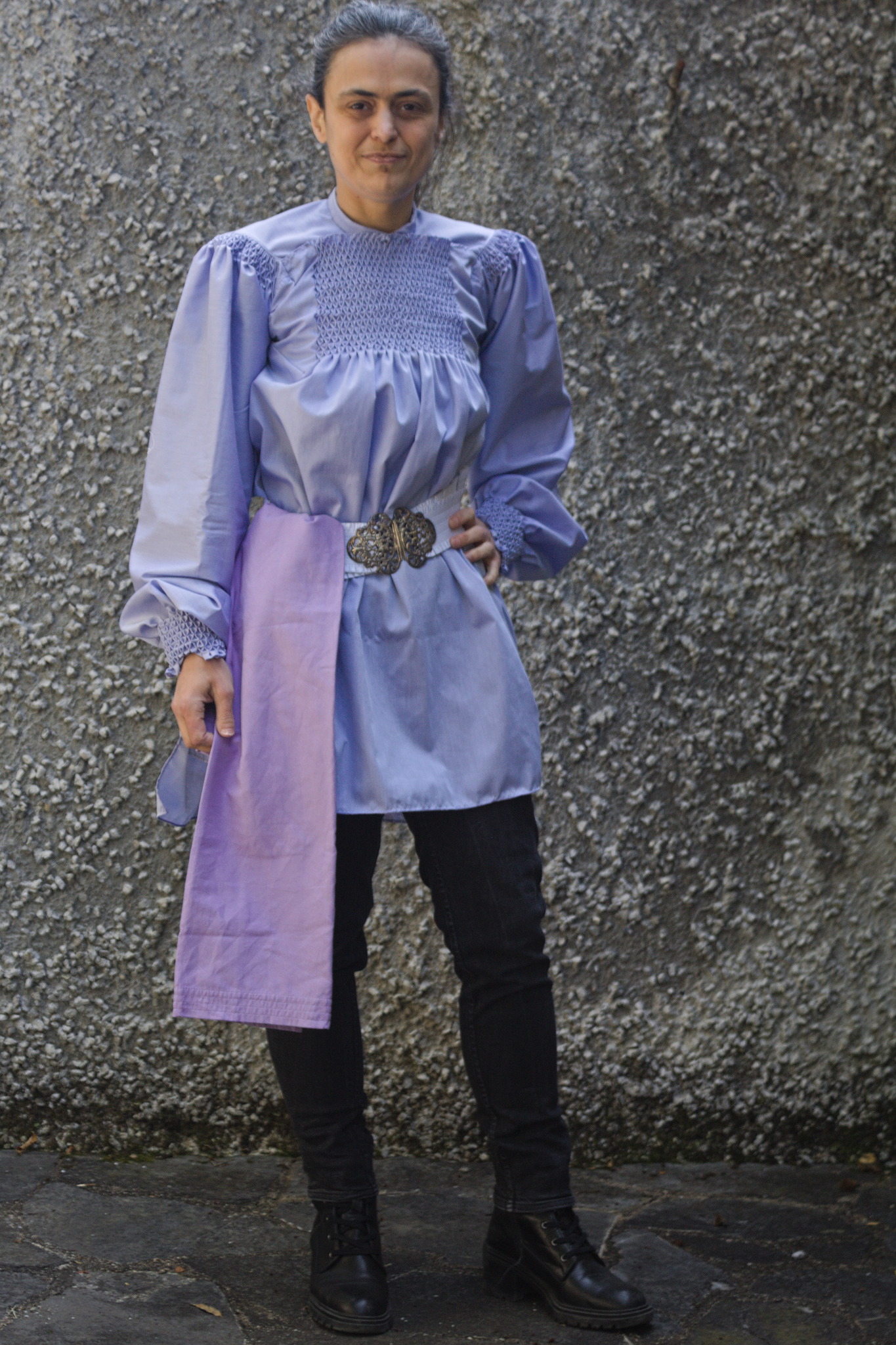 After cartridge pleating, the next fabric manipulation technique I
wanted to try was smocking, of the honeycombing variety, on a shirt.
My current go-to pattern for shirts is the 1880 menswear one
I have on my website: I love the fact that most of the fabric is still
cut as big rectangles, but the shaped yoke and armscyes make it
significantly more comfortable than the earlier style where most of the
shaping at the neck was done with gathers into a straight collar.
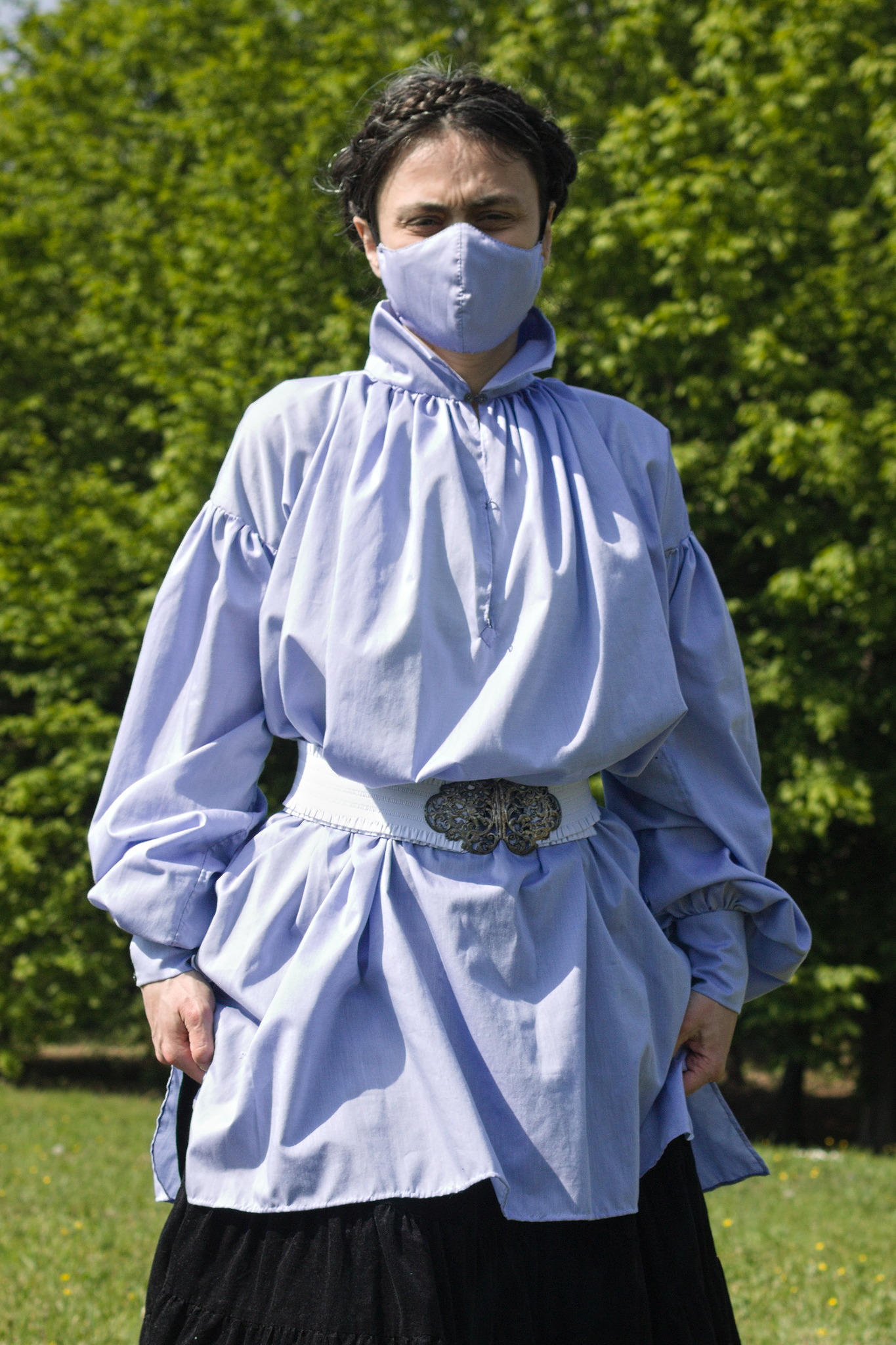 In my stash I had a cut of purple-blue hopefully cotton [#cotton] I had
bought for a cheap price and used for my first attempt at an
historically accurate pirate / vampire shirt that has now become by
official summer vaccine jab / blood test shirt (because it has the long
sleeves I need, but they are pretty easy to roll up to give access to my
arm.
That shirt tends to get out of the washing machine pretty wearable even
without ironing, which made me think it could be a good fabric for
something that may be somewhat hard to iron (but also made me
suspicious about the actual composition of the fabric, even if it feels
nice enough even when worn in the summer).
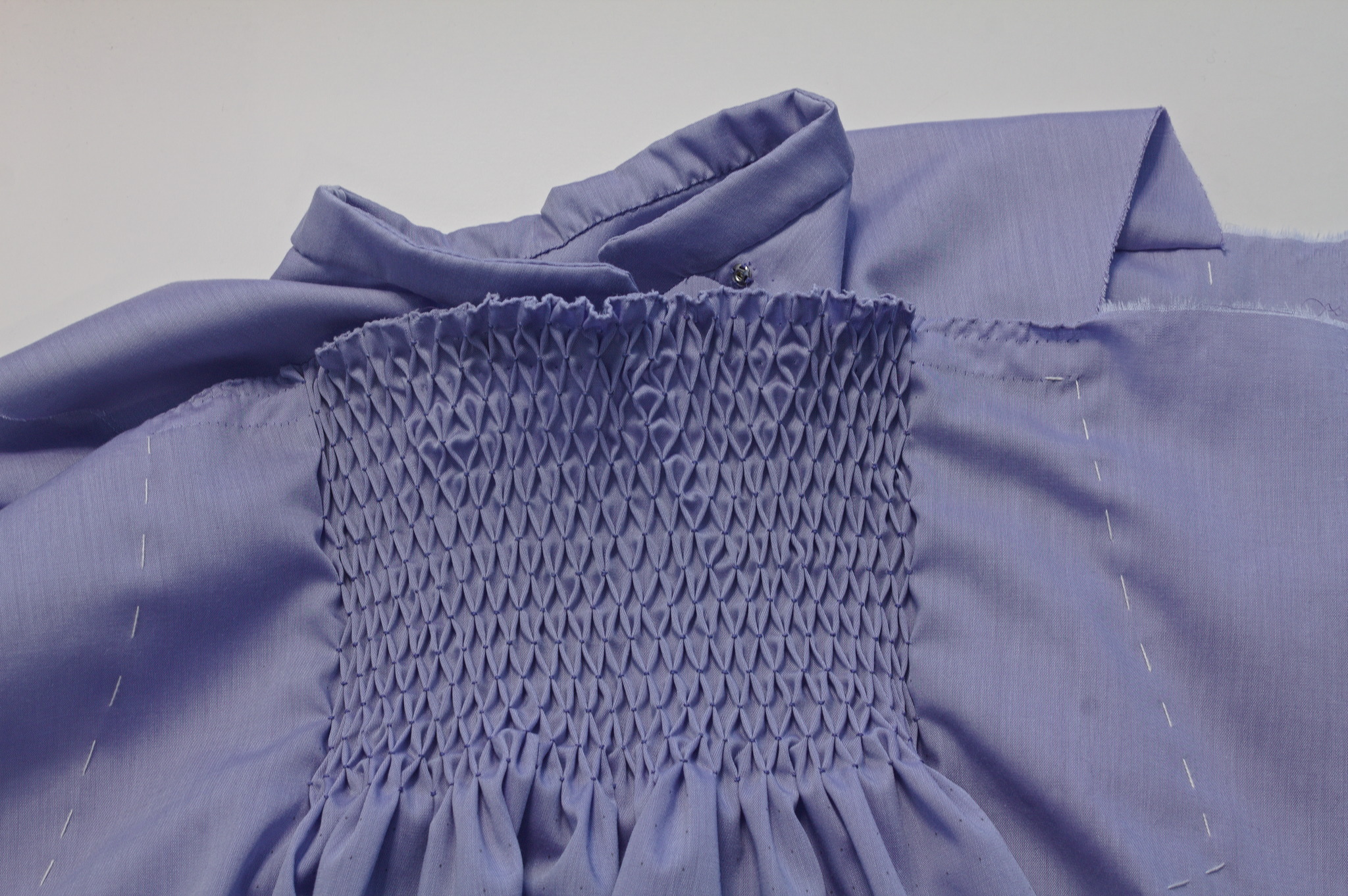 Of course I wanted some honeycombing on the front, but I was afraid that
the slit in the middle of it would interfere with the honeycombing and
gape, so I decided to have the shirt open in an horizontal line at the
yoke.
I added instructions to the pattern page
for how I changed the opening in the front, basically it involved
finishing the front edge of the yoke, and sewing the honeycombed yoke to
a piece of tape with snaps.
Another change from the pattern is that I used plain rectangles for the
sleeves, and a square gusset, rather than the new style tapered sleeve ,
because I wanted to have more fabric to gather at the wrist. I did the
side and sleeve seams with a hem + whipstitch method rather than a
felled seam, which may have helped, but the sleeves went into the
fitted armscyes with no issue.
I think that if (yeah, right. when) I ll make another sleeve in this
style I ll sew it into the side seam starting 2-3 cm lower than the
place I ve marked on the pattern for the original sleeve.
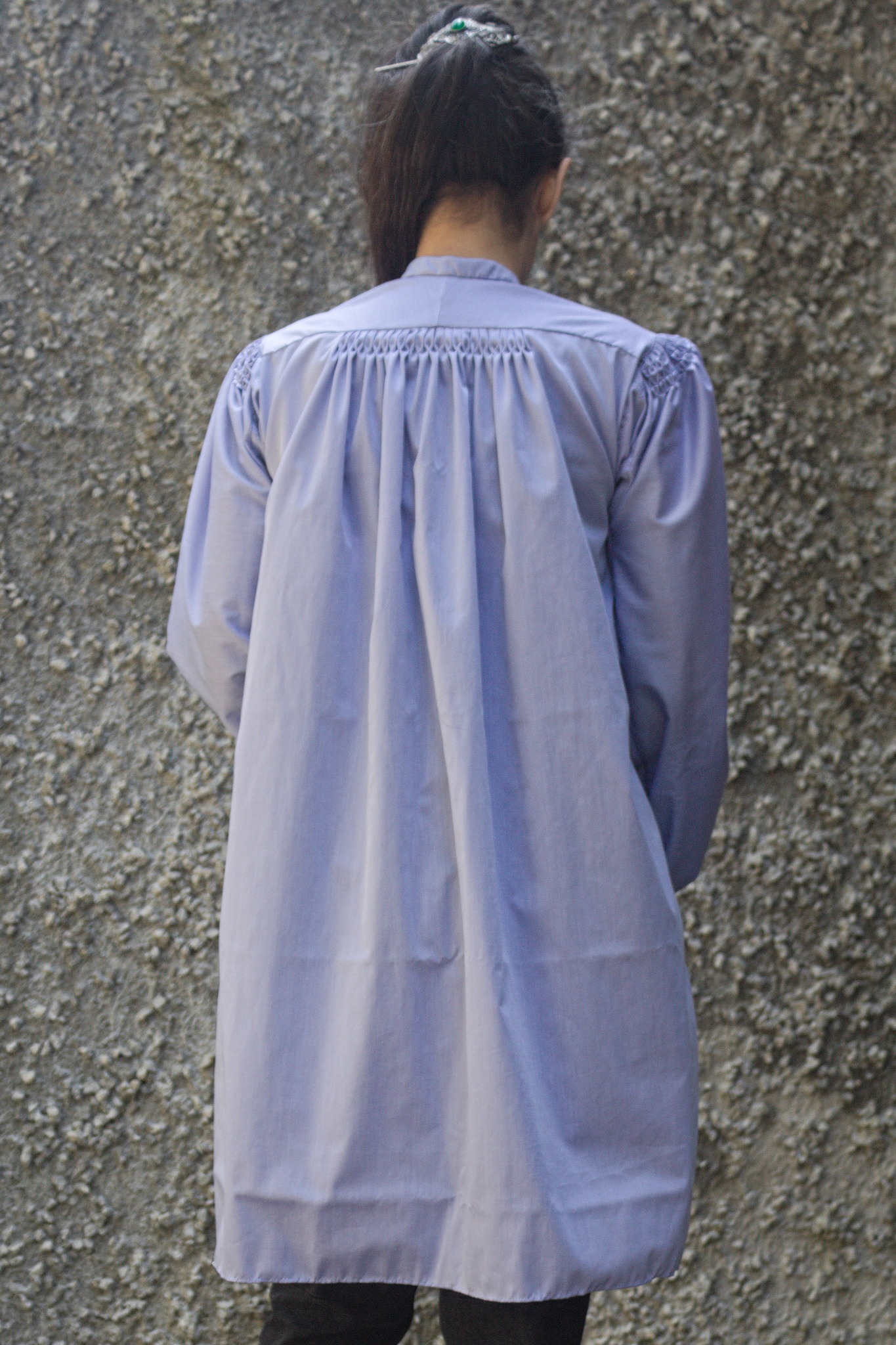 I also used a row of honeycombing on the back and two on the upper part
of the sleeves, instead of the gathering, and of course some rows to
gather the cuffs.
The honeycombing on the back was a bit too far away from the edge, so
it s a bit of an odd combination of honeycombing and pleating that I
don t hate, but don t love either. It s on the back, so I don t mind. On
the sleeves I ve done the honeycombing closer to the edge and I ve
decided to sew the sleeve as if it was a cartridge pleated sleeve, and
that worked better.
Because circumstances are still making access to my sewing machine
more of a hassle than I d want it to be, this was completely sewn by
hand, and at a bit more than a month I have to admit that near the end
it felt like it had been taken forever. I m not sure whether it was the
actual sewing being slow, some interruptions that happened when I had
little time to work on it, or the fact that I ve just gone through a
time when my brain kept throwing new projects at me, and I kept thinking
of how to make those. Thanks brain.
Even when on a hurry to finish it, however, it was still enjoyable
sewing, and I think I ll want to do more honeycombing in the future.
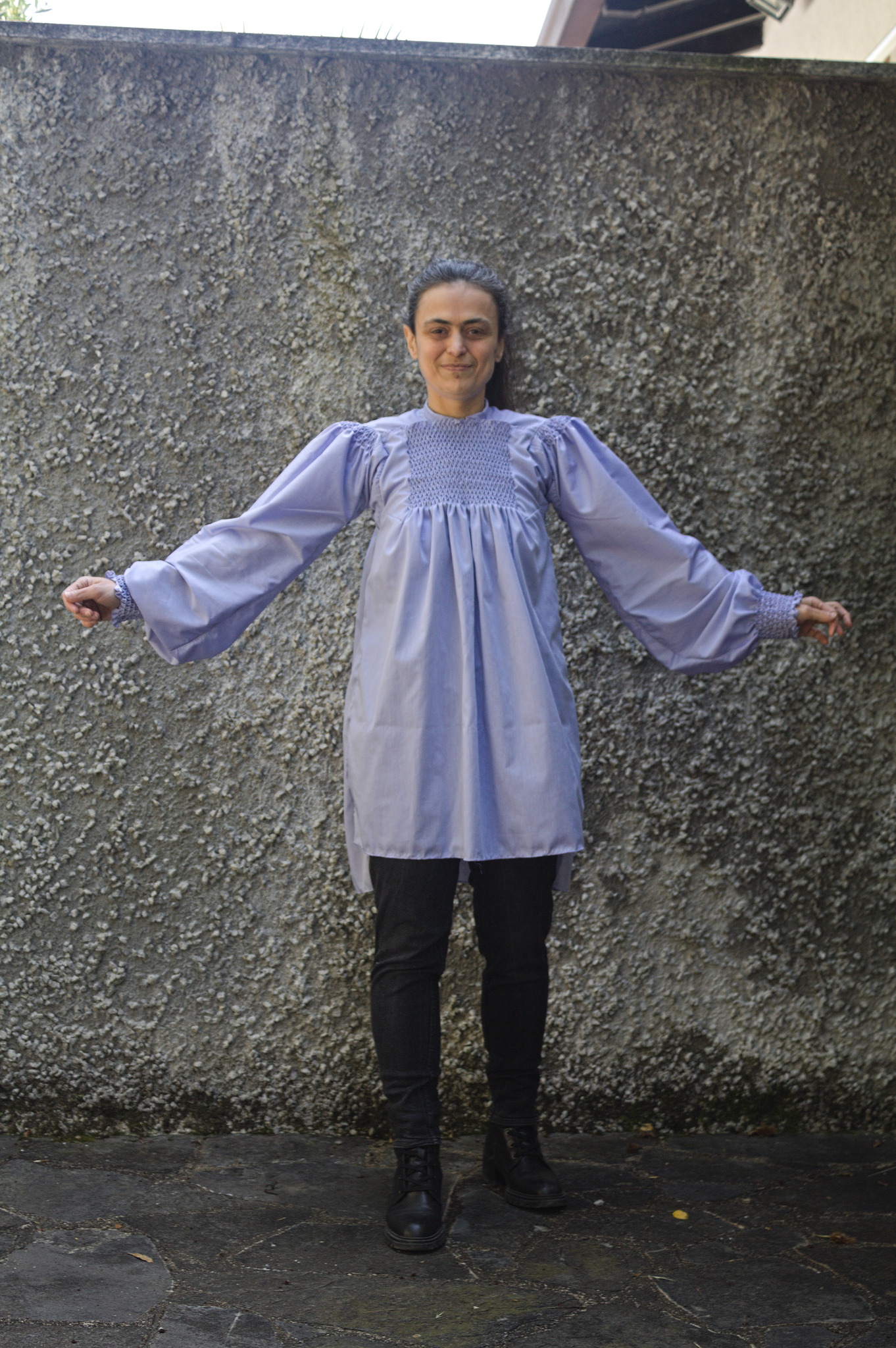 Anyway, it s done! And it s going straight into my daily garment
rotation, because the weather is getting hot, and that means it s
definitely shirt time.
 Orbital at NX, Newcastle in 2023
| Series: | Discworld #41 |
| Publisher: | Harper |
| Copyright: | 2015 |
| Printing: | 2016 |
| ISBN: | 0-06-242998-1 |
| Format: | Trade paperback |
| Pages: | 276 |
"Well," said Tiffany, "there's too much to be done and not enough people to do it." The smile that the kelda gave her was a strange one. The little woman said, "Do ye let them try? Ye mustn't be afraid to ask for help. Pride is a good thing, my girl, but it will kill you in time."And that's before an earth-shattering change in the world of witches, one that leaves Tiffany shuttling between Lancre and the Chalk trying to be too many things to too many people. Plus the kelda is worried some deeper trouble is brewing. And then Tiffany gets an exiled elven queen who has never understood the worth of other people dumped on her, and has to figure out what to do with her. The starting idea is great. I continue to be impressed with how well Pratchett handles Tiffany's coming-of-age story. Finding one's place in the world isn't one lesson or event; it's layers of them, with each new growth in responsibility uncovering new things to learn that are often quite different from the previous problems. Tiffany has worked through child problems, adolescent problems, and new adulthood problems. Now she's on a course towards burnout, which is exactly the kind of problem Tiffany would have given her personality. Even better, the writing at the start of The Shepherd's Crown is tight and controlled and sounds like Pratchett, which was a relief after the mess of Raising Steam. The contrast is so sharp that I found myself wondering if parts of this book had been written earlier, or if Pratchett found a new writing or editing method. The characters all sound like themselves, and although some of the turns of phrase are not quite as sharp as in earlier books, they're at least at the level of Snuff. Unfortunately, it doesn't last. There are some great moments and some good quotes, but the writing starts to slip at about the two-thirds point, the sentences began to meander, the characters start repeating the name of the person they're talking to, and the narration becomes increasingly strained. It felt like Pratchett knew the emotional tone he wanted to evoke but couldn't find a subtle way to express it, so the story and the characters start to bludgeon the reader with Grand Statements. It's never as bad as Raising Steam, but it doesn't slip smoothly off the page to rewrite your brain the way that Pratchett could at his best. What makes this worse is that the plot is not very interesting. I wanted to read a book about Tiffany understanding burnout, asking for help, and possibly also about mental load and how difficult delegation is. There is some movement in that direction: she takes on some apprentices, although we don't see as much of her interactions with them as I'd like, and there's an intriguing new male character who wants to be a witch. I wish Pratchett had been able to give Geoffrey his own book. He and his goat were the best part of the story, but it felt rushed and I think he would have had more impact if the reader got to see him develop his skills over time the way that we did with Tiffany. But, alas, all of that is side story to the main plot, which is about elves. As you may know from previous reviews, I do not get along with Pratchett's conception of elves. I find them boring and too obviously evil, and have since Lords and Ladies. Villains have never been one of Pratchett's strengths, and I think his elves are my least favorite. One of the goals of this book is to try to make them less one-note by having Tiffany try to teach one of them empathy, but I didn't find any of the queen's story arc convincing. If Pratchett had pulled those threads together with something more subtle, emotional, and subversive, I think it could have worked, but instead we got another battle royale, and Lords and Ladies did that better.
"Granny never said as she was better than others. She just got on with it and showed 'em and people worked it out for themselves."And so we come to the end. I wish I could say that the quality held up through the whole series, and it nearly did, but alas it fell apart a bit at the end. Raising Steam I would skip entirely. The Shepherd's Crown is not that bad, but it's minor Pratchett that's worth reading mainly because it's the send-off (and there are a lot of reasons within the story to think Pratchett knew that when writing it). There are a few great lines, some catharsis, and a pretty solid ending for Tiffany, but it's probably not a book that I'll re-read. Content warning: major character death. Special thanks to Emmet Asher-Perrin, whose Tor.com/Reactor re-read of all of Discworld got me to pick the series up again and finally commit to reading all of it. I'm very glad I did. Rating: 6 out of 10
| Series: | Discworld #40 |
| Publisher: | Anchor Books |
| Copyright: | 2013 |
| Printing: | October 2014 |
| ISBN: | 0-8041-6920-9 |
| Format: | Trade paperback |
| Pages: | 365 |
It is said that a soft answer turneth away wrath, but this assertion has a lot to do with hope and was now turning out to be patently inaccurate, since even a well-spoken and thoughtful soft answer could actually drive the wrong kind of person into a state of fury if wrath was what they had in mind, and that was the state the elderly dwarf was now enjoying.One of the best things about Discworld is Pratchett's ability to drop unexpected bits of wisdom in a sentence or two, or twist a verbal knife in an unexpected and surprising direction. Raising Steam still shows flashes of that ability, but it's buried in run-on sentences, drowned in cliches and repetition, and often left behind as the containing sentence meanders off into the weeds and sputters to a confused halt. The idea is still there; the delivery, sadly, is not. This is the first Discworld novel that I found mentally taxing to read. Sentences are often so overpacked that they require real effort to untangle, and the untangled meaning rarely feels worth the effort. The individual voice of the characters is almost gone. Vetinari's monologues, rather than being a rare event with dangerous layers, are frequent, rambling, and indecisive, often sounding like an entirely different character than the Vetinari we know. The constant repetition of the name any given character is speaking to was impossible for me to ignore. And the momentum of the story feels wrong; rather than constructing the events of the story in a way that sweeps the reader along, it felt like Pratchett was constantly pushing, trying to convince the reader that trains were the most exciting thing to ever happen to Discworld. The bones of a good story are here, including further development of dwarf politics from The Fifth Elephant and Thud! and the further fallout of the events of Snuff. There are also glimmers of Pratchett's typically sharp observations and turns of phrase that could have been unearthed and polished. But at the very least this book needed way more editing and a lot of rewriting. I suspect it could have dropped thirty pages just by tightening the dialogue and removing some of the repetition. I'm afraid I did not enjoy this. I am a bit of a hard sell for the magic fascination of trains I love trains, but my model railroad days are behind me and I'm now more interested in them as part of urban transportation policy. Previous Discworld books on technology and social systems did more of the work of drawing the reader in, providing character hooks and additional complexity, and building a firmer foundation than "trains are awesome." The main problem, though, was the quality of the writing, particularly when compared to the previous novels with the same characters. I dragged myself through this book out of a sense of completionism and obligation, and was relieved when I finished it. This is the first Discworld novel that I don't recommend. I think the only reason to read it is if you want to have read all of Discworld. Otherwise, consider stopping with Snuff and letting it be the send-off for the Ankh-Morpork characters. Followed by The Shepherd's Crown, a Tiffany Aching story and the last Discworld novel. Rating: 3 out of 10
| Series: | Discworld #39 |
| Publisher: | Harper |
| Copyright: | October 2011 |
| Printing: | January 2013 |
| ISBN: | 0-06-221886-7 |
| Format: | Mass market |
| Pages: | 470 |
| Series: | Discworld #38 |
| Publisher: | Harper |
| Copyright: | 2010 |
| Printing: | 2011 |
| ISBN: | 0-06-143306-3 |
| Format: | Trade paperback |
| Pages: | 355 |
"I'm a witch. It's what we do. When it's nobody else's business, it's my business."One of the things that I adore about this series is how well Pratchett shows the different ways in which one can be a witch. Granny Weatherwax out-thinks everyone and nudges (or shoves) people in the right direction, but her natural tendency is to be icy and a bit frightening. Nanny Ogg is that person you can't help but talk to, who may seem happy-go-lucky and hedonistic but who can effortlessly change the mood of a room. And Tiffany is stubborn duty and blunt practicality, which fits the daughter of shepherds. In previous books, we've watched Tiffany as a student, learning the practicalities of being a witch. This is the book where she realizes how much she knows and how much easier the world is to navigate when she's in her own territory. There is a wonderful scene, late in this book, where Pratchett shows Nanny Ogg at her best, doing the kinds of things that only Nanny Ogg can do. Both Tiffany and the reader are in awe.
I should have learned this, she thought. I wanted to learn fire, and pain, but I should have learned people.And it's true that Nanny Ogg can do things that Tiffany can't. But what makes this book so great is that it shows how Tiffany's personality and her training come together with her knowledge of the Chalk. She may not know people, in general, but she knows her neighbors and how they think. She doesn't manage them the way that Nanny Ogg would; she's better at solving different kinds of problems, in different ways. But they're the right ways, and the right problems, for her home. This is another Discworld novel with a forgettable villain that's more of a malevolent force of nature than a character in its own right. It's also another Discworld novel where Pratchett externalizes a human tendency into a malevolent force that can possess people. I have mixed feelings about this narrative approach. That externalization of evil into (in essence) demons has been repeatedly used to squirm out of responsibility and excuse atrocities, and it neatly avoids having to wrestle with the hard questions of prejudice and injustice and why apparently good people do awful things. I think some of those weaknesses persist even in Pratchett's hands, but I think what he was attempting with that approach in this book is to show how almost no one is immune to nastier ideas that spread through society. Rather than using the externalization of evil as an excuse, he's using it as a warning. With enough exposure to those ideas, they start sounding tempting and partly credible even to people who would never have embraced them earlier. Pratchett also does a good job capturing the way prejudice can start from thoughtless actions that have more to do with the specific circumstances of someone's life than any coherent strategy. Still, the one major complaint I have about this book is that the externalization of evil is an inaccurate portrayal of the world, and this catches up with Pratchett at the ending. Postulating an external malevolent force reduces evil to something that can be puzzled out and decisively defeated, thus resolving the problem. Sadly, this is not how humans actually work. I'll forgive that structural flaw, though, because the rest of this book is so good. It's rare that a plot twist in a Discworld novel surprises me twisty plots are not Pratchett's strength but this one did. I will not spoil the surprise, but one of the characters is not quite who they seem to be, and Tiffany's reactions once she figures that out are one of my favorite parts of this book. Pratchett is making a point about assumptions, observation, and the importance of being willing to change one's mind about someone when you know more, and I thought it was very well done. But, most of all, I enjoyed reading about Tiffany being calm, competent, determined, and capable. There's also a bit of an unexpected romance plot that's one of my favorite types: the person who notices that you're doing a lot of work and quietly steps in and starts helping while paying attention to what's needed and not taking over. And it's full of the sort of pithy moral wisdom that makes Discworld such a delight to read.
"There have been times, lately, when I dearly wished that I could change the past. Well, I can't, but I can change the present, so that when it becomes the past it will turn out to be a past worth having."This was just what I wanted. Highly recommended. Followed by Snuff in publication order. The next (and last, sadly) Tiffany Aching book is The Shepherd's Crown. Rating: 9 out of 10
| Publisher: | Harper |
| Copyright: | 2008 |
| Printing: | 2009 |
| ISBN: | 0-06-143303-9 |
| Format: | Trade paperback |
| Pages: | 369 |
| Series: | Discworld #37 |
| Publisher: | Harper |
| Copyright: | October 2009 |
| Printing: | November 2014 |
| ISBN: | 0-06-233500-6 |
| Format: | Mass market |
| Pages: | 517 |
Glenda enjoyed her job. She didn't have a career; they were for people who could not hold down jobs.She is the kind of person who knows where she fits in the world and likes what she does and is happy to stay there until she decides something isn't right, and then she changes the world through the power of common sense morality, righteous indignation, and sheer stubborn persistence. Discworld is full of complex and subtle characters fencing with each other, but there are few things I have enjoyed more than Glenda being a determinedly good person. Vetinari of course recognizes and respects (and uses) that inner core immediately. Unfortunately, as great as the setup and characters are, Unseen Academicals falls apart a bit at the end. I was eagerly reading the story, wondering what Pratchett was going to weave out of the stories of these individuals, and then it partly turned into yet another wizard book. Pratchett pulled another of his deus ex machina tricks for the climax in a way that I found unsatisfying and contrary to the tone of the rest of the story, and while the characters do get reasonable endings, it lacked the oomph I was hoping for. Rincewind is as determinedly one-note as ever, the wizards do all the standard wizard things, and the plot just isn't that interesting. I liked Mr. Nutt a great deal in the first part of the book, and I wish he could have kept that edge of enigmatic competence and unflappableness. Pratchett wanted to tell a different story that involved more angst and self-doubt, and while I appreciate that story, I found it less engaging and a bit more melodramatic than I was hoping for. Mr. Nutt's reactions in the last half of the book were believable and fit his background, but that was part of the problem: he slotted back into an archetype that I thought Pratchett was going to twist and upend. Mr. Nutt does, at least, get a fantastic closing line, and as usual there are a lot of great asides and quotes along the way, including possibly the sharpest and most biting Vetinari speech of the entire series.
The Patrician took a sip of his beer. "I have told this to few people, gentlemen, and I suspect never will again, but one day when I was a young boy on holiday in Uberwald I was walking along the bank of a stream when I saw a mother otter with her cubs. A very endearing sight, I'm sure you will agree, and even as I watched, the mother otter dived into the water and came up with a plump salmon, which she subdued and dragged on to a half-submerged log. As she ate it, while of course it was still alive, the body split and I remember to this day the sweet pinkness of its roes as they spilled out, much to the delight of the baby otters who scrambled over themselves to feed on the delicacy. One of nature's wonders, gentlemen: mother and children dining on mother and children. And that's when I first learned about evil. It is built into the very nature of the universe. Every world spins in pain. If there is any kind of supreme being, I told myself, it is up to all of us to become his moral superior."My dissatisfaction with the ending prevents Unseen Academicals from rising to the level of Night Watch, and it's a bit more uneven than the best books of the series. Still, though, this is great stuff; recommended to anyone who is reading the series. Followed in publication order by I Shall Wear Midnight. Rating: 8 out of 10
 The following contributors got their Debian Developer accounts in the last two months:
| Series: | Discworld #36 |
| Publisher: | Harper |
| Copyright: | October 2007 |
| Printing: | November 2014 |
| ISBN: | 0-06-233499-9 |
| Format: | Mass market |
| Pages: | 473 |
"We are not going to have another wretched empire while I am Patrician. We've only just got over the last one."Also, Vetinari processing dead letters in the post office was an absolute delight. Making Money does have the recurring Pratchett problem of having a fairly thin plot surrounded by random... stuff. Moist's attempts to reform the city currency while staying ahead of the Lavishes is only vaguely related to Mr. Bent's plot arc. The golems are unrelated to the rest of the plot other than providing a convenient deus ex machina. There is an economist making water models in the bank basement with an Igor, which is a great gag but has essentially nothing to do with the rest of the book. One of the golems has been subjected to well-meaning older ladies and 1950s etiquette manuals, which I thought was considerably less funny (and somewhat creepier) than Pratchett did. There are (sigh) clowns, which continue to be my least favorite Ankh-Morpork world-building element. At least the dog was considerably less annoying than I was afraid it was going to be. This grab-bag randomness is a shame, since I think there was room here for a more substantial plot that engaged fully with the high weirdness of finance. Unfortunately, this was a bit like the post office in Going Postal: Pratchett dives into the subject just enough to make a few wry observations and a few funny quips, and then resolves the deeper issues off-camera. Moist tries to invent fiat currency, because of course he does, and Pratchett almost takes on the gold standard, only to veer away at the last minute into vigorous hand-waving. I suspect part of the problem is that I know a little bit too much about finance, so I kept expecting Pratchett to take the humorous social commentary a couple of levels deeper. On a similar note, the villains have great potential that Pratchett undermines by adding too much over-the-top weirdness. I wish Cosmo Lavish had been closer to what he appears to be at the start of the book: a very wealthy and vindictive man (and a reference to Cosimo de Medici) who doesn't have Moist's ability to come up with wildly risky gambits but who knows considerably more than he does about how banking works. Instead, Pratchett gives him a weird obsession that slowly makes him less sinister and more pathetic, which robs the book of a competent antagonist for Moist. The net result is still a fun book, and a solid Discworld entry, but it lacks the core of the best series entries. It felt more like a skit comedy show than a novel, but it's an excellent skit comedy show with the normal assortment of memorable Pratchettisms. Certainly if you've read this far, or even if you've only read Going Postal, you'll want to read Making Money as well. Followed by Unseen Academicals. The next Moist von Lipwig book is Raising Steam. Rating: 8 out of 10
| Series: | Discworld #35 |
| Publisher: | Clarion Books |
| Copyright: | 2006 |
| Printing: | 2007 |
| ISBN: | 0-06-089033-9 |
| Format: | Mass market |
| Pages: | 450 |
| Series: | Discworld #34 |
| Publisher: | Harper |
| Copyright: | October 2005 |
| Printing: | November 2014 |
| ISBN: | 0-06-233498-0 |
| Format: | Mass market |
| Pages: | 434 |
| Series: | Discworld #33 |
| Publisher: | Harper |
| Copyright: | October 2004 |
| Printing: | November 2014 |
| ISBN: | 0-06-233497-2 |
| Format: | Mass market |
| Pages: | 471 |
Next.