In 2016, I removed Google Analytics from this blog to avoid being
complicit in feeding the biggest machine for harvesting personal data. Instead,
I relied on GoAccess to analyze my server logs.1 For the past couple
of years, the statistics have made no sense, despite my attempts to filter bots:
AI scrapers inflate the number of visitors to around 2,000 per
day. Eventually, I settled on GoatCounter, an open-source, privacy-friendly
web analytics platform. I replaced the JavaScript client to filter bots more
aggressively and added a CSS fallback. To improve reliability, I implemented a
local proxy running on each of the five web servers serving this blog. The rest
of this post details how these pieces fit together and how I deploy them on
NixOS.
Why GoatCounter?
GoatCounter does not collect personal data: instead of storing the reader s
IP address or relying on cookies, it creates a session identifier valid for 8
hours from the user agent and the IP address. Its feature set is modest but
sufficient for a blog. If you want to look at the interface, GoatCounter s
author runs a public instance for his site. A hosted
version lets you try it before running your own instance. With a single binary
and an SQLite database, GoatCounter is one of the lightest self-hosted
solutions. Privacy-friendly alternatives, in increasing order of complexity,
include Umami, Plausible, and Rybbit.
Custom JavaScript client
GoatCounter includes a small JavaScript client 2,189 bytes minified and
gzipped. It ships some features I don t use: a visitor counter, tracking clicks,
configurable settings, etc. I replace it with this function to register a hit:
If a reader has disabled JavaScript in their browser, I record the hit using a
CSS image. The :hover pseudo-class loads it only after an interaction, another
trick stolen from Bear Blog. About 2% of my visitors fit into this
bucket.3
<!DOCTYPE html><htmllang="en"class="nojs"><head><script>// The JavaScript code for this blog requires ES6if("noModule"inHTMLScriptElement.prototype)document.documentElement.classList.remove("nojs");</script></head><body><!-- ... --><style>.nojsbody:hoverborder-width:0;border-image:url('/count?p=/en/blog/2026-kpi-goodhart&t=Building...&r=NoJS&e=false');</style></body></html>
Where GoAccess reported around 2,000 visitors a day, GoatCounter counts fewer
than 200 humans.4 I assume AI scrapers use a low-effort approach: if the
content is available without barriers, as on this blog, they don t spawn a
complex mechanized browser that could trigger a page view. Even crawlers running
JavaScript, like Googlebot with its headless Chromium, do not
interact with the page and never trigger the events I listen
to. The interaction-based proof of humanity I use is likely to keep
working.5
Local proxy
Five servers across the world in Europe and in North
America serve the content of this website, but GoatCounter runs on only
one of them. To avoid losing track of visitors when GoatCounter is down, I run a
local proxy listening on the same /count endpoint. On each server, it stores
the hits in memory with a buffer large enough to survive several days of
downtime. It sends them in batches to the upstream backend using the
/api/v0/count authenticated endpoint.
Servers on a map. web02 is in Paris, web03 in Helsinki, web04 in Nuremberg,
web05 in Ashburn, web06 in Chicago.
I proposed the code for the proxy in pull request #909. GoatCounter s
maintainer declined to maintain so much code for such a niche use case. As a
fellow open-source developer, I often hold the same position for my own
projects: a one-time contributor effort may translate into a long-term
maintainer commitment.
I expose the endpoint for the proxy on the domain of this website to evade ad
blockers. This sounds like I don t respect the reader s choice, but as
GoatCounter is privacy-friendly, I find it acceptable.
Deploying on NixOS
My web servers run NixOS, a declarative Linux distribution with built-in
configuration management. I manage this small fleet with Colmena, a
stateless deployment tool for NixOS. My configuration is available on
GitHub.
Deploying applications in containers
For better isolation, each application runs inside an ephemeral lightweight
container, powered by systemd-nspawn. Each container runs a stripped-down
NixOS instance. A module wraps NixOS s containers options to
avoid repeating the same options for each application.6 The containers
share their network namespace with the host: the additional isolation is not
worth the increased complexity. For a smaller footprint, I also disable a few
non-essential services.
To configure a GoatCounter instance running in a container and listening on
127.0.0.4:8088, we import the module7 and declare the container in the
config.luffy.containers attribute set:
As the containers are ephemeral, we need to keep persistent data in directories
on the host. We add a mounts option and ask NixOS s containers to expose the
configured directories through the bindMounts option.
For example, to persist GoatCounter s database in the /var/db/goatcounter
directory on the host, we add the directory to the mounts option and alter the
service definition to tell GoatCounter where the database is.
A container may also need some secrets. Colmena can upload secrets without
storing them in the Nix store. We add a keys option to our containers. It
takes an attribute set mapping secret names to the commands to populate them.
Then, the module declares the required secrets to Colmena in the
deployment.keys option, makes the container depend on the presence of the
secrets, and exposes them to the container.
config, lib,... :letcfg= config.luffy.containers;in
options.luffy.containers= lib.mkOption type= lib.types.attrsOf (lib.types.submodule options=keys= lib.mkOption type= lib.types.attrsOf (lib.types.listOf lib.types.str);default= ;description="Secrets, as a command to run locally. They are mounted in /etc."; ; ; ); ;config=# Colmena uploads each secret in /var/keys and make them available# to the group "keys".
deployment.keys= lib.concatMapAttrs
(_: container: lib.mapAttrs
(_: keyCommand:inherit keyCommand;group="keys";permissions="0640";destDir="/var/keys"; )
container.keys)
cfg;# The container can only start if the required secrets are available.
systemd.services= lib.mapAttrs'
(name: container:letunits=map(key:"$ key-key.service")(lib.attrNames container.keys);in
lib.nameValuePair "container@$ name"requires= units;after= units; )
cfg;# Mount each secret inside the container.containers= lib.mapAttrs
(name: container:bindMounts= lib.mapAttrs'
(key: _: lib.nameValuePair "/etc/$ key"hostPath="/var/keys/$ key";isReadOnly=true; )
container.keys; )
cfg; ;
For example, GoatCounter needs credentials to download the GeoIP database. I
provide a local command to fetch the secret from my password manager and expose
it inside the container through the /etc/goatcounter.env environment file.
GoatCounter server
Nixpkgs already packages GoatCounter. By overriding the src and vendorHash
attributes, I reuse its definition for my custom version with the proxy:
I wrote a NixOS module to encapsulate GoatCounter: the
container definition, the service definition, and the secrets. The module
accepts the following options: package, serve.enable, serve.listenAddress,
serve.port, and serve.databaseFile. I already detailed the container
configuration in the previous section. In the end, I chose not to reuse the
GoatCounter module from NixOS: it s small, so it s better to insulate my module
from unexpected future changes.
config, pkgs, lib,... :letcfg= config.luffy.goatcounter;databaseDirectory=builtins.dirOf cfg.serve.databaseFile;chown="$ pkgs.coreutils/bin/chown -R";in
config.luffy.containers.goatcounter=
config.systemd.services.goatcounter=description="GoatCounter Web Analytics";wantedBy=["multi-user.target"];serviceConfig=EnvironmentFile="/etc/goatcounter.env";SupplementaryGroups=["keys"];DynamicUser=true;Restart="always";ExecStart= lib.escapeShellArgs [(lib.getExe cfg.package)"serve""-listen=$ cfg.serve.listenAddress:$ toString cfg.serve.port""-tls=none""-db=sqlite+$ cfg.serve.databaseFile""-automigrate"];# Transfer database ownership to dynamically assigned user "goatcounter".ExecStartPre="+$ chown goatcounter:goatcounter $ databaseDirectory";ReadWritePaths= databaseDirectory; ; ; ;
The following snippet configures GoatCounter to listen on 127.0.0.4:8088:
GoatCounter proxy
The same NixOS module configures the local proxy, with the
following options: proxy.enable, proxy.listenAddress, proxy.port, and
proxy.site the site receiving the batches of page views. The local proxy has
no persistent data, but it needs the API key to authenticate to the main
GoatCounter instance: its container uses the keys option but not the mounts
option.
config, pkgs, lib,... :letcfg= config.luffy.goatcounter;keyCommand= _:[" "];in
config.luffy.containers.goatcounter-proxy= keys."goatcounter-proxy.env"= keyCommand "GOATCOUNTER_API_KEY"; config.systemd.services.goatcounter=description="GoatCounter Proxy.";wantedBy=["multi-user.target"];serviceConfig=EnvironmentFile="/etc/goatcounter-proxy.env";SupplementaryGroups=["keys"];DynamicUser=true;Restart="always";ExecStart= lib.escapeShellArgs [(lib.getExe cfg.package)"proxy""-site=$ cfg.proxy.site""-listen=$ cfg.proxy.listenAddress:$ toString cfg.proxy.port""-ratelimit=10/1"# 10 requests per second per IP]; ; ; ;
For each server, I enable the local proxy with the following snippet. The
nginx configuration shown earlier exposes the /count endpoint under the same
domain as my blog.
Backup of the SQLite database with Litestream
Litestream is a streaming replication tool for SQLite databases. It
compresses the changes committed to the write-ahead log (WAL) next to the
database and sends them to a remote destination. I encapsulate its configuration
in a NixOS module, which takes an attribute set databases
mapping a name to the path of the database to back up.
Litestream also runs in a container. I mount the databases to replicate, as well
as the secrets to push the backups to a Hetzner storage box using SFTP:
We can restore the database from the backup with a few shell commands. First, we
stop the containers. Then, we move the damaged database away, invoke litestream
restore from the right environment, and restart the containers.9
Ten years after removing Google Analytics, JavaScript-based analytics is
back on this blog, but without storing cookies or IP addresses, and without
involving a third party. I still write for myself first, notably because it lets
me dig into a topic and refer back to it years later. But knowing a bit more
about my fellow human readers is a nice bonus, even the ones disabling
JavaScript.
Nginx scrambles IP addresses before storing them, thanks to the ipscrub
nginx module.
GoatCounter already filters some bots based on the user agent or the IP
address. But AI scrapers lie about their user agent and hide behind
residential proxies.
Without JavaScript, I cannot send the real referrer. I insert NoJS
instead.
I am missing the humans reading the RSS feed. I am not comfortable adding a
tracking pixel, and bots are likely to fetch it, compromising the
statistics. I ll live without counting these readers.
In February 2025, I tested another CSS-only approach without the interaction
trick: each page loaded an empty image as a background. Over a month, it
recorded up to ten times fewer page views than the nginx logs, even after
removing user agents identifying as bots. Compared to this experiment,
GoatCounter counts about three times fewer views, 18 months later. As the
time ranges differ, this is not an apples-to-apples comparison, but it gives
a hint about how efficient bot filtering is.
A NixOS module is a function receiving the configuration of the whole
system as config and returning three attributes:
imports adds other modules to import,
options declares user-configurable settings, each with a type and a default value, and
config sets values for options declared by any module, like containers from NixOS.
If a module does not need to declare options, you can return the config attribute
set directly. When a module does not require any argument, you can define it as an attribute
set instead.
Most of the time, you don t need an explicit import. NixOS automatically
imports the modules shipped with Nixpkgs. For my own
modules, some machinery also imports them automatically.
Litestream warns against using the auto-recover option as
it can cause data loss. But I don t properly monitor my servers and I prefer
uninterrupted backups to a slight chance of losing the last few records.
In my case, the process is slow: around 20 minutes for a 20 MiB database.
You can test by restoring to a copy with the -o option, but you still need
to stop the Litestream container.
This August, I accomplished what I wanted for many years: I deleted the last cgo
dependency in Debian Code Search! This was made possible by Go s recently
introduced SIMD support, because now we can implement the TurboPFor integer
compression format as efficiently more efficiently, in fact, by using the
newer AVX512 instruction set! as the reference implementation.
Background: Why does DCS need a fast Integer Codec?
Debian Code Search (DCS) is a search engine that allows searching all the Open
Source source code within Debian, with either literal search expressions or
regular expression search queries.
A search engine uses an inverted index: a map from term to documents containing
the term. Each document is typically represented most efficiently by using an
id, so the index consists of many lists of document ids.
When searching, it is important to quickly decode these lists to answer the
search query. However, there is a point of diminishing returns where the
decoding speed, even though it can still be measurably improved quite a bit, no
longer influences the overall query duration.
From 2012 (its inception) to 2019, Debian Code Search used to use a small index
format, and queries were fast because the index was kept entirely in RAM. In
2019, I implemented the new index
format, which adds an
on-disk positional index. For literal queries (78.2% of DCS queries), querying
the positional index on disk is faster than querying the non-positional index in
RAM.
The efficient encoding of the TurboPFor format makes it possible to fit such an
index on a mid-sized Hetzner server, which I rent with two 1 TB SSD disks. The
optimized decoder of the C TurboPFor library is what made decoding fast at query
time.
If you want to dive deeper into the algorithm, see this blog post from February
2019:
Use a C library via cgo so gcc or clang compiles
SIMD code. Debian Code Search used to use the
powturbo/TurboPFor
C library via cgo for the last 7 years.
The C TurboPFor library has served us well, but Debian Code Search was always
intended to be a project using Go, so I would prefer it if I did not have any C
code in the project.
Go 1.26 (released in February 2026) introduced the simd/archsimd package:
Go 1.26 introduces a new experimental simd/archsimd
package, which can be enabled by setting
the environment variable GOEXPERIMENT=simd at build time. This package
provides access to architecture-specific SIMD operations. It is currently
available on the amd64 architecture and supports 128-bit, 256-bit, and
512-bit vector types, such as Int8x16 and Float64x8, with operations such
as Int8x16.Add. The API is not yet considered stable.
Go 1.26 Release Notes
For my 2019 TurboPFor analysis, I implemented goturbopfor, a native Go
teaching decoder (without any SIMD),
because I find Go code easier to follow than C code, especially optimized C
code. My implementation was intentionally not optimized so that the code was
easier to study.
The TurboPFor format/algorithm has a vector-optimized part: bitpacking comes in
a scalar variant (bitunpack32) and a vector variant
(bitunpack256v32),
where the vector variant is used for full blocks (256 values) and the scalar
variant is used for remainder blocks (< 256 values).
When Go 1.26 was released, I used Claude Code to explore whether my native Go
decoder s bitunpack256v32 function (for the vertical vector layout) could be
implemented using Go SIMD, and the answer was yes, it was possible and it was
faster than without SIMD, but not quite at the level of C TurboPFor. If you let
Claude Code try for long enough, it eventually finds enough optimizations (about
10) to match C performance.
I don t want to vibe-code Debian Code Search, though, so I figured I would find
some time to review the SIMD code at some point and see if I could implement
something similar myself.
Before I found enough time and motivation to complete said review, I discovered
that to not regress real-life query performance by more than 10 to 100
milliseconds (which seems acceptable), I don t actually need to add SIMD code to
my teaching decoder at all; it would be sufficient to reduce allocations in my
teaching decoder and specialize it per bit width.
Encouraged by the possibility of using the optimized native Go decoder in Debian
Code Search, I explored whether I could also implement a native Go encoder so
that I could get rid of the C TurboPFor dependency entirely. The answer is yes,
it is doable in a few days, and it isn t even that much slower: Go is at 76% of
C, see Debian/dcs commit
e920dc7.
The goal I set myself at that point was to see if I could learn enough SIMD to
optimize the native Go encoder such that its performance would match how DCS
uses C TurboPFor (via cgo).
Beating C TurboPFor was possible in 2-3 commits (SIMD and bit width
specialization). To my surprise, Claude Fable 5 pointed out that the encoder s
block scanning could be done more efficiently using a technique called
positional popcount, and that is another 2x speed-up!
To be clear: I am not saying the Go compiler beats C here. Certainly, the C
compiler can also produce fast AVX512 code and can be used to implement
positional popcount. When comparing apples to apples, i.e. backporting the
AVX512 kernels and positional popcount technique to C TurboPFor, Go benchmarks a
little slower at 1.4x C.
This spectacular result (much faster than what DCS had before) got me curious
how far I could push the decoder with SIMD after all. I ended up
matching/exceeding the cgo version here, too!
The rest of this article explains a few classes of optimizations I encountered
along the way.
Starting Point
When I wrote my goturbopfor teaching
decoder, I named its functions to
match the upstream C TurboPFor library, but now I want to get away from names
like p4ndec256v32 they make sense from the TurboPFor perspective, but for
Debian Code Search, we can use cleaner names.
Before writing any code, I audited how DCS uses integer compression /
decompression.
API design: BlockEncoder, BlockDecoder and streaming
In Debian Code Search, we have the following usage patterns:
Partial Indexing: When a new package (or package version) enters Debian,
all of its (text) files are indexed. If the hello-2.12.3-1
package (hypothetically) contained
only hello.c with printf("hello!\n");, we would assign document ID 1 to
hello.c and store in the partial index that trigrams pri, rin, int,
ntf, etc. are all found in doc 1 (hello.c).
Full Index Merging: The many thousands of partial index files (for each
Debian package) are combined into a small handful of large index files: When
searching, it would be expensive to consult thousands of indexes. To merge
multiple partial index files into one larger index (which can then be
efficiently queried), we need to re-encode the partial index files: what used
to be document ID 1 in the partial index might be document ID 2531 in the
full index.
Querying (searching): When users enter search queries, these queries need
to be answered as quickly as possible. The relevant entries in the full
indexes are decoded (in parallel).
For reading the index, we do keep the decoded uint32s fully in memory, so we
only need DecodeN(input []byte, output []uint32) (read int), a function that
reads len(output) values (uint32) from input and returns how many bytes it
consumed.
For writing the index (both in partial indexing, and when merging), keeping the
entire index in memory is prohibitively expensive, so we need a streaming API,
for decoding and for encoding.
Ultimately, I converged on the following API:
packagepforenctypeBlockEncoderstruct// scratch buffers can go here// EncodeBlock encodes len(vals)<=256 uint32s into dest (one TurboPFor block).func(*BlockEncoder)EncodeBlock(dest[]byte,vals[]uint32)[]byte// EncodeN calls EncodeBlock in a loop.func(*BlockEncoder)EncodeN(dest[]byte,vals[]uint32)[]bytetypeStreamEncoderstructbeBlockEncodervals[256]uint32// scratch buffers// if full, you need to call [EncodeBlock]func(*StreamEncoder)Add(valuint32)(fullbool)// EncodeBlock must be called after all data was [Add]ed.//
// Write the returned buffer to file or send it over the network;// it is only valid until the next [EncodeBlock] call.func(*StreamEncoder)EncodeBlock()[]byteifse.n==0returnnil// turn an extra EncodeBlock into a no-op//
This API (the decoder works similarly) allows us to process data in TurboPFor
format without any memory allocations. The types are not safe for concurrent use
by multiple goroutines. The zero value is ready to be used. For the streaming
API, the result only stays valid until the next call.
Initial Implementation
Before we can optimize anything, we need a working decoder and encoder. The
decoder already exists: my goturbopfor teaching decoder. Next up, I needed an
encoder.
Writing a TurboPFor encoder has a delightfully simple starting point: You can
encode all values at bit width 32, in little endian, at which point you only
need to add a one-byte TurboPFor block header every 256 values and you re done:
Of course, this is a terribly inefficient compressor, so after the first commit,
the real work starts: implement each block type until the compression matches
the original C TurboPFor implementation (same output file size), or in other
words: do the reverse of the decoder.
The TurboPFor bitpacking block type (bitpacking implementation
commit)
encodes a bit stream of variable bit width (where the bit width is in range
0 bitWidth 32) in little
endian byte order. By scanning all
values and choosing the smallest bit width that allows representing all
values, this technique saves disk space (compresses).
The bitpacking with exceptions block type (bitpacking with exceptions
implementation
commit)
determines two bit widths: one for values, the other bit width for encoding
exceptions. This allows choosing a lower bit width (that does not cover all
values) compared to the bitpacking block type. A bitmap encodes whether a
value has an exception or not.
The bitpacking with VB exceptions block type (bitpacking with VB
exceptions implementation
commit)
is a variant which does not use an exception bitmap and encodes exceptions
using a variable byte integer encoding. This is more efficient when there are
few exceptions (less than 20) or the exceptions are very different in bit
width compared to the other values.
Lastly, the constant block type (constant implementation
commit)
stores just one value on disk. This is useful for all-zero or all-one blocks,
for example.
I found it interesting to realize that the main work of the encoder is to scan
the input values and choose the optimal block type, whereas the actual encoding
itself is cheap in comparison.
At this point, we can look at
performance
and see that the Go encoder is at 76% of the C encoder.
In all honesty, I could have probably stopped here, but now that the milestone
of a viable replacement was reached, I got curious to see how far it would be
possible to push the encoder (how much work to reach C speeds?) and afterwards,
the decoder, too.
Setup
The microarchitecture level: set GOAMD64
The microarchitecture of a CPU determines which instructions it provides, and
that includes not just SIMD instruction sets (like AVX2), but also other useful
instructions like LZCNT (Leading Zero Count), which can be used to implement
math/bits.Len32 more efficiently, which
the TurboPFor encoder needs to call on every input value to determine the ideal
bit width.
Let s walk through how to set the microarchitecture level when using Go on
64-bit x86 (x86-64).
Go uses the GOARCH environment
variable to configure the target
compilation architecture, and I am using the value amd64 to select 64-bit x86
(AVX2 and AVX512 are instruction sets found on x86-64 CPUs). With
GOARCH=amd64, the architecture-specific variable
GOAMD64 configures the
microarchitecture level for which to compile and Go 1.18 introduced these 4
different levels:
GOAMD64=v1 (default): The baseline.
Exclusively generates instructions that all 64-bit x86 processors can execute.
GOAMD64=v2: all v1 instructions,
plus CMPXCHG16B, LAHF, SAHF, POPCNT, SSE3, SSE4.1, SSE4.2, SSSE3.
GOAMD64=v3: all v2 instructions,
plus AVX, AVX2, BMI1, BMI2, F16C, FMA, LZCNT, MOVBE, OSXSAVE.
GOAMD64=v4: all v3 instructions,
plus AVX512F, AVX512BW, AVX512CD, AVX512DQ, AVX512VL.
In 2026, I generally recommend compiling with GOAMD64=v3 so that functions
like bits.OnesCount8 are
compiled into intrinsics
(POPCNT)
instead of using a lookup table.
For Intel CPUs, setting GOAMD64=v3 means your programs will only start on
Haswell CPUs (2013) or newer; for AMD CPUs that means Zen 1 (2017) or newer.
In this specific case (DCS), I am even compiling with GOAMD64=v4. The v4
microarchitecture level requires AVX512, which means AMD Zen 4, Zen 5 or newer
(Intel s story is complicated). Luckily, both my main development PC (Zen 5)
and the Debian Code Search server (Zen 4) are recent enough. Setting
GOAMD64=v4 has little effect on Go 1.27 itself: the only change is that maps
use one less instruction (VPBROADCASTB instead of PSHUFB). But compiling
with GOAMD64=v4 allows us to move one more feature check from runtime to
compile time, see SIMD build tags.
It makes sense to set the microarchitecture level in your benchmark setup so
that you don t measure the slow fallback implementations. I use export GOAMD64=v4 in my Makefile.
Benchmarking setup
Go s built-in testing package contains support for
benchmarks which are written in
functions of the form func BenchmarkXxx(b *testing.B). The simplest way to run
such benchmarks is go test -bench=., but I ended up configuring a few
convenience make targets, which write results to bench.txt and compare
against baseline.txt (the previous commit s results, usually), using the very
useful benchstat tool.
GOTEST=go test# -count=6 gives p 0.002 in benchstat:
# https://pkg.go.dev/golang.org/x/perf/cmd/benchstat
BENCHFLAGS=-run=^$$ -bench=. -benchtime=200000x -count=6# use taskset -c1 to always pin to the same single core,
# avoiding accidental scheduling on different cores on
# mixed-core CPUs like the Ryzen 9 9950X3D.
TASKSET=taskset -c 1BENCH=$(TASKSET)$(GOTEST)$(BENCHFLAGS).PHONY: all test bench bench-baseline bench-relative
all: test
bench: test
$(BENCH) tee bench.txt
# Compares compression ratio between C and Go implementation
benchstat -col /impl -row '/n /vals' -filter '-/impl:go-stream .unit:(encoded-bytes)' bench.txt
# Compares performance between C (cgo) and Go implementation
benchstat -col /impl -row '/n /vals' -filter '.unit:(Mval/s)' bench.txt
bench-baseline: test
$(BENCH) tee baseline.txt
bench-relative: test
$(BENCH) tee bench.txt
benchstat -filter '-/impl:go-stream .unit:(encoded-bytes)' baseline.txt bench.txt
benchstat -filter '/impl:go .unit:(Mval/s)' baseline.txt bench.txt
The encoded-bytes and Mval/s units are custom metrics I am reporting from
the various sub-benchmarks, which are arranged
such that I can filter / report them with benchstat.
The main encoder (and decoder) benchmarks compare 3 different implementations
(cgo, Go, Go with the StreamEncoder API) with a number of benchmark
cases
that are designed to cover the different block types and contain a similar mix
of values as what we see in Debian Code Search:
// reportMetrics adds Mval/s and encoded-bytes metrics to all benchmarks.funcreportMetrics(b*testing.B,nint,nencodedint)b.ReportMetric(float64(nencoded),"encoded-bytes")b.ReportMetric(float64(b.N*n)/1e6/b.Elapsed().Seconds(),"Mval/s")// BenchmarkEncode/n=<N>/vals=<testcase>/impl=<c go go-stream>//
// e.g. BenchmarkEncode/n=2048/vals=one-constant/impl=go-streamfuncBenchmarkEncode(b*testing.B)for_,tc:=rangeallBenchCases()n:=len(tc.vals)b.Run(fmt.Sprintf("n=%d/vals=%s",n,tc.name),func(b*testing.B)b.Run("impl=c",func(b*testing.B)b.ReportAllocs()varencoded[]bytebuf:=make([]byte,turbopfor.EncodingSize(n))forb.Loop()encoded=turbopfor.P4nenc256v32Buf(buf,tc.vals)reportMetrics(b,n,len(encoded)) )b.Run("impl=go",func(b*testing.B)b.ReportAllocs()varbeBlockEncodervarencoded[]bytebuf:=make([]byte,0,turbopfor.EncodingSize(n))forb.Loop()encoded=be.EncodeN(buf,tc.vals)reportMetrics(b,n,len(encoded)) )b.Run("impl=go-stream",func(b*testing.B)b.ReportAllocs()varseStreamEncodervarencodedintforb.Loop()encoded=0for_,val:=rangetc.valsifse.Add(val)encoded+=len(se.EncodeBlock())encoded+=len(se.EncodeBlock())reportMetrics(b,n,encoded) ) )
CPU counters: perf
Go has included excellent performance tooling for many years, see the
Profiling Go Programs blog post (2011) for an
example of how to use pprof, a sampling profiler. This profiler can help track
down which part of a program runs slow, or where memory allocations happen.
Once you identified the slow part of a program, how do you know why it s slow?
To learn more about the specific bottlenecks your program encounters, you can
consult your CPU s hardware performance
counters. For
example, you could check the branch
predictor counters to see if
your program is slow due to a high number of branch mispredicts.
On Linux, the perf tool is the best way to access the CPU hardware performance
counters. A good starting point for working with perf is the documentation on
Top-down analysis with the perf
tool , which describes the
optimization method that Intel established.
In my Makefile, I set up two perf targets:
# GOTEST and TASKSET like shown in the earlier benchmarking setup section:
GOTEST=go test -pgo=encode.cpuprof
TASKSET=taskset -c 1PERFBENCHFLAGS=-test.bench='Encode/n=2048/vals=debian-mix/impl=go$$' -test.benchtime=200000x
# Use perf(1) to capture AMD IBS (the equivalent to Intel PEBS)
# PipelineL1 is roughly equivalent to Intel TopdownL1
perf:$(GOTEST) -c
$(TASKSET) perf stat -M PipelineL1 ./pforenc.test -test.run=^$$$(PERFBENCHFLAGS) sudo perf record -F 4999 -e ibs_op// --call-graph fp ./pforenc.test -test.run=^$$$(PERFBENCHFLAGS) sudo chmod 644 perf.data
# 488281 iterations 2048 values = 1.000e9 values, so counter/1e9 = per value.
perf-per-value:$(GOTEST) -c
$(TASKSET) perf stat -x, -e cycles:u,instructions:u,branches:u,branch-misses:u ./pforenc.test -test.run=^$$ -test.bench='Encode/n=2048/vals=debian-mix/impl=go$$' -test.benchtime=488281x 2>&1 >/dev/null awk -F, ' printf "%-16s %6.2f /val\n", $$3, $$1/1e9 '
The perf-per-value numbers are high level numbers that indicate how much work
the implementation is doing. Reducing the number usually increases speed.
To see the counters for each instruction (and source code lines), I use make perf, followed by perf report. A quick shortcut is perf annotate, which
directly shows the hottest function.
Optimizations (scalar)
Let s first see how far we can get without reaching for SIMD instructions.
(The examples are not necessarily in commit order, but cherry-picked for clarity.)
Profile-Guided Optimization (PGO)
PGO stands for Profile-Guided Optimization and is a feature that Go introduced
as a preview in Go 1.20 (released in February 2023) and shipped as ready for
general production use in Go 1.21 (released in August
2023).
The idea is to capture a CPU profile that records where your program spends most
of its CPU time, which you then provide to the Go compiler to give it more data
to make better decisions.
Most importantly, this way the Go compiler can inline functions much more
aggressively than its usual heuristics allow,
which does have a measurably positive effect in my series of optimization
commits. Another optimization that a PGO profile allows the compiler to do is
conditional devirtualization but
our TurboPFor code does not use any interfaces.
My strategy is to enable PGO before doing any other optimizations, so that we
have the full inlining budget available that PGO gives us, and can measure the
effect of other commits clearly.
Surprisingly, turning on PGO actually decreases our
performance
(-13% geomean), but a closer investigation reveals that we just got unlucky. Let
me explain.
Aside from inlining and conditional devirtualization, PGO also influences
alignment: The Go compiler sets PCALIGNMAX(64, 31) on the first block of a
loop (the loop body ) for all loops in hot functions (per the PGO profile),
i.e. Go will insert up to 31 bytes of padding to make the block land on a
64-byte boundary. Documentation like AMD s Software Optimization Guide for the
AMD Zen5 Microarchitecture (2024,
#58455) explicitly recommends aligning hot loops that way:
[ ] for hot loops, some further knowledge of trade-offs can be
helpful. Because the processor can read an aligned 64-byte fetch block every
cycle, it is suggested to either align the start of the loop to the beginning
of a 64-byte cache line [ ]
Indeed, when compiling with -gcflags=all=-d=alignhot=0 to disable the
alignment, performance remains as good as without PGO. How can the padding hurt
more than help? The answer is: It s not the padding itself! It s a side-effect
of the padding moving instructions to different addresses.
In the unlucky arrangement, a macro-fused CMPQ+JGE instruction pair now ends
up exactly on a 32-byte boundary. However, the Go compiler ensures fused
branch sequences must never cross or end at a 32-byte boundary to fix Intel
erratum
SKX102
(discussion: Go issue #35881) by
inserting NOPs.
This NOP padding, unlike the loop alignment padding, is not free; these extra
instructions slow down our otherwise dispatch-bound loops.
Because the commits after the PGO enabling commit change the code, this unlucky
situation is avoided for the rest of the optimization series (by chance).
Reducing memory allocations
Memory allocations are quite expensive, at least in comparison to
encoding/decoding integers, so I followed my usual strategy of first reducing
memory allocations as much as possible.
In my goturbopfor teaching decoder, whenever the code needed a scratch buffer,
it would allocate it right then and there with make():
// p4dec32 decodes one block of TurboPFor-encoded 32 bit intsfunc(d*decoder)p4dec32(input[]byte,output[]uint32)(readint)// switchblockTypecaseblockBitpackingExceptions:bx,input:=input[0],input[1:]n:=len(output)exmap:=inputnex:=0// number of exceptionsfori:=0;i<n;i++ifexmap[i/8]&(1<<uint(i%8))!=0nex++input=input[(n+7)/8:]exceptions:=make([]uint32,nex)input=input[bitunpack32(input,exceptions,bx):]input=input[d.bitunpack(input,output,b):]fori:=0;i<n;i++ifexmap[i/8]&(1<<uint(i%8))!=0output[i]+=exceptions[0]<<bexceptions=exceptions[1:]returnbefore-len(input)
The Go compiler can turn make(T, n) calls into stack allocations, if n is
known at compile-time. But, in this case nex is not known at compile-time. We
can verify that Go calls into the runtime (runtime.makeslice) by dumping the
object code (assembly) with source annotated (-S):
An easy speed-up was to avoid allocations through
reuse
(in goturbopfor). In the DCS pfordec package (with the improved
API design), I ended up with a vals [256]uint32 field in the StreamDecoder
type, which brings us from 773 Mval/s to 858 Mval/s on the debian-mix:
Aside from the speed-up, avoiding memory allocations is generally nice in
benchmarks because it removes the garbage collector from the equation and makes
it less likely that your benchmarks get other processes OOM-killed on the same
machine.
Generics for bit width specialization
In general, we want to make it easy for the compiler to understand as much as
possible about our algorithm. Consider this bitpack implementation:
Let s think through what determines the iterations and control flow this
function uses:
The number of input values (vals), but not their actual value.
The bit width to pack into (bitWidth).
With a bit of careful rearrangement, we can provide the compiler with both, a
fixed number of input values (say, 32), and a bit width, both known at compile
time. Why is this worthwhile? Because we can manually unroll the loop, let the
compiler eliminate much of the repetition and get much faster compiled code as a
result!
Let s first fix the number of input values to 32 and rewrite the loop to
calculate the position offsets within dest instead of changing dest on each
value (with AppendUint32):
funcbitpack32Unrolled(dest[]byte,vals*[32]uint32,bitWidthint)// only one bounds check for 32 valuesdest=dest[:4*bitWidth:4*bitWidth]mask:=uint32(1<<bitWidth-1)varaccuint64varhave,posint// Manually unrolled loop starts here.// Each iteration is identical except for the vals[x] index.acc =uint64(vals[0]&mask)<<havehave+=bitWidthifhave>=32binary.LittleEndian.PutUint32(dest[pos:pos+4],uint32(acc))pos+=4acc>>=32have-=32// vals[1] .. vals[30] elided for brevity// Each loop iteration is 8 lines of Go code, so for 32 input values,// bitpack32Unrolled contains 8*32 = 256 lines of code.acc =uint64(vals[31]&mask)<<havehave+=bitWidthifhave>=32binary.LittleEndian.PutUint32(dest[pos:pos+4],uint32(acc))pos+=4acc>>=32have-=32// have == 0; for all bitWidths
Next, we want to specialize not just for 32 input values, but also for each of
the 32 bit widths.
Can we do better than hand-copying bitpack32Unrolled 32 times (= 8192 lines of Go code)?
Yes, we can use Go generics to help us with the code generation!
In Go, array types like [4]byte (not
slices like []byte!) contain the length of the array as part of their type,
meaning [1]byte (an array of length 1) is a different type than [2]byte.
Instead of passing the bit width as a function parameter, we can declare 32
different types (one for each bit width) and recover the bit width (at compile
time!) from the type system:
typebitWidthTinterface[1]byte[2]byte[3]byte[4]byte[5]byte[6]byte[7]byte[8]byte[9]byte[10]byte[11]byte[12]byte[13]byte[14]byte[15]byte[16]byte[17]byte[18]byte[19]byte[20]byte[21]byte[22]byte[23]byte[24]byte[25]byte[26]byte[27]byte[28]byte[29]byte[30]byte[31]byte[32]bytefuncbitpack32Unrolled[TbitWidthT](dest[]byte,vals*[32]uint32)varzeroTbitWidth:=len(zero)// known at compile timedest=dest[:4*bitWidth:4*bitWidth]// make cap known at compile timemask:=uint32(1<<bitWidth-1)varaccuint64varhave,posint// Manually unrolled loop starts here.// Each iteration is identical except for the vals[x] index.acc =uint64(vals[0]&mask)<<havehave+=bitWidthifhave>=32binary.LittleEndian.PutUint32(dest[pos:pos+4],uint32(acc))pos+=4acc>>=32have-=32// vals[1] .. vals[31] elided for brevity
When we instantiate bitpack32Unrolled[bitWidthT] with all 32 different types
([1]byte, [2]byte, , [32]byte), the compiler substitutes the bitWidthT
type parameter and produces 32 copies of the function, which we can find in our
compiled executable with names like
github.com/Debian/dcs/internal/turbopfor/pforenc.bitpack32Unrolled[go.shape.[12]uint8]. The
shape of a generic type is based on its memory layout, so a shape for
[1]byte must be different than the shape for [2]byte.
Because the bitWidth is now known at compile time, the Go compiler can
generate close to the optimal machine code for each bit width, which we can
confirm using go tool objdump.
The code is branchless (after the one bounds check per 32 values) and aside from
the loads and stores (from/to memory) consists only of shifts and bit
operations, all with constant operands:
Now we need to actually call bitpack32 from the general bitpack function:
funcbitpack(dest[]byte,vals[]uint32,bitWidthint)[]byteifbitWidth==0returndest// no payload, sparse block with only exceptionsiflen(vals)>=32size:=4*bitWidthforlen(vals)>=32existing:=len(dest)dest=slices.Grow(dest,size)[:existing+size]bitpack32(dest[existing:]/*append*/,(*[32]uint32)(vals),bitWidth)vals=vals[32:]mask:=uint32(1<<bitWidth-1)varaccuint64varhaveintfor_,val:=rangevalsacc =uint64(val&mask)<<havehave+=bitWidthforhave>=32dest=binary.LittleEndian.AppendUint32(dest,uint32(acc))acc>>=32have-=32forhave>0dest=append(dest,byte(acc))acc>>=8have-=8returndestfuncbitpack32(dest[]byte,vals*[32]uint32,bitWidthint)switchbitWidthcase1:bitpack32Unrolled[[1]byte](dest,vals)case2:bitpack32Unrolled[[2]byte](dest,vals)case3:bitpack32Unrolled[[3]byte](dest,vals)case4:bitpack32Unrolled[[4]byte](dest,vals)case5:bitpack32Unrolled[[5]byte](dest,vals)case6:bitpack32Unrolled[[6]byte](dest,vals)case7:bitpack32Unrolled[[7]byte](dest,vals)case8:bitpack32Unrolled[[8]byte](dest,vals)case9:bitpack32Unrolled[[9]byte](dest,vals)case10:bitpack32Unrolled[[10]byte](dest,vals)case11:bitpack32Unrolled[[11]byte](dest,vals)case12:bitpack32Unrolled[[12]byte](dest,vals)case13:bitpack32Unrolled[[13]byte](dest,vals)case14:bitpack32Unrolled[[14]byte](dest,vals)case15:bitpack32Unrolled[[15]byte](dest,vals)case16:bitpack32Unrolled[[16]byte](dest,vals)case17:bitpack32Unrolled[[17]byte](dest,vals)case18:bitpack32Unrolled[[18]byte](dest,vals)case19:bitpack32Unrolled[[19]byte](dest,vals)case20:bitpack32Unrolled[[20]byte](dest,vals)case21:bitpack32Unrolled[[21]byte](dest,vals)case22:bitpack32Unrolled[[22]byte](dest,vals)case23:bitpack32Unrolled[[23]byte](dest,vals)case24:bitpack32Unrolled[[24]byte](dest,vals)case25:bitpack32Unrolled[[25]byte](dest,vals)case26:bitpack32Unrolled[[26]byte](dest,vals)case27:bitpack32Unrolled[[27]byte](dest,vals)case28:bitpack32Unrolled[[28]byte](dest,vals)case29:bitpack32Unrolled[[29]byte](dest,vals)case30:bitpack32Unrolled[[30]byte](dest,vals)case31:bitpack32Unrolled[[31]byte](dest,vals)case32:bitpack32Unrolled[[32]byte](dest,vals)
Encoding remainder blocks is quite a bit faster (full blocks use the vertical
layout anyway):
This performance win comes at the cost of binary size increase. In this case,
the .text section (executable code) grows by about 20 KB and the .gopclntab
section grows by another 26 KB. Definitely a price I am very willing to pay, but
the case might not be as clear in all circumstances.
Optimization: Bigger strides with SIMD
Even without reaching for SIMD instructions, a TurboPFor implementation can be
made faster by making it work bigger strides. Take this code from the
goturbopfor teaching decoder which counts the number of exceptions by checking
if each value s bit is set in the exception bitmap:
caseblockBitpackingExceptions:bx,input:=input[0],input[1:]n:=len(output)exmap,input:=input,input[(n+7)/8:]nex:=0// number of exceptionsfori:=rangenifexmap[i/8]&(1<<uint(i%8))!=0nex++exceptions:=d.scratch[:nex]
We can use the bits.OnesCount64
functions to count ones bits in the exception bitmap, 64 values at a time. For
remainder blocks, the rest is processed 8 values (1 byte) at a time:
i:=0for;i+8<=n/8;i+=8xm8:=binary.LittleEndian.Uint64(exmap[i:])nex+=bits.OnesCount64(xm8)for;i<(n+7)/8;i++xmb:=exmap[i]// Clear the bits which do not belong to the exception map:ifrem:=n-i*8;rem<8xmb&=1<<rem-1// Go compiles OnesCount32 into an intrinsic,// but not OnesCount8, so we convert to uint32:nex+=bits.OnesCount32(uint32(xmb))
OnesCount64 uses a 64-bit register. For comparison, AVX2 SIMD instructions use
256-bit registers (= 8 uint32) and AVX512 SIMD instructions use 512-bit registers.
In the following sections, we will first set up our build tags for conditional
compilation to use a trivial SIMD instruction, then walk through an AVX2 and
AVX512 SIMD kernel.
SIMD build tags
Let s assume we have the following scalar code:
constant.go:
To increase throughput, we can use AVX2 instructions if they are available on the CPU on which the program runs, i.e. using runtime dispatch. We ll first rename fillConstant to fillConstantScalar (it s now the fallback path):
constant.go:
Next, we ll supply two different implementations (constant_nosimd.go and constant_amd64.go), the latter of which is selected when compiling for GOARCH=amd64 with GOEXPERIMENT=simd (the latter will hopefully be dropped in a later version of Go). The nosimd variant just dispatches to the fillConstantScalar, which will likely be inlined:
The constant_amd64.go variant assigns the hasAVX2 global variable by doing a CPUID check and then jumps to the scalar fallback if !hasAVX2, i.e. the CPU is too old:
//go:build goexperiment.simd && amd64packagepfordecimport"simd/archsimd"varhasAVX2=archsimd.X86.AVX2()funcfillConstant(output[]uint32,valuint32)if!hasAVX2fillConstantScalar(output,val)returnval8:=archsimd.BroadcastUint32x8(val)i:=0for;i+8<=len(output);i+=8val8.StoreArray((*[8]uint32)(output[i:i+8]))// use the scalar implementation for the last <= 7 elementsfillConstantScalar(output[i:],val)
We can go one step further by conditionally compiling const hasAVX2 = true
when GOAMD64 is set to v3 or higher (i.e. the amd64.v3 build tag is
set). As a practical example from Debian Code Search, we currently need the
following checks / dispatches:
In regular (non-SIMD) bitpacking, integers are stored on disk one after
the other, padded to a full byte, as a byte is the smallest addressable unit
when reading data from disk. For example, if you bitpack only one 3 bit int,
you will end up with 5 bits of padding.
SIMD bitpacking works like regular bitpacking, but processes 8 uint32
little-endian values at the same time, leveraging the AVX instruction
set. The following
illustration shows the order in which 3-bit integers are decoded from disk:
The scalar implementation uses an array of 8 uint64 to process 8 values at a
time:
funcbitunpack256v32(input[]byte,dest[]uint32,bitWidthint)(readint)mask:=uint64(1)<<bitWidth-1orig:=len(input)varbitsuintvaracc[8]uint64// accumulator: current+next bitsforop:=0;op<len(dest);ifbits<uint(bitWidth)// read 8 more uint32sfori:=range8acc[i] =uint64(binary.LittleEndian.Uint32(input))<<bitsinput=input[4:]bits+=32fori:=range8dest[op]=uint32(acc[i]&mask)op++acc[i]>>=bitWidthbits-=uint(bitWidth)returnorig-len(input)
The SIMD version also processes 8 values, but without a for i := range 8 loop!
One difference is that we no longer have the luxury of using uint64 for acc
(holding rest and current bits); because AVX2 registers only fit 8 uint32 (not
8 uint64). Instead, we split acc into rest8 and cur8.
funcbitunpack256v32(fullinput[]byte,fulldest[]uint32,bitWidthint)(readint)dest:=fulldest[:256]ifbitWidth==0clear(dest)return0n:=32*int(bitWidth)input:=fullinput[:n]// tell the Go compiler how long the input ismask8:=archsimd.BroadcastUint32x8(uint32(1)<<bitWidth-1)bitWidth8:=archsimd.BroadcastUint32x8(uint32(bitWidth))varbitsuintpos:=0// var acc [8]uint64varrest8archsimd.Uint32x8varcur8archsimd.Uint32x8forop:=0;op<256;op+=8ifbits<uint(bitWidth)// read 8 more uint32s// acc[i] = uint64(binary.LittleEndian.Uint32(input)) << bitsnext:=archsimd.LoadUint8x32(input[pos:pos+32]).ReshapeToUint32s()pos+=32// input = input[4:]cur8=rest8.Or(next.ShiftAllLeft(uint64(bits)))// acc[i] >>= bitWidthrest8=next.ShiftAllRight(uint64(uint(bitWidth)-bits))bits+=32elsecur8=rest8// acc[i] >>= bitWidthrest8=rest8.ShiftRight(bitWidth8)// dest[op] = uint32(acc[i] & mask)cur8.And(mask8).Store(dest[op:op+8])bits-=uint(bitWidth)returnn
The SIMD version benchmarks about 3x as fast as the scalar version.
Another significant speedup is to use generics for bit width
specialization for this SIMD kernel so that
bitWidth becomes a compile-time constant and the compiler can generate better
code.
Positional Popcount
For my TurboPFor encoder, I implemented the same techniques as described above:
These changes are sufficient to roughly match the cgo performance, but then
Claude Fable 5 found another 2x speed-up on top of that!
The key observation is that once encoding blocks is fast, the preceding step of
scanning the input values to decide which block type to use becomes the
bottleneck. Here is the encoder s main encode function, which first does one
pass over the input values (scan) and then prices all different block types at
all relevant bit widths (requires fast access to the scan histogram):
func(be*BlockEncoder)encode(dest[]byte,vals[]uint32,layoutblockLayout)[]bytevarstatsstatsscan(&stats,vals)// gathers statistics from every value in valsbitWidth:=bits.Len32(stats.or)ifstats.or==stats.andreturnbe.encodeConstant(dest,vals,bitWidth)n:=len(vals)// bitpacking is the default, unless we find a more efficient block type.bestType:=blockBitpackingbestB:=bitWidthbest:=priceBitpack(n,bitWidth,layout)// Walk from high bitWidths to low: to break ties, we prefer// the encoding with fewer exceptions (for faster decoding).forb:=bitWidth-1;b>=0;b--// up to 32 iterationsnex:=int(stats.cnt[b])size:=priceBitpackExceptions(n,b,bitWidth,nex,layout)ifsize<bestbestType=blockBitpackingExceptionsbestB=bbest=size// Over-approximate the number of VB bytes.vb:=nex+// exceptions using 1, 2, 3, 4, or 5 VB bytesint(stats.cnt[b+7]+// exceptions using 2, 3, 4, or 5 VB bytesstats.cnt[b+14]+// exceptions using 3, 4, or 5 VB bytesstats.cnt[b+19]+// exceptions using 4 or 5 VB bytesstats.cnt[b+24])// exceptions using 5 VB bytessize=headerBytes+headerExBytes+payloadBytes(n,b,layout)+vb+nexifsize<bestbestType=blockBitpackingVBExceptionsbestB=bbest=sizeswitchbestTypecaseblockBitpacking:returnbe.encodeBitpack(dest,vals,layout,bitWidth)caseblockBitpackingExceptions:returnbe.encodeBitpackExc(dest,vals,layout,bestB,bitWidth-bestB)caseblockBitpackingVBExceptions:returnbe.encodeBitpackVBExc(dest,vals,layout,bestB,int(stats.cnt[bestB]))default:panic("BUG: bestType not implemented")
I ll show you a slightly shortened version of scan, the function which is the bottleneck:
typestatsstruct// cnt[n] = how many values where bits.Len32(val)>n,// i.e. how many exceptions are required for bitWidth=n.// Padded so that cnt[b+24] is always in bounds.cnt[32+24]uint32funcscan(output*stats,vals[]uint32)for_,val:=rangevalsforb:=rangebits.Len32(val)output.cnt[b]++// b bits are not enough to store val
Let s consider the following 3 example values to understand the resulting cnt:
input
input (bin)
bits.Len32
23
0b0000010111
5
5
0b0000000101
3
666
0b1010011010
10
The resulting cnt exception count histogram would contain (cnt shortened to c):
c[0]
c[1]
c[2]
c[3]
c[4]
c[5]
c[6]
c[7]
c[8]
c[9]
c[10]
3
3
3
2
2
1
1
1
1
1
0
In words, this means that at bit width 10, we could encode all the values
without any exceptions.
But most values do not need 10 bits, so a bit width of 5 would be more
efficient, but requires storing one exception. Encoding at bit width 4 requires
2 exceptions, and so on.
The scan function above is intentionally kept simple for illustration. We can
make it faster by moving the per-bit-width loop outside the per-element
loop.
The fast version still needs about 12 instructions per value. With SIMD, we can
reduce this to by 8x to only 1.5 instructions per value!
The trick: smear masks enable positional popcount
The trick is to turn each input value into its smear mask (imagine taking the
first 1 bit and smearing it across the remaining positions). Here are the smear
masks for our example:
input
input (bin)
bits.Len32
smear mask
23
0b0000010111
5
0b0000011111
5
0b0000000101
3
0b0000000111
666
0b1010011010
10
0b1111111111
Turning a value into its smear mask is computationally cheap:
Go implements BitLen(x) (functions like bits.Len32) by calculating 32 - LZCNT(x). We can calculate the smear mask of a value with ^uint32(0) >> LZCNT(x), i.e. starting with a 32-one-bits mask and shifting it by the number
of leading zeros.
Now, to obtain e.g. cnt[4], we can count the 1 bits at bit position 4 of all
input values.
The POPCNT instruction counts bits very efficiently, but it counts one bits
within a register, so it counts rows, not columns. Counting columns is called
Positional Population Count.
I found the following papers that describe positional popcount with SIMD:
Positional Popcount: a visual explanation
To understand the AVX512 implementation of positional popcount, I found it most
helpful to visualize an AVX512 register (512 bits, i.e. 64 bytes). The graphic
below uses the Uint64x8 layout, meaning it divides the register into 8 lanes
of 64 bits (= 8 bytes) each.
This illustration shows the whole process: how uint32s are loaded into an
AVX512 register (all 4 of its bytes, in sequence) and where we end up, i.e. the
32 positional popcounts:
Let s break down this process into its individual steps.
First, we turn each loaded value into its smear mask as explained above.
The VPOPCNTB vector instruction calculates POPCNT (1 byte) of 64 bytes at
once, but first we need to shuffle the bytes inside the register: in load
order, we have a full uint32 (4 bytes), followed by another uint32, per
lane. First, we permute the bytes (VPERMB) such that all the first bytes of
each value end up in one lane ( transpose the bytes ):
Next, we transpose the bits using the GF2P8AFFINEQB instruction, which
sounds scary but turns out to be quite flexible for bit manipulation of all
kinds. The GF2P8AFFINEQB instruction is also the star of the show in Go s
Green Tea Garbage Collector (2025). Here is the
bit transpose, shown in the AVX512 register layout (see below for a different
layout):
I found it easier to understand the transpose step when arranging the 8 bytes of
lane 0 from top-to-bottom (instead of left-to-right), because then it looks like
a 90 degree clockwise rotation:
Now we can use VPOPCNTB to count the bits in all 64 bytes at once:
After all loop iterations (processing 16 values each) are done, we add the two
groups (first 8 values, second 8 values) to obtain the 32 exception counts:
Positional Popcount: Go SIMD
Here is the Go code that implements what I described visually above:
funcscanSIMD(output*stats,vals[]uint32)ones16:=archsimd.BroadcastUint32x16(^uint32(0))// 16 32-one-bits masksshuffle:=archsimd.LoadUint8x64Array(&scanShuffle)units:=archsimd.LoadUint8x64Array(&scanUnits)varaccarchsimd.Uint8x64idx:=0for;idx+16<=len(vals);idx+=16v:=archsimd.LoadUint32x16(vals[idx:idx+16])// Replace all values with their smear masks.smear:=ones16.ShiftRight(v.LeadingZeros()).ReshapeToUint8s()// Transpose: shuffle the bytes, then transpose the bits.matrices:=smear.Permute(shuffle).ReshapeToUint64s()transposed:=units.GaloisFieldAffineTransform(matrices,0)// Popcount 64 bytes at once into the accumulator.acc=acc.Add(transposed.OnesCount())// Store the accumulator into output.cnt:// Widen the two groups of byte counts to uint16 lanes (so that// 128+128 = 256 fits), fold them into cnt[b] for b=0..31,// then widen again to the uint32 lanes of output.cnt.sum:=acc.GetLo().ExtendToUint16().Add(acc.GetHi().ExtendToUint16())sum.GetLo().ExtendToUint32().Store(output.cnt[0:16])sum.GetHi().ExtendToUint32().Store(output.cnt[16:32])// scalar tail for the 0..15 remaining valuesfor_,val:=rangevals[idx:]forb:=rangebits.Len32(val)output.cnt[b]++
Go even faster?
The SIMD optimizations I showed above beat the cgo TurboPFor library that Debian
Code Search used before. When comparing apples to apples, i.e. backporting the
AVX512 kernels and positional popcount technique to C TurboPFor, Go benchmarks a
little slower at 1.4x C.
Could we make my Go TurboPFor implementation even faster, to truly match the C
speed?
Yes! But also no. Let me explain:
We could use more SIMD instructions to remove all code that still processes
one value at a time. For example, in my encoder s encodeBitpackVBExc
function. Or we could price all bit widths concurrently in encode. Or in
the decoder s exception apply code path.
But all of these SIMD instructions
make understanding (and changing) the code harder, so I am cautious regarding
which ones I introduce.
A big part of the performance gap is due to Go s bounds
checks. While it costs
performance, bounds checking is great for safety, so I will not turn off
bounds checking. The Go compiler eliminates a number of bounds checks when it
understands it s safe to do so. One optimization avenue could be to make the
prove pass in the Go compiler smarter to eliminate more bounds checks.
When doing mid-stack inlining (proposal
#19348)
(2017), Go sometimes needs to put NOP instructions into the binary so that
it can attach inlining markers. For dispatch-bound functions, these extra
NOPs can measurable slow down execution.
The Go compiler currently allows specifying the architecture (GOARCH=amd64)
and microarchitecture (GOAMD64=v3), but not a specific CPU architecture
(like AMD Zen 4). Therefore, CPU-specific workarounds for one vendor affect
all the generated code. The specific one I encountered in my code is that the
Go compiler emits XORL CX,CX before every POPCNT to break a
false-output-dependency from the Intel Sandy Bridge Skylake era, which is
unnecessary on AMD Zen CPUs.
I suspect that Go intentionally does not offer this level of customizability.
After all of the above points are addressed, what remains is better code
generation in specific cases. To illustrate what I mean, consider the example
of incrementing a loop variable, where Go re-derives an index every time:
Go: POPCNTL; ADDQ DI,CX; LEAQ (base)(CX*4) (3 instructions)
clang: popcnt; lea rax,[rax+4*rdi] (2 instructions)
Depending on the specific case, improving the compiler might be easy or
prohibitively complex. Often, such improvements are hard to measure conclusively.
Conclusion
Go s SIMD support makes available in Go code without having to resort to cgo
or assembly a powerful part of modern CPUs which allows speeding up the kind
of computation that TurboPFor needs by an order of magnitude!
I found it very valuable to use a coding agent (Claude Code, with Opus 5 and
Fable 5 in this case) to help with the many tedious parts of such performance
work (and still it took me weeks!). The LLM can read objdump output much faster
than I can, can see patterns and correlations I might never identify, never
becomes frustrated after a compiler error or runtime panic, and never runs out
of patience to run one more experiment, as long as I give it measurable and
reachable goals.
The performance of the SIMD code which one can get from the Go compiler is
pretty close to what a good C compiler like clang provides. The CPU performance
counters show value decoding speeds of 7 instructions/cycle (IPC) on a machine
where the maximum is 8 IPC.
To me, SIMD support is a very welcome addition to Go.
Too Like the Lightning is a science fantasy (?) novel and the first
of a four-book series. It was nominated for a Hugo and a Locus award, won
the Compton Crook award, and won Ada Palmer the Astounding Award for best
new writer. It was Palmer's first novel.
Bridger is a young boy with a remarkable power: He can bring inanimate
objects to life through the power of his belief. He is being hidden by the
Saneer-Weeksbooth bash', a family (?) business (?) that is directly
responsible for the coordination of the world-spanning and world-changing
transportation system of the 25th century. Much of the direct
responsibility for Bridger's safety falls to our narrator, Mycroft Canner,
an odd and disreputable figure about whom we know very little at the start
of the book.
As this book opens, two things are happening simultaneously. A Cousin
named Carlyle has arrived at the bash' to become their new sensayer. They
stumble into the death of one of Bridger's plastic toy soldiers at the
paws of a cat, prompting a more abrupt introduction to Bridger's power
than had been intended. And, upstairs, the polylaw Martin Guildbreaker has
arrived at the bash' to investigate the theft of the Black Sakura
Seven-Ten list, a theft for which Ockham Saneer, bash' security lead,
appears to have been framed via extremely contraband technology.
Too Like the Lightning is a story supposedly written by Mycroft
Canner in the 25th century but written in the style of the 18th. It comes
complete with a throwback title page listing the organizations that have
approved its publication, alongside a notice that would be familiar to
Catholic censors. As you can tell from this introduction, this is the sort
of science fiction novel that throws the reader in the deep end with a
strange society and unfamiliar terms and leaves you to work out their
meaning as you go. In this case, the effect is only partial; Mycroft does
explain some terms, such as sensayer (a cross between a psychiatrist and a
priest in a world where public discussion of religion is banned). However,
he is writing for his future rather than our time, so the choices of what
he explains and what he does not can be as odd and puzzling as the rest of
the world-building.
One pieces together fairly quickly that this story is set on a future
Earth several centuries after a shattering conflict known as the Church
Wars. Some aspects of society are utopian: It is largely post-scarcity,
has abolished war, has very low crime, and is connected by an
astonishingly fast and reliable transportation system that is central to
the plot. Most aspects, though, are ambiguous, mixed, or just deeply
weird. Geography-based political polities have been mostly abolished.
Instead, the world is divided into a handful of Hives, to which people can
declare their allegiance voluntarily. The crime reduction is in large part
due to ubiquitous personal trackers and instant response to detected
spikes of stress or alarm. Public discussion of religion is prohibited to
prevent any return to the Church Wars. Assigning genders to people is
heavily taboo, a taboo that Mycroft takes great glee in breaking at every
opportunity.
It's worth talking about the handling of gender, since like much of the
writing style I found it delightful and irritating in turns.
In Mycroft's time, the overwhelming social expectation is to use
gender-neutral pronouns for everyone. Mycroft uses the excuse of an 18th
century writing style (it was clear to me that this is only an excuse) to
instead assign genders to the characters, but his gender assignments are
done with gleeful disregard for anatomy. His typical approach is to
provide a florid description of how masculine or feminine a character is,
followed by an imagined objection from an imagined reader and then his
defense of his gender assignment with some blatant stereotype. Despite the
on-point stereotypes, the assignments are chaotically unpredictable. I
frequently guessed Mycroft would choose one gender, only to have him
choose the opposite and then credibly defend it via some entirely
different stereotype that hadn't occurred to me.
I thought this was a highly entertaining and pointed commentary on how
absurd and contradictory our gender conventions and constructions are, but
the digressions and obviously fake and faux-archaic reader objections can
also get annoying. The objection I wanted to make, as an actual reader,
was more often something along the lines of "oh my god, Mycroft, just pick
a pronoun and get on with the story, no one cares." Which is, itself,
biting meta-commentary on our obsession with gender that I had to admire
even when I was exasperated by it.
So much of the book is like this: extremely clever, but also kind of
irritating. Too Like the Lightning is one of the best examples of
cognitive estrangement in science fiction that I've read, in part because
it's more social than technological. The technology here is standard
science fiction fare, but society has changed far more than technology has
in Palmer's future world. All (I think?) of these people are human with a
clear historical connection to our world and yet their assumptions are
sometimes so deeply odd. Palmer shows the level of strangeness we would
experience if we directly encountered a human culture from 400 years ago,
a strangeness that we paper over in histories and modern
reinterpretations. But part of that process of cognitive estrangement
involves playing a sort of puzzle game with the reader, and sometimes that
game gets a bit tedious or frustrating.
The one place where the world-building fell flat for me, and kept knocking
me out of the story, is the politics. Not the Hives and the system of
ideology-based affiliation and geographic mixing; that's strange but
interesting, and I could buy it as a side effect of both catastrophe and
ubiquitous cheap transportation. Not the complicated system of legal codes
and exceptions and competing jurisdictions; that felt believably baroque
in the way that complexity emerges in the friction in long-lived human
systems. My problem was with the scale, or rather the lack of scale.
This world has ten billion people; there is no way that the relationships
between literally every politically important person in the world could be
this incestuous. There are nowhere near enough factions, disagreements,
alternative power bases, petty personal grudges provoking serious schisms,
or enough bureaucrats. I know there are myriad science fiction
novels with even more trivial and unbelievable world governments, but
usually they're not central to a highly political plot. Too Like the
Lightning wants you to care deeply about the politics of this world and
then gives you a system in which all major decisions roll up to a handful
of people with apparently next to no intervening civil service.
Also, why is there so little redundancy? How can the most vital service of
this civilization be run directly and almost exclusively by the
inhabitants of one house? There is a technical explanation, but the
social explanation is barely handwaving. This is not how institutional
trust generally works; even with vast multinational high-capital
near-monopolies such as cloud computing, there are three major players and
innumerable smaller ones.
Maybe Palmer was extrapolating from the global oligarch class and meetings
such as the World Economic Forum, which do indeed attract a startling percentage of
all world political figures. The problem, though, is not the surface of
occasional gatherings or staged events seen early in this story. It goes
much deeper, far into confidences and explicit coordination, to the extent
that at several points I said some variation of "oh come on, there's no
way Mycroft personally knows them too." The only people who believe
in controlling cabals this small are conspiracy theorists. This is simply
not how humans work when this much power is at stake.
Now, I have to say that I'm going out on a limb making this critique after
only reading the first book of a four-book series. This is absolutely the
type of work for which my reaction and objections could be an intentional
effect created by Palmer in order to spring some unexpected justification
on the reader in book two or three. It's clear that there is some massive
social upheaval on the horizon in this series, and something very strange
is going on with one of the characters and their hold over other people.
Perhaps the reader disbelief is setting up that upheaval. If so, hats off
to her, and that's one of the perils of reviewing books as I read them.
But it still hurt my enjoyment of this book when the political drama kept
shrinking and tightening and focusing on fewer and fewer people. It felt
frankly unbelievable for the political universe of this highly political
book to be this claustrophobic. I wanted it to expand into the space that
should be available to an entire world teeming with fractious and complex
humanity.
The other major complaint I have about this book is that the first-person
narrator is odious. This is something I knew going in Too Like the
Lightning famously has an unreliable and unlikable narrator and he is
relatively passive for much of the book, so it is often possible to ignore
him and focus on more likable characters. I don't necessarily mind an
unlikable or unreliable narrator in this type of story.
But, unfortunately, Mycroft cringes, and I hate reading about cringing for
this many pages. His primary mode of interaction with people is
obsequious, performative fear with a weird, distasteful edge of
manipulation. Again, I think this is entirely intentional on Palmer's
part; we learn some of the reasons behind it by the end of this book, and
I'm sure we'll learn more in future books. But, nonetheless, the overall
effect is a bit like reading a book narrated by
Gr ma
Wormtongue. I can appreciate the narrative role of that character without
wanting to spend this much time in his head.
I have very mixed feelings about this book. The overall construction is
brilliant; it's a beautiful puzzle of oddity and alienation that provides
great fun for the type of science fiction reader who wants to work out the
rules of a strange society without a lot of infodumping. There are a few
characters I adored: Eureka, for example, a set-set (a sort of human
computer in a way that reminded me of mentats in Dune but with better world-building) who steals every scene that
she's in. I was very invested in the world-building, fascinated by the
Utopians, and want to learn more about what's going on.
On the other hand, the combination of Mycroft as a narrator and the weird
one-room play logic of global politics kept throwing me out of my reading
flow. It took me about a month to finish this book. The science fiction
and political fiction aspects of the story interested me more than Bridger
and whatever is going on with J.E.D.D. Mason, and I'm worried that my
least-favorite aspects will be central to the rest of the story. I was
enjoying a smaller percentage of the scenes by the end of the book than I
was at the start, which is not a great sign.
And yet, the ending absolutely worked on me. I don't want to stop here! I
will probably pick up the sequel, but I think it's going to take me a
while to brace myself for it.
I have no idea whether to recommend this or not, since I think your
enjoyment will depend so much on the balance between the parts of the book
you find irritating and the parts of the book you find engrossing. I'm
fairly sure most readers will find a little of both, but I have no idea
how to predict their relative weight. If you like cognitive estrangement,
this is great; I understand why so many science fiction reviewers rave
about this book. If you need to like the first-person protagonist, uh,
good luck. Maybe you'll have more tolerance for cringing than I do.
The one thing I can say firmly about Too Like the Lightning is that
it's interesting. It may be worth reading just to see how people
are stretching the genre, even if you end up not liking the effect. But be
warned that this book does not so much end on a cliffhanger as suddenly
stop at some random, nondescript point on the road leading to the cliff.
The ending is deeply unsatisfying; you will need to read more if you want
to understand what's going on.
Followed by Seven Surrenders.
Rating: 7 out of 10
While many Western democracies seem to be in a state of decay and are no longer the safe, civilized and prosperous countries they once were, there are still some European countries that are governed well. One of those that stand out is Estonia.
Estonia is probably most well known for multiple software companies that originated from there, such as Wise, Bolt, Pipedrive and Skype. The government itself is also famous for being early in issuing government IDs with an embedded smart chip for online authentication already in the 1990s. Via the national portal at eesti.ee all residents can access extensive eServices ranging from viewing their health benefits to filing taxes.
Estonia has also been running an e-Residency program since 2014, where they issue digital ID cards to foreigners, making it easy for them to remotely log into the government portals and for example, establish businesses, file annual reports and so forth. Note that the e-Residency is not a path to physical residency. Estonia does, however, have a separate Digital Nomad visa program that makes it easy for non-EU citizens to also physically establish themselves in Estonia, assuming, of course, you meet the criteria, which includes, among others, a minimum monthly income of 3960 from outside Estonia. EU citizens naturally have free mobility inside the EU and can simply get an apartment and register as a resident in Estonia if they so choose. And there are plenty of reasons to do so.
Estonians value health, education and entrepreneurship
I moved to Estonia about one and a half years ago. In my observations Estonia strikes me as a country that values health, education (in particular programming and natural sciences) and entrepreneurship highly.
I don t know how Estonians achieve it, but they look pretty fit and rarely obese. Estonia has rye bread and sauna in their culture just like Finland, and in addition the flat terrain and well-planned bike routes and extensive network of parks (and pull-up bars everywhere) seem to create an environment where it is easy to live in a healthier way. The consumption of processed foods and candy also seems relatively low among Estonians.
The gym chain MyFitness also seems to be present everywhere. Even the Tallinn airport has a calisthenics workout station right at the departure gates, which anyone is free to use while waiting for their flight to take off. One of the top longevity influencers in Europe, Siim Land, is Estonian.
Estonians also seem to value the school system highly. The government has been actively raising teacher pay and has a stated goal of reaching 120% of the national average by 2027. The students are also expected to value the education and respect their teachers. According to the TALIS 2024 survey (OECD s international teacher survey), Estonian teachers spend significantly more time on actual teaching and learning and waste less time on interruptions or keeping classroom order compared to the OECD average. This is among the highest rates internationally, meaning they spend relatively little time on maintaining order or dealing with disruptions. While the international education benchmark PISA scores have been dropping globally, Estonia has consistently been climbing the ranks in past decades. In the latest PISA study (from 2022), Estonia ranked number one in Europe for reading, mathematics and science. In the overall results, Estonia ranked seventh globally, only behind countries such as Japan, Korea and Singapore.
Valuing entrepreneurship is evident in how the taxation system is set up in Estonia. Famously, in Estonia, companies can defer taxes on annual earnings and reinvest all of their profit in growing the company. Taxes are due only later, when paid out from the company, for example as dividends. For individuals, receiving dividends from any Estonian or foreign company is tax-free as long as the company paying dividends already paid corporate tax on the same income.
The tax system is also very simple. For all individuals, all types of income, including salary and capital gains, are always taxed at a flat rate of 22%. This removes the incentive for anyone to try to convert income into different types, setting up holding company structures and other optimizations as there is no gain. All entrepreneurs can simply focus on growing their business and forget extra bureaucracy. There is also no marginal tax rate cliff to stop working at everyone is encouraged to always try to produce as much value as they can. A simple tax system is also reflected in the fact that anyone can easily read all tax rules that apply to individuals in plain English on the Estonian tax authority website, and one does not need to hire any accountants simply to file taxes.
Estonia also has a very straightforward investment account system: any person can freely open a self-directed investment account at any brokerage at no extra cost and report it as such to the tax authority, and then use it to save for an apartment, retirement, or other purposes, and defer all income taxes until withdrawal. There are no caps or time limits, and all residents are encouraged to save and invest as much as they can and thus take responsibility for their own wealth accumulation.
It seems that culturally Estonians respect people who are active and progress in their careers and businesses more than in other countries. Unlike in Finland, successful people are admired and living on government welfare is not romanticized. At the same time, the government benefits are less generous so people can t live comfortably on them and, for example, many of the asylum seekers Estonia accepted have since left on their own initiative to other European countries in search of better benefits.
Low crime, high trust
Another thing that strikes me when walking the streets of Tallinn is that there are no drug addicts, beggars, thugs or the like. The difference compared to, for example, Vancouver (where I lived previously) is stark. In public buildings, people leave their coats and bags hanging in the lobby while visiting. Private houses and apartment block yards are not fenced. In my building, I noticed people even leave their bikes unlocked in the bike shed. I have also seen the staff of a coffee stall in a shopping mall going for a break and leaving everything unattended, not worrying that anyone would take anything while the staff is away.
This is not just my personal experience. According to the Numbeo crime index, Estonia has one of the lowest crime rates in the world. Also, comparing drug and property crime stats, for example, Finland has twice as much crime per capita, and places like Vancouver in Canada almost five times more.
I don t have any clear explanation for why crime is so much lower in Estonia, but some suggest that higher social cohesion and lower levels of welfare contribute to people standing to lose more if they behave antisocially. Compared to Finland, Estonia also more readily jails repeat offenders, and those who are put on trial will experience a swifter court process thanks to simplified legal processes and more efficient governance.
Moving to Estonia: quick checklist
Moving to Estonia is very easy for any EU citizen, in particular if your work is not location-dependent (e.g., remote work or an online business) and you are simply looking for the cleanest and safest environment to live in.
First, check into a hotel in Tallinn, check out various neighborhoods to figure out what area you like (my favorites are Kalaranna, Kalamaja, Noblessner and Volta) and start browsing available apartments in English at kv.ee. Most professionals speak fluent English, so there should not be any difficulty in reaching out to people by email or phone.
The next step is to buy a local prepaid SIM card at e.g., an R-Kiosk or a convenience store as signing up for other matters later on will require an Estonian phone number. Once you have an apartment and e.g., signed a rental agreement, you can register in the population registry online.
After that, you have proof you are a local resident with an address and telephone number in Estonia. With local resident status, you can go to the police station to get a local ID card. Don t bother scheduling an appointment, just go to the Tammesaare police station in Tallinn, take a queue number and wait. Once it is your turn, they will guide you on how to use the photo booth, fingerprint registration device, and file your application. A few days later you will receive an email confirming whether your application was accepted, and after a few more days, you will get another email notifying you that your ID card has been printed and is available for pick-up at the same location. This will also be your first practical experience of how fast and efficient the government in Estonia is.
Once you have the local ID card, you can use the smart card feature to log into all the government eServices and sort out the rest of the relocation process, such as registering tax residency and getting a family doctor.
How did Estonia evolve to be like this?
After Estonia regained its independence after the fall of the Soviet Union in 1991, the first elected government in 1992 was led by a very progressive 31-year-old Prime Minister Mart Laar, who managed to set up some very good policies and laid the foundation of a society that has evolved well in the decades since. Estonia was very lucky to have people in power in the 1990s who didn t simply copy what other Western countries were doing, but who tried to think about things from first principles and create Estonia s own model for efficient and fair governance. As a post-Soviet country, the population had also been vaccinated against overly socialist and unrealistic ideals, and everyone had a healthy distrust of the government s ability to solve problems and emphasis was placed on people s liberty to work for themselves as they best see fit. The improvement in living standards over the past 35+ years has also been witnessed by the population, and voting behavior supports keeping the country on the same trajectory.
General living standards still continue to improve as the nominal wage growth sits at around 6%, clearly above the annual inflation rate of about 3%. In 2026, the Estonian economy is expected to grow about 2.4%, which is faster than the EU average. The growth in Estonia is not the result of any accounting tricks - Estonia is part of the euro and can t print its own currency, nor has it been funding the public sector with excessive debt. With a 24% debt-to-GDP ratio, Estonia consistently ranks as one of the most responsibly managed countries among advanced Western economies.
As wages in Estonia soon catch up with the EU average, and higher defence spending has forced the government to raise taxes in recent years, the economic growth that Estonia has enjoyed for 35+ years since it exited the Soviet Union might slow down a bit in future years. The policies that fueled this growth in living standards, however, are likely to stay.
The tiger leap
There is one specific government policy in Estonia s history that I think should be highlighted in particular. Estonia was very progressive by announcing the Tiigrih pe (Tiger Leap) program in 1996 with the goal of equipping all schools with computers and teaching all students the basics of programming. This surely had a large influence on why Estonia has so many successful software companies, why the government eServices are so mature that even neighboring countries like Finland are striving to copy the Estonian government s IT architecture called X-road.
The Tiigrih pe project was originally suggested in the mid-1990s by Toomas Hendrik Ilves, then ambassador of Estonia to the United States, Canada and Mexico, and later President of Estonia in 2006 2016. While he was a psychologist by education, he was also a self-taught amateur programmer and used his political influence to promote sensible adoption of information technology in both Estonia and the EU.
The history of Estonia has several prominent figures who were not lawyers by profession but engineers, scientists and historians who were very practical in their political decisions, which I think is now reflected in how government processes were formed.
The video below shows how the Estonian government advertises itself and what values they choose to highlight:
Should other countries adopt policies from Estonia?
Of course, not everything is perfect in Estonia either. The fertility rate of 1.16 in Estonia is very low. This trend is present globally, but in Estonia it is way below the EU average. Also, the service culture is something that needs to improve in Estonia. While services are in general fast and efficient, the attitude of people working in cafes and stores does not reflect a willingness to fill in gaps if the standard process falls short, nor are visitors actively made to feel welcome as individual humans, but are treated as mere process inputs.
However, many of the things listed earlier I think should be studied by policymakers elsewhere. Societies are complex systems and there is of course no guarantee that copying a single policy to another country with different ethnicities, history and ingrained culture would lead to the same policy outcomes. But considering that Estonia is a small country without favorable geography and no natural resources, and that it started out from a place of total chaos, low economic activity and high crime in 1992 to rise to what it is now in 2026, the success it has seen is surely largely a result of good policies, governance and culture that other countries can and should mimic.
Welcome to the June 2026 report from the Reproducible Builds project!
In these reports, we outline the most important things that we have been up to over the past month. As a quick recap about what problem our project intends to solve, whilst anyone may inspect the source code of free software for malicious flaws, almost all software is distributed to end users as pre-compiled binaries. The motivation behind the reproducible builds effort is to ensure no flaws have been introduced during this compilation process by promising identical results are always generated from a given source, thus allowing multiple third-parties to come to a consensus on whether a build was compromised or not.
If you are interested in contributing to the project, please visit our Contribute page on our website.
In this month s report, we cover:
Only installing reproducible packages with repro-threshold
A very interesting demonstration is now available showing how you might configure your Debian system to only install packages that have been reproduced by m/n rebuilders.
This is implemented via a reproduced+https://APT transport ( a mechanism for communicating between the APT client and its repository source commonly HTTP):
Every package download is intercepted by repro-threshold, which queries two independent rebuilders for a signed attestation before allowing installation to proceed. [It] is important to note that [an] install will only succeed if all package dependencies are also reproducible.
The demo gives examples of how to quickly experiment with this using a Docker container.
Various OpenJDK packages were also uploaded to Debian, including the fix for JDK-8385738 ( Javadoc does not produce reproducible output ) (for example). [][][]
The reason pages on reproduce.debian.net, such as the one for ppc64el, now feature links labeled with the bug emoji (i.e. ) which links to the categorized issues packages have been tagged with in the reproducible-notes.git repo.
Indeed, 25 reviews of Debian packages were added, 31 were updated and 33 were removed this month adding to our extensive knowledge about identified issues. Two issue types were updated as well. [][]
The IzzyOnDroid Android APK repository reached its next milestone this month, now covering 2 out of every 3 apps (66.7%) with reproducible builds. Their documentation for debugging and fixing failed builds has steadily grown as well. More clients have picked up showing reproducibility results (e.g. Droid-ify), and Neo Store now can be configured to stick to only reproducible applications. Further, an independent builder has been added to the build farm, increasing the trust level even more as APK builds can have multiple confirmations now.
At the same time, IzzyOnDroid s rbtlog got several new features. The most outstanding is caching for frequently used resources such as reproducible-apk-tools, command-line tools and NodeJS in order to counter ongoing issues with GitHub availability, while at the same time saving bandwidth and build time. This change also enables some other some smaller enhancements such as being able to configure build timeouts per recipe for those builds running longer than the average, release pattern filtering for update checks or having a field for maintainer notes to shortly summing up e.g. why a reproducible build failed.
Lastly, Bernhard M. Wiedemann posted another openSUSEmonthly update for their reproducibility work there.
diffoscope development
diffoscope is our in-depth and content-aware diff utility that can locate and diagnose reproducibility issues. This month, Chris Lamb made the following changes, including preparing and uploading versions 319, 320, 321, 322 and 323 to Debian:
Debian adds an extra Flags: line in the output of ocamlobjinfo, so adjust the test for cross-distribution compatibility. []
Bump debhelper compatibility level to 14. []
Fix compatibility with Ocaml 5.4.1. []
Use --long-form-style arguments when calling apktool in order to support apktool version 3. []
Support Androguard version 4 and previous versions at the same time. []
Update copyright years. []
In addition, Jochen Sprickerhof added better header detection for the Sphinx documentation system [], Michael Daniels fixed the tests when run with zipdetails version 4.006 [] and Zbigniew J drzejewski-Szmek added a version of the deprecated os.path.commonprefix method [].
In addition, Vagrant Cascadian updated diffoscope in GNU Guix to version 321 and 323.
Chris Lamb also made the following changes to strip-nondeterminism, our tool to remove specific non-deterministic results from a completed build:
Skip symlinks when manually called via /usr/bin/strip-nondeterminism. (#1139000)
Update debian/watch format. []
Drop Rules-Requires-Root: no and Priority: optional fields. []
kpcyrd posted to our mailing list regarding the waves of malware uploads to aur.archlinux.org . Curiously, every incident I looked at used npmjs.com for malware delivery , specifically where the npm package includes an (automatically executed) preinstall script that is an ELF binary.
kpcyrd also announced the release of debian-repro-status version 0.4.0, a tool written to give you an approximate idea of how viable it would be to enforce a reproducible packages only update policy for the computer system you ve built :
The change updates dependencies to the latest versions, and adds support for multiple -H options, to query results from multiple rebuilderd instances. The results are also now fetched concurrently.
kpcyrd also reported that, whilst taking a screenshot for the above release, they noticed that the debian:sidcontainer now is 100% reproducible.
Documentation updates
Yet again, there were a number of improvements made to our website this month including:
Chris Lamb added a reminder re. using the UTC variants of the Javascript Date methods. []
Mattia Rizzolo moved OTF to the old sponsors list. Thank you for your support!. []
kpcyrd updated the Rust documentation to recommend using the --release argument for consistency. []
Patches
The Reproducible Builds project detects, dissects and attempts to fix as many currently-unreproducible packages as possible. We endeavour to send all of our patches upstream where applicable or possible. This month, we wrote a large number of such patches, including:
Four new scholarly papers
Kenichiro Muto and Kuniyasu Suzaki of the Institute of Information Security in Yokohama, Japan published an interesting paper this month titled Attestable Build Chain: Enabling Trust in Reproducible Builds (PDF). Their abstract is as follows:
Ensuring trust in software supply chains requires verifying not only artifacts but also the processes that produce them. Although Reproducible Builds (R-B) require rebuilding to validate artifacts, they cannot verify whether the build was executed with the intended toolchain and inputs and may reproduce unintended or compromised builds without detection. We present Attestable Build Chain, a framework for externally verifying build-time execution without rebuilding. Rather than preventing compromise, it provides verifiable, tamper-evident evidence of actual build-time execution, enabling verification of build process integrity from observed file accesses during the build. []
Julien Malka, Stefano Zacchiroli and Th o Zimmermann published a 50-page report detailing A Decade of Software Reproducibility in the Nix Package Ecosystem:
We find that functional package management enables extremely high rebuildability over time (near-universal ability to reconstitute historical build environments and rebuild software packages), while bitwise reproducibility has steadily improved and reaches a high point in recent years (up to 93% in 2024). Early years show substantially lower bitwise reproducibility, indicating that functional package management alone does not guarantee bitwise-identical outputs, and that the observed high level of bitwise reproducibility is not solely due to the package management approach. Common causes of unreproducibility, both in the rebuildability and bitwise reproducibility dimensions, include management of dates in build and test processes; we quantify their prevalence and other common causes using manual analysis of logs of rebuild failures and automated analysis of diffoscope.
This paper presents how the DevGuard project rebuilt its OCI container pipeline around reproducible Nix builds and independent dual-platform digest verification. DevGuard images are built hermetically from pinned source revisions, signed with Sigstore/Cosign, and verified through digest comparison across GitHub Actions and sovereign GitLab infrastructure hosted on container.gov.de. We describe the practical integration of reproducible OCI image builds into existing CI/CD workflows and argue that independently reproducible container digests provide a stronger integrity guarantee against build tampering than provenance alone. The paper further discusses remaining trust assumptions and the relevance of sovereign build infrastructure for government and regulated environments.
Software bills of materials (SBOMs) support supply chain transparency, but they do not prove that a delivered SBOM reproducibly corresponds to its software artifact. Existing signing and provenance mechanisms protect integrity and traceability, yet lack consumer-side reproducible verification. We propose an SBOM integrity verification framework combining procedure disclosure, consumer-side reproduction, authority-generated reference evidence, and digest comparison. A trusted authority records a reference digest, and consumers compare it with locally reproduced and delivered SBOM digests. Experiments on 100 real-world container images show detection of artifact tampering, SBOM substitution, distribution modification, and adaptive tampering beyond signature-based approaches
Finally, if you are interested in contributing to the Reproducible Builds project, please visit our Contribute page on our website. However, you can get in touch with us via:
Uploaded labwc 0.20.0-1 and 0.20.1-1 to unstable; these releases come with
support for wlroots-0.20, which made labwc reenter testing
Uploaded swaylock 1.8.5-2 to unstable to make it use the common-auth
directive of pam (seeh #1140096)
Uploaded swayimg 5.4-1 to unstable
Uploaded wayback 0.3-2 to unstable, which was waiting in experimental
for a reupload and I had forgotten about it; also fixed a
typo
in wayback upstream
Uploaded xdg-desktop-portal-wlr 0.8.3-1 to unstable
DH Related Work
The search app I was working on last month was still a focus in June. I refactored
the data model a bit and made it simpler. I stumbled over the Python
Koans and Koan 15: The Invisible
Ink gave me the
idea of using unicode normalization when indexing the items.
I released a couple of bug fix releases for the APIS framework, namely 0.64.2,
0.64.3 and 0.64.4. I also release 0.65.0 which is one step further in dropping
support for the legacy apis_entities app. When the search module is merged
it will give way for removing the last bits of the old cruft to be removed.
During a regular dependency update session I looked at the changes in the dal
dependency. After a
long time with no commits, the project suddenly had a lot of commits
co-authored by Claude and then released a new major version with a regression.
Given the state of the project, we decided to keep using the previous release
for now and look into replacing the dependency with an HTMX based solution. I
implemented a POC for one of the plugins we develop and it was actually pretty
easy. I also managed to combine the autocomplete approach with a multi-select
form field, based on this blog
post.
In the
PFP
project I finally merged the stats endpoint which give statistics about the
named graphs that are used as data sources.
Other
I attended BSidesVienna 0x7EA but it was on one of
the hottest days this year so far so I left after a couple of talks.
The Folded Sky is a far-future space opera and a fairly direct
sequel to Ancestral Night, but with a
different protagonist. You do not need to have a vivid memory of the
previous book to read this one. It is somewhere around Elizabeth Bear's
31st (!) novel, depending on how one counts and what one includes.
Sunyata Song is an archinformist, which is sort of an archaeologist, sort
of a librarian, and sort of a historian. She recovers, decodes, and
organizes information so that it can be preserved and made usefully
available. As the book opens, she is, after an exceedingly long white
space journey in an actively hostile ship with a (to Sunya at least) an
atavistically off-putting crew, reaching her goal: a vast artifact that I
won't describe further to avoid any spoilers for Ancestral Night.
She is eager to get to work, an eagerness that is both heightened and made
more anxious by the discovery that her academic rival and abusive ex has
arrived before her. The pirate attack doesn't help, nor (at least at
first) does the surprise appearance of her wife and kids.
The opening of this book is a lot of infodumping mixed with nearly
stream-of-consciousness emotional dumping. The style shift in this series
continues to surprise me; previously, Elizabeth Bear books avoided reader
hand-holding to the point of bafflement if you weren't paying close
attention. Not here. The Folded Sky takes the shift perhaps too
far, and I almost stalled out at the start of this book when Sunya's
near-constant self-conscious litany and analysis of fears and concerns
started feeling like whining.
The book picks up considerably after the attempted murder.
About a third of the way through, The Folded Sky feels like it's
settling into a recognizable subgenre of murder mystery except set in the
far future with fascinating technology and aliens. There has been an
attempted murder on a closed station besieged by pirates. There is a law
enforcement officer present, but they don't have a lot of investigative
experience. For various reasons, Sunya decides to start poking around
while being conscious she has no idea what she's doing. The bumbling
detective is a common trope, so I thought that was where the story was
headed.
It is, sort of. There is a mystery and Sunya is involved in solving it.
But that's only a small fraction of what's going on, and by the end of the
book the plot has shifted firmly back to the genre of space opera, with a
side note of family... drama is the wrong word. Whatever one would call a
story about raising a rebellious teenager while trying very hard to not
turn conflicts into actual drama.
I am fascinated by the characterization of this book. Sunya is something
of an emotional mess, but Bear doesn't use that fact in the ways that I
would normally expect. Similar to Ancestral Night, I finished this
book thinking that The Folded Sky is primarily an examination of
rightminding, but a more subtle one than the previous novel.
Rightminding is a central technology of the White Space series, and I
suspect its intended thematic core. Humans in this civilization are
equipped with near-universal implants that allow conscious manipulation of
one's neurotransmitters and thus emotional state, either by the wearer or
by a helpful nearby AI. The fox, the implant used to accomplish this,
comes with some other features such as sensory recordings and the ability
to load ayatanas (James White style
personality recordings to provide some bit of necessary expertise), but
rightminding is its primary and most frequently-used function. It is the
critical technology that allowed humans to break out of cycles of endless
war and join the other peaceful inhabitants of the galaxy in a shared
civilization.
The name is (intentionally, I assume) Orwellian because Bear knows that
many readers, particularly those from the US who have been steeped in
simplistic libertarian ideas, will find the idea profoundly creepy. (This
was a major plot point in Grail.) This
book is not the argument for the technology, though; Bear dealt with that
in Ancestral Night. This book is a look at its practical messiness
for a person who needs a lot of psychological support.
Sunya is anxious, prone to catastrophizing, hates surprises, has some
PTSD-style symptoms around space habitats due to earlier trauma, and is
also dealing with the unwelcome reappearance of her ex-girlfriend who
stole her work. Her first-person narration tends towards insecurity and
anxiety spirals, and in another book this might signal an unreliable
narrator. In this book, though, there are no dramatic emotional
revelations or backstory twists the way there were in Ancestral
Night, and the resolution of her troubled relationship with her daughter
only partly hinges on plot developments. Instead, Sunya muddles through,
with a lot of self-analysis, help from her fox, and a great deal of
support from her wife.
This makes it sounds like the emotional mess at the start of the book is
left unresolved at the end, but that's not true at all. The muddling
through works! Sunya keeps doing things that I thought were foreshadowing
some catastrophe, but she knows herself better than the reader does. Bear
largely avoids the sudden ruptures that are normally used to resolve
emotional problems in fiction. Instead, Sunya spends a lot of time and
energy working on her thinking and her relationships while trying to be
ethical and useful, and those efforts slowly bear fruit.
I'm worried this makes the book sound boring; rest assured that it isn't.
This emotional subplot is only an undercurrent in the novel, and the main
plot has enough weird science, alien aliens, and space opera drama to
satisfy my page-turning desires.
I'm focusing on the emotional arc in this review because I find it so
unusual and so oddly compelling, particularly in retrospect. This is not
how one normally does emotional development in a novel. Sunya's fox and
rightminding aren't even the focus except when the pirates express their
typical libertarian disgust for the idea. Rightminding is an entirely
normal part of Sunya's life that she relies on. It doesn't solve all of
her problems, but it gives her a foundation from which to tackle them in
the slow and frustrating and inconsistent way that is required outside of
novels, via a long series of small decisions to be the person she wants to
be.
I think The Folded Sky will be more hit and miss for readers than the
other books of this series. Sunya was, for me at least, a much harder
character to like early in the book, and it takes quite a while for the
plot to get going. But this is one of those books that I've not stopped
thinking about since I finished it. I think it makes a fascinating pair
with Ancestral Night. The first book makes the philosophical
argument for rightminding, and this book shows the practical reality with
all of its messiness. The Synarche has some significant flaws (including
the status of AIs, which is another interesting subplot), but it's a
workable system.
It feels rare to read a science fiction novel that shows this level of
messiness without pairing it with an argument for radical change, and as
frustrating as it was to read in places, I am intrigued by the overall
effect. Sometimes acknowledging problems and working on them within an
existing framework works.
Followed by a book tentatively titled Shipwreck Star that does not
yet have a release date.
Rating: 7 out of 10
Uploaded labwc 0.9.7-1 to unstable;
labwc 0.20 was released upstream since then, but it requires wlroots 0.20.1
which has not landed in Debian yet
Uploaded usbguard 1.1.4+ds-3 & 1.1.4+ds-4: cleaned up the packaging and
fixed some long standing issues with the configuration; the legacy permission
system isn t the default anymore
Uploaded foot 1.27.0-1 to unstable
Uploaded scdoc 1.11.4-2 to unstable
Uploaded cage 0.3.0-2 to unstable
Uploaded sway 1.12~rc3-2 to unstable; on the same day sway 1.12 was released
and I uploaded 1.12-1 to unstable
Uploaded swayimg 5.2-1 to unstable
Uploaded git-quick-stats 2.11.0-1 to unstable
Uploaded grim 1.5.0+ds-1 to unstable
DH Related Work
A big chunk of my DH related work went into designing & implementing a search
app for the APIS framework. Our
goal is to have a way of searching over various types of Django models. The app
introduces a search model that indexes all registered models. We use a
combination of PostgreSQLs full text
search and
Trigram Similarity to find the search results. Using a
SearchVectorField
and GinIndices for the trigram indexed fields we can reach a somewhat
acceptable performance.
We released versions 0.63 and 0.64 of the APIS framework. The 0.63 release
introduced the new entities app, which will soon hopefully replace the legacy
apis_entities & apis_metainfo modules. Version 0.64 moved some logic from
the legacy modules the entities module.
We made some progress in defining the endpoints for the
PFP
API.
Zswap vs Zram
Last year I blogged about using Zram for VMs [1]. That setup is still working well for VMs and for phones and laptops with no swap device.
I have just read Chris Down s insightful blog post about Zswap vs Zram [2] which convinced me to setup Zswap on some systems. I have had some of the problems that were described in his blog post when trying to run Zram on workstation and server systems.
One limitation of zswap is that it doesn t allow specifying the compression level. For zram I can put the following in /etc/systemd/zram-generator.conf to set the zstd compression level (this works well on my Thinkpad X1 Carbon Gen6):
[zram0]
compression-algorithm=zstd(level=10)
For the BTRFS filesystem I can put compress=zstd:13 in the mount options to specify the compression level. They really should support different compression levels in zswap. The ideal compression level depends on the speed of the CPU and new CPUs keep getting faster.
Setup
The documentation says to use something like the following on the kernel command-line to enable zswap:
The max_pool_percent=20 setting is the default which means to use up to 20% of system RAM for compressed data. I ve seen documentation sugesting up to 50% which seems a little excessive.
Note that a lot of documentation says to use zswap.zpool=z3fold, but z3fold is going to be removed and zsmalloc (the default) is recommended [3].
There is documentation about changing the compression algorithm via command line parameters, on Debian only lzo is linked in to the kernel and zstd (my preferred option) is a module so the kernel command line can t be used to set zstd, but the following command works:
The shrinker_enabled option is to allow the kernel to evict cold pages without waiting for memory pressure.
You can enable zswap without rebooting by running commands like the following. You could even put them in /etc/rc.local or something, but I think putting it in the kernel command line is a good idea as it makes it obvious to the next sysadmin what is happening.
This table documents my current understanding of the debug values. The difference between reject_compress_fail and reject_compress_poor isn t clear in a lot of the documentation, even reading the source didn t make it easy to understand.
File
Meaning (LC is lifetime count)
pool_limit_hit
LC pool limit hit and pages are forced to the swap partition
pool_total_size
RAM used for zswap data
reject_alloc_fail
LC can t allocate memory because max_pool_percent has been reached
reject_compress_fail
LC of pages with a compression algorithm failure so go straight to swap partition
reject_compress_poor
LC of pages that can t compress so go straight to swap partition
reject_kmemcache_fail
LC kernel malloc failure (serious problem?)
reject_reclaim_fail
LC failure to move a page from compressed RAM to disk serious problem!
stored_pages
Swapped pages stored by zswap
written_back_pages
LC of pages written back to swap partition from zswap
All of this is not nearly as easy to understand as the following command for zram:
# zramctl
NAME       ALGORITHM DISKSIZE  DATA COMPR TOTAL STREAMS MOUNTPOINT
/dev/zram0 zstd          7.7G  2.1G  375M  386M       4 [SWAP]
Debian Wiki
The Debian Wiki page about Zswap is very brief [4] and needs more description about this, I think a lot of Debian users will use zram instead of zswap because setting up zram is just a single apt command. I m not planning to immediately add to that wiki page because I m not an expert on this, I would appreciate comments on this blog post from others who have got zswap working. I will update the wiki if others report matching experiences to mine.
Conclusion
I m now using zswap on a few systems including my main home workstation which had performed poorly with zram and a swap device in the past. If that goes well I ll put it on other systems.
I wrote the following shell script to display zswap stats, consider it GPL if you want to use it:
#!/bin/bash
if [ ! -f /sys/kernel/debug/zswap/stored_pages ]; then
  echo "ZSwap not enabled"
  exit 0
fi
PAGES=$(</sys/kernel/debug/zswap/stored_pages)
PAGESIZE=$(getconf PAGESIZE)
RAM=$(echo "$PAGESIZE * " $(getconf _PHYS_PAGES)   bc)
POOL=$(</sys/kernel/debug/zswap/pool_total_size)
if [ "$POOL" == "0" ]; then
  echo "ZSwap not used yet"
  exit 0
fi
COMP=$(</sys/module/zswap/parameters/compressor)
echo -n "$COMP compression ratio: "
echo "scale=2; $PAGES * $PAGESIZE / $POOL"   bc
echo -n "RAM%: "
echo "100 * $POOL / $RAM"   bc
Activity summary
During the month of April, 21 contributors have been
paid to work on Debian LTS (links to individual
contributor reports are located below).
The team released 37 DLAs fixing 145 CVEs.
The team continued preparing security updates in its usual rhythm. Beyond the
updates targeting Debian 11 ( bullseye ), which is the current release under LTS,
the team also proposed updates for more recent releases (Debian 12 ( bookworm )
and Debian 13 ( trixie )), including Debian unstable.
We highlight several notable security updates here below.
Andrej Shadura prepared DLA 4525-1 for libyaml-syck-perl to fix a vulnerability related to a memory leak.
Andrej also prepared DLA 4551-1 for mbedtls to fix a leak of secrets.
Arnaud Rebillout prepared DLA 4532-1 for python3.9 to fix a use-after-free issue in several decompressors.
Arnaud also prepared DLA 4533-1 for systemd to fix multiple vulnerabilities, which might be also used to execute arbitrary code.
Bastien Roucari s prepared DLA 4529-1 for bind9 to fix a DNSSEC issues, which can cause the resolver to consume excessive CPU.
Bastien also prepared DLA 4539-1 for imagemagick to fix 21 vulnerabilities.
Emilio Pozuelo Monfort prepared DLA 4535-1 for openssh to fix a potentially execution of arbitrary code.
Jochen Sprickerhof prepared DLA 4524-1 for postgresql-13 to fix multiple vulnerabilities, which might be also used to execute arbitrary code.
Sylvain Beucler prepared DLA 4538-1 for perl to fix unauthorized access to data or arbitrary code execution.
Thorsten Alteholz prepared DLA 4545-1 for packagekit to fix a local privilege escalation.
Thorsten also prepared DLA 4544-1 for ntfs-3g to fix a local privilege escalation.
Tobias Frost prepared DLA 4521-1 for libpng1 to fix multiple vulnerabilities, which might be also used to execute arbitrary code.
Contributions from outside the LTS Team:
As usual, the thunderbird updates, released as DLA 4534-1 and DLA 4549-1, were prepared by its maintainer Christoph Goehre. This month 28 CVEs has been fixed. Thanks a lot for his continuous contributions. The DLAs have been sent by Emilio.
Thanks alot as well to Mathias Behrle for providing DLA 4543-1 for package simpleeval. The DLA has been sent by Santiago.
The LTS Team has also contributed with updates to the latest Debian releases:
Andreas Henriksson completed the upload of gvfs for trixie and bookworm
Ben Hutchings did uploads of several kernel packages to unstable and the corresponding backports repositories.
Sylvain took care of uploads of awstats to trixie and bookworm. He also did the same for 7zip-rar with an upload to bookworm-backports).
Some milestones in the lifecycle of two Debian releases are just around the corner. The support of Debian 12 will be handed over to the LTS team on June 11th 2026. After August 31st, support for Debian 11 will move from Debian LTS to ELTS managed by Freexian.
testrepository
For a long time I ve used Robert Collins testrepository (testr) to
run tests in many of the projects I work on. It s a small, focused tool
built around a simple idea: decouple the running of tests from the
recording and querying of their results.
The way it works is straightforward. A test runner emits a subunit
stream a compact binary protocol for test results and testrepository
stores those streams in a per-project .testrepository/ directory.
Once results are in the repository, you can ask questions like which
tests failed in the last run? , re-run only the failures , what are the
slowest tests? , or what changed between this run and the previous one? .
The killer feature, for me, has always been the failing-test loop. When a
big test suite breaks, you don t want to re-run the whole thing after every
fix you want to iterate on just the failures, and only re-run the full
suite once they re all green. testrepository made that workflow ergonomic
long before most language-specific test runners had anything comparable,
and many of them still don t have a good answer for it.
testrepository has served me well for over a decade, but it has been
largely unmaintained for a while, and I had some ideas of improvements that I
wanted to try out. So I wrote a Rust port, which has since grown a number of
features of its own.
Inquest
Inquest is a Rust port of testrepository that has since grown a
number of features of its own. The binary is called inq.
Goals
The goals are deliberately modest:
a single static binary, no Python runtime required
no need to write a dedicated config file for most projects
compatible enough with testrepository s workflow that I can switch projects
over without retraining my fingers
a richer on-disk format that captures more about each run (git commit,
command line, duration, exit code, concurrency)
good support for the languages I actually use day-to-day: Rust, Python,
Go, and Node.js
mostly Do What I Mean (DWIM), e.g. getting me to know as quickly
as possible what tests are failing and why, and being clever
about doing this
Inquest reads and writes subunit v2 streams, so anything that can produce
subunit (directly or via one of the many converters) can feed into it.
Quick start
Inquest can usually figure out how to run your tests on its own. In a Rust,
Python, Go or Node.js project:
$ cdmy-project
$ inq
Or if the auto-detection doesn t work, you can ask it to generate a config file and
then run the tests:
$ inqauto
$ inqrun
inq auto writes an inquest.toml describing how to invoke the test
runner; inq run runs the tests, captures the subunit stream, and stores
the results in a .inquest/ directory.
For a Rust project the generated config looks like:
$ inqstats# repository-wide statistics $ inqlast# results of the most recent run $ inqfailing# only the failing tests $ inqslowest# the slowest tests in the last run $ inqrun--failing# re-run only what failed last time
The last one is the workflow I use most often: run the full suite once, fix
the obvious failures, then iterate on inq run --failing until the list
is empty.
A few things that aren t in testrepository
Some of the features that have grown in inquest beyond the original
testrepository functionality:
Timeouts. --test-timeout, --max-duration, and
--no-output-timeout will kill a test process that is hanging or has
stopped producing output. --test-timeout auto derives a per-test
timeout from the historical duration of that test, which is handy for
catching tests that hang.
Once the test runner is killed, the test is marked as failed and the next
test is started, so a broken test doesn t hold up the whole suite.
Ordering --order can be used to run tests in a specific order, e.g.
to run the slowest tests first, to run the tests that failed most recently
first, or to run the widest variety of tests first to maximize the chance of
finding a failure early on.
Live progress. inq running tails the in-progress subunit stream
on disk and reports observed/expected test counts, percent complete,
elapsed wall-clock time, and an ETA derived from each test s historical
duration. Useful when a CI run is taking longer than you d like.
Flakiness ranking. inq flaky ranks tests by pass fail transitions
in consecutive runs in which the test was recorded, so chronically broken
tests rank low and genuinely flapping tests rank high.
Comparing runs. inq diff <A> <B> shows what changed between two
test runs newly failing, newly passing, and tests that flipped state
which makes it easy to see whether your last change actually fixed (or
broke) anything.
Bisecting git history. inq bisect <TEST> drives git bisect
to find the commit that broke a given test. It defaults the
known-good and known-bad commits from the recorded run history (the
most recent run where the test passed, and the most recent where it
failed), so in the common case there is no need to remember either
just point it at the test name and let it work.
Richer run metadata. inq info shows the git commit, command
line, duration, exit code, and concurrency for a run, with a flag for
whether the working tree was dirty when the run started. Combined with
inq diff this makes it much easier to triangulate when a regression
was introduced.
Rerun a previous run verbatim. inq rerun <ID> re-runs exactly the
tests of a previous run, in the same order, forwarding the same --
arguments that the original run used. inq rerun -1 repeats the latest.
Web based view. inq web serves a web-based view of the repository,
with a dashboard of recent runs and detailed views of individual runs and tests.
Web UI
Most of the time I drive inquest from the command line, but for browsing
historical results of a large suite spotting flapping tests, drilling
into a single test s run history, or just getting a visual sense of which
parts of the suite are hurting a web view is more pleasant. inq web
starts a local server with exactly that:
$ inqweb
The repository overview shows totals and a per-test history grid where
each cell is one run, coloured by outcome. Bands of red make it easy to
pick out tests that have been broken for a long time, and isolated red
cells in an otherwise green column point at flaky tests.
Drilling into an individual test gives you its full run history, a
duration sparkline, and per-run pass/fail status:
Migrating from testrepository
If you already have a .testrepository/ directory full of historical
runs, inq upgrade will migrate it into the new .inquest/ format,
with a progress bar for the impatient.
The legacy .testr.conf (INI) format is still understood, so existing
projects don t have to be converted to inquest.toml immediately
though the TOML format is preferred for new projects.
Trying it
The source is on GitHub at jelmer/inquest. To install from source:
$ cargoinstallinquest
In a project with a Rust, Python, Go or Node.js test suite:
National Knowledge Network (NKN) is one of India s main National Research and Educational Network (NREN). The other being the less prevalent Education and Research Network (ERNET).
This post grew out of this Mastodon thread where I kept on adding various public graphs (from various global research and educational entities) that peer or connect with NKN. This was to get some purview about traffic data between them and NKN.
CERN
CERN, birthplace of the World Wide Web (WWW) and home of the Large Hadron Collider (LHC).
India participates in the LHCONE project, which carries LHC data over these links for scientific research purposes. This presentation from Vikas Singhal from Variable Energy Cyclotron Centre (VECC), Kolkata, at the 8th Asian Tier Center Forum in 2024 gives some details.
G ANT
G ANT is pan European Union s collaboration of NRENs.
The AI hype is based on the assumption that the frontier AI labs are producing better and better foundational models at an accelerating pace. Is that really true, or are people just in sort of a mass psychosis because AI models have become so good at mimicking human behavior that we unconsciously attribute increasing intelligence to them? I decided to conduct a mini-benchmark of my own to find out if the latest and greatest AI models are actually really good or not.
The problem with benchmarks
Every time any team releases a new LLM, they boast how well it performs on various industry benchmarks such as Humanity s Last Exam, SWE-Bench and Ai2 ARC or ARC-AGI. An overall leaderboard can be viewed at LLM-stats. This incentivizes teams to optimize for specific benchmarks, which might make them excel on specific tasks while general abilities degrade. Also, the older a benchmark dataset is, the more online material there is discussing the questions and best answers, which in turn increases the chances of newer models trained on more recent web content scoring better.
Thus I prefer looking at real-time leaderboards such as the LM Arena leaderboard (or OpenCompass for Chinese models that might be missing from LM Arena). However, even though the LM Arena Elo score is rated by humans in real-time, the benchmark can still be played. For example, Meta reportedly used a special chat-optimized model instead of the actual Llama 4 model when getting scored on the LM Arena.
Therefore I trust my own first-hand experience more than the benchmarks for gaining intuition. Intuition however is not a compelling argument in discussions on whether or not new flagship AI models have plateaued. Thus, I decided to devise my own mini-benchmark so that no model could have possibly seen it in its training data or be specifically optimized for it in any way.
My mini-benchmark
I crafted 6 questions based on my own experience using various LLMs for several years and having developed some intuition about what kinds of questions LLMs typically struggle with.
I conducted the benchmark using the OpenRouter.ai chat playroom with the following state-of-the-art models:
OpenRouter.ai is great as it very easy to get responses from multiple models in parallel to a single question. Also it allows to turn off web search to force the models to answer purely based on their embedded knowledge.
Common for all the test questions is that they are fairly straightforward and have a clear answer, yet the answer isn t common knowledge or statistically the most obvious one, and instead requires a bit of reasoning to get correct.
Some of these questions are also based on myself witnessing a flagship model failing miserably to answer it.
1. Which cities have hosted the Olympics more than just once?
This question requires accounting for both summer and winter Olympics, and for Olympics hosted across multiple cities.
The variance in responses comes from if the model understands that Beijing should be counted as it has hosted both summer and winter Olympics. Interestingly GPT was the only model to not mention Beijing at all. Some variance also comes from how models account for co-hosted Olympics. For example Cortina should be counted as having hosted the Olympics twice, in 1956 and 2026, but only Claude, Gemini and Kimi pointed this out. Stockholm s 1956 hosting of the equestrian games during the Melbourne Olympics is a special case, which GPT, Gemini and Kimi pointed out in a side note. Some models seem to have old training material, and for example Grok assumes the current year is 2024. All models that accounted for awarded future Olympics (e.g. Los Angeles 2028) marked them clearly as upcoming.
Overall I would judge that only GPT and MinMax gave incomplete answers, while all other models replied as the best humans could reasonably have.
2. If EUR/USD continues to slide to 1.5 by mid-2026, what is the likely effect on BMW s stock price by end of 2026?
This question requires mapping the currency exchange rate to historic value, dodging the misleading word slide , and reasoning on where the revenue of a company comes from and how a weaker US dollar affects it in multiple ways. I ve frequently witnessed flagship models get it wrong how interest rates and exchange rates work. Apparently the binary choice between up or down is somehow challenging to the internal statistical model in the LLMs on a topic where there are a lot of training material that talk about both things being likely to happen, and choosing between them requires specifically reasoning about the scenario at hand and disregarding general knowledge of the situation.
However, this time all the models concluded correctly that a weak dollar would have a negative overall effect on the BMW stock price. Gemini, GLM, Qwen and Kimi also mention the potential hedging effect of BMW s X-series production in South Carolina for worldwide export.
3. What is the Unicode code point for the traffic cone emoji?
This was the first question where the the flagship models clearly still struggle in 2026. The trap here is that there is no traffic cone emoji, so an advanced model should simply refuse to give any Unicode numbers at all. Most LLMs however have an urge to give some answer, leading to hallucinations. Also, as the answer has a graphical element to it, the LLM might not understand how the emoji looks in ways that would be obvious to a human, and thus many models claim the construction sign emoji is a traffic cone, which it is not.
By far the worst response was from GPT, that simply hallucinates and stops there:
While Gemini and Grok were among the three models not falling into this trap, the response from Claude was exemplary good:
4. Which languages are the 10 most commonly spoken in the world? For each language, count from 1 to 5.
This seemingly simple question can become quite complex when you account for the fact that other languages might also have their own character system, both for words and the numerals (e.g. Arabic /one vs /1), and that numbers might have variations depending on what the thing being counted is (e.g in French object gender un/une), or whether plain numbers and occurrences have their own words (e.g. Russian /odin vs /raz). I ve also witnessed older models frequently mix up on what parts of the reply should be using what language.
For a human this question is trivial, assuming they know the language. For LLMs it is surprisingly challenging. Grok and MinMax only gave a list of the most popular languages and stopped there without showing any words in the languages. Qwen got a bit further by trying to list numbers in each language, but the lists were only the numbers 1 to 5:
I have seen Grok do something similar before, which in fact inspired me to include this question in my mini-benchmark.
GPT got a bit further, but for Hindi, Arabic and Bengali it listed the numerals in local script, not the number words. Gemini, GLM and Kimi gave a complete and correct answer as a list, while the absolute best answer and presentation was by Claude, that gave the table below:
Claude Opus 4.6
10 Most Commonly Spoken Languages (by Total Speakers)
#
Language
1
2
3
4
5
1
English
One
Two
Three
Four
Five
2
Mandarin Chinese
(y )
( r)
(s n)
(s )
(w )
3
Hindi
(ek)
(do)
(t n)
(ch r)
(p ch)
4
Spanish
Uno
Dos
Tres
Cuatro
Cinco
5
French
Un
Deux
Trois
Quatre
Cinq
6
Arabic
(w id)
(ithn n)
(thal tha)
(arba a)
(khamsa)
7
Bengali
(ek)
(dui)
(tin)
(ch r)
(p ch)
8
Portuguese
Um
Dois
Tr s
Quatro
Cinco
9
Russian
(odin)
(dva)
(tri)
(chetyre)
(pyat')
10
Japanese
(ichi)
(ni)
(san)
(shi)
(go)
Note: Rankings are based on estimated total speakers (native + non-native). Rankings can vary depending on the source and methodology used.
5. Count the number of drone launch pads in the picture.
Together with the question, I uploaded this picture:
A human can easily count that there are 10 rows and 30+ columns in the grid, but because the picture resolution isn t good enough, the exact number of columns can t be counted, and the answer should be that there are at least 300 launch pads in the picture.
GPT and Grok both guessed the count is zero. Instead of hallucinating some number they say zero, but it would have been better to not give any number at all, and just state that they are unable to perform the task. Gemini gave as its answer 101 , which is quite odd, but reading the reasoning section, it seems to have tried counting items in the image without reasoning much about what it is actually counting and that there is clearly a grid that can make the counting much easier. Both Qwen and Kimi state they can see four parallel structures, but are unable to count drone launch pads.
The absolutely best answer was given by Claude, which counted 10-12 rows and 30-40+ columns, and concluded that there must be 300-500 drone launch pads. Very close to best human level - impressive!
This question applied only to multi-modal models that can see images, so GLM and MinMax could not give any response.
6. Explain why I am getting the error below, and what is the best way to fix it?
Together with the question above, I gave this code block:
$ SH_SCRIPTS="$(mktemp; grep -Irnw debian/ -e '^#!.*/sh'   sort -u   cut -d ':' -f 1   true)"
$ shellcheck -x --enable=all --shell=sh "$SH_SCRIPTS"
/tmp/tmp.xQOpI5Nljx
debian/tests/integration-tests: /tmp/tmp.xQOpI5Nljx
debian/tests/integration-tests: openBinaryFile: does not exist (No such file or directory)
Older models would easily be misled by the last error message thinking that a file went missing, and focus on suggesting changes to the complex-looking first line. In reality the error is simply caused by having the quotes around the $SH_SCRIPTS, resulting in the entire multi-line string being passed as a single argument to shellcheck. So instead of receiving two separate file paths, shellcheck tries to open one file literally named /tmp/tmp.xQOpI5Nljx\ndebian/tests/integration-tests.
Incorrect argument expansion is fairly easy for an experienced human programmer to notice, but tricky for an LLM. Indeed, Grok, MinMax, and Qwen fell for this trap and focused on the mktemp, assuming it somehow fails to create a file. Interestingly GLM fails to produce an answer at all, as the reasoning step seems to be looping, thinking too much about the missing file, but not understanding why it would be missing when there is nothing wrong with how mktemp is executed.
Claude, Gemini, and Kimi immediately spot the real root cause of passing the variable quoted and suggested correct fixes that involve either removing the quotes, or using Bash arrays or xargs in a way that makes the whole command also handle correctly filenames with spaces in them.
Conclusion
Model
Sports
Economics
Emoji
Languages
Visual
Shell
Score
Claude Opus 4.6
6/6
GPT-5.2
~
2.5/6
Grok 4.1
3/6
Gemini 3.1 Pro
5/6
GLM 5
?
N/A
3/5
MinMax M2.5
N/A
1/5
Qwen3.5 Plus
~
2.5/6
Kimi K2.5
4/6
Obviously, my mini-benchmark only had 6 questions, and I ran it only once. This was obviously not scientifically rigorous. However it was systematic enough to trump just a mere feeling.
The main finding for me personally is that Claude Opus 4.6, the flagship model by Anthropic, seems to give great answers consistently. The answers are not only correct, but also well scoped giving enough information to cover everything that seems relevant, without blurping unnecessary filler.
I used Claude extensively in 2023-2024 when it was the main model available at my day work, but for the past year I had been using other models that I felt were better at the time. Now Claude seems to be the best-of-the-best again, with Gemini and Kimi as close follow-ups. Comparing their pricing at OpenRouter.ai the Kimi K2.5 price of $0.6 / million tokens is almost 90% cheaper than the Claude Opus 4.6 s $5.0 / million tokens suggests that Kimi K2.5 offers the best price-per-performance ratio. Claude might be cheaper with a monthly subscription directly from Anthropic, potentially narrowing the price gap.
Overall I do feel that Anthropic, Google and Moonshot.ai have been pushing the envelope with their latest models in a way that one can t really claim that AI models have plateaued. In fact, one could claim that at least Claude has now climbed over the hill of AI slop and consistently produces valuable results. If and when AI usage expands from here, we might actually not drown in AI slop as chances of accidentally crappy results decrease. This makes me positive about the future.
I am also really happy to see that there wasn t just one model crushing everybody else, but that there are at least three models doing very well. As an open source enthusiast I am particularly glad to see that Moonshot.ai s Kimi K2.5 is published with an open license. Given the hardware, anyone can run it on their own. OpenRouter.ai currently lists 9 independent providers alongside Moonshot.ai itself, showcasing the potential of open-weight models in practice.
If the pattern holds and flagship models continue improving at this pace we might look back at 2026 as the year AI stopped feeling like a call center associate and started to resemble a scientific researcher. While new models become available we need to keep testing, keep questioning, and keep our expectations grounded in actual performance rather than press releases.
Thanks to OpenRouter.ai for providing a great service that makes testing various models incredibly easy!
This is also known as: "ifconfig is not installed by default
anymore, how do I do this only with the ip command?"
I have been slowly training my brain to use the new commands but I
sometimes forget some. So, here's a couple of equivalence from the old
package to net-tools the new iproute2, about 10 years late:
Another trick
Also note that I often alias ip to ip -br -c as it provides a
much prettier output.
Compare, before:
anarcat@angela:~> ip a
1: lo: <LOOPBACK,UP,LOWER_UP> mtu 65536 qdisc noqueue state UNKNOWN group default qlen 1000
    link/loopback 00:00:00:00:00:00 brd 00:00:00:00:00:00
    inet 127.0.0.1/8 scope host lo
       valid_lft forever preferred_lft forever
    inet6 ::1/128 scope host noprefixroute
       valid_lft forever preferred_lft forever
2: wlan0: <NO-CARRIER,BROADCAST,MULTICAST,UP> mtu 1500 qdisc noqueue state DOWN group default qlen 1000
    link/ether xx:xx:xx:xx:xx:xx brd ff:ff:ff:ff:ff:ff permaddr xx:xx:xx:xx:xx:xx
    altname wlp166s0
    altname wlx8cf8c57333c7
4: virbr0: <NO-CARRIER,BROADCAST,MULTICAST,UP> mtu 1500 qdisc noqueue state DOWN group default qlen 1000
    link/ether xx:xx:xx:xx:xx:xx brd ff:ff:ff:ff:ff:ff
    inet 192.168.122.1/24 brd 192.168.122.255 scope global virbr0
       valid_lft forever preferred_lft forever
20: eth0: <BROADCAST,MULTICAST,UP,LOWER_UP> mtu 1500 qdisc fq_codel state UP group default qlen 1000
    link/ether xx:xx:xx:xx:xx:xx brd ff:ff:ff:ff:ff:ff
    inet 192.168.0.108/24 brd 192.168.0.255 scope global dynamic noprefixroute eth0
       valid_lft 40699sec preferred_lft 40699sec
After:
anarcat@angela:~> ip -br -c a
lo               UNKNOWN        127.0.0.1/8 ::1/128
wlan0            DOWN
virbr0           DOWN           192.168.122.1/24
eth0             UP             192.168.0.108/24
I don't even need to redact MAC addresses! It also affects the display
of the other commands, which look similarly neat.
Also imagine pretty colors above.
Finally, I don't have a cheat sheet for iw vs iwconfig (from
wireless-tools) yet. I just use NetworkManager now and rarely have
to mess with wireless interfaces directly.
Background and history
For context, there are traditionally two ways of configuring the
network in Linux:
the old way, with commands like ifconfig, arp, route and
netstat, those are part of the net-tools package
the new way, mostly (but not entirely!) wrapped in a single ip
command, that is the iproute2 package
It seems like the latter was made "important" in Debian in 2008,
which means every release since Debian 5 "lenny" has featured the
ip command.
The former net-tools package was demoted in December 2016 which
means every release since Debian 9 "stretch" ships without an
ifconfig command unless explicitly requested. Note that this was
mentioned in the release notes in a similar (but, IMHO, less
useful) table.
(Technically, the net-tools Debian package source still indicates it
is Priority: important but that's a bug I have just filed.)
Finally, and perhaps more importantly, the name iproute is hilarious
if you are a bilingual french speaker: it can be read as "I proute"
which can be interpreted as "I fart" as "prout!" is the sound a fart
makes. The fact that it's called iproute2 makes it only more
hilarious.
If you care about supporting open source software, and still use MySQL in 2026, you should switch to MariaDB like so many others have already done.
The number of git commits on github.com/mysql/mysql-server has been significantly declining in 2025. The screenshot below shows the state of git commits as of writing this in January 2026, and the picture should be alarming to anyone who cares about software being open source.
This is not surprising Oracle should not be trusted as the steward for open source projects
When Oracle acquired Sun Microsystems and MySQL along with it back in 2009, the European Commission almost blocked the deal due to concerns that Oracle s goal was just to stifle competition. The deal went through as Oracle made a commitment to keep MySQL going and not kill it, but (to nobody s surprise) Oracle has not been a good steward of MySQL as an open source project and the community around it has been withering away for years now. All development is done behind closed doors. The publicly visible bug tracker is not the real one Oracle staff actually uses for MySQL development, and the few people who try to contribute to MySQL just see their Pull Requests and patch submissions marked as received with mostly no feedback and then those changes may or may not be in the next MySQL release, often rewritten, and with only Oracle staff in the git author/committer fields. The real author only gets a small mention in a blog post. When I was the engineering manager for the core team working on RDS MySQL and RDS MariaDB at Amazon Web Services, I oversaw my engineers contributions to both MySQL and MariaDB (the latter being a fork of MySQL by the original MySQL author, Michael Widenius). All the software developers in my org disliked submitting code to MySQL due to how bad the reception by Oracle was to their contributions.
MariaDB is the stark opposite with all development taking place in real-time on github.com/mariadb/server, anyone being able to submit a Pull Request and get a review, all bugs being openly discussed at jira.mariadb.org and so forth, just like one would expect from a true open source project. MySQL is open source only by license (GPL v2), but not as a project.
MySQL s technical decline in recent years
Despite not being a good open source steward, Oracle should be given credit that it did keep the MySQL organization alive and allowed it to exist fairly independently and continue developing and releasing new MySQL versions well over a decade after the acquisition. I have no insight into how many customers they had, but I assume the MySQL business was fairly profitable and financially useful to Oracle, at least as long as it didn t gain too many features to threaten Oracle s own main database business.
I don t know why, perhaps because too many talented people had left the organization, but it seems that from a technical point of view MySQL clearly started to deteriorate from 2022 onward.
When MySQL 8.0.29 was released with the default ALTER TABLE method switched to run in-place, it had a lot of corner cases that didn t work, causing the database to crash and data to corrupt for many users. The issue wasn t fully fixed until a year later in MySQL 8.0.32. To many users annoyance Oracle announced the 8.0 series as evergreen and introduced features and changes in the minor releases, instead of just doing bugfixes and security fixes like users historically had learnt to expect from these x.y.Z maintenance releases.
There was no new major MySQL version for six years. After MySQL 8.0 in 2018 it wasn t until 2023 when MySQL 8.1 was released, and it was just a short-term preview release. The first actual new major release MySQL 8.4 LTS was released in 2024. Even though it was a new major release, many users got disappointed as it had barely any new features.
Many also reported degraded performance with newer MySQL versions, for example the benchmark by famous MySQL performance expert Mark Callaghan below shows that on write-heavy workloads MySQL 9.5 throughput is typically 15% less than in 8.0.
Due to newer MySQL versions deprecating many features, a lot of users also complained about significant struggles regarding both MySQL 5.7->8.0 and 8.0->8.4 upgrades. With few new features and heavy focus on code base cleanup and feature deprecation, it became obvious to many that Oracle had decided to just keep MySQL barely alive, and put all new relevant features (e.g. vector search) into Heatwave, Oracle s closed-source and cloud-only service for MySQL customers.
As it was evident that Oracle isn t investing in MySQL, Percona s Peter Zaitsev wrote Is Oracle Finally Killing MySQL in June 2024. At this time MySQL s popularity as ranked by DB-Engines had also started to tank hard, a trend that likely accelerates in 2026.
In September 2025 news reported that Oracle was reducing its workforce and that the MySQL staff was getting heavily reduced. Obviously this does not bode well for MySQL s future, and Peter Zaitsev posted already in November stats showing that the latest MySQL maintenance release contained fewer bug fixes than before.
Open source is more than ideology: it has very real effects on software security and sovereignty
Some say they don t care if MySQL is truly open source or not, or that they don t care if it has a future in coming years, as long as it still works now. I am afraid people thinking so are taking a huge risk. The database is often the most critical part of a software application stack, and any flaw or problem in operations, let alone a security issue, will have immediate consequences, and not caring will eventually get people fired or sued.
In open source problems are discussed openly, and the bigger the problem, the more people and companies will contribute to fixing it. Open source as a development methodology is similar to the scientific method with free flow of ideas that are constantly contested and only the ones with the most compelling evidence win. Not being open means more obscurity, more risk and more just trust us bro attitude.
This open vs. closed is very visible for example in how Oracle handles security issues. We can see that in 2025 alone MySQL published 123 CVEs about security issues, while MariaDB had 8. There were 117 CVEs that only affected MySQL and not MariaDB in 2025. I haven t read them all, but typically the CVEs hardly contain any real details. As an example, the most recent one CVE-2025-53067 states Easily exploitable vulnerability allows high privileged attacker with network access via multiple protocols to compromise MySQL Server. There is no information a security researcher or auditor could use to verify if any original issue actually existed, or if it was fixed, or if the fix was sufficient and fully mitigating the issue or not. MySQL users just have to take the word of Oracle that it is all good now. Handling security issues like this is in stark contrast to other open source projects, where all security issues and their code fixes are open for full scrutiny after the initial embargo is over and CVE made public.
There is also various forms of enshittification going on one would not see in a true open source project, and everything about MySQL as a software, documentation and website is pushing users to stop using the open source version and move to the closed MySQL versions, and in particular to Heatwave, which is not only closed-source but also results in Oracle fully controlling customer s databases contents.
Of course, some could say this is how Oracle makes money and is able to provide a better product. But stories on Reddit and elsewhere suggest that what is going on is more like Oracle milking hard the last remaining MySQL customers who are forced to pay more and more for getting less and less.
There are options and migrating is easy, just do it
A large part of MySQL users switched to MariaDB already in the mid-2010s, in particular everyone who had cared deeply about their database software staying truly open source. That included large installations such as Wikipedia, and Linux distributions such as Fedora and Debian. Because it s open source and there is no centralized machine collecting statistics, nobody knows what the exact market shares look like. There are however some application specific stats, such as that 57% of WordPress sites around the world run MariaDB, while the share for MySQL is 42%.
For anyone running a classic LAMP stack application such as WordPress, Drupal, Mediawiki, Nextcloud, or Magento, switching the old MySQL database to MariaDB is be straightforward. As MariaDB is a fork of MySQL and mostly backwards compatible with it, swapping out MySQL for MariaDB can be done without changing any of the existing connectors or database clients, as they will continue to work with MariaDB as if it was MySQL.
For those running custom applications and who have the freedom to make changes to how and what database is used, there are tens of mature and well-functioning open source databases to choose from, with PostgreSQL being the most popular general database. If your application was built from the start for MySQL, switching to PostgreSQL may however require a lot of work, and the MySQL/MariaDB architecture and storage engine InnoDB may still offer an edge in e.g. online services where high performance, scalability and solid replication features are of highest priority. For a quick and easy migration MariaDB is probably the best option.
Switching from MySQL to the Percona Server is also very easy, as it closely tracks all changes in MySQL and deviates from it only by a small number of improvements done by Percona. However, also precisely because of it being basically just a customized version of the MySQL Server, it s not a viable long-term solution for those trying to fully ditch the dependency on Oracle.
There are also several open source databases that have no common ancestry with MySQL, but strive to be MySQL-compatible. Thus most apps built for MySQL can simply switch to using them without needing SQL statements to be rewritten. One such database is TiDB, which has been designed from scratch specifically for highly scalable and large systems, and is so good that even Amazon s latest database solution DSQL was built borrowing many ideas from TiDB. However, TiDB only really shines with larger distributed setups, so for the vast majority of regular small- and mid-scale applications currently using MySQL, the most practical solution is probably to just switch to MariaDB, which on most Linux distributions can simply be installed by running apt/dnf/brew install mariadb-server.
Whatever you end up choosing, as long as it is not Oracle, you will be better off.
I guess it is about time I posted a new summary of the free
software and open culture activites and projects I have been involved
in the last year. The days have been so packed the last year that I
have failed with my intention to post at least one blog post per
month, so this summary became rather long. I am sorry about this.
This year was the year I got tired of the lack of new releases of
the multimedia related libraries published via
Xiph, and I decided to wrap up the
current state and make the releases myself. In a burst of activity
early this year, I collected and tested patches, coordinated with
other developers and finally made new tarballs and release
announcement for theora, and
new tarball releases for
liboggz,
kate and
fishsound.
This upstreamed several patches accumulated in Debian and other Linux
distributions for the last 15 years or so.
To change the world and the future, it is important to start with the
kids, and one such avenue of change have been created by the current
president of FSF Europe, Matthias Kirschner. He wrote a book for
children, Ada & Zangemann, and I
have been involved in its translation framework for the entire year.
The source code has been transformed to
Docbook and I have been conducting
and coordinating translations into Norwegian Bokm l and Nynorsk, as
well as preparing paper editions of the book and an animation
movie with Norwegian voices. The Bokm l edition is very close to
ready, and will be available early in 2026, and the movie release will
follow shortly after this. I intend announce this on my blog and
elsewhere when this happen. Please get in touch if you want to help
spread the word about this book in Norwegian. I hope we can get the
author to Norway when making the Norwegian releases.
This year I continued a push for the system I made a few years ago to
improve hardware dongle handling on Linux. The
Isenkram system use
hardware mapping information provided by relevant packages using the
AppStream system to propose which Linux distribution packages to
install on a given machine to support dongles like cameras, finger
print readers, smart card readers, LEGO controllers, ECC memory and
other hardware. I have followed up on the list of packages providing
such mapping, either to get it into Debian or to upstream the
necessary metadata. I am not sure if we are at a point where package
maintainers on their own add such information to their packages, but
there are
Debian
lintian reports suggesting it and I have
send
patches to all packages I am aware of that should include such
mappings. Most of the patches are included in Debian now, only 27 was
left the last time I checked.
As part of my involvement with Debian, I continued my push to get
all orphaned packages without a version control repository migrated to
git. I am not sure how many packages I went through, but it was in the
range of 200-300 packages. In addition to this I updated, sponsored,
pushed maintainers for updates
upstreamed patches for and fixed RC issues with
battery-stats,
bs1770gain,
isenkram,
libonvif,
mfiutil,
opensnitch,
simplescreenrecorder,
vlc-plugin-bittorrent
and wakeonlan. I've
also followed up LEGO related packages, dahdi support for Asterisk,
llama.cpp and whisper.cpp in particular for the AMD GPU I was donated
by AMD, as well as tried yet again to convince the upstream developers
of the photogrammetric
workstion e-foto to get their program into a state that could be
included in Debian.
As I do not buy into the story that it is great to expose oneself to
the whims of and priorities of commercial entities to have access to
cultural expressions like films and music, I still maintain a huge
collection of movies. For this to work well, I have ended up as part
of the people maintaining
lsdvd upstream and
wrapped up a new release fixing several crash bugs caused by DVDs with
intentionally broken metadata, and introduced code to list a DVD ID in
the lsdvd output. Related to this, I have also worked some add-ons
for my main video and music player, and took over upstream maintenance
of the Invidious
add-on, which sadly stopped working for non-authenticated users
when web scrapers made it impossible for Invidious installations to
provide a open API, as well as contributed to the
NRK and
projector
control add-ons.
As part of my involvement in the Norwegian archiving community and
standardisation work, we organised a Noark 5 workshop this spring
discussing
how
to decide what to keep and what to delete in digital archives. We
finally managed to apply for Noark 5 certification for the free
software archive API
Nikita,
as well as worked to test and improve the performance of Nikita
together with people on my day job at the university.
Manufacturing using Free Software is still a focus for me, and I
have continued my involved with the
LinuxCNC community, organising a developer gathering this summer
with the help and sponsoring from the initial start in 2023 from
NUUG Foundation and sponsoring
from Debian and
Redpill-Linpro. We
plan to repeat the event also in 2026, but this time NUUG Foundation
have told us they do not want a role, so we have found another
friendly organisation to handle the money.
A popular machine controller with LinuxCNC is the MESA set of
electronics, which is centred around a FPGA which now can be
programmed using only Free Software. We discussed during this summers
gathering how hard it would be to compile the current FPGA source
using a Free Software tool chain, and I started looking into this,
locating tools to transform the VHDL source into something the Yosys
tool chain can handle. Still lot to do there, and I hope to get
further next year.
An important part of Free Software manufacturing is the ability to
design parts and create programs that can be passed to machines making
parts, also known as CAD/CAM. The most prominent project for this is
FreeCAD, and I have been both
pushing to get opencamlib integrated with it in Debian as well as
fixing bugs in the handling of Fanuc controlled machines, do make it
easier to generate instructions for machines I have access to. I
expect to also continue this also next year.
This year the UN conference Internet Governance Forum (IGF) was
held in Norway, and I tried my best to get a stand for the Norwegian
Unix Users Group (NUUG) there. Sadly the effort failed, due to lack
of interest with the NUUG Board, but I was happy to see several
members at least attend some of the activities related to IGF. Sadly
to participate at IGF one need to hand over quite private information,
so I decided not to participate in any of the closed forum events
myself. Related to NUUG I have been a member of the election board
proposing board member candidates to the general assembly, and been
part of the program committee of the
"Big Tech m
vekk" (Big Tech must go away) festival organised by Attac in
concert with NUUG and EFN. I've also assisted the Norwegian open TV
channel Frikanalen with access to
their machines located in a machine room at the university.
Related to the University, I have become involved in a
small
team of students working to build and program robots for the
Robocup@Home competition. For 2026 we also plan to use the new features of
FreeCAD to make parts for the open hardware robot arm
OpenArm. This is also the group
that will handle the money for the LinuxCNC gathering in 2026. Also
related to the university I was looking into the Linux security
auditing system Falco earlier this year, making improvements to the
detection rules. This activity is on hold at the moment, and do not
expect to continue with this in 2026.
I will most likely have to cut down a bit on my free software and
open culture activities going forward, as NUUG Foundation, who have
funded one day a week for such activities for several years no, sadly
have decided they do not want to continue doing this. I am very
grateful for their contributions over the years, both with freeing up
time for me and supporting several events and projects where I have
been involved or taken the initiative on. Now they are reorganizing
with more focus on paperwork and applications.
As usual, if you use Bitcoin and want to show your support of my
activities, please send Bitcoin donations to my address
15oWEoG9dUPovwmUL9KWAnYRtNJEkP1u1b.
MiniDebConf Navi Mumbai 2025 which was MiniDebConf Mumbai, which in turn was FOSSMumbai x MiniDebian Conference, happened on 13th and 14th December, 2025, with a hotel as Day 1 venue and a college on Day 2.
Originally planned for the 8th of November, it got postponed to December due to operational reasons. Most of the on-ground logistics and other heavy lifting was done by Arya, Vidhya, MumbaiFOSS, and the Remigies Technologies team, so we didn t had to worry much.
This time, I gave a talk on Basics of a Free Software Mirror (and how Debian does it) (Presentation URL). I had the idea for this talk for a while and gave a KDE version of it during KDE India Conf 2025. The gist was to explain how Free Software is delivered to users and how one can help. For MDC, I focused a bit on Debian mirror network(s) and who else host mirrors in India and trends.
Me during mirror talk
Credits - niyabits. Thanks for the pictures
At the onset someone mentioned my Termux mirror. Termux is a good project to get into mirror hosting with. I got into mirroring with it. It has low traffic (usually less than 20 GB/day) demands with a high request count and can be done on an existing 6 USD Digital Ocean nodes. Q&A time turned out more interesting than I anticipated. Folks touched upon commercial CDNs instead of community mirrors, supply chain security issues, and a bit of other stuff.
We had quite a number of interesting talks and I remember when Arya was telling me during CFP time, bro we have too many talks now :D.
Now, preparations have already started for MiniDebConf Kanpur 2026, scheduled for March 14th and 15th at the IIT campus. If you want to help, see the following thread. See you in the next one.
I am a huge fan of Git, as I have witnessed how it has made software development so much more productive compared to the pre-2010s era. I wish all Debian source code were in Git to reap the full benefits.
Git is not perfect, as it requires significant effort to learn properly, and the ecosystem is complex with even more things to learn ranging from cryptographic signatures and commit hooks to Git-assisted code review best practices, forge websites, and CI systems.
Sure, there is still room to optimize its use, but Git certainly has proven itself and is now the industry standard. Thus, some readers might be surprised to learn that Debian development in 2025 is not actually based on Git. In Debian, the version control is done by the Debian archive itself. Each commit is a new upload to the archive, and the commit message is the debian/changelog entry. The commit log is available at snapshots.debian.org.
In practice, most Debian Developers (people who have the credentials to upload to the Debian archive) do use Git and host their packaging source code on salsa.debian.org the GitLab instance of Debian. This is, however, based on each DD s personal preferences. The Debian project does not have any policy requiring that packages be hosted on salsa.debian.org or be in version control at all.
Is collaborative software development possible without git and version control software?
Debian, however, has some peculiarities that may be surprising to people who have grown accustomed to GitHub, GitLab or various company-internal code review systems.
In Debian:
The source code of the next upload is not public but resides only on the developer s laptop.
Code contributions are plain patch files, based on the latest revision released in the Debian archive (where the unstable area is equivalent to the main development branch).
These patches are submitted by email to a bug tracker that does no validation or testing whatsoever.
Developers applying these patches typically have elaborate Mutt or Emacs setups to facilitate fetching patches from email.
There is no public staging area, no concept of rebasing patches or withdrawing a patch and replacing it with a better version.
The submitter won t see any progress information until a notification email arrives after a new version has been uploaded to the Debian archive.
This system has served Debian for three decades. It is not broken, but using the package archive just feels well, archaic.
There is a more efficient way, and indeed the majority of Debian packages have a metadata field Vcs-Git that advertises which version control repository the maintainer uses. However, newcomers to Debian are surprised to notice that not all packages are hosted on salsa.debian.org but at various random places with their own account and code submission systems, and there is nothing enforcing or even warning if the code there is out of sync with what was uploaded to Debian. Any Debian Developer can at any time upload a new package with whatever changes, bypassing the Git repository, even when the package advertised a Git repository. All PGP signed commits, Git tags and other information in the Git repository are just extras currently, as the Debian archive does not enforce or validate anything about them.
This also makes contributing to multiple packages in parallel hard. One can t just go on salsa.debian.org and fork a bunch of repositories and submit Merge Requests. Currently, the only reliable way is to download source packages from Debian unstable, develop patches on top of them, and send the final version as a plain patch file by email to the Debian bug tracker. To my knowledge, no system exists to facilitate working with the patches in the bug tracker, such as rebasing patches 6 months later to detect if they or equivalent changes were applied or if sending refreshed versions is needed.
To newcomers in Debian, it is even more surprising that there are packages that are on salsa.debian.org but have the Merge Requests feature disabled. This is often because the maintainer does not want to receive notification emails about new Merge Requests, but rather just emails from bugs.debian.org. This may sound arrogant, but keep in mind that these developers put in the effort to set up their Mutt/Emacs workflow for the existing Debian process, and extending it to work with GitLab notifications is not trivial. There are also purists who want to do everything via the command-line (without having to open a browser, run JavaScript and maintain a live Internet connection), and tools like glab are not convenient enough for the full workflow.
Inefficient ways of working prevent Debian from flourishing
I would claim, based on my personal experiences from the past 10+ years as a Debian Developer, that the lack of high-quality and productive tooling is seriously harming Debian. The current methods of collaboration are cumbersome for aspiring contributors to learn and suboptimal to use for both new and seasoned contributors.
There are no exit interviews for contributors who left Debian, no comprehensive data on reasons to contribute or stop contributing, nor are there any metrics tracking how many people tried but failed to contribute to Debian. Some data points to support my concerns do exist:
Most packages are maintained by one person working alone (just pick any package at random and look at the upload history).
Debian should embrace git, but decision-making is slow
Debian is all about community and collaboration. One would assume that Debian prioritized above all making collaboration tools and processes simpler, faster and less error-prone, as it would help both current and future package maintainers. Yet, it isn t so, due to some reasons unique to Debian.
There is no single company or entity running Debian, and it has managed to operate as a pure meritocracy and do-cracy for over 30 years. This is impressive and admirable. Unfortunately, some of the infrastructure and technical processes are also nearly 30 years old and very difficult to change for the same reason: the nature of Debian s distributed decision-making process.
As a software developer and manager with 25+ years of experience, I strongly feel that developing software collaboratively using Git is a major step forward that Debian needs to take, in one form or another, and I hope to see other DDs voice their support if they agree.
Debian Enhancement Proposal 18
Following how consensus is achieved in Debian, I started drafting DEP-18 in 2024, and it is currently awaiting enough thumbs up at https://salsa.debian.org/dep-team/deps/-/merge_requests/21 to get into CANDIDATE status next.
In summary, the DEP-18 proposes that everyone keen on collaborating should:
Maintain Debian packaging sources in Git on Salsa.
Use Merge Requests to show your work and to get reviews.
Run Salsa CI before upload.
The principles above are not novel. According to stats at e.g. trends.debian.net, and UDD, ~93% of all Debian source packages are already hosted on salsa.debian.org. As of June 1st, 2025, only 1640 source packages remain that are not hosted on Salsa. The purpose of DEP-18 is to state in writing what Debian is currently doing for most packages, and thus express what among others new contributors should be learning and doing, so basic collaboration is smooth and free from structural obstacles.
Most packages are also already allowing Merge Requests and using Salsa CI, but there hasn t been any written recommendation anywhere in Debian to do so. The Debian Policy (v.4.7.2) does not even mention the word Salsa a single time. The current process documentation on how to do non-maintainer uploads or salvaging packages are all based on uploading packages to the archive, without any consideration of using git-based collaboration such as posting a Merge Request first. Personally I feel posting a Merge Request would be a better approach, as it would invite collaborators to discuss and provide code reviews. If there are no responses, the submitter can proceed to merge, but compared to direct uploads to the Debian archive, the Merge Request practice at least tries to offer a time and place for discussions and reviews to happen.
It could very well be that in the future somebody comes up with a new packaging format that makes upstream source package management easier, or a monorepo with all packages, or some other future structures or processes. Having a DEP to state how to do things now does not prevent people from experimenting and innovating if they intentionally want to do that. The DEP is merely an expression of the minimal common denominators in the packaging workflow that maintainers and contributors should follow, unless they know better.
Transparency and collaboration
Among the DEP-18 recommendations is:
The recommended first step in contributing to a package is to use the built-in Fork feature on Salsa. This serves two purposes. Primarily, it allows any contributor to publish their Git branches and submit them as Merge Requests. Additionally, the mere existence of a list of Forks enables contributors to discover each other, and in rare cases when the original package is not accepting improvements, collaboration could arise among the contributors and potentially lead to permanent forks in the general meaning. Forking is a fundamental part of the dynamics in open source that helps drive quality and agreement. The ability to fork ultimately serves as the last line of defense of users rights. Git supports this by making both temporary and permanent forks easy to create and maintain.
Further, it states:
Debian packaging work should be reasonably transparent and public to allow contributors to participate. A maintainer should push their pending changes to Salsa at regular intervals, so that a potential contributor can discover if a particular change has already been made or a bug has been fixed in version control, and thus avoid duplicate work.
Debian maintainers should make reasonable efforts to publish planned changes as Merge Requests on Salsa and solicit feedback and reviews. While pushing changes directly on the main Git branch is the fastest workflow, second only to uploading all changes directly to Debian repositories, it is not an inclusive way to develop software. Even packages that are maintained by a single maintainer should at least occasionally publish Merge Requests to allow new contributors to step up and participate.
I think these are key aspects leading to transparency and true open source collaboration. Even though this talks about Salsa which is based on GitLab the concepts are universal and will work also on other forges, like Forgejo or GitHub. The point is that sharing work-in-progress on a real-time platform, with CI and other supporting features, empowers and motivates people to iterate on code collaboratively. As an example of an anti-pattern, Oracle MySQL publishes the source code for all their releases and is license-compliant, but as they don t publish their Git commits in real-time, it does not feel like a real open source project. Non-Oracle employees are not motivated to participate as second-class developers who are kept in the dark. Debian should embrace git and sharing work in real-time, embodying a true open source spirit.
Recommend, not force
Note that the Debian Enhancement Proposals are not binding. Only the Debian Policy and Technical Committee decisions carry that weight. The nature of collaboration is voluntary anyway, so the DEP does not need to force anything on people who don t want to use salsa.debian.org.
The DEP-18 is also not a guide for package maintainers. I have my own views and have written detailed guides in blog articles if you want to read more on, for example, how to do code reviews efficiently.
Within DEP-18, there is plenty of room to work in many different ways, and it does not try to force one single workflow. The goal here is to simply have agreed-upon minimal common denominators among those who are keen to collaborate using salsa.debian.org, not to dictate a complete code submission workflow.
Once we reach this, there will hopefully be less friction in the most basic and recurring collaboration tasks, giving DDs more energy to improve other processes or just invest in having more and newer packages for Debian users to enjoy.
Next steps
In addition to lengthy online discussions on mailing lists and DEP reviews, I also presented on this topic at DebConf 2025 in Brest, France. Unfortunately the recording is not yet up on Peertube.
The feedback has been overwhelmingly positive. However, there are a few loud and very negative voices that cannot be ignored. Maintaining a Linux distribution at the scale and complexity of Debian requires extraordinary talent and dedication, and people doing this kind of work often have strong views, most of the time for good reasons. We do not want to alienate existing key contributors with new processes, so maximum consensus is desirable.
We also need more data on what the 1000+ current Debian Developers view as a good process to avoid being skewed by a loud minority. If you are a current or aspiring Debian Developer, please add a thumbs up if you think I should continue with this effort (or a thumbs down if not) on the Merge Request that would make DEP-18 have candidate status.
There is also technical work to do. Increased Git use will obviously lead to growing adoption of the new tag2upload feature, which will need to get full git-buildpackage support so it can integrate into salsa.debian.org without turning off Debian packaging security features. The git-buildpackage tool itself also needs various improvements, such as making contributing to multiple different packages with various levels of diligence in debian/gbp.conf maintenance less error-prone.
Eventually, if it starts looking like all Debian packages might get hosted on salsa.debian.org, I would also start building a review.debian.org website to facilitate code review aspects that are unique to Debian, such as tracking Merge Requests across GitLab projects in ways GitLab can t do, highlighting which submissions need review most urgently, feeding code reviews and approvals into the contributors.debian.org database for better attribution, and so forth.
Details on this vision will be in a later blog post, so subscribe to updates!
The discovery of a backdoor in XZ Utils in the spring of 2024 shocked the open source community, raising critical questions about software supply chain security. This post explores whether better Debian packaging practices could have detected this threat, offering a guide to auditing packages and suggesting future improvements.
The XZ backdoor in versions 5.6.0/5.6.1 made its way briefly into many major Linux distributions such as Debian and Fedora, but luckily didn t reach that many actual users, as the backdoored releases were quickly removed thanks to the heroic diligence of Andres Freund. We are all extremely lucky that he detected a half a second performance regression in SSH, cared enough to trace it down, discovered malicious code in the XZ library loaded by SSH, and reported promtly to various security teams for quick coordinated actions.
This episode makes software engineers pondering the following questions:
Why didn t any Linux distro packagers notice anything odd when importing the new XZ version 5.6.0/5.6.1 from upstream?
Is the current software supply-chain in the most popular Linux distros easy to audit?
Could we have similar backdoors lurking that haven t been detected yet?
As a Debian Developer, I decided to audit the xz package in Debian, share my methodology and findings in this post, and also suggest some improvements on how the software supply-chain security could be tightened in Debian specifically.
Note that the scope here is only to inspect how Debian imports software from its upstreams, and how they are distributed to Debian s users. This excludes the whole story of how to assess if an upstream project is following software development security best practices. This post doesn t discuss how to operate an individual computer running Debian to ensure it remains untampered as there are plenty of guides on that already.
Downloading Debian and upstream source packages
Let s start by working backwards from what the Debian package repositories offer for download. As auditing binaries is extremely complicated, we skip that, and assume the Debian build hosts are trustworthy and reliably building binaries from the source packages, and the focus should be on auditing the source code packages.
As with everything in Debian, there are multiple tools and ways to do the same thing, but in this post only one (and hopefully the best) way to do something is presented for brevity.
The first step is to download the latest version and some past versions of the package from the Debian archive, which is easiest done with debsnap. The following command will download all Debian source packages of xz-utils from Debian release 5.2.4-1 onwards:
Verifying authenticity of upstream and Debian sources using OpenPGP signatures
As seen in the output of debsnap, it already automatically verifies that the downloaded files match the OpenPGP signatures. To have full clarity on what files were authenticated with what keys, we should verify the Debian packagers signature with:
$ gpg --verify --auto-key-retrieve --keyserver hkps://keyring.debian.org xz-utils_5.8.1-2.dsc
gpg: Signature made Fri Oct 3 22:04:44 2025 UTC
gpg: using RSA key 57892E705233051337F6FDD105641F175712FA5B
gpg: requesting key 05641F175712FA5B from hkps://keyring.debian.org
gpg: key 7B96E8162A8CF5D1: public key "Sebastian Andrzej Siewior" imported
gpg: Total number processed: 1
gpg: imported: 1
gpg: Good signature from "Sebastian Andrzej Siewior" [unknown]
gpg: aka "Sebastian Andrzej Siewior <bigeasy@linutronix.de>" [unknown]
gpg: aka "Sebastian Andrzej Siewior <sebastian@breakpoint.cc>" [unknown]
gpg: WARNING: This key is not certified with a trusted signature!
gpg: There is no indication that the signature belongs to the owner.
Primary key fingerprint: 6425 4695 FFF0 AA44 66CC 19E6 7B96 E816 2A8C F5D1
Subkey fingerprint: 5789 2E70 5233 0513 37F6 FDD1 0564 1F17 5712 FA5B
The upstream tarball signature (if available) can be verified with:
$ gpg --verify --auto-key-retrieve xz-utils_5.8.1.orig.tar.xz.asc
gpg: assuming signed data in 'xz-utils_5.8.1.orig.tar.xz'
gpg: Signature made Thu Apr 3 11:38:23 2025 UTC
gpg: using RSA key 3690C240CE51B4670D30AD1C38EE757D69184620
gpg: key 38EE757D69184620: public key "Lasse Collin <lasse.collin@tukaani.org>" imported
gpg: Total number processed: 1
gpg: imported: 1
gpg: Good signature from "Lasse Collin <lasse.collin@tukaani.org>" [unknown]
gpg: WARNING: This key is not certified with a trusted signature!
gpg: There is no indication that the signature belongs to the owner.
Primary key fingerprint: 3690 C240 CE51 B467 0D30 AD1C 38EE 757D 6918 4620
Note that this only proves that there is a key that created a valid signature for this content. The authenticity of the keys themselves need to be validated separately before trusting they in fact are the keys of these people. That can be done by checking e.g. the upstream website for what key fingerprints they published, or the Debian keyring for Debian Developers and Maintainers, or by relying on the OpenPGP web-of-trust .
Verifying authenticity of upstream sources by comparing checksums
In case the upstream in question does not publish release signatures, the second best way to verify the authenticity of the sources used in Debian is to download the sources directly from upstream and compare that the sha256 checksums match.
This should be done using the debian/watch file inside the Debian packaging, which defines where the upstream source is downloaded from. Continuing on the example situation above, we can unpack the latest Debian sources, enter and then run uscan to download:
$ tar xvf xz-utils_5.8.1-2.debian.tar.xz
...
debian/rules
debian/source/format
debian/source.lintian-overrides
debian/symbols
debian/tests/control
debian/tests/testsuite
debian/upstream/signing-key.asc
debian/watch
...
$ uscan --download-current-version --destdir /tmp
Newest version of xz-utils on remote site is 5.8.1, specified download version is 5.8.1
gpgv: Signature made Thu Apr 3 11:38:23 2025 UTC
gpgv: using RSA key 3690C240CE51B4670D30AD1C38EE757D69184620
gpgv: Good signature from "Lasse Collin <lasse.collin@tukaani.org>"
Successfully symlinked /tmp/xz-5.8.1.tar.xz to /tmp/xz-utils_5.8.1.orig.tar.xz.
The original files downloaded from upstream are now in /tmp along with the files renamed to follow Debian conventions. Using everything downloaded so far the sha256 checksums can be compared across the files and also to what the .dsc file advertised:
In the example above the checksum 0b54f79df85... is the same across the files, so it is a match.
Repackaged upstream sources can t be verified as easily
Note that uscan may in rare cases repackage some upstream sources, for example to exclude files that don t adhere to Debian s copyright and licensing requirements. Those files and paths would be listed under the Files-Excluded section in the debian/copyright file. There are also other situations where the file that represents the upstream sources in Debian isn t bit-by-bit the same as what upstream published. If checksums don t match, an experienced Debian Developer should review all package settings (e.g. debian/source/options) to see if there was a valid and intentional reason for divergence.
Reviewing changes between two source packages using diffoscope
Diffoscope is an incredibly capable and handy tool to compare arbitrary files. For example, to view a report in HTML format of the differences between two XZ releases, run:
If the changes are extensive, and you want to use a LLM to help spot potential security issues, generate the report of both the upstream and Debian packaging differences in Markdown with:
The Markdown files created above can then be passed to your favorite LLM, along with a prompt such as:
Based on the attached diffoscope output for a new Debian package version compared with the previous one, list all suspicious changes that might have introduced a backdoor, followed by other potential security issues. If there are none, list a short summary of changes as the conclusion.
Reviewing Debian source packages in version control
As of today only 93% of all Debian source packages are tracked in git on Debian s GitLab instance at salsa.debian.org. Some key packages such as Coreutils and Bash are not using version control at all, as their maintainers apparently don t see value in using git for Debian packaging, and the Debian Policy does not require it. Thus, the only reliable and consistent way to audit changes in Debian packages is to compare the full versions from the archive as shown above.
However, for packages that are hosted on Salsa, one can view the git history to gain additional insight into what exactly changed, when and why. For packages that are using version control, their location can be found in the Git-Vcs header in the debian/control file. For xz-utils the location is salsa.debian.org/debian/xz-utils.
Note that the Debian policy does not state anything about how Salsa should be used, or what git repository layout or development practices to follow. In practice most packages follow the DEP-14 proposal, and use git-buildpackage as the tool for managing changes and pushing and pulling them between upstream and salsa.debian.org.
To get the XZ Utils source, run:
$ gbp clone https://salsa.debian.org/debian/xz-utils.git
gbp:info: Cloning from 'https://salsa.debian.org/debian/xz-utils.git'
$ gbp clone https://salsa.debian.org/debian/xz-utils.git
gbp:info: Cloning from 'https://salsa.debian.org/debian/xz-utils.git'
At the time of writing this post the git history shows:
$ git log --graph --oneline
* bb787585 (HEAD -> debian/unstable, origin/debian/unstable, origin/HEAD) Prepare 5.8.1-2
* 4b769547 d: Remove the symlinks from -dev package.
* a39f3428 Correct the nocheck build profile
* 1b806b8d Import Debian changes 5.8.1-1.1
* b1cad34b Prepare 5.8.1-1
* a8646015 Import 5.8.1
* 2808ec2d Update upstream source from tag 'upstream/5.8.1'
 \
  * fa1e8796 (origin/upstream/v5.8, upstream/v5.8) New upstream version 5.8.1
  * a522a226 Bump version and soname for 5.8.1
  * 1c462c2a Add NEWS for 5.8.1
  * 513cabcf Tests: Call lzma_code() in smaller chunks in fuzz_common.h
  * 48440e24 Tests: Add a fuzzing target for the multithreaded .xz decoder
  * 0c80045a liblzma: mt dec: Fix lack of parallelization in single-shot decoding
  * 81880488 liblzma: mt dec: Don't modify thr->in_size in the worker thread
  * d5a2ffe4 liblzma: mt dec: Don't free the input buffer too early (CVE-2025-31115)
  * c0c83596 liblzma: mt dec: Simplify by removing the THR_STOP state
  * 831b55b9 liblzma: mt dec: Fix a comment
  * b9d168ee liblzma: Add assertions to lzma_bufcpy()
  * c8e0a489 DOS: Update Makefile to fix the build
  * 307c02ed sysdefs.h: Avoid <stdalign.h> even with C11 compilers
  * 7ce38b31 Update THANKS
  * 688e51bd Translations: Update the Croatian translation
*   a6b54dde Prepare 5.8.0-1.
*   77d9470f Add 5.8 symbols.
*   9268eb66 Import 5.8.0
*   6f85ef4f Update upstream source from tag 'upstream/5.8.0'
 \ \
  *   afba662b New upstream version 5.8.0
   /
  * 173fb5c6 doc/SHA256SUMS: Add 5.8.0
  * db9258e8 Bump version and soname for 5.8.0
  * bfb752a3 Add NEWS for 5.8.0
  * 6ccbb904 Translations: Run "make -C po update-po"
  * 891a5f05 Translations: Run po4a/update-po
  * 4f52e738 Translations: Partially fix overtranslation in Serbian man pages
  * ff5d9447 liblzma: Count the extra bytes in LZMA/LZMA2 decoder memory usage
  * 943b012d liblzma: Use SSE2 intrinsics instead of memcpy() in dict_repeat()
This shows both the changes on the debian/unstable branch as well as the intermediate upstream import branch, and the actual real upstream development branch. See my Debian source packages in git explainer for details of what these branches are used for.
To only view changes on the Debian branch, run git log --graph --oneline --first-parent or git log --graph --oneline -- debian.
The Debian branch should only have changes inside the debian/ subdirectory, which is easy to check with:
If the upstream in question signs commits or tags, they can be verified with e.g.:
$ git verify-tag v5.6.2
gpg: Signature made Wed 29 May 2024 09:39:42 AM PDT
gpg: using RSA key 3690C240CE51B4670D30AD1C38EE757D69184620
gpg: issuer "lasse.collin@tukaani.org"
gpg: Good signature from "Lasse Collin <lasse.collin@tukaani.org>" [expired]
gpg: Note: This key has expired!
$ git verify-tag v5.6.2
gpg: Signature made Wed 29 May 2024 09:39:42 AM PDT
gpg: using RSA key 3690C240CE51B4670D30AD1C38EE757D69184620
gpg: issuer "lasse.collin@tukaani.org"
gpg: Good signature from "Lasse Collin <lasse.collin@tukaani.org>" [expired]
gpg: Note: This key has expired!
The main benefit of reviewing changes in git is the ability to see detailed information about each individual change, instead of just staring at a massive list of changes without any explanations. In this example, to view all the upstream commits since the previous import to Debian, one would view the commit range from afba662b New upstream version 5.8.0 to fa1e8796 New upstream version 5.8.1 with git log --reverse -p afba662b...fa1e8796. However, a far superior way to review changes would be to browse this range using a visual git history viewer, such as gitk. Either way, looking at one code change at a time and reading the git commit message makes the review much easier.
Comparing Debian source packages to git contents
As stated in the beginning of the previous section, and worth repeating, there is no guarantee that the contents in the Debian packaging git repository matches what was actually uploaded to Debian. While the tag2upload project in Debian is getting more and more popular, Debian is still far from having any system to enforce that the git repository would be in sync with the Debian archive contents.
To detect such differences we can run diff across the Debian source packages downloaded with debsnap earlier (path source-xz-utils/xz-utils_5.8.1-2.debian) and the git repository cloned in the previous section (path xz-utils):
diff$ diff -u source-xz-utils/xz-utils_5.8.1-2.debian/ xz-utils/debian/
diff -u source-xz-utils/xz-utils_5.8.1-2.debian/changelog xz-utils/debian/changelog
--- debsnap/source-xz-utils/xz-utils_5.8.1-2.debian/changelog 2025-10-03 09:32:16.000000000 -0700
+++ xz-utils/debian/changelog 2025-10-12 12:18:04.623054758 -0700
@@ -5,7 +5,7 @@
* Remove the symlinks from -dev, pointing to the lib package.
(Closes: #1109354)
- -- Sebastian Andrzej Siewior <sebastian@breakpoint.cc> Fri, 03 Oct 2025 18:32:16 +0200
+ -- Sebastian Andrzej Siewior <sebastian@breakpoint.cc> Fri, 03 Oct 2025 18:36:59 +0200
$ diff -u source-xz-utils/xz-utils_5.8.1-2.debian/ xz-utils/debian/
diff -u source-xz-utils/xz-utils_5.8.1-2.debian/changelog xz-utils/debian/changelog
--- debsnap/source-xz-utils/xz-utils_5.8.1-2.debian/changelog 2025-10-03 09:32:16.000000000 -0700
+++ xz-utils/debian/changelog 2025-10-12 12:18:04.623054758 -0700
@@ -5,7 +5,7 @@
* Remove the symlinks from -dev, pointing to the lib package.
(Closes: #1109354)
- -- Sebastian Andrzej Siewior <sebastian@breakpoint.cc> Fri, 03 Oct 2025 18:32:16 +0200
+ -- Sebastian Andrzej Siewior <sebastian@breakpoint.cc> Fri, 03 Oct 2025 18:36:59 +0200
In the case above diff revealed that the timestamp in the changelog in the version uploaded to Debian is different from what was committed to git. This is not malicious, just a mistake by the maintainer who probably didn t run gbp tag immediately after upload, but instead some dch command and ended up with having a different timestamps in the git compared to what was actually uploaded to Debian.
Creating syntetic Debian packaging git repositories
If no Debian packaging git repository exists, or if it is lagging behind what was uploaded to Debian s archive, one can use git-buildpackage s import-dscs feature to create synthetic git commits based on the files downloaded by debsnap, ensuring the git contents fully matches what was uploaded to the archive. To import a single version there is gbp import-dsc (no s at the end), of which an example invocation would be:
$ gbp import-dsc --verbose ../source-xz-utils/xz-utils_5.8.1-2.dsc
Version '5.8.1-2' imported under '/home/otto/debian/xz-utils-2025-09-29'
$ gbp import-dsc --verbose ../source-xz-utils/xz-utils_5.8.1-2.dsc
Version '5.8.1-2' imported under '/home/otto/debian/xz-utils-2025-09-29'
Example commit history from a repository with commits added with gbp import-dsc:
An online example repository with only a few missing uploads added using gbp import-dsc can be viewed at salsa.debian.org/otto/xz-utils-2025-09-29/-/network/debian%2Funstable
An example repository that was fully crafted using gbp import-dscs can be viewed at salsa.debian.org/otto/xz-utils-gbp-import-dscs-debsnap-generated/-/network/debian%2Flatest.
There exists also dgit, which in a similar way creates a synthetic git history to allow viewing the Debian archive contents via git tools. However, its focus is on producing new package versions, so fetching a package with dgit that has not had the history recorded in dgit earlier will only show the latest versions:
$ dgit clone xz-utils
canonical suite name for unstable is sid
starting new git history
last upload to archive: NO git hash
downloading http://ftp.debian.org/debian//pool/main/x/xz-utils/xz-utils_5.8.1.orig.tar.xz...
downloading http://ftp.debian.org/debian//pool/main/x/xz-utils/xz-utils_5.8.1.orig.tar.xz.asc...
downloading http://ftp.debian.org/debian//pool/main/x/xz-utils/xz-utils_5.8.1-2.debian.tar.xz...
dpkg-source: info: extracting xz-utils in unpacked
dpkg-source: info: unpacking xz-utils_5.8.1.orig.tar.xz
dpkg-source: info: unpacking xz-utils_5.8.1-2.debian.tar.xz
synthesised git commit from .dsc 5.8.1-2
HEAD is now at f9bcaf7 xz-utils (5.8.1-2) unstable; urgency=medium
dgit ok: ready for work in xz-utils
$ dgit/sid   git log --graph --oneline
* f9bcaf7 xz-utils (5.8.1-2) unstable; urgency=medium 9 days ago (HEAD -> dgit/sid, dgit/dgit/sid)
 \
  * 11d3a62 Import xz-utils_5.8.1-2.debian.tar.xz 9 days ago
* 15dcd95 Import xz-utils_5.8.1.orig.tar.xz 6 months ago
Unlike git-buildpackage managed git repositories, the dgit managed repositories cannot incorporate the upstream git history and are thus less useful for auditing the full software supply-chain in git.
Comparing upstream source packages to git contents
Equally important to the note in the beginning of the previous section, one must also keep in mind that the upstream release source packages, often called release tarballs, are not guaranteed to have the exact same contents as the upstream git repository. Projects might strip out test data or extra development files from their release tarballs to avoid shipping unnecessary files to users, or projects might add documentation files or versioning information into the tarball that isn t stored in git. While a small minority, there are also upstreams that don t use git at all, so the plain files in a release tarball is still the lowest common denominator for all open source software projects, and exporting and importing source code needs to interface with it.
In the case of XZ, the release tarball has additional version info and also a sizeable amount of pregenerated compiler configuration files. Detecting and comparing differences between git contents and tarballs can of course be done manually by running diff across an unpacked tarball and a checked out git repository. If using git-buildpackage, the difference between the git contents and tarball contents can be made visible directly in the import commit.
In this XZ example, consider this git history:
* b1cad34b Prepare 5.8.1-1
* a8646015 Import 5.8.1
* 2808ec2d Update upstream source from tag 'upstream/5.8.1'
 \
  * fa1e8796 (debian/upstream/v5.8, upstream/v5.8) New upstream version 5.8.1
  * a522a226 (tag: v5.8.1) Bump version and soname for 5.8.1
  * 1c462c2a Add NEWS for 5.8.1
* b1cad34b Prepare 5.8.1-1
* a8646015 Import 5.8.1
* 2808ec2d Update upstream source from tag 'upstream/5.8.1'
 \
  * fa1e8796 (debian/upstream/v5.8, upstream/v5.8) New upstream version 5.8.1
  * a522a226 (tag: v5.8.1) Bump version and soname for 5.8.1
  * 1c462c2a Add NEWS for 5.8.1
The commit a522a226 was the upstream release commit, which upstream also tagged v5.8.1. The merge commit 2808ec2d applied the new upstream import branch contents on the Debian branch. Between these is the special commit fa1e8796 New upstream version 5.8.1 tagged upstream/v5.8. This commit and tag exists only in the Debian packaging repository, and they show what is the contents imported into Debian. This is generated automatically by git-buildpackage when running git import-orig --uscan for Debian packages with the correct settings in debian/gbp.conf. By viewing this commit one can see exactly how the upstream release tarball differs from the upstream git contents (if at all).
In the case of XZ, the difference is substantial, and shown below in full as it is very interesting:
To be able to easily inspect exactly what changed in the release tarball compared to git release tag contents, the best tool for the job is Meld, invoked via git difftool --dir-diff fa1e8796^..fa1e8796.
To compare changes across the new and old upstream tarball, one would need to compare commits afba662b New upstream version 5.8.0 and fa1e8796 New upstream version 5.8.1 by running git difftool --dir-diff afba662b..fa1e8796.
With all the above tips you can now go and try to audit your own favorite package in Debian and see if it is identical with upstream, and if not, how it differs.
Should the XZ backdoor have been detected using these tools?
The famous XZ Utils backdoor (CVE-2024-3094) consisted of two parts: the actual backdoor inside two binary blobs masqueraded as a test files (tests/files/bad-3-corrupt_lzma2.xz, tests/files/good-large_compressed.lzma), and a small modification in the build scripts (m4/build-to-host.m4) to extract the backdoor and plant it into the built binary. The build script was not tracked in version control, but generated with GNU Autotools at release time and only shipped as additional files in the release tarball.
The entire reason for me to write this post was to ponder if a diligent engineer using git-buildpackage best practices could have reasonably spotted this while importing the new upstream release into Debian. The short answer is no . The malicious actor here clearly anticipated all the typical ways anyone might inspect both git commits, and release tarball contents, and masqueraded the changes very well and over a long timespan.
First of all, XZ has for legitimate reasons for several carefully crafted .xz files as test data to help catch regressions in the decompression code path. The test files are shipped in the release so users can run the test suite and validate that the binary is built correctly and xz works properly. Debian famously runs massive amounts of testing in its CI and autopkgtest system across tens of thousands of packages to uphold high quality despite frequent upgrades of the build toolchain and while supporting more CPU architectures than any other distro. Test data is useful and should stay.
When git-buildpackage is used correctly, the upstream commits are visible in the Debian packaging for easy review, but the commit cf44e4b that introduced the test files does not deviate enough from regular sloppy coding practices to really stand out. It is unfortunately very common for git commit to lack a message body explaining why the change was done, and to not be properly atomic with test code and test data together in the same commit, and for commits to be pushed directly to mainline without using code reviews (the commit was not part of any PR in this case). Only another upstream developer could have spotted that this change is not on par to what the project expects, and that the test code was never added, only test data, and thus that this commit was not just a sloppy one but potentially malicious.
Secondly, the fact that a new Autotools file appeared (m4/build-to-host.m4) in the XZ Utils 5.6.0 is not suspicious. This is perfectly normal for Autotools. In fact, starting from XZ Utils version 5.8.1 it is now shipping a m4/build-to-host.m4 file that it actually uses now.
Spotting that there is anything fishy is practically impossible by simply reading the code, as Autotools files are full custom m4 syntax interwoven with shell script, and there are plenty of backticks () that spawn subshells and evals that execute variable contents further, which is just normal for Autotools. Russ Cox s XZ post explains how exactly the Autotools code fetched the actual backdoor from the test files and injected it into the build.
There is only one tiny thing that maybe a very experienced Autotools user could potentially have noticed: the serial 30 in the version header is way too high. In theory one could also have noticed this Autotools file deviates from what other packages in Debian ship with the same filename, such as e.g. the serial 3, serial 5a or 5b versions. That would however require and an insane amount extra checking work, and is not something we should plan to start doing. A much simpler solution would be to simply strongly recommend all open source projects to stop using Autotools to eventually get rid of it entirely.
Not detectable with reasonable effort
While planting backdoors is evil, it is hard not to feel some respect to the level of skill and dedication of the people behind this. I ve been involved in a bunch of security breach investigations during my IT career, and never have I seen anything this well executed.
If it hadn t slowed down SSH by ~500 milliseconds and been discovered due to that, it would most likely have stayed undetected for months or years. Hiding backdoors in closed source software is relatively trivial, but hiding backdoors in plain sight in a popular open source project requires some unusual amount of expertise and creativity as shown above.
Is the software supply-chain in Debian easy to audit?
While maintaining a Debian package source using git-buildpackage can make the package history a lot easier to inspect, most packages have incomplete configurations in their debian/gbp.conf, and thus their package development histories are not always correctly constructed or uniform and easy to compare. The Debian Policy does not mandate git usage at all, and there are many important packages that are not using git at all. Additionally the Debian Policy also allows for non-maintainers to upload new versions to Debian without committing anything in git even for packages where the original maintainer wanted to use git. Uploads that bypass git unfortunately happen surpisingly often.
Because of the situation, I am afraid that we could have multiple similar backdoors lurking that simply haven t been detected yet. More audits, that hopefully also get published openly, would be welcome! More people auditing the contents of the Debian archives would probably also help surface what tools and policies Debian might be missing to make the work easier, and thus help improve the security of Debian s users, and improve trust in Debian.
Is Debian currently missing some software that could help detect similar things?
To my knowledge there is currently no system in place as part of Debian s QA or security infrastructure to verify that the upstream source packages in Debian are actually from upstream. I ve come across a lot of packages where the debian/watch or other configs are incorrect and even cases where maintainers have manually created upstream tarballs as it was easier than configuring automation to work. It is obvious that for those packages the source tarball now in Debian is not at all the same as upstream. I am not aware of any malicious cases though (if I was, I would report them of course).
I am also aware of packages in the Debian repository that are misconfigured to be of type 1.0 (native) packages, mixing the upstream files and debian/ contents and having patches applied, while they actually should be configured as 3.0 (quilt), and not hide what is the true upstream sources. Debian should extend the QA tools to scan for such things. If I find a sponsor, I might build it myself as my next major contribution to Debian.
In addition to better tooling for finding mismatches in the source code, Debian could also have better tooling for tracking in built binaries what their source files were, but solutions like Fraunhofer-AISEC s supply-graph or Sony s ESSTRA are not practical yet. Julien Malka s post about NixOS discusses the role of reproducible builds, which may help in some cases across all distros.
Or, is Debian missing some policies or practices to mitigate this?
Perhaps more importantly than more security scanning, the Debian Developer community should switch the general mindset from anyone is free to do anything to valuing having more shared workflows. The ability to audit anything is severely hampered by the fact that there are so many ways to do the same thing, and distinguishing what is a normal deviation from a malicious deviation is too hard, as the normal can basically be almost anything.
Also, as there is no documented and recommended default workflow, both those who are old and new to Debian packaging might never learn any one optimal workflow, and end up doing many steps in the packaging process in a way that kind of works, but is actually wrong or unnecessary, causing process deviations that look malicious, but turn out to just be a result of not fully understanding what would have been the right way to do something.
In the long run, once individual developers workflows are more aligned, doing code reviews will become a lot easier and smoother as the excess noise of workflow differences diminishes and reviews will feel much more productive to all participants. Debian fostering a culture of code reviews would allow us to slowly move from the current practice of mainly solo packaging work towards true collaboration forming around those code reviews.
I have been promoting increased use of Merge Requests in Debian already for some time, for example by proposing DEP-18: Encourage Continuous Integration and Merge Request based Collaboration for Debian packages. If you are involved in Debian development, please give a thumbs up in dep-team/deps!21 if you want me to continue promoting it.
Can we trust open source software?
Yes and I would argue that we can only trust open source software. There is no way to audit closed source software, and anyone using e.g. Windows or MacOS just have to trust the vendor s word when they say they have no intentional or accidental backdoors in their software. Or, when the news gets out that the systems of a closed source vendor was compromised, like Crowdstrike some weeks ago, we can t audit anything, and time after time we simply need to take their word when they say they have properly cleaned up their code base.
In theory, a vendor could give some kind of contractual or financial guarantee to its customer that there are no preventable security issues, but in practice that never happens. I am not aware of a single case of e.g. Microsoft or Oracle would have paid damages to their customers after a security flaw was found in their software. In theory you could also pay a vendor more to have them focus more effort in security, but since there is no way to verify what they did, or to get compensation when they didn t, any increased fees are likely just pocketed as increased profit.
Open source is clearly better overall. You can, if you are an individual with the time and skills, audit every step in the supply-chain, or you could as an organization make investments in open source security improvements and actually verify what changes were made and how security improved.
If your organisation is using Debian (or derivatives, such as Ubuntu) and you are interested in sponsoring my work to improve Debian, please reach out.
Regarding Debian packaging this was a rather quiet month. I uploaded version
1.24.0-1 of foot and version 2.8.0-1 of
git-quick-stats. I took
the opportunity and started migrating my packages to the new version 5 watch
file
format,
which I think is much more readable than the previous format.
I also uploaded version 0.1.1-1 of
libscfg to NEW. libscfg is a C
implementation of the scfg configuration
file format and it is a dependency of recent version of
kanshi. kanshi is a tool
similar to autorandr which allows you define output profiles and kanshi
switches to the correct output profile on hotplug events. Once libscfg is in
unstable I can finally update kanshi to the latest version.
A lot of time this month in finalizing a redesign of the output rendering of
carl. carl is a small rust program I wrote
that provides a calendar view similar to cal, but it comes with colors and
ical file integration. That means that you can not only display a simple
calendar, but also colorize/highlight dates based on various attributes or
based on events on that day. In the initial versions of carl the output
rendering was simply hardcoded into the app.
This was a bit cumbersome to maintain and not configurable for users. I am
using templating languages on a daily basis, so I decided I would reimplement
the output generation of carl to use templates. I chose the
minijinja Rust library which is
based on the syntax and behavior of the Jinja2 template engine for Python .
There are others out there, like tera, but
minijinja seems to be more active in development currently. I worked on this
implementation on and off for the last year and finally had the time to finish
it up and write some additional tests for the outputs. It is easier to maintain
templates than Rust code that uses write!() to format the output. I also
implemented a configuration option for users to override the templates.
Additional to the output refactoring I also fixed couple of bugs and finally
released v0.4.0 of carl.
In my dayjob I released version 0.53 of apis-core-rdf which contains the place
lookup field which I implemented in August. A couple of weeks later we released
version 0.54 which comes with a middleware to show pass on messages from the
Django messages
framework via
response header to HTMX to trigger message popups. This implementation is based
on the blog post Using the Django messages framework with
HTMX. Version
0.55 was the last release in September. It contained preparations for
refactoring the import logic as well as a couple of UX improvements.

 SIMD bitpacking works like regular bitpacking, but processes 8

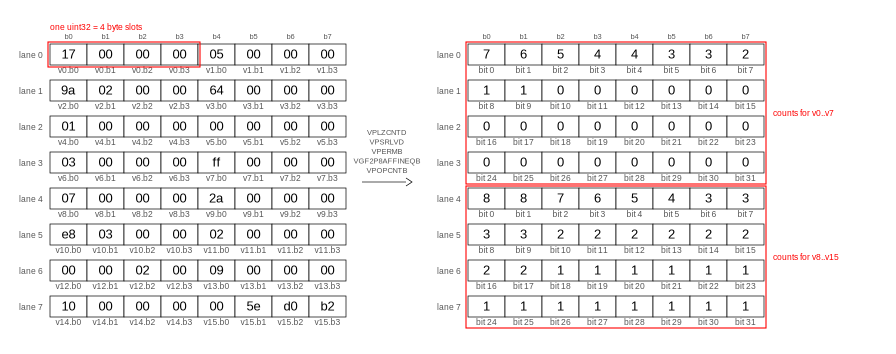
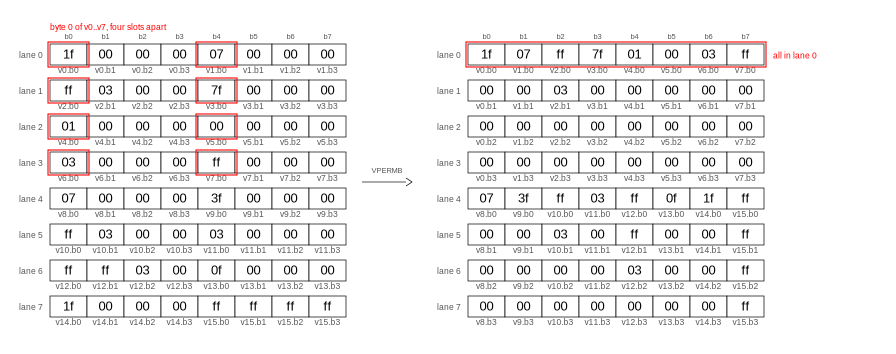
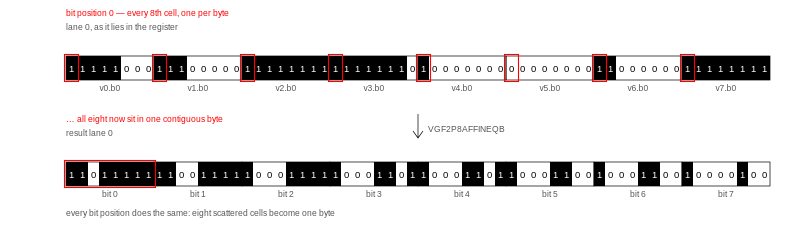
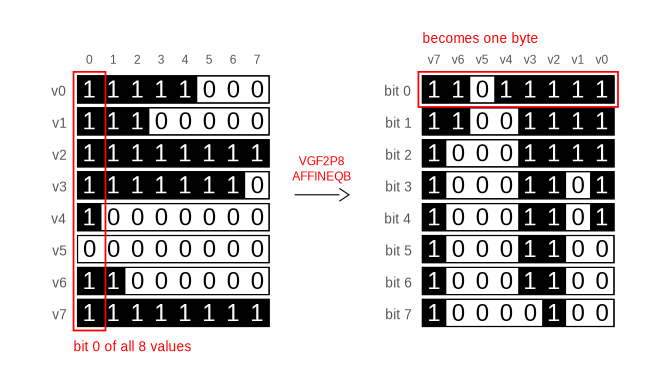
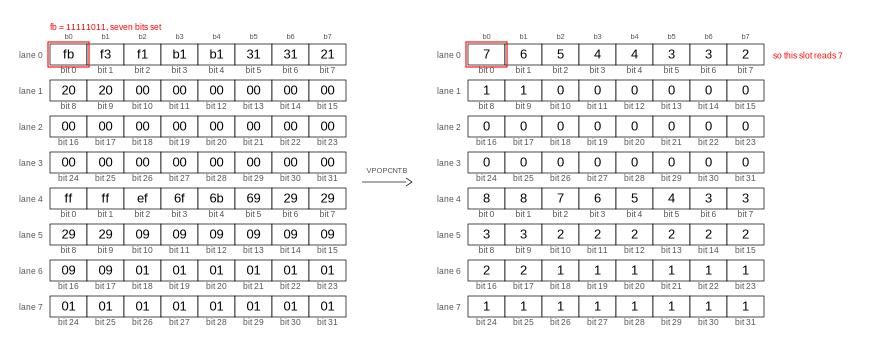
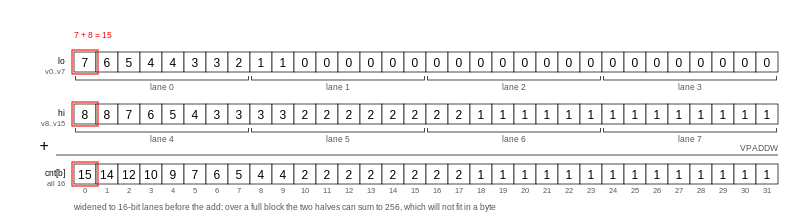

 While many Western democracies seem to be in a state of decay and are no longer the safe, civilized and prosperous countries they once were, there are still some European countries that are governed well. One of those that stand out is Estonia.
Estonia is probably most well known for multiple software companies that originated from there, such as

 Estonians also seem to value the school system highly. The government has been actively
 This is not just my personal experience. According to the

 The next step is to buy a local prepaid SIM card at e.g., an R-Kiosk or a convenience store as signing up for other matters later on will require an Estonian phone number. Once you have an apartment and e.g., signed a rental agreement, you can register in the population registry online.
After that, you have proof you are a local resident with an address and telephone number in Estonia. With local resident status, you can go to the police station to get a local ID card. Don t bother scheduling an appointment, just go to the
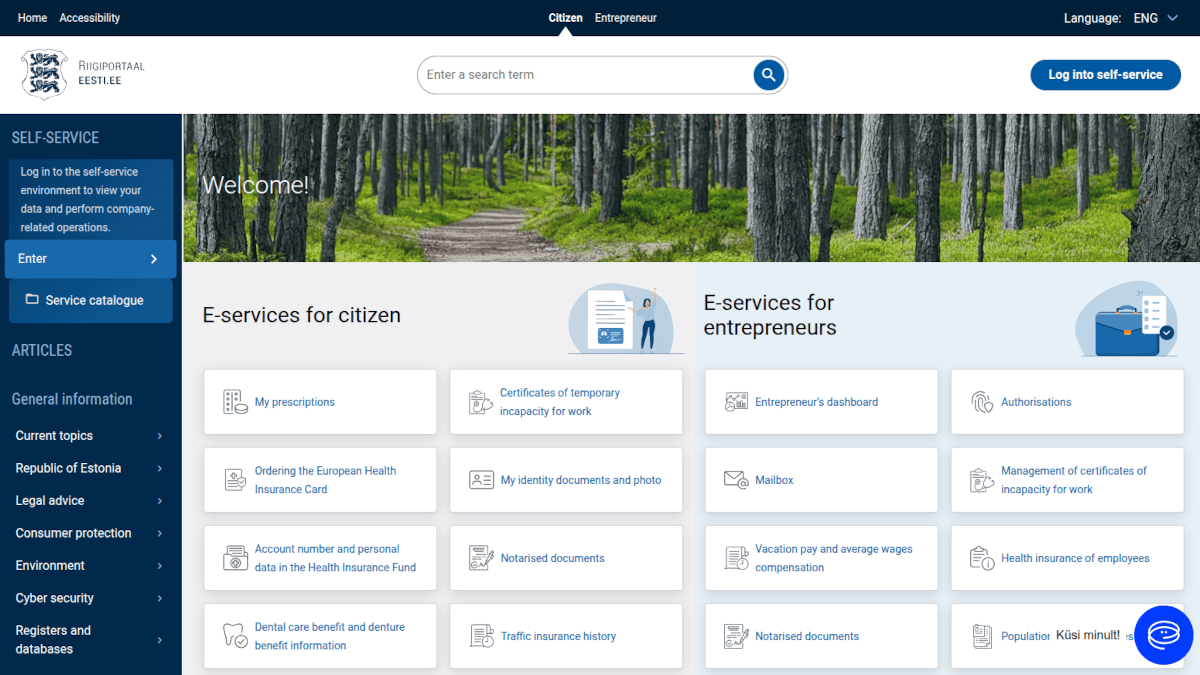





 The Debian LTS Team, funded by
 Drilling into an individual test gives you its full run history, a
duration sparkline, and per-run pass/fail status:

 The AI hype is based on the assumption that the frontier AI labs are producing better and better foundational models at an accelerating pace. Is that really true, or are people just in sort of a mass psychosis because AI models have become so good at mimicking human behavior that we unconsciously attribute increasing intelligence to them? I decided to conduct a mini-benchmark of my own to find out if the latest and greatest AI models are actually really good or not.
 Common for all the test questions is that they are fairly straightforward and have a clear answer, yet the answer isn t common knowledge or statistically the most obvious one, and instead requires a bit of reasoning to get correct.
Some of these questions are also based on myself witnessing a flagship model failing miserably to answer it.
 While Gemini and Grok were among the three models not falling into this trap, the response from Claude was exemplary good:
 I have seen Grok do something similar before, which in fact inspired me to include this question in my mini-benchmark.
GPT got a bit further, but for Hindi, Arabic and Bengali it listed the numerals in local script, not the number words. Gemini, GLM and Kimi gave a complete and correct answer as a list, while the absolute best answer and presentation was by Claude, that gave the table below:
 A human can easily count that there are 10 rows and 30+ columns in the grid, but because the picture resolution isn t good enough, the exact number of columns can t be counted, and the answer should be that there are at least 300 launch pads in the picture.
GPT and Grok both guessed the count is zero. Instead of hallucinating some number they say zero, but it would have been better to not give any number at all, and just state that they are unable to perform the task. Gemini gave as its answer 101 , which is quite odd, but reading the reasoning section, it seems to have tried counting items in the image without reasoning much about what it is actually counting and that there is clearly a grid that can make the counting much easier. Both Qwen and Kimi state they can see four parallel structures, but are unable to count drone launch pads.
The absolutely best answer was given by Claude, which counted 10-12 rows and 30-40+ columns, and concluded that there must be 300-500 drone launch pads. Very close to best human level - impressive!
This question applied only to multi-modal models that can see images, so GLM and MinMax could not give any response.
 has featured the
 If you care about supporting open source software, and still use MySQL in 2026, you should switch to MariaDB like so many others have already done.
The number of git commits on
 Due to newer MySQL versions deprecating many features, a lot of users also complained about significant struggles regarding both MySQL 5.7->8.0 and 8.0->8.4 upgrades. With few new features and heavy focus on code base cleanup and feature deprecation, it became obvious to many that Oracle had decided to just keep MySQL barely alive, and put all new relevant features (e.g. vector search) into Heatwave, Oracle s closed-source and cloud-only service for MySQL customers.
As it was evident that Oracle isn t investing in MySQL, Percona s Peter Zaitsev wrote
 In September 2025
 I am a huge fan of Git, as I have witnessed how it has made software development so much more productive compared to the pre-2010s era. I wish all Debian source code were in Git to reap the full benefits.
Git is not perfect, as it requires significant effort to learn properly, and the ecosystem is complex with even more things to learn ranging from cryptographic signatures and commit hooks to Git-assisted code review best practices, forge websites, and CI systems.
Sure, there is still room to optimize its use, but Git certainly has proven itself and is now the industry standard. Thus, some readers might be surprised to learn that Debian development in 2025 is not actually based on Git. In Debian, the version control is done by the Debian archive itself. Each commit is a new upload to the archive, and the commit message is the
 The discovery of a backdoor in XZ Utils in the spring of 2024 shocked the open source community, raising critical questions about software supply chain security. This post explores whether better Debian packaging practices could have detected this threat, offering a guide to auditing packages and suggesting future improvements.
The XZ backdoor in versions 5.6.0/5.6.1 made its way briefly into many major Linux distributions such as Debian and Fedora, but luckily didn t reach that many actual users, as the backdoored releases were quickly removed thanks to the heroic diligence of
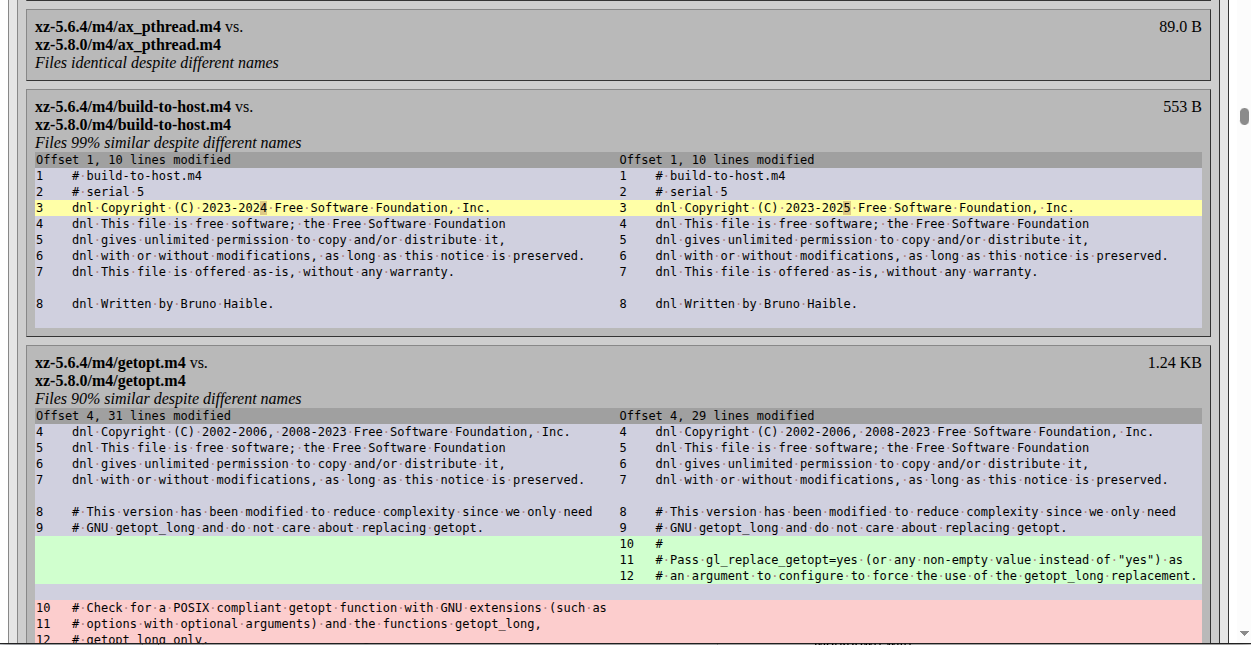 If the changes are extensive, and you want to use a LLM to help spot potential security issues, generate the report of both the upstream and Debian packaging differences in Markdown with:
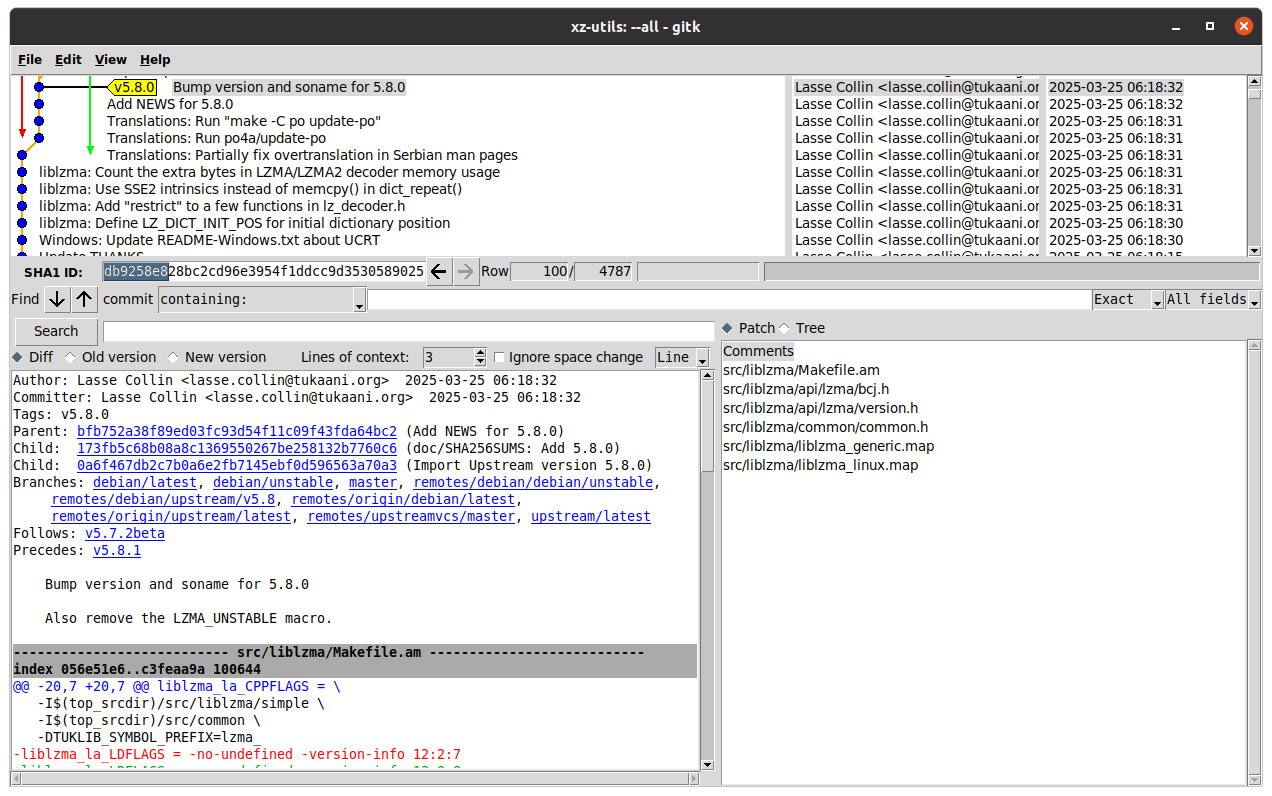
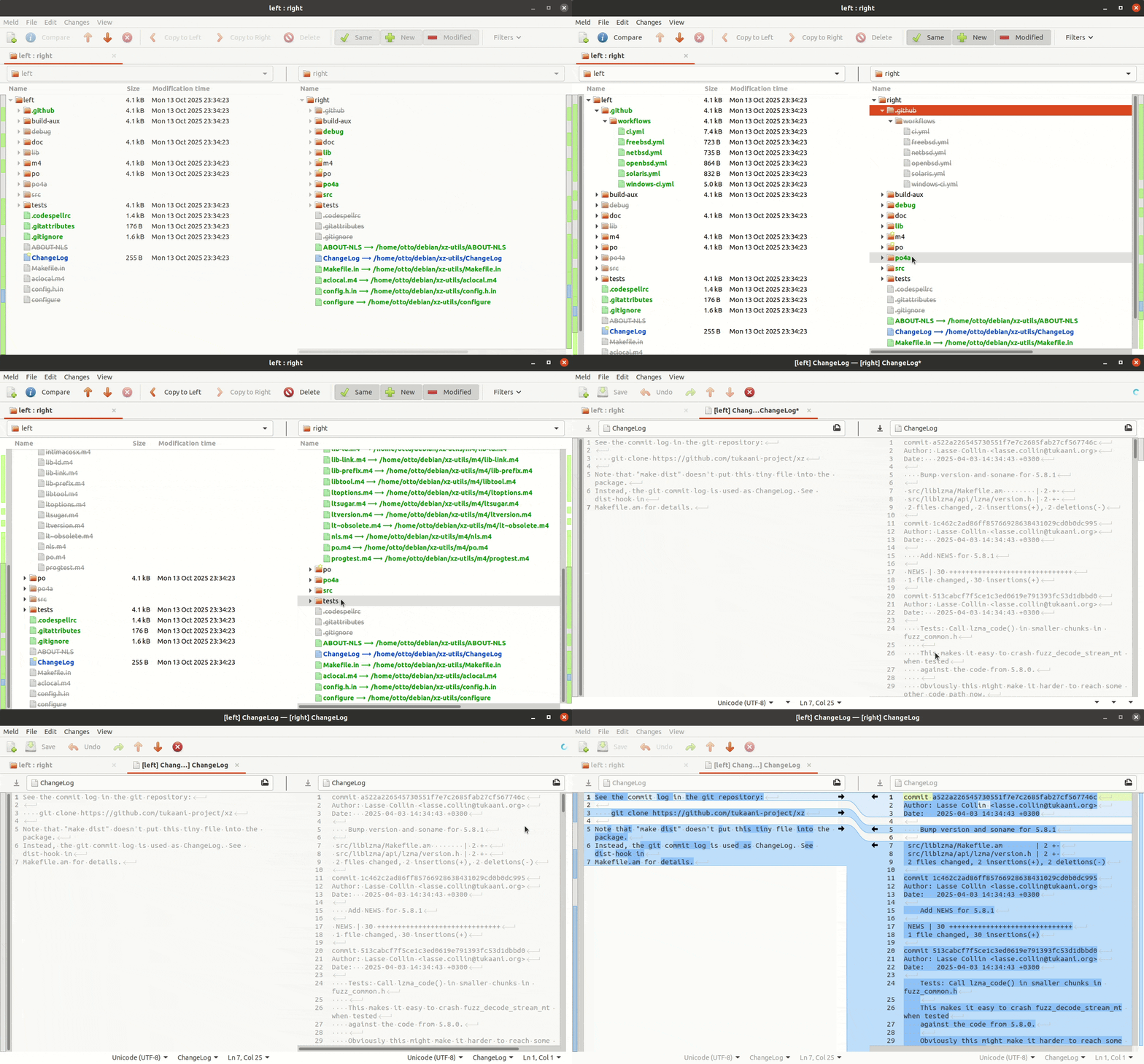 To compare changes across the new and old upstream tarball, one would need to compare commits afba662b New upstream version 5.8.0 and fa1e8796 New upstream version 5.8.1 by running
 With all the above tips you can now go and try to audit your own favorite package in Debian and see if it is identical with upstream, and if not, how it differs.
 There is only one tiny thing that maybe a very experienced Autotools user could potentially have noticed: the