Debian packages may seem simple to generate using the many bundling tools out there, but it is much more involved than that. There are policies and procedures in place before stuff can get into Debian, including how the package is made, what it must include, and more. This article aims to cover the stuff prospective contributors to Debian should know that other resources miss.When I started, I didn't know a lot of this and had to learn a lot along the way. Hopefully what I've put together here will make it easier for the next person that comes along.
Find the right thing to work onPackages are the bread and butter of Debian, so it may be the first place you look at. There are two ways to go: adopting or helping out with an existing package, or introducing a new package.Outside of packaging, contributing to Debian's infrastructure is also very much welcomed and appreciated, especially as a lot of it is decades old. Some examples include Lintian (Debian package linter), DAK (archive software), and distro-tracker (package info tracker), and there are many, many other projects in need of help.If you are a native speaker of any non-English languages, you may want to also consider helping translate stuff. Everything from the installer to mentors.debian.net to package descriptions needs volunteers to translate.This article mainly focuses on the packaging side of things.
Working on an existing packagewnpp.debian.net lists packages that need help with maintenance.The most useful thing you can do as someone interested in packaging is to help with an existing package. You can either:
Help other maintainers on an existing package. Maintainers will publish Request for Help (RFH) bugs asking for assistance to maintain a package. Some packages are so unruly that help is welcome even when not asked (e.g. Docker).
Adopt an orphaned package. An orphaned package is one where the previous maintainer could not continue maintaining it for whatever reason, and so it needs a new maintainer (or deletion). These are indicated by Orphaned (O) bugs. Request for Adoption (RFA) bugs are similar, as they mean the maintainer is about to orphan the package.Some orphaned packages are effectively abandoned, being both unmaintained upstream and having no users in Debian, but many maintainers will choose to orphan these packages rather than remove them. Keep this in mind when looking through the list.
By the way, this is how I started contributing to Debian! With the help of a Debian Developer, I adopted kitty, and to this day I continue to maintain it.
Introducing a new packageMany people opt to start their Debian contribution journey through producing a new package for the Debian archive. Unfortunately, many people do not do this properly or try to use Debian as a dumping ground for their own software, so here is a general checklist to see if something belongs in Debian:Repology shows an overview of a package across Linux distributions.
How established is the software, and is it still maintained? The longer a project has been around while continuing to be actively maintained, the more likely it is to continue to be maintained in the long-term.
How many people use the software? Hundreds? Thousands? How many people will benefit from the software being packaged and included in the Debian archive?The point of packaging something for Debian is to make it easier for the existing userbase to install the software. For instance, as a user you generally expect notable software like Firefox and Vim to be available with a single apt install, and it would be weird if you had to hunt down binary tarballs or build these from source.
Do any other Linux distributions package the software? If yes, that's a good indicator it belongs in Debian as well. You can check this on https://repology.org.
Does the software introduce new or unique functionality not found in any other software currently present in the archive? It's okay if it doesn't, but there would be a much stronger case for a new package if the answer is yes.
Does the software have generally stable releases and proper versioning? If it doesn't, it's going to be a whole lot harder to create and maintain a package for it, considering Debian is a distribution that releases snapshots of software every 1-2 years with nothing but security updates for stable.
You also need to keep in mind that you should be prepared to maintain the software throughout the lifetime of the next Debian stable. Debian is not a rolling release distro. You cannot upload new versions of software to stable. The only thing you can upload to stable are fixes that meet the stable release team's criteria, and security fixes via the security archive, which you sometimes have to cherry-pick and backport if upstream does not provide them. And Debian packaging is not a one-off task; you should be ready to look after the package long-term, which consists mostly of updating the package in unstable for new upstream releases and fixing bugs.Many people miss the memo. They bring their "revolutionary" app that they threw together (often vibe-coded) in a weekend and try to get it added to Debian. Project members mostly won't upload such packages; as a result, more useful packages may be drowned out. At the time of writing, I estimate around half of the open Request for Sponsorship (RFS) bugs is this kind of toy software with little to no real users.If you've made something, great! Feel free to package it, but distribute it in your own external repo. Not everything belongs in Debian, and no Debian Developer has an obligation to sponsor and upload your package. Services like GitLab, and Forgejo (Codeberg) also have built-in repository features that let you easily create an external apt repository.When looking at software that could potentially be packaged, also consider the amount of effort you may have to spend investigating licensing status and compiling copyright information. This is covered a bit later in this article.
Become familiar with Debian packagingNow, you probably don't need read the Debian Policy and Debian Developer's Reference from cover to cover, but you should familiarise yourself with Debian packaging and the key infrastructure involved. Look at the important bits in the Policy and Developer's Reference.Check out this list of packaging manuals and this introduction to packaging on mentors.debian.net for some additional material. There are also some great manual pages like deb-control(5), deb-src-control(5) (from dpkg-dev), debian-watch(5) (from devscripts), and dh(1) (from debhelper) describing some of the packaging files in detail. You can read these with the man program or at https://manpages.debian.org.Look at other similar packages and pay attention to how they were made. Ask questions when you're unsure, people are always willing to answer on the debian-mentors mailing list and IRC channel.Once you get a rough idea of how a Debian package works, it will feel natural working through packaging files.By the way, you can read a lot of these documents offline: manpages can obviously be installed and read on your own machine, but the debian-policy and developers-reference packages (from unstable) will allow you to read the policy and reference offline as HTML in their respective directories under /usr/share/doc/.
Git-based packagingPeople have many opinions on how to create a package, but by far the most popular is the GBP format for packaging in a git repo.GBP stands for git-buildpackage, the tool behind this workflow, based[2] loosely on the DEP-14 proposal. Here, the upstream code is placed in an "upstream" branch (this is what goes in the .orig.tar.xz tarball), and the Debian-specific packaging work is placed in a "debian" branch (this is what goes in the .debian.tar.xz tarball).Many people have different ideas of what these branches should be called: upstream vs upstream/latest, debian/latest vs debian/unstable vs debian/sid. It generally doesn't matter though as the end result will be the same either way.Using a git repo for your packaging rather than just a DSC makes it easy to see and review the changes you've made, and allows others to easily get the package source with full history and contribute (when located in a permissive group on Salsa like debian/ or one of the many teams).It goes without saying that you should maintain proper commit hygiene by separating changes into multiple commits, having meaningful commit messages, and avoiding force pushing whenever you can.Commit messages do not need to have explanations like other projects may expect, but feel free to add one if you think it will help whoever is looking at your changes understand what's going on.Keep in mind that you can and should use the gbp-dch-style meta tags, which are Gbp-Dch, Thanks, and Closes, documented in the gbp-dch(1) manpage:
Gbp-Dch: ignore will not include your commit in the generated debian/changelog when gbp dch is executed.
Gbp-Dch: full will include the extended description of your commit as well in the generated debian/changelog when gbp dch is executed.
Thanks: John Doe will add a thankyou to the person named in the generated debian/changelog when gbp dch is executed. Useful when a commit is related to a bug report, patch or other useful contribution from someone else.
Closes: #123456 will add the relevant (Closes: #123456) in the generated debian/changelog when gbp dch is executed, to close one or more (comma-separated) bugs in the Debian Bug Tracker when the package is uploaded.This is the most important one, and should always be used even when not using GBP in an alternative workflow. Most groups on Salsa, including debian/, have webhooks that will send an email to bug reports and tag them as pending if a commit using this meta tag is pushed, which is great for notifying people that a fix is ready and about to be uploaded.Note: Don't bother trying to add Closes: to your "Initial packaging" commit description; there is no need and debian/changelog should already close it in your initial packaging work.
Team maintenanceMore and more packages are being moved into "team" maintenance with weak package ownership, over the traditional single-maintainer model with strong ownership. This allows everyone to help maintain a package through team uploads, rather than relying on the same people to remain active.When it makes sense, you should try to maintain your package in a team, especially as it will have other contributors familiar with the topic or language that may be able to spot issues in your package others may miss.Most packaging teams fit into two categories:
Language teams - these are teams that package software exclusively written in a specific programming language, and usually also maintain the toolchain for that language as well. Examples include the Go team, Python team, and Rust team. Many of these teams also have their own tooling to make packaging easier for these languages, like dh-make-golang and debcargo.
Topic teams - these are teams that package software related to a certain topic or project, usually by contributors very interested in that topic. Examples include the Med Team, the Electronics Packaging Team, and the Debian Vim Maintainers.
Language-specific libraries like golang-*-dev packages should almost always be maintained in a language team, and packages centered around a project like Vim or Treesitter should be put in the related team if it exists. For all other cases, it is completely up to you. It usually does not matter which team you put it in, as long as you put it in a team, as you get the same benefits. Keep in mind, many teams have certain policies and guidelines for how packages within them should be maintained, so make sure to check that.If you're maintaining stuff outside of a team, you should consider adding yourself to the LowThresholdNmu list to indicate that you are happy for people to follow a relaxed non-maintainer upload process when it comes to these packages.
Compiling copyright information Upstream sometimes adds files taken from other projects, which must be documented in debian/copyright.Every Debian package must include copyright information. In the packaging source, this is in debian/copyright, and this ends up being installed under /usr/share/doc/<package>/copyright on Debian systems.This is important for a variety of reasons, some of which are:
It establishes that the software is compliant with the Debian Free Software Guidelines (when in main).
In the case of packages in the contrib and non-free archive areas, it helps people running mirrors or creating installation media (like install USBs) determine which software they are allowed to redistribute.
It helps people working in enterprise settings produce a Software Bill of Materials (SBOM).
It provides a consistent source of licensing information for software installed on your system so that you, as the end user, don't have to hunt down this information yourself.
All new packages should follow the machine-readable debian/copyright specification to produce a consistent, complete copyright file that covers every file in the source package.As a result, this can mean a lot of work hunting down copyright and license information, especially for large software projects. In fact, you will often spend more time on the debian/copyright file than the rest of the package combined when working on Debian packaging.There are a range of copyright review tools to make your life easier when doing this work. Some of the highlights are:
licensecheck - tool to try to detect the license of files passed to it
licenserecon - uses licensecheck to compare detected licenses against those in debian/copyright and shows you the differences
scan-copyrights - generate a preliminary copyright file using licensecheck, useful for finding stuff that got missed
When the licensing status of a file is unclear, you may have to ask the upstream author to clarify. Note that if something has no license (e.g. upstream does not specify a license at all for their project), it is considered "all rights reserved" and cannot be distributed in Debian.Some projects will have vendored copies of some or all of their dependencies. When this is the case, you need to remove as much as possible and make the package use the libraries provided in Debian instead, as this is a Debian policy requirement (more info on this wiki page on embedded copies). Additionally, you may need to remove non-DFSG-compliant parts of upstream's source to ensure the package is DFSG-free. Both of these are done via repacking, which involves:
Specifying the Files-Excluded field in debian/copyright, preferrably with a Comment as well on why it is being repacked.
Modifying the tarball retrieved from upstream to remove these files. Some people do this by hand, but it is better to use either mk-origtargz (from devscripts) to do this when you already have a tarball, where it will read and use Files-Excluded (refer to it's manpage), or uscan, which will download a new tarball using your debian/watch file and then run mk-origtargz on it.
Adding a +dfsg (repackaged for DFSG reasons) or +ds (repackaged to remove vendored copies or other reason) suffix to the upstream version. This will appear in the name of the repackaged tarball (e.g. foo_1.2.3+ds.orig.tar.xz), and in the upstream part of the Debian version (e.g. 1.2.3+ds-1, where 1.2.3+ds is the upstream part). If you end up repacking the same version multiple times, you can add a numeric suffix (e.g. +ds2) to indicate this.
Also make sure to check if your package source contains binary files like images and PDFs, and to figure out if they have separate copyright and licensing status. Some of these files have their copyright information embedded within them. Of course, you can ignore build artifacts, as long as they are cleaned and rebuilt during package build.
Build and check your packageYou should build your package in a clean unstable environment to ensure that your Build-Depends pull in all the required packages from the unstable repos. The best tool to do this is sbuild, which builds your package in an isolated unshare-based environment and allows easily running lintian and autopkgtest as well; this is the same tool used by the Debian build daemons (buildd) once your package is uploaded.There is a great sbuild page on the wiki containing setup instructions and many useful tips.There are many quality-checking tools available to catch common and not-so-common issues with your packaging. Using the sbuild configuration that the wiki page suggests, after each build it will automatically run:
Lintian: static Debian package checker that analyses the outputted files (.deb, .dsc, .changes)
Autopkgtest: tests your package as installed on a testbed system if your package defines them
Piuparts: checks your package cleanly installs, upgrades and removes (useful for checking custom installation and removal scripts)
You should always check the output of these tools and ensure they pass. Debian Developers use these same tools when reviewing your packaging.If you are able to and when it makes sense, you should also install the package onto your own system and check everything works correctly. Even if a package builds successfully, it may not actually work when installed.Unless your package only produces Architecture: all packages, you may want to also check that it cross-compiles correctly. You are probably either reading this on an amd64 or arm64 device, so you can easily cross-compile to the other architecture using the --host option with sbuild. Ability to cross-compile is not a policy requirement, but it will be raised as a bug against your package if it fails to do so.Adding on to that, if your package is not straightforward and it produces packages on multiple architectures (usually Architecture: any), you may want to also check that it compiles on all of Debian's release architectures (aka. official ports). You can do this using virtual machines (QEMU is probably the easiest), but if you can't do this for whatever reason (like your computer being too weak to run a VM or the long package build time), also note that Debian Developers have access to porterbox machines that can be used to check your package before upload.
Find a sponsorNew contributors cannot upload to and manipulate the Debian archive directly. Rather, they need a Debian Developer to do so on their behalf after reviewing all their work; this person is called the "sponsor".If you are planning to maintain your package within a team, check if they have their own guidelines or policy for finding a sponsor, as this will likely be quicker than the traditional RFS process outlined below. For instance, in the Go team, sending an email to the mailing list is much better, especially since usually multiple packages need to be uploaded at once.Outside teams, the usual method is to upload your package to mentors.debian.net, and then file a Request For Sponsorship (RFS) bug to ask for a sponsor. The mentors website has an overview and very clear instructions on properly filing an RFS and finding a sponsor. Properly formatted RFS bugs go a long way.When filing the RFS bug, make sure you follow the template exactly. Deviating from it or sending a misformatted email is one of the quickest ways for your RFS to be both ignored by humans and missed by automated tools, so double check that it actually has everything needed. Ensure each of these fields is filled correctly:
Package name: This is the name of the source package set in debian/control.
Version: The version of the package you want the sponsor to upload, usually the latest version in debian/changelog.
Upstream contact: The contact info you put in the Upstream-Contact field in debian/copyright. This can be a name & email or a URL (e.g. to upstream's issues tracker).
URL: The homepage of upstream's website, usually from the Homepage field in debian/control.
License: List all the licenses present in debian/copyright, comma-separated.
Vcs: The URL to your Git repo containing your packaging, which should be on salsa.debian.org and be set up accordingly in the Git-buildpackage format.
Section: The value of Section in debian/control for the source package.
Adding notes or comments to the end of the RFS message is fine, but make sure the rest of it follow the right format.Things to keep in mind include:
Do not file multiple RFS bugs, for any reason. If you have reuploaded your package or made a change, you can send a follow-up to the same bug.
If you want to change the name of your RFS (e.g. following a change in the name of the package), modify the tags or anything else, you can send commands via email to the Bug Tracking System (BTS).
Your RFS bug will only be closed if the package is uploaded or someone decides your package should not be uploaded.
Do not change the Package: field at the top of the email from sponsorship-requests, this tells the BTS that your bug report should be filed against sponsorship-requests and not some package in the archive.
The Severity: field at the top of the email should be "wishlist" for new packages, "important" for updates fixing Release-Critical (RC) bugs, and "normal" for everything else.
Skipping the bug and sending an email directly to the debian-mentors mailing list is a great way for your RFS to be ignored, especially since automated tools will not be able to pick it up.
Format the bug's title correctly. It needs to be RFS: name/version [ITP/ITA/RC/NMU] -- short description. Again, this is helpful for automated tools when they try to figure out what your RFS means. Examples include:
RFS: qiv/3.0.4-1 [ITA] -- Quick image viewer
RFS: wattsi/0.0~git20251112.d8caa36+dfsg-1 [ITP] -- Preprocessor for the HTML Standard
Now, when filed properly, an interested sponsor may come along and review your package, then either upload your package or send you feedback to iterate on before that. Ensure you watch for responses to your RFS and respond promptly.Note there is no obligation for anyone to upload your package, and that anyone can review your package but only Debian Developers can upload it for you.The Lintian output given by the Mentors website was usually right, but at the time of writing the website is using an outdated version of Lintian, so many of the hints it gives are incorrect. For the most up-to-date output, it's best to run Lintian from unstable on your own machine (which sbuild does for you).
Next stepsIf your package is new to Debian, it will head to the NEW queue for manual review. Here, the DFSG team primarily checks that the package is compliant with the Debian Free Software Guidelines and is suitable for "main", but also check for mistakes in debian/copyright and obvious/major packaging issues.Once your package is uploaded, whether new or existing, and you are named maintainer, you are in charge of looking after it, including new upstream version uploads to unstable, bug fixes, and security fixes. This mostly involves updating and cherry-picking fixes from upstream, but occasionally it gets interesting and you need to dive into the packaging to figure out what's going on and fix the issue.You should try to work towards becoming a Debian Maintainer at the very least in order to easily maintain packages long-term. As a DM, you can be granted upload permissions on a per-package basis for your existing packages so that you don't have to rely on sponsors forever. Having this goal can also appeal to sponsors.Have fun packaging!
(Opinion) What I look for in an RFSThis is not definitive, but I usually scan for these indicators:
Upstream and the packager being the same person is usually a red flag for a low-quality package. Exceptions can be made when it makes sense and this would actually be a benefit, but this is rare.
Properly formatted BTS bug, which shows ability to follow a simple guide.
The software existing in other Linux distros is a good sign.
Packaging VCS should be up-to-date, located on Debian Salsa, and follow Git-buildpackage / DEP-14 format. Deviations should only occur for a good reason. Only experienced packagers should really be experimenting with alternative Git styles like dgit-maint-merge etc.
I can understand what it does just from the package's full description, without having to go to upstream, since this helps me gauge whether I am interested in sponsoring the package. This is not always the case, since packages sometimes come through of a technical nature (usually kernel-related or maths/science packages) where I wouldn't be able to understand no matter how hard I try.
Updates to existing packages and adoptions (ITAs) are easier to sponsor than new packages since it doesn't have to go through the NEW queue and does not need to justify its addition to the archive.
Common misconceptions about Debian
Debian Developers and Debian Maintainers speak for themselves, not for the project. They are just people who happen to have some permissions in the project.The only official way to put forward the position of the Debian Project as a whole on a particular issue is through a General Resolution as per Debian's constitution. Other official sources include those maintained by the Publicity Team delegates, such as Debian News and Bits from Debian.Also note that delegates for a certain team can speak on behalf of that team. In this case, they usually get consensus within that team before making such statements.
The only formal, official "teams" in Debian are those delegated by the project leader, listed at https://www.debian.org/intro/organization.Debian does not have a "legal team", the debian-legal mailing list is for discussion about licensing.There is no "Debian Team", it's just a bunch of contributors working together to deliver a quality collection of packages. Packaging teams are informal, as they are not delegated; rather, they are people working on a certain category of packages under one roof.
Keep in mind contributors are all volunteers, with most not getting paid to work on Debian. Debian is owned by a non-profit and relies on donations, rather than a company like Ubuntu and Canonical. The Debian constitution explicitly states that no contributor is obligated to do anything.
Whalesong is a far-future semi-military science fiction novel and
the third in the Arana Imperii series, not counting the story collection
Beyond the Fringe. It did an adequate
job of jogging my memory of previous events, but I kind of wish I had
re-read the series before reading this entry.
Artifact Space and
Deep Black were closely linked, almost
one novel in two volumes. Whalesong is not. There is a frame story
featuring Nbaro and Dorcas and an introductory story featuring Nbaro's
friend Qaqqaq, but the protagonist for most of the novel is a minor
character from the earlier books: Thor Storkel.
After Deep Black, Storkel mustered out of the DHC and purchased the
captured New Texas ship Silver Star. An arrangement with Morosini
involving secret reserve status let him keep a hidden weapon system. His
plan was to become an independent trader, working for himself and going
wherever he wanted.
This did not go as smoothly has he planned. Keeping a ship running was
expensive in numerous ways that had never previously been his problem, and
the end of the Non-War meant a glut of ships and crews trying to do the
same thing he was doing. His PTSD and associated paranoia from his time on
the Athens didn't help. As Whalesong opens, Storkel is
running the Silver Star by himself (a horrible idea), trying to
find both cargo he can make money on and crew he can afford to hire.
Also the antigravity is weirdly glitchy, and he's fairly sure the ship's
sub-AI doesn't like him.
Whalesong feels like an interlude in the larger series. Although
there are important connections to the larger series plot, the advancement
of that plot is limited and mostly happens in the background. Instead,
this is more of a merchant adventure with some found family vibes,
returning to military SF and larger political concerns only late in the
book. It felt like Cameron needed to move pieces into place for the next
major plot development and decided to use that interlude to tell a smaller
character story.
The appeal of this book is therefore going to depend on how much you like
the characters. Storkel is an improviser and a tinkerer, the kind of
person who sets up an elaborate set of tools and macros and alarms to
partly automate his job without letting go of any piece of it. The primary
tension in the story is Storkel's paranoia and the increasing evidence
that it is justified, that there is something fundamentally wrong with his
ship. By himself, Storkel is a little too intense. Thankfully, he
gradually accumulates crew over the course of the story, and that settles
him down and adds some enjoyable character interactions. Dorcas, when he
shows up, is exactly like Dorcas in the previous books; if you liked him
before, you'll still like him here.
This is the kind of book that I enjoyed while reading and then promptly
forgot most of as soon as I finished it. The details of Storkel's attempt
to become an independent trader and how it is slowly hijacked by the
series plot is competent, but not more than that (at least for me). The
one real complaint that I have is that Nbaro, even when mostly off-camera,
continues to be hypercompetent and central to DHC politics in a way that I
found a bit unbelievable. Otherwise, the worst that I can say is that this
book never grabbed me like Artifact Space did. I happily turned the
pages, but I probably won't read it again.
After reading this book, I re-read both Artifact Space and
Deep Black and greatly enjoyed both of them. I haven't felt any
similar desire to re-read this one.
If you're following the series, there's no reason to skip
Whalesong, but I doubt it will be your favorite.
Followed by The Alien's War, which will hopefully have the sort of
major plot advancements hinted at by the title. At the time I am writing
this review, it is scheduled for publication in September of 2027 in the
UK and does not yet have a publishing schedule in the US.
Rating: 7 out of 10
For my thesis paper I had the need to have high-quality diagrams as images to include
in my LaTeX document. While TiKz provides a neat way to do so, sometimes it does not cut it,
especially if you want to have a certain degree of flexibility or add some signal forms.
Furthermore, writing TikZ (CircuitTikz in this case) can be rather convoluted.
While solutions such as the online designer
exist, IMO a plain drawing is just better.
Inkscape to the rescue
Fortunately, inkscape has all we need to produce high-quality circuit diagrams.
Install it via apt, and then first add the electrical symbols library:
Then open inkscape. The newly added symbols can be found at Objects->Symbols (or press CTRL+Shift+Y).
To efficiently draw, press "#" to enable the grid, and set "Enable snapping". This makes it easier to
align the objects to the grid.
Afterwards, one can just drag and drop symbols from the menu onto the drawing area, and construct a transmission
line like this:
Function plotting
The best part is inkscape also supports plotting signals that follow a mathematical expression. This comes
especially in handy if you need to have some signal next to a circuit part. This can be done via
Extensions->Render->Function plotter. It is a bit convoluted, since you first need to draw a rectangle, which is then
converted to a plot. In this example, I drew a fourier transform of a square wave with five terms:
4/pi*(sin(x)+1/3*sin(3*x)+1/5*sin(5*x)+1/7*sin(7*x)+1/9*sin(9*x))
Then set some defaults: Check "Remove rectangle"; uncheck "Cut with rectangle", "draw axes" and "Add endpoints on x-axis".
For the scaling, I chose an x range of -0.5 to 0.5, checked "multiply x values by 2 pi", an y range of -1 to 1, and 100 data points.
I also unchecked isotropic scaling and polar coordinates.
The end result (with some inkscape coercing) is a nice jittery rectangluar waveform:
Overall, this is pretty nice and allows for high-quality images. Once the svg is finished, it can easily be exported as png.
I recommend a DPI of 300.
On 22nd May 2026, we organized a MiniDebCamp at Bolgatty Palace, Kochi, Kerala.
The actual discussion for this year s camp began when we had a small meetup at Urbec s place in Kochi. We decided to do a MiniCamp rather than MiniConfs which we were doing for quite some time. Also, We had already done a Bug Squashing Party last year with 4 people and we wanted to do a bigger one this time.
Kiran(hacksk) was involved with organizing the camp initially. Later when we finalized the dates for the camp, he had to leave since it conflicted with another event he had to attend. Thanks to Aryan(spaciouscoder) for the event logo and designs. Due to his exam clashes, he also couldn t attend the event.
Choosing venue wasn t hard this time. We were already in talk with Bolgatty Palace for a bigger event and we decided to conduct the camp here after couple of visits and negotiations on rates. Our booking was still with them due to the unfortunate event happened during the DebConf23.
Our announcement and Wiki page
We opened our registration via LiberaForms as we had decided on avoiding non free platforms for data collection and wanted to do it as private as possible. After exploring our options, we decided on LiberaForms. We prepared a data collection, retention and destruction policy for the event. We purposefully only asked for the required fields. We were so particular that we didn t even have a phone number filed but this backfired a little. Turns out many people don t check mail as frequent as we thought. Inspite of it, we managed to reach out with updates on the event successfully.
In parallel, we also sent out some mails for sponsorships. Thanks to OnlyOffice and FOSSUNITED who generously sponsored our event and enabled us to accommodate more participants. Since its a camp and not just a BSP like last year, we welcomed new people to the event.
We started the event on Friday evening. We did a small orientation for new comers. Before the event, we shortlisted some bugs and tasks to share. All began hacking on stuffs that was interesting to them. Some did packaging, some did bug fixes and others worked on website fixes. There was even some fiddling done on beagleboard SBC and other boards.
The venue was calm and serene. The weather was nice, notwithstanding the few downpours we experienced. Some people from Hyderabad (South eastern side) and Kolkata actually got amazed by the tropical greenery around the venue and Kochi in general. The food served to us through out the event was amazing and accommodation was also very nice.
In terms of bug squashing statistics, we managed to touch 93 bugs \o/ and of which 82 bugs are resolved. Parallel to bug squashing, Subin (bin/su) and Muneer worked on revamping the Debian Project website. MRs
Seeing the outcome, we are hopeful and thrilled to conduct this as an annual event. Couple of people had a brainstorm later and the current decision is to do similar event next year in Bengaluru, given it will be more accessible than Kochi.
A few years ago the kitchen of the company I worked for suddenly had no soup spoons or dessert spoons. One day there was about 40 in the drawer and the next day there was none, to the great annoyance of everyone who ate breakfast cereal, soup, and similar food at the office. Someone had stolen about 20 dessert spoons and about 20 soup spoons while apparently not stealing tea spoons, knives, or forks.
For a while I kept my own soup spoon in a locked desk drawer, but that was a hassle. After a couple of months of unsuccessfully lobbying management to buy more spoons I went to an op-shop (thrift-shop for American readers) and bought most of the soup spoons and dessert spoons they had and donated them to the office. After that everything was good for about a week until all the regular knives were stolen. They didn t steal carving knives or bread knives, just the type of knife you would use to eat dinner or make a Vegemite sandwich.
After the knife theft management agreed to buy new knives.
Not long after that the company had financial issues and I was laid off, so I don t know whether the forks ended up being stolen later on. If the cutlery thief wasn t among the people laid off then I m sure a fork heist happened sooner or later.
I remain mystified as to why someone would want to steal cutlery. The security around laptops wasn t great and walking out of the office with a laptop would look much less suspicious than walking out with a bag of spoons or knives. One would expect that stealing a laptop and selling it to buy cutlery would be a better option.
If anyone who lives in my area wondered why their local op-shop had a sudden lack of spoons, I m sorry that I don t have a satisfying answer for you, just many more questions.
For some time now I ve been looking for a way of keeping projects I m working
on in a separate VM without much setup. There are numerous solutions to do this
kind of thing using namespaces (various container technologies, firejail,
flatpak, bubblewrap, ) but I wanted something that uses real virtualization.
I recently stumbled upon incus and it
seemed like it could be a solution to my problem. Incus is a manager for both
containers and virtual machines. It is possible to create VM images that can be
used as templates, meaning that other machines can then be based on them on
creation. Virtual machines can be configured using profiles .
For my use case, I have created a profile that defines how my template image
should look like. In this profile I use
cloud-init to configure the
template machine on startup:
and I use a script to regenerate the template image when I want to adapt the
config:
#!/bin/sh
#set -eset -x
NAME=dev-vm-template
# adapt the profile before rebuilding the template imageincus profile edit cloud-dev-template
incus delete --force $ NAMEtrueincus create images:debian/13/cloud --vm --quiet --profile default --profile cloud-dev-template $ NAMEincus start $ NAMEincus wait$ NAME agent
incus exec$ NAME -- cloud-init status --wait trueincus stop $ NAMEincus publish --alias cloud-dev-template --reuse $ NAME
This script uses the debian/13/cloud image together with my
cloud-dev-template profile to set up a machine, configure it using
cloud-init and store the result as an image called cloud-dev-template.
inker
To use this setup, I created a small python tool called
inker that talks to the incus REST
API. Using inker create creates a new VM based on my template. Using inker attach attaches
the current working directory to a VM as a readonly mount. It is possible to
combine those commands like inker create inker attach to do those two steps
in one command. inker login logs into the VM that has the current directory
attached. This way I can create VMs that are connected to directories on my
filesystem.
I am currently playing around with this setup, but I think this could help me
to have a throwaway development machine, similar to dev
containers. I m not sure yet how happy I am with
incus, though. I was also looking at systemd-vmspawn, but there are still
some features missing that I would need. But I might rewrite inker at some
point to use a different backend.
Bunny CDN
Bunny.net started as BunnyCDN in 2015. They added IPv6
support in 2017. Switching was uneventful. I don't bring a custom domain: I
serve the content from the b-cdn.net domain. As I depend on content
negotiation to serve AVIF and WebP images, I configure the CDN to cache
each image format separately.
I disable logging to avoid collecting personal
information. While the bunny.net GDPR page promises they anonymize data, it
is unclear what CloudFront keeps in its own logs when logging is disabled.
The only downside of the bunny.net CDN offering is the lack of HTTP/3. I asked
their support: two minutes later, they answered they are working on it but have
no ETA to share.
Bunny DNS
Bunny.net introduced their DNS offering in 2022 and recently reduced its
cost to almost zero. They support geographical routing, but a
very cool feature is the scriptable DNS: it runs a piece of user-supplied
JavaScript on each query to compute the answer.
I run seven small NixOS virtual machines to host this blog around the world:
Paris, Nuremberg, Ashburn, Singapore, San Jose, S o Paulo, and Sydney. Bunny's
scriptable DNS lets me return the IP addresses of the two nearest servers.
The browser falls back to the second server if the first one is down.
constservers=[ipv4:"45.90.160.60",ipv6:"2a0c:8881:5:100::1",latitude:48.88,longitude:2.22, ,/* [ ] */ipv4:"139.180.162.114",ipv6:"2001:19f0:5800:1855:5400:6ff:fef0:4c0a",latitude:-33.87,longitude:151.21, ,];constfamilies=A:"ipv4",AAAA:"ipv6" ;constrecords=A:ARecord,AAAA:AaaaRecord ;exportdefaultfunctionhandleQuery(query)consttype=String(query.request.queryType).toUpperCase();constfamily=families[type];if(!family)return[];// Get user locationconstlocation=query.request.geoLocation;// Build a list of candidatesletcandidates=servers.map((s)=>newServer(s[family],s.latitude,s.longitude,100),);// Select the two closest alive serversconstselected=[];while(selected.length<2)constserver=RoutingEngine.getClosestServer(candidates,location,true);selected.push(server);candidates=candidates.filter((s)=>s.ip!==server.ip);// Return their IP addressesreturnselected.map((s)=>newrecords[type](s.ip,3600));
The above script relies on the
RoutingEngine.getClosestServer() helper, which returns the
closest alive3 server to the user.4 Thanks to Doggo, we can
check it works as expected, at least for A:5
$ doggo--gp-from="Amsterdam"Avincent.bernat.ch
LOCATION NAME TYPE TTL ADDRESSAmsterdam, NL vincent.bernat.ch. A 3600s 45.90.160.60 vincent.bernat.ch. A 3600s 116.203.18.48$ doggo--gp-from="Texas"Avincent.bernat.ch
LOCATION NAME TYPE TTL ADDRESSHouston (TX), US vincent.bernat.ch. A 3600s 5.161.44.145 vincent.bernat.ch. A 3600s 149.28.219.155
The most annoying drawback of this method is that a user from Buenos Aires gets
both S o Paulo (1000 mi, 30 ms RTT) and Ashburn (5200 mi, 140 ms RTT). Most
resolvers randomize the order, so the user may pull the web page from Ashburn.
We could return only the nearest server and swap the scripted record with the
built-in geographic routing instead. But if the server becomes unavailable, the
browser has no alternative until the DNS cache expires. It leaves a short window
of unavailability, even with a short TTL.
The HTTPS record solution
The HTTPS DNS record, defined in RFC 9460, solves both the availability
and the latency issues. Modern browsers query this record to get additional
information to reach an HTTP server, including an alternative port and the
application layer protocol HTTP/2 or HTTP/3. Each record has a priority. We
can ask browsers to contact the nearest server first and fall back to the next
one if the first is unavailable:
vincentHTTPS1first.geoalpn="h3,h2"vincentHTTPS2second.geoalpn="h3,h2"vincentHTTPS3.alpn="h3,h2"; Bunny DNS must provide the two closest servers as "first.geo"; and "second.geo" with geographic or latency routing.first.geoA45.90.160.60first.geoAAAA2a0c:8881:5:100::1second.geoA116.203.18.48second.geoAAAA2a01:4f8:1c0c:5eb5::1vincentA45.90.160.60vincentA116.203.18.48vincentAAAA2a0c:8881:5:100::1vincentAAAA2a01:4f8:1c0c:5eb5::1
This looks like the ideal solution! Unfortunately, Chrome ignores any record
whose target is not ., hence the last record at priority 3.
Moreover, unlike with a CNAME, Bunny DNS does not return the IP addresses for
first.geo and second.geo in the additional section. The resolver needs to
send a first request to get the HTTPS record, and a second to resolve
first.geo.
HTTPS records are still too new for this use case. Back to the drawing board!
The hybrid solution
As a compromise, the script returns the two nearest servers if they are at a
similar distance from the user. Otherwise, it returns only the nearest one with
a lower TTL of 2 minutes.
exportdefaultfunctionhandleQuery(query)constlocation=query.request.geoLocation;letcandidates=servers.map((s)=>newServer(s.ipv4,s.latitude,s.longitude,100),);// Select the two closest serversconstselected=[];while(selected.length<2)constserver=RoutingEngine.getClosestServer(candidates,location,true);selected.push(server);candidates=candidates.filter((s)=>s.ip!==server.ip);// Compute the distance to the user for each of themconst[first,second]=selected.map((s)=>GeoDistance.calculate(s,location),);// If the second one is at twice the distance and at more than 1000 miles// from the first, return only the first one with a TTL of 2 minutes.if(second>2*first&&second-first>1000)return[newARecord(selected[0].ip,120)];// Otherwise, return both with a TTL of 1 hour.returnselected.map((s)=>newARecord(s.ip,3600));
We can check it with Doggo. From Chicago, we get only the Ashburn server
with a TTL of 2 minutes, while from Mexico, we get both Ashburn and San Jose.
$ doggo--gp-from="Chicago"Avincent.bernat.ch
LOCATION NAME TYPE TTL ADDRESSChicago (IL), US vincent.bernat.ch. A 120s 5.161.44.145$ doggo--gp-from="Mexico"Avincent.bernat.ch
LOCATION NAME TYPE TTL ADDRESSQueretaro, MX vincent.bernat.ch. A 3600s 5.161.44.145 vincent.bernat.ch. A 3600s 149.28.219.155$ doggo--reverse5.161.44.145149.28.219.155
NAME TYPE TTL ADDRESS145.44.161.5.in-addr.arpa. PTR 7187s web05.luffy.cx.155.219.28.149.in-addr.arpa. PTR 3600s web07.luffy.cx.
Note
On the live page, the map below is interactive: point at a
location to get the DNS answer, or disable servers to see how the answers
change.
The complete code is a bit more complex. It works around
RoutingEngine.getClosestServer() supporting only IPv4, and it handles the case
where there are not enough alive servers to build an answer.
Bunny.net has a comprehensive Terraform provider. I leverage CDK
Terrain to build the target state in TypeScript and OpenTofu to deploy
it. Have a look at "Managing infrastructure with Terraform, CDKTF, and
NixOS" for more details.6
ACME DNS with Hickory DNS
Route 53 covered one additional use case of mine: serving acme.luffy.cx to
solve DNS-01 ACME challenges. Unlike Route 53, Bunny DNS cannot
restrict access to a single zone with a fine-grained access policy. As this
usage requires neither high availability nor low latency, I replaced Route 53
with Hickory, a memory-safe DNS server written in Rust. It supports
automatic DNSSEC signatures and dynamic updates. Its
configuration is simple:
[[zones]]zone="acme.luffy.cx"zone_type="Primary"[zones.stores]allow_update=truetype="sqlite"journal_path="acme.luffy.cx.sqlite"zone_path="acme.luffy.cx.zone"# Private key to sign the zone with DNSSEC. Generated with:# openssl genpkey -algorithm EC -pkeyopt ec_paramgen_curve:P-256[[zones.keys]]algorithm="ECDSAP256SHA256"key_path="/etc/hickory-dns.acme.luffy.cx.pem"# TSIG key to sign zone updates. Generated with:# openssl rand 32[[zones.stores.tsig_keys]]algorithm="hmac-sha256"key_file="/etc/hickory-dns.acme.luffy.cx.update.acme.luffy.cx.tsig"name="update.acme.luffy.cx."
The provided zone file only seeds the database on first start. I delegate
DNS-01 challenges to this zone with CNAME records:
Lego, the ACME client I use to get certificates from Let's Encrypt,
answers the DNS-01 challenge by pushing entries with the DNS UPDATE protocol.
Unfortunately, Bunny DNS cannot publish a DS record in a zone.7 I need one
to secure the acme.luffy.cx zone and certificate delivery. Therefore, I host
the luffy.cx zone on deSEC,8 a free DNS hosting service run by a
non-profit organization based in Berlin. I derive the DS record to publish in
luffy.cx from the DNSKEY record of acme.luffy.cx:
Overall, I am quite happy with the switch to bunny.net. There are still a few
rough edges, like the inability to publish DS records, the lack of HTTP/3, and
the IPv4-only RoutingEngine.getClosestServer() helper. The bill went from US$5
per month to US$1. So far, performance is on par with AWS, but I
only finalized the current setup, including the server in Sydney, in late
October. I need a bit more time to gather more data, and I'll post a short update.
Update (2026-11)
This post was briefly discussed on Hacker News and Lobsters.
I had been hosting media assets on CloudFront since 2011.
Route 53 had served bernat.ch since December 2021. I didn't use healthchecks as
they were too expensive. I didn't host most of my zones there either, as queries
for haproxy.debian.net alone would have cost me around US$10 per month.
A server is alive if it answers an ICMP ping. The bunny.net
documentation gives more details about the checks.
The user queries Bunny DNS through a resolver. Usually, either the resolver
is close to the user, or it exposes the user's subnet through EDNS client
subnet.
Don't use this script as is: RoutingEngine.getClosestServer() only works
with IPv4. The final script works around this limitation.
The article is a bit outdated. CDK Terrain replaces CDKTF, OpenTofu
replaces Terraform, and I now use Colmena instead of NixOps.
I contacted bunny.net support to ask when they will support publishing a
DS record and got an answer seven minutes later: they don't know.
This is a bummer, as they support automatic CDS, a DNS record to advertise
a DS record to the parent zone. They handle one side of the delegation,
not the other.
I also reported a bug with the proof of non-existence, and they replied a
day later with a detailed answer.
Why not use deSEC for ACME challenges? You can limit its tokens to a
single RRset. I could say I prefer to self-host, but the
truth is I only discovered this while writing this article.
As a person that has lived in Kansas almost all my life, I have never seen such good political news for this state as we got this week. It is a stunning rebuke of fascism from across the country.
One of the many pieces of wisdom from mechanic Tom Magliozzi is this question: Would you rather be right, or happy? He often asked it in the context of somebody that had just won an argument.
This is my plea to all our progressive friends: remember that question, and keep it in mind carefully over the next 2 years. We can either build on this momentum for an even bigger victory in 2028, or we can start to lose this unique coalition.
Kansans spend our lives being misunderstood and forgotten.
Many of us, myself included, visit large cities regularly.
It is a more surprising event when someone from a large city drives down one of our dirt roads. The kind of road that leaves your car covered in mud when you drive your daughter to school. The kind of road that we drive on for 3 miles before we reach the nearest paved road.
Statisticians label Topeka, the capital of Kansas and city of 126,000 people, as rural.
The nearst town to me, 7 miles away, has a population of 600. In winter, many people here still leave their keys in their running, unlocked cars while they run into the grocery store. The person at the bank, the owner of the grocery store, the mechanic, the electricians, the builders, the people that run the local museum, all know my name and recognize me. Not because I m famous locally, but because this is normal here. We are a community, a real one.
Yet I ve lost long-time friends, especially from the west coast, because, while I m progressive, I still talk to Republicans. They thought Republicans are so evil, they ought to be shunned and ostracized.
It probably doesn t compute to a San Franciscan what it means to live in a county that went 80% for Trump one time. A county of about 10,000 people living in a space larger than Los Angeles, New York, and San Jose combined. (Those cities have a combined population of about 13 million, living on the same amount of land as 10,000 people do out here.)
If I avoided talking to Republicans, it wouldn t be them that would be isolated. It would be me.
Out here, many of us have lived with each other for generations. We may go on living with them for generations. If somebody s car is stuck in the mud, the first person that comes by with a truck and a rope will probably pull them out. Nobody asks who you voted for. This is what you do for neighbors, because neighbors are humans, and next time it might be me that s stuck in the mud.
I can be as incensed as anyone else about what the fascists are doing. I don t have direct knowledge of how a lot of people vote. But I take a deep breath sometimes and remind myself: these are my neighbors. I ve seen them go out of their way to be kind and generous with all walks of humanity. (Yes, even whatever groups you re imaginging to argue with me about.)
This is part of how Adam Hamilton defeated Roger Marshal. The anti-Trump sentiment wasn t enough on its own. Lifelong Republicans dissatisfied with how Trump handled things weren t just going to vote for any Democrat. They needed someone that was safe. Someone that talked to them as humans. Someone that respected them.
Adam Hamilton went and shook hands with MAGA protestors at his events. He told them I want to be your senator, too.
This is how you win over the most strident of Republicans. Hamilton didn t compromise his beliefs. He invited discussion about them.
I have already been seeing some progressives say things like, Don t cut them any slack. Remember how many times people voted for fascism! They need to still be ostracized.
That, folks, is the way we lose. It is the wrong strategy everywhere. And it is especially culturally wrong in the close-knit communities again, actual communities where people know each other and have for years that make up the heartland.
Building relationships with people different than us is our best chance to build on this coalition. And, isn t that what progressive values call for?
So, celebrate this victory. Clap for all the activists that made it happen.
And, before you set off to alienate your new and tentative allies, ask yourself:
Would I rather be right? Or win again?
Another new version of our still-new-ish package myman reached CRAN this morning, and has been
built for r2u and on
r-universe. The
matching Python package
has also been updated. The package offers twenty two hundred eighty four
My man posts by Kevin Kruse
made on bsky during the summer of 2026.
Each wave picked at one particular public persona. This package wrapse
these up in the style of packages like fortunes or gaussfacts.
This release contains a new wave from October 31 to November 1 poking
fun at Mike Johnson just in time for the election.
>library(myman)>set.seed(20261102) # reproducible sampling>myman(target="Mike Johnson")My man looks like he used parental controls to block "Pimp My Ride".-- about Mike Johnson on 2026-11-01>
So have a chuckle, and then go out and vote! The short NEWS entry for
this release follows.
Changes in version 0.13.0
(2026-11-02)
New wave thirteen (100 posts); total is now 2284 posts
To experiment with network stuff, I was using
UML-based network labs. Many alternatives exist, like
GNS3, Netkit, Marionnet or Cloonix. All of them are
great viable solutions but I still prefer to stick to my minimal
home-made solution with UML virtual machines. Here is why:
I didn t want to use disk images. They take a lot of space and
they have to be maintained. They also become cluttered, especially
if you try to reuse them across several labs. They are also
difficult to share.
I want to be able to access my home directory. It contains the
important configuration files related to the lab and I can put them
in the right place thanks to symbolic links when the lab starts. It
also makes exchanging files with the lab quite easy.
I don t want to boot a complete system. This allows me to be
cheap on memory and each virtual system should boot in a few
seconds.
The use of UML had some drawbacks:
It may be buggy. For example, it is currently not possible to use
gdbserver inside UML without a patch. Sometimes, the kernel
won t even compile.
It is slow.
However, UML features HostFS, a filesystem providing access to any
part of the host filesystem. This is the killer feature which allows
me to not use any virtual disk image and to get access to my home
directory right from the guest.
I discovered recently that QEMU provided 9P, a similar filesystem
on top of VirtIO, the paravirtualized IO framework.
Booting QEMU with a minimal kernel
My initial goal was to experiment with
Nicolas Dichtel s IPv6 ECMP patch. Therefore, I needed to
configure a custom kernel. I have started from make defconfig,
removed everything that was not necessary, added what I needed for my
lab (mostly network stuff) and added the appropriate options for VirtIO
drivers:
No modules. Grab the complete configuration if you want to
have a look.
From here, you can start your kernel with the following command
($LINUX is the appropriate bzImage):
Since there is no disk to boot from, the kernel will panic when trying
to mount the root filesystem. QEMU is configured to not display video
output (-display none). A serial port is defined and uses stdio as
a backend.1 The kernel is configured to use this serial port
as a console (console=ttyS0). A VirtIO console could have been used
instead but it seems it is not possible to make it work early in the
boot process.
The QEMU monitor is setup to listen on a Unix socket. It is possible
to connect to it with socat UNIX:$TMP/vm-$name-console.pipe -.
Initial ramdisk
Update (2012-10)
I was initially unable to mount the host filesystem as the root filesystem
for the guest directly by the kernel. In a comment, Josh
Triplett told me to use /dev/root as the mount
tag to solve this problem. I keep using an initrd in this post but the lab
on GitHub has been updated to not use one.
The copy_exec function is stolen from the initramfs-tools package
in Debian. It will ensure that the appropriate libraries are also
copied. Another solution would have been to use a static busybox.
The setup script is copied as /init in the initial ramdisk. It will
detect it has been invoked as such. If it were omitted, a shell would
be spawned instead. Remove the cp call if you want to experiment
manually.
The flag -initrd allows QEMU to use this initial ramdisk.
Root filesystem
Let s mount our root filesystem using 9P. This is quite easy. First
QEMU needs to be configured to export the host filesystem to
the guest:
You should find a complete root filesystem inside /target/ro. I have
used version=9p2000.u instead of version=9p2000.L because the
latter does not allow a program to mount() a host mount
point.2
Now, you have a read-only root filesystem (because you do not want to
mess with your existing root filesystem and moreover, you did not run
this lab as root, did you?). Let s use a union filesystem. Debian
comes with AUFS while Ubuntu and OpenWRT have migrated to
overlayfs. I was previously using AUFS but got errors on some
specific cases. It is still not clear
which one will end up in the kernel. So, let s try
overlayfs.
I didn t find any patchset ready to be applied on top of my kernel
tree. I was working with David Miller s net-next tree. Here
is how I have applied the overlayfs patch on top of it:
Don t forget to enable CONFIG_OVERLAYFS_FS in .config. Here is how
I configured the whole root filesystem:
info"Setup overlayfs"
mkdir/target
mkdir/target/ro
mkdir/target/rw
mkdir/target/overlay
# Version 9p2000.u allows one to access /dev, /sys and mount new# partitions over them. This is not the case for 9p2000.L.
mount-t9prootshare/target/ro-otrans=virtio,version=9p2000.u
mount-ttmpfstmpfs/target/rw-orw
mount-toverlayfsoverlayfs/target/overlay-olowerdir=/target/ro,upperdir=/target/rw
mount-n-tprocproc/target/overlay/proc
mount-n-tsysfssys/target/overlay/sys
info"Mount home directory on /root"
mount-t9phomeshare/target/overlay/root-otrans=virtio,version=9p2000.L,access=0,rw
info"Mount lab directory on /lab"
mkdir/target/overlay/lab
mount-t9plabshare/target/overlay/lab-otrans=virtio,version=9p2000.L,access=0,rw
info"Chroot"exportSTATE=1
cp"$PROGNAME"/target/overlay
execchroot/target/overlay"$PROGNAME"
You have to export your $ HOME and the lab directory from host:
The use of a VDE switch allows me to run the lab as a non-root
user. It is possible to give Internet access to each VM, either by
using the -net user flag or using slirpvde on a special switch. I
prefer the latter solution since it will allow the VMs to speak to each
other.
Debugging
This lab was mostly done to debug both the kernel and Quagga. Each of
them can be debugged remotely.
Kernel debugging
While the kernel features KGDB, its own debugger, compatible with
GDB, it is easier to use the remote GDB server built inside
QEMU.
To connect to the remote GDB server from the host, first locate the
vmlinux file at the root of the source tree and run GDB on it. The
kernel has to be compiled with CONFIG_DEBUG_INFO=y to get the
appropriate debugging symbols. Then, use socat with the Unix socket
to attach to the remote debugger:
$ gdbvmlinux
GNU gdb (GDB) 7.4.1-debianReading symbols from /home/bernat/src/linux/vmlinux...done.(gdb)target remote socat UNIX:$TMP/vm-r1-gdb.pipe -Remote debugging using socat UNIX:/tmp/tmp.W36qWnrCEj/vm-r1-gdb.pipe -native_safe_halt () at /home/bernat/src/linux/arch/x86/include/asm/irqflags.h:5050 (gdb)
You can now set breakpoints and resume the execution of the kernel.
It is easier to debug the kernel if optimizations are not
enabled. However, it is not possible to
disable them globally. You can however disable them
for some files. For example, to debug net/ipv6/route.c, add
CFLAGS_route.o = -O0 to net/ipv6/Makefile, remove
net/ipv6/route.o and type make.
Userland debugging
To debug a program inside QEMU, you can just use gdb as usual. Your
$HOME directory is available and it should therefore be
straightforward. However, if you want to perform some remote
debugging, that s quite easy. Add a new serial port to QEMU:
$ libtoolexecutegdbserver/dev/ttyS1zebra/zebra
Process /root/code/orange/quagga/build/zebra/.libs/lt-zebra created; pid = 800Remote debugging using /dev/ttyS1
And from the host, you can attach to the remote process:
$ libtoolexecutegdbzebra/zebra
GNU gdb (GDB) 7.4.1-debianReading symbols from /home/bernat/code/orange/quagga/build/zebra/.libs/lt-zebra...done.(gdb)target remote socat UNIX:/tmp/tmp.W36qWnrCEj/vm-r1-serial.pipe -Remote debugging using socat UNIX:/tmp/tmp.W36qWnrCEj/vm-r1-serial.pipe -Reading symbols from /lib64/ld-linux-x86-64.so.2...(no debugging symbols found)...done.Loaded symbols for /lib64/ld-linux-x86-64.so.20x00007ffff7dddaf0 in ?? () from /lib64/ld-linux-x86-64.so.2(gdb)
Demo
For a demo, have a look at the following video:
stdio is configured such that signals are not
enabled. QEMU will not stop when receiving SIGINT. This is
important for the usage we want to have.
Therefore, it is not possible to mount a fresh /proc
on top of the existing one. I have searched a bit but
did not find why. Any comments on this are welcome.
I have a Samsung Q800A soundbar. It ships with built-in support for the Apple Airplay protocol, but I m not really an Apple kind of guy so that s never been particularly helpful for me. So, instead, I have a Chromecast Audio plugged into it via TOSLINK, and that works fine - except for the fact that there s no way to explicitly pick TOSLINK as the audio input. Instead, there s a Digital In option that refers to both the optical in and eARC input from a TV. Not inherently a problem, given I m unlikely to be watching TV while listening to music, but my TV is a Samsung Frame, a device that s intended to display art whenever someone is standing nearby, and which infuriatingly generates an eARC signal even if it s only in art mode and isn t going to make any noise. This switches the soundbar away from optical and I get sad. I could plug a video cast device into the HDMI port on the soundbar and cast audio to that, but then the art would get replaced with album covers whenever I m playing music, and again that s not quite the ambience I want. Still, none of this is that important.
Until I learned that the Australian version of the soundbar does have Google Cast support. The firmware image was downloadable from Samsung support, so I grabbed that, but unfortunately found that it was encrypted. However, if I downloaded the firmware image for the US model, the encrypted blob was identical - there s no difference in the underlying firmware between the two of them. So, how come one has support, and the other doesn t?
I d need an unencrypted copy of the firmware to have a real chance of figuring this out, and the easiest way to get one was to just run an ebay watch for a broken model of the same series. Once I had one in my hands I used hot air to remove the eMMC storage from the device, cleaned up the chip, and then stuck it in one of these adapters to read it on a local system. Samsung uses a weird in-house filesystem called VDFS4 on some of their devices and this was one of them, so I needed to cobble together a kernel that was compatible with their source dump for this device (not all VDFS drivers seem to be able to read all VDFS filesystems), but eventually I had it all extracted, and then I got distracted by other stuff, so let s fast forward to this week.
Samsung makes use of a modified version of the Android Debug Bridge called sdb, which is included in the Tizen SDK. The firmware showed that this device had sdbd on it, and it would be executed if a network device called huart0 was plugged in. Samsung does, thankfully, provide the source code for their GPLed components, so I could dig through that to discover that drivers/net/usb/usbnet.c had a bunch of references to huart (which apparently stands for HyperUART ). If CONFIG_SAMSUNG_USBNET_HYPERUART_IFNAME is set, and if the ethernet device is using either the asix or ax88179_178a drivers, and if /opt/etc/HyperUART_IP_Addr 1 isn t just 0 , it sets the interface name to huart0 and in turn triggers sdbd startup. So now I just needed to figure out how to set /opt/etc/HyperUART_IP_Addr to something else.
Some digging revealed a binary called wap-factory that referenced the file, which then led to /usr/share/mobile-mgr/jsons/com.samsung.audio.waapp-verification-test.json which mentioned a SetUartOnOff call, which brought me here2, which led me into a bit of a rabbit hole about the Samsung WAM protocol. Long story short, you connect to either port 55001 or 56001 and make two requests over the same connection:
1
2
3
4
5
6
7
8
9
GET /connect HTTP/1.1
Host: 192.168.87.126:56001
User-Agent: SamsungMultiroom/1.0
Connection: interactive

GET /UIC?cmd=%3Cname%3ESetUartOnOff%3C/name%3E%3Cp%20type%3D%22str%22%20name%3D%22uartOnOff%22%20val%3D%22on%22/%3E HTTP/1.1
Host: 192.168.87.126:56001
User-Agent: SamsungMultiroom/1.0
Connection: interactive
and then plug in an asix chipset ethernet adapter into the USB port (which on mine is micro-B, so I needed an OTG adapter), and suddenly it s sitting there on 192.168.250.250 and will speak sdb to you. sdb root on switches it into root mode, and sdb shell now gives you a root shell. I was in, and now I could investigate what was happening.
First up, there was a process called com.samsung.audio.google-cast-control-app running, which seemed like a good start. Unfortunately it wasn t doing anything. After some tracing I found that it was making a call to Samsung at startup time, and getting back a response telling it that Cast support wasn t available. The request (which was helpfully dumped to stdout when I ran this by hand) included the country code, in my case US . Repeating the request by hand with curl and changing the code to AU told me it was supported, so now I needed to figure out how to get the soundbar to believe it was Australian. Some digging showed it was reading this from a config variable called db/comss/countrycode, and running
1
buxton2ctl set-string system db/comss/countrycode AU
got me past that gate. Now, however, it was complaining that it couldn t provision a key. /usr/apps/com.samsung.audio.google-cast-control-app/shared/res included a bunch of encrypted blobs and an app called teeStoreKey.elf, and tracing com.samsung.audio.google-cast-control-app showed it was trying to call that, but it seemed like it was failing with a permissions issue. Running com.samsung.audio.google-cast-control-ap directly as root triggered key provisioning successfully, and a few seconds later the rest of the Cast API came up and I could talk to port 8443 with standard Cast API calls. Unfortunately it still wasn t working as a Cast device, though - it wasn t advertising itself via mDNS and so nothing could see it. Querying the /setup/eureka_info endpoint gave me a clue - the tos_accepted field was false. Normally this would be set as part of initial device setup, but the Samsung app wasn t doing that because it didn t think the device had Cast support. It turns out that POSTing some json with tos_accepted : true to setup/set_eureka_info made it work, and suddenly there was an additional Cast device available to me.
(Update: I realised I didn t mention anything about why it was doing key provisioning in the first place! The Cast protocol doesn t enforce cryptographic identity as such, but Google s reference client implementation which is what almost everything uses verifies that the device is presenting an identity that chains back to Google. Unsurprisingly they don t want the private key material to be easily extractable and used to produce clone devices, so it s all supposed to be encrypted and only accessible to some sort of trusted execution environment, which is why keys here need to be loaded into Trustzone and never be visible in the clear to the main OS)
Mission accomplished. Unfortunately the device vanished from my Smartthings home aferwards, presumably because there s a mismatch between its reported country code and my account country. To get around that I d somehow need to get com.samsung.audio.google-cast-control-app to either change the query without changing the global device country, or to ignore the response from Samsung (it does this every 24 hours, ugh), and that s made more annoying by the fact that this thing will only execute signed binaries. Although, weirdly, one of the signed binaries shipped is a full Python interpreter, so if I cared enough I could probably cobble together enough Python to execute arbitrary binaries. I currently don t.
More modern soundbars don t implement the listener on port 55001 or 56001. I don t know how you get sdb working on them.
At the end of last year I paid $177.40 for a Radxa ROCK 5A GREEN RK3588S, 8-core CPU SBC, HDMI with 8K Output, WiFi 6 Support and Gigabit Ethernet, Single Board Computer [1] from AliExpress. I got the version with 8G of RAM as 4G didn t seem enough and I didn t feel like paying for the 16G or 32G versions. The prices excluding postage are $106, $130, $203, and $332 for the 4G, 8G, 16G, and 32G versions respectively. The $332 version is quite reasonably priced if you need to do some big compiles on ARM64. Since then the prices have changed by a few dollars but are almost the same (variations in postage will be greater than the price changes).
They provide modified versions of Debian/Bookworm and Debian/Bullseye [2] and an Android installation. The Debian setup includes a custom kernel, bootloader, some configuration packages including for ALSA, and some firmware.
I installed Bookworm and upgraded it to Trixie (the current Debian release). There were some conflicts with some radxa packages that contained the same files as Trixie packages but didn t have a package conflict but it was not a big deal. It would be nice if Radxa updated their setup to Trixie and it wouldn t be that difficult for them to do so.
The board has an expansion bus which apparently can be used for NVMe. It also has an option for a EMMC module. But if you get the default configuration then the only boot device supported is a micro SD card.
One of the aims of purchasing this card is for testing 8K monitors, but it turns out that there are no TVs that will take 8K input on sale in Australia [3].
The next thing I considered doing is running it for playing movies on a 4K but it turns out to not support HDMI audio (at least not with the supplied drivers) and has no other audio support. Apparently boards like this have a common use case of digital signs where audio isn t required.
I had this post in draft for a year because I planned to write more, but I haven t come up with anything. It s not an exciting device. Handy to have another ARM test and build system and handy to be able to test high resolution video with a portable device but I don t use it for much. I guess just works in a boring way isn t a bad review.
In discussion about my post on banks and phones [1] questions were asked about CEO impersonation (link to an article on the security blog Krebs on Security about it) [2].
CEO fraud (or more generally executive fraud) is a subset of Business Email Compromise fraud which allegedly loses Australian businesses $84M/year [3]. The numbers vary a lot depending on what is counted, is it just attacks where money is lost or do situations where the bank reverses the transaction count? There s a lot of secrecy around this because of reputation issues related to fraud, a company that gets defrauded might be regarded as an unreliable business partner. Also in terms of interpreting results there are organisations that want to promote the idea that it s a major crime that could cost you everything unless you pay us to improve your security .
My experience of these things is that at one company I worked for someone had gained access to an executive mailbox and setup rules to move mail from certain senders to a mailbox that wouldn t be checked (maybe .Sent or .Spam or something I can t remember the details) as well as forwarding it to an address the attacker controlled. That meant that the executive wouldn t see email from the scam targets while the email gets forwarded to the attackers. At the time it appeared that Office 365 didn t have any features for sending automatic audit alerts for such changes. I think that all changes to executive email accounts should trigger alerts to the corporate security team (in that case me). One would hope that such exploitation would be a major wake-up call for the company but it wasn t. It was never discovered how the attacker got access to the account, I presume it was by compromising a personal computer of the executive which they used for company purposes. Having a strong separation of hardware used for work and hardware for personal use is a really good thing.
At the same company every time the CEO went on a scheduled trip there would be email sent impersonating him claiming that money needed to be transferred. It was never discovered how the attackers knew when he was on a trip. Was the CEO telling people on LinkedIn about his plans or something? Was his calendar shared to someone outside the company? Was there an employee leaking information? We never found out and surprisingly the executive team didn t think this was a problem. It s not necessarily bad for the CEO to publicise their trips even if that alerts hostile parties, but everyone needs to know what the situation is. An unexplained attack is more concerning than a known attack that can be predicted and dealt with.
The role of CEO has a unique combination of being able to authorise funds transfers while also being able to reject other security methods. You can tell a line manager that they need to follow the process for a $10 purchase but you can t necessarily tell the CEO that they need to follow the process for $100,000. Even if the CEO always follows the process for funds transfers you have to convince all the people involved in funds transfers that the CEO will follow the process and any unexpected email demanding an immediate transfer should be rejected.
A final problem is getting executives to understand the importance of computer security. My experience is that getting a CTO to adhere to good security practices can be a challenge and that even on the rare occasions someone like me gets to communicate with the CEO it s not possible to convince them to change anything.
Most computer security problems end up as people problems.
The Problem
For years there have been ongoing issues with SMS being used as a security mechanism for important things including financial services. The problem with this is that access to a phone number is not very well secured, the business model of phone stores is based on having a price of service that doesn t allow the amounts of money spent on security and training that organisations such as banks can spend and are legally required to spend.
The way things work now is that SMS is a second factor of authentication for banks and other traditional financial companies as well as for services involving cryptocurrencies such as bitcoin. To gain unauthorised access to SMS an attacker can physically steal a phone or SIM or they can trick an employee of a phone store into replacing the SIM or attack the computers of the telco to gain access to replace SIMs.
SMS authentication is also used for many services which have indirect access to financial service. For example when I m employed in a sysadmin role I may get given admin access to the email server used for the CEO s email and have it default to using the phone number of my personal phone for authentication. So while my personal phone doesn t give the potential for defrauding much money I own it does give the potential for being used for defrauding however much money the CEO can authorise which may be significantly greater than my net worth.
Hardware Security Devices
The best thing to do for securing such things is to use hardware security devices like FIDO keys, of which there is a wide range that cost less than $50. The problem with acceptance of such things is lack of general knowledge and lack of forced requirements to use them.
The vast majority of banks (including all banks in Australia AFAIK) have chosen not to require hardware security devices because of the cost. It has been widely claimed that 20% of the customers of a typical bank make 120% of the profit 80% of the customers lose money for the bank. While I m not in a position to know the accuracy of that most banks seem to have implemented monthly fees for accounts below a certain minimum balance to discourage less profitable customers. If there were banking regulations requiring hardware security devices then the costs would be passed on to people who really can t afford an extra $50 per year in banking fees to pay for it.
It might be a good option for the government to require personal presence at the bank or a hardware security device for transfers of more than $1000. That would allow kids and minimum wage workers to have bank accounts without excessive fees while forcing a higher level of security for larger transfers.
I really should use the hardware security devices I own more, although they are mostly only usable on systems I run.
Improving Phone Store Security
The problems of employees of phone stores being tricked or bribed to giving attackers access to someone s phone service could be addressed by introducing new regulations about security at phone stores. I think this isn t a viable option as the amount of work required to develop new procedures, train staff, and implement more secure systems is significant. Also the stores used for selling phones aren t the type of secure buildings that are used for banks so some construction work would be required and many phone stores in small towns would no longer be economically viable and would be shut down.
I think we should have legislation to require better security for phone stores as there is a lot of scope to do things better without the expense of bank type security. Crimes that involve stealing phone service don t just hurt people who want a regular phone service, they hurt the community by facilitating other crimes.
How Virtual Telcos Work
In Australia there are 3 companies providing the full mobile phone service, Telstra, TPG (which bought Vodafone), and Optus. There are many virtual telcos that use those services. The virtual telcos are companies that will sell a phone service but use one of the 3 companies to provide the actual connection. The backend mobile service run by the big 3 has appeared to be secure, but probably doesn t have the protect $200m of bitcoin level of security.
When you get a phone service you are issued a SIM or given a QR code for an eSIM by a company that has SIMs issued by the big 3. That company can then replace your SIM if it s damaged, lost, or stolen by using a level of security that it deems appropriate, which probably isn t very secure. Most of the news about SIM swapping attacks comes from other countries and it s shown that the security of virtual telcos in the US is quite insecure and probably Australian companies aren t any better.
To transfer a service to another virtual telco you used to be able to do it with just knowing the invoice number of your last invoice but in recent times you receive a SMS on your old SIM to confirm that you wish to change. That could be viable for any crime that involves stealing a phone today and stealing money tomorrow. But for most attacks that involve stealing a phone number transferring to a different virtual telco isn t a good option.
Another possibility for crime that I haven t seen reported yet is to steal eSIMs. It s unreasonably difficult (although not impossible) to steal an eSIM once it s installed in a phone. But stealing an eSIM before it gets installed is much easier. Kogan and Aldi email eSIMs to customers which is very vulnerable to attack and should be illegal. Telstra and Optus use an app to install an eSIM which could be quite secure if implemented properly. TPG uses a web page and QR code or an app which again could be quite secure.
Currently the iPhone 17 Air is apparently the only phone released world-wide without support for physical SIMs. When phones that have no support for physical SIMs become common people may have to make the security of eSIM delivery a factor when choosing a telco.
Banks as Virtual Telcos or SIM Providers
I think that in the near future the best thing to do to improve security involving the phone system would be to have the banks run virtual telco businesses or manage the supply of SIMs for virtual telcos. Then getting a SIM replaced would require the same security as changing access to a bank account and a lot of problems related to stealing phone service would be solved. Banks wouldn t need to provide all phone services, just services to customers who want to use it which would be everyone who considers themself to be at risk of fraud.
I don t think that this would be a great solution, but I think it s better than anything else that s likely to get used by a sufficient number of people in the near future.
What Will Happen
This blog post is mostly a thought experiment on ways of improving overall computer security in society. It can be read as advocacy for hardware security tokens. I don t expect anything to be done to improve these issues.
I expect that banks will continue with their current security mechanisms (including SMS authentication) and just accepting a certain amount of fraud as the cost of doing business. For large fraud they can try to claw the money back or blame the customer to avoid having to pay. It s not impossible to solve these things, I had a hardware device issued to me by a Dutch bank about 25 years ago but countries like Australia and the US are much more than 25 years behind.
I expect most people to regard whatever security they have on their bank account to be sufficient and that they will be happy to use the same for everything else. So we will continue to have things like SMS on a personal phone used to secure important corporate access to data and then people will be shocked when something goes wrong.
To make things even more exciting if a criminal takes over the phone number of the sysadmin to access the CEO s email then there may be no-one to call to get the access restored.
We can add rampant financial fraud to the list for the AI related world economic crash that s about to happen.
Another new and exciting version of our still-new package myman reached CRAN this morning, and has been
built for r2u and on
r-universe. The
matching Python package
has also been updated. The package offers twenty one hundred eighty four
My man posts by Kevin Kruse
made on bsky during the summer of 2026.
Each wave picked at one particular public persona. This package wrapse
these up in the style of packages like fortunes or gaussfacts.
This release regroups two new waves of posts mocking, respectively,
Peter Thiel and Michael Tracy, and make a small update to continuous
integration. The short NEWS entry for this release follows.
Changes in version 0.12.0
(2026-10-18)
New waves eleven (100 posts) and twelve (100 posts) made last
week; total is now 2184 posts
Epic just announced the upcoming version 2 of their Linux implementation of Easy Anti-Cheat. It s based on using the Linux eBPF security module to monitor what s happening, and then a bunch of extra infrastructure to make sure this can t be bypassed. The core part of this is requiring secure boot be enabled (ensuring that modified kernels can t be used), using measured boot to verify that secure boot is enabled and which keys are used (to prevent you from just signing your own modified kernel), and then doing remote attestation, a mechanism where the TPM generates a signed copy of the boot measurements and passes that off to a server which verifies it came from a real TPM, verifies that you have secure boot enabled and are using the right keys, and presumably then allows you into the game.
This is all fine as long as you can prove that the measurements provided are real, and that s actually a lot harder than you might think. First, we can simply make up our own quote signed with our own key and say that it came from a TPM. This is avoided by every TPM having an Endorsement Key (or EK) and an associated certificate, with that certificate being signed by the TPM vendor. If you have a list of all the legitimate TPM vendors and their CA keys, you can verify that the measurements came from a real TPM. Easy enough. So we need to get the measurements from a real TPM, and the one on our motherboard contains the measurements that were generated by the firmware and bootloader, and we can t reset those at runtime without resetting the TPM, which oh huh there s actually nothing stopping us from doing that at runtime, as long as we have access to the hardware. Many desktop boards have the TPM on a small plugin module with a standard pinout that includes a reset pin. Simply short that to ground briefly and the TPM is back in its initial state, and userland can write whatever measurements it wants to it. Boot a modified kernel which lies to the eBPF code? As long as you replay the expected log values from a boot with secure boot on and a trusted kernel, the TPM will still happily provide a legitimate set of measurements that ll satisfy the checker.
What if the TPM is less accessible, either because it s mounted directly to the motherboard or it s inside the CPU or chipset? That s going to be trickier. But here s the thing. The quote needs to come from a TPM, but not necessarily the TPM on your motherboard. TPMs these days are usually connected via the Serial Peripheral Interface, usually referred to as SPI. Microchip make a USB to SPI bridge, and there s a Linux driver. Wire one of those up with an appropriate header and you can plug in an easily available TPM module intended for plugging into a motherboard, and now we tell the kernel to ignore the motherboard TPM and make /dev/tpmrm0 point at the USB one and program it with a set of trusted measurements and once again everything is going to look just fine (yes obviously the eBPF code can look for this, but we re running a modified kernel so we can just lie to the eBPF code).
Remote attestation on PCs just doesn t work that well in environments where you can t associate a specific TPM with a specific system, which is basically everywhere except enterprises. But maybe that doesn t matter and cheaters wouldn t be willing to spend the $20 or so it d take to produce one of these things? That would seem somewhat surprising, but it s not impossible. And obviously any server-side cheat detection that triggers could then block that specific TPM, meaning they d need to go and get another TPM, and maybe that ends up being enough to discourage people from bothering. From a practical level, this may be sufficient. But at a technical level? It s not great.
Welcome to the September 2026 report from the Reproducible Builds project!
In our reports, we try to outline the most important things that we have been up to over the past month. As a quick recap about what problem our project intends to solve, whilst anyone may inspect the source code of free software for malicious flaws, almost all software is distributed to end users as pre-compiled binaries. The motivation behind the reproducible builds effort is to ensure no flaws have been introduced during this compilation process by promising identical results are always generated from a given source, thus allowing multiple third-parties to come to a consensus on whether a build was compromised or not.
As ever, if you are interested in contributing to the project, please visit our Contribute page on our website.
In this month s report, we cover:
Reproducible Builds Summit 2026 held in Gothenburg, Sweden
The annual Reproducible Builds summit took place from 22 to 24 September 2026 in Gothenburg, Sweden. The event brought together developers, distribution maintainers, security researchers and free software advocates from across the ecosystem to share updates on current initiatives, address outstanding toolchain bottlenecks and strengthen cross-project collaboration.
Participants engaged in a series of working sessions and technical roundtables focused on expanding the practical scope of reproducibility. Discussions covered ongoing work within major Linux distributions, language-specific package ecosystems and the various parts of the binary verification infrastructure.
Strategic planning formed a pillar of the gathering, with participants discussing long-term roadmap goals for supply-chain security, software integrity and related topics. Attendees explored new methods for automated verification, discussing how to lower the adoption barriers for maintainers and streamline the integration of deterministic build pipelines into established continuous integration (CI) systems. The event was then followed by two days of unmoderated hacking sessions. These hacking sessions provided space for technical progress, allowing attendees to draft specification updates, prototype new tool features and resolve standing reproducibility bugs in-person.
Dettrace expanding architecture support for PGO & Lisp dumps
Bernhard M. Wiedemann announced major updates to dettrace, porting the tool across most architectures supported by Debian and openSUSE. The release addresses key stability issues, passing test suites across these targets and making it ready for production build pipelines.
These improvements enable deterministic builds when utilising Profile-Guided Optimisations (PGO), removing the need to sacrifice runtime performance for reproducibility. Additionally, dettrace can now be applied to (notoriously difficult-to-reproduce) Lisp and Scheme memory dumps, including environments such as CLISP, SBCL, Scheme 48, Racket and GNU Emacs.
Trusted Execution Environments (TEEs) have become a cornerstone of modern cloud computing, providing strong confidentiality and integrity guarantees for both code and data. A critical component of this trust model is remote attestation, which enables external entities to verify the authenticity and integrity of code executing within a TEE through cryptographic measurements. However, the effectiveness of remote attestation fundamentally depends on the verifier s ability to trace the reported measurement back to the original source code - a property that can only be guaranteed through reproducible builds. []
SOURCE_DATE_EPOCH specification updates
Bernhard M. Wiedemann shared a number of proposals regarding updating the SOURCE_DATE_EPOCH specification following discussions at a project summit. Seven distinct proposed changes have been submitted as merge requests on Salsa.
Bernhard s proposed modifications are independent of one another, allowing for any combination to be merged depending on community feedback. Bernhard noted that one proposal may see the most debate, and could still benefit from further refinement before reaching consensus. Community members are invited to review and provide feedback on the individual merge requests by 1 December 2026. Input can be submitted via reactions or comments on Salsa, directly by email to Bernhard or the mailing list.
The specification was first published in 2015 and updated in 2017.
Reproducible Builds at SeaGL 2026
Reproducible Builds will be present at SeaGL in Seattle, WA, on October 23rd & 24th. Come chat with us in person!
Founded in 2013, SeaGL is a free, grassroots technical summit dedicated to spreading awareness and knowledge about free source software, hardware and culture.
New Code of Conduct (CoC) for the Reproducible Builds project
Mattia Rizzolo announced the official launch of a Code of Conduct for the Reproducible Builds project. This follows work and community discussions originally initiated in 2024, incorporating feedback gathered over email and during project summits, as well as with input from the Software Freedom Conservancy.
The new Code of Conduct establishes guidelines emphasising mutual respect among project contributors. It also defines a formalised process for submitting and handling complaints regarding community misconduct, ensuring transparent governance across project spaces. Along with the core policy document, an accompanying Code of Conduct FAQ has been published to outline the rationale behind adopting the guidelines.
Supporter Spotlight: Jochen Sprickerhof
As a reminder, another supporter spotlight interview was published featuring long-time Debian and Reproducible Builds contributor Jochen Sprickerhof, highlighting his work on package verification and project infrastructure.
Jonathan Starr from the Institute of Open Science Practices (IOSP) posted with an announcement of its upcoming 2026 workshop series in Leiden in the Netherlands. This free-to-attend event aims to build a participant-owned data storage consortium, allowing community members to publish datasets, code and knowledge objects alongside algorithms designed to evaluate trust and value. The event features a dedicated Community Track for talks and discussions, a tool showcase and an opening session on resilient data storage.
Following up on IRC discussions regarding profile-guided optimization (PGO) on build servers, kpcyrd created a demonstration repository showing how PGO profiling can introduce non-determinism into output binaries. The demo highlights how runtime randomness (specifically, the randomised keys used in HashMaps to prevent denial-of-service attacks) causes varying bucket collision rates during test runs. These structural variances alter execution weights on underlying code branches, prompting the compiler to generate differing final assembly output for builds that would otherwise be perfectly reproducible if PGO was disabled. Rather than abandoning PGO performance gains, kpcyrd suggested treating generated profiling data as a documented build input or recorded environment artifact (similar to .buildinfo files), rather than regenerating profiles dynamically on the fly during build execution.
Tool and documentation development
diffoscope is our in-depth and content-aware diff utility that can locate and diagnose reproducibility issues. This month, Chris Lamb made a number of changes, including preparing and uploading versions 330, 331 and 332 to Debian. In particular, Chris committed support for radare2 versions greater than 5.9.0 [] based on input from Guillaume Girol [], and committed support for .nar files via Guix. [][].
Chris later modified diffoscope to not Build-Depend on the Debian package of GNU Guix, as its status in the Debian bug tracking system would transitively render diffoscope as being overly buggy for the next stable release []. Similarly, he adjusted the Build-Depends on the apksigcopier package as it has been removed from Debian testing [] and, finally, he updated a number of copyright years [][].
Vagrant Cascadian updated diffoscope in GNU Guix to version 332.
reprotest is our tool for building the same source code twice in different environments and then checking the binaries produced by each build for any differences. This month, reprotest version 0.7.33 was uploaded to Debian by Holger Levsen with the following changes:
Sergei Tachenov fixed the fileordering test on all filesystems, including the likes of ZFS, which could return a different order across two builds due to build being done in a different directory [].
Holger Levsen bumped the Standards-Version to 4.7.4, reflected that Priority: optional is the default now [], fixed the old Free Software Foundation address [] and bumped the debhelper compat level to 14 after confirming there are only desired changes [].
rebuilderd, our server designed monitor the official package repositories of Linux distributions and attempt to reproduce the observed results there; it powers, amongst other things, reproduce.debian.net. This month, Bernhard M. Wiedemann submitted a pull request to rebuilderd that refactors RPM repository metadata handling. The change extracts rpm-md parsing out of the Fedora-specific scheduler module and into a shared one.
Lastly, there were a number of improvements made to our website this month as well. For example:
Chris Lamb:
Added a note re. TZ=UTC vs. TZ=UTC0 to the Timezones page. [][][]
Patches
The Reproducible Builds project detects, dissects and attempts to fix as many currently-unreproducible packages as possible. We endeavour to send all of our patches upstream where applicable or possible. This month, we wrote a large number of such patches, including:
Vagrant Cascadian also performed a number of Non-Maintainer Uploads (NMUs) and Quality Assurance (QA) uploads in Debian for several packages with outstanding reproducibility issues. These included molttemplate, buddy, xfonts-nexus, fte and lifelines.
At the time of this writing, that leaves 130 submitted patches, with only 61 outstanding submitted patches that older than a year in the Debian bug tracking system. This number is only 26 if we exclude any low-priority build path issues.
If you are interested in contributing to the Reproducible Builds project, please visit our Contribute page on our website. However, you can get in touch with us via:
Review: Ties That Bond in Gretna Green, by Linzi Day
Series:
Midlife Recorder #3
Publisher:
Linzi Day
Copyright:
February 2023
ISBN:
9798376517017
Format:
Kindle
Pages:
616
Ties That Bond in Gretna Green is a self-published fantasy novel
and the third book in the Midlife Recorder series. As with the previous
book, it picks up almost immediately after Painting the Blues in Gretna Green. Day calls the genre
paranormal women's fantasy, and that sounds about right to me.
There is an intervening short story that you can get by
joining Day's mailing list (along
with an epilogue to the first book and to this book). I don't think it's
that important, but there are frequent references to it at the start of
this novel that become somewhat annoying if you haven't read it.
Valentine's Day is fast approaching. This the busiest day of the year for
the part of the Recorder's job that Niki already knew how to do: marrying
people. She performed marriage ceremonies in her previous job before her
inheritance, and she loved that work despite her awful boss. Performing
marriages in the Gateway sounds even more rewarding, but the sheer number
of couples and the political complications from the first two books create
logistical problems she has to solve first.
Also, the remaining member of her staff held over from her grandmother's
time has returned from vacation to discover that Niki has upended most of
what she thought she knew about the job. Time for Niki to apply what she
learned from the change management training her old boss forced her to
attend and then ignored! (If you just groaned, rest assured that Day
somehow makes this work, although she clearly has a higher opinion of
corporate training than I do.)
This plot was more to my taste than Painting the Blues, mostly
because Niki seemed on top of the problems and didn't postpone looking at
them for half the book. There is more of the management competence porn
that readers have come to expect of the series, a few more revelations
about Niki's magic, more mysterious manifestations and the first mention
of a prophecy, and a few political developments. As always, the pacing is
exceptional. These books grab me and pull me along, page after page, often
robbing me of sleep because I find them nearly impossible to put down.
Ties that Bond (and to some extent the last book) looked like it
was going to introduce a romantic subplot, and I was preparing to be
annoyed by it because I did not like the man in the subplot at all. I
won't spoil how it works out in this book, but I will say that Niki
surprised me and showed more sense than I thought the author was
telegraphing. This is not the first time that Day has surprised me with
what I thought was foreshadowing that did not turn out how I expected,
usually for the better. If she can keep that up, it's a nice effect (if a
bit unbalancing) and adds to my desire to read just one more chapter.
The way the world-building of these books is structured continues to
intrigue me. Day gets away with some problems that I think would be more
noticeable in other books thanks to the excellent pacing (no time to ponder
the world-building, we're on to the next crisis!) and the tight
third-person perspective. Niki is not a detail person, to say the least,
but she does keep returning to bits of world-building and poking at them a
bit harder, which gives Day repeated opportunities to shore up ideas that
felt shaky and dubious at first glance. Still, this is not a book that
prizes deep logical consistency or full exploration of the ramifications
of a bit of magic. You have to be willing to go along with the ride and
not think too hard.
For example, Niki can see bonds between couples and judge their strength.
This is apparently a long-standing power of the Recorder's line (she was
able to do that before she became the Recorder), and part of her
responsibility in these weddings is to check the bonds of the couples.
This leads to some well-handled scenes where she diagnoses a problem or
resolves a conflict because she can magically see the true relationship
structure.
Everyone in the book just takes this power in stride. This is wild to me!
This ability would completely upend half of society if you fully worked
out its ramifications and could find people other than Niki with the same
ability. Even if one assumes that a bond only forms over time and can't be
sensed in the early stages of a relationship (something the book never
establishes), can you imagine the implications of having an infallible
oracle that says at a glance whether a marriage will work (permanently,
the book strongly implies)? The implications for how to structure
marriage, for family planning, for psychology and psychiatry, for how to
structure dating, even for living arrangements and housing markets? This
is not a small world-building detail, and yet it's treated more like part
of Niki's characterization than like a foundation of society.
I think some of this all-vibes world-building may come from the general
new-age feel to how magic works. Day makes a grab-bag of random magic
canonical in this world: psychic lie detecting abilities, auras, chakras,
premonitions, and other bits of the sort of spiritualism that tends to be
heavily marketed to middle-class women. I have that niggling feeling that
one sometimes gets in SF that a lot of this is in the world-building
because the author believes it's partly real (see, for instance, psychic
powers and the Dean drive in 1960s science fiction). If one believes that
psychic powers and various bits of mysticism are true in our world, one
has already developed the rationalization mechanisms to explain away their
almost total lack of influence or impact on how the world is structured.
If one then introduces them into a true fantasy world, one may not notice
how many implications that should have for how society is structured,
since one is used to believing magic exists but has no significant
implications.
I could be entirely wrong about this analysis, and maybe it's a bit unfair
to Day. I should also be clear that this is not a complaint, just a point
of fascination to me when I think back over one of these books after I
finished it. There is a glut of fantasy out there that's constructed like
an engineering problem or that goes deep into politics or social theory,
usually written by people with strong opinions but not a lot of training
in real sociology. One of the joys of self-published books is that you
occasionally get something that assembles genre conventions in a way that
feels odd and delightfully strange. What if, in addition to dimensional
gates and overwhelming protean power invested in a true heir, all the
magic sold by the local Tarot and crystal store was also true? Sure, why
not! If the pacing is good and the story is grabby, it works for me.
It does seem worth attaching a warning for the folks who need scientific
reproducibility and explored implications in their world-building, though.
If you're the sort of reader who is bothered by political boundaries and
economic systems that match our world despite the existence of magic, this
series may cause you problems.
This continues to be a grabby, highly entertaining story of a woman who
finally gets to run her own small business the way that she always thought
the business should be run after years of working for an awful manager,
except that her business is total magical power over an interchange point
between dimensions, she's the chosen one, and the setting is a high
fantasy world with prophecies and gods. If that sounds appealing, don't
start here, but I highly recommend giving Midlife in Gretna Green a try. The series seems to be holding up.
Followed by a short story epilogue available by joining Day's mailing
list, an optional novella (maybe novelette) published in Spilling
the Tea in Gretna Green, and then Seeing Red in Gretna Green.
Rating: 7 out of 10
Daggerbound is a secondary-world fantasy and a sequel to
Swordheart, although it follows
different protagonists for most of the book. It's also a sort of sequel to
the Clocktaur War duology in that one of the
protagonists was a protagonist of those books. T. Kingfisher is the pen
name Ursula Vernon uses for her adult fiction.
Learned Edmond was once a devout acolyte of the Order of the Many-Armed
God and a true believer in its teachings, including the ones about the
evils of women. Then he went on an adventure with, among other people, a
forger named Mistress Slate, during which he learned a great deal of
things about the world that his order did not teach him. He has spent the
subsequent years trying to bring this important new information to his
order and encourage them to adjust their view of the world accordingly.
The order has not changed, and Edmond is very tired.
Someone needs to carry a number of books and a magical sword to the city
of Archon's Glory. Edmond has volunteered and intends to perform the task
exactly as expected, and then never return. He is unsure what he will do
then, but at least it will be different.
Edmond did not expect to be waylaid by bandits or to accidentally draw the
magical sword. He certainly did not expect the man who appeared in a flash
of light and violently saved him from the bandits.
It would have been very convenient for the Dervish if Edmond died of his
injuries after drawing the sword. That would leave the sword without a
wielder and therefore the Dervish without someone he had to protect. All
he would have to do was sit and watch while the fever and cold and lack of
water did the work, and then he would be free. Given his past experience
with wielders, no one could even blame him. Except maybe his own
conscience.
I did not realize I wanted to read a novel about a traumatized Mercedes
Lackey sword waking up in a T. Kingfisher universe, but apparently I did.
The Dervish is not a sword, precisely, at least not in the way that
Need has become by the time we meet her in
Lackey's novels. He's a man trapped in a sword, he doesn't like it, and he
would very much like it to stop. But at the start of the book, he has the
rest of the vibe of a Mercedes Lackey protagonist: vast past trauma, poor
emotional regulation skills, and a prickly cynicism that only runs skin
deep. Pairing him with an Edmund who is far more mature than in the
earlier duology but still rather innocent and delightfully neurodivergent
is a great touch.
The rest of the plot was fine but not that memorable. Like the Clocktaur
series, there is a strong feeling of episodic D&D adventure as the
characters stumble across disconnected problems and hostilities while
collecting party members. Like Ursula Vernon's occasional D&D recaps, this
party has a tendency to adopt everyone they come in contact with, which
includes a gnole (as always one of the best parts of the book) and a
sentient giant pill bug. The pill bug, who has a complex
appendage-operated mechanical talk box and a banner that says "I DO NOT
EAT HUMAN MEAT," is the most Ursula Vernon character that has ever existed
in fiction.
There is a romance because there is always a romance in the novels set in
this universe. I didn't mind this one. Like every Kingfisher romance, it
involves a lot of irritating refusal to communicate and endless angst
about how the other person couldn't possibly be in love with them, but the
characters have rather more justification than usual and at least I didn't
spend most of the book thinking one half of the romantic pairing was an
idiot. Apparently it helps if no paladins are involved.
The strongest parts of this book are the beginning, before the Lackey
vibes unfortunately drain out of the story, and the end, when all of the
best characters from Swordheart show up again. The Temple of the
White Rat continues to be the best feature of this fictional universe, and
I could read endless books about how they solve problems.
The Dervish gazed at her with admiration. "And here I thought you'd be
on the side of law and order..."
"No, young man," said Beartongue, despite being several centuries his
junior. "I am on the side of justice. If we're lucky, the two run in
parallel. If they don't, we bend the law to attain justice, not the
other way around."
The ending also featured some exploration of the edge cases of the rules
for the sentient swords that reminded me a bit of
Fred Saberhagen with better characterization.
Daggerbound was not as charming as Swordheart, mostly
because Halla appeared only at the end. I wish Kingfisher had leaned more
into the Mercedes Lackey vibes rather than taking her normal D&D-flavored
romance approach. But this was enjoyable, charming at times, had great
supporting characters like all Kingfisher novels, and was a satisfying
continuation of the series. I am looking forward to the third (and I
believe final) book, which is supposed to be out next year.
Recommended if you liked Swordheart.
Followed by the not-yet-published Shieldborn.
Rating: 7 out of 10
As a casual user of Gmail, I find its ability to recognize when I ve received
tickets, invoices, and flight confirmations, and to display this
information in a structured way, very useful. Flights appear directly in Google
Calendar, parcel delivery statuses are tracked, and reservations are easy to
find at a glance.
However, my main email address is not Gmail, and I don t want to migrate
to Gmail for a number of reasons (privacy, data sovereignty, vendor lock-in).
At the same time, I missed having that automatic extraction: having flight and
train bookings appear in my calendar without manual copy-pasting, keeping track
of incoming parcels, and having invoices neatly organized.
JSON-LD and schema.org
There is an established standard format for structured data called
JSON-LD, which is used by Google and other search
engines to extract structured data from web pages. JSON-LD represents linked
data using JSON, and it can be embedded directly in HTML documents.
Email messages can also contain structured data in the form of JSON-LD,
which can link the information in the email to external data sources. There are
standardized schemas for structured data in email messages, such as the
schema.org vocabulary, which defines types and
properties for describing entities including flight reservations, train trips,
hotel bookings, parcel deliveries, and invoices.
For example, an email containing a flight reservation might embed the following
JSON-LD snippet:
1 2 3 4 5 6 7 8 91011121314151617181920212223
"@context":"https://schema.org","@type":"FlightReservation","reservationNumber":"ABC123","underName":"@type":"Person","name":"John Doe" ,"reservationFor":"@type":"Flight","flightNumber":"AA123","departureAirport":"@type":"Airport","name":"John F. Kennedy International Airport" ,"arrivalAirport":"@type":"Airport","name":"Los Angeles International Airport" ,"departureTime":"2026-11-01T10:00:00-05:00","arrivalTime":"2026-11-01T13:00:00-08:00"
When this is present, reading email data is clean and straightforward. The
reality, however, is that only a fraction of vendors actually include
schema.org markup in their emails. Most airlines, train operators, couriers, and
web shops still send regular HTML or plain-text messages with arbitrary layouts
that change over time.
Mailsift
To bridge this gap on my own infrastructure, I built mailsift. Written in Rust, it is a daemon and CLI
tool that monitors incoming email, extracts structured information, and routes
it to standard files and services.
Rather than locking data into an internal database, mailsift embraces the Unix
philosophy: it delegates extraction to small, isolated programs and files the
resulting structured artifacts into standard formats and protocols:
Calendar events & reservations: Turned into iCalendar (.ics) events and
pushed directly to a CalDAV server (such as Xandikos)
or stored in a local directory.
Bills & invoices: Extracted as structured JSON records, organized by year,
and optionally synced to a personal finance manager like Firefly III.
Parcels: Extracted as delivery records keyed by tracking number, merged
across status update emails, and optionally registered with tracking APIs like 17track or Karrio.
Tickets & boarding passes: Saved as PDFs, Apple Wallet passes (.pkpass),
or images, accompanied by JSON metadata sidecars linking them to the booking.
Receipts & orders: Filed as JSON records, synced over WebDAV, or forwarded
via email.
How extractors work
Mailsift decouples the pipeline that handles emails from the logic that parses
individual vendors. It discovers extractors from a directory of manifests.
The contract between mailsift and an extractor is deliberately simple:
Input: The raw RFC822 message is fed to the extractor on stdin.
Execution: The extractor runs in a fresh, temporary working directory,
with a strict timeout (typically 10 seconds).
Output: The extractor writes zero or more named artifact files into its
working directory and exits 0.
Extractors can be written in any programming language. In practice, most are
small Python scripts that parse HTML with regexes or BeautifulSoup, using a
small helper library (mailsift_extractor) that handles Unicode normalization
and HTML body stripping.
Filtering and DKIM verification
Spawning a subprocess for every single email in an active inbox would be
wasteful. Each extractor therefore has a YAML manifest declaring prefiltering criteria:
Before running an extractor, mailsift evaluates the message headers and MIME
structure - possibly converting it to an IMAP filter. If the sender domain or
subject doesn t match, or the required MIME parts are missing, the extractor is
skipped immediately.
Crucially, the manifest can also require a valid DKIM signature via
require_dkim. Mailsift inspects the Authentication-Results: header
produced by the receiving mail server. This guarantees that an extractor only
processes messages that genuinely originated from the vendor s domain,
preventing forged emails from injecting fake calendar events or bills.
Generic vs. vendor extractors
Extractors fall into two categories:
Generic extractors: schema-ld inspects the HTML for any
<script type="application/ld+json"> blocks conforming to schema.org
reservations. Another extractor, ics-passthrough, extracts standard
iCalendar attachments.
Vendor-specific extractors: For vendors that don t include structured
markup, dedicated extractors parse the message text. For instance, the
easyjet extractor looks for booking references and flight tables,
producing a standard FlightReservation artifact:
The collection of extractors is maintained in a separate repository,
mailsift-extractors, and
currently includes nearly 60 extractors covering airlines (British Airways, KLM,
EasyJet, Transavia, Eurostar), transport (NS, SNCF Connect, FlixBus), package
carriers (Royal Mail, DPD, DHL, UPS, Evri, PostNL), online orders, and utility bills.
Handling forwarded mail
In real life, travel bookings or receipts are often forwarded by family,
friends, or colleagues. By default, forwarded mail would fail sender checks, and
DKIM signatures on inline forwards are broken by mail clients.
Mailsift handles this via a trusted_forwarders configuration. When an email
arrives from a trusted forwarder, mailsift unwraps the forwarded message:
Attachment forwards: If the original email was attached as
message/rfc822, mailsift extracts the original message and re-evaluates
the vendor s DKIM signature on the inner message.
Inline forwards: Mailsift reconstructs a synthetic RFC822 message from the
client s forwarded quotation header block and quotes, deriving a deterministic
Message-ID.
This means hotel confirmations or flight tickets forwarded by a partner still
end up in the family calendar automatically.
Running mailsift
Mailsift fits into existing email setups in several ways:
Dovecot Sieve
For local delivery, Sieve provides an elegant integration using the
sieve_extprograms plugin. Because Sieve runs during local delivery after
Dovecot has validated DKIM and added Authentication-Results:,
require_dkim checks work as expected:
12
require["vnd.dovecot.pipe"];pipe:copy"mailsift";
The :copy flag ensures the email continues to the user s inbox while a copy
is piped through mailsift.
IMAP watching
If you don t run your own mail server, or want to process mail on an existing
remote mailbox, imap-scan connects over IMAP:
With --watch, mailsift uses IMAPIDLE (RFC 2177) to wait for new messages
and process them as they arrive. It supports standard passwords, Kerberos (SASLGSSAPI), and OAuth2 (XOAUTH2) for providers like Gmail and Microsoft 365 via
an interactive mailsift imap-auth flow.
Other modes
Postfix Milter: mailsift milter runs as an MTA filter, processing
messages in real-time as they pass through Postfix.
Maildir scan: mailsift maildir-scan walks an on-disk Maildir folder,
useful for backfilling historical mail.
Replay: mailsift replay message.eml runs extractors on a single
saved message file, which is invaluable when writing or testing an extractor.
Web UI and RESTAPI
In addition to routing data to CalDAV and disk, mailsift includes an optional
read-only web dashboard (mailsift web):
$ mailsiftweb--listen127.0.0.1:8088
The dashboard provides an overview of upcoming trips, arriving packages,
unpaid bills, and recent orders. It rescans the artifact directories on request,
so it stays in sync with incoming mail without needing a separate database.
JSON endpoints (such as /api/parcels.json or /api/bills.json) are also
available for custom status scripts or home automation dashboards.
Status and getting involved
Mailsift has been running reliably on my mail server for over a year, and having
flights, hotel bookings, and train journeys seamlessly sync into my calendar
without relying on proprietary cloud services has been very satisfying.
The project is free software under the GPL-3.0:
Adding support for new vendors only requires writing a small YAML manifest and a
Python script with a couple of regexes. If you have vendors you d like to
extract data from, contributions of new extractors are very welcome!
 wnpp.debian.net lists packages that need help with maintenance.
 Repology shows an overview of a package across Linux distributions.
 Upstream sometimes adds files taken from other projects, which must be documented in debian/copyright.
 Properly formatted RFS bugs go a long way.
 wnpp.debian.net lists packages that need help with maintenance.
 Repology shows an overview of a package across Linux distributions.
 Upstream sometimes adds files taken from other projects, which must be documented in debian/copyright.
 Properly formatted RFS bugs go a long way.
 Function plotting
The best part is inkscape also supports plotting signals that follow a mathematical expression. This comes
especially in handy if you need to have some signal next to a circuit part. This can be done via
Extensions->Render->Function plotter. It is a bit convoluted, since you first need to draw a rectangle, which is then
converted to a plot. In this example, I drew a fourier transform of a square wave with five terms:
 Overall, this is pretty nice and allows for high-quality images. Once the svg is finished, it can easily be exported as png.
I recommend a DPI of 300.
 On 22nd May 2026, we organized a MiniDebCamp at Bolgatty Palace, Kochi, Kerala.
The actual discussion for this year s camp began when we had a small meetup at Urbec s place in Kochi. We decided to do a MiniCamp rather than MiniConfs which we were doing for quite some time. Also, We had already done a

 We started the event on Friday evening. We did a small orientation for new comers. Before the event, we shortlisted some bugs and tasks to share. All began hacking on stuffs that was interesting to them. Some did packaging, some did bug fixes and others worked on website fixes. There was even some fiddling done on beagleboard SBC and other boards.
The venue was calm and serene. The weather was nice, notwithstanding the few downpours we experienced. Some people from Hyderabad (South eastern side) and Kolkata actually got amazed by the tropical greenery around the venue and Kochi in general. The food served to us through out the event was amazing and accommodation was also very nice.
In terms of bug squashing statistics, we managed to touch 93 bugs \o/ and of which 82 bugs are
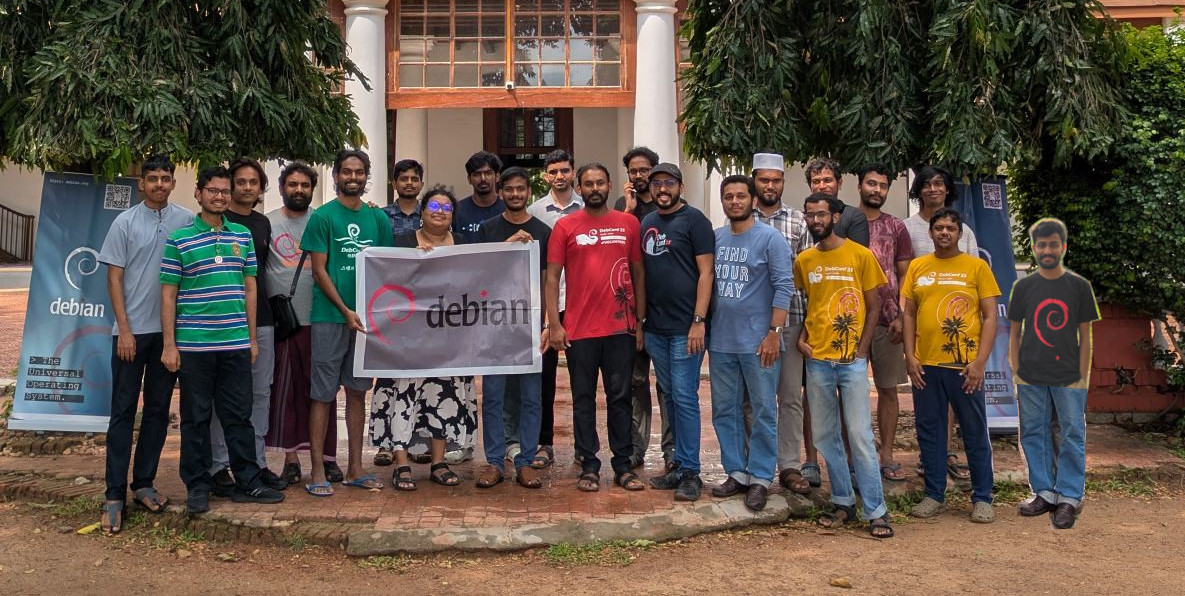
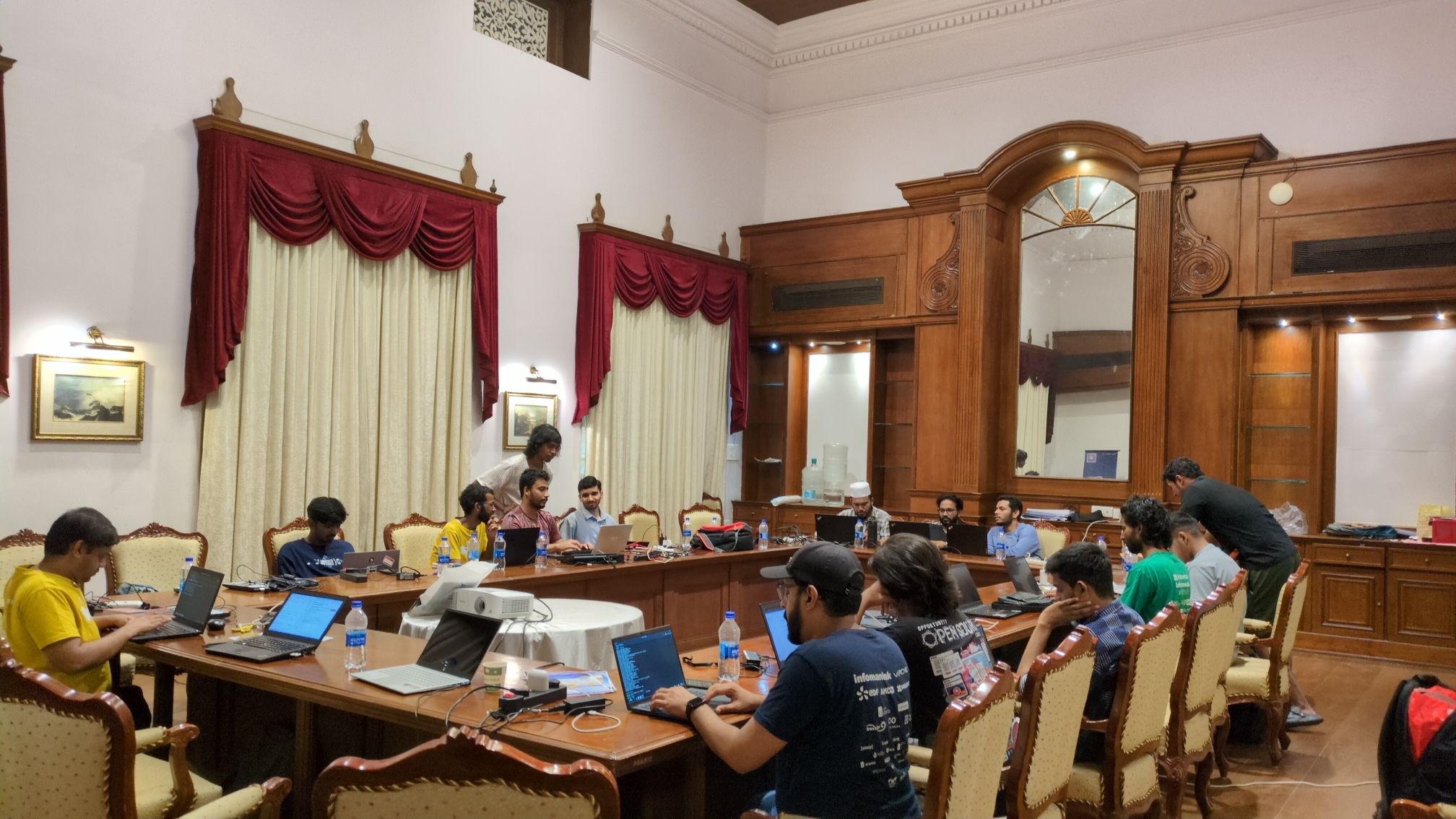

 Another new version of our still-new-ish package
 I have a Samsung Q800A soundbar. It ships with built-in support for the Apple Airplay protocol, but I m not really an Apple kind of guy so that s never been particularly helpful for me. So, instead, I have a Chromecast Audio plugged into it via TOSLINK, and that works fine - except for the fact that there s no way to explicitly pick TOSLINK as the audio input. Instead, there s a Digital In option that refers to both the optical in and eARC input from a TV. Not inherently a problem, given I m unlikely to be watching TV while listening to music, but my TV is a Samsung Frame, a device that s intended to display art whenever someone is standing nearby, and which infuriatingly generates an eARC signal even if it s only in art mode and isn t going to make any noise. This switches the soundbar away from optical and I get sad. I could plug a video cast device into the HDMI port on the soundbar and cast audio to that, but then the art would get replaced with album covers whenever I m playing music, and again that s not quite the ambience I want. Still, none of this is that important.
Until I learned that the Australian version of the soundbar does have Google Cast support. The firmware image was downloadable from Samsung support, so I grabbed that, but unfortunately found that it was encrypted. However, if I downloaded the firmware image for the US model, the encrypted blob was identical - there s no difference in the underlying firmware between the two of them. So, how come one has support, and the other doesn t?
I d need an unencrypted copy of the firmware to have a real chance of figuring this out, and the easiest way to get one was to just run an ebay watch for a broken model of the same series. Once I had one in my hands I used hot air to remove the eMMC storage from the device, cleaned up the chip, and then stuck it in