Search Results: "sesse"

26 July 2026

Russ Allbery: Review: Radiant Star

Review: Radiant Star, by Ann Leckie
Publisher: Orbit
Copyright: May 2026
ISBN: 0-316-29068-8
Format: Kindle
Pages: 359
Radiant Star is a science fiction novel set in the Imperial Radch universe without being a direct sequel to the other books in that universe. It will badly spoil the end of Ancillary Mercy, and I recommend reading that trilogy first, but it's independent of the other books in the same universe.
In the 3,008th year after the manifestation of the Radiant Star (the 1,024th since the founding of the Consorority itself), Zaved, a newly minted consoror, disappeared a mere two days after the ceremony that elevated her to womanhood. She left a note that read, Bored. Back whenever. This was not normal or even remotely acceptable behavior in a consoror, particularly one who held as much promise as Zaved had, but what could the consorors do?
Zaved, faced with the unpleasant prospect of running out of money during her galactic tour, plied a rich benefactor with tales of how talented, polite, and obedient the boys of the Consorority are. Her plan worked brilliantly. After funding further non-boring adventures, she arrived home in Ooioiaa with a chest full of money and a pregnancy. Great for Zaved and the Consorority; kind of a shame for her son Jonr, who is to be delivered to her benefactor after proper training. Oh well, telling Jonr about that is a problem for future Zaved. After a strained childhood in which he convinces himself he is a misfit with few redeeming qualities, Jonr ends up in a suspension pod. Before shipping can be arranged, however, external events intervene, leaving Jonr sitting unnoticed in a warehouse. The planet of Aaa is in a highly inconvenient location, drifting as it does through interstellar space unattached to any star. It would be as irrelevant and overlooked as any other random interstellar object except for two critical properties. The first is that Aaa and its sole city of Ooioiaa are sacred to a religion of obscure origin. Its primary population are members of a religious cult who believe the Radiant Star manifested in the Temporal Location on Ooioiaa and will eventually return to bring light to the galaxy. The second interesting property of Aaa is that it is drifting ever so slowly towards a strategic system of military importance. The first property brings pilgrims and their accompanying bounty of money, food, and other resources necessary to dig a small city out of rock, make it habitable, and supplement the sparse and strange native edible life. The second property brings the Radchaai, who easily conquer the city of Ooioiaa and are now faced with the unpleasant task of running it. Some decades after the Radchaai conquest, having never left Aaa, Jonr is woken up. He will not be sent off into the broader galaxy as a slave to pay off a vacation debt. Instead, he will be one of the many protagonists in this novel about the perils of living through supply chain disruptions on a planet full of status-obsessed religious fanatics who would drown in a rain shower. The other books set in this universe make abundantly clear that the Radch is a voracious colonial power that enslaves native populations and enforces their own cultural preferences at the point of a gun. A reader familiar with this series is predisposed to take whatever side is not the Radch. Radiant Star adds a complication, however. Charak Svo, the Radchaai governor, is impatient with native inhabitants and strongly dislikes their religion, but she is reasonably competent. The religious factions that ran Ooioiaa before the arrival of the Radchaai, on the other hand, are dogmatic authoritarians with the collective wisdom of a sack of turnips. Charak does not get everything right and is arguably responsible for at least one catastrophe. By the end of the book, though, I was firmly convinced that had the original religious government still been in charge, everyone would have died. I found the structure of this book a little odd. The omniscient narrator tells the story in the form of a history. The target audience appears to be future inhabitants of Ooioiaa and adherents to the Radiant Star religion, and the narrator is often maddeningly uninterested in topics that a reader of the rest of the Imperial Radch books is intensely curious about. This same property carries through to the plot: I was interested in how all of the tensions in this obviously absurd society could be resolved or, preferably, overturned entirely. The narrator, on the other hand, is far more interested in Serque Tais's intent to become the last saint in the Temporal Location, and in the details of the subsequent political, economic, and religious fallout. Leckie has written three novels set in the Imperial Radch after the original trilogy: Provenance, Translation State, and now Radiant Star. I am sure that I'm not the only person who wants a direct continuation of the original trilogy, but I'm drawing the conclusion that Leckie doesn't want to write that. Instead, she's writing around the edges of the subsequent events, in effect showing readers the shape of them and their broader implications without showing the details. Now that I can see what she's doing, I kind of like it. Given what we now know from the books written around the edges, the ensuing events in the center of galactic politics are chaotic in a way that could easily devolve into tedious accounts of messy conflicts. Seeing the effects from afar lets the reader fill in some of the blanks and speculate, and it makes the moments where we get a concrete update (such as at the end of this book) all the more rewarding. I still find it odd, though, to read a book where the narrator's interests so sharply diverge from mine. I wish I could say that Radiant Star sucked me in as the story developed, but it never did. Part of the problem is that I think this book is intended as a very dry farce, and farce often doesn't work with my reading style. I prefer to attach myself to a protagonist and hope they do competent things, and this book is full of characters who are being themselves far too aggressively and loudly to have time to be competent at anything. My favorite moments were therefore the small pockets of people with sense: The governor, Jonr, his charge, and the delightfully strange Justice of Albis. I enjoyed all of them, but I had trouble caring about the overall plot and kept putting this book down for days between chapters. I think this is mostly personal taste, though. Like all of Leckie's novels since the original Imperial Radch trilogy, Radiant Star is competently executed and a little strange. When that strangeness aligns with your tastes, it's a great deal of fun and rather unlike other science fiction novels. In this case, it didn't quite work for me, but I suspect it will for others. I still want another Leckie novel with a ship as a protagonist, though. Content notes: Rather disturbing (although bloodless) religious practices, mass death. Rating: 6 out of 10

6 July 2026

Russ Allbery: Review: The Player of Games

Review: The Player of Games, by Iain M. Banks
Series: Culture #2
Publisher: HarperPrism
Copyright: 1989
Printing: February 1987
ISBN: 0-06-105356-2
Format: Trade paperback
Pages: 295
The Player of Games is political space opera and the second book in the shared Culture setting. As with most Culture books, the reading order is not particularly important. It won the 1989 Locus Award for best science fiction novel and sometimes competes with Use of Weapons as the consensus best Culture novel. This review is a re-read and yet another experiment in how to re-review a book. This time, I decided to write a full second review with substantial spoilers so that I can talk in more detail about the book. If you want to avoid spoilers, or just want to see how my thoughts have evolved from my first reading, see my original review from 2005. Gurgeh plays games. He is probably the best strategy game player in the entirety of the galaxy-spanning Culture. He has written papers on game theory, won innumerable major championships, and is a celebrity in the circle of like-minded aficionados. Gurgeh is also bored and in the middle of the Culture equivalent of a mid-life crisis. As the story opens, he's vaguely unsatisfied and adrift, unenthused by his normal activities, and searching vaguely for something that will break through his ennui. He is caught by surprise by the thrill he gets from a moment's misunderstanding in which an opponent suspects him of cheating, which sets him up to be (apparently) clumsily blackmailed by a deeply unpleasant drone named Mawhrin-Skel. SPOILERS BELOW. If you have not read this book, consider stopping here and instead reading my original no spoiler review. The first hundred pages of The Player of Games is a slow, somewhat plodding introduction to Gurgeh, his social circle, and life in (one part of) the Culture. I remember being fascinated by this part the first time I read this book. It was only the second Culture novel I read and the first set in the Culture proper, so the world-building underlying this odd post-scarcity utopia on a vast intelligent habitat with sentient drones, complex privacy rules, endless cocktail parties, and apparently directionless socialites was intriguingly unlike the other science fiction I was reading at the time. This time through, I have to admit I was less impressed. Gurgeh is not very likable, and his desultory mid-life crisis is a little boring. None of his friends have enough depth to appear as more than side notes, in part because Gurgeh doesn't seem to care enough about any of them to make them interesting to the reader. I've since read seven other Culture novels, so Banks's cocktail parties hold less charm and I was impatient for the real action to begin. These chapters are still important, though, because they establish how utterly average Gurgeh is. He has one unique talent, a deep affinity with and obsession with strategy games, and is otherwise a bit of a depressed narcissist with a few casual relationships, a friend that he barely confides in, and a comfortable and familiar life. He is not in any way a hero or a charismatic figure; he just happens to be exceptionally good at one thing, enough to make him famous among people who care about that one thing and probably unknown to anyone else apart from the occasional idly perused news headline. He is the Culture's equivalent of the world chess champion. The Contact division of the Culture has a problem. The Empire of Azad in the Lesser Magellanic Cloud is a nasty, expansionist culture of the sort that Contact would like to deal with before it causes broader problems. The Culture's normal approaches are thwarted by an unusual organizing principle: The empire is built around and takes its name from the game of Azad, a highly complex strategy game developed over thousands of years. Azad is the civil service exams, means of political and religious dispute resolution, selection mechanism for the emperor, and civic religion. Faced with that oddity, Contact turned to Special Circumstances, the Culture's more aggressive and less restrained way of dealing with tricky problems. Special Circumstances, in turn, needs someone who can learn how to play the game of Azad. They want Gurgeh to take a very long trip. For all of Gurgeh's dissatisfaction, he's not impulsive enough to take a five year journey away from his life and everyone he knows just to play a novel game. Conveniently, Mawhrin-Skel's blackmail resolves this reluctance. The game of Azad requires some suspension of disbelief. Banks provides a few glimpses at the mechanics of the game, but those details are insufficient to reconstruct the rules, and some of the claims made about its properties are improbable at best. The best mental model I could build for it is a strategy or simulation game built around units and territory control, with supplemental side games used to build up resources for the main boards, but it's more of a plot device and a set piece than a world-building invention. The significance of Azad the game is its role in society: The Empire of Azad believes they have constructed a game whose complexity so closely models reality that the skills required for success in the game are precisely the skills required for success in the empire. The Empire of Azad is wrong, and this is one of the core themes of The Player of Games. As with many Culture novels, what Special Circumstances tells Gurgeh is, at best, incomplete. Gurgeh is a refutation of the basis of belief in Azad; this is why it is important thematically that he is an average, somewhat unlikable citizen of the Culture whose only special characteristic is skill at learning and playing games. Azad is the myth of meritocracy given physical form as a game. It provides the anchor of the empire for the same reason that societies on Earth place enormous weight on standardized tests, capitalist success, or public debates. All societies face the problem of selecting good leaders and testing opposing beliefs, and all societies attempt to find some form of shortcut, some set of general principles, tests, or objective metrics used to select the best person via a process that people consider plausible and fair. The game of Azad is a paragon of apparently meritocratic process. No matter who you are or what your background is, if you excel at the game that, in theory, objectively tests your skills, you are given a position of power. In practice, the Empire of Azad is not that naive. Manipulation outside of the game happens, only some players have the opportunity and resources to spend years learning the game at a deep level, and only their dominant sex truly stands a chance in games that matter. But neither is Azad's place in society a fiction. There is corruption around the edges, and a lot of people are filtered out before the games begin, but the highest echelons of society are true believers. The game does decide both rank and policy; Banks is arguing against a strong form of apparently working meritocracy. Gurgeh represents a refutation of this meritocracy through the mechanism that breaks every supposed meritocracy: The map is not and cannot be the territory. Any objective evaluation criteria is necessarily separate from what it is trying to measure, and in that separation there is always an opportunity. Gurgeh has none of the background, training, or mindset expected for a player of Azad because he could not possibly care less about any of the things Azad represents to the Empire. What he has instead is a preternatural skill at games and vast experience with the most intricate strategy games the Culture, a much larger society, has been able to devise. He also has both the patience and the resources to devote himself entirely to learning a game for several years, and past experience in doing that with other games. If Azad represents the civil service exams, Gurgeh is the person who has no interest in ruling but adores memorizing facts and taking tests. The theory behind the exams is that the skills to pass the exam only come with the correct mindset to do the job for which the exam is testing. Gurgeh is an existence proof that this is not always the case. Banks also uses Azad to show another aspect of the failure of meritocracy: A society whose rulers are chosen through a competition takes on the shape of that competition. The Empire of Azad is run by the winners of competitive games, so the empire is a winner-take-all system of dominance and status hierarchy. Here, I think Banks lays the point on a little thick; the empire is an irredeemable hellhole of misogyny, sexual abuse, slavery, genocide, and military colonialism to a degree that is a bit hard to justify solely from the game. There is a beautiful turning point about two-thirds of the way through the book where Gurgeh's face is shoved into just how vile Azad society is and reconsiders his approach to the tournament as a result, and I think it may have been a bit stronger if the morality had been a little less blatant and absolute. To the extent that Gurgeh has political beliefs, he represents a Culture flavor of soft liberalism. He has opinions about acceptable and unacceptable ways to treat people, but he grew up in a utopia and his opinions are mostly theoretical. When he sees just how vile people can be outside of that utopia, he is revolted and appalled and redoubles his efforts to fight that society in the only way he knows how, inside of a game. This part of the book follows the standard, if enjoyable, plot of a flawed but fundamentally decent person discovering a true injustice and becoming enraged at it. In a lot of books, that would have been where the plot stops. Banks is doing something more subtle and more interesting, though. Gurgeh wipes the board with his next challenger, but that soft liberalism eventually proves inadequate. To learn the game of Azad and to play in the tournament, Gurgeh has been wrapping himself in Azad culture and its language, and in that frame of mind he is losing the climactic game of the book. It's only when he is pushed to think in Marain, the native language of the Culture, that he understands what is happening in the game and how to defeat Nicosar, the emperor. This, on the surface, is a bit too close to the strong hypothesis of linguistic relativity to be entirely plausible, but such an objection would miss the point that Banks is making here. Marain is a construct, the product of considerable effort within the Culture to match language to the most nuance and complexity that brains can understand, and it is a language, one of the most social and collective artifacts a society can produce. Gurgeh is a remarkable individual with an impressive talent, but individual skill and achievement can only take him so far. The critical final piece is the support of societal infrastructure intentionally built and maintained to help him make better decisions. Once I noticed that point, I saw it everywhere in the book. The empire repeatedly attempts to subvert or distract Gurgeh with drugs, pleasure, politics, or danger, and at each point there is some critical piece of Culture social infrastructure that blunts the attack. Illicit substances and forbidden vices are less tempting to someone for whom the illicit has been demystified by the Culture's gentler approach to rules and boundaries. Embedded biological mechanisms allow him to divert drugs so that they don't affect him. At first, it's easy to read this as an exercise of self-control, but on this re-read I saw how much behind-the-scenes infrastructure supports Gurgeh's ability to ignore temptation. This social support notably does not take the form of some ideological principle or moral framework. Gurgeh is not a monk or an ascetic, as is obvious from the first third of the book, and he has no political ideology to speak of. He is a flawed person with a streak of danger-seeking and self-aggrandizement, which the Culture exploited to get him involved in Azad. But through a lot of hard work, technological and social, the Culture has given him a robust foundation and a set of mental and biological tools that make him remarkably hard to corrupt. The implication is that if Gurgeh has that support, so does every other member of the Culture. It's neither a religion or an ideology; it's well-maintained infrastructure, complex and nuanced and pragmatic, and composed of innumerable small solutions to specific problems. I think the true climax of this book takes place the night before the final day of the game, in the tower meeting between Gurgeh and Nicosar. Gurgeh has realized that he's already won; there's nothing Nicosar can do to salvage the game. He's also seen that the game represents a cultural conflict and conversation between the Culture and Azad and he's overwhelmed by the beauty of that communication and sadness that the game is about to be over. Gurgeh's true passion is the game. It is doubtless easier for him to be magnanimous because he's winning, but he also loves the structure of the game itself and what two players can create in a sort of collaborative competition. Gurgeh tries to express all of this to Nicosar. It is one of the most centrist liberal moments I've ever read in a novel, the pure essence of "reaching across the aisle" or "disagreeing agreeably." Gurgeh has seen something beautiful, something he's created with Nicosar, a moment of true communication, and he wants to share it. Surely Nicosar sees the same thing; surely now that he sees Gurgeh has won, he can appreciate the board structure, savor the moment, understand the transient beauty of a game that is about to end and how perfectly it captures the meeting of their different cultures. That moment does Gurgeh real credit. It's a rare sign of emotional and spiritual depth in a character who often seems superficial. Nicosar meets this outreach with unhinged, furious contempt. He despises everything Gurgeh represents, everything the Culture is, and the next day he tries to kill Gurgeh on the board of the game. It is a devastating critique of liberal tolerance, all the more so because Gurgeh's attitude and outreach is truly admirable. It is perhaps the most sympathetic moment that Gurgeh has in the entire book, the moment where the reader thinks "oh, I get it, I understand what he really cares about." Gurgeh assumes that Nicosar is not his position or culture, that they have made a moment of connection that transcends all the awful things he previously learned about the empire of Azad. That Nicosar, despite being the emperor of the society that is currently doing so many things Gurgeh finds repulsive, cannot be as bad as his society. And Nicosar considers that outreach to be weak, disgusting, and vile, and does everything that he can to destroy it. One of the oddest twists of our current moment is the obsession that some billionaires have with stories that are moral arguments against exactly what those billionaires are currently doing. The most obvious example is Peter Thiel, who is obsessed with The Lord of the Rings and has devoted his life to becoming Saruman, a character who is notably not one of the protagonists. It's as if something in them recognizes the power of the story, but some deep shame or narcissism or simple aversion allows them to completely ignore what the story means. Elon Musk is obsessed with the Culture novels. He names the SpaceX rockets following Culture Ship naming conventions and has claimed that one of his goals is to bring about a Culture-style utopia. And in 1989, years before anyone had ever heard of him, Banks cast him as the villain of The Player of Games. There is so much of Nicosar in Musk: the superficial charm, the limited brilliance (Nicosar is a very good Azad player), the ambition, the pride, and the vicious, spitting contempt for everything the Culture represents at every level deeper than superficial materialism. And Banks is as clear about his opinion of Nicosar as he is about anything in any Culture novel. One of the oldest fictional answers to what a society does with people like Nicosar is the consequences of hubris. By being unable to accept defeat, by holding a vision of the world so tightly, they become brittle and unstable and bring about their own collapse. In a broad sense, that is what happens in The Player of Games with a bit of pushing from Special Circumstances. By the politics of the game, Nicosar had already won; the results of Gurgeh's earlier games had already been faked, the final game had no political consequences, and everyone who knew its true outcome could be disposed of. Gurgeh's win could have been covered up and ignored. But Nicosar could not endure the thought that he would be beaten by someone like Gurgeh, playing Azad the way that Gurgeh was playing it. Gurgeh had to be destroyed on the board of the game; Nicosar's pride did not allow any other outcome, even if it meant Nicosar's death. However, Special Circumstances didn't let hubris be the end of the story. In the climax of the book, the drone protecting Gurgeh also makes sure that Nicosar dies. There is a fig leaf of plausible deniability, but it's so obvious that even the unobservant Gurgeh sees through it immediately. It's hard to escape the feeling that was Banks's answer to what to do with people like Nicosar: They cannot live within society, because they will not live peacefully within society. I enjoyed The Player of Games as much this time through as I did the first time, but for entirely different reasons. In my first read, I focused on the world-building of the Culture, the political machinations, and the concept of games as conversations between the players. This time, I was struck by the political commentary just below the surface. Special Circumstances wanted to resolve the problem of the Empire of Azad without a military conflict and occupation that would be long, brutal, expensive, and demoralizing. They found an answer that relied on the diversity of the Culture. A vast, utopian civilization in which people can pursue whatever interests make them happy produces innumerable microspecialized oddities, people with astonishing talents in some small field that only a tiny fraction of people care about. It produces, in other words, innumerable keys for locks that you may never encounter, but which are invaluable if you happen to stumble across that lock. Gurgeh is not a hero. He is not a paragon of moral virtue, or even a charming charismatic, He is an entirely average member of an extraordinary society, the beneficiary of thousands of years of concerted effort at producing a robust, flexible foundation on which to raise robust, flexible citizens with a shared sense of basic morality. Those people, by themselves, do not solve all of life's problems; the structure of Special Circumstances and its willingness to bend rules in order to maintain them is the tension and deus ex machina in all of the Culture novels. But much of the strength of Special Circumstances is that it has an entire civilization of people like Gurgeh to draw upon when it needs them. It has those people because the Culture comprehensively rejects competitive meritocracy, something that some readers of the Culture novels appear incapable of comprehending. Rating: 9 out of 10

13 May 2026

Jonathan Dowland: iPad Mini (2013)

In or around 2014 I bought an iPad Mini (2), and following the normal lifecycle of iOS devices, a major OS update eventually killed it as a useful, general-purpose device: operating it was just too sluggish. It remained useful as a streaming media player for a little while longer until eventually the big streamers (BBC iPlayer, Netflix, etc.) stopped supporting the version of their app which the iPad could install: the last officially supported iOS was 12.4.8 in July 2020, and by November it was officially dead.
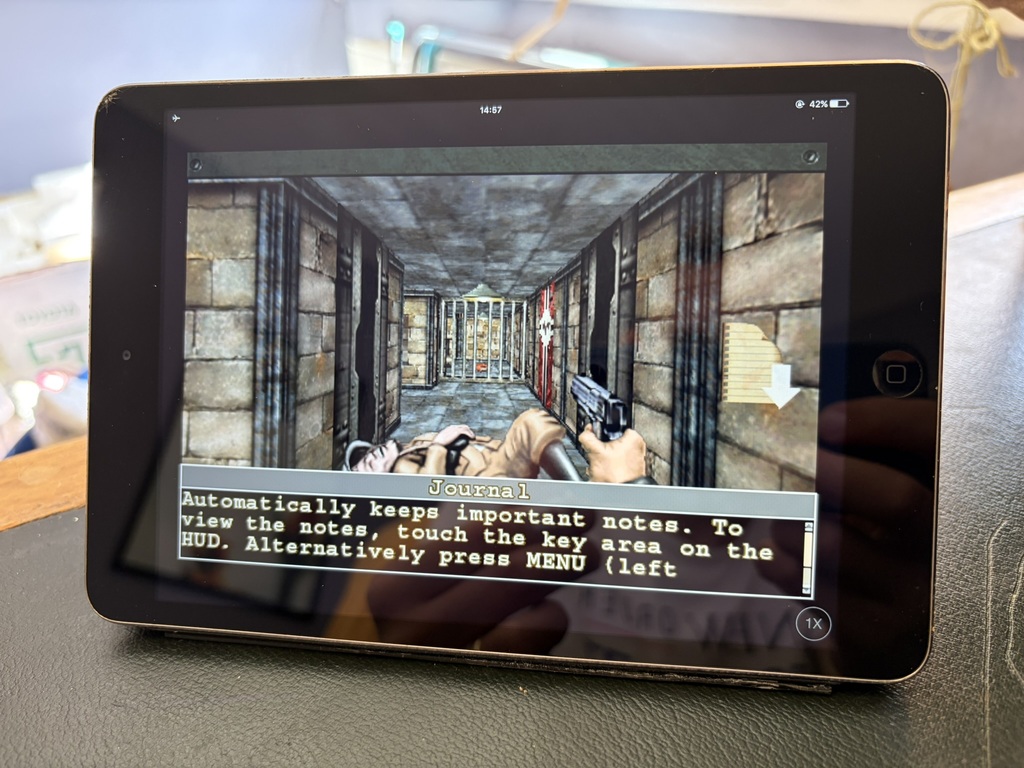
Old 32bit games Old 32bit games
During its useful life, the iPad Mini witnessed Apple's transition from 32 to 64 bit apps. In the 32 bit days, there was a little cottage industry of app developers, and in particular, game developers. There were even several independent websites (App Shopper, Pod Gamer, Free-App Hero), which aided in sorting through the morass of apps to find the good ones (then as now, the App Store itself was almost impossible to effectively browse). This all went away during the 32/64 transition, as many small-scale developers weren't actively developing their applications or games any more, and weren't prepared to pay the time or apple tax to rebuild and publish them as 64 bit. The last version of iOS that supported 32 bit apps on this device was 10.3.3, and by luck, there are some methods available to install this old version of iOS on the Mini 2 Today. A couple of years ago I did so, and I kept no notes so sadly I can't report on which method I used. But it worked, and I was able to install a bunch of old 32 bit games that I had no access to on more modern devices. Prior to John Carmack's1 departure from iD Software, he'd been responsible for publishing several experimental iD software games on iOS. These mostly disappeared in the 64 bit transition. Amongst them are ports of Wolfenstein 3D, classic Doom, some RAGE tie-ins, but perhaps most interestingly. at least two original games, designed for the phone form factor: Doom 2 RPG and Wolfenstein RPG.
Reading magazine-style things Reading magazine-style things
Another notable game that disappeared was "Civilisation Revolution", a cut-down Civ game that for a while I was obsessed with. Rather than port it to 64 bit, the publisher withdrew it, and then published a "new" game "Civilisation Revolution 2", requiring a separate purchase. Sadly, it is rubbish, nowhere near as good as the first one. Anyway, having managed to downgrade it to the 32 bit iOS and install these old lost games, I then, of course, never played them and the device continued to gather dust. I should make clear that, running such an old unpatched iOS version means it's not safe at all to put any kind of sensitive information on this, including entering passwords. I don't recommend even opening the web browser. However, this 12 year old device does have some use as an e-reader, especially for certain types of ebook or magazine, that I've struggled to engage with on other devices. That's a topic for another blog post.

  1. Carmack reportedly also had a pivotal role in convincing Steve Jobs to permit native apps and provide an App Store on iOS: the plan had been to solely support web apps, at least for 3rd parties.

27 April 2026

Russ Allbery: Review: What We Are Seeking

Review: What We Are Seeking, by Cameron Reed
Publisher: Tor
Copyright: 2026
ISBN: 1-250-36474-4
Format: Kindle
Pages: 339
What We Are Seeking is a bit hard to classify beyond science fiction. I think I would call it anthropological science fiction, but it's also a first contact story and a planetary colony story. It is a standalone novel (well, so far as I know; see later in the review for caveats). This is Cameron Reed's second novel after the excellent and memorable cyberpunk novel The Fortunate Fall, first published in 1996 under Reed's former name of Raphael Carter. John Maraintha is a doctor from the world of Essius. He took what he thought was a temporary job on the Free Ship Edgar's Folly, where he's endured considerable culture shock. As the novel opens, John learns that the colonists on Scythia have requested a translator to talk to one of the native life forms, and a doctor since they're down to only one. John will be that doctor. The captain has decided, and by the rules of the free ships, John does not get a choice in the matter. The Scythian colony is about four hundred people, now located in a desert climate since the complex native life forms destroyed their previous settlement. The colonists are a split between Ischnurans and Zandaheans, two other human civilizations from the scatter of colony worlds left after Earth embraced AIs (aiyis here) and turned inward. Both of those groups marry, something John considers a moral abomination. Neither of them seem likely to understand Essian sexual ethics. More devastatingly, John had intended to spend some time as a ship doctor and then return home to a new place in Essian society. Once he lands on Scythia, the chances of that are gone; it is highly unlikely any ship would pick him up again and take him home. I have been trying to find the right books to compare What We Are Seeking with ever since I read it. The best I've come up with are Ursula K. Le Guin (particularly The Dispossessed), Eleanor Arnason's A Woman of the Iron People, and Becky Chambers's To Be Taught, If Fortunate. The start of the book felt like an intentional revisiting of an earlier era of science fiction, with somewhat updated science and politics, but the last half of the book, where the action picks up considerably, is a meditation on gender, social systems, religion, and small-group politics. All of that is mixed with biological exploration and a first-contact story with some quite-alien aliens. This is the sort of novel where the protagonist's culture is as foreign to the reader as any of the other cultures he counters, so the reader is assembling several jigsaw puzzles at once. John is dropped into an established colony with its own social norms and established hierarchies. The one other outsider, the translator Sudharma Jain, is, as his name implies, a Jain who keeps very strict religious observances. Half of the colony is from something akin to a fundamentalist Christian religious sect that practices patriarchy and strict marriage codes. The other half is more gently sexist (but still sexist) and has its own tradition of a third gender that becomes central to the story. John, meanwhile, is a strong believer in the Essian approach to social organization: Any two partners of any gender freely have sex by mutual consent and without obligation, and family is based solely on blood relations. These beliefs do not fit comfortably together, even when people are trying (as they mostly do) to be welcoming. The first half of this book is very slow. This gives all of the characters space to breathe and become comfortable, and the characterization is superb, but it is a book to start when you're in the mood for something slow and observational. There is a plot that gradually becomes apparent, or rather there are several plots that are intertwined, but tension and urgency are mostly reserved for the second half of the book. Instead, the book opens with a lot of close observation of alien flora and fauna and the untangling of subtle social dynamics among the Scythians. There is also a visitor from earth, much to the distress of the Scythians. Earth presence means the ships will not return and the colony may be cut off from any sort of technological resupply. Despite speaking a common language, that visitor is as mutually alien to the other groups as they are to the native flora. Her life is fully integrated with aiyis, giving her essentially godlike powers and the ability to turn off inconvenient emotions and disregard anything she doesn't want to see. What she and the Earth aiyis are doing on the planet is one of the early mysteries. The dialogue in this book is truly excellent. Each characters has their own voice, there are fascinating digressions on different words that lead to tidbits of world-building, and some of the culture-specific idioms are delightful.
"I'm making a mess of this. None of that matters. Let me fall out the window and come in the door again. This is how my story ought to start:"
The challenges for the characters in this story are slow but deep ones: belonging and self-definition, the conflict between cultural tradition and personal circumstance, and the sacrifices required to live with small groups in situations where civil war is viscerally attractive. It has one of the most comprehensive and fascinating treatments of transgender issues that I've read in science fiction. Its commentary on current politics is subtle and estranged in the way that science fiction does best, but still pointed and satisfying. And, well, there are passages like this that I absolutely adore:
"I wouldn't go that far. It could be they are right, the universe we see exists because a mind like ours created it at least, a mind enough like ours that we can say it wants one thing and not another, and when it acts it does so with intent. That's as good an idea as any. But it is certainly not plausible that such a being believes that people everywhere should marry, or that men should never visit men, or no one should become a jess. Look at what they have created. The universe could have been nothing at all, or one atom of hydrogen floating in a void, or a diamond crystal infinite in all directions, if their mind cared for simplicity or tidiness. Instead we have stars and planets and black holes and nebulas. It could have all been cold and dead, but there is life. They could have made one species for each world, or just a few, which could have stayed the same forever, but instead we have millions and millions, all of which are changing every moment, varying among themselves and boiling off in all directions. Such a god is like an artist who fills up a library of sketchbooks with their drawings of strange creatures, and when every scrap of paper in the place is used up, goes back with a different color ink and scribbles over them again. They are obsessed with variation they gorge themselves with it and never grow full. Do you really think a mind like that could want us all to live in the same way?"
I had one problem with this book, though, and for me it was a big one: There is no ending. Reed effectively builds tension, gets me caring about all of the characters, sets up several problems, starts down a path towards resolution, and then the book just... ends. Long-time readers of my reviews will know that I'm a denouement fanatic. I want the scouring of the shire, I want the chapter set in the happily ever after, I want the catharsis of an ending. This made me so grumpy! To be clear, this is not sequel bait (at least so far as I can tell). I can write a philosophical defense of the ending. The types of problems and lives that Reed set up don't have clear endings; this is, to some extent, the point. We muddle through, and then those who come after us muddle through some more, and the cumulative effect is called human civilization. And there is some denouement; Reed doesn't leave the reader at a cliffhanger or anything that egregious. But still, I wanted the happy ending, even though that was unrealistic for the style of story this is, because I'm a happy ending reader. This is not an ending sort of book; it's the sort of book where I get a sinking feeling at the 95% mark because there aren't enough pages left for the number of remaining unresolved problems. I've gotten less annoyed in the days since I finished the book, and I can appreciate the thematic point made by how the book ends, but I still feel like it's worth an advance warning if you're a reader like I am. I would be delighted by a sequel, but it didn't feel like that was the intent. Apart from that, this was both excellent and rather unlike a lot of current science fiction. I think the closest comparison I can make among recent novels I've read is Sue Burke's Semiosis. What We Are Seeking has a similar sort of world-building, but I liked these characters so much more. It felt like a classic literary science fiction novel, but very much written in 2026. Highly recommended, just beware of the lack of closure. Content notes: Sexism, homophobia, stomach illness, and some religious abuse. Rating: 8 out of 10

19 April 2026

Russ Allbery: Review: Collision Course

Review: Collision Course, by Michelle Diener
Series: Class 5 #6
Publisher: Eclipse
Copyright: November 2024
ISBN: 1-7637844-0-1
Format: Kindle
Pages: 289
Collision Course is the sixth novel in the Class 5 science fiction series and the first that doesn't use the Dark X naming convention. There are lots of spoilers in this story for the earlier books, but you don't have to remember all the details of previous events. Like the novella, Dark Ambitions, this novel returns to Rose, Sazo, and Dav instead of introducing another Earth woman and Class 5 ship. In Dark Class, Ellie discovered an interesting artifact of a previously-unknown space-faring civilization. Rose, Sazo, and Dav are on their way to make first contact when, during a routine shuttle flight between the Class 5 and Dav's Grih military ship, Rose is abducted. The aliens they came to contact have an aggressive, leverage-based negotiating strategy. They're also in the middle of a complicated war with more sides than are readily apparent. What I liked most about Dark Horse, the first book of this series and our introduction to Rose, was the revealed ethical system and a tense plot that hinged primarily on establishing mutual trust when there were excellent reasons for the characters to not trust each other. As the series has continued, I think the plots have become more complicated but the ethical dilemmas and revealing moments of culture shock have become less common. That is certainly true of Collision Course; this is science fiction as thriller, with a complex factional conflict, a lot of events, more plot reversals than the earlier books, but also less ethics and philosophy. I'm not sure if this is a complaint. I kind of miss the ethics and philosophy, but Diener also hasn't had much new to say for the past few books. The plot of Collision Course is quite satisfyingly twisty for a popcorn-style science fiction series. I was kept guessing about the merits of some of the factions quite late into the book, although admittedly I was in the mood for light entertainment and was not trying too hard to figure out where the book was going. I did read nearly the entire book in one sitting and stayed up until 2am to finish it, which is a solid indication that something Diener was doing worked. I do have quibbles, though. One is that the ending is a bit unsatisfying. Like Sazo, I was getting quite annoyed at the people capturing (and recapturing) Rose and would have enjoyed somewhat more decisive consequences. Also, and here I have to be vague to avoid spoilers, I was expecting a bit more of a redemption arc for one of the players in the multi-sided conflict. The ending I did get was believable but rather sad, and I wish Diener had either chosen a different outcome (this is light happily-ever-after science fiction, after all) or wrestled more directly with the implications. There were a bit too many "wait, one more thing" ending reversals and not quite enough emotional payoff for me. The other quibble is that Collision Course was a bit too damsel in distress for this series. Rose is pregnant, which Diener uses throughout the book as a way to raise the stakes of the plot and also make Rose more annoyed but also less capable than she was in her earlier novel. Both Sazo and Dav are in full heroic rescue mode, and while Diener still ensures Rose is primarily responsible for her own fate, there is some "military men attempt to protect the vulnerable woman" here. One of the things I like about this series is that it does not use that plot, so while the balance between Rose rescuing herself and other people rescuing her is still tilted towards Rose, I would have liked this book more if Rose were in firmer control of events. I will mostly ignore the fact that a human and a Grih sexually reproducing makes little to no biological sense, since Star Trek did similar things routinely and it's an established genre trope. But I admit that it still annoys me a bit that the alien hunk is essentially human except that he's obsessed with Rose's singing and has pointy ears. Diener cares about Rose's pregnancy a lot more than I did, which added to my mild grumpiness at how often it came up. Overall, this was fine. I prefer a bit more of a protagonist discovering how powerful she is by making ingenious use of the ethical dilemmas her captors have trapped themselves in, and a bit less of Rose untangling a complicated political situation by getting abducted by every player serially, but it still kept the pages turning. Any book that is sufficiently engrossing for me to read straight through is working at some level. Collision Course was highly readable, undemanding, and distracting, which is what I was looking for when I read it. I would put it about middle of pack in the series. If Rose's pregnancy is more interesting to you than it was to me, that might push it a bit higher. If you have gotten this far in the series, you will probably enjoy this, although it does feel like Diener is running out of new things to say about this universe. That's unfortunate given the number of threads about AI sentience and rights that could still be followed, but I think tracing them properly would require more philosophical meat than Diener intends for these books. Which is why the next book I grabbed was a Culture novel. Currently this is the final book in the Class 5 series, but there is no inherent reason why Diener couldn't write more of them. Rating: 7 out of 10

9 November 2025

Stefano Rivera: Debian Video Team Sprint: November 2025

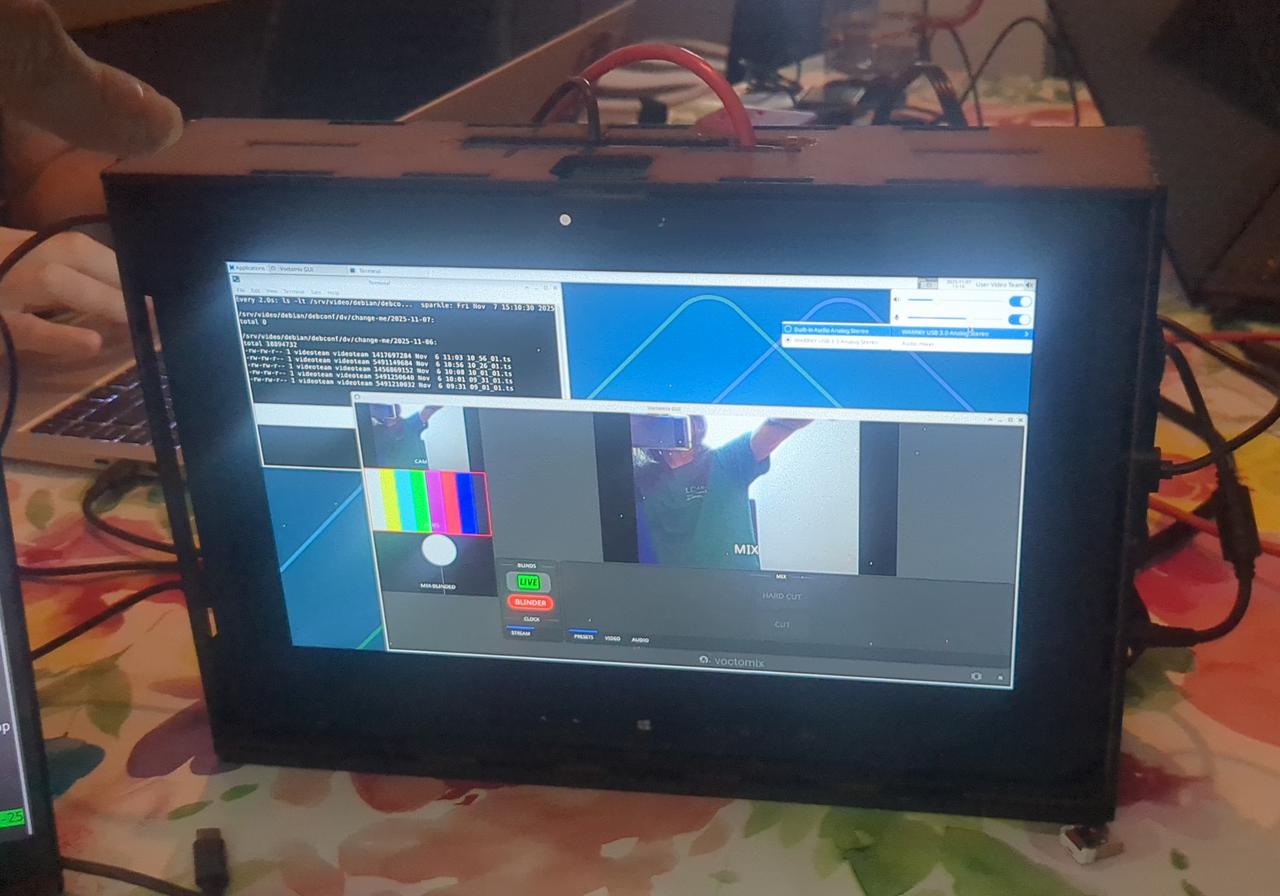
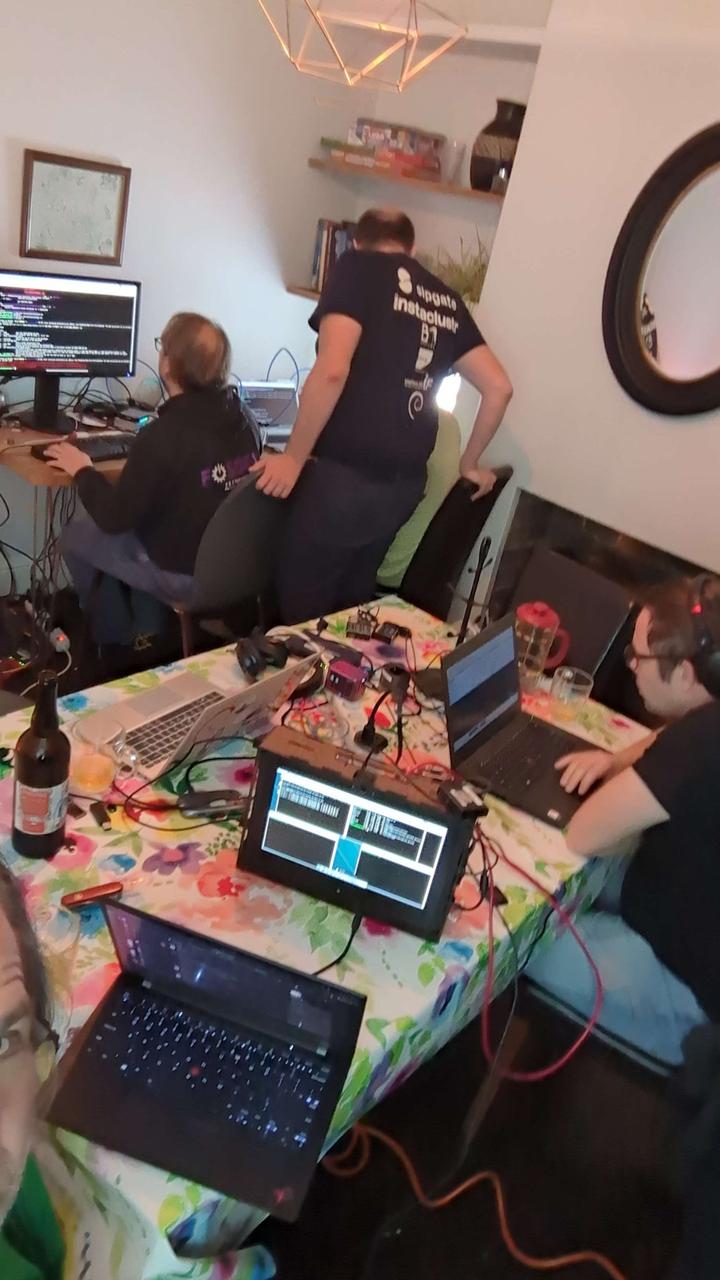
This week, some of the DebConf Video Team met in Herefordshire (UK) for a sprint. We didn't have a sprint in 2024, and it was sorely needed, now. At the sprint we made good progress towards using Voctomix 2 more reliably, and made plans for our future hardware needs. Attendees Voctomix 2 DebConf 25 was the first event that the team used Voctomix version 2. Testing it during DebCamp 25 (the week before DebConf), it seemed to work reliably. But during the event, we hit repeated audio dropout issues, that affected about 18 of our recordings (and live streams). We had attempted to use Voctomix 2 at DebConf 24, and quickly rolled back to version 1, on day 1 of the conference, when we hit similar issues. We thought these issues would be resolved for DebConf 25, by using more powerful (newer) mixing machines. Trying to get to the bottom of these issues was the main focus of the sprint. Nicolas brought 2 of Debian's cameras and the Framework laptop that we'd used at the conference, so we could reproduce the problem. It didn't take long to reproduce, in fact, we spent most of the week trying any configuration changes we could think of to avoid it. The issue we've been seeing feels like a gstreamer bug, rather than something voctomix is doing incorrectly. If anything, configuration changes are avoiding hitting it. Finally, on the last night of the sprint, we managed to run voctomix all night without the problem appearing. But... that isn't enough to feel confident that the issue is avoided. More testing will be required. Detecting audio breakage Kyle worked on a way to report the audio quality in our Prometheus exporter, so we can automatically detect this kind of audio breakage. This was implemented in helios our audio level monitor, and lead to some related code refactoring. Framework Laptops Historically, the video team has relied on borrowed and rented computer hardware at conferences for our (software) video mixing, streaming, storage and encoding. Many years ago, we'd even typically have a local Debian mirror and upload queue on site. Our video mixing machines had to be desktop size computers with 2 Blackmagic Declink Mini Recorder PCI-e cards installed in them, to capture video from our cameras. Now that we reliably have more Internet bandwidth than we really need, at our conference venues, we can rely on offsite cloud servers. We only need the video capture and mixing machines on site. Blackmagic also has UltraStudio Recorder thunderbolt capture boxes that we can use with a laptop. The project bought a couple of these and a Framework 13 AMD laptop to test at DebConf 25. We used it in production at DebConf, in the "Petit Amphi" room, where it seemed to work fairly well. It was very picky about thunderbolt cable and port combinations, refusing to even boot when they were connected. Since then, Framework firmware has fixed these issues, and in our testing at the sprint, it worked almost perfectly. (One of the capture boxes got into a broken state, and had to be unplugged and re-connected to fix it.) We think these are the best option for the future, and plan to ask the project to buy some more of them. HDCP Apple Silicon devices seem to like to HDCP-encrypt their HDMI output whenever possible. This causes our HDMI capture hardware to display an "Encrypted" error, rather than any useful image. Chris experimented with a few different devices to strip HDCP from HDMI video, at least 2 of them worked. Spring Cleaning Kyle dug through the open issues in our Salsa repositories and cleaned up some issues. DebConf 25 Video Encoding The core video team at DebConf 25 was a little under-staffed, significantly overlapping with core conference organization, which took priority. That, combined with the Voctomix 2 audio dropout issues we'd hit, meant that there was quite a bit of work left to be done to get the conference videos properly encoded and released. We found that the encodings had been done at the wrong resolution, which forced a re-encode of all videos. In the process, we reviewed videos for audio issues and made a list of the ones that need more work. We ran out of time and this work isn't done, yet. DebConf 26 Preparation Kyle reviewed floorplans and photographs of the proposed DebConf 26 talk venues, and build up a list of A/V kit that we'll need to hire. Carl's Video Box Carl uses much of the same stack as the video team, for many other events in the US. He has experimenting with using a Dell 7212 tablet in an all-in-one laser-cut box. Carl demonstrated this box, which could perfect for small miniDebConfs, at the sprint. Using voctomix 2 on the box requires some work, because it doesn't use Blackmagic cards for video capture. The Box: Front The Box: Back gst-fallbacksrc Carl's box's needs lead to looking at gstfallbacksrc. This should let Voctomix 2 survive cameras (or network sources) going away for a moment. Matthias Geiger packaged it for us, and it's now in Debian NEW. Thanks! voctomix-outcasts Carl cut a release of voctomix-outcasts and Stefano uploaded it to unstable. Ansible Configuration The videoteam's stack is deployed with Ansible, and almost everything we do involves work on this stack. Carl upstreamed some of his features to us, and we updated our voctomix2 configuration to take advantage of our experiments at the sprint. Miscellaneous Voctomix contributions We fixed a couple of minor bugs in voctomix. More Nageru experimentation In 2023, we tried to configure Nageru (another live video mixer) for the video team's needs. Like voctomix it needs some configuration and scaffolding to adapt it to your needs. Practically, this means writing a "theme" in Lua that controls the mixer. The team still has a preference for Voctomix (as we're all very familiar with it), but would like to have Nageru available as an option when we need it. We fixed some minor issues in our theme, enough to get it running again, on the Framework laptop. Much more work is needed to really make it a useable option. Thank you Thanks to the Debian project for funding the costs of the sprint, and Chris Boot's extended family for providing us with a no-cost sprint venue. Thanks to c3voc for developing and maintaining voctomix, and helping us to debug issues in it. Thank you to everyone in the videoteam who attended or helped out remotely! And to employers who let us work on Debian on company time. We'll likely need to keep working on our stack remotely, in the leadup to DebConf 26, and/or have another sprint before then. Breakfast Coffee Hacklab Trains!
21 October 2025

Russ Allbery: Review: Space Trucker Jess

Review: Space Trucker Jess, by Matthew Kressel
Publisher: Fairwood Press
Copyright: July 2025
ISBN: 1-958880-27-2
Format: Kindle
Pages: 472
Space Trucker Jess is a stand-alone far-future space fantasy novel. Jess is a sixteen-year-old mechanic working grey-market jobs on Chadeisson Station with a couple of younger kids. She's there because her charming and utterly unreliable father got caught running a crypto scam and is sitting in detention. This was only the latest in a long series of scams, con jobs, and misadventures she's been dragged through since her mother disappeared without a word. Jess is cynical, world-weary, and infuriated by her own sputtering loyalty to her good-for-nothing dad. What Jess wants most in the universe is to own a CCM 6454 Spark Megahauler, the absolute best cargo ship in the universe according to Jess. She should know; she's worked on nearly every type of ship in existence. With her own ship, she could make a living hauling cargo, repairing her own ship, and going anywhere she wants, free of her father and his endless schemes. (A romantic relationship with her friend Leurie would be a nice bonus.) Then her father is taken off the station on a ship leaving the galactic plane, no one will tell her why, and all the records of the ship appear to have been erased. Jess thinks her father is an asshole, but that doesn't mean she can sit idly by when he disappears. That's how she ends up getting in serious trouble with station security due to some risky in-person sleuthing, followed by an expensive flight off the station with a dodgy guy and a kid in a stolen spaceship. The setup for this book was so great. Kressel felt the need to make up a futuristic slang for Jess and her friends to speak, which rarely works as well as the author expects and does not work here, but apart from that I was hooked. Jess is sarcastic, blustery, and a bit of a con artist herself, but with the idealistic sincerity of someone who knows that her life is been kind of broken and understands the value of friends. She's profoundly cynical in the heartbreakingly defensive way of a sixteen-year-old with a rough life. I have a soft spot in my heart for working-class science fiction (there isn't nearly enough of it), and there are few things I enjoy more than reading about the kind of protagonist who has Opinions about starship models and a dislike of shoddy work. I think this is the only book I've bought solely on the basis of one of the Big Idea blog posts John Scalzi hosts. I really wish this book had stuck with the setup instead of morphing into a weird drug-enabled mystical space fantasy, to which Jess's family is bizarrely central. SPOILERS below because I can't figure out how to rant about what annoyed me without them. Search for the next occurrence of spoilers to skip past them. There are three places where this book lost me. The first was when Jess, after agreeing to help another kid find his father, ends up on a world obsessed with a religious cult involving using hallucinatory drugs to commune with alien gods. Jess immediately flags this as unbelievable bullshit and I was enjoying her well-founded cynicism until Kressel pulls the rug out from under both Jess and the reader by establishing that this new-age claptrap is essentially true. Kressel does try to put a bit of a science fiction gloss on it, but sadly I think that effort was unsuccessful. Sometimes absurdly powerful advanced aliens with near-telepathic powers are part of the fun of a good space opera, but I want the author to make an effort to connect the aliens to plausibility or, failing that, at least avoid sounding indistinguishable from psychic self-help grifters or religious fantasy about spiritual warfare. Stargate SG-1 and Babylon 5 failed on the first part but at least held the second line. Kressel gets depressingly close to Seth territory, although at least Jess is allowed to retain some cynicism about motives. The second, related problem is that Jess ends up being a sort of Chosen One, which I found intensely annoying. This may be a fault of reader expectations more than authorial skill, but one of the things I like to see in working-class science fiction is for the protagonist to not be absurdly central to the future of the galaxy, or to at least force themselves into that position through their own ethics and hard work. This book turns into a sort of quest story with epic fantasy stakes, which I thought was much less interesting than the story the start of the book promised and which made Jess a less interesting character. Finally, this is one of those books where Jess's family troubles and the plot she stumbles across turn into the same plot. Space Trucker Jess is far from alone in having that plot structure, and that's the problem. I'm not universally opposed to this story shape, but Jess felt like the wrong character for it. She starts the story with a lot of self-awareness about how messed up her family dynamics were, and I was rooting for her to find some space to construct her own identity separate from her family. To have her family turn out to be central not only to this story but to the entire galaxy felt like it undermined that human core of the story, although I admit it's a good analogy to the type of drama escalation that dysfunctional families throw at anyone attempting to separate from them. Spoilers end here. I rather enjoyed the first third of this book, despite being a bit annoyed at the constructed slang, and then started rolling my eyes and muttering things about the story going off the rails. Jess is a compelling enough character (and I'm stubborn enough) that I did finish the book, so I can say that I liked the very end. Kressel does finally arrive at the sort of story that I wanted to read all along. Unfortunately, I didn't enjoy the path he took to get there. I think much of my problem was that I wanted Jess to be a more defiant character earlier in the novel, and I wanted her family problems to influence her character growth but not be central to her story. Both of these may be matters of opinion and an artifact of coming into the book with the wrong assumptions. If you are interested in a flawed and backsliding effort to untangle one's identity from a dysfunctional family and don't mind some barely-SF space mysticism and chosen one vibes, it's possible this book will click with you. It's not one that I can recommend, though. I still want the book that I hoped I was getting from that Big Idea piece. Rating: 4 out of 10

6 June 2025

Reproducible Builds: Reproducible Builds in May 2025

Welcome to our 5th report from the Reproducible Builds project in 2025! Our monthly reports outline what we ve been up to over the past month, and highlight items of news from elsewhere in the increasingly-important area of software supply-chain security. If you are interested in contributing to the Reproducible Builds project, please do visit the Contribute page on our website. In this report:
  1. Security audit of Reproducible Builds tools published
  2. When good pseudorandom numbers go bad
  3. Academic articles
  4. Distribution work
  5. diffoscope and disorderfs
  6. Website updates
  7. Reproducibility testing framework
  8. Upstream patches

Security audit of Reproducible Builds tools published The Open Technology Fund s (OTF) security partner Security Research Labs recently an conducted audit of some specific parts of tools developed by Reproducible Builds. This form of security audit, sometimes called a whitebox audit, is a form testing in which auditors have complete knowledge of the item being tested. They auditors assessed the various codebases for resilience against hacking, with key areas including differential report formats in diffoscope, common client web attacks, command injection, privilege management, hidden modifications in the build process and attack vectors that might enable denials of service. The audit focused on three core Reproducible Builds tools: diffoscope, a Python application that unpacks archives of files and directories and transforms their binary formats into human-readable form in order to compare them; strip-nondeterminism, a Perl program that improves reproducibility by stripping out non-deterministic information such as timestamps or other elements introduced during packaging; and reprotest, a Python application that builds source code multiple times in various environments in order to to test reproducibility. OTF s announcement contains more of an overview of the audit, and the full 24-page report is available in PDF form as well.

When good pseudorandom numbers go bad Danielle Navarro published an interesting and amusing article on their blog on When good pseudorandom numbers go bad. Danielle sets the stage as follows:
[Colleagues] approached me to talk about a reproducibility issue they d been having with some R code. They d been running simulations that rely on generating samples from a multivariate normal distribution, and despite doing the prudent thing and using set.seed() to control the state of the random number generator (RNG), the results were not computationally reproducible. The same code, executed on different machines, would produce different random numbers. The numbers weren t just a little bit different in the way that we ve all wearily learned to expect when you try to force computers to do mathematics. They were painfully, brutally, catastrophically, irreproducible different. Somewhere, somehow, something broke.
Thanks to David Wheeler for posting about this article on our mailing list

Academic articles There were two scholarly articles published this month that related to reproducibility: Daniel Hugenroth and Alastair R. Beresford of the University of Cambridge in the United Kingdom and Mario Lins and Ren Mayrhofer of Johannes Kepler University in Linz, Austria published an article titled Attestable builds: compiling verifiable binaries on untrusted systems using trusted execution environments. In their paper, they:
present attestable builds, a new paradigm to provide strong source-to-binary correspondence in software artifacts. We tackle the challenge of opaque build pipelines that disconnect the trust between source code, which can be understood and audited, and the final binary artifact, which is difficult to inspect. Our system uses modern trusted execution environments (TEEs) and sandboxed build containers to provide strong guarantees that a given artifact was correctly built from a specific source code snapshot. As such it complements existing approaches like reproducible builds which typically require time-intensive modifications to existing build configurations and dependencies, and require independent parties to continuously build and verify artifacts.
The authors compare attestable builds with reproducible builds by noting an attestable build requires only minimal changes to an existing project, and offers nearly instantaneous verification of the correspondence between a given binary and the source code and build pipeline used to construct it , and proceed by determining that t he overhead (42 seconds start-up latency and 14% increase in build duration) is small in comparison to the overall build time.
Timo Pohl, Pavel Nov k, Marc Ohm and Michael Meier have published a paper called Towards Reproducibility for Software Packages in Scripting Language Ecosystems. The authors note that past research into Reproducible Builds has focused primarily on compiled languages and their ecosystems, with a further emphasis on Linux distribution packages:
However, the popular scripting language ecosystems potentially face unique issues given the systematic difference in distributed artifacts. This Systemization of Knowledge (SoK) [paper] provides an overview of existing research, aiming to highlight future directions, as well as chances to transfer existing knowledge from compiled language ecosystems. To that end, we work out key aspects in current research, systematize identified challenges for software reproducibility, and map them between the ecosystems.
Ultimately, the three authors find that the literature is sparse , focusing on few individual problems and ecosystems, and therefore identify space for more critical research.

Distribution work In Debian this month:
Hans-Christoph Steiner of the F-Droid catalogue of open source applications for the Android platform published a blog post on Making reproducible builds visible. Noting that Reproducible builds are essential in order to have trustworthy software , Hans also mentions that F-Droid has been delivering reproducible builds since 2015 . However:
There is now a Reproducibility Status link for each app on f-droid.org, listed on every app s page. Our verification server shows or based on its build results, where means our rebuilder reproduced the same APK file and means it did not. The IzzyOnDroid repository has developed a more elaborate system of badges which displays a for each rebuilder. Additionally, there is a sketch of a five-level graph to represent some aspects about which processes were run.
Hans compares the approach with projects such as Arch Linux and Debian that provide developer-facing tools to give feedback about reproducible builds, but do not display information about reproducible builds in the user-facing interfaces like the package management GUIs.
Arnout Engelen of the NixOS project has been working on reproducing the minimal installation ISO image. This month, Arnout has successfully reproduced the build of the minimal image for the 25.05 release without relying on the binary cache. Work on also reproducing the graphical installer image is ongoing.
In openSUSE news, Bernhard M. Wiedemann posted another monthly update for their work there.
Lastly in Fedora news, Jelle van der Waa opened issues tracking reproducible issues in Haskell documentation, Qt6 recording the host kernel and R packages recording the current date. The R packages can be made reproducible with packaging changes in Fedora.

diffoscope & disorderfs diffoscope is our in-depth and content-aware diff utility that can locate and diagnose reproducibility issues. This month, Chris Lamb made the following changes, including preparing and uploading versions 295, 296 and 297 to Debian:
  • Don t rely on zipdetails --walk argument being available, and only add that argument on newer versions after we test for that. [ ]
  • Review and merge support for NuGet packages from Omair Majid. [ ]
  • Update copyright years. [ ]
  • Merge support for an lzma comparator from Will Hollywood. [ ][ ]
Chris also merged an impressive changeset from Siva Mahadevan to make disorderfs more portable, especially on FreeBSD. disorderfs is our FUSE-based filesystem that deliberately introduces non-determinism into directory system calls in order to flush out reproducibility issues [ ]. This was then uploaded to Debian as version 0.6.0-1. Lastly, Vagrant Cascadian updated diffoscope in GNU Guix to version 296 [ ][ ] and 297 [ ][ ], and disorderfs to version 0.6.0 [ ][ ].

Website updates Once again, there were a number of improvements made to our website this month including:

Reproducibility testing framework The Reproducible Builds project operates a comprehensive testing framework running primarily at tests.reproducible-builds.org in order to check packages and other artifacts for reproducibility. However, Holger Levsen posted to our mailing list this month in order to bring a wider awareness to funding issues faced by the Oregon State University (OSU) Open Source Lab (OSL). As mentioned on OSL s public post, recent changes in university funding makes our current funding model no longer sustainable [and that] unless we secure $250,000 in committed funds, the OSL will shut down later this year . As Holger notes in his post to our mailing list, the Reproducible Builds project relies on hardware nodes hosted there. Nevertheless, Lance Albertson of OSL posted an update to the funding situation later in the month with broadly positive news.
Separate to this, there were various changes to the Jenkins setup this month, which is used as the backend driver of for both tests.reproducible-builds.org and reproduce.debian.net, including:
  • Migrating the central jenkins.debian.net server AMD Opteron to Intel Haswell CPUs. Thanks to IONOS for hosting this server since 2012.
  • After testing it for almost ten years, the i386 architecture has been dropped from tests.reproducible-builds.org. This is because that, with the upcoming release of Debian trixie, i386 is no longer supported as a regular architecture there will be no official kernel and no Debian installer for i386 systems. As a result, a large number of nodes hosted by Infomaniak have been retooled from i386 to amd64.
  • Another node, ionos17-amd64.debian.net, which is used for verifying packages for all.reproduce.debian.net (hosted by IONOS) has had its memory increased from 40 to 64GB, and the number of cores doubled to 32 as well. In addition, two nodes generously hosted by OSUOSL have had their memory doubled to 16GB.
  • Lastly, we have been granted access to more riscv64 architecture boards, so now we have seven such nodes, all with 16GB memory and 4 cores that are verifying packages for riscv64.reproduce.debian.net. Many thanks to PLCT Lab, ISCAS for providing those.

Outside of this, a number of smaller changes were also made by Holger Levsen:
  • reproduce.debian.net-related:
    • Only use two workers for the ppc64el architecture due to RAM size. [ ]
    • Monitor nginx_request and nginx_status with the Munin monitoring system. [ ][ ]
    • Detect various variants of network and memory errors. [ ][ ][ ][ ]
    • Add a prominent link to reproducible-builds.org. [ ]
    • Add a rebuilderd-cache-cleanup.service and run it daily via timer. [ ][ ][ ][ ][ ]
    • Be more verbose what sources are being downloaded. [ ]
    • Correctly deal with packages with an epoch in their version [ ] and deal with binNMUs versions with an epoch as well [ ][ ].
    • Document how to reschedule all other errors on all archs. [ ]
    • Misc documentation improvements. [ ][ ][ ][ ]
    • Include the $HOSTNAME variable in the rebuilderd logfiles. [ ]
    • Install the equivs package on all worker nodes. [ ][ ]
  • Jenkins nodes:
    • Permit the sudo tool to fix up permission issues. [ ][ ]
    • Document how to manage diskspace with OpenStack. [ ]
    • Ignore a number of spurious monitoring errors on riscv64, FreeBSD, etc.. [ ][ ][ ][ ]
    • Install ntpsec-ntpdate (instead of ntpdate) as the former is available on Debian trixie and bookworm. [ ][ ]
    • Use the same SSH ControlPath for all nodes. [ ]
    • Make sure the munin user uses the same SSH config as the jenkins user. [ ]
  • tests.reproducible-builds.org-related:
    • Disable testing of the i386 architecture. [ ][ ][ ][ ][ ]
    • Document the current disk usage. [ ][ ]
    • Address some image placement now that we only test three architectures. [ ]
    • Keep track of build performance. [ ]
  • Misc:
    • Fix a (harmless) typo in the multiarch_versionskew script. [ ]
In addition, Jochen Sprickerhof made a series of changes related to reproduce.debian.net:
  • Add out of memory detection to the statistics page. [ ]
  • Reverse the sorting order on the statistics page. [ ][ ][ ][ ]
  • Improve the spacing between statistics groups. [ ]
  • Update a (hard-coded) line number in error message detection pertaining to a debrebuild line number. [ ]
  • Support Debian unstable in the rebuilder-debian.sh script. [ ] ]
  • Rely on rebuildctl to sync only arch-specific packages. [ ][ ]

Upstream patches The Reproducible Builds project detects, dissects and attempts to fix as many currently-unreproducible packages as possible. This month, we wrote a large number of such patches, including:

Finally, if you are interested in contributing to the Reproducible Builds project, please visit our Contribute page on our website. However, you can get in touch with us via:

1 May 2025

Russ Allbery: Review: Beyond Pain

Review: Beyond Pain, by Kit Rocha
Series: Beyond #3
Publisher: Kit Rocha
Copyright: December 2013
ASIN: B00GIA4GN8
Format: Kindle
Pages: 328
Beyond Pain is a science fiction dystopian erotic romance novel and a direct sequel to Beyond Control. Following the romance series convention, each book features new protagonists who were supporting characters in the previous book. You could probably start here if you wanted, but there are significant spoilers here for earlier books in the series. I read this book as part of the Beyond Series Bundle (Books 1-3), which is what the sidebar information is for. Six has had a brutally hard life. She was rescued from an awful situation in a previous book and is now lurking around the edges of the Sector Four gang, oddly fascinated (as are we all) with their constant sexuality and trying to decide if she wants to, and can, be part of their world. Bren is one of the few people she lets get close: a huge bruiser who likes cage fights and pain but treats Six with a protective, careful respect that she finds comforting. This book is the story of Six and Bren getting to the bottom of each other's psychological hangups while the O'Kanes start taking over Six's former sector. Yes, as threatened, I read another entry in the dystopian erotica series because I keep wondering how these people will fuck their way into a revolution. This is not happening very quickly, but it seems obvious that is the direction the series is going. It's been a while since I've reviewed one of these, so here's another variation of the massive disclaimer: I think erotica is harder to review than any other genre because what people like is so intensely personal and individual. This is not even an attempt at an erotica review. I'm both wholly unqualified and also less interested in that part of the book, which should lead you to question my reading choices since that's a good half of the book. Rather, I'm reading these somewhat for the plot and mostly for the vibes. This is not the most competent collection of individuals, and to the extent that they are, it's mostly because the men (who are, as a rule, charismatic but rather dim) are willing to listen to the women. What they are good at is communication, or rather, they're good about banging their heads (and other parts) against communication barriers until they figure out a way around them. Part of this is an obsession with consent that goes quite a bit deeper than the normal simplistic treatment. When you spend this much time trying to understand what other people want, you have to spend a lot of time communicating about sex, and in these books that means spending a lot of time communicating about everything else as well. They are also obsessively loyal and understand the merits of both collective action and in making space for people to do the things that they are the best at, while still insisting that people contribute when they can. On the surface, the O'Kanes are a dictatorship, but they're run more like a high-functioning collaboration. Dallas leads because Dallas is good at playing the role of leader (and listening to Lex), which is refreshingly contrary to how things work in the real world right now. I want to be clear that not only is this erotica, this is not the sort of erotica where there's a stand-alone plot that is periodically interrupted by vaguely-motivated sex scenes that you can skim past. These people use sex to communicate, and therefore most of the important exchanges in the book are in the middle of a sex scene. This is going to make this novel, and this series, very much not to the taste of a lot of people, and I cannot be emphatic enough about that warning. But, also, this is such a fascinating inversion. It's common in media for the surface plot of the story to be full of sexual tension, sometimes to the extent that the story is just a metaphor for the sex that the characters want to have. This is the exact opposite of that: The sex is a metaphor for everything else that's going on in the story. These people quite literally fuck their way out of their communication problems, and not in an obvious or cringy way. It's weirdly fascinating? It's also possible that my reaction to this series is so unusual as to not be shared by a single other reader. Anyway, the setup in this story is that Six has major trust issues and Bren is slowly and carefully trying to win her trust. It's a classic hurt/comfort setup, and if that had played out in the way that this story often does, Bren would have taken the role of the gentle hero and Six the role of the person he rescued. That is not at all where this story goes. Six doesn't need comfort; Six needs self-confidence and the ability to demand what she wants, and although the way Beyond Pain gets her there is a little ham-handed, it mostly worked for me. As with Beyond Shame, I felt like the moral of the story is that the O'Kane men are just bright enough to stop doing stupid things at the last possible moment. I think Beyond Pain worked a bit better than the previous book because Bren is not quite as dim as Dallas, so the reader doesn't have to suffer through quite as many stupid decisions. The erotica continues to mostly (although not entirely) follow traditional gender roles, with dangerous men and women who like attention. Presumably most people are reading these books for the sex, which I am wholly unqualified to review. For whatever it's worth, the physical descriptions are too mechanical for me, too obsessed with the precise structural assemblage of parts in novel configurations. I am not recommending (or disrecommending) these books, for a whole host of reasons. But I think the authors deserve to be rewarded for understanding that sex can be communication and that good communication about difficult topics is inherently interesting in a way that (at least for me) transcends the erotica. I bet I'm going to pick up another one of these about a year from now because I'm still thinking about these people and am still curious about how they are going to succeed. Followed by Beyond Temptation, an interstitial novella. The next novel is Beyond Jealousy. Rating: 6 out of 10

29 January 2025

Russ Allbery: Review: The Sky Road

Review: The Sky Road, by Ken MacLeod
Series: Fall Revolution #4
Publisher: Tor
Copyright: 1999
Printing: August 2001
ISBN: 0-8125-7759-0
Format: Mass market
Pages: 406
The Sky Road is the fourth book in the Fall Revolution series, but it represents an alternate future that diverges after (or during?) the events of The Sky Fraction. You probably want to read that book first, but I'm not sure reading The Stone Canal or The Cassini Division adds anything to this book other than frustration. Much more on that in a moment. Clovis colha Gree is a aspiring doctoral student in history with a summer job as a welder. He works on the platform for the project, which the reader either slowly discovers from the book or quickly discovers from the cover is a rocket to get to orbit. As the story opens, he meets (or, as he describes it) is targeted by a woman named Merrial, a tinker who works on the guidance system. The early chapters provide only a few hints about Clovis's world: a statue of the Deliverer on a horse that forms the backdrop of their meeting, the casual carrying of weapons, hints that tinkers are socially unacceptable, and some division between the white logic and the black logic in programming. Also, because this is a Ken MacLeod novel, everyone is obsessed with smoking and tobacco the way that the protagonists of erotica are obsessed with sex. Clovis's story is one thread of this novel. The other, told in the alternating chapters, is the story of Myra Godwin-Davidova, chair of the governing Council of People's Commissars of the International Scientific and Technical Workers' Republic, a micronation embedded in post-Soviet Kazakhstan. Series readers will remember Myra's former lover, David Reid, as the villain of The Stone Canal and the head of the corporation Mutual Protection, which is using slave labor (sort of) to support a resurgent space movement and its attempt to take control of a balkanized Earth. The ISTWR is in decline and a minor power by all standards except one: They still have nuclear weapons. So, first, we need to talk about the series divergence. I know from reading about this book on-line that The Sky Road is an alternate future that does not follow the events of The Stone Canal and The Cassini Division. I do not know this from the text of the book, which is completely silent about even being part of a series. More annoyingly, while the divergence in the Earth's future compared to The Cassini Division is obvious, I don't know what the Jonbar hinge is. Everything I can find on-line about this book is maddeningly coy. Wikipedia claims the divergence happens at the end of The Sky Fraction. Other reviews and the Wikipedia talk page claim it happens in the middle of The Stone Canal. I do have a guess, but it's an unsatisfying one and I'm not sure how to test its correctness. I suppose I shouldn't care and instead take each of the books on their own terms, but this is the type of thing that my brain obsesses over, and I find it intensely irritating that MacLeod didn't explain it in the books themselves. It's the sort of authorial trick that makes me feel dumb, and books that gratuitously make me feel dumb are less enjoyable to read. The second annoyance I have with this book is also only partly its fault. This series, and this book in particular, is frequently mentioned as good political science fiction that explores different ways of structuring human society. This was true of some of the earlier books in a surprisingly superficial way. Here, I would call it hogwash. This book, or at least the Myra portion of it, is full of people doing politics in a tactical sense, but like the previous books of this series, that politics is mostly embedded in personal grudges and prior romantic relationships. Everyone involved is essentially an authoritarian whose ability to act as they wish is only contested by other authoritarians and is largely unconstrained by such things as persuasion, discussions, elections, or even theory. Myra and most of the people she meets are profoundly cynical and almost contemptuous of any true discussion of political systems. This is the trappings and mechanisms of politics without the intellectual debate or attempt at consensus, turning it into a zero-sum game won by whoever can threaten the others more effectively. Given the glowing reviews I've seen in relatively political SF circles, presumably I am missing something that other people see in MacLeod's approach. Perhaps this level of pettiness and cynicism is an accurate depiction of what it's like inside left-wing political movements. (What an appalling condemnation of left-wing political movements, if so.) But many of the on-line reviews lead me to instead conclude that people's understanding of "political fiction" is stunted and superficial. For example, there is almost nothing Marxist about this book it contains essentially no economic or class analysis whatsoever but MacLeod uses a lot of Marxist terminology and sets half the book in an explicitly communist state, and this seems to be enough for large portions of the on-line commentariat to conclude that it's full of dangerous, radical ideas. I find this sadly hilarious given that MacLeod's societies tend, if anything, towards a low-grade libertarianism that would be at home in a Robert Heinlein novel. Apparently political labels are all that's needed to make political fiction; substance is optional. So much for the politics. What's left in Clovis's sections is a classic science fiction adventure in which the protagonist has a radically different perspective from the reader and the fun lies in figuring out the world-building through the skewed perspective of the characters. This was somewhat enjoyable, but would have been more fun if Clovis had any discernible personality. Sadly he instead seems to be an empty receptacle for the prejudices and perspective of his society, which involve a lot of quasi-religious taboos and an essentially magical view of the world. Merrial is a more interesting character, although as always in this series the romance made absolutely no sense to me and seemed to be conjured by authorial fiat and weirdly instant sexual attraction. Myra's portion of the story was the part I cared more about and was more invested in, aided by the fact that she's attempting to do something more interesting than launch a crewed space vehicle for no obvious reason. She at least faces some true moral challenges with no obviously correct response. It's all a bit depressing, though, and I found Myra's unwillingness to ground her decisions in a more comprehensive moral framework disappointing. If you're going to make a protagonist the ruler of a communist state, even an ironic one, I'd like to hear some real political philosophy, some theory of sociology and economics that she used to justify her decisions. The bits that rise above personal animosity and vibes were, I think, said better in The Cassini Division. This series was disappointing, and I can't say I'm glad to have read it. There is some small pleasure in finishing a set of award-winning genre books so that I can have a meaningful conversation about them, but the awards failed to find me better books to read than I would have found on my own. These aren't bad books, but the amount of enjoyment I got out of them didn't feel worth the frustration. Not recommended, I'm afraid. Rating: 6 out of 10

1 January 2025

Russ Allbery: Review: Driving the Deep

Review: Driving the Deep, by Suzanne Palmer
Series: Finder Chronicles #2
Publisher: DAW
Copyright: 2020
ISBN: 0-7564-1512-8
Format: Kindle
Pages: 426
Driving the Deep is science fiction, a sequel to Finder (not to be confused with Finders, Emma Bull's Finder, or the many other books and manga with the same title). It stands alone and you could start reading here, although there will be spoilers for the first book of the series. It's Suzanne Palmer's second novel. When Fergus Ferguson was fifteen, he stole his cousin's motorcycle to escape an abusive home, stashed it in a storage locker, and got the hell off of Earth. Nineteen years later, he's still paying for the storage locker and it's still bothering him that he never returned the motorcycle. His friends in the Shipyard orbiting Pluto convince him to go to Earth and resolve this ghost of his past, once and for all. Nothing for Fergus is ever that simple. When the key he's been carrying all these years fails to open the storage unit, he hacks it open, only to find no sign of his cousin's motorcycle. Instead, the unit is full of expensive storage crates containing paintings by artists like Van Gogh. They're obviously stolen. Presumably the paintings also explain the irate retired police officer who knocks him out and tries to arrest him, slightly after the urgent message from the Shipyard AI telling him his friends are under attack. Fergus does not stay arrested, a development that will not surprise readers of the previous book. He does end up with an obsessed and increasingly angry ex-cop named Zacker as an unwanted passenger. Fergus reluctantly cuts a deal with Zacker: assist him in finding out what happened to his friends, and Fergus will then go back to Earth and help track down the art thieves who shot Zacker's daughter. It will be some time before they get back to Earth. Fergus's friends have been abducted by skilled professionals. What faint clues he can track down point to Enceladus, a moon of Saturn with a vast subsurface ocean. One simulation test with a desperate and untrustworthy employer later, Fergus is now a newly-hired pilot of an underwater hauler. The trend in recent SFF genre novels has been towards big feelings and character-centric stories. Sometimes this comes in the form of found family, sometimes as melodrama, and often now as romance. I am in general a fan of this trend, particularly as a corrective to the endless engineer-with-a-wrench stories, wooden protagonists, and cardboard characters that plagued classic science fiction. But sometimes I want to read a twisty and intelligent plot navigated by a competent but understated protagonist and built around nifty science fiction ideas. That is exactly what Driving the Deep is, and I suspect this series is going to become my go-to recommendation for people who "just want a science fiction novel." I don't want to overstate this. Fergus is not a blank slate; he gets the benefit of the dramatic improvement in writing standards and characterization in SFF over the past thirty years. He's still struggling with what happened to him in Finder, and the ending of this book is rather emotional. But the overall plot structure is more like a thriller or a detective novel: there are places to go, people to investigate, bases to infiltrate, and captives to find, so the amount of time spent on emotional processing is necessarily limited. Fergus's emotions and characterization are grace notes around the edges of the plot, not its center. I thoroughly enjoyed this. Palmer has a light but effective touch with characterization and populates the story with interesting and distinguishable characters. The plot has a layered complexity that allows Fergus to keep making forward progress without running out of twists or getting repetitive. The motivations of the villains were not the most original, but they didn't need to be; the fun of the story is figuring out who the villains are and watching Fergus get out of impossible situations with the help of new friends. Finder was a solid first novel, but I thought Driving the Deep was a substantial improvement in both pacing and plot coherence. If I say a novel is standard science fiction, that sounds like criticism of lack of originality, but sometimes standard science fiction is exactly what I want to read. Not every book needs to do something wildly original or upend my understanding of story. I started reading science fiction because I loved tense adventures on moons of Saturn with intelligent spaceships and neat bits of technology, and they're even better with polished writing, quietly competent characterization, and an understated sense of humor. This is great stuff, and there are two more books already published that I'm now looking forward to. Highly recommended when you just want a science fiction novel. Followed by The Scavenger Door. Rating: 8 out of 10

29 December 2024

Russ Allbery: Review: The Last Hour Between Worlds

Review: The Last Hour Between Worlds, by Melissa Caruso
Series: The Echo Archives #1
Publisher: Orbit
Copyright: November 2024
ISBN: 0-316-30364-X
Format: Kindle
Pages: 388
The Last Hour Between Worlds is urban, somewhat political high fantasy with strong fae vibes. It is the first book of a series, but it stands alone quite well. Kembral Thorne is a Hound, a member of the guild that serves as guards, investigators, and protectors. Kembral's specialty is Echo retrieval: rescues of people and animals who have fallen through a weak spot in reality into one of the strange, dangerous, and malleable layers called Echoes. Kem once rescued a dog from six layers down, an almost unheard-of feat. Kem is also a new single mother, which means her past two months have been spent in a sleep-deprived haze revolving exclusively around her much-beloved infant. Dona Marjorie Swift's year-turning party is the first time she's been out without Emmi since she gave birth, and she's only there because her sister took the child and practically shoved her out the door. Now, she's desperately trying to remember how to be social and normal, which is not made easier by the unexpected presence of Rika at the party. Rika Nonesuch is not a Hound. She's a Cat, a member of the guild of thieves and occasional assassins. They are the nemesis of the Hounds, but in a stylized and formalized way in which certain courtesies are expected. (The politics of this don't really make sense; you just have to go with it.) Kem has complicated feelings about Rika's grace, banter, and intoxicating perfume, feelings that she thought might be reciprocated until Rika drugged her during an apparent date and left her buried under a pile of garbage. She was not expecting Rika to be at this party and is definitely not ready to have a conversation with her. This emotional turmoil is rudely interrupted by the death of nearly everyone at the party via an Echo poison, the appearance of a dark figure driving a black sword into someone, and the descent of the entire party into an Echo. This was one of those books that kept getting better the farther into the book I read. I was a bit leery at first because the publisher's blurb made it sound more like horror than I prefer, but this is more the disturbing strangeness of fae creatures than the sort of gruesomeness, disgust, or body horror that I find off-putting. Most importantly, the point of this book is not to torture the characters or scare the reader. It's instead structured a bit like a murder mystery, but one whose resolution requires working out obscure fantasy rules and hidden political agendas. One of the currencies in the world of Echos is blood, but another is emotion, revelation, and the stories that bring both, and Caruso focuses the story more on that aspect than on horrifying imagery.
Rika frowned. "Resolve it? How?" "I have no idea." I couldn't keep my frustration from leaking through. "Might be that we have to delve deep into our own hearts to confront the unhealed wounds we've carried with us in secret. Might be that we have to say their names backward, or just close our eyes and they'll go away. Echoes never make any damned sense." Rika made a face. "We'd better not have to confront our unhealed wounds, or I'm leaving you to die."
All of The Last Hour Between Worlds is told in the first person from Kem's perspective, but Rika is the best character in this book. Kem is a rather straightforward, dogged, stubborn protector; Rika is complicated, selfish, conflicted, and considerably more dynamic. The first obvious twist in her background I spotted so long before Kem found out that it was a bit frustrating, but there were multiple satisfying twists after that. As advertised in the blurb, there's a sapphic romance angle here, but it's the sort that comes from a complicated friendship and a lot of mutual respect rather than love at first sight. Some of their relationship conflict is driven by misunderstanding, but the misunderstanding happens before the novel begins, which means the reader doesn't have to sit through the bit where one yells at the characters for being stupid. It helps that the characters have something concrete to do, and that driving plot problem is multi-layered and satisfying. Each time the party falls through a layer of reality, it's mostly reset to the start of the book, but the word "mostly" is hiding a lot of subtlety. Given the clock at the start of each chapter and the blurb (if one read it), the reader can make a good guess that the plot problem will not be fully resolved until the characters fall quite deep into the Echoes, but the story never felt repetitive the way that some time loop stories can. As the characters gain more understanding, the problems change, the players change, and they have to make several excursions into the surrounding world. This is the sort of fantasy that feels a bit like science fiction. You're thrown into a world with a different culture and different rules that are foreign to the reader and natural to the characters. Part of the fun of reading is figuring out the rules, history, and backstory while watching the characters try to solve the puzzles they're faced with. The writing is good but not great. Characterization was good enough for a story primarily focused on action and puzzle-solving, but it was a bit lacking in subtlety. I think Caruso's strengths showed most in the world design, particularly the magic system and the rules followed by the Echo creatures. The excursions outside of the somewhat-protected house struck a balance between eeriness and comprehensibility that reminded me of T. Kingfisher or Sandman. The human politics were unfortunately less successful and rested on some tired centrist cliches. Thankfully, this was not the main point of the story. I should also warn that there is a lot of talk about babies. Kem's entire identity at the start of the novel, to the point of incessant monologue, is "new mother." This is not a perspective we get very often in fantasy, and Kem eventually finds a steadier balance between her bond with her daughter and the other parts of her life. I think some readers will feel very seen. But Caruso leans hard into maternal bonding. So hard. If you don't want to read about someone who is deliriously obsessed with their new child, you may want to skip this one. Right after I finished this book, I thought it was amazing. Now that I've had a few days to think about it, the lack of subtlety and the facile human politics brought it down a notch. I'm a science fiction reader at heart, so I loved the slow revelation of mechanics; the reader starts the story by knowing that Kem can "blink step" but not knowing what that means, and by the end of the story one not only knows but has opinions about its limitations, political implications, and interactions with other forms of magic. The Echo worlds are treated similarly, and this type of world-building is my jam. But the cost is that the human characters, particularly the supporting cast, don't get the same focus and therefore are a bit straightforward and obvious. The subplot with Dona Vandelle was particularly annoying. Ah well. Kem and Rika's relationship did work, and it's the center of the book. If you like fantasy mechanics but are a bit leery of fae stories because they feel too symbolic or arbitrary, give this a try. It's the most satisfyingly constructed fae story that I've read in a long time. It's not great literary fiction, but it's also not trying to be; it's a puzzle adventure, and a well-executed one. Recommended, and I will definitely be reading the sequel. Content notes: Lots of violent death and other physical damage, creepy dream worlds with implied but not explicit horror, and rather a lot of blood. Followed by The Last Soul Among Wolves, not yet published at the time I wrote this review. Rating: 8 out of 10

14 November 2024

Reproducible Builds: Reproducible Builds mourns the passing of Lunar

The Reproducible Builds community sadly announces it has lost its founding member. J r my Bobbio aka Lunar passed away on Friday November 8th in palliative care in Rennes, France. Lunar was instrumental in starting the Reproducible Builds project in 2013 as a loose initiative within the Debian project. Many of our earliest status reports were written by him and many of our key tools in use today are based on his design. Lunar was a resolute opponent of surveillance and censorship, and he possessed an unwavering energy that fueled his work on Reproducible Builds and Tor. Without Lunar s far-sightedness, drive and commitment to enabling teams around him, Reproducible Builds and free software security would not be in the position it is in today. His contributions will not be forgotten, and his high standards and drive will continue to serve as an inspiration to us as well as for the other high-impact projects he was involved in. Lunar s creativity, insight and kindness were often noted. He will be greatly missed.

Other tributes:

21 August 2024

Russ Allbery: Review: These Burning Stars

Review: These Burning Stars, by Bethany Jacobs
Series: Kindom Trilogy #1
Publisher: Orbit
Copyright: October 2023
ISBN: 0-316-46342-6
Format: Kindle
Pages: 430
These Burning Stars is a science fiction thriller with cyberpunk vibes. It is Bethany Jacobs's first novel and the first of an expected trilogy, and won the 2024 Philip K. Dick Award for the best SF paperback original published in the US. Generation starships brought humanity to the three star systems of the Treble, where they've built a new and thriving culture of billions. The Treble is ruled by the Kindom, a tripartite government structure built around the worship of six gods and the aristocratic power of the First Families. The Clerisy handle religion, the Secretaries run the bureaucracy, and the Cloaksaan enforce the decisions of the other branches. The Nightfoots are one of the First Families. They control sevite, the propellant required to move between the systems of the Treble now that the moon Jeve and the sole source of natural jevite has been destroyed. Esek Nightfoot is a cleric, theoretically following the rules of the Clerisy, but she has made a career of training cloaksaan. She is is mercurial, powerful, ruthless, ambitious, politically well-connected, and greatly feared. She is also obsessed with a person named Six: an orphan she first encountered at a training school who was too young to have a gender or a name but who was already one of the best fighters in the school. In the sort of manipulative challenge typical of Esek, she dangled the offer of a place as a student and challenged the child to learn enough to do something impressive. The subsequent twenty years of elusive taunts and mysterious gifts from the impossible-to-locate Six have driven Esek wild. Cleric Chono was beside Esek for much of that time. One of Six's classmates and another of Esek's rescues, Chono is the rare student who became a cleric rather than a cloaksaan. She is pious, cautious, and careful, the opposite of Esek's mercurial rage, but it's impossible to spend that much time around the woman and not be affected and manipulated by her. As this story opens, Chono is summoned by the First Cleric to join Esek on an assignment: recover a data coin that was stolen from a pirate raid on the Nightfoot compound. He refuses to tell them what data is on it, only saying that he believes it could be used to undermine public trust in the Nightfoot family. Jun is a hacker with considerably fewer connections to power or government and no desire to meet any of these people. She and her partner Liis make a dubiously legal living from smaller, quieter jobs. Buying a collection of stolen data coins for an archivist consortium is riskier than she prefers, but she's been tracking down rumors of this coin for months. The deal is worth a lot of money, enough to make a huge difference for her family. This is the second book I've read recently with strong cyberpunk vibes, although These Burning Stars mixes them with political thriller. This is a messy world with complicated political and religious systems, a lot of contentious history, and vast inequality. The story is told in two interleaved time sequences: the present-day fight over the data coin and the information that it contains, and a sequence of flashbacks telling the history of Esek's relationship with Six and Chono. Jun's story is the most cyberpunk and the one I found the most enjoyable to read, but Chono is a good viewpoint character for Esek's vicious energy and abusive charisma. Six is not a viewpoint character. For most of the book, they're present mostly in shadows, glimpses, and consequences, but they're the strongest character of the book. Both Esek and Six are larger than life, creatures of legend stuffed into mundane politics but too full of strong emotions, both good and bad, to play by any of the rules. Esek has the power base and access to the levers of government, but Six's quiet competence and mercilessly targeted morality may make them the more dangerous of the pair. I found the twisty political thriller part of this book engrossing and very difficult to put down, but it was also a bit too much drama for me in places. Jacobs has some surprises in store, one of which I did not expect at all, and they're set up beautifully and well-done within the story, but Esek and Six become an emotional star that the other characters orbit around and are in danger of getting pulled into. Chono is an accomplished and powerful character in her own right, but she's also an abuse victim, and while those parts are realistic, I didn't entirely enjoy reading them. There is quiet competence here alongside the drama, but I think I wanted the balance of emotion to tip a bit more towards the competence. There is one thing that Jacobs does with the end of the book that greatly impressed me. Unfortunately I can't even hint at it for fear of spoilers, but the ending is unsettling in a way that I found surprising and thought-provoking. I think what I can say is that this book respects the intelligence and skill of secondary characters in a way that I think is rare in a story with such overwhelming protagonists. I'm still thinking about that, and it's going to pull me right into the sequel. This is not going to be to everyone's taste. Esek is a viewpoint character and she can be very nasty. There's a lot of violence and abuse, including one rather graphic fight scene that I thought dragged on much longer than it needed to. But it's a satisfying, complex story with a true variety of characters and some real surprises. I'm glad I read it. Followed by On Vicious Worlds, not yet published as I write this. Content warnings: emotional and physical abuse, graphic violence, off-screen rape and sexual abuse of minors. Rating: 7 out of 10

9 July 2024

Russ Allbery: Review: Raising Steam

Review: Raising Steam, by Terry Pratchett
Series: Discworld #40
Publisher: Anchor Books
Copyright: 2013
Printing: October 2014
ISBN: 0-8041-6920-9
Format: Trade paperback
Pages: 365
Raising Steam is the 40th Discworld novel and the third Moist von Lipwig novel, following Making Money. This is not a good place to start reading the series. Dick Simnel is a tinkerer from a line of tinkerers. He has been obsessed with mastering the power of steam since the age of ten, when his father died in a steam accident. That pursuit took him deeper into mathematics and precision, calculations and experiments, until he built Iron Girder: Discworld's first steam-powered locomotive. His early funding came from some convenient family pirate treasure, but turning his prototype into something more will require significantly more resources. That is how he ends up in the office of Harry King, Ankh-Morpork's sanitation magnate. Simnel's steam locomotive has the potential to solve some obvious logistical problems, such as getting fish from the docks of Quirm to the streets of Ankh-Morpork before it stops being vaguely edible. That's not what makes railways catch fire, however. As soon as Iron Girder is huffing and puffing its way around King's compound, it becomes the most popular attraction in the city. People stand in line for hours to ride it over and over again for reasons that they cannot entirely explain. There is something wild and uncontrollable going on. Vetinari is not sure he likes wild and uncontrollable, but he knows the lap into which such problems can be dumped: Moist von Lipwig, who is already getting bored with being a figurehead for the city's banking system. The setup for Raising Steam reminds me more of Moving Pictures than the other Moist von Lipwig novels. Simnel himself is a relentlessly practical engineer, but the trains themselves have tapped some sort of primal magic. Unlike Moving Pictures, Pratchett doesn't provide an explicit fantasy explanation involving intruding powers from another world. It might have been a more interesting book if he had. Instead, this book expects the reader to believe there is something inherently appealing and fascinating about trains, without providing much logic or underlying justification. I think some readers will be willing to go along with this, and others (myself included) will be left wishing the story had more world-building and fewer exclamation points. That's not the real problem with this book, though. Sadly, its true downfall is that Pratchett's writing ability had almost completely collapsed by the time he wrote it. As mentioned in my review of Snuff, we're now well into the period where Pratchett was suffering the effects of early-onset Alzheimer's. In that book, his health issues mostly affected the dialogue near the end of the novel. In this book, published two years later, it's pervasive and much worse. Here's a typical passage from early in the book:
It is said that a soft answer turneth away wrath, but this assertion has a lot to do with hope and was now turning out to be patently inaccurate, since even a well-spoken and thoughtful soft answer could actually drive the wrong kind of person into a state of fury if wrath was what they had in mind, and that was the state the elderly dwarf was now enjoying.
One of the best things about Discworld is Pratchett's ability to drop unexpected bits of wisdom in a sentence or two, or twist a verbal knife in an unexpected and surprising direction. Raising Steam still shows flashes of that ability, but it's buried in run-on sentences, drowned in cliches and repetition, and often left behind as the containing sentence meanders off into the weeds and sputters to a confused halt. The idea is still there; the delivery, sadly, is not. This is the first Discworld novel that I found mentally taxing to read. Sentences are often so overpacked that they require real effort to untangle, and the untangled meaning rarely feels worth the effort. The individual voice of the characters is almost gone. Vetinari's monologues, rather than being a rare event with dangerous layers, are frequent, rambling, and indecisive, often sounding like an entirely different character than the Vetinari we know. The constant repetition of the name any given character is speaking to was impossible for me to ignore. And the momentum of the story feels wrong; rather than constructing the events of the story in a way that sweeps the reader along, it felt like Pratchett was constantly pushing, trying to convince the reader that trains were the most exciting thing to ever happen to Discworld. The bones of a good story are here, including further development of dwarf politics from The Fifth Elephant and Thud! and the further fallout of the events of Snuff. There are also glimmers of Pratchett's typically sharp observations and turns of phrase that could have been unearthed and polished. But at the very least this book needed way more editing and a lot of rewriting. I suspect it could have dropped thirty pages just by tightening the dialogue and removing some of the repetition. I'm afraid I did not enjoy this. I am a bit of a hard sell for the magic fascination of trains I love trains, but my model railroad days are behind me and I'm now more interested in them as part of urban transportation policy. Previous Discworld books on technology and social systems did more of the work of drawing the reader in, providing character hooks and additional complexity, and building a firmer foundation than "trains are awesome." The main problem, though, was the quality of the writing, particularly when compared to the previous novels with the same characters. I dragged myself through this book out of a sense of completionism and obligation, and was relieved when I finished it. This is the first Discworld novel that I don't recommend. I think the only reason to read it is if you want to have read all of Discworld. Otherwise, consider stopping with Snuff and letting it be the send-off for the Ankh-Morpork characters. Followed by The Shepherd's Crown, a Tiffany Aching story and the last Discworld novel. Rating: 3 out of 10

7 July 2024

Russ Allbery: Review: Welcome to Boy.Net

Review: Welcome to Boy.Net, by Lyda Morehouse
Series: Earth's Shadow #1
Publisher: Wizard's Tower Press
Copyright: April 2024
ISBN: 1-913892-71-9
Format: Kindle
Pages: 355
Welcome to Boy.Net is a science fiction novel with cyberpunk vibes, the first of a possible series. Earth is a largely abandoned wasteland. Humanity has survived in the rest of the solar system and spread from Earth's moon to the outer planets. Mars is the power in the inner system, obsessed with all things Earth and effectively run by the Earth Nations' Peacekeeping Force, the ENForcers. An ENForcer soldier is raised in a creche from an early age, implanted with cybernetic wetware and nanite enhancements, and extensively trained to be an elite fighting unit. As befits a proper military, every ENForcer is, of course, male. The ENForcers thought Lucia Del Toro was a good, obedient soldier. They also thought she was a man. They were wrong about those and many other things. After her role in an atrocity that named her the Scourge of New Shanghai, she went AWOL and stole her command ship. Now she and her partner/girlfriend Hawk, a computer hacker from Luna, make a living with bounty hunting jobs in the outer system. The ENForcers rarely cross the asteroid belt; the United Miners see to that. The appearance of an F-class ENForcer battle cruiser in Jupiter orbit is a very unpleasant surprise. Lucia and Hawk hope it has nothing to do with them. That hope is dashed when ENForcers turn up in the middle of their next job: a bounty to retrieve an AI eye. I first found Lyda Morehouse via her AngeLINK cyberpunk series, the last of which was published in 2011. Since then, she's been writing paranormal romance and urban fantasy as Tate Hallaway. This return to science fiction is an adventure with trickster hackers, throwback anime-based cowboy bars, tense confrontations with fascist thugs, and unexpected mutual aid, but its core is a cyberpunk look at the people who are unwilling or unable to follow the rules of social conformity. Gender conformity, specifically. Once you understand what this book is about, Welcome to Boy.Net is a great title, but I'm not sure it serves its purpose as a marketing tool. This is not the book that I would have expected from that title in isolation, and I'm a bit worried that people who would like it might pass it by. Inside the story, Boy.Net is the slang term for the cybernetic network that links all ENForcers. If this were the derogatory term used by people outside the ENForcers, I could see it, but it's what the ENForcers themselves call it. That left me with a few suspension of disbelief problems, since the sort of macho assholes who are this obsessed with male gender conformance usually consider "boys" to be derogatory and wouldn't call their military cybernetic network something that sounds that belittling, even as a joke. It would be named after some sort of Orwellian reference to freedom, or something related to violence, dominance, brutality, or some other "traditional male" virtue. But although this term didn't work for me as world-building, it's a beautiful touch thematically. What Morehouse is doing here is the sort of concretized metaphor that science fiction is so good at: an element of world-building that is both an analogy for something the reader is familiar with and is also a concrete piece of world background that follows believable rules and can be manipulated by the characters. Boy.Net is trying to reconnect to Lucia against her will. If it succeeds, it will treat the body modifications she's made as damage and try to reverse all of them, attempting to convert her back to the model of an ENForcer. But it is also a sharp metaphor for how gender roles are enforced in our world: a child assigned male is connected to a pervasive network of gender expectations and is programmed, shaped, and monitored to match the social role of a boy. Even if they reject those expectations, the gender role keeps trying to reconnect and convert them back. I really enjoyed Morehouse's handling of the gender dynamics. It's an important part of the plot, but it's not the only thing going on or the only thing the characters think about. Lucia is occasionally caught by surprise by well-described gender euphoria, but mostly gender is something other people keep trying to impose on her because they're obsessed with forcing social conformity. The rest of the book is a fun romp with a few memorable characters and a couple of great moments with unexpected allies. Hawk and Lucia have an imperfect but low drama relationship that features a great combination of insight and the occasional misunderstanding. It's the kind of believable human relationship that I don't see very much in science fiction, written with the comfortable assurance of an author with over a dozen books under her belt. Some of the supporting characters are also excellent, including a non-binary deaf hacker that I wish had been a bit more central to the story. This is not the greatest science fiction novel I've read, but it was entertaining throughout and kept me turning the pages. Recommended if you want some solar-system cyberpunk in your life. Welcome to Boy.Net reaches a conclusion of sorts, but there's an obvious hook for a sequel and a lot of room left for more stories. I hope enough people buy this book so that I can read it. Rating: 7 out of 10

25 February 2024

Russ Allbery: Review: The Fund

Review: The Fund, by Rob Copeland
Publisher: St. Martin's Press
Copyright: 2023
ISBN: 1-250-27694-2
Format: Kindle
Pages: 310
I first became aware of Ray Dalio when either he or his publisher plastered advertisements for The Principles all over the San Francisco 4th and King Caltrain station. If I recall correctly, there were also constant radio commercials; it was a whole thing in 2017. My brain is very good at tuning out advertisements, so my only thought at the time was "some business guy wrote a self-help book." I think I vaguely assumed he was a CEO of some traditional business, since that's usually who writes heavily marketed books like this. I did not connect him with hedge funds or Bridgewater, which I have a bad habit of confusing with Blackwater. The Principles turns out to be more of a laundered cult manual than a self-help book. And therein lies a story. Rob Copeland is currently with The New York Times, but for many years he was the hedge fund reporter for The Wall Street Journal. He covered, among other things, Bridgewater Associates, the enormous hedge fund founded by Ray Dalio. The Fund is a biography of Ray Dalio and a history of Bridgewater from its founding as a vehicle for Dalio's advising business until 2022 when Dalio, after multiple false starts and title shuffles, finally retired from running the company. (Maybe. Based on the history recounted here, it wouldn't surprise me if he was back at the helm by the time you read this.) It is one of the wildest, creepiest, and most abusive business histories that I have ever read. It's probably worth mentioning, as Copeland does explicitly, that Ray Dalio and Bridgewater hate this book and claim it's a pack of lies. Copeland includes some of their denials (and many non-denials that sound as good as confirmations to me) in footnotes that I found increasingly amusing.
A lawyer for Dalio said he "treated all employees equally, giving people at all levels the same respect and extending them the same perks."
Uh-huh. Anyway, I personally know nothing about Bridgewater other than what I learned here and the occasional mention in Matt Levine's newsletter (which is where I got the recommendation for this book). I have no independent information whether anything Copeland describes here is true, but Copeland provides the typical extensive list of notes and sourcing one expects in a book like this, and Levine's comments indicated it's generally consistent with Bridgewater's industry reputation. I think this book is true, but since the clear implication is that the world's largest hedge fund was primarily a deranged cult whose employees mostly spied on and rated each other rather than doing any real investment work, I also have questions, not all of which Copeland answers to my satisfaction. But more on that later. The center of this book are the Principles. These were an ever-changing list of rules and maxims for how people should conduct themselves within Bridgewater. Per Copeland, although Dalio later published a book by that name, the version of the Principles that made it into the book was sanitized and significantly edited down from the version used inside the company. Dalio was constantly adding new ones and sometimes changing them, but the common theme was radical, confrontational "honesty": never being silent about problems, confronting people directly about anything that they did wrong, and telling people all of their faults so that they could "know themselves better." If this sounds like textbook abusive behavior, you have the right idea. This part Dalio admits to openly, describing Bridgewater as a firm that isn't for everyone but that achieves great results because of this culture. But the uncomfortably confrontational vibes are only the tip of the iceberg of dysfunction. Here are just a few of the ways this played out according to Copeland: In one of the common and all-too-disturbing connections between Wall Street finance and the United States' dysfunctional government, James Comey (yes, that James Comey) ran internal security for Bridgewater for three years, meaning that he was the one who pulled evidence from surveillance cameras for Dalio to use to confront employees during his trials. In case the cult vibes weren't strong enough already, Bridgewater developed its own idiosyncratic language worthy of Scientology. The trials were called "probings," firing someone was called "sorting" them, and rating them was called "dotting," among many other Bridgewater-specific terms. Needless to say, no one ever probed Dalio himself. You will also be completely unsurprised to learn that Copeland documents instances of sexual harassment and discrimination at Bridgewater, including some by Dalio himself, although that seems to be a relatively small part of the overall dysfunction. Dalio was happy to publicly humiliate anyone regardless of gender. If you're like me, at this point you're probably wondering how Bridgewater continued operating for so long in this environment. (Per Copeland, since Dalio's retirement in 2022, Bridgewater has drastically reduced the cult-like behaviors, deleted its archive of probings, and de-emphasized the Principles.) It was not actually a religious cult; it was a hedge fund that has to provide investment services to huge, sophisticated clients, and by all accounts it's a very successful one. Why did this bizarre nightmare of a workplace not interfere with Bridgewater's business? This, I think, is the weakest part of this book. Copeland makes a few gestures at answering this question, but none of them are very satisfying. First, it's clear from Copeland's account that almost none of the employees of Bridgewater had any control over Bridgewater's investments. Nearly everyone was working on other parts of the business (sales, investor relations) or on cult-related obsessions. Investment decisions (largely incorporated into algorithms) were made by a tiny core of people and often by Dalio himself. Bridgewater also appears to not trade frequently, unlike some other hedge funds, meaning that they probably stay clear of the more labor-intensive high-frequency parts of the business. Second, Bridgewater took off as a hedge fund just before the hedge fund boom in the 1990s. It transformed from Dalio's personal consulting business and investment newsletter to a hedge fund in 1990 (with an earlier investment from the World Bank in 1987), and the 1990s were a very good decade for hedge funds. Bridgewater, in part due to Dalio's connections and effective marketing via his newsletter, became one of the largest hedge funds in the world, which gave it a sort of institutional momentum. No one was questioned for putting money into Bridgewater even in years when it did poorly compared to its rivals. Third, Dalio used the tried and true method of getting free publicity from the financial press: constantly predict an upcoming downturn, and aggressively take credit whenever you were right. From nearly the start of his career, Dalio predicted economic downturns year after year. Bridgewater did very well in the 2000 to 2003 downturn, and again during the 2008 financial crisis. Dalio aggressively takes credit for predicting both of those downturns and positioning Bridgewater correctly going into them. This is correct; what he avoids mentioning is that he also predicted downturns in every other year, the majority of which never happened. These points together create a bit of an answer, but they don't feel like the whole picture and Copeland doesn't connect the pieces. It seems possible that Dalio may simply be good at investing; he reads obsessively and clearly enjoys thinking about markets, and being an abusive cult leader doesn't take up all of his time. It's also true that to some extent hedge funds are semi-free money machines, in that once you have a sufficient quantity of money and political connections you gain access to investment opportunities and mechanisms that are very likely to make money and that the typical investor simply cannot access. Dalio is clearly good at making personal connections, and invested a lot of effort into forming close ties with tricky clients such as pools of Chinese money. Perhaps the most compelling explanation isn't mentioned directly in this book but instead comes from Matt Levine. Bridgewater touts its algorithmic trading over humans making individual trades, and there is some reason to believe that consistently applying an algorithm without regard to human emotion is a solid trading strategy in at least some investment areas. Levine has asked in his newsletter, tongue firmly in cheek, whether the bizarre cult-like behavior and constant infighting is a strategy to distract all the humans and keep them from messing with the algorithm and thus making bad decisions. Copeland leaves this question unsettled. Instead, one comes away from this book with a clear vision of the most dysfunctional workplace I have ever heard of, and an endless litany of bizarre events each more astonishing than the last. If you like watching train wrecks, this is the book for you. The only drawback is that, unlike other entries in this genre such as Bad Blood or Billion Dollar Loser, Bridgewater is a wildly successful company, so you don't get the schadenfreude of seeing a house of cards collapse. You do, however, get a helpful mental model to apply to the next person who tries to talk to you about "radical honesty" and "idea meritocracy." The flaw in this book is that the existence of an organization like Bridgewater is pointing to systematic flaws in how our society works, which Copeland is largely uninterested in interrogating. "How could this have happened?" is a rather large question to leave unanswered. The sheer outrageousness of Dalio's behavior also gets a bit tiring by the end of the book, when you've seen the patterns and are hearing about the fourth variation. But this is still an astonishing book, and a worthy entry in the genre of capitalism disasters. Rating: 7 out of 10

23 December 2023

Russ Allbery: Review: Bookshops & Bonedust

Review: Bookshops & Bonedust, by Travis Baldree
Series: Legends & Lattes #2
Publisher: Tor
Copyright: 2023
ISBN: 1-250-88611-2
Format: Kindle
Pages: 337
Bookshops & Bonedust is a prequel to the cozy fantasy Legends & Lattes. You can read them in either order, although the epilogue of Bookshops & Bonedust spoils (somewhat guessable) plot developments in Legends & Lattes. Viv is a new member of the mercenary troop Rackam's Ravens and is still possessed of more enthusiasm than sense. As the story opens, she charges well ahead of her allies and nearly gets killed by a pike through the leg. She survives, but her leg needs time to heal and she is not up to the further pursuit of a necromancer. Rackam pays for a room and a doctor in the small seaside town of Murk and leaves her there to recuperate. The Ravens will pick her up when they come back through town, whenever that is. Viv is very quickly bored out of her skull. On a whim, and after some failures to find something else to occupy her, she tries a run-down local bookstore and promptly puts her foot through the boardwalk outside it. That's the start of an improbable friendship with the proprietor, a rattkin named Fern with a knack for book recommendations and a serious cash flow problem. Viv, being Viv, soon decides to make herself useful. The good side and bad side of this book are the same: it's essentially the same book as Legends & Lattes, but this time with a bookstore. There's a medieval sword and sorcery setting, a wide variety of humanoid species, a local business that needs love and attention (this time because it's failing instead of new), a lurking villain, an improbable store animal (this time a gryphlet that I found less interesting than the cat of the coffee shop), and a whole lot of found family. It turns out I was happy to read that story again, and there were some things I liked better in this version. I find bookstores more interesting than coffee shops, and although Viv and Fern go through a similar process of copying features of a modern bookstore, this felt less strained than watching Viv reinvent the precise equipment and menu of a modern coffee shop in a fantasy world. Also, Fern is an absolute delight, probably my favorite character in either of the books. I love the way that she uses book recommendations as a way of asking questions and guessing at answers about other people. As with the first book, Baldree's world-building is utterly unconcerned with trying to follow the faux-medieval conventions of either sword and sorcery or D&D-style role-playing games. On one hand, I like this; most of that so-called medievalism is nonsense anyway, and there's no reason why fantasy with D&D-style species diversity should be set in a medieval world. On the other hand, this world seems exactly like a US small town except the tavern also has rooms for rent, there are roving magical armies, and everyone fights with swords for some reason. It feels weirdly anachronistic, and I can't tell if that's because I've been brainwashed into thinking fantasy has to be medievaloid or if it's a true criticism of the book. I was reminded somewhat of reading Jack McDevitt's SF novels, which are supposedly set in the far future but are indistinguishable from 1980s suburbia except with flying cars. The other oddity with this book is that the reader of the series knows Viv isn't going to stay. This is the problem with writing a second iteration of this story as a prequel. I see why Baldree did it the story wouldn't have worked if Viv were already established but it casts a bit of a pall over the cheeriness of the story. Baldree to his credit confronts this directly, weaves it into the relationships, and salvages it a bit more in the epilogue, but it gave the story a sort of preemptive wistfulness that was at odds with how I wanted to read it. But, despite that, the strength of this book are the characters. Viv is a good person who helps where she can, which sounds like a simple thing but is so restful to read about. This book features her first meeting with the gnome Gallina, who is always a delight. There are delicious baked goods from a dwarf, a grumpy doctor, a grumpier city guard, and a whole cast of people who felt complicated and normal and essentially decent. I'm not sure the fantasy elements do anything for this book, or this series, other than marketing and the convenience of a few plot devices. Even though one character literally disappears into a satchel, it felt like Baldree could have written roughly the same story as a contemporary novel without a hint of genre. But that's not really a complaint, since the marketing works. I would not have read this series if it had been contemporary novels, and I thoroughly enjoyed it. It's a slice of life novel about kind and decent people for readers who are bored by contemporary settings and would rather read fantasy. Works for me. I'm hoping Baldree finds other stories, since I'm not sure I want to read this one several more times, but twice was not too much. If you liked Legends & Lattes and are thinking "how can I get more of that," here's the book for you. If you haven't read Legends & Lattes, I think I would recommend reading this one first. It does many of the same things, it's a bit more polished, and then you can read Viv's adventures in internal chronological order. Rating: 8 out of 10

21 December 2023

Russ Allbery: Review: The Box

Review: The Box, by Marc Levinson
Publisher: Princeton University Press
Copyright: 2006, 2008
Printing: 2008
ISBN: 0-691-13640-8
Format: Trade paperback
Pages: 278
The shipping container as we know it is only about 65 years old. Shipping things in containers is obviously much older; we've been doing that for longer than we've had ships. But the standardized metal box, set on a rail car or loaded with hundreds of its indistinguishable siblings into an enormous, specially-designed cargo ship, became economically significant only recently. Today it is one of the oft-overlooked foundations of global supply chains. The startlingly low cost of container shipping is part of why so much of what US consumers buy comes from Asia, and why most complex machinery is assembled in multiple countries from parts gathered from a dizzying variety of sources. Marc Levinson's The Box is a history of container shipping, from its (arguable) beginnings in the trailer bodies loaded on Pan-Atlantic Steamship Corporation's Ideal-X in 1956 to just-in-time international supply chains in the 2000s. It's a popular history that falls on the academic side, with a full index and 60 pages of citations and other notes. (Per my normal convention, those pages aren't included in the sidebar page count.) The Box is organized mostly chronologically, but Levinson takes extended detours into labor relations and container standardization at the appropriate points in the timeline. The book is very US-centric. Asian, European, and Australian shipping is discussed mostly in relation to trade with the US, and Africa is barely mentioned. I don't have the background to know whether this is historically correct for container shipping or is an artifact of Levinson's focus. Many single-item popular histories focus on something that involves obvious technological innovation (paint pigments) or deep cultural resonance (salt) or at least entertaining quirkiness (punctuation marks, resignation letters). Shipping containers are important but simple and boring. The least interesting chapter in The Box covers container standardization, in which a whole bunch of people had boring meetings, wrote some things done, discovered many of the things they wrote down were dumb, wrote more things down, met with different people to have more meetings, published a standard that partly reflected the fixations of that one guy who is always involved in standards discussions, and then saw that standard be promptly ignored by the major market players. You may be wondering if that describes the whole book. It doesn't, but not because of the shipping containers. The Box is interesting because the process of economic change is interesting, and container shipping is almost entirely about business processes rather than technology. Levinson starts the substance of the book with a description of shipping before standardized containers. This was the most effective, and probably the most informative, chapter. Beyond some vague ideas picked up via cultural osmosis, I had no idea how cargo shipping worked. Levinson gives the reader a memorable feel for the sheer amount of physical labor involved in loading and unloading a ship with mixed cargo (what's called "breakbulk" cargo to distinguish it from bulk cargo like coal or wheat that fills an entire hold). It's not just the effort of hauling barrels, bales, or boxes with cranes or raw muscle power, although that is significant. It's also the need to touch every piece of cargo to move it, inventory it, warehouse it, and then load it on a truck or train. The idea of container shipping is widely attributed, including by Levinson, to Malcom McLean, a trucking magnate who became obsessed with the idea of what we now call intermodal transport: using the same container for goods on ships, railroads, and trucks so that the contents don't have to be unpacked and repacked at each transfer point. Levinson uses his career as an anchor for the story, from his acquisition of Pan-American Steamship Corporation to pursue his original idea (backed by private equity and debt, in a very modern twist), through his years running Sea-Land as the first successful major container shipper, and culminating in his disastrous attempted return to shipping by acquiring United States Lines. I am dubious of Great Man narratives in history books, and I think Levinson may be overselling McLean's role. Container shipping was an obvious idea that the industry had been talking about for decades. Even Levinson admits that, despite a few gestures at giving McLean central credit. Everyone involved in shipping understood that cargo handling was the most expensive and time-consuming part, and that if one could minimize cargo handling at the docks by loading and unloading full containers that didn't have to be opened, shipping costs would be much lower (and profits higher). The idea wasn't the hard part. McLean was the first person to pull it off at scale, thanks to some audacious economic risks and a willingness to throw sharp elbows and play politics, but it seems likely that someone else would have played that role if McLean hadn't existed. Container shipping didn't happen earlier because achieving that cost savings required a huge expenditure of capital and a major disruption of a transportation industry that wasn't interested in being disrupted. The ships had to be remodeled and eventually replaced; manufacturing had to change; railroad and trucking in theory had to change (in practice, intermodal transport; McLean's obsession, didn't happen at scale until much later); pricing had to be entirely reworked; logistical tracking of goods had to be done much differently; and significant amounts of extremely expensive equipment to load and unload heavy containers had to be designed, built, and installed. McLean's efforts proved the cost savings was real and compelling, but it still took two decades before the shipping industry reconstructed itself around containers. That interim period is where this history becomes a labor story, and that's where Levinson's biases become somewhat distracting. In the United States, loading and unloading of cargo ships was done by unionized longshoremen through a bizarre but complex and long-standing system of contract hiring. The cost savings of container shipping comes almost completely from the loss of work for longshoremen. It's a classic replacement of labor with capital; the work done by gangs of twenty or more longshoreman is instead done by a single crane operator at much higher speed and efficiency. The longshoreman unions therefore opposed containerization and launched numerous strikes and other labor actions to delay use of containers, force continued hiring that containers made unnecessary, or win buyouts and payoffs for current longshoremen. Levinson is trying to write a neutral history and occasionally shows some sympathy for longshoremen, but they still get the Luddite treatment in this book: the doomed reactionaries holding back progress. Longshoremen had a vigorous and powerful union that won better working conditions structured in ways that look absurd to outsiders, such as requiring that ships hire twice as many men as necessary so that half of them could get paid while not working. The unions also had a reputation for corruption that Levinson stresses constantly, and theft of breakbulk cargo during loading and warehousing was common. One of the interesting selling points for containers was that lossage from theft during shipping apparently decreased dramatically. It's obvious that the surface demand of the longshoremen unions, that either containers not be used or that just as many manual laborers be hired for container shipping as for earlier breakbulk shipping, was impossible, and that the profession as it existed in the 1950s was doomed. But beneath those facts, and the smoke screen of Levinson's obvious distaste for their unions, is a real question about what society owes workers whose jobs are eliminated by major shifts in business practices. That question of fairness becomes more pointed when one realizes that this shift was massively subsidized by US federal and local governments. McLean's Sea-Land benefited from direct government funding and subsidized navy surplus ships, massive port construction in New Jersey with public funds, and a sweetheart logistics contract from the US military to supply troops fighting the Vietnam War that was so generous that the return voyage was free and every container Sea-Land picked up from Japanese ports was pure profit. The US shipping industry was heavily government-supported, particularly in the early days when the labor conflicts were starting. Levinson notes all of this, but never draws the contrast between the massive support for shipping corporations and the complete lack of formal support for longshoremen. There are hard ethical questions about what society owes displaced workers even in a pure capitalist industry transformation, and this was very far from pure capitalism. The US government bankrolled large parts of the growth of container shipping, but the only way that longshoremen could get part of that money was through strikes to force payouts from private shipping companies. There are interesting questions of social and ethical history here that would require careful disentangling of the tendency of any group to oppose disruptive change and fairness questions of who gets government support and who doesn't. They will have to wait for another book; Levinson never mentions them. There were some things about this book that annoyed me, but overall it's a solid work of popular history and deserves its fame. Levinson's account is easy to follow, specific without being tedious, and backed by voluminous notes. It's not the most compelling story on its own merits; you have to have some interest in logistics and economics to justify reading the entire saga. But it's the sort of history that gives one a sense of the fractal complexity of any area of human endeavor, and I usually find those worth reading. Recommended if you like this sort of thing. Rating: 7 out of 10

19 December 2023

Matthew Garrett: Making SSH host certificates more usable

Earlier this year, after Github accidentally committed their private RSA SSH host key to a public repository, I wrote about how better support for SSH host certificates would allow this sort of situation to be handled in a user-transparent way without any negative impact on security. I was hoping that someone would read this and be inspired to fix the problem but sadly that didn't happen so I've actually written some code myself.

The core part of this is straightforward - if a server presents you with a certificate associated with a host key, then make the trust in that host be whoever signed the certificate rather than just trusting the host key. This means that if someone needs to replace the host key for any reason (such as, for example, them having published the private half), you can replace the host key with a new key and a new certificate, and as long as the new certificate is signed by the same key that the previous certificate was, you'll trust the new key and key rotation can be carried out without any user errors. Hurrah!

So obviously I wrote that bit and then thought about the failure modes and it turns out there's an obvious one - if an attacker obtained both the private key and the certificate, what stops them from continuing to use it? The certificate isn't a secret, so we basically have to assume that anyone who possesses the private key has access to it. We may have silently transitioned to a new host key on the legitimate servers, but a hostile actor able to MITM a user can keep on presenting the old key and the old certificate until it expires.

There's two ways to deal with this - either have short-lived certificates (ie, issue a new certificate every 24 hours or so even if you haven't changed the key, and specify that the certificate is invalid after those 24 hours), or have a mechanism to revoke the certificates. The former is viable if you have a very well-engineered certificate issuing operation, but still leaves a window for an attacker to make use of the certificate before it expires. The latter is something SSH has support for, but the spec doesn't define any mechanism for distributing revocation data.

So, I've implemented a new SSH protocol extension that allows a host to send a key revocation list to a client. The idea is that the client authenticates to the server, receives a key revocation list, and will no longer trust any certificates that are contained within that list. This seems simple enough, but a naive implementation opens the client to various DoS attacks. For instance, if you simply revoke any key contained within the received KRL, a hostile server could revoke any certificates that were otherwise trusted by the client. The easy way around this is for the client to ensure that any revoked keys are associated with the same CA that signed the host certificate - that way a compromised host can only revoke certificates associated with that CA, and can't interfere with anyone else.

Unfortunately that still means that a single compromised host can still trigger revocation of certificates inside that trust domain (ie, a compromised host a.test.com could push a KRL that invalidated the certificate for b.test.com), because there's no way in the KRL format to indicate that a given revocation is associated with a specific hostname. This means we need a mechanism to verify that the KRL update is legitimate, and the easiest way to handle that is to sign it. The KRL format specifies an in-band signature but this was deprecated earlier this year - instead KRLs are supposed to be signed with the sshsig format. But we control both the server and the client, which means it's easy enough to send a detached signature as part of the extension data.

Putting this all together: you ssh to a server you've never contacted before, and it presents you with a host certificate. Instead of the host key being added to known_hosts, the CA key associated with the certificate is added. From now on, if you ssh to that host and it presents a certificate signed by that CA, it'll be trusted. Optionally, the host can also send you a KRL and a signature. If the signature is generated by the CA key that you already trust, any certificates in that KRL associated with that CA key will be incorporated into local storage. The expected flow if a key is compromised is that the owner of the host generates a new keypair, obtains a new certificate for the new key, and adds the old certificate to a KRL that is signed with the CA key. The next time the user connects to that host, they receive the new key and new certificate, trust it because it's signed by the same CA key, and also receive a KRL signed with the same CA that revokes trust in the old certificate.

Obviously this breaks down if a user is MITMed with a compromised key and certificate immediately after the host is compromised - they'll see a legitimate certificate and won't receive any revocation list, so will trust the host. But this is the same failure mode that would occur in the absence of keys, where the attacker simply presents the compromised key to the client before trust in the new key has been created. This seems no worse than the status quo, but means that most users will seamlessly transition to a new key and revoke trust in the old key with no effort on their part.

The work in progress tree for this is here - at the point of writing I've merely implemented this and made sure it builds, not verified that it actually works or anything. Cleanup should happen over the next few days, and I'll propose this to upstream if it doesn't look like there's any showstopper design issues.

comment count unavailable comments

Next.