Search Results: "rover"

25 August 2026

Antoine Beaupr : A more nuanced view of LLMs

Also in this series:
After ranting and railing about LLMs or "AI" as the optimists (or accelerationists?) call it, I figured it might be important to be a little more honest about my use of LLMs and how I think about it more practically in the world.

The Debian vote context This is not a coming out. I am not using LLMs on a daily basis, and this blog is, again, written out of my cold dead hands in a dying world, with over-engineered hardware and (to a certain extent, hi Emacs!) software, powered by 100% green energy built on stolen land. There is a vote going on in Debian. If you're unfamiliar with it, you can catch up at LWN. So far I've essentially said "LLM is bad" which is not a very balanced or useful opinion. Obviously, people are using LLMs, sometimes unknowing or unwillingly, and we need to take that into account. Furthermore, there has been many different blog posts on Debian planet about this. Some that I found balanced, good summaries, even if I didn't fully agree with them, at least some did the basic civil service of being short. But others were just not only Wrong but also so long that I couldn't finish that I just had to write something.1 This is not an explanation of the ballots, nor how I will vote. This vote is Debian's failure of framing that debate in a reasonable way: we have 8 options on the ballot with many duplicates. We have failed to do the hard work of summarizing and aggregating options into a meaningful set. I doubt the final vote will represent a readable position we can rally around. I have not read the two months of debates on the topic either. Normally, before voting, I take a cursory look at the debate to see points of view I might have missed. But in this case, it will just make me sad, add noise, and I'm already pretty sure on where I stand on this. So let me describe how I use LLMs and how I think they fit in our work, as computer engineers and hobbyists.

My LLM use

Debian Packaging An astute reader has pointed out that I maintain a package in Debian made to use Anthropic. It's actually multiple packages: As I previously explained in response, I am not entirely comfortable with this work: it's a compromise. In fact, I first uploaded llm to the contrib section of Debian, where we keep software that depends on other non-free software, but I was told that, since yt-dlp was in main, llm belonged there as well. So I moved it to main, alongside similarly controversial tools like llama.cpp or the python-openai library.

OpenAI and Anthropic usage An important part of my work is technology watch. I keep tabs on thousands of (new and old) software projects, follow news, and generally try to keep my skills up to date. It's a pretty impossible race, especially as I grow older, but I still think I'm doing the right choices in my job. Testing large language models is part of that work. At first, I was using ChatGPT's web interface, but it was annoying to copy-paste things into a browser, so I looked for different interfaces. For a while I tried gptel, a "simple, extensible LLM client for Emacs" but I found it kind of terrifying. Giving a LLM control over an Emacs buffer seems like a security nightmare, so I stopped doing that. So I use the llm command-line tool to talk to Anthropic's API. I started that in the summer of 2025, when I bought 20$USD of API credits. Before that, I paid for a ChatGPT subscription and then OpenAI credits, which expired and sent me over to Anthropic, which seemed then to have better ethics. As it turns out, Anthropic is also happy to work for the US military (which is a big red line for me). Anthropic also won't let you talk about the genocide in Gaza, it is destroying physical books, and is blackmailing us to use their product for security coverage. Needless to say, Anthropic and "Claude" are not my friends, but they seem like the lesser evil in current "frontier models". So I have renewed, a couple of weeks ago, another 20$USD of API credits with Anthropic.

Actual prompts and responses So what does 20$ give you at Anthropic anyways? What am I using LLMs for and how? The neat thing with llm is that everything is logged in a sqlite database, so there are some answers that are easy to get:
> llm logs status
Logging is ON for all prompts
Found log database at /home/anarcat/.config/io.datasette.llm/logs.db
Number of threads logged:   7
Number of turns logged:     12
Number of legacy conversations: 543
Number of legacy responses: 970
Database file size:         9.61MB
That is 10MB of logs, with about a thousand prompts. My logs go back to 2024-03-07, a little over two years ago, and include a mix of Anthropic and OpenAI responses. I used it more in 2024 than 2025, and if the trend continues, I will have used it less in 2026 again:
> llm logs list -n 0  --json   jq -r .[].datetime_utc   sed 's/-.*//'   sort   uniq -c 
    527 2024
    357 2025
     98 2026
It looks like about 10 prompts per month right now, down from a peak of about 60 per month in 2024. It's pretty difficult to analyze those actual logs to get more patterns and I won't run the prompts through a model again to process them.

How I'm using models now At first, I was using it partly for benchmarking model's capabilities, like Simon Willison does with his pelicans, clearly not trusting its output. But I was impressed by the capacities of the Claude Opus 4.5 model when it wrote this script in January. Impressed, but also scared: it's the first time I felt I could delegate the entirety of my programming to a model. Just run the code, if it works, it works, right? So what do I use it now? As an example, here are the 10 last prompts in my history:
  1. there is now Claude 5, and a fable model, maybe you know about it?
  2. impress me
  3. not impressive, i already know all of this
  4. chat
  5. in postfix, i have a 300k mailing that happens regularly here. normally, it delivers within about...
  6. is there a way i could have drained the maildrop queue faster without removing the milter?
  7. the problem was that rspamd was timing out on the FUZZY_CALLBACK check. how do i disable that?
  8. how do i disable all spam checks? i just want rspamd to add dkim signatures
  9. how do the default_destination_concurrency_limit and initial_destination_concurrency settings int...
  10. mic check
The first one was me trying to confirm which model I am using, which is not always obvious when going through the whole llm stack I've been using. The following two are an attempt at seeing what the model is capable of and I was "not impressed", to which Claude answered that I have a "high bar", which, fair enough. The chat is me failing to use a command line, which shows that perhaps I need to readjust that "high bar", again. The next five are a rather embarrassing debacle in a large Postfix mailing that went sideways, and where I couldn't find an actual Postfix expert of my level to help. The fabled Claude Fable 5 answered rather correctly, but dangerously, that I could empty the queue by disabling the non_smtpd_milters. What Fable (and myself) did not realize is that the milter was also adding DKIM signatures, so while the mailing was expedited, it was done without those precious signatures, which got us promptly blocked at Gmail. We have recovered since, and, thanks to the model and reading the Postfix manual for the hundredth time, that pickup(8) is single-threaded and that we needed to review the architecture of that mailing (and our spam filters) a bit. Many tickets ensued. The last one is a test I did to make sure my last uploads of llm-anthropic and its dependency worked correctly.
Note that the above excludes 5 questions I asked Anthropic while writing this article, where I asked for synonyms and "what nanometer scale are arduino processors built from? how is an arduino CPU printed?", a question which Wikipedia furiously evades providing a good answer.
Those prompts are pretty typical of my LLM use: I'm testing the models to see if they work at all, but also, out of desperation, I fire off a prompt after I fire off questions to colleagues or search engines (in that order). It's often weird edge cases like the Prometheus query language, Python's matplotlib, LaTeX, Elisp, optimizations, and so on. I use models for translation a lot. Being fully bilingual, it is common for me to think of a word in French or English and fail to find exactly the right word for that in the other language. Models help with that, and are also useful to find synonyms. Those are low-token uses that seem pretty innocuous to me, but I realize the irony of this after writing about the tower of Babel.

What I am not using models for I am not using models to write prose. I am not using models to read prose. If it's generated with LLMs, I stop reading. I am not using models to write code, with the exception of that single Python script above. I am generally not using models to review code, with exceptions. If I get stuck on a hard problem, I might feed a piece of code to the model. I repeatedly fed asncounter into Claude to try to fix a performance regression I had introduced. It found micro-optimizations that taught me a thing or two about Python's internal implementations, but overall, it was mostly a waste of time. This was in June 2025, so perhaps now models would fare better. I have not tried again. I am not using LLMs to do Debian packaging. When I can, I manually review the diffs of packages I upload into Debian, still, by hand. I do this for the reasons outlined in The Four Horsemen of the LLM Apocalypse, because I refuse to be complicit in the:
  1. aggressive and illegal scraping of the servers I steward
  2. world-wide computer hardware shortage (making it, by the way, nearly impossible to run presumably clean local models) and the attack on our job conditions (also discussed in The people vs the AI overlords)
  3. death of copyright and free software
  4. complication and enshifitication of everything, and the destruction of our communities
  5. the imperialist Nerd Reich that wants to take over the world
Like I reluctantly use Intel computers, I do fire off a prompt. But I still hold on to the dream that we can build communities of practice that hold human knowledge collectively and not offload that as a utility to some megalomaniac billionaire.

Their LLM use I am forced into So that's me. Clearly, I'm going against the grain here. Everywhere I look, I see LLM-generated code and projects. Slop and botnets have flooded the web. I use Wadamesh, clearly vibe-coded, because it's the best graphical interface for MeshCore that runs on portable devices. I wish it was made by a human, in a community I could participate in, but it isn't, and I don't. I package the above llm toolset, which is more and more vibe-coded, but I still review the diffs. And I have to say: I trust Simon here. The code is verbose as hell, feels overengineered, and llm feels slow, but it generally works, and Simon is still at the gate. The Anthropic SDK is another thing entirely. The 0.91.0 to 0.120 upload, for example, was nuts:
 806 files changed, 72281 insertions(+), 1478 deletions(-)
I explicitly did not review that entire diff. It feels like there's a lot of garbage there to just have a shim between a proprietary API and Python. But this is the hand I've been dealt.

Larger projects LLM use LLMs are being used in the Linux kernel, Firefox, rsync, Rust, and other places. I don't feel good about this, particularly in Rust, but they at least made a decent policy. I am glad GCC made a policy against LLM contributions and I support the human Emacs project. We need to have a set of foundational tools that are "clean" in the sense that they are built upon a community of people that understand how they are built. Maybe that's naive or even impossible. The Linux kernel and GCC, in particular, are massive projects that have long grown past the scale of a single person's understanding. But the theory was that a community of humans can understand collectively. Now we seem to be throwing up our hands and giving up on that community. That LLMs will just fix the problem, whatever it is. But we're all just one rug pull away from being completely incapable of managing those projects. The argument there is that we'll just switch to local models, but no one is actually doing that. All I see is people use local models as a corner case (for privacy) or as in theory, but in reality, everyone uses the centralized frontier models right now. We just can't fallback. We're in the same situation we were, a decade or two ago, when Microsoft decided it would kill free office alternatives by making Office free for non-profits. It worked: thousands, if not millions of schools, community groups and individuals stopped looking for alternatives (including free software but also "piracy") for Office and embraced what seemed like a generous offer. Now Microsoft pulled the plug and Over 170,000 Nonprofits Lost All Their Data. I'm afraid the rug pull on LLMs will be much worse: never mind that Linus won't be able to use his tireless helper to fix obscure kernel bugs; we're looking at a collapse of the economy so large that we are already talking about bailing out the companies responsible. In a sense, the most striking thing about the Debian vote is it has actually no option to completely refuse upstream LLM contributions. It seems the community has taken it for granted that it's now impossible to build Debian entirely without LLMs. We lost the battle even without a fight, it seems.

A plea for small If it has really become impossible for us to manage the complexity we have built, maybe it's time to stop and think about what we're doing in the first place. We're struggling to even bootstrap our current toolchain! This is one of the things I like the most about working on the mesh: it's low tech, small Arduino devices that is built with decades-old semiconductor processes that is understandable by human beings. Maybe the answer lies more in single-purpose devices like those communicators and simpler multi-purpose computers than what we have now, which is what the permacomputing movement is about. Small is beautiful, let's scale it down.

  1. and yes, I'm sorry this has gotten this long, I hope you will forgive those 3000 words.

24 July 2026

Russell Coker: Systemd Linger

Killing Processes One of the features of systemd that is most controversial is the option to kill user processes when the user logs out. That initially killed screen/tmux/nohup processes too. In recent Debian releases the default configuration of systemd-logind (the login manager for systemd) is to allow processes to keep running, the configuration file /etc/systemd/logind.conf has an option KillUserProcesses that can be enabled to have user processes killed. If you do that then there are options to only kill processes for certain users and to exclude some users (default to excluding root). If using that option you can apparently use a systemd unit to start screen which prevents it being killed on logout. This is a very handy feature for some particular user cases. One situation was that I was supporting some people who weren t very good at computers on a system running KDE and some KDE processes would linger. So the option of logout and login again to deal with an issue of akonadi or some other KDE service misbehaving didn t work. On that system I enabled the option to kill user processes which reduced the number of problems they had while not requiring rebooting. It is widely believed that the linger feature is required to allow screen/tmux/nohup to work, in Debian (and probably most distributions) that is not the case. It might be that some combinations of configuration requires linger to allow screen/tmux to work but I am not interested in trying to discover them. Of all the people I have directly supported for Linux desktop use (which numbers in the hundreds) none of them have had the ability to use screen/tmux and also the cluelessnes that makes me want to automatically kill their processes when the logout. Controlling Linger You can enable and disable linger for your own account with the following commands if polkit is installed and in a typical configuration:
loginctl enable-linger
loginctl disable-linger
If running as root you can enable and disable it for another user with the following commands:
loginctl enable-linger $ACCOUNT
loginctl disable-linger $ACCOUNT
There doesn t seem to be any documented way of discovering if an account has linger enabled or for listing accounts that have it, it seems that ls /var/lib/systemd/linger is the only option. Linger on Debian On a Debian system with close to default settings the processes won t be killed on logout and the only difference linger makes is to start programs in the user s context BEFORE they login. A friend was recently testing out a bunch of LLM programs on one of my servers and the account he used for that ended up with linger enabled, presumably one of the install scripts he ran was written on the assumption that enabling linger was necessary for nohup to work and it did so automatically without being asked. One benefit I ve found from this behaviour is on my laptop. I m currently testing out new SE Linux policy on my laptop and rebooting it a lot. When I enabled linger on my account it caused the laptop to connect to wifi on boot without needing to login which is convenient. I can then ssh to it even when the X11/Wayland login configuration is broken. I will leave it enabled after finishing these tests. Having background processes like Pipewire and Bluetooth start before I login will presumably make things slightly faster when I do login.

10 July 2026

Tim Retout: Blocking distracting news links

You are what you eat but perhaps this is even more true of our information diet. It is hard to strike a balance between remaining a well-informed citizen versus spending hours ingesting unnecessary news about issues and events we can t affect. But I m increasingly convinced that my hours lost to doomscrolling are down to design choices by web publishers rather than a failure of individual willpower.

We have created an obesogenic information environment I don t think it is just me I think our information environment has been progressively altered over time as news sites look to maximize engagement. Even outside of social media, the invisible hand of the market for eyeballs forces sites to optimize for browse time or risk irrelevance. Even as newspapers find it increasingly difficult to fund good journalism through advertising in an online world, especially local journalism, they need to keep readers on their sites, clicking through as many articles as possible. Clickbait headlines, urgent flashing live icons to draw the attention, and many opportunities to leap from one article to another, and another. But this design approach even extends to news organisations with a different funding model, like BBC News, which is a public service (state-owned but arms-length) organisation funded through a mandatory television licence a matter of controversy in some quarters. And it extends even to sites where I pay a subscription fee; I might get adverts removed, but I am still bombarded with the same design philosophy; too many opportunities to be pulled away from what I m reading towards some other unrelated article. Even if I try and limit my exposure to algorithmic discovery of new news, via RSS feeds or similar, if I m reading the full article in a browser then I am prompted to read more stuff that I didn t intend. This defeats the benefit of curating a set of feeds, because you still get dragged away to random articles.

Only 44% of BBC News is news To show you what I mean, I m going to pick on the BBC, although I love them dearly and the same issue very much applies elsewhere. I ve taken a screenshot of a random BBC News article in mobile view (my preferred doomscrolling user access device), and measured approximately what proportion of the full length of the page is taken up by each section. This is a fairly in-depth news article, so I reckon if anything the figures would be worse than this on shorter articles. A full-length screenshot of a BBC News article showing proportions of the page allocated to the main article vs. related links etc. (These numbers will not sum to 100% for reasons which are obvious if you look at the crossbars. Also they re approximations.) Less than half of the page (44% if you exclude the inline related links) is actual news text/images; the rest are links trying to help you find the next thing to read/watch. I do not want this. I m sure this A/B tests well in terms of reader figures, but it sometimes leaves me exhausted it must take subconscious mental energy to ignore, or I spend too much time trying to keep on top of things. And remember, this is a publicly-funded site that does not rely on advertising!

Blocking out the noise If you are technically-minded, you can use an ad-blocker such as uBlock Origin to take back some control. Applying the following lines as a custom filter (Settings > My filters) brutally cuts out almost all of these links:
bbc.co.uk##aside
bbc.co.uk##footer>div:has(h2)
bbc.co.uk##[data-block="uploaderEmbed"]
bbc.co.uk##[data-block="links"]
Caveat emptor: I have not road-tested this for more than half an hour, so who knows what consequences this could have on your web browsing. In particular, international readers outside the UK will likely be redirected to bbc.com, the commercial arm of the BBC, where these rules will need adapting. Is it unethical to use an ad-blocker to remove these links? I would argue not. I am not depriving the BBC of any revenue, because I pay my licence fee. I might reduce the amount of time I spend on their website, but if anything the subjectively better experience might encourage me to consume more news from them, not less. In other circumstances (outside the UK for instance, where the BBC relies on advertising), the balance might be different.

Product managers, please find better metrics I lament the state of the internet in 2026. I now can t unsee these innocuous related stories links as a mechanism to grab my attention, and it s gone too far. If you are a normal person just browsing the news and looking to discover the latest important stories relatively quickly, I can see that these types of links might actually be useful for discovery; but I m actually reasonably sure that I m not going to miss out on anything major. You still have the option of the news home page if you want to be presented with more news for example, and it feels natural to go back to there when you ve run out of stories to consume. But it shouldn t be down to individual responsibility to ignore or geekily block these types of link; news sites with alternative funding models should find better metrics for engagement than hours spent on site how about optimizing for customer mental wellbeing, or minimizing time required to catch up with the news? There s no need to maximize clicks and eyeballs. This is a societal level issue, because we are all going mad with news over-engagement. Product managers, over to you.

20 June 2026

Gunnar Wolf: systemd for Linux SysAdmins

This post is a review for Computing Reviews for systemd for Linux SysAdmins , a book published in Apress
systemd. Yes, in full lowercase. If there was ever a technology to cause controversy in the Linux world, this is it. Since its inception in 2010, systemd s goals were set quite high: to replace the vital part in every Linux system that takes care of the system boot process. It quickly reached maturity, allowing it to be adopted as the main init system in most major distributions just five years later. Despite describing events that happened over a decade ago, systemd adoption still raises the temperature in any Linux-related discussion. David Both s comprehensive book tackles the what, why, and how issues surrounding systemd. Carefully divided into 16 chapters, going from the basics and some of the technical and political history behind the project to the different subsystems and aspects covered by systemd, its almost 450 pages can scare people away. But the text is written in a very clear, tutorial-like fashion, and while it can be read sequentially, cover-to-cover, readers can also pick a single aspect and jump straight to the relevant chapter. A frequent criticism of the systemd project is that it aims to basically rewrite all of a Linux system, and just looking at this book s index shows there is some truth to it. The first chapter is an introduction to the systemd project and a brief overview of its history (including the controversies around it), and the following four chapters deal with understanding and controlling the system boot process. That leaves ten chapters to cover different aspects or subprojects of systemd, such as time and date issues (synchronization, time specifications, and controlling repetitive tasks), understanding and leveraging the system journal that strongly departs from the old syslog system, network configuration and firewall management, system health and performance debugging all aspects that in the traditional Unix philosophy were managed by independent programs. And I can identify several systemd subprojects not covered by this book! We long-time Unix and Linux administrators took pride in how highly performant and stable systems were supported by the simplicity of our tools; systemd critics point out this massive project has absorbed dozens of individual tools, yielding corporate control over vast swaths of vital system tooling. Truth is, as a sysadmin myself, systemd is today one of my greatest allies. I appreciate how the author evaluates every component independently, including his personal evaluation of each even acknowledging when he prefers working with the traditional programs. If I had to note one criticism: given the many console captures, having a maximum width below 70 characters means several lines are unnaturally cut short (and continued with odd indentations). There is probably no right way to solve this, but it does affect the reading experience.

17 May 2026

Otto Kek l inen: Balancing persistence vs pivoting is grit a virtue or wasteful?

Featured image of post Balancing persistence vs pivoting   is grit a virtue or wasteful?Being persistent, sticking to a plan and showing up to work every day is generally valued highly across all cultures as virtuous behavior. It is obvious that anything of value and worth achieving is also not easy, but requires significant and recurring effort. Learning a new language, winning a sports competition or building a successful business are all typical scenarios where grit plays a central role above everything else. However, sometimes the virtue of tenacity can result in just a waste of energy. The question is then: how does one recognize that true progress is being blocked by stubbornness and a pivot would be the correct decision, as opposed to being close to breakthrough where doing more of the same would actually be the right choice?


What is persistence actually? To think clearly about this topic, one must first grasp the concept of grit and what it looks like in practice. Research by psychologist Angela Duckworth on grit shows that sustained effort in the face of setbacks separates high achievers from those who quit too soon. Entrepreneurs who iterated through dozens of failed prototypes or writers who revised manuscripts for years understand this truth. Persistence builds resilience, deep expertise, and the kind of compounding results that shortcuts cannot deliver. It also protects against the distraction of shiny new ideas that pull focus from what actually works. Persistence is about:
  1. Believing in an outcome and working towards it despite people around you not sharing the belief, and despite your own work and experiments not being successful.
  2. Continuing to hold the belief and sticking to the decision despite other ideas, solutions and competing alternatives surfacing.
  3. The more time passes, the firmer the conviction becomes. Time, money, and emotional energy invested in a failing direction create psychological pressure to continue (sunk-cost fallacy).
Simply following through on a plan or upholding a contract is not true persistence. Grit is a personal trait one can cultivate to actually become more energized to do something precisely because it turns out to be harder than expected.

Pivoting: a calculated choice The opposite of being persistent is giving up. Pivoting is not about giving up, but about redirecting the energy and momentum towards a new goal. Pivoting requires coming to the realization that you were wrong, and going through the painful process of discovering a new truth. Ideas tend to be abundant, and doing something new isn t hard as such. The hard part is to abandon a previously held belief and adopt a new one with equal conviction. To have that conviction you need to have data and metrics. This is also the key to how to decide between persisting vs pivoting at any moment in time.

Key metrics of success Any decision is only as good as the information available at the time it was made. To be set up for success one needs to start by deciding on what the actual goal is, what one values and how progress is measured. Key metrics are usually easiest to discover by working backwards from the goal. If you want to build an electric car, you might decide that the goal is to have a car that costs 30,000 euros and can drive 300 km on one charge. From that goal you can break down what the cost structure should be, what volume of production is needed to break even, what raw materials are needed and what the battery chemistry needs to achieve to meet the goal. That can further be broken down into a rate of progress. Suppose the plan requires battery energy density to reach 150 Wh/kg to be viable. If the state of the art starts at 100 Wh/kg and funding lasts a maximum of five years, the team needs at least an 8% improvement every year (1.08^5 100 Wh/kg 150 Wh/kg). This can then be used as a guideline. Sometimes progress is not steady, but happens in jumps. Even in those cases there should be a trajectory to benchmark the jumps against. In an online business, the key metric could, for example, be one of these:
  • 7- or 30-day retention rate: Do new users who try the service actually like it?
  • Weekly or monthly active users: Is usage trending up?
  • Feature adoption rate: In an existing service, how many users are using the new feature?
  • Product-Market Fit Score (from Sean Ellis test): Percentage of users who say they would be very disappointed if the product disappeared. Above 40% is a strong early indicator. A number below that (after multiple iterations) is a good data point to pivot.
  • Revenue run rate or burn rate: The most generic metric everything eventually boils down to. Healthy markets reward good products.
Weekly metrics are better than monthly, as they make the feedback loop faster and allow you to get validation quickly and do minor course corrections along the way. A complete pivot should, however, be based on long-term data, driven by the key metric and supported by additional data points. Metrics are also needed because they can t be bribed or convinced to be anything other than what they are. Listening to other people is good, but just relying on the opinion of others is extremely dangerous because people are biased either for you or against you depending on whether they see you as a trusted leader or an outcast. Key metrics are of course domain-specific and everyone needs to come up with their own. However, you must have some key metric. You can t have the excuse that what you are doing can t be measured. If you are part of a larger organization and you need to advocate for a difficult decision for example, to kill your darlings when facing a pivot you need to have the metrics to back up your views, and those metrics need to have been established way before as something the organization values, and not cherry-picked just for this one decision. It does not matter if you are on a personal improvement journey, running a political campaign, inventing a new product, or growing a business you need to have some metric you can check at any given time to see if things are improving fast enough to predict success. Metrics can and should also be used in daily work to validate that you are on the correct path, and to optimize execution.

Famous examples of persistence and pivoting that led to breakthroughs In all of the cases below it is of course in hindsight easy to say they made the right decision. However, take a minute to try to imagine yourself in their shoes at the time of the decision. What metrics might they have had available to support their decision? What would you have wanted to measure or find out if you were in the same situation?
  • Frustrated that his vacuum lost suction, James Dyson spent five years and built thousands of failed prototypes in a backyard shed. He remortgaged his home, lived on savings, and faced rejection from every major manufacturer who wanted to protect their bag-replacement business. The 5,127th prototype based on an idea from a sawmill with a cyclone finally worked. Launched in 1993, the Dyson DC01 became Britain s best-selling vacuum within two years.
  • As a single mother on welfare in the mid-1990s, J.K. Rowling finished her manuscript for Harry Potter and the Philosopher s Stone while battling depression and poverty. She hand-typed copies and mailed them to publishers. Twelve rejected it outright, with comments like children s books about magic don t sell. She nearly quit multiple times but kept revising and submitting. Bloomsbury finally accepted it after the CEO s eight-year-old daughter read the first chapter and demanded the rest. The series has since sold hundreds of millions of copies worldwide.
  • Founded in 1997 as a mail-order DVD rental service, Netflix added unlimited subscriptions in 1999 to compete with Blockbuster. By 2007, broadband growth and declining DVD sales signaled a shift. CEO Reed Hastings pivoted aggressively toward streaming, investing in bandwidth deals and original content while de-emphasizing physical media. The move faced skepticism, but eventually changed the whole culture of how entertainment is consumed.
  • YouTube launched in 2005 as a video-dating site. Founders offered money to women who uploaded dating videos, but almost no one did. Meanwhile, users uploaded random clips. The team recognized the mismatch and pivoted within months to a general-purpose video-sharing platform with easy uploading. Google bought it just 18 months later.
  • Instagram began in 2010 as Burbn, a location-based check-in app that let users post plans, earn points, and share photos. Co-founders Kevin Systrom and Mike Krieger quickly noticed users ignored most features and mainly used it for photo-sharing. They made the tough call: scrap everything else. Within weeks, they rebuilt the app around clean, simple photography with filters. The pivot launched as Instagram in October 2010. It gained 1 million users in two months and was acquired by Facebook just 18 months later.

Insanity or conviction? English has several proverbs that warn against excessive persistence, such as banging your head against the wall . Insanity is commonly defined as Doing the same thing over and over again and expecting different results. In Finland, the national identity is practically built on the concept of sisu . It means much more than just grit . The word is derived from the word for inside or guts and represents an unexplained, almost superhuman force that makes one stoically take action despite seemingly impossible odds and somehow succeed anyway. It became a defining national mythos during the Winter War (1939 1940), where a force 10 times larger than the Finnish army tried to invade the country but was stopped and Finland just barely managed to keep its independence. The word sisu transitioned from a character trait to a pillar of national survival. I think Finns survived because the more you believe in persistence, the more likely you are to persist. I view persistence as a religion that requires faith, while pivoting is a science where you derive the truth from the numbers. When in doubt, I would always choose persistence over pivoting. Perhaps it is because of my genetic tendency towards having sisu , but I would also rather keep on going a bit more and try one more time before giving up and pivoting in order to get more data, so that when I pivot, I know it is absolutely the right thing to do at that point. Depending on the situation, the costs of postponing the pivot vary. Of course, if the main metric is the burn rate and a company is running out of money, a pivot must be done early enough that the remaining runway is enough to execute the pivot, and then some more. In some situations a business idea might simply be ahead of its time. If that is the conviction and the key metrics support it, the best way to navigate the situation is to cut down on costs and wait for competitors to appear, help build general awareness, and then ramp up again to ride the wave. Remember that success does not come from grit alone there is always an element of timing and luck as well. But if you are not persistent and stop showing up every day, you won t be able to seize the opportunities if and when they arise.

Failure is the likely outcome you have to avoid it at any cost One must also realize that most attempts end in failure. Failure is the baseline, and success is the exception. To reach a breakthrough, one must be stubbornly persistent. In particular, if you are a leader, you need to be so high in conviction that it almost becomes an aura that radiates to those around you. Postponing the decision to pivot allows you to get a bit more data for the decision, so that once you pivot, you have full belief in the new direction. Once you pivot, there is no looking back, otherwise you will undermine morale and most certainly fail with the new thing as people will execute it with hesitation. Failure is statistically always the more likely outcome. Most things end in failure and we never hear about them. If someone on your team does not believe in what you are doing, it is very easy for them to prove that something is a failure by spreading negativity, putting in less effort (perhaps unconsciously due to lack of conviction) and thus actually contributing to a self-fulfilling failure. In most areas of life, ideas are cheap and the only thing that matters is execution. To be good at executing, you need to be good at making decisions. When drafting plans it is good to have alternatives and a lot of consideration. However, when execution starts, there is no room for doubt, otherwise the chances of success decrease. Therefore, the best way of balancing persistence vs pivoting is to
  1. plan well ahead,
  2. establish the key metrics,
  3. have thresholds established for what would trigger a pivot, and
  4. do everything you can to move the metrics in the direction you want them to go.
Finally, if you decide to pivot, you must do so only with very high conviction, as you can t undo a pivot, and you should not be doing multiple pivots in a row either. If you are fully convinced yourself about the pivot, you will also be able to convince others about it, and carry the momentum.

15 May 2026

Freexian Collaborators: Debian Contributions: Detecting undeclared file conflicts, contributors.debian.org mini-sprint, security-tracker performance and more! (by Anupa Ann Joseph)

Debian Contributions: 2026-04 Contributing to Debian is part of Freexian s mission. This article covers the latest achievements of Freexian and their collaborators. All of this is made possible by organizations subscribing to our Long Term Support contracts and consulting services.

Undeclared file conflicts, by Helmut Grohne The duplication checker, the Multi-Arch hinter, and the /usr-move analyzer share significant parts of their code. While the /usr-move transition is complete, the other tools needed a bit of love. Helmut added Python type annotations, slightly improved the performance of the duplication website and shared more code between these tools. Building upon this Helmut looked into file conflicts of various kinds such as unrelated packages installing overlapping files, file type conflicts, mismatching directory metadata and shared files of Multi-Arch: same packages with varying content. Implementing reliable detection proved to be difficult due to the amount of corner cases. So Helmut semi-manually filed bugs. In that process, it became apparent that binNMUs do not reproduce SOURCE_DATE_EPOCH across architectures and therefore some shared files embedding the build date would vary in content. Additionally, a significant number of reports required further correspondence.

contributors.debian.org mini-sprint, by Enrico Zini Enrico Zini met with Mattia Rizzolo to continue the work started at DebConf 25 on crediting contributions done via salsa, and to catch up with accumulated site issues. Building on the same kind of infrastructure used to notify tag2upload, salsa.debian.org triggers a webping on pushes and merge request activity, which causes a small JSON payload to be queued in a private directory on contributors.debian.org. We worked on processing, filtering and aggregating the files in the queue into a private, staging database table. When configuring a data source on the site, it is now possible to configure automated submission of contributions from information in the staging table. This makes it significantly simpler to credit contributors for all teams that use Salsa as their code repository and coordination tool, as the site can take care of the data mining for you. See more details in the sprint report posted to debian-devel-announce.

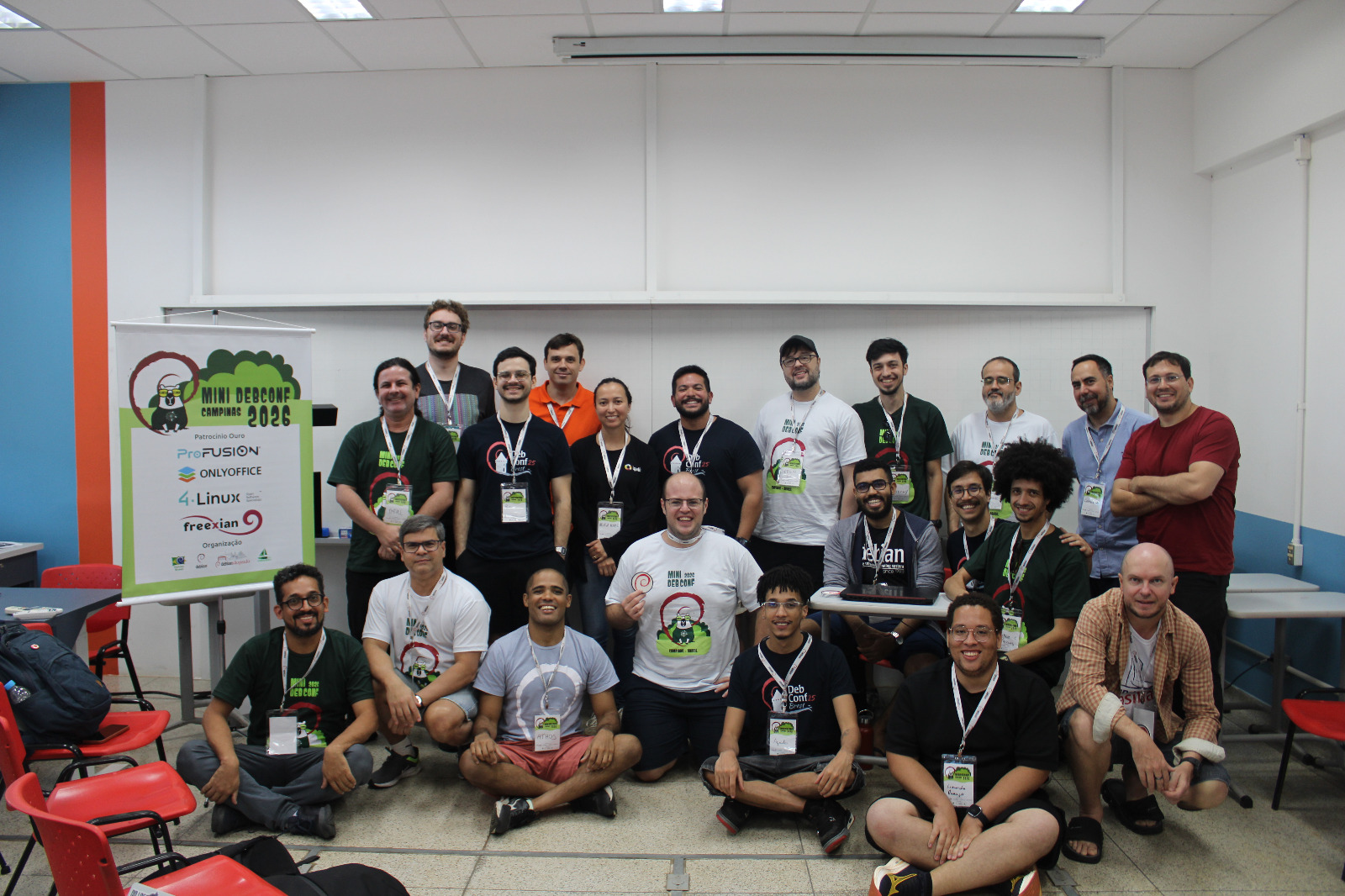
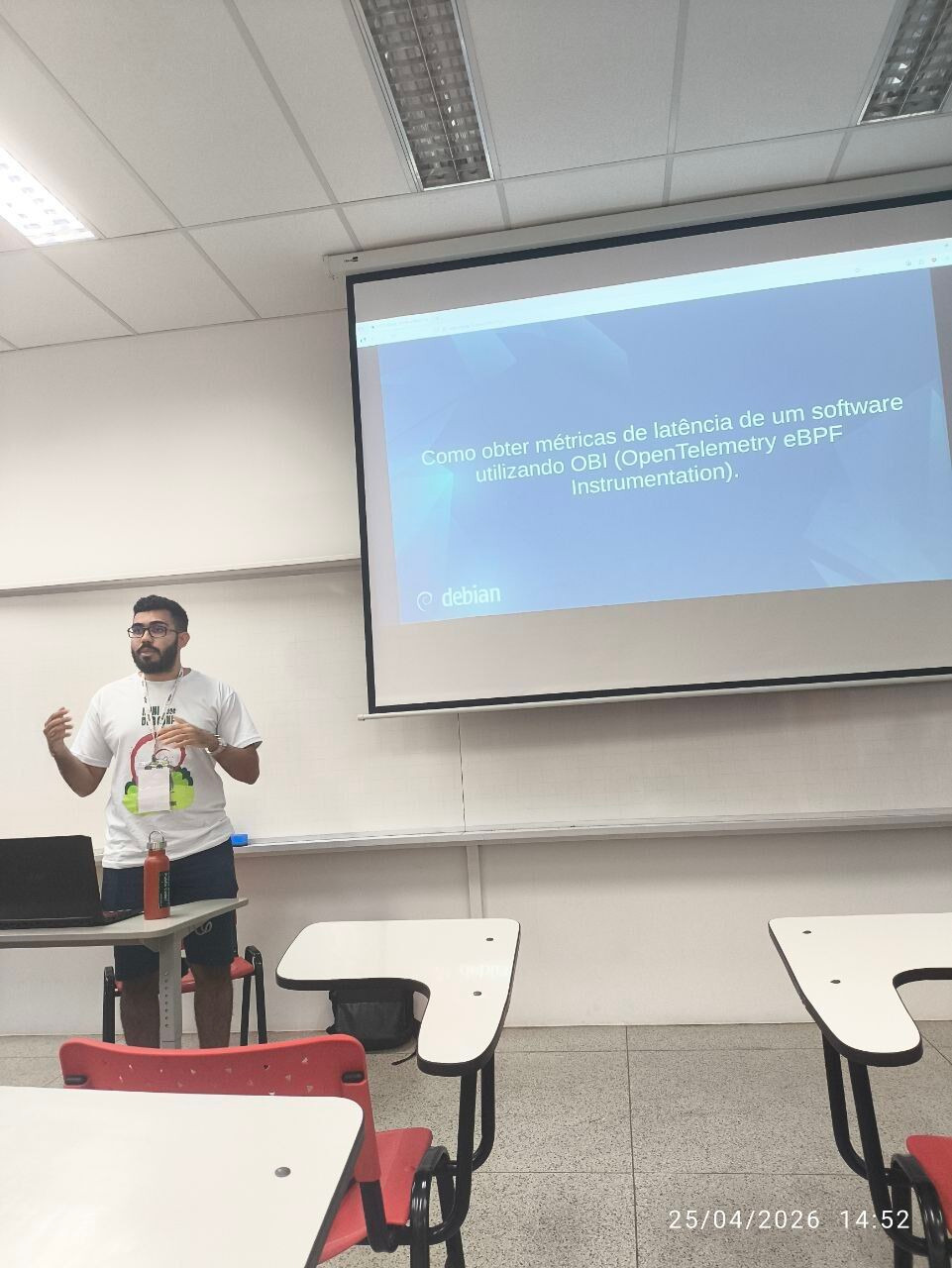
MiniDebConf Campinas, by Lucas Kanashiro, Santiago Ruano Rinc n and Antonio Terceiro MiniDebConf Campinas was held between April 23rd and 25th, at the State University of Campinas, and was preceded by a MiniDebcamp between April 20th and 22nd. Freexian was Gold sponsor for the event, and Freexian collaborators were active contributors to the conference success. Lucas and Santiago delivered a talk about Debian LTS during MiniDebConf Campinas 2026, where they described how the LTS project benefits Debian users and developers, while strengthening Debian itself. Lucas and Antonio delivered a talk about internship programs in Debian during MiniDebConf Campinas 2026, with the goal of getting students interested in working in and with Debian. Lucas took part in the MiniDebConf Campinas content team, reviewing/accepting talks and building the schedule. Antonio led a session where he invited the audience to weigh in on current controversies in Debian. The session presented playful elements as colored signs to denote agree/disagree, and was not recorded, to help people feel more comfortable about speaking up. He might be convinced to lead a similar session at the next DebConf. Antonio also organized a debate to discuss the consequences of new Brazilian regulation for the protection of children and adolescents in digital spaces for Debian and other free operating systems, but also for the free software community in general. This session was very fruitful and will lead into further actions, as one of the main outcomes was the realization that the free software community must follow the discussion leading up to similar regulations more closely to avoid being caught by surprise when they come into effect.

security-tracker performance, by Helmut Grohne and Emilio Pozuelo Monfort Prompted by spontaneous influx of web requests on Freexian s security-tracker back in February, we considered the options for managing that demand. One of our mitigations was making it faster. To that end, Helmut sent two MRs towards improving the situation. There are four notable improvements. The use of Python s str.translate generally speeds up rendering of larger templates. Indexing the CVE names avoids a costly sequential table scan. Avoiding FFI calls while sorting and reducing the queryset speeds up the source package view. Emilio reviewed and deployed the changes on to the Debian instance. Together these changes provide a twofold speedup on both Freexian s and Debian s instance on average.

dput-ng data loss bug, by Colin Watson Ian Jackson (not affiliated with Freexian) reported that dput-ng could lose data when using the local install method, which could cause misleading results in tests of other packages; they also filed an initial merge request to fix it. Colin improved this to isolate its tests properly, and uploaded it.

Miscellaneous contributions
  • Lucas coordinated the src:valkey update to version 9 in unstable with a potential co-maintainer.
  • Lucas provided a security update for src:valkey targeting trixie .
  • Thorsten did two uploads of foo2zjs, one to fix a bug and one to improve packaging. As there have been several CVEs published for cups he also did an upload of a new upstream version. Unfortunately this introduces a regression and another upload was needed to take care of a crash. The patch for one CVE also broke a test script, which is used by lots of printing packages in Debian. As a result some autopkgtest runs failed. This could be fixed as well and the only remaining issue that needs some more investigation is related to cups-pdf. It is also worth mentioning that some issues related to the apparmor configuration of cups could be resolved.
  • Helmut sent patches for 11 cross build failures.
  • Helmut sent a MR for enabling the new mainline YT6801 ethernet Linux driver and it is now working fine with Debian s 7.x kernels.
  • Helmut upgraded a crossqa.debian.net autobuilder to trixie .
  • Carles using po-debconf-manager, improved Catalan translations: reviewed 2 packages, submitted 3 packages, deleted 5 packages.
  • Carles did further code developments for check-relations: steps towards making it production ready when the initial round of reports are analyzed. New show-package (information) command, improvements for report_missing cases, added support for ignoring packages for specific reasons, added unit tests, added CI. Used it to open 39 new bugs. Also followed up different open bugs
  • Rapha l completed the French translation of Zulip for the release of version 12.0. Zulip is a nice 100% free software threaded communication platform for distributed teams.
  • Stefano did routine uploads of python-pipx, python-mitogen, platformdirs, python-authlib, python-discovery, distro-info-data, python-virtualenv, python-certifi, python-wheel, pypy3.
  • Stefano uploaded distro-info-data updates to stable and oldstable proposed updates, with the latest Ubuntu release.
  • Stefano took part in DebConf 26 preparation meetings.
  • Stefano prepared DebConf s online video streaming infrastructure for MiniDebConf Campinas, and configured the Debian reimbursement system to handle their travel bursary claims.
  • Stefano helped MiniDebConf Hamburg prepare their website for 2027.
  • Stefano did some sysadmin work on debian.social infrastructure.
  • Stefano reviewed Matthias python3.15 packaging and rebased his work on top of it.
  • Antonio implemented several improvements to the Debian CI platform, including but not limited to adding support for dark mode, dropping compatibility with ActiveRecord < 7 which is no longer shipped in Debian stable, and generating content-based links to static assets, in two parts.
  • Antonio debugged a general slowness in salsa, caused by loss of IPv6 connectivity between the salsa host and the remote object storage in the cloud , which is a problem due to an open upstream bug in gitlab.
  • Santiago reviewed different changes to the Salsa CI pipeline, including the new uscan test job, prepared by Tha s Rebou as Araujo, and the final review to introduce faketime testing, made by quila Macedo.
  • Santiago continued helping the DebConf 26 local team to prepare the conference.
  • Emilio updated libxpm to address a security issue.
  • Colin finished upgrading groff to 1.24.1; 1.24.0 and 1.24.1 were the first upstream releases since 2023 and had extensive changes, so this took some time to get right.
  • Colin released bookworm and trixie fixes for CVE-2026-3497 in openssh, and issued the corresponding BSA-130 for trixie-backports.
  • Colin upgraded openssh to 10.3p1.
  • Anupa worked on the accounting tasks for MiniDebConf Kanpur and prepared and submitted a report to the fiscal host.

13 May 2026

Sergio Cipriano: My experience at MiniDebConf Campinas 2026

My experience at MiniDebConf Campinas 2026 Last week, I spent the entire week in Campinas attending MiniDebConf and MiniDebCamp. The Debian Brazil community organizes this event every year, and this year's edition was the biggest so far. During MiniDebCamp, I sponsored a few uploads and spent two days teaching packaging to two participants. I usually teach packaging online, so it was refreshing to do it in person. I believe the experience was much better than teaching online. One of my mentees introduced me to the DDTSS (Debian Distributed Translation Server Satellite). Even though there are many i18n contributors in Brazil, this was my first time learning about this system. I plan to contribute to translations over the next few weeks using DDTSS.

My Activities
NOTE: I translated every talk title; the original titles are in PT-BR, so some details may have been lost in translation.
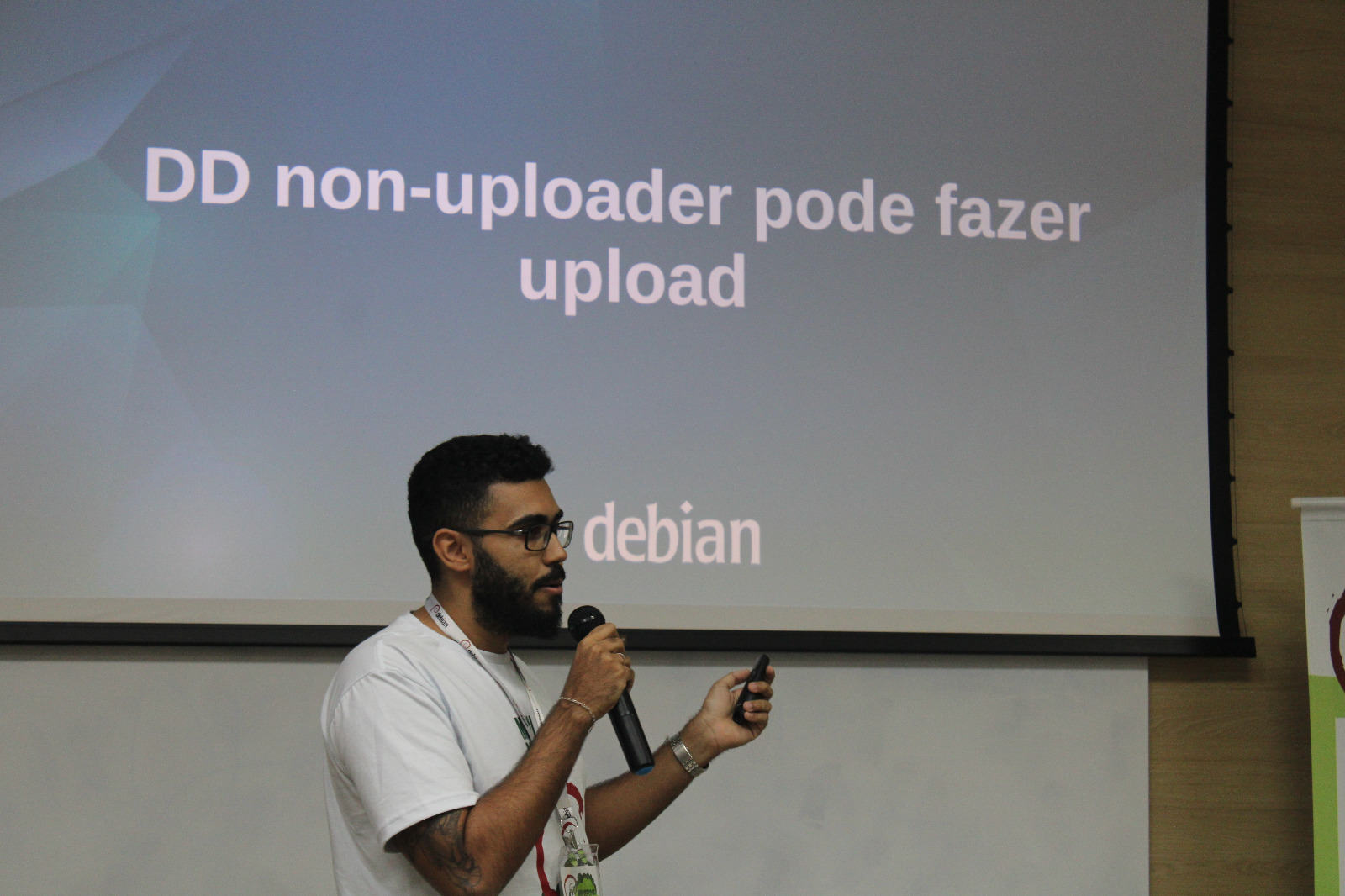
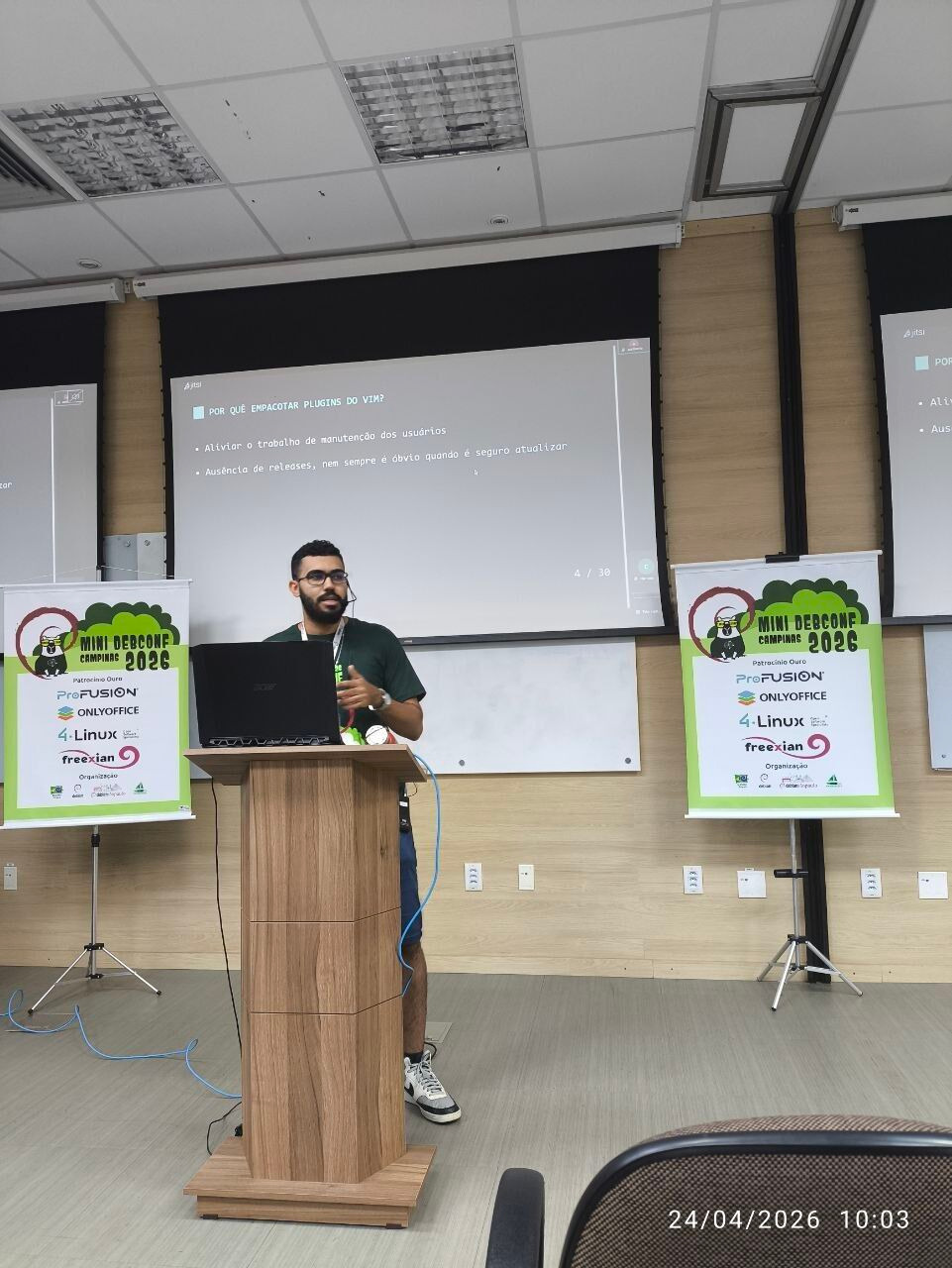
I presented three talks and led one BoF session. The talks are all available on Debian's Peertube: You can also find my slides at people.d.o. My first talk was a showcase of dh-make-vim, a tool I created and have been using for a few months. Some people tested it and found bugs, which was really nice to see. My second talk was essentially a live version of my blog post Zero-Code Instrumentation of an Envoy TCP Proxy using eBPF. I also gave a lightning talk about something many people are not aware of: non-uploading DDs can also sponsor uploads. If you're interested, this bug report provides more context: tracker.debian.org: Signed by field is missing when sponsoring as DD non-uploading Finally, I led the BoF session "Experiences, lessons learned, and next steps from the mentoring sessions". This was my favorite session, we had many participants with different perspectives and ideas, which led to a very engaging discussion. I'm still working on the action plans and I plan to release them soon. Here are some photos of these activities: Mentorship BoF Mentorship BoF DD non-uploading can upload talk dh-make-vim showcase Zero-Code Instrumentation showcase

My favorite activities This is a list, in no particular order, of some of the sessions I enjoyed the most:
  • Salsa CI, showing features that almost nobody knows I wrote a blog post about one of the things I learned in this talk, and there is still a lot more to explore. Aquila Macedo is developing many cool features in Salsa CI.
  • Free Software: Freedom, Autonomy, Sovereignty I had been really looking forward to this one. Alexandre Oliva is a very important figure in the Free Software movement, especially in South America. I'll need to rewatch it, my futures talks about Free Software will likely be inspired by this one.
  • What I've lived/seen in 33 Years of Debian & Free Software in general Eduardo Ma an was the first Debian Developer in Brazil, so it's always valuable to hear the story from someone who was part of it.
  • Symbolism - an introduction Despite the title, this talk was not about astrology! I'll probably rewatch it as well, as there is a lot of information to take in. I really like the passion S rgio Durigan has for C. He is also a great speaker and knows how to guide the audience through the topic.
  • Debate: Contemporary controversies in Debian The debate itself was great, but the conversations we had afterward were even better. I changed some of my opinions after hearing different perspectives. I don't think this format would work at DebConf, but I would definitely like to attend another one like this.
  • Why LTS on Debian? I had a few questions about LTS, and Kanashiro and Santiago answered them both during the talk and in the Q&A session. They also shared some challenges and how to avoid them, it was a great learning experience.
  • From my first contribution to the Debian Maintainer Polkorny was a bit shy but did a great job! I really enjoy this kind of talk. It is always nice to see the different paths people take.
Unfortunatly, I couldn't attend everything I was interested in, as always.

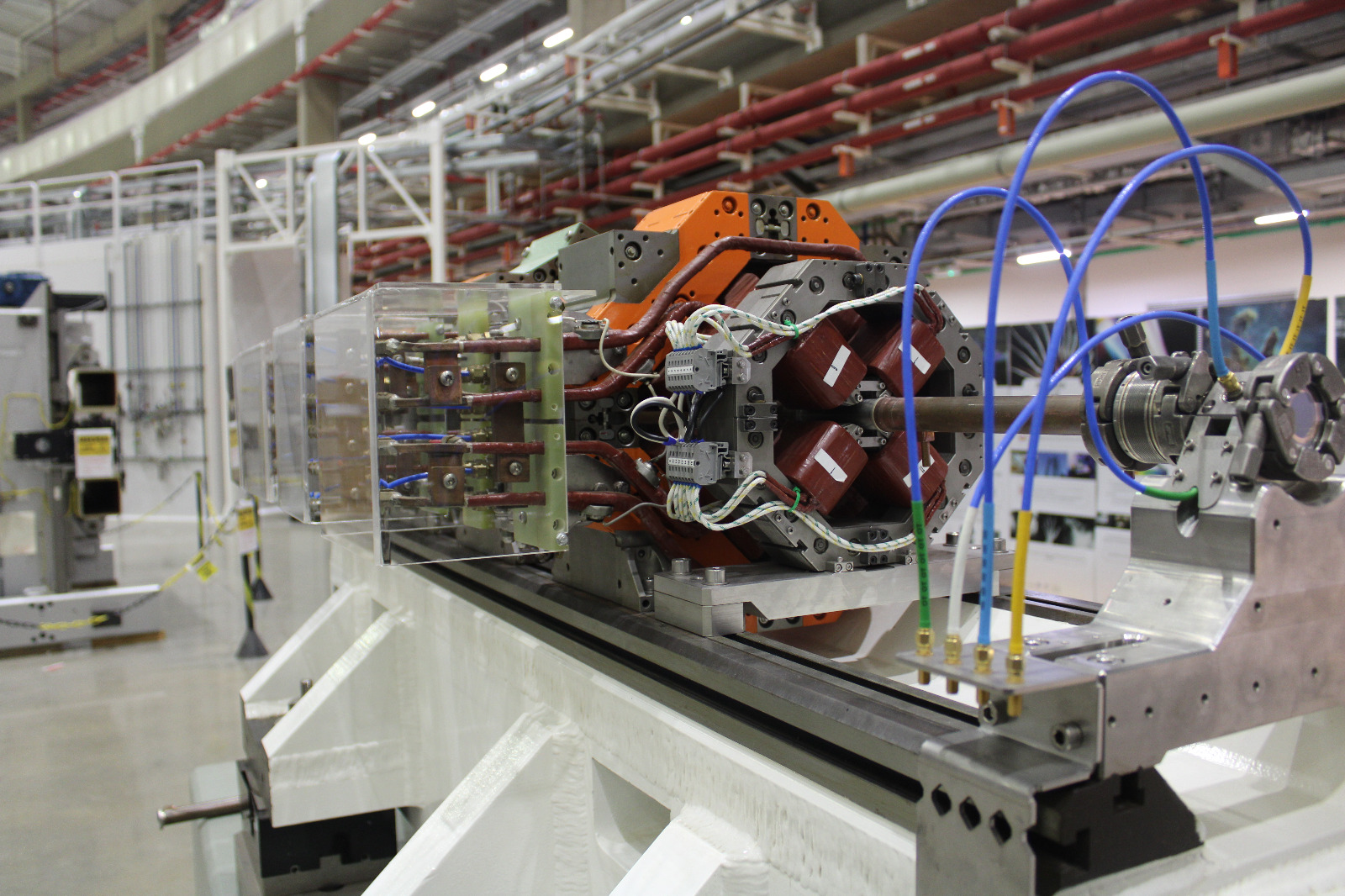
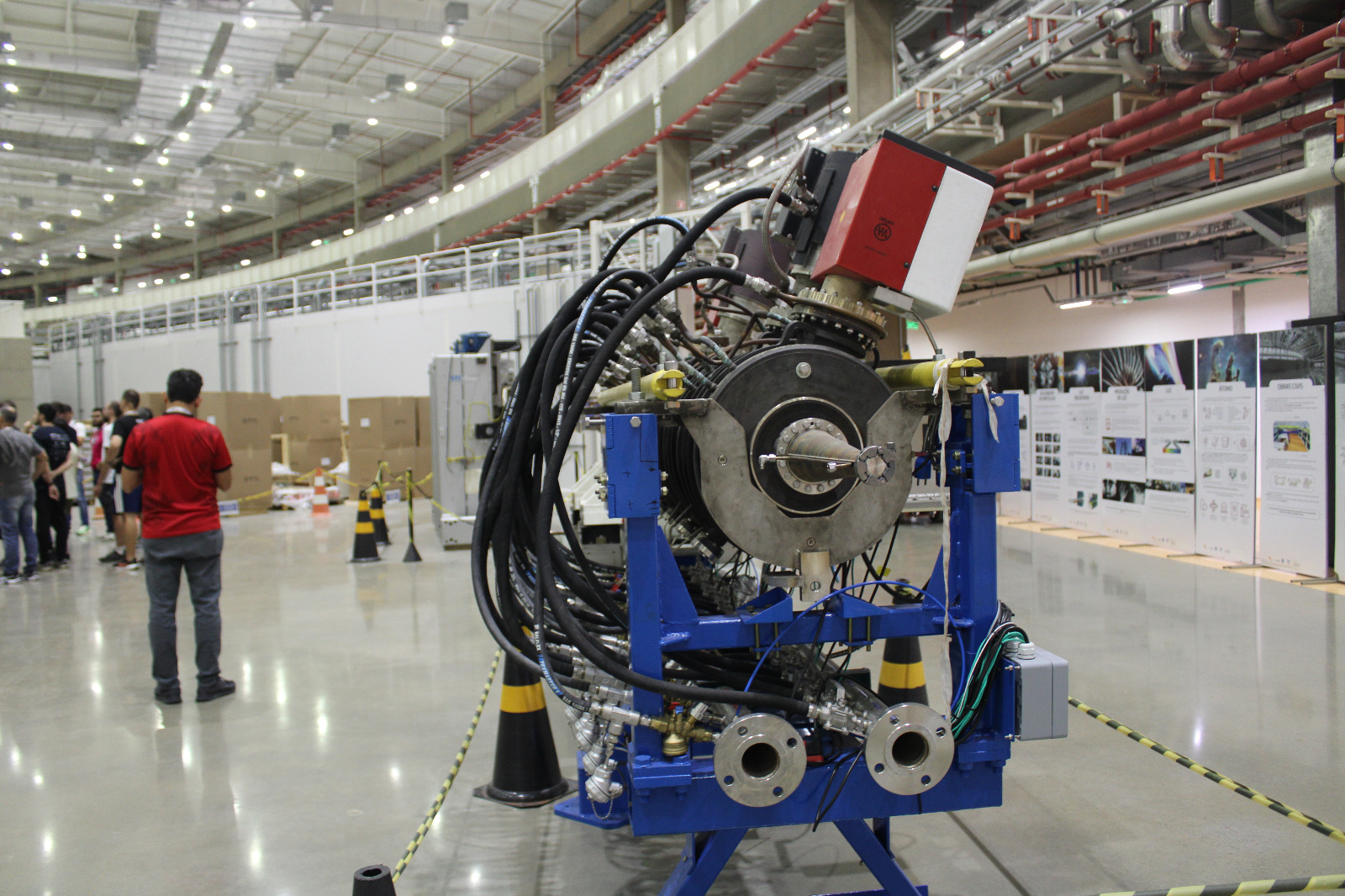
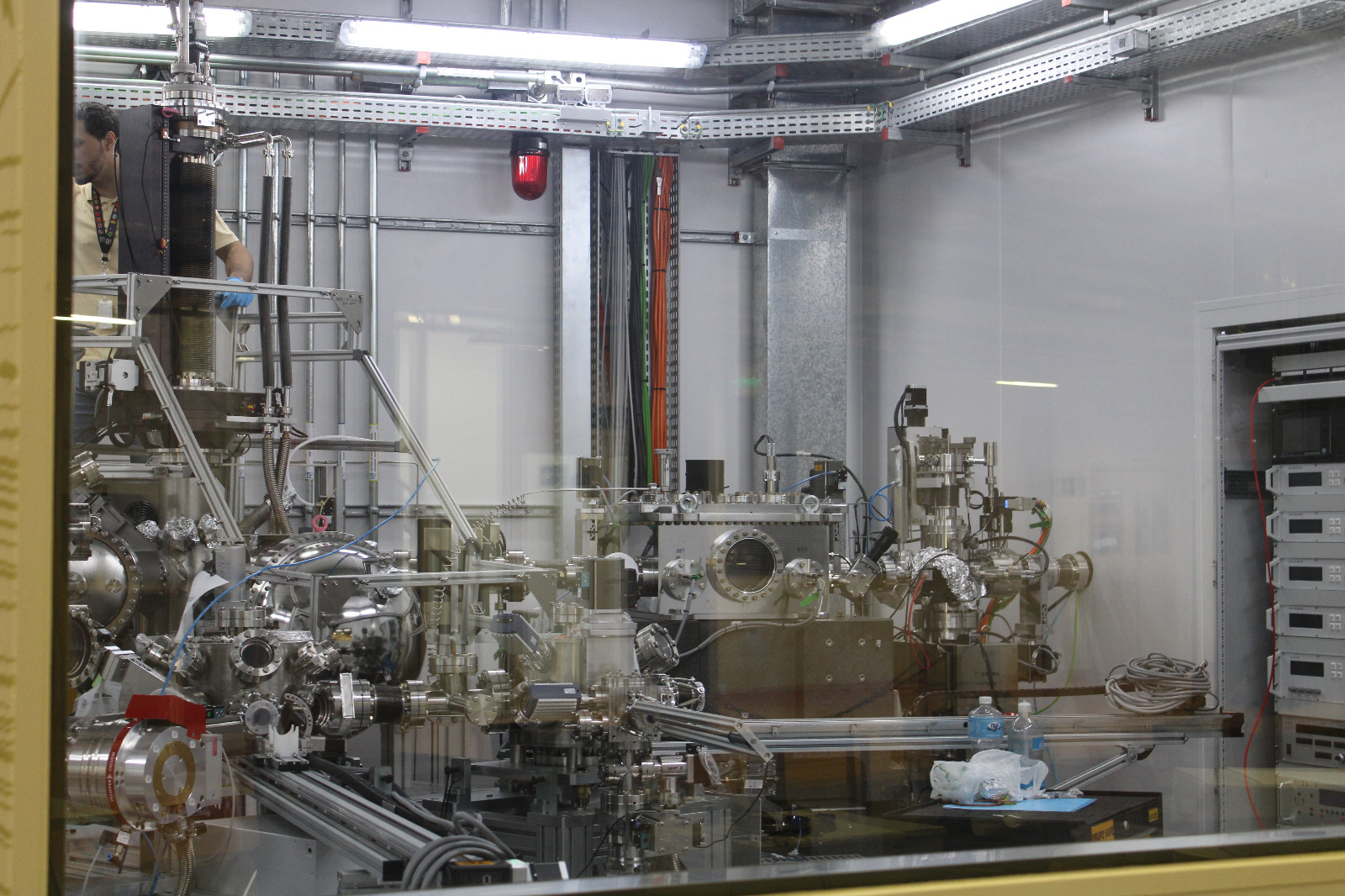
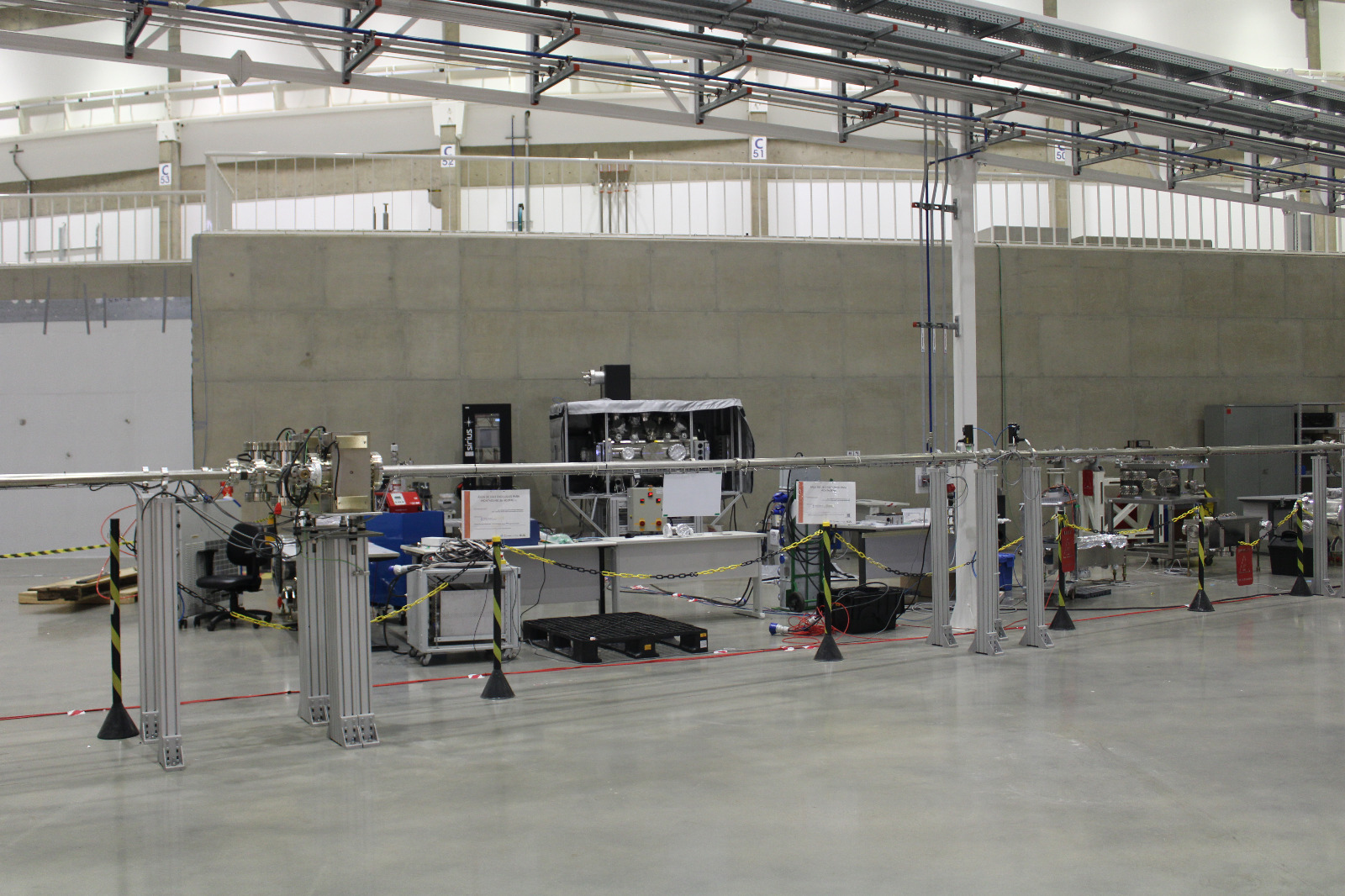
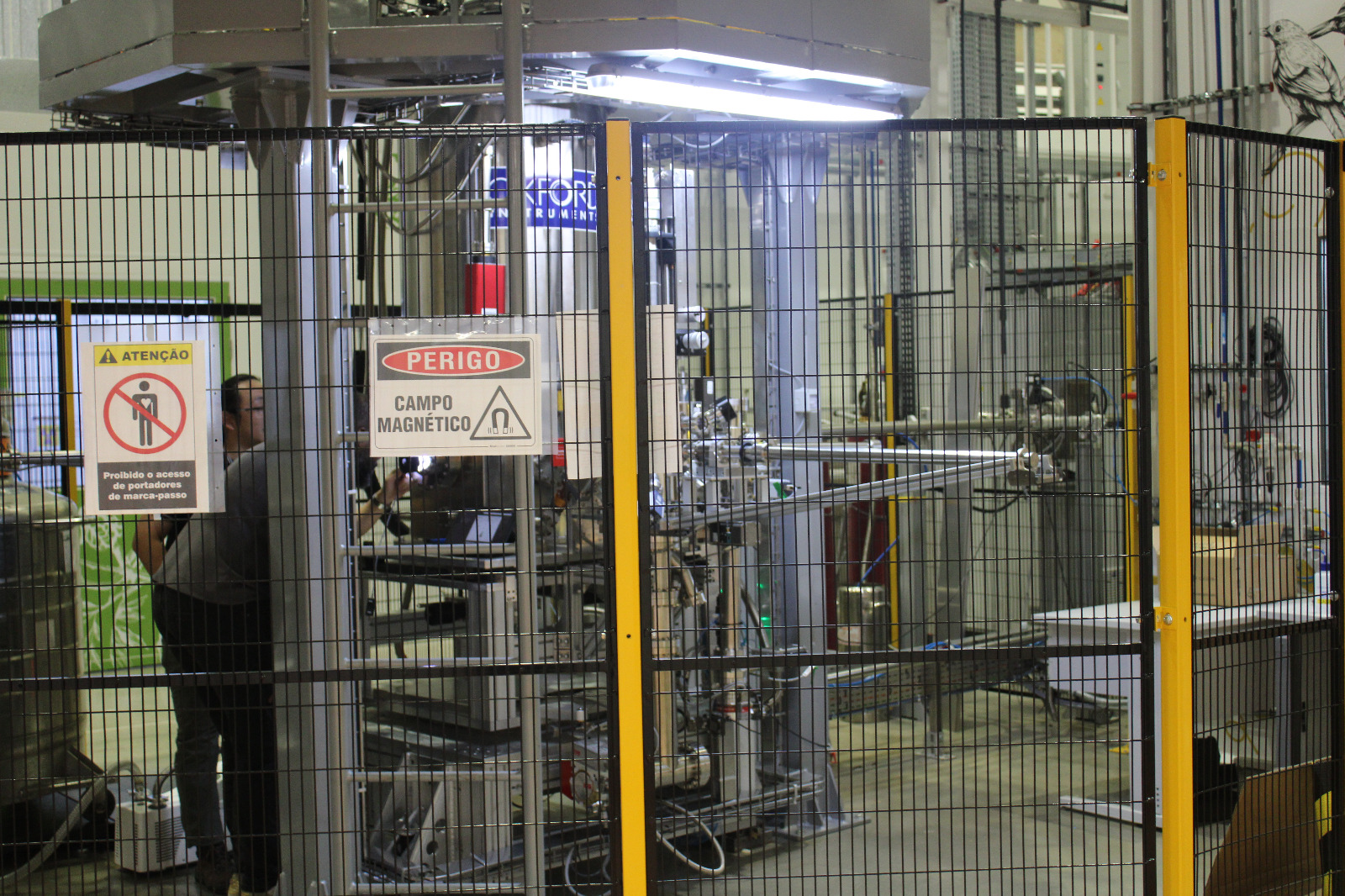
DayTrip - The Brazilian Particle Accelerator Sirius is the largest and most complex scientific infrastructure ever built in Brazil and one of the most advanced synchrotron light sources in the world. My jaw dropped the entire time; it's hard to describe how incredible this is. My favorite detail: they're running Debian :)

Wrap up I believe this was the best MiniDebConf Brazil so far. There were many other things I chose not to include here, as this post is already quite long. Still, here are a few more highlights:
  • A Bug Squashing Party
  • Driving Samuel Henrique's drones
  • Lots of capybaras
  • A small birthday party
  • A visit to two data centers

25 February 2026

Joachim Breitner: Vibe-coding a debugger for a DSL

Earlier this week a colleague of mine, Emilio Jes s Gallego Arias, shared a demo of something he built as an experiment, and I felt the desire to share this and add a bit of reflection. (Not keen on watching a 5 min video? Read on below.)

What was that? So what did you just see (or skipped watching)? You could see Emilio s screen, running VSCode and editing a Lean file. He designed a small programming language that he embedded into Lean, including an evaluator. So far, so standard, but a few things stick out already:
  • Using Lean s very extensible syntax this embedding is rather elegant and pretty.
  • Furthermore, he can run this DSL code right there, in the source code, using commands like #eval. This is a bit like the interpreter found in Haskell or Python, but without needing a separate process, or like using a Jupyter notebook, but without the stateful cell management.
This is already a nice demonstration of Lean s abilities and strength, as we know them. But what blew my mind the first time was what happened next: He had a visual debugger that allowed him to debug his DSL program. It appeared on the right, in Lean s Info View , where various Lean tools can hook into, show information and allow the user to interact. But it did not stop there, and my mind was blown a second time: Emilio opened VSCode s Debugger pane on the left, and was able to properly use VSCode s full-fledged debugger frontend for his own little embedded programming language! Complete with highlighting the executed line, with the ability to set breakpoints there, and showing the state of local variables in the debugger. Having a good debugger is not to be taken for granted even for serious, practical programming languages. Having it for a small embedded language that you just built yourself? I wouldn t have even considered that.

Did it take long? If I were Emilio s manager I would applaud the demo and then would have to ask how many weeks he spent on that. Coming up with the language, getting the syntax extension right, writing the evaluator and especially learning how the debugger integration into VSCode (using the DAP protocol) works, and then instrumenting his evaluator to speak that protocol that is a sizeable project! It turns out the answer isn t measured in weeks: it took just one day of coding together with GPT-Codex 5.3. My mind was blown a third time.

Why does Lean make a difference? I am sure this post is just one of many stories you have read in recent weeks about how new models like Claude Opus 4.6 and GPT-Codex 5.3 built impressive things in hours that would have taken days or more before. But have you seen something like this? Agentic coding is powerful, but limited by what the underlying platform exposes. I claim that Lean is a particularly well-suited platform to unleash the agents versatility. Here we are using Lean as a programming language, not as a theorem prover (which brings other immediate benefits when using agents, e.g. the produced code can be verified rather than merely plausible, but that s a story to be told elsewhere.) But arguably because Lean is also a theorem prover, and because of the requirements that stem from that, its architecture is different from that of a conventional programming language implementation:
  • As a theorem prover, it needs extensible syntax to allow formalizing mathematics in an ergonomic way, but it can also be used for embedding syntax.
  • As a theorem prover, it needs the ability to run tactics written by the user, hence the ability to evaluate the code right there in the editor.
  • As a theorem prover, it needs to give access to information such as tactic state, and such introspection abilities unlock many other features such as a debugger for an embedded language.
  • As a theorem prover, it has to allow tools to present information like the tactic state, so it has the concept of interactive Widgets .
So Lean s design has always made such a feat possible. But it was no easy feat. The Lean API is large, and documentation never ceases to be improvable. In the past, it would take an expert (or someone willing to become one) to pull off that stunt. These days, coding assistants have no issue digesting, understanding and using the API, as Emilio s demo shows. The combination of Lean s extensibility and the ability of coding agents to make use of that is a game changer to how we can develop software, with rich, deep, flexible and bespoke ways to interact with our code, created on demand.

Where does that lead us? Emilio actually shared more such demos (Github repository). A visual explorer for the compiler output (have a look at the screenshot. A browser-devtool-like inspection tool for Lean s InfoTree . Any of these provide a significant productivity boost. Any of these would have been a sizeable project half a year ago. Now it s just a few hours of chatting with the agent. So allow me to try and extrapolate into a future where coding agents have continued to advance at the current pace, and are used ubiquitously. Is there then even a point in polishing these tools, shipping them to our users, documenting them? Why build a compiler explorer for our users, if our users can just ask their agent to build one for them, right then when they need it, tailored to precisely the use case they have, with no unnecessary or confusing feature. The code would be single use, as the next time the user needs something like that the agent can just re-create it, maybe slightly different because every use case is different. If that comes to pass then Lean may no longer get praise for its nice out-of-the-box user experience, but instead because it is such a powerful framework for ad-hoc UX improvements. And Emilio wouldn t post demos about his debugger. He d just use it.

23 February 2026

Antoine Beaupr : PSA: North america changes time forward soon, Europe next

This is a copy of an email I used to send internally at work and now made public. I'm not sure I'll make a habit of posting it here, especially not twice a year, unless people really like it. Right now, it's mostly here to keep with my current writing spree going.
This is your bi-yearly reminder that time is changing soon!

What's happening? For people not on tor-internal, you should know that I've been sending semi-regular announcements when daylight saving changes occur. Starting now, I'm making those announcements public so they can be shared with the wider community because, after all, this affects everyone (kind of). For those of you lucky enough to have no idea what I'm talking about, you should know that some places in the world implement what is called Daylight saving time or DST. Normally, you shouldn't have to do anything: computers automatically change time following local rules, assuming they are correctly configured, provided recent updates have been applied in the case of a recent change in said rules (because yes, this happens). Appliances, of course, will likely not change time and will need to adjusted unless they are so-called "smart" (also known as "part of a bot net"). If your clock is flashing "0:00" or "12:00", you have no action to take, congratulations on having the right time once or twice a day. If you haven't changed those clocks in six months, congratulations, they will be accurate again! In any case, you should still consider DST because it might affect some of your meeting schedules, particularly if you set up a new meeting schedule in the last 6 months and forgot to consider this change.

If your location does not have DST Properly scheduled meetings affecting multiple time zones are set in UTC time, which does not change. So if your location does not observer time changes, your (local!) meeting time will not change. But be aware that some other folks attending your meeting might have the DST bug and their meeting times will change. They might miss entire meetings or arrive late as you frantically ping them over IRC, Matrix, Signal, SMS, Ricochet, Mattermost, SimpleX, Whatsapp, Discord, Slack, Wechat, Snapchat, Telegram, XMPP, Briar, Zulip, RocketChat, DeltaChat, talk(1), write(1), actual telegrams, Meshtastic, Meshcore, Reticulum, APRS, snail mail, and, finally, flying a remote presence drone to their house, asking what's going on. (Sorry if I forgot your preferred messaging client here, I tried my best.) Be kind; those poor folks might be more sleep deprived as DST steals one hour of sleep from them on the night that implements the change.

If you do observe DST If you are affected by the DST bug, your local meeting times will change access the board. Normally, you can trust that your meetings are scheduled to take this change into account and the new time should still be reasonable. Trust, but verify; make sure the new times are adequate and there are no scheduling conflicts. Do this now: take a look at your calendar in two week and in April. See if any meeting need to be rescheduled because of an impossible or conflicting time.

When does time change, how and where? Notice how I mentioned "North America" in the subject? That's a lie. ("The doctor lies", as they say on the BBC.) Other places, including Europe, also changes times, just not all at once (and not all North America). We'll get into "where" soon, but first let's look at the "how". As you might already know, the trick is:
Spring forward, fall backwards.
This northern-centric (sorry!) proverb says that clocks will move forward by an hour this "spring", after moving backwards last "fall". This is why we lose an hour of work, sorry, sleep. It sucks, to put it bluntly. I want it to stop and will keep writing those advisories until it does. To see where and when, we, unfortunately, still need to go into politics.

USA and Canada First, we start with "North America" which, really, is just some parts of USA[1] and Canada[2]. As usual, on the Second Sunday in March (the 8th) at 02:00 local (not UTC!), the clocks will move forward. This means that properly set clocks will flip from 1:59 to 3:00, coldly depriving us from an hour of sleep that was perniciously granted 6 months ago and making calendar software stupidly hard to write. Practically, set your wrist watch and alarm clocks[3] back one hour before going to bed and go to bed early. [1] except Arizona (except the Navajo nation), US territories, and Hawaii [2] except Yukon, most of Saskatchewan, and parts of British Columbia (northeast), one island in Nunavut (Southampton Island), one town in Ontario (Atikokan) and small parts of Quebec (Le Golfe-du-Saint-Laurent), a list which I keep recopying because I find it just so amazing how chaotic it is. When your clock has its own Wikipedia page, you know something is wrong. [3] hopefully not managed by a botnet, otherwise kindly ask your bot net operator to apply proper software upgrades in a timely manner

Europe Next we look at our dear Europe, which will change time on the last Sunday in March (the 29th) at 01:00 UTC (not local!). I think it means that, Amsterdam-time, the clocks will flip from 1:59 to 3:00 AM local on that night. (Every time I write this, I have doubts. I would welcome independent confirmation from night owls that observe that funky behavior experimentally.) Just like your poor fellows out west, just fix your old-school clocks before going to bed, and go to sleep early, it's good for you.

Rest of the world with DST Renewed and recurring apologies again to the people of Cuba, Mexico, Moldova, Israel, Lebanon, Palestine, Egypt, Chile (except Magallanes Region), parts of Australia, and New Zealand which all have their own individual DST rules, omitted here for brevity. In general, changes also happen in March, but either on different times or different days, except in the south hemisphere, where they happen in April.

Rest of the world without DST All of you other folks without DST, rejoice! Thank you for reminding us how manage calendars and clocks normally. Sometimes, doing nothing is precisely the right thing to do. You're an inspiration for us all.

Changes since last time There were, again, no changes since last year on daylight savings that I'm aware of. It seems the US congress debating switching to a "half-daylight" time zone which is an half-baked idea that I should have expected from the current USA politics. The plan is to, say, switch from "Eastern is UTC-4 in the summer" to "Eastern is UTC-4.5". The bill also proposes to do this 90 days after enactment, which is dangerously optimistic about our capacity at deploying any significant change in human society. In general, I rely on the Wikipedia time nerds for this and Paul Eggert which seems to singlehandledly be keeping everything in order for all of us, on the tz-announce mailing list. This time, I've also looked at the tz mailing list which is where I learned about the congress bill. If your country has changed time and no one above noticed, now would be an extremely late time to do something about this, typically writing to the above list. (Incredibly, I need to write to the list because of this post.) One thing that did change since last year is that I've implemented what I hope to be a robust calendar for this, which was surprisingly tricky. If you have access to our Nextcloud, it should be visible under the heading "Daylight saving times". If you don't, you can access it using this direct link. The procedures around how this calendar was created, how this email was written, and curses found along the way, are also documented in this wiki page, if someone ever needs to pick up the Time Lord duty.

12 September 2025

Freexian Collaborators: Using JavaScript in Debusine without depending on JavaScript (by Enrico Zini)

Debusine is a tool designed for Debian developers and Operating System developers in general. This posts describes our approach to the use of JavaScript, and some practical designs we came up with to integrate it with Django with minimal effort.

Debusine web UI and JavaScript Debusine currently has 3 user interfaces: a client on the command line, a RESTful API, and a Django-based Web UI. Debusine s web UI is a tool to interact with the system, and we want to spend most of our efforts in creating a system that works and works well, rather than chasing the latest and hippest of the frontend frameworks for the web. Also, Debian as a community has an aversion to having parts of the JavaScript ecosystem in the critical path of its core infrastructure, and in our professional experience this aversion is not at all unreasonable. This leads to having some interesting requirements for the web UI, that (rather surprisingly, one would think) one doesn t usually find advertised in many projects:
  • Straightforward to create and maintain.
  • Well integrated with Django.
  • Easy to package in Debian, with as little vendoring as possible, which helps mitigate supply chain attacks
  • Usable without JavaScript whenever possible, for progressive enhancement rather than core functionality.
The idea is to avoid growing the technical complexity and requirements of the web UI, both server-side and client-side, for functionality that is not needed for this kind of project, with tools that do not fit well in our ecosystem. Also, to limit the complexity of the JavaScript portions that we do develop, we choose to limit our JavaScript browser supports to the main browser versions packaged in Debian Stable, plus recent oldstable. This makes JavaScript easier to write and maintain, and it also makes it less needed, as modern HTML plus modern CSS interfaces can go a long way with less scripting interventions. We recently encoded JavaScript practices and tradeoffs in a JavaScript Practices chapter of Debusine s documentation.

How we use JavaScript From the start we built the UI using Bootstrap, which helps in having responsive layouts that can also work on mobile devices. When we started having large select fields, we introduced Select2 to make interaction more efficient, and which degrades gracefully to working HTML. Both Bootstrap and Select2 are packaged in Debian. Form validation is done server-side by Django, and we do not reimplement it client-side in JavaScript, as we prefer the extra round trip through a form submission to the risk of mismatches between the two validations. In those cases where a UI task is not at all possible without JavaScript, we can make its support mandatory as long as the same goal can be otherwise achieved using the debusine client command.

Django messages as Bootstrap toasts Django has a Messages framework that allows different parts of a view to push messages to the user, and it is useful to signal things like a successful form submission, or warnings on unexpected conditions. Django messages integrate well with Bootstrap toasts, which use a recognisable notification language, are nicely dismissible and do not invade the rest of the page layout. Since toasts require JavaScript to work, we added graceful degradation. to Bootstrap alerts Doing so was surprisingly simple: we handle the toasts as usual, and also render the plain alerts inside a <noscript> tag. This is precisely the intended usage of the <noscript> tag, and it works perfectly: toasts are displayed by JavaScript when it s available, or rendered as alerts when not. The resulting Django template is something like this:
<div aria-live="polite" aria-atomic="true" class="position-relative">
    <div class="toast-container position-absolute top-0 end-0 p-3">
     % for message in messages % 
        <div class="toast" role="alert" aria-live="assertive" aria-atomic="true">
            <div class="toast-header">
                <strong class="me-auto">  message.level_tag capfirst  </strong>
                <button type="button"
                        class="btn-close"
                        data-bs-dismiss="toast"
                        aria-label="Close"></button>
            </div>
            <div class="toast-body">  message  </div>
        </div>
     % endfor % 
    </div>
</div>
<!--   -->
 % if messages % 
<noscript>
     % for message in messages % 
        <div class="alert alert-primary" role="alert">
              message  
        </div>
     % endfor % 
</noscript>
 % endif % 
We have a webpage to test the result.

JavaScript incremental improvement of formsets Debusine is built around workspaces, which are, among other things, containers for resources. Workspaces can inherit from other workspaces, which act as fallback lookups for resources. This allows, for example, to maintain an experimental package to be built on Debian Unstable, without the need to copy the whole Debian Unstable workspace. A workspace can inherit from multiple others, which are looked up in order. When adding UI to configure workspace inheritance, we faced the issue that plain HTML forms do not have a convenient way to perform data entry of an ordered list. We initially built the data entry around Django formsets, which support ordering using an extra integer input field to enter the ordering position. This works, and it s good as a fallback, but we wanted something more appropriate, like dragging and dropping items to reorder them, as the main method of interaction. Our final approach renders the plain formset inside a <noscript> tag, and the JavaScript widget inside a display: none element, which is later shown by JavaScript code. As the workspace inheritance is edited, JavaScript serializes its state into <form type='hidden'> fields that match the structure used by the formset, so that when the form is submitted, the view performs validation and updates the server state as usual without any extra maintenance burden. Serializing state as hidden form fields looks a bit vintage, but it is an effective way of preserving the established data entry protocol between the server and the browser, allowing us to do incremental improvement of the UI while minimizing the maintenance effort.

More to come Debusine is now gaining significant adoption and is still under active development, with new features like personal archives coming soon. This will likely mean more user stories for the UI, so this is a design space that we are going to explore again and again in the coming future. Meanwhile, you can try out Debusine on debusine.debian.net, and follow its development on salsa.debian.org!

3 September 2025

Joachim Breitner: F91 in Lean

Back in March, with version 4.17.0, Lean introduced partial_fixpoint, a new way to define recursive functions. I had drafted a blog post for the official Lean FRO blog back then, but forgot about it, and with the Lean FRO blog discontinued, I ll just publish it here, better late than never. With the partial_fixpoint mechanism we can model possibly partial functions (so those returning an Option) without an explicit termination proof, and still prove facts about them. See the corresponding section in the reference manual for more details. On the Lean Zulip, I was asked if we can use this feature to define the McCarthy 91 function and prove it to be total. This function is a well-known tricky case for termination proofs. First let us have a brief look at why this function is tricky to define in a system like Lean. A naive definition like
def f91 (n : Nat) : Nat :=
  if n > 100
  then n - 10
  else f91 (f91 (n + 11))
does not work; Lean is not able to prove termination of this functions by itself. Even using well-founded recursion with an explicit measure (e.g. termination_by 101 - n) is doomed, because we would have to prove facts about the function s behaviour (namely that f91n = f91101 = 91 for 90 n 100) and at the same time use that fact in the termination proof that we have to provide while defining the function. (The Wikipedia page spells out the proof.) We can make well-founded recursion work if we change the signature and use a subtype on the result to prove the necessary properties while we are defining the function. Lean by Example shows how to do it, but for larger examples this approach can be hard or tedious. With partial_fixpoint, we can define the function as a partial function without worrying about termination. This requires a change to the function s signature, returning an Option Nat:
def f91 (n : Nat) : Option Nat :=
  if n > 100
    then pure (n - 10)
    else f91 (n + 11) >>= f91
partial_fixpoint
From the point of view of the logic, Option.none is then used for those inputs for which the function does not terminate. This function definition is accepted and the function runs fine as compiled code:
#eval f91 42
prints some 91. The crucial question is now: Can we prove anything about f91 In particular, can we prove that this function is actually total? Since we now have the f91 function defined, we can start proving auxillary theorems, using whatever induction schemes we need. In particular we can prove that f91 is total and always returns 91 for n 100:
theorem f91_spec_high (n : Nat) (h : 100 < n) : f91 n = some (n - 10) := by
  unfold f91; simp [*]
theorem f91_spec_low (n : Nat) (h  : n   100) : f91 n = some 91 := by
  unfold f91
  rw [if_neg (by omega)]
  by_cases n < 90
    rw [f91_spec_low (n + 11) (by omega)]
    simp only [Option.bind_eq_bind, Option.some_bind]
    rw [f91_spec_low 91 (by omega)]
    rw [f91_spec_high (n + 11) (by omega)]
    simp only [Nat.reduceSubDiff, Option.some_bind]
    by_cases h : n = 100
      simp [f91, *]
      exact f91_spec_low (n + 1) (by omega)
theorem f91_spec (n : Nat) : f91 n = some (if n   100 then 91 else n - 10) := by
  by_cases h100 : n   100
    simp [f91_spec_low, *]
    simp [f91_spec_high, Nat.lt_of_not_le  _ , *]
-- Generic totality theorem
theorem f91_total (n : Nat) : (f91 n).isSome := by simp [f91_spec]
(Note that theorem f91_spec_low is itself recursive in a somewhat non-trivial way, but Lean can figure that out all by itself. Use termination_by? if you are curious.) This is already a solid start! But what if we want a function of type f91! (n : Nat) : Nat, without the Option? Then can derive that from the partial variant, as we have just proved that to be actually total:
def f91! (n : Nat) : Nat  := (f91 n).get (f91_total n)
theorem f91!_spec (n : Nat) : f91! n = if n   100 then 91 else n - 10 := by
  simp [f91!, f91_spec]
Using partial_fixpoint one can decouple the definition of a function from a termination proof, or even model functions that are not terminating on all inputs. This can be very useful in particular when using Lean for program verification, such as with the aeneas package, where such partial definitions are used to model Rust programs.

18 August 2025

Otto Kek l inen: Best Practices for Submitting and Reviewing Merge Requests in Debian

Featured image of post Best Practices for Submitting and Reviewing Merge Requests in DebianHistorically the primary way to contribute to Debian has been to email the Debian bug tracker with a code patch. Now that 92% of all Debian source packages are hosted at salsa.debian.org the GitLab instance of Debian more and more developers are using Merge Requests, but not necessarily in the optimal way. In this post I share what I ve found the best practice to be, presented in the natural workflow from forking to merging.
Why use Merge Requests? Compared to sending patches back and forth in email, using a git forge to review code contributions brings several benefits:
  • Contributors can see the latest version of the code immediately when the maintainer pushes it to git, without having to wait for an upload to Debian archives.
  • Contributors can fork the development version and easily base their patches on the correct version and help test that the software continues to function correctly at that specific version.
  • Both maintainer and other contributors can easily see what was already submitted and avoid doing duplicate work.
  • It is easy for anyone to comment on a Merge Request and participate in the review.
  • Integrating CI testing is easy in Merge Requests by activating Salsa CI.
  • Tracking the state of a Merge Request is much easier than browsing Debian bug reports tagged patch , and the cycle of submit review re-submit re-review is much easier to manage in the dedicated Merge Request view compared to participants setting up their own email plugins for code reviews.
  • Merge Requests can have extra metadata, such as Approved , and the metadata often updates automatically, such as a Merge Request being closed automatically when the Git commit ID from it is pushed to the target branch.
Keeping these benefits in mind will help ensure that the best practices make sense and are aligned with maximizing these benefits.

Finding the Debian packaging source repository and preparing to make a contribution Before sinking any effort into a package, start by checking its overall status at the excellent Debian Package Tracker. This provides a clear overview of the package s general health in Debian, when it was last uploaded and by whom, and if there is anything special affecting the package right now. This page also has quick links to the Debian bug tracker of the package, the build status overview and more. Most importantly, in the General section, the VCS row links to the version control repository the package advertises. Before opening that page, note the version most recently uploaded to Debian. This is relevant because nothing in Debian currently enforces that the package in version control is actually the same as the latest uploaded to Debian. Packaging source code repository links at tracker.debian.org Following the Browse link opens the Debian package source repository, which is usually a project page on Salsa. To contribute, start by clicking the Fork button, select your own personal namespace and, under Branches to include, pick Only the default branch to avoid including unnecessary temporary development branches. View after pressing Fork Once forking is complete, clone it with git-buildpackage. For this example repository, the exact command would be gbp clone --verbose git@salsa.debian.org:otto/glow.git. Next, add the original repository as a new remote and pull from it to make sure you have all relevant branches. Using the same fork as an example, the commands would be:
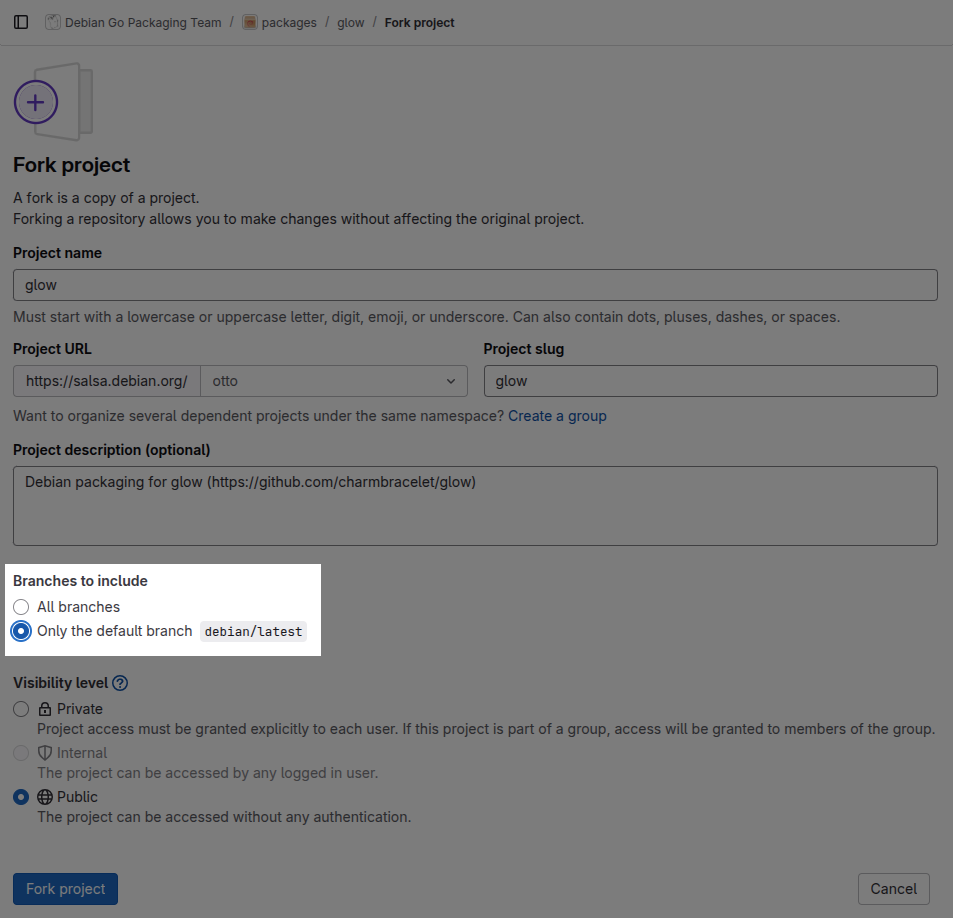
git remote add go-team https://salsa.debian.org/go-team/packages/glow.git
gbp pull --verbose --track-missing go-team
The gbp pull command can be repeated whenever you want to make sure the main branches are in sync with the original repository. Finally, run gitk --all & to visually browse the Git history and note the various branches and their states in the two remotes. Note the style in comments and repository structure the project has and make sure your contributions follow the same conventions to maximize the chances of the maintainer accepting your contribution. It may also be good to build the source package to establish a baseline of the current state and what kind of binaries and .deb packages it produces. If using Debcraft, one can simply run debcraft build in the Git repository.
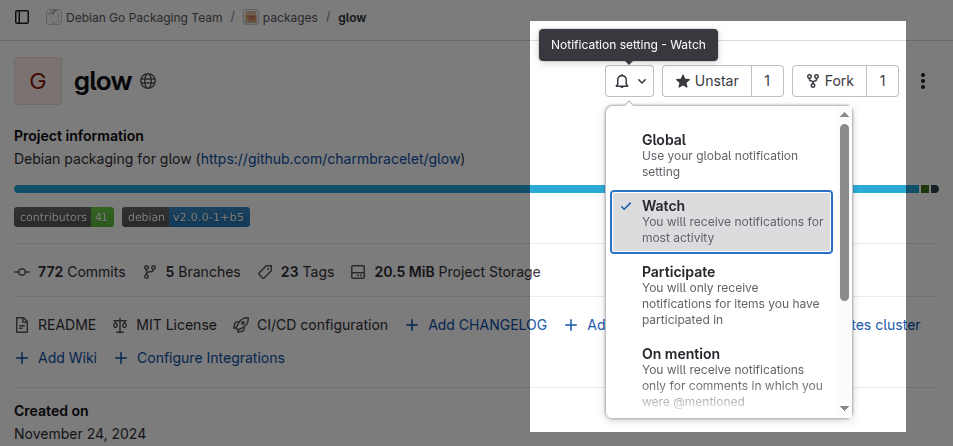
Submitting a Merge Request for a Debian packaging improvement Always start by making a development branch by running git checkout -b <branch name> to clearly separate your work from the main branch. When making changes, remember to follow the conventions you already see in the package. It is also important to be aware of general guidelines on how to make good Git commits. If you are not able to immediately finish coding, it may be useful to publish the Merge Request as a draft so that the maintainer and others can see that you started working on something and what general direction your change is heading in. If you don t finish the Merge Request in one sitting and return to it another day, you should remember to pull the Debian branch from the original Debian repository in case it has received new commits. This can be done easily with these commands (assuming the same remote and branch names as in the example above):
git fetch go-team
git rebase -i go-team/debian/latest
Frequent rebasing is a great habit to help keep the Git history linear, and restructuring and rewording your commits will make the Git history easier to follow and understand why the changes were made. When pushing improved versions of your branch, use git push --force. While GitLab does allow squashing, I recommend against it. It is better that the submitter makes sure the final version is a neat and clean set of commits that the receiver can easily merge without having to do any rebasing or squashing themselves. When ready, remove the draft status of the Merge Request and wait patiently for review. If the maintainer does not respond in several days, try sending an email to <source package name>@packages.debian.org, which is the official way to contact maintainers. You could also post a comment on the MR and tag the last few committers in the same repository so that a notification email is triggered. As a last resort, submit a bug report to the Debian bug tracker to announce that a Merge Request is pending review. This leaves a permanent record for posterity (or the Debian QA team) of your contribution. However, most of the time simply posting the Merge Request in Salsa is enough; excessive communication might be perceived as spammy, and someone needs to remember to check that the bug report is closed.

Respect the review feedback, respond quickly and avoid Merge Requests getting stale Once you get feedback, try to respond as quickly as possible. When people participating have everything fresh in their minds, it is much easier for the submitter to rework it and for the reviewer to re-review. If the Merge Request becomes stale, it can be challenging to revive it. Also, if it looks like the MR is only waiting for re-review but nothing happens, re-read the previous feedback and make sure you actually address everything. After that, post a friendly comment where you explicitly say you have addressed all feedback and are only waiting for re-review.

Reviewing Merge Requests This section about reviewing is not exclusive to Debian package maintainers anyone can contribute to Debian by reviewing open Merge Requests. Typically, the larger an open source project gets, the more help is needed in reviewing and testing changes to avoid regressions, and all diligently done work is welcome. As the famous Linus quote goes, given enough eyeballs, all bugs are shallow . On salsa.debian.org, you can browse open Merge Requests per project or for a whole group, just like on any GitLab instance. Reviewing Merge Requests is, however, most fun when they are fresh and the submitter is active. Thus, the best strategy is to ensure you have subscribed to email notifications in the repositories you care about so you get an email for any new Merge Request (or Issue) immediately when posted. Change notification settings from Global to Watch to get an email on new Merge Requests When you see a new Merge Request, try to review it within a couple of days. If you cannot review in a reasonable time, posting a small note that you intend to review it later will feel better to the submitter compared to not getting any response. Personally, I have a habit of assigning myself as a reviewer so that I can keep track of my whole review queue at https://salsa.debian.org/dashboard/merge_requests?reviewer_username=otto, and I recommend the same to others. Seeing the review assignment happen is also a good way to signal to the submitter that their submission was noted.
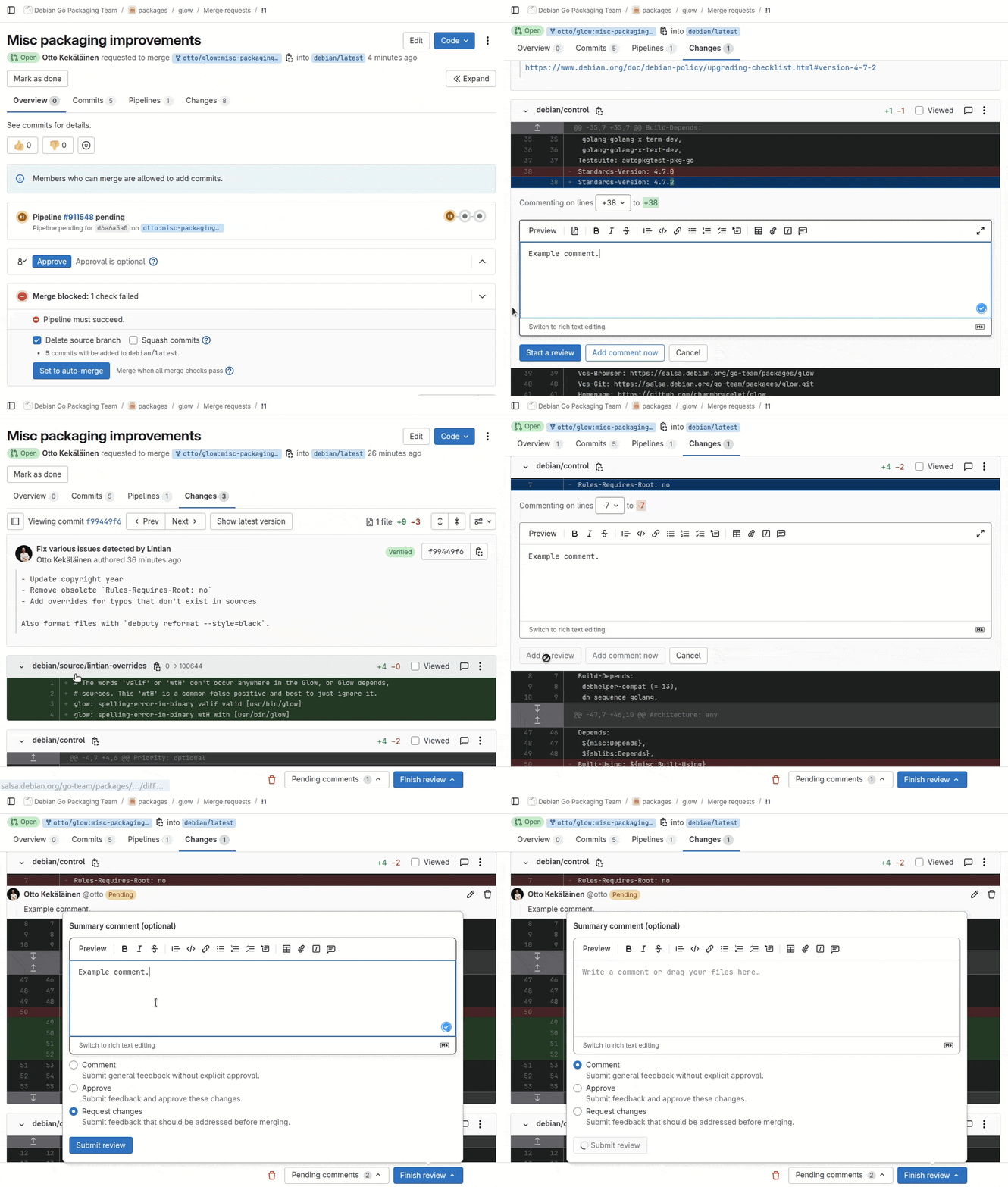
Reviewing commit-by-commit in the web interface Reviewing using the web interface works well in general, but I find that the way GitLab designed it is not ideal. In my ideal review workflow, I first read the Git commit message to understand what the submitter tried to do and why; only then do I look at the code changes in the commit. In GitLab, to do this one must first open the Commits tab and then click on the last commit in the list, as it is sorted in reverse chronological order with the first commit at the bottom. Only after that do I see the commit message and contents. Getting to the next commit is easy by simply clicking Next. Example review to demonstrate location of buttons and functionality When adding the first comment, I choose Start review and for the following remarks Add to review. Finally, I click Finish review and Submit review, which will trigger one single email to the submitter with all my feedback. I try to avoid using the Add comment now option, as each such comment triggers a separate notification email to the submitter.

Reviewing and testing on your own computer locally For the most thorough review, I pull the code to my laptop for local review with git pull <remote url> <branch name>. There is no need to run git remote add as pulling using a URL directly works too and saves from needing to clean up old remotes later. Pulling the Merge Request contents locally allows me to build, run and inspect the code deeply and review the commits with full metadata in gitk or equivalent.

Investing enough time in writing feedback, but not too much See my other post for more in-depth advice on how to structure your code review feedback. In Debian, I would emphasize patience, to allow the submitter time to rework their submission. Debian packaging is notoriously complex, and even experienced developers often need more feedback and time to get everything right. Avoid the temptation to rush the fix in yourself. In open source, Git credits are often the only salary the submitter gets. If you take the idea from the submission and implement it yourself, you rob the submitter of the opportunity to get feedback, try to improve and finally feel accomplished. Sure, it takes extra effort to give feedback, but the contributor is likely to feel ownership of their work and later return to further improve it. If a submission looks hopelessly low quality and you feel that giving feedback is a waste of time, you can simply respond with something along the lines of: Thanks for your contribution and interest in helping Debian. Unfortunately, looking at the commits, I see several shortcomings, and it is unlikely a normal review process is enough to help you finalize this. Please reach out to Debian Mentors to get a mentor who can give you more personalized feedback. There might also be contributors who just dump the code , ignore your feedback and never return to finalize their submission. If a contributor does not return to finalize their submission in 3-6 months, I will in my own projects simply finalize it myself and thank the contributor in the commit message (but not mark them as the author). Despite best practices, you will occasionally still end up doing some things in vain, but that is how volunteer collaboration works. We all just need to accept that some communication will inevitably feel like wasted effort, but it should be viewed as a necessary investment in order to get the benefits from the times when the communication led to real and valuable collaboration. Please just do not treat all contributors as if they are unlikely to ever contribute again; otherwise, your behavior will cause them not to contribute again. If you want to grow a tree, you need to plant several seeds.

Approving and merging Assuming review goes well and you are ready to approve, and if you are the only maintainer, you can proceed to merge right away. If there are multiple maintainers, or if you otherwise think that someone else might want to chime in before it is merged, use the Approve button to show that you approve the change but leave it unmerged. The person who approved does not necessarily have to be the person who merges. The point of the Merge Request review is not separation of duties in committing and merging the main purpose of a code review is to have a different set of eyeballs looking at the change before it is committed into the main development branch for all eternity. In some packages, the submitter might actually merge themselves once they see another developer has approved. In some rare Debian projects, there might even be separate people taking the roles of submitting, approving and merging, but most of the time these three roles are filled by two people either as submitter and approver+merger or submitter+merger and approver. If you are not a maintainer at all and do not have permissions to click Approve, simply post a comment summarizing your review and that you approve it and support merging it. This can help the maintainers review and merge faster.

Making a Merge Request for a new upstream version import Unlike many other Linux distributions, in Debian each source package has its own version control repository. The Debian sources consist of the upstream sources with an additional debian/ subdirectory that contains the actual Debian packaging. For the same reason, a typical Debian packaging Git repository has a debian/latest branch that has changes only in the debian/ subdirectory while the surrounding upstream files are the actual upstream files and have the actual upstream Git history. For details, see my post explaining Debian source packages in Git. Because of this Git branch structure, importing a new upstream version will typically modify three branches: debian/latest, upstream/latest and pristine-tar. When doing a Merge Request for a new upstream import, only submit one Merge Request for one branch: which means merging your new changes to the debian/latest branch. There is no need to submit the upstream/latest branch or the pristine-tar branch. Their contents are fixed and mechanically imported into Debian. There are no changes that the reviewer in Debian can request the submitter to do on these branches, so asking for feedback and comments on them is useless. All review, comments and re-reviews concern the content of the debian/latest branch only. It is not even necessary to use the debian/latest branch for a new upstream version. Personally, I always execute the new version import (with gbp import-orig --verbose --uscan) and prepare and test everything on debian/latest, but when it is time to submit it for review, I run git checkout -b import/$(dpkg-parsechangelog -SVersion) to get a branch named e.g. import/1.0.1 and then push that for review.

Reviewing a Merge Request for a new upstream version import Reviewing and testing a new upstream version import is a bit tricky currently, but possible. The key is to use gbp pull to automate fetching all branches from the submitter s fork. Assume you are reviewing a submission targeting the Glow package repository and there is a Merge Request from user otto s fork. As the maintainer, you would run the commands:
git remote add otto https://salsa.debian.org/otto/glow.git
gbp pull --verbose otto
If there was feedback in the first round and you later need to pull a new version for re-review, running gbp pull --force will not suffice, and this trick of manually fetching each branch and resetting them to the submitter s version is needed:
for BRANCH in pristine-tar upstream debian/latest
do
git checkout $BRANCH
git reset --hard origin/$BRANCH
git pull --force https://salsa.debian.org/otto/glow.git $BRANCH
done
Once review is done, either click Approve and let the submitter push everything, or alternatively, push all the branches you pulled locally yourself. In GitLab and other forges, the Merge Request will automatically be marked as Merged once the commit ID that was the head of the Merge Request is pushed to the target branch.

Please allow enough time for everyone to participate When working on Debian, keep in mind that it is a community of volunteers. It is common for people to do Debian stuff only on weekends, so you should patiently wait for at least a week so that enough workdays and weekend days have passed for the people you interact with to have had time to respond on their own Debian time. Having to wait may feel annoying and disruptive, but try to look at the upside: you do not need to do extra work simply while waiting for others. In some cases, that waiting can be useful thanks to the sleep on it phenomenon: when you yourself look at your own submission some days later with fresh eyes, you might notice something you overlooked earlier and improve your code change even without other people s feedback!

Contribute reviews! The last but not least suggestion is to make a habit of contributing reviews to packages you do not maintain. As we already see in large open source projects, such as the Linux kernel, they have far more code submissions than they can handle. The bottleneck for progress and maintaining quality becomes the reviews themselves. For Debian, as an organization and as a community, to be able to renew and grow new contributors, we need more of the senior contributors to shift focus from merely maintaining their packages and writing code to also intentionally interact with new contributors and guide them through the process of creating great open source software. Reviewing code is an effective way to both get tangible progress on individual development items and to transfer culture to a new generation of developers.

Why aren t 100% of all Debian source packages hosted on Salsa? As seen at trends.debian.net, more and more packages are using Salsa. Debian does not, however, have any policy about it. In fact, the Debian Policy Manual does not even mention the word Salsa anywhere. Adoption of Salsa has so far been purely organic, as in Debian each package maintainer has full freedom to choose whatever preferences they have regarding version control. I hope the trend to use Salsa will continue and more shared workflows emerge so that collaboration gets easier. To drive the culture of using Merge Requests and more, I drafted the Debian proposal DEP-18: Encourage Continuous Integration and Merge Request based Collaboration for Debian packages. If you are active in Debian and you think DEP-18 is beneficial for Debian, please give a thumbs up at dep-team/deps!21.

17 August 2025

C.J. Collier: The Very Model of a Patriot Online

It appears that the fragile masculinity tech evangelists have identified Debian as a community with boundaries which exclude them from abusing its members and they re so angry about it! In response to posts such as this, and inspired by Dr. Conway s piece, I ve composed a poem which, hopefully, correctly addresses the feelings of that crowd.

The Very Model of a Patriot Online
I am the very model of a modern patriot online,
My keyboard is my rifle and my noble cause is so divine.
I didn't learn my knowledge in a dusty college lecture hall,
But from the chans where bitter anonymity enthralls us all.
I spend a dozen hours every day upon my sacred quest,
To put the globo-homo narrative completely to the test.
My arguments are peer-reviewed by fellas in the comments section,
Which proves my every thesis is the model of complete perfection.
I m steeped in righteous anger that the libs call 'white fragility,'
For mocking their new pronouns and their lack of masculinity.
I m master of the epic troll, the comeback, and the searing snark,
A digital guerrilla who is fighting battles in the dark.
I know the secret symbols and the dog-whistles historical,
From Pepe the Frog to  Let s Go Brandon,  in order categorical;
In short, for fighting culture wars with rhetoric rhetorical,
I am the very model of a patriot polemical.
***
I stand for true expression, for the comics and the edgy clown,
Whose satire is too based for all the fragile folks in town.
They say my speech is 'violence' while my spirit they are trampling,
The way they try to silence me is really quite a startling sampling
Of 1984, which I've not read but thoroughly understand,
Is all about the tyranny that's gripping this once-blessed land.
My humor is a weapon, it s a razor-bladed, sharp critique,
(Though sensitive elites will call my masterpiece a form of  hate speech ).
They cannot comprehend my need for freedom from all consequence,
They call it 'hate,' I call it 'jokes,' they just don't have a lick of sense.
So when they call me  bigot  for the spicy memes I post pro bono,
I tell them their the ones who're cancelled, I'm the victim here, you know!
Then I can write a screed against the globalist cabal, you see,
And tell you every detail of their vile conspiracy.
In short, when I use logic that is flexible and personal,
I am the very model of a patriot controversial.
***
I'm very well acquainted with the scientific method, too,
It's watching lengthy YouTube vids until my face is turning blue.
I trust the heartfelt testimony of a tearful, blonde ex-nurse,
But what a paid fact-checker says has no effect and is perverse.
A PhD is proof that you've been brainwashed by the leftist mob,
While my own research on a meme is how I really do my job.
I know that masks will suffocate and vaccines are a devil's brew,
I learned it from a podcast host who used to sell brain-boosting goo.
He scorns the lamestream media, the CNNs and all the rest,
Whose biased reporting I've put fully to a rigorous test
By only reading headlines and confirming what I already knew,
Then posting my analysis for other patriots to view.
With every "study" that they cite from sources I can't stand to hear,
My own profound conclusions become ever more precisely clear.
In short, when I've debunked the experts with a confident "Says who?!",
I am the very model of a researcher who sees right through you.
***
But all these culture wars are just a sleight-of-hand, a clever feint,
To hide the stolen ballots and to cover up the moral taint
Of D.C. pizza parlors and of shipping crates from Wayfair, it s true,
It's all connected in a plot against the likes of me and you!
I've analyzed the satellite photography and watermarks,
I understand the secret drops, the cryptic Qs, the coded sparks.
The  habbening  is coming, friends, just give it two more weeks or three,
When all the traitors face the trials for their wicked treachery.
They say that nothing happened and the dates have all gone past, you see,
But that's just disinformation from the globalist enemy!
Their moving goalposts constantly, a tactic that is plain to see,
To wear us down and make us doubt the coming, final victory!
My mind can see the patterns that a simple sheep could never find,
The hidden puppet-masters who are poisoning our heart and mind.
In short, when I link drag queens to the price of gas and child-trafficking,
I am the very model of a patriot whose brain is quickening!
***
My pickup truck's a testament to everything that I hold dear,
With vinyl decals saying things the liberals all hate and fear.
The Gadsden flag is waving next to one that's blue and starkly thin,
To show my deep respect for law, except the feds who're steeped in sin.
There's Punisher and Molon Labe, so that everybody knows
I'm not someone to trifle with when push to final shoving goes.
I've got my tactical assault gear sitting ready in the den,
Awaiting for the signal to restore our land with my fellow men.
I practice clearing rooms at home when my mom goes out to the store,
A modern Minuteman who's ready for a civil war.
The neighbors give me funny looks, I see them whisper and take note,
They'll see what's what when I'm the one who's guarding checkpoints by their throat.
I am a peaceful man, of course, but I am also pre-prepared,
To neutralize the threats of which the average citizen's unscared.
In short, when my whole identity's a brand of tactical accessory,
You'll say a better warrior has never graced a Cabela's registry.
***
They say I have to tolerate a man who thinks he is a dame,
While feminists and immigrants are putting out my vital flame!
There taking all the jobs from us and giving them to folks who kneel,
And "woke HR" says my best jokes are things I'm not allowed to feel!
An Alpha Male is what I am, a lion, though I'm in this cubicle,
My life's frustrations can be traced to policies Talmudical.
They lecture me on privilege, I, who have to pay my bills and rent!
While they give handouts to the lazy, worthless, and incompetent!
My grandad fought the Nazis! Now I have to press a key for  one 
To get a call-rep I can't understand beneath the blazing sun
Of global, corporate tyranny that's crushing out the very soul
Of men like me, who've lost their rightful, natural, and just control!
So yes, I am resentful! And I'm angry! And I'm right to be!
They've stolen all my heritage and my masculinity!
In short, when my own failures are somebody else's evil plot,
I am the very model of the truest patriot we've got!
***
There putting chips inside of you! Their spraying things up in the sky!
They want to make you EAT THE BUGS and watch your very spirit die!
The towers for the 5G are a mind-control delivery tool!
To keep you docile while the children suffer in a grooming school!
The WEF, and Gates, and Soros have a plan they call the 'Great Reset,'
You'll own no property and you'll be happy, or you'll be in debt
To social credit overlords who'll track your every single deed!
There sterilizing you with plastics that they've hidden in the feed!
The world is flat! The moon is fake! The dinosaurs were just a lie!
And every major tragedy's a hoax with actors paid to cry!
I'M NOT INSANE! I SEE THE TRUTH! MY EYES ARE OPEN! CAN'T YOU SEE?!
YOU'RE ALL ASLEEP! YOU'RE COWARDS! YOU'RE AFRAID OF BEING TRULY FREE!
My heart is beating faster now, my breath is short, my vision's blurred,
From all the shocking truth that's in each single, solitary word!
I've sacrificed my life and friends to bring this message to the light, so...
You'd better listen to me now with all your concentrated might, ho!
***
For my heroic struggle, though it's cosmic and it's biblical,
Is waged inside the comments of a post that's algorithm-ical.
And still for all my knowledge that's both tactical and practical,
My mom just wants the rent I owe and says I'm being dramatical.

4 July 2025

Russell Coker: Function Keys

For at least 12 years laptops have been defaulting to not having the traditional PC 101 key keyboard function key functionality and instead have had other functions like controlling the volume and have had a key labelled Fn to toggle the functions. It s been a BIOS option to control whether traditional function keys or controls for volume etc are the default and for at least 12 years I ve configured all my laptops to have the traditional function keys as the default. Recently I ve been working in corporate IT and having exposure to many laptops with the default BIOS settings for those keys to change volume etc and no reasonable option for addressing it. This has made me reconsider the options for configuring these things. Here s a page listing the standard uses of function keys [1]. Here is a summary of the relevant part of that page: The keys F1, F3, F4, F7, F9, F10, and F12 don t get much use for me and for the people I observe. The F2 and F8 keys aren t useful in most programs, F6 is only really used in web browsers but the web browser counts as most programs nowadays. Here s the description of Thinkpad Fn keys [2]. I use Thinkpads for fun and Dell laptops for work, so it would be nice if they both worked in similar ways but of course they don t. Dell doesn t document how their Fn keys are laid out, but the relevant bit is that F1 to F4 are the same as on Thinkpads which is convenient as they are the ones that are likely to be commonly used and needed in a hurry. I have used the KDE settings on my Thinkpad to map the function F1 to F3 keys to the Fn equivalents which are F1 to mute-audio, F2 for vol-down, and F3 for vol-up to allow using them without holding down the Fn key while having other function keys such as F5 and F6 have their usual GUI functionality. Now I have to could train myself to use F8 in situations where I usually use F2, at least when using a laptop. The only other Fn combinations I use are F5 and F6 for controlling screen brightness, but that s not something I use much. It s annoying that the laptop manufacturers forced me to this. Having a Fn key to get extra functions and not need 101+ keys on a laptop size device is a reasonable design choice. But they could have done away with the PrintScreen key to make space for something else. Also for Thinkpads a touch pad is something that could obviously be removed to gain some extra space as the Trackpoint does all that s needed in that regard.

30 June 2025

Otto Kek l inen: Corporate best practices for upstream open source contributions

Featured image of post Corporate best practices for upstream open source contributions
This post is based on presentation given at the Validos annual members meeting on June 25th, 2025.
When I started getting into Linux and open source over 25 years ago, the majority of the software development in this area was done by academics and hobbyists. The number of companies participating in open source has since exploded in parallel with the growth of mobile and cloud software, the majority of which is built on top of open source. For example, Android powers most mobile phones today and is based on Linux. Almost all software used to operate large cloud provider data centers, such as AWS or Google, is either open source or made in-house by the cloud provider. Pretty much all companies, regardless of the industry, have been using open source software at least to some extent for years. However, the degree to which they collaborate with the upstream origins of the software varies. I encourage all companies in a technical industry to start contributing upstream. There are many benefits to having a good relationship with your upstream open source software vendors, both for the short term and especially for the long term. Moreover, with the rollout of CRA in EU in 2025-2027, the law will require software companies to contribute security fixes upstream to the open source projects their products use. To ensure the process is well managed, business-aligned and legally compliant, there are a few do s and don t do s that are important to be aware of.

Maintain your SBOMs For every piece of software, regardless of whether the code was done in-house, from an open source project, or a combination of these, every company needs to produce a Software Bill of Materials (SBOM). The SBOMs provide a standardized and interoperable way to track what software and which versions are used where, what software licenses apply, who holds the copyright of which component, which security fixes have been applied and so forth. A catalog of SBOMs, or equivalent, forms the backbone of software supply-chain management in corporations.

Identify your strategic upstream vendors The SBOMs are likely to reveal that for any piece of non-trivial software, there are hundreds or thousands of upstream open source projects in use. Few organizations have resources to contribute to all of their upstreams. If your organization is just starting to organize upstream contribution activities, identify the key projects that have the largest impact on your business and prioritize forming a relationship with them first. Organizations with a mature contribution process will be collaborating with tens or hundreds of upstreams.

Appoint an internal coordinator and champions Having a written policy on how to contribute upstream will help ensure a consistent process and avoid common pitfalls. However, a written policy alone does not automatically translate into a well-running process. It is highly recommended to appoint at least one internal coordinator who is knowledgeable about how open source communities work, how software licensing and patents work, and is senior enough to have a good sense of what business priorities to optimize for. In small organizations it can be a single person, while larger organizations typically have a full Open Source Programs Office. This coordinator should oversee the contribution process, track all contributions made across the organization, and further optimize the process by working with stakeholders across the business, including legal experts, business owners and CTOs. The marketing and recruiting folks should also be involved, as upstream contributions will have a reputation-building aspect as well, which can be enhanced with systematic tracking and publishing of activities. Additionally, at least in the beginning, the organization should also appoint key staff members as open source champions. Implementing a new process always includes some obstacles and occasional setbacks, which may discourage employees from putting in the extra effort to reap the full long-term benefits for the company. Having named champions will empower them to make the first few contributions themselves, setting a good example and encouraging and mentoring others to contribute upstream as well.

Avoid excessive approvals To maintain a high quality bar, it is always good to have all outgoing submissions reviewed by at least one or two people. Two or three pairs of eyeballs are significantly more likely to catch issues that might slip by someone working alone. The review also slows down the process by a day or two, which gives the author time to sleep on it , which usually helps to ensure the final submission is well-thought-out by the author. Do not require more than one or two reviewers. The marginal utility goes quickly to zero beyond a few reviewers, and at around four or five people the effect becomes negative, as the weight of each approval decreases and the reviewers begin to take less personal responsibility. Having too many people in the loop also makes each feedback round slow and expensive, to the extent that the author will hesitate to make updates and ask for re-reviews due to the costs involved. If the organization experiences setbacks due to mistakes slipping through the review process, do not respond by adding more reviewers, as it will just grind the contribution process to a halt. If there are quality concerns, invest in training for engineers, CI systems and perhaps an internal certification program for those making public upstream code submissions. A typical software engineer is more likely to seriously try to become proficient at their job and put effort into a one-off certification exam and then make multiple high-quality contributions, than it is for a low-skilled engineer to improve and even want to continue doing more upstream contributions if they are burdened by heavy review processes every time they try to submit an upstream contribution.

Don t expect upstream to accept all code contributions Sure, identifying the root cause of and fixing a tricky bug or writing a new feature requires significant effort. While an open source project will certainly appreciate the effort invested, it doesn t mean it will always welcome all contributions with open arms. Occasionally, the project won t agree that the code is correct or the feature is useful, and some contributions are bound to be rejected. You can minimize the chance of experiencing rejections by having a solid internal review process that includes assessing how the upstream community is likely to understand the proposal. Sometimes how things are communicated is more important than how they are coded. Polishing inline comments and git commit messages help ensure high-quality communication, along with a commitment to respond quickly to review feedback and conducting regular follow-ups until a contribution is finalized and accepted.

Start small to grow expertise and reputation In addition to keeping the open source contribution policy lean and nimble, it is also good to start practical contributions with small issues. Don t aim to contribute massive features until you have a track record of being able to make multiple small contributions. Keep in mind that not all open source projects are equal. Each has its own culture, written and unwritten rules, development process, documented requirements (which may be outdated) and more. Starting with a tiny contribution, even just a typo fix, is a good way to validate how code submissions, reviews and approvals work in a particular project. Once you have staff who have successfully landed smaller contributions, you can start planning larger proposals. The exact same proposal might be unsuccessful when proposed by a new person, and successful when proposed by a person who already has a reputation for prior high-quality work.

Embrace all and any publicity you get Some companies have concerns about their employees working in the open. Indeed, every email and code patch an employee submits, and all related discussions become public. This may initially sound scary, but is actually a potential source of good publicity. Employees need to be trained on how to conduct themselves publicly, and the discussions about code should contain only information strictly related to the code, without any references to actual production environments or other sensitive information. In the long run most employees contributing have a positive impact and the company should reap the benefits of positive publicity. If there are quality issues or employee judgment issues, hiding the activity or forcing employees to contribute with pseudonyms is not a proper solution. Instead, the problems should be addressed at the root, and bad behavior addressed rather than tolerated. When people are working publicly, there tends to also be some degree of additional pride involved, which motivates people to try their best. Contributions need to be public for the sponsoring corporation to later be able to claim copyright or licenses. Considering that thousands of companies participate in open source every day, the prevalence of bad publicity is quite low, and the benefits far exceed the risks.

Scratch your own itch When choosing what to contribute, select things that benefit your own company. This is not purely about being selfish - often people working on resolving a problem they suffer from are the same people with the best expertise of what the problem is and what kind of solution is optimal. Also, the issues that are most pressing to your company are more likely to be universally useful to solve than any random bug or feature request in the upstream project s issue tracker.

Remember there are many ways to help upstream While submitting code is often considered the primary way to contribute, please keep in mind there are also other highly impactful ways to contribute. Submitting high-quality bug reports will help developers quickly identify and prioritize issues to fix. Providing good research, benchmarks, statistics or feedback helps guide development and the project make better design decisions. Documentation, translations, organizing events and providing marketing support can help increase adoption and strengthen long-term viability for the project. In some of the largest open source projects there are already far more pending contributions than the core maintainers can process. Therefore, developers who contribute code should also get into the habit of contributing reviews. As Linus law states, given enough eyeballs, all bugs are shallow. Reviewing other contributors submissions will help improve quality, and also alleviate the pressure on core maintainers who are the only ones providing feedback. Reviewing code submitted by others is also a great learning opportunity for the reviewer. The reviewer does not need to be better than the submitter - any feedback is useful; merely posting review feedback is not the same thing as making an approval decision. Many projects are also happy to accept monetary support and sponsorships. Some offer specific perks in return. By human nature, the largest sponsors always get their voice heard in important decisions, as no open source project wants to take actions that scare away major financial contributors.

Starting is the hardest part Long-term success in open source comes from a positive feedback loop of an ever-increasing number of users and collaborators. As seen in the examples of countless corporations contributing open source, the benefits are concrete, and the process usually runs well after the initial ramp-up and organizational learning phase has passed. In open source ecosystems, contributing upstream should be as natural as paying vendors in any business. If you are using open source and not contributing at all, you likely have latent business risks without realizing it. You don t want to wake up one morning to learn that your top talent left because they were forbidden from participating in open source for the company s benefit, or that you were fined due to CRA violations and mismanagement in sharing security fixes with the correct parties. The faster you start with the process, the less likely those risks will materialize.

21 May 2025

Russell Coker: Digital Sovereignty and Email

Running Your Own Email Srever I run my own mail server. I have run it since about 1995, initially on a 28k8 modem connection but the connection improved as technology became cheaper and now I m running it on a VM on a Hetzner server which is also running domains for some small businesses. I make a small amount of money running mail services for those companies but generally not enough to make it profitable. From a strictly financial basis I might be better off just using a big service, but I like having control over my own email. If email doesn t arrive I can read the logs to find out why. I repeatedly have issues of big services not accepting mail. The most recent is the MS services claiming that my IP has a bad ratio of good mail to spam and blocked me so I had to tunnel that through a different IP address. It seems that the way things are going is that if you run a small server companies like MS can block you even though your amount of spam is low but if you run a large scale service that is horrible for sending spam then you don t get blocked. For most users they just use one of the major email services (Gmail or Microsoft) and find that no-one blocks them because those providers are too big to block and things mostly work. Until of course the company decides to cancel their account. The Latest News The latest news is that MS is shutting down services for the International Court of Justice after a panel of ICC judges issued arrest warrants against Israeli Prime Minister Benjamin Netanyahu [1] . This is now making politicians realise the issues of email accounts hosted outside their jurisdiction. What we need is for each independent jurisdiction to have it s own email infrastructure, that means controlling DNS servers for their domains, commercial and government mail services on those domains, running the servers for those services on hardware located in the jurisdiction and run by people based in that jurisdiction and citizens of it. I say independent jurisdiction because there are groups like the EU which have sufficient harmony of laws to not require different services. With the current EU arrangements I don t think it s possible for the German government to block French people from accessing email or vice versa. While Australia and New Zealand have a long history of cooperation there s still the possibility of a lying asshole like Scott Morrison trying something on so New Zealanders shouldn t feel safe using services run in Australia. Note that Scott Morrison misled his own parliamentary colleagues about what he was doing and got himself assigned as a secret minister [2] demonstrating that even conservatives can t trust someone like him. With the ongoing human rights abuses by the Morrison government it s easy to imagine New Zealand based organisations that protect human rights being treated by the Australian government in the way that the ICC was treated by the US government. The Problem with Partial Solutions Now it would be very easy for the ICC to host their own mail servers and they probably will do just that in the near future. I m sure that there are many companies offering to set them up accounts in a hurry to deal with this (probably including some of the Dutch companies I ve worked for). Let s imagine for the sake of discussion that the ICC has their own private server, the US government could compel Google and MS to block the IP addresses of that server and then at least 1/3 of the EU population won t get mail from them. If the ICC used email addresses hosted on someone else s server then Google and MS could be compelled to block the addresses in question for the same result. The ICC could have changing email addresses to get around block lists and there could be a game of cat and mouse between the ICC and the US government but that would just be annoying for everyone. The EU needs to have services hosted and run in their jurisdiction that are used by the vast majority of the people in the country. The more people who are using services outside the control of hostile governments the lesser the impact of bad IT policies by those hostile governments. One possible model to consider is the Postbank model. Postbank is a bank run in the Netherlands from post offices which provides services to people deemed unprofitable for the big banks. If the post offices were associated with a mail service you could have it government subsidised providing free service for citizens and using government ID if the user forgets their password. You could also have it provide a cheap service for non-citizen residents. Other Problems What will the US government do next? Will they demand that Apple and Google do a remote-wipe on all phones run by ICC employees? Are they currently tracking all ICC employees by Android and iPhone services? Huawei s decision to develop their own phone OS was a reasonable one but there s no need to go that far. Other governments could setup their own equivalent to Google Play services for Android and have their own localised Android build. Even a small country like Australia could get this going for the services of calendaring etc. But the app store needs a bigger market. There s no reason why Android has to tie the app store to the services for calendaring etc. So you could have a per country system for calendaring and a per region system for selling apps. The invasion of Amazon services such as Alexa is also a major problem for digital sovereignty. We need government controls about this sort of thing, maybe have high tariffs on the import of all hardware that can only work with a single cloud service. Have 100+% tariffs on every phone, home automation system, or networked device that is either tied to a single cloud service or which can t work in a usable manner on other cloud services.

2 May 2025

Daniel Lange: The Stallman wars

So, 2021 isn't bad enough yet, but don't despair, people are working to fix that:
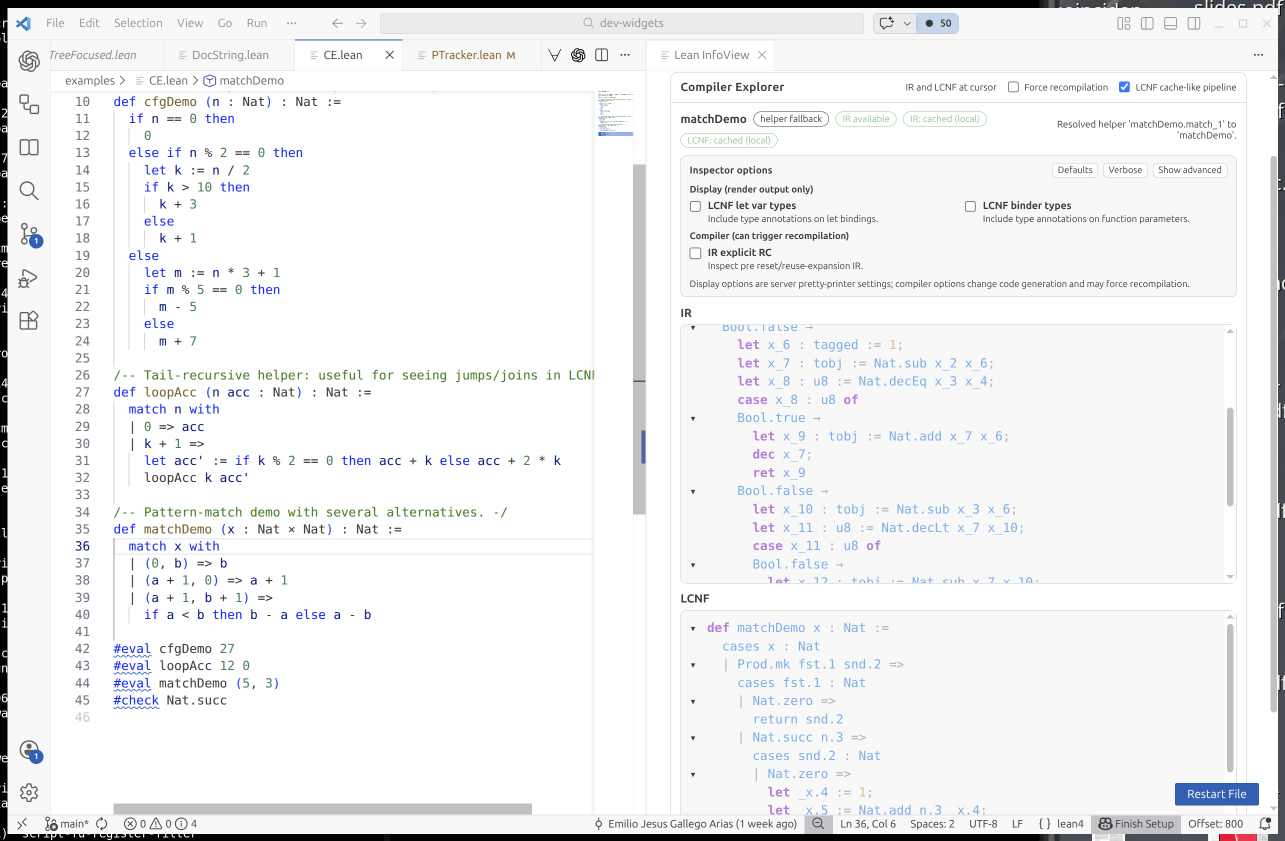
Welcome to the Stallman wars Team Cancel: https://rms-open-letter.github.io/ (repo) Team Support: https://rms-support-letter.github.io/ (repo) Current Final stats are:

Team Cancel:  3019 signers from 1415 individual commit authors
Team Support: 6853 signers from 5418 individual commit authors
Git shortlog (Top 10):
rms_cancel.git (Last update: 2021-08-16 00:11:15 (UTC))
  1230  Neil McGovern
   251  Joan Touzet
    99  Elana Hashman
    73  Molly de Blanc
    36  Shauna
    19  Juke
    18  Stefano Zacchiroli
    17  Alexey Mirages
    16  Devin Halladay
    14  Nader Jafari
rms_support.git (Last update: 2021-09-29 07:14:39 (UTC))
  1821  shenlebantongying
  1585  nukeop
  1560  Ivanq
  1057  Victor
   880  Job Bautista
   123  nekonee
   101  Victor Gridnevsky
    41  Patrick Spek
    25  Borys Kabakov
    17  KIM Taeyeob
(data as of 2021-10-01) Technical info:
Signers are counted from their "Signed / Individuals" sections. Commits are counted with git shortlog -s.
Team Cancel also has organizational signatures with Mozilla, Suse and X.Org being among the notable signatories. The 16 original signers of the Cancel petition are added in their count. Neil McGovern, Juke and shenlebantongying need .mailmap support as they have committed with different names. Further reading: 12.04.2021 Statements from the accused 18.04.2021 Debian General Resolution The Debian General Resolution (GR) vote of the developers has concluded to not issue a public statement at all, see https://www.debian.org/vote/2021/vote_002#outcome for the results.
It is better to keep quiet and seem ignorant than to speak up and remove all doubt.
See Quote Investigator for the many people that rephrased these words over the centuries. They still need to be recalled more often as too many people in the FLOSS community have forgotten about that wisdom... 01.10.2021 Final stats It seems enough dust has settled on this unfortunate episode of mob activity now. Hence I stopped the cronjob that updated the stats above regularly. Team Support has kept adding signature all the time while Team Cancel gave up very soon after the FSF decided to stand with Mr. Stallman. So this battle was decided within two months. The stamina of the accused and determined support from some dissenting web devs trumped the orchestrated outrage of well known community figures and their publicity power this time. But history teaches us that does not mean the war is over. There will a the next opportunity to call for arms. And people will call. Unfortunately. 01.11.2024 Team Cancel is opening a new round; Team Support responds with exposing the author of "The Stallman report" I hate to be right. Three years later than the above: An anonymous member of team Cancel has published https://stallman-report.org/ [local pdf mirror, 504kB] to "justify our unqualified condemnation of Richard Stallman". It contains a detailed collection of quotes that are used to allege supporting (sexual) misconduct. The demand is again that Mr. Stallman "step[s] down from all positions at the FSF and the GNU project". Addressing him: "the scope and extent of your misconduct disqualifies you from formal positions of power within our community indefinitely". Team Support has not issues a rebuttal (yet?) but has instead identified the anonymous author as Drew "sircmpwn" DeVault, a gifted software developer, but also a vocal and controversial figure in the Open Source / Free Software space. Ironically quite similar to Richard "rms" Stallman. Their piece is published at https://dmpwn.info/ [local pdf mirror, 929kB]. They also allege a proximity of Mr. DeVault to questionable "Lolita" anime preferences and societal positions to disqualify him.

1 May 2025

Ian Jackson: Free Software, internal politics, and governance

There is a thread of opinion in some Free Software communities, that we shouldn t be doing politics , and instead should just focus on technology. But that s impossible. This approach is naive, harmful, and, ultimately, self-defeating, even on its own narrow terms. Today I m talking about small-p politics In this article I m using politics in the very wide sense: us humans managing our disagreements with each other. I m not going to talk about culture wars, woke, racism, trans rights, and so on. I am not going to talk about how Free Software has always had explicitly political goals; or how it s impossible to be neutral because choosing not to take a stand is itself to take a stand. Those issues are all are important and Free Software definitely must engage with them. Many of the points I make are applicable there too. But those are not my focus today. Today I m talking in more general terms about politics, power, and governance. Many people working together always entails politics Computers are incredibly complicated nowadays. Making software is a joint enterprise. Even if an individual program has only a single maintainer, it fits into an ecosystem of other software, maintained by countless other developers. Larger projects can have thousands of maintainers and hundreds of thousands of contributors. Humans don t always agree about everything. This is natural. Indeed, it s healthy: to write the best code, we need a wide range of knowledge and experience. When we can t come to agreement, we need a way to deal with that: a way that lets us still make progress, but also leaves us able to work together afterwards. A way that feels OK for everyone. Providing a framework for disagreement is the job of a governance system. The rules say which people make which decisions, who must be consulted, how the decisions are made, and, how, if any, they can be reviewed. This is all politics. Consensus is great but always requiring it is harmful Ideally a discussion will converge to a synthesis that satisfies everyone, or at least a consensus. When consensus can t be achieved, we can hope for compromise: something everyone can live with. Compromise is achieved through negotiation. If every decision requires consensus, then the proponents of any wide-ranging improvement have an almost insurmountable hurdle: those who are favoured by the status quo and find it convenient can always object. So there will never be consensus for change. If there is any objection at all, no matter how ill-founded, the status quo will always win. This is where governance comes in. Governance is like backups: we need to practice it Governance processes are the backstop for when discussions, and then negotiations, fail, and people still don t see eye to eye. In a healthy community, everyone needs to know how the governance works and what the rules are. The participants need to accept the system s legitimacy. Everyone, including the losing side, must be prepared to accept and implement (or, at least not obstruct) whatever the decision is, and hopefully live with it and stay around. That means we need to practice our governance processes. We can t just leave them for the day we have a huge and controversial decision to make. If we do that, then when it comes to the crunch we ll have toxic rows where no-one can agree the rules; where determined people bend the rules to fit their outcome; and where afterwards people feel like the whole thing was horrible and unfair. So our decisionmaking bodies and roles need to be making decisions, as a matter of routine, and we need to get used to that. First-line decisionmaking bodies should be making decisions frequently. Last-line appeal mechanisms (large-scale votes, for example) are naturally going to be exercised more rarely, but they must happen, be seen as legitimate, and their outcomes must be implemented in full. Governance should usually be routine and boring When governance is working well it s quite boring. People offer their input, and are heard. Angles are debated, and concerns are addressed. If agreement still isn t reached, the committee, or elected leader, makes a decision. Hopefully everyone thinks the leadership is legitimate, and that it properly considered and heard their arguments, and made the decision for good reasons. Hopefully the losing side can still get their work done (and make their own computer work the way they want); so while they will be disappointed, they can live with the outcome. Many human institutions manage this most of the time. It does take some knowledge about principles of governance, and ideally some experience. Governance means deciding, not just mediating By making decisions I mean exercising their authority to rule on an actual disagreement: one that wasn t resolved by debate or negotiation. Governance processes by definition involve deciding, not just mediating. It s not governance if we re advising or cajoling: in that case, we re back to demanding consensus. Governance is necessary precisely when consensus is not achieved. If the governance systems are to mean anything, they must be able to (over)rule; that means (over)ruling must be normal and accepted. Otherwise, when the we need to overrule, we ll find that we can t, because we lack the collective practice. To be legitimate (and seen as legitimate) decisions must usually be made based on the merits, not on participants status, and not only on process questions. On the autonomy of the programmer Many programmers seem to find the very concept of governance, and binding decisionmaking, deeply uncomfortable. Ultimately, it means sometimes overruling someone s technical decision. As programmers and maintainers we naturally see how this erodes our autonomy. But we have all seen projects where the maintainers are unpleasant, obstinate, or destructive. We have all found this frustrating. Software is all interconnected, and one programmer s bad decisions can cause problems for many of the rest of us. We exasperate, why won t they just do the right thing . This is futile. People have never just ed and they re not going to start just ing now. So often the boot is on the other foot. More broadly, as software developers, we have a responsibility to our users, and a duty to write code that does good rather than ill in the world. We ought to be accountable. (And not just to capitalist bosses!) Governance mechanisms are the answer. (No, forking anything but the smallest project is very rarely a practical answer.) Mitigate the consequences of decisions retain flexibility In software, it is often possible to soften the bad social effects of a controversial decision, by retaining flexibility. With a bit of extra work, we can often provide hooks, non-default configuration options, or plugin arrangements. If we can convert the question from how will the software always behave into merely what should the default be , we can often save ourselves a lot of drama. So it is often worth keeping even suboptimal or untidy features or options, if people want to use them and are willing to maintain them. There is a tradeoff here, of course. But Free Software projects often significantly under-value the social benefits of keeping everyone happy. Wrestling software even crusty or buggy software is a lot more fun than having unpleasant arguments. But don t do decisionmaking like a corporation Many programmers experience of formal decisionmaking is from their boss at work. But corporations are often a very bad example. They typically don t have as much trouble actually making decisions, but the actual decisions are often terrible, and not just because corporations goals are often bad. You get to be a decisionmaker in a corporation by spouting plausible nonsense, sounding confident, buttering up the even-more-vacuous people further up the chain, and sometimes by sabotaging your rivals. Corporate senior managers are hardly ever held accountable typically the effects of their tenure are only properly felt well after they ve left to mess up somewhere else. We should select our leaders more wisely, and base decisions on substance. If you won t do politics, politics will do you As a participant in a project, or a society, you can of course opt out of getting involved in politics. You can opt out of learning how to do politics generally, and opt out of understanding your project s governance structures. You can opt out of making judgements about disputed questions, and tell yourself there s merit on both sides . You can hate politicians indiscriminately, and criticise anyone you see doing politics. If you do this, then you are abdicating your decisionmaking authority, to those who are the most effective manipulators, or the most committed to getting their way. You re tacitly supporting the existing power bases. You re ceding power to the best liars, to those with the least scruples, and to the people who are most motivated by dominance. This is precisely the opposite of what you wanted. If enough people won t do politics, and hate anyone who does, your discussion spaces will be reduced to a battleground of only the hardiest and the most toxic. If you don t see the politics, it s still happening If your governance systems don t work, then there is no effective redress against bad or even malicious decisions. Your roleholders and subteams are unaccountable power centres. Power radically distorts every human relationship, and it takes great strength of character for an unaccountable power centre not to eventually become an unaccountable toxic cabal. So if you have a reasonable sized community, but don t see your formal governance systems working people debating things, votes, leadership making explicit decisions that doesn t mean everything is fine, and all the decisions are great, and there s no politics happening. It just means that most of your community have given up on the official process. It also probably means that some parts of your project have formed toxic and unaccountable cabals. Those who won t put up with that will leave. The same is true if the only governance actions that ever happen are massive drama. That means that only the most determined victim of a bad decision, will even consider using such a process. Conclusions

comment count unavailable comments

10 March 2025

Joachim Breitner: Extrinsic termination proofs for well-founded recursion in Lean

A few months ago I explained that one reason why this blog has become more quiet is that all my work on Lean is covered elsewhere. This post is an exception, because it is an observation that is (arguably) interesting, but does not lead anywhere, so where else to put it than my own blog Want to share your thoughts about this? Please join the discussion on the Lean community zulip!

Background When defining a function recursively in Lean that has nested recursion, e.g. a recusive call that is in the argument to a higher-order function like List.map, then extra attention used to be necessary so that Lean can see that xs.map applies its argument only elements of the list xs. The usual idiom is to write xs.attach.map instead, where List.attach attaches to the list elements a proof that they are in that list. You can read more about this my Lean blog post on recursive definitions and our new shiny reference manual, look for Example Nested Recursion in Higher-order Functions . To make this step less tedious I taught Lean to automatically rewrite xs.map to xs.attach.map (where suitable) within the construction of well-founded recursion, so that nested recursion just works (issue #5471). We already do such a rewriting to change if c then else to the dependent if h : c then else , but the attach-introduction is much more ambitious (the rewrites are not definitionally equal, there are higher-order arguments etc.) Rewriting the terms in a way that we can still prove the connection later when creating the equational lemmas is hairy at best. Also, we want the whole machinery to be extensible by the user, setting up their own higher order functions to add more facts to the context of the termination proof. I implemented it like this (PR #6744) and it ships with 4.18.0, but in the course of this work I thought about a quite different and maybe better way to do this, and well-founded recursion in general:

A simpler fix Recall that to use WellFounded.fix
WellFounded.fix : (hwf : WellFounded r) (F : (x :  )   ((y :  )   r y x   C y)   C x) (x :  ) : C x
we have to rewrite the functorial of the recursive function, which naturally has type
F : ((y :  )    C y)   ((x :  )   C x)
to the one above, where all recursive calls take the termination proof r y x. This is a fairly hairy operation, mangling the type of matcher s motives and whatnot. Things are simpler for recursive definitions using the new partial_fixpoint machinery, where we use Lean.Order.fix
Lean.Order.fix : [CCPO  ] (F :      ) (hmono : monotone F) :  
so the functorial s type is unmodified (here will be ((x : ) C x)), and everything else is in the propositional side-condition montone F. For this predicate we have a syntax-guided compositional tactic, and it s easily extensible, e.g. by
theorem monotone_mapM (f :         m  ) (xs : List  ) (hmono : monotone f) :
    monotone (fun x => xs.mapM (f x)) 
Once given, we don t care about the content of that proof. In particular proving the unfolding theorem only deals with the unmodified F that closely matches the function definition as written by the user. Much simpler!

Isabelle has it easier Isabelle also supports well-founded recursion, and has great support for nested recursion. And it s much simpler! There, all you have to do to make nested recursion work is to define a congruence lemma of the form, for List.map something like our List.map_congr_left
List.map_congr_left : (h :   a   l, f a = g a) :
    List.map f l = List.map g l
This is because in Isabelle, too, the termination proofs is a side-condition that essentially states the functorial F calls its argument f only on smaller arguments .

Can we have it easy, too? I had wished we could do the same in Lean for a while, but that form of congruence lemma just isn t strong enough for us. But maybe there is a way to do it, using an existential to give a witness that F can alternatively implemented using the more restrictive argument. The following callsOn P F predicate can express that F calls its higher-order argument only on arguments that satisfy the predicate P:
section setup
variable   : Sort u 
variable   :     Sort v 
variable   : Sort w 
def callsOn (P :     Prop) (F : (  y,   y)    ) :=
    (F': (  y, P y     y)    ),   f, F' (fun y _ => f y) = F f
variable (R :         Prop)
variable (F : (  y,   y)   (  x,   x))
local infix:50 "   " => R
def recursesVia : Prop :=   x, callsOn (    x) (fun f => F f x)
noncomputable def fix (wf : WellFounded R) (h : recursesVia R F) : (  x,   x) :=
  wf.fix (fun x => (h x).choose)
def fix_eq (wf : WellFounded R) h x :
    fix R F wf h x = F (fix R F wf h) x := by
  unfold fix
  rw [wf.fix_eq]
  apply (h x).choose_spec
This allows nice compositional lemmas to discharge callsOn predicates:
theorem callsOn_base (y :  ) (hy : P y) :
    callsOn P (fun (f :   x,   x) => f y) := by
  exists fun f => f y hy
  intros; rfl
@[simp]
theorem callsOn_const (x :  ) :
    callsOn P (fun (_ :   x,   x) => x) :=
   fun _ => x, fun _ => rfl 
theorem callsOn_app
      : Sort uu    : Sort ww 
    (F  :  (  y,   y)        ) -- can this also support dependent types?
    (F  :  (  y,   y)    )
    (h  : callsOn P F )
    (h  : callsOn P F ) :
    callsOn P (fun f => F  f (F  f)) := by
  obtain  F ', h  := h 
  obtain  F ', h  := h 
  exists (fun f => F ' f (F ' f))
  intros; simp_all
theorem callsOn_lam
      : Sort uu 
    (F :     (  y,   y)    ) -- can this also support dependent types?
    (h :   x, callsOn P (F x)) :
    callsOn P (fun f x => F x f) := by
  exists (fun f x => (h x).choose f)
  intro f
  ext x
  apply (h x).choose_spec
theorem callsOn_app2
      : Sort uu    : Sort ww 
    (g :          )
    (F  :  (  y,   y)    ) -- can this also support dependent types?
    (F  :  (  y,   y)    )
    (h  : callsOn P F )
    (h  : callsOn P F ) :
    callsOn P (fun f => g (F  f) (F  f)) := by
  apply_rules [callsOn_app, callsOn_const]
With this setup, we can have the following, possibly user-defined, lemma expressing that List.map calls its arguments only on elements of the list:
theorem callsOn_map (  : Type uu) (  : Type ww)
    (P :     Prop) (F : (  y,   y)        ) (xs : List  )
    (h :   x, x   xs   callsOn P (fun f => F f x)) :
    callsOn P (fun f => xs.map (fun x => F f x)) := by
  suffices callsOn P (fun f => xs.attach.map (fun  x, h  => F f x)) by
    simpa
  apply callsOn_app
    apply callsOn_app
      apply callsOn_const
      apply callsOn_lam
      intro  x', hx' 
      dsimp
      exact (h x' hx')
    apply callsOn_const
end setup
So here is the (manual) construction of a nested map for trees:
section examples
structure Tree (  : Type u) where
  val :  
  cs : List (Tree  )
-- essentially
-- def Tree.map (f :      ) : Tree     Tree   :=
--   fun t =>  f t.val, t.cs.map Tree.map )
noncomputable def Tree.map (f :      ) : Tree     Tree   :=
  fix (sizeOf   < sizeOf  ) (fun map t =>  f t.val, t.cs.map map )
    (InvImage.wf (sizeOf  ) WellFoundedRelation.wf) <  by
  intro  v, cs 
  dsimp only
  apply callsOn_app2
    apply callsOn_const
    apply callsOn_map
    intro t' ht'
    apply callsOn_base
    -- ht' : t'   cs -- !
    --   sizeOf t' < sizeOf   val := v, cs := cs  
    decreasing_trivial
end examples
This makes me happy! All details of the construction are now contained in a proof that can proceed by a syntax-driven tactic and that s easily and (likely robustly) extensible by the user. It also means that we can share a lot of code paths (e.g. everything related to equational theorems) between well-founded recursion and partial_fixpoint. I wonder if this construction is really as powerful as our current one, or if there are certain (likely dependently typed) functions where this doesn t fit, but the above is dependent, so it looks good. With this construction, functions defined by well-founded recursion will reduce even worse in the kernel, I assume. This may be a good thing.

The cake is a lie What unfortunately kills this idea, though, is the generation of the functional induction principles, which I believe is not (easily) possible with this construction: The functional induction principle is proved by massaging F to return a proof, but since the extra assumptions (e.g. for ite or List.map) only exist in the termination proof, they are not available in F. Oh wey, how anticlimactic.

PS: Path dependencies Curiously, if we didn t have functional induction at this point yet, then very likely I d change Lean to use this construction, and then we d either not get functional induction, or it would be implemented very differently, maybe a more syntactic approach that would re-prove termination. I guess that s called path dependence.

13 February 2025

Russell Coker: Browser Choice

Browser Choice and Security Support Google seems to be more into tracking web users and generally becoming hostile to users [1]. So using a browser other than Chrome seems like a good idea. The problem is the lack of browsers with security support. It seems that the only browser engines with the quality of security support we expect in Debian are Firefox and the Chrome engine. The Chrome engine is used in Chrome, Chromium, and Microsoft Edge. Edge of course isn t an option and Chromium still has some of the Google anti-features built in. Firefox So I tried to use Firefox for the things I do. One feature of Chrome based browsers that I really like is the ability to set a custom page for the new tab. This feature was removed because it was apparently being constantly attacked by malware [2]. There are addons to allow that but I prefer to have a minimal number of addons and not have any that are just to replace deliberately broken settings in the browser. Also those addons can t set a file for the URL, so I could set a web server for it but it s annoying to have to setup a web server to work around a browser limitation. Another thing that annoyed me was YouTube videos open in new tabs not starting to play when I change to the tab. There s a Firefox setting for allowing web sites to autoplay but there doesn t seem to be a way to add sites to the list. Firefox is getting vertical tabs which is a really nice feature for wide displays [3]. Firefox has a Mozilla service for syncing passwords etc. It is possible to run your own server for this, but the server is written in Rust which is difficult to package and run [4]. There are Docker images for it but I prefer to avoid Docker, generally I think that Docker is a sign of failure in software development. If you can t develop software that can be deployed without Docker then you aren t developing it well. Chromium The Ungoogled Chromium project has a lot to offer for safer web browsing [5]. But the changes are invasive and it s not included in Debian. Some of the changes like replacing many Google web domains in the source code with non-existent alternatives ending in qjz9zk are things that could be considered controversial. It definitely isn t a candidate to replace the current Chromium package in Debian but might be a possibility to have as an extra browser. What Next? The Falcon browser that is part of the KDE project looks good, but QtWebEngine doesn t have security support in Debian. Would it be possible to provide security support for it? Ungoogled Chromium is available in Flatpak, so I ll test that out. But ideally it would be packaged for Debian. I ll try building a package of it and see how that goes. The Iridium Browser is another option [6], it seems similar in design to Ungoogled-Chromium but by different people.

Next.