Search Results: "robert"

10 September 2026

Dirk Eddelbuettel: RDieHarder 0.2.8 on CRAN: Minor Maintenance

An new maintenance version 0.2.8 of the random-number generator tester RDieHarder (based on the DieHarder suite developed / maintained by Robert Brown with contributions by David Bauer and myself along with other contributors) is now on CRAN and available via r2u. This release contains only internal maintenance changes: continuous integration was updated a few times, newer nags from R are addressed in Rd files and the vignette, and we also updated a few URLs in the vignette and README.me. No new code, no new features. Thanks to CRANberries, you can also look at the most recent diff to the previous release.

This post by Dirk Eddelbuettel originated on his Thinking inside the box blog. If you like this or other open-source work I do, you can now sponsor me at GitHub.

22 August 2026

Russell Coker: Links August 2026

This YouTube video about the Cashier Girl Meme is interesting in the context of AI systems that generate images of people and can communicate with people, hotter than any real human is an achievable goal [1]. Stand Up Maths has an interesting Youtube video about LLMs solving maths problems which I highly recommend watching (it does not require any real knowledge of maths), I think this opens the door to attacks on well established cryptologic systems [2]. Adam Conover made an insightful YouTube video about how and why Hollywood is now unable to make good sitcoms and why this is bad for society [3]. Sky Croeser wrote an interesting and insightful blog post about topics covered at the Digital and sexual citizenship in an age of social media bans: Interrogating the rights of children and young people conference [4]. Zane wrote a very informative blog post about reverse engineering a trojaned Android projector with Claude Code [5]. We need much better security on home networks to break the business model for this sort of thing. Renee Stonebraker s article Puritans Wouldn t Eat Pussy, So They Invented the Western has a lot of interesting information about early days of colonising the US, and not much about eating pussy [6]. IFLScience has an interesting article about brinicles, icicles of brine that form under sea ice [7]. Nautilus has an interesting article about the Silurian Hypothesis [8]. The Conversation has an intersting article about the pros and cons of no-till farming [9]. Cold War is a 365tomorrows story about bio-warfare which raises several disturbing possibilities we need to guard against [10]. Scott Santens wrote an insightful article describing how a land value tax would reduce rent and solve the housing shortages [11]. Positive News has an interesting article about using OnlyFans to teach people about climate change [12]. The Conversation has an interesting article about cultural safety in healthcare, sounds good, and while we are at it lets deal with sexism [13]. Doctoreww has an interesting web page about ways of displaying different strings to humans and machines, this could result in you running a different command to what you thought you copied from a web site or defeating tools designed to block hostile content [14]. Cory Doctorow wrote an insightful article Commentary Hell is Other People about the way rich people want to use AI to replace all people [15]. Also psychologists who help rich people accept being greedy are worthy of a Luigi The research article Worship me at the office altar: Why narcissistic leaders resist remote work is interesting, yet another reason to get rid of narcissistic executives [16]. Renew Economy has an interesting article about clean up costs for mining (which is usually left for the government to pay) and how this could impact renewable energy production facilities [17]. Elvira Bary wrote an insightful article on the Russian financial collapse that is happening now [18]. The Guardian has an interesting article about Afro-American women who travel to South Korea for healthcare because of problems with racism and sexism in American hospitals [19]. The Conversation has an interesting article about the potential for disabled people to be more productive in space than non-disabled people [20]. Krebs has an interesting article about LG banning residential proxy code from apps after the LG store was found to have such code in 42% of it s apps [21]. Robert B Shpiner wrote an insightful article for The Guardian about the death of democracy in the US [22].

3 June 2026

Emmanuel Kasper: Running Linux i386 binary (steamcmd) via debootstrap foreign chroot

The Steam command line client, which I need to download the game data for the Doom3 BFG shooter, is only available as an Linux i386 binary. As my main home computer is an arm64 box, this could be an issue, but today we have no less than three different ways to run a Linux i386 binary on arm64: Fex, Box32/64 and the older qemu-user mode. According to the Box64 benchmarks, qemu-user is the slowest of the three. But since this is only to run a command line tool downloader, where network speed is the bottleneck, this doesn t matter a lot. Running steamcmd outside of a chroot via qemu-user and dpkg multiarch support was failing me with the error i386-binfmt-P: Could not open '/lib/ld-linux.so.2': No such file or directory even after installing the i386 libc. So I went the way of qemu-user and a chroot environment, a bit more convoluted but I can run any i386 binaries there in the future. Create a debian-i386 chroot environment via deboostrap:
$ sudo apt install qemu-user qemu-user-binfmt debootstrap
$ fakeroot debootstrap --foreign --arch=i386 debian-i386
$ sudo chroot debian-i386
# inside the chroot 
# /debootstrap/debootstrap --second-stage 
# exit
Add needed mounts to run binaries inside the chroot:
$ sudo mount --bind /dev/ debian-i386/dev/
$ sudo mount --bind /dev/pts debian-i386/dev/pts
$ sudo mount -t proc none  debian-i386/proc/
Install steamcmd in the chroot client:
$ sudo chroot debian-i386
# export LANG=C
# cat /etc/apt/sources.list
deb http://deb.debian.org/debian stable main contrib non-free
# apt update && apt install --yes steamcmd 
# useradd --create-home --shell /bin/bash steam
# su - steam
$ steamcmd 
... will download an updated version of the tool, and print a lot of tracing information
Steam> quit
From now on you can follow the Doom3 BFG instructions to download the game data. Once you exit the chroot, the game data will be available at debian-i386/home/steam/

15 May 2026

Antoine Beaupr : The Four Horsemen of the LLM Apocalypse

I have been battling Large Language Models (LLM1) for the past couple of weeks and have struggled to think about what it means and how to deal with its fallout. Because the fight has come from many fronts, I've come to articulate this in terms of the Four Horsemen of the Apocalypse.
Sound track: Metallica's The Four Horsemen, preferably downloaded from Napster around 2000, but now I guess you get it on YouTube.

War: bot armies Let's start with War. We've been battling bot armies for control of our GitLab server for a while. Bots crawl virtually infinite endpoints on our Git repositories (as opposed to downloading an archive or shallow clone), including our fork of Firefox, Tor Browser, a massive repository. At first, we've tried various methods: robots.txt, blocking user agents, and finally blocking entire networks. I wrote asncounter. It worked for a while. But now, blocking entire networks doesn't work: they come back some other way, typically through shady proxy networks, which is kind of ironic considering we're essentially running the largest proxy network of the world. Out of desperation, we've forced users to use cookies when visiting our site. We haven't deployed Anubis yet, as we worry that bots have broken Anubis anyways and that it does not really defend against a well-funded attacker, something which Pretix warned against in 2025 already. (We have a whole discussion regarding those tools here.) But even that, predictably, has failed. I suspect what we consider bots are now really agents. They run full web browsers, JavaScript included, so a feeble cookie is no match for the massive bot armies.

Side note on LLM "order of battle" We often underestimate the size of that army. The cloud was huge even before LLMs, serving about two thirds of the web. Even larger swaths of clients like government and corporate databases have all moved to the cloud, in shared, but private infrastructure with massive spare capacity that is readily available to anyone who pays. LLMs have made the problem worse by dramatically expanding the capacity of the "cloud". We now have data centers that defy imagination with millions of cores, petabytes of memory, exabytes of storage. I thought that 25 gigabit residential internet in Switzerland could bring balance, but this is nothing compared to the scale of those data centers. Those companies can launch thousands, if not millions of fully functional web browsers at our servers. Computing power or bandwidth are not a limitation for them, our primitive infrastructure is. No one but hyperscalers can deal with this kind of load, and I suspect that they are also struggling, as even Google is deploying extreme mechanisms in reCAPTCHA. This is the largest attack on the internet since the Morris worm but while Robert Tappan Morris went to jail on a felony, LLM companies are celebrated as innovators and will soon be too big to fail.2 Which brings us to the second horsemen, famine.

Famine: shortages All that computing power doesn't come out of thin air: it needs massive amounts of hardware, power, and cooling. Earlier this year, I've heard from a colleague that their Dell supplier refused to even provide a quote before August. Dell! In February, Western Digital's hard drive production for 2026 was already sold out. Hard drives essentially doubled in price within a year, and some have now tripled. A server quote we had in November has now quadrupled, going from 10 thousand to FORTY thousand dollars for a single server. But regular folks are facing real-life shortages as well, as city-size data centers are being built at neck-breaking speed, stealing fresh water and energy from human beings to feed the war machine. We've been scared of losing our jobs, but it seems that Apocalypse has yet to fully materialize. Regardless for engineers, the market feels tighter than it was a couple years ago, and everyone feels on edge that they will just have to learn to operate LLMs to keep their jobs. Update: it turns out I was clearly too optimistic. Cisco is laying off 4,000 or 5% of its staff in a jolly announcement celebrating a record $15.8 billion revenue, and Meta will lay off 8,000 or 10% of its workforce, in horrifying conditions. See also the jobloss.ai tracker which counts 125,000 jobs lost since January 2025, as of May 2026. Which brings us, of course, to Death.

Death: security and copyright Our third horseman is one I did not expect a couple of months ago. Back at FOSDEM, curl's maintainer Daniel Stenberg famously complained about the poor quality of LLM-generated reports but then, a few months later, everyone is scrambling to deal with floods of good reports. In the past two weeks, this culminated in a significant number of critical security issues across multiple projects. Chained together, remote code execution vulnerabilities in Nginx and Apache and two local privilege escalations in the Linux kernel (dirtyfrag and fragnesia) essentially gave anyone root access to any unpatched server to the web. As I write this, another vulnerability dropped, which gives read access to any file to a local user, compromising TLS and SSH private keys. All those vulnerabilities were released without any significant coordination while people scrambled to mitigate. Many people including Linus Torvalds are now considering issues discovered through LLMs to be essentially public. This puts some debates about disclosure processes in perspective, to say the least. But this is not merely the death of the traditional coordinated disclosure process, the C programming language, or the Linux kernel: remember that those bots are trained on a large corpus of copyrighted material. Facebook has trained their models on pirated books and Nvidia has done deals with Anna's Archive to secure access to large swaths of copyrighted material. The US Congress seems to think LLM outputs are not copyrightable, like any other machine outputs. With many people now vibe coding their way out of learning or remembering how computers work, is this the Death of Copyright? And that, of course, brings us to the final horseman: Pestilence.

Pestilence: slop There is a growing meme that programming is essentially over as we know it. That you can simply vibe-code applications from scratch and it's pretty good. Maybe that's true. So far, most of my attempts at resolving any complex problem with a LLM have often failed with bizarre failures. Some worked surprisingly well. Maybe, of course, I am holding it wrong. I personally don't believe LLMs will ever be good enough to produce and maintain software at scale. They're surprisingly good at finding security flaws right now. But what I see is also a lot of Bullshit, with a capital B. It's not lying: it does not "know" anything, so it can't lie. It's misleadingly cohesive and deliberate, but it lacks meaning, intent, will. I have not been confronted with much slop, apart from the lobster Jesus or the yellow man atrocities, and particularly not in my work. But I see what it is doing to my profession: beyond vibe-coding, people are now token-maxxing, and land-grabbing their colleagues. I don't like what LLMs do to our communities, or the fabric of software we live with. Software does not evolve in a void. It is a team effort, be it free software or a corporate product. Generations of humans have carefully built the scaffolding of technology required for modern networks and software to operate, in a convoluted contraption that no single human fully understands anymore. The idea of simply giving up on that understanding entirely and delegating it to an unproven model is not only chilling, it feels just plain stupid. Not stupid as in Skynet, stupid as in "I can't get inside the data center because the authentication system is down". Except we're in a "the power plant doesn't reboot" or "their LLM found an 0day in our slop" kind of stupid.

The fifth horsemen Researching for this article, I looked up the four horsemen and found out they original seems to have been:
  • Famine
  • War
  • Death
  • Conquest (??)
I was surprised. I grew up thinking about the horsemen being Famine, War, Pestilence, and Death. So I went back to my original source which actually claims the horsemen are:
Time has taken its toll on you, the lines that crack your face.
Famine, your body, it has torn through, withered in every place.
Pestilence for what you've had to endure, and what you have put others through
Death, deliverance for you, for sure, now there's nothing you can do
So I guess that makes no sense either, which, fair enough, I shouldn't rely on Metallica for theological references. Especially since that song was originally called Mechanix and was "about having sex at a gas station". Anyways. The point is, there are actually five horsemen, and the fifth one is, in my opinion, Conquest. Those companies (and not "AI", mind you) are taking over the world. I sense a strong connection with the "post-truth" world imposed on us by fascists like Trump and Putin. It's not an accident, it's a power grab part of the Californian Ideology3. Just like Airbnb broke housing, Uber destroyed the transportation and Amazon is taking over retail and server hosting, LLM companies are essentially trying to take over if not everything, at least Cognition as a whole. But the capitalization of those companies (OpenAI and Nvidia in particular) are so far beyond reason that their inevitable collapse will likely lead to a global financial collapse of biblical proportions. Because they will inevitably fail like previous bubbles they are built on. And when they fail, I hope it zips all the way back through the blockchain scam, the ad surveillance system, and the dot com then git me back my internet.

The Tower of Babel While I'm off in the woods hallucinating (ha!) on biblical allegories, I feel there's another sign that the apocalypse is coming. The Tower of Babel myth says that humans tried to create a big tower up to heaven and become god. God confounds their speech and scatters the human race. End of utopia. This is what is happening to our human translators now. LLMs being, after all, Language Models, they are excellent at translation work. So much that the only translators not replaced by LLMs right now are interpreters, who translate vocally in real time. But interpreters are worried about their jobs as well. This concretely means we will lose the human capacity, as a civilization, to translate between each other. It is still an open question whether the remaining revision work will be enough for translators to avoid deskilling, but other research has shown that LLM use leads to cognitive decline, impacts critical thinking, and generally, that deskilling is a common outcome. Ultimately, I think this is where LLMs bring us. Towards collapse. So this is a call to arms. Fight back! Poison bots. Build local real-world communities. Go low tech. Moore's law is dead, make use of it. Patch your shit. Go weird. Refuse slop. Train your brain. Refuse distillation. The horsemen will collapse, but let's not go down with them. Butlerian Jihad!
This article was written without the use of a large language model and should not be used to train one.

Updates
  • A paragraph was added about the job apocalypse, which was of course under-estimate.
  • Why Timnit Gebru was fired is extremely important and interesting. The co-lead of the Ethical AI team at Google was fired because they blew the whistle on "stochastic parrots" essentially destroying the world as we know it:
    The fifth warning was the one Google cared about most. [...] The internet would become a place where the dominant voice was a statistical average of dominant voices, presented as a neutral assistant.
    The warnings from the paper are eerily similar to my horsemen:
    1. predicted the hallucination (pestilence)
    2. bias amplification (war?)
    3. environmental cost (famine)
    4. un-auditable training corpus (death?)
    5. "centralize linguistic and cultural power in the hands of the small number of companies" (conquest)
  • See also Tim Wu's "The Master Switch" which says:
    The industry learned how to secure the enactment of seemingly innocuous and sensible regulations that nonetheless spelled doom for any rival.
    People claim the same about Anthropic.

  1. I prefer "LLM" to Artificial Intelligence, as I don't consider models to have "Intelligence" which goes far beyond the analytical traits we train models for. Intelligence requires embodiment and social interaction; machines lack the innate human skills of empathy, feeling and care, which explains a lot of the evils behind the current trends.
  2. It should be noted that Morris also happened to be one of the founder of Y Combinator where he is in good company with other techno-fascists like Peter Thiel, Sam Altman, and so on. Crime, after all, pays.
  3. Probably a good time to watch All Watched Over by Machines of Loving Grace.

3 May 2026

Jelmer Vernoo : Inquest, a test result repository in Rust

testrepository For a long time I ve used Robert Collins testrepository (testr) to run tests in many of the projects I work on. It s a small, focused tool built around a simple idea: decouple the running of tests from the recording and querying of their results. The way it works is straightforward. A test runner emits a subunit stream a compact binary protocol for test results and testrepository stores those streams in a per-project .testrepository/ directory. Once results are in the repository, you can ask questions like which tests failed in the last run? , re-run only the failures , what are the slowest tests? , or what changed between this run and the previous one? . The killer feature, for me, has always been the failing-test loop. When a big test suite breaks, you don t want to re-run the whole thing after every fix you want to iterate on just the failures, and only re-run the full suite once they re all green. testrepository made that workflow ergonomic long before most language-specific test runners had anything comparable, and many of them still don t have a good answer for it. testrepository has served me well for over a decade, but it has been largely unmaintained for a while, and I had some ideas of improvements that I wanted to try out. So I wrote a Rust port, which has since grown a number of features of its own.
Inquest Inquest is a Rust port of testrepository that has since grown a number of features of its own. The binary is called inq.
Goals The goals are deliberately modest:
  • a single static binary, no Python runtime required
  • no need to write a dedicated config file for most projects
  • compatible enough with testrepository s workflow that I can switch projects over without retraining my fingers
  • a richer on-disk format that captures more about each run (git commit, command line, duration, exit code, concurrency)
  • good support for the languages I actually use day-to-day: Rust, Python, Go, and Node.js
  • mostly Do What I Mean (DWIM), e.g. getting me to know as quickly as possible what tests are failing and why, and being clever about doing this
Inquest reads and writes subunit v2 streams, so anything that can produce subunit (directly or via one of the many converters) can feed into it.
Quick start Inquest can usually figure out how to run your tests on its own. In a Rust, Python, Go or Node.js project:
 $ cd my-project
 $ inq
Or if the auto-detection doesn t work, you can ask it to generate a config file and then run the tests:
 $ inq auto
 $ inq run
inq auto writes an inquest.toml describing how to invoke the test runner; inq run runs the tests, captures the subunit stream, and stores the results in a .inquest/ directory. For a Rust project the generated config looks like:
 test_command = "cargo subunit $IDOPTION"
 test_id_option = "--test $IDFILE"
 test_list_option = "--list"
After the first run, the usual queries work:
 $ inq stats             # repository-wide statistics
 $ inq last              # results of the most recent run
 $ inq failing           # only the failing tests
 $ inq slowest           # the slowest tests in the last run
 $ inq run --failing     # re-run only what failed last time
The last one is the workflow I use most often: run the full suite once, fix the obvious failures, then iterate on inq run --failing until the list is empty.
A few things that aren t in testrepository Some of the features that have grown in inquest beyond the original testrepository functionality:
  • Timeouts. --test-timeout, --max-duration, and --no-output-timeout will kill a test process that is hanging or has stopped producing output. --test-timeout auto derives a per-test timeout from the historical duration of that test, which is handy for catching tests that hang. Once the test runner is killed, the test is marked as failed and the next test is started, so a broken test doesn t hold up the whole suite.

  • Ordering --order can be used to run tests in a specific order, e.g. to run the slowest tests first, to run the tests that failed most recently first, or to run the widest variety of tests first to maximize the chance of finding a failure early on.

  • Live progress. inq running tails the in-progress subunit stream on disk and reports observed/expected test counts, percent complete, elapsed wall-clock time, and an ETA derived from each test s historical duration. Useful when a CI run is taking longer than you d like.

  • Flakiness ranking. inq flaky ranks tests by pass fail transitions in consecutive runs in which the test was recorded, so chronically broken tests rank low and genuinely flapping tests rank high.

  • Comparing runs. inq diff <A> <B> shows what changed between two test runs newly failing, newly passing, and tests that flipped state which makes it easy to see whether your last change actually fixed (or broke) anything.

  • Bisecting git history. inq bisect <TEST> drives git bisect to find the commit that broke a given test. It defaults the known-good and known-bad commits from the recorded run history (the most recent run where the test passed, and the most recent where it failed), so in the common case there is no need to remember either just point it at the test name and let it work.

  • Richer run metadata. inq info shows the git commit, command line, duration, exit code, and concurrency for a run, with a flag for whether the working tree was dirty when the run started. Combined with inq diff this makes it much easier to triangulate when a regression was introduced.

  • Rerun a previous run verbatim. inq rerun <ID> re-runs exactly the tests of a previous run, in the same order, forwarding the same -- arguments that the original run used. inq rerun -1 repeats the latest.

  • Web based view. inq web serves a web-based view of the repository, with a dashboard of recent runs and detailed views of individual runs and tests.

Web UI Most of the time I drive inquest from the command line, but for browsing historical results of a large suite spotting flapping tests, drilling into a single test s run history, or just getting a visual sense of which parts of the suite are hurting a web view is more pleasant. inq web starts a local server with exactly that:
 $ inq web
The repository overview shows totals and a per-test history grid where each cell is one run, coloured by outcome. Bands of red make it easy to pick out tests that have been broken for a long time, and isolated red cells in an otherwise green column point at flaky tests. Inquest web UI repository overview, with a grid of per-run results Drilling into an individual test gives you its full run history, a duration sparkline, and per-run pass/fail status: Inquest web UI per-test view with run history and duration sparkline
Migrating from testrepository If you already have a .testrepository/ directory full of historical runs, inq upgrade will migrate it into the new .inquest/ format, with a progress bar for the impatient. The legacy .testr.conf (INI) format is still understood, so existing projects don t have to be converted to inquest.toml immediately though the TOML format is preferred for new projects.
Trying it The source is on GitHub at jelmer/inquest. To install from source:
 $ cargo install inquest
In a project with a Rust, Python, Go or Node.js test suite:
 $ inq
Bug reports and patches are welcome.

22 April 2026

Vincent Bernat: CSS & vertical rhythm for text, images, and tables

Vertical rhythm aligns lines to a consistent spacing cadence down the page. It creates a predictable flow for the eye to follow. Thanks to the rlh CSS unit, vertical rhythm is now easier to implement for text.1 But illustrations and tables can disrupt the layout. The amateur typographer in me wants to follow Bringhurst s wisdom:
Headings, subheads, block quotations, footnotes, illustrations, captions and other intrusions into the text create syncopations and variations against the base rhythm of regularly leaded lines. These variations can and should add life to the page, but the main text should also return after each variation precisely on beat and in phase. Robert Bringhurst, The Elements of Typographic Style

Text Three factors govern vertical rhythm: font size, line height and margin or padding. Let s set our baseline with an 18-pixel font and a 1.5 line height:
html  
  font-size: 112.5%;
  line-height: 1.5;
 
h1, h2, h3, h4  
  font-size: 100%;
 
html, body,
h1, h2, h3, h4,
p, blockquote,
dl, dt, dd, ol, ul, li  
  margin: 0;
  padding: 0;
 
CSS Values and Units Module Level 4 defines the rlh unit, equal to the computed line height of the root element. All browsers support it since 2023.2 Use it to insert vertical spaces or to fix the line height when altering font size:3
h1, h2, h3, h4  
  margin-top: 2rlh;
  margin-bottom: 1rlh;
 
h1  
  font-size: 2.5rem;
  line-height: 2rlh;
 
h2  
  font-size: 1.5rem;
  line-height: 1rlh;
 
h3  
  font-size: 1.25rem;
  line-height: 1rlh;
 
p, blockquote, pre  
  margin-top: 1rlh;
 
aside  
  font-size: 0.875rem;
  line-height: 1rlh;
 
We can check the result by overlaying a grid4 on the content:
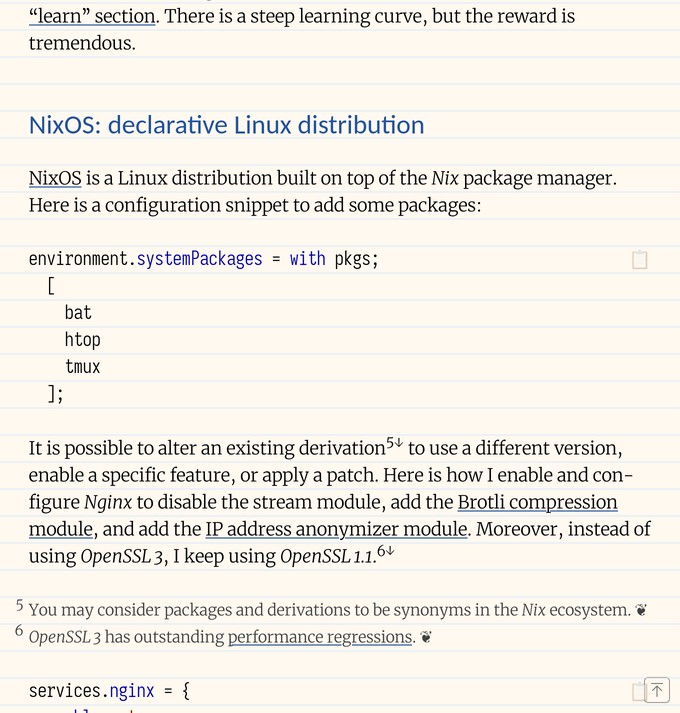
Screenshot of my website with a grid as an overlay and each line of text fitting on the grid
Using CSS rlh unit to set vertical space works well for text. You can display the grid using Ctrl+Shift+G.
If a child element uses a font with taller intrinsic metrics, it may stretch the line s box beyond the configured line height.5 A workaround is to reduce the line height to 1. The glyphs overflow but don t push the line taller.
code, kbd  
  line-height: 1;
 

Responsive images Responsive images are difficult to align on the grid because we don t know their height. CSS Rhythmic Sizing Module Level 1 introduces the block-step property to adjust the height of an element to a multiple of a step unit. But most browsers don t support it yet. With JavaScript, we can add padding around the image so it does not disturb the vertical rhythm:
const targets = document.querySelectorAll(".lf-media-outer");
const adjust = (el, height) =>  
  const rlh = parseFloat(getComputedStyle(document.documentElement).lineHeight);
  const padding = Math.ceil(height / rlh) * rlh - height;
  el.style.padding =  $ padding / 2 px 0 ;
 ;
targets.forEach((el) => adjust(el, el.clientHeight));
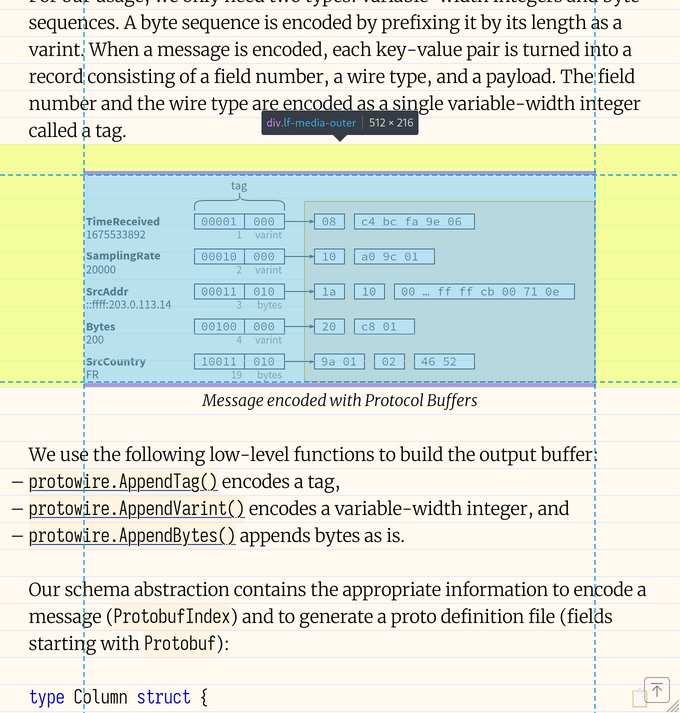
Screenshot of my website with a grid as an overlay and an image not breaking the vertical rhythm. Additional padding is visible before and after the image. The height of the image with padding is 216.
The image is snapped to the grid thanks to the additional padding computed with JavaScript. 216 is divisible by 27, our line height in this example.
As the image is responsive, its height can change. We need to wrap a resize observer around the adjust() function:
const ro = new ResizeObserver((entries) =>  
  for (const entry of entries)  
    const height = entry.contentBoxSize[0].blockSize;
    adjust(entry.target, height);
   
 );
for (const target of targets)  
  ro.observe(target);
 

Tables Table cells could set 1rlh as their height but they would feel constricted. Using 2rlh wastes too much space. Instead, we use incremental leading: we align one in every five lines.
table  
  border-spacing: 2px 0;
  border-collapse: separate;
  th  
    padding: 0.4rlh 1em;
   
  td  
    padding: 0.2rlh 0.5em;
   
 
To align the elements after the table, we need to add some padding. We can either reuse the JavaScript code from images or use a few lines of CSS that count the regular rows and compute the missing vertical padding:
table:has(tbody tr:nth-child(5n):last-child)     padding-bottom: 0.2rlh;  
table:has(tbody tr:nth-child(5n+1):last-child)   padding-bottom: 0.8rlh;  
table:has(tbody tr:nth-child(5n+2):last-child)   padding-bottom: 0.4rlh;  
table:has(tbody tr:nth-child(5n+3):last-child)   padding-bottom: 0  
table:has(tbody tr:nth-child(5n+4):last-child)   padding-bottom: 0.6rlh;  
A header cell has twice the padding of a regular cell. With two regular rows, the total padding is 2 2 0.2+2 0.4=1.6. We need to add 0.4rlh to reach 2rlh of extra vertical padding across the table.
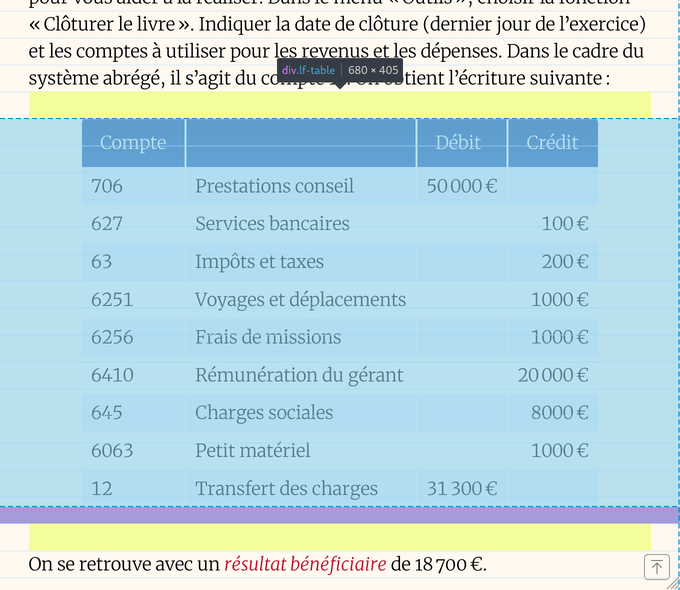
Screenshot of my website with a grid as an overlay and a table following the vertical rhythm. Additional padding is visible after the table. The height of the table with padding is 405.
One line out of five is aligned to the grid. Additional padding is added after the table to not break the vertical rhythm. 405 is divisible by 27, our line height in this example.

None of this is necessary. But once you start looking, you can t unsee it. Until browsers implement CSS Rhythmic Sizing, a bit of CSS wizardry and a touch of JavaScript is enough to pull it off. The main text now returns after each intrusion precisely on beat and in phase.

  1. See Vertical rhythm using CSS lh and rlh units by Pawe Grzybek.
  2. For broader compatibility, you can replace 2rlh with calc(var(--line-height) * 2rem) and set the --line-height custom property in the :root pseudo-class. I wrote a simple PostCSS plugin for this purpose.
  3. It would have been nicer to compute the line height with calc(round(up, calc(2.4rem / 1rlh), 0) * 1rlh). Unfortunately, typed arithmetic is not supported by Firefox yet. Moreover, browsers support round() only since 2024. Instead, I coded a PostCSS plugin for this as well.
  4. The following CSS code defines a grid tracking the line height:
    body  
      position: relative;
     
    body::after  
      content: "";
      position: absolute;
      inset: 0;
      z-index: 9999;
      background: linear-gradient(180deg, #c8e1ff99 1px, transparent 1px);
      background-size: 20px 1rlh;
      pointer-events: none;
     
    
  5. See Deep dive CSS: font metrics, line-height and vertical-align by Vincent De Oliveira.

16 March 2026

Freexian Collaborators: Monthly report about Debian Long Term Support, February 2026 (by Thorsten Alteholz)

The Debian LTS Team, funded by [Freexian s Debian LTS offering] (https://www.freexian.com/lts/debian/), is pleased to report its activities for February.

Activity summary During the month of February, 20 contributors have been paid to work on Debian LTS (links to individual contributor reports are located below). The team released 35 DLAs fixing 527 CVEs. We also welcomed Arnaud Rebillout to the team and had to say farewell to Roberto, who left the team after more than nine years as part of it. The team continued preparing security updates in its usual rhythm. Beyond the updates targeting Debian 11 ( bullseye ), which is the current release under LTS, the team also proposed updates for more recent releases (Debian 12 ( bookworm ) and Debian 13 ( trixie )), including Debian unstable. Notable security updates:
  • Guilhem Moulin prepared DLA 4492-1 for gnutls28 to fix vulnerabilities which may lead to Denial of Service.
  • Utkarsh Gupta prepared DLA 4464-1 for xrdp, to fix a a vulnerability that could allow remote attackers to execute arbitrary code on the target system.
  • Emilio Pozuelo Monfort prepared DLA-4465-1 to replace ClamAV 1.0 with ClamAV 1.4. This latter is the current LTS version supported by upstream.
  • Markus Koschany prepared DLA 4468-1 for tomcat9, to fix a vulnerability that can be used to bypass security constraints.
  • Santiago Ruano Rinc n prepared DLA 4471-1 to update package debian-security-support, the Debian security coverage checker.
  • Bastien Roucari s prepared DLA 4473-1 for zabbix, to fix a potential remote code execution vulnerability.
  • Paride Legovini prepared DLA 4478-1 for tcpflow, to fix a vulnerability that might result in DoS and potentially code execution.
  • Thorsten Alteholz prepared DLA 4477-1 for munge, to fix a vulnerability which may allow local users to leak the MUNGE cryptographic key and forge arbitrary credentials.
  • Ben Hutchings prepared DLA 4475-1 and DLA 4476-1 for Linux kernel updates.
  • Chris Lamb prepared DLA 4482-1 for ceph, to fix SSL certificate checking in the Python bindings.
  • Andreas Henriksson prepared DLA 4491-1 to fix vulnerabilities in glib2.0, which could result in denial of service, memory corruption or potentially arbitrary code execution.
Contributions from outside the LTS Team:
  • The update of nova was prepared by the maintainer, Thomas Goirand. The corresponding DLA 4486-1 was published by Carlos Henrique Lima Melara.
  • The updates of thunderbird were prepared by the maintainer Christoph Goehre. The corresponding DLA 4466-1 and DLA 4495-1 was published by Emilio Pozuelo Monfort.
The LTS Team has also contributed with updates to the latest Debian releases:
  • Jochen prepared a point update of wireshark for bookworm (#1127945).
  • Jochen prepared point updates of erlang for trixie (#1127606) and bookworm (#1127607).
  • Bastien helped preparing DSA 6160-1 for netty and uploaded a fixed package to unstable.
  • Bastien prepared a point update of zabbix for trixie (#1127437).
  • Tobias prepared a point update of modsecurity-crs for bookworm (#1128655).
  • Tobias prepared a point update of busybox for bookworm (#1129503).
  • Tobias helped preparing DSA 6138-1 for libpng1.6.
  • Daniel prepared point updates of python-authlib for trixie (#1129477) and bookworm (#1129246).
  • Ben uploaded several Linux kernel packages to trixie-backports and bookworm-backports.
  • Ben prepared point updates of wireless-regdb for trixie and bookworm.
Other than the work related to updates, Sylvain made several improvements to the documentation and tooling used by the team. Some milestones in the lifecycle of two Debian releases are just around the corner. The support of Debian 12 will be handed over to the LTS team on June 11th 2026. After August 31st, support for Debian 11 will move from Debian LTS to ELTS managed by Freexian.

Individual Debian LTS contributor reports

Thanks to our sponsors Sponsors that joined recently are in bold.

17 February 2026

Freexian Collaborators: Monthly report about Debian Long Term Support, January 2026 (by Santiago Ruano Rinc n)

The Debian LTS Team, funded by Freexian s Debian LTS offering, is pleased to report its activities for January.

Activity summary During the month of January, 20 contributors have been paid to work on Debian LTS (links to individual contributor reports are located below). The team released 33 DLAs fixing 216 CVEs. The team continued preparing security updates in its usual rhythm. Beyond the updates targeting Debian 11 ( bullseye ), which is the current release under LTS, the team also proposed updates for more recent releases (Debian 12 ( bookworm ) and Debian 13 ( trixie )), including Debian unstable. We highlight several notable security updates here below. Notable security updates:
  • python3.9, prepared by Andrej Shadura (DLA-4455-1), fixing multiple vulnerabilities in the Python interpreter.
  • php, prepared by Guilhem Moulin (DLA-4447-1), fixing two vulnerabilities that could yield to request forgery or denial of service.
  • apache2, prepared by Bastien Roucari s DLA-4452-1, fixing four CVEs.
  • linux-6.1, prepared by Ben Hutchings (DLA-4436-1), as a regular update of the linux 6.1 backport to Debian 11.
  • python-django, prepared by Chris Lamb (DLA-4458-1), resolving multiple vulnerabilities.
  • firefox-esr prepared by Emilio Pozuelo Monfort (DLA-4439-1)
  • gnupg2, prepared by Roberto S nchez (DLA-4437-1), fixing multiple issues, including CVE-2025-68973 that could potentially be exploited to execute arbitrary code.
  • apache-log4j2, prepared by Markus Koschany (DLA-4444-1)
  • ceph, prepared by Utkarsh Gupta (DLA-4460-1)
  • inetutils, prepared by Andreas Henriksson (DLA-4453-1), fixing an authentication bypass in telnetd.
Moreover, Sylvain Beucler studied the security support status of p7zip, a fork of 7zip that has become unmaintained upstream. To avoid letting the users continue using an unsupported package, Sylvain has investigated a path forward in collaboration with the security team and the 7zip maintainer, looking to replace p7zip with 7zip. It is to note however that 7zip developers don t reveal the information about the patches that fix CVEs, making it difficult to backport single patches to fix vulnerabilities in Debian released versions. Contributions from outside the LTS Team: Thunderbird, prepared by maintainer Christoph Goehre. The DLA (DLA-4442-1) was published by Emilio. The LTS Team has also contributed with updates to the latest Debian releases:
  • Bastien uploaded gpsd to unstable, and proposed updates for trixie #1126121 and bookworm #1126168 to fix two CVEs.
  • Bastien also prepared the imagemagick updates for trixie and bookworm, released as DSA-6111-1, along with the bullseye update DLA-4448-1.
  • Chris proposed a trixie point update for python-django (#112646), and the work for bookworm was completed in February (#1079454). The longstanding bookworm update required tracking down a regression in the django-storages packages.
  • Markus prepared tomcat10 updates for trixie and bookworm (DSA-6120-1), and tomcat11 for trixie (DSA-6121-1)
  • Thorsten Alteholz prepared bookworm point updates for zvbi (#1126167) to fix five CVEs; taglib (#1126273) to fix one CVE; and libuev (#1126370) to fix one CVE.
  • Utkarsh prepared an unstable update of node-lodash to fix one CVE.
Other than the work related to updates, Sylvain made several improvements to the documentation and tooling used by the team.

Individual Debian LTS contributor reports

Thanks to our sponsors Sponsors that joined recently are in bold.

16 January 2026

Freexian Collaborators: Monthly report about Debian Long Term Support, December 2025 (by Santiago Ruano Rinc n)

The Debian LTS Team, funded by [Freexian s Debian LTS offering] (https://www.freexian.com/lts/debian/), is pleased to report its activities for December.

Activity summary During the month of December, 18 contributors have been paid to work on Debian LTS (links to individual contributor reports are located below). The team released 41 DLAs fixing 252 CVEs. The team currently focuses on preparing security updates for Debian 11 bullseye , but also looks for contributing with updates for Debian 12 bookworm , Debian 13 trixie and even Debian unstable. Notable security updates:
  • libsoup2.4 (DLA-4398-1), prepared by Andreas Henrikson, fixing several vulnerabilities.
  • glib2.0 (DLA-4412-1), published by Emilio Pozuelo Monfort, addressing multiple issues.
  • lasso (DLA-4397-1), prepared by Sylvain Beucler, addressing multiple issues, including a critical remote code execution (RCE) vulnerability (CVE-2025-47151)
  • roundcube (DLA 4415-1), prepared by Guilhem Moulin, fixing a cross-site-scripting (XSS) (CVE-2025-68461) and an information disclosure (CVE-2025-68460) vulnerabilities
  • mediawiki (DLA 4428-1), published by Guilhem, fixing multiple vulnerabilities could lead to information disclosure, denial of service or privilege escalation.
  • While the DLA has not been published yet, Charles Henrique Melara proposed upstream fixes for seven CVEs in ffmpeg: https://code.ffmpeg.org/FFmpeg/FFmpeg/pulls/21275.
  • python-apt (DLA 4408-1), prepared by Utkarsh Gupta, in coordination with the Debian Security Team and Julian Andres Klode, the apt s maintainer.
  • libpng1.6 (DLA-4396-1), published by Tobias Frost, completing the work started the previous month.
Notable non-security updates:
  • tzdata (DLA-4403-1), prepared by Emilio, including the latest changes to the leap second list and its expiry date, which was set for the end of December.
Contributions from outside the LTS Team:
  • Christoph Berg, co-maintainer of PostgreSQL in Debian, prepared a postgresql-13 update, released as DLA-4420-1
The LTS Team has also contributed with updates to the latest Debian releases:

Individual Debian LTS contributor reports

Thanks to our sponsors Sponsors that joined recently are in bold.

8 January 2026

Reproducible Builds: Reproducible Builds in December 2025

Welcome to the December 2025 from the Reproducible Builds project! Our monthly reports outline what we ve been up to over the past month, highlighting items of news from elsewhere in the increasingly-important area of software supply-chain security. As ever, if you are interested in contributing to the Reproducible Builds project, please see the Contribute page on our website.

  1. New orig-check service to validate Debian upstream tarballs
  2. Distribution work
  3. disorderfs updated to FUSE 3
  4. Mailing list updates
  5. Three new academic papers published
  6. Website updates
  7. Upstream patches

New orig-check service to validate Debian upstream tarballs This month, Debian Developer Lucas Nussbaum announced the orig-check service, which attempts to automatically reproduce the generation upstream tarballs (ie. the original source component of a Debian source package), comparing that to the upstream tarball actually shipped with Debian. As of the time of writing, it is possible for a Debian developer to upload a source archive that does not actually correspond to upstream s version. Whilst this is not inherently malicious (it typically indicates some tooling/process issue), the very possibility that a maintainer s version may differ potentially permits a maintainer to make (malicious) changes that would be misattributed to upstream. This service therefore nicely complements the whatsrc.org service, which was reported in our reports for both April and August. The orig-check is dedicated to Lunar, who sadly passed away a year ago.

Distribution work In Arch Linux this month, Robin Candau and Mark Hegreberg worked at making the Arch Linux WSL image bit-for-bit reproducible. Robin also shared some implementation details and future related work on our mailing list. Continuing a series reported in these reports for March, April and July 2025 (etc.), Simon Josefsson has published another interesting article this month, itself a followup to a post Simon published in December 2024 regarding GNU Guix Container Images that are hosted on GitLab. In Debian this month, Micha Lenk posted to the debian-backports-announce mailing list with the news that the Backports archive will now discard binaries generated and uploaded by maintainers: The benefit is that all binary packages [will] get built by the Debian buildds before we distribute them within the archive. Felix Moessbauer of Siemens then filed a bug in the Debian bug tracker to signal their intention to package debsbom, a software bill of materials (SBOM) generator for distributions based on Debian. This generated a discussion on the bug inquiring about the output format as well as a question about how these SBOMs might be distributed. Holger Levsen merged a number of significant changes written by Alper Nebi Yasak to the Debian Installer in order to improve its reproducibility. As noted in Alper s merge request, These are the reproducibility fixes I looked into before bookworm release, but was a bit afraid to send as it s just before the release, because the things like the xorriso conversion changes the content of the files to try to make them reproducible. In addition, 76 reviews of Debian packages were added, 8 were updated and 27 were removed this month adding to our knowledge about identified issues. A new different_package_content_when_built_with_nocheck issue type was added by Holger Levsen. [ ] Arnout Engelen posted to our mailing list reporting that they successfully reproduced the NixOS minimal installation ISO for the 25.11 release without relying on a pre-compiled package archive, with more details on their blog. Lastly, Bernhard M. Wiedemann posted another openSUSE monthly update for his work there.

disorderfs updated to FUSE 3 disorderfs is our FUSE-based filesystem that deliberately introduces non-determinism into system calls to reliably flush out reproducibility issues. This month, however, Roland Clobus upgraded disorderfs* from FUSE 2 to FUSE 3 after its package automatically got removed from Debian testing. Some tests in Debian currently require disorderfs to make the Debian live images reproducible, although disorderfs is not a Debian-specific tool.

Mailing list updates On our mailing list this month:
  • Luca Di Maio announced stampdalf, a filesystem timestamp preservation tool that wraps arbitrary commands and ensures filesystem timestamp reproducibility :
    stampdalf allows you to run any command that modifies files in a directory tree, then automatically resets all timestamps back to their original values. Any new files created during command execution are set to [the UNIX epoch] or a custom timestamp via SOURCE_DATE_EPOCH.
    The project s GitHub page helpfully reveals that the project is pronounced: stamp-dalf (stamp like time-stamp, dalf like Gandalf the wizard) as it s a wizard of time and stamps .)
  • Lastly, Reproducible Builds developer cen1 posted to our list announcing that early/experimental/alpha support for FreeBSD was added to rebuilderd. In their post, cen1 reports that the initial builds are in progress and look quite decent . cen1 also interestingly notes that since the upstream is currently not technically reproducible I had to relax the bit-for-bit identical requirement of rebuilderd [ ] I consider the pkg to be reproducible if the tar is content-identical (via diffoscope), ignoring timestamps and some of the manifest files. .

Three new academic papers published Yogya Gamage and Benoit Baudry of Universit de Montr al, Canada together with Deepika Tiwari and Martin Monperrus of KTH Royal Institute of Technology, Sweden published a paper on The Design Space of Lockfiles Across Package Managers:
Most package managers also generate a lockfile, which records the exact set of resolved dependency versions. Lockfiles are used to reduce build times; to verify the integrity of resolved packages; and to support build reproducibility across environments and time. Despite these beneficial features, developers often struggle with their maintenance, usage, and interpretation. In this study, we unveil the major challenges related to lockfiles, such that future researchers and engineers can address them. [ ]
A PDF of their paper is available online. Benoit Baudry also posted an announcement to our mailing list, which generated a number of replies.
Betul Gokkaya, Leonardo Aniello and Basel Halak of the University of Southampton then published a paper on the A taxonomy of attacks, mitigations and risk assessment strategies within the software supply chain:
While existing studies primarily focus on software supply chain attacks prevention and detection methods, there is a need for a broad overview of attacks and comprehensive risk assessment for software supply chain security. This study conducts a systematic literature review to fill this gap. By analyzing 96 papers published between 2015-2023, we identified 19 distinct SSC attacks, including 6 novel attacks highlighted in recent studies. Additionally, we developed 25 specific security controls and established a precisely mapped taxonomy that transparently links each control to one or more specific attacks. [ ]
A PDF of the paper is available online via the article s canonical page.
Aman Sharma and Martin Monperrus of the KTH Royal Institute of Technology, Sweden along with Benoit Baudry of Universit de Montr al, Canada published a paper this month on Causes and Canonicalization of Unreproducible Builds in Java. The abstract of the paper is as follows:
[Achieving] reproducibility at scale remains difficult, especially in Java, due to a range of non-deterministic factors and caveats in the build process. In this work, we focus on reproducibility in Java-based software, archetypal of enterprise applications. We introduce a conceptual framework for reproducible builds, we analyze a large dataset from Reproducible Central, and we develop a novel taxonomy of six root causes of unreproducibility. [ ]
A PDF of the paper is available online.

Website updates Once again, there were a number of improvements made to our website this month including:

Upstream patches The Reproducible Builds project detects, dissects and attempts to fix as many currently-unreproducible packages as possible. We endeavour to send all of our patches upstream where appropriate. This month, we wrote a large number of such patches, including:

Finally, if you are interested in contributing to the Reproducible Builds project, please visit our Contribute page on our website. However, you can get in touch with us via:

16 December 2025

Freexian Collaborators: Monthly report about Debian Long Term Support, November 2025 (by Santiago Ruano Rinc n)

The Debian LTS Team, funded by [Freexian s Debian LTS offering] (https://www.freexian.com/lts/debian/), is pleased to report its activities for November.

Activity summary During the month of November, 18 contributors have been paid to work on Debian LTS (links to individual contributor reports are located below). The team released 33 DLAs fixing 219 CVEs. The LTS Team kept going with the usual cadence of preparing security updates for Debian 11 bullseye , but also for Debian 12 bookworm , Debian 13 trixie and even Debian unstable. As in previous months, we are pleased to say that there have been multiple contributions of LTS uploads by Debian Fellows outside the regular LTS Team. Notable security updates:
  • Guilhem Moulin prepared DLA 4365-1 for unbound, a caching DNS resolver, fixing a cache poisoning vulnerability that could lead to domain hijacking.
  • Another update related to DNS software was made by Andreas Henriksson. Andreas completed the work on bind9, released as DLA 4364-1 to fix cache poisoning and Denial of Service (DoS) vulnerabilities.
  • Chris Lamb released DLA 4374-1 to fix a potential arbitrary code execution vulnerability in pdfminer, a tool for extracting information from PDF documents.
  • Ben Hutchings published a regular security update for the linux 6.1 bullseye backport, as DLA 4379-1.
  • A couple of other important recurrent updates were prepared by Emilio Pozuelo, who handled firefox-esr and thunderbird (in collaboration with Christoph Goehre), published as DLAs DLA 4370-1 and DLA 4372-1, respectively.
Contributions from fellows outside the LTS Team:
  • Thomas Goirand uploaded a bullseye update for keystone and swift
  • Jeremy B cha prepared the bullseye update for gst-plugins-base1.0
  • As mentioned above, Christoph Goehre prepared the bullseye update for thunderbird.
  • Mathias Behrle provided feedback about the tryton-server and tryton-sao vulnerabilities that were disclosed last month, and helped to review the bullseye patches for tryton-server.
Other than the regular LTS updates for bullseye, the LTS Team has also contributed updates to the latest Debian releases:
  • Bastien Roucari s prepared a bookworm update for squid, the web proxy cache server.
  • Carlos Henrique Lima Melara filed a bookworm point update request for gdk-pixbuf to fix CVE-2025-7345, a heap buffer overflow vulnerability that could lead to arbitrary code execution.
  • Daniel Leidert prepared bookworm and trixie updates for r-cran-gh to fix CVE-2025-54956, an issue that may expose user credentials in HTTP responses.
  • Along with the bullseye updates for unbound mentioned above, Guilhem helped to prepare the trixie update for unbound.
  • In collaboration with Lukas M rdian, Tobias Frost prepared trixie and bookworm updates for log4cxx, the C++ port of the logging framework for JAVA.
  • Jochen Sprickerhof prepared a bookworm update for syslog-ng.
  • Utkarsh completed the bookworm update for wordpress, addressing multiple security issues in the popular blogging tool.
Beyond security updates, there has been a significant effort in revamping our documentation, aiming to make the processes more clear and consistent for all the members of the team. This work was mainly carried out by Sylvain, Jochen and Roberto. We would like to express our gratitude to the sponsors for making the Debian LTS project possible. Also, special thanks to the fellows outside the LTS team for their valuable help.

Individual Debian LTS contributor reports

Thanks to our sponsors Sponsors that joined recently are in bold.

3 December 2025

Reproducible Builds: Reproducible Builds in November 2025

Welcome to the report for November 2025 from the Reproducible Builds project! These monthly reports outline what we ve been up to over the past month, highlighting items of news from elsewhere in the increasingly-important area of software supply-chain security. As always, if you are interested in contributing to the Reproducible Builds project, please see the Contribute page on our website. In this report:

  1. 10 years of Reproducible Build at SeaGL
  2. Distribution work
  3. Tool development
  4. Website updates
  5. Miscellaneous news
  6. Software Supply Chain Security of Web3
  7. Upstream patches

10 years of Reproducible Builds at SeaGL 2025 On Friday 8th November, Chris Lamb gave a talk called 10 years of Reproducible Builds at SeaGL in Seattle, WA. Founded in 2013, SeaGL is a free, grassroots technical summit dedicated to spreading awareness and knowledge about free source software, hardware and culture. Chris talk:
[ ] introduces the concept of reproducible builds, its technical underpinnings and its potentially transformative impact on software security and transparency. It is aimed at developers, security professionals and policy-makers who are concerned with enhancing trust and accountability in our software. It also provides a history of the Reproducible Builds project, which is approximately ten years old. How are we getting on? What have we got left to do? Aren t all the builds reproducible now?

Distribution work In Debian this month, Jochen Sprickerhof created a merge request to replace the use of reprotest in Debian s Salsa Continuous Integration (CI) pipeline with debrebuild. Jochen cites the advantages as being threefold: firstly, that only one extra build needed ; it uses the same sbuild and ccache tooling as the normal build ; and works for any Debian release . The merge request was merged by Emmanuel Arias and is now active. kpcyrd posted to our mailing list announcing the initial release of repro-threshold, which implements an APT transport that defines a threshold of at least X of my N trusted rebuilders need to confirm they reproduced the binary before installing Debian packages. Configuration can be done through a config file, or through a curses-like user interface. Holger then merged two commits by Jochen Sprickerhof in order to address a fakeroot-related reproducibility issue in the debian-installer, and J rg Jaspert deployed a patch by Ivo De Decker for a bug originally filed by Holger in February 2025 related to some Debian packages not being archived on snapshot.debian.org. Elsewhere, Roland Clobus performed some analysis on the live Debian trixie images, which he determined were not reproducible. However, in a follow-up post, Roland happily reports that the issues have been handled. In addition, 145 reviews of Debian packages were added, 12 were updated and 15 were removed this month adding to our knowledge about identified issues. Lastly, Jochen Sprickerhof filed a bug announcing their intention to binary NMU a very large number of the R programming language after a reproducibility-related toolchain bug was fixed.
Bernhard M. Wiedemann posted another openSUSE monthly update for their work there.
Julien Malka and Arnout Engelen launched the new hash collection server for NixOS. Aside from improved reporting to help focus reproducible builds efforts within NixOS, it collects build hashes as individually-signed attestations from independent builders, laying the groundwork for further tooling.

Tool development diffoscope version 307 was uploaded to Debian unstable (as well as version 309). These changes included further attempts to automatically attempt to deploy to PyPI by liaising with the PyPI developers/maintainers (with this experimental feature). [ ][ ][ ] In addition, reprotest versions 0.7.31 and 0.7.32 were uploaded to Debian unstable by Holger Levsen, who also made the following changes:
  • Do not vary the architecture personality if the kernel is not varied. (Thanks to Ra l Cumplido). [ ]
  • Drop the debian/watch file, as Lintian now flags this as error for native Debian packages. [ ][ ]
  • Bump Standards-Version to 4.7.2, with no changes needed. [ ]
  • Drop the Rules-Requires-Root header as it is no longer required.. [ ]
In addition, however, Vagrant Cascadian fixed a build failure by removing some extra whitespace from an older changelog entry. [ ]

Website updates Once again, there were a number of improvements made to our website this month including:

Miscellaneous news

Software Supply Chain Security of Web3 Via our mailing list, Martin Monperrus let us know about their recently-published page on the Software Supply Chain Security of Web3. The abstract of their paper is as follows:
Web3 applications, built on blockchain technology, manage billions of dollars in digital assets through decentralized applications (dApps) and smart contracts. These systems rely on complex, software supply chains that introduce significant security vulnerabilities. This paper examines the software supply chain security challenges unique to the Web3 ecosystem, where traditional Web2 software supply chain problems intersect with the immutable and high-stakes nature of blockchain technology. We analyze the threat landscape and propose mitigation strategies to strengthen the security posture of Web3 systems.
Their paper lists reproducible builds as one of the mitigating strategies. A PDF of the full text is available to download.

Upstream patches The Reproducible Builds project detects, dissects and attempts to fix as many currently-unreproducible packages as possible. We endeavour to send all of our patches upstream where appropriate. This month, we wrote a large number of such patches, including:

Finally, if you are interested in contributing to the Reproducible Builds project, please visit our Contribute page on our website. However, you can get in touch with us via:

30 November 2025

Utkarsh Gupta: FOSS Activites in November 2025

Here s my monthly but brief update about the activities I ve done in the FOSS world.

Debian
Whilst I didn t get a chance to do much, here are still a few things that I worked on:
  • Did a few sessions with the new DFSG team to help kickstart things, et al.
  • Assited a few folks in getting their patches submitted via Salsa.
  • Mentoring for newcomers.
  • Moderation of -project mailing list.

Ubuntu
I joined Canonical to work on Ubuntu full-time back in February 2021. Whilst I can t give a full, detailed list of things I did, here s a quick TL;DR of what I did:
  • Successfully released Resolute Snapshot 1!
    • This one was particularly interesting as it was done without the ISO tracker and cdimage access.
    • There are some wrinkles that need ironing out for the next snapshot.
  • Resolute Raccoon is now fully and formally open.
  • Assisted a bunch of folks with my Archive Admin and Release team hats to:
    • review NEW packages for Ubuntu Studio.
    • remove old binaries that are stalling transition and/or migration.
    • LTS requalification of Ubuntu flavours.
    • bootstrapping dotnet-10 packages.
    • removal of openjdk-19 from Jammy, which sparked some interesting discussions.

Debian (E)LTS
This month I have worked 22 hours on Debian Long Term Support (LTS) and on its sister Extended LTS project and did the following things:
  • wordpress: There were multiple vulnerabilities reported in Wordpress, leading to Sent Data & Cross-site Scripting.
    • [bookworm]: Roberto rightly pointed out that the upload to bookworm hadn t gone through last month, so I re-uploaded wordpress/6.1.9+dfsg1-0+deb12u1 to bookworm-security.
    • This is now released as DSA 6075-1.
  • ruby-rack: There were multiple vulnerabilities reported in Rack, leading to DoS (memory exhaustion) and proxy bypass.
    • [ELTS]: Last month I had backported fixes for CVE-2025-46727 & CVE-2025-32441 to buster and stretch but the other backports were being a bit tricky due to really old versions.
    • I spent a bit more time but there s a lot to demystify. Gonna take a bit of break from this one and come back to this after doing other updates. Might even consider sending a RFH to the list.
  • libwebsockets: Multiple issues were reported in LWS causing denial of service and stack-based buffer overflow.
  • mako: It was found that Mako, a Python template library, was vulnerable to a denial of service attack via crafted regular expressions.
    • [LTS]: For bullseye, these were fixed via 1.1.3+ds1-2+deb11u1. And released as DLA 4393-1.
    • Backporting tests was an interesting exercise as I had to make them compatible with the bullseye version. :)
  • ceph: Affected by CVE-2024-47866, using the argument x-amz-copy-source to put an object and specifying an empty string as its content leads to the RGW daemon crashing, resulting in a DoS attack.
    • [LTS]: Whilst the patch is straightforward, backports are a bit tricky. I ve prepared the update but would like to reach out to zigo, the maintainer, to make sure nothing regresses.
    • [ELTS]: Same as LTS, I d like to get a quick review and upload to LTS first before I start staging uploads for ELTS.
  • [LTS] Attended the monthly LTS meeting on IRC. Summary here.
    • It was also followed by a 50-minute post-meeting technical discussion/question session.
  • [E/LTS] Monitored discussions on mailing lists, IRC, and all the documentation updates. Thanks, Sylvain, for a great documentation summary.

Until next time.
:wq for today.

29 November 2025

Freexian Collaborators: Monthly report about Debian Long Term Support, October 2025 (by Roberto C. S nchez)

The Debian LTS Team, funded by Freexian s Debian LTS offering, is pleased to report its activities for October.

Activity summary During the month of October, 21 contributors have been paid to work on Debian LTS (links to individual contributor reports are located below). The team released 37 DLAs fixing 893 CVEs. The team has continued in its usual rhythm, preparing and uploading security updates targeting LTS and ELTS, as well as helping with updates to oldstable, stable, testing, and unstable. Additionally, the team received several contributions of LTS uploads from Debian Developers outside the standing LTS Team. Notable security updates:
  • https-everywhere, prepared by Markus Koschany, deals with a problem created by ownership of the https-rulesets.org domain passing to a malware operator
  • openjdk-17 and openjdk-11, prepared by Emilio Pozuelo Monfort, fixes XML external entity and certificate validation vulnerabilities
  • intel-microcode, prepared by Tobias Frost, fixes a variety of privilege escalation and denial of service vulnerabilities
Notable non-security updates:
  • distro-info-data, prepared by Stefano Rivera, updates information concerning current and upcoming Debian and Ubuntu releases
Contributions from outside the LTS Team:
  • Lukas M rdian, a Debian Developer, provided an update of log4cxx
  • Andrew Ruthven, one of the request-tracker4 maintainers, provided an update of request-tracker4
  • Christoph Goehre, co-maintainer of thunderbird, provided an update of thunderbird
Beyond the typical LTS updates, the team also helped the Debian community more broadly:
  • Guilhem Moulin prepared oldstable/stable updates of libxml2, and an unstable update of libxml2.9
  • Bastien Roucari s prepared oldstable/stable updates of imagemagick
  • Daniel Leidert prepared an oldstable update of python-authlib, oldstable update of libcommons-lang-java and stable update of libcommons-lang3-java
  • Utkarsh Gupta prepared oldstable/stable/testing/unstable updates of ruby-rack
The LTS Team is grateful for the opportunity to contribute to making LTS a high quality for sponsors and users. We are also particularly grateful for the collaboration from others outside the time; their contributions are important to the success of the LTS effort.

Individual Debian LTS contributor reports

Thanks to our sponsors Sponsors that joined recently are in bold.

13 October 2025

Freexian Collaborators: Monthly report about Debian Long Term Support, September 2025 (by Roberto C. S nchez)

Like each month, have a look at the work funded by Freexian s Debian LTS offering.

Debian LTS contributors In September, 20 contributors have been paid to work on Debian LTS, their reports are available:
  • Abhijith PA did 10.0h (out of 10.0h assigned and 4.0h from previous period), thus carrying over 4.0h to the next month.
  • Andreas Henriksson did 1.0h (out of 0.0h assigned and 20.0h from previous period), thus carrying over 19.0h to the next month.
  • Bastien Roucari s did 20.0h (out of 20.0h assigned).
  • Ben Hutchings did 20.0h (out of 21.0h assigned), thus carrying over 1.0h to the next month.
  • Carlos Henrique Lima Melara did 10.0h (out of 12.0h assigned), thus carrying over 2.0h to the next month.
  • Chris Lamb did 18.0h (out of 18.0h assigned).
  • Daniel Leidert did 21.0h (out of 21.0h assigned).
  • Emilio Pozuelo Monfort did 39.75h (out of 40.0h assigned), thus carrying over 0.25h to the next month.
  • Guilhem Moulin did 15.0h (out of 15.0h assigned).
  • Jochen Sprickerhof did 12.0h (out of 9.25h assigned and 11.75h from previous period), thus carrying over 9.0h to the next month.
  • Lee Garrett did 13.5h (out of 21.0h assigned), thus carrying over 7.5h to the next month.
  • Lucas Kanashiro did 8.0h (out of 20.0h assigned), thus carrying over 12.0h to the next month.
  • Markus Koschany did 15.0h (out of 3.25h assigned and 17.75h from previous period), thus carrying over 6.0h to the next month.
  • Paride Legovini did 6.0h (out of 8.0h assigned), thus carrying over 2.0h to the next month.
  • Roberto C. S nchez did 7.25h (out of 7.75h assigned and 13.25h from previous period), thus carrying over 13.75h to the next month.
  • Santiago Ruano Rinc n did 13.25h (out of 13.5h assigned and 1.5h from previous period), thus carrying over 1.75h to the next month.
  • Sylvain Beucler did 17.0h (out of 7.75h assigned and 13.25h from previous period), thus carrying over 4.0h to the next month.
  • Thorsten Alteholz did 21.0h (out of 21.0h assigned).
  • Tobias Frost did 5.0h (out of 0.0h assigned and 8.0h from previous period), thus carrying over 3.0h to the next month.
  • Utkarsh Gupta did 16.5h (out of 14.25h assigned and 6.75h from previous period), thus carrying over 4.5h to the next month.

Evolution of the situation In September, we released 38 DLAs.
  • Notable security updates:
    • modsecurity-apache prepared by Adrian Bunk, fixes a cross-site scripting vulnerability
    • cups, prepared by Thorsten Alteholz, fixes authentication bypass and denial of service vulnerabilities
    • jetty9, prepared by Adrian Bunk, fixes the MadeYouReset vulnerability (a recent, well-known denial of service vulnerability)
    • python-django, prepared by Chris Lamb, fixes a SQL injection vulnerability
    • firefox-esr and thunderbird, prepared by Emilio Pozuelo Monfort, were updated from the 128.x ESR series to the 140.x ESR series, fixing a number of vulnerabilities as well
  • Notable non-security updates:
    • wireless-regdb prepared by Ben Hutchings, updates information reflecting changes to radio regulations in many countries
There was one package update contributed by a Debian Developer outside of the LTS Team: an update of node-tar-fs, prepared by Xavier Guimard (a member of the Node packaging team). Finally, LTS Team members also contributed updates of the following packages:
  • libxslt (to stable and oldstable), prepared by Guilhem Moulin, to address a regression introduced in a previous security update
  • libphp-adodb (to stable and oldstable), prepared by Abhijith PA
  • cups (to stable and oldstable), prepared by Thorsten Alteholz
  • u-boot (to oldstable), prepared by Daniel Leidert and Jochen Sprickerhof
  • libcommongs-lang3-java (to stable and oldstable), prepared by Daniel Leidert
  • python-internetarchive (to oldstable), prepared by Daniel Leidert
One other notable contribution by a member of the LTS Team is that Sylvain Beucler proposed a fix upstream for CVE-2025-2760 in gimp2. Upstream no longer supports gimp2, but it is still present in Debian LTS, and so proposing this fix upstream is of benefit to other distros which may still be supporting the older gimp2 packages.

Thanks to our sponsors Sponsors that joined recently are in bold.

11 September 2025

Freexian Collaborators: Monthly report about Debian Long Term Support, August 2025 (by Roberto C. S nchez)

Like each month, have a look at the work funded by Freexian s Debian LTS offering.

Debian LTS contributors In August, 21 contributors have been paid to work on Debian LTS, their reports are available:
  • Abhijith PA did 10.0h (out of 0.0h assigned and 14.0h from previous period), thus carrying over 4.0h to the next month.
  • Andrej Shadura did 12.0h (out of 9.0h assigned and 3.0h from previous period).
  • Bastien Roucari s did 20.0h (out of 19.75h assigned and 0.25h from previous period).
  • Ben Hutchings did 22.75h (out of 16.5h assigned and 6.25h from previous period).
  • Carlos Henrique Lima Melara did 10.0h (out of 10.0h assigned).
  • Chris Lamb did 18.0h (out of 18.0h assigned).
  • Daniel Leidert did 23.25h (out of 23.25h assigned).
  • Emilio Pozuelo Monfort did 23.25h (out of 23.25h assigned).
  • Guilhem Moulin did 15.0h (out of 15.0h assigned).
  • Jochen Sprickerhof did 11.0h (out of 6.0h assigned and 16.75h from previous period), thus carrying over 11.75h to the next month.
  • Lee Garrett did 16.25h (out of 0.0h assigned and 16.25h from previous period).
  • Lucas Kanashiro did 20.0h (out of 1.25h assigned and 18.75h from previous period).
  • Markus Koschany did 5.0h (out of 13.0h assigned and 9.75h from previous period), thus carrying over 17.75h to the next month.
  • Paride Legovini did 8.0h (out of 0.0h assigned and 8.0h from previous period).
  • Roberto C. S nchez did 7.5h (out of 11.75h assigned and 11.0h from previous period), thus carrying over 15.25h to the next month.
  • Santiago Ruano Rinc n did 13.5h (out of 7.25h assigned and 7.75h from previous period), thus carrying over 1.5h to the next month.
  • Stefano Rivera did 0.5h (out of 0.0h assigned and 3.0h from previous period), thus carrying over 2.5h to the next month.
  • Sylvain Beucler did 10.0h (out of 23.25h assigned), thus carrying over 13.25h to the next month.
  • Thorsten Alteholz did 22.75h (out of 22.75h assigned).
  • Tobias Frost did 4.0h (out of 0.0h assigned and 12.0h from previous period), thus carrying over 8.0h to the next month.
  • Utkarsh Gupta did 16.0h (out of 22.75h assigned), thus carrying over 6.75h to the next month.

Evolution of the situation In August, we released 27 DLAs. The month of August marked the release of Debian 13 (codename trixie ). This is worth noting because it brought with it the return of the customary fast development pace of Debian unstable, which included several contributions from LTS Team members. More on that below. Of the many security updates which were published (and a few non-security updates as well), some notable ones are highlighted here.
  • Notable security updates:
    • gnutls28 prepared by Adrian Bunk, fixes several potential denial of service vulnerabilities
    • apache2, prepared by Bastien Roucari s, fixes several vulnerabilities including a potential denial of service and SSL/TLS-related access control
    • mbedtls (original update, regression update) prepared by Andrej Shadura, fixes several potential denial of service and information disclosure vulnerabilities
    • openjdk-17, prepared by Emilio Pozuelo Monfort, fixes several vulnerabilities which could result in denial of service, information disclosure or weakened TLS connections
  • Notable non-security updates:
    • distro-info-data, prepared by Stefano Rivera, adds information concerning future Debian and Ubuntu releases
    • ca-certificates-java, prepared by Bastien Roucari s, fixes some bugs which could disrupt future updates
The LTS Team continues to welcome the collaboration of maintainers from across the Debian community. The contributions of maintainers from outside the LTS Team include: postgresql-13 (Christoph Berg), sope (Jordi Mallach), thunderbird (Carsten Schoenert), and iperf3 (Roberto Lumbreras). Finally, LTS Team members also contributed updates of the following packages:
  • redis (to stable), prepared by Chris Lamb
  • firebird3.0 (to oldstable and stable), prepared by Adrian Bunk
  • node-tmp (to oldstable, stable, and unstable), prepared by Adrian Bunk
  • openjpeg2 (to oldstable, stable, and unstable), prepared by Adrian Bunk
  • apache2 (to oldstable), prepared by Bastien Roucari s
  • unbound (to oldstable), prepared by Guilhem Moulin
  • luajit (to oldstable), prepared by Guilhem Moulin
  • golang-github-gin-contrib-cors (to oldstable and stable), prepared by Thorsten Alteholz
  • libcoap3 (to stable), prepared by Thorsten Alteholz
  • libcommons-lang-java and libcommons-lang3-java (both to unstable), prepared by Daniel Leidert
  • python-flask-cors (to oldstable), prepared by Daniel Leidert
The LTS Team would especially like to thank our many longtime friends and sponsors for their support and collaboration.

Thanks to our sponsors Sponsors that joined recently are in bold.

15 August 2025

Freexian Collaborators: Monthly report about Debian Long Term Support, July 2025 (by Roberto C. S nchez)

Like each month, have a look at the work funded by Freexian s Debian LTS offering.

Debian LTS contributors In July, 17 contributors have been paid to work on Debian LTS, their reports are available:
  • Adrian Bunk did 19.0h (out of 19.0h assigned).
  • Andrej Shadura did 5.0h (out of 0.0h assigned and 8.0h from previous period), thus carrying over 3.0h to the next month.
  • Bastien Roucari s did 18.5h (out of 18.75h assigned), thus carrying over 0.25h to the next month.
  • Ben Hutchings did 12.5h (out of 3.25h assigned and 15.5h from previous period), thus carrying over 6.25h to the next month.
  • Carlos Henrique Lima Melara did 10.0h (out of 10.0h assigned).
  • Chris Lamb did 18.0h (out of 18.0h assigned).
  • Daniel Leidert did 18.75h (out of 17.25h assigned and 1.5h from previous period).
  • Emilio Pozuelo Monfort did 18.75h (out of 18.75h assigned).
  • Guilhem Moulin did 15.0h (out of 14.0h assigned and 1.0h from previous period).
  • Jochen Sprickerhof did 2.0h (out of 16.5h assigned and 2.25h from previous period), thus carrying over 16.75h to the next month.
  • Lee Garrett did 7.0h (out of 0.0h assigned and 23.25h from previous period), thus carrying over 16.25h to the next month.
  • Markus Koschany did 9.0h (out of 18.75h assigned), thus carrying over 9.75h to the next month.
  • Roberto C. S nchez did 10.25h (out of 18.5h assigned and 2.75h from previous period), thus carrying over 11.0h to the next month.
  • Santiago Ruano Rinc n did 7.25h (out of 12.75h assigned and 2.25h from previous period), thus carrying over 7.75h to the next month.
  • Sylvain Beucler did 18.75h (out of 18.75h assigned).
  • Thorsten Alteholz did 15.0h (out of 15.0h assigned).
  • Utkarsh Gupta did 15.0h (out of 1.0h assigned and 14.0h from previous period).

Evolution of the situation In July, we released 24 DLAs.
  • Notable security updates:
    • angular.js, prepared by Bastien Roucari s, fixes multiple vulnerabilities including input sanitization and potential regular expression denial of service (ReDoS)
    • tomcat9, prepared by Markus Koschany, fixes an assortment of vulnerabilities
    • mediawiki, prepared by Guilhem Moulin, fixes several information disclosure and privilege escalation vulnerabilities
    • php7.4, prepared by Guilhem Moulin, fixes several server side request forgery and denial of service vulnerabilities
This month s contributions from outside the regular team include an update to thunderbird, prepared by Christoph Goehre (the package maintainer). LTS Team members also contributed updates of the following packages:
  • commons-beanutils (to stable and unstable), prepared by Adrian Bunk
  • djvulibre (to oldstable, stable, and unstable), prepared by Adrian Bunk
  • git (to stable), prepared by Adrian Bunk
  • redis (to oldstable), prepared by Chris Lamb
  • libxml2 (to oldstable), prepared by Guilhem Moulin
  • commons-vfs (to oldstable), prepared by Daniel Leidert
Additionally, LTS Team member Santiago Ruano Rinc n proposed and implemented an improvement to the debian-security-support package. This package is available so that interested users can quickly determine if any installed packages are subject to limited security support or are excluded entirely from security support. However, there was not previously a way to identify explicitly supported packages, which has become necessary to note exceptions to broad exclusion policies (e.g., those which apply to substantial package groups, like modules belonging to the Go and Rust language ecosystems). Santiago s work has enabled the notation of exceptions to these exclusions, thus ensuring that users of debian-security-support have accurate status information concerning installed packages.

DebCamp 25 Security Tracker Sprint The previously announced security tracker sprint took place at DebCamp from 7-13 July. Participants included 8 members of the standing LTS Team, 2 active Debian Developers with an interest in LTS, 3 community members, and 1 member of the Debian Security Team (who provided guidance and reviews on proposed changes to the security tracker); participation was a mix of in person at the venue in Brest, France and remote. During the days of the sprint, the team tackled a wide range of bugs and improvements, mostly targeting the security tracker. The sprint participants worked on the following items: As can be seen from the above list, only a small number of changes were brought to completion during the sprint week itself. Given the very compressed timeframe involved, the broad scope of tasks which were under consideration, and the highly sensitive data managed by the security tracker, this is not entirely unexpected and in no way diminishes the great work done by the sprint participants. The LTS Team would especially like to thank Salvatore Bonaccorso of the Debian Security Team for making himself available throughout the sprint to answer questions, for providing guidance on the work, and for helping the work by reviewing and merging the MRs which were able to merged during the sprint itself. In the weeks that follow the sprint, the team will continue working towards completing the in progress items.

Thanks to our sponsors Sponsors that joined recently are in bold.

30 July 2025

Utkarsh Gupta: FOSS Activites in July 2025

Here s my 70th monthly but brief update about the activities I ve done in the F/L/OSS world.

Debian
This was my 79th month of actively contributing to Debian. I became a DM in late March 2019 and a DD on Christmas 19! \o/ Debian was in freeze throughout so whilst I didn t do many uploads, there s a bunch of other things I did:
  • Attended DebConf25 in Brest, France.
    • Lead the bursary BOF and discussions.
    • Participated in other sessions, especially around the FTP masters.
    • I ve started to look at things with my trainee hat on.
    • Participated in the Debian Security Tracker sprints during DebCamp. More on that below.
  • Mentoring for newcomers.
  • Moderation of -project mailing list.

Ubuntu
This was my 54th month of actively contributing to Ubuntu. I joined Canonical to work on Ubuntu full-time back in February 2021. Whilst I can t give a full, detailed list of things I did (there s so much and some of it might not be public yet!), here s a quick TL;DR of what I did:
  • Released Questing snapshot 3! \o/
  • EOL d Oracular. o/
  • Participated in the mid-cycle sprints.
  • Got a recognition award for leading 24.04.2 LTS release and leading the Release Management team.
  • Preparing for the 24.04.3 LTS release early next month.

Debian (E)LTS
Debian Long Term Support (LTS) is a project to extend the lifetime of all Debian stable releases to (at least) 5 years. Debian LTS is not handled by the Debian security team, but by a separate group of volunteers and companies interested in making it a success. And Debian Extended LTS (ELTS) is its sister project, extending support to the stretch and jessie release (+2 years after LTS support). This was my 70th month as a Debian LTS and 57th month as a Debian ELTS paid contributor.
I only worked for 15.00 hours for LTS and 5.00 hours for ELTS and did the following things:
  • [LTS] Released DLA 4263-1 for ruby-graphql.
    • Coordinated with upstream due to lack of clarity on 1.11.4 being affected & not having a clear reproducer.
    • As 1.11.4 was still partially vulnerable and the backport was non-trivial, it was probably conveinent to bump the upstream version to 1.11.12 instead, fixing:
    • CVE-2025-27407): a remote code execution.
    • Salsa repository: https://salsa.debian.org/lts-team/packages/ruby-graphql.
    • Coordinated with the Security team for a p-u fix or a DSA.
  • [E/LTS] Frontdesk duty from 28th July to 04th August.
  • [LTS] Attended the monthly LTS meeting on IRC. Summary here.

Debian Security Tracker sprint 2025 Thanks to the LTS team for also organizing a security tracker sprint during DebCamp25. I attended the sprint and spent 10 hours working on the following tasks: That s all. A quicky shoutout to Roberto for organizing the sprints remotely and being awake at odd hours. <3
Until next time.
:wq for today.

12 July 2025

Freexian Collaborators: Monthly report about Debian Long Term Support, June 2025 (by Roberto C. S nchez)

Like each month, have a look at the work funded by Freexian s Debian LTS offering.

Debian LTS contributors In June, 20 contributors have been paid to work on Debian LTS, their reports are available:
  • Abhijith PA did 14.0h (out of 14.0h assigned).
  • Adrian Bunk did 23.5h (out of 23.5h assigned).
  • Andreas Henriksson did 3.0h (out of 3.0h assigned and 17.0h from previous period), thus carrying over 17.0h to the next month.
  • Andrej Shadura did 2.0h (out of 3.0h assigned and 7.0h from previous period), thus carrying over 8.0h to the next month.
  • Bastien Roucari s did 20.0h (out of 20.0h assigned).
  • Ben Hutchings did 8.0h (out of 7.5h assigned and 16.0h from previous period), thus carrying over 15.5h to the next month.
  • Carlos Henrique Lima Melara did 12.0h (out of 12.0h assigned).
  • Chris Lamb did 18.0h (out of 18.0h assigned).
  • Daniel Leidert did 22.0h (out of 22.5h assigned and 1.0h from previous period), thus carrying over 1.5h to the next month.
  • Emilio Pozuelo Monfort did 23.5h (out of 16.75h assigned and 6.75h from previous period).
  • Guilhem Moulin did 14.0h (out of 11.5h assigned and 3.5h from previous period), thus carrying over 1.0h to the next month.
  • Jochen Sprickerhof did 21.0h (out of 0.5h assigned and 22.75h from previous period), thus carrying over 2.25h to the next month.
  • Lucas Kanashiro did 20.0h (out of 20.0h assigned).
  • Markus Koschany did 23.25h (out of 17.0h assigned and 6.25h from previous period).
  • Roberto C. S nchez did 21.25h (out of 20.75h assigned and 3.25h from previous period), thus carrying over 2.75h to the next month.
  • Santiago Ruano Rinc n did 12.75h (out of 15.0h assigned), thus carrying over 2.25h to the next month.
  • Sean Whitton did 1.0h (out of 4.25h assigned and 1.75h from previous period), thus carrying over 5.0h to the next month.
  • Sylvain Beucler did 23.5h (out of 23.5h assigned).
  • Thorsten Alteholz did 15.0h (out of 15.0h assigned).
  • Tobias Frost did 2.5h (out of 12.0h assigned), thus carrying over 9.5h to the next month.

Evolution of the situation In June, we released 35 DLAs.
  • Notable security updates:
    • mariadb-10.5, prepared by Otto Kek l inen, fixes vulnerabilities which could result in denial of service, information disclosure, or unauthorized data modification
    • python-django, prepared by Chris Lamb, fixes vulnerabilities which would result in log injection or denial of service
    • webkit2gtk, prepared by Emilio Pozuelo Monfort, fixes many vulnerabilities which could results in a wide range of issues
    • xorg-server, prepared by Emilio Pozuelo Monfort, fixes multiple vulnerabilities which may result in privilege escalation
    • sudo, prepared by Thorsten Alteholz, fixes a vulnerability which could result in privilege escalation
  • Notable non-security updates:
    • debian-security-support, prepared by Santiago Ruano Rinc n, updates status of packages which receive limited security support or which have reached the end of security support
    • dns-root-data, prepared by Sylvain Beucler, updates the DNSSEC trust anchors
This month s contributions from outside the regular team include the mariadb-10.5 update mentioned above, prepared by Otto Kek l inen (the package maintainer); an update to libfile-find-rule-perl, prepared by Salvatore Bonaccorso (a member of the Debian Security Team); an update to activemq, prepared by Emmanuel Arias (a maintainer of the package). Additionally, LTS Team members contributed stable updates of the following packages:
  • curl, prepared by Carlos Henrique Lima Melara
  • python-tornado, prepared by Daniel Leidert
  • python-flask-cors, prepared by Daniel Leidert
  • common-vfs, prepared by Daniel Leidert
  • cjson, prepared by Adrian Bunk
  • icu, prepared by Adrian Bunk
  • node-tar-fs, prepared by Adrian Bunk
  • rar, prepared by Adrian Bunk
Something of particular noteworthiness is that LTS contributor Carlos Henrique Lima Melara discovered a regression in the upstream fix for CVE-2023-2753 in curl. The corrective action which he took included providing a patch to upstream, uploading a stable update of curl, and further updating the version of curl in LTS. DebConf, the annual Debian Conference, is coming up in July and, as is customary each year, the week preceding the conference will feature an event called DebCamp. The DebCamp week provides an opportunity for teams and other interested groups/individuals to meet together in person in the same venue as the conference itself, with the purpose of doing focused work, often called sprints . LTS coordinator Roberto C. S nchez has announced that the LTS Team is planning to hold a sprint primarily focused on the Debian security tracker and the associated tooling used by the LTS Team and the Debian Security Team.

Thanks to our sponsors Sponsors that joined recently are in bold.

11 June 2025

Freexian Collaborators: Monthly report about Debian Long Term Support, May 2025 (by Roberto C. S nchez)

Like each month, have a look at the work funded by Freexian s Debian LTS offering.

Debian LTS contributors In May, 22 contributors have been paid to work on Debian LTS, their reports are available:
  • Abhijith PA did 8.0h (out of 0.0h assigned and 8.0h from previous period).
  • Adrian Bunk did 26.0h (out of 26.0h assigned).
  • Andreas Henriksson did 1.0h (out of 15.0h assigned and 3.0h from previous period), thus carrying over 17.0h to the next month.
  • Andrej Shadura did 3.0h (out of 10.0h assigned), thus carrying over 7.0h to the next month.
  • Bastien Roucari s did 20.0h (out of 20.0h assigned).
  • Ben Hutchings did 8.0h (out of 20.0h assigned and 4.0h from previous period), thus carrying over 16.0h to the next month.
  • Carlos Henrique Lima Melara did 12.0h (out of 11.0h assigned and 1.0h from previous period).
  • Chris Lamb did 15.5h (out of 0.0h assigned and 15.5h from previous period).
  • Daniel Leidert did 25.0h (out of 26.0h assigned), thus carrying over 1.0h to the next month.
  • Emilio Pozuelo Monfort did 21.0h (out of 16.75h assigned and 11.0h from previous period), thus carrying over 6.75h to the next month.
  • Guilhem Moulin did 11.5h (out of 8.5h assigned and 6.5h from previous period), thus carrying over 3.5h to the next month.
  • Jochen Sprickerhof did 3.5h (out of 8.75h assigned and 17.5h from previous period), thus carrying over 22.75h to the next month.
  • Lee Garrett did 26.0h (out of 12.75h assigned and 13.25h from previous period).
  • Lucas Kanashiro did 20.0h (out of 18.0h assigned and 2.0h from previous period).
  • Markus Koschany did 20.0h (out of 26.25h assigned), thus carrying over 6.25h to the next month.
  • Roberto C. S nchez did 20.75h (out of 24.0h assigned), thus carrying over 3.25h to the next month.
  • Santiago Ruano Rinc n did 15.0h (out of 12.5h assigned and 2.5h from previous period).
  • Sean Whitton did 6.25h (out of 6.0h assigned and 2.0h from previous period), thus carrying over 1.75h to the next month.
  • Sylvain Beucler did 26.25h (out of 26.25h assigned).
  • Thorsten Alteholz did 15.0h (out of 15.0h assigned).
  • Tobias Frost did 12.0h (out of 12.0h assigned).
  • Utkarsh Gupta did 1.0h (out of 15.0h assigned), thus carrying over 14.0h to the next month.

Evolution of the situation In May, we released 54 DLAs. The LTS Team was particularly active in May, publishing a higher than normal number of advisories, as well as helping with a wide range of updates to packages in stable and unstable, plus some other interesting work. We are also pleased to welcome several updates from contributors outside the regular team.
  • Notable security updates:
    • containerd, prepared by Andreas Henriksson, fixes a vulnerability that could cause containers launched as non-root users to be run as root
    • libapache2-mod-auth-openidc, prepared by Moritz Schlarb, fixes a vulnerability which could allow an attacker to crash an Apache web server with libapache2-mod-auth-openidc installed
    • request-tracker4, prepared by Andrew Ruthven, fixes multiple vulnerabilities which could result in information disclosure, cross-site scripting and use of weak encryption for S/MIME emails
    • postgresql-13, prepared by Bastien Roucari s, fixes an application crash vulnerability that could affect the server or applications using libpq
    • dropbear, prepared by Guilhem Moulin, fixes a vulnerability which could potentially result in execution of arbitrary shell commands
    • openjdk-17, openjdk-11, prepared by Thorsten Glaser, fixes several vulnerabilities, which include denial of service, information disclosure or bypass of sandbox restrictions
    • glibc, prepared by Sean Whitton, fixes a privilege escalation vulnerability
  • Notable non-security updates:
    • wireless-regdb, prepared by Ben Hutchings, updates information reflecting changes to radio regulations in many countries
This month s contributions from outside the regular team include the libapache2-mod-auth-openidc update mentioned above, prepared by Moritz Schlarb (the maintainer of the package); the update of request-tracker4, prepared by Andrew Ruthven (the maintainer of the package); and the updates of openjdk-17 and openjdk-11, also noted above, prepared by Thorsten Glaser. Additionally, LTS Team members contributed stable updates of the following packages:
  • rubygems and yelp/yelp-xsl, prepared by Lucas Kanashiro
  • simplesamlphp, prepared by Tobias Frost
  • libbson-xs-perl, prepared by Roberto C. S nchez
  • fossil, prepared by Sylvain Beucler
  • setuptools and mydumper, prepared by Lee Garrett
  • redis and webpy, prepared by Adrian Bunk
  • xrdp, prepared by Abhijith PA
  • tcpdf, prepared by Santiago Ruano Rinc n
  • kmail-account-wizard, prepared by Thorsten Alteholz
Other contributions were also made by LTS Team members to packages in unstable:
  • proftpd-dfsg DEP-8 tests (autopkgtests) were provided to the maintainer, prepared by Lucas Kanashiro
  • a regular upload of libsoup2.4, prepared by Sean Whitton
  • a regular upload of setuptools, prepared by Lee Garrett
Freexian, the entity behind the management of the Debian LTS project, has been working for some time now on the development of an advanced CI platform for Debian-based distributions, called Debusine. Recently, Debusine has reached a level of feature implementation that makes it very usable. Some members of the LTS Team have been using Debusine informally, and during May LTS coordinator Santiago Ruano Rinc n has made a call for the team to help with testing of Debusine, and to help evaluate its suitability for the LTS Team to eventually begin using as the primary mechanism for uploading packages into Debian. Team members who have started using Debusine are providing valuable feedback to the Debusine development team, thus helping to improve the platform for all users. Actually, a number of updates, for both bullseye and bookworm, made during the month of May were handled using Debusine, e.g. rubygems s DLA-4163-1. By the way, if you are a Debian Developer, you can easily test Debusine following the instructions found at https://wiki.debian.org/DebusineDebianNet. DebConf, the annual Debian Conference, is coming up in July and, as is customary each year, the week preceding the conference will feature an event called DebCamp. The DebCamp week provides an opportunity for teams and other interested groups/individuals to meet together in person in the same venue as the conference itself, with the purpose of doing focused work, often called sprints . LTS coordinator Roberto C. S nchez has announced that the LTS Team is planning to hold a sprint primarily focused on the Debian security tracker and the associated tooling used by the LTS Team and the Debian Security Team.

Thanks to our sponsors Sponsors that joined recently are in bold.

Next.