Search Results: "pini"

23 November 2026

C.J. Collier: Why Perl Lost the Cloud Era, and How Native gRPC, Protobuf, and GenAI SDKs Can Bring It Back

Disclaimer: The opinions stated here are my own, not those of my employer.

Every so often, someone asks why Perl once the undisputed duct tape of the Internet faded from mainstream greenfield software development. Was there a single cultural flashpoint that canceled Perl? Was it the fifteen-year wait for Perl 6? Or did Damian Conway s Perl Best Practices, Perl::Critic, and CPAN s Kwalitee metrics simply arrive too late?

Having spent time recently building a modern Protocol Buffers and gRPC cloud client stack for Perl, I ve come to a simple conclusion: languages don t fade solely because of syntax debates. They decline when the friction of talking to the current generation of infrastructure outweighs the language s natural strengths.

Here is a look back at why Perl lost momentum during the 2000s enterprise shift and why the GenAI and gRPC era offers an unexpected opening for a modern Perl resurgence.


1. What Actually Drove Perl s Decline?

Perl wasn t sidelined by a single societal scandal. Rather, several technical, historical, and organizational forces converged between 2000 and 2012:

TIMTOWTDI vs. Readability at Scale

Designed by Larry Wall a linguist by training Perl embraced natural-language expressiveness under the motto There s More Than One Way To Do It (TIMTOWTDI). Context sensitivity, topicalizers ($_), and compact regex idioms made Perl extraordinarily fast for an individual developer or sysadmin to write. Seat a hundred engineers in a shared codebase without shared guardrails, however, and TIMTOWTDI produces divergent dialects.

As software teams scaled in the late 1990s and 2000s, engineering leadership increasingly favored Python s counter-philosophy ( There should be one and preferably only one obvious way to do it ), prioritizing uniform, easily reviewable code over expressive flexibility. Tellingly, the public Google Style Guides repository maintains official prose guides for C++, C#, Go, Java, JavaScript, Python, Shell, and TypeScript while omitting Perl altogether, leaving open-source Google Perl projects to codify standards directly in executable .perlcriticrc and .perltidyrc configurations alongside core perlstyle and Perl Best Practices.

The Perl 6 (Raku) Waiting Game & Ecosystem Shifts

If one historical event hurt Perl s momentum above all else, it was the Perl 6 transition. Announced in 2000 as an ambitious, backward-incompatible redesign, Perl 6 took 15 years to reach a stable specification (ultimately renaming to Raku in 2019 as a distinct sister language). During that 2000 2015 window, much of the industry assumed Perl 5 was in maintenance mode even as Perl 5 underwent a major renaissance between 2007 and 2012 (Modern Perl, Perl 5.10+, Moose, Moo, PSGI/Plack, and cpanminus).

Meanwhile, Perl s traditional strongholds migrated elsewhere: CGI.pm and mod_perl gave way to PHP, Ruby on Rails, and Django; cloud and DevOps tooling (Puppet, Chef, Ansible, Docker, Kubernetes, Terraform) coalesced around Ruby, Python, and Go; and scientific computing shifted from Perl s 1990s bioinformatics dominance to Python s C-extension ecosystem (NumPy, SciPy, Pandas, PyTorch). Even the 2020 debates over a proposed jump to Perl 7 which never came to fruition, ultimately giving way to the Perl Steering Council and steady incremental modernization via use v5.36 and use v5.40 happened long after that 2000s market shift.

Why Perl Best Practices, Perl::Critic, and Kwalitee Didn t Reverse the Trend Alone

Damian Conway s Perl Best Practices (2005), static analysis via Perl::Critic (built on PPI), formatting via Perl::Tidy, and CPAN s Kwalitee metrics (Module::CPANTS::Analyse) solved many of the readability complaints associated with 1990s Perl. Enforce strict Perl::Critic policies and modern conventions, and Perl code becomes remarkably clear and intentional. Yet four structural factors kept those tools from reversing the broader industry trend:

  • Opt-in discipline vs. language defaults: Unlike Python s indentation grammar or Go s gofmt, clean Perl relies on opt-in team toolchain discipline and two Modern Perl teams can still choose different object dialects (blessed hashes, Moose, Moo, or Perl 5.38+ Corinna class blocks).
  • Static analysis limits ( Only perl can parse Perl ): Because BEGIN blocks, prototypes, and symbol-table manipulation make Perl 5 undecidable to parse statically in full generality, PPI excels at lint policies but cannot easily power the deep static type checking and automated million-line AST refactorings that enterprise monorepos rely on.
  • What Kwalitee actually measures: Coined as a tongue-in-cheek pun on Quality ( it looks like quality, it sounds like quality, but it s not quite quality ), Kwalitee measures CPAN distribution hygiene metadata, licenses, POD, use strict, and test suites making CPAN extraordinarily reliable, without addressing application-scale type safety.
  • The 2005 2011 timing gap: By the time Modern Perl matured, major tech companies had already locked in build systems, hermetic toolchains, and RPC code generators for Python and Java, leaving little appetite to fund parallel infrastructure for a second dynamic scripting language.

2. The Real Blocker Today: The Protobuf & gRPC Chasm

If you write Perl 5.36 5.40+ today with native subroutine signatures, try/catch, builtin booleans, Moo or Corinna class blocks, and strict Perl::Critic gates the language itself is clean, fast, and expressive.

The real wall a modern Perl engineer hits isn t syntax. It s infrastructure integration.

Over the past decade, cloud databases and AI services standardized on Protocol Buffers (Proto3 / Edition 2024) and gRPC over HTTP/2, using automated generators like GAPIC to ship official client libraries for Python, Go, Java, TypeScript, C#, Ruby, and PHP. Perl was left off that list. Even major commercial libraries such as the Google Ads API Perl Client Library had to build custom HTTP/1.1 REST/JSON wrappers because Perl lacked an official upb Protobuf runtime and native gRPC stack.

When calling Cloud Spanner or an LLM requires hand-rolling OAuth2 token flows, REST wrappers, and JSON payload builders for every service, Perl loses its greatest superpower: getting complex things done fast.


3. Closing the Gap: A Modular Cloud & AI Stack for Perl

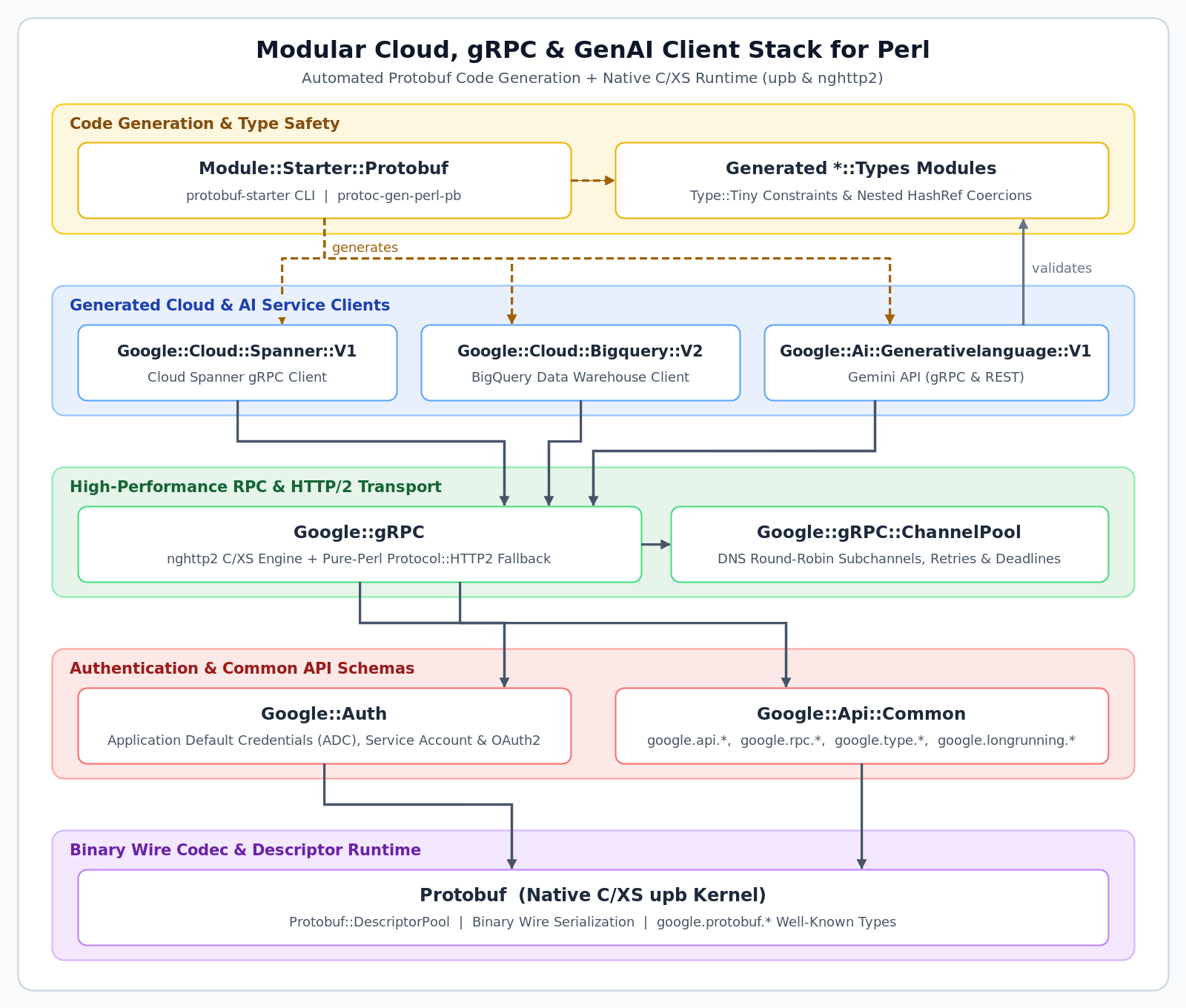
To test whether modern API ergonomics can revitalize Perl for cloud and AI engineering, I ve been building an open-source modular stack (published on CPAN and GitHub) that brings first-class Protocol Buffers, gRPC, DBI drivers, and automated client generation to Perl:

Architecture diagram of the modular Perl Cloud, gRPC, and GenAI client stackFigure 1: Open-source Protocol Buffers, gRPC, and automated client-generation stack for Perl.

With this stack in place, querying Cloud Spanner over native gRPC in Perl requires zero hand-rolled REST boilerplate:

use strict;
use warnings;
use Google::Cloud::Spanner::V1;
use Google::Auth;
# 1. Initialize Application Default Credentials (ADC)
my $auth = Google::Auth->default();
# 2. Initialize Spanner Client over gRPC transport
my $spanner = Google::Cloud::Spanner::V1->new(
    credentials => $auth,
);
# 3. Execute SQL Query
my $result = $spanner->execute_sql(
    database => 'projects/my-proj/instances/my-inst/databases/my-db',
    sql      => 'SELECT 1 AS alive',
);

And calling Gemini via Google::Ai::Generativelanguage::V1 with automatic nested hashref-to-Protobuf coercion feels just as ergonomic as Python or Go:

use strict;
use warnings;
use Google::Ai::Generativelanguage::V1;
use Google::Auth;
my $gemini = Google::Ai::Generativelanguage::V1->new(
    credentials => Google::Auth->default(),
);
my $response = $gemini->generate_content(
    model    => 'models/gemini-2.5-pro',
    contents => [
         
            role  => 'user',
            parts => [   text => 'Summarize this stack trace in three bullets.'   ],
         ,
    ],
);

4. What This Means for Debian Developers and Systems Administrators

Nowhere is this gap and the opportunity to close it more tangible than on Debian.

While greenfield web startups may have moved on from Perl, Debian remains one of the largest, healthiest Modern Perl ecosystems on the planet. Core project tooling dpkg-dev (Dpkg::*), debhelper, lintian, devscripts (uscan, dch, debuild), debconf, and po4a is written in Perl, backed by more than 4,000 lib*-perl packages maintained by the Debian Perl Group (pkg-perl). And Debian 13 (trixie) ships Perl v5.40.1 right in base, giving every Debian machine native subroutine signatures, lexical try/catch, and builtin booleans out of the box.

Yet until now, a Debian developer or systems administrator who wanted to interface with Google Cloud from an existing Perl tool had to either install the multi-hundred-megabyte Python-bundled google-cloud-cli (gcloud / bq) just to shell out and scrape stdout, or rewrite working Perl automation into another language.

Having a native Perl gRPC, Protobuf, and Auth stack and pairing it with native Debian packaging changes day-to-day life on Debian in four concrete ways:

1. Keyless IAM Auth on Debian Cloud VMs

When running official Debian Cloud images on Compute Engine, GKE (with Workload Identity), or Cloud Run, Google::Auth->default() speaks directly to the local GCE metadata server (metadata.google.internal) to fetch and cache short-lived OAuth2 tokens for the attached IAM service account. Sysadmins no longer need to deploy long-lived service-account JSON keys into /etc/ or shell out to gcloud auth print-access-token inside cron jobs and systemd units.

2. Moving Beyond local::lib (and venv) to Native pkg-perl Packages

Right now, before these distributions land in the Debian archive, installing them cleanly from CPAN without polluting /usr requires local::lib (e.g., cpanm --local-lib=~/perl5) which is the exact Perl counterpart to maintaining an isolated Python venv on Debian 12 (bookworm) and Debian 13 (trixie) under PEP 668 (EXTERNALLY-MANAGED). Even under local::lib, keeping cloud RPC calls in-process avoids pulling in the ~500 MB google-cloud-cli bundle or splitting an existing Perl daemon across two runtimes.

The real goal on Debian, however, is eliminating per-user overlay trees altogether via native .deb packages maintained with the Debian Perl Group (pkg-perl) so administrators can install libgoogle-auth-perl, libgoogle-grpc-perl, and service clients straight from apt with dpkg verification, sbuild reproducibility, and autopkgtest-pkg-perl coverage.

3. Alignment with Debian s Packaged Libraries & Policy

Most of the runtime and build prerequisites already ship in Debian main (verified on trixie), making native packaging straightforward:

  • libssl-dev backs Google::Auth s XS crypto bindings, and libnghttp2-dev provides the shared system C library for Google::gRPC s C/XS HTTP/2 engine while libprotocol-http2-perl (already in Debian main) powers the 100% pure-Perl HTTP/2 fallback.
  • libmoo-perl, libtype-tiny-perl, libfuture-perl, liblog-any-perl, libperl-critic-perl, and perltidy are all available via apt today.
  • Draft placeholder before publishing: Add links to the WNPP ITP bugs and Salsa / pkg-perl packaging repositories (including coordinating upb packaging details under Debian Policy 4.13 for Protobuf).

4. Practical Workflows for DDs and Sysadmins

On a Debian 13 (trixie) host running Perl v5.40, streaming structured fleet telemetry to BigQuery or triaging failed sbuild / autopkgtest logs with Gemini fits naturally into idiomatic modern Perl using native v5.40 signatures and try/catch without a single shell-out:

#!/usr/bin/perl
use v5.40;
use Google::Auth;
use Google::Cloud::Bigquery::V2;
use Sys::Hostname qw(hostname);
sub record_package_audit ($pkg, $version, $status)  
    my $bq = Google::Cloud::Bigquery::V2->new(
        credentials => Google::Auth->default(), # GCE metadata server / ADC
    );
    try  
        $bq->insert_all(
            project_id => 'my-debian-fleet',
            dataset_id => 'ops_telemetry',
            table_id   => 'dpkg_audits',
            rows       => [
                 
                    json =>  
                        host    => hostname(),
                        package => $pkg,
                        version => $version,
                        status  => $status,
                     ,
                 ,
            ],
        );
     
    catch ($err)  
        warn "BigQuery telemetry insert failed: $errn";


Whether it is archiving buildd and QA metrics into BigQuery, storing distributed coordination state in Cloud Spanner, or summarizing 10,000-line FTBFS ( Fails To Build From Source ) logs via Google::Ai::Generativelanguage::V1, Debian maintainers and sysadmins can keep their automation in a single, auditable, dpkg-managed language rather than splitting glue code across Perl, bash, jq, and Python virtualenvs.


5. Why the GenAI Era Plays to Perl s Strengths and the Headwinds Ahead

In classical machine learning, Python s lead was anchored by in-process C/C++ tensor libraries (NumPy, PyTorch). In the LLM and AI Agent era, however, the heavy matrix math happens remotely behind an RPC endpoint. What happens on the client side?

  • Ingesting gigabytes of messy, compressed distributed-system event logs and diagnostic traces.
  • Running high-speed regular expressions and text distillation pipelines.
  • Validating structured outputs and coercing hashrefs into strict request schemas via Type::Tiny.
  • Orchestrating Unix CLI tools, SQL queries, and concurrent gRPC calls.

That is Perl s historic wheelhouse. Just as importantly, thousands of enterprises and veteran SREs still maintain battle-tested brownfield Perl systems; drop-in CPAN clients for Spanner, BigQuery, and Gemini let teams modernize those systems in place rather than forcing a costly rewrite into Python or Go simply to call a gRPC API.

Two realistic headwinds remain:

  1. The AI code-generation feedback loop: Modern LLM coding assistants are trained overwhelmingly on recent Python, TypeScript, Go, and Rust code, and can default to dated 2000s Perl idioms if left unguided. Embedding automated 00_critic.t, 00_tidy.t, and 00_pod.t author tests backed by concrete .perlcriticrc and .perltidyrc rulesets directly into generated Module::Starter::Protobuf skeletons turns out to be an ideal counterweight, acting as an automated guardrail that keeps AI-assisted Perl clean and idiomatic.
  2. The education and hiring pipeline: Universities and bootcamps standardized on Python and JavaScript over the past 15 years, so greenfield staffing decisions will continue to favor larger hiring pools.

Will ergonomic gRPC and GenAI SDKs make universities teach Perl 101 again? Unlikely. Will they make Perl a high-leverage powerhouse again for engineers and organizations who value its text-processing and Unix orchestration strengths? Without question because in an API-driven world, a language is only as alive as the services it can talk to natively.

Maytham Alsudany: Getting your package sponsored in Debian

Debian packages may seem simple to generate using the many bundling tools out there, but it is much more involved than that. There are policies and procedures in place before stuff can get into Debian, including how the package is made, what it must include, and more. This article aims to cover the stuff prospective contributors to Debian should know that other resources miss.When I started, I didn't know a lot of this and had to learn a lot along the way. Hopefully what I've put together here will make it easier for the next person that comes along.

Find the right thing to work onPackages are the bread and butter of Debian, so it may be the first place you look at. There are two ways to go: adopting or helping out with an existing package, or introducing a new package.Outside of packaging, contributing to Debian's infrastructure is also very much welcomed and appreciated, especially as a lot of it is decades old. Some examples include Lintian (Debian package linter), DAK (archive software), and distro-tracker (package info tracker), and there are many, many other projects in need of help.If you are a native speaker of any non-English languages, you may want to also consider helping translate stuff. Everything from the installer to mentors.debian.net to package descriptions needs volunteers to translate.This article mainly focuses on the packaging side of things.

Working on an existing package
Screenshot of wnpp.debian.net homepage wnpp.debian.net lists packages that need help with maintenance.
The most useful thing you can do as someone interested in packaging is to help with an existing package. You can either:
  • Help other maintainers on an existing package. Maintainers will publish Request for Help (RFH) bugs asking for assistance to maintain a package. Some packages are so unruly that help is welcome even when not asked (e.g. Docker).
  • Adopt an orphaned package. An orphaned package is one where the previous maintainer could not continue maintaining it for whatever reason, and so it needs a new maintainer (or deletion). These are indicated by Orphaned (O) bugs. Request for Adoption (RFA) bugs are similar, as they mean the maintainer is about to orphan the package.Some orphaned packages are effectively abandoned, being both unmaintained upstream and having no users in Debian, but many maintainers will choose to orphan these packages rather than remove them. Keep this in mind when looking through the list.
By the way, this is how I started contributing to Debian! With the help of a Debian Developer, I adopted kitty, and to this day I continue to maintain it.

Introducing a new packageMany people opt to start their Debian contribution journey through producing a new package for the Debian archive. Unfortunately, many people do not do this properly or try to use Debian as a dumping ground for their own software, so here is a general checklist to see if something belongs in Debian:
Screenshot of repology.org page about Kitty Repology shows an overview of a package across Linux distributions.
  • How established is the software, and is it still maintained? The longer a project has been around while continuing to be actively maintained, the more likely it is to continue to be maintained in the long-term.
  • How many people use the software? Hundreds? Thousands? How many people will benefit from the software being packaged and included in the Debian archive?The point of packaging something for Debian is to make it easier for the existing userbase to install the software. For instance, as a user you generally expect notable software like Firefox and Vim to be available with a single apt install, and it would be weird if you had to hunt down binary tarballs or build these from source.
  • Do any other Linux distributions package the software? If yes, that's a good indicator it belongs in Debian as well. You can check this on https://repology.org.
  • Does the software introduce new or unique functionality not found in any other software currently present in the archive? It's okay if it doesn't, but there would be a much stronger case for a new package if the answer is yes.
  • Does the software have generally stable releases and proper versioning? If it doesn't, it's going to be a whole lot harder to create and maintain a package for it, considering Debian is a distribution that releases snapshots of software every 1-2 years with nothing but security updates for stable.
You also need to keep in mind that you should be prepared to maintain the software throughout the lifetime of the next Debian stable. Debian is not a rolling release distro. You cannot upload new versions of software to stable. The only thing you can upload to stable are fixes that meet the stable release team's criteria, and security fixes via the security archive, which you sometimes have to cherry-pick and backport if upstream does not provide them. And Debian packaging is not a one-off task; you should be ready to look after the package long-term, which consists mostly of updating the package in unstable for new upstream releases and fixing bugs.Many people miss the memo. They bring their "revolutionary" app that they threw together (often vibe-coded) in a weekend and try to get it added to Debian. Project members mostly won't upload such packages; as a result, more useful packages may be drowned out. At the time of writing, I estimate around half of the open Request for Sponsorship (RFS) bugs is this kind of toy software with little to no real users.If you've made something, great! Feel free to package it, but distribute it in your own external repo. Not everything belongs in Debian, and no Debian Developer has an obligation to sponsor and upload your package. Services like GitLab, and Forgejo (Codeberg) also have built-in repository features that let you easily create an external apt repository.When looking at software that could potentially be packaged, also consider the amount of effort you may have to spend investigating licensing status and compiling copyright information. This is covered a bit later in this article.

Become familiar with Debian packagingNow, you probably don't need read the Debian Policy and Debian Developer's Reference from cover to cover, but you should familiarise yourself with Debian packaging and the key infrastructure involved. Look at the important bits in the Policy and Developer's Reference.Check out this list of packaging manuals and this introduction to packaging on mentors.debian.net for some additional material. There are also some great manual pages like deb-control(5), deb-src-control(5) (from dpkg-dev), debian-watch(5) (from devscripts), and dh(1) (from debhelper) describing some of the packaging files in detail. You can read these with the man program or at https://manpages.debian.org.Look at other similar packages and pay attention to how they were made. Ask questions when you're unsure, people are always willing to answer on the debian-mentors mailing list and IRC channel.Once you get a rough idea of how a Debian package works, it will feel natural working through packaging files.By the way, you can read a lot of these documents offline: manpages can obviously be installed and read on your own machine, but the debian-policy and developers-reference packages (from unstable) will allow you to read the policy and reference offline as HTML in their respective directories under /usr/share/doc/.

Git-based packagingPeople have many opinions on how to create a package, but by far the most popular is the GBP format for packaging in a git repo.GBP stands for git-buildpackage, the tool behind this workflow, based[2] loosely on the DEP-14 proposal. Here, the upstream code is placed in an "upstream" branch (this is what goes in the .orig.tar.xz tarball), and the Debian-specific packaging work is placed in a "debian" branch (this is what goes in the .debian.tar.xz tarball).Many people have different ideas of what these branches should be called: upstream vs upstream/latest, debian/latest vs debian/unstable vs debian/sid. It generally doesn't matter though as the end result will be the same either way.Using a git repo for your packaging rather than just a DSC makes it easy to see and review the changes you've made, and allows others to easily get the package source with full history and contribute (when located in a permissive group on Salsa like debian/ or one of the many teams).It goes without saying that you should maintain proper commit hygiene by separating changes into multiple commits, having meaningful commit messages, and avoiding force pushing whenever you can.Commit messages do not need to have explanations like other projects may expect, but feel free to add one if you think it will help whoever is looking at your changes understand what's going on.Keep in mind that you can and should use the gbp-dch-style meta tags, which are Gbp-Dch, Thanks, and Closes, documented in the gbp-dch(1) manpage:
  • Gbp-Dch: ignore will not include your commit in the generated debian/changelog when gbp dch is executed.
  • Gbp-Dch: full will include the extended description of your commit as well in the generated debian/changelog when gbp dch is executed.
  • Thanks: John Doe will add a thankyou to the person named in the generated debian/changelog when gbp dch is executed. Useful when a commit is related to a bug report, patch or other useful contribution from someone else.
  • Closes: #123456 will add the relevant (Closes: #123456) in the generated debian/changelog when gbp dch is executed, to close one or more (comma-separated) bugs in the Debian Bug Tracker when the package is uploaded.This is the most important one, and should always be used even when not using GBP in an alternative workflow. Most groups on Salsa, including debian/, have webhooks that will send an email to bug reports and tag them as pending if a commit using this meta tag is pushed, which is great for notifying people that a fix is ready and about to be uploaded.Note: Don't bother trying to add Closes: to your "Initial packaging" commit description; there is no need and debian/changelog should already close it in your initial packaging work.

Team maintenanceMore and more packages are being moved into "team" maintenance with weak package ownership, over the traditional single-maintainer model with strong ownership. This allows everyone to help maintain a package through team uploads, rather than relying on the same people to remain active.When it makes sense, you should try to maintain your package in a team, especially as it will have other contributors familiar with the topic or language that may be able to spot issues in your package others may miss.Most packaging teams fit into two categories:
  • Language teams - these are teams that package software exclusively written in a specific programming language, and usually also maintain the toolchain for that language as well. Examples include the Go team, Python team, and Rust team. Many of these teams also have their own tooling to make packaging easier for these languages, like dh-make-golang and debcargo.
  • Topic teams - these are teams that package software related to a certain topic or project, usually by contributors very interested in that topic. Examples include the Med Team, the Electronics Packaging Team, and the Debian Vim Maintainers.
Language-specific libraries like golang-*-dev packages should almost always be maintained in a language team, and packages centered around a project like Vim or Treesitter should be put in the related team if it exists. For all other cases, it is completely up to you. It usually does not matter which team you put it in, as long as you put it in a team, as you get the same benefits. Keep in mind, many teams have certain policies and guidelines for how packages within them should be maintained, so make sure to check that.If you're maintaining stuff outside of a team, you should consider adding yourself to the LowThresholdNmu list to indicate that you are happy for people to follow a relaxed non-maintainer upload process when it comes to these packages.

Build and check your packageYou should build your package in a clean unstable environment to ensure that your Build-Depends pull in all the required packages from the unstable repos. The best tool to do this is sbuild, which builds your package in an isolated unshare-based environment and allows easily running lintian and autopkgtest as well; this is the same tool used by the Debian build daemons (buildd) once your package is uploaded.There is a great sbuild page on the wiki containing setup instructions and many useful tips.There are many quality-checking tools available to catch common and not-so-common issues with your packaging. Using the sbuild configuration that the wiki page suggests, after each build it will automatically run:
  • Lintian: static Debian package checker that analyses the outputted files (.deb, .dsc, .changes)
  • Autopkgtest: tests your package as installed on a testbed system if your package defines them
  • Piuparts: checks your package cleanly installs, upgrades and removes (useful for checking custom installation and removal scripts)
You should always check the output of these tools and ensure they pass. Debian Developers use these same tools when reviewing your packaging.If you are able to and when it makes sense, you should also install the package onto your own system and check everything works correctly. Even if a package builds successfully, it may not actually work when installed.Unless your package only produces Architecture: all packages, you may want to also check that it cross-compiles correctly. You are probably either reading this on an amd64 or arm64 device, so you can easily cross-compile to the other architecture using the --host option with sbuild. Ability to cross-compile is not a policy requirement, but it will be raised as a bug against your package if it fails to do so.Adding on to that, if your package is not straightforward and it produces packages on multiple architectures (usually Architecture: any), you may want to also check that it compiles on all of Debian's release architectures (aka. official ports). You can do this using virtual machines (QEMU is probably the easiest), but if you can't do this for whatever reason (like your computer being too weak to run a VM or the long package build time), also note that Debian Developers have access to porterbox machines that can be used to check your package before upload.

Find a sponsorNew contributors cannot upload to and manipulate the Debian archive directly. Rather, they need a Debian Developer to do so on their behalf after reviewing all their work; this person is called the "sponsor".If you are planning to maintain your package within a team, check if they have their own guidelines or policy for finding a sponsor, as this will likely be quicker than the traditional RFS process outlined below. For instance, in the Go team, sending an email to the mailing list is much better, especially since usually multiple packages need to be uploaded at once.Outside teams, the usual method is to upload your package to mentors.debian.net, and then file a Request For Sponsorship (RFS) bug to ask for a sponsor. The mentors website has an overview and very clear instructions on properly filing an RFS and finding a sponsor.
Screenshot of RFS bug for wpa-cute package Properly formatted RFS bugs go a long way.
When filing the RFS bug, make sure you follow the template exactly. Deviating from it or sending a misformatted email is one of the quickest ways for your RFS to be both ignored by humans and missed by automated tools, so double check that it actually has everything needed. Ensure each of these fields is filled correctly:
  • Package name: This is the name of the source package set in debian/control.
  • Version: The version of the package you want the sponsor to upload, usually the latest version in debian/changelog.
  • Upstream contact: The contact info you put in the Upstream-Contact field in debian/copyright. This can be a name & email or a URL (e.g. to upstream's issues tracker).
  • URL: The homepage of upstream's website, usually from the Homepage field in debian/control.
  • License: List all the licenses present in debian/copyright, comma-separated.
  • Vcs: The URL to your Git repo containing your packaging, which should be on salsa.debian.org and be set up accordingly in the Git-buildpackage format.
  • Section: The value of Section in debian/control for the source package.
Adding notes or comments to the end of the RFS message is fine, but make sure the rest of it follow the right format.Things to keep in mind include:
  • Do not file multiple RFS bugs, for any reason. If you have reuploaded your package or made a change, you can send a follow-up to the same bug.
  • If you want to change the name of your RFS (e.g. following a change in the name of the package), modify the tags or anything else, you can send commands via email to the Bug Tracking System (BTS).
  • Your RFS bug will only be closed if the package is uploaded or someone decides your package should not be uploaded.
  • Do not change the Package: field at the top of the email from sponsorship-requests, this tells the BTS that your bug report should be filed against sponsorship-requests and not some package in the archive.
  • The Severity: field at the top of the email should be "wishlist" for new packages, "important" for updates fixing Release-Critical (RC) bugs, and "normal" for everything else.
  • Skipping the bug and sending an email directly to the debian-mentors mailing list is a great way for your RFS to be ignored, especially since automated tools will not be able to pick it up.
  • Format the bug's title correctly. It needs to be RFS: name/version [ITP/ITA/RC/NMU] -- short description. Again, this is helpful for automated tools when they try to figure out what your RFS means. Examples include:
    • RFS: qiv/3.0.4-1 [ITA] -- Quick image viewer
    • RFS: wattsi/0.0~git20251112.d8caa36+dfsg-1 [ITP] -- Preprocessor for the HTML Standard
Now, when filed properly, an interested sponsor may come along and review your package, then either upload your package or send you feedback to iterate on before that. Ensure you watch for responses to your RFS and respond promptly.Note there is no obligation for anyone to upload your package, and that anyone can review your package but only Debian Developers can upload it for you.The Lintian output given by the Mentors website was usually right, but at the time of writing the website is using an outdated version of Lintian, so many of the hints it gives are incorrect. For the most up-to-date output, it's best to run Lintian from unstable on your own machine (which sbuild does for you).

Next stepsIf your package is new to Debian, it will head to the NEW queue for manual review. Here, the DFSG team primarily checks that the package is compliant with the Debian Free Software Guidelines and is suitable for "main", but also check for mistakes in debian/copyright and obvious/major packaging issues.Once your package is uploaded, whether new or existing, and you are named maintainer, you are in charge of looking after it, including new upstream version uploads to unstable, bug fixes, and security fixes. This mostly involves updating and cherry-picking fixes from upstream, but occasionally it gets interesting and you need to dive into the packaging to figure out what's going on and fix the issue.You should try to work towards becoming a Debian Maintainer at the very least in order to easily maintain packages long-term. As a DM, you can be granted upload permissions on a per-package basis for your existing packages so that you don't have to rely on sponsors forever. Having this goal can also appeal to sponsors.Have fun packaging!

(Opinion) What I look for in an RFSThis is not definitive, but I usually scan for these indicators:
  • Upstream and the packager being the same person is usually a red flag for a low-quality package. Exceptions can be made when it makes sense and this would actually be a benefit, but this is rare.
  • Properly formatted BTS bug, which shows ability to follow a simple guide.
  • The software existing in other Linux distros is a good sign.
  • Packaging VCS should be up-to-date, located on Debian Salsa, and follow Git-buildpackage / DEP-14 format. Deviations should only occur for a good reason. Only experienced packagers should really be experimenting with alternative Git styles like dgit-maint-merge etc.
  • I can understand what it does just from the package's full description, without having to go to upstream, since this helps me gauge whether I am interested in sponsoring the package. This is not always the case, since packages sometimes come through of a technical nature (usually kernel-related or maths/science packages) where I wouldn't be able to understand no matter how hard I try.
  • Updates to existing packages and adoptions (ITAs) are easier to sponsor than new packages since it doesn't have to go through the NEW queue and does not need to justify its addition to the archive.

Common misconceptions about Debian
  • Debian Developers and Debian Maintainers speak for themselves, not for the project. They are just people who happen to have some permissions in the project.The only official way to put forward the position of the Debian Project as a whole on a particular issue is through a General Resolution as per Debian's constitution. Other official sources include those maintained by the Publicity Team delegates, such as Debian News and Bits from Debian.Also note that delegates for a certain team can speak on behalf of that team. In this case, they usually get consensus within that team before making such statements.
  • The only formal, official "teams" in Debian are those delegated by the project leader, listed at https://www.debian.org/intro/organization.Debian does not have a "legal team", the debian-legal mailing list is for discussion about licensing.There is no "Debian Team", it's just a bunch of contributors working together to deliver a quality collection of packages. Packaging teams are informal, as they are not delegated; rather, they are people working on a certain category of packages under one roof.
  • Keep in mind contributors are all volunteers, with most not getting paid to work on Debian. Debian is owned by a non-profit and relies on donations, rather than a company like Ubuntu and Canonical. The Debian constitution explicitly states that no contributor is obligated to do anything.

20 October 2026

Russell Coker: Cixin Liu is a Bad Person

The Chinese author Cixin Liu [1] is most known for his book The Three Body Problem and it s sequels. One of the main plot elements in the book is that every species in the universe is cool with genocide and willing to commit genocide as a preemptive strike against any star system found to contain intelligent life. It s not unreasonable to think that some planets may be by run societies like that, if one star system in 10,000 had a technological society and one society in 10,000 is run by depraved autocratic governments that would make 1,000+ planets in our galaxy that are run by genocidal groups! To think that every single society wants to commit genocide at every opportunity says a lot about every person who makes such claims. If you believe that everyone wants to do something then it must be something you really want to do. If there s something you really don t want to do then you will be able to imagine a system of government where the majority of citizens vote against doing it. Even in the more horrible parts of human history there hasn t been a genocide comparable to destroying and entire star system, genocide is usually based on slavery and large scale armed robbery. To just commit large scale genocide with a side effect of destroying valuable resources without any investigation or attempts at negotiation just based on fear of others is an extreme that I don t think humans have reached in history. The Daleks are portrayed as a perverse extreme of xenophobia but even with the low budget SciFi trend of depicting aliens as mostly having a common belief system they managed to show some Daleks going against their system from time to time. Cixin Liu is a very talented writer but his attitude towards genocide has caused him to write SciFi with a major plot point that s not great by Dr Who standards. Overall his short stories are much better than the three novels he is most known for. But he shows his ass in some of them too. One notable example is a short story where a significant plot point is declaring a right to sex (for men) which involves government sponsored sex workers. A right to sex conflicts with a sex workers right to refuse sex for a potential client who is undesirable in some way. Regardless of opinions on whether sex work should be permitted I hope that the vast majority of voters in every jurisdiction can agree that sex workers shouldn t be forced to do things that they don t want to do. Some writers like George Orwell create deliberately fictional scenarios that they hope to inspire opposition to bad ideas, I m sure that many proposed laws have failed to get enacted after being described as Orwellian . But describing a fictional horror situation as inevitable is a way of driving support for such things. It s particularly noteworthy when written by a citizen of a country that s involved in genocide. A possible counter argument would be but he is living in a repressive country and can t oppose his government . But when Herg (the author of the Tintin graphic novels) was threatened about the consequences of writing another book like King Ottokar s Sceptre [2] he didn t write books in favour of authoritarianism, he just avoided the topic by writing about visiting the moon instead. I don t think that people living in China now should be expected to publicly oppose evil things done by their government, but when they go out of their way to support such things it s their choice and we should note that they made that choice. I m not saying that people shouldn t read his work as his short stories are definitely worth reading. But the Three Body Problem series really isn t that good, he prevented many potentially interesting situations from happening by having every interaction between different species be based around genocide or the potential for it. Being a horrible person also made him a less capable SciFi author.

14 October 2026

Russ Allbery: Review: Ties That Bond in Gretna Green

Review: Ties That Bond in Gretna Green, by Linzi Day
Series: Midlife Recorder #3
Publisher: Linzi Day
Copyright: February 2023
ISBN: 9798376517017
Format: Kindle
Pages: 616
Ties That Bond in Gretna Green is a self-published fantasy novel and the third book in the Midlife Recorder series. As with the previous book, it picks up almost immediately after Painting the Blues in Gretna Green. Day calls the genre paranormal women's fantasy, and that sounds about right to me. There is an intervening short story that you can get by joining Day's mailing list (along with an epilogue to the first book and to this book). I don't think it's that important, but there are frequent references to it at the start of this novel that become somewhat annoying if you haven't read it. Valentine's Day is fast approaching. This the busiest day of the year for the part of the Recorder's job that Niki already knew how to do: marrying people. She performed marriage ceremonies in her previous job before her inheritance, and she loved that work despite her awful boss. Performing marriages in the Gateway sounds even more rewarding, but the sheer number of couples and the political complications from the first two books create logistical problems she has to solve first. Also, the remaining member of her staff held over from her grandmother's time has returned from vacation to discover that Niki has upended most of what she thought she knew about the job. Time for Niki to apply what she learned from the change management training her old boss forced her to attend and then ignored! (If you just groaned, rest assured that Day somehow makes this work, although she clearly has a higher opinion of corporate training than I do.) This plot was more to my taste than Painting the Blues, mostly because Niki seemed on top of the problems and didn't postpone looking at them for half the book. There is more of the management competence porn that readers have come to expect of the series, a few more revelations about Niki's magic, more mysterious manifestations and the first mention of a prophecy, and a few political developments. As always, the pacing is exceptional. These books grab me and pull me along, page after page, often robbing me of sleep because I find them nearly impossible to put down. Ties that Bond (and to some extent the last book) looked like it was going to introduce a romantic subplot, and I was preparing to be annoyed by it because I did not like the man in the subplot at all. I won't spoil how it works out in this book, but I will say that Niki surprised me and showed more sense than I thought the author was telegraphing. This is not the first time that Day has surprised me with what I thought was foreshadowing that did not turn out how I expected, usually for the better. If she can keep that up, it's a nice effect (if a bit unbalancing) and adds to my desire to read just one more chapter. The way the world-building of these books is structured continues to intrigue me. Day gets away with some problems that I think would be more noticeable in other books thanks to the excellent pacing (no time to ponder the world-building, we're on to the next crisis!) and the tight third-person perspective. Niki is not a detail person, to say the least, but she does keep returning to bits of world-building and poking at them a bit harder, which gives Day repeated opportunities to shore up ideas that felt shaky and dubious at first glance. Still, this is not a book that prizes deep logical consistency or full exploration of the ramifications of a bit of magic. You have to be willing to go along with the ride and not think too hard. For example, Niki can see bonds between couples and judge their strength. This is apparently a long-standing power of the Recorder's line (she was able to do that before she became the Recorder), and part of her responsibility in these weddings is to check the bonds of the couples. This leads to some well-handled scenes where she diagnoses a problem or resolves a conflict because she can magically see the true relationship structure. Everyone in the book just takes this power in stride. This is wild to me! This ability would completely upend half of society if you fully worked out its ramifications and could find people other than Niki with the same ability. Even if one assumes that a bond only forms over time and can't be sensed in the early stages of a relationship (something the book never establishes), can you imagine the implications of having an infallible oracle that says at a glance whether a marriage will work (permanently, the book strongly implies)? The implications for how to structure marriage, for family planning, for psychology and psychiatry, for how to structure dating, even for living arrangements and housing markets? This is not a small world-building detail, and yet it's treated more like part of Niki's characterization than like a foundation of society. I think some of this all-vibes world-building may come from the general new-age feel to how magic works. Day makes a grab-bag of random magic canonical in this world: psychic lie detecting abilities, auras, chakras, premonitions, and other bits of the sort of spiritualism that tends to be heavily marketed to middle-class women. I have that niggling feeling that one sometimes gets in SF that a lot of this is in the world-building because the author believes it's partly real (see, for instance, psychic powers and the Dean drive in 1960s science fiction). If one believes that psychic powers and various bits of mysticism are true in our world, one has already developed the rationalization mechanisms to explain away their almost total lack of influence or impact on how the world is structured. If one then introduces them into a true fantasy world, one may not notice how many implications that should have for how society is structured, since one is used to believing magic exists but has no significant implications. I could be entirely wrong about this analysis, and maybe it's a bit unfair to Day. I should also be clear that this is not a complaint, just a point of fascination to me when I think back over one of these books after I finished it. There is a glut of fantasy out there that's constructed like an engineering problem or that goes deep into politics or social theory, usually written by people with strong opinions but not a lot of training in real sociology. One of the joys of self-published books is that you occasionally get something that assembles genre conventions in a way that feels odd and delightfully strange. What if, in addition to dimensional gates and overwhelming protean power invested in a true heir, all the magic sold by the local Tarot and crystal store was also true? Sure, why not! If the pacing is good and the story is grabby, it works for me. It does seem worth attaching a warning for the folks who need scientific reproducibility and explored implications in their world-building, though. If you're the sort of reader who is bothered by political boundaries and economic systems that match our world despite the existence of magic, this series may cause you problems. This continues to be a grabby, highly entertaining story of a woman who finally gets to run her own small business the way that she always thought the business should be run after years of working for an awful manager, except that her business is total magical power over an interchange point between dimensions, she's the chosen one, and the setting is a high fantasy world with prophecies and gods. If that sounds appealing, don't start here, but I highly recommend giving Midlife in Gretna Green a try. The series seems to be holding up. Followed by a short story epilogue available by joining Day's mailing list, an optional novella (maybe novelette) published in Spilling the Tea in Gretna Green, and then Seeing Red in Gretna Green. Rating: 7 out of 10

18 September 2026

Paul Tagliamonte: Why Write?

As a graduate of a liberal arts university, I wound up, unsurprisingly, taking a lot of classes in every possible academic discipline. Thinking back to the person that I was going into university, I don t think I would have chosen to take them after all, my degree was in the sciences; I d have been stoked to do nothing more than wall-to-wall computer science until I ran out of coursework and filled the rest of my hours with research and independent studies with my professors (which, I guess I did actually do, just not as much as I would have otherwise). Even this blog s CSS theme (now 18 years old and starting to look it) was something I wrote after receiving and repeatedly re-reading a tattered third-hand copy of The Laws of Thought by George Boole. It was gifted to me by a college friend majoring in philosophy while I was crashing at his rental on the beach. He gave it to me because he knew I liked that shit and, while it was definitely computer science in nature, I would not have read it otherwise. I have vivid memories of sleeping on his la-z-boy surrounded by towers of books he was working through. He went on to do incredible work, getting his PhD, doing research, brilliant writing his death in 2023 has robbed humanity of more time with him. The Laws of Thought sits behind me in my office, and is one of my most valued possessions. My friends mean more to me than I could ever express, and I definitely don t show it enough. Each of my classes made me a more thoughtful person. My professors made me a better, more well-rounded person and a person who attempts to live up to the oft repeated credo of being men and women for others . I did the best I could, even though I was never a particularly good student. Without liberal arts, I don t think I would, dispositionally, have been capable of pushing myself to this day to continue to learn on nights and weekends, for no reason other than wanting to learn. I refuse to stop expanding my perspective, and do my best to approach new problems with as much humility and curiosity as I can muster. Every few days for the last year or so, I have been thinking back to a reading assignment from my junior year that, at the time, I thought was a borderline throwaway filler assignment for the class. The reading is an essay from 1947 by the french existentialist philosopher and libertarian marxist, Jean-Paul Sartre (as some of the more erudite may have now already worked out given the blog s title), Why Write? . I re-read it this week. It is not filler. I remember this essay better than some of the classwork I considered more important at the time.

Why Write? Why Write? starts off by describing the ways in which writing trying to communicate your thoughts, opinions, or feelings to others is an act of projection. The writer will only ever draw from a place of their own subjectivity writing is taking your person and putting it on display. You re choosing what words to use, how to use them, pulling from knowledge you ve accumulated (based on how you ve chosen to spend your time). Spending any amount of your finite existence in order to convey a thought is, itself, announcing to the world that you believe it to be a thought worth sharing. Meanwhile, the act of reading is not simply turning letters into words. Reading is engaging with the work, and understanding the work in a process that looks more like what Sartre terms re-invention or discovery the literary object, though realized through language, is never given in language . It is not enough to read the words in a book end-to-end; you must, as a reader, actively engage with the work to understand what is being communicated by those words. Reading is to take the words on the page, and exceed the mere words through what he calls directed creation . The reader is re-inventing / discovering the writer s thoughts by following their landmarks in the void . And this all makes pretty good sense to me I know if someone is being sarcastic because I know the writer; I have read their words and have read into their words, allowing myself to be directed by the writer into discovering the thought they have left me in their work. I understand that their words are humorous, not irate. Knowing who the author of a work is can completely change the point of a sentence. The fact I m writing about Sartre at all, or that this very writing has been constrained for presentation in this blog s CSS is only happening because of who I am, what things I ve experienced in life, and what has made me, me. Sartre argues that this dyadic coupling between writer and writing means that I, as a writer, can never truly read my own writing. I will never be capable of reading my own work and getting something out of it the work is already an extension of my own person. I can discover no thought in my own works. Of course, Sartre, as an existentialist, is honor bound to go one step further here the reader, by participating in reading a work, is asserting their own freedom. Every time a writer writes [ ] the writer appeals to the reader s freedom to collaborate in the production of [their] work . The creative act may only be complete if both writer and reader have recognized one another and made a choice to do so. No one is compelled to complete the creative act. The things you read matter. Reading something fundamentally alters you as a person you can not simply un-read a thought. Everything you read changes your universe. I have a hunch Sartre would find things like the (original early 2010s era) tl;dr reply to obviously terrible writing absolutely hilarious as a reader s expression of freedom (not to be confused with modern 2020s era usage as shorthand for summary section ). Using your freedom to choose to complete the writer s creative act (or not) is inherently asserting your humanity. I m a bit fuzzy on the specifics of this quote, but I think it was sj who told me at one year s Mystery Hunt that A puzzle is a contract between puzzle author and puzzle solver, the author promises that the puzzle is solvable if you re clever enough . The puzzle author and puzzle solver are engaging in a collaborative production of the work that is only possible by recognizing one another. Similarly, Sartre whatever connections [the reader] may establish among the different parts of the book among the chapters or the words [the reader] has a guarantee, namely, that they have been expressly willed .

Wall Drawing #123 It follows, Sartre argues, that the act of writing, as a means to convey a thought to a reader, may only be completed through the act of reading. Reading can only be done by others; writing, therefore, only exists to be read it can serve no other purpose. Writing and reading are two halves of the same creative, collaborative act, only satisfied when both writer and reader acknowledge one another. Combined, writing and reading are the act of recognizing one another s humanity, thoughts, experiences, consciousness the act of co-creation of thought is the critical aspect of writing and reading reconstructing the author s perspective, thought, intent, point. The co-creation is the point of both reading and writing. Writing without anyone to read the work leaves the writer s bid for co-creation unsatisfied and humanity unrecognized. No thought has been conveyed to any reader, no one has understood the reason behind the landmarks in the void you ve carefully placed, leaving you to either [ ] put down [your] pen or despair . Writing is an appeal to the reader s freedom, and the nature of that freedom is the writer can not control it never being understood is always a possibility any time anyone sets out to write. Nearly 12 years ago, I attempted to read the text on the git manpage generator for the first time I remember the exact feeling of my brain going into git manpage parsing mode where every word was dragging git plumbing megaliths through the sand from their far-flung homes. I can still feel the surface of my desk as I instinctually started to trace out logical connections between git internals referenced as I read along. It took me a good 20 seconds to realize what I was reading made no sense. This website broke Sartre s writer-reader agreement I was attempting to read this website, but there was nothing there. You can mechanically read the git-man-page-generator, but you can never read it it is not possible to read it. It was funny unsettling. Each grasp at a real-looking image in front of me misses, my hand coming back empty. I couldn t get enough of it. I must have tried to read a dozen generations in a row. I had never had something quite that broken pass that far into my consciousness before. Although I kept trying, it never did feel quite the same as that first time; I think fundamentally, I couldn t forget that it was random. While never having anyone read your writing drives them to put down your pen or despair , Sartre never had to contend with the opposite problem being asked to read that which was not written. Reading that which was not written does not merely leave someone unrecognized when a reader makes a choice; instead, it is an inherent violation of the contract between reader and writer. Not only is no humanity being recognized through attempting to read words which were not written, but the reader, not the writer, is the one who bears the burden of unexpected apophenia. The reader, while engaging in co-creation, must now contort themselves to uphold their end of the Sartrean agreement, scrutinizing text to ascribe consciousness, thought and intent only to come back up with pareidolia-fueled echos of one s own self and disfigured half-thoughts of others. The reality is, the modern reader must now mechanically read most written work they come across, scrutinizing text for any signs of thought before truly attempting to read the work. Failing to do this correctly changes our person each time it happens, a small part of us is irrevocably altered. Choosing to engage in this ballet because you wish to do so is one thing this is your right and freedom as a reader but passing words which were not written as your own in an attempt to wrestle a reader s freedom of co-creation from them is another entirely. If you didn t write it, I don t want to read it (dw;dr). Send me your prompt instead.

Louis-Philippe V ronneau: Fake Cash: The World Trade Game

This is a new series1 I'm starting on the tools I have been crafting and buying to play pedagogical games in my Economics classes. These games, aside from being just plain fun for the students, often aim to teach them a lesson via interactive play. Unsurprisingly, it is much easier for them to grok a particular concept this way. Moreover, many students told me these activities were the best part of the classes I teach. The World Trade Game I found out about The World Trade Game in The Handbook of Pluralist Economics Education2, which also contains many other fun pedagogical games. It was first developed by Action Aid, but has since been refined by John Sloman and then by Irene van Staveren, who wrote about her use of the game in the aforementioned book. The goal of this blog entry is not to describe the game and teach you how to play it. If that interests you, either buy the book I mentioned or read about Sloman's version here. No, our focus point here is the tools to play this game: fake cash! Fake cash can be used in many economics pedagogical games and in my opinion, is a worthwhile "investment" of your time and energy. You could indeed play with regular printed sheets of paper listing a value (I sure did!), but using Play Money (a more appropriate term, since we're not trying to defraud anyone) will up your game and create a more immersive atmosphere in your classes. At first, I tried to buy play money. Surely, some commercial offering aiming to create realistic props for movies and TV productions existed? At least in Canada, it turns out the answer was no. The only thing I could find were shady websites and weird expensive listings on AliExpress. Not being tenured yet, I did not try to convince my employer to take a 50-50 chance on supporting criminal endeavours. As such, the next best thing I found was printable play money designed by the Bank of Canada Museum. Their designs were quite nice and met my needs, but their PDF layout made it overly complicated to print large quantities of bills. As such, I played around with GIMP a little and came out with these files. A commercial printer shouldn't have issues printing them on glossy cardstock paper and cutting them up for you: Once printed and cut, you'll unfortunately have to fold each bill by hand. To secure both halves, I ended up using a strip of transparent tape on each long edge. Here is the result, with a real Canadian 20$ bill as a comparison: Stacks of play money bills, with examples of the 5$, 10$, 20$, 50$ and 100$ bills A real Canadian 20$ bill, side-to-side with the play money version

  1. Don't hold your breath though, as I do not currently have a release schedule.
  2. Reardon, J. (2009). The Handbook of Pluralist Economic Education. New York : Routledge.

9 September 2026

Matthew Garrett: SystemIO conflicts are not firmware bugs

I m looking at something entirely unrelated, but tripped over some search results that made me realise that a lot of people still think getting errors like ACPI Warning: SystemIO range 0x0000000000001828-0x000000000000182F conflicts with OpRegion 0x0000000000001800-0x000000000000187F indicate a firmware bug. This is generally untrue. We need to dive a little into what ACPI is to clarify why. The Advanced Configuration and Power Interface1 specification defines a whole bunch of stuff, but what s interesting to us here is the hardware abstraction it performs. While PCs are nominally a well-defined platform that s really not true at the hardware level once you get beyond a certain level of complexity. When you suspend a system you want to power down the hardware in the correct order, for instance, and knowing what that order is requires you to know details about the specific motherboard design. The approach taken in the embedded world is to just bake that knowledge into the OS in some form, which is how we end up with Devicetree. ACPI takes an alternative approach - rather than provide that information as data that has to be consumed by OS drivers, it distributes it as code. The ACPI Source Language, or ASL, is a simple language that gets compiled into a bytecode that s then interpreted by the OS at runtime. One of the features of this language is the ability to define Operation Regions , effectively structure definitions that describe access to underlying hardware. Let s imagine a simple device with two exposed registers. The first is an index register - it describes which internal register we want to access. The second is a data register, where reading it gives us the value of the internal register whose address is currently in the index register, and writing to it modifies that register. An example operation region declaration would look something like
1
2
3
4
5
6
OperationRegion(OPR1, SystemIO, 0x400, 0x2)
Field(OPR1, ByteAcc, NoLock, Preserve)
 
  INDX, 8
  DATA, 8
 
This defines an operation region called OPR1 at IO port 0x400, 2 bytes long. Inside it are two 8-bit fields, INDX and DATA. These are to be accessed one at a time, do not need the ACPI interpreter to take a global lock when accessing them, and if a subset of the register is modified then the other values should be preserved (irrelevant in this case since the fields are only a byte wide). Now any references to INDX or DATA in this scope will trigger accesses to those registers. So, a method to read the value of register 0x03 would look something like:
1
2
3
4
Method (RD03)  
  INDX = 0x3
  Return (DATA)
 
ie, set INDX to 3, and then read the value of DATA and return it. But! What if another ACPI method is running at the same time? Let s say we have one that writes to register 0x05:
1
2
3
4
Method (WR05, 1)  
  INDX = 0x05
  DATA = Arg1
 
What happens if RD03 executes while we re part-way through WR05? INDX might get reset to 0x03, and now WR05 will modify register 0x03 instead of 0x05. Oh no! But we can avoid this - we declare a mutex (Mutex (MUTX, 0x00)), and update our methods to be something like:
 1
 2
 3
 4
 5
 6
 7
 8
 9
10
11
12
13
14
Method (RD03)  
  Acquire (MUTX, 0xFFFF)
  INDX = 0x3
  Local0 = DATA
  Release (MUTX)
  Return (Local0)
 

Method (WR05, 1)  
  Acquire (MUTX, 0xFFFF)
  INDX = 0x05
  DATA = Arg1
  Release (MUTX)
 
Each method takes a lock (waiting up to 0xffff milliseconds and then erroring out if it doesn t), and performs the access. There s now no chance of a race. Phew! Now suppose someone writes a Linux driver for this piece of hardware. It accesses the hardware directly, with no knowledge of ACPI. What stops the driver from racing against one of the ACPI access methods? Nothing at all. Oh no! Again! This isn t hypothetical, by the way - here s a relatively harmless example, but back in the day we did trip over cases where temperature monitoring chips would be accessed by the firmware and Linux simultaneously and as a result you might end up thinking you re reading a temperature when you re actually reading a status flag, resulting in an impossibly high temperature and an immediate thermal shutdown. In this case, the kernel saves you from this (potentially hardware damaging) outcome by printing a message like ACPI Warning: SystemIO range 0x0000000000000400-0x000000000000401 conflicts with OpRegion 0x0000000000000400-0x0000000000000401 (OPR1), telling you that the kernel has detected that a driver is attempting to allocate IO ports 0x400-0x401, but that there s an ACPI operation region called OPR1 that is claiming the same addresses. The kernel isn t in a position to know what type of access the firmware might perform in that region, so assumes that it might be dangerous and blocks the driver from loading. But all is not lost! The kernel also prints some helpful advice, ACPI: If an ACPI driver is available for this device, you should use it instead of the native driver. And ACPI tables will often actually have a definition that looks like this:
 1
 2
 3
 4
 5
 6
 7
 8
 9
10
11
12
13
14
15
16
17
18
19
20
21
22
23
24
25
Device (HDW1)
 
  Name (_HID, "VEND0001")
  OperationRegion(OPR1, SystemIO, 0x400, 0x2)
  Field(OPR1, ByteAcc, NoLock, Preserve)
   
    INDX, 8
    DATA, 8
   
  Mutex (MUTX, 0)
  Method (RD03)  
    Acquire (MUTX, 0xFFFF)
    INDX = 0x3
    Local0 = DATA
    Release (MUTX)
    Return (Local0)
   

  Method (WR05, 1)  
    Acquire (MUTX, 0xFFFF)
    INDX = 0x05
    DATA = Arg1
    Release (MUTX)
   
 
which defines an ACPI device and associated methods. The _HID field defines the device type, and a Linux driver can be written that will be automatically loaded if a device with type VEND0001 is seen. That driver can then call ACPI methods associated with the device and access the resources in a way that matches the firmware s expectations. (Interested in writing such a driver? I wrote a guide back in 2009) The firmware did absolutely nothing wrong here2, but trying to load the native driver will generate an error and the internet will tell you that PC firmware developers are incompetent3 and you should pass a kernel argument that overrides this behaviour and it never did them any harm, and it probably won t do you any harm either but it might and you might never know why your system occasionally wedges or catches fire.

  1. The ACPI spec used to live at acpi.info, but sadly that seems to have vanished some time after UEFI took over stewardship of the spec
  2. You might argue that the firmware should simply not do anything at runtime because it is not the firmware s job to do that, and I do understand that and you can certainly boot with acpi=off if you want to and no ACPI code will be executed at runtime. Let me know how that goes.
  3. I m not going to present an opinion on that here, merely say that this provides no supporting evidence for that assertion

7 September 2026

Colin Watson: Free software activity in August 2026

My Debian contributions this month were all sponsored by Freexian. You can also support my work directly via Liberapay or GitHub Sponsors. Personal note This month, my Dad unexpectedly passed away after a short illness. As a result I obviously got less work done than usual, and I still have a lot to take care of (since I m the executor of his will, as well as helping with funeral arrangements) while grieving and generally having less focus and energy. Having routine work to do is one of the ways I cope with this sort of thing, but all the same, I hope people will bear with me and maybe remind me if I seem to be dropping the ball on something you especially need. LLM vote [Content note: strong opinions.] I voted in General Resolution: LLM usage in Debian. My vote was pretty much the opposite of what ended up winning, so I m quite disappointed. My personal opinion is that LLMs are cognitive hazards to their users that impose ecological costs far out of proportion to their utility at a time when the world absolutely cannot afford them. When the impossible economics of the large commercial models are finally allowed to catch up with reality, I expect there to be significant macroeconomic consequences, and that people who have become dependent on them will have problems; and who knows what the copyright situation on their output really is. I m not convinced that local models are better enough on these axes to be worth the costs. Debian s direct contribution to all that will be negligible on a global scale, and even the most radical proposals in the GR didn t expect that we could do much about upstreams that have gone all-in on LLMs. Even so, I d hoped that my fellow developers might be more willing to lean on our position in the free software ecosystem to make at least a moderately radical statement. Instead, we ve at best presented an undistinguished fence-sitting position to the world, and further entrenched the idea that humans can reliably do a good job of reviewing the output of tools that are designed to produce output plausible to humans. I certainly don t trust my own code review skills that far. Since I ve never voluntarily used an LLM (not counting LLMs being foisted on me by things like search results, support chatbots, or incoming pull requests, regardless of whether I asked for them), and don t intend to for the foreseeable future, I doubt this will change much for me in terms of the way I work. The winning option is a very weak one that imposes no new requirements on developers, which means that it also does nothing to stop me continuing to reject LLM-generated material from Debian bug reports and merge requests in my areas of responsibility. I know this probably won t do much to satisfy people who have decided that Debian is slop now, but it s the best I can do. OpenSSH I finally landed the GSS-API key exchange package split in our OpenSSH packaging. Here s the NEWS entry:

openssh (1:10.4p1-5) unstable; urgency=medium
  The openssh-client and openssh-server packages no longer include GSS-API
  authentication and key exchange support; this adds pre-authentication
  attack surface and generally increases complexity, and should only be used
  where specifically needed.  Users who need these features should install
  openssh-client-gssapi or openssh-server-gssapi instead.
 -- Colin Watson <cjwatson@debian.org>  Sun, 23 Aug 2026 17:39:55 +0100
I fixed a flaky autopkgtest. I upgraded from 10.4p1 to 10.5p1, which was a good test of keeping openssh and the new openssh-gssapi source package in sync. PuTTY I upgraded from 0.84 to 0.85. Python packaging New upstream versions: The version treadmill continues: we ve just finished dropping Python 3.13 as a supported version, so now we ve started working on enabling Python 3.15 as a supported version. Maximiliano Curia has been very helpfully driving this. I didn t get as much done here as I d have liked (see the top of this post), but I fixed a couple of packages: Other build/test failures: I fixed some other bugs: bugs.debian.org I deployed the fix for Invalid link rel= canonical on bugs.debian.org. In the process I found a few bugs in recent undeployed code and fixed them.

1 September 2026

Valhalla's Things: Granddaughter Clock

Posted on September 1, 2026
Tags: madeof:atoms, madeof:bits, craft:electronics, craft:paper
a paper mach  object in the shape of a cartoony grandfather clock with a somewhat irregular shape, painted reddish brown except for the white face. Remember the Conference Talk Timeout Ring? Well, things may have escalated a bit. The first thing that happened is that I may have accidentally added more RGB LED rings, one for each size to an order of things that we actually needed, because they were cheap and potentially shiny (and I may have ideas that involve the big ones, but they are still just vague ideas). When they arrived, I played a bit with them to check that they were working, and one was used in a pinch as a light while soldering, and worked nicely. In the same order there was also a Raspberry Pico2 W and I decided to use it instead of the ESP32-C3-DevKit-Lipo I ve used a lot lately because it has better support1 in CircuitPython. So, I have an RGB LED ring with a multiple of 12 LEDs and a microcontroller board with a lot of memory and wifi, what I m going to do? a grandfather clock, obviously. Except our grandfathers didn t exactly have LEDs, so it s going to be a granddaughter clock. Have I mentioned that things escalated? well, of course I wanted the clock to show the time, but I also wanted it to be able to turn into a flashlight, and to run a countdown for conference talks and any other need, and to tell me if there are things that need to be taken care of around the house, and And I have an MQTT server and a number of sensors around the house that provide environmental data, and I decided I might as well use it for other things. So I designed this to listen to an MQTT topic for commands, another MQTT topic for data, and to switch between modes when instructed to do so by a command. Other considerations included the fact that this is keeping a number of LEDs on, so I didn t even try to reduce power usage to run it on battery power for significant amounts (weeks) of time (although running it from a power bank seems to work for shorter durations I m thinking a day or two). And then it was time to fix the part where recognising the first LED on a ring is hard, and I decided to grab my Art Attack supplies and make a case in the shape of a grandfather clock, scaled down to a suitable size for keeping on a desk or bookcase. I used some IKEA box to make a structure, glued it with hot glue, and then wrapped everything with paper napkins and PVA for added strength, plus a bit of tarlatan for the door hinge. I opted for a very cartoonish look (and yes, if you are old enough that it resembles something, there was a vague source of inspiration in a cultural artefact of the early 1990) with just a clock face that fits in by friction, a hinged door to access the electronics and a bit of decorative trimming at the top. a structure made of circles of cardboard in various sizes glued together and strengthened with tissue paper, with a LED ring fitting snugly on top. The ring is marked WCMCU-2812B-12. For the face I decided to make holes in the cardboard and fill them with hot glue to make a sort of light pipe, with the LEDs pressed against them on the inside. It s not perfect, but it mostly works. And then everything stopped: while I waited for the PVA to dry I started doing something else, and then there were other projects, and other, and the clock lingered in the Pile. There was a brief interruption as I started to paint the first coat of brown, and then I moved back to the other projects. Until, months later, I decided it was time to finish using the brown and white tubes of paint that I had on my desktop, so I could put them away 2, and in a reasonable time I finished painting the clock, including a second coat of brown, and black contour lines to add a bit of depth in a way consistent with the cartoonish look. And then it was time to go back to the internals: I got the LED ring and raspberry pico back from their respective drawers, connected them with dupont cables and fit them in the case for a test: it worked. a LED ring mounted on the back of structure made out of circles of cardboard in different sizes, glued together; it's connected with wires kept together with heat shrink to a perfboard with a couple of connectors, two buttons and a small microcontroller board (details on which are in the next paragraph). However, the raspberry had quite a lot of pins, and it felt wasteful to use it on something that basically needs one. On the other hand, I had recently bought a few Seed Studio XIAO ESP32C3 for another project3, and those are quite smaller, and also slightly cheaper, and I could spare one out of the 13 I had. Up to now on the XIAO boards I had been using MicroPython: I had started to use it on the ESP32-C3-DevKit-Lipo because, contrary to CircuitPython, the generic ESP32-C3 image worked on it, and on the ESP32 boards there is no CIRCUITPYTHON partition, which in my opinion is one of the advantages that make CircuitPython more convenient to use than MicroPython. However, the code I had already written for the clock used CircuitPython, so I flashed one of the XIAOs with the other interpreter, and after changing just one pin definition the software I had worked. Going back and forwards between the two interpreters will be interesting, especially since I have already started to write some code for the other project in MicroPython, and they are supposed to interoperate. I may end up rewriting one of them, if I start getting hindered by the subtle differences. A rat nest of mostly colour-coded wire that cross each other. badly soldered to the back of a bit of perfboard, with heat damage on the wire insulation. The next step involved dealing with the temporary connections to make them a bit more permanent: I have been using LibrePCB for that other project, so of course what I did was grabbing a bit of perfboard and YOLO a growing rat nest of cables over it, without bothering with drawing any kind of schematics in advance. And having to desolder stuff and solder it again a couple of times, because I had issues with the difference between left and right, and with the concept of rotations in 3D space. the clock turned 90 , with the door open showing the board inside, plus a hint of a round plastic container that housed the microcontroller board. A rectangular hole about the size of an USB cable is visible in the back of the clock. Everything was brought back into the case, in a mostly stable configuration with an usb cable coming out of a hole in the back for power and surprisingly it works. Or at least, 95% of the issues it still has are software, plus I still need to add a few features, so right now it lives above my desktop, with the cable dangling close to an USB port, so that I can continue working on that in the next few weeks. The external look is not going to change, so there will be changes on the git repository, and there may or not be a third post here in the future, depending on whether there will be something funny or interesting, or it will just be small incremental improvements.
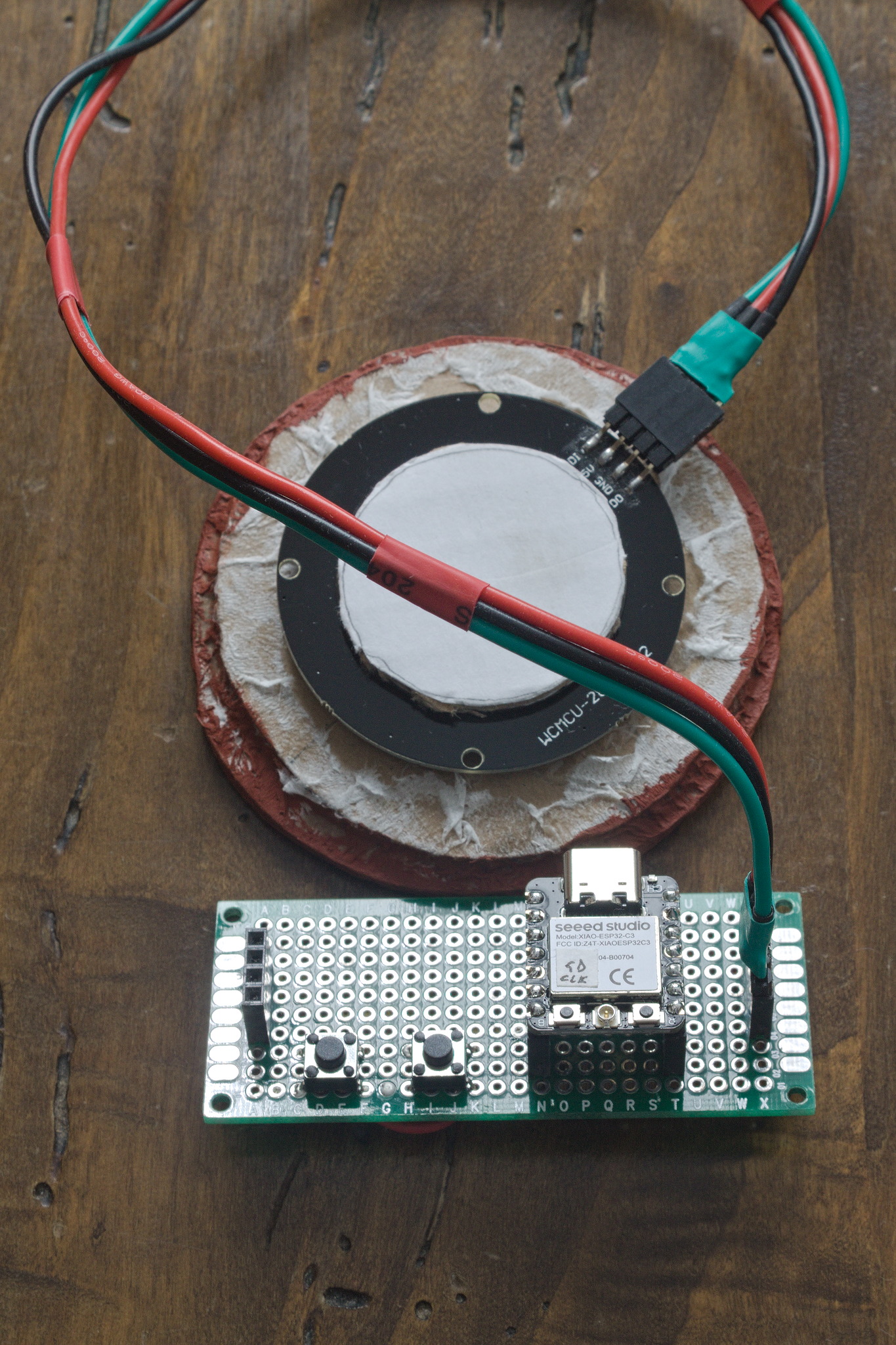
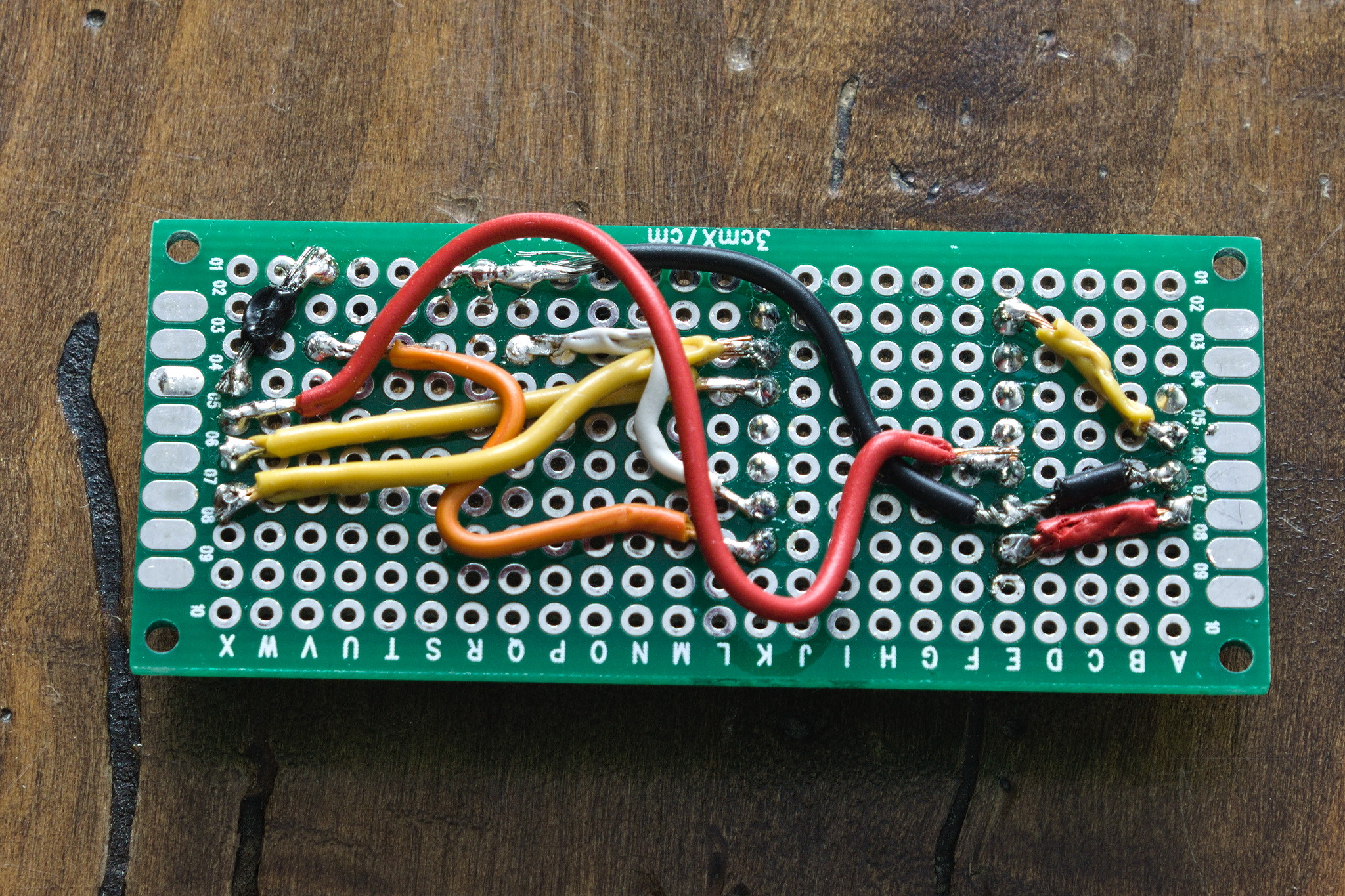
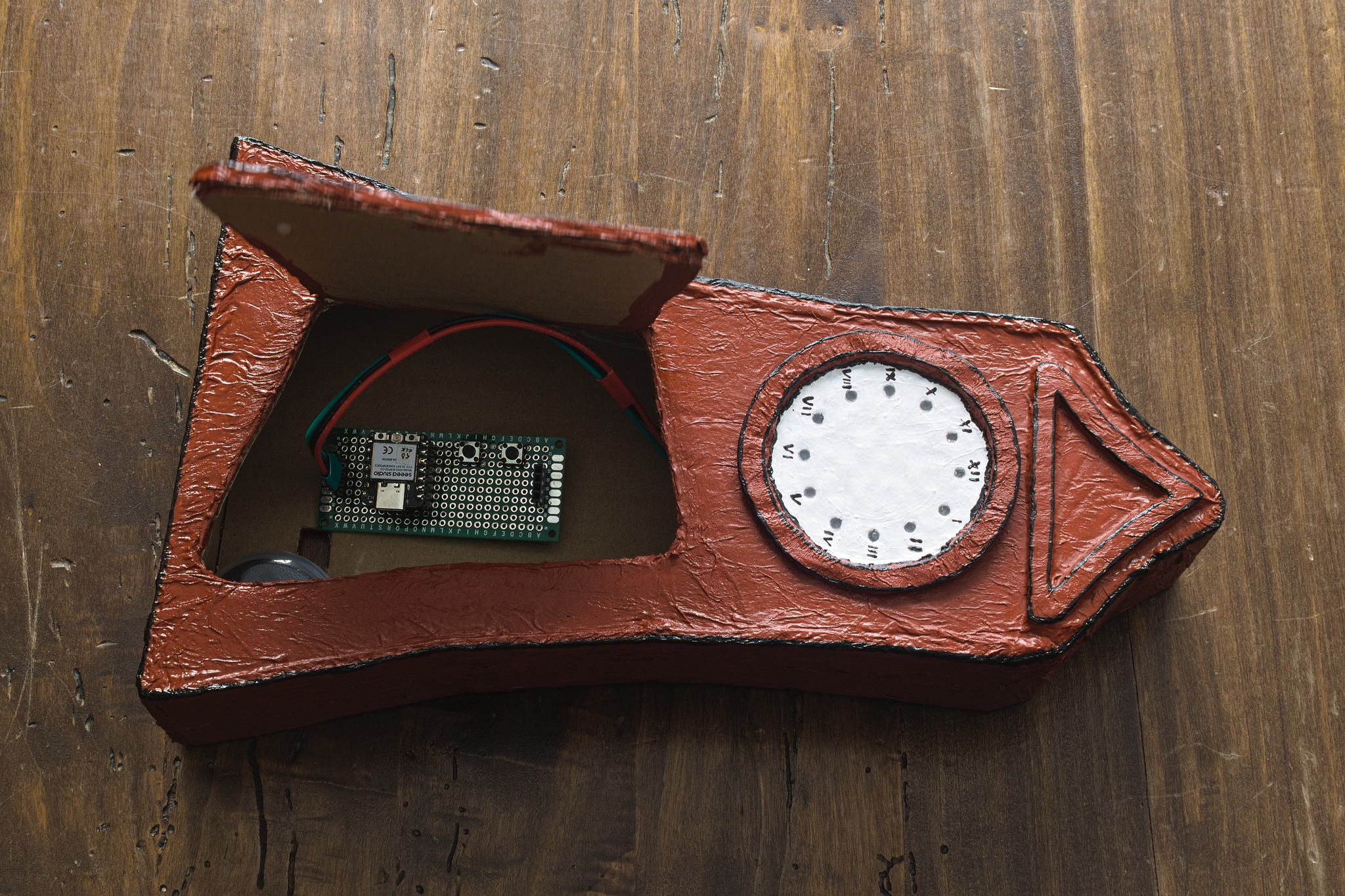
  1. I think that CircuitPython on the ESP32-C3-DevKit-Lipo only requires fixing two PIN definitions in the files for a very similar board and a recompile, but the latter part looks like a PITA and I haven t committed to it.
  2. to make room for other crafting supplies for other projects, of course.
  3. yes, it will be blogged! unless it fails in a catastrophic way and gets buried under a layer of litter to forget about it. :D

31 August 2026

Russ Allbery: Review: The Hands of the Emperor

Review: The Hands of the Emperor, by Victoria Goddard
Series: Lays of the Hearth-Fire #1
Publisher: Underhill Books
Copyright: January 2019
ISBN: 1-988908-15-9
Format: Kindle
Pages: 739
The Hands of the Emperor is a self-published political fantasy novel. It's the recommended first book (although not the first published book) in a complicated set of interrelated series. I was not able to definitively confirm that Underhill Books is Goddard's self-publishing press name, but the press does not appear to have an Internet presence apart from Goddard's books and her books appear to be using the standard self-publishing channels. Cliopher Mdang is the personal secretary of the last emperor of Astandalas, the magical heart of Zunidh, a man worshiped as a god. The emperor's word is absolute, his magic supports the health of the entire world, and he cannot be physically touched without risking physical damage and severe political and religious punishment. Cliopher is one of the emperor's closest associates, but the distance between them is still vast. It therefore represents a terrifying and dangerous breach of etiquette for him to suggest the emperor may enjoy a vacation on a tropical island near Cliopher's remote home. The emperor's acceptance of the invitation is even more startling. The emperor has opinions about his life as the emperor that no one had guessed. Cliopher has not assimilated as completely into the bureaucratic machinery of the empire as it first may appear. And Cliopher's family have vastly misunderstood the nature of his role in the emperor's government. I find the marketing blurb for this book unfortunate since, at least to me, the emphasis on physical touch and intimacy implies that The Hands of the Emperor is a romance novel or at least has significant romantic elements. I've been aware of this book for years but put off reading it because I wasn't quite in the mood for that story. This is not a romance novel; there is no romance in this book whatsoever. It is a political fantasy, both in the sense that it is set in a secondary fantasy world with magic and (apparently) some form of interplanetary travel, and in the sense that it is a fantasy of governance. When I say that this book blew up in certain corners of the Internet during the pandemic, I think you will still underestimate the passion of its advocates. I heard about this book constantly, in a way that reminded me of Kushiel's Dart and the time when fans of Jacqueline Carey would bring her up in every fantasy conversation, or when we created a Usenet newsgroup for The Wheel of Time mostly to get the voluminous conversations off of the regular SFF newsgroup. I'm one of those mildly contrarian people for whom that degree of enthusiasm is a little off-putting, which is another reason why I resisted buying a copy for years and only read it in 2026. It's delightful, although also a bit embarrassing, when the book everyone was in love with turns out to be just as good as everyone said it was. I adore stories about friendship, and this is one of the best stories about friendship that I've ever read. It is a very, very slow burn, but I also thought the first three quarters of the book was exquisitely paced. There were long sections where not very much was happening, and yet I couldn't put the book down because there was so much subtle character work just beneath the surface. Almost all of the novel is told in tight third person from Cliopher's perspective, and I thought that was an excellent choice. Neither Cliopher nor the narrator comment on things that Cliopher finds obvious, which is both immersive and critical to the pacing. There are discoveries for the reader throughout the book, the sort of discoveries that make pieces fit together satisfyingly in retrospect, and the reader stays sufficiently ahead of the misunderstandings of Cliopher's friends and family that one also gets the joy of watching other people discover things that one figured out a hundred pages earlier. It helps that I truly liked nearly everyone in this book. There are no real villains, only a few supporting characters whose role is to be irritating or corrupt. If you're looking for a lot of conflict and drama, you may want to save this book for a different mood, but if you're in the mood for a varied collection of fundamentally good characters working methodically through the complexities and obstacles of politics and social systems to improve the world, there are few books I would recommend more. Goddard achieves one of the hardest tricks of slow burns: steady forward progress that does not rely on reversals, misunderstandings, or the friendship equivalent of the third-act breakup. This book spends 700 pages building towards a climax that managed to be worthy of all 700 pages without ever annoying me with artificial obstacles, and that's quite a feat. I've not said much about the details of the plot. There is one it's not just character work but I think this book benefits immensely from going in as blind as possible. I found the twists and turns and growing revelations so deeply satisfying that I don't want to rob any other reader of the experience. The fantasy world-building is intriguing but a bit unsatisfying because it is so unexplained. We get a few details of the magic system, but since Cliopher has no magic, he isn't that interested in the details. There is a catastrophic magical event in the world background, and we learn some of the details of its practical effects, but the nature of the world before the cataclysm is so obvious to the characters that it's never explained. I'm not even certain that this civilization is interplanetary; that feels like the implication of how characters talk about multiple worlds, but the method of travel is left entirely undefined. This might be frustrating to some genre readers, but I personally enjoy books where the world-building is a bit mysterious. It's a good reason to read more of Goddard's books set in the same universe. This was my favorite of the books I've read so far this year, but I do have one caution and a couple of caveats. The caution is that Cliopher comes from an island culture based heavily on (I think) Polynesian cultures. That culture is very central to the story and is treated with considerable respect, but I still get a bit nervous when a Canadian author from Nova Scotia with an academic background in European medieval studies writes a story focused this deeply on a non-European culture. Nothing about her portrayal seemed off to me (although there is a very clunky and ham-handed scene about a different native culture that worries me), and for all I know she has family background or other connections to the culture she is borrowing from, but it's possible I missed serious problems. The flip side of that caution is that I'm delighted to see a fantasy author drawing on a non-European culture, and I thought the clash of cultures was very well-handled. The first caveat is that the story is very focused on good governance, but both the process and the details of that governance are not going to satisfy someone reading primarily for the politics. The policies and reforms are very standard 21st century progressive material that felt a bit out of place in a quasi-medieval world with magic and airships. Their implementation is not the point of the story, and is therefore heavily backgrounded, but that means Goddard barely mentions the inevitable practical implementation difficulties and does not discuss how they're overcome. The world structure also means that Goddard can make use of the favorite cheat of political reformers in fiction: Absolute monarchy lets you enact a political agenda without having to do the hard and frustrating work of persuasion or political (or actual) warfare. This objection is not entirely fair because we do get some memorable scenes of persuasion, but the political portion of the plot is unrealistically devoid of setbacks or resistance that goes beyond token arguments. Whether this will bother you will depend heavily on what parts of the book you'd rather focus on. I can see why this was such a popular pandemic read: The Hands of the Emperor is focused tightly on the joy of competent people fixing things and does not focus on the arguments, division, or polarization. The heart of the book is the friendship and characterization of some deeply admirable people, and the political reform is incidental background material. I suspect this is the right choice for readers who aren't political junkies, but I kept having the niggling objection that the politics felt a bit too pat and simplistic. Goddard stressed that the characters were investing considerable effort, but even still, it is not this easy to change the direction of a political system and idealistic plans usually do not work out this neatly. The second caveat is that, as previously mentioned, I thought the pacing was excellent for about three quarters of the book. Goddard is building towards a grand climax, and I think she built a little too much and tried to make the climax a bit too grand and risked over-egging the pudding. That made the payoff feel a bit belabored to me. I still enjoyed it, and parts of it are wonderfully emotional, but I think the ending might have been stronger if Goddard had dialed Cliopher back just a little and tightened up the climax a touch. That said, this book fully commits to being a sprawling slow burn and that's part of its appeal, so it's probably better for Goddard to err in that direction than it would have been to cut short the denouement. This is one of those books that I'm not sure would exist without self-publishing. It's a little too long, a little too political in the wrong ways, a little too devoid of the typical sorts of conflicts expected in a fantasy book, and too determined to be its own peculiar thing. I think it would scare off publishers. Unlike some self-published books, though, I didn't notice any obvious editing flaws or lack of polish. It's one of those glorious novels that is so very much its own type of story that it provides an experience that would be hard to replicate with another book. I was so deeply satisfied by this book. It's a wish-fulfillment political fantasy full of diligent restraint and competence porn, so you have to be in the mood for that. This is not the book to read when you're feeling cynical, or are in the mood for action and high drama. But if you're in the mood for a long, slow, open-hearted story of friendship that offers the fantasy of giving truly good people enough power to be effective, I highly recommend this one. Followed in the direct sequel sense by At the Feet of the Sun, but there is a very complex story progression in this world that I think I'd have to read all the other books to understand. This was such a satisfying and complete experience that I'm not in a hurry to figure out which Goddard book to read next, but I'm sure I'll be returning to this world at some point. Rating: 9 out of 10

29 August 2026

Joey Hess: Debian and the sirens

Thirty years ago I became a Debian developer. Twelve years ago I left the project. I left because it seemed that the Debian ship had become too slow to turn, too barnacled with a series of individually OK decisions that each added a little bit of friction and a little less flexability. That made Debian strongly what it is, but prevented it from fruitfully exploring the vast possibility space of what it could be. Debian will probably resolve today to allow LLM use in Debian development. I'm writing before the vote results are in, but will only post this afterwards. (Update: as expected) It's not my place any longer to try to steer the ship. But I'm still a passenger and I still have opinions, and I still pass by well-worn parts of the rigging that I put up decades ago, and remember what I was trying to accomplish back then. When I think about LLMs in Debian development, I mostly think about debhelper and what it accomplished. The debian/rules files back when I joined the project were long and complex, full of weird boilerplate, and often you'd copy one and modify it to try to get something that could build a package without too much work. Debhelper first regularized the boilerplate, so packages had rules files that were a succession of dh_ commands, and then it scapped almost all of the boilerplate, reducing the files to the minimum possible. What was left was 3 lines of unncessary boilerplate, there only to satisfy a legalistic reading of a policy document. Changing that to eliminate the boilerplate was already impossible, even though the actual benefit would have been large over the many thousands of packages in the distribution. What LLMs in Debian development will do, I fear, is eliminate any incentive to scrap boilerplate or reform policies that require a lot of other senseless human effort. If I had had access to LLMs 30 years ago, I might have just had them generate the rules files, replate with complexity. So they will make Debian even more firmly what it is, and ever less likely to explore what it could become. Unfortunately, one of the things that Debian is, is almost unable to manage packaging modern dependency trees. While more recent distributions like Guix can recursively import dependencies from a dozen programming languages' package repositories, with a result that is generally acceptable to add to the distribution, Debian's policies don't make that very possible for a progam to accomplish. Perhaps some will use LLMs to do that. If they succeeed, Debian will become dependent on proprietary software for development, while still needing people in the loop, doing even less appealing scut-work. I could speak of other harms, but that alone is enough that I'm sure that, if I had not left the project twelve years ago, I would be leaving it soon. As a passenger, I imagine I'll spend time aboard still from time to time, but it's certainly time to hop off in different places and look around and relish the different ways. I lost a parent yesterday, and I'm trying hard not to think of the results today as having lost a child, though I spent 18 years helping Debian grow up. That would be too unbearably painful. I respect that Debian is navigating a choice that may have no right answer. Whichever particular compromise is arrived at today, it will still be up to individuals to make choices about what they do and accept. Debian has always been more than the sum of its policies, not just a ship, but a crew. I will always love you.

28 August 2026

Otto Kek l inen: The growing divide between AI hype and software engineering reality

Featured image of post The growing divide between AI hype and software engineering realityIt is widely accepted that there is an AI bubble in the financial markets at the moment. The moderate opinion is however that LLMs are constantly improving and will eventually take over more and more tasks from humans and increase productivity. But are LLMs actually getting smarter, or just better at fooling us? There is a growing faction of technical experts that argue that LLMs are actually so bad for real progress, that they are banning their use and requiring human-only work to ensure quality and efficient use of humans time. A recent review of AI policies of 120 open source projects by Rakshit Yadav shows that 37 chose to have a total AI ban. In the Linux kernel AI-assisted contributions are allowed, but the LLM used needs to be attributed for transparency, while projects like GCC, QEMU, SDL, Gentoo, Zig and Ghostty have adopted policies to reject all AI-assisted contributions. There are also development platforms such as Codeberg and Sourcehut and app stores like Flathub that have banned AI use to generate software, documentation, bug reports, review comments and basically anything that is intended for humans to read. The projects that allow AI use typically still require that there must be a human-in-the-loop and the submitter must have read and filtered everything the LLM spits out before another human is exposed to it, in an effort to contain the spread of AI slop. Right now, the Linux distribution Debian is having a vote among its developers on whether AI should be allowed or banned for use to contribute to Debian. One of the proposals on the ballot is a total ban of AI for code, documentation, translations, bug reports and more. The initial reaction from most people is astonishment why don t these techies want to use the latest and greatest technology mankind has produced so far? Is it that they don t want Debian to improve faster with the help of AI? Or is it actually so that LLMs are a scam and incapable of being truly useful for Debian? These people are distinguished experts in their own field, and certainly not stupid, so it is worth pausing to understand why they are proposing AI banning policies. Also, keep in mind that the AI datacenters themselves run on Debian or other Linux-based systems. All the open source software in the world has been fed to LLMs and software development is one of the main use cases for AI currently. So why is it that the maintainers of many open source projects don t want to receive LLM-assisted contributions, despite the LLMs basically all running on top of those same software stacks and having been trained on how to do software development using the very same open source software codebases?

Why LLMs are so deceptive The output of an LLM often looks very compelling, professional and correct. Humans have evolved to trust or distrust new information based on easy to detect secondary factors like what authority the speaker holds, or how confidently and eloquently the message is conveyed. Humans are however very bad at fact-checking and cross-referencing new information, as it requires a lot of effort, and humans like saving energy and being as lazy as possible.

Information asymmetry The less you know about something, the easier it is to fool you on that topic. Nobel prizes in economics have been given in for research on how information asymmetry distorts markets and leads to suboptimal outcomes. In the field of software engineering we have now witnessed a flood of aspiring software developers using AI to create software that looks like it might work, but that is actually full of flaws. These people are well-intended, but they simply lack the expertise to understand what they are actually doing, and don t possess the necessary judgement to decide when an LLM spits out something truly useful and when it is creating mostly garbage. This asymmetry in expertise I think explains the majority of the conflict currently witnessed in open source projects the senior developers are flooded with requests to review code that is bad and a waste of time for everyone involved, while availability of AI grows the pool of people who could contribute and create more code slop at an ever-increasing speed. The information asymmetry could to some degree be evened out if seniors teach juniors to do software engineering well, but it is of course not feasible to quickly mass educate everyone. Also, it seems that many don t want to learn but instead expect to have all understanding outsourced to LLMs. Many seniors have noticed this and have stopped teaching juniors as the seniors don t like the feeling of having their time wasted by teaching people who don t want to learn. Juniors probably all understand that it would be better to learn to design and write software yourself, but using LLMs just feels too easy. I can fully relate to why people choose to take the path of least resistance. Unfortunately, that path often leads to a dead end.

Humans fall too easily for anthropomorphism The human brain is wired to think that inanimate objects are alive and have feelings. Small children talk to their stuffed animals as if they were real, and lots of adults experience feelings of things happening in their surroundings due to some acts of gods or elves being angry or whatever. When we see a machine writing just like a human, or even more convincingly hear it talk and respond to our talk like a living thing, our brain automatically starts assuming it is a living thing with intelligence and feelings. The fact that these creatures live in the abstract cloud and only appear through a portal we hold in our palm and behave in a way that was designed for maximum engagement makes the illusion even stronger. I recommend people try out running LLMs locally on their laptop to see the raw thing spitting out tokens and have some of the illusion shattered. Also stop saying please to an LLM. It does not have any feelings.

Understanding temperature In my experience understanding the concept of temperature in LLMs helps see why an LLM might confidently generate a plausible-looking but totally wrong code change. The large language models are statistical machines that, based on the input (previous tokens) to the neural network, try to predict what to output (next token). When running an LLM, if the temperature is configured to be zero, the output is very predictable and always follows the paths of the strongest connections (a.k.a. weights) between nodes and layers of the neural network. Unlike in living creatures where the brain learns and changes all the time, the weights of an LLM can only change during training. When an LLM is in normal use (during inference, generating next tokens) the weights are fixed, and if temperature is zero, the answer to a specific question will always be exactly the same. This is of course a bit boring and too machine-like, so typically LLMs have a bit of temperature set, which introduces random variation in what connections the neural network traverses. Again, I recommend people try running small LLMs locally where temperature and other settings are fully exposed and configurable to see this themselves. It is a good antidote to falling for the illusion that LLMs would actually be intelligent.

Why benchmarks don t tell the whole story If LLMs continue to produce so much garbage, why are benchmarks showing that they are constantly improving? AI models are indeed improving all the time. For example the CAIS AI dashboard visualizes how frontier models have evolved in the past few years. However, the best models still have a pass rate of only about 50% on the Humanity s Last Exam. On SWE-bench the best model today resolves just under 77%. That means there is a significant number of times when the AI is wrong. This matches my personal experiences, and the renowned Greg Kroah-Hartman recently wrote on the Linux developers mailing list that even with the best of the current and next generation tools, at least 1/3 of the results they generate are flat out wrong or harmful . When generating cat videos the error rate does not matter, but in engineering, things absolutely must be correct. Sure, humans also make mistakes, but well educated and properly incentivized humans are so much more capable than LLMs in many regards. We can achieve complex things that work reliably, such as operating worldwide commercial air traffic without planes falling down every day. There are currently a lot of humans who are incentivized to maintain the narrative that general artificial intelligence is coming soon and will take over everything. In fact, the whole financial system is currently skewed towards such a vision because the promise of falling labour costs and increased profits and monopolistic control of everything attracts capital like nothing before. In this environment we need to remember that machines and economic systems are ultimately servants of humans, and not the other way around.

It s just a tool LLMs are not a scam, but a useful tool and technology that has its uses. But the idea that AI has or will surpass humans any time soon in either capabilities or efficiency is simply not true, and we should listen to the people who created humanity s so far most complex systems (computers and software), who are saying that LLMs are in many cases so bad, that it might be better to ban them in certain places completely for the time being than to waste far more valuable human time on reading the text and code they generate. The time asymmetry is not a new phenomenon as there has been various script kiddies for a long time. As an example, a person running a memory leak scanner without understanding the results and spending 10 minutes to file a bug report could force an open soruce maintainer to spend an hour on proving and explaining that the finding is false. What is new is how much the AI users blindly trust the outputs they get, and open source is uniquely vulnerable as there are no managers protecting developers use of time.

What I do, recommend, and expect to see in the next stages I am using AI tools daily, and constantly experimenting with new models and new ways to use them. Sometimes they work, and often they don t. Sometimes looping AI on itself can make it fix its own errors, but sometimes it just gets derailed and will never arrive at the correct solution. When an LLM fails to make a calendar entry for the right time based on reading my email it is easy for me to spot that it is wrong. I try to avoid using LLMs for anything where I can t exercise judgement myself on whether the result was correct or not. I also really hope that other people would not send me anything where their own effort was less than the effort I have to make reading and understanding it. This principle is not new many have heard the requirement that reading code must require less effort than what it took to write it. I have always kept a high bar on software code and asked fellow developers to make sure their code is well structured, easy to follow and documented. LLMs unfortunately make it easier for people to cheat in this regard, but if cheating is easier, maybe the punishment and deterrence needs to be higher now too. Now with many open source projects adopting policies that put guardrails on AI use, I expect we will soon start witnessing cases where the policies are enforced and it will be interesting to see how violations are judged. As a society we might also need to develop new social standards and rules in what is acceptable treatment of other humans in human-to-machine interactions, and perhaps also new standards in showing what humans are responsible for what machine as the machines start acting more and more independently. I encourage people to take part in these discussions, and in case of doubt, err on the side that favors real human interactions. Contrary to what many business people seem to think, and even though I am in general a techno-optimist myself, I don t feel there is any need to rush with AI adoption.

27 August 2026

Gunnar Wolf: As far as LLMs go in Debian, I think that 936241857

I believe that, in the context of Debian voting, we are better off when we know the opinion of our peers, however, since the 2022-001 vote, it is no longer the case. Still, some DDs have disclosed the way they are voting on the 2026-002 General Resolution currently in progress, regarding LLM usage in Debian. So, here goes my vote and reasoning as briefly as possible. This is the ballot I sent to devotee, the Debian Vote Engine:
-=-=-=-=-=- Don't Delete Anything Between These Lines =-=-=-=-=-=-=-=-
d69f9187-ed2f-40b6-a2eb-4211d3f84d86
[9] Choice 1: Ban LLM contributions from Debian via Social Contract
[3] Choice 2: Allow AI-Assisted Contributions with conditions
[6] Choice 3: Reject LLMs as far as practical, update Code of Conduct
[2] Choice 4: Accept AI contributions for Debian specific work
[4] Choice 5: Responsible Use of Generative AI
[1] Choice 6: A cautious approach to generative AI
[8] Choice 7: Debian is created by humans
[5] Choice 8: Avoid the use of LLM: climate destruction is a deal breaker
[7] Choice 9: None of the above
-=-=-=-=-=- Don't Delete Anything Between These Lines =-=-=-=-=-=-=-=-
This is the first time I can recall I delay my voting until after receiving the final call for votes (the vote will be over two days from now). I had some participation in the discussion, so I guess my position will be of no big surprise to anybody. I was also a seconder for choices D and F (4 and 6 in the vote text). This does not necessarily mean I believe they are the best (although I did rank them as 2 and 1, meaning I do): sometimes you agree a given text needs to be in the ballot, and second it even though you don t intend to vote for it. LLM? Ranking this ballot was a mess due to the complex array of options it encodes. I warmly thank Lucas Nussbaum for coming up with the LLM usage in Debian: ballot option comparison (URL shown with my particular ballot ordering). How do you read a complex Debian ballot like this one? I rank with [1] my favorite option, [2] for the next one, etc. We can encode options to be tied (i.e. setting more than options to the same value), and we can implicitly push options to the worst position by leaving them blank (so, with[ ]); I chose not to do any of those. What were my voting guidelines? First, I don t want anything banning or that threatens with disciplinary action, so I push them below the special none of the above marker. Second Some time ago I published a review in my blog (and in Computing Reviews) about the unfeasibility and unfairness of detecting LLM output on students assignments. I strongly believe we ought to appeal to the human responsibility and professionalism in all Debian contributors. This is the reason I proposed this amendment paragraph, that was accepted in choice F (6), which I ranked as my favorite:
The Debian project has always recognized the commitment and
professionalism of its members. All contributions are under the
responsibility of the Debian Contributor making it, no matter the
technology they have behind. We trust all Debian Developers,
Maintainers and Contributors will continue to uphold the high quality
values that have distinguished our project from its onset.
Other than that I do not consider myself to be in any way an LLM fanboy nor anything like that. I distrust and dislike the excessive use of this technology, and continue to warn about the dangers and bad points of its abuse. But in my day-to-day professional work, I am also starting to rely on it for some tasks. I recognize it needs a lot of human oversight and lets call it hand-holding to produce anything worth it, at least in my experience. But I do benefit from it and always disclose its use to people who might be affected by it. I would like Debian to adopt such a stance. Of course, I recgnize proposal H/8 as important (Avoid the use of LLM: climate destruction is a deal breaker). Some people have argued it s not bad at all. I do not buy such claims: LLMs are f*cking expensive to train. But training can be seen as a once-per-model cost, and fine-tuning a good model to be run locally can be really worth it. It still pains me somewhat, but I cannot push this option higher than its #5 position in my list.

26 August 2026

Rapha&#235;l Hertzog: Debian s General Resolution on AI and LLM

As a Debian developer, I have had to cast a vote for the General Resolution named LLM usage in Debian (progress report here). This was not an easy task for me

It s a good thing that the vote is secret so that people are not scared of voting according to their own beliefs. I have Debian friends on the whole spectrum of opinions that are represented here, and I hesitated twice on sharing my own thoughts for fear of alienating my relationship with them. But in the end, we all make efforts to respect the opinions of those who are not thinking like us, and it s precisely that willingness to work together towards a solution that is acceptable by the majority that makes Debian so strong. So here s the train of thoughts that I followed to cast my vote.

The difficulty for me was to reconcile the political statement that I want to make and my desire for this vote to not be (too) divisive for the Debian community, and to make sure we are not putting off newcomers with choices that might be hard to stand by in the long term.

So let s be clear : if I had a magical wand to make AI and LLM disappear, I would use it for that purpose, since at this point in time I don t believe that the benefits outweigh the costs that the AI race is inflicting on us. If I were a political decision-maker, I would forbid the construction of new data centers unless they also build renewable energy infrastructure to cover for their additional energy consumption. I would also legislate so that AI companies have to document what material they used to train their models, and I would forbid scraping for that purpose, and build ways for those companies to buy copies of properly-sourced training data. That is to say, I don t like the way LLM are built by the players in that market, I m pretty scared of the ecological impact of what those players are doing, and I m certainly worried about the long term effect that LLM will have on society as a whole.

Nevertheless what brought me to Debian is the ability to experiment and contribute to something useful with cool technologies, and as a computer scientist, the potential of LLM done right is hard to ignore. Given what we have seen already, I expect that LLM will empower (a part of) the next generation to learn IT, computing and even Debian packaging. Completely refusing the use of LLM is likely to make it harder for us to attract new contributors. In fact, we have already seen people inside Debian that would likely stop contributing if they are now forbidden to use LLM. I know there are likely others that will quit Debian if we accept it too, but I hope we can find a middle-ground where such persons can decide that LLM are not welcome in the small corner of Debian that they are in charge of

In the end, I decided that answering clearly the question Shall we accept LLM contributions ? was more important than making the political statement about the current state of affairs in the AI landscape, both because I believe that Debian statements have a negligible impact on policy-makers, and because historically Debian has grown by staying close to technical excellence and relatively far from politics, except when it comes to the way we handle people. And as much as I care about climate change, I don t see how bringing this up in the context of a Debian statement is helping its cause.

More concretely, it gives the following ranking (in decreasing order of importance):

I don t know what option will win, but assuming that LLM-assisted contributions are allowed, I believe that it would be helpful to have further statements to clarify a few things:

25 August 2026

Antoine Beaupr : A more nuanced view of LLMs

Also in this series:
After ranting and railing about LLMs or "AI" as the optimists (or accelerationists?) call it, I figured it might be important to be a little more honest about my use of LLMs and how I think about it more practically in the world.

The Debian vote context This is not a coming out. I am not using LLMs on a daily basis, and this blog is, again, written out of my cold dead hands in a dying world, with over-engineered hardware and (to a certain extent, hi Emacs!) software, powered by 100% green energy built on stolen land. There is a vote going on in Debian. If you're unfamiliar with it, you can catch up at LWN. So far I've essentially said "LLM is bad" which is not a very balanced or useful opinion. Obviously, people are using LLMs, sometimes unknowing or unwillingly, and we need to take that into account. Furthermore, there has been many different blog posts on Debian planet about this. Some that I found balanced, good summaries, even if I didn't fully agree with them, at least some did the basic civil service of being short. But others were just not only Wrong but also so long that I couldn't finish that I just had to write something.1 This is not an explanation of the ballots, nor how I will vote. This vote is Debian's failure of framing that debate in a reasonable way: we have 8 options on the ballot with many duplicates. We have failed to do the hard work of summarizing and aggregating options into a meaningful set. I doubt the final vote will represent a readable position we can rally around. I have not read the two months of debates on the topic either. Normally, before voting, I take a cursory look at the debate to see points of view I might have missed. But in this case, it will just make me sad, add noise, and I'm already pretty sure on where I stand on this. So let me describe how I use LLMs and how I think they fit in our work, as computer engineers and hobbyists.

My LLM use

Debian Packaging An astute reader has pointed out that I maintain a package in Debian made to use Anthropic. It's actually multiple packages: As I previously explained in response, I am not entirely comfortable with this work: it's a compromise. In fact, I first uploaded llm to the contrib section of Debian, where we keep software that depends on other non-free software, but I was told that, since yt-dlp was in main, llm belonged there as well. So I moved it to main, alongside similarly controversial tools like llama.cpp or the python-openai library.

OpenAI and Anthropic usage An important part of my work is technology watch. I keep tabs on thousands of (new and old) software projects, follow news, and generally try to keep my skills up to date. It's a pretty impossible race, especially as I grow older, but I still think I'm doing the right choices in my job. Testing large language models is part of that work. At first, I was using ChatGPT's web interface, but it was annoying to copy-paste things into a browser, so I looked for different interfaces. For a while I tried gptel, a "simple, extensible LLM client for Emacs" but I found it kind of terrifying. Giving a LLM control over an Emacs buffer seems like a security nightmare, so I stopped doing that. So I use the llm command-line tool to talk to Anthropic's API. I started that in the summer of 2025, when I bought 20$USD of API credits. Before that, I paid for a ChatGPT subscription and then OpenAI credits, which expired and sent me over to Anthropic, which seemed then to have better ethics. As it turns out, Anthropic is also happy to work for the US military (which is a big red line for me). Anthropic also won't let you talk about the genocide in Gaza, it is destroying physical books, and is blackmailing us to use their product for security coverage. Needless to say, Anthropic and "Claude" are not my friends, but they seem like the lesser evil in current "frontier models". So I have renewed, a couple of weeks ago, another 20$USD of API credits with Anthropic.

Actual prompts and responses So what does 20$ give you at Anthropic anyways? What am I using LLMs for and how? The neat thing with llm is that everything is logged in a sqlite database, so there are some answers that are easy to get:
> llm logs status
Logging is ON for all prompts
Found log database at /home/anarcat/.config/io.datasette.llm/logs.db
Number of threads logged:   7
Number of turns logged:     12
Number of legacy conversations: 543
Number of legacy responses: 970
Database file size:         9.61MB
That is 10MB of logs, with about a thousand prompts. My logs go back to 2024-03-07, a little over two years ago, and include a mix of Anthropic and OpenAI responses. I used it more in 2024 than 2025, and if the trend continues, I will have used it less in 2026 again:
> llm logs list -n 0  --json   jq -r .[].datetime_utc   sed 's/-.*//'   sort   uniq -c 
    527 2024
    357 2025
     98 2026
It looks like about 10 prompts per month right now, down from a peak of about 60 per month in 2024. It's pretty difficult to analyze those actual logs to get more patterns and I won't run the prompts through a model again to process them.

How I'm using models now At first, I was using it partly for benchmarking model's capabilities, like Simon Willison does with his pelicans, clearly not trusting its output. But I was impressed by the capacities of the Claude Opus 4.5 model when it wrote this script in January. Impressed, but also scared: it's the first time I felt I could delegate the entirety of my programming to a model. Just run the code, if it works, it works, right? So what do I use it now? As an example, here are the 10 last prompts in my history:
  1. there is now Claude 5, and a fable model, maybe you know about it?
  2. impress me
  3. not impressive, i already know all of this
  4. chat
  5. in postfix, i have a 300k mailing that happens regularly here. normally, it delivers within about...
  6. is there a way i could have drained the maildrop queue faster without removing the milter?
  7. the problem was that rspamd was timing out on the FUZZY_CALLBACK check. how do i disable that?
  8. how do i disable all spam checks? i just want rspamd to add dkim signatures
  9. how do the default_destination_concurrency_limit and initial_destination_concurrency settings int...
  10. mic check
The first one was me trying to confirm which model I am using, which is not always obvious when going through the whole llm stack I've been using. The following two are an attempt at seeing what the model is capable of and I was "not impressed", to which Claude answered that I have a "high bar", which, fair enough. The chat is me failing to use a command line, which shows that perhaps I need to readjust that "high bar", again. The next five are a rather embarrassing debacle in a large Postfix mailing that went sideways, and where I couldn't find an actual Postfix expert of my level to help. The fabled Claude Fable 5 answered rather correctly, but dangerously, that I could empty the queue by disabling the non_smtpd_milters. What Fable (and myself) did not realize is that the milter was also adding DKIM signatures, so while the mailing was expedited, it was done without those precious signatures, which got us promptly blocked at Gmail. We have recovered since, and, thanks to the model and reading the Postfix manual for the hundredth time, that pickup(8) is single-threaded and that we needed to review the architecture of that mailing (and our spam filters) a bit. Many tickets ensued. The last one is a test I did to make sure my last uploads of llm-anthropic and its dependency worked correctly.
Note that the above excludes 5 questions I asked Anthropic while writing this article, where I asked for synonyms and "what nanometer scale are arduino processors built from? how is an arduino CPU printed?", a question which Wikipedia furiously evades providing a good answer.
Those prompts are pretty typical of my LLM use: I'm testing the models to see if they work at all, but also, out of desperation, I fire off a prompt after I fire off questions to colleagues or search engines (in that order). It's often weird edge cases like the Prometheus query language, Python's matplotlib, LaTeX, Elisp, optimizations, and so on. I use models for translation a lot. Being fully bilingual, it is common for me to think of a word in French or English and fail to find exactly the right word for that in the other language. Models help with that, and are also useful to find synonyms. Those are low-token uses that seem pretty innocuous to me, but I realize the irony of this after writing about the tower of Babel.

What I am not using models for I am not using models to write prose. I am not using models to read prose. If it's generated with LLMs, I stop reading. I am not using models to write code, with the exception of that single Python script above. I am generally not using models to review code, with exceptions. If I get stuck on a hard problem, I might feed a piece of code to the model. I repeatedly fed asncounter into Claude to try to fix a performance regression I had introduced. It found micro-optimizations that taught me a thing or two about Python's internal implementations, but overall, it was mostly a waste of time. This was in June 2025, so perhaps now models would fare better. I have not tried again. I am not using LLMs to do Debian packaging. When I can, I manually review the diffs of packages I upload into Debian, still, by hand. I do this for the reasons outlined in The Four Horsemen of the LLM Apocalypse, because I refuse to be complicit in the:
  1. aggressive and illegal scraping of the servers I steward
  2. world-wide computer hardware shortage (making it, by the way, nearly impossible to run presumably clean local models) and the attack on our job conditions (also discussed in The people vs the AI overlords)
  3. death of copyright and free software
  4. complication and enshifitication of everything, and the destruction of our communities
  5. the imperialist Nerd Reich that wants to take over the world
Like I reluctantly use Intel computers, I do fire off a prompt. But I still hold on to the dream that we can build communities of practice that hold human knowledge collectively and not offload that as a utility to some megalomaniac billionaire.

Their LLM use I am forced into So that's me. Clearly, I'm going against the grain here. Everywhere I look, I see LLM-generated code and projects. Slop and botnets have flooded the web. I use Wadamesh, clearly vibe-coded, because it's the best graphical interface for MeshCore that runs on portable devices. I wish it was made by a human, in a community I could participate in, but it isn't, and I don't. I package the above llm toolset, which is more and more vibe-coded, but I still review the diffs. And I have to say: I trust Simon here. The code is verbose as hell, feels overengineered, and llm feels slow, but it generally works, and Simon is still at the gate. The Anthropic SDK is another thing entirely. The 0.91.0 to 0.120 upload, for example, was nuts:
 806 files changed, 72281 insertions(+), 1478 deletions(-)
I explicitly did not review that entire diff. It feels like there's a lot of garbage there to just have a shim between a proprietary API and Python. But this is the hand I've been dealt.

Larger projects LLM use LLMs are being used in the Linux kernel, Firefox, rsync, Rust, and other places. I don't feel good about this, particularly in Rust, but they at least made a decent policy. I am glad GCC made a policy against LLM contributions and I support the human Emacs project. We need to have a set of foundational tools that are "clean" in the sense that they are built upon a community of people that understand how they are built. Maybe that's naive or even impossible. The Linux kernel and GCC, in particular, are massive projects that have long grown past the scale of a single person's understanding. But the theory was that a community of humans can understand collectively. Now we seem to be throwing up our hands and giving up on that community. That LLMs will just fix the problem, whatever it is. But we're all just one rug pull away from being completely incapable of managing those projects. The argument there is that we'll just switch to local models, but no one is actually doing that. All I see is people use local models as a corner case (for privacy) or as in theory, but in reality, everyone uses the centralized frontier models right now. We just can't fallback. We're in the same situation we were, a decade or two ago, when Microsoft decided it would kill free office alternatives by making Office free for non-profits. It worked: thousands, if not millions of schools, community groups and individuals stopped looking for alternatives (including free software but also "piracy") for Office and embraced what seemed like a generous offer. Now Microsoft pulled the plug and Over 170,000 Nonprofits Lost All Their Data. I'm afraid the rug pull on LLMs will be much worse: never mind that Linus won't be able to use his tireless helper to fix obscure kernel bugs; we're looking at a collapse of the economy so large that we are already talking about bailing out the companies responsible. In a sense, the most striking thing about the Debian vote is it has actually no option to completely refuse upstream LLM contributions. It seems the community has taken it for granted that it's now impossible to build Debian entirely without LLMs. We lost the battle even without a fight, it seems.

A plea for small If it has really become impossible for us to manage the complexity we have built, maybe it's time to stop and think about what we're doing in the first place. We're struggling to even bootstrap our current toolchain! This is one of the things I like the most about working on the mesh: it's low tech, small Arduino devices that is built with decades-old semiconductor processes that is understandable by human beings. Maybe the answer lies more in single-purpose devices like those communicators and simpler multi-purpose computers than what we have now, which is what the permacomputing movement is about. Small is beautiful, let's scale it down.

  1. and yes, I'm sorry this has gotten this long, I hope you will forgive those 3000 words.

23 August 2026

Sergio Cipriano: Two Debian Days in one week

Two Debian Days in one week The Debian Project was officially founded by Ian Murdock on August 16, 1993. The Debian community celebrates its birthday, Debian Day, on or around this date every year. This year, I had the chance to attend two of them: one in Jo o Pessoa, Para ba, and another in Bras lia, the capital of Brazil.

Jo o Pessoa Debian Day Jo o Pessoa Group Photo In Jo o Pessoa, we had a two-day event. The first day was dedicated entirely to workshops, and I ran a packaging workshop for newcomers. It was the first time I had been responsible for a workshop, and it was a great experience. We didn't have a lot of time, so I decided to start with a 30-minute talk explaining a few things about Debian. For example, I made this image to explain the packaging workflow: Debian upload workflow This image was based on The Debian Administrator's Handbook, and I think the participants really enjoyed learning about this workflow. When I showed the slide with this image, it was the moment when I received the most questions. After the talk, I explained my way of working and what they were going to do. The hardest part was setting up the environment, since my approach uses sbuild + gbp. They were running different Debian releases and, because of my inexperience with workshops, I had some of them configure sbuild with unshare, even though it is only available in stable through backports. Some of them even managed to learn how to use backports, while others decided to start again using the "old" way. One thing that helped a lot was the Debian Brasil Wiki. It has all the instructions for configuring sbuild in Portuguese, along with great examples. The Brazilian wiki is an opinionated version of the Debian Wiki. We generally prefer to use it for the convenience of having the exact workflow we follow, as well as an up-to-date Portuguese version of our process. If you want to learn more about the Brazilian community, you can find more details in the schedules from previous DebConfs. We almost always had a talk about the community and its activities. In the end, everyone successfully set up their development environment, and all six participants made their first contribution to Debian. If you take a look at my upload tracking page, you will see that every upload made on August 15, 2026 was a sponsored upload from this event. One of them appear twice in the list because I sponsored the upload and also made some other changes. I also asked all of them to put this in their changelog:
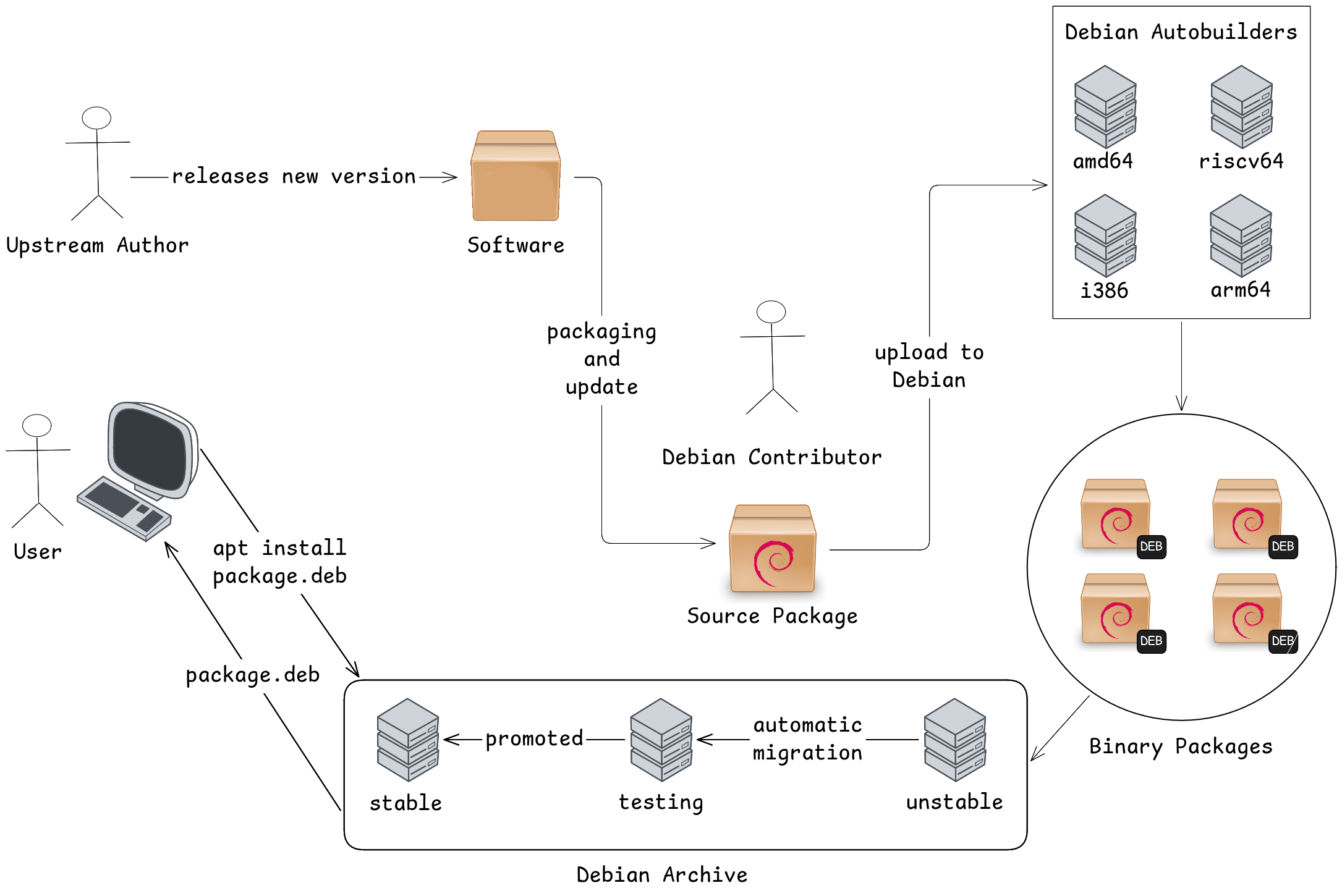
* My first contribution!
The idea was to make it clear to other people that they were only working on small Lintian issues as a way of learning and understanding the process. By the way, I made a UDD query to find packages with the following Lintian tag: redundant-rules-requires-root-no-field. To fix this issue, they only had to remove one line from the debian/control file. It is obvious that these uploads are not particularly useful. I call them "motivational uploads" because my goal is to help newcomers understand the process and immediately give them the reward of having made a contribution to Debian. I'll try to keep in touch with them. My plan is to hold another session, this time remotetly, to help them continue contributing to Debian. In fact, I already have another package prepared by one of them waiting for my review. The second day was a full-day event featuring a bunch of talks from the local community. I gave a talk explaining the new members process. I was the only Debian Developer at the event, and I think having a DD there made a real difference. Being there to answer questions, and simply being present, makes Debian feel more tangible and accessible to people. A big shout-out to Rafael Rocha, who put in a lot of work to make this event happen, with the help of many volunteers who contributed along the way.

Bras lia Debian Day talk in Bras lia One thing I really like about Debian Days is that each place has its own way of doing things. In Jo o Pessoa, we had a MiniDebConf-like event, while in Bras lia, we had something smaller but still very valuable. We decided to keep things simple: talk to a few students at the University of Bras lia (UnB) and then go somewhere to eat and have a few drinks.

A bit of history For those who don't know, the DebConf 19 was held in Curitiba, Brazil. After the event, Arthur Diniz got really excited about Debian and decided to go back to his University, UnB, to share his experience and encourage more people to contribute to Debian. I attended one of his talks, thanks to Joenio Costa, who invited Arthur to give the talk. Joenio was also my professor at the time and a Debian contributor. I really liked what Arthur had to say about free software, and he did a great job of presenting the Debian community as a friendly and welcoming place. So I decided to attend local meetings of the Debian Bras lia community, which had been inactive for a long time. Lucas Kanashiro was the Debian Developer who answered our questions and, as I mentioned earlier, simply being there made Debian feel more tangible. Everything stopped when the pandemic began. Then, towards the end of 2020, I saw a message in the Debian Bras lia channel saying that the meetings were back, this time remotely. I was hesitant to join because, back in 2019, I hadn't managed to make a packaging contribution, even with their help. I had eventually given up on the process. So this time, I decided to join the meeting with something already prepared for review. I watched all of Eriberto's packaging videos, picked a random package, and joined the meeting. I remember Kanashiro being excited that someone had just shown up with something ready for review. At the time, it was only the second meeting since Debian Bras lia had come back online, and none of the newcomers had started working on contributions yet. During the same meeting, he also convinced us, the newcomers, to give a talk about Debian just three days later. The MiniDebConf Online Brazil 2020 was happening on Sunday, and the meeting was on the Thursday before it. Since he has great convincing skills, I went along with the idea and prepared the talk with Francisco Ferreira. That was the rebirth of the Debian Bras lia community. Since then, we have maintained a close connection with the University of Bras lia, and today, at least seven Debian Developers are from UnB, whether as former students or former professors. The reason I told this story is that, even though the Debian Day we held in Bras lia was smaller, it is part of something that has been working for us for several years: staying close to an University. We've managed to attract and retain many people who share the same values and interests. I've hope you all had a great Debian Day. If you're reading this and aren't part of the Debian community but would like to join, get in touch!

Iustin Pop: Another optimistic take on AI

Disclaimers The current discussion in Debian around the AI GR is very heated, and I won t add to that, however, I am very confused about some of the viewpoints there. But, I had no idea how to even try to write this, so did shut up, until I saw Aigars excellent Optimistic take on AI, which motivated me to try, at least. For the record, I fully subscribe to the post, and to the voting suggestions (and I just voted). Also, for full disclosure, I don t think I did any contribution to Debian until now using AI, neither packaging, nor emails, nor bug reports. And this blog post specifically is 100% hand written. With that out of the way there are two points I want to make in this post.

AI is useful, even if it has risks First is, that even if we could put the genie back in the metaphorical bottle, we should not. We do need to continue working towards safe AI, and efficient AI (less environmental impact), but we should not work towards removing the usage of AI. There are already significant advancements in sciences and technology thanks to the use of AI, so desiring AI to not exist (assuming we had a magical wand) is the wrong approach. Sure, AI has significant risks and I can see ways in which AI can do significant damage to society but I don t think we can go from Kardashev I to II without the use of AI, and definitely not to III. And I think, that should be the goal. A few simple examples: Do we want to rollback all the 20 years old security issues that AI found? Do we want to rollback the recent Moderna cancer findings? Do we want to rollback the concept of extremely large scale pattern matchings , just because it runs on chips and no longer in one person s head?

Reading Debian lists The second point is, lately I found less and less enjoyment in reading Debian lists. Even with that already being the case, I feel so disconnected from many of the opinions being voiced in this discussion. On one hand, it s normal and healthy that people have different opinions, disagree, and move forward. On the other hand, looking at one of the proposed options:
  • Moderators and disciplinary teams may make narrow and tailored exceptions to rule 4, and decide on interpretation .
  • Violations of these requirements should be treated as violations of the relevant Code of Conduct and should result in swift and proportionate disciplinary action .
I already knew Debian, and some large parts of the OSS world, is left leaning. But those phrasings, to me, are too close to socialism/communism. As someone who grew up under communism, this is a much more slippery slope (disciplinary teams? really?) than AI usage. Ask me in person for more details. So, it is possible that Debian continues to evolve in such a way that I don t find myself in any way close to its ongoing culture. I will be sad at that point, but it will be what it is.

Where to? I think that, until such a time that an AI bubble bursts, what any organization should do is try to logically see where and if AI can help. And in an organization that is about computer software, I see hundreds of places that are subject to very large scale pattern matching so the half of the discussion is, to me, mind-boggling. To be clear, it s not about if you can t beat them, join them . As I wrote above, I think AI is useful, so the point is how to use it effectively. Well, will see what Debian votes. I am half curious, half sad already.

Wouter Verhelst: Programming and GR 2026 002

Programming language generations When I was young, I learned about a model of classifying programming language: the system of programming language generations. In this model, first generation programming languages are, basically, where you program the computer in the language that is defined by its architecture. On a Von Neumann machine, with its load-and-store architecture, you do that by inputting a string of numbers. The first programmer in human history -- her name was Ada Lovelace -- wrote in a first-generation language. 1GLs aren't so much invented as they are a byproduct of the computers for which they're created. Second-generation languages are the assembler languages. Because humans are not computers, and because decoding long lines of numbers to understand what the computer is doing, when programming became a full-time job, the programmers that did it decided that doing all this assembling manually is too complicated, so they quickly wrote assemblers to automate the process for them. They still could understand the 1GL output of the 2GL assembler, but most of them quickly forgot how to write software in a first-generation language. Not that anyone cared, as the translation from a 2GL to a 1GL is lossless and you can just revert it. Third-generation languages are higher-level languages. When the first 3GLs were invented (such as COBOL and, more famously, FORTRAN) in the late 1950s and early 1960s, it was believed by some that the work of programming a computer so accessible to non-programmers that the job of programmer would eventually cease to exist, and people would just ask the computer what they needed by entering COBOL instructions. This of course was ridiculous and incorrect, because converting algorithms to computer instructions, whether at the 2GL or 3GL level, is a specialized skill that some automation can perhaps make simpler but never completely take away the need for. At the time, some people also felt to some extent that using 3GL wasn't the same thing as actually programming 3GLs, but eventually the world moved on and embraced things. The invention of 3GL environments reduced, but did not completely take away, the need for people to understand 2GLs, as compiler and operating system authors still need to understand them, and some highly optimized code still continues to be written in 2GLs to this day. Fourth-generation languages abstract away some or all of the process of programming. For instance, a database-related 4GL will hide away the complexities of storing data in particular locations, how to fetch that data, how to index it such that you can fetch it efficiently, how to loop over the data to get you a summary of that data, and instead allows you to express the required information in an abstract way, expecing the computer to fill in the blanks. When SQL, an early 4GL, was invented, some people believed that the language made accessing databases so simple that the requirement to implement database applications would eventually cease to exist and we would just hand SQL prompts to users who need to access data. This of course was ridiculous and incorrect, because understanding data schemas and using that understanding to query data from a database is a specialized skill that perhaps a higher abstraction can help you make simpler, but that in the longer run it can never completely take away the need for. The invention of 4GLs also reduced, but did not completely take away, the need for people to understand how to do the things that the 4GLs automate for you manually, as the people who do write those things still need to understand them, and there are also environments where these particular 4GLs are rather not appropriate or just very slow. The first definition of programming language generations that I read about in the 1980s simply stated that fifth-generation languages did not yet exist, but that they would in the future, and that in those, you would "tell the computer what to do, and it would then do that". Now that we have a way of doing so, it could be said that by some definition, we now actually do have a number of 5GLs. The existence of these LLM systems has caused some, especially the people who build and exploit these systems, to exclaim that programming as we know it today is going to cease to exist, and everyone will just ask an LLM to generate a program, which will then do so. That is of course ridiculous and incorrect, as no automaton can generate software from nothing; input is still required for the model to be able to produce something that approaches usability, and being able to word that input in a correct and productive fashion will be a skill that future programmers can benefit from. I ran some experiments a while back, and from that concluded that, if we look only at the technical side, LLM use can, in some niches, increase productivity for a programmer. There are certainly things that you shouldn't use an LLM for, but equally there can be cases where use of an LLM to perform some task that traditionally would have been done by a programmer would be a net positive. But LLMs, as they exist today, are highly problematic. They require vast amounts of data to build the model. The companies that build these models are disrespectful of people who run web services, and as a result, everyone now has to implement various types of application firewalls just to not make systems fall over from the overwhelming requests for data. They are also disregarding the licenses that are attached to these vast amounts of data, which makes me, as a person who believes in the tenets of free software, sad. They require vast amounts of energy, causing an already-critical global warming crisis to, well, not improve. They require vast amounts of coolant to dissipate the energy concentrated in their data centers, causing further environmental effects. In this, they are problematic and to be avoided. But these are side states of the current state of affairs; I do not believe that they are inherently implied to be able to build and operate an LLM -- any LLM. I guess it's fair to say that my feelings towards LLM usage are complex and many-faceted. I haven't been involved in many debates about the subject, debates that to me seem to be mostly focused on "LLM good" vs "LLM bad" arguments that aren't as nuanced as the position that I would believe is more accurate. This is not because I don't care, but partially because I've been busy in my personal life recently and partially because the whole thing seems somewhat disheartening. But then Debian popped up GR 2026-002, meaning, I now have to come up with an opinion about various candidate statements in the context of the above, which is... not easy. But I did it anyway. There are 8 choices on the ballot, and they all have some truth and some falsehood to them. My position about LLMs can be summarized as:
  • The current state of affairs wrt LLMs is disastrous and we should not encourage them
  • However, there's no technical reason why this must remain true for all time
  • And so any statement should keep in mind what might happen in the future and that the current disastrousness of the whole thing isn't guaranteed to continue to exist for all eternity.
With that, let's go over them.

GR vote options

Proposal A Its summary, from the GR text:
This proposal aims to expressly forbid any contributions to Debian written with the use or assistance of large language models (LLMs) or other generative AI tools.
This falls squarely in the "LLM bad" camp, outlawing all generative-AI contributions, disregarding potential future ones where the problematic situations that exist today are not present. It makes a change to the social contract, which is especially difficult to reverse (on purpose), and which therefore also will require a 3:1 supermajority, but if we want to ban LLM-assisted contributions, this is probably the best way to do it.

Proposal B This one tries to allow AI-assisted contributions under certain conditions. It's mostly an "LLM good" proposal, with some caveats that can be discribed as "make sure you know what you're doing".

Proposal C This proposal is both a weaker (in some places) and stronger (in other places) version of Proposal A. It makes changes to the code of conduct instead of to the social contract, and it also wants to, at least, suggest policy to parties beyond the Debian project. By not changing the social contract, however, it is more likely to reach its simple majority requirement than proposal A. I don't think the language that it wants to add to the code of conduct is particularly well phrased, however.

Proposal D This is a weaker form of proposal B. The language is more compact and there are a few requirements that are spelled out in proposal B that are not spelled out in proposal D, but if you read between the lines you'll see that the requirement is still there really and I don't understand why proposals B and D were not merged into one.

Proposal E This proposal tries to hold a middle ground between "LLM good" and "LLM bad". It appreciates that things are quite muddled at the present time, and that perhaps the situation might might change in the future. It acknowledges that certain questions remain unanswered and that perhaps future considerations might therefore be different. But it essentially refuses to take a stance on whether LLMs should be accepted by the project or not.

Proposal F Similar to proposal E, this proposal tries to discourage Debian contributors from using LLMs, while still allowing people to use it should they want to, but with some requests and requirements to mark LLM-assisted contributions to account for those people who don't want to interact with LLM-generated software. As such, it is a proposal similar to proposal E that leans closer to the "LLM bad" camp.

Proposal G
This proposal aims to ensure that contributions directly to Debian are created by humans, while at the same time avoiding restrictions on the tools those humans may choose to use when contributing
Another "LLM bad" proposal, it however restricts the "bad" bits to only the direct output of the LLM. If you use an LLM to do something and then clean-room re-implement the same thing yourself, that's apparently fine.

Proposal H This proposal condemns the use of LLM for its environmental and moral problems, but explicitly not for its technical considerations. I feel that it is closest to my position as explained above.

Voting Expressing a vote on a ballot so convoluted and complicated like this one takes time. I have to read and understand every ballot option, and formulate an order of them. And I shouldn't just state which option has my preference; Debian's voting process allows a rich expression of opinion on ballot options. Anyway, I eventually ended up voting in a way that I think is consistent with my opinion. But it wasn't easy.

22 August 2026

Aigars Mahinovs: Optimistic take on AI

As I am writing this, there is a vote ongoing in the Debian project on how to deal with AI in general and AI-assisted contributions to Debian specifically. Massive discussions have happened in debian-vote and other locations. I have also asked questions there and offered my perspective. IMHO now is the time to summarize that, after all the discussions that I've had with people on multiple sides of this debate both online and offline, and explain how I will be voting and why. Hopefully that will be helpful to someone else as well. None of this has been compiled with AI assistance, but only because I think that forming opinions is not something where AI can really be helpful. Spellcheck was used though. So, first I will describe how I see each of the 8 proposals, then what my vote will be, and then a bit more detail on the reasoning and thinking behind this. WARNING - this went long. With all the above considered I will vote like this (earlier options are preferred over later options): Details on rationale Hypocrisy - I find any proposal that would ban AI-assisted contributions to Debian, but at the same time not ban including AI-assisted contributions from upstream projects to be inherently hypocritical. If LLMs and AI are the very incarnation of evil (a puppy-killing machine, as the analogy went in some emails), then any rational proposal would involve excluding any and ALL code contaminated by this evil from the project. What does it matter if puppies were killed in writing the debian subfolder of the source code or the src subfolder? No proposals went there because everyone knows that such a ban would be the death of the relevance of the project for the future. Debian would be frozen on some old version of the Linux kernel forever and other software would be falling to the same problem too, for example as projects on GitHub start enabling AI-supported reviews with patch suggestions. Soon the "development" of Debian could just be stopped as there is nothing to develop without any upstreams. Assumptions - a lot of proposals mention various "concerns" with at most one word, like "practical" or "community" without an explanation of what exactly they mean by that. The proposers assumed that everyone lives in the same info bubble as they do and already know everything that they mean and already agree to that. That is false. Proposal A was a positive stand-out in this area. Debian has contributors all over the world with very different exposure to different information sources and very different world views. If you want to convince the project as a whole that LLMs are bad because of "ethics", then you do really need to explain what you mean by that and give links to sources, at least as well as Proposal A did. All other proposals were really weak in this area. Copyright - the question on how copyright law interacts with training LLMs and their outputs is still not settled law. The closest legal statements we have so far are that - just because an LLM is trained on copyrighted material does not make that LLM itself be a derivative work of the training data (you, however, cannot just create and distribute a "library" of copyrighted materials just because you plan to train LLMs on it). The output of the LLM might not be subject to copyright law at all, like a photo taken by a monkey. It would then be public domain and thus can be modified and then licensed by the user of the LLM. It might also be a derived work of the context of the inference (so for software - if you refactor a GPL project, the refactoring itself is likely GPL too). Any stricter interpretations would break a lot of existing copyright doctrine, such as raising questions like: "does the output of any programmer now become a derived work of the programming manual books they read in college?". In any case it is really not up to Debian to legislate the nuances of copyright law. And I strongly disagree with the concept that an author can tell me how I am allowed to use the learnings that I gained by reading their work. That is not how either copyright or society works. I can look at 10 pictures of a sunset and draw my own, inspired by the ones I saw. No one can forbid me that expression. The same must be true for a machine learning and replicating patterns. Ethics - I've re-read all proposals and emails and the only real specifically ethical concern I could find was the complaint that some LLMs (or their training farms) are running their web scrapers too aggressively and that causes extra load on services. Like that is not an LLM problem. Scraping the web is not an inherent part of the LLM training or inference process. It's just a few misconfigured scripts. We saw the exact same thing in the early days of web search engine proliferation. Then we banned/blocked the misconfigured engines and the survivors learned that obeying robots.txt is one of the rules for surviving. Literally the exact same problem and it will be solved the same way. Did we ban all search engines back then just because some of them were misconfigured? No. Some claims (like in Proposal C) are just bombastic hyperbole ("hazards to users' mental health", "fraud", ...) and on top of that have zero relevance to the topic at hand - AI-assisted contributions to Debian. What "hazard to users' mental health" is created when a Coderabbit spots that a lock is not taken before accessing a resource in a particular function and suggests an AI-generated patch to fix it? What "fraud" is committed by this? There is no sane answer. I get that some people are very busy fighting some culture wars and sometimes, some AI-bros happen to be on the other side of one such war, so it is useful to label everything coming from the AI sphere as "bad" in all possible and impossible ways. You do you. In private. Why pull Debian into that? Why force your position on everyone else in the project? Why deny everyone in the project access to useful tooling, just because you have strong feelings about some of the people promoting some of those tools? This seems to me a repeating pattern here - blaming the technology as a whole or blaming all providers of this type of technology for failings (ethical or technical) of some of those providers. Like refusing to wear all shoes and condemning all shoemakers and sellers, just because some American billionaires figured out a way to make and sell cheap shoes by killing puppies. Not refusing and condemning those providers, but condemning all for the actions of a few. Resource usage - this is a big topic for many and it has reasonable points to it. The LLM and AI technology has no inherent need to be damaging to the environment in any way for it to function. It does not need to burn oil or dig up cobalt. It does not need to sacrifice a ton of water to the Gods. It is perfectly possible to run AI (both inference and training) purely from green, electrical energy and cool data centers in equally sustainable ways, like with simple air-source heat pumps (also known as air conditioning) or even use it beneficially (many data centers are used for heating surrounding buildings via district heating). However, some AI companies do use non-green power for their data centers, some do use locally-limited fresh water for evaporative cooling (evaporated water still rains down as rain, it is not really lost, but that may happen in another location so lack of water can still happen locally). Some even run unlicensed natural gas turbines in their data centers to provide them with power. And those specific providers can and should be shunned and condemned. Not the other ones, who are doing the right things. Not the technology or its users or its outputs. There is a very wide spectrum of options on how an AI system could be powered: starting from local execution on already existing private hardware powered by one's own local solar power (good), to a data center stuffed with borrowed AI-only cards powered by a gas turbine or coal power station that operates solely to supply this data center (bad). Proposals that talk about ecological impact, but do not even consider where on that (very wide) spectrum to draw the line between "good", "acceptable", "discouraged" and "bad" well, I cannot see those proposals being actually serious about the environment to begin with. It feels like they just refer to it for points. And if we go into the power question deeper, well the grid dynamics and economics become very, very complex and often also non-intuitive. Like, all large software companies with data centers (that also happen to provide AI services), like Google, Meta, Apple, Microsoft and others do actually care about sustainability (in part because their customers care and vote with their wallets) and so all of them use 100% green energy for their data centers (including AI data centers) .... "on an annual scale". Wait, what does that mean? Well, the electrical grid is special - the amount of electricity produced and consumed on the whole electrical grid together has to match almost exactly every second. If there is just a single second where there is significantly more energy consumed from the grid than is produced, the frequency will plummet and you get a brownout and risk a grid collapse. The same is true in reverse - that causes a voltage swell. So grid operators manage energy flows every second and command power stations to increase and decrease generation all the time. Some power stations are easier to regulate dynamically than others. In the end, all that means is that even if your data center has a contract for 100% green energy with your power company, at some seconds across the year there might not be enough green energy in the grid to fully supply ALL people and companies that have 100% green energy contracts. This gets compensated in other seconds, so that across the year ("on an annual scale") for each kWh that your data center pulled from the grid, the same amount of kWh of 100% green energy flows into the grid. But it might not happen at the exact same second. Pedantic companies, like Google, take that discrepancy and count that as CO2 emissions for themselves. And then they and the power companies (they have contracts with) invest billions into new green energy projects, better grids and better batteries so that eventually this discrepancy goes down to zero. In this way green AI data centers with their increasing consumption of green energy are actually doing a lot of good work in making our electrical grid more green. They are making more resources than they are consuming. And that is just the tip of the iceberg. This is a deep topic that really abhors generalizations like "more consumption = bad". I've heard similar discussions in the context of electric cars - "so you got an electric car? you'd have fewer emissions if you drove no car at all!". That might be so. And I would also reduce my emissions to zero if I stopped breathing, but I really do not want that kind of thinking to be propagated further, especially when impressionable young people are around who may take it to its logical (but wrong!) conclusion. Instead I talk about how early adopters use electric cars to gather experience and achieve volume to start the network effects working. Once network effects of many electric cars on the roads are sufficient, it becomes an economically logical choice to get an electric car. People who cannot avoid having a car start to switch over. And at the point of mass switchover the reduction of emissions is so massive that those early adopters failing to go all the way to riding a bicycle becomes a rounding error. But surely that does not apply to LLMs? They are only increasing consumption and bring no benefit? Benefit - and here we have to actually talk about benefits. Because you cannot make any cost-benefit analysis if you do not actually fully investigate the benefits. Are there environmental benefits from running those AI models? Yes, in a lot of very diverse ways. Hard to measure, however. There are projects that are easy to quantify - like that Google AI project on contrail avoidance. An advanced, special model trained and executed in Google AI data centers was able to predict where in the air contrails would be produced and could generate proposed course adjustments to commercial flights to avoid specific heights in specific locations at specific times. This stopped these aircraft from creating contrails and those contrails did not make a further contribution to global warming. That benefit in a year was many times higher than the environmental cost of training and running that AI model. And it can keep running for many years accumulating further benefits. On a personal scale, I've had problems that I bashed my head (and computer and CI resources) against without much success years ago solved with a few minutes of compute. Having a good enough candidate solution quickly is much cheaper from a resource perspective than spending days trying different things, running my PC for it, trying different patches on CI executions, doing different rebuilds. I've seen very significant benefits in AI-assisted development in enterprise environments where code way more complex than what is in Debian (especially in Debian tools and packaging) gets analysed, reviewed, modified or even refactored or rewritten in another language with AI assistance. And it generally works. The commonly mentioned "hallucinations" are a thing of last year in the coding context. Nowadays the AIs work in special coding harnesses and use real tools as foundational facts. You cannot "hallucinate" an API call or parameter if you have to run and pass the unit tests and integration tests by your harness before you can return "success" to the caller. I've personally seen high-level AI models read very complex software projects across multiple repositories and point out a very specific design consideration that was encoded in the code logic, but never mentioned in comments or documentation. It was so obscure that even I did not immediately know what it was talking about (and I wrote that code). Only on close inspection of code interaction across three repos did I remember that there was indeed that bug 2 years ago that I fixed by doing the change that this AI picked up (it wasn't in the history of this git repo due to repo migration). It mentioned this because it was very relevant to the task I initially gave it to review. These LLMs in a proper harness with proper system instructions and usage approach are not just fancy spell checkers or auto-complete. They function more like very advanced pattern matchers. They have learned millions of patterns from training data. When they look at the code, they see hundreds or thousands of overlapping patterns. When you ask them to make or change something, they pull out a pattern (or ten) from their training and apply those patterns to the context of your program. You get something that looks just like the surrounding code, same style choices, same language, same comment voice, but it implements something new there, based on other patterns learned. If you've studied design patterns in your CS class, this will be familiar. But people can learn and remember maybe 20-30 patterns, while an LLM can have a million patterns and can combine them when needed. So it takes a pattern of Python code, pattern of standalone script, pattern of parsing command line parameters, pattern of classes, pattern for background threads, pattern for file tree traversing, pattern for pipes, ... and squishes them together to make a solution for your query. And then tries to debug it with compilation, tests and execution until it works as expected. Even if there is zero LLM development going forward, it will take many years to fully appreciate the benefits we can extract from the already trained models. They don't even have to be retrained - for existing languages they just keep working. For new language variations, like a new Python version, you can feed the changelog into context and they will be able to work with a Python version that they never saw in training. And patterns are mostly abstract, so not really specific to any language - human or programming. This is another big enabler that LLMs have created that we have not really explored yet. LLMs have created really free software. People can actually create software that is perfectly suited just for them and no one else. They don't even have to know how to program and don't even need to speak English. I've seen people writing prompts in their native language and LLMs creating and then adjusting web apps or Android/iPhone apps and deploying them to the user's own phone. It was too buggy to work last year, but this year it is actually very functional for simpler use-cases. And the code looks just fine too - I've seen external contractors in a business setting deliver far worse. If you start with a good initial system prompt, the project will have architecture documentation, use-case documentation, unit tests, integration tests, deployment harness, testing and production deployments, audit logs, monitoring, clear git commits, CI validation on commit, ... Modern AI systems have the capabilty to deliver software freedom to people who are not coders. I really can not overstate the consequences this may have on the world. Community - I find the concerns that new people will be using LLMs so much that they will no longer be understanding the actual code they are contributing a bit regressive. I don't see any significant difference between this and people relying on compilers, on high-level languages or on debhelper. Writing modern debhelper packaging feels more like writing configuration and not writing code. It takes really significant effort to dig down through layers of abstraction to find what actually is being executed in debian/rules. AI does not really make this worse. In fact, I find that AI can make it much easier to understand arcane syntax because you can ask an LLM to explain what is happening in any part of the code and it will do a pretty good job of it, digging down through the layers of abstraction for you. All the pro-AI proposals include the requirement that each human contributor needs to understand and stand behind their AI-assisted contribution and I believe that is a good requirement and also a sufficient requirement. Modern LLMs not only produce clear and concise code, but they are also capable of producing good comments explaining why the code is how it is, good commit messages explaining the change and reason behind it and also making corresponding changes to test suites and documentation. You know - the housekeeping stuff that is often skipped because it slows down the actual feature development, but then its lack becomes a problem for future contributors. Responsible use of AI assistance is a great chance to actually strengthen our community and make our software easier to maintain. That said, I have no qualms about flat-out rejecting contributions that do not make sense. And it does not matter if they are made with or without AI assistance. If the contributor will not explain their patch, it might be they do not understand what their AI produced or it could be that the contribution is deliberately hiding a backdoor being planted. It is also quite common for a contribution of a new feature to be rejected because the author/maintainer does not believe that it is a good fit for the project. Featuritis is a real disease. AI or not. There have always been drive-by contributions to various projects. They will continue to exist. Each of them should be evaluated on its merits - is this feature valuable to our users and is the added complexity (if any) worth the functionality? A lot of security bug reports are "drive-by" contributions as well. And many of them nowadays are discovered, exploited and patched with AI assistance. We could reject them, but that just leaves us holding the bag on the now-known exploits. And the New Maintainer process should be able to figure out if an upcoming Developer has actually understood the nuances of Debian packaging or not. A contributor with upload rights to the archive has to be able to create a basic package with no support tooling (maybe even without using debhelper?) and be able to understand and modify more complex packages (possibly with tooling support). IMHO that is a separate discussion that is worth having, involving experts from the educational sector. Conclusion IMHO the Debian project should not restrict what tooling individual contributors use to contribute. Expecting high-quality contributions and that contributors understand what they are contributing (as a first level of review) is enough. However, Debian should provide its contributors (internal or external) with guidance on how to contribute in the best way possible. That could include: In addition to that it would be helpful for Debian, as a project, to reach out to AI service providers to: Questions? Feedback? Just ask here or here.

6 July 2026

Russ Allbery: Review: The Player of Games

Review: The Player of Games, by Iain M. Banks
Series: Culture #2
Publisher: HarperPrism
Copyright: 1989
Printing: February 1987
ISBN: 0-06-105356-2
Format: Trade paperback
Pages: 295
The Player of Games is political space opera and the second book in the shared Culture setting. As with most Culture books, the reading order is not particularly important. It won the 1989 Locus Award for best science fiction novel and sometimes competes with Use of Weapons as the consensus best Culture novel. This review is a re-read and yet another experiment in how to re-review a book. This time, I decided to write a full second review with substantial spoilers so that I can talk in more detail about the book. If you want to avoid spoilers, or just want to see how my thoughts have evolved from my first reading, see my original review from 2005. Gurgeh plays games. He is probably the best strategy game player in the entirety of the galaxy-spanning Culture. He has written papers on game theory, won innumerable major championships, and is a celebrity in the circle of like-minded aficionados. Gurgeh is also bored and in the middle of the Culture equivalent of a mid-life crisis. As the story opens, he's vaguely unsatisfied and adrift, unenthused by his normal activities, and searching vaguely for something that will break through his ennui. He is caught by surprise by the thrill he gets from a moment's misunderstanding in which an opponent suspects him of cheating, which sets him up to be (apparently) clumsily blackmailed by a deeply unpleasant drone named Mawhrin-Skel. SPOILERS BELOW. If you have not read this book, consider stopping here and instead reading my original no spoiler review. The first hundred pages of The Player of Games is a slow, somewhat plodding introduction to Gurgeh, his social circle, and life in (one part of) the Culture. I remember being fascinated by this part the first time I read this book. It was only the second Culture novel I read and the first set in the Culture proper, so the world-building underlying this odd post-scarcity utopia on a vast intelligent habitat with sentient drones, complex privacy rules, endless cocktail parties, and apparently directionless socialites was intriguingly unlike the other science fiction I was reading at the time. This time through, I have to admit I was less impressed. Gurgeh is not very likable, and his desultory mid-life crisis is a little boring. None of his friends have enough depth to appear as more than side notes, in part because Gurgeh doesn't seem to care enough about any of them to make them interesting to the reader. I've since read seven other Culture novels, so Banks's cocktail parties hold less charm and I was impatient for the real action to begin. These chapters are still important, though, because they establish how utterly average Gurgeh is. He has one unique talent, a deep affinity with and obsession with strategy games, and is otherwise a bit of a depressed narcissist with a few casual relationships, a friend that he barely confides in, and a comfortable and familiar life. He is not in any way a hero or a charismatic figure; he just happens to be exceptionally good at one thing, enough to make him famous among people who care about that one thing and probably unknown to anyone else apart from the occasional idly perused news headline. He is the Culture's equivalent of the world chess champion. The Contact division of the Culture has a problem. The Empire of Azad in the Lesser Magellanic Cloud is a nasty, expansionist culture of the sort that Contact would like to deal with before it causes broader problems. The Culture's normal approaches are thwarted by an unusual organizing principle: The empire is built around and takes its name from the game of Azad, a highly complex strategy game developed over thousands of years. Azad is the civil service exams, means of political and religious dispute resolution, selection mechanism for the emperor, and civic religion. Faced with that oddity, Contact turned to Special Circumstances, the Culture's more aggressive and less restrained way of dealing with tricky problems. Special Circumstances, in turn, needs someone who can learn how to play the game of Azad. They want Gurgeh to take a very long trip. For all of Gurgeh's dissatisfaction, he's not impulsive enough to take a five year journey away from his life and everyone he knows just to play a novel game. Conveniently, Mawhrin-Skel's blackmail resolves this reluctance. The game of Azad requires some suspension of disbelief. Banks provides a few glimpses at the mechanics of the game, but those details are insufficient to reconstruct the rules, and some of the claims made about its properties are improbable at best. The best mental model I could build for it is a strategy or simulation game built around units and territory control, with supplemental side games used to build up resources for the main boards, but it's more of a plot device and a set piece than a world-building invention. The significance of Azad the game is its role in society: The Empire of Azad believes they have constructed a game whose complexity so closely models reality that the skills required for success in the game are precisely the skills required for success in the empire. The Empire of Azad is wrong, and this is one of the core themes of The Player of Games. As with many Culture novels, what Special Circumstances tells Gurgeh is, at best, incomplete. Gurgeh is a refutation of the basis of belief in Azad; this is why it is important thematically that he is an average, somewhat unlikable citizen of the Culture whose only special characteristic is skill at learning and playing games. Azad is the myth of meritocracy given physical form as a game. It provides the anchor of the empire for the same reason that societies on Earth place enormous weight on standardized tests, capitalist success, or public debates. All societies face the problem of selecting good leaders and testing opposing beliefs, and all societies attempt to find some form of shortcut, some set of general principles, tests, or objective metrics used to select the best person via a process that people consider plausible and fair. The game of Azad is a paragon of apparently meritocratic process. No matter who you are or what your background is, if you excel at the game that, in theory, objectively tests your skills, you are given a position of power. In practice, the Empire of Azad is not that naive. Manipulation outside of the game happens, only some players have the opportunity and resources to spend years learning the game at a deep level, and only their dominant sex truly stands a chance in games that matter. But neither is Azad's place in society a fiction. There is corruption around the edges, and a lot of people are filtered out before the games begin, but the highest echelons of society are true believers. The game does decide both rank and policy; Banks is arguing against a strong form of apparently working meritocracy. Gurgeh represents a refutation of this meritocracy through the mechanism that breaks every supposed meritocracy: The map is not and cannot be the territory. Any objective evaluation criteria is necessarily separate from what it is trying to measure, and in that separation there is always an opportunity. Gurgeh has none of the background, training, or mindset expected for a player of Azad because he could not possibly care less about any of the things Azad represents to the Empire. What he has instead is a preternatural skill at games and vast experience with the most intricate strategy games the Culture, a much larger society, has been able to devise. He also has both the patience and the resources to devote himself entirely to learning a game for several years, and past experience in doing that with other games. If Azad represents the civil service exams, Gurgeh is the person who has no interest in ruling but adores memorizing facts and taking tests. The theory behind the exams is that the skills to pass the exam only come with the correct mindset to do the job for which the exam is testing. Gurgeh is an existence proof that this is not always the case. Banks also uses Azad to show another aspect of the failure of meritocracy: A society whose rulers are chosen through a competition takes on the shape of that competition. The Empire of Azad is run by the winners of competitive games, so the empire is a winner-take-all system of dominance and status hierarchy. Here, I think Banks lays the point on a little thick; the empire is an irredeemable hellhole of misogyny, sexual abuse, slavery, genocide, and military colonialism to a degree that is a bit hard to justify solely from the game. There is a beautiful turning point about two-thirds of the way through the book where Gurgeh's face is shoved into just how vile Azad society is and reconsiders his approach to the tournament as a result, and I think it may have been a bit stronger if the morality had been a little less blatant and absolute. To the extent that Gurgeh has political beliefs, he represents a Culture flavor of soft liberalism. He has opinions about acceptable and unacceptable ways to treat people, but he grew up in a utopia and his opinions are mostly theoretical. When he sees just how vile people can be outside of that utopia, he is revolted and appalled and redoubles his efforts to fight that society in the only way he knows how, inside of a game. This part of the book follows the standard, if enjoyable, plot of a flawed but fundamentally decent person discovering a true injustice and becoming enraged at it. In a lot of books, that would have been where the plot stops. Banks is doing something more subtle and more interesting, though. Gurgeh wipes the board with his next challenger, but that soft liberalism eventually proves inadequate. To learn the game of Azad and to play in the tournament, Gurgeh has been wrapping himself in Azad culture and its language, and in that frame of mind he is losing the climactic game of the book. It's only when he is pushed to think in Marain, the native language of the Culture, that he understands what is happening in the game and how to defeat Nicosar, the emperor. This, on the surface, is a bit too close to the strong hypothesis of linguistic relativity to be entirely plausible, but such an objection would miss the point that Banks is making here. Marain is a construct, the product of considerable effort within the Culture to match language to the most nuance and complexity that brains can understand, and it is a language, one of the most social and collective artifacts a society can produce. Gurgeh is a remarkable individual with an impressive talent, but individual skill and achievement can only take him so far. The critical final piece is the support of societal infrastructure intentionally built and maintained to help him make better decisions. Once I noticed that point, I saw it everywhere in the book. The empire repeatedly attempts to subvert or distract Gurgeh with drugs, pleasure, politics, or danger, and at each point there is some critical piece of Culture social infrastructure that blunts the attack. Illicit substances and forbidden vices are less tempting to someone for whom the illicit has been demystified by the Culture's gentler approach to rules and boundaries. Embedded biological mechanisms allow him to divert drugs so that they don't affect him. At first, it's easy to read this as an exercise of self-control, but on this re-read I saw how much behind-the-scenes infrastructure supports Gurgeh's ability to ignore temptation. This social support notably does not take the form of some ideological principle or moral framework. Gurgeh is not a monk or an ascetic, as is obvious from the first third of the book, and he has no political ideology to speak of. He is a flawed person with a streak of danger-seeking and self-aggrandizement, which the Culture exploited to get him involved in Azad. But through a lot of hard work, technological and social, the Culture has given him a robust foundation and a set of mental and biological tools that make him remarkably hard to corrupt. The implication is that if Gurgeh has that support, so does every other member of the Culture. It's neither a religion or an ideology; it's well-maintained infrastructure, complex and nuanced and pragmatic, and composed of innumerable small solutions to specific problems. I think the true climax of this book takes place the night before the final day of the game, in the tower meeting between Gurgeh and Nicosar. Gurgeh has realized that he's already won; there's nothing Nicosar can do to salvage the game. He's also seen that the game represents a cultural conflict and conversation between the Culture and Azad and he's overwhelmed by the beauty of that communication and sadness that the game is about to be over. Gurgeh's true passion is the game. It is doubtless easier for him to be magnanimous because he's winning, but he also loves the structure of the game itself and what two players can create in a sort of collaborative competition. Gurgeh tries to express all of this to Nicosar. It is one of the most centrist liberal moments I've ever read in a novel, the pure essence of "reaching across the aisle" or "disagreeing agreeably." Gurgeh has seen something beautiful, something he's created with Nicosar, a moment of true communication, and he wants to share it. Surely Nicosar sees the same thing; surely now that he sees Gurgeh has won, he can appreciate the board structure, savor the moment, understand the transient beauty of a game that is about to end and how perfectly it captures the meeting of their different cultures. That moment does Gurgeh real credit. It's a rare sign of emotional and spiritual depth in a character who often seems superficial. Nicosar meets this outreach with unhinged, furious contempt. He despises everything Gurgeh represents, everything the Culture is, and the next day he tries to kill Gurgeh on the board of the game. It is a devastating critique of liberal tolerance, all the more so because Gurgeh's attitude and outreach is truly admirable. It is perhaps the most sympathetic moment that Gurgeh has in the entire book, the moment where the reader thinks "oh, I get it, I understand what he really cares about." Gurgeh assumes that Nicosar is not his position or culture, that they have made a moment of connection that transcends all the awful things he previously learned about the empire of Azad. That Nicosar, despite being the emperor of the society that is currently doing so many things Gurgeh finds repulsive, cannot be as bad as his society. And Nicosar considers that outreach to be weak, disgusting, and vile, and does everything that he can to destroy it. One of the oddest twists of our current moment is the obsession that some billionaires have with stories that are moral arguments against exactly what those billionaires are currently doing. The most obvious example is Peter Thiel, who is obsessed with The Lord of the Rings and has devoted his life to becoming Saruman, a character who is notably not one of the protagonists. It's as if something in them recognizes the power of the story, but some deep shame or narcissism or simple aversion allows them to completely ignore what the story means. Elon Musk is obsessed with the Culture novels. He names the SpaceX rockets following Culture Ship naming conventions and has claimed that one of his goals is to bring about a Culture-style utopia. And in 1989, years before anyone had ever heard of him, Banks cast him as the villain of The Player of Games. There is so much of Nicosar in Musk: the superficial charm, the limited brilliance (Nicosar is a very good Azad player), the ambition, the pride, and the vicious, spitting contempt for everything the Culture represents at every level deeper than superficial materialism. And Banks is as clear about his opinion of Nicosar as he is about anything in any Culture novel. One of the oldest fictional answers to what a society does with people like Nicosar is the consequences of hubris. By being unable to accept defeat, by holding a vision of the world so tightly, they become brittle and unstable and bring about their own collapse. In a broad sense, that is what happens in The Player of Games with a bit of pushing from Special Circumstances. By the politics of the game, Nicosar had already won; the results of Gurgeh's earlier games had already been faked, the final game had no political consequences, and everyone who knew its true outcome could be disposed of. Gurgeh's win could have been covered up and ignored. But Nicosar could not endure the thought that he would be beaten by someone like Gurgeh, playing Azad the way that Gurgeh was playing it. Gurgeh had to be destroyed on the board of the game; Nicosar's pride did not allow any other outcome, even if it meant Nicosar's death. However, Special Circumstances didn't let hubris be the end of the story. In the climax of the book, the drone protecting Gurgeh also makes sure that Nicosar dies. There is a fig leaf of plausible deniability, but it's so obvious that even the unobservant Gurgeh sees through it immediately. It's hard to escape the feeling that was Banks's answer to what to do with people like Nicosar: They cannot live within society, because they will not live peacefully within society. I enjoyed The Player of Games as much this time through as I did the first time, but for entirely different reasons. In my first read, I focused on the world-building of the Culture, the political machinations, and the concept of games as conversations between the players. This time, I was struck by the political commentary just below the surface. Special Circumstances wanted to resolve the problem of the Empire of Azad without a military conflict and occupation that would be long, brutal, expensive, and demoralizing. They found an answer that relied on the diversity of the Culture. A vast, utopian civilization in which people can pursue whatever interests make them happy produces innumerable microspecialized oddities, people with astonishing talents in some small field that only a tiny fraction of people care about. It produces, in other words, innumerable keys for locks that you may never encounter, but which are invaluable if you happen to stumble across that lock. Gurgeh is not a hero. He is not a paragon of moral virtue, or even a charming charismatic, He is an entirely average member of an extraordinary society, the beneficiary of thousands of years of concerted effort at producing a robust, flexible foundation on which to raise robust, flexible citizens with a shared sense of basic morality. Those people, by themselves, do not solve all of life's problems; the structure of Special Circumstances and its willingness to bend rules in order to maintain them is the tension and deus ex machina in all of the Culture novels. But much of the strength of Special Circumstances is that it has an entire civilization of people like Gurgeh to draw upon when it needs them. It has those people because the Culture comprehensively rejects competitive meritocracy, something that some readers of the Culture novels appear incapable of comprehending. Rating: 9 out of 10

Next.