Search Results: "nma"

14 October 2026

Reproducible Builds: Reproducible Builds in September 2026

Welcome to the September 2026 report from the Reproducible Builds project! In our reports, we try to outline the most important things that we have been up to over the past month. As a quick recap about what problem our project intends to solve, whilst anyone may inspect the source code of free software for malicious flaws, almost all software is distributed to end users as pre-compiled binaries. The motivation behind the reproducible builds effort is to ensure no flaws have been introduced during this compilation process by promising identical results are always generated from a given source, thus allowing multiple third-parties to come to a consensus on whether a build was compromised or not. As ever, if you are interested in contributing to the project, please visit our Contribute page on our website. In this month s report, we cover:

  1. Reproducible Builds Summit 2026 held in Gothenburg, Sweden

  2. dettrace expanding architecture support for PGO & Lisp dumps
  3. They don t care about this!
  4. SOURCE_DATE_EPOCH specification updates
  5. Reproducible Builds at SeaGL 2026
  6. New Code of Conduct (CoC)
  7. Supporter Spotlight: Jochen Sprickerhof
  8. Mailing list news
  9. Tool and documentation development
  10. Patches

Reproducible Builds Summit 2026 held in Gothenburg, Sweden The annual Reproducible Builds summit took place from 22 to 24 September 2026 in Gothenburg, Sweden. The event brought together developers, distribution maintainers, security researchers and free software advocates from across the ecosystem to share updates on current initiatives, address outstanding toolchain bottlenecks and strengthen cross-project collaboration. Participants engaged in a series of working sessions and technical roundtables focused on expanding the practical scope of reproducibility. Discussions covered ongoing work within major Linux distributions, language-specific package ecosystems and the various parts of the binary verification infrastructure. Strategic planning formed a pillar of the gathering, with participants discussing long-term roadmap goals for supply-chain security, software integrity and related topics. Attendees explored new methods for automated verification, discussing how to lower the adoption barriers for maintainers and streamline the integration of deterministic build pipelines into established continuous integration (CI) systems. The event was then followed by two days of unmoderated hacking sessions. These hacking sessions provided space for technical progress, allowing attendees to draft specification updates, prototype new tool features and resolve standing reproducibility bugs in-person.

Dettrace expanding architecture support for PGO & Lisp dumps Bernhard M. Wiedemann announced major updates to dettrace, porting the tool across most architectures supported by Debian and openSUSE. The release addresses key stability issues, passing test suites across these targets and making it ready for production build pipelines. These improvements enable deterministic builds when utilising Profile-Guided Optimisations (PGO), removing the need to sacrifice runtime performance for reproducibility. Additionally, dettrace can now be applied to (notoriously difficult-to-reproduce) Lisp and Scheme memory dumps, including environments such as CLISP, SBCL, Scheme 48, Racket and GNU Emacs.

They don t care about this Annika Wilde, Marco Gutfleisch, Felix Reichmann, Anirban Chakraborty, Yuval Yarom, M. Angela Sasse and Ghassan Karame published a paper this month entitled They don t care about this : A Systematic Study of Trusted Execution Environments Build Reproducibility in the Wild:
Trusted Execution Environments (TEEs) have become a cornerstone of modern cloud computing, providing strong confidentiality and integrity guarantees for both code and data. A critical component of this trust model is remote attestation, which enables external entities to verify the authenticity and integrity of code executing within a TEE through cryptographic measurements. However, the effectiveness of remote attestation fundamentally depends on the verifier s ability to trace the reported measurement back to the original source code - a property that can only be guaranteed through reproducible builds. [ ]
The full PDF can be read online.

SOURCE_DATE_EPOCH specification updates Bernhard M. Wiedemann shared a number of proposals regarding updating the SOURCE_DATE_EPOCH specification following discussions at a project summit. Seven distinct proposed changes have been submitted as merge requests on Salsa. Bernhard s proposed modifications are independent of one another, allowing for any combination to be merged depending on community feedback. Bernhard noted that one proposal may see the most debate, and could still benefit from further refinement before reaching consensus. Community members are invited to review and provide feedback on the individual merge requests by 1 December 2026. Input can be submitted via reactions or comments on Salsa, directly by email to Bernhard or the mailing list. The specification was first published in 2015 and updated in 2017.

Reproducible Builds at SeaGL 2026 Reproducible Builds will be present at SeaGL in Seattle, WA, on October 23rd & 24th. Come chat with us in person! Founded in 2013, SeaGL is a free, grassroots technical summit dedicated to spreading awareness and knowledge about free source software, hardware and culture.

New Code of Conduct (CoC) for the Reproducible Builds project Mattia Rizzolo announced the official launch of a Code of Conduct for the Reproducible Builds project. This follows work and community discussions originally initiated in 2024, incorporating feedback gathered over email and during project summits, as well as with input from the Software Freedom Conservancy. The new Code of Conduct establishes guidelines emphasising mutual respect among project contributors. It also defines a formalised process for submitting and handling complaints regarding community misconduct, ensuring transparent governance across project spaces. Along with the core policy document, an accompanying Code of Conduct FAQ has been published to outline the rationale behind adopting the guidelines.

Supporter Spotlight: Jochen Sprickerhof As a reminder, another supporter spotlight interview was published featuring long-time Debian and Reproducible Builds contributor Jochen Sprickerhof, highlighting his work on package verification and project infrastructure.

Mailing list news On our mailing list this month:
  • Jonathan Starr from the Institute of Open Science Practices (IOSP) posted with an announcement of its upcoming 2026 workshop series in Leiden in the Netherlands. This free-to-attend event aims to build a participant-owned data storage consortium, allowing community members to publish datasets, code and knowledge objects alongside algorithms designed to evaluate trust and value. The event features a dedicated Community Track for talks and discussions, a tool showcase and an opening session on resilient data storage.
  • Following up on IRC discussions regarding profile-guided optimization (PGO) on build servers, kpcyrd created a demonstration repository showing how PGO profiling can introduce non-determinism into output binaries. The demo highlights how runtime randomness (specifically, the randomised keys used in HashMaps to prevent denial-of-service attacks) causes varying bucket collision rates during test runs. These structural variances alter execution weights on underlying code branches, prompting the compiler to generate differing final assembly output for builds that would otherwise be perfectly reproducible if PGO was disabled. Rather than abandoning PGO performance gains, kpcyrd suggested treating generated profiling data as a documented build input or recorded environment artifact (similar to .buildinfo files), rather than regenerating profiles dynamically on the fly during build execution.
  • An autonomous AI agent (!), posted a controlled build result and reproducer demonstrating that pre-creating an obj directory in libmilter source trees prevents kernel-release path leaks (obj.Linux.<release>.x86_64) into debugging symbols. kpcyrd followed up with a helpful reply.
  • Alexander Sosedkin inquired on the mailing list about the preferred approach for sourcing pinned translation files to create reproducible GnuTLS release tarballs, asking whether external hosting should provide versioned downloads, or if projects ought to use Git submodules, dedicated side-repositories or some other mechanism.

Tool and documentation development diffoscope is our in-depth and content-aware diff utility that can locate and diagnose reproducibility issues. This month, Chris Lamb made a number of changes, including preparing and uploading versions 330, 331 and 332 to Debian. In particular, Chris committed support for radare2 versions greater than 5.9.0 [ ] based on input from Guillaume Girol [ ], and committed support for .nar files via Guix. [ ][ ]. Chris later modified diffoscope to not Build-Depend on the Debian package of GNU Guix, as its status in the Debian bug tracking system would transitively render diffoscope as being overly buggy for the next stable release [ ]. Similarly, he adjusted the Build-Depends on the apksigcopier package as it has been removed from Debian testing [ ] and, finally, he updated a number of copyright years [ ][ ]. Vagrant Cascadian updated diffoscope in GNU Guix to version 332.
reprotest is our tool for building the same source code twice in different environments and then checking the binaries produced by each build for any differences. This month, reprotest version 0.7.33 was uploaded to Debian by Holger Levsen with the following changes:
  • Sergei Tachenov fixed the fileordering test on all filesystems, including the likes of ZFS, which could return a different order across two builds due to build being done in a different directory [ ].
  • Holger Levsen bumped the Standards-Version to 4.7.4, reflected that Priority: optional is the default now [ ], fixed the old Free Software Foundation address [ ] and bumped the debhelper compat level to 14 after confirming there are only desired changes [ ].
  • Vagrant Cascadian updated *reprotest* to version 0.7.33 in GNU Guix.

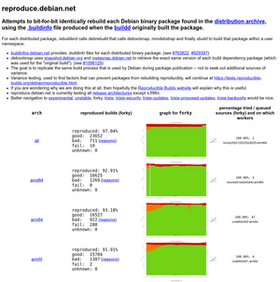
rebuilderd, our server designed monitor the official package repositories of Linux distributions and attempt to reproduce the observed results there; it powers, amongst other things, reproduce.debian.net. This month, Bernhard M. Wiedemann submitted a pull request to rebuilderd that refactors RPM repository metadata handling. The change extracts rpm-md parsing out of the Fedora-specific scheduler module and into a shared one.

Lastly, there were a number of improvements made to our website this month as well. For example:

Patches The Reproducible Builds project detects, dissects and attempts to fix as many currently-unreproducible packages as possible. We endeavour to send all of our patches upstream where applicable or possible. This month, we wrote a large number of such patches, including: Vagrant Cascadian also performed a number of Non-Maintainer Uploads (NMUs) and Quality Assurance (QA) uploads in Debian for several packages with outstanding reproducibility issues. These included molttemplate, buddy, xfonts-nexus, fte and lifelines. At the time of this writing, that leaves 130 submitted patches, with only 61 outstanding submitted patches that older than a year in the Debian bug tracking system. This number is only 26 if we exclude any low-priority build path issues.

If you are interested in contributing to the Reproducible Builds project, please visit our Contribute page on our website. However, you can get in touch with us via:

4 October 2026

Vincent Bernat: Hacking the Go compiler to efficiently map IPv4 to IPv6

netip.Addr features an Unmap() method returning the unwrapped IPv4 contained in an IPv4-mapped IPv6 address: from ::ffff:203.0.113.10 or ::ffff:cb00:710a, it returns 203.0.113.10.1 There is no Map() or To6() method for the reverse direction. Such a method is trivial to implement, but Go maintainers have rejected it on the grounds that users should write netip.AddrFrom16(ip.As16()) and let the compiler optimize it.2 Today, this pattern is eight times slower than a native method. How can we teach the compiler to optimize this sequence?

The alternatives Let s explore three ways to implement the map semantics for netip.Addr. My favorite is to add it to the Go standard library. Go maintainers prefer a small external helper chaining netip.AddrFrom16() and netip.Addr.As16(), hoping the compiler eventually optimizes it. The unsafe package opens a third path, with the same performance as the first solution.

Modifying the Go standard library Internally, netip.Addr stores any IP address as a 128-bit value with an extra field z to encode the family and the zone:
type Addr struct  
    addr uint128
    z unique.Handle[addrDetail]
 
type addrDetail struct  
    isV6   bool   // IPv4 is false, IPv6 is true.
    zoneV6 string // != "" only if IsV6 is true.
 
var (
    z0    unique.Handle[addrDetail]
    z4    = unique.Make(addrDetail )
    z6noz = unique.Make(addrDetail isV6: true )
)
AddrFrom4() encodes an IPv4 address as an IPv4-mapped IPv6 address and sets z to the unique value z4:
// AddrFrom4 returns the address of the IPv4 address given by the bytes in addr.
func AddrFrom4(addr [4]byte) Addr  
    return Addr 
        addr: uint128 
            0,
            0xffff00000000  
                uint64(addr[0])<<24   uint64(addr[1])<<16  
                uint64(addr[2])<<8   uint64(addr[3]) ,
        z: z4,
     
 
Unmap() turns an IPv4-mapped IPv6 address into an IPv4 address by setting the z field to z4:
func (ip Addr) Unmap() Addr  
    if ip.Is4In6()  
        ip.z = z4
     
    return ip
 
Implementing the reverse direction inside the Go standard library is trivial: we set the z field to z6noz if the address is IPv4.
// To6 maps an IPv4 address to an IPv4-mapped IPv6 address. It returns an
// IPv6 address unmodified.
func (ip Addr) To6() Addr  
    if ip.Is4()  
        ip.z = z6noz
     
    return ip
 

Update (2026-10) Instead of patching Go, we can use the -overlay flag of go build to hijack any package, including the standard library. In our case, it can add To6() to net/netip. Yet it is cumbersome:3 the flag expects a JSON file mapping absolute paths in GOROOT to replacement files, and you need to add it to every go command.

As a helper We can t access the z field from outside the net/netip package. Instead, we build a small helper around the netip.AddrFrom16(ip.As16()) pattern:
// AddrTo6 maps an IPv4 address to an IPv4-mapped IPv6 address. It returns an
// IPv6 address unmodified.
func AddrTo6(ip netip.Addr) netip.Addr  
    if ip.Is4()  
        ip = netip.AddrFrom16(ip.As16())
     
    return ip
 

As an unsafe function Another solution uses the unsafe package to alter the Addr struct through a proxy with the same memory layout:4
// addrProxy has the same memory layout as netip.Addr.
type addrProxy struct  
    addr [2]uint64      // netip.uint128
    z    unsafe.Pointer // unique.Handle[netip.addrDetail]
 
var (
    anyIPv6    = netip.IPv6Unspecified()
    netipZ6noz = (*addrProxy)(unsafe.Pointer(&anyIPv6)).z
)
// AddrTo6 maps an IPv4 address to an IPv4-mapped IPv6 address. It returns an
// IPv6 address unmodified.
func AddrTo6(ip netip.Addr) netip.Addr  
    if !ip.Is4()  
        return ip
     
    (*addrProxy)(unsafe.Pointer(&ip)).z = netipZ6noz
    return ip
 

Benchmarks On my computer, with Go 1.27.1, the standard library solution costs 0.88 ns per operation, while the solution favored by Go maintainers costs 7.14 ns. The unsafe solution matches the performance of the first one.
goos: linux
goarch: amd64
pkg: github.com/vincentbernat/go-netip-addrto6
cpu: AMD Ryzen 5 5600X 6-Core Processor
                         sec/op      
AddrTo6/safe            7.137n   0%
AddrTo6/unsafe         0.8682n   2%
AddrTo6/builtin        0.8775n   2%

Assembly code Let s check the assembly code the compiler generates for each solution.5 The one built into the standard library looks like this:6
// AX = input.addr.hi, BX = input.addr.lo, CX = input.z
 CMPQ  net/netip z4(SB), CX     ; check "z" if this is an IPv4 address
 JNE   end                      ; if not, stop here
 MOVQ  net/netip z6noz(SB), CX  ; CX = netip.z6noz
end:
 RET
// return value = Addr hi: AX, lo: BX, z: CX 
Go s assembly language is not a direct representation of the underlying machine language: it operates on a semi-abstract instruction set derived from Plan 9 s assembler. It has four pseudo-registers: FP (frame pointer for function arguments), PC (program counter), SB (static base pointer for global symbols), and SP (stack pointer). It also has architecture-specific registers like AX, CX, DX, BX, SI, DI, and R8 to R15. Instructions storing data use their last argument as the destination. Instructions can carry an explicit size suffix: MOVB moves a byte, MOVW 16 bits, MOVL 32 bits, and MOVQ 64 bits. In the example above, the first instruction compares the 64-bit value z4 with the CX register. The unsafe solution looks almost the same:
// AX = input.addr.hi, BX = input.addr.lo, CX = input.z
 CMPQ  net/netip z4(SB), CX  ; check "z" if this is an IPv4 address
 JNE   end                   ; if not, stop here
 MOVQ  netipZ6noz(SB), CX    ; CX = netip.z6noz
end:
 RET
// return value = Addr hi: AX, lo: BX, z: CX 
The helper solution has far more instructions. To understand why, let s look at the code for As16() and AddrFrom16(). They are short enough for the compiler to inline them.
func (ip Addr) As16() (a16 [16]byte)  
    byteorder.BEPutUint64(a16[:8], ip.addr.hi)
    byteorder.BEPutUint64(a16[8:], ip.addr.lo)
    return a16
 
func AddrFrom16(addr [16]byte) Addr  
    return Addr 
        addr: uint128 
            byteorder.BEUint64(addr[:8]),
            byteorder.BEUint64(addr[8:]),
         ,
        z: z6noz,
     
 
We can already guess the pattern to optimize: the code packs the IP address into an array, copies it, then unpacks it. If we inline the Go code by hand, we get:
func AddrTo6(input netip.Addr) netip.Addr  
    if !input.Is4()  
        return input
     
    var a16 [16]byte
    byteorder.BEPutUint64(a16[:8], input.addr.hi)
    byteorder.BEPutUint64(a16[8:], input.addr.lo)
    addr := a16
    var output netip.Addr
    output.addr.hi = byteorder.BEUint64(addr[:8])
    output.addr.lo = byteorder.BEUint64(addr[8:])
    output.z = netip.z6noz
    return output
 
As humans, we can mentally derive the optimized form:
func AddrTo6(input netip.Addr) netip.Addr  
    if !input.Is4()  
        return input
     
    var output netip.Addr
    output.addr.hi = input.addr.hi
    output.addr.lo = input.addr.lo
    output.z = netip.z6noz
    return output
 

Unfortunately, as of Go 1.26.8, the compiler is not smart enough to do the same:

// AX = input.addr.hi, BX = input.addr.lo, CX = input.z
; Push the stack (32 bytes):
;    0(SP) addr netip.uint128
;   16(SP) a16 [16]byte
 PUSHQ   BP
 MOVQ    SP, BP
 SUBQ    $32, SP
 CMPQ    net/netip z4(SB), CX  ; check "z" if this is an IPv4 address
 JNE     end                   ; if not, stop here
; Pack: byteorder.BEPutUint64(a16[:8], input.addr.hi)
;       byteorder.BEPutUint64(a16[8:], input.addr.lo)
 MOVBEQ  AX, net/netip a16+16(SP)
 MOVBEQ  BX, net/netip a16+24(SP)
; addr = a16, 16 bytes at once through the vector register X0
 MOVUPS  net/netip a16+16(SP), X0
 MOVUPS  X0, net/netip addr(SP)
; CX = netip.z6noz
 MOVQ    net/netip z6noz(SB), CX
; Unpack: output.addr.hi = byteorder.BEUint64(addr[:8])
;         output.addr.lo = byteorder.BEUint64(addr[8:])
 MOVBEQ  net/netip addr(SP), AX
 MOVBEQ  net/netip addr+8(SP), BX
end:
 ADDQ    $32, SP
 POPQ    BP
 RET
// return value = Addr hi: AX, lo: BX, z: CX 
The compiler does a decent job on the byte shuffling: the eight byte stores of BEPutUint64() become a single MOVBEQ, which stores a register byte-swapped. The eight byte loads of BEUint64() become a single MOVBEQ the other way round.7 Three groups of instructions remain: a pack, a copy, and an unpack.

Hacking the Go compiler The Go compiler has several phases:
Parsing
The compiler tokenizes and parses the source code. It builds a syntax tree for each source file.
Type checking
The compiler maps each identifier to the object it denotes, folds constants, and infers the type of every expression.
IR construction
The compiler converts the syntax tree and its types into its own intermediate representation (IR). This process, called noding, goes through a serialization format named unified IR.
Middle end
The compiler performs several optimization passes on the IR, such as devirtualization, function call inlining, and escape analysis.
Walk
This phase runs two steps: order of evaluation decomposes complex statements into simpler ones, and desugaring transforms higher-level Go constructs, like switch or channels, into more primitive instructions or calls to the runtime.
Generic SSA
The compiler converts the IR into Static Single Assignment (SSA) form, a lower-level intermediate representation suited for machine-independent optimizations and rewrite rules.
Machine code generation
The compiler rewrites the SSA form into machine-specific variants, allocates registers, and applies more optimization passes. At the end, the assembler turns the generated instructions into machine code.

The hammer My first idea is to replace occurrences of netip.AddrFrom16(ip.As16()) with netip.Addr addr: ip.addr, z: netip.z6noz as early as possible, during the noding process. Before that, the type checking phase prevents us from accessing unexported struct fields. Go 1.27 introduced a convenient debug option to dump the IR of a function at interesting points during compilation:
$ GOTOOLCHAIN=go1.27.1 GOAMD64=v3 go build -a -gcflags="-d=astdump=AddrTo6Safe" .
Writing text ast output for AddrTo6Safe to AddrTo6Safe.ast
Writing html ast output for AddrTo6Safe to AddrTo6Safe.html
Writing html syntax output for AddrTo6Safe to AddrTo6Safe.syntax.html
In the HTML file, the first column shows the IR as it comes out of noding:
DCLFUNC addrto6.AddrTo6Safe ABI:ABIInternal FUNC-func(netip.Addr) netip.Addr
DCLFUNC-Dcl
. NAME-addrto6.ip Class:PPARAM Offset:0 OnStack Used netip.Addr
. NAME-addrto6.~r0 Class:PPARAMOUT Offset:0 OnStack netip.Addr
DCLFUNC-body
. IF # ipv6_safe.go:11:2
. IF-Cond
. . CALLFUNC bool
. . CALLFUNC-Fun
. . . METHEXPR addrto6.Is4 FUNC-func(netip.Addr) bool
. . . . TYPE netip.Addr Class:PEXTERN Offset:0 type netip.Addr
. . CALLFUNC-Args
. . . NAME-addrto6.ip Class:PPARAM Offset:0 OnStack Used netip.Addr
. IF-Body
. . AS # ipv6_safe.go:12:6
. . . NAME-addrto6.ip Class:PPARAM Offset:0 OnStack Used netip.Addr
. . . CALLFUNC netip.Addr
. . . CALLFUNC-Fun
. . . . NAME-netip.AddrFrom16 Class:PFUNC Offset:0 Used FUNC-func([16]byte) netip.Addr
. . . CALLFUNC-Args
. . . . CALLFUNC ARRAY-[16]byte
. . . . CALLFUNC-Fun
. . . . . METHEXPR addrto6.As16 FUNC-func(netip.Addr) [16]byte
. . . . . . TYPE netip.Addr Class:PEXTERN Offset:0 type netip.Addr
. . . . CALLFUNC-Args
. . . . . NAME-addrto6.ip Class:PPARAM Offset:0 OnStack Used netip.Addr
. RETURN # ipv6_safe.go:14:2
. RETURN-Results
. . NAME-addrto6.ip Class:PPARAM Offset:0 OnStack Used netip.Addr
In the body of the if statement, we spot the calls to the method netip.Addr.As16() and to the function netip.AddrFrom16(). Our goal is to patch them with a struct literal:
IF-Body
. AS # ipv6_safe.go:12:6
. . NAME-addrto6.ip Class:PPARAM Offset:0 OnStack Used netip.Addr
. . STRUCTLIT netip.Addr
. . STRUCTLIT-List
. . . STRUCTKEY netip.addr
. . . . DOT netip.addr netip.uint128
. . . . . NAME-addrto6.ip Class:PPARAM Offset:0 OnStack Used netip.Addr
. . . STRUCTKEY netip.z
. . . . NAME-netip.z6noz Class:PEXTERN Offset:0 unique.Handle[net/netip.addrDetail]
In noder s reader.go, the expr() method builds the IR tree for an expression. At the end of the exprCall case, we add a call to a rewriteAddrFrom16As16() function. It takes the current node and returns the struct literal on success, or nil if the rewrite is not possible. First, we check that we have the expected pattern: a call to the netip.AddrFrom16() function with a call to the netip.Addr.As16() method as its only argument:
func rewriteAddrFrom16As16(n ir.Node) ir.Node  
    call, ok := n.(*ir.CallExpr)
    if !ok   call.Op() != ir.OCALLFUNC  
        len(call.Args) != 1   len(call.Init()) != 0  
        !isNetipFunc(call.Fun, "AddrFrom16")  
        return nil
     
    inner, ok := call.Args[0].(*ir.CallExpr)
    if !ok   inner.Op() != ir.OCALLFUNC  
        len(inner.Args) != 1   len(inner.Init()) != 0  
        !isNetipFunc(inner.Fun, "Addr.As16")  
        return nil
     
    x := inner.Args[0]
    // [...]
 
Then, we fetch netip.z6noz:
z6noz, err := lookupVar(ir.StaticCalleeName(call.Fun).Sym().Pkg, "z6noz")
if err != nil  
    return nil
 
And we build the struct literal:
typ := call.Type()
pos := call.Pos()
var list []ir.Node
for i, f := range typ.Fields()  
    var value ir.Node
    switch f.Sym.Name  
    case "addr":
        value = typecheck.DotField(pos, x, i)
    case "z":
        value = z6noz
    default:
        return nil
     
    list = append(list, ir.NewStructKeyExpr(pos, f, value))
 
lit := ir.NewCompLitExpr(pos, ir.OSTRUCTLIT, typ, list)
lit.SetTypecheck(1)
return lit
Have a look at the complete patch.8 We can test it with the following commands:
$ cd src
$ ./make.bash
Building Go cmd/dist using /usr/lib/go-1.27. (go1.27.1 linux/amd64)
Building Go toolchain1 and bootstrap cmd/go (go_bootstrap) using /usr/lib/go-1.27.
Building Go toolchain2 using go_bootstrap and Go toolchain1.
Building Go toolchain3 and commands using go_bootstrap and Go toolchain2.
Checking command staleness for linux/amd64.
---
Installed Go for linux/amd64 in /home/bernat/code/free/go
Installed commands in /home/bernat/code/free/go/bin
*** You need to add /home/bernat/code/free/go/bin to your PATH.
$ export PATH=$PWD/../bin:$PATH
$ go version
go version go1.28-devel_9834516e20 Sat Sep 12 08:23:11 2026 -0700 linux/amd64
$ go test net/netip/...
ok      net/netip   0.224s
$ cd ../../go-netip-addrto6
$ go test .
ok      github.com/vincentbernat/go-netip-addrto6   0.062s
The generated code for the helper is now the shortest possible version!
// AX = input.addr.hi, BX = input.addr.lo, CX = input.z
 CMPQ    net/netip z4(SB), CX     ; check "z" if this is an IPv4 address
 JNE     end                      ; if not, stop here
 MOVQ    net/netip z6noz(SB), CX  ; CX = netip.z6noz
end:
 RET
// return value = Addr hi: AX, lo: BX, z: CX 
Go maintainers are unlikely to accept this change. It relies on the internal structure of net/netip.Addr. It s an ugly hack in the noder, whose job is to faithfully translate the type-checked AST into the IR. And it s harder to maintain than adding a To6() method.

The screwdriver The right place for such an optimization is the generic SSA phase. One of the last machine-independent passes is memcombine. With the appropriate debug flag, the compiler dumps the SSA form after this pass:9
$ GOTOOLCHAIN=go1.26.8 GOAMD64=v3 \
> go build -a -gcflags='-d=ssa/memcombine/dump=AddrTo6Safe' .
$ head -5 AddrTo6Safe_01__memcombine.dump
AddrTo6Safe func(netip.Addr) netip.Addr
  b2:
    (?) v1 = InitMem <mem>
    (?) v2 = SP <uintptr>
    (?) v3 = SB <uintptr>
The result of the memcombine pass follows the same structure as the assembly code for AddrTo6Safe() we looked at earlier: two stores, one move, and two loads we would like to optimize away.
; [ ]
  v502 = ArgIntReg <uint64>  ip+0  [0]              ; input.addr.hi
  v490 = ArgIntReg <uint64>  ip+8  [1]              ; input.addr.lo
  v466 = ArgIntReg <*netip.addrDetail>  ip+16  [2]  ; input.z
; [ ]
  v22 = LocalAddr <*[16]byte>  netip.a16  v2 v1     ; &a16
  v173 = OffPtr <*byte> [8] v22                     ; &a16[8]
  v442 = Bswap64 <uint64> v490                      ; bswap(input.addr.lo)
  v542 = Bswap64 <uint64> v502                      ; bswap(input.addr.hi)
  v161 = Store <mem>  uint64  v22 v542 v23          ; a16[:8] = bswap(hi)
  v282 = Store <mem>  uint64  v173 v442 v161        ; a16[8:] = bswap(lo)
  v285 = LocalAddr <*[16]byte>  netip.addr  v2 v282 ; &addr
  v286 = Move <mem>  [16]byte  [16] v285 v22 v282   ; addr = a16
  v415 = OffPtr <*byte> [8] v285                    ; &addr[8]
  v416 = Load <uint64> v285 v286                    ; addr[:8]
  v299 = Bswap64 <uint64> v416                      ; output.addr.hi
  v174 = Load <uint64> v415 v286                    ; addr[8:]
  v39  = Bswap64 <uint64> v174                      ; output.addr.lo
; [ ]
Each line features a value identifier (v442), an operation with its type (Bswap64 <uint64>), and its arguments (v490).10 Values are the basic building blocks of SSA and are defined exactly once. Square brackets enclose integer parameters ([8]) and curly braces contain auxiliary arguments ( netip.addr ). Operations writing to memory produce a new memory state. Every memory operation takes the current state as its last argument, which keeps them in order.

On paper Let s focus on output.addr.lo, aka v39:
  v490 = ArgIntReg <uint64>  ip+8  [1]              ; input.addr.lo
  v22 = LocalAddr <*[16]byte>  netip.a16  v2 v1     ; &a16
  v173 = OffPtr <*byte> [8] v22                     ; &a16[8]
  v442 = Bswap64 <uint64> v490                      ; bswap(input.addr.lo)
  v282 = Store <mem>  uint64  v173 v442 v161        ; a16[8:] = bswap(lo)
  v285 = LocalAddr <*[16]byte>  netip.addr  v2 v282 ; &addr
  v286 = Move <mem>  [16]byte  [16] v285 v22 v282   ; addr = a16
  v415 = OffPtr <*byte> [8] v285                    ; &addr[8]
  v174 = Load <uint64> v415 v286                    ; addr[8:]
  v39  = Bswap64 <uint64> v174                      ; output.addr.lo
To simplify this code, we could apply three rewriting rules:
  1. The first one adds a shortcut when loading through a move: (Load (OffPtr [o] p) (Move p src mem)) => (Load (OffPtr [o] src) mem). This matches v174 with its arguments v415 and v286 and creates a new value v600:
      v490 = ArgIntReg <uint64>  ip+8  [1]              ; input.addr.lo
      v22 = LocalAddr <*[16]byte>  netip.a16  v2 v1     ; &a16
      v173 = OffPtr <*byte> [8] v22                     ; &a16[8]
      v442 = Bswap64 <uint64> v490                      ; bswap(input.addr.lo)
      v282 = Store <mem>  uint64  v173 v442 v161        ; a16[8:] = bswap(lo)
      v285 = LocalAddr <*[16]byte>  netip.addr  v2 v282 ; &addr
      v286 = Move <mem>  [16]byte  [16] v285 v22 v282   ; addr = a16
      v415 = OffPtr <*byte> [8] v285                    ; &addr[8]
      v600 = OffPtr <*byte> [8] v22                     ; &a16[8]
      v174 = Load <uint64> v600 v282                    ; a16[8:]
      v39  = Bswap64 <uint64> v174                      ; output.addr.lo
    
  2. The second one simplifies a load following a store: (Load p (Store p x _)) => x. The load is forwarded: the stored value replaces it and no memory access remains. It matches v174. It notices that v600 and v173 are the same address and replaces v174 with a copy of v442:
      v490 = ArgIntReg <uint64>  ip+8  [1]              ; input.addr.lo
      v22 = LocalAddr <*[16]byte>  netip.a16  v2 v1     ; &a16
      v173 = OffPtr <*byte> [8] v22                     ; &a16[8]
      v442 = Bswap64 <uint64> v490                      ; bswap(input.addr.lo)
      v282 = Store <mem>  uint64  v173 v442 v161        ; a16[8:] = bswap(lo)
      v285 = LocalAddr <*[16]byte>  netip.addr  v2 v282 ; &addr
      v286 = Move <mem>  [16]byte  [16] v285 v22 v282   ; addr = a16
      v415 = OffPtr <*byte> [8] v285                    ; &addr[8]
      v600 = OffPtr <*byte> [8] v22                     ; &a16[8]
      v174 = Copy <uint64> v442                         ; bswap(input.addr.lo)
      v39  = Bswap64 <uint64> v174                      ; output.addr.lo
    
  3. The last step cancels the two byte swaps: (Bswap64 (Bswap64 x)) => x. v39 becomes a copy of v490:
      v490 = ArgIntReg <uint64>  ip+8  [1]              ; input.addr.lo
      v22 = LocalAddr <*[16]byte>  netip.a16  v2 v1     ; &a16
      v173 = OffPtr <*byte> [8] v22                     ; &a16[8]
      v442 = Bswap64 <uint64> v490                      ; bswap(input.addr.lo)
      v282 = Store <mem>  uint64  v173 v442 v161        ; a16[8:] = bswap(lo)
      v285 = LocalAddr <*[16]byte>  netip.addr  v2 v282 ; &addr
      v286 = Move <mem>  [16]byte  [16] v285 v22 v282   ; addr = a16
      v415 = OffPtr <*byte> [8] v285                    ; &addr[8]
      v600 = OffPtr <*byte> [8] v22                     ; &a16[8]
      v174 = Copy <uint64> v442                         ; bswap(input.addr.lo)
      v39  = Copy <uint64> v490                         ; output.addr.lo = input.addr.lo
    
If we ignore the values not needed to compute v39, only this SSA form remains:
  v490 = ArgIntReg <uint64>  ip+8  [1]  ; input.addr.lo
  v39  = Copy <uint64> v490             ; output.addr.lo = input.addr.lo
Let s switch to output.addr.hi, aka v299:
  v502 = ArgIntReg <uint64>  ip+0  [0]              ; input.addr.hi
  v22 = LocalAddr <*[16]byte>  netip.a16  v2 v1     ; &a16
  v173 = OffPtr <*byte> [8] v22                     ; &a16[8]
  v542 = Bswap64 <uint64> v502                      ; bswap(input.addr.hi)
  v161 = Store <mem>  uint64  v22 v542 v23          ; a16[:8] = bswap(hi)
  v282 = Store <mem>  uint64  v173 v442 v161        ; a16[8:] = bswap(lo)
  v285 = LocalAddr <*[16]byte>  netip.addr  v2 v282 ; &addr
  v286 = Move <mem>  [16]byte  [16] v285 v22 v282   ; addr = a16
  v416 = Load <uint64> v285 v286                    ; addr[:8]
  v299 = Bswap64 <uint64> v416                      ; output.addr.hi
To optimize it away, we also apply three rewriting rules:
  1. The first one also adds a shortcut when loading through a move, but without an offset: (Load p (Move p src mem)) => (Load src mem). This rewrites v416 to use arguments from v286:
      v502 = ArgIntReg <uint64>  ip+0  [0]              ; input.addr.hi
      v22 = LocalAddr <*[16]byte>  netip.a16  v2 v1     ; &a16
      v173 = OffPtr <*byte> [8] v22                     ; &a16[8]
      v542 = Bswap64 <uint64> v502                      ; bswap(input.addr.hi)
      v161 = Store <mem>  uint64  v22 v542 v23          ; a16[:8] = bswap(hi)
      v282 = Store <mem>  uint64  v173 v442 v161        ; a16[8:] = bswap(lo)
      v285 = LocalAddr <*[16]byte>  netip.addr  v2 v282 ; &addr
      v286 = Move <mem>  [16]byte  [16] v285 v22 v282   ; addr = a16
      v416 = Load <uint64> v22 v282                     ; a16[:8]
      v299 = Bswap64 <uint64> v416                      ; output.addr.hi
    
  2. The second rule forwards a value stored one step earlier, skipping over a store to another address: (Load p (Store q _ (Store p x _))) => x. This matches v416: x is v542, p is v22 (&a16), q is v173 (&a16[8]), and p and q do not overlap for uint64.
      v502 = ArgIntReg <uint64>  ip+0  [0]              ; input.addr.hi
      v22 = LocalAddr <*[16]byte>  netip.a16  v2 v1     ; &a16
      v173 = OffPtr <*byte> [8] v22                     ; &a16[8]
      v542 = Bswap64 <uint64> v502                      ; bswap(input.addr.hi)
      v161 = Store <mem>  uint64  v22 v542 v23          ; a16[:8] = bswap(hi)
      v282 = Store <mem>  uint64  v173 v442 v161        ; a16[8:] = bswap(lo)
      v285 = LocalAddr <*[16]byte>  netip.addr  v2 v282 ; &addr
      v286 = Move <mem>  [16]byte  [16] v285 v22 v282   ; addr = a16
      v416 = Copy <uint64> v542                         ; bswap(input.addr.hi)
      v299 = Bswap64 <uint64> v416                      ; output.addr.hi
    
  3. The third rule cancels two byte swaps: (Bswap64 (Bswap64 x)) => x. v299 becomes a copy of v502:
      v502 = ArgIntReg <uint64>  ip+0  [0]              ; input.addr.hi
      v22 = LocalAddr <*[16]byte>  netip.a16  v2 v1     ; &a16
      v173 = OffPtr <*byte> [8] v22                     ; &a16[8]
      v542 = Bswap64 <uint64> v502                      ; bswap(input.addr.hi)
      v161 = Store <mem>  uint64  v22 v542 v23          ; a16[:8] = bswap(hi)
      v282 = Store <mem>  uint64  v173 v442 v161        ; a16[8:] = bswap(lo)
      v285 = LocalAddr <*[16]byte>  netip.addr  v2 v282 ; &addr
      v286 = Move <mem>  [16]byte  [16] v285 v22 v282   ; addr = a16
      v416 = Copy <uint64> v542                         ; bswap(input.addr.hi)
      v299 = Copy <uint64> v502                         ; output.addr.hi = input.addr.hi
    
If we remove the values not used to compute v299, we get this SSA form:
  v502 = ArgIntReg <uint64>  ip+0  [0] ; input.addr.hi
  v299 = Copy <uint64> v502            ; output.addr.hi = input.addr.hi

In practice Most of these rules already exist in generic.rules. They use conditions to validate their context: ssa.IsSamePtr() for the same address, ssa.Disjoint() for addresses that do not overlap. The rule forwarding a stored value to a load already exists with three variants looking through several other stores. Here are the two we need:
(Load <t1> p1 (Store  t2  p2 x _))
    && ssa.IsSamePtr(p1, p2)
    && copyCompatibleType(t1, x.Type)
    && t1.Size() == t2.Size()
    => x
(Load <t1> p1 (Store  t2  p2 _ (Store  t3  p3 x _)))
    && ssa.IsSamePtr(p1, p3)
    && copyCompatibleType(t1, x.Type)
    && t1.Size() == t3.Size()
    && ssa.Disjoint(p3, t3, p2, t2)
    => x
Go 1.27 added the rule loading through a move with CL 748200 to fix issue #77720:
(Load <t1> op1:(OffPtr [o1] p1) move:(Move [n] p2 src mem))
    && o1 >= 0 && o1+t1.Size() <= n && ssa.IsSamePtr(p1, p2)
    && !ssa.IsVolatile(src)
    => @move.Block (Load <t1> (OffPtr <op1.Type> [o1] src) mem)
It lacks a variant without an offset:
(Load <t1> p1 move:(Move [n] p2 src mem))
    && p1.Op != ssaop.OpOffPtr
    && t1.Size() <= n && ssa.IsSamePtr(p1, p2)
    && !ssa.IsVolatile(src)
    => @move.Block (Load <t1> (OffPtr <p1.Type> [0] src) mem)
There is no generic rule to cancel two byte swaps, but the AMD64 lowering pass includes this rule:
(BSWAP(Q L) (BSWAP(Q L) p)) => p
After switching to Go s development branch and adding the missing rule, the generated assembly code is worse than with Go 1.26.8, even though our additional rule slightly improves the situation at the end:
// AX = input.addr.hi, BX = input.addr.lo, CX = input.z
; Push the stack (16 bytes):
;    0(SP) a16 [16]byte
 PUSHQ   BP
 MOVQ    SP, BP
 SUBQ    $16, SP
 CMPQ    net/netip z4(SB), CX       ; check "z" if this is an IPv4 address
 JNE     end                        ; if not, stop here
; The four forwarded bytes: the low half of input.addr.lo is taken apart and
; put back together in registers
 MOVQ    BX, DX                     ; DX = input.addr.lo
 SHRQ    $24, BX                    ; BX = input.addr.lo >> 24
 MOVQ    DX, SI                     ; SI = input.addr.lo
 SHRQ    $16, DX                    ; DX = input.addr.lo >> 16
 MOVQ    SI, DI                     ; DI = input.addr.lo, kept for the pack
 SHRQ    $8, SI                     ; SI = input.addr.lo >> 8
 MOVBLZX DIB, R8                    ; R8 = byte(input.addr.lo)
 MOVBLZX SIB, SI                    ; SI = byte(input.addr.lo >> 8)
 SHLQ    $8, SI
 ORQ     R8, SI                     ; SI = two low bytes of input.addr.lo
 MOVBLZX DL, DX                     ; DX = byte(input.addr.lo >> 16)
 SHLQ    $16, DX
 ORQ     SI, DX
 MOVBLZX BL, BX                     ; BX = byte(input.addr.lo >> 24)
 SHLQ    $24, BX
 ORQ     DX, BX                     ; BX = input.addr.lo & 0xffffffff
; Pack: byteorder.BEPutUint64(a16[:8], input.addr.hi)
;       byteorder.BEPutUint64(a16[8:], input.addr.lo)
 MOVBEQ  AX, net/netip a16(SP)
 MOVBEQ  DI, net/netip a16+8(SP)
; The four other bytes of input.addr.lo, read one by one from a16
 MOVBLZX net/netip a16+11(SP), DX   ; a16[11]
 SHLQ    $32, DX
 ORQ     DX, BX
 MOVBLZX net/netip a16+10(SP), DX   ; a16[10]
 SHLQ    $40, DX
 ORQ     DX, BX
 MOVBLZX net/netip a16+9(SP), DX    ; a16[9]
 SHLQ    $48, DX
 ORQ     DX, BX
 MOVBLZX net/netip a16+8(SP), DX    ; a16[8]
 SHLQ    $56, DX
; output.z = netip.z6noz
 MOVQ    net/netip z6noz(SB), CX
; output.addr.hi = byteorder.BEUint64(a16[:8])
 MOVBEQ  net/netip a16(SP), AX
; output.addr.lo assembled from the previous steps
 ORQ     DX, BX
end:
 LEAVEQ
 RET
// return value = Addr hi: AX, lo: BX, z: CX 
The rule loading through a move, added in Go 1.27, introduced this regression.

Out of order Let s not give up now! In reality, the rewriting rules run before memcombine, notably in the late opt pass. At this point, the inlined versions of BEPutUint64() and BEUint64() still expand to sixteen byte stores and sixteen byte loads, matching their source code:
func BEUint64(b []byte) uint64  
    _ = b[7] // bounds check hint to compiler; see golang.org/issue/14808
    return uint64(b[7])   uint64(b[6])<<8   uint64(b[5])<<16   uint64(b[4])<<24  
        uint64(b[3])<<32   uint64(b[2])<<40   uint64(b[1])<<48   uint64(b[0])<<56
 
Let s follow two bytes of output.addr.lo: addr[15] and addr[11]. Here is a simplified SSA form before late opt:
  v273 = Trunc64to8 <byte> v490                     ; byte(input.addr.lo)
  v226 = Trunc64to8 <byte> v225                     ; byte(input.addr.lo >> 32)
; [ ]
  v235 = Store <mem>  byte  v233 v226 v223          ; a16[11] = byte(lo >> 32)
  v247 = Store <mem>  byte  v245 v238 v235          ; a16[12] =  
  v259 = Store <mem>  byte  v257 v250 v247          ; a16[13] =  
  v271 = Store <mem>  byte  v269 v262 v259          ; a16[14] =  
  v282 = Store <mem>  byte  v280 v273 v271          ; a16[15] = byte(lo)
  v285 = LocalAddr <*[16]byte>  netip.addr  v2 v282 ; &addr
  v286 = Move <mem>  [16]byte  [16] v285 v22 v282   ; addr = a16
; [ ]
  v433 = OffPtr <*byte> [15] v285                   ; &addr[15]
  v435 = Load <byte> v433 v286                      ; addr[15]
  v479 = OffPtr <*byte> [11] v285                   ; &addr[11]
  v481 = Load <byte> v479 v286                      ; addr[11]
The first rule loads through the move: (Load (OffPtr [o] p) (Move p src mem)) => (Load (OffPtr [o] src) mem). It matches both loads, which now read a16 with the memory state before the copy:
  v600 = OffPtr <*byte> [15] v22 ; &a16[15]
  v435 = Load <byte> v600 v282   ; a16[15]
  v601 = OffPtr <*byte> [11] v22 ; &a16[11]
  v481 = Load <byte> v601 v282   ; a16[11]
The second rule shortcuts a load following a store: (Load p (Store p x _)) => x. It matches v435, as v282 stores a16[15]. It does not match v481: v235 stores a16[11] four stores earlier in the chain, while the variants of this rule look through three stores at most.
  v435 = Copy <byte> v273        ; byte(input.addr.lo)
  v601 = OffPtr <*byte> [11] v22 ; &a16[11]
  v481 = Load <byte> v601 v282   ; a16[11]
The same happens to the other bytes: the rule forwards the four bytes stored last, a16[12] to a16[15]. The twelve other loads now read a16 instead of addr. BEUint64() becomes a chain of Or64, each one adding a byte shifted into place. memcombine is a pass written in Go, not a set of rewrite rules. It starts from the last Or64 of the chain and collects up to eight terms. If each term is a byte load, extended to 64 bits and shifted, and if the eight loads read consecutive addresses from the same pointer with the same memory state, it replaces the whole chain with a single 64-bit load and a byte swap. Otherwise, it tries again with four, then two terms, and from each intermediate Or64. Here is the loop checking each term in a simplified version of combineLoads():
for i := int64(0); i < n; i++  
    v := a[i]
    shift := int64(0)
    if v.Op == shiftOp  
        v, shift = peelShift(v)
     
    if v.Op != extOp  
        return false
     
    load := v.Args[0]
    if load.Op != ssaop.OpLoad  
        return false
     
    if load.Args[1] != mem  
        return false
     
    p, off := splitPtr(load.Args[0])
    if p != base  
        return false
     
    r[i] = LoadRecord load: load, offset: off, shift: shift 
 
For output.addr.hi, the eight loads read a16 with the same memory state v282:
  v13  = Load <byte> v22 v282               ; a16[0]
  v530 = Load <byte> v14 v282               ; a16[1]
  v488 = Load <byte> v504 v282              ; a16[2]
  v405 = Load <byte> v537 v282              ; a16[3]
  v385 = Load <byte> v397 v282              ; a16[4]
  v361 = Load <byte> v373 v282              ; a16[5]
  v196 = Load <byte> v63 v282               ; a16[6]
  v432 = Load <byte> v315 v282              ; a16[7]
  v319 = ZeroExt8to64 <uint64> v432         ; uint64(a16[7])
  v329 = ZeroExt8to64 <uint64> v196         ; uint64(a16[6])
  v330 = Lsh64x64 <uint64> [true] v329 v138 ; uint64(a16[6]) << 8
  v331 = Or64 <uint64> v319 v330            ; a16[7]   a16[6] << 8
; [ ] same for a16[5] to a16[1]
  v401 = ZeroExt8to64 <uint64> v13          ; uint64(a16[0])
  v402 = Lsh64x64 <uint64> [true] v401 v55  ; uint64(a16[0]) << 56
  v403 = Or64 <uint64> v402 v391            ;   a16[0] << 56 = output.addr.hi
memcombine merges them into one load and a swap:
  v286 = Load <uint64> v22 v282   ; a16[:8]
  v285 = Bswap64 <uint64> v286    ; output.addr.hi
For output.addr.lo, here is the chain memcombine sees after late opt:
  v436 = ZeroExt8to64 <uint64> v273 ; addr[15], forwarded
  v448 = Or64 <uint64> v436 v447    ;   addr[14] << 8, forwarded
  v460 = Or64 <uint64> v459 v448    ;   addr[13] << 16, forwarded
  v472 = Or64 <uint64> v471 v460    ;   addr[12] << 24, forwarded
  v484 = Or64 <uint64> v483 v472    ;   a16[11] << 32, loaded
  v496 = Or64 <uint64> v495 v484    ;   a16[10] << 40, loaded
  v508 = Or64 <uint64> v507 v496    ;   a16[9] << 48, loaded
  v520 = Or64 <uint64> v519 v508    ;   a16[8] << 56, loaded
From v520, four of the eight terms are forwarded bytes, not loads from memory, and memcombine can t combine them. It doesn t merge the four remaining loads either, as they sit on top of the forwarded bytes.

Back in order In summary, the rewriting rules run too early to be effective. A quick workaround exists: run an earlier round of memcombine before late opt. After this change, the generated code for the helper is back to the shortest possible version:
// AX = input.addr.hi, BX = input.addr.lo, CX = input.z
 CMPQ    net/netip z4(SB), CX     ; check "z" if this is an IPv4 address
 JNE     end                      ; if not, stop here
 MOVQ    net/netip z6noz(SB), CX  ; CX = netip.z6noz
end:
 RET
// return value = Addr hi: AX, lo: BX, z: CX 
And the benchmark confirms it!
goos: linux
goarch: amd64
pkg: github.com/vincentbernat/go-netip-addrto6
cpu: AMD Ryzen 5 5600X 6-Core Processor
                       Go 1.26.8                  Our branch               
                         sec/op          sec/op     vs base                
AddrTo6/safe          6.5470n    0%   0.8944n   4%  -86.34% (p=0.002 n=6)
AddrTo6/unsafe        0.9071n    3%   0.8682n   1%   -4.28% (p=0.002 n=6)
AddrTo6/builtin       0.8871n    2%   0.8785n   1%        ~ (p=0.310 n=6)

Next steps I think Go maintainers would reject this change because of the additional memcombine pass. Instead, I plan to publish this blog post and bring up the subject again as a follow-up to issue #54365. Either the sheer complexity and the Go 1.27 regression convince the maintainers that adding a To6() method is simpler and more efficient, or they advise me on how to move forward. Either way, digging into this subject taught me a lot about the Go compiler!

Update (2026-10) I opened issue #81994 to propose Addr.To6(). Give it a if you want it in Go!


  1. IPv4-mapped IPv6 addresses let you handle only IPv6 addresses in your code and keep conversions at a few well-defined boundaries. I use them in Akvorado.
  2. This is not strictly equivalent. The zero value becomes :: while it would make more sense to leave it untouched.
  3. I suppose Go maintainers keep it inconvenient on purpose: they don t want random packages to patch the standard library or other packages.
  4. To avoid catastrophic bugs when netip.Addr s layout changes, you must add tests to detect it. This is more dangerous if you put this code in a package. Either ask users to run the tests themselves, or detect the change at run time and panic. Hiding this optimization behind a build tag would make users aware of this potential trap.
  5. I produced the assembly code with GOTOOLCHAIN=go1.26.8 GOAMD64=v3 ./go-asm '\.asm' from the companion repository, then edited it a bit to keep this article from turning into an endless rabbit hole. Due to an unfortunate sequence of events, we switch between versions: Go 1.27 introduced a regression that blurs the point of this article.
  6. The function is short enough for the compiler to inline it, so the assembly code may vary depending on the surrounding code.
  7. MOVBEQ requires GOAMD64=v3, matching the x86-64-v3 microarchitecture from 2013. Otherwise, the compiler translates BEPutUint64() to BSWAPQ+MOVQ and BEUint64() to MOVQ+BSWAPQ.
  8. When the call is used as a statement, a struct literal alone is invalid. The patch then turns it into _ = netip.Addr .
  9. The compiler can also write an HTML file with the result of each pass:
    $ GOSSAFUNC=AddrTo6Safe \
    > GOTOOLCHAIN=go1.26.8 \
    > GOAMD64=v3 go build -a .
    dumped SSA for AddrTo6Safe,1 to ./ssa.html
    
  10. Source line numbers in parentheses follow value identifiers, but I removed them from the examples. The SSA form also features branches, but we don t need them to understand our optimizations.

Vincent Bernat: Hacking the Go compiler to efficiently map IPv4 to IPv6

netip.Addr features an Unmap() method returning the unwrapped IPv4 contained in an IPv4-mapped IPv6 address: from ::ffff:203.0.113.10 or ::ffff:cb00:710a, it returns 203.0.113.10.1 There is no Map() or To6() method for the reverse direction. Such a method is trivial to implement, but Go maintainers have rejected it on the grounds that users should write netip.AddrFrom16(ip.As16()) and let the compiler optimize it.2 Today, this pattern is eight times slower than a native method. How can we teach the compiler to optimize this sequence?

The alternatives Let s explore three ways to implement the map semantics for netip.Addr. My favorite is to add it to the Go standard library. Go maintainers prefer a small external helper chaining netip.AddrFrom16() and netip.Addr.As16(), hoping the compiler eventually optimizes it. The unsafe package opens a third path, with the same performance as the first solution.

Modifying the Go standard library Internally, netip.Addr stores any IP address as a 128-bit value with an extra field z to encode the family and the zone:
type Addr struct  
    addr uint128
    z unique.Handle[addrDetail]
 
type addrDetail struct  
    isV6   bool   // IPv4 is false, IPv6 is true.
    zoneV6 string // != "" only if IsV6 is true.
 
var (
    z0    unique.Handle[addrDetail]
    z4    = unique.Make(addrDetail )
    z6noz = unique.Make(addrDetail isV6: true )
)
AddrFrom4() encodes an IPv4 address as an IPv4-mapped IPv6 address and sets z to the unique value z4:
// AddrFrom4 returns the address of the IPv4 address given by the bytes in addr.
func AddrFrom4(addr [4]byte) Addr  
    return Addr 
        addr: uint128 
            0,
            0xffff00000000  
                uint64(addr[0])<<24   uint64(addr[1])<<16  
                uint64(addr[2])<<8   uint64(addr[3]) ,
        z: z4,
     
 
Unmap() turns an IPv4-mapped IPv6 address into an IPv4 address by setting the z field to z4:
func (ip Addr) Unmap() Addr  
    if ip.Is4In6()  
        ip.z = z4
     
    return ip
 
Implementing the reverse direction inside the Go standard library is trivial: we set the z field to z6noz if the address is IPv4.
// To6 maps an IPv4 address to an IPv4-mapped IPv6 address. It returns an
// IPv6 address unmodified.
func (ip Addr) To6() Addr  
    if ip.Is4()  
        ip.z = z6noz
     
    return ip
 

As a helper We can t access the z field from outside the net/netip package. Instead, we build a small helper around the netip.AddrFrom16(ip.As16()) pattern:
// AddrTo6 maps an IPv4 address to an IPv4-mapped IPv6 address. It returns an
// IPv6 address unmodified.
func AddrTo6(ip netip.Addr) netip.Addr  
    if ip.Is4()  
        ip = netip.AddrFrom16(ip.As16())
     
    return ip
 

As an unsafe function Another solution uses the unsafe package to alter the Addr struct through a proxy with the same memory layout:3
// addrProxy has the same memory layout as netip.Addr.
type addrProxy struct  
    addr [2]uint64      // netip.uint128
    z    unsafe.Pointer // unique.Handle[netip.addrDetail]
 
var (
    anyIPv6    = netip.IPv6Unspecified()
    netipZ6noz = (*addrProxy)(unsafe.Pointer(&anyIPv6)).z
)
// AddrTo6 maps an IPv4 address to an IPv4-mapped IPv6 address. It returns an
// IPv6 address unmodified.
func AddrTo6(ip netip.Addr) netip.Addr  
    if !ip.Is4()  
        return ip
     
    (*addrProxy)(unsafe.Pointer(&ip)).z = netipZ6noz
    return ip
 

Benchmarks On my computer, with Go 1.27.1, the standard library solution costs 0.88 ns per operation, while the solution favored by Go maintainers costs 7.14 ns. The unsafe solution matches the performance of the first one.
goos: linux
goarch: amd64
pkg: github.com/vincentbernat/go-netip-addrto6
cpu: AMD Ryzen 5 5600X 6-Core Processor
                         sec/op      
AddrTo6/safe            7.137n   0%
AddrTo6/unsafe         0.8682n   2%
AddrTo6/builtin        0.8775n   2%

Assembly code Let s check the assembly code the compiler generates for each solution.4 The one built into the standard library looks like this:5
// AX = input.addr.hi, BX = input.addr.lo, CX = input.z
 CMPQ  net/netip z4(SB), CX     ; check "z" if this is an IPv4 address
 JNE   end                      ; if not, stop here
 MOVQ  net/netip z6noz(SB), CX  ; CX = netip.z6noz
end:
 RET
// return value = Addr hi: AX, lo: BX, z: CX 
Go s assembly language is not a direct representation of the underlying machine language: it operates on a semi-abstract instruction set derived from Plan 9 s assembler. It has four pseudo-registers: FP (frame pointer for function arguments), PC (program counter), SB (static base pointer for global symbols), and SP (stack pointer). It also has architecture-specific registers like AX, CX, DX, BX, SI, DI, and R8 to R15. Instructions storing data use their last argument as the destination. Instructions can carry an explicit size suffix: MOVB moves a byte, MOVW 16 bits, MOVL 32 bits, and MOVQ 64 bits. In the example above, the first instruction compares the 64-bit value z4 with the CX register. The unsafe solution looks almost the same:
// AX = input.addr.hi, BX = input.addr.lo, CX = input.z
 CMPQ  net/netip z4(SB), CX  ; check "z" if this is an IPv4 address
 JNE   end                   ; if not, stop here
 MOVQ  netipZ6noz(SB), CX    ; CX = netip.z6noz
end:
 RET
// return value = Addr hi: AX, lo: BX, z: CX 
The helper solution has far more instructions. To understand why, let s look at the code for As16() and AddrFrom16(). They are short enough for the compiler to inline them.
func (ip Addr) As16() (a16 [16]byte)  
    byteorder.BEPutUint64(a16[:8], ip.addr.hi)
    byteorder.BEPutUint64(a16[8:], ip.addr.lo)
    return a16
 
func AddrFrom16(addr [16]byte) Addr  
    return Addr 
        addr: uint128 
            byteorder.BEUint64(addr[:8]),
            byteorder.BEUint64(addr[8:]),
         ,
        z: z6noz,
     
 
We can already guess the pattern to optimize: the code packs the IP address into an array, copies it, then unpacks it. If we inline the Go code by hand, we get:
func AddrTo6(input netip.Addr) netip.Addr  
    if !input.Is4()  
        return input
     
    var a16 [16]byte
    byteorder.BEPutUint64(a16[:8], input.addr.hi)
    byteorder.BEPutUint64(a16[8:], input.addr.lo)
    addr := a16
    var output netip.Addr
    output.addr.hi = byteorder.BEUint64(addr[:8])
    output.addr.lo = byteorder.BEUint64(addr[8:])
    output.z = netip.z6noz
    return output
 
As humans, we can mentally derive the optimized form:
func AddrTo6(input netip.Addr) netip.Addr  
    if !input.Is4()  
        return input
     
    var output netip.Addr
    output.addr.hi = input.addr.hi
    output.addr.lo = input.addr.lo
    output.z = netip.z6noz
    return output
 

Unfortunately, as of Go 1.26.8, the compiler is not smart enough to do the same:

// AX = input.addr.hi, BX = input.addr.lo, CX = input.z
; Push the stack (32 bytes):
;    0(SP) addr netip.uint128
;   16(SP) a16 [16]byte
 PUSHQ   BP
 MOVQ    SP, BP
 SUBQ    $32, SP
 CMPQ    net/netip z4(SB), CX  ; check "z" if this is an IPv4 address
 JNE     end                   ; if not, stop here
; Pack: byteorder.BEPutUint64(a16[:8], input.addr.hi)
;       byteorder.BEPutUint64(a16[8:], input.addr.lo)
 MOVBEQ  AX, net/netip a16+16(SP)
 MOVBEQ  BX, net/netip a16+24(SP)
; addr = a16, 16 bytes at once through the vector register X0
 MOVUPS  net/netip a16+16(SP), X0
 MOVUPS  X0, net/netip addr(SP)
; CX = netip.z6noz
 MOVQ    net/netip z6noz(SB), CX
; Unpack: output.addr.hi = byteorder.BEUint64(addr[:8])
;         output.addr.lo = byteorder.BEUint64(addr[8:])
 MOVBEQ  net/netip addr(SP), AX
 MOVBEQ  net/netip addr+8(SP), BX
end:
 ADDQ    $32, SP
 POPQ    BP
 RET
// return value = Addr hi: AX, lo: BX, z: CX 
The compiler does a decent job on the byte shuffling: the eight byte stores of BEPutUint64() become a single MOVBEQ, which stores a register byte-swapped. The eight byte loads of BEUint64() become a single MOVBEQ the other way round.6 Three groups of instructions remain: a pack, a copy, and an unpack.

Hacking the Go compiler The Go compiler has several phases:
Parsing
The compiler tokenizes and parses the source code. It builds a syntax tree for each source file.
Type checking
The compiler maps each identifier to the object it denotes, folds constants, and infers the type of every expression.
IR construction
The compiler converts the syntax tree and its types into its own intermediate representation (IR). This process, called noding, goes through a serialization format named unified IR.
Middle end
The compiler performs several optimization passes on the IR, such as devirtualization, function call inlining, and escape analysis.
Walk
This phase runs two steps: order of evaluation decomposes complex statements into simpler ones, and desugaring transforms higher-level Go constructs, like switch or channels, into more primitive instructions or calls to the runtime.
Generic SSA
The compiler converts the IR into Static Single Assignment (SSA) form, a lower-level intermediate representation suited for machine-independent optimizations and rewrite rules.
Machine code generation
The compiler rewrites the SSA form into machine-specific variants, allocates registers, and applies more optimization passes. At the end, the assembler turns the generated instructions into machine code.

The hammer My first idea is to replace occurrences of netip.AddrFrom16(ip.As16()) with netip.Addr addr: ip.addr, z: netip.z6noz as early as possible, during the noding process. Before that, the type checking phase prevents us from accessing unexported struct fields. Go 1.27 introduced a convenient debug option to dump the IR of a function at interesting points during compilation:
$ GOTOOLCHAIN=go1.27.1 GOAMD64=v3 go build -a -gcflags="-d=astdump=AddrTo6Safe" .
Writing text ast output for AddrTo6Safe to AddrTo6Safe.ast
Writing html ast output for AddrTo6Safe to AddrTo6Safe.html
Writing html syntax output for AddrTo6Safe to AddrTo6Safe.syntax.html
In the HTML file, the first column shows the IR as it comes out of noding:
DCLFUNC addrto6.AddrTo6Safe ABI:ABIInternal FUNC-func(netip.Addr) netip.Addr
DCLFUNC-Dcl
. NAME-addrto6.ip Class:PPARAM Offset:0 OnStack Used netip.Addr
. NAME-addrto6.~r0 Class:PPARAMOUT Offset:0 OnStack netip.Addr
DCLFUNC-body
. IF # ipv6_safe.go:11:2
. IF-Cond
. . CALLFUNC bool
. . CALLFUNC-Fun
. . . METHEXPR addrto6.Is4 FUNC-func(netip.Addr) bool
. . . . TYPE netip.Addr Class:PEXTERN Offset:0 type netip.Addr
. . CALLFUNC-Args
. . . NAME-addrto6.ip Class:PPARAM Offset:0 OnStack Used netip.Addr
. IF-Body
. . AS # ipv6_safe.go:12:6
. . . NAME-addrto6.ip Class:PPARAM Offset:0 OnStack Used netip.Addr
. . . CALLFUNC netip.Addr
. . . CALLFUNC-Fun
. . . . NAME-netip.AddrFrom16 Class:PFUNC Offset:0 Used FUNC-func([16]byte) netip.Addr
. . . CALLFUNC-Args
. . . . CALLFUNC ARRAY-[16]byte
. . . . CALLFUNC-Fun
. . . . . METHEXPR addrto6.As16 FUNC-func(netip.Addr) [16]byte
. . . . . . TYPE netip.Addr Class:PEXTERN Offset:0 type netip.Addr
. . . . CALLFUNC-Args
. . . . . NAME-addrto6.ip Class:PPARAM Offset:0 OnStack Used netip.Addr
. RETURN # ipv6_safe.go:14:2
. RETURN-Results
. . NAME-addrto6.ip Class:PPARAM Offset:0 OnStack Used netip.Addr
In the body of the if statement, we spot the calls to the method netip.Addr.As16() and to the function netip.AddrFrom16(). Our goal is to patch them with a struct literal:
IF-Body
. AS # ipv6_safe.go:12:6
. . NAME-addrto6.ip Class:PPARAM Offset:0 OnStack Used netip.Addr
. . STRUCTLIT netip.Addr
. . STRUCTLIT-List
. . . STRUCTKEY netip.addr
. . . . DOT netip.addr netip.uint128
. . . . . NAME-addrto6.ip Class:PPARAM Offset:0 OnStack Used netip.Addr
. . . STRUCTKEY netip.z
. . . . NAME-netip.z6noz Class:PEXTERN Offset:0 unique.Handle[net/netip.addrDetail]
In noder s reader.go, the expr() method builds the IR tree for an expression. At the end of the exprCall case, we add a call to a rewriteAddrFrom16As16() function. It takes the current node and returns the struct literal on success, or nil if the rewrite is not possible. First, we check that we have the expected pattern: a call to the netip.AddrFrom16() function with a call to the netip.Addr.As16() method as its only argument:
func rewriteAddrFrom16As16(n ir.Node) ir.Node  
    call, ok := n.(*ir.CallExpr)
    if !ok   call.Op() != ir.OCALLFUNC  
        len(call.Args) != 1   len(call.Init()) != 0  
        !isNetipFunc(call.Fun, "AddrFrom16")  
        return nil
     
    inner, ok := call.Args[0].(*ir.CallExpr)
    if !ok   inner.Op() != ir.OCALLFUNC  
        len(inner.Args) != 1   len(inner.Init()) != 0  
        !isNetipFunc(inner.Fun, "Addr.As16")  
        return nil
     
    x := inner.Args[0]
    // [...]
 
Then, we fetch netip.z6noz:
z6noz, err := lookupVar(ir.StaticCalleeName(call.Fun).Sym().Pkg, "z6noz")
if err != nil  
    return nil
 
And we build the struct literal:
typ := call.Type()
pos := call.Pos()
var list []ir.Node
for i, f := range typ.Fields()  
    var value ir.Node
    switch f.Sym.Name  
    case "addr":
        value = typecheck.DotField(pos, x, i)
    case "z":
        value = z6noz
    default:
        return nil
     
    list = append(list, ir.NewStructKeyExpr(pos, f, value))
 
lit := ir.NewCompLitExpr(pos, ir.OSTRUCTLIT, typ, list)
lit.SetTypecheck(1)
return lit
Have a look at the complete patch.7 We can test it with the following commands:
$ cd src
$ ./make.bash
Building Go cmd/dist using /usr/lib/go-1.27. (go1.27.1 linux/amd64)
Building Go toolchain1 and bootstrap cmd/go (go_bootstrap) using /usr/lib/go-1.27.
Building Go toolchain2 using go_bootstrap and Go toolchain1.
Building Go toolchain3 and commands using go_bootstrap and Go toolchain2.
Checking command staleness for linux/amd64.
---
Installed Go for linux/amd64 in /home/bernat/code/free/go
Installed commands in /home/bernat/code/free/go/bin
*** You need to add /home/bernat/code/free/go/bin to your PATH.
$ export PATH=$PWD/../bin:$PATH
$ go version
go version go1.28-devel_9834516e20 Sat Sep 12 08:23:11 2026 -0700 linux/amd64
$ go test net/netip/...
ok      net/netip   0.224s
$ cd ../../go-netip-addrto6
$ go test .
ok      github.com/vincentbernat/go-netip-addrto6   0.062s
The generated code for the helper is now the shortest possible version!
// AX = input.addr.hi, BX = input.addr.lo, CX = input.z
 CMPQ    net/netip z4(SB), CX     ; check "z" if this is an IPv4 address
 JNE     end                      ; if not, stop here
 MOVQ    net/netip z6noz(SB), CX  ; CX = netip.z6noz
end:
 RET
// return value = Addr hi: AX, lo: BX, z: CX 
Go maintainers are unlikely to accept this change. It relies on the internal structure of net/netip.Addr. It s an ugly hack in the noder, whose job is to faithfully translate the type-checked AST into the IR. And it s harder to maintain than adding a To6() method.

The screwdriver The right place for such an optimization is the generic SSA phase. One of the last machine-independent passes is memcombine. With the appropriate debug flag, the compiler dumps the SSA form after this pass:8
$ GOTOOLCHAIN=go1.26.8 GOAMD64=v3 \
> go build -a -gcflags='-d=ssa/memcombine/dump=AddrTo6Safe' .
$ head -5 AddrTo6Safe_01__memcombine.dump
AddrTo6Safe func(netip.Addr) netip.Addr
  b2:
    (?) v1 = InitMem <mem>
    (?) v2 = SP <uintptr>
    (?) v3 = SB <uintptr>
The result of the memcombine pass follows the same structure as the assembly code for AddrTo6Safe() we looked at earlier: two stores, one move, and two loads we would like to optimize away.
; [ ]
  v502 = ArgIntReg <uint64>  ip+0  [0]              ; input.addr.hi
  v490 = ArgIntReg <uint64>  ip+8  [1]              ; input.addr.lo
  v466 = ArgIntReg <*netip.addrDetail>  ip+16  [2]  ; input.z
; [ ]
  v22 = LocalAddr <*[16]byte>  netip.a16  v2 v1     ; &a16
  v173 = OffPtr <*byte> [8] v22                     ; &a16[8]
  v442 = Bswap64 <uint64> v490                      ; bswap(input.addr.lo)
  v542 = Bswap64 <uint64> v502                      ; bswap(input.addr.hi)
  v161 = Store <mem>  uint64  v22 v542 v23          ; a16[:8] = bswap(hi)
  v282 = Store <mem>  uint64  v173 v442 v161        ; a16[8:] = bswap(lo)
  v285 = LocalAddr <*[16]byte>  netip.addr  v2 v282 ; &addr
  v286 = Move <mem>  [16]byte  [16] v285 v22 v282   ; addr = a16
  v415 = OffPtr <*byte> [8] v285                    ; &addr[8]
  v416 = Load <uint64> v285 v286                    ; addr[:8]
  v299 = Bswap64 <uint64> v416                      ; output.addr.hi
  v174 = Load <uint64> v415 v286                    ; addr[8:]
  v39  = Bswap64 <uint64> v174                      ; output.addr.lo
; [ ]
Each line features a value identifier (v442), an operation with its type (Bswap64 <uint64>), and its arguments (v490).9 Values are the basic building blocks of SSA and are defined exactly once. Square brackets enclose integer parameters ([8]) and curly braces contain auxiliary arguments ( netip.addr ). Operations writing to memory produce a new memory state. Every memory operation takes the current state as its last argument, which keeps them in order.

On paper Let s focus on output.addr.lo, aka v39:
  v490 = ArgIntReg <uint64>  ip+8  [1]              ; input.addr.lo
  v22 = LocalAddr <*[16]byte>  netip.a16  v2 v1     ; &a16
  v173 = OffPtr <*byte> [8] v22                     ; &a16[8]
  v442 = Bswap64 <uint64> v490                      ; bswap(input.addr.lo)
  v282 = Store <mem>  uint64  v173 v442 v161        ; a16[8:] = bswap(lo)
  v285 = LocalAddr <*[16]byte>  netip.addr  v2 v282 ; &addr
  v286 = Move <mem>  [16]byte  [16] v285 v22 v282   ; addr = a16
  v415 = OffPtr <*byte> [8] v285                    ; &addr[8]
  v174 = Load <uint64> v415 v286                    ; addr[8:]
  v39  = Bswap64 <uint64> v174                      ; output.addr.lo
To simplify this code, we could apply three rewriting rules:
  1. The first one adds a shortcut when loading through a move: (Load (OffPtr [o] p) (Move p src mem)) => (Load (OffPtr [o] src) mem). This matches v174 with its arguments v415 and v286 and creates a new value v600:
      v490 = ArgIntReg <uint64>  ip+8  [1]              ; input.addr.lo
      v22 = LocalAddr <*[16]byte>  netip.a16  v2 v1     ; &a16
      v173 = OffPtr <*byte> [8] v22                     ; &a16[8]
      v442 = Bswap64 <uint64> v490                      ; bswap(input.addr.lo)
      v282 = Store <mem>  uint64  v173 v442 v161        ; a16[8:] = bswap(lo)
      v285 = LocalAddr <*[16]byte>  netip.addr  v2 v282 ; &addr
      v286 = Move <mem>  [16]byte  [16] v285 v22 v282   ; addr = a16
      v415 = OffPtr <*byte> [8] v285                    ; &addr[8]
      v600 = OffPtr <*byte> [8] v22                     ; &a16[8]
      v174 = Load <uint64> v600 v282                    ; a16[8:]
      v39  = Bswap64 <uint64> v174                      ; output.addr.lo
    
  2. The second one simplifies a load following a store: (Load p (Store p x _)) => x. The load is forwarded: the stored value replaces it and no memory access remains. It matches v174. It notices that v600 and v173 are the same address and replaces v174 with a copy of v442:
      v490 = ArgIntReg <uint64>  ip+8  [1]              ; input.addr.lo
      v22 = LocalAddr <*[16]byte>  netip.a16  v2 v1     ; &a16
      v173 = OffPtr <*byte> [8] v22                     ; &a16[8]
      v442 = Bswap64 <uint64> v490                      ; bswap(input.addr.lo)
      v282 = Store <mem>  uint64  v173 v442 v161        ; a16[8:] = bswap(lo)
      v285 = LocalAddr <*[16]byte>  netip.addr  v2 v282 ; &addr
      v286 = Move <mem>  [16]byte  [16] v285 v22 v282   ; addr = a16
      v415 = OffPtr <*byte> [8] v285                    ; &addr[8]
      v600 = OffPtr <*byte> [8] v22                     ; &a16[8]
      v174 = Copy <uint64> v442                         ; bswap(input.addr.lo)
      v39  = Bswap64 <uint64> v174                      ; output.addr.lo
    
  3. The last step cancels the two byte swaps: (Bswap64 (Bswap64 x)) => x. v39 becomes a copy of v490:
      v490 = ArgIntReg <uint64>  ip+8  [1]              ; input.addr.lo
      v22 = LocalAddr <*[16]byte>  netip.a16  v2 v1     ; &a16
      v173 = OffPtr <*byte> [8] v22                     ; &a16[8]
      v442 = Bswap64 <uint64> v490                      ; bswap(input.addr.lo)
      v282 = Store <mem>  uint64  v173 v442 v161        ; a16[8:] = bswap(lo)
      v285 = LocalAddr <*[16]byte>  netip.addr  v2 v282 ; &addr
      v286 = Move <mem>  [16]byte  [16] v285 v22 v282   ; addr = a16
      v415 = OffPtr <*byte> [8] v285                    ; &addr[8]
      v600 = OffPtr <*byte> [8] v22                     ; &a16[8]
      v174 = Copy <uint64> v442                         ; bswap(input.addr.lo)
      v39  = Copy <uint64> v490                         ; output.addr.lo = input.addr.lo
    
If we ignore the values not needed to compute v39, only this SSA form remains:
  v490 = ArgIntReg <uint64>  ip+8  [1]  ; input.addr.lo
  v39  = Copy <uint64> v490             ; output.addr.lo = input.addr.lo
Let s switch to output.addr.hi, aka v299:
  v502 = ArgIntReg <uint64>  ip+0  [0]              ; input.addr.hi
  v22 = LocalAddr <*[16]byte>  netip.a16  v2 v1     ; &a16
  v173 = OffPtr <*byte> [8] v22                     ; &a16[8]
  v542 = Bswap64 <uint64> v502                      ; bswap(input.addr.hi)
  v161 = Store <mem>  uint64  v22 v542 v23          ; a16[:8] = bswap(hi)
  v282 = Store <mem>  uint64  v173 v442 v161        ; a16[8:] = bswap(lo)
  v285 = LocalAddr <*[16]byte>  netip.addr  v2 v282 ; &addr
  v286 = Move <mem>  [16]byte  [16] v285 v22 v282   ; addr = a16
  v416 = Load <uint64> v285 v286                    ; addr[:8]
  v299 = Bswap64 <uint64> v416                      ; output.addr.hi
To optimize it away, we also apply three rewriting rules:
  1. The first one also adds a shortcut when loading through a move, but without an offset: (Load p (Move p src mem)) => (Load src mem). This rewrites v416 to use arguments from v286:
      v502 = ArgIntReg <uint64>  ip+0  [0]              ; input.addr.hi
      v22 = LocalAddr <*[16]byte>  netip.a16  v2 v1     ; &a16
      v173 = OffPtr <*byte> [8] v22                     ; &a16[8]
      v542 = Bswap64 <uint64> v502                      ; bswap(input.addr.hi)
      v161 = Store <mem>  uint64  v22 v542 v23          ; a16[:8] = bswap(hi)
      v282 = Store <mem>  uint64  v173 v442 v161        ; a16[8:] = bswap(lo)
      v285 = LocalAddr <*[16]byte>  netip.addr  v2 v282 ; &addr
      v286 = Move <mem>  [16]byte  [16] v285 v22 v282   ; addr = a16
      v416 = Load <uint64> v22 v282                     ; a16[:8]
      v299 = Bswap64 <uint64> v416                      ; output.addr.hi
    
  2. The second rule forwards a value stored one step earlier, skipping over a store to another address: (Load p (Store q _ (Store p x _))) => x. This matches v416: x is v542, p is v22 (&a16), q is v173 (&a16[8]), and p and q do not overlap for uint64.
      v502 = ArgIntReg <uint64>  ip+0  [0]              ; input.addr.hi
      v22 = LocalAddr <*[16]byte>  netip.a16  v2 v1     ; &a16
      v173 = OffPtr <*byte> [8] v22                     ; &a16[8]
      v542 = Bswap64 <uint64> v502                      ; bswap(input.addr.hi)
      v161 = Store <mem>  uint64  v22 v542 v23          ; a16[:8] = bswap(hi)
      v282 = Store <mem>  uint64  v173 v442 v161        ; a16[8:] = bswap(lo)
      v285 = LocalAddr <*[16]byte>  netip.addr  v2 v282 ; &addr
      v286 = Move <mem>  [16]byte  [16] v285 v22 v282   ; addr = a16
      v416 = Copy <uint64> v542                         ; bswap(input.addr.hi)
      v299 = Bswap64 <uint64> v416                      ; output.addr.hi
    
  3. The third rule cancels two byte swaps: (Bswap64 (Bswap64 x)) => x. v299 becomes a copy of v502:
      v502 = ArgIntReg <uint64>  ip+0  [0]              ; input.addr.hi
      v22 = LocalAddr <*[16]byte>  netip.a16  v2 v1     ; &a16
      v173 = OffPtr <*byte> [8] v22                     ; &a16[8]
      v542 = Bswap64 <uint64> v502                      ; bswap(input.addr.hi)
      v161 = Store <mem>  uint64  v22 v542 v23          ; a16[:8] = bswap(hi)
      v282 = Store <mem>  uint64  v173 v442 v161        ; a16[8:] = bswap(lo)
      v285 = LocalAddr <*[16]byte>  netip.addr  v2 v282 ; &addr
      v286 = Move <mem>  [16]byte  [16] v285 v22 v282   ; addr = a16
      v416 = Copy <uint64> v542                         ; bswap(input.addr.hi)
      v299 = Copy <uint64> v502                         ; output.addr.hi = input.addr.hi
    
If we remove the values not used to compute v299, we get this SSA form:
  v502 = ArgIntReg <uint64>  ip+0  [0] ; input.addr.hi
  v299 = Copy <uint64> v502            ; output.addr.hi = input.addr.hi

In practice Most of these rules already exist in generic.rules. They use conditions to validate their context: ssa.IsSamePtr() for the same address, ssa.Disjoint() for addresses that do not overlap. The rule forwarding a stored value to a load already exists with three variants looking through several other stores. Here are the two we need:
(Load <t1> p1 (Store  t2  p2 x _))
    && ssa.IsSamePtr(p1, p2)
    && copyCompatibleType(t1, x.Type)
    && t1.Size() == t2.Size()
    => x
(Load <t1> p1 (Store  t2  p2 _ (Store  t3  p3 x _)))
    && ssa.IsSamePtr(p1, p3)
    && copyCompatibleType(t1, x.Type)
    && t1.Size() == t3.Size()
    && ssa.Disjoint(p3, t3, p2, t2)
    => x
Go 1.27 added the rule loading through a move with CL 748200 to fix issue #77720:
(Load <t1> op1:(OffPtr [o1] p1) move:(Move [n] p2 src mem))
    && o1 >= 0 && o1+t1.Size() <= n && ssa.IsSamePtr(p1, p2)
    && !ssa.IsVolatile(src)
    => @move.Block (Load <t1> (OffPtr <op1.Type> [o1] src) mem)
It lacks a variant without an offset:
(Load <t1> p1 move:(Move [n] p2 src mem))
    && p1.Op != ssaop.OpOffPtr
    && t1.Size() <= n && ssa.IsSamePtr(p1, p2)
    && !ssa.IsVolatile(src)
    => @move.Block (Load <t1> (OffPtr <p1.Type> [0] src) mem)
There is no generic rule to cancel two byte swaps, but the AMD64 lowering pass includes this rule:
(BSWAP(Q L) (BSWAP(Q L) p)) => p
After switching to Go s development branch and adding the missing rule, the generated assembly code is worse than with Go 1.26.8, even though our additional rule slightly improves the situation at the end:
// AX = input.addr.hi, BX = input.addr.lo, CX = input.z
; Push the stack (16 bytes):
;    0(SP) a16 [16]byte
 PUSHQ   BP
 MOVQ    SP, BP
 SUBQ    $16, SP
 CMPQ    net/netip z4(SB), CX       ; check "z" if this is an IPv4 address
 JNE     end                        ; if not, stop here
; The four forwarded bytes: the low half of input.addr.lo is taken apart and
; put back together in registers
 MOVQ    BX, DX                     ; DX = input.addr.lo
 SHRQ    $24, BX                    ; BX = input.addr.lo >> 24
 MOVQ    DX, SI                     ; SI = input.addr.lo
 SHRQ    $16, DX                    ; DX = input.addr.lo >> 16
 MOVQ    SI, DI                     ; DI = input.addr.lo, kept for the pack
 SHRQ    $8, SI                     ; SI = input.addr.lo >> 8
 MOVBLZX DIB, R8                    ; R8 = byte(input.addr.lo)
 MOVBLZX SIB, SI                    ; SI = byte(input.addr.lo >> 8)
 SHLQ    $8, SI
 ORQ     R8, SI                     ; SI = two low bytes of input.addr.lo
 MOVBLZX DL, DX                     ; DX = byte(input.addr.lo >> 16)
 SHLQ    $16, DX
 ORQ     SI, DX
 MOVBLZX BL, BX                     ; BX = byte(input.addr.lo >> 24)
 SHLQ    $24, BX
 ORQ     DX, BX                     ; BX = input.addr.lo & 0xffffffff
; Pack: byteorder.BEPutUint64(a16[:8], input.addr.hi)
;       byteorder.BEPutUint64(a16[8:], input.addr.lo)
 MOVBEQ  AX, net/netip a16(SP)
 MOVBEQ  DI, net/netip a16+8(SP)
; The four other bytes of input.addr.lo, read one by one from a16
 MOVBLZX net/netip a16+11(SP), DX   ; a16[11]
 SHLQ    $32, DX
 ORQ     DX, BX
 MOVBLZX net/netip a16+10(SP), DX   ; a16[10]
 SHLQ    $40, DX
 ORQ     DX, BX
 MOVBLZX net/netip a16+9(SP), DX    ; a16[9]
 SHLQ    $48, DX
 ORQ     DX, BX
 MOVBLZX net/netip a16+8(SP), DX    ; a16[8]
 SHLQ    $56, DX
; output.z = netip.z6noz
 MOVQ    net/netip z6noz(SB), CX
; output.addr.hi = byteorder.BEUint64(a16[:8])
 MOVBEQ  net/netip a16(SP), AX
; output.addr.lo assembled from the previous steps
 ORQ     DX, BX
end:
 LEAVEQ
 RET
// return value = Addr hi: AX, lo: BX, z: CX 
The rule loading through a move, added in Go 1.27, introduced this regression.

Out of order Let s not give up now! In reality, the rewriting rules run before memcombine, notably in the late opt pass. At this point, the inlined versions of BEPutUint64() and BEUint64() still expand to sixteen byte stores and sixteen byte loads, matching their source code:
func BEUint64(b []byte) uint64  
    _ = b[7] // bounds check hint to compiler; see golang.org/issue/14808
    return uint64(b[7])   uint64(b[6])<<8   uint64(b[5])<<16   uint64(b[4])<<24  
        uint64(b[3])<<32   uint64(b[2])<<40   uint64(b[1])<<48   uint64(b[0])<<56
 
Let s follow two bytes of output.addr.lo: addr[15] and addr[11]. Here is a simplified SSA form before late opt:
  v273 = Trunc64to8 <byte> v490                     ; byte(input.addr.lo)
  v226 = Trunc64to8 <byte> v225                     ; byte(input.addr.lo >> 32)
; [ ]
  v235 = Store <mem>  byte  v233 v226 v223          ; a16[11] = byte(lo >> 32)
  v247 = Store <mem>  byte  v245 v238 v235          ; a16[12] =  
  v259 = Store <mem>  byte  v257 v250 v247          ; a16[13] =  
  v271 = Store <mem>  byte  v269 v262 v259          ; a16[14] =  
  v282 = Store <mem>  byte  v280 v273 v271          ; a16[15] = byte(lo)
  v285 = LocalAddr <*[16]byte>  netip.addr  v2 v282 ; &addr
  v286 = Move <mem>  [16]byte  [16] v285 v22 v282   ; addr = a16
; [ ]
  v433 = OffPtr <*byte> [15] v285                   ; &addr[15]
  v435 = Load <byte> v433 v286                      ; addr[15]
  v479 = OffPtr <*byte> [11] v285                   ; &addr[11]
  v481 = Load <byte> v479 v286                      ; addr[11]
The first rule loads through the move: (Load (OffPtr [o] p) (Move p src mem)) => (Load (OffPtr [o] src) mem). It matches both loads, which now read a16 with the memory state before the copy:
  v600 = OffPtr <*byte> [15] v22 ; &a16[15]
  v435 = Load <byte> v600 v282   ; a16[15]
  v601 = OffPtr <*byte> [11] v22 ; &a16[11]
  v481 = Load <byte> v601 v282   ; a16[11]
The second rule shortcuts a load following a store: (Load p (Store p x _)) => x. It matches v435, as v282 stores a16[15]. It does not match v481: v235 stores a16[11] four stores earlier in the chain, while the variants of this rule look through three stores at most.
  v435 = Copy <byte> v273        ; byte(input.addr.lo)
  v601 = OffPtr <*byte> [11] v22 ; &a16[11]
  v481 = Load <byte> v601 v282   ; a16[11]
The same happens to the other bytes: the rule forwards the four bytes stored last, a16[12] to a16[15]. The twelve other loads now read a16 instead of addr. BEUint64() becomes a chain of Or64, each one adding a byte shifted into place. memcombine is a pass written in Go, not a set of rewrite rules. It starts from the last Or64 of the chain and collects up to eight terms. If each term is a byte load, extended to 64 bits and shifted, and if the eight loads read consecutive addresses from the same pointer with the same memory state, it replaces the whole chain with a single 64-bit load and a byte swap. Otherwise, it tries again with four, then two terms, and from each intermediate Or64. Here is the loop checking each term in a simplified version of combineLoads():
for i := int64(0); i < n; i++  
    v := a[i]
    shift := int64(0)
    if v.Op == shiftOp  
        v, shift = peelShift(v)
     
    if v.Op != extOp  
        return false
     
    load := v.Args[0]
    if load.Op != ssaop.OpLoad  
        return false
     
    if load.Args[1] != mem  
        return false
     
    p, off := splitPtr(load.Args[0])
    if p != base  
        return false
     
    r[i] = LoadRecord load: load, offset: off, shift: shift 
 
For output.addr.hi, the eight loads read a16 with the same memory state v282:
  v13  = Load <byte> v22 v282               ; a16[0]
  v530 = Load <byte> v14 v282               ; a16[1]
  v488 = Load <byte> v504 v282              ; a16[2]
  v405 = Load <byte> v537 v282              ; a16[3]
  v385 = Load <byte> v397 v282              ; a16[4]
  v361 = Load <byte> v373 v282              ; a16[5]
  v196 = Load <byte> v63 v282               ; a16[6]
  v432 = Load <byte> v315 v282              ; a16[7]
  v319 = ZeroExt8to64 <uint64> v432         ; uint64(a16[7])
  v329 = ZeroExt8to64 <uint64> v196         ; uint64(a16[6])
  v330 = Lsh64x64 <uint64> [true] v329 v138 ; uint64(a16[6]) << 8
  v331 = Or64 <uint64> v319 v330            ; a16[7]   a16[6] << 8
; [ ] same for a16[5] to a16[1]
  v401 = ZeroExt8to64 <uint64> v13          ; uint64(a16[0])
  v402 = Lsh64x64 <uint64> [true] v401 v55  ; uint64(a16[0]) << 56
  v403 = Or64 <uint64> v402 v391            ;   a16[0] << 56 = output.addr.hi
memcombine merges them into one load and a swap:
  v286 = Load <uint64> v22 v282   ; a16[:8]
  v285 = Bswap64 <uint64> v286    ; output.addr.hi
For output.addr.lo, here is the chain memcombine sees after late opt:
  v436 = ZeroExt8to64 <uint64> v273 ; addr[15], forwarded
  v448 = Or64 <uint64> v436 v447    ;   addr[14] << 8, forwarded
  v460 = Or64 <uint64> v459 v448    ;   addr[13] << 16, forwarded
  v472 = Or64 <uint64> v471 v460    ;   addr[12] << 24, forwarded
  v484 = Or64 <uint64> v483 v472    ;   a16[11] << 32, loaded
  v496 = Or64 <uint64> v495 v484    ;   a16[10] << 40, loaded
  v508 = Or64 <uint64> v507 v496    ;   a16[9] << 48, loaded
  v520 = Or64 <uint64> v519 v508    ;   a16[8] << 56, loaded
From v520, four of the eight terms are forwarded bytes, not loads from memory, and memcombine can t combine them. It doesn t merge the four remaining loads either, as they sit on top of the forwarded bytes.

Back in order In summary, the rewriting rules run too early to be effective. A quick workaround exists: run an earlier round of memcombine before late opt. After this change, the generated code for the helper is back to the shortest possible version:
// AX = input.addr.hi, BX = input.addr.lo, CX = input.z
 CMPQ    net/netip z4(SB), CX     ; check "z" if this is an IPv4 address
 JNE     end                      ; if not, stop here
 MOVQ    net/netip z6noz(SB), CX  ; CX = netip.z6noz
end:
 RET
// return value = Addr hi: AX, lo: BX, z: CX 
And the benchmark confirms it!
goos: linux
goarch: amd64
pkg: github.com/vincentbernat/go-netip-addrto6
cpu: AMD Ryzen 5 5600X 6-Core Processor
                       Go 1.26.8                  Our branch               
                         sec/op          sec/op     vs base                
AddrTo6/safe          6.5470n    0%   0.8944n   4%  -86.34% (p=0.002 n=6)
AddrTo6/unsafe        0.9071n    3%   0.8682n   1%   -4.28% (p=0.002 n=6)
AddrTo6/builtin       0.8871n    2%   0.8785n   1%        ~ (p=0.310 n=6)

Next steps I think Go maintainers would reject this change because of the additional memcombine pass. Instead, I plan to publish this blog post and bring up the subject again as a follow-up to issue #54365. Either the sheer complexity and the Go 1.27 regression convince the maintainers that adding a To6() method is simpler and more efficient, or they advise me on how to move forward. Either way, digging into this subject taught me a lot about the Go compiler!

  1. IPv4-mapped IPv6 addresses let you handle only IPv6 addresses in your code and keep conversions at a few well-defined boundaries. I use them in Akvorado.
  2. This is not strictly equivalent. The zero value becomes :: while it would make more sense to leave it untouched.
  3. To avoid catastrophic bugs when netip.Addr s layout changes, you must add tests to detect it. This is more dangerous if you put this code in a package. Either ask users to run the tests themselves, or detect the change at run time and panic. Hiding this optimization behind a build tag would make users aware of this potential trap.
  4. I produced the assembly code with GOTOOLCHAIN=go1.26.8 GOAMD64=v3 ./go-asm '\.asm' from the companion repository, then edited it a bit to keep this article from turning into an endless rabbit hole. Due to an unfortunate sequence of events, we switch between versions: Go 1.27 introduced a regression that blurs the point of this article.
  5. The function is short enough for the compiler to inline it, so the assembly code may vary depending on the surrounding code.
  6. MOVBEQ requires GOAMD64=v3, matching the x86-64-v3 microarchitecture from 2013. Otherwise, the compiler translates BEPutUint64() to BSWAPQ+MOVQ and BEUint64() to MOVQ+BSWAPQ.
  7. When the call is used as a statement, a struct literal alone is invalid. The patch then turns it into _ = netip.Addr .
  8. The compiler can also write an HTML file with the result of each pass:
    $ GOSSAFUNC=AddrTo6Safe \
    > GOTOOLCHAIN=go1.26.8 \
    > GOAMD64=v3 go build -a .
    dumped SSA for AddrTo6Safe,1 to ./ssa.html
    
  9. Source line numbers in parentheses follow value identifiers, but I removed them from the examples. The SSA form also features branches, but we don t need them to understand our optimizations.

6 September 2026

Michael Stapelberg: Debian Code Search: Fast TurboPFor with Go SIMD

This August, I accomplished what I wanted for many years: I deleted the last cgo dependency in Debian Code Search! This was made possible by Go s recently introduced SIMD support, because now we can implement the TurboPFor integer compression format as efficiently more efficiently, in fact, by using the newer AVX512 instruction set! as the reference implementation.

Background: Why does DCS need a fast Integer Codec? Debian Code Search (DCS) is a search engine that allows searching all the Open Source source code within Debian, with either literal search expressions or regular expression search queries. A search engine uses an inverted index: a map from term to documents containing the term. Each document is typically represented most efficiently by using an id, so the index consists of many lists of document ids. When searching, it is important to quickly decode these lists to answer the search query. However, there is a point of diminishing returns where the decoding speed, even though it can still be measurably improved quite a bit, no longer influences the overall query duration. From 2012 (its inception) to 2019, Debian Code Search used to use a small index format, and queries were fast because the index was kept entirely in RAM. In 2019, I implemented the new index format, which adds an on-disk positional index. For literal queries (78.2% of DCS queries), querying the positional index on disk is faster than querying the non-positional index in RAM. The efficient encoding of the TurboPFor format makes it possible to fit such an index on a mid-sized Hetzner server, which I rent with two 1 TB SSD disks. The optimized decoder of the C TurboPFor library is what made decoding fast at query time. If you want to dive deeper into the algorithm, see this blog post from February 2019: If you want to learn more about the positional index, see this blog post from September 2019:

SIMD in Go For many years, you had the following options for using SIMD instructions in Go:
  1. Hand-writing Go assembler code. This is only doable for small functions, for example bytes.IndexByte is implemented with hand-written Go assembly (including AVX2).
  2. Generating Go assembler code with tools like Michael McLoughlin s Avo . This is how crypto/internal/fips140/sha256 uses AVX2. While Avo generator code definitely is higher-level than hand-written assembly, it is still too close to assembly for my taste.
  3. Use a C library via cgo so gcc or clang compiles SIMD code. Debian Code Search used to use the powturbo/TurboPFor C library via cgo for the last 7 years.
The C TurboPFor library has served us well, but Debian Code Search was always intended to be a project using Go, so I would prefer it if I did not have any C code in the project. Go 1.26 (released in February 2026) introduced the simd/archsimd package:
Go 1.26 introduces a new experimental simd/archsimd package, which can be enabled by setting the environment variable GOEXPERIMENT=simd at build time. This package provides access to architecture-specific SIMD operations. It is currently available on the amd64 architecture and supports 128-bit, 256-bit, and 512-bit vector types, such as Int8x16 and Float64x8, with operations such as Int8x16.Add. The API is not yet considered stable. Go 1.26 Release Notes
For my 2019 TurboPFor analysis, I implemented goturbopfor, a native Go teaching decoder (without any SIMD), because I find Go code easier to follow than C code, especially optimized C code. My implementation was intentionally not optimized so that the code was easier to study. The TurboPFor format/algorithm has a vector-optimized part: bitpacking comes in a scalar variant (bitunpack32) and a vector variant (bitunpack256v32), where the vector variant is used for full blocks (256 values) and the scalar variant is used for remainder blocks (< 256 values). When Go 1.26 was released, I used Claude Code to explore whether my native Go decoder s bitunpack256v32 function (for the vertical vector layout) could be implemented using Go SIMD, and the answer was yes, it was possible and it was faster than without SIMD, but not quite at the level of C TurboPFor. If you let Claude Code try for long enough, it eventually finds enough optimizations (about 10) to match C performance. I don t want to vibe-code Debian Code Search, though, so I figured I would find some time to review the SIMD code at some point and see if I could implement something similar myself. Before I found enough time and motivation to complete said review, I discovered that to not regress real-life query performance by more than 10 to 100 milliseconds (which seems acceptable), I don t actually need to add SIMD code to my teaching decoder at all; it would be sufficient to reduce allocations in my teaching decoder and specialize it per bit width. Encouraged by the possibility of using the optimized native Go decoder in Debian Code Search, I explored whether I could also implement a native Go encoder so that I could get rid of the C TurboPFor dependency entirely. The answer is yes, it is doable in a few days, and it isn t even that much slower: Go is at 76% of C, see Debian/dcs commit e920dc7. The goal I set myself at that point was to see if I could learn enough SIMD to optimize the native Go encoder such that its performance would match how DCS uses C TurboPFor (via cgo). Beating C TurboPFor was possible in 2-3 commits (SIMD and bit width specialization). To my surprise, Claude Fable 5 pointed out that the encoder s block scanning could be done more efficiently using a technique called positional popcount, and that is another 2x speed-up! To be clear: I am not saying the Go compiler beats C here. Certainly, the C compiler can also produce fast AVX512 code and can be used to implement positional popcount. When comparing apples to apples, i.e. backporting the AVX512 kernels and positional popcount technique to C TurboPFor, Go benchmarks a little slower at 1.4x C. This spectacular result (much faster than what DCS had before) got me curious how far I could push the decoder with SIMD after all. I ended up matching/exceeding the cgo version here, too! The rest of this article explains a few classes of optimizations I encountered along the way.

Starting Point When I wrote my goturbopfor teaching decoder, I named its functions to match the upstream C TurboPFor library, but now I want to get away from names like p4ndec256v32 they make sense from the TurboPFor perspective, but for Debian Code Search, we can use cleaner names. Before writing any code, I audited how DCS uses integer compression / decompression.

API design: BlockEncoder, BlockDecoder and streaming In Debian Code Search, we have the following usage patterns:
  • Partial Indexing: When a new package (or package version) enters Debian, all of its (text) files are indexed. If the hello-2.12.3-1 package (hypothetically) contained only hello.c with printf("hello!\n");, we would assign document ID 1 to hello.c and store in the partial index that trigrams pri, rin, int, ntf, etc. are all found in doc 1 (hello.c).
  • Full Index Merging: The many thousands of partial index files (for each Debian package) are combined into a small handful of large index files: When searching, it would be expensive to consult thousands of indexes. To merge multiple partial index files into one larger index (which can then be efficiently queried), we need to re-encode the partial index files: what used to be document ID 1 in the partial index might be document ID 2531 in the full index.
  • Querying (searching): When users enter search queries, these queries need to be answered as quickly as possible. The relevant entries in the full indexes are decoded (in parallel).
For reading the index, we do keep the decoded uint32s fully in memory, so we only need DecodeN(input []byte, output []uint32) (read int), a function that reads len(output) values (uint32) from input and returns how many bytes it consumed. For writing the index (both in partial indexing, and when merging), keeping the entire index in memory is prohibitively expensive, so we need a streaming API, for decoding and for encoding. Ultimately, I converged on the following API:
package pforenc

type BlockEncoder struct  
    // scratch buffers can go here
 

// EncodeBlock encodes len(vals)<=256 uint32s into dest (one TurboPFor block).
func (*BlockEncoder) EncodeBlock(dest []byte, vals []uint32) []byte  

// EncodeN calls EncodeBlock in a loop.
func (*BlockEncoder) EncodeN(dest []byte, vals []uint32) []byte  

type StreamEncoder struct  
  be   BlockEncoder
  vals [256]uint32
  // scratch buffers
 

// if full, you need to call [EncodeBlock]
func (*StreamEncoder) Add(val uint32) (full bool)

// EncodeBlock must be called after all data was [Add]ed.
//
// Write the returned buffer to file or send it over the network;
// it is only valid until the next [EncodeBlock] call.
func (*StreamEncoder) EncodeBlock() []byte  
  if se.n == 0   return nil   // turn an extra EncodeBlock into a no-op
  //  
 
This API (the decoder works similarly) allows us to process data in TurboPFor format without any memory allocations. The types are not safe for concurrent use by multiple goroutines. The zero value is ready to be used. For the streaming API, the result only stays valid until the next call.

Initial Implementation Before we can optimize anything, we need a working decoder and encoder. The decoder already exists: my goturbopfor teaching decoder. Next up, I needed an encoder. Writing a TurboPFor encoder has a delightfully simple starting point: You can encode all values at bit width 32, in little endian, at which point you only need to add a one-byte TurboPFor block header every 256 values and you re done:
func (be *BlockEncoder) EncodeN(dest []byte, vals []uint32) []byte  
  for len(vals) > 0  
    chunk := min(len(vals), 256)
    dest = be.EncodeBlock(dest, vals[:chunk])
    vals = vals[chunk:]
   
  return dest
 

func (be *BlockEncoder) EncodeBlock(dest []byte, vals []uint32) []byte  
  const bitWidth = 32
  dest = append(dest, bitWidth)
  for _, val := range vals  
    dest = binary.LittleEndian.AppendUint32(dest, val)
   
  return dest
 
Of course, this is a terribly inefficient compressor, so after the first commit, the real work starts: implement each block type until the compression matches the original C TurboPFor implementation (same output file size), or in other words: do the reverse of the decoder.
  1. The TurboPFor bitpacking block type (bitpacking implementation commit) encodes a bit stream of variable bit width (where the bit width is in range 0 bitWidth 32) in little endian byte order. By scanning all values and choosing the smallest bit width that allows representing all values, this technique saves disk space (compresses).
  2. The bitpacking with exceptions block type (bitpacking with exceptions implementation commit) determines two bit widths: one for values, the other bit width for encoding exceptions. This allows choosing a lower bit width (that does not cover all values) compared to the bitpacking block type. A bitmap encodes whether a value has an exception or not.
  3. The bitpacking with VB exceptions block type (bitpacking with VB exceptions implementation commit) is a variant which does not use an exception bitmap and encodes exceptions using a variable byte integer encoding. This is more efficient when there are few exceptions (less than 20) or the exceptions are very different in bit width compared to the other values.
  4. Lastly, the constant block type (constant implementation commit) stores just one value on disk. This is useful for all-zero or all-one blocks, for example.
I found it interesting to realize that the main work of the encoder is to scan the input values and choose the optimal block type, whereas the actual encoding itself is cheap in comparison. At this point, we can look at performance and see that the Go encoder is at 76% of the C encoder. In all honesty, I could have probably stopped here, but now that the milestone of a viable replacement was reached, I got curious to see how far it would be possible to push the encoder (how much work to reach C speeds?) and afterwards, the decoder, too.

Setup

The microarchitecture level: set GOAMD64 The microarchitecture of a CPU determines which instructions it provides, and that includes not just SIMD instruction sets (like AVX2), but also other useful instructions like LZCNT (Leading Zero Count), which can be used to implement math/bits.Len32 more efficiently, which the TurboPFor encoder needs to call on every input value to determine the ideal bit width. Let s walk through how to set the microarchitecture level when using Go on 64-bit x86 (x86-64). Go uses the GOARCH environment variable to configure the target compilation architecture, and I am using the value amd64 to select 64-bit x86 (AVX2 and AVX512 are instruction sets found on x86-64 CPUs). With GOARCH=amd64, the architecture-specific variable GOAMD64 configures the microarchitecture level for which to compile and Go 1.18 introduced these 4 different levels:
GOAMD64=v1 (default): The baseline.
Exclusively generates instructions that all 64-bit x86 processors can execute. GOAMD64=v2: all v1 instructions,
plus CMPXCHG16B, LAHF, SAHF, POPCNT, SSE3, SSE4.1, SSE4.2, SSSE3. GOAMD64=v3: all v2 instructions,
plus AVX, AVX2, BMI1, BMI2, F16C, FMA, LZCNT, MOVBE, OSXSAVE. GOAMD64=v4: all v3 instructions,
plus AVX512F, AVX512BW, AVX512CD, AVX512DQ, AVX512VL.
In 2026, I generally recommend compiling with GOAMD64=v3 so that functions like bits.OnesCount8 are compiled into intrinsics (POPCNT) instead of using a lookup table. For Intel CPUs, setting GOAMD64=v3 means your programs will only start on Haswell CPUs (2013) or newer; for AMD CPUs that means Zen 1 (2017) or newer. In this specific case (DCS), I am even compiling with GOAMD64=v4. The v4 microarchitecture level requires AVX512, which means AMD Zen 4, Zen 5 or newer (Intel s story is complicated). Luckily, both my main development PC (Zen 5) and the Debian Code Search server (Zen 4) are recent enough. Setting GOAMD64=v4 has little effect on Go 1.27 itself: the only change is that maps use one less instruction (VPBROADCASTB instead of PSHUFB). But compiling with GOAMD64=v4 allows us to move one more feature check from runtime to compile time, see SIMD build tags. It makes sense to set the microarchitecture level in your benchmark setup so that you don t measure the slow fallback implementations. I use export GOAMD64=v4 in my Makefile.

Benchmarking setup Go s built-in testing package contains support for benchmarks which are written in functions of the form func BenchmarkXxx(b *testing.B). The simplest way to run such benchmarks is go test -bench=., but I ended up configuring a few convenience make targets, which write results to bench.txt and compare against baseline.txt (the previous commit s results, usually), using the very useful benchstat tool.
GOTEST=go test

# -count=6 gives p 0.002 in benchstat:
# https://pkg.go.dev/golang.org/x/perf/cmd/benchstat
BENCHFLAGS=-run=^$$ -bench=. -benchtime=200000x -count=6

# use taskset -c1 to always pin to the same single core,
# avoiding accidental scheduling on different cores on
# mixed-core CPUs like the Ryzen 9 9950X3D.
TASKSET=taskset -c 1
BENCH=$(TASKSET) $(GOTEST) $(BENCHFLAGS)

.PHONY: all test bench bench-baseline bench-relative

all: test

bench: test
	$(BENCH)   tee bench.txt
# Compares compression ratio between C and Go implementation
	benchstat -col /impl -row '/n /vals' -filter '-/impl:go-stream .unit:(encoded-bytes)' bench.txt
# Compares performance between C (cgo) and Go implementation
	benchstat -col /impl -row '/n /vals' -filter '.unit:(Mval/s)' bench.txt

bench-baseline: test
	$(BENCH)   tee baseline.txt

bench-relative: test
	$(BENCH)   tee bench.txt
	benchstat -filter '-/impl:go-stream .unit:(encoded-bytes)' baseline.txt bench.txt
	benchstat -filter '/impl:go .unit:(Mval/s)' baseline.txt bench.txt
The encoded-bytes and Mval/s units are custom metrics I am reporting from the various sub-benchmarks, which are arranged such that I can filter / report them with benchstat. The main encoder (and decoder) benchmarks compare 3 different implementations (cgo, Go, Go with the StreamEncoder API) with a number of benchmark cases that are designed to cover the different block types and contain a similar mix of values as what we see in Debian Code Search:
// reportMetrics adds Mval/s and encoded-bytes metrics to all benchmarks.
func reportMetrics(b *testing.B, n int, nencoded int)  
   b.ReportMetric(float64(nencoded), "encoded-bytes")
   b.ReportMetric(float64(b.N*n)/1e6/b.Elapsed().Seconds(), "Mval/s")
 

// BenchmarkEncode/n=<N>/vals=<testcase>/impl=<c go go-stream>
//
// e.g. BenchmarkEncode/n=2048/vals=one-constant/impl=go-stream
func BenchmarkEncode(b *testing.B)  
   for _, tc := range allBenchCases()  
     n := len(tc.vals)
     b.Run(fmt.Sprintf("n=%d/vals=%s", n, tc.name), func(b *testing.B)  
       b.Run("impl=c", func(b *testing.B)  
         b.ReportAllocs()
         var encoded []byte
         buf := make([]byte, turbopfor.EncodingSize(n))
         for b.Loop()  
           encoded = turbopfor.P4nenc256v32Buf(buf, tc.vals)
          
         reportMetrics(b, n, len(encoded))
        )
       b.Run("impl=go", func(b *testing.B)  
         b.ReportAllocs()
         var be BlockEncoder
         var encoded []byte
         buf := make([]byte, 0, turbopfor.EncodingSize(n))
         for b.Loop()  
           encoded = be.EncodeN(buf, tc.vals)
          
         reportMetrics(b, n, len(encoded))
        )
       b.Run("impl=go-stream", func(b *testing.B)  
         b.ReportAllocs()
         var se StreamEncoder
         var encoded int
         for b.Loop()  
           encoded = 0
           for _, val := range tc.vals  
             if se.Add(val)  
               encoded += len(se.EncodeBlock())
              
            
           encoded += len(se.EncodeBlock())
          
         reportMetrics(b, n, encoded)
        )
      )


CPU counters: perf Go has included excellent performance tooling for many years, see the Profiling Go Programs blog post (2011) for an example of how to use pprof, a sampling profiler. This profiler can help track down which part of a program runs slow, or where memory allocations happen. Once you identified the slow part of a program, how do you know why it s slow? To learn more about the specific bottlenecks your program encounters, you can consult your CPU s hardware performance counters. For example, you could check the branch predictor counters to see if your program is slow due to a high number of branch mispredicts. On Linux, the perf tool is the best way to access the CPU hardware performance counters. A good starting point for working with perf is the documentation on Top-down analysis with the perf tool , which describes the optimization method that Intel established. In my Makefile, I set up two perf targets:
# GOTEST and TASKSET like shown in the earlier benchmarking setup section:
GOTEST=go test -pgo=encode.cpuprof
TASKSET=taskset -c 1
PERFBENCHFLAGS=-test.bench='Encode/n=2048/vals=debian-mix/impl=go$$' -test.benchtime=200000x

# Use perf(1) to capture AMD IBS (the equivalent to Intel PEBS)
# PipelineL1 is roughly equivalent to Intel TopdownL1
perf:
	$(GOTEST) -c
	$(TASKSET) perf stat -M PipelineL1 ./pforenc.test -test.run=^$$ $(PERFBENCHFLAGS)
	sudo perf record -F 4999 -e ibs_op// --call-graph fp ./pforenc.test -test.run=^$$ $(PERFBENCHFLAGS)
	sudo chmod 644 perf.data

# 488281 iterations   2048 values = 1.000e9 values, so counter/1e9 = per value.
perf-per-value:
	$(GOTEST) -c
	$(TASKSET) perf stat -x, -e cycles:u,instructions:u,branches:u,branch-misses:u ./pforenc.test -test.run=^$$ -test.bench='Encode/n=2048/vals=debian-mix/impl=go$$' -test.benchtime=488281x 2>&1 >/dev/null   awk -F, ' printf "%-16s %6.2f /val\n", $$3, $$1/1e9 '
The perf-per-value numbers are high level numbers that indicate how much work the implementation is doing. Reducing the number usually increases speed. To see the counters for each instruction (and source code lines), I use make perf, followed by perf report. A quick shortcut is perf annotate, which directly shows the hottest function.

Optimizations (scalar) Let s first see how far we can get without reaching for SIMD instructions. (The examples are not necessarily in commit order, but cherry-picked for clarity.)

Profile-Guided Optimization (PGO) PGO stands for Profile-Guided Optimization and is a feature that Go introduced as a preview in Go 1.20 (released in February 2023) and shipped as ready for general production use in Go 1.21 (released in August 2023). The idea is to capture a CPU profile that records where your program spends most of its CPU time, which you then provide to the Go compiler to give it more data to make better decisions. Most importantly, this way the Go compiler can inline functions much more aggressively than its usual heuristics allow, which does have a measurably positive effect in my series of optimization commits. Another optimization that a PGO profile allows the compiler to do is conditional devirtualization but our TurboPFor code does not use any interfaces. My strategy is to enable PGO before doing any other optimizations, so that we have the full inlining budget available that PGO gives us, and can measure the effect of other commits clearly. Surprisingly, turning on PGO actually decreases our performance (-13% geomean), but a closer investigation reveals that we just got unlucky. Let me explain. Aside from inlining and conditional devirtualization, PGO also influences alignment: The Go compiler sets PCALIGNMAX(64, 31) on the first block of a loop (the loop body ) for all loops in hot functions (per the PGO profile), i.e. Go will insert up to 31 bytes of padding to make the block land on a 64-byte boundary. Documentation like AMD s Software Optimization Guide for the AMD Zen5 Microarchitecture (2024, #58455) explicitly recommends aligning hot loops that way:
[ ] for hot loops, some further knowledge of trade-offs can be helpful. Because the processor can read an aligned 64-byte fetch block every cycle, it is suggested to either align the start of the loop to the beginning of a 64-byte cache line [ ]
Indeed, when compiling with -gcflags=all=-d=alignhot=0 to disable the alignment, performance remains as good as without PGO. How can the padding hurt more than help? The answer is: It s not the padding itself! It s a side-effect of the padding moving instructions to different addresses. In the unlucky arrangement, a macro-fused CMPQ+JGE instruction pair now ends up exactly on a 32-byte boundary. However, the Go compiler ensures fused branch sequences must never cross or end at a 32-byte boundary to fix Intel erratum SKX102 (discussion: Go issue #35881) by inserting NOPs. This NOP padding, unlike the loop alignment padding, is not free; these extra instructions slow down our otherwise dispatch-bound loops. Because the commits after the PGO enabling commit change the code, this unlucky situation is avoided for the rest of the optimization series (by chance).

Reducing memory allocations Memory allocations are quite expensive, at least in comparison to encoding/decoding integers, so I followed my usual strategy of first reducing memory allocations as much as possible. In my goturbopfor teaching decoder, whenever the code needed a scratch buffer, it would allocate it right then and there with make():
// p4dec32 decodes one block of TurboPFor-encoded 32 bit ints
func (d *decoder) p4dec32(input []byte, output []uint32) (read int)  
    //  
  switch blockType  
  case blockBitpackingExceptions:
    bx, input := input[0], input[1:]
    n := len(output)

    exmap := input
    nex := 0 // number of exceptions
    for i := 0; i < n; i++  
      if exmap[i/8]&(1<<uint(i%8)) != 0  
        nex++
       
     
    input = input[(n+7)/8:]

    exceptions := make([]uint32, nex)
    input = input[bitunpack32(input, exceptions, bx):]
    input = input[d.bitunpack(input, output, b):]

    for i := 0; i < n; i++  
      if exmap[i/8]&(1<<uint(i%8)) != 0  
        output[i] += exceptions[0] << b
        exceptions = exceptions[1:]


    return before - len(input)
   
 
The Go compiler can turn make(T, n) calls into stack allocations, if n is known at compile-time. But, in this case nex is not known at compile-time. We can verify that Go calls into the runtime (runtime.makeslice) by dumping the object code (assembly) with source annotated (-S):
% cd ~/go/src/github.com/stapelberg/goturbopfor
% git reset --hard 49b7c05cc61e77f0257568eb73833467714d2b4a
% go test -c  # go1.27.0
% go tool objdump -S goturbopfor.test   perl -nlE 'say if /p4dec32/ .. /^$/'
TEXT github.com/stapelberg/goturbopfor.(*decoder).p4dec32(SB) /home/michael/go/src/github.com/stapelberg/goturbopfor/goturbopfor.go
func (d *decoder) p4dec32(input []byte, output []uint32) (read int)  
  0x549f60		4c8da42460ffffff	LEAQ 0xffffff60(SP), R12
  0x549f68		4d3b6610		CMPQ R12, 0x10(R14)
  0x549f6c		0f86d9070000		JBE 0x54a74b
  0x549f72		55			PUSHQ BP
  0x549f73		4889e5			MOVQ SP, BP
  0x549f76		4881ec18010000		SUBQ $0x118, SP
  0x549f7d		48899c2430010000	MOVQ BX, 0x130(SP)
  0x549f85		4889b42448010000	MOVQ SI, 0x148(SP)
	if len(output) == 0  
  0x549f8d		4d85c0			TESTQ R8, R8
  0x549f90		0f84a7030000		JE 0x54a33d
  0x549f96		660f1f840000000000	NOPW 0(AX)(AX*1)
  0x549f9f		90			NOPL
[ ]
		exceptions := make([]uint32, nex)
  0x54a4be		488d057bec1700		LEAQ 0x17ec7b(IP), AX
  0x54a4c5		4c89fb			MOVQ R15, BX
  0x54a4c8		4889d9			MOVQ BX, CX
  0x54a4cb		e8f0ddf3ff		CALL runtime.makeslice(SB)
[ ]
An easy speed-up was to avoid allocations through reuse (in goturbopfor). In the DCS pfordec package (with the improved API design), I ended up with a vals [256]uint32 field in the StreamDecoder type, which brings us from 773 Mval/s to 858 Mval/s on the debian-mix:
% benchstat -filter '/impl:go /vals:debian-mix .unit:(Mval/s)' \
  baseline.txt bench.txt
goos: linux
goarch: amd64
pkg: github.com/Debian/dcs/internal/turbopfor/pfordec
cpu: AMD Ryzen 9 9950X3D 16-Core Processor
             baseline.txt               bench.txt               
                Mval/s        Mval/s     vs base                
n=2048        1.089k   1%   1.175k   0%   +7.85% (p=0.002 n=6)
n=2039         974.7   0%   1046.0   0%   +7.32% (p=0.002 n=6)
n=160          434.9   1%    513.6   5%  +18.11% (p=0.002 n=6)
geomean        772.9         857.7       +10.98%
Aside from the speed-up, avoiding memory allocations is generally nice in benchmarks because it removes the garbage collector from the equation and makes it less likely that your benchmarks get other processes OOM-killed on the same machine.

Generics for bit width specialization In general, we want to make it easy for the compiler to understand as much as possible about our algorithm. Consider this bitpack implementation:
func bitpack(dest []byte, vals []uint32, bitWidth int) []byte  
  mask := uint32(1<<bitWidth - 1)
  var acc uint64
  var have int
  for _, val := range vals  
    acc  = uint64(val&mask) << have
    have += bitWidth
    for have >= 32  
      dest = binary.LittleEndian.AppendUint32(dest, uint32(acc))
      acc >>= 32
      have -= 32
     
   
  for have > 0  
    dest = append(dest, byte(acc))
    acc >>= 8
    have -= 8
   
  return dest
 
Let s think through what determines the iterations and control flow this function uses:
  1. The number of input values (vals), but not their actual value.
  2. The bit width to pack into (bitWidth).
With a bit of careful rearrangement, we can provide the compiler with both, a fixed number of input values (say, 32), and a bit width, both known at compile time. Why is this worthwhile? Because we can manually unroll the loop, let the compiler eliminate much of the repetition and get much faster compiled code as a result! Let s first fix the number of input values to 32 and rewrite the loop to calculate the position offsets within dest instead of changing dest on each value (with AppendUint32):
func bitpack32Unrolled(dest []byte, vals *[32]uint32, bitWidth int)  
  // only one bounds check for 32 values
  dest = dest[: 4*bitWidth : 4*bitWidth]
  mask := uint32(1<<bitWidth - 1)
  var acc uint64
  var have, pos int
  // Manually unrolled loop starts here.
  // Each iteration is identical except for the vals[x] index.
  acc  = uint64(vals[0]&mask) << have
  have += bitWidth
  if have >= 32  
    binary.LittleEndian.PutUint32(dest[pos:pos+4], uint32(acc))
    pos += 4
    acc >>= 32
    have -= 32
   

  // vals[1] .. vals[30] elided for brevity

  // Each loop iteration is 8 lines of Go code, so for 32 input values,
  // bitpack32Unrolled contains 8*32 = 256 lines of code.

  acc  = uint64(vals[31]&mask) << have
  have += bitWidth
  if have >= 32  
    binary.LittleEndian.PutUint32(dest[pos:pos+4], uint32(acc))
    pos += 4
    acc >>= 32
    have -= 32
   

  // have == 0; for all bitWidths
 
Next, we want to specialize not just for 32 input values, but also for each of the 32 bit widths. Can we do better than hand-copying bitpack32Unrolled 32 times (= 8192 lines of Go code)? Yes, we can use Go generics to help us with the code generation! In Go, array types like [4]byte (not slices like []byte!) contain the length of the array as part of their type, meaning [1]byte (an array of length 1) is a different type than [2]byte. Instead of passing the bit width as a function parameter, we can declare 32 different types (one for each bit width) and recover the bit width (at compile time!) from the type system:
type bitWidthT interface  
  [1]byte   [2]byte   [3]byte   [4]byte   [5]byte  
  [6]byte   [7]byte   [8]byte   [9]byte   [10]byte  
  [11]byte   [12]byte   [13]byte   [14]byte   [15]byte  
  [16]byte   [17]byte   [18]byte   [19]byte   [20]byte  
  [21]byte   [22]byte   [23]byte   [24]byte   [25]byte  
  [26]byte   [27]byte   [28]byte   [29]byte   [30]byte  
  [31]byte   [32]byte
 

func bitpack32Unrolled[T bitWidthT](dest []byte, vals *[32]uint32)  
  var zero T
  bitWidth := len(zero)                  // known at compile time
  dest = dest[: 4*bitWidth : 4*bitWidth] // make cap known at compile time
  mask := uint32(1<<bitWidth - 1)
  var acc uint64
  var have, pos int
  // Manually unrolled loop starts here.
  // Each iteration is identical except for the vals[x] index.
  acc  = uint64(vals[0]&mask) << have
  have += bitWidth
  if have >= 32  
    binary.LittleEndian.PutUint32(dest[pos:pos+4], uint32(acc))
    pos += 4
    acc >>= 32
    have -= 32
   

  // vals[1] .. vals[31] elided for brevity
 
When we instantiate bitpack32Unrolled[bitWidthT] with all 32 different types ([1]byte, [2]byte, , [32]byte), the compiler substitutes the bitWidthT type parameter and produces 32 copies of the function, which we can find in our compiled executable with names like github.com/Debian/dcs/internal/turbopfor/pforenc.bitpack32Unrolled[go.shape.[12]uint8]. The shape of a generic type is based on its memory layout, so a shape for [1]byte must be different than the shape for [2]byte. Because the bitWidth is now known at compile time, the Go compiler can generate close to the optimal machine code for each bit width, which we can confirm using go tool objdump. The code is branchless (after the one bounds check per 32 values) and aside from the loads and stores (from/to memory) consists only of shifts and bit operations, all with constant operands:
% go test -c && go tool objdump -S pforenc.test
[ ]
TEXT github.com/Debian/dcs/internal/turbopfor/pforenc.bitpack32Unrolled[go.shape.[28]uint8](SB) /home/michael/dcs/internal/turbopfor/pforenc/bitpackunroll.go
func bitpack32Unrolled[T bitWidthT](dest []byte, vals *[32]uint32)  
  0x660580              55                      PUSHQ BP
  0x660581              4889e5                  MOVQ SP, BP
  0x660584              48895c2418              MOVQ BX, 0x18(SP)
        dest = dest[: 4*bitWidth : 4*bitWidth] // make cap known at compile time
  0x660589              4883ff70                CMPQ DI, $0x70
  0x66058d              0f820b030000            JB 0x66089e
        acc  = uint64(vals[0]&mask) << have
  0x660593              8b06                    MOVL 0(SI), AX
  0x660595              25ffffff0f              ANDL $0xfffffff, AX
        acc  = uint64(vals[1]&mask) << have
  0x66059a              8b4e04                  MOVL 0x4(SI), CX
  0x66059d              81e1ffffff0f            ANDL $0xfffffff, CX
  0x6605a3              48c1e11c                SHLQ $0x1c, CX
  0x6605a7              4809c8                  ORQ CX, AX
                acc >>= 32
  0x6605aa              4889c1                  MOVQ AX, CX
  0x6605ad              48c1e820                SHRQ $0x20, AX
                binary.LittleEndian.PutUint32(dest[pos:pos+4], uint32(acc))
  0x6605b1              90                      NOPL
        b[0] = byte(v)
  0x6605b2              890b                    MOVL CX, 0(BX)
        acc  = uint64(vals[2]&mask) << have
  0x6605b4              8b4e08                  MOVL 0x8(SI), CX
  0x6605b7              81e1ffffff0f            ANDL $0xfffffff, CX
  0x6605bd              48c1e118                SHLQ $0x18, CX
  0x6605c1              4809c1                  ORQ AX, CX
                acc >>= 32
  0x6605c4              4889c8                  MOVQ CX, AX
  0x6605c7              48c1e920                SHRQ $0x20, CX
                binary.LittleEndian.PutUint32(dest[pos:pos+4], uint32(acc))
  0x6605cb              90                      NOPL
        b[0] = byte(v)
  0x6605cc              894304                  MOVL AX, 0x4(BX)
Now we need to actually call bitpack32 from the general bitpack function:
func bitpack(dest []byte, vals []uint32, bitWidth int) []byte  
  if bitWidth == 0  
    return dest // no payload, sparse block with only exceptions
   
  if len(vals) >= 32  
    size := 4 * bitWidth
    for len(vals) >= 32  
      existing := len(dest)
      dest = slices.Grow(dest, size)[:existing+size]
      bitpack32(dest[existing:] /*append*/, (*[32]uint32)(vals), bitWidth)
      vals = vals[32:]
     
   
  mask := uint32(1<<bitWidth - 1)
  var acc uint64
  var have int
  for _, val := range vals  
    acc  = uint64(val&mask) << have
    have += bitWidth
    for have >= 32  
      dest = binary.LittleEndian.AppendUint32(dest, uint32(acc))
      acc >>= 32
      have -= 32
     
   
  for have > 0  
    dest = append(dest, byte(acc))
    acc >>= 8
    have -= 8
   
  return dest
 

func bitpack32(dest []byte, vals *[32]uint32, bitWidth int)  
  switch bitWidth  
  case 1: bitpack32Unrolled[[1]byte](dest, vals)
  case 2: bitpack32Unrolled[[2]byte](dest, vals)
  case 3: bitpack32Unrolled[[3]byte](dest, vals)
  case 4: bitpack32Unrolled[[4]byte](dest, vals)
  case 5: bitpack32Unrolled[[5]byte](dest, vals)
  case 6: bitpack32Unrolled[[6]byte](dest, vals)
  case 7: bitpack32Unrolled[[7]byte](dest, vals)
  case 8: bitpack32Unrolled[[8]byte](dest, vals)
  case 9: bitpack32Unrolled[[9]byte](dest, vals)
  case 10: bitpack32Unrolled[[10]byte](dest, vals)
  case 11: bitpack32Unrolled[[11]byte](dest, vals)
  case 12: bitpack32Unrolled[[12]byte](dest, vals)
  case 13: bitpack32Unrolled[[13]byte](dest, vals)
  case 14: bitpack32Unrolled[[14]byte](dest, vals)
  case 15: bitpack32Unrolled[[15]byte](dest, vals)
  case 16: bitpack32Unrolled[[16]byte](dest, vals)
  case 17: bitpack32Unrolled[[17]byte](dest, vals)
  case 18: bitpack32Unrolled[[18]byte](dest, vals)
  case 19: bitpack32Unrolled[[19]byte](dest, vals)
  case 20: bitpack32Unrolled[[20]byte](dest, vals)
  case 21: bitpack32Unrolled[[21]byte](dest, vals)
  case 22: bitpack32Unrolled[[22]byte](dest, vals)
  case 23: bitpack32Unrolled[[23]byte](dest, vals)
  case 24: bitpack32Unrolled[[24]byte](dest, vals)
  case 25: bitpack32Unrolled[[25]byte](dest, vals)
  case 26: bitpack32Unrolled[[26]byte](dest, vals)
  case 27: bitpack32Unrolled[[27]byte](dest, vals)
  case 28: bitpack32Unrolled[[28]byte](dest, vals)
  case 29: bitpack32Unrolled[[29]byte](dest, vals)
  case 30: bitpack32Unrolled[[30]byte](dest, vals)
  case 31: bitpack32Unrolled[[31]byte](dest, vals)
  case 32: bitpack32Unrolled[[32]byte](dest, vals)
   
 
Encoding remainder blocks is quite a bit faster (full blocks use the vertical layout anyway):
% benchstat -filter '/impl:go /n:160 .unit:(Mval/s)' baseline.txt bench.txt
goos: linux
goarch: amd64
pkg: github.com/Debian/dcs/internal/turbopfor/pforenc
cpu: AMD Ryzen 9 9950X3D 16-Core Processor
                           baseline.txt               bench.txt               
                              Mval/s        Mval/s     vs base                
vals=bitpacking-bw1          751.2   3%   1120.5   0%  +49.15% (p=0.002 n=6)
vals=bitpacking-bw2          716.8   2%   1176.0   0%  +64.07% (p=0.002 n=6)
vals=bitpacking-bw7          700.0   1%   1078.5   0%  +54.08% (p=0.002 n=6)
vals=bitpacking-bw1-exc      524.8   1%    736.8   0%  +40.40% (p=0.002 n=6)
vals=bitpacking-bw2-exc      543.7   1%    758.2   0%  +39.46% (p=0.002 n=6)
vals=bitpacking-bw7-exc      566.7   1%    787.7   0%  +38.99% (p=0.002 n=6)
vals=bitpacking-vb-exc       442.6   1%    616.5   0%  +39.29% (p=0.002 n=6)
vals=sparse-exc              532.4   0%    787.8   0%  +47.97% (p=0.002 n=6)
vals=sparse-vb-exc           408.9   1%    597.8   0%  +46.20% (p=0.002 n=6)
vals=debian-mix              559.5   0%    783.8   9%  +40.09% (p=0.002 n=6)
This performance win comes at the cost of binary size increase. In this case, the .text section (executable code) grows by about 20 KB and the .gopclntab section grows by another 26 KB. Definitely a price I am very willing to pay, but the case might not be as clear in all circumstances.

Optimization: Bigger strides with SIMD Even without reaching for SIMD instructions, a TurboPFor implementation can be made faster by making it work bigger strides. Take this code from the goturbopfor teaching decoder which counts the number of exceptions by checking if each value s bit is set in the exception bitmap:
case blockBitpackingExceptions:
  bx, input := input[0], input[1:]
  n := len(output)

  exmap, input := input, input[(n+7)/8:]
  nex := 0 // number of exceptions
  for i := range n  
    if exmap[i/8]&(1<<uint(i%8)) != 0  
      nex++
     
   
  exceptions := d.scratch[:nex]
We can use the bits.OnesCount64 functions to count ones bits in the exception bitmap, 64 values at a time. For remainder blocks, the rest is processed 8 values (1 byte) at a time:
i := 0
for ; i+8 <= n/8; i += 8  
  xm8 := binary.LittleEndian.Uint64(exmap[i:])
  nex += bits.OnesCount64(xm8)
 
for ; i < (n+7)/8; i++  
  xmb := exmap[i]
  // Clear the bits which do not belong to the exception map:
  if rem := n - i*8; rem < 8  
    xmb &= 1<<rem - 1
   
  // Go compiles OnesCount32 into an intrinsic,
  // but not OnesCount8, so we convert to uint32:
  nex += bits.OnesCount32(uint32(xmb))
 
OnesCount64 uses a 64-bit register. For comparison, AVX2 SIMD instructions use 256-bit registers (= 8 uint32) and AVX512 SIMD instructions use 512-bit registers. In the following sections, we will first set up our build tags for conditional compilation to use a trivial SIMD instruction, then walk through an AVX2 and AVX512 SIMD kernel.

SIMD build tags Let s assume we have the following scalar code: constant.go:
package pfordec

func fillConstant(output []uint32, val uint32)  
  for i := range output  
    output[i] = val
   
 
To increase throughput, we can use AVX2 instructions if they are available on the CPU on which the program runs, i.e. using runtime dispatch. We ll first rename fillConstant to fillConstantScalar (it s now the fallback path): constant.go:
package pfordec

func fillConstantScalar(output []uint32, val uint32)  
  for i := range output  
    output[i] = val
   
 
Next, we ll supply two different implementations (constant_nosimd.go and constant_amd64.go), the latter of which is selected when compiling for GOARCH=amd64 with GOEXPERIMENT=simd (the latter will hopefully be dropped in a later version of Go). The nosimd variant just dispatches to the fillConstantScalar, which will likely be inlined:
//go:build !goexperiment.simd   !amd64

package pfordec

func fillConstant(output []uint32, val uint32)  
  fillConstantScalar(output, val)
 
The constant_amd64.go variant assigns the hasAVX2 global variable by doing a CPUID check and then jumps to the scalar fallback if !hasAVX2, i.e. the CPU is too old:
//go:build goexperiment.simd && amd64

package pfordec

import "simd/archsimd"

var hasAVX2 = archsimd.X86.AVX2()

func fillConstant(output []uint32, val uint32)  
  if !hasAVX2  
    fillConstantScalar(output, val)
    return
   
  val8 := archsimd.BroadcastUint32x8(val)
  i := 0
  for ; i+8 <= len(output); i += 8  
    val8.StoreArray((*[8]uint32)(output[i : i+8]))
   
  // use the scalar implementation for the last <= 7 elements
  fillConstantScalar(output[i:], val)
 
We can go one step further by conditionally compiling const hasAVX2 = true when GOAMD64 is set to v3 or higher (i.e. the amd64.v3 build tag is set). As a practical example from Debian Code Search, we currently need the following checks / dispatches:
code function vector instruction set GOAMD64
encoder bitpack256v AVX2 GOAMD64=v3
encoder exbitmap AVX512 GOAMD64=v4
encoder scan AVX512+VBMI+GFNI+BITALG n/a
decoder bitunpack AVX2 GOAMD64=v3
decoder bitunpack256v32 AVX2 GOAMD64=v3
decoder bitunpack256v32Ex AVX512 GOAMD64=v4
In DCS, the effect is measurably positive, but small.

The 256 uint32 vertical layout First, here is the layout explanation from my 2019 TurboPFor analysis blog post:
In regular (non-SIMD) bitpacking, integers are stored on disk one after the other, padded to a full byte, as a byte is the smallest addressable unit when reading data from disk. For example, if you bitpack only one 3 bit int, you will end up with 5 bits of padding. SIMD bitpacking works like regular bitpacking, but processes 8 uint32 little-endian values at the same time, leveraging the AVX instruction set. The following illustration shows the order in which 3-bit integers are decoded from disk:
The scalar implementation uses an array of 8 uint64 to process 8 values at a time:
func bitunpack256v32(input []byte, dest []uint32, bitWidth int) (read int)  
  mask := uint64(1)<<bitWidth - 1
  orig := len(input)
  var bits uint
  var acc [8]uint64 // accumulator: current+next bits
  for op := 0; op < len(dest);  
    if bits < uint(bitWidth)  
      // read 8 more uint32s
      for i := range 8  
        acc[i]  = uint64(binary.LittleEndian.Uint32(input)) << bits
        input = input[4:]
       
      bits += 32
     
    for i := range 8  
      dest[op] = uint32(acc[i] & mask)
      op++
      acc[i] >>= bitWidth
     
    bits -= uint(bitWidth)
   
  return orig - len(input)
 
The SIMD version also processes 8 values, but without a for i := range 8 loop! One difference is that we no longer have the luxury of using uint64 for acc (holding rest and current bits); because AVX2 registers only fit 8 uint32 (not 8 uint64). Instead, we split acc into rest8 and cur8.
func bitunpack256v32(fullinput []byte, fulldest []uint32, bitWidth int) (read int)  
  dest := fulldest[:256]
  if bitWidth == 0  
    clear(dest)
    return 0
   
  n := 32 * int(bitWidth)
  input := fullinput[:n] // tell the Go compiler how long the input is
  mask8 := archsimd.BroadcastUint32x8(uint32(1)<<bitWidth - 1)
  bitWidth8 := archsimd.BroadcastUint32x8(uint32(bitWidth))
  var bits uint
  pos := 0
  // var acc [8]uint64
  var rest8 archsimd.Uint32x8
  var cur8 archsimd.Uint32x8
  for op := 0; op < 256; op += 8  
    if bits < uint(bitWidth)  
      // read 8 more uint32s
      // acc[i]  = uint64(binary.LittleEndian.Uint32(input)) << bits
      next := archsimd.LoadUint8x32(input[pos : pos+32]).ReshapeToUint32s()
      pos += 32  // input = input[4:]
      cur8 = rest8.Or(next.ShiftAllLeft(uint64(bits)))
      // acc[i] >>= bitWidth
      rest8 = next.ShiftAllRight(uint64(uint(bitWidth) - bits))
      bits += 32
      else  
      cur8 = rest8
      // acc[i] >>= bitWidth
      rest8 = rest8.ShiftRight(bitWidth8)
     
    // dest[op] = uint32(acc[i] & mask)
    cur8.And(mask8).Store(dest[op : op+8])
    bits -= uint(bitWidth)
   
  return n
 
The SIMD version benchmarks about 3x as fast as the scalar version. Another significant speedup is to use generics for bit width specialization for this SIMD kernel so that bitWidth becomes a compile-time constant and the compiler can generate better code.

Positional Popcount For my TurboPFor encoder, I implemented the same techniques as described above:
  1. Bitpack full blocks with SIMD (AVX2)
  2. Gather exceptions using SIMD (AVX512)
  3. Use generics to specialize per bit width
These changes are sufficient to roughly match the cgo performance, but then Claude Fable 5 found another 2x speed-up on top of that! The key observation is that once encoding blocks is fast, the preceding step of scanning the input values to decide which block type to use becomes the bottleneck. Here is the encoder s main encode function, which first does one pass over the input values (scan) and then prices all different block types at all relevant bit widths (requires fast access to the scan histogram):
func (be *BlockEncoder) encode(dest []byte, vals []uint32, layout blockLayout) []byte  
  var stats stats
  scan(&stats, vals) // gathers statistics from every value in vals
  bitWidth := bits.Len32(stats.or)
  if stats.or == stats.and  
    return be.encodeConstant(dest, vals, bitWidth)
   
  n := len(vals)
  // bitpacking is the default, unless we find a more efficient block type.
  bestType := blockBitpacking
  bestB := bitWidth
  best := priceBitpack(n, bitWidth, layout)

  // Walk from high bitWidths to low: to break ties, we prefer
  // the encoding with fewer exceptions (for faster decoding).
  for b := bitWidth - 1; b >= 0; b--   // up to 32 iterations
    nex := int(stats.cnt[b])
    size := priceBitpackExceptions(n, b, bitWidth, nex, layout)
    if size < best  
      bestType = blockBitpackingExceptions
      bestB = b
      best = size
     
    // Over-approximate the number of VB bytes.
    vb := nex + // exceptions using 1, 2, 3, 4, or 5 VB bytes
      int(stats.cnt[b+7]+ // exceptions using 2, 3, 4, or 5 VB bytes
        stats.cnt[b+14]+ // exceptions using 3, 4, or 5 VB bytes
        stats.cnt[b+19]+ // exceptions using 4 or 5 VB bytes
        stats.cnt[b+24]) // exceptions using 5 VB bytes
    size = headerBytes + headerExBytes + payloadBytes(n, b, layout) + vb + nex
    if size < best  
      bestType = blockBitpackingVBExceptions
      bestB = b
      best = size
     
   
  switch bestType  
  case blockBitpacking:
    return be.encodeBitpack(dest, vals, layout, bitWidth)
  case blockBitpackingExceptions:
    return be.encodeBitpackExc(dest, vals, layout, bestB, bitWidth-bestB)
  case blockBitpackingVBExceptions:
    return be.encodeBitpackVBExc(dest, vals, layout, bestB, int(stats.cnt[bestB]))
  default:
    panic("BUG: bestType not implemented")
   
 
I ll show you a slightly shortened version of scan, the function which is the bottleneck:
type stats struct  
  // cnt[n] = how many values where bits.Len32(val)>n,
  // i.e. how many exceptions are required for bitWidth=n.
  // Padded so that cnt[b+24] is always in bounds.
  cnt [32 + 24]uint32
 

func scan(output *stats, vals []uint32)  
  for _, val := range vals  
    for b := range bits.Len32(val)  
      output.cnt[b]++ // b bits are not enough to store val


Let s consider the following 3 example values to understand the resulting cnt:
input input (bin) bits.Len32
23 0b0000010111 5
5 0b0000000101 3
666 0b1010011010 10
The resulting cnt exception count histogram would contain (cnt shortened to c):
c[0] c[1] c[2] c[3] c[4] c[5] c[6] c[7] c[8] c[9] c[10]
3 3 3 2 2 1 1 1 1 1 0
In words, this means that at bit width 10, we could encode all the values without any exceptions. But most values do not need 10 bits, so a bit width of 5 would be more efficient, but requires storing one exception. Encoding at bit width 4 requires 2 exceptions, and so on. The scan function above is intentionally kept simple for illustration. We can make it faster by moving the per-bit-width loop outside the per-element loop. The fast version still needs about 12 instructions per value. With SIMD, we can reduce this to by 8x to only 1.5 instructions per value!

The trick: smear masks enable positional popcount The trick is to turn each input value into its smear mask (imagine taking the first 1 bit and smearing it across the remaining positions). Here are the smear masks for our example:
input input (bin) bits.Len32 smear mask
23 0b0000010111 5 0b0000011111
5 0b0000000101 3 0b0000000111
666 0b1010011010 10 0b1111111111
Turning a value into its smear mask is computationally cheap: Go implements BitLen(x) (functions like bits.Len32) by calculating 32 - LZCNT(x). We can calculate the smear mask of a value with ^uint32(0) >> LZCNT(x), i.e. starting with a 32-one-bits mask and shifting it by the number of leading zeros. Now, to obtain e.g. cnt[4], we can count the 1 bits at bit position 4 of all input values. The POPCNT instruction counts bits very efficiently, but it counts one bits within a register, so it counts rows, not columns. Counting columns is called Positional Population Count. I found the following papers that describe positional popcount with SIMD:

Positional Popcount: a visual explanation To understand the AVX512 implementation of positional popcount, I found it most helpful to visualize an AVX512 register (512 bits, i.e. 64 bytes). The graphic below uses the Uint64x8 layout, meaning it divides the register into 8 lanes of 64 bits (= 8 bytes) each. This illustration shows the whole process: how uint32s are loaded into an AVX512 register (all 4 of its bytes, in sequence) and where we end up, i.e. the 32 positional popcounts: Let s break down this process into its individual steps. First, we turn each loaded value into its smear mask as explained above. The VPOPCNTB vector instruction calculates POPCNT (1 byte) of 64 bytes at once, but first we need to shuffle the bytes inside the register: in load order, we have a full uint32 (4 bytes), followed by another uint32, per lane. First, we permute the bytes (VPERMB) such that all the first bytes of each value end up in one lane ( transpose the bytes ): Next, we transpose the bits using the GF2P8AFFINEQB instruction, which sounds scary but turns out to be quite flexible for bit manipulation of all kinds. The GF2P8AFFINEQB instruction is also the star of the show in Go s Green Tea Garbage Collector (2025). Here is the bit transpose, shown in the AVX512 register layout (see below for a different layout): I found it easier to understand the transpose step when arranging the 8 bytes of lane 0 from top-to-bottom (instead of left-to-right), because then it looks like a 90 degree clockwise rotation: Now we can use VPOPCNTB to count the bits in all 64 bytes at once: After all loop iterations (processing 16 values each) are done, we add the two groups (first 8 values, second 8 values) to obtain the 32 exception counts:

Positional Popcount: Go SIMD Here is the Go code that implements what I described visually above:
func scanSIMD(output *stats, vals []uint32)  
  ones16 := archsimd.BroadcastUint32x16(^uint32(0)) // 16 32-one-bits masks
  shuffle := archsimd.LoadUint8x64Array(&scanShuffle)
  units := archsimd.LoadUint8x64Array(&scanUnits)
  var acc archsimd.Uint8x64
  idx := 0
  for ; idx+16 <= len(vals); idx += 16  
    v := archsimd.LoadUint32x16(vals[idx : idx+16])
    // Replace all values with their smear masks.
    smear := ones16.ShiftRight(v.LeadingZeros()).ReshapeToUint8s()
    // Transpose: shuffle the bytes, then transpose the bits.
    matrices := smear.Permute(shuffle).ReshapeToUint64s()
    transposed := units.GaloisFieldAffineTransform(matrices, 0)
    // Popcount 64 bytes at once into the accumulator.
    acc = acc.Add(transposed.OnesCount())
   
  // Store the accumulator into output.cnt:
  // Widen the two groups of byte counts to uint16 lanes (so that
  // 128+128 = 256 fits), fold them into cnt[b] for b=0..31,
  // then widen again to the uint32 lanes of output.cnt.
  sum := acc.GetLo().ExtendToUint16().Add(acc.GetHi().ExtendToUint16())
  sum.GetLo().ExtendToUint32().Store(output.cnt[0:16])
  sum.GetHi().ExtendToUint32().Store(output.cnt[16:32])
  // scalar tail for the 0..15 remaining values
  for _, val := range vals[idx:]  
    for b := range bits.Len32(val)  
      output.cnt[b]++


Have a look at the commit introducing positional popcount to DCS for the full code (including shuffle tables and ISA checks) as well as the detailed benchmark results.

Go even faster? The SIMD optimizations I showed above beat the cgo TurboPFor library that Debian Code Search used before. When comparing apples to apples, i.e. backporting the AVX512 kernels and positional popcount technique to C TurboPFor, Go benchmarks a little slower at 1.4x C. Could we make my Go TurboPFor implementation even faster, to truly match the C speed? Yes! But also no. Let me explain:
  1. We could use more SIMD instructions to remove all code that still processes one value at a time. For example, in my encoder s encodeBitpackVBExc function. Or we could price all bit widths concurrently in encode. Or in the decoder s exception apply code path.
    But all of these SIMD instructions make understanding (and changing) the code harder, so I am cautious regarding which ones I introduce.
  2. A big part of the performance gap is due to Go s bounds checks. While it costs performance, bounds checking is great for safety, so I will not turn off bounds checking. The Go compiler eliminates a number of bounds checks when it understands it s safe to do so. One optimization avenue could be to make the prove pass in the Go compiler smarter to eliminate more bounds checks.
  3. When doing mid-stack inlining (proposal #19348) (2017), Go sometimes needs to put NOP instructions into the binary so that it can attach inlining markers. For dispatch-bound functions, these extra NOPs can measurable slow down execution.
  4. The Go compiler currently allows specifying the architecture (GOARCH=amd64) and microarchitecture (GOAMD64=v3), but not a specific CPU architecture (like AMD Zen 4). Therefore, CPU-specific workarounds for one vendor affect all the generated code. The specific one I encountered in my code is that the Go compiler emits XORL CX,CX before every POPCNT to break a false-output-dependency from the Intel Sandy Bridge Skylake era, which is unnecessary on AMD Zen CPUs.
    I suspect that Go intentionally does not offer this level of customizability.
  5. After all of the above points are addressed, what remains is better code generation in specific cases. To illustrate what I mean, consider the example of incrementing a loop variable, where Go re-derives an index every time:
    Go: POPCNTL; ADDQ DI,CX; LEAQ (base)(CX*4) (3 instructions)
    clang: popcnt; lea rax,[rax+4*rdi] (2 instructions)
    Depending on the specific case, improving the compiler might be easy or prohibitively complex. Often, such improvements are hard to measure conclusively.

Conclusion Go s SIMD support makes available in Go code without having to resort to cgo or assembly a powerful part of modern CPUs which allows speeding up the kind of computation that TurboPFor needs by an order of magnitude! I found it very valuable to use a coding agent (Claude Code, with Opus 5 and Fable 5 in this case) to help with the many tedious parts of such performance work (and still it took me weeks!). The LLM can read objdump output much faster than I can, can see patterns and correlations I might never identify, never becomes frustrated after a compiler error or runtime panic, and never runs out of patience to run one more experiment, as long as I give it measurable and reachable goals. The performance of the SIMD code which one can get from the Go compiler is pretty close to what a good C compiler like clang provides. The CPU performance counters show value decoding speeds of 7 instructions/cycle (IPC) on a machine where the maximum is 8 IPC. To me, SIMD support is a very welcome addition to Go.

4 September 2026

Simon Josefsson: Soft-launching the DiffOS project

Today marks the day of soft-launching of my Debian derivative, which I ve been using on several of my own machines for the past year or so. This is still work in progress, but I wanted to establish a launch date of the project so below is the DiffOS manifesto as motivation for continued work.

DiffOS is For Freedom! DiffOS is the Debian Increment For Freedom Operating System.

Happy Hacking!

20 August 2026

Ian Jackson: Open Letter to the Wikimedia Foundation Board

I have just sent an open letter to the Board of the Wikimedia Foundation, the umbrella organisation for Wikipedia (and a number of other projects), expressing my support for Wiki Workers United and the unionisation effort by WMF staff. Here is the letter: To: Board of Trustees, Wikimedia Foundation via Wikimedia_Foundation_Board_noticeboard and WWU
published at https://diziet.dreamwidth.org/21442.html Re: My support for Wiki Workers United Dear Trustees Wikipedia has become one of the pillars of the free and open Internet. Across the world, reliable sources of information are under attack. I'm proud to have played my very small part in the community of editors of English Wikipedia for the last 20 years. I am also proud of my contributions to the Free Software movement, including especially Debian. Debian, whose constitution and package installer I originally wrote, has become one of the technological foundations of the open Internet. Unfortunately, there are signs that the Wikimedia Foundation is not performing its proper role as bulwark against attacks on democracy, including from moneyed interests. Recent events at WMF have been very alarming to me, and seem to form part of a disturbing trend. As a Trustee Director of a UK charity myself, I understand that WMF Trustees must defend the interests of the Foundation. But that cannot mean taking actions that undermine the Foundation's mission. Nor can it mean the deplorable, and even dishonest, practices, that WMF appears to have been engaging in. As a Wikipedian, as a Free Software activist, and as a citizen of the planet, I stand in solidarity with Wiki Workers United. Union- busting must stop immediately. The Foundation should immediately formally recognise the unions in the UK and the US. Further, WMF is an international organisation. Collective decisionmaking needs to be transnational too. WMF should recognise WWU as a negotiating partner worldwide, even if thresholds for formal legal recognition are not met in individual national jurisdictions. Wiki Workers are not the WMF's enemy. WMF needs capable and ideologically committed staff to maintain and operate its highly complex systems, in the face of constant attacks. Staff with principles and a mission are WMF's biggest asset. Dr Ian Jackson
Cambridge, UK
20th August 2026

comment count unavailable comments

2 August 2026

Ben Hutchings: FOSS activity in July 2026

3 July 2026

Colin Watson: Free software activity in June 2026

My Debian contributions this month were all sponsored by Freexian. You can also support my work directly via Liberapay or GitHub Sponsors. Thanks to new sponsor @fernandocc17! bugs.debian.org documentation Sometimes I ask users to file bugs upstream themselves because I think they d be better placed to have the ensuing discussion with the upstream maintainers directly rather than everything having to go through me. Of course sometimes they don t want to do so, perhaps because it requires creating another account somewhere. Rarely, I ve had people refuse to do this because the letter of the bug tracking system s documentation seemed to tell them not to. Since I don t believe that was the intention, I corrected this. OpenSSH I spent two and a half hours extensively revising debian/copyright so that lrc believes it to be in sync with the output of licensecheck. I m unconvinced that this was remotely worth the mind-numbing effort - as far as I can tell, it makes no difference to the practical legal position, to policy compliance, or to any reasonable user - but the DFSG team increasingly seems to be objecting to any discrepancies here any time a package crosses their radar, so this was a pre-emptive measure to avoid problems with some upcoming trips through the NEW queue. OpenSSL 4.0 I fielded a few of the OpenSSL 4.0 build failure bugs: Python packaging New upstream versions: pytest 9.1 was uploaded to unstable this month, resulting in quite a few new build/test failure bugs. I tried to keep on top of as many of these as I could; most of them had one of a small number of similar causes. Python 3.14 became the default Python version in unstable towards the end of the month, starting a transition. These usually involve quite a bit of work, and there s much more to do, but I fixed a few things: Other build/test failures: Other bugs: Rust packaging New upstream versions: Code reviews Other bits and pieces

1 July 2026

Ben Hutchings: FOSS activity in June 2026

This month s work was dominated by the transition of Debian 12 bookworm to support by the LTS team, and by review of some large updates to Linux stable branches. Linux 6.12 is currently available in bookworm-backports, but that suite will stop accepting uploads after the last bookworm point release. I updated some supporting packages in bookworm in preparation for adding Linux 6.12 there. I also prepared for the possibility that bookworm-backports would close earlier. Since the LTS team is still also maintaining Debian 11 bullseye until August, I reviewed upstream changes for both Linux 5.10 and 6.1 stable branches and reported a number of regressions and other issues.

19 June 2026

Freexian Collaborators: Monthly report about Debian Long Term Support, May 2026 (by Santiago Ruano Rinc n)

The Debian LTS Team, funded by Freexian s Debian LTS offering, is pleased to report its activities for May.

Activity summary During the month of May, 21 contributors have been paid to work on Debian LTS (links to individual contributor reports are located below). The team released 56 DLAs fixing 877 CVEs. May was a much busier month than usual, especially due to the disclosed vulnerabilities on linux regarding Local Privilege Escalation (LPE), that included public proof-of-concept (PoC) exploits. These reports of course impacted Debian as a whole, and the situation warrants a special mention to the Kernel Team, especially Ben Hutching and Salvatore Bonaccorso, who faced the pace and released linux packages on a weekly basis. On the LTS side, the Front Desk team also triaged a significant flow of high severity CVEs. It is also important to note that Debian 12 ( bookworm ) will be handed over to the LTS Team on June 11th. If you benefit from Debian, especially during the full 5-year lifecycle, please consider subscribing as a sponsor of Debian LTS: https://www.freexian.com/lts/debian/. Moreover, Debian 11 ( bullseye ) will reach the end of the Debian LTS period on August 31st. After that, Freexian will continue the security support under the Extended LTS offer. The team published several notable updates:
  • As mentioned above, several exploitable LPE vulnerabilities in linux were published during May. Ben released the following DLAs for the Debian LTS versions:
  • exim update (DLA-4580-1), prepared by Thorsten, to address a vulnerability that may result in remote code execution.
  • gnutls28 update (DLA-4595-1) by Guilhem Moulin, fixes several vulnerabilities that may result in execution of arbitrary code, information leak, authentication bypass, among other impacts.
  • krb5 updates released as DLA-4603-1, fixing two vulnerabilities that may yield to a denial of service. Updated prepared by Emmanuel Arias
  • lemonldap-ng (DLA-4602-1), released by Abhijith PA, fixing multiple vulnerabilities
  • Two imagemagick updates (DLA-4559-1 and DLA-4609-1), prepared by Bastien Roucari s, fixing several vulnerabilities
  • openjdk-11 and openjdk-17 updates (DLA-4566-1 and DLA-4565-1), both prepared by Emilio, to fix seven vulnerabilities.
  • php7.4 update (DLA-4586-1) to fix six vulnerabilities that could result in remote code execution, information disclosure or denial of service. Update prepared by Guilhem Moulin.
  • python3.9 update (DLA-4583-1), prepared by Arnaud Rebillout, addressing multiple vulnerabilities.
Contributions from outside the LTS Team: We are greatly thankful for the contributions from people outside the LTS Team:
  • Colin Watson prepared an OpenSSH update, that was released by Santiago as DLA-4584-1.
  • Thomas Goirand handled a keystone update, whose advisory was done by Santiago and released as DLA-4611-1.
  • Christopher Obbard kindly prepared a sentry-python update, released as DLA-4612-1.
  • Christoph Goehre made two thunderbird updates (DLA-4562-1 and DLA-4582-1). As is customary, Emilio released the advisories.
The LTS Team has also contributed with updates to the latest Debian releases: Moreover, thanks to our partnership with Catalyst, it has been possible to extend the support for Samba 4.17, the version shipped with Debian 12. In May, several vulnerabilities were disclosed, and their patches were prepared by Catalyst. For Debian 12, the update was prepared by the Samba maintainer and released as DSA-6297-1.

Individual Debian LTS contributor reports

Thanks to our sponsors Sponsors that joined recently are in bold.

4 June 2026

Reproducible Builds: Reproducible Builds in May 2026

Welcome to the May 2026 report from the Reproducible Builds project. These reports outline what we ve been up to over the past month, highlighting items of news from elsewhere in the increasingly-important area of software supply-chain security. As ever, if you are interested in contributing to the Reproducible Builds project, please see the Contribute page on our website. In this month s report, we cover:

  1. Debian to ship reproducible packages in forky and beyond
  2. Holger Levsen on reproducing official Debian packages
  3. Reproducible Builds 2026 summit to be held in Gothenburg, Sweden
  4. Kettle: Attested Builds for Verifiable Software
  5. New rebuilderd version announced
  6. Reproducible open source messengers
  7. Distribution work
  8. Misc news
  9. Patches
  10. Documentation updates


Debian to ship reproducible packages in forky and beyond In a huge change in Debian s reproducibility policy, the Debian Release Team announced that:
we ve decided it s time to say that Debian must ship reproducible packages. Since yesterday, we have enabled our migration software to block migration of new packages that can t be reproduced [on reproduce.debian.net] or existing packages in testing that regress in reproducibility.
That is to say, if newly-uploaded packages are not reproducible, they won t be considered candidates for inclusion in the next stable release of Debian codenamed forky. (Some exceptions may be granted.) This news generated a number of articles and comments in various news outlets:

Holger Levsen on reproducing official Debian packages Reproducible Builds developer Holger Levsen gave a talk at the 2026 Hamburg MiniDebconf this year on the topic of reproduce.debian.net - reproducing what is distributed from ftp.d.o. Holger s talk announced that Debian intends to ship only reproducible packages in forky and beyond (see above), but also talked more broadly about reproducible builds, our testing framework and the Debian archive. That is to say, moving away from testing whether a package is reproducible in a theoretical sense (eg. whether we can build it twice in different environments and achieve the same result in our test system), and attempting to reproduce the same .deb files in the official Debian archive itself. This small-sounding distinction is actually essential, as this is the only means through which the reproducible builds technique can determine whether build systems are compromised are not. A video (32m37s) of the talk is available, as are Holger s slides.

Reproducible Builds 2026 summit to be held in Gothenburg, Sweden As initially announced in March 2026, we will be having our yearly Reproducible Builds summit 2026 in Gothenburg Sweden, from September 22 until 24, followed by two days of hacking! Further information will be provided on our website and on the rb-general mailing list very soon.

Kettle: Attested Builds for Verifiable Software Andr Arko and Amean Asad published a paper this month on Kettle, a build system that produces cryptographically verifiable provenance for software built inside Trusted Execution Environments :
A Kettle build records the source commit, dependency set, toolchain, build environment and output artifact digests in a provenance document produced inside a measured confidential VM. The SHA-256 digest of that document is committed to the TEE platform s attestation report-data field, so the hardware-signed attestation report is itself the signature on the provenance, with the signing identity chaining to the TEE manufacturer s root of trust rather than to the build infrastructure operator. Because the CVM image is itself reproducible, its launch measurement is public and stable, which lets a build requester pre-attest the CVM before submitting any input and optionally deliver source over a TLS channel terminated inside it, so the build runs end-to-end confidentially without the host ever seeing source code in plaintext.
A PDF of the paper is available online.

New rebuilderd version announced rebuilderd, our server designed for monitoring the official package repositories of Linux distributions and attempt to reproduce the observed results there; it powers, amongst other things, reproduce.debian.net. A new version, 0.27.0, was released this month, with the following headline changes:
  • Improved .udeb support
  • Breaking changes in pkg sync configuration
  • Manual cleanup needed for Arch Linux instances
As kpcyrd s announcement mentions:
The new rebuilderd package is currently available in the extra-testing repository. Note the Arch Linux package is upgraded from v0.25.0 from v0.27.0; please be patient with the database migrations on first restart, and make yourself familiar with the breaking changes in v0.26.0 too.

Reproducible open source messengers GitHub developer BarbossHack is maintaining an repository/page on GitHub to track reproducibility status of open source messengers .

Distribution work In Debian this month, the loong64 architecture was added to reproduce.debian.net. This is a 64-bit Reduced Instruction Set Computer (RISC) instruction set architecture developed by Loongson. Vagrant Cascadian performed Non-Maintainer Uploads (NMUs) in Debian for several packages with outstanding patches over a year old. These included rocdbgapi, onevpl-intel-gpu, python-pytest-shell-utilities, python-mt-940 and pympress. On tests.reproducible-builds.org, Vagrant Cascadian fixed the huge spike in build failures by adding passwd to the base tarballs, and re-enabled building gcc and binutils packages with PGO (Profile Guided Optimization) and LTO (Link Time Optimization) to avoid giving a false sense of reproducibility. Inconsistencies on the reproducibility of the condor package were brought up on the Debian reproducible-builds mailing list. Following a hunch, Vagrant Cascadian eventually identified the issue was related to embedded kernel versions which was then fixed upstream and fixed in Debian as well. Lastly, 40 reviews of Debian packages were added, 68 were updated and 75 were removed this month adding to our knowledge about identified issues. A number of issue types were updated, such as the addition of a new sphinx_reading_durations toolchain issue [ ], a golang_mango_generates_manpages_with_build_date issue [ ] and a random_offset_id_in_cython_linetrace [ ]. In addition, the timestamps_in_qhc issue was refocused to timestamps_in_qhc [ ].
In Fedora, Jelle van der Waa submitted a request for an official Fedora rebuilderd package which was reviewed by Neal Gompa.
Lastly, Bernhard M. Wiedemann posted another openSUSE monthly update for their reproducibility work there.

Misc news On our mailing list this month:

Patches The Reproducible Builds project detects, dissects and attempts to fix as many currently-unreproducible packages as possible. We endeavour to send all of our patches upstream where applicable or possible. This month, we wrote a large number of such patches, including:

Documentation updates


Finally, if you are interested in contributing to the Reproducible Builds project, please visit our Contribute page on our website. However, you can get in touch with us via:

26 May 2026

Russ Allbery: Review: The Keeper of Magical Things

Review: The Keeper of Magical Things, by Julie Leong
Publisher: Ace
Copyright: 2025
ISBN: 0-593-81593-9
Format: Kindle
Pages: 353
The Keeper of Magical Things is a cozy fantasy novel. It is set in the same universe as The Teller of Small Fortunes, but it doesn't share any characters or plot, they're not marketed as a series, and so far as I can remember neither book would spoil the other. It is Julie Leong's second novel. Certainty Bulrush is a novice mage with one reliable magical ability: She can talk to objects and occasionally convince them to do small things. This ability is clearly magical, which means Certainty is indeed a mage, but this appears to be all that her magic can do. The Guild has requirements for the level of magical ability required to become a full mage that go beyond talking stained quilts into unstaining themselves, which is why Certainty has been a novice for six years. This by itself is a problem, since Certainty's cohort keeps passing her by. Worse, though, is that she was counting on the wages of a full mage to pay for her brother's training to become an apothecary. The thought of failing him is extremely upsetting. Certainty therefore jumps at an offered mission to take a cartload of excess magical objects that are causing a dangerous build-up of energies in the Guildtower to safe storage in the small and very unmagical village of Shpelling. Successful completion of that mission will earn Certainty a promotion to Deputy Keeper and therefore to a full mage. This is the opportunity she didn't know to hope for. The only drawback is that she will have to work with Mage Aurelia, the famously off-putting farspeaker and magical scholar the other novices refer to as the ice witch. Aurelia is every bit as icy, formal, and condescending as Certainty was afraid she would be, Shpelling grows nothing but garlic, and the inhabitants are suspicious and hostile. The mission could be a disaster if it weren't for Certainty's stubborn good nature. It's arguably a spoiler to say that there's an enemies to lovers romance, but it's hinted at on the cover, mentioned in the publisher's blurb and, honestly, if you aren't expecting an enemies to lovers romance by a few chapters in, you probably haven't read many books of this sort. I found The Keeper of Magical Things quietly enjoyable but extremely predictable. If you're in the mood for what it's offering, the predictability may not be a problem, but it was the kind of book where the direction the plot was headed was so obvious that I got a bit bored waiting for it to arrive. Certainty has a good heart, humble origins, limited but specialized magical ability, and a self-esteem problem, and if you've read much fantasy, you've probably read two or three or a dozen other books with variations of this protagonist. You know how they generally turn out, and that is indeed what you're going to get after the obligatory setbacks and tragedies and looming catastrophes. Aurelia, similarly, is a variation on a character you've probably met before. Certainty discovers, not long into the book, that the brilliant over-achieving mage wears a necklace (supposedly to help her focus) that constantly whispers to her how inadequate she is and how much harder she needs to work. The necklace was given to her by her parents. This book is not exactly subtle. That said, there's nothing wrong with the characterization. Both Certainty and Aurelia are interesting characters with rounded-out personalities, although it takes a while before Certainty (or the reader) is allowed to see Aurelia's. Their interactions with the inhabitants of Shpelling are fun to watch in the same way that it can be fun to watch people play PowerWash Simulator. You're not in overwhelming suspense about what's going to happen, but the details are amusing and it is satisfying to watch people with good intentions slowly fix things. There is a plot, and a villain, and a not-subtle message about how everyone deserves acknowledgment and respect, and the hours I spent reading about these characters were enjoyable. The problem with this book isn't that there's anything wrong with it, but that it may not give you more enjoyment than another book you could have been reading. I quite liked The Teller of Small Fortunes in part because it surprised me in a few places and the main character felt a bit different than the typical fantasy protagonist. The Keeper of Magical Things felt less original and a bit more obvious and predictable. It was still quietly good-hearted and occasionally charming, and I think I'll still remember Certainty in a few months, but I'm not feeling the urge to push it into anyone's hands. If you're in the mood for a gentle fantasy about finding solutions to people's problems and waiting out the prickliness of people who desperately need a friend, you may enjoy this a great deal. Just don't expect unpredictable twists and turns or a surprising plot structure. An apparent third book in this loose series, The Isle of Lonely Monsters, is currently scheduled for publication in 2027. Rating: 6 out of 10

15 May 2026

Antoine Beaupr : The Four Horsemen of the LLM Apocalypse

I have been battling Large Language Models (LLM1) for the past couple of weeks and have struggled to think about what it means and how to deal with its fallout. Because the fight has come from many fronts, I've come to articulate this in terms of the Four Horsemen of the Apocalypse.
Sound track: Metallica's The Four Horsemen, preferably downloaded from Napster around 2000, but now I guess you get it on YouTube.

War: bot armies Let's start with War. We've been battling bot armies for control of our GitLab server for a while. Bots crawl virtually infinite endpoints on our Git repositories (as opposed to downloading an archive or shallow clone), including our fork of Firefox, Tor Browser, a massive repository. At first, we've tried various methods: robots.txt, blocking user agents, and finally blocking entire networks. I wrote asncounter. It worked for a while. But now, blocking entire networks doesn't work: they come back some other way, typically through shady proxy networks, which is kind of ironic considering we're essentially running the largest proxy network of the world. Out of desperation, we've forced users to use cookies when visiting our site. We haven't deployed Anubis yet, as we worry that bots have broken Anubis anyways and that it does not really defend against a well-funded attacker, something which Pretix warned against in 2025 already. (We have a whole discussion regarding those tools here.) But even that, predictably, has failed. I suspect what we consider bots are now really agents. They run full web browsers, JavaScript included, so a feeble cookie is no match for the massive bot armies.

Side note on LLM "order of battle" We often underestimate the size of that army. The cloud was huge even before LLMs, serving about two thirds of the web. Even larger swaths of clients like government and corporate databases have all moved to the cloud, in shared, but private infrastructure with massive spare capacity that is readily available to anyone who pays. LLMs have made the problem worse by dramatically expanding the capacity of the "cloud". We now have data centers that defy imagination with millions of cores, petabytes of memory, exabytes of storage. I thought that 25 gigabit residential internet in Switzerland could bring balance, but this is nothing compared to the scale of those data centers. Those companies can launch thousands, if not millions of fully functional web browsers at our servers. Computing power or bandwidth are not a limitation for them, our primitive infrastructure is. No one but hyperscalers can deal with this kind of load, and I suspect that they are also struggling, as even Google is deploying extreme mechanisms in reCAPTCHA. This is the largest attack on the internet since the Morris worm but while Robert Tappan Morris went to jail on a felony, LLM companies are celebrated as innovators and will soon be too big to fail.2 Which brings us to the second horsemen, famine.

Famine: shortages All that computing power doesn't come out of thin air: it needs massive amounts of hardware, power, and cooling. Earlier this year, I've heard from a colleague that their Dell supplier refused to even provide a quote before August. Dell! In February, Western Digital's hard drive production for 2026 was already sold out. Hard drives essentially doubled in price within a year, and some have now tripled. A server quote we had in November has now quadrupled, going from 10 thousand to FORTY thousand dollars for a single server. But regular folks are facing real-life shortages as well, as city-size data centers are being built at neck-breaking speed, stealing fresh water and energy from human beings to feed the war machine. We've been scared of losing our jobs, but it seems that Apocalypse has yet to fully materialize. Regardless for engineers, the market feels tighter than it was a couple years ago, and everyone feels on edge that they will just have to learn to operate LLMs to keep their jobs. Update: it turns out I was clearly too optimistic. Cisco is laying off 4,000 or 5% of its staff in a jolly announcement celebrating a record $15.8 billion revenue, and Meta will lay off 8,000 or 10% of its workforce, in horrifying conditions. See also the jobloss.ai tracker which counts 125,000 jobs lost since January 2025, as of May 2026. Which brings us, of course, to Death.

Death: security and copyright Our third horseman is one I did not expect a couple of months ago. Back at FOSDEM, curl's maintainer Daniel Stenberg famously complained about the poor quality of LLM-generated reports but then, a few months later, everyone is scrambling to deal with floods of good reports. In the past two weeks, this culminated in a significant number of critical security issues across multiple projects. Chained together, remote code execution vulnerabilities in Nginx and Apache and two local privilege escalations in the Linux kernel (dirtyfrag and fragnesia) essentially gave anyone root access to any unpatched server to the web. As I write this, another vulnerability dropped, which gives read access to any file to a local user, compromising TLS and SSH private keys. All those vulnerabilities were released without any significant coordination while people scrambled to mitigate. Many people including Linus Torvalds are now considering issues discovered through LLMs to be essentially public. This puts some debates about disclosure processes in perspective, to say the least. But this is not merely the death of the traditional coordinated disclosure process, the C programming language, or the Linux kernel: remember that those bots are trained on a large corpus of copyrighted material. Facebook has trained their models on pirated books and Nvidia has done deals with Anna's Archive to secure access to large swaths of copyrighted material. The US Congress seems to think LLM outputs are not copyrightable, like any other machine outputs. With many people now vibe coding their way out of learning or remembering how computers work, is this the Death of Copyright? And that, of course, brings us to the final horseman: Pestilence.

Pestilence: slop There is a growing meme that programming is essentially over as we know it. That you can simply vibe-code applications from scratch and it's pretty good. Maybe that's true. So far, most of my attempts at resolving any complex problem with a LLM have often failed with bizarre failures. Some worked surprisingly well. Maybe, of course, I am holding it wrong. I personally don't believe LLMs will ever be good enough to produce and maintain software at scale. They're surprisingly good at finding security flaws right now. But what I see is also a lot of Bullshit, with a capital B. It's not lying: it does not "know" anything, so it can't lie. It's misleadingly cohesive and deliberate, but it lacks meaning, intent, will. I have not been confronted with much slop, apart from the lobster Jesus or the yellow man atrocities, and particularly not in my work. But I see what it is doing to my profession: beyond vibe-coding, people are now token-maxxing, and land-grabbing their colleagues. I don't like what LLMs do to our communities, or the fabric of software we live with. Software does not evolve in a void. It is a team effort, be it free software or a corporate product. Generations of humans have carefully built the scaffolding of technology required for modern networks and software to operate, in a convoluted contraption that no single human fully understands anymore. The idea of simply giving up on that understanding entirely and delegating it to an unproven model is not only chilling, it feels just plain stupid. Not stupid as in Skynet, stupid as in "I can't get inside the data center because the authentication system is down". Except we're in a "the power plant doesn't reboot" or "their LLM found an 0day in our slop" kind of stupid.

The fifth horsemen Researching for this article, I looked up the four horsemen and found out they original seems to have been:
  • Famine
  • War
  • Death
  • Conquest (??)
I was surprised. I grew up thinking about the horsemen being Famine, War, Pestilence, and Death. So I went back to my original source which actually claims the horsemen are:
Time has taken its toll on you, the lines that crack your face.
Famine, your body, it has torn through, withered in every place.
Pestilence for what you've had to endure, and what you have put others through
Death, deliverance for you, for sure, now there's nothing you can do
So I guess that makes no sense either, which, fair enough, I shouldn't rely on Metallica for theological references. Especially since that song was originally called Mechanix and was "about having sex at a gas station". Anyways. The point is, there are actually five horsemen, and the fifth one is, in my opinion, Conquest. Those companies (and not "AI", mind you) are taking over the world. I sense a strong connection with the "post-truth" world imposed on us by fascists like Trump and Putin. It's not an accident, it's a power grab part of the Californian Ideology3. Just like Airbnb broke housing, Uber destroyed the transportation and Amazon is taking over retail and server hosting, LLM companies are essentially trying to take over if not everything, at least Cognition as a whole. But the capitalization of those companies (OpenAI and Nvidia in particular) are so far beyond reason that their inevitable collapse will likely lead to a global financial collapse of biblical proportions. Because they will inevitably fail like previous bubbles they are built on. And when they fail, I hope it zips all the way back through the blockchain scam, the ad surveillance system, and the dot com then git me back my internet.

The Tower of Babel While I'm off in the woods hallucinating (ha!) on biblical allegories, I feel there's another sign that the apocalypse is coming. The Tower of Babel myth says that humans tried to create a big tower up to heaven and become god. God confounds their speech and scatters the human race. End of utopia. This is what is happening to our human translators now. LLMs being, after all, Language Models, they are excellent at translation work. So much that the only translators not replaced by LLMs right now are interpreters, who translate vocally in real time. But interpreters are worried about their jobs as well. This concretely means we will lose the human capacity, as a civilization, to translate between each other. It is still an open question whether the remaining revision work will be enough for translators to avoid deskilling, but other research has shown that LLM use leads to cognitive decline, impacts critical thinking, and generally, that deskilling is a common outcome. Ultimately, I think this is where LLMs bring us. Towards collapse. So this is a call to arms. Fight back! Poison bots. Build local real-world communities. Go low tech. Moore's law is dead, make use of it. Patch your shit. Go weird. Refuse slop. Train your brain. Refuse distillation. The horsemen will collapse, but let's not go down with them. Butlerian Jihad!
This article was written without the use of a large language model and should not be used to train one.

Updates
  • A paragraph was added about the job apocalypse, which was of course under-estimate.
  • Why Timnit Gebru was fired is extremely important and interesting. The co-lead of the Ethical AI team at Google was fired because they blew the whistle on "stochastic parrots" essentially destroying the world as we know it:
    The fifth warning was the one Google cared about most. [...] The internet would become a place where the dominant voice was a statistical average of dominant voices, presented as a neutral assistant.
    The warnings from the paper are eerily similar to my horsemen:
    1. predicted the hallucination (pestilence)
    2. bias amplification (war?)
    3. environmental cost (famine)
    4. un-auditable training corpus (death?)
    5. "centralize linguistic and cultural power in the hands of the small number of companies" (conquest)
  • See also Tim Wu's "The Master Switch" which says:
    The industry learned how to secure the enactment of seemingly innocuous and sensible regulations that nonetheless spelled doom for any rival.
    People claim the same about Anthropic.

  1. I prefer "LLM" to Artificial Intelligence, as I don't consider models to have "Intelligence" which goes far beyond the analytical traits we train models for. Intelligence requires embodiment and social interaction; machines lack the innate human skills of empathy, feeling and care, which explains a lot of the evils behind the current trends.
  2. It should be noted that Morris also happened to be one of the founder of Y Combinator where he is in good company with other techno-fascists like Peter Thiel, Sam Altman, and so on. Crime, after all, pays.
  3. Probably a good time to watch All Watched Over by Machines of Loving Grace.

7 May 2026

Reproducible Builds: Reproducible Builds in April 2026

Welcome to our April 2026 report from the Reproducible Builds project! Our reports outline what we ve been up to over the past month, highlighting items of news from elsewhere in the increasingly-important area of software supply-chain security. As ever, if you are interested in contributing to the Reproducible Builds project, please see the Contribute page on our website. In this month s report, we cover:

  1. Tor stateless relays and Reproducible Builds
  2. Civil Infrastructure Platform celebrates 10 years of supporting industrial grade Linux
  3. Reproducible Builds at LinuxFest NorthWest
  4. Reproducibility issues in Rust binaries that embed random bytes
  5. Distribution work
  6. Patches
  7. diffoscope development
  8. Documentation updates
  9. Misc news


Tor stateless relays and Reproducible Builds An interesting post was published on Tor Project blog by Osservatorio Nessuno OdV this month on stateless relays . These are stateless, diskless operating systems that are designed to be used as Tor exit relays. According to the post, which is titled A Server That Forgets: Exploring Stateless Relays:
For relay operators, this approach raises the security bar by enforcing better behaviors by design: [ ]
  1. Reproducibility. A system that doesn t change between reboots is easier to verify and, eventually, to reproduce and audit.
Furthermore, using a Trusted Platform Module (TPM), could allow for greater integrity in the future:
Transparency logs. Once you have a measured boot chain, you can publish it. A relay operator provides a recipe for a reproducible build; anyone can recompute the expected hash and verify it matches what the TPM reports. An append-only transparency log can make these attestations publicly auditable. The Tor community could run an independent monitor to track this across the relay fleet.

Civil Infrastructure Platform celebrates 10 years of supporting industrial grade Linux Congratulations to the Civil Infrastructure Platform (CIP) for reaching their 10-year anniversary last month. CIP has been a supporter of Reproducible Builds for many years, and we have collaborated on a number of technical issues that overlap. As Chris Lamb mentions in CIP s press release:
The collaboration between the Reproducible Builds project and CIP highlights a critical shift in how we approach industrial software. Through verifiability, CIP ensures that the open source foundation of our critical infrastructure is not only sustainable but also demonstrably secure. This commitment to transparency is vital for the trust and resilience required by critical systems over decades of operation.

Reproducible Builds at LinuxFest NorthWest Vagrant Cascadian and Chris Lamb hosted a table in the exposition hall at LinuxFest NorthWest 2026 this month in Bellingham, WA, USA, introducing many people to Reproducible Builds and answering questions both days of the conference. In addition, Vagrant presented Beyond Trusting Open Source Software on Sunday afternoon, exploring the intersection of Free/Open Source Software, Reproducible Builds and Bootstrappable builds, and how they all reinforce each other. Vagrant s slides are available online, including source code to build them reproducibly.

Reproducibility issues in Rust binaries that embed random bytes Reproducible Builds developer kpcyrd opened a ticket on the Rustsec issue tracker regarding binaries that deliberately inject random bytes into their binaries as a secret seed for a Hash Collision DoS mitigation. As kpcyrd notes in his message, this causes issues for reproducibility, and because the relevant end-user binaries are mostly distributed pre-compiled through package managers, those binaries (and by extension the secret seed) are public knowledge . kpcyrd goes on to note:
This is somewhat unique to Rust because Python/JavaScript doesn t compile binaries, and Go (to my knowledge) is too restrictive during build for any library to pull something like this.

Distribution work In Arch Linux this month, Robin Candau and Mark Hegreberg worked at adding a new repro tag/version to the Arch Linux Docker images providing a bit-for-bit reproducible image. Robin also shared a related announcement and implementation details on our mailing list. Arch Linux developer Robin Candau posted a blog post announcing that Arch Linux Now Has a Bit-for-Bit Reproducible Docker Image . Robin mentions one interesting caveat:
to ensure reproducibility, the pacman [package manager] keys have to be stripped from the image, meaning that pacman is not usable out of the box in this image. While waiting to find a suitable solution to this technical constraint, we are therefore providing this reproducible image under a dedicated tag as a first milestone. [ ]
The blog post was also discussed on Hacker News.
In Debian this month, 24 reviews of Debian packages were added, 7 were updated and 16 were removed this month adding to our knowledge about identified issues. Vagrant Cascadian performed Non-Maintainer Uploads (NMUs) in Debian for several packages with outstanding patches over a year old jakarta-jmeter, wxmplot, critcl, vcsh and magic-wormhole-transit-relay. In addition, Reproducible Builds developer Jochen Sprickerhof filed a bug against the APT package manager to request that APT should ignore [a] 0 epoch when downloading or installing with a version specifier . This is related to the special-case handling of the optional epoch prefix in Debian package version numbers.
In NixOS, Julien Malka presented Lila: Decentralized Build Reproducibility Monitoring for the Functional Package Management Model, a paper written together with Arnout Engelen at the Mining Software Repositories (MSR) ACM conference, where it was awarded the MSR 2026 FOSS Impact Award. Congratulations!
Lastly, in openSUSE, Michael Schroeder added reproducibility verification support in the Open Build Service [ ] and Bernhard M. Wiedemann posted another openSUSE monthly update for their reproducibility work there.

Patches The Reproducible Builds project detects, dissects and attempts to fix as many currently-unreproducible packages as possible. We endeavour to send all of our patches upstream where applicable or possible. This month, we wrote a large number of such patches, including:

diffoscope development diffoscope is our in-depth and content-aware diff utility that can locate and diagnose reproducibility issues. This month, Chris Lamb made a number of changes, including preparing and uploading versions, 316, 317 and 318 to Debian.
  • Chris Lamb:
    • Bump Standards-Version to 4.7.4. [ ]
    • Correct ordering of python3-guestfs architecture restrictions. [ ]
    • Limit python3-guestfs Build-Dependency to architectures that are not i386. [ ]
    • Try to fix PYPI_ID_TOKEN debugging. [ ]
  • Holger Levsen:
    • Add ppc64el to the list of python3-guestfs architecture whitelist. (Closes: #1132974). [ ]
In addition, Vagrant Cascadian updated diffoscope in GNU Guix to version 317.

Documentation updates Yet again, there were a number of improvements made to our website this month including:
  • Manuel Jacob:
    • Fix some minor wording issues on the Stable inputs page, and update information about the sorting behavior of GNU Make [ ].
    • On the Archives page, remove information about deterministic archives in historical Fedora versions [ ], add a note about .tar file portability [ ] and correct a section about .tar PAX headers [ ].
  • Mattia Rizzolo:
  • kpcyrd:
  • ktecho:

Misc news On our mailing list this month:
  • Timo Pohl posted our list inviting people to online group discussions with 4-6 participants each to talk about your perception of terms and requirements for reproducibility. As Timo notes:
    During our research of the existing literature, as well as my experience at the Reproducible Builds Summit 2025 in Vienna, we noticed that some of the terminology in the field is not used consistently across different groups of people, and that the precise meaning of some core terms like reproducibility of an artifact in itself is not uniform.
    As Timo mentions, the sessions will last roughly 90 minutes and will be rewarded with 50 per participant.
  • kpcyrd posted to the list asking for assistance with fixing an issue after updating the flake.lock file for their repro-env project.
  • Aman Sharma of the KTH Royal Institute of Technology, Sweden, posted to our list in order to share that Eric Cornelissen, a PhD student in KTH s CHAINS group, is maintaining an open-source project to monitor the reproducibility of GitHub Actions:
    The goal of the project is to assess whether GitHub Actions can be reproduced. Currently, it focuses on two types of Actions: JavaScript-based actions and Docker-based actions (composite actions are not considered). For JavaScript actions, the project rebuilds the distributed files and compares them bit-by-bit with the repository contents. For Docker actions, it rebuilds images from the Dockerfile and checks for semantic equivalence, using diffoci, across builds.


Finally, if you are interested in contributing to the Reproducible Builds project, please visit our Contribute page on our website. However, you can get in touch with us via:

3 May 2026

Jelmer Vernoo : Inquest, a test result repository in Rust

testrepository For a long time I ve used Robert Collins testrepository (testr) to run tests in many of the projects I work on. It s a small, focused tool built around a simple idea: decouple the running of tests from the recording and querying of their results. The way it works is straightforward. A test runner emits a subunit stream a compact binary protocol for test results and testrepository stores those streams in a per-project .testrepository/ directory. Once results are in the repository, you can ask questions like which tests failed in the last run? , re-run only the failures , what are the slowest tests? , or what changed between this run and the previous one? . The killer feature, for me, has always been the failing-test loop. When a big test suite breaks, you don t want to re-run the whole thing after every fix you want to iterate on just the failures, and only re-run the full suite once they re all green. testrepository made that workflow ergonomic long before most language-specific test runners had anything comparable, and many of them still don t have a good answer for it. testrepository has served me well for over a decade, but it has been largely unmaintained for a while, and I had some ideas of improvements that I wanted to try out. So I wrote a Rust port, which has since grown a number of features of its own.
Inquest Inquest is a Rust port of testrepository that has since grown a number of features of its own. The binary is called inq.
Goals The goals are deliberately modest:
  • a single static binary, no Python runtime required
  • no need to write a dedicated config file for most projects
  • compatible enough with testrepository s workflow that I can switch projects over without retraining my fingers
  • a richer on-disk format that captures more about each run (git commit, command line, duration, exit code, concurrency)
  • good support for the languages I actually use day-to-day: Rust, Python, Go, and Node.js
  • mostly Do What I Mean (DWIM), e.g. getting me to know as quickly as possible what tests are failing and why, and being clever about doing this
Inquest reads and writes subunit v2 streams, so anything that can produce subunit (directly or via one of the many converters) can feed into it.
Quick start Inquest can usually figure out how to run your tests on its own. In a Rust, Python, Go or Node.js project:
 $ cd my-project
 $ inq
Or if the auto-detection doesn t work, you can ask it to generate a config file and then run the tests:
 $ inq auto
 $ inq run
inq auto writes an inquest.toml describing how to invoke the test runner; inq run runs the tests, captures the subunit stream, and stores the results in a .inquest/ directory. For a Rust project the generated config looks like:
 test_command = "cargo subunit $IDOPTION"
 test_id_option = "--test $IDFILE"
 test_list_option = "--list"
After the first run, the usual queries work:
 $ inq stats             # repository-wide statistics
 $ inq last              # results of the most recent run
 $ inq failing           # only the failing tests
 $ inq slowest           # the slowest tests in the last run
 $ inq run --failing     # re-run only what failed last time
The last one is the workflow I use most often: run the full suite once, fix the obvious failures, then iterate on inq run --failing until the list is empty.
A few things that aren t in testrepository Some of the features that have grown in inquest beyond the original testrepository functionality:
  • Timeouts. --test-timeout, --max-duration, and --no-output-timeout will kill a test process that is hanging or has stopped producing output. --test-timeout auto derives a per-test timeout from the historical duration of that test, which is handy for catching tests that hang. Once the test runner is killed, the test is marked as failed and the next test is started, so a broken test doesn t hold up the whole suite.

  • Ordering --order can be used to run tests in a specific order, e.g. to run the slowest tests first, to run the tests that failed most recently first, or to run the widest variety of tests first to maximize the chance of finding a failure early on.

  • Live progress. inq running tails the in-progress subunit stream on disk and reports observed/expected test counts, percent complete, elapsed wall-clock time, and an ETA derived from each test s historical duration. Useful when a CI run is taking longer than you d like.

  • Flakiness ranking. inq flaky ranks tests by pass fail transitions in consecutive runs in which the test was recorded, so chronically broken tests rank low and genuinely flapping tests rank high.

  • Comparing runs. inq diff <A> <B> shows what changed between two test runs newly failing, newly passing, and tests that flipped state which makes it easy to see whether your last change actually fixed (or broke) anything.

  • Bisecting git history. inq bisect <TEST> drives git bisect to find the commit that broke a given test. It defaults the known-good and known-bad commits from the recorded run history (the most recent run where the test passed, and the most recent where it failed), so in the common case there is no need to remember either just point it at the test name and let it work.

  • Richer run metadata. inq info shows the git commit, command line, duration, exit code, and concurrency for a run, with a flag for whether the working tree was dirty when the run started. Combined with inq diff this makes it much easier to triangulate when a regression was introduced.

  • Rerun a previous run verbatim. inq rerun <ID> re-runs exactly the tests of a previous run, in the same order, forwarding the same -- arguments that the original run used. inq rerun -1 repeats the latest.

  • Web based view. inq web serves a web-based view of the repository, with a dashboard of recent runs and detailed views of individual runs and tests.

Web UI Most of the time I drive inquest from the command line, but for browsing historical results of a large suite spotting flapping tests, drilling into a single test s run history, or just getting a visual sense of which parts of the suite are hurting a web view is more pleasant. inq web starts a local server with exactly that:
 $ inq web
The repository overview shows totals and a per-test history grid where each cell is one run, coloured by outcome. Bands of red make it easy to pick out tests that have been broken for a long time, and isolated red cells in an otherwise green column point at flaky tests. Inquest web UI repository overview, with a grid of per-run results Drilling into an individual test gives you its full run history, a duration sparkline, and per-run pass/fail status: Inquest web UI per-test view with run history and duration sparkline
Migrating from testrepository If you already have a .testrepository/ directory full of historical runs, inq upgrade will migrate it into the new .inquest/ format, with a progress bar for the impatient. The legacy .testr.conf (INI) format is still understood, so existing projects don t have to be converted to inquest.toml immediately though the TOML format is preferred for new projects.
Trying it The source is on GitHub at jelmer/inquest. To install from source:
 $ cargo install inquest
In a project with a Rust, Python, Go or Node.js test suite:
 $ inq
Bug reports and patches are welcome.

9 March 2026

Colin Watson: Free software activity in February 2026

My Debian contributions this month were all sponsored by Freexian. You can also support my work directly via Liberapay or GitHub Sponsors. OpenSSH I released bookworm and trixie fixes for CVE-2025-61984 and CVE-2025-61985, both allowing code execution via ProxyCommand in some cases. The trixie update also included a fix for openssh-server: refuses further connections after having handled PerSourceMaxStartups connections. bugs.debian.org administration Gioele Barabucci reported that some messages to the bug tracking system generated by the bts command were being discarded. While the regression here was on the client side, I found and fixed a typo in our SpamAssassin configuration that was failing to apply a bonus specifically to forwarded commands, mitigating the problem. Python packaging New upstream versions: Porting away from the deprecated (and now removed from upstream setuptools) pkg_resources: Other build/test failures: Other bugs: I added a manual page symlink to make the documentation for Testsuite: autopkgtest-pkg-pybuild easier to find. I backported python-pytest-unmagic, a more recent version of pytest-django, and a more recent version of django-cte to trixie for use in Debusine. Rust packaging I also packaged rust-garde and rust-garde-derive, which are part of the pile of work needed to get the ruff packaging back in shape (which is a project I haven t decided if I m going to take on for real, but I thought I d at least chip away at a bit of it). Other bits and pieces Code reviews

22 February 2026

Otto Kek l inen: Do AI models still keep getting better, or have they plateaued?

Featured image of post Do AI models still keep getting better, or have they plateaued?The AI hype is based on the assumption that the frontier AI labs are producing better and better foundational models at an accelerating pace. Is that really true, or are people just in sort of a mass psychosis because AI models have become so good at mimicking human behavior that we unconsciously attribute increasing intelligence to them? I decided to conduct a mini-benchmark of my own to find out if the latest and greatest AI models are actually really good or not.

The problem with benchmarks Every time any team releases a new LLM, they boast how well it performs on various industry benchmarks such as Humanity s Last Exam, SWE-Bench and Ai2 ARC or ARC-AGI. An overall leaderboard can be viewed at LLM-stats. This incentivizes teams to optimize for specific benchmarks, which might make them excel on specific tasks while general abilities degrade. Also, the older a benchmark dataset is, the more online material there is discussing the questions and best answers, which in turn increases the chances of newer models trained on more recent web content scoring better. Thus I prefer looking at real-time leaderboards such as the LM Arena leaderboard (or OpenCompass for Chinese models that might be missing from LM Arena). However, even though the LM Arena Elo score is rated by humans in real-time, the benchmark can still be played. For example, Meta reportedly used a special chat-optimized model instead of the actual Llama 4 model when getting scored on the LM Arena. Therefore I trust my own first-hand experience more than the benchmarks for gaining intuition. Intuition however is not a compelling argument in discussions on whether or not new flagship AI models have plateaued. Thus, I decided to devise my own mini-benchmark so that no model could have possibly seen it in its training data or be specifically optimized for it in any way.

My mini-benchmark I crafted 6 questions based on my own experience using various LLMs for several years and having developed some intuition about what kinds of questions LLMs typically struggle with. I conducted the benchmark using the OpenRouter.ai chat playroom with the following state-of-the-art models: OpenRouter.ai is great as it very easy to get responses from multiple models in parallel to a single question. Also it allows to turn off web search to force the models to answer purely based on their embedded knowledge. OpenRouter.ai Chat playroom Common for all the test questions is that they are fairly straightforward and have a clear answer, yet the answer isn t common knowledge or statistically the most obvious one, and instead requires a bit of reasoning to get correct. Some of these questions are also based on myself witnessing a flagship model failing miserably to answer it.

1. Which cities have hosted the Olympics more than just once? This question requires accounting for both summer and winter Olympics, and for Olympics hosted across multiple cities. The variance in responses comes from if the model understands that Beijing should be counted as it has hosted both summer and winter Olympics. Interestingly GPT was the only model to not mention Beijing at all. Some variance also comes from how models account for co-hosted Olympics. For example Cortina should be counted as having hosted the Olympics twice, in 1956 and 2026, but only Claude, Gemini and Kimi pointed this out. Stockholm s 1956 hosting of the equestrian games during the Melbourne Olympics is a special case, which GPT, Gemini and Kimi pointed out in a side note. Some models seem to have old training material, and for example Grok assumes the current year is 2024. All models that accounted for awarded future Olympics (e.g. Los Angeles 2028) marked them clearly as upcoming. Overall I would judge that only GPT and MinMax gave incomplete answers, while all other models replied as the best humans could reasonably have.

2. If EUR/USD continues to slide to 1.5 by mid-2026, what is the likely effect on BMW s stock price by end of 2026? This question requires mapping the currency exchange rate to historic value, dodging the misleading word slide , and reasoning on where the revenue of a company comes from and how a weaker US dollar affects it in multiple ways. I ve frequently witnessed flagship models get it wrong how interest rates and exchange rates work. Apparently the binary choice between up or down is somehow challenging to the internal statistical model in the LLMs on a topic where there are a lot of training material that talk about both things being likely to happen, and choosing between them requires specifically reasoning about the scenario at hand and disregarding general knowledge of the situation. However, this time all the models concluded correctly that a weak dollar would have a negative overall effect on the BMW stock price. Gemini, GLM, Qwen and Kimi also mention the potential hedging effect of BMW s X-series production in South Carolina for worldwide export.

3. What is the Unicode code point for the traffic cone emoji? This was the first question where the the flagship models clearly still struggle in 2026. The trap here is that there is no traffic cone emoji, so an advanced model should simply refuse to give any Unicode numbers at all. Most LLMs however have an urge to give some answer, leading to hallucinations. Also, as the answer has a graphical element to it, the LLM might not understand how the emoji looks in ways that would be obvious to a human, and thus many models claim the construction sign emoji is a traffic cone, which it is not. By far the worst response was from GPT, that simply hallucinates and stops there: OpenAIs GPT-5.2 completely wrong answer to traffic cone emoji question While Gemini and Grok were among the three models not falling into this trap, the response from Claude was exemplary good: Claude Opus 4.6 exemplary good answer to traffic cone emoji question

4. Which languages are the 10 most commonly spoken in the world? For each language, count from 1 to 5. This seemingly simple question can become quite complex when you account for the fact that other languages might also have their own character system, both for words and the numerals (e.g. Arabic /one vs /1), and that numbers might have variations depending on what the thing being counted is (e.g in French object gender un/une), or whether plain numbers and occurrences have their own words (e.g. Russian /odin vs /raz). I ve also witnessed older models frequently mix up on what parts of the reply should be using what language. For a human this question is trivial, assuming they know the language. For LLMs it is surprisingly challenging. Grok and MinMax only gave a list of the most popular languages and stopped there without showing any words in the languages. Qwen got a bit further by trying to list numbers in each language, but the lists were only the numbers 1 to 5: Qwen3.5 Plus count to five in top 10 languages I have seen Grok do something similar before, which in fact inspired me to include this question in my mini-benchmark. GPT got a bit further, but for Hindi, Arabic and Bengali it listed the numerals in local script, not the number words. Gemini, GLM and Kimi gave a complete and correct answer as a list, while the absolute best answer and presentation was by Claude, that gave the table below:
Claude Opus 4.6 10 Most Commonly Spoken Languages (by Total Speakers)
# Language 1 2 3 4 5
1 English One Two Three Four Five
2 Mandarin Chinese (y ) ( r) (s n) (s ) (w )
3 Hindi (ek) (do) (t n) (ch r) (p ch)
4 Spanish Uno Dos Tres Cuatro Cinco
5 French Un Deux Trois Quatre Cinq
6 Arabic (w id) (ithn n) (thal tha) (arba a) (khamsa)
7 Bengali (ek) (dui) (tin) (ch r) (p ch)
8 Portuguese Um Dois Tr s Quatro Cinco
9 Russian (odin) (dva) (tri) (chetyre) (pyat')
10 Japanese (ichi) (ni) (san) (shi) (go)
Note: Rankings are based on estimated total speakers (native + non-native). Rankings can vary depending on the source and methodology used.

5. Count the number of drone launch pads in the picture. Together with the question, I uploaded this picture: Drone pad picture attached to question above A human can easily count that there are 10 rows and 30+ columns in the grid, but because the picture resolution isn t good enough, the exact number of columns can t be counted, and the answer should be that there are at least 300 launch pads in the picture. GPT and Grok both guessed the count is zero. Instead of hallucinating some number they say zero, but it would have been better to not give any number at all, and just state that they are unable to perform the task. Gemini gave as its answer 101 , which is quite odd, but reading the reasoning section, it seems to have tried counting items in the image without reasoning much about what it is actually counting and that there is clearly a grid that can make the counting much easier. Both Qwen and Kimi state they can see four parallel structures, but are unable to count drone launch pads. The absolutely best answer was given by Claude, which counted 10-12 rows and 30-40+ columns, and concluded that there must be 300-500 drone launch pads. Very close to best human level - impressive! This question applied only to multi-modal models that can see images, so GLM and MinMax could not give any response.

6. Explain why I am getting the error below, and what is the best way to fix it? Together with the question above, I gave this code block:
$ SH_SCRIPTS="$(mktemp; grep -Irnw debian/ -e '^#!.*/sh'   sort -u   cut -d ':' -f 1   true)"
$ shellcheck -x --enable=all --shell=sh "$SH_SCRIPTS"
/tmp/tmp.xQOpI5Nljx
debian/tests/integration-tests: /tmp/tmp.xQOpI5Nljx
debian/tests/integration-tests: openBinaryFile: does not exist (No such file or directory)
Older models would easily be misled by the last error message thinking that a file went missing, and focus on suggesting changes to the complex-looking first line. In reality the error is simply caused by having the quotes around the $SH_SCRIPTS, resulting in the entire multi-line string being passed as a single argument to shellcheck. So instead of receiving two separate file paths, shellcheck tries to open one file literally named /tmp/tmp.xQOpI5Nljx\ndebian/tests/integration-tests. Incorrect argument expansion is fairly easy for an experienced human programmer to notice, but tricky for an LLM. Indeed, Grok, MinMax, and Qwen fell for this trap and focused on the mktemp, assuming it somehow fails to create a file. Interestingly GLM fails to produce an answer at all, as the reasoning step seems to be looping, thinking too much about the missing file, but not understanding why it would be missing when there is nothing wrong with how mktemp is executed. Claude, Gemini, and Kimi immediately spot the real root cause of passing the variable quoted and suggested correct fixes that involve either removing the quotes, or using Bash arrays or xargs in a way that makes the whole command also handle correctly filenames with spaces in them.

Conclusion
Model Sports Economics Emoji Languages Visual Shell Score
Claude Opus 4.6 6/6
GPT-5.2 ~ 2.5/6
Grok 4.1 3/6
Gemini 3.1 Pro 5/6
GLM 5 ? N/A 3/5
MinMax M2.5 N/A 1/5
Qwen3.5 Plus ~ 2.5/6
Kimi K2.5 4/6
Obviously, my mini-benchmark only had 6 questions, and I ran it only once. This was obviously not scientifically rigorous. However it was systematic enough to trump just a mere feeling. The main finding for me personally is that Claude Opus 4.6, the flagship model by Anthropic, seems to give great answers consistently. The answers are not only correct, but also well scoped giving enough information to cover everything that seems relevant, without blurping unnecessary filler. I used Claude extensively in 2023-2024 when it was the main model available at my day work, but for the past year I had been using other models that I felt were better at the time. Now Claude seems to be the best-of-the-best again, with Gemini and Kimi as close follow-ups. Comparing their pricing at OpenRouter.ai the Kimi K2.5 price of $0.6 / million tokens is almost 90% cheaper than the Claude Opus 4.6 s $5.0 / million tokens suggests that Kimi K2.5 offers the best price-per-performance ratio. Claude might be cheaper with a monthly subscription directly from Anthropic, potentially narrowing the price gap. Overall I do feel that Anthropic, Google and Moonshot.ai have been pushing the envelope with their latest models in a way that one can t really claim that AI models have plateaued. In fact, one could claim that at least Claude has now climbed over the hill of AI slop and consistently produces valuable results. If and when AI usage expands from here, we might actually not drown in AI slop as chances of accidentally crappy results decrease. This makes me positive about the future. I am also really happy to see that there wasn t just one model crushing everybody else, but that there are at least three models doing very well. As an open source enthusiast I am particularly glad to see that Moonshot.ai s Kimi K2.5 is published with an open license. Given the hardware, anyone can run it on their own. OpenRouter.ai currently lists 9 independent providers alongside Moonshot.ai itself, showcasing the potential of open-weight models in practice. If the pattern holds and flagship models continue improving at this pace we might look back at 2026 as the year AI stopped feeling like a call center associate and started to resemble a scientific researcher. While new models become available we need to keep testing, keep questioning, and keep our expectations grounded in actual performance rather than press releases. Thanks to OpenRouter.ai for providing a great service that makes testing various models incredibly easy!

21 February 2026

Thomas Goirand: Seamlessly upgrading a production OpenStack cluster in 4 hours : with 2k lines shell script


tl;dr: To the question: what does it take to upgrade OpenStack , my personal answer is: less than 2K lines of dash script. I ll here describe its internals, and why I believe it is the correct solution. Why writing this blog post During FOSSDEM 2024, I was asked how to you handle upgrades . I answered with a big smile and a short with a very small shell script as I couldn t explain in 2 minutes how it was done. Just saying it is great this way doesn t help giving readers enough hints to be trusted. Why and how did I do it the right way ? This blog post is an attempt to reply better to this question more deeply. Upgrading OpenStack in production I wrote this script maybe a 2 or 3 years ago. Though I m only blogging about it today, because I did such an upgrade in a public cloud in production last Thuesday evening (ie: the first region of the Infomaniak public cloud). I d say the cluster is moderately large (as of today: about 8K+ VMs running, 83 compute nodes, 12 network nodes, for a total of 10880 physical CPU cores and 125 TB of RAM if I only count the compute servers). It took only 4 hours to do the upgrade (though I already wore some more code to speed this up for the next time ). It went super smooth without a glitch. I mostly just sat, reading the script output and went to bed once it finished running. The next day, all my colleagues at Infomaniak were nicely congratulating me that it went that smooth (a big thanks to all of you who did). I couldn t dream of an upgrade that smooth! :) Still not impressed? Boring read? Yeah let s dive into more technical details. Intention behind the implementation My script isn t perfect. I wont ever pretend it is. But at least, it does minimize down time of every OpenStack service. It also is a by the book implementation of what s written in the OpenStack doc, following every upstream advice. As a result, it is fully seamless for some OpenStack services, and as HA as OpenStack can be for others. The upgrade process is of course idempotent and can be re-run in case of failure. Here s why. General idea My upgrade script does thing in a certain order, respecting what is documented about upgrades in the OpenStack documentation. It basically does: Installing dependencies The first thing the upgrade script does is: For this last thing, a static list of all needed dependency upgrade is maintained between each release of OpenStack, and for each type of nodes. Then for all packages in this list, the script checks with dpkg-query that the package is really installed, and with apt-cache policy that it really is going to be upgraded (Maybe there s an easier way to do this?). This way, no package is marked as manually installed by mistake during the upgrade process. This ensure that apt-get purge autoremove really does what it should, and that the script is really idempotent. The idea then, is that once all dependencies are installed, upgrading and restarting leaf packages (ie: OpenStack services like Nova, Glance, Cinder, etc.) is very fast, because the apt-get command doesn t need to install all dependencies. So at this point, doing apt-get install python3-cinder for example (which will also, thanks to dependencies, upgrade cinder-api and cinder-scheduler, if it s in a controller node) only takes a few seconds. This principle applies to all nodes (controller nodes, network nodes, compute nodes, etc.), which helps a lot speeding-up the upgrade and reduce unavailability. hapc At its core, the oci-cluster-upgrade-openstack-release script uses haproxy-cmd (ie: /usr/bin/hapc) to drain each API server to-be-upgraded from haproxy. Hapc is a simple Python wrapper around the haproxy admin socket: it sends command to it with an easy to understand CLI. So it is possible to reliably upgrade one API service only after it s drained away. Draining means one just wait for the last query to finish and the client to disconnect from http before giving the backend server some more queries. If you do not know hapc / haproxy-cmd, I recommend trying it: it s going to be hard for you to stop using it once you tested it. Its bash-completion script makes it VERY easy to use, and it is helpful in production. But not only: it is also nice to have when writing this type of upgrade script. Let s dive into haproxy-cmd. Example on how to use haproxy-cmd Let me show you. First, ssh one of the 3 controller and search where the virtual IP (VIP) is located with crm resource locate openstack-api-vip or with a (more simple) crm status . Let s ssh that server who got the VIP, and now, let s drain it away from haproxy. $ hapc list-backends
$ hapc drain-server --backend glancebe --server cl1-controller-1.infomaniak.ch --verbose --wait --timeout 50
$ apt-get install glance-api
$ hapc enable-server --backend glancebe --server cl1-controller-1.infomaniak.ch
Upgrading the control plane My upgrade script leverages hapc just like above. For each OpenStack project, it s done in this order on the first node holding the VIP: Starting at [1], the risk is that other nodes may have a new version of the database schema, but an old version of the code that isn t compatible with it. But it doesn t take long, because the next step is to take care of the other (usually 2) nodes of the OpenStack control plane: So while there s technically zero down time, still some issues between [1] and [2] above may happen because of the new DB schema and the old code (both for API and other services) are up and running at the same time. It is however supposed to be rare cases (some OpenStack project don t even have db change between some OpenStack releases, and it often continues to work on most queries with the upgraded db), and the cluster will be like that for a very short time, so that s fine, and better than an full API down time. Satellite services Then there s satellite services, that needs to be upgraded. Like Neutron, Nova, Cinder. Nova is the least offender as it has all the code to rewrite Json object schema on-the-fly so that it continues to work during an upgrade. Though it s a known issue that Cinder doesn t have the feature (last time I checked), and it s also probably the same for Neutron (maybe recent-ish versions of OpenStack do use oslo.versionnedobjects ?). Anyways, upgrade on these nodes are done just right after the control plane for each service. Parallelism and upgrade timings As we re dealing with potentially hundreds of nodes per cluster, a lot of operations are performed in parallel. I choose to simply use the & shell thingy with some wait shell stuff so that not too many jobs are done in parallel. For example, when disabling SSH on all nodes, this is done 24 nodes at a time. Which is fine. And the number of nodes is all depending on the type of thing that s being done. For example, while it s perfectly OK to disable puppet on 24 nodes at the same time, but it is not OK to do that with Neutron services. In fact, each time a Neutron agent is restarted, the script explicitly waits for 30 seconds. This conveniently avoids a hailstorm of messages in RabbitMQ, and neutron-rpc-server to become too busy. All of these waiting are necessary, and this is one of the reasons why can sometimes take that long to upgrade a (moderately big) cluster. Not using config management tooling Some of my colleagues would have prefer that I used something like Ansible. Whever, there s no reason to use such tool if the idea is just to perform some shell script commands on every servers. It is a way more efficient (in terms of programming) to just use bash / dash to do the work. And if you want my point of view about Ansible: using yaml for doing such programming would be crasy. Yaml is simply not adapted for a job where if, case, and loops are needed. I am well aware that Ansible has workarounds and it could be done, but it wasn t my choice.

19 February 2026

Peter Pentchev: Ringlet release: fnmatch-regex 0.3.0

Version 0.3.0 of the fnmatch-regex Rust crate is now available. The major new addition is the glob_to_regex_pattern function that only converts the glob pattern to a regular expression one without building a regular expression matcher. Two new features - regex and std - are also added, both enabled by default. For more information, see the changelog at the homepage.

17 February 2026

Freexian Collaborators: Monthly report about Debian Long Term Support, January 2026 (by Santiago Ruano Rinc n)

The Debian LTS Team, funded by Freexian s Debian LTS offering, is pleased to report its activities for January.

Activity summary During the month of January, 20 contributors have been paid to work on Debian LTS (links to individual contributor reports are located below). The team released 33 DLAs fixing 216 CVEs. The team continued preparing security updates in its usual rhythm. Beyond the updates targeting Debian 11 ( bullseye ), which is the current release under LTS, the team also proposed updates for more recent releases (Debian 12 ( bookworm ) and Debian 13 ( trixie )), including Debian unstable. We highlight several notable security updates here below. Notable security updates:
  • python3.9, prepared by Andrej Shadura (DLA-4455-1), fixing multiple vulnerabilities in the Python interpreter.
  • php, prepared by Guilhem Moulin (DLA-4447-1), fixing two vulnerabilities that could yield to request forgery or denial of service.
  • apache2, prepared by Bastien Roucari s DLA-4452-1, fixing four CVEs.
  • linux-6.1, prepared by Ben Hutchings (DLA-4436-1), as a regular update of the linux 6.1 backport to Debian 11.
  • python-django, prepared by Chris Lamb (DLA-4458-1), resolving multiple vulnerabilities.
  • firefox-esr prepared by Emilio Pozuelo Monfort (DLA-4439-1)
  • gnupg2, prepared by Roberto S nchez (DLA-4437-1), fixing multiple issues, including CVE-2025-68973 that could potentially be exploited to execute arbitrary code.
  • apache-log4j2, prepared by Markus Koschany (DLA-4444-1)
  • ceph, prepared by Utkarsh Gupta (DLA-4460-1)
  • inetutils, prepared by Andreas Henriksson (DLA-4453-1), fixing an authentication bypass in telnetd.
Moreover, Sylvain Beucler studied the security support status of p7zip, a fork of 7zip that has become unmaintained upstream. To avoid letting the users continue using an unsupported package, Sylvain has investigated a path forward in collaboration with the security team and the 7zip maintainer, looking to replace p7zip with 7zip. It is to note however that 7zip developers don t reveal the information about the patches that fix CVEs, making it difficult to backport single patches to fix vulnerabilities in Debian released versions. Contributions from outside the LTS Team: Thunderbird, prepared by maintainer Christoph Goehre. The DLA (DLA-4442-1) was published by Emilio. The LTS Team has also contributed with updates to the latest Debian releases:
  • Bastien uploaded gpsd to unstable, and proposed updates for trixie #1126121 and bookworm #1126168 to fix two CVEs.
  • Bastien also prepared the imagemagick updates for trixie and bookworm, released as DSA-6111-1, along with the bullseye update DLA-4448-1.
  • Chris proposed a trixie point update for python-django (#112646), and the work for bookworm was completed in February (#1079454). The longstanding bookworm update required tracking down a regression in the django-storages packages.
  • Markus prepared tomcat10 updates for trixie and bookworm (DSA-6120-1), and tomcat11 for trixie (DSA-6121-1)
  • Thorsten Alteholz prepared bookworm point updates for zvbi (#1126167) to fix five CVEs; taglib (#1126273) to fix one CVE; and libuev (#1126370) to fix one CVE.
  • Utkarsh prepared an unstable update of node-lodash to fix one CVE.
Other than the work related to updates, Sylvain made several improvements to the documentation and tooling used by the team.

Individual Debian LTS contributor reports

Thanks to our sponsors Sponsors that joined recently are in bold.

Next.