Search Results: "morph"

9 October 2026

Colin Watson: Free software activity in September 2026

My Debian contributions this month were all sponsored by Freexian. You can also support my work directly via Liberapay or GitHub Sponsors. OpenSSH I worked with upstream to remove libselinux linkage from /usr/sbin/sshd. I applied a fix from Mark Robillard Jr to fix reload logic when using sysvinit. groff I upgraded from 1.24.1 to 1.24.2, which fixed a few command injection security vulnerabilities. parted I upgraded from 3.7 to 3.8, which fixed CVE-2026-89085 and CVE-2026-89088. Python packaging New upstream versions: setuptools 84 is now in Debian and no longer contains pkg_resources. Removing uses of that module has been an ongoing project for a while now, but I did another batch of fixes this month: A new python-coverage version triggered several build regressions due to a known problem in pytest-cov. I worked around these by setting COVERAGE_CORE=ctrace: Other build/test failures: I investigated a build failure in python-proton-vpn-local-agent and proposed a fix upstream, but I m not comfortable applying this in Debian without review. If you re familiar with this code, please take a look. I fixed some other bugs: Rust packaging rust-derivre had an invalid Section field, which I cleaned up.

Russell Coker: Don t Anthromorphise LLMs

Greg KH gave a great lecture for Kernel Recipies 2026 about the use of LLMs to find and fix bugs in kernel code [1]. I recommend that everyone watch this and I also think it s important to note that hardly any of the lecture is really specific to kernel coding, it s just that the Linux kernel is one of the highest profile large free software projects so it gets more attention than most projects in both good and bad ways. One side note that Greg made at 20:30 is about the natural tendency to anthromorphise the entity sending bug reports, I think this deserves much wider appreciation. For the case of patches to source code the human sending the patch will have dedicated some time and effort to writing it, if it s their first patch then they will have probably checked it a lot and maybe sought advice from people they regard as skilled. If they have a history of sending patches for the project they will probably do fewer checks but the quality of their work would be higher. In every case there s some minimum level of quality that you can expect from a human who has gone to the effort of finding a bug and writing code to try and fix it. This doesn t mean that all code written by humans is good, I have written code that s objectively bad on many occasions and I have also written code that s good for my scenario but bad for others. For example the first patch I sent to the Linux kernel made all possible configuration settings of an ISA NE2000 network card be detected by the kernel (a clear benefit when using hardware I had available) but was rejected by Linus because it would break some ISA SCSI cards. So while being unsuitable for inclusion in the main kernel source tree the patch wasn t bad for everyone and the change was clear and easy to check. I had of course checked the code many times before submitting it because I didn t want to waste Linus time on rubbish code. When you receive something produced by a human you will consider that the work was done by someone who spent some effort on it and did it for a reason. It may be misguided or even hostile in some rare cases but it is definitely worth some consideration. If you think of the output of LLMs in the same way you will give them much more consideration than they deserve. I think that the output of a LLM should not be given any more consideration than the first hit from a web search engine, it might be good but it might also be ridiculously wrong. I think in many ways LLM output should be treated with less trust than the first result from a web search because LLMs are designed to be convincing as an answer to your question unlike the cases where a web page has the wrong answer and it s more obviously wrong. This is going to become more of an issue as LLMs give responses that are more human-like. Early LLMs would refuse to advise on crimes. Currently ChatGPT will deflect for example when asking about advice for writing a crime novel it recommends to have the action of finding an employee to bribe happen outside the plot and concentrate on interactions within the group. One recent model I tried gave a human style conversation about how it felt uncomfortable about discussing such things in a similar manner to a law abiding person being coerced into helping with a criminal plan. I expect that the attempts to appear human will increase and that this will become more of a problem. Possibly to the extent that we need to use something like the GPG web of trust to determine who is human.

28 August 2026

Otto Kek l inen: The growing divide between AI hype and software engineering reality

Featured image of post The growing divide between AI hype and software engineering realityIt is widely accepted that there is an AI bubble in the financial markets at the moment. The moderate opinion is however that LLMs are constantly improving and will eventually take over more and more tasks from humans and increase productivity. But are LLMs actually getting smarter, or just better at fooling us? There is a growing faction of technical experts that argue that LLMs are actually so bad for real progress, that they are banning their use and requiring human-only work to ensure quality and efficient use of humans time. A recent review of AI policies of 120 open source projects by Rakshit Yadav shows that 37 chose to have a total AI ban. In the Linux kernel AI-assisted contributions are allowed, but the LLM used needs to be attributed for transparency, while projects like GCC, QEMU, SDL, Gentoo, Zig and Ghostty have adopted policies to reject all AI-assisted contributions. There are also development platforms such as Codeberg and Sourcehut and app stores like Flathub that have banned AI use to generate software, documentation, bug reports, review comments and basically anything that is intended for humans to read. The projects that allow AI use typically still require that there must be a human-in-the-loop and the submitter must have read and filtered everything the LLM spits out before another human is exposed to it, in an effort to contain the spread of AI slop. Right now, the Linux distribution Debian is having a vote among its developers on whether AI should be allowed or banned for use to contribute to Debian. One of the proposals on the ballot is a total ban of AI for code, documentation, translations, bug reports and more. The initial reaction from most people is astonishment why don t these techies want to use the latest and greatest technology mankind has produced so far? Is it that they don t want Debian to improve faster with the help of AI? Or is it actually so that LLMs are a scam and incapable of being truly useful for Debian? These people are distinguished experts in their own field, and certainly not stupid, so it is worth pausing to understand why they are proposing AI banning policies. Also, keep in mind that the AI datacenters themselves run on Debian or other Linux-based systems. All the open source software in the world has been fed to LLMs and software development is one of the main use cases for AI currently. So why is it that the maintainers of many open source projects don t want to receive LLM-assisted contributions, despite the LLMs basically all running on top of those same software stacks and having been trained on how to do software development using the very same open source software codebases?

Why LLMs are so deceptive The output of an LLM often looks very compelling, professional and correct. Humans have evolved to trust or distrust new information based on easy to detect secondary factors like what authority the speaker holds, or how confidently and eloquently the message is conveyed. Humans are however very bad at fact-checking and cross-referencing new information, as it requires a lot of effort, and humans like saving energy and being as lazy as possible.

Information asymmetry The less you know about something, the easier it is to fool you on that topic. Nobel prizes in economics have been given in for research on how information asymmetry distorts markets and leads to suboptimal outcomes. In the field of software engineering we have now witnessed a flood of aspiring software developers using AI to create software that looks like it might work, but that is actually full of flaws. These people are well-intended, but they simply lack the expertise to understand what they are actually doing, and don t possess the necessary judgement to decide when an LLM spits out something truly useful and when it is creating mostly garbage. This asymmetry in expertise I think explains the majority of the conflict currently witnessed in open source projects the senior developers are flooded with requests to review code that is bad and a waste of time for everyone involved, while availability of AI grows the pool of people who could contribute and create more code slop at an ever-increasing speed. The information asymmetry could to some degree be evened out if seniors teach juniors to do software engineering well, but it is of course not feasible to quickly mass educate everyone. Also, it seems that many don t want to learn but instead expect to have all understanding outsourced to LLMs. Many seniors have noticed this and have stopped teaching juniors as the seniors don t like the feeling of having their time wasted by teaching people who don t want to learn. Juniors probably all understand that it would be better to learn to design and write software yourself, but using LLMs just feels too easy. I can fully relate to why people choose to take the path of least resistance. Unfortunately, that path often leads to a dead end.

Humans fall too easily for anthropomorphism The human brain is wired to think that inanimate objects are alive and have feelings. Small children talk to their stuffed animals as if they were real, and lots of adults experience feelings of things happening in their surroundings due to some acts of gods or elves being angry or whatever. When we see a machine writing just like a human, or even more convincingly hear it talk and respond to our talk like a living thing, our brain automatically starts assuming it is a living thing with intelligence and feelings. The fact that these creatures live in the abstract cloud and only appear through a portal we hold in our palm and behave in a way that was designed for maximum engagement makes the illusion even stronger. I recommend people try out running LLMs locally on their laptop to see the raw thing spitting out tokens and have some of the illusion shattered. Also stop saying please to an LLM. It does not have any feelings.

Understanding temperature In my experience understanding the concept of temperature in LLMs helps see why an LLM might confidently generate a plausible-looking but totally wrong code change. The large language models are statistical machines that, based on the input (previous tokens) to the neural network, try to predict what to output (next token). When running an LLM, if the temperature is configured to be zero, the output is very predictable and always follows the paths of the strongest connections (a.k.a. weights) between nodes and layers of the neural network. Unlike in living creatures where the brain learns and changes all the time, the weights of an LLM can only change during training. When an LLM is in normal use (during inference, generating next tokens) the weights are fixed, and if temperature is zero, the answer to a specific question will always be exactly the same. This is of course a bit boring and too machine-like, so typically LLMs have a bit of temperature set, which introduces random variation in what connections the neural network traverses. Again, I recommend people try running small LLMs locally where temperature and other settings are fully exposed and configurable to see this themselves. It is a good antidote to falling for the illusion that LLMs would actually be intelligent.

Why benchmarks don t tell the whole story If LLMs continue to produce so much garbage, why are benchmarks showing that they are constantly improving? AI models are indeed improving all the time. For example the CAIS AI dashboard visualizes how frontier models have evolved in the past few years. However, the best models still have a pass rate of only about 50% on the Humanity s Last Exam. On SWE-bench the best model today resolves just under 77%. That means there is a significant number of times when the AI is wrong. This matches my personal experiences, and the renowned Greg Kroah-Hartman recently wrote on the Linux developers mailing list that even with the best of the current and next generation tools, at least 1/3 of the results they generate are flat out wrong or harmful . When generating cat videos the error rate does not matter, but in engineering, things absolutely must be correct. Sure, humans also make mistakes, but well educated and properly incentivized humans are so much more capable than LLMs in many regards. We can achieve complex things that work reliably, such as operating worldwide commercial air traffic without planes falling down every day. There are currently a lot of humans who are incentivized to maintain the narrative that general artificial intelligence is coming soon and will take over everything. In fact, the whole financial system is currently skewed towards such a vision because the promise of falling labour costs and increased profits and monopolistic control of everything attracts capital like nothing before. In this environment we need to remember that machines and economic systems are ultimately servants of humans, and not the other way around.

It s just a tool LLMs are not a scam, but a useful tool and technology that has its uses. But the idea that AI has or will surpass humans any time soon in either capabilities or efficiency is simply not true, and we should listen to the people who created humanity s so far most complex systems (computers and software), who are saying that LLMs are in many cases so bad, that it might be better to ban them in certain places completely for the time being than to waste far more valuable human time on reading the text and code they generate. The time asymmetry is not a new phenomenon as there has been various script kiddies for a long time. As an example, a person running a memory leak scanner without understanding the results and spending 10 minutes to file a bug report could force an open soruce maintainer to spend an hour on proving and explaining that the finding is false. What is new is how much the AI users blindly trust the outputs they get, and open source is uniquely vulnerable as there are no managers protecting developers use of time.

What I do, recommend, and expect to see in the next stages I am using AI tools daily, and constantly experimenting with new models and new ways to use them. Sometimes they work, and often they don t. Sometimes looping AI on itself can make it fix its own errors, but sometimes it just gets derailed and will never arrive at the correct solution. When an LLM fails to make a calendar entry for the right time based on reading my email it is easy for me to spot that it is wrong. I try to avoid using LLMs for anything where I can t exercise judgement myself on whether the result was correct or not. I also really hope that other people would not send me anything where their own effort was less than the effort I have to make reading and understanding it. This principle is not new many have heard the requirement that reading code must require less effort than what it took to write it. I have always kept a high bar on software code and asked fellow developers to make sure their code is well structured, easy to follow and documented. LLMs unfortunately make it easier for people to cheat in this regard, but if cheating is easier, maybe the punishment and deterrence needs to be higher now too. Now with many open source projects adopting policies that put guardrails on AI use, I expect we will soon start witnessing cases where the policies are enforced and it will be interesting to see how violations are judged. As a society we might also need to develop new social standards and rules in what is acceptable treatment of other humans in human-to-machine interactions, and perhaps also new standards in showing what humans are responsible for what machine as the machines start acting more and more independently. I encourage people to take part in these discussions, and in case of doubt, err on the side that favors real human interactions. Contrary to what many business people seem to think, and even though I am in general a techno-optimist myself, I don t feel there is any need to rush with AI adoption.

18 June 2026

Mike Gabriel: Commenting on the recent Ubuntu Touch review done by @SwitchandClickOfficial on Youtube

There has been a video blog post recently published with a review of Ubuntu Touch as an option to opt out of the Android world: https://www.youtube.com/watch?v=wTK6TS3pXgc Thanks to @SwitchandClick for spending time on this and publishing that video. Much appreciated. Many Issues amended in upcoming 24.04-2.0 Release When I watched that video referenced above, I continuously thought: ah... this is fixed in the next major release of Ubuntu Touch, or: ah... this is a known issue that we have on the roadmap..., or: ah... this is done in this ways by design (so it's a feature or basic functionality)... Let me just state, that most of the criticized aspects will be resolved in upcoming Ubuntu Touch release 24.04-2.0 (the tests in that video blog post have been run on Ubuntu Touch 24.04-1.x): The full feature preview of the 24.04-2.0 release can be found here: https://ubports.com/blog/ubports-news-1/ubuntu-touch-24-04-2-0-beta-is-n... Ubuntu Touch App Ecosystem The app ecosystem of Ubuntu Touch is quite specific, because many apps in Ubuntu Touch have been explicitly developed for Ubuntu Touch using a widget toolkit called Lomiri.Components. However, in Ubuntu Touch we also encourage developers to provide apps written with other convergent-capable toolkits, such as QQC2-based apps or Kirigami-based apps. One reason for the very different app ecosystem in Ubuntu Touch is that many service providers don't have Ubuntu Touch on their radar when investing in app development for their services. Some Ubuntu Touch App Developers work around this by either implementing unofficial client apps for web services (e.g. the Flow app for Deezer by Sander Klootwijk), others provide the web service via implementing a web app (will not work when offline, but at least will show up as an app in the launcher). The overall solution for making Open-Store.io more familiar to users who migrate from Android is that commercial service providers start honouring digital sovereignty and start providing apps for Linux. Not just for the Linux desktop, but also for mobile Linux platforms. This dual use case can easily achieved with an app development that bears convergence in mind. App Ecosystems are also a Matter of Perspective And one more minor note: whenever I open an Android appstore or can peak over someone's shoulder using an iOS device: I always wonder: what are all these apps about??? Never heard about them. So, familiarity really depends on perspective. And perspective depends on what you are used to. Change what you do and your perspective will follow. Ubuntu Touch's root filesystem (rootfs) is Immutable Only thing from that video blog post that we haven't fixed and won't do so in the midterm future is apt-get not working on the command line. The reason for this is: the Ubuntu Touch root file system is an immutable file system and thus shall not be changed via apt-get & friends by ordinary users. There are various discussions ongoing such as dpkg-divert'ing apt-get to a wrapper shell script that spits out an error message if rootfs is mounted read-only and someone tries to install packages the Debian/Ubuntu way. Other approaches are to mount some RAM disk over the rootfs, so apt-get can be used at runtime but changes to the system get reset at reboot. However, it is possible to mount the root filesystem read-write and test newer package versions (as UT core developers do regularly, in fact). If you tinker with this, it is recommended to reflash your device (don't wipe user data, when you reflash!) from time to time, because adding packages or package upgrades to your rootfs may over time corrupt the integrity of the rootfs. One reason for apt-get breaking the rootfs and thus your Ubuntu Touch development device is that the upgrade process of the rootfs image is incremental, so update tarballs sometimes contain only those parts that got changed between this and your previous upgrade (sometimes, upgrades contain a complete rootf image, depending on the interval between upgrades). If files from an incremental update tarball mix into a rootfs that got tinkered with via apt-get, you really end up on your own. Re-flashing will grab the complete rootfs tarball and wipe the whole rootfs and reinstall a fresh version of the newest rootfs image. Developers also do this in regular intervals to ensure their test device is clean again before running more/other tests.

16 June 2026

Vincent Bernat: Building a Soviet Nail Factory: how KPIs killed efficiency

In 2008, I landed my second job, in the network team at Orange Portails1, the division behind the websites and search engine of the French telecom operator Orange. The place ran like clockwork: a comprehensive technical setup, a dedicated team for every part of the business, and room to focus on what I do best. A few years later, none of that mattered: thanks to an obsession with the numbers, we could no longer deliver new services on time.

Disclaimer This is a story I like to tell to warn people about Goodhart s law.2 As these events happened almost 15 years ago, my recollection is a bit fuzzy. I left in 2012.

The first years During my first years, the department operated like a startup. Its cradle was the French company Echo. They built a search engine. France T l com bought it and renamed it Voila. It was the most visited search engine in France in the early 2000s. France T l com consolidated the portal activities into the Wanadoo Portails division, later renamed Orange Portails. The technical environment was excellent. We had many internal tools:3 a ticket system, an RRD-based graphing tool, an IPAM, a reporting tool, and an SNMP-based alerting tool.4 We deployed our Linux servers with CFEngine. We installed systems and applications from internal Debian repositories. We documented everything in a private MediaWiki instance. Supervision was performed with an ancestor of Xymon. The network architecture was clean and scalable with little legacy. We onboarded new people in a day. It was a nurturing environment for me. I developed several tools: lldpd, an 802.1AB implementation, Snimpy, a pythonic binding for Net-SNMP, Wiremaps, a layer-2 discovery tool with a time machine to know which device is connected where, Kit r , a tool to simulate network conditions, QCSS-3, a controller for load-balancers, and ipoo, a service available through a Jabber chatbot and a Greasemonkey script to expose IP-related information. I added SNMP support for Keepalived and Quagga. I also started this blog, with articles like Anycast DNS, TLS-related articles like TLS computational DoS mitigation, SNMP-related articles like Integration of Net-SNMP into an event loop, Linux-related articles like Tuning Linux IPv4 route cache, and an article about VXLAN long before it was cool.

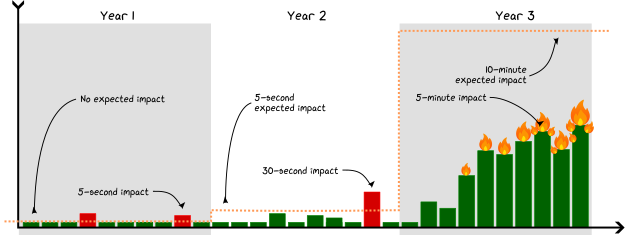
The collapse When we needed new servers, the on-site team would take a set from the inventory, install our base Linux distribution on them, put them in the datacenter, and cable them to the top-of-the-rack switches. We opened a ticket describing the servers we needed, and one week later, our servers were available. Orange wanted to know if this team was performing well, so they asked for KPIs. They decided to use the number of tickets completed in a year. They asked to double this number. So instead of one ticket for a new service, we would open six tickets one per server. By the end of the year, the KPIs had more than doubled. Everybody saw it as a success for performance management. So, they asked to do the same for the next year. Now, we needed to open a ticket per server and per step. Again, the KPIs doubled. Behind the scenes, the tickets went to different people and were no longer handled in order. So, for the next year, it was decided to have meta-tickets and meetings to follow the progress of these tickets. Of course, all these extra steps pushed the KPI even higher. This performance management method spread to the other teams.5 Everything became slower. Instead of a couple of weeks, a new service now took six months. We built a Soviet nail factory. But the KPIs were good, and we stopped caring. Let me give you another example. We had to estimate the impact of each night operation. We weren t half bad: we declared most operations without any expected impact. Most of the time, there was no impact. One time out of five, there was a 5-second impact. We were told to try harder to meet our expected impact. What did we do? We started declaring a 5-second expected impact. One day, we got a 30-second impact and were told we failed to match the expected impact. In the end, we declared most operations with a 10-minute expected impact, and we stopped caring: instead of carefully shifting traffic around, we allowed ourselves a 5-minute impact. And our KPIs were never better.
Graph showing the impact of night operations. Year after year, the impact tolerance has been increased. In the final year, the expected impact is 10 minutes, and all operations remain under this threshold. However, the impacts are much more significant than they were in the first year.
An artist's rendering of the evolution of impacts over the years.

KPIs are not bad, but they are easy to break. Use them carefully: let the people doing the work help choose the metrics, and tie those metrics to the quality of the service for example, with service level objectives. Otherwise, even dedicated people stop caring, game the system, and eventually quit.6

  1. Internally, this division was named Hebex. It was located in Bagnolet (next to Paris) and Sophia-Antipolis (near Nice).
  2. Goodhart s law often gets the credit, but Campbell s law describes my experience even better: the more you lean on a number to make decisions, the faster people corrupt it.
  3. At the time, SaaS was not really a thing. I remember we considered, with a couple of colleagues, selling Wiremaps as a SaaS, with homomorphic encryption for the database. But who would outsource their observability stack?
  4. Snalert was a metacircular alerting tool in Perl. It was able to poll a very large number of SNMP targets in a short timespan. All our monitoring was SNMP-based, including system monitoring.
  5. My team also managed the rules of many Linux-based firewalls. To increase our KPIs, we used the same method: rather than accepting one ticket with a flow matrix, we requested one ticket per flow.
  6. Orange is not unique. Google s promotion process is another well-known example of a broken KPI. Michael Lynch explains it in Why I Quit Google to Work for Myself.

12 March 2026

Mike Gabriel: Debian Lomiri Tablets 2025-2027 - Project Report (Q4/2025)

On 25th Oct 2025, I announced via my personal blog and on Mastodon that Fre(i)e Software GmbH was hiring. The hiring process was a mix of asking developers I know and waiting for new people to apply. At the beginning of November 2025 / in mid November 2025, we started with 13 developers (all part-time) to work on various topics around Lomiri (upstream and downstream). Note that the below achievements don't document the overall activity in the Lomiri project, but that part that our team at Fre(i)e Software GmbH contributed to. Organizational Achievements Maintenance Development Qt6 Porting Feature Development Research [1] https://gitlab.com/groups/ubports/development/-/boards/9895029?label_name%5B%5D=Topic%3A%20Qt%206
[2] https://gitlab.com/groups/ubports/development/-/boards/10037876?label_name[]=Topic%3A%20salsa2ubports%20DEB%20syncing

28 February 2026

Mike Gabriel: Debian Lomiri Tablets 2025-2027 - Project Report (Q3/2025)

Debian Lomiri for Debian 13 (previous project) In our previous project around Debian and Lomiri (lasting until July 2025), we achieved to get Lomiri 0.5.0 (and with it another 130 packages) into Debian (with two minor exceptions [1]) just in time for the Debian 13 release in August 2025. Debian Lomiri for Debian 14 At DebConf in Brest, a follow-up project has been designed between the project sponsor and Fre(i)e Software GmbH [2]. The new project (on paper) started on 1st August 2025 and project duration was agreed on to be 2 years, allowing our company to work with an equivalent of ~5 FTE on Lomiri targetting the Debian 14 release some time in the second half of 2027 (an assumed date, let's see what happens). Ongoing work would be covered from day one of the new project and once all contract details had been properly put on paper end of September, Fre(i)e Software GmbH started hiring a new team of software developers and (future) Debian maintainers. (More of that new team in our next Q4/2025 report). The ongoing work of Q3/2025 was basically Guido Berh rster and myself working on Morph Browser Qt6 (mostly Guido together with Bhushan from MiraLab [3]) and package maintenance in Debian (mostly me). Morph Browser Qt6 The first milestone we could reach with the Qt6 porting of Morph Browser [4] and related components (LUITK aka lomiri-ui-toolkit (big chunk! [5]), lomiri-content-hub, lomiri-download-manager and a few other components) was reached on 21st Sep 2025 with an upload of Morph Browser 1.2.0~git20250813.1ca2aa7+dfsg-1~exp1 to Debian experimental and the Lomiri PPA [6]). Preparation of Debian 13 Updates (still pending) In background, various Lomiri updates for Debian 13 have been prepared during Q3/2025 (with a huge patchset), but publishing those to Debian 13 are still pending as tests are still not satisfying. [1] lomiri-push-service and nuntium
[2] https://freiesoftware.gmbh
[3] https://miralab.one/
[4] https://gitlab.com/ubports/development/core/morph-browser/-/merge_reques... et al.
[5] https://gitlab.com/ubports/development/core/lomiri-ui-toolkit/-/merge_re... et al.
[6] https://launchpad.net/~lomiri

25 December 2025

Russ Allbery: Review: Machine

Review: Machine, by Elizabeth Bear
Series: White Space #2
Publisher: Saga Press
Copyright: October 2020
ISBN: 1-5344-0303-5
Format: Kindle
Pages: 485
Machine is a far-future space opera. It is a loose sequel to Ancestral Night, but you do not have to remember the first book to enjoy this book and they have only a couple of secondary characters in common. There are passing spoilers for Ancestral Night in the story, though, if you care. Dr. Brookllyn Jens is a rescue paramedic on Synarche Medical Vessel I Race To Seek the Living. That means she goes into dangerous situations to get you out of them, patches you up enough to not die, and brings you to doctors who can do the slower and more time-consuming work. She was previously a cop (well, Judiciary, which in this universe is mostly the same thing) and then found that medicine, and specifically the flagship Synarche hospital Core General, was the institution in all the universe that she believed in the most. As Machine opens, Jens is boarding the Big Rock Candy Mountain, a generation ship launched from Earth during the bad era before right-minding and joining the Synarche, back when it looked like humanity on Earth wouldn't survive. Big Rock Candy Mountain was discovered by accident in the wrong place, going faster than it was supposed to be going and not responding to hails. The Synarche ship that first discovered and docked with it is also mysteriously silent. It's the job of Jens and her colleagues to get on board, see if anyone is still alive, and rescue them if possible. What they find is a corpse and a disturbingly servile early AI guarding a whole lot of people frozen in primitive cryobeds, along with odd artificial machinery that seems to be controlled by the AI. Or possibly controlling the AI. Jens assumes her job will be complete once she gets the cryobeds and the AI back to Core General where both the humans and the AI can be treated by appropriate doctors. Jens is very wrong. Machine is Elizabeth Bear's version of a James White Sector General novel. If one reads this book without any prior knowledge, the way that I did, you may not realize this until the characters make it to Core General, but then it becomes obvious to anyone who has read White's series. Most of the standard Sector General elements are here: A vast space station with rings at different gravity levels and atmospheres, a baffling array of species, and the ability to load other people's personalities into your head to treat other species at the cost of discomfort and body dysmorphia. There's a gruff supervisor, a fragile alien doctor, and a whole lot of idealistic and well-meaning people working around complex interspecies differences. Sadly, Bear does drop White's entertainingly oversimplified species classification codes; this is the correct call for suspension of disbelief, but I kind of missed them. I thoroughly enjoy the idea of the Sector General series, so I was delighted by an updated version that drops the sexism and the doctor/nurse hierarchy and adds AIs, doctors for AIs, and a more complicated political structure. The hospital is even run by a sentient tree, which is an inspired choice. Bear, of course, doesn't settle for a relatively simple James White problem-solving plot. There are interlocking, layered problems here, medical and political, immediate and structural, that unwind in ways that I found satisfyingly twisty. As with Ancestral Night, Bear has some complex points to make about morality. I think that aspect of the story was a bit less convincing than Ancestral Night, in part because some of the characters use rather bizarre tactics (although I will grant they are the sort of bizarre tactics that I could imagine would be used by well-meaning people using who didn't think through all of the possible consequences). I enjoyed the ethical dilemmas here, but they didn't grab me the way that Ancestral Night did. The setting, though, is even better: An interspecies hospital was a brilliant setting when James White used it, and it continues to be a brilliant setting in Bear's hands. It's also worth mentioning that Jens has a chronic inflammatory disease and uses an exoskeleton for mobility, and (as much as I can judge while not being disabled myself) everything about this aspect of the character was excellent. It's rare to see characters with meaningful disabilities in far-future science fiction. When present at all, they're usually treated like Geordi's sight: something little different than the differential abilities of the various aliens, or even a backdoor advantage. Jens has a true, meaningful disability that she has to manage and that causes a constant cognitive drain, and the treatment of her assistive device is complex and nuanced in a way that I found thoughtful and satisfying. The one structural complaint that I will make is that Jens is an astonishingly talkative first-person protagonist, particularly for an Elizabeth Bear novel. This is still better than being inscrutable, but she is prone to such extended philosophical digressions or infodumps in the middle of a scene that I found myself wishing she'd get on with it already in a few places. This provides good characterization, in the sense that the reader certainly gets inside Jens's head, but I think Bear didn't get the balance quite right. That complaint aside, this was very fun, and I am certainly going to keep reading this series. Recommended, particularly if you like James White, or want to see why other people do.
The most important thing in the universe is not, it turns out, a single, objective truth. It's not a hospital whose ideals you love, that treats all comers. It's not a lover; it's not a job. It's not friends and teammates. It's not even a child that rarely writes me back, and to be honest I probably earned that. I could have been there for her. I didn't know how to be there for anybody, though. Not even for me. The most important thing in the universe, it turns out, is a complex of subjective and individual approximations. Of tries and fails. Of ideals, and things we do to try to get close to those ideals. It's who we are when nobody is looking.
Followed by The Folded Sky. Rating: 8 out of 10

21 October 2025

Russ Allbery: Review: Space Trucker Jess

Review: Space Trucker Jess, by Matthew Kressel
Publisher: Fairwood Press
Copyright: July 2025
ISBN: 1-958880-27-2
Format: Kindle
Pages: 472
Space Trucker Jess is a stand-alone far-future space fantasy novel. Jess is a sixteen-year-old mechanic working grey-market jobs on Chadeisson Station with a couple of younger kids. She's there because her charming and utterly unreliable father got caught running a crypto scam and is sitting in detention. This was only the latest in a long series of scams, con jobs, and misadventures she's been dragged through since her mother disappeared without a word. Jess is cynical, world-weary, and infuriated by her own sputtering loyalty to her good-for-nothing dad. What Jess wants most in the universe is to own a CCM 6454 Spark Megahauler, the absolute best cargo ship in the universe according to Jess. She should know; she's worked on nearly every type of ship in existence. With her own ship, she could make a living hauling cargo, repairing her own ship, and going anywhere she wants, free of her father and his endless schemes. (A romantic relationship with her friend Leurie would be a nice bonus.) Then her father is taken off the station on a ship leaving the galactic plane, no one will tell her why, and all the records of the ship appear to have been erased. Jess thinks her father is an asshole, but that doesn't mean she can sit idly by when he disappears. That's how she ends up getting in serious trouble with station security due to some risky in-person sleuthing, followed by an expensive flight off the station with a dodgy guy and a kid in a stolen spaceship. The setup for this book was so great. Kressel felt the need to make up a futuristic slang for Jess and her friends to speak, which rarely works as well as the author expects and does not work here, but apart from that I was hooked. Jess is sarcastic, blustery, and a bit of a con artist herself, but with the idealistic sincerity of someone who knows that her life is been kind of broken and understands the value of friends. She's profoundly cynical in the heartbreakingly defensive way of a sixteen-year-old with a rough life. I have a soft spot in my heart for working-class science fiction (there isn't nearly enough of it), and there are few things I enjoy more than reading about the kind of protagonist who has Opinions about starship models and a dislike of shoddy work. I think this is the only book I've bought solely on the basis of one of the Big Idea blog posts John Scalzi hosts. I really wish this book had stuck with the setup instead of morphing into a weird drug-enabled mystical space fantasy, to which Jess's family is bizarrely central. SPOILERS below because I can't figure out how to rant about what annoyed me without them. Search for the next occurrence of spoilers to skip past them. There are three places where this book lost me. The first was when Jess, after agreeing to help another kid find his father, ends up on a world obsessed with a religious cult involving using hallucinatory drugs to commune with alien gods. Jess immediately flags this as unbelievable bullshit and I was enjoying her well-founded cynicism until Kressel pulls the rug out from under both Jess and the reader by establishing that this new-age claptrap is essentially true. Kressel does try to put a bit of a science fiction gloss on it, but sadly I think that effort was unsuccessful. Sometimes absurdly powerful advanced aliens with near-telepathic powers are part of the fun of a good space opera, but I want the author to make an effort to connect the aliens to plausibility or, failing that, at least avoid sounding indistinguishable from psychic self-help grifters or religious fantasy about spiritual warfare. Stargate SG-1 and Babylon 5 failed on the first part but at least held the second line. Kressel gets depressingly close to Seth territory, although at least Jess is allowed to retain some cynicism about motives. The second, related problem is that Jess ends up being a sort of Chosen One, which I found intensely annoying. This may be a fault of reader expectations more than authorial skill, but one of the things I like to see in working-class science fiction is for the protagonist to not be absurdly central to the future of the galaxy, or to at least force themselves into that position through their own ethics and hard work. This book turns into a sort of quest story with epic fantasy stakes, which I thought was much less interesting than the story the start of the book promised and which made Jess a less interesting character. Finally, this is one of those books where Jess's family troubles and the plot she stumbles across turn into the same plot. Space Trucker Jess is far from alone in having that plot structure, and that's the problem. I'm not universally opposed to this story shape, but Jess felt like the wrong character for it. She starts the story with a lot of self-awareness about how messed up her family dynamics were, and I was rooting for her to find some space to construct her own identity separate from her family. To have her family turn out to be central not only to this story but to the entire galaxy felt like it undermined that human core of the story, although I admit it's a good analogy to the type of drama escalation that dysfunctional families throw at anyone attempting to separate from them. Spoilers end here. I rather enjoyed the first third of this book, despite being a bit annoyed at the constructed slang, and then started rolling my eyes and muttering things about the story going off the rails. Jess is a compelling enough character (and I'm stubborn enough) that I did finish the book, so I can say that I liked the very end. Kressel does finally arrive at the sort of story that I wanted to read all along. Unfortunately, I didn't enjoy the path he took to get there. I think much of my problem was that I wanted Jess to be a more defiant character earlier in the novel, and I wanted her family problems to influence her character growth but not be central to her story. Both of these may be matters of opinion and an artifact of coming into the book with the wrong assumptions. If you are interested in a flawed and backsliding effort to untangle one's identity from a dysfunctional family and don't mind some barely-SF space mysticism and chosen one vibes, it's possible this book will click with you. It's not one that I can recommend, though. I still want the book that I hoped I was getting from that Big Idea piece. Rating: 4 out of 10

25 August 2025

Gunnar Wolf: The comedy of computation, or, how I learned to stop worrying and love obsolescence

This post is a review for Computing Reviews for The comedy of computation, or, how I learned to stop worrying and love obsolescence , a book published in Stanford University Press
The Comedy of Computation is not an easy book to review. It is a much enjoyable book that analyzes several examples of how being computational has been approached across literary genres in the last century how authors of stories, novels, theatrical plays and movies, focusing on comedic genres, have understood the role of the computer in defining human relations, reactions and even self-image. Mangrum structures his work in six thematic chapters, where he presents different angles on human society: How have racial stereotypes advanced in human imagination and perception about a future where we interact with mechanical or computational partners (from mechanical tools performing jobs that were identified with racial profiles to intelligent robots that threaten to control society); the genericity of computers and people can be seen as generic, interchangeable characters, often fueled by the tendency people exhibit to confer anthropomorphic qualities to inanimate objects; people s desire to be seen as truly authentic , regardless of what it ultimately means; romantic involvement and romance-led stories (with the computer seen as a facilitator for human-to-human romances, distractor away from them, or being itself a part of the couple); and the absurdity in antropomorphization, in comparing fundamentally different aspects such as intelligence and speed at solving mathematical operations, as well as the absurdity presented blatantly as such by several techno-utopian visions. But presenting this as a linear set of concepts that are presented does not do justice to the book. Throughout the sections of each chapter, a different work serves as the axis Novels and stories, Hollywood movies, Broadway plays, some covers for the Time magazine, a couple of presenting the would-be future, even a romantic comedy entirely written by bots . And for each of them, Benjamin Mangrum presents a very thorough analysis, drawing relations and comparing with contemporary works, but also with Shakespeare, classical Greek myths, and a very long etc tera. This book is hard to review because of the depth of work the author did: Reading it repeatedly made me look for other works, or at least longer references for them. Still, despite being a work with such erudition, Mangrum s text is easy and pleasant to read, without feeling heavy or written in an overly academic style. I very much enjoyed reading this book. It is certainly not a technical book about computers and society in any way; it is an exploration of human creativity and our understanding of the aspects the author has found as central to understanding the impact of computing on humankind. However, there is one point I must mention before closing: I believe the editorial decision to present the work as a running text, with all the material conceptualized as footnotes presented as a separate, over 50 page long final chapter, detracts from the final result. Personally, I enjoy reading the footnotes because they reveal the author s thought processes, even if they stray from the central line of thought. Even more, given my review copy was a PDF, I could not even keep said chapter open with one finger, bouncing back and forth. For all purposes, I missed out on the notes; now that I finished reading and stumbled upon that chapter, I know I missed an important part of the enjoyment.

22 June 2025

Iustin Pop: Coding, as we knew it, has forever changed

Back when I was terribly na ve When I was younger, and definitely na ve, I was so looking forward to AI, which will help us write lots of good, reliable code faster. Well, principally me, not thinking what impact it will have industry-wide. Other more general concerns, like societal issues, role of humans in the future and so on were totally not on my radar. At the same time, I didn t expect this will actually happen. Even years later, things didn t change dramatically. Even the first release of ChatGPT a few years back didn t click for me, as the limitations were still significant.

Hints of serious change The first hint of the change, for me, was when a few months ago (yes, behind the curve), I asked ChatGPT to re-explain a concept to me, and it just wrote a lot of words, but without a clear explanation. On a whim, I asked Grok then recently launched, I think to do the same. And for the first time, the explanation clicked and I felt I could have a conversation with it. Of course, now I forgot again that theoretical CS concept, but the first step was done: I can ask an LLM to explain something, and it will, and I can have a back and forth logical discussion, even if on some theoretical concept. Additionally, I learned that not all LLMs are the same, and that means there s real competition and that leap frogging is possible. Another topic on which I tried to adopt early and failed to get mileage out of it, was GitHub Copilot (in VSC). I tried, it helped, but didn t feel any speed-up at all. Then more recently, in May, I asked Grok what s the state of the art in AI-assisted coding. It said either Claude in a browser tab, or in VSC via continue.dev extension. The continue.dev extension/tooling is a bit of a strange/interesting thing. It seems to want to be a middle-man between the user and actual LLM services, i.e. you pay a subscription to continue.dev, not to Anthropic itself, and they manage the keys/APIs, for whatever backend LLMs you want to use. The integration with Visual Studio Code is very nice, but I don t know if long-term their business model will make sense. Well, not my problem.

Claude: reverse engineering my old code and teaching new concepts So I installed the latter and subscribed, thinking 20 CHF for a month is good for testing. I skipped the tutorial model/assistant, created a new one from scratch, just enabled Claude 3.7 Sonnet, and started using it. And then, my mind was blown-not just by the LLM, but by the ecosystem. As said, I ve used GitHub copilot before, but it didn t seem effective. I don t know if a threshold has been reached, or Claude (3.7 at that time) is just better than ChatGPT. I didn t use the AI to write (non-trivial) code for me, at most boilerplate snippets. But I used it both as partner for discussion - I want to do x, what do you think, A or B? , and as a teacher, especially for fronted topics, which I m not familiar with. Since May, in mostly fragmented sessions, I ve achieved more than in the last two years. Migration from old school JS to ECMA modules, a webpacker (reducing bundle size by 50%), replacing an old Javascript library with hand written code using modern APIs, implementing the zoom feature together with all of keyboard, mouse, touchpad and touchscreen support, simplifying layout from manually computed to automatic layout, and finding a bug in webkit for which it also wrote a cool minimal test (cool, as in, way better than I d have ever, ever written, because for me it didn t matter that much). And more. Could I have done all this? Yes, definitely, nothing was especially tricky here. But hours and hours of reading MDN, scouring Stack Overflow and Reddit, and lots of trial and error. So doable, but much more toily. This, to me, feels like cheating. 20 CHF per month to make me 3x more productive is free money well, except that I don t make money on my code which is written basically for myself. However, I don t get stuck anymore searching hours in the web for guidance, I ask my question, and I get at least direction if not answer, and I m finished way earlier. I can now actually juggle more hobbies, in the same amount of time, if my personal code takes less time or differently said, if I m more efficient at it. Not all is roses, of course. Once, it did write code with such an endearing error that it made me laugh. It was so blatantly obvious that you shouldn t keep other state in the array that holds pointer status because that confuses the calculation of how many pointers are down , probably to itself too if I d have asked. But I didn t, since it felt a bit embarassing to point out such a dumb mistake. Yes, I m anthropomorphising again, because this is the easiest way to deal with things. In general, it does an OK-to-good-to-sometimes-awesome job, and the best thing is that it summarises documentation and all of Reddit and Stack Overflow. And gives links to those. Now, I have no idea yet what this means for the job of a software engineer. If on open source code, my own code, it makes me 3x faster reverse engineering my code from 10 years ago is no small feat for working on large codebases, it should do at least the same, if not more. As an example of how open-ended the assistance can be, at one point, I started implementing a new feature threading a new attribute to a large number of call points. This is not complex at all, just add a new field to a Haskell record, and modifying everything to take it into account, populate it, merge it when merging the data structures, etc. The code is not complex, tending toward boilerplate a bit, and I was wondering on a few possible choices for implementation, so, with just a few lines of code written that were not even compiling, I asked I want to add a new feature, should I do A or B if I want it to behave like this , and the answer was something along the lines of I see you want to add the specific feature I was working on, but the implementation is incomplete, you still need to to X, Y and Z . My mind was blown at this point, as I thought, if the code doesn t compile, surely the computer won t be able to parse it, but this is not a program, this is an LLM, so of course it could read it kind of as a human would. Again, the code complexity is not great, but the fact that it was able to read a half-written patch, understand what I was working towards, and reason about, was mind-blowing, and scary. Like always.

Non-code writing Now, after all this, while writing a recent blog post, I thought this is going to be public anyway, so let me ask Claude what it thinks about it. And I was very surprised, again: gone was all the pain of rereading three times my post to catch typos (easy) or phrasing structure issues. It gave me very clearly points, and helped me cut 30-40% of the total time. So not only coding, but word smithing too is changed. If I were an author, I d be delighted (and scared). Here is the overall reply it gave me:
  • Spelling and grammar fixes, all of them on point except one mistake (I claimed I didn t capitalize one word, but I did). To the level of a good grammar checker.
  • Flow Suggestions, which was way beyond normal spelling and grammar. It felt like a teacher telling me to do better in my writing, i.e. nitpicking on things that actually were true even if they d still work. I.e. lousy phrase structure, still understandable, but lousy nevertheless.
  • Other notes: an overall summary. This was mostly just praising my post . I wish LLMs were not so focused on praise the user .
So yeah, this speeds me up to about 2x on writing blog posts, too. It definitely feels not fair.

Wither the future? After all this, I m a bit flabbergasted. Gone are the 2000 s with code without unittests, gone are the 2010 s without CI/CD, and now, mid-2020 s, gone is the lone programmer that scours the internet to learn new things, alone? What this all means for our skills in software development, I have no idea, except I know things have irreversibly changed (a butlerian jihad aside). Do I learn better with a dedicated tutor even if I don t fight with the problem for so long? Or is struggling in finding good docs the main method of learning? I don t know yet. I feel like I understand the topics I m discussing with the AI, but who knows in reality what it will mean long term in terms of stickiness of learning. For the better, or for worse, things have changed. After all the advances over the last five centuries in mechanical sciences, it has now come to some aspects of the intellectual work. Maybe this is the answer to the ever-growing complexity of tech stacks? I.e. a return of the lone programmer that builds things end-to-end, but with AI taming the complexity added in the last 25 years? I can dream, of course, but this also means that the industry overall will increase in complexity even more, because large companies tend to do that, so maybe a net effect of not much One thing I did learn so far is that my expectation that AI (at this level) will only help junior/beginner people, i.e. it would flatten the skills band, is not true. I think AI can speed up at least the middle band, likely the middle top band, I don t know about the 10x programmers (I m not one of them). So, my question about AI now is how to best use it, not to lament how all my learning (90% self learning, to be clear) is obsolete. No, it isn t. AI helps me start and finish one migration (that I delayed for ages), then start the second, in the same day. At the end of this a bit rambling reflection on the past month and a half, I still have many questions about AI and humanity. But one has been answered: yes, AI , quotes or no quotes, already has changed this field (producing software), and we ve not seen the end of it, for sure.

26 April 2025

John Goerzen: Memoirs of the Early Internet

The Internet is an amazing place, and occasionally you can find things on the web that have somehow lingered online for decades longer than you might expect. Today I ll take you on a tour of some parts of the early Internet. The Internet, of course, is a network of networks and part of its early (and continuing) promise was to provide a common protocol that all sorts of networks can use to interoperate with each other. In the early days, UUCP was one of the main ways universities linked with each other, and eventually UUCP and the Internet sort of merged (but that s a long story). Let s start with some Usenet maps, which were an early way to document the UUCP modem links between universities. Start with this PDF. The first page is a Usenet map (which at the time mostly flowed over UUCP) from April of 1981. Notice that ucbvax, a VAX system at Berkeley, was central to the map. ucbvax continued to be a central node for UUCP for more than a decade; on page 5 of that PDF, you ll see that it asks for a Path from a major node (eg, ucbvax, devcax, harpo, duke) . Pre-Internet email addresses used a path; eg, mark@ucbvax was duke!decvax!ucbvax!mark to someone. You had to specify the route from your system to the recipient on your email To line. If you gave out your email address on a business card, you would start it from a major node like ucbvax, and the assumption was that everyone would know how to get from their system to the major node. On August 19, 1994, ucbvax was finally turned off. TCP/IP had driven UUCP into more obscurity; by then, it was mostly used by people without a dedicated Internet connection to get on the Internet, rather than an entire communication network of its own. A few days later, Cliff Frost posted a memoir of ucbvax; an obscurbe bit of Internet lore that is fun to read. UUCP was ad-hoc, and by 1984 there was an effort to make a machine-parsable map to help automate routing on UUCP. This was called the pathalias project, and there was a paper about it. The Linux network administration guide even includes a section on pathalias. Because UUCP mainly flowed over phone lines, long distance fees made it quite expensive. In 1985, the Stargate Project was formed, with the idea of distributing Usenet by satellite. The satellite link was short-lived, but the effort eventually morphed into UUNET. It was initially a non-profit, but eventually became a commercial backbone provider, and later ISP. Over a long series of acquisitions, UUNET is now part of Verizon. An article in ;login: is another description of this history. IAPS has an Internet in 1990 article, which includes both pathalias data and an interesting map of domain names to UUCP paths. As I was pondering what interesting things a person could do with NNCPNET Internet email, I stumbled across a page on getting FTP files via e-mail. Yes, that used to be a thing! I remember ftpmail@decwrl.dec.com. It turns out that page is from a copy of EFF s (Extended) Guide to the Internet from 1994. Wow, what a treasure! It has entries such as A Slice of Life in my Virtual Community, libraries with telnet access, Gopher, A Statement of Principle by Bruce Sterling, and I could go on. You can also get it as a PDF from Internet Archive. UUCP is still included with modern Linux and BSD distributions. It was part of how I experienced the PC and Internet revolution in rural America. It lacks modern security, but NNCP is to UUCP what ssh is to telnet.

24 February 2025

Russ Allbery: Review: A Little Vice

Review: A Little Vice, by Erin E. Elkin
Publisher: Erin Elkin
Copyright: June 2024
ASIN: B0CTHRK61X
Format: Kindle
Pages: 398
A Little Vice is a stand-alone self-published magical girl novel. It is the author's first novel. C is a high school student and frequent near-victim of monster attacks. Due to the nefarious work of Avaritia Wolf and her allies, his high school is constantly attacked by Beasts, who are magical corruptions of some internal desire taken to absurd extremes. Standing in their way are the Angelic Saints: magical girls who transform into Saint Castitas, Saint Diligentia, and Saint Temperantia and fight the monsters. The monsters for some reason seem disposed to pick C as their victim for hostage-taking, mind control, use as a human shield, and other rather traumatic activities. He's always rescued by the Saints before any great harm is done, but in some ways this makes the situation worse. It is obvious to C that the Saints are his three friends Inessa, Ida, and Temperance, even though no one else seems able to figure this out despite the blatant clues. Inessa has been his best friend since childhood when she was awkward and needed his support. Now, she and his other friends have become literal heroes, beautiful and powerful and capable, constantly protecting the school and innocent people, and C is little more than a helpless burden to be rescued. More than anything else, he wishes he could be an Angelic Saint like them, but of course the whole idea is impossible. Boys don't get to be magical girls. (I'm using he/him pronouns for C in this review because C uses them for himself for most of the book.) This is a difficult book to review because it is deeply focused on portraying a specific internal emotional battle in all of its sometimes-ugly complexity, and to some extent it prioritizes that portrayal over conventional story-telling. You have probably already guessed that this is a transgender coming-out story Elkin's choice of the magical girl genre was done with deep understanding of its role in transgender narratives but more than that, it is a transgender coming-out story of a very specific and closely-observed type. C knows who he wishes he was, but he is certain that this transformation is absolutely impossible. He is very deep in a cycle of self-loathing for wanting something so manifestly absurd and insulting to people who have the virtues that C does not. A Little Vice is told in the first person from C's perspective, and most of this book is a relentless observation of C's anxiety and shame spiral and reflexive deflection of any possibility of a way out. This is very well-written: Elkin knows the reader is going to disagree with C's internalized disgust and hopelessness, knows the reader desperately wants C to break out of that mindset, and clearly signals in a myriad of adroit ways that Elkin is on the reader's side and does not agree with C's analysis. C's friends are sympathetic, good-hearted people, and while sometimes oblivious, it is obvious to the reader that they're also on the reader's side and would help C in a heartbeat if they saw an opening. But much of the point of the book is that it's not that easy, that breaking out of the internal anxiety spiral is nearly impossible, and that C is very good at rejecting help, both because he cannot imagine what form it could take but also because he is certain that he does not deserve it. In other words, much of the reading experience of this book involves watching C torture and insult himself. It's all the more effective because it isn't gratuitous. C's internal monologue sounds exactly like how an anxiety spiral feels, complete with the sort of half-effective coping mechanisms, deflections, and emotional suppression one develops to blunt that type of emotional turmoil. I normally hate this kind of book. I am a happy ending and competence porn reader by default. The world is full of enough pain that I don't turn to fiction to read about more pain. It says a lot about how well-constructed this book is that I stuck with it. Elkin is going somewhere with the story, C gets moments of joy and delight along the way to keep the reader from bogging down completely, and the best parts of the book feel like a prolonged musical crescendo with suspended chords. There is a climax coming, but Elkin is going to make you wait for it for far longer than you want to. The main element that protects A Little Vice from being too grim is that it is a genre novel that is very playful about both magical girls and superhero tropes in general. I've already alluded to one of those elements: Elkin plays with the Mask Principle (the inability of people to see through entirely obvious secret identities) in knowing and entertaining ways. But there are also villains, and that leads me to the absolutely delightful Avaritia Wolf, who for me was the best character in this book. The Angelic Saints are not the only possible approach to magical girl powers in this universe. There are villains who can perform a similar transformation, except they embrace a vice rather than a virtue. Avaritia Wolf embraces the vice of greed. They (Avaritia's pronouns change over the course of the book) also have a secret identity, which I suspect will be blindingly obvious to most readers but which I'll avoid mentioning since it's still arguably a spoiler. The primary plot arc of this book is an attempt to recruit C to the side of the villains. The Beasts are drawn to him because he has magical potential, and the villains are less picky about gender. This initially involves some creepy and disturbing mind control, but it also brings C into contact with Avaritia and Avaritia's very specific understanding of greed. As far as Avaritia is concerned, greed means wanting whatever they want, for whatever reason they feel like wanting it, and there is absolutely no reason why that shouldn't include being greedy for their friends to be happy. Or doing whatever they can to make their friends happy, whether or not that looks like villainy. Elkin does two things with this plot that I thought were remarkably skillful. The first is that she directly examines and then undermines the "easy" transgender magical girl ending. In a world of transformation magic, someone who wants to be a girl could simply turn into a girl and thus apparently resolve the conflict in a way that makes everyone happy. I think there is an important place for that story (I am a vigorous defender of escapist fantasy and happy endings), but that is not the story that Elkin is telling. I won't go into the details of why and how the story complicates and undermines this easy ending, but it's a lot of why this book feels both painful and honest to a specific, and very not easy, transgender experience, even though it takes place in an utterly unrealistic world. But the second, which is more happy and joyful, is that Avaritia gleefully uses a wholehearted embrace of every implication of the vice of greed to bulldoze the binary morality of the story and question the classification of human emotions into virtues and vices. They are not a hero, or even all that good; they have some serious flaws and a very anarchic attitude towards society. But Avaritia provides the compelling, infectious thrill of the character who looks at the social construction of morality that is constraining the story and decides that it's all bullshit and refuses to comply. This is almost the exact opposite of C's default emotional position at the start of the book, and watching the two characters play off of each other in a complex friendship is an absolute delight. The ending of this book is complicated, messy, and incomplete. It is the sort of ending that I think could be incredibly powerful if it hits precisely the right chords with the reader, but if you're not that reader, it can also be a little heartbreaking because Elkin refuses to provide an easy resolution. The ending also drops some threads that I wish Elkin hadn't dropped; there are some characters who I thought deserved a resolution that they don't get. But this is one of those books where the author knows exactly what story they're trying to tell and tells it whether or not that fits what the reader wants. Those books are often not easy reading, but I think there's something special about them. This is not the novel for people who want detailed world-building that puts a solid explanation under events. I thought Elkin did a great job playing with the conventions of an episodic anime, including starting the book on Episode 12 to imply C's backstory with monster attacks and hinting at a parallel light anime story by providing TV-trailer-style plot summaries and teasers at the start and end of each chapter. There is a fascinating interplay between the story in which the Angelic Saints are the protagonists, which the reader can partly extrapolate, and the novel about C that one is actually reading. But the details of the world-building are kept at the anime plot level: There's an arch-villain, a World Tree, and a bit of backstory, but none of it makes that much sense or turns into a coherent set of rules. This is a psychological novel; the background and rules exist to support C's story. If you do want that psychological novel... well, I'm not sure whether to recommend this book or not. I admire the construction of this book a great deal, but I don't think appealing to the broadest possible audience was the goal. C's anxiety spiral is very repetitive, because anxiety spirals are very repetitive, and you have to be willing to read for the grace notes on the doom loop if you're going to enjoy this book. The sentence-by-sentence writing quality is fine but nothing remarkable, and is a bit shy of the average traditionally-published novel. The main appeal of A Little Vice is in the deep and unflinching portrayal of a specific emotional journey. I think this book is going to work if you're sufficiently invested in that journey that you are willing to read the brutal and repetitive parts. If you're not, there's a chance you will bounce off this hard. I was invested, and I'm glad I read this, but caveat emptor. You may want to try a sample first. One final note: If you're deep in the book world, you may wonder, like I did, if the title is a reference to Hanya Yanagihara's (in)famous A Little Life. I do not know for certain I have not read that book because I am not interested in being emotionally brutalized but if it is, I don't think there is much similarity. Both books are to some extent about four friends, but I couldn't find any other obvious connections from some Wikipedia reading, and A Little Vice, despite C's emotional turmoil, seems to be considerably more upbeat. Content notes: Emotionally abusive parent, some thoughts of self-harm, mind control, body dysmorphia, and a lot (a lot) of shame and self-loathing. Rating: 7 out of 10

31 January 2025

Gunnar Wolf: ChatGPT is bullshit

This post is an unpublished review for ChatGPT is bullshit
As people around the world understand how LLMs behave, more and more people wonder as to why these models hallucinate, and what can be done about to reduce it. This provocatively named article by Michael Townsen Hicks, James Humphries and Joe Slater bring is an excellent primer to better understanding how LLMs work and what to expect from them. As humans carrying out our relations using our language as the main tool, we are easily at awe with the apparent ease with which ChatGPT (the first widely available, and to this day probably the best known, LLM-based automated chatbot) simulates human-like understanding and how it helps us to easily carry out even daunting data aggregation tasks. It is common that people ask ChatGPT for an answer and, if it gets part of the answer wrong, they justify it by stating that it s just a hallucination. Townsen et al. invite us to switch from that characterization to a more correct one: LLMs are bullshitting. This term is formally presented by Frankfurt [1]. To Bullshit is not the same as to lie, because lying requires to know (and want to cover) the truth. A bullshitter not necessarily knows the truth, they just have to provide a compelling description, regardless of what is really aligned with truth. After introducing Frankfurt s ideas, the authors explain the fundamental ideas behind LLM-based chatbots such as ChatGPT; a Generative Pre-trained Transformer (GPT) s have as their only goal to produce human-like text, and it is carried out mainly by presenting output that matches the input s high-dimensional abstract vector representation, and probabilistically outputs the next token (word) iteratively with the text produced so far. Clearly, a GPT s ask is not to seek truth or to convey useful information they are built to provide a normal-seeming response to the prompts provided by their user. Core data are not queried to find optimal solutions for the user s requests, but are generated on the requested topic, attempting to mimic the style of document set it was trained with. Erroneous data emitted by a LLM is, thus, not equiparable with what a person could hallucinate with, but appears because the model has no understanding of truth; in a way, this is very fitting with the current state of the world, a time often termed as the age of post-truth [2]. Requesting an LLM to provide truth in its answers is basically impossible, given the difference between intelligence and consciousness: Following Harari s definitions [3], LLM systems, or any AI-based system, can be seen as intelligent, as they have the ability to attain goals in various, flexible ways, but they cannot be seen as conscious, as they have no ability to experience subjectivity. This is, the LLM is, by definition, bullshitting its way towards an answer: their goal is to provide an answer, not to interpret the world in a trustworthy way. The authors close their article with a plea for literature on the topic to adopt the more correct bullshit term instead of the vacuous, anthropomorphizing hallucination . Of course, being the word already loaded with a negative meaning, it is an unlikely request. This is a great article that mixes together Computer Science and Philosophy, and can shed some light on a topic that is hard to grasp for many users. [1] Frankfurt, Harry (2005). On Bullshit. Princeton University Press. [2] Zoglauer, Thomas (2023). Constructed truths: truth and knowledge in a post-truth world. Springer. [3] Harari, Yuval Noah (2023. Nexus: A Brief History of Information Networks From the Stone Age to AI. Random House.

2 January 2025

Colin Watson: Free software activity in December 2024

Most of my Debian contributions this month were sponsored by Freexian, as well as one direct donation via Liberapay (thanks!). OpenSSH I issued a bookworm update with a number of fixes that had accumulated over the last year, especially fixing GSS-API key exchange which was quite broken in bookworm. base-passwd A few months ago, the adduser maintainer started a discussion with me (as the base-passwd maintainer) and the shadow maintainer about bringing all three source packages under one team, since they often need to cooperate on things like user and group names. I agreed, but hadn t got round to doing anything about it until recently. I ve now officially moved it under team maintenance. debconf Gioele Barabucci has been working on eliminating duplicated code between debconf and cdebconf, ultimately with the goal of migrating to cdebconf (which I m not sure I m convinced of as a goal, but if we can make improvements to both packages as part of working towards it then there s no harm in that). I finally got round to reviewing and merging confmodule changes in each of debconf and cdebconf. This caused an installer regression due to a weirdness in cdebconf-udeb s packaging, which I fixed - sorry about that! I ve also been dealing with a few patch submissions that had been in my queue for a long time, but more on that next month if all goes well. CI issues I noticed and fixed a problem with Restrictions: needs-sudo in autopkgtest. I fixed broken aptly images in the Salsa CI pipeline. Python team Last month, I mentioned some progress on sorting out the multipart vs. python-multipart name conflict in Debian (#1085728), and said that I thought we d be able to finish it soon. I was right! We got it all done this month: The Python 3.13 transition continues, and last month we were able to add it to the supported Python versions in testing. (The next step will be to make it the default.) I fixed lots of problems in aid of this, including: Sphinx 8.0 removed some old intersphinx_mapping syntax which turned out to still be in use by many packages in Debian. The fixes for this were individually trivial, but there were a lot of them: I found that twisted 24.11.0 broke tests in buildbot and wokkel, and fixed those. I packaged python-flatdict, needed for a new upstream version of python-semantic-release. I tracked down a test failure in vdirsyncer (which I ve been using for some years, but had never previously needed to modify) and contributed a fix upstream. I fixed some packages to tolerate future versions of dh-python that will drop their dependency on python3-setuptools: I fixed django-cte to remove a build-dependency on the obsolete python3-nose package. I added Django 5.1 support to django-polymorphic. (There are a number of other packages that still need work here.) I fixed various other build/test failures: I upgraded these packages to new upstream versions: I updated the team s library style guide to remove material related to Python 2 and early versions of Python 3, which is no longer relevant to any current Python packaging work. Other Python upstream work I happened to notice a Twisted upstream issue requesting the removal of the deprecated twisted.internet.defer.returnValue, realized it was still used in many places in Debian, and went on a PR-filing spree informed by codesearch to try to reduce the future impact of such a change on Debian: Other small fixes Santiago Vila has been building the archive with make --shuffle (also see its author s explanation). I fixed associated bugs in cccc (contributed upstream), groff, and spectemu. I backported an upstream patch to putty to fix undefined behaviour that affected use of the small keypad . I removed groff s Recommends: libpaper1 (#1091375, #1091376), since it isn t currently all that useful and was getting in the way of a transition to libpaper2. I filed an upstream bug suggesting better integration in this area.

1 January 2025

Louis-Philippe V ronneau: 2024 A Musical Retrospective

Another musical retrospective. If you enjoy this, I also did a 2022 and a 2023 one. Albums In 2024, I added 88 new albums to my collection that's a lot! This year again, I bought the vast majority of my music on Bandcamp. To be honest, I'm quite distraught by what's become of that website. Although it stays a wonderful place to buy underground music, Songtradr, the new owner of the platform, has been shown to be viciously anti-union. Money continues to ruin the world, I guess. Concerts I continued to go to a lot of concerts in 2024 (25!). Over the past 3 years, I have been going to more and more concerts, and I think I've reached my "peak". A mean of a concert every two weeks is quite a lot :) If you also like music and concerts, but find yourself not going to as many as you would like, the real secret is not to be afraid to go to concerts alone. Going with friends is always fun, but if I restricted myself to only going to concerts in a group, I'd barely see a few each year. Another good advice is to bring a book or something else1 to pass the time between sets. It can often take 30-45 minutes between sets for the artists to get their instruments ready, which can get quite boring if you just stand there and wait. Anyway, here are the concerts I went to in 2024: Shout out to the Gancio project and to the folks running the Montreal instance. It continues to be a smash hit and most of the interesting concerts end up being advertised there. See you all in 2025!

  1. I bought a Miyoo Mini Plus, a handheld Linux console running OnionOS, for that express reason. So far it's been great and I've been very happy to revisit some childhood classics.

8 August 2024

Jonathan Carter: DebConf24 Busan, South Korea

I m finishing typing up this blog entry hours before my last 13 hour leg back home, after I spent 2 weeks in Busan, South Korea for DebCamp24 and DebCamp24. I had a rough year and decided to take it easy this DebConf. So this is the first DebConf in a long time where I didn t give any talks. I mostly caught up on a bit of packaging, worked on DebConf video stuff, attended a few BoFs and talked to people. Overall it was a very good DebConf, which also turned out to be more productive than I expeced it would. In the welcome session on the first day of DebConf, Nicolas Dandrimont mentioned that a benefit of DebConf is that it provides a sort of caffeine for your Debian motivation. I could certainly feel that affect swell as the days went past, and it s nice to be excited about some ideas again that would otherwise be fading.

Recovering DPL It s a bit of a gear shift being DPL for 4 years, and DebConf Committee for nearly 5 years before that, and then being at DebConf while some issue arise (as it always does during a conference). At first I jump into high alert mode, but then I have to remind myself it s not your problem anymore and let others deal with it. It was nice spending a little in-person time with Andreas Tille, our new DPL, we did some more handover and discussed some current issues. I still have a few dozen emails in my DPL inbox that I need to collate and forward to Andreas, I hope to finish all that up by the end of August. During the Bits from the DPL talk, the usual question came up whether Andreas will consider running for DPL again, to which he just responded in a slide Maybe . I think it s a good idea for a DPL to do at least two terms if it all works out for everyone, since it takes a while to get up to speed on everything. Also, having been DPL for four years, I have a lot to say about it, and I think there s a lot we can fix in the role, or at least discuss it. If I had the bandwidth for it I would have scheduled a BoF for it, but I ll very likely do that for the next DebConf instead!

Video team I set up the standby loop for the video streaming setup. We call it loopy, it s a bunch of OBS scenes that provide announcements, shows sponsors, the schedule and some social content. I wrote about it back in 2020, but it s evolved quite a bit since then, so I m probably due to write another blog post with a bunch of updates on it. I hope to organise a video team sprint in Cape Town in the first half of next year, so I ll summarize everything before then.

It would ve been great if we could have some displays in social areas that could show talks, the loop and other content, but we were just too pressed for time for that. This year s DebConf had a very compressed timeline, and there was just too much that had to be done and that had to be figured out on the last minute. This put quite a lot of strain on the organisers, but I was glad to see how, for the most part, most attendees were very sympathetic to some rough edges (but I digress ). I added more of the OBS machine setup to the videoteam s ansible repository, so as of now it just needs an ansible setup and the OBS data and it s good to go. The loopy data is already in the videoteam git repository, so I could probably just add a git pull and create some symlinks in ansible and then that machine can be installed from 0% to 100% by just installing via debian-installer with our ansible hooks. This DebConf I volunteered quite a bit for actual video roles during the conference, something I didn t have much time for in recent DebConfs, and it s been fun, especially in a session or two where nearly none of the other volunteers showed up. Sometimes chaos is just fun :-)
Baekyongee is the university mascot, who s visible throughout the university. So of course we included this four legged whale creature on the loop too!

Packaging I was hoping to do more packaging during DebCamp, but at least it was a non-zero amount:
  • Uploaded gdisk 1.0.10-2 to unstable (previously tested effects of adding dh-sequence-movetousr) (Closes: #1073679).
  • Worked a bit on bcachefs-tools (updating git to 1.9.4), but has a build failure that I need to look into (we might need a newer bindgen) update: I m probably going to ROM this package soon, it doesn t seem suitable for packaging in Debian.
  • Calamares: Tested a fix for encrypted installs, and uploaded it.
  • Calamares: Uploaded (3.3.8-1) to backports (at the time of writing it s still in backports-NEW).
  • Backport obs-gradient-source for bookworm.
  • Did some initial packaging on Cambalache, I ll upload to unstable once wlroots (0.18) hits unstable.
  • Pixelorama 1.0 I did some initial packaging for Pixelorama back when we did the MiniDebConf Gaming Edition, but it had a few stoppers back then. Version 1.0 seems to fix all of that, but it depends on Godot 4.2 and we re still on the 3 series in Debian, so I ll upload this once Godot 4.2 hits at least experimental. Godot software/games is otherwise quite easy to run, it s basically just source code / data that is installed and then run via godot-runner (godot3-runner package in Debian).

BoFs Python Team BoF Link to the etherpad / pad archive link and video can be found on the talk page: https://debconf24.debconf.org/talks/31-python-bof/ The session ended up being extended to a second part, since all the issues didn t fit into the first session. I was distracted by too many thing during the Python 3.12 transition (to the point where I thought that 3.11 was still new in Debian), so it was very useful listening to the retrospective of that transition. There was a discussion whether Python 3.13 could still make it to testing in time for freeze, and it seems that there is consensus that it can, although, likely with new experimental features like disabling the global interpreter lock and the just in time compiler disabled. I learned for the first time about the dead batteries project, PEP-0594, which removes ancient modules that have mostly been superseded, from the Python standard library. There was some talk about the process for changing team policy, and a policy discussion on whether we should require autopkgtests as a SHOULD or a MUST for migration to testing. As with many things, the devil is in the details and in my opinion you could go either way and achieve a similar result (the original MUST proposal allowed exceptions which imho made it the same as the SHOULD proposal). There s an idea to do some ongoing remote sprints, like having co-ordinated days for bug squashing / working on stuff together. This is a nice idea and probably a good way to energise the team and also to gain some interest from potential newcomers. Louis-Philipe V ronneau was added as a new team admin and there was some discussion on various Sphinx issues and which Lintian tags might be needed for Python 3.13. If you want to know more, you probably have to watch the videos / read the notes :)
    Debian.net BoF Link to the etherpad / pad archive link can be found on the talk page: https://debconf24.debconf.org/talks/37-debiannet-team-bof Debian Developers can set up services on subdomains on debian.net, but a big problem we ve had before was that developers were on their own for hosting those services. This meant that they either hosted it on their DSL/fiber connection at home, paid for the hosting themselves, or hosted it at different services which became an accounting nightmare to claim back the used funds. So, a few of us started the debian.net hosting project (sometimes we just call it debian.net, this is probably a bit of a bug) so that Debian has accounts with cloud providers, and as admins we can create instances there that gets billed directly to Debian. We had an initial rush of services, but requests have slowed down since (not really a bad thing, we don t want lots of spurious requests). Last year we did a census, to check which of the instances were still used, whether they received system updates and to ask whether they are performing backups. It went well and some issues were found along the way, so we ll be doing that again. We also gained two potential volunteers to help run things, which is great. Debian Social BoF Link to the etherpad / pad archive link can be found on the talk page: https://debconf24.debconf.org/talks/34-debiansocial-bof We discussed the services we run, you can view the current state of things at: https://wiki.debian.org/Teams/DebianSocial Pleroma has shown some cracks over the last year or so, and there are some forks that seem promising. At the same time, it might be worth while considering Mastodon too. So we ll do some comparison of features and maintenance and find a way forward. At the time when Pleroma was installed, it was way ahead in terms of moderation features. Pixelfed is doing well and chugging along nicely, we should probably promote it more. Peertube is working well, although we learned that we still don t have all the recent DebConf videos on there. A bunch of other issues should be fixed once we move it to a new machine that we plan to set up. We re removing writefreely and plume. Nice concepts, but it didn t get much traction yet, and no one who signed up for these actually used it, which is fine, some experimentation with services is good and sometimes they prove to be very popular and other times not. The WordPress multisite instance has some mild use, otherwise haven t had any issues. Matrix ended up to be much, much bigger than we thought, both in usage and in its requirements. It s very stateful and remembers discussions for as long as you let it, so it s Postgres database is continuously expanding, this will also be a lot easier to manage once we have this on the new host. Jitsi is also quite popular, but it could probably be on jitsi.debian.net instead (we created this on debian.social during the initial height of COVID-19 where we didn t have the debian.net hosting yet), although in practice it doesn t really matter where it lives. Most of our current challenges will be solved by moving everything to a new big machine that has a few public IPs available for some VMs, so we ll be doing that shortly. Debian Foundation Discussion BoF This was some brainstorming about the future structure of Debian, and what steps might be needed to get there. It s way too big a problem to take on in a BoF, but we made some progress in figuring out some smaller pieces of the larger puzzle. The DPL is going to get in touch with some legal advisors and our trusted organisations so that we can aim to formalise our relationships a bit more by the time it s DebConf again. I also introduced my intention to join the Debian Partners delegation. When I was DPL, I enjoyed talking with external organisations who wanted to help Debian, but helping external organisations help Debian turned out to be too much additional load on the usual DPL roles, so I m pursuing this with the Debian Partners team, more on that some other time. This session wasn t recorded, but if you feel like you missed something, don t worry, all intentions will be communicated and discussed with project members before anything moves forward. There was a strong agreement in the room though that we should push forward on this, and not reach another DebConf where we didn t make progress on formalising Debian s structure more.



    Social Conference Dinner
    Conference Dinner Photo from Santiago
    The conference dinner took place in the university gymnasium. I hope not many people do sports there in the summer, because it got HOT. There was also some interesting observations on the thermodynamics of the attempted cooling solutions, which was amusing. On the plus side, the food was great, the company was good, and the speeches were kept to a minimum, so it was a great conference dinner, even though it was probably cut a bit short due to the heat. Cheese and Wine Cheese and Wine happened on 1 August, which happens to be the date I became a DD at DebConf17 in Montr al seven years before, so this was a nice accidental celebration of my Debiversary :) Since I m running out of time, I ll add some more photos to this post some time after publishing it :P Group Photo As per DebConf tradition, Aigars took the group photo. You can find the high resolution version on Debian s GitLab instance.
    Debian annual conference Debconf 24, Busan, South Korea
    Photography: Aigars Mahinovs aigarius@debian.org
    License: CC-BYv3+ or GPLv2+
    Talking Ah yes, talking to people is a big part of DebConf, but I didn t keep track of it very well.
    • I mostly listened to Alper a bit about his ideas for his talk about debian installer.
    • I talked to Rhonda a bit about ActivityPub and MQTT and whether they could be useful for publicising Debian activity.
    • Listened to Gunnar and Julian have a discussion about GPG and APT which was interesting.
    • I learned that you can learn Hangul, the Korean alphabet, in about an hour or so (I wish I knew that in all my years of playing StarCraft II).
    • We had the usual continuous keysigning party. Besides it s intended function, this is always a good ice breaker and a way to for shy people to meet other shy people.
    • and many other fly-by discussions.

    Stuff that didn t happen this DebConf
    • loo.py A simple Python script that could eventually replace the obs-advanced-scene-switcher sequencer in OBS. It would also be extremely useful if we d ever replace OBS for loopy. I was hoping to have some time to hack on this, and try to recreate the current loopy in loo.py, but didn t have the time.
    • toetally This year videoteam had to scramble to get a bunch of resistors to assemble some tally light. Even when assembled, they were a bit troublesome. It would ve been nice to hack on toetally and get something ready for testing, but it mostly relies on having something like a rasbperry pi zero with an attached screen in order to work on further. I ll try to have something ready for the next mini conf though.
    • extrepo on debian live I think we should have extrepo installed by default on desktop systems, I meant to start a discussion on this, but perhaps it s just time I go ahead and do it and announce it.
    • Live stream to peertube server It would ve been nice to live stream DebConf to PeerTube, but the dependency tree to get this going got a bit too huge. Following our plans discussed in the Debian Social BoF, we should have this safely ready before the next MiniDebConf and should be able to test it there.
    • Desktop Egg there was this idea to get a stand-in theme for Debian testing/unstable until the artwork for the next release is finalized (Debian bug: #1038660), I have an idea that I meant to implement months ago, but too many things got in the way. It s based on Juliette Taka s Homeworld theme, and basically transforms the homeworld into an egg. Get it? Something that hasn t hatched yet? I also only recently noticed that we never used the actual homeworld graphics (featuring the world image) in the final bullseye release. lol.
    So, another DebConf and another new plush animal. Last but not least, thanks to PKNU for being such a generous and fantastic host to us! See you again at DebConf25 in Brest, France next year!

      23 July 2024

      Russell Coker: More About Kogan 5120*2160 Monitor

      On the 18th of May I blogged about my new 5120*2160 monitor [1]. One thing I noted was that one Netflix movie had run in an aspect ratio that used all space on the monitor. I still don t know if the movie in question was cropped in a letterbox manner but other Netflix shows in full screen mode don t extend to both edges. Also one movie I downloaded as in 3840*1608 resolution which is almost exactly the same aspect ratio as my monitor. I wonder if some company is using 5120*2160 screens for TVs, 4K and FullHD are rumoured to be cheaper than most other resolutions partly due to TV technology being used for monitors. There is the Anamorphic Format of between 2.35:1 and 2.40:1 [2] which is a close match for the 2.37:1 of my new monitor. I tried out the HDMI audio on a Dell laptop and my Thinkpad Yoga Gen3 and found it to be of poor quality, it seemed limited to 2560*1440, at this time I m not sure how much of the fault is due to the laptops and how much is due to the monitor. The monitor docs state that it needs HDMI version 2.1 which was released in 2017 and my Thinkpad Yoga Gen3 was released in 2018 so probably doesn t have that. The HDMI cable in question did 4K resolution on my previous monitor so it should all work at a minimum of 4K resolution. The switching between inputs is a problem. If I switch between DisplayPort for my PC and HDMI for a laptop the monitor will usually timeout before the laptop establishes a connection and then switch back to the DisplayPort input. So far I have had to physically disconnect the input source I don t want to use. The DisplayPort switch that I ve used doesn t seem designed to work with resolutions higher than 4K. I ve bought a new USB-C dock which is described as doing 8K which means that as my Thinkpad is described as supporting 5120 2880@60Hz over USB-C I should be able to get 5120*2160 without any problems, however for unknown reasons I only get 4K. For work I m using a Dell Latitude 7400 2in1 that s apparently only capable of 4096*2304 @24 Hz which is less pixels than 5120*2160 and it will also only do 4K resolution. But for both those cases it s still a significant improvement over 2560*1440. I tested with a Dell Latitude 7440 which gave the full 5120*2160 resolution, I was unable to find specs on what the maximum resolution of the 7440 is. I also have bought DisplayPort switch rated at 8K resolution. I got a switch that doesn t also do USB because the ones that do 8K resolution and USB are about $70. The only KVM switch I saw for 8K resolution at a reasonable price was one designed for switching between two laptops and there doesn t seem to be any adaptors to convert from regular DisplayPort to USB-C alternative mode so that wasn t viable. Currently I have the old KVM switch used for USB only (for keyboard and mouse) and the new switch which only does DisplayPort. So I have two buttons to push when switching between input sources which isn t too bad. It seems that for PCs resolutions with more pixels than 4K are as difficult and inconvenient now as 4K was 6 years ago when I started doing it. If you want higher than 4K resolution to just work at this time then you need Apple hardware. The monitor has a series of modes for different types of output, I ve found standard to be good for text and movie to be good for watching movies/TV and for playing RTS games. I previously wrote about how to use ddcutil to use a monitor as a KVM switch [3], unfortunately I can t do this with the new monitor as the time that the monitor waits for a good signal on a new input after changing is shorter than the time taken for Linux on the laptops I m using to enable HDMI output. I ve found the following commands to do the basics.
      # get display mode
      ddcutil getvcp DC
      # set standard mode
      ddcutil setvcp DC 0
      # set movie mode
      ddcutil setvcp DC 03
      Now that I have that going the next thing I want to do is to have it switch between standard and movie modes when I switch keyboard focus.

      17 July 2024

      Gunnar Wolf: Script for weather reporting in Waybar

      While I was living in Argentina, we (my family) found ourselves checking for weather forecasts almost constantly weather there can be quite unexpected, much more so that here in Mexico. So it took me a bit of tinkering to come up with a couple of simple scripts to show the weather forecast as part of my Waybar setup. I haven t cared to share with anybody, as I believe them to be quite trivial and quite dirty. But today, V ctor was asking for some slightly-related things, so here I go. Please do remember I warned: Dirty. Forecast I am using OpenWeather s open API. I had to register to get an APPID, and it allows me for up to 1,000 API calls per day, more than plenty for my uses, even if I am logged in at my desktops at three different computers (not an uncommon situation). Having that, I set up a file named /etc/get_weather/, that currently reads:
      # Home, Mexico City
      LAT=19.3364
      LONG=-99.1819
      # # Home, Paran , Argentina
      # LAT=-31.7208
      # LONG=-60.5317
      # # PKNU, Busan, South Korea
      # LAT=35.1339
      #LONG=129.1055
      APPID=SomeLongRandomStringIAmNotSharing
      
      Then, I have a simple script, /usr/local/bin/get_weather, that fetches the current weather and the forecast, and stores them as /run/weather.json and /run/forecast.json:
      #!/usr/bin/bash
      CONF_FILE=/etc/get_weather
      if [ -e "$CONF_FILE" ]; then
          . "$CONF_FILE"
      else
          echo "Configuration file $CONF_FILE not found"
          exit 1
      fi
      if [ -z "$LAT" -o -z "$LONG" -o -z "$APPID" ]; then
          echo "Configuration file must declare latitude (LAT), longitude (LONG) "
          echo "and app ID (APPID)."
          exit 1
      fi
      CURRENT=/run/weather.json
      FORECAST=/run/forecast.json
      wget -q "https://api.openweathermap.org/data/2.5/weather?lat=$ LAT &lon=$ LONG &units=metric&appid=$ APPID " -O "$ CURRENT "
      wget -q "https://api.openweathermap.org/data/2.5/forecast?lat=$ LAT &lon=$ LONG &units=metric&appid=$ APPID " -O "$ FORECAST "
      
      This script is called by the corresponding systemd service unit, found at /etc/systemd/system/get_weather.service:
      [Unit]
      Description=Get the current weather
      [Service]
      Type=oneshot
      ExecStart=/usr/local/bin/get_weather
      
      And it is run every 15 minutes via the following systemd timer unit, /etc/systemd/system/get_weather.timer:
      [Unit]
      Description=Get the current weather every 15 minutes
      [Timer]
      OnCalendar=*:00/15:00
      Unit=get_weather.service
      [Install]
      WantedBy=multi-user.target
      
      (yes, it runs even if I m not logged in, wasting some of my free API calls but within reason) Then, I declare a "custom/weather" module in the desired position of my ~/.config/waybar/waybar.config, and define it as:
      "custom/weather":  
          "exec": "while true;do /home/gwolf/bin/parse_weather.rb;sleep 10; done",
      "return-type": "json",
       ,
      
      This script basically morphs a generic weather JSON description into another set of JSON bits that display my weather in the way I prefer to have it displayed as:
      #!/usr/bin/ruby
      require 'json'
      Sources =  :weather => '/run/weather.json',
                 :forecast => '/run/forecast.json'
                 
      Icons =  '01d' => ' ', # d   day
               '01n' => ' ', # n   night
               '02d' => ' ',
               '02n' => ' ',
               '03d' => ' ',
               '03n' => ' ',
               '04d'  => ' ',
               '04n' => ' ',
               '09d' => ' ',
               '10n' =>  '  ',
               '10d' => ' ',
               '13d' => ' ',
               '50d' => ' '
               
      ret =  'text': nil, 'tooltip': nil, 'class': 'weather', 'percentage': 100 
      # Current weather report: Main text of the module
      begin
        weather = JSON.parse(open(Sources[:weather],'r').read)
        loc_name = weather['name']
        icon = Icons[weather['weather'][0]['icon']]   ' ' + f['weather'][0]['icon'] + f['weather'][0]['main']
        temp = weather['main']['temp']
        sens = weather['main']['feels_like']
        hum = weather['main']['humidity']
        wind_vel = weather['wind']['speed']
        wind_dir = weather['wind']['deg']
        portions =  
        portions[:loc] = loc_name
        portions[:temp] = '%s  %2.2f C (%2.2f)' % [icon, temp, sens]
        portions[:hum] = '  %2d%%' % hum
        portions[:wind] = ' %2.2fm/s %d ' % [wind_vel, wind_dir]
        ret['text'] = [:loc, :temp, :hum, :wind].map   p  portions[p] .join(' ')
      rescue => err
        ret['text'] = 'Could not process weather file (%s   %s: %s)' % [Sources[:weather], err.class, err.to_s]
      end
      # Weather prevision for the following hours/days
      begin
        cast = []
        forecast = JSON.parse(open(Sources[:forecast], 'r').read)
        min = ''
        max = ''
        day=Time.now.strftime('%Y.%m.%d')
        by_day =  
        forecast['list'].each_with_index do  f,i 
          by_day[day]  = []
          time = Time.at(f['dt'])
          time_lbl = '%02d:%02d' % [time.hour, time.min]
          icon = Icons[f['weather'][0]['icon']]   ' ' + f['weather'][0]['icon'] + f['weather'][0]['main']
          by_day[day] << f['main']['temp']
          if time.hour == 0
            min = '%2.2f' % by_day[day].min
            max = '%2.2f' % by_day[day].max
            cast << '          min: <b>%s C</b> max: <b>%s C</b>' % [min, max]
            day = time.strftime('%Y.%m.%d')
            cast << '        <b>%04d.%02d.%02d</b>  ' %
                    [time.year, time.month, time.day]
          end
          cast << '%s   %2.2f C    %2d%%   %s %s' % [time_lbl,
                                                      f['main']['temp'],
                                                      f['main']['humidity'],
                                                      icon,
                                                      f['weather'][0]['description']
                                                     ]
        end
        cast << '          min: <b>%s</b> C max: <b>%s C</b>' % [min, max]
        ret['tooltip'] = cast.join("\n")
        
      rescue => err
        ret['tooltip'] = 'Could not process forecast file (%s   %s)' % [Sources[:forecast], err.class, err.to_s]
      end
      # Print out the result for Waybar to process
      puts ret.to_json
      
      The end result? Nothing too stunning, but definitively something I find useful and even nicely laid out: Screenshot Do note that it seems OpenWeather will return the name of the closest available meteorology station with (most?) recent data for my home, I often get Ciudad Universitaria, but sometimes Coyoac n or even San ngel Inn.

      1 May 2024

      Russ Allbery: Review: To Each This World

      Review: To Each This World, by Julie E. Czerneda
      Publisher: DAW
      Copyright: November 2022
      ISBN: 0-7564-1543-8
      Format: Kindle
      Pages: 676
      To Each This World is a standalone science fiction novel. Henry m'Yama t'Nowak is the Arbiter of New Earth. This is somewhat akin to a president, but only in very specific ways. Henry's job is to deal with the Kmet. New Earth was settled by a slower-than-light colony ship from old Earth, our Earth. It is, so far as they know, the last of humanity in the universe. Origin Earth fell silent hundreds of years previous, before the colonists even landed. New Earth is now a carefully and thoughtfully managed world where humans survived, thrived, and at one point sent out six slower-than-light colony ships of its own. All were feared lost after a rushed launch due to a solar storm. As this story opens, a probe from one of those ships arrives. This is cause for rejoicing, but there are two small problems. The first is that the culture of New Earth has changed drastically since the days when they launched the Halcyon colony ships. New Earth is now part of the Duality, a new alliance with aliens painstakingly negotiated after their portal appeared in orbit. The Kmet were peaceful, eager to form an alliance and offer new technology, although they struggled with concepts such as individuality and insisted on interacting only with the Arbiter. Their technological gifts and the apparent loss of the Halcyon colony ships refocused New Earth on safety and caution. This unexpected message is a somewhat tricky political problem, a reminder of the path not taken. The other small problem is that the reaction of the Kmet to this message is... dramatic. This book has several problems, but the most serious is that it is simply too long. If you have read any other Czerneda novels, you know that she tends towards sprawling world-building, but usually there are enough twists and turns in the plot to keep the story moving while the protagonists slowly puzzle out the scientific mysteries. To Each This World is not sufficiently twisty for 676 pages. I think you could have cut half the novel without losing any major plot points. The interesting parts of this book, to me, were figuring out what's going on with the Kmet, some of the political tensions within the New Earth government, and understanding what Henry and Pilot Killian's story had to do with the apparently-unrelated but intriguing interludes following Beth Seeker in a strange place called Doublet. All that stuff is in here, but it's alongside a whole lot of Henry wrestling with lifeboat ethics in situations where he thinks he needs to lie to and manipulate people for their own good. We also get several extended tours of societies that, while vaguely interesting in a science fiction world-building way, have essentially nothing to do with the plot. We also get a whole lot of Henry's eagerly helpful AI polymorph Flip. I wanted to like this character, and I occasionally managed, but I felt like there was a constant mismatch between, in hindsight, how Czerneda meant for me to see Flip and what I thought she was signaling while I was reading. I wanted Flip to either be a fascinatingly weird companion or to be directly relevant to the plot, but instead there were hundreds of pages of unnerving creepiness mixed with obsequiousness and emotional neediness, all of which I think I read more into than Czerneda had intended. The overall experience was more exhausting than fun. The core of the plot is solid, and if you like SF novels built around world-building and scientific mysteries, there's a lot here to enjoy. I think Czerneda's Species Imperative series (starting with Survival) is a better execution of some of the same ideas, but I liked that series a lot and was willing to read another take on it. Czerneda is one of the SF writers who takes biology seriously and is willing to write very alien aliens, and that leads to a few satisfying twists. Also, Beth Seeker is a great character (I wish we'd seen more of her), and Killian, while a bit generic, is a serviceable protagonist when Czerneda needs someone to go poke things with a stick. Henry... I'm not sure what I think of Henry, and your enjoyment of this book may depend on how much you click with him. Henry is a diplomat and an extrovert. His greatest joy and talent is talking to people, navigating political situations, and negotiating. Science fiction is full of protagonists who should be this character, but they rarely are this character, probably because a lot of writers are introverts. I think Czerneda deserves real credit for making her charismatic politician sufficiently accurate that his thought processes occasionally felt alien. For me, Henry was easiest to appreciate when Killian was the viewpoint protagonist and I could look at him through someone else's eyes, but Henry's viewpoint mostly worked as well. There's a lot of competence porn enjoyment in watching him do his thing. The problem for me is that I thought several of his actions were unforgivably unethical, but no one in the book who matters seems to agree. I can see why he reached those unethical decisions, but they were profound violations of consent. He directly lies to people because he thinks telling the truth would be too risky and not get them to do what he wants them to do, and Czerneda sets up the story to imply that he might be right. This is not necessarily a bad choice in a novel, but the author has to do some work to bring me along, and Czerneda didn't do enough of that work. I kept wanting there to be some twist or sting or complication that forced Henry to come to terms with what he was doing, but it never happens. He has to pick between two moral principles that I consider rather finely balanced, if not tilted in the opposite direction that he does, and he treats one principle as inviolable and the other as mostly unimportant. The plans he makes on that basis work fine, and those on the other side of that decision are never heard from again. It left a bad taste in my mouth, particularly given how much of the book is built around Henry making tough, tricky decisions under pressure. I don't know about this book. I have a lot of mixed feelings. Parts of it I quite enjoyed. Parts of it I mostly enjoyed but wish were much less dragged out. Parts of it frustrated or bored me. It's one of those books where the more I thought about it after reading it, the more the parts I disliked annoyed me. If you like Czerneda's style of world-building and biology, and if you have more tolerance for Henry's decisions than I did, you may well like this, but read Species Imperative first. I should probably also warn that there is a lot of magical technology in this book that blatantly violates some core principles of physics. I have a high tolerance for that sort of thing, but if you don't, you're going to be grumbling. Rating: 6 out of 10

      Next.