Search Results: "matrix"

23 November 2026

C.J. Collier: Why Perl Lost the Cloud Era, and How Native gRPC, Protobuf, and GenAI SDKs Can Bring It Back

Disclaimer: The opinions stated here are my own, not those of my employer.

Every so often, someone asks why Perl once the undisputed duct tape of the Internet faded from mainstream greenfield software development. Was there a single cultural flashpoint that canceled Perl? Was it the fifteen-year wait for Perl 6? Or did Damian Conway s Perl Best Practices, Perl::Critic, and CPAN s Kwalitee metrics simply arrive too late?

Having spent time recently building a modern Protocol Buffers and gRPC cloud client stack for Perl, I ve come to a simple conclusion: languages don t fade solely because of syntax debates. They decline when the friction of talking to the current generation of infrastructure outweighs the language s natural strengths.

Here is a look back at why Perl lost momentum during the 2000s enterprise shift and why the GenAI and gRPC era offers an unexpected opening for a modern Perl resurgence.


1. What Actually Drove Perl s Decline?

Perl wasn t sidelined by a single societal scandal. Rather, several technical, historical, and organizational forces converged between 2000 and 2012:

TIMTOWTDI vs. Readability at Scale

Designed by Larry Wall a linguist by training Perl embraced natural-language expressiveness under the motto There s More Than One Way To Do It (TIMTOWTDI). Context sensitivity, topicalizers ($_), and compact regex idioms made Perl extraordinarily fast for an individual developer or sysadmin to write. Seat a hundred engineers in a shared codebase without shared guardrails, however, and TIMTOWTDI produces divergent dialects.

As software teams scaled in the late 1990s and 2000s, engineering leadership increasingly favored Python s counter-philosophy ( There should be one and preferably only one obvious way to do it ), prioritizing uniform, easily reviewable code over expressive flexibility. Tellingly, the public Google Style Guides repository maintains official prose guides for C++, C#, Go, Java, JavaScript, Python, Shell, and TypeScript while omitting Perl altogether, leaving open-source Google Perl projects to codify standards directly in executable .perlcriticrc and .perltidyrc configurations alongside core perlstyle and Perl Best Practices.

The Perl 6 (Raku) Waiting Game & Ecosystem Shifts

If one historical event hurt Perl s momentum above all else, it was the Perl 6 transition. Announced in 2000 as an ambitious, backward-incompatible redesign, Perl 6 took 15 years to reach a stable specification (ultimately renaming to Raku in 2019 as a distinct sister language). During that 2000 2015 window, much of the industry assumed Perl 5 was in maintenance mode even as Perl 5 underwent a major renaissance between 2007 and 2012 (Modern Perl, Perl 5.10+, Moose, Moo, PSGI/Plack, and cpanminus).

Meanwhile, Perl s traditional strongholds migrated elsewhere: CGI.pm and mod_perl gave way to PHP, Ruby on Rails, and Django; cloud and DevOps tooling (Puppet, Chef, Ansible, Docker, Kubernetes, Terraform) coalesced around Ruby, Python, and Go; and scientific computing shifted from Perl s 1990s bioinformatics dominance to Python s C-extension ecosystem (NumPy, SciPy, Pandas, PyTorch). Even the 2020 debates over a proposed jump to Perl 7 which never came to fruition, ultimately giving way to the Perl Steering Council and steady incremental modernization via use v5.36 and use v5.40 happened long after that 2000s market shift.

Why Perl Best Practices, Perl::Critic, and Kwalitee Didn t Reverse the Trend Alone

Damian Conway s Perl Best Practices (2005), static analysis via Perl::Critic (built on PPI), formatting via Perl::Tidy, and CPAN s Kwalitee metrics (Module::CPANTS::Analyse) solved many of the readability complaints associated with 1990s Perl. Enforce strict Perl::Critic policies and modern conventions, and Perl code becomes remarkably clear and intentional. Yet four structural factors kept those tools from reversing the broader industry trend:

  • Opt-in discipline vs. language defaults: Unlike Python s indentation grammar or Go s gofmt, clean Perl relies on opt-in team toolchain discipline and two Modern Perl teams can still choose different object dialects (blessed hashes, Moose, Moo, or Perl 5.38+ Corinna class blocks).
  • Static analysis limits ( Only perl can parse Perl ): Because BEGIN blocks, prototypes, and symbol-table manipulation make Perl 5 undecidable to parse statically in full generality, PPI excels at lint policies but cannot easily power the deep static type checking and automated million-line AST refactorings that enterprise monorepos rely on.
  • What Kwalitee actually measures: Coined as a tongue-in-cheek pun on Quality ( it looks like quality, it sounds like quality, but it s not quite quality ), Kwalitee measures CPAN distribution hygiene metadata, licenses, POD, use strict, and test suites making CPAN extraordinarily reliable, without addressing application-scale type safety.
  • The 2005 2011 timing gap: By the time Modern Perl matured, major tech companies had already locked in build systems, hermetic toolchains, and RPC code generators for Python and Java, leaving little appetite to fund parallel infrastructure for a second dynamic scripting language.

2. The Real Blocker Today: The Protobuf & gRPC Chasm

If you write Perl 5.36 5.40+ today with native subroutine signatures, try/catch, builtin booleans, Moo or Corinna class blocks, and strict Perl::Critic gates the language itself is clean, fast, and expressive.

The real wall a modern Perl engineer hits isn t syntax. It s infrastructure integration.

Over the past decade, cloud databases and AI services standardized on Protocol Buffers (Proto3 / Edition 2024) and gRPC over HTTP/2, using automated generators like GAPIC to ship official client libraries for Python, Go, Java, TypeScript, C#, Ruby, and PHP. Perl was left off that list. Even major commercial libraries such as the Google Ads API Perl Client Library had to build custom HTTP/1.1 REST/JSON wrappers because Perl lacked an official upb Protobuf runtime and native gRPC stack.

When calling Cloud Spanner or an LLM requires hand-rolling OAuth2 token flows, REST wrappers, and JSON payload builders for every service, Perl loses its greatest superpower: getting complex things done fast.


3. Closing the Gap: A Modular Cloud & AI Stack for Perl

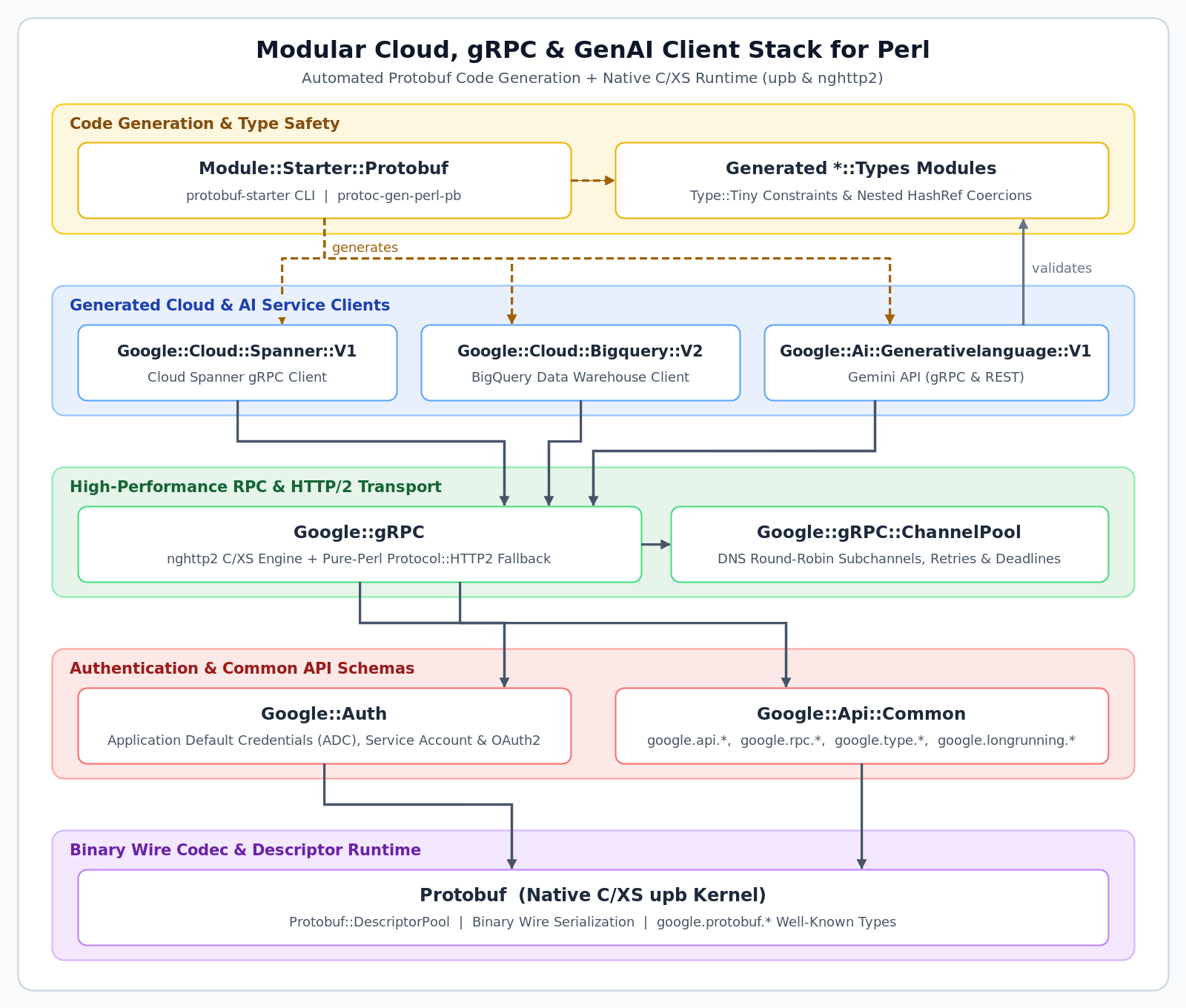
To test whether modern API ergonomics can revitalize Perl for cloud and AI engineering, I ve been building an open-source modular stack (published on CPAN and GitHub) that brings first-class Protocol Buffers, gRPC, DBI drivers, and automated client generation to Perl:

Architecture diagram of the modular Perl Cloud, gRPC, and GenAI client stackFigure 1: Open-source Protocol Buffers, gRPC, and automated client-generation stack for Perl.

With this stack in place, querying Cloud Spanner over native gRPC in Perl requires zero hand-rolled REST boilerplate:

use strict;
use warnings;
use Google::Cloud::Spanner::V1;
use Google::Auth;
# 1. Initialize Application Default Credentials (ADC)
my $auth = Google::Auth->default();
# 2. Initialize Spanner Client over gRPC transport
my $spanner = Google::Cloud::Spanner::V1->new(
    credentials => $auth,
);
# 3. Execute SQL Query
my $result = $spanner->execute_sql(
    database => 'projects/my-proj/instances/my-inst/databases/my-db',
    sql      => 'SELECT 1 AS alive',
);

And calling Gemini via Google::Ai::Generativelanguage::V1 with automatic nested hashref-to-Protobuf coercion feels just as ergonomic as Python or Go:

use strict;
use warnings;
use Google::Ai::Generativelanguage::V1;
use Google::Auth;
my $gemini = Google::Ai::Generativelanguage::V1->new(
    credentials => Google::Auth->default(),
);
my $response = $gemini->generate_content(
    model    => 'models/gemini-2.5-pro',
    contents => [
         
            role  => 'user',
            parts => [   text => 'Summarize this stack trace in three bullets.'   ],
         ,
    ],
);

4. What This Means for Debian Developers and Systems Administrators

Nowhere is this gap and the opportunity to close it more tangible than on Debian.

While greenfield web startups may have moved on from Perl, Debian remains one of the largest, healthiest Modern Perl ecosystems on the planet. Core project tooling dpkg-dev (Dpkg::*), debhelper, lintian, devscripts (uscan, dch, debuild), debconf, and po4a is written in Perl, backed by more than 4,000 lib*-perl packages maintained by the Debian Perl Group (pkg-perl). And Debian 13 (trixie) ships Perl v5.40.1 right in base, giving every Debian machine native subroutine signatures, lexical try/catch, and builtin booleans out of the box.

Yet until now, a Debian developer or systems administrator who wanted to interface with Google Cloud from an existing Perl tool had to either install the multi-hundred-megabyte Python-bundled google-cloud-cli (gcloud / bq) just to shell out and scrape stdout, or rewrite working Perl automation into another language.

Having a native Perl gRPC, Protobuf, and Auth stack and pairing it with native Debian packaging changes day-to-day life on Debian in four concrete ways:

1. Keyless IAM Auth on Debian Cloud VMs

When running official Debian Cloud images on Compute Engine, GKE (with Workload Identity), or Cloud Run, Google::Auth->default() speaks directly to the local GCE metadata server (metadata.google.internal) to fetch and cache short-lived OAuth2 tokens for the attached IAM service account. Sysadmins no longer need to deploy long-lived service-account JSON keys into /etc/ or shell out to gcloud auth print-access-token inside cron jobs and systemd units.

2. Moving Beyond local::lib (and venv) to Native pkg-perl Packages

Right now, before these distributions land in the Debian archive, installing them cleanly from CPAN without polluting /usr requires local::lib (e.g., cpanm --local-lib=~/perl5) which is the exact Perl counterpart to maintaining an isolated Python venv on Debian 12 (bookworm) and Debian 13 (trixie) under PEP 668 (EXTERNALLY-MANAGED). Even under local::lib, keeping cloud RPC calls in-process avoids pulling in the ~500 MB google-cloud-cli bundle or splitting an existing Perl daemon across two runtimes.

The real goal on Debian, however, is eliminating per-user overlay trees altogether via native .deb packages maintained with the Debian Perl Group (pkg-perl) so administrators can install libgoogle-auth-perl, libgoogle-grpc-perl, and service clients straight from apt with dpkg verification, sbuild reproducibility, and autopkgtest-pkg-perl coverage.

3. Alignment with Debian s Packaged Libraries & Policy

Most of the runtime and build prerequisites already ship in Debian main (verified on trixie), making native packaging straightforward:

  • libssl-dev backs Google::Auth s XS crypto bindings, and libnghttp2-dev provides the shared system C library for Google::gRPC s C/XS HTTP/2 engine while libprotocol-http2-perl (already in Debian main) powers the 100% pure-Perl HTTP/2 fallback.
  • libmoo-perl, libtype-tiny-perl, libfuture-perl, liblog-any-perl, libperl-critic-perl, and perltidy are all available via apt today.
  • Draft placeholder before publishing: Add links to the WNPP ITP bugs and Salsa / pkg-perl packaging repositories (including coordinating upb packaging details under Debian Policy 4.13 for Protobuf).

4. Practical Workflows for DDs and Sysadmins

On a Debian 13 (trixie) host running Perl v5.40, streaming structured fleet telemetry to BigQuery or triaging failed sbuild / autopkgtest logs with Gemini fits naturally into idiomatic modern Perl using native v5.40 signatures and try/catch without a single shell-out:

#!/usr/bin/perl
use v5.40;
use Google::Auth;
use Google::Cloud::Bigquery::V2;
use Sys::Hostname qw(hostname);
sub record_package_audit ($pkg, $version, $status)  
    my $bq = Google::Cloud::Bigquery::V2->new(
        credentials => Google::Auth->default(), # GCE metadata server / ADC
    );
    try  
        $bq->insert_all(
            project_id => 'my-debian-fleet',
            dataset_id => 'ops_telemetry',
            table_id   => 'dpkg_audits',
            rows       => [
                 
                    json =>  
                        host    => hostname(),
                        package => $pkg,
                        version => $version,
                        status  => $status,
                     ,
                 ,
            ],
        );
     
    catch ($err)  
        warn "BigQuery telemetry insert failed: $errn";


Whether it is archiving buildd and QA metrics into BigQuery, storing distributed coordination state in Cloud Spanner, or summarizing 10,000-line FTBFS ( Fails To Build From Source ) logs via Google::Ai::Generativelanguage::V1, Debian maintainers and sysadmins can keep their automation in a single, auditable, dpkg-managed language rather than splitting glue code across Perl, bash, jq, and Python virtualenvs.


5. Why the GenAI Era Plays to Perl s Strengths and the Headwinds Ahead

In classical machine learning, Python s lead was anchored by in-process C/C++ tensor libraries (NumPy, PyTorch). In the LLM and AI Agent era, however, the heavy matrix math happens remotely behind an RPC endpoint. What happens on the client side?

  • Ingesting gigabytes of messy, compressed distributed-system event logs and diagnostic traces.
  • Running high-speed regular expressions and text distillation pipelines.
  • Validating structured outputs and coercing hashrefs into strict request schemas via Type::Tiny.
  • Orchestrating Unix CLI tools, SQL queries, and concurrent gRPC calls.

That is Perl s historic wheelhouse. Just as importantly, thousands of enterprises and veteran SREs still maintain battle-tested brownfield Perl systems; drop-in CPAN clients for Spanner, BigQuery, and Gemini let teams modernize those systems in place rather than forcing a costly rewrite into Python or Go simply to call a gRPC API.

Two realistic headwinds remain:

  1. The AI code-generation feedback loop: Modern LLM coding assistants are trained overwhelmingly on recent Python, TypeScript, Go, and Rust code, and can default to dated 2000s Perl idioms if left unguided. Embedding automated 00_critic.t, 00_tidy.t, and 00_pod.t author tests backed by concrete .perlcriticrc and .perltidyrc rulesets directly into generated Module::Starter::Protobuf skeletons turns out to be an ideal counterweight, acting as an automated guardrail that keeps AI-assisted Perl clean and idiomatic.
  2. The education and hiring pipeline: Universities and bootcamps standardized on Python and JavaScript over the past 15 years, so greenfield staffing decisions will continue to favor larger hiring pools.

Will ergonomic gRPC and GenAI SDKs make universities teach Perl 101 again? Unlikely. Will they make Perl a high-leverage powerhouse again for engineers and organizations who value its text-processing and Unix orchestration strengths? Without question because in an API-driven world, a language is only as alive as the services it can talk to natively.

22 November 2026

Dirk Eddelbuettel: RcppArmadillo 15.8.0-1 on CRAN: New Upstream

armadillo image Armadillo is a powerful and expressive C++ template library for linear algebra and scientific computing. It aims towards a good balance between speed and ease of use, has a syntax deliberately close to Matlab, and is useful for algorithm development directly in C++, or quick conversion of research code into production environments. RcppArmadillo integrates this library with the R environment and language and is widely used by (currently) 1396 other packages on CRAN, downloaded 53.2 million times (per the partial logs from the cloud mirrors of CRAN), and the CSDA paper (preprint / vignette) by Conrad and myself has been cited 743 times according to Google Scholar. This versions updates to the new 15.8.0 upstream Armadillo release made today. As detailed below, it expands the API a little but also updates a few interfaces including one related to sparse matrix operations. As usual, we ran two full reverse-depdency checks against the nearly 1400 packages. This resulted in one additional small change set upstream (and the second reverse-dependency run) along with a small and focusses extension on our side which Kevin very kindly and promptly offered after I was scratching my chin over what may be needed. The package has also already been updated for Debian, built for r2u and should build shortly in r-universe as well as at CRAN for the different binary releases. We also note that we once again had a perfectly clean CRAN: all incoming tests, including full reverse dependencies, passed without the need for a follow-up email and were 100% automated. Smooth sailing! All changes since the last CRAN release follow.

Changes in RcppArmadillo version 15.8.0-1 (2026-11-22)
  • Upgraded to Armadillo release 15.8.0 (Medium Roast Chill)
    • Added solve_factoriser class for reusing matrix factorisation to solve systems of linear equations
    • Added solve_lse() for solving linear least squares with equality constraints
    • More efficient handling of spones()
    • Reworked detection of aliasing for cubes
  • Added wrap() support for different sparse matrix expressions (Kevin Ushey in #514 fixing #513)

Courtesy of my CRANberries, there is a diffstat report relative to previous release. More detailed information is on the RcppArmadillo page. Questions, comments etc should go to the rcpp-devel mailing list off the Rcpp R-Forge page.

This post by Dirk Eddelbuettel originated on his Thinking inside the box blog. If you like this or other open-source work I do, you can sponsor me at GitHub.

20 November 2026

Matthias Klumpp: Changes on freedesktop.org!

Today we launched a change that has been a long time in the making: The updated website for freedesktop.org, as well as the refreshed wiki.freedesktop.org are live now!

You can read the announcement here, this blog post elaborates a bit on it and on the background of the changes, as well as future plans.

Why change anything?

The freedesktop.org website has been a wiki for a long time, which definitely was the right call in its inception. A wiki is very much in spirit of Freedesktop s mission statement to foster collaboration between desktop environments and to be a place to create de-facto standards.

However, over the years, working with the wiki became a bit of an issue: Not only did we face multiple spam-apocalypses (which in part motivated the switch to IkiWiki in 2013 and resulted in us heavily restricting write access to the wiki), but it also meant that official project information, finished specifications, half-finished proposals and pages nobody had touched in fifteen years were all sitting next to each other.

Since 2000 when Freedesktop.org was started, the project has grown so much and has had so many associated projects and specifications over the decades that it is now very difficult for new people to get an overview what is current and what state the software projects and specifications hosted by Freedesktop.org are in.

Having only a wiki as a large and somewhat disorganized pile of information did not help with that issue, so I worked to split things up: We now have a website as well as a wiki, using different designs to distinguish the two, and serving different purposes.

Website & website plans

The website at www.freedesktop.org will be the place for official , or rather, more curated information. Now that the new website is live, its content is still largely that of the old wiki. Over the next weeks, I will be working on cleaning up its contents and listings. For example, I will clearly split active projects from archived ones, add missing ones, and also work towards synchronizing the specifications hosted on the former wiki / website with the ones listed on specifications.fd.o.

So, basically I will do an inventory check of Freedesktop. That work has already started, but until now, I could not make any public changes to not disrupt workflows or make my own future work harder by having diverging information in two places (website & wiki).

I also wanted to make it easier for people to find information on how to get involved with Freedesktop and associated projects, so the new website now has a more discoverable section for that.

The new website is a static site hosted via GitLab Pages and using Pelican. You can view its sources if you like.

Wiki changes

Of course, we also still want to keep the Wiki and all of its rich history around! It remains the easy-to-edit place for collaboration on upcoming projects and specifications.

Wiki edits must now happen through GitLab instead of the old IkiWiki web interface. While this sounds like an additional barrier to edit the wiki, it is significantly easier than requesting an account on annarchy to edit the old Wiki through the web interface. It also still allows us to keep the existing history as well as spam protection measures. In order to use the wiki with GitLab Pages and to keep the history easily accessible and readable, I rewrote the Git history of the wiki to make it pretend that all changes always happened in a content subdirectory. So, if commit signatures are missing and hashes are different: That is the only reason why. There have been no content changes or other metadata changes (and we still have a copy of the pristine wiki Git repository).

For the fd.o wiki, we are now also using Hari s IkiWiki template that is already in use on the X.org website and which is much easier on the eyes.

Next steps

At the moment, I am mostly concerned with ensuring that the change has not broken any existing links and all systems keep working. After that, the wiki website deduplication work will start and we can modernize both the content of the website and wiki.

If you find a broken link, an outdated page or anything else that looks wrong, please file an issue or, even better, open a merge request.
For the wiki, you are very welcome to just fix or otherwise update the page directly.

I did reach out to all wiki editors and projects impacted by this change in advance, but since there are so many people and projects involved, it is always possible to miss someone or something. If you found a bug, need edit permissions, or need help with anything, don t hesitate to ping me: You can find me as ximion in OFTC s #freedesktop IRC channel, in the very recently created #xdg-specs channel on the Freedesktop Matrix space, or you can email me.

Thank you!

I do want to echo the announcement news post here: None of Freedesktop.org would exist without the people who filled it with life over the years and who worked on cross-desktop collaborative projects. I have read through a lot of wiki history and old project pages over the recent months, and it feels amazing to know how much work and passion people have poured into the projects and collaborative efforts over the years no matter if they were successes in the end, or remained experiments. I am very thankful for all current, past and future editors of the website and wiki, as well as all project maintainers and contributors.

I also want to thank the Sovereign Tech Agency once more for supporting me in their fellowship program as a maintainer, which enabled me to work on this task among other things.

Thanks to all contributors, in whichever way you contribute to our free desktop ecosystem!

30 October 2026

Russell Coker: More Furilabs FLX1s

In April I got my Furilabs FLX1s basically working [1]. Below is a post I wrote about the FLX1s before it broke at the start of September, there was a problem with the display controller and it would randomly go into a messed up mode that wasn t readable but also changed a bit in relation to button presses etc so the phone was still working. Also I could ssh to the phone when it was in that state if it was on my home wifi. It took almost 2 months to get a replacement phone but I now have that working and the new 14.1.0 OS release. So some of the below may be obsolete when it comes to the latest release but I decided to publish it anyway for history if nothing else. Current Issues Wifi Hotspot Status One thing I had known about but not mentioned before is that the icon in the drop-down menu for the hotspot will often be gray (indicating hotspot-off) when it s actually on. To address that I have to click on it (which then indicates that the hotspot is on) and then click on it again to turn it off. QT6 and MESA GL Currently I have problems with QT6 applications that don t run due to library issues and issues of missing GL support. I blogged about setting up my own container on my phone [2] which helped for some things but not for most things. I have given up trying to get Tokodon working on the phone for the moment. Tokodon is a nice Mastodon client that would allow me to get notifications from Mastodon. Apparently the Furilabs people are working on some issues related to this. Bluetooth Bluetooth is currently a bit unreliable. When I turn on my car (Nissan LEAF) the phone usually either doesn t connect or claims to be connected while not sending audio to the car. When it does connect my favourite music player (Lollypop) usually doesn t display the album and track names. I ve found that turning my car off and on again usually makes it connect properly. I admit the possibility of my car not doing things correctly in this regard. But every Android phone I tried just worked, they would connect as soon as the car was turned on and correctly display track names. So if the car is doing things wrong and needs a software work around then Linux is at fault for not doing that we can t get tens of millions of cars and hundreds of millions of other weird devices fixed! I also note that my Debian laptop and a friend s Debian laptop also have problems connecting to my car. So it s quite possible that Debian code is at fault (the FLX1s is running a modified version of Debian). It currently appears to have no support for handset mode so I can t answer phone calls through the car interface. But this is a lesser problem. I plan to do more testing with Debian laptops and file some bug reports if I can find out enough useful information. My current knowledge of this is insufficient to create a useful bug report. I do have quite a few bluetooth headsets and test laptops so I plan to start by testing Debian and Ubuntu on all the combinations last time I tested Ubuntu 24.04 on Dell laptops worked much better than Debian/Trixie on Thinkpads. Improvements by Furilabs Wifi Hotspot After a set of updates including the following Wifi hotspot seems to be working.
adaptation-furiphone-radon (1.3.0+git20260513192743.e94f2ec.forky.production) forky; urgency=medium
  * NetworkManager: sync hotspot channel/band with STA and restart on change
  * debian: depend on libhybris-utils and libgbinder-tools
  * startup: drop schedtune and add m4u debug log level
  * startup: enable glove and disable edge palm
  * device: drop flashlightd-scalable signatures
 -- Bardia Moshiri <bardia@furilabs.com>  Wed, 13 May 2026 15:27:43 -0400
Charging Connecting the power cable now makes the phone immediately make the click sound and it starts charging while previously there was a 22 second delay. Once I get used to this I can avoid the problem of failing to plug it in firmly before going to bed and having it run flat overnight. Things I ve Done SMS The following command will send a message via SMS.
dbus-send --system --print-reply --dest=org.ofono /ril_0 org.ofono.MessageManager.SendMessage string:"+61400000000" string:"this is the message"
Also the Librem5 Wiki has another way of doing it [3], I haven t tested if that works as the dbus method works well enough for the moment. Also calls can be scripted via the following command:
xdg-open tel://+61400000000
Contacts My aim is to get contacts synchronised via my own cloud service. Nextcloud is supposed to be able to do this. It s been years since I first tried this, my most recent serious attempt at Nextcloud was in 2021 [4] and I couldn t get the Android app for NextCloud to connect. Since then I have made more recent attempts and been unable to get the Android or Linux desktop clients to connect to it. A friend gave me a test account on his Nextcloud server which allowed me to connect the Linux desktop app, his hypothesis was that it was somehow related to using Debian and that his server worked because it was on Ubuntu. I have since installed my own Nextcloud test server on the Ubuntu variant used by the Oracle cloud VMs which had the same apparent problem. I conclude that it s not Debian at fault but something related to how I configured it. In the meantime after a couple of months of having no named contacts I exported the contacts from my Android phone as a VCF file and imported them into the Gnome contacts program. I had to run killall chatty for it to get the names for the contacts, but the phone call program found them without needing to do that. Chatty A missing feature of Chatty (the default SMS and Jabber program for Phosh/Phoc systems) is archiving old messages. I use Chatty to receive Jabber messages from my monitoring system which can be a lot of messages. The following shell code deletes all Jabber messages older than 2 days. Note that this relies on type=3 matching Jabber messages which I m not sure is going to be the case on all systems or all versions of Chatty.
for ID in $(echo "select id from users where type=3;"   sqlite3 ~/.purple/chatty/db/chatty-history.db); do
  echo "delete from messages where sender_id=$ID and time < unixepoch('now') - (48 * 3600);"   sqlite3 ~/.purple/chatty/db/chatty-history.db
done
The following shell code extracts a dump of all messages from Chatty.
echo "select messages.id,users.username,users.alias,messages.body from messages inner join users on messages.sender_id=users.id;"  sqlite3 ~/.purple/chatty/db/chatty-history.db
Dino-IM An update to the Chatty program for SMS and Matrix has made it crash repeatedly. There is a request in the list for Chatty upstream to have a systemd-user unit to restart it which when implemented will reduce the scope of the problem (but not solve it). I've setup a monitoring system that uses notify-send to notify me when Chatty isn't running or when 4G data turns off (a recurring problem). This crashing is allegedly due to Jabber so I installed Dino-IM for Jabber and have for the moment at least stopped using Chatty for Jabber. It turned out that having Chatty not do Jabber didn't stop it crashing. However having alerts separated from SMS can be convenient and also my long term plan is to use a phone with Plasma Mobile and Spacebar (the SMS program for Plasma Mobile) doesn't do Jabber. So I will continue using Dino-IM.
echo "delete from message where time < unixepoch('now') - (48 * 3600);"   sqlite3 ~/.local/share/dino/dino.db
Andromeda/Android I put in the following cron job to stop this log file from using all the storage space:
1 0 * * *	echo -n > /home/furios/.local/share/andromeda/data/system/uiderrors.txt
Wifi DHCP I gave up on attempts to force the Wifi configuration to have a fixed MAC that I could use for a fixed IPv4 address so I manually configured the address. 4G Monitoring I've had problems with the reliability of the 4G service, sometimes it stop working and I need to stop and restart it. I setup my etbe-mon monitoring system on the phone [5] and configured it to ssh to localhost and run notify-send to send a local notification. This means I get notified if my phone loses net access and can't access regular monitoring. Then to monitor the 4G connection (which I want to have working even when Wifi is connected) I had the following monitor line:
monitor ping.monitor -I ccmni1 -c 5 8.8.8.8 ;;
That uses the ccmni1 interface for pinging 8.8.8.8 (Google DNS). That worked for a while but I discovered that sometimes the interface for 4G would change to ccmni2, so I put the following monitor script under /usr/local/mon.d:
#!/bin/bash
DEV=$(route -n grep ^0.0.0.0.*ccm  sed -e s/^.*ccmn/ccmn/)
exec /usr/lib/mon/mon.d/ping.monitor -I $DEV -c 5 8.8.8.8
Mastodon I couldn't get Tokodon to work, not the native package, not running in a Debian/Testing container, and not running a Flatpak. It seems that this is all graphics library issues. So I wrote a Perl program to run "toot notifications &-json" and then send the relevant parts of the output via XMPP. As I already use XMPP for server monitoring there's no extra effort to have an extra account and use it for notifications about Mastodon activity. The Perl script is at the bottom of the post and won't be in the RSS feed. At some future time I may change the script to send the notifications by Matrix instead to have all my social media stuff in the same place. Source
#!/usr/bin/perl
# depends on Debian packages: toot libjson-pp-perl go-sendxmpp
use strict;
use JSON::PP;
my $homeurl = "https://mastodon.nzoss.nz/";
my $lastfile = "mast/last_id";
my $xaddr = "russell\@coker.com.au";
my $jsontxt;
while()
 
  $jsontxt .= $_;
 
my $data = decode_json($jsontxt);
my $last_id = 0, my $new_last_id;
if(open(ID, "<$lastfile"))
 
  $last_id = ;
  close(ID);
 
$new_last_id = $last_id;
for(my $i = 0; $data->[$i]; $i++)
 
  my $id = $data->[$i] id ;
  if($id <= $last_id)
   
    next;
   
  if($id > $new_last_id)
   
    $new_last_id = $id;
   
  open(XMPP, " go-sendxmpp $xaddr") or die "Can't send XMPP";
  my $type = $data->[$i] type ;
  print XMPP "type: $type\n";
  print XMPP "their_url: $homeurl\@$data->[$i] account acct \n";
  print XMPP "display_name: $data->[$i] account display_name \n";
  if($type ne "follow")
   
    print XMPP "status_url: $data->[$i] status url \n";
    print XMPP "content: $data->[$i] status content \n";
   
  print XMPP "created_at: $data->[$i] created_at \n";
  print XMPP "\n";
  close(XMPP);
 
open(ID, ">$lastfile") or die "Can't write to $lastfile";
print ID $new_last_id;
close(ID);

9 October 2026

Dirk Eddelbuettel: RcppSimdJson 0.1.16 on CRAN: Much Faster Again!

A brand new release 0.1.16 of the RcppSimdJson package is now on CRAN, has been built for r2u, and is updated on r-universe. RcppSimdJson wraps the fantastic and genuinely impressive simdjson library by Daniel Lemire and collaborators. Via very clever algorithmic engineering to obtain largely branch-free code, coupled with modern C++ and newer compiler instructions, it results in parsing gigabytes of JSON parsed per second which is quite mindboggling. The best-case performance is faster than CPU speed as use of parallel SIMD instructions and careful branch avoidance can lead to less than one cpu cycle per byte parsed; see the video of the talk by Daniel Lemire at QCon. This version updates to the recent 5.0.2 upstream release with improved performance. Given the strong focus on performance, this release also alters some of the R and C++ interfaces to be more direct. Rcpp generally aims for a balance between readable / maintainable code and good performance; this moves the dial closer to strong performance gains. As Daniel noted in a table in the (main) PR for this release, this now consistently beats yyjsonr, and improves considerably over the previous release of this package. I had made some smaller interim upgrades earlier (without a CRAN releases), and made a number of minor standard packaging updates. The short NEWS entry for this release follows.

Changes in version 0.1.16 (2026-10-09)
  • simdjson was upgraded to versions 4.6.1 and 4.6.3 (Dirk in #100 and #102 fixing #99 and #101)
  • simdjson was upgraded to version 5.0.2 (Daniel in #104)
  • A number of small tweaks to the Rcpp interface were made too (Daniel in #104)
  • Diagnostics for gcc and clang are not suppressed per CRAN Policy (Dirk in #106 closing #105)
  • The continuous integration matrix was extended to g++ version 15 and 16 (Dirk in #108 closing #107)
  • A few minor packaging nags were address (Dirk in #109)

Courtesy of my CRANberries, there is also a diffstat report for this release. For questions, suggestions, or issues please use the issue tracker at the GitHub repo.

This post by Dirk Eddelbuettel originated on his Thinking inside the box blog. If you like this or other open-source work I do, you can now sponsor me at GitHub.

5 October 2026

Russell Coker: Kdeconnect DBUS

I ve tested the DBUS interfaces for Kdeconnect (the system for connecting a KDE desktop to a phone or another computer). Unlike most DBUS interfaces it has a significant tree of interfaces so the busctl command to get the tree is important. Here s the useful things I discovered:
# list basic interfaces for kdeconnect
qdbus6 org.kde.kdeconnect.daemon /modules/kdeconnect
# get tree of interfaces for kdeconnect
busctl --user tree org.kde.kdeconnect.daemon
# get list of devices
qdbus6 --literal org.kde.kdeconnect.daemon /modules/kdeconnect org.kde.kdeconnect.daemon.deviceNames
# list interfaces for a device (DEVID is a hex string from the above command)
qdbus6 org.kde.kdeconnect.daemon /modules/kdeconnect/devices/$DEVID
# get battery charge
qdbus6 org.kde.kdeconnect.daemon /modules/kdeconnect/devices/$DEVID/battery org.kde.kdeconnect.device.battery.charge
Sending an SMS apparently requires using the QVariantList type which is more pain than I wanted so I tried the kdeconnect-cli command. Here s a quick summary of how to use it:
# list devices
kdeconnect-cli -l
# send a SMS
kdeconnect-cli -d $DEVID --send-sms "the message" --destination $NUMBER
# find device (ring)
kdeconnect-cli --ring -d $DEVID
# send a notification message
kdeconnect-cli --ping-msg "this is the message" -d $DEVID
# unlock and lock screen (only works on Debian devices for me not Android devices)
kdeconnect-cli --unlock -d $DEVID
kdeconnect-cli --lock -d $DEVID
There doesn t seem to be support for making phone calls via kdeconnect which is a significant omission. It s a very common situation to want to call a number that s listed on a web site or in some other data source that s easier to access on a PC than on a phone. The clipboard could be used but that s needless pain.

17 September 2026

Russell Coker: Nheko DBUS

Nheko is my current favourite client for the Matrix IM system, which is my favourite IM system. Matrix is an open system with end to end encryption and Nheko is free software and runs well on Linux desktops and phones. The Nheko client allows interaction with dbus which could be good for automating things, EG you could change the status message when unlocking the screen. I m documenting the most useful ones here because they don t seem to be documented anywhere else. I have filed a Debian bug about the activate room option not working. The qdbus6 program is the QT6 version of the dbus command-line query program, there are a range of other programs which work in much the same way.
# list all interfaces
qdbus6 im.nheko.Nheko / 
# get the version of Nheko
qdbus6 im.nheko.Nheko / im.nheko.Nheko.nhekoVersion
# list rooms in a dump of the data structures (pity it's not json or something)
qdbus6 --literal im.nheko.Nheko / im.nheko.Nheko.rooms less
# join a room
qdbus6 im.nheko.Nheko / im.nheko.Nheko.joinRoom "#flounder-random:luv.asn.au"
# supposed to activate a room but doesn't
qdbus6 im.nheko.Nheko / im.nheko.Nheko.activateRoom "#flounder-random:luv.asn.au"
# set the status
qdbus6 im.nheko.Nheko / im.nheko.Nheko.setStatusMessage "whatever"
# get the status
qdbus6 im.nheko.Nheko / im.nheko.Nheko.statusMessage
Here are a couple of examples of using other dbus clients to get similar results. Note that the difference between the Debian version of Nheko (and maybe other recent versions) and what LLMs return for usage examples is that Debian has / as the path while the examples have /im/nheko/Nheko .
# list rooms via gdbus
gdbus call --session --dest im.nheko.Nheko --object-path / --method im.nheko.Nheko.rooms
# get status via dbus-send
dbus-send --session --print-reply --type=method_call --dest=im.nheko.Nheko / im.nheko.Nheko.statusMessage

8 September 2026

Dirk Eddelbuettel: RcppArmadillo 15.6.0-1 on CRAN: New Upstream Minor

armadillo image Armadillo is a powerful and expressive C++ template library for linear algebra and scientific computing. It aims towards a good balance between speed and ease of use, has a syntax deliberately close to Matlab, and is useful for algorithm development directly in C++, or quick conversion of research code into production environments. RcppArmadillo integrates this library with the R environment and language and is widely used by (currently) 1331 other packages on CRAN, downloaded 48.5 million times (per the partial logs from the cloud mirrors of CRAN), and the CSDA paper (preprint / vignette) by Conrad and myself has been cited 727 times according to Google Scholar. This versions updates to the 15.6.0 upstream Armadillo release made yesterday. It extends solver options for poorly conditioned systems, and brings some updates and extension to the cube data type. For this release, we once again ran the usual complete reverse-dependency check which came back spotless, and did CRAN so no email exchange needed despite nearly 1300 reverse dependencies (but it ended up taking more than a single business day). Still, automation can be helpful when used with a well-maintained software stack. The package has also already been updated for Debian, built for r2u and r-universe, and will build shortly at CRAN for the different binary releases. All changes since the last CRAN release follow.

Changes in RcppArmadillo version 15.6.0-1 (2026-09-07)
  • Upgraded to Armadillo release 15.6.0 (Medium Roast Cortado)
    • Expanded solve() with solve_opts::scale_thresh option to widen detection of poorly conditioned systems
    • Expanded trans() and .t() to handle cubes
    • Added permute() to rearrange dimensions of cubes (generalised transpose)
    • Added cubemul() for batched matrix multiplication of cube slices

Courtesy of my CRANberries, there is a diffstat report relative to previous release. More detailed information is on the RcppArmadillo page. Questions, comments etc should go to the rcpp-devel mailing list off the Rcpp R-Forge page.

This post by Dirk Eddelbuettel originated on his Thinking inside the box blog. If you like this or other open-source work I do, you can sponsor me at GitHub.

Paul Tagliamonte: wrapping it all up (Part 8/12)

This post is part of a series called "Pigeon". If this is the first post you've found, it'd be worth reading the intro post first and then looking over all posts in the series.

If you're looking for it, the intro to the PHY (layer 1) that this belongs at a high level and listing of the parts that make it up (including this one) is on the phy post.
The time has come. If you re following along at home, we now have all the basics we need to glue these parts together and see what this looks like. We re going to build the highest-level constructs for the PHY in code something that takes some number of bytes in and writes out IQ samples fit for transmit over the airwaves (we ll call this the Encoder), and something that takes chunks of IQ samples in, writing out decoded bytes (which we ll call the Decoder).

Encoder Let s begin with the Encoder, since it s slightly less involved. I ve tried to make this a bit more accessible by drawing a diagram out before describing the order of operations, so that it s possible to follow along visually. While the process here can look like a lot, it s really not that bad. We begin by taking the incoming bytes, converting the bytes into bits, and chunk those bits into parts which are sized to fit completely within an LDPC message. We will then encode incoming data into LDPC messages, using our configured LDPC Matrix (the table we appropriated from 802.3an). Next, we apply whitning over all the bits in our encoded (and packed) LDPC messages, using our configured whitening constant. In the case of QPSK, pairs of bits will then be modulated into a QAM subcarrier, where each QAM point represents a range of bits in the message. We ll go through each of those modulated IQ subcarriers, and set each corresponding data subcarrier in order, for each OFDM symbol contained in the pigeon Burst. The preamble configuration is then used to generate (or, more likely, can be used at startup to precompute) the Schmidl-Cox preamble, which is written to the first IQ samples in our output IQ buffer. Finally, we will do a series of inverse FFT operations to convert each OFDM symbol to the time domain, including their cyclic prefix. Let s take a look at doing that, but in code this time now:
// (lightly edited for clarity)
impl Encoder  
 ..

 /// Encode the provided bits into the output time-domain IQ samples.
 fn encode(
 &mut self,
 dst: &mut [IQ],
 src: &Vector,
 ) -> Result<Burst, Error>  
 let src =  
 let mut raw = Vector::new(self.fec.message_len());

 // Set  raw 's data bits, compute and set LDPC
 // checkbits.
 self.fec.add(&mut raw, src);

 // Apply whitening, and return
 raw.xor(&self.whitening)
  ;

 // copy in the precomputed schmidl-cox preamble to  dst 
 let preamble_len = self.preamble_iq.len();
 dst[..preamble_len].copy_from_slice(&self.preamble_iq);

 // allocate a new (frequency domain) 'Burst' container.
 let mut burst = Burst::new(
 &self.mode.ofdm.plan,
 self.mode.ofdm.symbols
 );

 // modulate bits from 'src' as iq, and set each
 // data subcarrier for each ofdm symbol in the
 // burst.
 self.burst_encoder.multiplex(&mut burst, &src);

 // convert from frequency-domain data into time
 // domain iq samples, writing out ofdm symbols
 // and cyclic prefixes to  dst .
 self.burst_encoder
 .transform(&mut dst[preamble_len..], &burst)?;

 // normalize all IQ samples; the maximum magnitude
 // in the IQ buffer may be very small, which weakens
 // our transmitted signal. Scale all IQ samples such
 // that the maximum IQ sample magnitude will be '1.0'.
 dst.norm();

 Ok(burst)
  
 
Using the Encoder should hopefully be fairly straightforward we ll give it a bag of bytes, and get back some IQ samples that we can ask our nearest SDR to transmit. As for what happens on the other end?

Decoder Next up is the mirror image of our Encoder the, imaginatively named, Decoder. The Decoder is slightly more involved (since it has to find the packet in the IQ stream, as well as correct for channel error(s)), so we ll do the same thing as above start with a diagram. My hope is going over the Encoder first helps us only really focus on the new stuff, otherwise it should feel like running the Encoder backwards. Here, we start with an incoming stream of IQ, where we will process scan detections as they come in from our Schmidl-Cox detector and burst Scanner. This will give us a snippit of IQ, sized to exactly our Burst. We ll begin to correct our IQ samples by first doing frequency estimation and correction in the time domain using our preamble and ofdm configuration. We ll then do a series of inverse FFTs to extract each OFDM symbol in our Burst, where we can then do channel estimation and correction. With the OFDM symbols (hopefully) good enough, we can now map each data subcarrier back to bits, and unapply whitning. The resulting bits are then chunked back up into LDPC messages, which are then checked, and concatanated data extracted. Finally the bits are turned back into bytes, which are written to our output buffer. However, before we get into the code to do this there s one last detail. We know bursts won t overlap (if they do, it s likely not possible to recover right now even though other PHYs can and do), so any time we see something we believe to be a burst, we can skip ahead by the burst s (constant) length within the IQ, and avoid trying to decode anything else in there. The nice side-effect here is this also gives us an interesting property for the Decoder namely, we know the maximum number of Burst detections we can get for a given block of incoming IQ data if they were packed end-to-end and we can pre-allocate the memory we need, avoiding allocations for every demodulation attempt (which may or may not even be a valid Burst). This pre-allocated block of memory to hold the burst s data is something that I ve called a frame buffer internally. Each frame buffer contains exactly sized buffers to hold decoded information from the burst an iq buffer that is exactly the same number of samples required to encode the preamble and data, exactly the number of bits needed to store pre and post FEC data, pre-allocated byte array, etc. Not shockingly, the code looks like this:
#[derive(Clone)]
pub struct FrameBuffer  
 /// Corrected IQ samples
 pub samples: Samples,

 /// post-correction OFDM burst
 pub burst: Burst,

 /// demodulated bits from the OFDM burst
 pub bits: Vector,

 /// demodulated bits from the OFDM burst,
 /// after FEC, and cleaned
 pub raw_bits: Vector,

 /// Layer 2 contents of the Frame
 pub contents: Vec<u8>,
 
Of course, that alone is handy but we need to use them. So let s go ahead and do what we promised above each Decoder uses a fixed number of pre-allocated FrameBuffers to store packets in-flight, packed into what is, creatively, called FrameBuffers within my code. As an aside, I likely should have called this a Memory Pool, since that s the common and accepted name for this design pattern but being stuck with unfortunate names is the burden of those of us who stumble into sensible ideas over time. The only nuance here is that I use the pools strictly sequentially we only save the FrameBuffer if the LDPC checksum is correct, allowing us to only keep track of how many successful packets we have and being able to get the valid FrameBuffers, rather than storing a handle to each FrameBuffer as we go a promise that most memory pools do not make, since blocks can usually be taken and returned in any order. Let s go ahead and do the whole Decoder dance now:
// (lightly edited for clarity)

impl Decoder  
 ..

 /// Process incoming IQ for Pigeon Bursts, and
 /// demodulate them.
 pub fn decode(
 &mut self,
 buf: &[IQ],
 ) -> Result<Vec<(Detection, &FrameBuffer)>, Error>  
 let mut ret = Vec::new();
 let mode = self.scanner.mode().clone();

 // reset the "valid frame buffer count" back to 0
 self.frames.reset();

 // call the scanner and get scan detections for
 // this block of iq ( buf )
 for detection in self.scanner.scan(buf)  
 // for each detection, we're (only) going to process
 // the iq snippit, but pass along the metadata
 // such as SNR.
 let ScanDetection  
 snippit,
 snr,
 range,
 m,
   = detection;

 // grab the next free frame buffer to work within.
 let frame_buffer = self.frames.next_mut();

 // Copy the snippit into the frame buffer (a mutable
 // location)
 frame_buffer.samples.copy_from_slice(snippit);

 // estimate the frequency offset based on the
 // Burst's Schmidl-Cox preamble.
 let preamble_fo = preamble::estimate_frequency_offset(
 &mode.preamble,
 mode.rate,
 &frame_buffer.samples[..mode.preamble.samples()],
 );

 // Shift the IQ stream by the estimated frequency
 // offset -- hopefully we're closer to 0Hz
 frame_buffer.samples.shift(mode.rate, preamble_fo);

 // estimate the frequency offset based on the
 // each burst's **cyclic prefix** -- exactly like
 // we did with the Burst Schmidl-Cox preamble,
 // but this time on each OFDM symbol.
 let ofdm_fo = ofdm::estimate_frequency_offset(
 &mode.ofdm,
 mode.rate,
 &frame_buffer.samples[mode.preamble.samples()..],
 );

 // Shift the IQ stream closer yet; hopefully this
 // is a very small nudge even closer still to 0Hz.
 frame_buffer.samples.shift(mode.rate, ofdm_fo);

 // Do a bunch of inverse fft operations for each
 // OFDM symbol, filling the frequency-domain Symbol
 // structs in  frame_buffer.burst  (Burst) struct.
 //
 // this will also do channel estimation and
 // correction before returning.
 self
 .decoder
 .transform(
 &mut frame_buffer.burst,
 &frame_buffer.samples[mode.preamble.samples()..],
 )?;

 // "demultiplex" each data subcarrier's frequency-domain
 // IQ constellation point, setting the correct bit range.
 self.decoder.demultiplex(
 &mut frame_buffer.raw_bits,
 &frame_buffer.burst
 );

 // unapply whitening by XOR-ing the buffer with
 // the well-known whitening vector.
 frame_buffer.raw_bits = frame_buffer.raw_bits.xor(
 &self.whitening);

 // verify that the LDPC message(s) are all correct,
 // and if so, concatanate the the data bits (no check
 // bits) to the  bits  vector.
 if self.fec.decode(
 &mut frame_buffer.bits,
 &frame_buffer.raw_bits
 ).is_err()  
 // this is where invalid packets fail. we gave it a good go.
 // next packet please.
 continue;
  

 // copy the raw bits out, as bytes, to the  contents  buffer.
 frame_buffer.bits.copy_as_bytes(&mut frame_buffer.contents);

 // store metadata/metrics on the demodulation.
 ret.push(Detection  
 m,
 snr,
 index: range.start,
  );

 // save the contents of this frame buffer (don't
 // reuse this buffer next go-around).
 self.frames.save();
  

 // We're going to take out the borrow on the frame at
 // the end since we don't want to deal with telling the
 // compiler via code gymnastics that the mut and non-mut
 // borrows are OK since they're non-overlapping.
 Ok(ret.into_iter().zip(self.frames.iter()).collect())
  
 
Phew. That was kinda a lot. In fact it s basically the whole thing. This function is as close to how do you read an OFDM packet as it gets, and perhaps the most important part of this whole series. Beyond that, though, this is a huge conceptual unlock. This means we now have an incredibly powerful primitive; the ability to take bytes and go to/from IQ samples over the air. Let s talk about pigeon modes

24 August 2026

Matthias Klumpp: Sovereign Tech Fellowship for Freedesktop Tasks

In 2025 I was honored to be selected for the first cohort of Sovereign Tech Fellows, a program by Germany s Sovereign Tech Agency to improve the resilience of the open source ecosystem by supporting maintainers directly (complementing their existing support for larger FOSS organizations). Back in 2025, I was only working very limited hours however, this has changed in 2026.

For the second half of 2026, I am working again as a Sovereign Tech Fellow, but this time with significantly increased hours. After finishing my PhD, I do have time now for new tasks (and new jobs!), and the fellowship presents an amazing opportunity to really advance projects that I maintain or am part of. This also has a very nice effect on contributors and bug reporters, as their feedback gets addressed a lot faster. With some luck, this ultimately will help finding new (co)maintainers for projects as well (although in the age of AI, a lot of how open source used to work is much more uncertain, but that is a matter for a different blog post).

The fellowship is time-limited, so I am intending to make the time I currently have count!

So, what s planned?

I am involved in many projects, but three of them will be getting attention as part of the fellowship. I know I am notoriously slow at blogging, but expect more details on each of them very soon. Here s an overview:

Freedesktop.org, Specifications and Organization

I maintain the Freedesktop Specifications, which is an area of Freedesktop that has traditionally been a bit chaotic. This worked in the past, because Freedesktop was never intended to be a formal standards body, but more a shared space where people could throw a lot of code and ideas over the wall and see what sticks and what people can collaborate on.

While I very much love the spirit of this and want to keep it in some form, we definitely would benefit not just from more formalization and better procedures, but also from better organization of the specifications in general. A lot of conflicts can be avoided by that. I will work on improving procedures, crunching through the (lots!) of pending bug reports and MRs, and to make the specifications site better searchable and accessible (similar to how Mozilla s MDN presents information, but I am not sure if we will get quite that far). I also intent to add a compatibility matrix for specifications, so if a desktop opts out of any one of them (or does not implement them yet) that fact is documented and authors of applications know what they can expect. This will allow us to move a lot faster and avoid a lot of conflict, because there is no implicit assumption that everybody will implement everything anymore (which has never been quite true anyway).

Hopefully, this will ultimately result in a Freedesktop that is both a lot more useful for application authors who want to bring their project to Linux, as well as developers of desktop environments who need to see which specifications are available and which ones are current.

In addition to that, I have also worked on a Freedesktop.org website refresh, which is pretty much done in its first iteration (pending sysadmin action). The aim there is to have a more official website, separate from user-contributed wiki content, that showcases what Freedesktop is and which projects are using it for hosting. Once the new website is live, I will also review every page again, archive dead projects in their own section and reorganize the software and specifications directory. Those sections are severely outdated and are missing recent efforts from the community, while still containing long-dead old projects (remember HAL?  ).

AppStream

A lot of extra maintenance work will be (has been!) done on it. This includes things such as JPEG-XL support (blog post soon), sandboxed media processing, support for newer specification additions, better OARS integration (and potentially migrating it to fd.o infrastructure), improvements and API stabilization for libappstream-compose and a lot of bugfixing and resolution of issues found by AI code review.

AppStream was originally designed to parse only trusted data from vetted Linux distribution sources this is no longer the case in today s world and in the way Flatpak uses it, so we need to increase resilience of the project.

I am also exploring a project that could vastly improve search accuracy for AppStream. Stay tuned for that.

PackageKit & System Upgrades

Many years ago, people thought we would all migrate to atomic Linux distributions and slowly not need PackageKit anymore. This has not turned out to be the case, and there are still plenty of reasons to use a package-based OS, especially in development environments. At the same time, PackageKit has been basically the same for years, and its older architecture is beginning to show. It being a daemon who s literal job it is to modify the entire system also makes it one of the most security-sensitive components that a Linux system can have, while simultaneously making it near-impossible to sandbox.

My plan is to create PackageKit 2.0 by building on the great foundation of PackageKit 1.0, but modernizing it. This will include simplifying its code and removing a bunch of features that have no more use in modern desktops, while also adding some features that PackageKit never had but that would be useful to expose to frontends (still no to interactivity an terminal-progress forwarding though!). PK 2.0 will also allow me to solve a few design issues that have been worked around in the past, by replacing them with better solutions. This will be a painful transition, as PackageKit 2.0 will break all interfaces PackageKit has and those interfaces have been frozen for more than a decade. However, I do fully expect this change to be worth the effort.

In addition to that, I intend to look into the offline-update procedure again and improve it. The current multi-reboot operation comes with downsides, that newer systemd features such as soft-reboot can alleviate. The end result should be a much smoother, less annoying offline-update experience for users (I especially want to get rid of updates running on system startup, which I consider quite bad from a usability perspective). The new behavior is in the early drafting stages and may need direct support from systemd. I will share more about it once I can.

That s a lot of tasks!

Yes! I will see how far I get. I am moving project-by-project though, to allow me to focus on one project at a time, rather than scattering my attention continuously. Amazingly, this means that the major tasks for AppStream are already almost done, and we are nearing the 1.2.0 release. AppStream got priority, because the new Freedesktop Flatpak runtime will be released soon, and because I want FlatHub/Flatpak to have access to the new AppStream release sooner. Freedesktop and PackageKit are next on the task list.

Either way, a lot of progress is coming if you have any feedback or want to help out, please don t hesitate to reach out! All work is happening fully in the open, so you can also chime in on the respective GitHub/GitLab tasks  .

You can also expect blog posts about key features or interesting changes, so stay tuned!

6 August 2026

Bits from Debian: DebConf26 closes in Santa Fe and DebConf27 announced

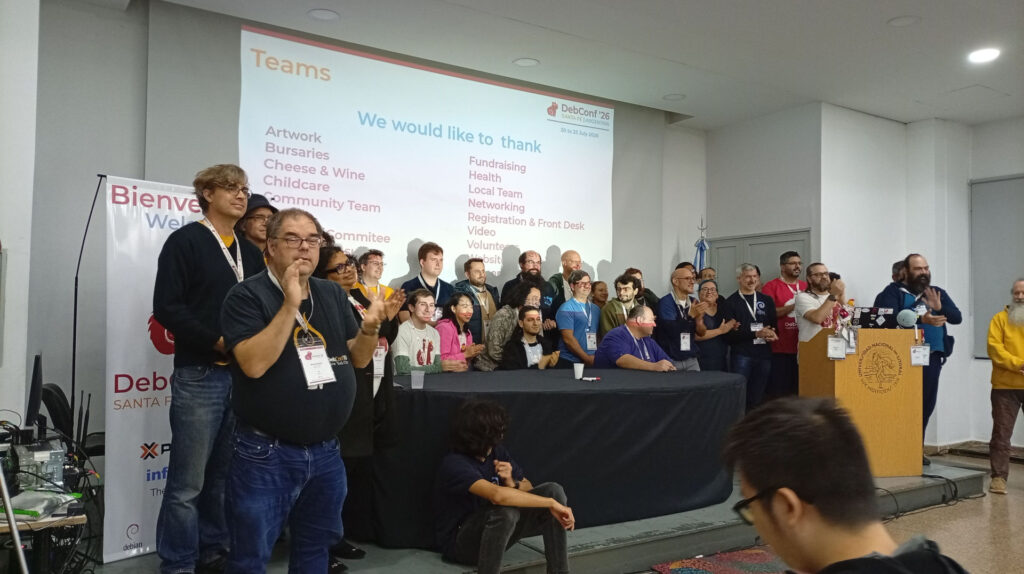
DebConf26 group photo - click to enlarge On Saturday 25 July 2026, the annual Debian Developers and Contributors Conference came to a close. Over 270 attendees representing 35 countries from around the world came together for a combined 90 events (including some which took place during the DebCamp) including more than 27 Talks, 21 Short Talks, 29 Birds of a Feather sessions ("BoF" informal meeting between developers and users), 8 workshops, and activities in support of furthering our distribution and free software, learning from our mentors and peers, building our community, and having a bit of fun. The conference was preceded by the annual DebCamp hacking session held 13 through 19 July where Debian Developers and Contributors convened to focus on their individual Debian-related projects or work in team sprints geared toward in-person collaboration in developing Debian. As has been the case for several years, a special effort has been made to welcome newcomers and help them become familiar with Debian and DebConf by organizing a sprint "New Contributors Onboarding" every day of Debcamp, followed more informally by mentorship during DebConf. Half a dozen new contributors joined the sessions and learned about Debian, free software, packaging and much more. This year, a week-long DebCamp session was dedicated to auditing, patching, and modernizing the Go ecosystem in Debian and enable the transition triggered by the recent upload of dh-golang enabling GO111MODULE=on by default in Experimental. In order to make the conference more accessible for local participants, a local language track was included in the schedule for talks in Spanish, as was done at DebConf19 in Brazil. The actual Debian Developers Conference started on Monday 20 July 2026. In addition to the traditional "Bits from the DPL" talk, the continuous key-signing party, lightning talks, and the announcement of next year's DebConf27, there were several update sessions shared by internal projects and teams. Many of the hosted discussion sessions were presented by our technical core teams with the usual and useful "Meet the Technical Committee", three talks about Linux Kernel, early boot and improving Debian s kernel and installer support for Chromebooks, and about twenty BoFs and talks about Debian packaging policy, Debian infrastructure, security and privacy. This year, and echoing ongoing discussions within the Free Software community, Artificial Intelligence and Age Verification have been the subject of several talks. The Python, Perl, Ruby, Go, and Rust programming language teams also shared updates on their work and efforts. More than 17 BoFs and talks about community, diversity, and local outreach highlighted the work of various teams involved in not just the technical but also the social aspect of our community The schedule was updated each day with planned and ad hoc activities introduced by attendees over the course of the conference. Several traditional activities took place: a poetry performance, the traditional Cheese and Wine party, the Group Photos, and the Day Trip. For those who were not able to attend, most of the talks and sessions were broadcasted live and recorded. One can find the seventy hours of recorded videos available via the conference schedule, or alternatively through this link. Almost all of the sessions facilitated remote participation via IRC and Matrix messaging apps or online collaborative text documents which allowed remote attendees to "be in the room" and ask questions or share comments with the speaker or assembled audience. DebConf26 saw over 341 T-shirts, a day trip, and up to 130 meals planned per day. All of these events, activities, conversations, and streams coupled with our love, interest, and participation in Debian and F/OSS certainly made this conference an overall success both here in Santa Fe, Argentina and online around the world. The DebConf26 website will remain active for archival purposes and will continue to offer links to the presentations and videos of talks and events. Next year, DebConf27 will be held in Asahikawa, Hokkaido, Japan, from Sunday September 5th to Saturday September 11th, 2027. As tradition follows before the next DebConf the local organizers in Japan will start the conference activities with DebCamp with a particular focus on individual and team work towards improving the distribution. DebConf is committed to a safe and welcome environment for all participants. See the web page about the Code of Conduct on the DebConf26 website for more details on this. Debian thanks the commitment of numerous sponsors to support DebConf26, particularly our Platinum Sponsors: Infomaniak, and Proxmox, and our Gold Sponsors : Freexian, and Viridien. We also wish to thank our Video and Infrastructure teams, the DebConf26 and DebConf committees, our host nation of Argentina, and each and every person who helped contribute to this event and to Debian overall. Thank you all for your work in helping Debian continue to be "The Universal Operating System". See you next year! About Debian The Debian Project was founded in 1993 by Ian Murdock to be a truly free community project. Since then the project has grown to be one of the largest and most influential Open Source projects. Thousands of volunteers from all over the world work together to create and maintain Debian software. Available in 70 languages, and supporting a huge range of computer types, Debian calls itself the universal operating system. About DebConf DebConf is the Debian Project's developer conference. In addition to a full schedule of technical, social and policy talks, DebConf provides an opportunity for developers, contributors and other interested people to meet in person and work together more closely. It has taken place annually since 2000 in locations as varied as Scotland, Bosnia and Herzegovina, India, Korea, France. More information about DebConf is available from https://debconf.org/. About Infomaniak Infomaniak is an independent, employee-owned Swiss technology company that designs, develops, and operates its own cloud infrastructure and digital services entirely in Switzerland. With over 300 employees more than 70% engineers and developers the company reinvests all profits into R&D. Its public cloud is built on OpenStack, with managed Kubernetes, Database as a Service, object storage, and sovereign AI services accessible via OpenAI-compatible APIs, all running on its own Swiss infrastructure. Infomaniak also develops a sovereign collaborative suite messaging, email, storage, online office tools, videoconferencing, and a built-in AI assistant developed in-house and as a privacy-respecting solution to proprietary platforms. Open source is central to how Infomaniak operates. Its latest data center (D4) runs on 100% renewable energy and uses no traditional cooling: all the heat generated by its servers is captured and fed into Geneva's district heating network, supplying up to 6,000 homes in winter and hot water year-round. The entire project has been documented and open-sourced at d4project.org. About Proxmox Proxmox develops powerful, yet easy-to-use open-source server solutions. The comprehensive open-source ecosystem is designed to manage divers IT landscapes, from single servers to large-scale distributed data centers. Our unified platform integrates server virtualization, easy backup, and rock-solid email security ensuring seamless interoperability across the entire portfolio. With the Proxmox Datacenter Manager, the ecosystem also offers a "single pane of glass" for centralized management across different locations. Since 2005, all Proxmox solutions have been built on the rock-solid Debian platform. We are proud to return to DebConf26 as a sponsor because the Debian community provides the foundation that makes our work possible. We believe in keeping IT simple, open, and under your control. Contact Information For further information, please visit the DebConf26 web page at https://debconf26.debconf.org/ or send mail to press@debian.org.

27 July 2026

Jonathan Carter: DebConf26 Santa Fe, Argentina

TL;DR: What a great DebConf! I managed to recharge my Debian batteries, and my talks / BoF sessions all went fine. Already looking forward to DebConf in Japan next year!

DebCamp

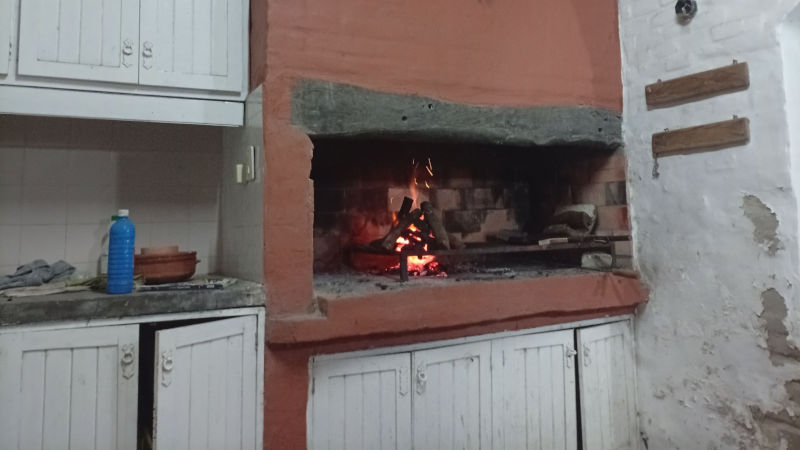
The evening before DebCamp started, we had a nice bbq (we taught some locals to call it a braai at an organiser s house and went for a walk around the river as the sun set. It was a very peaceful lead-in to DebCamp.

  • I set up and sent out the call for Forky desktop artwork:
  • Had many nice discussions about various Debian topics with all the Debian people around. It s really fun being around people who are natural problem solvers who care deeply about both technical and social issues. At one point Jonas told me Holy shit, these people are motivated! and I appreciate that so much too!

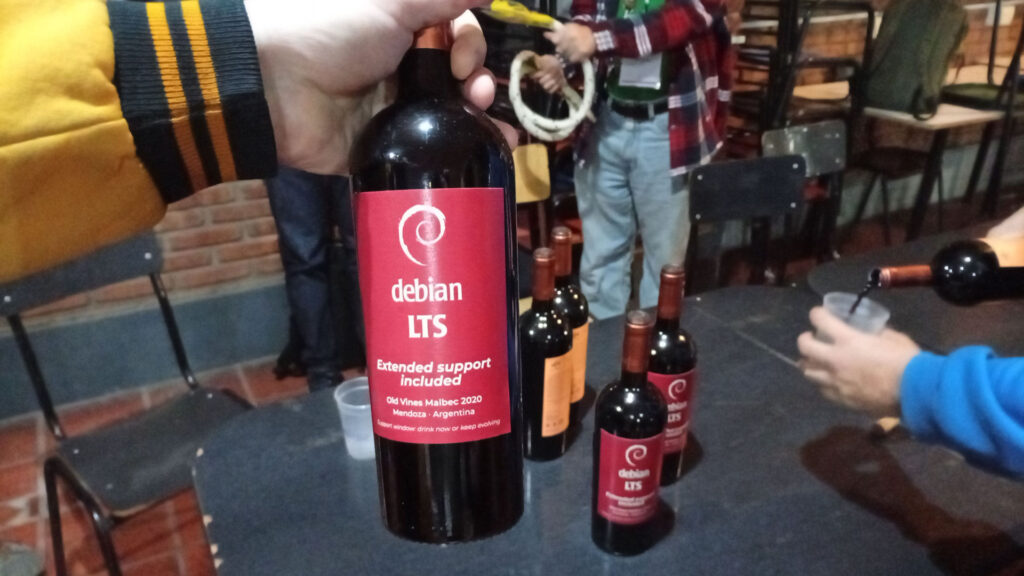
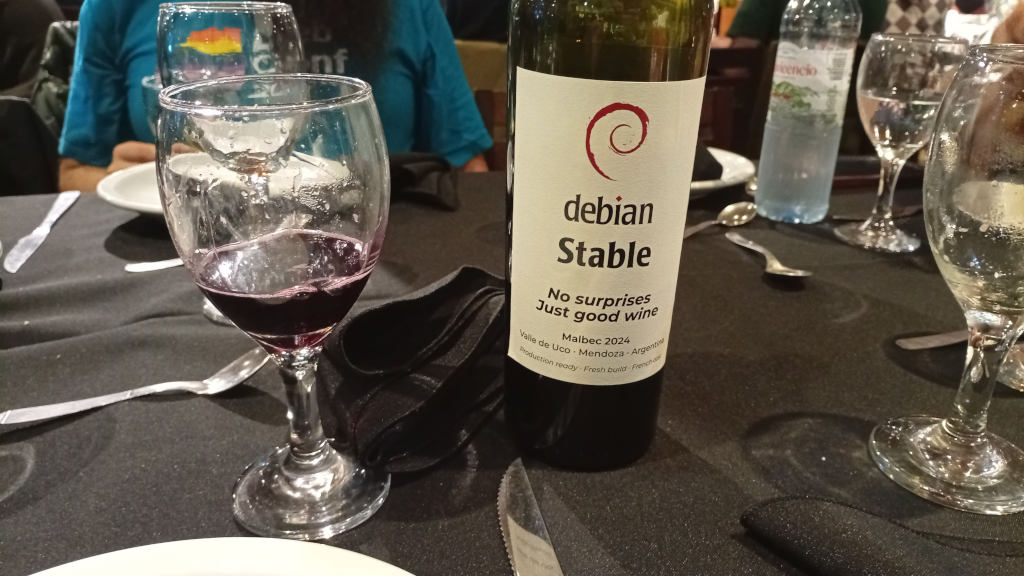
Debian LTS wine

  • Most of my DebCamp was dedicated to preparing for my demo and main talk that followed at DebConf.
  • Sadly, we had no loopy this year, I just didn t have the time, and the people who stepped up to help last year were either overwhelmed with other issues or couldn t make it. I ll try to make it happen again for next year by kicking it off long before DC27.

View of Santa Fe city from hotel

DebConf

Talk Is it even possible to build a truly universal system installer?

In this talk I do a very quick comparison of system installers based on my experience with them. It s hard to directly compare all of them, since there are so many, and each have their own niche that they attempt to satisfy.

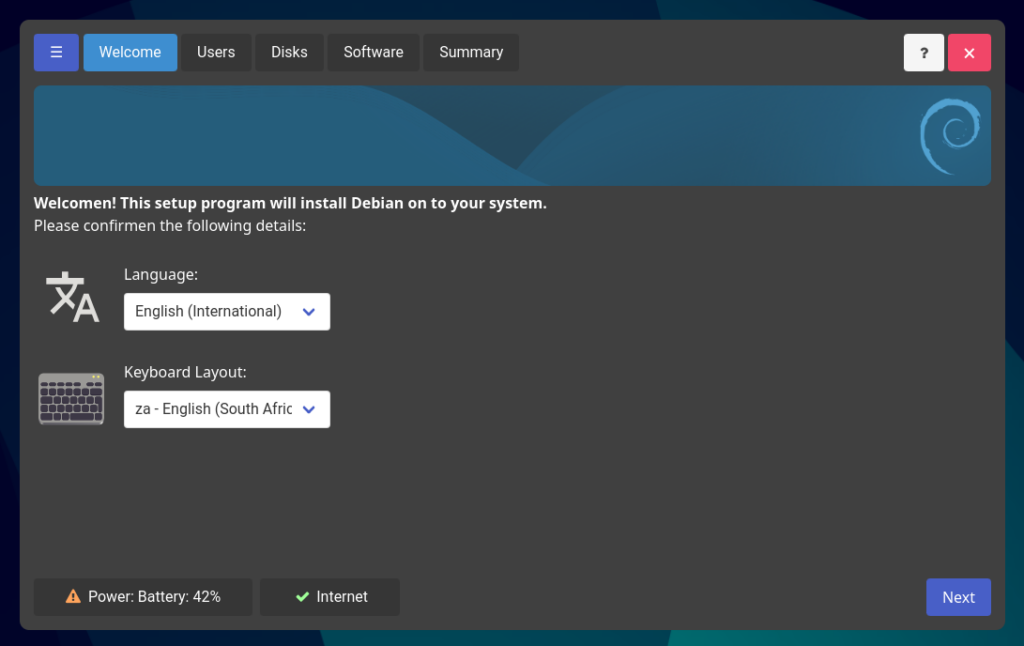
I also introduce Yasi my attempt to answer the question of whether we could build a universal installer, which can also better cover advanced installations, automated installations and niche setups.

It s very early days for the project, and I didn t quite feel ready to share the code with the world, but it was nice that I did a quick demo where I could install a Debian system and the resulting system actually booted up. *phew*.

This is also going to be my main focus for the mid-term future. I aim to have all the basic partitioning options working by the time Debian 14 (Forky) is released, and by the time Debian 15 is released, I have a long list of features that I aim to have working. So, my timeline for having something that s generally useful is around a year from now, and in around 3 years it should be a fully fledged installer that should cover a very large amount of Debian use cases and architectures.

Day Trip

For the day trip, we did a tour across Santa Fe, visited Constituci n de la Naci n Argentina, had lunch where we tried various dishes based on local fish from the river, and then went on a boat ride on the river.

BoF Sessions:

Funding in Free Software Projects: I initially registered this BoF because I m increasingly concerned about how upstreams are asking for donations in their software. I increased the scope to talk about funding in free software in general. It followed Marga s talk about funding, which focussed more about how developers are funded in general. We didn t dive very deep into this, but we certainly need some further discussion (and action) on this within Debian.

Debian Social Team: My most important issue for this team is a carry-over from last year, I want to set up barman (packaged in Debian) for live postgres syncing for our larger databases. For the smaller DBs, doing a daily dump is quite cheap. But for Matrix, it s very expensive in terms if i/o and CPU, so it would be ideal to do less regular complete dumps and use live replication for the first line of redundancy instead.

Images Team: I wasn t initially planning to say much during this session, I have some ideas to reduce both size and count of images, without losing any benefits, but I don t have any work to show for that yet. I ended up talking a lot more than I anticipated, the topics covered were quite good and representative of the current state of Debian images built. I don t have time to create a full summary, so I suggest checking the etherpad / video recording if you re interested.

Some more wine variety during the conference dinner

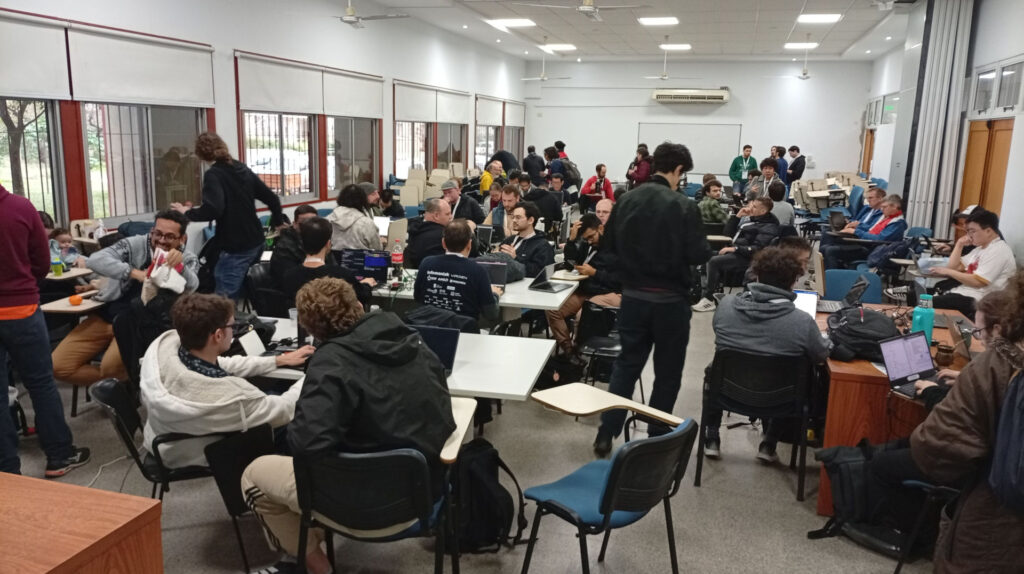
Debianites in the main hacklab

Rosario

I m spending two days in Rosario before I head home. Exploring a bit, catching up with sleep, finishing this blog post, signing keys and exploring some ideas I made note of during DebConf.

Thank you to the DebConf26 Team!

It was a little surreal not being part of any DebConf team for the first time ever, I ve just been too focussed on getting Yasi ready for my talk (no regrets!). I hope to be more involved again next year, in the meantime, I m very grateful to everyone who has made this happen, you did a stellar job! I hope to see many of you again next year in Japan!

5 July 2026

Dirk Eddelbuettel: Rcpp 1.1.2 on CRAN: Usual Improvements in Semi-Annual Update

rcpp logo Team Rcpp is excited to share that an brandnew new version 1.1.2 of Rcpp is now on CRAN, has also been uploaded to Debian, and has already built for r2u and r-universe; Windows etc builds at CRAN should follow in due course. Rcpp has long established itself as the most popular way of enhancing R with C or C++ code. Right now, 3236 packages on CRAN depend on Rcpp for making analytical code go faster and further. On CRAN, 13.4% of all packages depend (directly) on Rcpp, and 61.4% of all compiled packages do. From the cloud mirror of CRAN (which is but a subset of all CRAN downloads), Rcpp has been downloaded 121.6 million times. The two published papers (also included in the package as preprint vignettes) have, respectively, 2263 (JSS, 2011) and 471 (TAS, 2018) citations, while the the book (Springer useR!, 2013) has another 742. The is the second update in the 1.1.* series which had, among other changes, switched to C++11 as the minimum standard. This release continues as usual with the six-months January-July cycle started with release 1.0.5 in July 2020. Interim snapshots are always available via the r-universe page and repo. We continue to strongly encourage the use of these development released and their testing we tend to run our systems with them too. Having said that, we would like to reiterate that we strongly object to the upstream R release and change management which in this 4.6.* cycle made several abrupt changes forcing packages which consume header files to make very abrupt change. Rcpp, just like numerous other CRAN packages demonstrates that API changes can be undertaken responsibly in a managed manner which allows for transition periods followed by possible warning periods, deprecations periods and finally (but only at long last) errors. What happened here is a speed run to the final stage of forced errors. Uncool and irritating for something as widely used as R. This forced us to make an interim release 1.1.1-1.1 even though we have of course had a policy of always keeping properly tested, installable, and error-free releases candidate version in the main repository branch and hence available via R-universe tested packages for all relevant platforms, and even via binaries for most (including Ubuntu LTS). It would be nice if R Core found a way to take advantage of this. Maybe development cycles, running apart for a year as they do for R, should also include selected packages. Once again I am not attempting to summarize the different changes. The full list follows below and details all these changes, their respective PRs and, if applicable, issue tickets. Big thanks from all of us to all contributors!
Changes in Rcpp release version 1.1.2 (2026-07-01)
  • Changes in Rcpp API:
    • Use of execinfo.h is again conditional to avoid build complexity (Dirk in #1445 addressing #1442)
    • An internal state component for Datetime is now int (Dirk in #1448 and #1449 fixing #1447)
    • Three new (in R 4.6.0) attribute accessors are used conditionally (Dirk in #1450 closing #1432)
    • An UBSAN error in the Sugar-based NA comparison has been corrected (I aki in #1453 fixing #1452)
    • Treatment of Inf outside of integer range in Sugar function has been corrected (I aki in #1458 fixing #1455)
    • Integer overflow protection has been added for sugar functions (I aki in #1457 fixing #1454)
    • The parent environment is now accessed via R_ParentEnv (Dirk in #1460 fixing #1459)
    • Change to returning dataptr again for better handling of empty vectors (I aki in #1462 fixing #1461)
    • Undefined behavior errors in use of ListOf proxies have been addressed (I aki in #1464 fixing #1463)
    • Under newer R version, R_UnboundValue is no longer used (I aki in #1466 fixing #1465)
    • New R API access point R_getRegisteredNamespace() is used with current R versions (Dirk in #1469 fixing #1468)
    • The Nullable::as() exporter now uses an explicit cast to the templated type (Dirk in #1471 fixing #1470)
    • A memory leak in the variadic Rcpp::warning() template has been fixed (Kevin in #1475 fixing #1474)
    • The Nullable::operatorT() has been added as a 'opt-out' (Dirk in #1477 with coordination in #1472)
    • Add templated integer-index overload for operator[] on small systems such as WASM (Jeroen Ooms in #1482)
    • The attribute accessors in AttributeProxyPolicy no longer rely on get__() (Kevin in #1484 fixing #1483)
  • Changes in Rcpp Documentation:
    • Reference in the bibliography used by the package vignettes have been updated.
  • Changes in Rcpp Deployment:
    • Excute permissions are set consistently on scripts with shebangs (Mattias Ellert in #1467)
    • R 4.5.* has been added to the CI matrix (Dirk in #1476)
    • Three nag messages issued when obsolete build flag accessors are used now show Rcpp::: (Dirk in #1480 fixing #1456)
    • Reference GitHub Actions have been updated to their current versions (Dirk in #1481)
  • Non-release Changes:
    • A non-release hotfix 1.1.1-1 used by CRAN accommodates breaking changes to the API in R 4.6.0. It would be nice to have the same level of release management in R itself that CRAN expects from us.

Thanks to my CRANberries, you can also look at a diff to the previous interim release along with pre-releases 1.1.1-1 and 1.1.1-1.1 that were needed because R-devel once again sudden decided to move fast and break things. Not our doing. And there also should not have been a need to two such uploads but it was amateur hour all around. Questions, comments etc should go to the GitHub discussion or issue section, or the Rcpp list. Bugs reports are welcome at the GitHub issue tracker as well. GitHub offers decent search for issue, pull requests and discussions; as many topics have been covered it is worth checking as well.

This post by Dirk Eddelbuettel originated on his Thinking inside the box blog. If you like this or other open-source work I do, you can sponsor me at GitHub.

28 June 2026

Russell Coker: Some GPU Stuff

After getting a HP Z4 G4 tower server/workstation to house my Intel Battlemage GPU [1] I ve been playing around with some GPU stuff. For years I ve been just buying GPUs based on the resolution and price and not bothering about anything else due to lack of ability to measure what cards are doing. The nvidia-smi program is really good for NVidia/CUDA setups but I hadn t been aware of anything similar for AMD cards. As I prefer AMD cards for my workstations due to driver issues with NVidia that was a problem for me. I ve recently discovered that the program nvtop (Debian package nvtop) shows the GPU use of multiple GPU types, for me it s worked on AMD and Intel discrete GPUs and shows some information on Intel integrated GPUs, I don t have others convenient for testing at the moment. Currently BOINC has the Einstein@Home [2] project running on the HP Z4 G4 and it s using between 66% and 100% of GPU compute power and 1.6G of GPU RAM. Using 100% GPU compute power allegedly takes 62W of power out of the 190W quoted TDP. I presume that the power use reported by nvtop is very inaccurate. A friend installed a LLM on that system and the libraries used for the LLM were sufficient that BOINC just started using the GPU. On my workstation running an AMD [Radeon RX 460/560D / Pro 450/455/460/555/555X/560/560X] (actually R560) with 4G of GPU RAM I have mpv taking 1G of GPU RAM to play a FullHD video expanded to a full screen window on my 5120*2160 display. I also have about 2G used by the kwin_wayland process (the Wayland server for KDE). That doesn t leave enough GPU RAM to allow Einstein@Home to use the GPU. When playing the FullHD video in question (which is 1.2G for 42 minutes about 500KB/s) at 1.5* speed (a common playback speed I use) that takes about 30% of the compute power on my GPU. I had installed the rocm-opencl-icd package on my workstation (with a 5120*2160 monitor) and restarted boinc-client.service which is all that s needed to allow BOINC to use an AMD GPU. Then the screen started flickering as the Einstein process repeatedly core dumped which I initially assumed to be it s reaction to not having enough GPU RAM available. On every core dump the screen flickered so it went through a process of dozens of screen flickers until it had caused a sufficient number of core dumps and BOINC gave up running that job. Another annoyance is that the boincmgr program (the graphical program for managing BOINC systems) launches two webkit processes that each use about 400M of GPU RAM, so even if other things weren t using all my GPU RAM the boincmgr process would stop the BOINC jobs from using the GPU. I shut down some of the programs that were using GPU RAM until there was 2G free and the BOINC process kept crashing so it seems that there is some other issue. On another system with a 4K monitor there were Chrome and Chromium GPU process taking 1.1G and 500M of GPU RAM respectively and the KWin Wayland process was taking 1G of GPU RAM. So that s well over half the GPU RAM for just browsers and Wayland. With programs like Kitty (terminal emulator) and Nheko (Matrix client) taking over 100M of GPU RAM it seems that 4G is the bare minimum for GPU RAM with modern software and a 4K or similar display. I also noticed the kscreenlocker_greet process taking 440M of GPU RAM. I wonder if a hostile web server could make a web browser take more GPU RAM and starve the screenlocker of GPU RAM, could that allow forcing a screen lock operation to fail? It seems that 4G is the minimum for modern systems, which isn t necessarily a problem as GPUs that are capable of driving 4K displays tend to have no less than 4G. My local computer store has new GPUs with 4G starting at $120 but 12G seems to be the next option up which starts at about $400. Ebay currently has a selection of AMD GPUs with 8G of RAM under $200. I ve had some problems with the GPU in my workstation crashing as described in my previous post where I thought it was driver issues [3]. I now believe that there are hardware issues and will look into buying one of the cards with 8G. Further Investigation I need to determine which of the AMD GPUs that are currently going cheap on ebay are best. While my current PC has support for 150W PCIe power I d rather something less power hungry than that. I have occasional issues of mpv reporting that my system is too slow for a video so slightly more compute power on the GPU would be good, but I think that every available option has significantly more compute power. I need to find out what the relationship is between screen resolution and GPU memory. If I get an 8K display or an array of 4*4K displays (which is quite plausible as 27 4K displays go for $230 each) will I find 16G of GPU RAM as limiting as I find 4G now? The nvtop program tracks PCIe data transfers for AMD GPUs, I haven t yet seen more than 25MB/s and I need to do more tests to see what the maximum is. Running on an Intel Battlemage card nvtop doesn t report PCIe data transfer speed which is a missing feature in either the driver or the program. I need to find out where the problem is and report a bug if someone hasn t already done so. The GPU RAM use of some applications seems excessive. 440M for a lockscreen? 100M+ for a terminal emulator? 320M for Thunderbird?

16 June 2026

Vincent Bernat: Building a Soviet Nail Factory: how KPIs killed efficiency

In 2008, I landed my second job, in the network team at Orange Portails1, the division behind the websites and search engine of the French telecom operator Orange. The place ran like clockwork: a comprehensive technical setup, a dedicated team for every part of the business, and room to focus on what I do best. A few years later, none of that mattered: thanks to an obsession with the numbers, we could no longer deliver new services on time.

Disclaimer This is a story I like to tell to warn people about Goodhart s law.2 As these events happened almost 15 years ago, my recollection is a bit fuzzy. I left in 2012.

The first years During my first years, the department operated like a startup. Its cradle was the French company Echo. They built a search engine. France T l com bought it and renamed it Voila. It was the most visited search engine in France in the early 2000s. France T l com consolidated the portal activities into the Wanadoo Portails division, later renamed Orange Portails. The technical environment was excellent. We had many internal tools:3 a ticket system, an RRD-based graphing tool, an IPAM, a reporting tool, and an SNMP-based alerting tool.4 We deployed our Linux servers with CFEngine. We installed systems and applications from internal Debian repositories. We documented everything in a private MediaWiki instance. Supervision was performed with an ancestor of Xymon. The network architecture was clean and scalable with little legacy. We onboarded new people in a day. It was a nurturing environment for me. I developed several tools: lldpd, an 802.1AB implementation, Snimpy, a pythonic binding for Net-SNMP, Wiremaps, a layer-2 discovery tool with a time machine to know which device is connected where, Kit r , a tool to simulate network conditions, QCSS-3, a controller for load-balancers, and ipoo, a service available through a Jabber chatbot and a Greasemonkey script to expose IP-related information. I added SNMP support for Keepalived and Quagga. I also started this blog, with articles like Anycast DNS, TLS-related articles like TLS computational DoS mitigation, SNMP-related articles like Integration of Net-SNMP into an event loop, Linux-related articles like Tuning Linux IPv4 route cache, and an article about VXLAN long before it was cool.

The collapse When we needed new servers, the on-site team would take a set from the inventory, install our base Linux distribution on them, put them in the datacenter, and cable them to the top-of-the-rack switches. We opened a ticket describing the servers we needed, and one week later, our servers were available. Orange wanted to know if this team was performing well, so they asked for KPIs. They decided to use the number of tickets completed in a year. They asked to double this number. So instead of one ticket for a new service, we would open six tickets one per server. By the end of the year, the KPIs had more than doubled. Everybody saw it as a success for performance management. So, they asked to do the same for the next year. Now, we needed to open a ticket per server and per step. Again, the KPIs doubled. Behind the scenes, the tickets went to different people and were no longer handled in order. So, for the next year, it was decided to have meta-tickets and meetings to follow the progress of these tickets. Of course, all these extra steps pushed the KPI even higher. This performance management method spread to the other teams.5 Everything became slower. Instead of a couple of weeks, a new service now took six months. We built a Soviet nail factory. But the KPIs were good, and we stopped caring. Let me give you another example. We had to estimate the impact of each night operation. We weren t half bad: we declared most operations without any expected impact. Most of the time, there was no impact. One time out of five, there was a 5-second impact. We were told to try harder to meet our expected impact. What did we do? We started declaring a 5-second expected impact. One day, we got a 30-second impact and were told we failed to match the expected impact. In the end, we declared most operations with a 10-minute expected impact, and we stopped caring: instead of carefully shifting traffic around, we allowed ourselves a 5-minute impact. And our KPIs were never better.
Graph showing the impact of night operations. Year after year, the impact tolerance has been increased. In the final year, the expected impact is 10 minutes, and all operations remain under this threshold. However, the impacts are much more significant than they were in the first year.
An artist's rendering of the evolution of impacts over the years.

KPIs are not bad, but they are easy to break. Use them carefully: let the people doing the work help choose the metrics, and tie those metrics to the quality of the service for example, with service level objectives. Otherwise, even dedicated people stop caring, game the system, and eventually quit.6

  1. Internally, this division was named Hebex. It was located in Bagnolet (next to Paris) and Sophia-Antipolis (near Nice).
  2. Goodhart s law often gets the credit, but Campbell s law describes my experience even better: the more you lean on a number to make decisions, the faster people corrupt it.
  3. At the time, SaaS was not really a thing. I remember we considered, with a couple of colleagues, selling Wiremaps as a SaaS, with homomorphic encryption for the database. But who would outsource their observability stack?
  4. Snalert was a metacircular alerting tool in Perl. It was able to poll a very large number of SNMP targets in a short timespan. All our monitoring was SNMP-based, including system monitoring.
  5. My team also managed the rules of many Linux-based firewalls. To increase our KPIs, we used the same method: rather than accepting one ticket with a flow matrix, we requested one ticket per flow.
  6. Orange is not unique. Google s promotion process is another well-known example of a broken KPI. Michael Lynch explains it in Why I Quit Google to Work for Myself.

9 June 2026

Otto Kek l inen: SpacemiT K3 is a compelling RISC-V AI CPU, but difficult to buy

Featured image of post SpacemiT K3 is a compelling RISC-V AI CPU, but difficult to buyThe RISC-V CPU architecture has been gaining a lot of popularity since it launched in 2014, and now that the industry is standardizing on the RVA23 level that includes vector support as a mandatory extension, we are likely to see a lot more edge- and IoT devices with the ability to run local LLMs at reasonable speed, and most importantly at very compelling prices. SpacemiT is a Chinese RISC-V CPU manufacturer that launched on May 11th, 2026, their long-anticipated next-gen RISC-V AI chip K3. It is among the earliest RISC-V CPUs that adhere to the RVA23 standard and performance-wise it is quite capable, providing 130 KDMIPS general computing power, 60 TOPS on INT4 which translates to about 15 tokens per second when running a 30 billion parameter large language model. The aspect that really makes it stand out is: SpacemiT also develops their own Debian-based Linux distribution Bianbu OS, and seems to have collaboration going on with the wider community. Their community site seems active, and they also have a dedicated X account @spacemit_riscv and Reddit account r/spacemit_riscv posting relevant progress info on Linux kernel upstreaming activities. The X account is also responsive, as evidenced by its replies to my questions. Canonical lists the SpacemiT K3 pico-ITX and K3 CoM260 Kit on its official Ubuntu for RISC-V partner-built hardware page, which strengthens the perception that upstream Linux support is being taken seriously. The SpacemiT folks also gave an interesting talk at the 2026 Ubuntu Summit that includes a peek into their roadmap with future K3, K7 and K9 models. For technical details, see SpacemiT s K3 pico-ITX documentation, the Jetson Orin Nano-compatible K3 CoM260 board documentation and documentation of the K3 processor itself. The SpacemiT K3 pico-ITX board and the K3 CoM260 board side-by-side (not to scale)
Comparing the resellers SpacemiT does not sell anything directly to consumers. Instead you need to buy a board that includes the K3 chip from an integrator. Currently the main resellers are: All of the above are Chinese companies that ship to customers both inside and outside China. DeepComputing stands out as the only one that actually has done real integration and ships the K3 on a custom board, while the others simply resell the SpacemiT-produced K3 pico-ITX and K3 CoM260 Kit.

Milk-V Milk-V is a RISC-V specialized integrator, as the name already implies. They sell the K3 under the name Jupiter2. Of all the K3 pico-ITX reseller product pages, the Jupiter2 presentation is the nicest and most detailed. Unfortunately their order page at arace.tech only states that it is a pre-order with no information about shipping schedule, taxes, or other details like what SSD is included (if any). Based on the pictures it does ship with a Milk-V branded case. The 32 GB RAM lists at 504 EUR, which is a very reasonable price. The @MilkV_Official account on X recently promoted the K3.

Documentation and support As of this writing, the Milk-V Jupiter2 documentation site is just a stub and has no actual content, and only two links to the SpacemiT K3 documentation site. For support there is a web forum with a dedicated Jupiter2 section. There is also a Matrix space, but unlike their other products, there is no dedicated Jupiter (neither v1 nor v2) channel.

Community size and open source involvement At least one prior Milk-V product was certified by Canonical, which indicates there is some collaboration in progress. Canonical also lists the Milk-V Titan on its official Ubuntu for RISC-V partner-built hardware page.

Sipeed The Sipeed K3 announcement is well written (in English) with all the relevant details and links to additional PDF manuals. However, their main page at sipeed.com says nothing about the K3, so one must know the subpage URL to access it. They offer both the K3 CoM260 kit compatible with Jetson Orin Nano carrier boards, and the stand-alone K3 pico-ITX-sized motherboard. The CoM260 kit is only 10 USD cheaper than the full pico-ITX motherboard, so choosing the latter is a no-brainer if starting from scratch. The pico-ITX model with 32 GB DDR5 RAM sells for 639 USD. The product page does not mention anything about hard disk size, so you don t really know exactly what you will be getting if placing an order. There is no indication about case, Wi-Fi antennas or power supply either, so most likely they are not included. Their store.sipeed.com website does not work at all, and their Taobao and AliExpress stores are not public and only accessible to registered users. The order page also says nothing about shipping time, delivery time, or taxes. The X account @SipeedIO is active and recently posted pictures of shipments in progress.

Documentation and support The main documentation wiki does not yet have any K3 content at the time of writing. There is a Discord channel for general RISC-V discussion, and their MaixHub also has a discussion board, but I didn t find anything K3-specific.

Community size and open source involvement Sipeed has had at least one of their previous devices certified by Canonical, which indicates they are active in the community. Note that the other RISC-V company SiFive that also has had hardware certified and officially supported by Canonical is a different company, despite the very similar name.

Banana Pi Banana Pi announced that they offer both the K3 CoM260 kit and the K3 pico-ITX motherboard version. Their product page for the K3 confusingly shows a MediaTek product in the page banner rather than the SpacemiT K3. Based on the product description and the fact they renamed the product as BPI-SM10, it seems to ship with some carrier board. The product pictures look identical to the SpacemiT documentation and there is no picture of the carrier board, and details are very sparse. The pico-ITX version with 8 GB RAM and 128 GB SSD sells for 293 USD and the CoM260 developer kit with the same specs sells for 287 USD and the 32 GB RAM with 128 GB SSD model sells for 595 USD. The shop page shows only five orders so far and items are currently out of stock. As there was no 32 GB RAM version of the pico-ITX available at all, this isn t an option for me as I want to run 30B parameter models that need the larger memory version. Of all of these resellers, the Banana Pi website seems the most outdated. It does not have a search feature, it is not mobile-friendly, pictures can t be pinched to zoom in and so forth. Product names are also almost all identical, and as the product listings only show the beginning of the product name, figuring out what product is what requires extra effort that just makes the online purchase experience plain bad.

Documentation and support I was only able to find the documentation page for the CoM260 kit, but none for the pico-ITX version. For support there is a forum, but the category list does not show any section for K3, and the forum search prohibits using the search term k3 as too short.

Community size and open source involvement Banana Pi has a long history in the ARM single-board computer market, but their presence in the RISC-V ecosystem is still growing. Their X account @sinovoip has posted only once about the K3 and otherwise promotes their ARM boards. However, their community culture page does express a commitment to open hardware in general, but there is no visible K3-specific community activity.

Firefly Firefly s K3 product page is comprehensive. Based on the details, they do not offer the K3 pico-ITX variant at all, but only the K3 CoM260 board inside the AIBOX-K3 Firefly RISC-V Edge Mini PC product. This is a feature-complete offering with a Jetson Orin Nano carrier board and case. The AIBOX-K3 with 32 GB RAM and 128 GB SSD in a case sells for 689 USD in their own Firefly.store. Unfortunately it only has HDMI and there is no USB-C with DisplayPort support, which is a deal-breaker for me personally. Interestingly, Firefly also offers rack-mounted servers with K3 as the CPU.

Documentation and support The wiki link on the product page is broken. The Firefly wiki does have a section for the AIBOX-K3, but it too has a broken link. It seems that as of the time of writing, there is no wiki section for this product yet. For support there is a web forum, which does have at least one K3 thread covering guides such as Hermes Agent installation, though broader K3-specific sections are still sparse.

Community size and open source involvement Firefly s X account @TeeFirefly has had no posts since 2024, and their GitLab/T-Firefly shows mostly 2024 activity, with only one repository updated in 2025 and nothing in 2026. Historically they have built a moderate community around their ARM-based Rockchip boards, with active forums and wiki contributions for those product lines. Their RISC-V K3 offerings are newer, and likely need a lot more polish to be attractive products overall.

DeepComputing Last, but certainly not least, is the laptop manufacturer DeepComputing that offers a Framework laptop compatible motherboard with the SpacemiT K3 chip. They also sell the plain motherboard, or with the Cooler Master case, which allows one to easily connect it to an external monitor and keyboard and use it as a desktop computer. The plain board with 32 GB RAM and no SSD sells for about 882 EUR. Shipping of the first batch is expected to start by end of June 2026. Their X account @DeepComputingio promotes this DC-ROMA RISC-V Mainboard III as their flagship product, so they seem to put a lot of effort into it. The overall product design and packaging seems good. Of all the K3 resellers and integrators that I was able to find, DeepComputing is the only one that actually designs their own boards with the K3 processor, while all the other vendors above are simply reselling the vanilla K3 boards with or without a case. After reviewing all these options I decided to buy the DC-ROMA RISC-V Mainboard III for Framework Laptop 13 with 32 GB RAM, 1 TB SSD and the Cooler Master case, totalling about 1100 EUR.

Documentation and support DeepComputing maintains product information for their RISC-V hardware at github.com/DC-DeepComputing/Framework, with documentation of the newest Mainboard III (FML13V05) still being finalized ahead of the first batch shipment. They provide community support through Discord and web forum, although the latter has very little activity.

Community size and open source involvement DeepComputing has established itself as a pioneer in RISC-V laptops, beginning with the DC-ROMA. I have seen their stand at FOSDEM, which shows they are genuinely active in the open source community. Canonical lists DeepComputing s first mainboard / FML13V01 on its official Ubuntu for RISC-V partner-built hardware page, and it seems likely that they will continue to collaborate with Canonical with the new model once it ships. While the underlying Linux enablement depends on SpacemiT s upstream efforts, DeepComputing s involvement helps bridge the gap between reference hardware and consumer-ready products. DeepComputing K3 board in the Cooler Master case

Conclusion After weighing all the options, I ended up placing an order with DeepComputing for their custom K3 board with the Cooler Master case. Despite the premium price, the active community support and the properly documented promise of a complete, working system made it easy to place an order with confidence. The SpacemiT K3 is poised to be one of the most significant RISC-V chips for local AI workloads, thanks to its RVA23 compliance and high tokens per second potential. Yet the buying experience in mid-2026 remains fragmented and incomplete. Hopefully this is just because the product is new, and they will get the purchase experience polished soon. What struck me most during this process was how poor the customer experience is across nearly all of these vendor websites: broken links, missing search functions, outdated product banners, pages that show the wrong product entirely, and no information about shipping times, stock levels, taxes, and so on. One wonders why these companies don t fully invest in their web presence. Personally I would assume they likely have enough customers already, primarily through domestic channels like Taobao and JD.com, that they do not feel any pressure to improve their international-facing sites. However, I did also review what was offered on Taobao, and the product details were very incomplete there too. Taobao, however, has a built-in live chat with almost all sellers, which can be used to ask questions and thus compensate for missing product details. I don t fully understand why the sales process seems unpolished. The websites feel almost like an afterthought a checkbox to claim global reach while the real business apparently happens elsewhere via closed platforms or via inaccessible reseller channels. It is a frustrating reminder that in the RISC-V hardware world, the technology may be open and global, but the purchase experience is less so.

30 April 2026

Otto Kek l inen: Mentoring Mondays for aspiring Debian contributors

Featured image of post Mentoring Mondays for aspiring Debian contributorsI mentor several people in Debian, and have been repeatedly asked to offer an opportunity to ask questions on a live call. I have now started a recurring video call for exactly that, which I call Mentoring Mondays, and it is open for anyone aspiring to contribute to Debian, one of the oldest and most widely used Linux distributions. Mentoring Mondays have already been happening for the past few Mondays, and this week we had a record 20 people on the call. During the calls so far we have had a demo of updating a package for a new upstream release using gbp, and of how to create a Merge Request on Salsa for a new upstream version. There is clearly a need for this, so I am announcing this now also on my blog, just as I have publicly announced that I offer mentoring for aspiring Debian contributors.

What is Mentoring Mondays? Mentoring Mondays is a recurring video call that lasts roughly 45 minutes with the agenda:
  • Weekly walk-through: demo of something in Debian packaging, explaining the what and why
  • Discussion on pros and cons to help participants develop their judgment
  • Questions & answers on Debian packaging, or open source contributing in general
This is ideal for you if you:
  • Have built a .deb package at least once and want to do it better
  • Are stuck on a specific Debian packaging bug and need guidance
  • Want to understand how Debian Developers actually work day-to-day
The call is mainly intended for those who want to contribute to Debian (or Debian derivatives, with Ubuntu being the most popular), but anyone can join to learn about things related to contributing to a Linux distribution. Please note that video chat uses Debian Social Jitsi. Joining the call requires authentication using a Salsa account, which anyone contributing to Debian should have anyway. Calls are not recorded, so participants can chat freely, and are also encouraged to be on-camera for an enhanced sense of community.

Next call: Monday May 4th, 2026 Make sure you are logged into Salsa first, before opening the call on Debian s Jitsi instance.

Matrix channel and future meeting time announcements Please join the Matrix channel #mentoringmondays:matrix.debian.social if you plan to attend Mentoring Mondays. All future meeting times will be announced there. It is also the channel to post questions about Debian packaging to be answered during the call. The current meeting time is friendly to people in Europe, Asia and Australian time zones, and will repeat at the same time slot on:
  • May 11th, 2026 at 12:30 UTC
  • May 18th, 2026 at 12:30 UTC
  • May 25th, 2026 at 12:30 UTC
  • June 1st, 2026 at 12:30 UTC
  • June 8th, 2026 at 12:30 UTC
Starting in mid-June the meeting time will change to accommodate participation in different time zones.

Spread the word Feel free to extend the invite to anyone you think might be interested in joining! If you mention this on social media, please post using tag #mentoringmondays, or simply boost the existing posts on the social media of your preference: Mastodon, Lemmy, Reddit, Bluesky, LinkedIn, Farcaster, X.

Thanks A big thanks to Jason Kregting for helping organize. I would also like to thank in advance all the Debian Developers who are able to join the call and be available to participate in discussions and help answer questions.

14 April 2026

Russell Coker: Furilabs FLX1s Finally Working

I ve been using the Furilabs FLX1s phone [1] as my daily driver for 6 weeks, it s a decent phone, not as good as I hoped but good enough to use every day and rely on for phone calls about job interviews etc. I intend to keep using it as my main phone and as a platform to improve phone software in Debian as you really can t effectively find bugs unless you use the platform for important tasks. Support Problems I previously wrote about the phone after I received it without a SIM caddy on the 13th of Jan. I had a saga with support about this, on the 16th of Jan one support person said that they would ship it immediately but didn t provide a tracking number or any indication of when it would arrive. On the 5th of Feb I contacted support again and asked how long it would be, the new support person seemed to have no record of my previous communication but said that they would send it. On the 17th of Feb I made another support request including asking for a way of direct communication as the support email came from an address that wouldn t accept replies, I was asked for a photo showing where the problem is. The support person also said that they might have to send a replacement phone! The last support request I sent included my disappointment at the time taken to resolve the issue and the proposed solution of replacing the entire phone (why have two international shipments of a fragile and expensive phone when a single letter with a cheap SIM caddy would do?). I didn t receive a reply but the SIM caddy arrived on the 2nd of Mar. Here is a pic of the SIM caddy and the package it came in: One thing that should be noted is that some of the support people seemed to be very good at their jobs and they were all friendly. It was the system that failed here, turning a minor issue of a missing part into a 6 week saga. Furilabs needs to do the following to address this issue:
  1. Make it possible to reply directly to a message from a support person. Accept email with a custom subject to sort it, give a URL for a web form, anything. Collating discussions with a customer allows giving better support while taking less time for the support people.
  2. Have someone monitor every social media address that is used by the company. When someone sends a support request in a public Mastodon post it indicates that something has gone wrong and you want to move quickly to resolve it.
  3. Take care of the little things, like sending a tracking number for every parcel. If it s something too small for a parcel (the SIM caddy could have fit in a regular letter) then just tell the customer what date it was posted and where it was posted from so they have some idea of when it will arrive.
This is not just a single failure of Furilabs support, it s a systemic failure of their processes. Problems I Will Fix Unless Someone Beats Me to it Here are some issues I plan to work on. Smart Watch Support I need to port one of the smart watch programs to Debian. Also I want to make one of them support the Colmi P80 [2]. A smart watch significantly increases the utility of a phone even though IMHO they aren t doing nearly all the things that they could and should do. When we get Debian programs talking to the PineTime it will make a good platform for development of new smart phone and OS features. Nextcloud I have ongoing issues of my text Nextcloud installation on a Debian VM not allowing connection from the Linux desktop app (as packaged in Debian) and from the Android client (from f-droid). The desktop client works with a friend s Nextcloud installation on Ubuntu so I may try running it on an Ubuntu VM I run while waiting for the Debian issue to get resolved. There was a bug recently fixed in Nextcloud that appears related so maybe the next release will fix it. For the moment I ve been running without these features and I call and SMS people from knowing their number or just returning calls. Phone calls generally aren t very useful for me nowadays except when applying for jobs. If I could deal with recruiters and hiring managers via video calls then I would consider just not having a phone number. Wifi IPv6 Periodically IPv6 support just stops working, I can t ping the gateway. I turn wifi off and on again and it works. This might be an issue with my wifi network configuration. This might be an issue with the way I have configured my IPv6 networking, although that problem doesn t happen with any of my laptops. Chatty Sorting Chatty is the program for SMS that is installed by default (part of the phosh/phoc setup), it also does Jabber. Version 0.8.7 is installed which apparently has some Furios modifications and it doesn t properly support sorting SMS/Jabber conversations. Version 0.8.9 from Debian sorts in the same way as most SMS and Jabber programs with the most recent at the top. But the Debian version doesn t support Jabber (only SMS and Matrix). When I went back to the Furilabs version of Chatty it still sorted for a while but then suddenly stopped. Killing Chatty (not just closing the window and reopening it) seems to make it sort the conversations sometimes. Problems for Others to Fix Here are the current issues I have starting with the most important. Important The following issues seriously reduce the usability of the device. Hotspot The Wifi hotspot functionality wasn t working for a few weeks, this Gitlab issue seems to match it [3]. It started working correctly for a day and I was not sure if an update I applied fixed the bug or if it s some sort of race condition that worked for this boot and will return next time I reboot it. Later on I rebooted it and found that it s somewhat random whether it works or now. Also while it is mostly working it seemed to stop working about every 25 minutes or so and I had to turn it off and on again to get it going. On another day it went to a stage where it got repeated packet loss when I pinged the phone as a hotspot from my laptop. A pattern of 3 ping responses and 3 Destination Host Unreachable messages was often repeated. I don t know if this is related to the way Android software is run in a container to access the hardware. 4G Reliability Sometimes 4G connectivity has just stopped, sometimes I can stop and restart the 4G data through software to fix it and sometimes I need to use the hardware switch. I haven t noticed this for a week or two so there is a possibility that one fix addressed both Hotspot and 4G. One thing that I will do is setup monitoring to give an alert on the phone if it can t connect to the Internet. I don t want it to just quietly stop doing networking stuff and not tell me! On-screen Keyboard The compatibility issues of the GNOME and KDE on-screen keyboards are getting me. I use phosh/phoc as the login environment as I want to stick to defaults at first to not make things any more difficult than they need to be. When I use programs that use QT such as Nheko the keyboard doesn t always appear when it should and it forgets the setting for word completion (which means spelling correction). The spelling correction system doesn t suggest replacing dont with don t which is really annoying as a major advantage for spelling checkers on touch screens is inserting an apostrophy. An apostrophy takes at least 3* longer than a regular character and saving that delay makes a difference to typing speed. The spelling correction doesn t correct two words run together. Medium Priority These issues are ongoing annoyances. Delay on Power Button In the best case scenario this phone has a much slower response to pressing the power button than the Android phones I tested (Huawei Mate 10 Pro and Samsung Galaxy Note 9) and a much slower response than my recollection of the vast majority of Android phones I ve ever used. For testing pressing buttons on the phones simultaneously resulted in the Android phone screens lighting up much sooner. Something like 200ms vs 600ms I don t have a good setup to time these things but it s very obvious when I test. In a less common case scenario (the phone having been unused for some time) the response can be something like 5 seconds. The worst case scenario is something in excess of 20 seconds. For UI designers, if you get multiple press events from a button that can turn the screen on/off please make your UI leave the screen on and ignore all the stacked events. Having the screen start turning on and off repeatedly when the phone recovers and processes all the button presses isn t good, especially when each screen flash takes half a second. Notifications Touching on a notification for a program often doesn t bring it to the foreground. I haven t yet found a connection between when it does and when it doesn t. Also the lack of icons in the top bar on the screen to indicate notifications is annoying, but that seems to be an issue of design not the implementation. Charge Delay When I connect the phone to a power source there is a delay of about 22 seconds before it starts to charge. Having it miss 22 seconds of charge time is no big deal, having to wait 22 seconds to be sure it s charging before leaving it is really annoying. Also the phone makes an audible alert when it gets to 0% charge which woke me up one night when I had failed to push the USB-C connector in hard enough. This phone requires a slightly deeper connector than most phones so with some plugs it s easy to not quite insert them far enough. Torch aka Flash The light for the torch or flash for camera is not bright at all. In a quick test staring into the light from 40cm away wasn t unpleasant compared to my Huawei Mate 10 Pro which has a light bright enough that it hurts to look at it from 4 meters away. Because of this photos at night are not viable, not even when photographing something that s less than a meter away. The torch has a brightness setting which doesn t seem to change the brightness, so it seems likely that this is a software issue and the brightness is set at a low level and the software isn t changing it. Audio When I connect to my car the Lollypop player starts playing before the phone directs audio to the car, so the music starts coming from the phone for about a second. This is an annoying cosmetic error. Sometimes audio playing pauses for no apparent reason. It doesn t support the phone profile with Bluetooth so phone calls can t go through the car audio system. Also it doesn t always connect to my car when I start driving, sometimes I need to disable and enable Bluetooth to make it connect. When I initially set the phone up Lollypop would send the track name when playing music through my car (Nissan LEAF) Bluetooth connection, after an update that often doesn t happen so the car doesn t display the track name or whether the music is playing but the pause icon works to pause and resume music (sometimes it does work). About 30 seconds into a phone call it switches to hands-free mode while the icon to indicate hands-free is not highlighted, so I have to press the hands-free button twice to get it back to normal phone mode. Low Priority I could live with these things remaining as-is but it s annoying. Ticket Mode There is apparently some code written to display tickets on screen without unlocking. I want to get this working and store screen-caps of the Android barcode screens of the different loyalty cards so I can scan them without unlocking. My threat model does not include someone trying to steal my phone to get a free loaf of bread on the bakery loyalty program. Camera The camera app works with both the back and front cameras, which is nice, and sadly based on my experience with other Debian phones it s noteworthy. The problem is that it takes a long time to take a photo, something like a second after the button is pressed long enough for you to think that it just silently took a photo and then move the phone. The UI of the furios-camera app is also a little annoying, when viewing photos there is an icon at the bottom left of the screen for a video camera and an icon at the bottom right with a cross. Which every time makes me think record videos and leave this screen not return to taking photos and delete current photo . I can get used to the surprising icons, but being so slow is a real problem. GUI App Installation The program for managing software doesn t work very well. It said that there were two updates for Mesa package needed, but didn t seem to want to install them. I ran flatpak update as root to fix that. The process of selecting software defaults to including non-free, and most of the available apps are for desktop/laptop with no way to search for phone/tablet apps. Generally I think it s best to just avoid this and use apt and flatpak directly from the command-line. Being able to ssh to my phone from a desktop or laptop is good! Android Emulation The file /home/furios/.local/share/andromeda/data/system/uiderrors.txt is created by the Andromeda system which runs Android apps in a LXC container and appears to grow without end. After using the phone for a month it was 3.5G in size. The disk space usage isn t directly a problem, out of the 110G storage space only 17G is used and I don t have a need to put much else on it, even if I wanted to put backups of /home from my laptop on it when travelling that would still leave plenty of free space. But that sort of thing is a problem for backing up the phone and wasting 3.5G out of 110G total is a fairly significant step towards breaking the entire system. Also having lots of logging messages from a subsystem that isn t even being used is a bad sign. I just tried using it and it doesn t start from either the settings menu or from the f-droid icon. Android isn t that important to me as I want to get away from the proprietary app space so I won t bother trying this any more. Unfixable Problems Unlocking After getting used to fingerprint unlocking going back to a password is a pain. I think that the hardware isn t sufficient for modern quality face recognition that can t be fooled by a photo and there isn t fingerprint hardware. When I first used an Android phone using a pin to unlock didn t seem like a big deal, but after getting used to fingerprint unlock it s a real drag to go without. This is a real annoyance when doing things like checking Wikipedia while watching TV. This phone would be significantly improved with a fingerprint sensor or a camera that worked well enough for face unlock. Plasma Mobile According to Reddit Plasma Mobile (KDE for phones) doesn t support Halium and can never work on this phone because of it [4]. This is one of a number of potential issues with the phone, running on hardware that was never designed for open OSs is always going to have issues. Wifi MAC Address The MAC keeps changing on reboot so I can t assign a permanent IPv4 address to the phone. It appears from the MAC prefix of 00:08:22 that the network hardware is made in InPro Comm which is well known for using random addresses in the products it OEMs. They apparently have one allocation of 2^24 addresses and each device randomly chooses a MAC from that range on boot. In the settings for a Wifi connection the Identity tab has a field named Cloned Address which can be set to Stable for SSID that prevents it from changing and allows a static IP address allocation from DHCP. It s not ideal but it works. Network Manager can be configured to have a permanent assigned MAC address for all connections or for just some connections. In the past for such things I have copied MAC addresses from ethernet devices that were being discarded and used them for such things. For the moment the Stable for SSID setting does what I need but I will consider setting a permanent address at some future time. Docks Having the ability to connect to a dock is really handy. The PinePhonePro and Librem5 support it and on the proprietary side a lot of Samsung devices do it with a special desktop GUI named Dex and some Huawei devices also have a desktop version of the GUI. It s unfortunate that this phone can t do it. The Good Things It s good to be able to ssh in to my phone, even if the on-screen keyboard worked as well as the Android ones it would still be a major pain to use when compared to a real keyboard. The phone doesn t support connecting to a dock (unlike Samsung phones I ve used for which I found Dex to be very useful with a 4K monitor and proper keyboard) so ssh is the best way to access it. This phone has very reliable connections to my home wifi. I ve had ssh sessions from my desktop to my phone that have remained open for multiple days. I don t really need this, I ve just forgotten to logout and noticed days later that the connection is still running. None of the other phones running Debian could do that. Running the same OS on desktop and phone makes things easier to test and debug. Having support for all the things that Linux distributions support is good. For example none of the Android music players support all the encodings of audio that comes from YouTube so to play all of my music collection on Android I would need to transcode most of them which means either losing quality, wasting storage space, or both. While Lollypop plays FLAC0, mp3, m4a, mka, webm, ogg, and more. Conclusion This is a step towards where I want to go but it s far from the end goal. The PinePhonePro and Librem5 are more open hardware platforms which have some significant benefits. But the battery life issues make them unusable for me. Running Mobian on a OnePlus 6 or Droidian on a Note 9 works well for the small tablet features but without VoLTE. While the telcos have blocked phones without VoLTE data devices still work so if recruiters etc would stop requiring phone calls then I could make one of them an option. The phone works well enough that it could potentially be used by one of my older relatives. If I could ssh in to my parents phones when they mess things up that would be convenient. I ve run this phone as my daily driver since the 3rd of March and it has worked reasonably well. 6 weeks compared to my previous use of the PinePhonePro for 3 days. This is the first time in 15 years that a non-Android phone has worked for me personally. I have briefly used an iPhone 7 for work which basically did what it needed to do, it was at the bottom of the pile of unused phones at work and I didn t want to take a newer iPhone that could be used by someone who s doing more than the occasional SMS or Slack message. So this is better than it might have been, not as good as I hoped, but a decent platform to use it while developing for it.

15 March 2026

Russell Coker: The Difference Between Email and Instant Messaging

Introduction With various forms of IM becoming so prevalent and a lot of communication that used to be via email happening via IM I ve been thinking about the differences between Email and IM. I think it s worth comparing them not for the purpose of convincing people to use one or the other (most people will use whatever is necessary to communicate with the people who are important to them) but for the purpose of considering ways to improve them and use them more effectively. Also I don t think that users of various electronic communications systems have had a free choice in what to use for at least 25 years and possibly much longer depending on how you define a free choice. What you use is determined by who you want to communicate with and by what systems are available in your region. So there s no possibility of an analysis of this issue giving a result of let s all change what we use as almost everyone lacks the ability to make a choice. What the Difference is Not The name Instant Messaging implies that it is fast, and probably faster than other options. This isn t necessarily the case, when using a federated IM system such as Matrix or Jabber there can be delays while the servers communicate with each other. Email used to be a slow communication method, in the times of UUCP and Fidonet email there could be multiple days of delay in sending email. In recent times it s expected that email is quite fast, many web sites have options for authenticating an email address which have to be done within 5 minutes so the common expectation seems to be that all email is delivered to the end user in less than 5 minutes. When an organisation has a mail server on site (which is a common configuration choice for a small company) the mail delivery can be faster than common IM implementations. The Wikipedia page about Instant Messaging [1] links to the Wikipedia page about Real Time Computing [2] which is incorrect. Most IM systems are obviously designed for minimum average delays at best. For most software it s not a bad thing to design for the highest performance on average and just let users exercise patience when they get an unusual corner case that takes much longer than expected. If an IM message takes a few minutes to arrive then that s life on the Internet which was the catchphrase of an Australian Internet entrepreneur in the 90s that infuriated some of his customers. Protocol and Data Format Differences Data Formats Email data contains the sender, one or more recipients, some other metadata (time, subject, etc), and the message body. The recipients are typically an arbitrary list of addresses which can only be validated by the destination mail servers. The sender addresses weren t validated in any way and are now only minimally validated as part of anti-spam measures. IM data is sent through predefined connections called rooms or channels. When an IM message is sent to a room it can tag one or more members of the room to indicate that they may receive a special notification of the message. In many implementations it s possible to tag a user who isn t in the room which may result in them being invited to the room. But in IM there is no possibility to add a user to the CC list for part of a discussion and then just stop CCing messages to them later on in the discussion. Protocols Internet email is a well established system with an extensive user base. Adding new mandatory features to the protocols isn t viable because many old systems won t be updated any time soon. So while it is possible to send mail that s SSL encrypted and has a variety of authentication mechanisms that isn t something that can be mandatory for all email. Most mail servers are configured to use the SSL option if it s available but send in cleartext otherwise, so a hostile party could launch a Man In the Middle (MITM) attack and pretend to be the mail server in question but without SSL support. Modern IM protocols tend to be based on encryption, even XMPP (Jabber) which is quite an old IM protocol can easily be configured to only support encrypted messaging and it s reasonable to expect that all other servers that will talk to you will at least support SSL. Even for an IM system that is run by a single company the fact that communication with the servers is encrypted by SSL makes it safer than most email. A security model of this can only be read by you, me, and the staff at an American corporation isn t the worst type of Internet security. The Internet mail infrastructure makes no attempt to send mail in order and the design of the Simple Mail Transfer Protocol (SMTP) means that a network problem after a message has been sent but before the recipient has confirmed receipt will mean that the message is duplicated and this is not considered to be a problem. The IM protocols are designed to support reliable ordered transfer of messages and Matrix (the most recently designed IM protocol) has cryptographic connections between users. Forgery For most email systems there is no common implementation that prevents forging email. For Internet email transferred via SMTP it s possible to use technologies like SPF and DKIM/DMARC to make recipients aware of attempts at forgery, but many recipient systems will still allow email that fails such checks to be delivered. The default configuration tends to be permitting everything and all of the measures to prevent forgery require extra configuration work and often trade-offs as some users desire features that go against security. The default configuration of most mail servers doesn t even prevent trivial forgeries of email from the domain(s) owned by that server. For evidence check the SPF records of some domains that you communicate with and see if they end with -all (to block email from bad sources), ~all (to allow email from bad sources through after possibly logging an error), ?all (to be neutral on mail from unknown sources, or just lack a SPF record entirely. The below shows that of the the top four mail servers in the world only outlook.com has a policy to reject mail from bad sources.
# dig -t txt _spf.google.com grep spf1
_spf.google.com.	300	IN	TXT	"v=spf1 ip4:74.125.0.0/16 ip4:209.85.128.0/17 ip6:2001:4860:4864::/56 ip6:2404:6800:4864::/56 ip6:2607:f8b0:4000::/36 ip6:2800:3f0:4000::/36 ip6:2a00:1450:4000::/36 ip6:2c0f:fb50:4000::/36 ~all"
# dig -t txt outlook.com grep spf1
outlook.com.		126	IN	TXT	"v=spf1 include:spf2.outlook.com -all"
# dig -t txt _spf.mail.yahoo.com grep spf1
_spf.mail.yahoo.com.	1800	IN	TXT	"v=spf1 ptr:yahoo.com ptr:yahoo.net ip4:34.2.71.64/26 ip4:34.2.75.0/26 ip4:34.2.84.64/26 ip4:34.2.85.64/26 ip4:34.2.64.0/22 ip4:34.2.68.0/23 ip4:34.2.70.0/23 ip4:34.2.72.0/22 ip4:34.2.78.0/23 ip4:34.2.80.0/23 ip4:34.2.82.0/23 ip4:34.2.84.0/24 ip4:34.2.86.0" "/23 ip4:34.2.88.0/23 ip4:34.2.90.0/23 ip4:34.2.92.0/23 ip4:34.2.85.0/24 ip4:34.2.94.0/23 ?all"
# dig -t txt icloud.com grep spf1
icloud.com.		3586	IN	TXT	"v=spf1 ip4:17.41.0.0/16 ip4:17.58.0.0/16 ip4:17.142.0.0/15 ip4:17.57.155.0/24 ip4:17.57.156.0/24 ip4:144.178.36.0/24 ip4:144.178.38.0/24 ip4:112.19.199.64/29 ip4:112.19.242.64/29 ip4:222.73.195.64/29 ip4:157.255.1.64/29" " ip4:106.39.212.64/29 ip4:123.126.78.64/29 ip4:183.240.219.64/29 ip4:39.156.163.64/29 ip4:57.103.64.0/18" " ip6:2a01:b747:3000:200::/56 ip6:2a01:b747:3001:200::/56 ip6:2a01:b747:3002:200::/56 ip6:2a01:b747:3003:200::/56 ip6:2a01:b747:3004:200::/56 ip6:2a01:b747:3005:200::/56 ip6:2a01:b747:3006:200::/56 ~all"
In most IM systems there is a strong connection between people who communicate. If I send you two direct messages they will appear in the same room, and if someone else tries forging messages from me (EG by replacing the c and e letters in my address with Cyrillic letters that look like them or by mis-spelling my name) a separate room will be created and it will be obvious that something unexpected is happening. Protecting against the same attacks in email requires the user carefully reading the message, given that it s not uncommon for someone to start a message to me with Hi Russel (being unable to correctly copy my name from the To: field of the message they are writing) it s obvious that any security measure relying on such careful reading will fail. The IM protections against casual forgery also apply to rooms with multiple users, a new user can join a room for the purpose of spamming but they can t send a casual message impersonating a member of the room. A user can join a Matrix room I m in with the name Russell from another server but the potential for confusion will be minimised by a message notifying everyone that another Russell has joined the room and the list of users will show two Russells. For email the protections against forgery when sending to a list server are no different than those when sending to an individual directly which means very weak protections. Authenticating the conversation context once as done with IM is easier and more reliable than authenticating each message independently. Is Email Sucking the Main Technical Difference? It seems that the problems with forgery, spam, and general confusion when using email are a large part of the difference between email and IM. But in terms of technical issues the fact that email has significantly more users (if only because you need an email account to sign up for an IM system) is a major difference. Internet email is currently a universal system (apart from when it breaks from spam) and it has historically been used to gateway to other email systems like Fidonet, Uucp, and others. The lack of tight connection between parties that exchange messages in email makes it easier to bridge between protocols but harder to authenticate communication. Most of the problems with Internet email are not problems for everyone at all times, they are technical trade-offs that work well for some situations and for some times. Unfortunately many of those trade-offs are for things that worked well 25+ years ago. The GUI From a user perspective there doesn t have to be a great difference between email and IM. Email is usually delivered quickly enough to be in the same range as IM. The differences in layout between IM client software and email client software is cosmetic, someone could write an email client that organises messages in the same way as Slack or another popular IM system such that the less technical users wouldn t necessarily know the difference. The significant difference in the GUI for email and IM software was a design choice. Conversation Organisation The most significant difference in the operation of email and IM at the transport level is the establishment of connections in IM. Another difference is the fact that there are no standards implemented for the common IM implementations to interoperate which is an issue of big corporations creating IM systems and deliberately making them incompatible. The methods for managing email need to be improved. Having an inbox that s an unsorted mess of mail isn t useful if you want to track one discussion, breaking it out into different sub folders for common senders (similar to IM folders for DMs) as a standard feature without having to setup rules for each sender would be nice. Someone could design an email program with multiple layouts, one being the traditional form (which seems to be copied from Eudora [3]) and one with the inbox (or other folders) split up into conversations. There are email clients that support managing email threads which can be handy in some situations but often isn t the best option for quickly responding to messages that arrived recently. Archiving Most IM systems have no method for selectively archiving messages, there s a request open for a bookmark function in Matrix and there s nothing stopping a user from manually copying a message. But there s nothing like the convenient ability to move email to an archive folder in most IM systems. Without good archiving IM is a transient medium. This is OK for conversations but not good for determining the solutions to technical problems unless there is a Wiki or other result which can be used without relying on archives. Composing Messages In a modern email client when sending a message it prompts you for things that it considers complete, so if you don t enter a Subject or have the word attached in the message body but no file is attached to the message then it will prompt you to confirm that you aren t making a mistake. In an IM client the default is usually that pressing ENTER sends the message so every paragraph is a new message. IM clients are programmed to encourage lots of short messages while email clients are programmed to encourage more complete messages. Social Issues Quality The way people think about IM and email is very different, as one example there was never a need for a site like nohello.net for email. The idea that it s acceptable to use even lower quality writing in IM than people tend to use in email seems to be a major difference between the communication systems. It can be a good thing to have a chatty environment with messages that are regarded as transient for socialising, but that doesn t seem ideal for business use. Ownership Email is generally regarded as being comparable to physical letters. It is illegal and widely considered to be socially wrong to steal a letter from someone s letterbox if you regret sending it. In email the only unsend function I m aware of is that in Microsoft software which is documented to only work within the same organisation, and that only works if the recipient hasn t read the message. The message is considered to be owned by the recipient. But for IM it s a widely supported and socially acceptable function to delete or edit messages that have been sent. The message is regarded as permanently the property of the sender. What Should We Do? Community Creators When creating a community (and I use this in the broadest sense including companies) you should consider what types of communication will work well. When I started the Flounder group [4] I made a deliberate decision that non-free communication systems go against the aim of the group, I started it with a mailing list and then created a Matrix room which became very popular. Now the list hardly gets any use. It seems that most of the communication in the group is fairly informal and works better with IM. Does it make sense to use both? Should IM systems be supplemented with other systems that facilitate more detail such as a Wiki or a Lemmy room/instance [5] to cover the lack of long form communication? I have created a Lemmy room for Flounder but it hasn t got much interest so far. It seems that almost no-one makes a strategic decision about such issues. Software Developers It would be good to have the same options for archiving IM as there are for email. Also some options to encourage quality in IM communication similar to the way email clients want confirmation before sending messages without a subject or that might be missing an attachment. It would also be good to have better options for managing conversations in email. The Inbox as currently used is good for some things but a button to switch between that and a conversation view would be good. There are email clients that allow selecting message sort order and aggregation (kmail has a good selection of options) but they are designed for choosing a single setup that you like not between multiple views based on the task you are doing. It would be good to have links between different communication systems, if users had the option of putting their email address in their IM profile it would make things much easier. Having entirely separate systems for email and IM isn t good for users. Users The overall communications infrastructure could be improved if more people made tactical decisions about where and how to communicate. Keep the long messages to email and the chatty things to IM. Also for IM just do the communication not start with hello . To discourage wasting time I generally don t reply to messages that just say hello unless it s the first ever IM from someone. Conclusion A large part of the inefficiencies in electronic communication are due to platforms and usage patterns evolving with little strategic thought. The only apparent strategic thought is coming from corporations that provide IM services and have customer lock in at the core of their strategies. Free software developers have done great work in developing software to solve tactical problems but the strategies of large scale communications aren t being addressed. Email is loosely coupled and universal while IM is tightly coupled, authenticated, and often siloed. This makes email a good option for initial contact but a risk for ongoing discussions. There is no great solution to these issues as they are largely a problem due to the installed user base. But I think we can mitigate things with some GUI design changes and strategic planning of communication.

12 March 2026

Mike Gabriel: Debian Lomiri Tablets 2025-2027 - Project Report (Q4/2025)

On 25th Oct 2025, I announced via my personal blog and on Mastodon that Fre(i)e Software GmbH was hiring. The hiring process was a mix of asking developers I know and waiting for new people to apply. At the beginning of November 2025 / in mid November 2025, we started with 13 developers (all part-time) to work on various topics around Lomiri (upstream and downstream). Note that the below achievements don't document the overall activity in the Lomiri project, but that part that our team at Fre(i)e Software GmbH contributed to. Organizational Achievements Maintenance Development Qt6 Porting Feature Development Research [1] https://gitlab.com/groups/ubports/development/-/boards/9895029?label_name%5B%5D=Topic%3A%20Qt%206
[2] https://gitlab.com/groups/ubports/development/-/boards/10037876?label_name[]=Topic%3A%20salsa2ubports%20DEB%20syncing

Next.