Search Results: "josch"

13 November 2026

Reproducible Builds: Reproducible Builds in October 2026

Welcome to the October 2026 report from the Reproducible Builds project! In our reports, we try to outline the most important things that we have been up to over the past month. As a quick recap about what problem our project intends to solve, whilst anyone may inspect the source code of free software for malicious flaws, almost all software is distributed to end users as pre-compiled binaries. The motivation behind the reproducible builds effort is to ensure no flaws have been introduced during this compilation process by promising identical results are always generated from a given source, thus allowing multiple third parties to come to a consensus on whether a build was compromised or not. As ever, if you are interested in contributing to the project, please visit our Contribute page on our website. In this month s report, we cover:

  1. GNU tar sparse archive non-determinism reported
  2. Reproducible Builds at SeaGL 2026
  3. Tool and documentation development
  4. Distribution work
  5. SOURCE_DATE_EPOCH specification updates
  6. Mailing list news
  7. Patches


GNU tar sparse archive non-determinism reported Johannes Schauer Marin Rodrigues (josch) reported an issue to the GNU tar mailing list where creating PAX-format sparse tar archives produces unreproducible outputs. Specifically, when GNU tar generates a PAX archive containing a sparse file it embeds the process ID into the member filename path structure (e.g. ./GNUSparseFile.<pid>/<filename>). Because process IDs vary between build runs, however, archiving identical sparse input files yields different binary outputs. In his report, Johannes outlined potential workarounds, such as running tar inside an unshared PID namespace where the process ID is pinned to 1, and proposed that GNU tar either omit the PID by default or provide a command-line flag to suppress it. Full details can be found in the post itself, and Johannes also filed the bug in Debian for completeness.

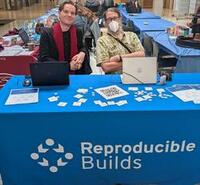
Reproducible Builds at SeaGL 2026 Reproducible Builds was present at SeaGL in Seattle, WA, on October 23rd & 24th. Thanks to everyone who attended and spoke with us! Members of the Reproducible Builds project attended SeaGL (the Seattle GNU/Linux Conference) in Seattle, WA, on October 23rd & 24th. It was a fantastic opportunity to connect with local community members, discuss software supply chain security and share updates on build verification tooling. Thanks to everyone who stopped by our sessions or spoke with us during the event. Founded in 2013, SeaGL is an annual free-as-in-freedom, grassroots technical summit dedicated to spreading awareness, community engagement and practical knowledge about free software, open hardware and libre culture.
Tool and documentation development diffoscope is our in-depth and content-aware diff utility that can locate and diagnose reproducibility issues. This month, Chris Lamb made a number of changes, including preparing and uploading versions 333, 334, 335 and 336 to Debian:
  • New features:
    • Support the dumppdf binary being called dumppdf.py on the host/runtime system. [ ]
  • Bug fixes:
    • Drop Recommends: guix from the diffoscope-minimal package as it is not minimal. (#1114739) [ ]
    • Fix a crash when using the latest version(s) of Androguard. Thanks, hc! [ ]
  • Codebase improvements:
    • Re-order various parts of the .tar file comparator to make it easier to progressively delve into its functionality. [ ]
    • Fix a silly prepend typo. [ ]
    • Reflect in the Python packaging that the use of the case-match language feature necessarily requires Python 3.10+. [ ]
  • Misc:
    • Update debian/tests/control. [ ]
    • Update copyright years. [ ]
In addition, Johannes Schauer Marin Rodrigues added support for POSIX.1-2001 PAX headers in the .tar file comparator [ ] and Vagrant Cascadian proposed an update in diffoscope in GNU Guix to version 335.

Distribution work In Debian this month, 20 reviews of Debian packages were added, 28 were updated and 27 were removed this month adding to our knowledge about identified issues. One issue type was updated to reflect that Debhelper compat level 14 is no longer experimental. [ ] In addition, Vagrant Cascadian performed a number of Non-Maintainer Uploads (NMUs) and Quality Assurance (QA) uploads in Debian for several packages with outstanding reproducibility issues. These included clhep, tea-cli, argparse-manpage, ruby-timers, mandos and cdebootstrap.
Lastly, Bernhard M. Wiedemann posted another openSUSE monthly update for their reproducibility work there.

SOURCE_DATE_EPOCH specification updates As announced in last month s report, further work has been done by Bernhard M. Wiedemann regarding updating the SOURCE_DATE_EPOCH specification following discussions at a project summit. Seven distinct proposed changes were originally submitted as merge requests on Salsa, and many of these have been approved or otherwise collapsed. Bernhard s proposed modifications were independent of one another, allowing for any combination to be merged depending on community feedback. Bernhard noted that one proposal may see the most debate, and could still benefit from further refinement before reaching consensus. Community members are invited to review and provide feedback on the individual merge requests; as Bernhard writes, The other MRs could still use feedback from more people before December . Input can be submitted via reactions or comments on Salsa, directly by email to Bernhard or the mailing list. The SOURCE_DATE_EPOCH specification was first published in 2015 and updated in 2017.

Mailing list news On our mailing list this month:

Patches The Reproducible Builds project detects, dissects and attempts to fix as many currently-unreproducible packages as possible. We endeavour to send all of our patches upstream where applicable or possible. This month, we wrote a large number of such patches, including: In addition, two build failure bugs were reported by Jochen Sprickerhof.

If you are interested in contributing to the Reproducible Builds project, please visit our Contribute page on our website. However, you can get in touch with us via:

15 September 2026

Reproducible Builds: Supporter spotlight: Jochen Sprickerhof on ... Reproducible Builds!

The Reproducible Builds project relies on several projects, supporters and sponsors for financial support, but they are also valued as ambassadors who spread the word about our project and the work that we do. This is the ninth installment in a series featuring the projects, companies and individuals who support the Reproducible Builds project. We started this series by featuring the Civil Infrastructure Platform project, and followed this up with a post about the Ford Foundation as well as recent ones about ARDC, the Google Open Source Security Team (GOSST), Bootstrappable Builds, the F-Droid project, David A. Wheeler, Simon Butler and Kees Cook. Today, however, we will be talking with Jochen Sprickerhof, one of the newer members of the Reproducible Builds project core team.

Vagrant Cascadian: Could you tell me a bit about yourself? What sort of things do you work on? Jochen Sprickerhof: I am a freelance programmer working on Open Source. Mainly doing Debian, F-Droid and some smaller software projects. In general I made it a habit to look into every software I use and try to fix bugs or add features I need. In Debian, I maintain about 180 packages with topics covering home banking, build systems and robotics. Most of my time, I currently work on reproduce.debian.net, where we try to bit-for-bit reproduce the packages distributed by Debian.
Vagrant: Could you describe the path that lead you to working on reproducible builds? Jochen: I started my Debian journey as a teenager, converting my school to Debian and serving as its system administrator for 13 years. After studying Applied System Science, I joined the university s robotics labs, where I worked on the Robot Operating System (ROS) and the Point Cloud Library (PCL). In the end, I enjoyed programming more than writing papers, so I eventually left academia for a robotics startup. Some years ago, I realized that the open source work I was doing in my spare time was actually the work I cared most about. Nowadays I am really grateful that I can spend my days working on things I find important and have lots of fun with.
Vagrant: What projects did you recently make big progress on? Jochen: A recent example is metasnap.debian.net. It is a meta archive of snapshot.debian.org which is itself archive of all packages in Debian. But let me explain it the other way round: with reproduce.debian.net, we try to reproduce the packages as they are distributed by the Debian archive. For that, we need the same build environment (compilers, libraries, build tools, etc) that was used by Debian back when the original package was compiled. Luckily, snapshot.debian.org has all those packages, but they are not easily accessible via apt, Debian s package manager. So, metasnap provides a mapping from a package name and version pair to the APT repo on snapshot.debian.org needed to download it from. It was created by josch some time ago, and it s awesome work. But when we tried to reproduce more and more packages on reproduce.debian.net, we found that some were missing packages from the build environment even though they where visible on snapshot.debian.org. We found that metasnap excluded some archive areas because they where not expected to be needed. Reimporting all the data took more than two months and surfaced a couple more flaws. With this fixed, we were able to build more packages, only to find out that metasnap also needs better support for version numbers. Luckily we were able to rewrite the data in a day instead of starting the import again.
Vagrant: You have been working on infrastructure to support reproducible builds for a while. Has recent adoption of reproduce.debian.net into the Debian release tooling changed the focus of your work? Jochen: Quite a bit. When we started reproduce.debian.net in 2024, only around 33% of the packages could be reproduced successfully. Today we are above 98%. Most were not bugs in the packages themselves but in the infrastructure. Similar to the metasnap issue I reference above, packages just needed a rebuild because something else, like the toolchain, was fixed in the meantime. In May, people from the Debian release team and the Reproducible Builds project sat together and decided that the overall state is good enough, and now packages that regress on reproducibility are blocked from entering the next Debian release. But that does not mean all the work is on the shoulders of Debian package maintainers. Since then I have been constantly looking at the migration tooling to spot regressions and provide fixes. Furthermore, a couple of maintainers reached out to us for help and I hope more will do so in future.
Vagrant: What is one small thing you (or others) have not yet gotten to that you would really like to see? Jochen: The central tool to reproduce Debian packages is debrebuild, also written by josch. Currently it has two ways to retrieve the build dependencies of a package. Either it uses metasnap.debian.net (as explained above), or it can access the Debian unstable APT repository directly. This allows to test packages locally before everything is indexed on metasnap by compiling against Debian unstable. But actually there are many other APT repositories to query, like Debian stable or even derivatives. Adding support for an optional list of APT repositories in debrebuild would be great. That would also be a big step to support reproducing other Debian based distributions.
Vagrant: and one big thing? Jochen: It would be great to integrate metasnap.debian.net into snapshot.debian.org. There is some discussion on it already in Debian bug #650783.
Vagrant: What are the tools you use the most? Jochen: According to my fish shell history:
$ history   cut -d' ' -f1   sort   uniq -c   sort -nr   head -10
  36199 git
  20941 vi
  12271 rm
   8599 cd
   7917 ls
   6407 apt
   5631 grep
   4249 mv
   3655 dpkg
   2873 cp

Vagrant: So, is the fish shell reproducible? I remember it did not used to be Jochen: You can check for yourself it was last time I checked. But looking through the other commands, neovim sadly is not. I hope we can fix that in future.
Vagrant: Oh, that s a nice URL to check for reproducible package you can just pass the source package name to check the current results? Jochen: Yes. Another one is udd.debian.org/reproducibility/, where you can list all packages of a Debian maintainer. It also lists source reproducibility and has nice filters as well.
Vagrant: What tools do you use specifically working on reproducible builds? Jochen: I don t have statistics for that, but I would say sbuild to build the package, debrebuild to reproduce it, and diffoscope to analyze the differences. Obviously I also need run apt source <package> or use git-buildpackage to get the sources and all the tools I mentioned above.
Vagrant: So how many packages are left to build reproducibly, and once those are finished, what is next? Jochen: Right now, reproduce.debian.net shows over 98% reproducibility, though there are still over 650 package left and some will probably need a lot of work. But actually I think making packages reproducible is just the first step. For me, this is a project to build confidence in the system. To reproduce a package we have two parts: the source of the package and the build environment. Fixing the packages means gaining confidence in the first part but we still rely on the individual build environments for each package as we need to use the same compiler that was used when the package was build initially. Because of this, we have to keep around every historical version of all toolchain packages. I really would like to remove this extra archive, which means we would have to rebuild all of Debian around release time. I am dreaming of a Debian release where you could bit-for-bit reproduce every package just from the released versions. Due to how Debian works, however, this is not a trivial rebuild and it would need some work on the infrastructure. By the way, initially there was a third component to pay attention to: any connection to the outside world during the build. Luckily we fixed the Debian build daemons to not allow network connections during the build some time ago.
Vagrant: Thanks for all that work, and taking the time to tell us a bit about yourself! Jochen: Thanks a lot for the interview!


For more information about the Reproducible Builds project, please see our website at reproducible-builds.org. If you are interested in ensuring the ongoing security of the software that underpins our civilisation and wish to sponsor the Reproducible Builds project, please reach out to the project by emailing contact@reproducible-builds.org.

22 July 2025

David Bremner: Hibernate on the pocket reform 9/n

Context Sidequest: Install u-boot-menu Don't be like me and reboot without configuring u-boot-menu. Although the defaults make sense for most people, in my case I lost access to the serial console (because that custom config needed to be re-done), and the default delay was not enough to choose a backup kernel. In consfigurator notation:
  (on-change
      (file:has-content "/etc/u-boot-menu/conf.d/reform.conf"
        '("U_BOOT_TIMEOUT=50"
          "U_BOOT_PARAMETERS=\"ro no_console_suspend cryptomgr.notests \\$ bootargs  console=ttyS2,1500000 keep_bootcon console=tty1\""))
    (cmd:single "u-boot-update"))

The panel, alive.
  • Thanks to a hint from joschc (and a bit of luck) I realized the
    issue I filed was nonsense. Yay?
  • The panel driver is not added by the rk3588 patches (since the build process applies all the patches, this is not a problem for building from reform-debian-packages).
  • After applying the two patches in reform-debian-packages/linux/patches6.15/imx8mp-mnt-pocket-reform/pocket-panel, the patched 6.16 kernel boots, and seems to work, including the panel.
  • The updated source is on branch reform-patches at https://salsa.debian.org/bremner/collabora-rockchip-3588
  • Unsurprisingly hibernate is not working out of the box with 6.16. My next mission is to apply the recommended pci-reset patches on top of 6.16.
previous episode next episode

4 April 2025

Johannes Schauer Marin Rodrigues: To boldly build what no one has built before

Last week, we (Helmut, Jochen, Holger, Gioele and josch) met in W rzburg for a Debian crossbuilding & bootstrap sprint. We would like to thank Angest pselt e. V. for generously providing us with their hacker space which we were able to use exclusively during the four-day-sprint. We d further like to thank Debian for their sponsorship of accommodation of Helmut and Jochen. The most important topics that we worked on together were: Our TODO items for after the sprint are: In addition to what was already listed above, people worked on the following tasks specifically: Thank you all for attending this sprint, for making it so productive and for the amazing atmosphere and enlightening discussions!

31 March 2025

Johannes Schauer Marin Rodrigues: NASA has pride across most of the universe

In July 2024, NASA posted an article titled NASA Has Pride Across the Universe featuring a pride flag by Rachel Lense where each color band is made up of images from across NASA. Today is the annual International Transgender Day of Visibility. The original NASA article from last year has since been taken offline. But the heroes from archive.org still carry a copy which I now archived myself together with the other source images. Here is NASA s pride flag in all its glory: NASA pride flag by Rachel Lense Southern Fried Science has an article about the flag. The original 4000x2547 TIFF image was stored not by archive.org but the PNG version in the same resolution can be downloaded here or by clicking on the image.

Johannes Schauer Marin Rodrigues: TIL: OpenPGP Web Key Directory

Today I was looking for a way on how to best publish my OpenPGP key on my webserver. Surely, somebody came up with some sort of standard way for where to place that key, right? Turns out, they did: https://datatracker.ietf.org/doc/draft-koch-openpgp-webkey-service/ The TLDR summary is, that my key can now be found here: https://mister-muffin.de/.well-known/openpgpkey/hu/8yxgr5jjfok88r9um56kb44x9h4dyj7f Or be downloadable by just running:
$ gpg --locate-key josch@mister-muffin.de
Where does the hash come from? It s the local part of my email (josch) hashed with sha1 and encoded in z-base32. That computation can be done by gpg:
$ gpg --with-wkd-hash -k josch@mister-muffin.de   grep mister-muffin.de
[...]
8yxgr5jjfok88r9um56kb44x9h4dyj7f@mister-muffin.de
I exported the key that I put there using the following command:
$ gpg --no-options --export --export-options export-minimal,export-clean \
    --export-filter keep-uid="uid = Johannes Schauer Marin Rodrigues <josch@mister-muffin.de>" \
    F83356BBE112B7462A41552F7D5D8C60CF4D3EB4
There is a handy validator for such setups that can be found here: https://www.webkeydirectory.com I had an interesting debugging experience when I tried to verify my setup in a fresh Debian chroot because I got this error message when I ran above command:
gpg: directory '/root/.gnupg' created
gpg: keybox '/root/.gnupg/pubring.kbx' created
gpg: /root/.gnupg/trustdb.gpg: trustdb created
gpg: error retrieving 'josch@mister-muffin.de' via WKD: General error
gpg: error reading key: General error
That s not very descriptive Turns out, that I was missing the ca-certificates package. After installing it, everything worked as expected:
$ gpg --locate-key josch@mister-muffin.de
gpg: key 7D5D8C60CF4D3EB4: public key "Johannes Schauer Marin Rodrigues <josch@mister-muffin.de>" imported
gpg: Total number processed: 1
gpg:               imported: 1
pub   rsa4096 2013-07-04 [SC]
      F83356BBE112B7462A41552F7D5D8C60CF4D3EB4
uid           [ unknown] Johannes Schauer Marin Rodrigues <josch@mister-muffin.de>
sub   rsa4096 2013-07-04 [E]
sub   rsa4096 2013-07-04 [S]
sub   rsa4096 2023-07-08 [S]

5 December 2024

Reproducible Builds: Reproducible Builds in November 2024

Welcome to the November 2024 report from the Reproducible Builds project! Our monthly reports outline what we ve been up to over the past month and highlight items of news from elsewhere in the world of software supply-chain security where relevant. As ever, if you are interested in contributing to the Reproducible Builds project, please visit our Contribute page on our website. Table of contents:
  1. Reproducible Builds mourns the passing of Lunar
  2. Introducing reproduce.debian.net
  3. New landing page design
  4. SBOMs for Python packages
  5. Debian updates
  6. Reproducible builds by default in Maven 4
  7. PyPI now supports digital attestations
  8. Dependency Challenges in OSS Package Registries
  9. Zig programming language demonstrated reproducible
  10. Website updates
  11. Upstream patches
  12. Misc development news
  13. Reproducibility testing framework

Reproducible Builds mourns the passing of Lunar The Reproducible Builds community sadly announced it has lost its founding member, Lunar. J r my Bobbio aka Lunar passed away on Friday November 8th in palliative care in Rennes, France. Lunar was instrumental in starting the Reproducible Builds project in 2013 as a loose initiative within the Debian project. He was the author of our earliest status reports and many of our key tools in use today are based on his design. Lunar s creativity, insight and kindness were often noted. You can view our full tribute elsewhere on our website. He will be greatly missed.

Introducing reproduce.debian.net In happier news, this month saw the introduction of reproduce.debian.net. Announced at the recent Debian MiniDebConf in Toulouse, reproduce.debian.net is an instance of rebuilderd operated by the Reproducible Builds project. rebuilderd is our server designed monitor the official package repositories of Linux distributions and attempts to reproduce the observed results there. In November, reproduce.debian.net began rebuilding Debian unstable on the amd64 architecture, but throughout the MiniDebConf, it had attempted to rebuild 66% of the official archive. From this, it could be determined that it is currently possible to bit-for-bit reproduce and corroborate approximately 78% of the actual binaries distributed by Debian that is, using the .buildinfo files hosted by Debian itself. reproduce.debian.net also contains instructions how to setup one s own rebuilderd instance, and we very much invite everyone with a machine to spare to setup their own version and to share the results. Whilst rebuilderd is still in development, it has been used to reproduce Arch Linux since 2019. We are especially looking for installations targeting Debian architectures other than i386 and amd64.

New landing page design As part of a very productive partnership with the Sovereign Tech Fund and Neighbourhoodie, we are pleased to unveil our new homepage/landing page. We are very happy with our collaboration with both STF and Neighbourhoodie (including many changes not directly related to the website), and look forward to working with them in the future.

SBOMs for Python packages The Python Software Foundation has announced a new cross-functional project for SBOMs and Python packages . Seth Michael Larson writes that the project is specifically looking to solve these issues :
  • Enable Python users that require SBOM documents (likely due to regulations like CRA or SSDF) to self-serve using existing SBOM generation tools.
  • Solve the phantom dependency problem, where non-Python software is bundled in Python packages but not recorded in any metadata. This makes the job of software composition analysis (SCA) tools difficult or impossible.
  • Make the adoption work by relevant projects such as build backends, auditwheel-esque tools, as minimal as possible. Empower users who are interested in having better SBOM data for the Python projects they are using to be able to contribute engineering time towards that goal.
A GitHub repository for the initiative is available, and there are a number of queries, comments and remarks on Seth s Discourse forum post.

Debian updates There was significant development within Debian this month. Firstly, at the recent MiniDebConf in Toulouse, France, Holger Levsen gave a Debian-specific talk on rebuilding packages distributed from ftp.debian.org that is to say, how to reproduce the results from the official Debian build servers: Holger described the talk as follows:
For more than ten years, the Reproducible Builds project has worked towards reproducible builds of many projects, and for ten years now we have build Debian packages twice with maximal variations applied to see if they can be build reproducible still. Since about a month, we ve also been rebuilding trying to exactly match the builds being distributed via ftp.debian.org. This talk will describe the setup and the lessons learned so far, and why the results currently are what they are (spoiler: they are less than 30% reproducible), and what we can do to fix that.
The Debian Project Leader, Andreas Tille, was present at the talk and remarked later in his Bits from the DPL update that:
It might be unfair to single out a specific talk from Toulouse, but I d like to highlight the one on reproducible builds. Beyond its technical focus, the talk also addressed the recent loss of Lunar, whom we mourn deeply. It served as a tribute to Lunar s contributions and legacy. Personally, I ve encountered packages maintained by Lunar and bugs he had filed. I believe that taking over his packages and addressing the bugs he reported is a meaningful way to honor his memory and acknowledge the value of his work.
Holger s slides and video in .webm format are available.
Next, rebuilderd is the server to monitor package repositories of Linux distributions and attempt to reproduce the observed results. This month, version 0.21.0 released, most notably with improved support for binNMUs by Jochen Sprickerhof and updating the rebuilderd-debian.sh integration to the latest debrebuild version by Holger Levsen. There has also been significant work to get the rebuilderd package into the Debian archive, in particular, both rust-rebuilderd-common version 0.20.0-1 and rust-rust-lzma version 0.6.0-1 were packaged by kpcyrd and uploaded by Holger Levsen. Related to this, Holger Levsen submitted three additional issues against rebuilderd as well:
  • rebuildctl should be more verbose when encountering issues. [ ]
  • Please add an option to used randomised queues. [ ]
  • Scheduling and re-scheduling multiple packages at once. [ ]
and lastly, Jochen Sprickerhof submitted one an issue requested that rebuilderd downloads the source package in addition to the .buildinfo file [ ] and kpcyrd also submitted and fixed an issue surrounding dependencies and clarifying the license [ ]
Separate to this, back in 2018, Chris Lamb filed a bug report against the sphinx-gallery package as it generates unreproducible content in various ways. This month, however, Dmitry Shachnev finally closed the bug, listing the multiple sub-issues that were part of the problem and how they were resolved.
Elsewhere, Roland Clobus posted to our mailing list this month, asking for input on a bug in Debian s ca-certificates-java package. The issue is that the Java key management tools embed timestamps in its output, and this output ends up in the /etc/ssl/certs/java/cacerts file on the generated ISO images. A discussion resulted from Roland s post suggesting some short- and medium-term solutions to the problem.
Holger Levsen uploaded some packages with reproducibility-related changes:
Lastly, 12 reviews of Debian packages were added, 5 were updated and 21 were removed this month adding to our knowledge about identified issues in Debian.

Reproducible builds by default in Maven 4 On our mailing list this month, Herv Boutemy reported the latest release of Maven (4.0.0-beta-5) has reproducible builds enabled by default. In his mailing list post, Herv mentions that this story started during our Reproducible Builds summit in Hamburg , where he created the upstream issue that builds on a multi-year effort to have Maven builds configured for reproducibility.

PyPI now supports digital attestations Elsewhere in the Python ecosystem and as reported on LWN and elsewhere, the Python Package Index (PyPI) has announced that it has finalised support for PEP 740 ( Index support for digital attestations ). Trail of Bits, who performed much of the development work, has an in-depth blog post about the work and its adoption, as well as what is left undone:
One thing is notably missing from all of this work: downstream verification. [ ] This isn t an acceptable end state (cryptographic attestations have defensive properties only insofar as they re actually verified), so we re looking into ways to bring verification to individual installing clients. In particular, we re currently working on a plugin architecture for pip that will enable users to load verification logic directly into their pip install flows.
There was an in-depth discussion on LWN s announcement page, as well as on Hacker News.

Dependency Challenges in OSS Package Registries At BENEVOL, the Belgium-Netherlands Software Evolution workshop in Namur, Belgium, Tom Mens and Alexandre Decan presented their paper, An Overview and Catalogue of Dependency Challenges in Open Source Software Package Registries . The abstract of their paper is as follows:
While open-source software has enabled significant levels of reuse to speed up software development, it has also given rise to the dreadful dependency hell that all software practitioners face on a regular basis. This article provides a catalogue of dependency-related challenges that come with relying on OSS packages or libraries. The catalogue is based on the scientific literature on empirical research that has been conducted to understand, quantify and overcome these challenges. [ ]
A PDF of the paper is available online.

Zig programming language demonstrated reproducible Motiejus Jak ty posted an interesting and practical blog post on his successful attempt to reproduce the Zig programming language without using the pre-compiled binaries checked into the repository, and despite the circular dependency inherent in its bootstrapping process. As a summary, Motiejus concludes that:
I can now confidently say (and you can also check, you don t need to trust me) that there is nothing hiding in zig1.wasm [the checked-in binary] that hasn t been checked-in as a source file.
The full post is full of practical details, and includes a few open questions.

Website updates Notwithstanding the significant change to the landing page (screenshot above), there were an enormous number of changes made to our website this month. This included:
  • Alex Feyerke and Mariano Gim nez:
    • Dramatically overhaul the website s landing page with new benefit cards tailored to the expected visitors to our website and a reworking of the visual hierarchy and design. [ ][ ][ ][ ][ ][ ][ ][ ][ ][ ]
  • Bernhard M. Wiedemann:
    • Update the System images page to document the e2fsprogs approach. [ ]
  • Chris Lamb:
  • FC (Fay) Stegerman:
    • Replace more inline markdown with HTML on the Success stories page. [ ]
    • Add some links, fix some other links and correct some spelling errors on the Tools page. [ ]
  • Holger Levsen:
    • Add a historical presentation ( Reproducible builds everywhere eg. in Debian, OpenWrt and LEDE ) from October 2016. [ ]
    • Add jochensp and Oejet to the list of known contributors. [ ][ ]
  • Julia Kr ger:
  • Ninette Adhikari & hulkoba:
    • Add/rework the list of success stories into a new page that clearly shows milestones in Reproducible Builds. [ ][ ][ ][ ][ ][ ]
  • Philip Rinn:
    • Import 47 historical weekly reports. [ ]
  • hulkoba:
    • Add alt text to almost all images (!). [ ][ ]
    • Fix a number of links on the Talks . [ ][ ]
    • Avoid so-called ghost buttons by not using <button> elements as links, as the affordance of a <button> implies an action with (potentially) a side effect. [ ][ ]
    • Center the sponsor logos on the homepage. [ ]
    • Move publications and generate them instead from a data.yml file with an improved layout. [ ][ ]
    • Make a large number of small but impactful stylisting changes. [ ][ ][ ][ ]
    • Expand the Tools to include a number of missing tools, fix some styling issues and fix a number of stale/broken links. [ ][ ][ ][ ][ ][ ]

Upstream patches The Reproducible Builds project detects, dissects and attempts to fix as many currently-unreproducible packages as possible. We endeavour to send all of our patches upstream where appropriate. This month, we wrote a large number of such patches, including:

Misc development news

Reproducibility testing framework The Reproducible Builds project operates a comprehensive testing framework running primarily at tests.reproducible-builds.org in order to check packages and other artifacts for reproducibility. In November, a number of changes were made by Holger Levsen, including:
  • reproduce.debian.net-related changes:
    • Create and introduce a new reproduce.debian.net service and subdomain [ ]
    • Make a large number of documentation changes relevant to rebuilderd. [ ][ ][ ][ ][ ]
    • Explain a temporary workaround for a specific issue in rebuilderd. [ ]
    • Setup another rebuilderd instance on the o4 node and update installation documentation to match. [ ][ ]
    • Make a number of helpful/cosmetic changes to the interface, such as clarifying terms and adding links. [ ][ ][ ][ ][ ]
    • Deploy configuration to the /opt and /var directories. [ ][ ]
    • Add an infancy (or alpha ) disclaimer. [ ][ ]
    • Add more notes to the temporary rebuilderd documentation. [ ]
    • Commit an nginx configuration file for reproduce.debian.net s Stats page. [ ]
    • Commit a rebuilder-worker.conf configuration for the o5 node. [ ]
  • Debian-related changes:
    • Grant jspricke and jochensp access to the o5 node. [ ][ ]
    • Build the qemu package with the nocheck build flag. [ ]
  • Misc changes:
    • Adapt the update_jdn.sh script for new Debian trixie systems. [ ]
    • Stop installing the PostgreSQL database engine on the o4 and o5 nodes. [ ]
    • Prevent accidental reboots of the o4 node because of a long-running job owned by josch. [ ][ ]
In addition, Mattia Rizzolo addressed a number of issues with reproduce.debian.net [ ][ ][ ][ ]. And lastly, both Holger Levsen [ ][ ][ ][ ] and Vagrant Cascadian [ ][ ][ ][ ] performed node maintenance.
If you are interested in contributing to the Reproducible Builds project, please visit our Contribute page on our website. However, you can get in touch with us via:

8 June 2024

Reproducible Builds: Reproducible Builds in May 2024

Welcome to the May 2024 report from the Reproducible Builds project! In these reports, we try to outline what we have been up to over the past month and highlight news items in software supply-chain security more broadly. As ever, if you are interested in contributing to the project, please visit our Contribute page on our website. Table of contents:
  1. A peek into build provenance for Homebrew
  2. Distribution news
  3. Mailing list news
  4. Miscellaneous news
  5. Two new academic papers
  6. diffoscope
  7. Website updates
  8. Upstream patches
  9. Reproducibility testing framework


A peek into build provenance for Homebrew Joe Sweeney and William Woodruff on the Trail of Bits blog wrote an extensive post about build provenance for Homebrew, the third-party package manager for MacOS. Their post details how each bottle (i.e. each release):
[ ] built by Homebrew will come with a cryptographically verifiable statement binding the bottle s content to the specific workflow and other build-time metadata that produced it. [ ] In effect, this injects greater transparency into the Homebrew build process, and diminishes the threat posed by a compromised or malicious insider by making it impossible to trick ordinary users into installing non-CI-built bottles.
The post also briefly touches on future work, including work on source provenance:
Homebrew s formulae already hash-pin their source artifacts, but we can go a step further and additionally assert that source artifacts are produced by the repository (or other signing identity) that s latent in their URL or otherwise embedded into the formula specification.

Distribution news In Debian this month, Johannes Schauer Marin Rodrigues (aka josch) noticed that the Debian binary package bash version 5.2.15-2+b3 was uploaded to the archive twice. Once to bookworm and once to sid but with differing content. This is problem for reproducible builds in Debian due its assumption that the package name, version and architecture triplet is unique. However, josch highlighted that
This example with bash is especially problematic since bash is Essential:yes, so there will now be a large portion of .buildinfo files where it is not possible to figure out with which of the two differing bash packages the sources were compiled.
In response to this, Holger Levsen performed an analysis of all .buildinfo files and found that this needs almost 1,500 binNMUs to fix the fallout from this bug. Elsewhere in Debian, Vagrant Cascadian posted about a Non-Maintainer Upload (NMU) sprint to take place during early June, and it was announced that there is now a #debian-snapshot IRC channel on OFTC to discuss the creation of a new source code archiving service to, perhaps, replace snapshot.debian.org. Lastly, 11 reviews of Debian packages were added, 15 were updated and 48 were removed this month adding to our extensive knowledge about identified issues. A number of issue types have been updated by Chris Lamb as well. [ ][ ]
Elsewhere in the world of distributions, deep within a larger announcement from Colin Percival about the release of version 14.1-BETA2, it was mentioned that the FreeBSD kernels are now built reproducibly.
In Fedora, however, the change proposal mentioned in our report for April 2024 was approved, so, per the ReproduciblePackageBuilds wiki page, the add-determinism tool is now running in new builds for Fedora 41 ( rawhide ). The add-determinism tool is a Rust program which, as its name suggests, adds determinism to files that are given as input by attempting to standardize metadata contained in binary or source files to ensure consistency and clamping to $SOURCE_DATE_EPOCH in all instances . This is essentially the Fedora version of Debian s strip-nondeterminism. However, strip-nondeterminism is written in Perl, and Fedora did not want to pull Perl in the buildroot for every package. The add-determinism tool eliminates many causes of non-determinism and work is ongoing to continue the scope of packages it can operate on.

Mailing list news On our mailing list this month, regular contributor kpcyrd wrote to the list with an update on their source code indexing project, whatsrc.org. The whatsrc.org project, which was launched last month in response to the XZ Utils backdoor, now contains and indexes almost 250,000 unique source code archives. In their post, kpcyrd gives an example of its intended purpose, noting that it shown that whilst there seems to be consensus about [the] source code for zsh 5.9 in various Linux distributions, it does not align with the contents of the zsh Git repository . Holger Levsen also posted to the list with a pre-announcement of sorts for the 2024 Reproducible Builds summit. In particular:
[Whilst] the dates and location are not fixed yet, however if you don help us with finding a suitable location soon, it is very likely that we ll meet again in Hamburg in the 2nd half of September 2024 [ ].
Lastly, Frederic-Emmanuel Picca wrote to the list asking for help understanding the non-reproducible status of the Debian silx package and received replies from both Vagrant Cascadian and Chris Lamb.

Miscellaneous news strip-nondeterminism is our tool to remove specific non-deterministic results from a completed build. This month strip-nondeterminism version 1.14.0-1 was uploaded to Debian unstable by Chris Lamb chiefly to incorporate a change from Alex Muntada to avoid a dependency on Sub::Override to perform monkey-patching and break circular dependencies related to debhelper [ ]. Elsewhere in our tooling, Jelle van der Waa modified reprotest because the pipes module will be removed in Python version 3.13 [ ].
It was also noticed that a new blog post by Daniel Stenberg detailing How to verify a Curl release mentions the SOURCE_DATE_EPOCH environment variable. This is because:
The [curl] release tools document also contains another key component: the exact time stamp at which the release was done using integer second resolution. In order to generate a correct tarball clone, you need to also generate the new version using the old version s timestamp. Because the modification date of all files in the produced tarball will be set to this timestamp.

Furthermore, Fay Stegerman filed a bug against the Signal messenger app for Android to report that their reproducible builds cannot, in fact, be reproduced. However, Fay is quick to note that she has:
found zero evidence of any kind of compromise. Some differences are yet unexplained but everything I found seems to be benign. I am disappointed that Reproducible Builds have been broken for months but I have zero reason to doubt Signal s security in any way.

Lastly, it was observed that there was a concise and diagrammatic overview of supply chain threats on the SLSA website.

Two new academic papers Two new scholarly papers were published this month. Firstly, Mathieu Acher, Beno t Combemale, Georges Aaron Randrianaina and Jean-Marc J z quel of University of Rennes on Embracing Deep Variability For Reproducibility & Replicability. The authors describe their approach as follows:
In this short [vision] paper we delve into the application of software engineering techniques, specifically variability management, to systematically identify and explicit points of variability that may give rise to reproducibility issues (e.g., language, libraries, compiler, virtual machine, OS, environment variables, etc.). The primary objectives are: i) gaining insights into the variability layers and their possible interactions, ii) capturing and documenting configurations for the sake of reproducibility, and iii) exploring diverse configurations to replicate, and hence validate and ensure the robustness of results. By adopting these methodologies, we aim to address the complexities associated with reproducibility and replicability in modern software systems and environments, facilitating a more comprehensive and nuanced perspective on these critical aspects.
(A PDF of this article is available.)
Secondly, Ludovic Court s, Timothy Sample, Simon Tournier and Stefano Zacchiroli have collaborated to publish a paper on Source Code Archiving to the Rescue of Reproducible Deployment. Their paper was motivated because:
The ability to verify research results and to experiment with methodologies are core tenets of science. As research results are increasingly the outcome of computational processes, software plays a central role. GNU Guix is a software deployment tool that supports reproducible software deployment, making it a foundation for computational research workflows. To achieve reproducibility, we must first ensure the source code of software packages Guix deploys remains available.
(A PDF of this article is also available.)

diffoscope diffoscope is our in-depth and content-aware diff utility that can locate and diagnose reproducibility issues. This month, Chris Lamb made a number of changes such as uploading versions 266, 267, 268 and 269 to Debian, making the following changes:
  • New features:
    • Use xz --list to supplement output when comparing .xz archives; essential when metadata differs. (#1069329)
    • Include xz --verbose --verbose (ie. double) output. (#1069329)
    • Strip the first line from the xz --list output. [ ]
    • Only include xz --list --verbose output if the xz has no other differences. [ ]
    • Actually append the xz --list after the container differences, as it simplifies a lot. [ ]
  • Testing improvements:
    • Allow Debian testing to fail right now. [ ]
    • Drop apktool from Build-Depends; we can still test APK functionality via autopkgtests. (#1071410)
    • Add a versioned dependency for at least version 5.4.5 for the xz tests as they fail under (at least) version 5.2.8. (#374)
    • Fix tests for 7zip 24.05. [ ][ ]
    • Fix all tests after additon of xz --list. [ ][ ]
  • Misc:
    • Update copyright years. [ ]
In addition, James Addison fixed an issue where the HTML output showed only the first difference in a file, while the text output shows all differences [ ][ ][ ], Sergei Trofimovich amended the 7zip version test for older 7z versions that include the string [64] [ ][ ] and Vagrant Cascadian relaxed the versioned dependency to allow version 5.4.1 for the xz tests [ ] and proposed updates to guix for versions 267, 268 and pushed version 269 to Guix. Furthermore, Eli Schwartz updated the diffoscope.org website in order to explain how to install diffoscope on Gentoo [ ].

Website updates There were a number of improvements made to our website this month, including Chris Lamb making the print CSS stylesheet nicer [ ]. Fay Stegerman made a number of updates to the page about the SOURCE_DATE_EPOCH environment variable [ ][ ][ ] and Holger Levsen added some of their presentations to the Resources page. Furthermore, IOhannes zm lnig stipulated support for SOURCE_DATE_EPOCH in clang version 16.0.0+ [ ], Jan Zerebecki expanded the Formal definition page and fixed a number of typos on the Buy-in page [ ] and Simon Josefsson fixed the link to Trisquel GNU/Linux on the Projects page [ ].

Upstream patches This month, we wrote a number of patches to fix specific reproducibility issues, including:

Reproducibility testing framework The Reproducible Builds project operates a comprehensive testing framework running primarily at tests.reproducible-builds.org in order to check packages and other artifacts for reproducibility. In May, a number of changes were made by Holger Levsen:
  • Debian-related changes:
    • Enable the rebuilder-snapshot API on osuosl4. [ ]
    • Schedule the i386 architecture a bit more often. [ ]
    • Adapt cleanup_nodes.sh to the new way of running our build services. [ ]
    • Add 8 more workers for the i386 architecture. [ ]
    • Update configuration now that the infom07 and infom08 nodes have been reinstalled as real i386 systems. [ ]
    • Make diffoscope timeouts more visible on the #debian-reproducible-changes IRC channel. [ ]
    • Mark the cbxi4a-armhf node as down. [ ][ ]
    • Only install the hdmi2usb-mode-switch package only on Debian bookworm and earlier [ ] and only install the haskell-platform package on Debian bullseye [ ].
  • Misc:
    • Install the ntpdate utility as we need it later. [ ]
    • Document the progress on the i386 architecture nodes at Infomaniak. [ ]
    • Drop an outdated and unnoticed notice. [ ]
    • Add live_setup_schroot to the list of so-called zombie jobs. [ ]
In addition, Mattia Rizzolo reinstalled the infom07 and infom08 nodes [ ] and Vagrant Cascadian marked the cbxi4a node as online [ ].

If you are interested in contributing to the Reproducible Builds project, please visit our Contribute page on our website. However, you can get in touch with us via:

13 March 2024

Freexian Collaborators: Debian Contributions: Upcoming Improvements to Salsa CI, /usr-move, packaging simplemonitor, and more! (by Utkarsh Gupta)

Contributing to Debian is part of Freexian s mission. This article covers the latest achievements of Freexian and their collaborators. All of this is made possible by organizations subscribing to our Long Term Support contracts and consulting services.

/usr-move, by Helmut Grohne Much of the work was spent on handling interaction with time time64 transition and sending patches for mitigating fallout. The set of packages relevant to debootstrap is mostly converted and the patches for glibc and base-files have been refined due to feedback from the upload to Ubuntu noble. Beyond this, he sent patches for all remaining packages that cannot move their files with dh-sequence-movetousr and packages using dpkg-divert in ways that dumat would not recognize.

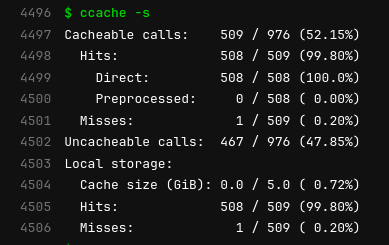
Upcoming improvements to Salsa CI, by Santiago Ruano Rinc n Last month, Santiago Ruano Rinc n started the work on integrating sbuild into the Salsa CI pipeline. Initially, Santiago used sbuild with the unshare chroot mode. However, after discussion with josch, jochensp and helmut (thanks to them!), it turns out that the unshare mode is not the most suitable for the pipeline, since the level of isolation it provides is not needed, and some test suites would fail (eg: krb5). Additionally, one of the requirements of the build job is the use of ccache, since it is needed by some C/C++ large projects to reduce the compilation time. In the preliminary work with unshare last month, it was not possible to make ccache to work. Finally, Santiago changed the chroot mode, and now has a couple of POC (cf: 1 and 2) that rely on the schroot and sudo, respectively. And the good news is that ccache is successfully used by sbuild with schroot! The image here comes from an example of building grep. At the end of the build, ccache -s shows the statistics of the cache that it used, and so a little more than half of the calls of that job were cacheable. The most important pieces are in place to finish the integration of sbuild into the pipeline. Other than that, Santiago also reviewed the very useful merge request !346, made by IOhannes zm lnig to autodetect the release from debian/changelog. As agreed with IOhannes, Santiago is preparing a merge request to include the release autodetection use case in the very own Salsa CI s CI.
Packaging simplemonitor, by Carles Pina i Estany Carles started using simplemonitor in 2017, opened a WNPP bug in 2022 and started packaging simplemonitor dependencies in October 2023. After packaging five direct and indirect dependencies, Carles finally uploaded simplemonitor to unstable in February. During the packaging of simplemonitor, Carles reported a few issues to upstream. Some of these were to make the simplemonitor package build and run tests reproducibly. A reproducibility issue was reprotest overriding the timezone, which broke simplemonitor s tests. There have been discussions on resolving this upstream in simplemonitor and in reprotest, too. Carles also started upgrading or improving some of simplemonitor s dependencies.

Miscellaneous contributions
  • Stefano Rivera spent some time doing admin on debian.social infrastructure. Including dealing with a spike of abuse on the Jitsi server.
  • Stefano started to prepare a new release of dh-python, including cleaning out a lot of old Python 2.x related code. Thanks to Niels Thykier (outside Freexian) for spear-heading this work.
  • DebConf 24 planning is beginning. Stefano discussed venues and finances with the local team and remotely supported a site-visit by Nattie (outside Freexian).
  • Also in the DebConf 24 context, Santiago took part in discussions and preparations related to the Content Team.
  • A JIT bug was reported against pypy3 in Debian Bookworm. Stefano bisected the upstream history to find the patch (it was already resolved upstream) and released an update to pypy3 in bookworm.
  • Enrico participated in /usr-merge discussions with Helmut.
  • Colin Watson backported a python-channels-redis fix to bookworm, rediscovered while working on debusine.
  • Colin dug into a cluster of celery build failures and tracked the hardest bit down to a Python 3.12 regression, now fixed in unstable. celery should be back in testing once the 64-bit time_t migration is out of the way.
  • Thorsten Alteholz uploaded a new upstream version of cpdb-libs. Unfortunately upstream changed the naming of their release tags, so updating the watch file was a bit demanding. Anyway this version 2.0 is a huge step towards introduction of the new Common Print Dialog Backends.
  • Helmut send patches for 48 cross build failures.
  • Helmut changed debvm to use mkfs.ext4 instead of genext2fs.
  • Helmut sent a debci MR for improving collector robustness.
  • In preparation for DebConf 25, Santiago worked on the Brest Bid.

20 October 2023

Freexian Collaborators: Debian Contributions: Freexian meetup, debusine updates, lpr/lpd in Debian, and more! (by Utkarsh Gupta, Stefano Rivera)

Contributing to Debian is part of Freexian s mission. This article covers the latest achievements of Freexian and their collaborators. All of this is made possible by organizations subscribing to our Long Term Support contracts and consulting services.

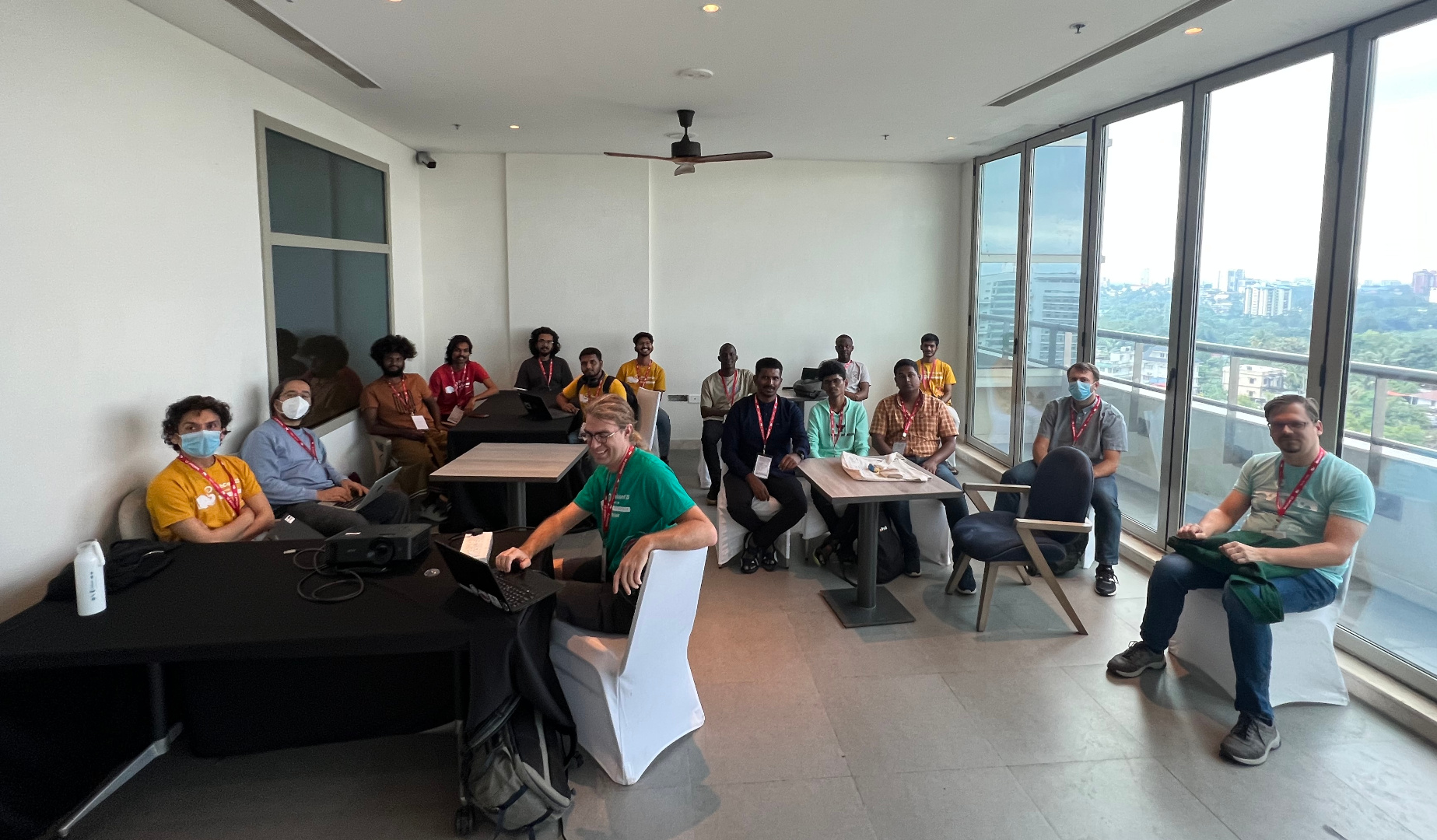
Freexian Meetup, by Stefano Rivera, Utkarsh Gupta, et al. During DebConf, Freexian organized a meetup for its collaborators and those interested in learning more about Freexian and its services. It was well received and many people interested in Freexian showed up. Some developers who were interested in contributing to LTS came to get more details about joining the project. And some prospective customers came to get to know us and ask questions. Sadly, the tragic loss of Abraham shook DebConf, both individually and structurally. The meetup got rescheduled to a small room without video coverage. With that, we still had a wholesome interaction and here s a quick picture from the meetup taken by Utkarsh (which is also why he s missing!).

Debusine, by Rapha l Hertzog, et al. Freexian has been investing into debusine for a while, but development speed is about to increase dramatically thanks to funding from SovereignTechFund.de. Rapha l laid out the 5 milestones of the funding contract, and filed the issues for the first milestone. Together with Enrico and Stefano, they established a workflow for the expanded team. Among the first steps of this milestone, Enrico started to work on a developer-friendly description of debusine that we can use when we reach out to the many Debian contributors that we will have to interact with. And Rapha l started the design work of the autopkgtest and lintian tasks, i.e. what s the interface to schedule such tasks, what behavior and what associated options do we support? At this point you might wonder what debusine is supposed to be let us try to answer this: Debusine manages scheduling and distribution of Debian-related build and QA tasks to a network of worker machines. It also manages the resulting artifacts and provides the results in an easy to consume way. We want to make it easy for Debian contributors to leverage all the great QA tools that Debian provides. We want to build the next generation of Debian s build infrastructure, one that will continue to reliably do what it already does, but that will also enable distribution-wide experiments, custom package repositories and custom workflows with advanced package reviews. If this all sounds interesting to you, don t hesitate to watch the project on salsa.debian.org and to contribute.

lpr/lpd in Debian, by Thorsten Alteholz During Debconf23, Till Kamppeter presented CPDB (Common Print Dialog Backend), a new way to handle print queues. After this talk it was discussed whether the old lpr/lpd based printing system could be abandoned in Debian or whether there is still demand for it. So Thorsten asked on the debian-devel email list whether anybody uses it. Oddly enough, these old packages are still useful:
  • Within a small network it is easier to distribute a printcap file, than to properly configure cups clients.
  • One of the biggest manufacturers of WLAN router and DSL boxes only supports raw queues when attaching an USB printer to their hardware. Admittedly the CPDB still has problems with such raw queues.
  • The Pharos printing system at MIT is still lpd-based.
As a result, the lpr/lpd stuff is not yet ready to be abandoned and Thorsten will adopt the relevant packages (or rather move them under the umbrella of the debian-printing team). Though it is not planned to develop new features, those packages should at least have a maintainer. This month Thorsten adopted rlpr, an utility for lpd printing without using /etc/printcap. The next one he is working on is lprng, a lpr/lpd printer spooling system. If you know of any other package that is also needed and still maintained by the QA team, please tell Thorsten.

/usr-merge, by Helmut Grohne Discussion about lifting the file move moratorium has been initiated with the CTTE and the release team. A formal lift is dependent on updating debootstrap in older suites though. A significant number of packages can automatically move their systemd unit files if dh_installsystemd and systemd.pc change their installation targets. Unfortunately, doing so makes some packages FTBFS and therefore patches have been filed. The analysis tool, dumat, has been enhanced to better understand which upgrade scenarios are considered supported to reduce false positive bug filings and gained a mode for local operation on a .changes file meant for inclusion in salsa-ci. The filing of bugs from dumat is still manual to improve the quality of reports. Since September, the moratorium has been lifted.

Miscellaneous contributions
  • Rapha l updated Django s backport in bullseye-backports to match the latest security release that was published in bookworm. Tracker.debian.org is still using that backport.
  • Helmut Grohne sent 13 patches for cross build failures.
  • Helmut Grohne performed a maintenance upload of debvm enabling its use in autopkgtests.
  • Helmut Grohne wrote an API-compatible reimplementation of autopkgtest-build-qemu. It is powered by mmdebstrap, therefore unprivileged, EFI-only and will soon be included in mmdebstrap.
  • Santiago continued the work regarding how to make it easier to (automatically) test reverse dependencies. An example of the ongoing work was presented during the Salsa CI BoF at DebConf 23.
    In fact, omniorb-dfsg test pipelines as the above were used for the omniorb-dfsg 4.3.0 transition, verifying how the reverse dependencies (tango, pytango and omnievents) were built and how their autopkgtest jobs run with the to-be-uploaded omniorb-dfsg new release.
  • Utkarsh and Stefano attended and helped run DebConf 23. Also continued winding up DebConf 22 accounting.
  • Anton Gladky did some science team uploads to fix RC bugs.

10 August 2023

Freexian Collaborators: Debian Contributions: PTS tracker, DebConf23 Bursary, and more! (by Utkarsh Gupta)

Contributing to Debian is part of Freexian s mission. This article covers the latest achievements of Freexian and their collaborators. All of this is made possible by organizations subscribing to our Long Term Support contracts and consulting services.

tracker.debian.org work by Rapha l Hertzog Rapha l spent some time during his vacation to update distro-tracker to be fully compatible with Django 3.2 so that the codebase and the whole testsuite can run on Debian 12. There s one exception though with the functional test suite that still needs further work to cope with the latest version of Selenium. By dropping support of Django 2.2, Rapha l could also start to work toward support of Django 4.2 since Django helpfully emits deprecation warnings of things that will break in future versions. All the warnings have been fixed but the codebase still fails its testsuite in Django 4.2 because we have to get rid of the python3-django-jsonfield dependency (that is rightfully dead upstream since Django has native support nowadays). All the JSONField have been converted to use Django s native field, but the migration system still requires that dependency at this point. This will require either some fresh reboot of the migration history, or some other trickery to erase the jsonfield dependency from the history of migrations. If you have experience with that, don t hesitate to share it (mail at hertzog@debian.org, or reach out to buxy on IRC). At this point, tracker.debian.org runs with Django 3.2 on Debian 11 since Debian System Administrators are not yet ready to upgrade debian.org hosts to Debian 12.

DebConf 23 bursary work by Utkarsh Gupta Utkarsh led the bursary team this year. The bursary team got a ton of requests this time. Rolling out the results in 4 batches, the bursary team catered over 165 bursary requests - which is superb! The team managed to address all the requests and answered a bit over 120 emails in the process. With that, the bursaries are officially closed for DebConf 2023. The team also intends to roll out some of the statistics closer to DebConf.

Miscellaneous contributions
  • Stefano implemented meson support in pybuild, the tool for building Python packages in Debian against multiple Python versions.
  • Santiago did some work on Salsa CI to enhance the ARM support on the autopkgtest job and make Josch s branch work. MR to come soon.
  • Helmut sent patches for 6 cross build failures.
  • Stefano has been preparing for DebConf 23: Working on the website, and assisting the local teams.
  • Stefano attended the DebConf Video team sprint in Paris, mostly looking at new hardware and software options for video capture and live-mixing. Full sprint report.

4 August 2023

Reproducible Builds: Reproducible Builds in July 2023

Welcome to the July 2023 report from the Reproducible Builds project. In our reports, we try to outline the most important things that we have been up to over the past month. As ever, if you are interested in contributing to the project, please visit the Contribute page on our website.
Marcel Fourn et al. presented at the IEEE Symposium on Security and Privacy in San Francisco, CA on The Importance and Challenges of Reproducible Builds for Software Supply Chain Security. As summarised in last month s report, the abstract of their paper begins:
The 2020 Solarwinds attack was a tipping point that caused a heightened awareness about the security of the software supply chain and in particular the large amount of trust placed in build systems. Reproducible Builds (R-Bs) provide a strong foundation to build defenses for arbitrary attacks against build systems by ensuring that given the same source code, build environment, and build instructions, bitwise-identical artifacts are created. (PDF)

Chris Lamb published an interview with Simon Butler, associate senior lecturer in the School of Informatics at the University of Sk vde, on the business adoption of Reproducible Builds. (This is actually the seventh instalment in a series featuring the projects, companies and individuals who support our project. We started this series by featuring the Civil Infrastructure Platform project, and followed this up with a post about the Ford Foundation as well as recent ones about ARDC, the Google Open Source Security Team (GOSST), Bootstrappable Builds, the F-Droid project and David A. Wheeler.) Vagrant Cascadian presented Breaking the Chains of Trusting Trust at FOSSY 2023.
Rahul Bajaj has been working with Roland Clobus on merging an overview of environment variations to our website:
I have identified 16 root causes for unreproducible builds in my empirical study, which I have linked to the corresponding documentation. The initial MR right now contains information about 10 root causes. For each root cause, I have provided a definition, a notable instance, and a workaround. However, I have only found workarounds for 5 out of the 10 root causes listed in this merge request. In the upcoming commits, I plan to add an additional 6 root causes. I kindly request you review the text for any necessary refinements, modifications, or corrections. Additionally, I would appreciate the help with documentation for the solutions/workarounds for the remaining root causes: Archive Metadata, Build ID, File System Ordering, File Permissions, and Snippet Encoding. Your input on the identified root causes for unreproducible builds would be greatly appreciated. [ ]

Just a reminder that our upcoming Reproducible Builds Summit is set to take place from October 31st November 2nd 2023 in Hamburg, Germany. Our summits are a unique gathering that brings together attendees from diverse projects, united by a shared vision of advancing the Reproducible Builds effort. During this enriching event, participants will have the opportunity to engage in discussions, establish connections and exchange ideas to drive progress in this vital field. If you re interested in joining us this year, please make sure to read the event page which has more details about the event and location.
There was more progress towards making the Go programming language ecosystem reproducible this month, including: In addition, kpcyrd posted to our mailing list to report that:
while packaging govulncheck for Arch Linux I noticed a checksum mismatch for a tar file I downloaded from go.googlesource.com. I used diffoscope to compare the .tar file I downloaded with the .tar file the build server downloaded, and noticed the timestamps are different.

In Debian, 20 reviews of Debian packages were added, 25 were updated and 25 were removed this month adding to our knowledge about identified issues. A number of issue types were updated, including marking ffile_prefix_map_passed_to_clang being fixed since Debian bullseye [ ] and adding a Debian bug tracker reference for the nondeterminism_added_by_pyqt5_pyrcc5 issue [ ]. In addition, Roland Clobus posted another detailed update of the status of reproducible Debian ISO images on our mailing list. In particular, Roland helpfully summarised that live images are looking good, and the number of (passing) automated tests is growing .
Bernhard M. Wiedemann published another monthly report about reproducibility within openSUSE.
F-Droid added 20 new reproducible apps in July, making 165 apps in total that are published with Reproducible Builds and using the upstream developer s signature. [ ]
The Sphinx documentation tool recently accepted a change to improve deterministic reproducibility of documentation. It s internal util.inspect.object_description attempts to sort collections, but this can fail. The change handles the failure case by using string-based object descriptions as a fallback deterministic sort ordering, as well as adding recursive object-description calls for list and tuple datatypes. As a result, documentation generated by Sphinx will be more likely to be automatically reproducible. Lastly in news, kpcyrd posted to our mailing list announcing a new repro-env tool:
My initial interest in reproducible builds was how do I distribute pre-compiled binaries on GitHub without people raising security concerns about them . I ve cycled back to this original problem about 5 years later and built a tool that is meant to address this. [ ]

Upstream patches The Reproducible Builds project detects, dissects and attempts to fix as many currently-unreproducible packages as possible. We endeavour to send all of our patches upstream where appropriate. This month, we wrote a large number of such patches, including:
In diffoscope development this month, versions 244, 245 and 246 were uploaded to Debian unstable by Chris Lamb, who also made the following changes:
  • Don t include the file size in image metadata. It is, at best, distracting, and it is already in the directory metadata. [ ]
  • Add compatibility with libarchive-5. [ ]
  • Mark that the test_dex::test_javap_14_differences test requires the procyon tool. [ ]
  • Initial work on DOS/MBR extraction. [ ]
  • Move to using assert_diff in the .ico and .jpeg tests. [ ]
  • Temporarily mark some Android-related as XFAIL due to Debian bugs #1040941 & #1040916. [ ]
  • Fix the test skipped reason generation in the case of a version outside of the required range. [ ]
  • Update copyright years. [ ][ ]
  • Fix try.diffoscope.org. [ ]
In addition, Gianfranco Costamagna added support for LLVM version 16. [ ]

Testing framework The Reproducible Builds project operates a comprehensive testing framework (available at tests.reproducible-builds.org) in order to check packages and other artifacts for reproducibility. In July, a number of changes were made by Holger Levsen:
  • General changes:
    • Upgrade Jenkins host to Debian bookworm now that Debian 12.1 is out. [ ][ ][ ][ ]
    • djm: improve UX when rebooting a node fails. [ ]
    • djm: reduce wait time between rebooting nodes. [ ]
  • Debian-related changes:
    • Various refactoring of the Debian scheduler. [ ][ ][ ]
    • Make Debian live builds more robust with respect to salsa.debian.org returning HTTP 502 errors. [ ][ ]
    • Use the legacy SCP protocol instead of the SFTP protocol when transfering Debian live builds. [ ][ ]
    • Speed up a number of database queries thanks, Myon! [ ][ ][ ][ ][ ]
    • Split create_meta_pkg_sets job into two (for Debian unstable and Debian testing) to half the job runtime to approximately 90 minutes. [ ][ ]
    • Split scheduler job into four separate jobs, one for each tested architecture. [ ][ ]
    • Treat more PostgreSQL errors as serious (for some jobs). [ ]
    • Re-enable automatic database documentation now that postgresql_autodoc is back in Debian bookworm. [ ]
    • Remove various hardcoding of Debian release names. [ ]
    • Drop some i386 special casing. [ ]
  • Other distributions:
    • Speed up Alpine SQL queries. [ ]
    • Adjust CSS layout for Arch Linux pages to match 3 and not 4 repos being tested. [ ]
    • Drop the community Arch Linux repo as it has now been merged into the extra repo. [ ]
    • Speed up a number of Arch-related database queries. [ ]
    • Try harder to properly cleanup after building OpenWrt packages. [ ]
    • Drop all kfreebsd-related tests now that it s officially dead. [ ]
  • System health:
    • Always ignore some well-known harmless orphan processes. [ ][ ][ ]
    • Detect another case of job failure due to Jenkins shutdown. [ ]
    • Show all non co-installable package sets on the status page. [ ]
    • Warn that some specific reboot nodes are currently false-positives. [ ]
  • Node health checks:
    • Run system and node health checks for Jenkins less frequently. [ ]
    • Try to restart any failed dpkg-db-backup [ ] and munin-node services [ ].
In addition, Vagrant Cascadian updated the paths in our automated to tests to use the same paths used by the official Debian build servers. [ ]

If you are interested in contributing to the Reproducible Builds project, please visit our Contribute page on our website. However, you can get in touch with us via:

9 September 2022

Reproducible Builds: Reproducible Builds in August 2022

Welcome to the August 2022 report from the Reproducible Builds project! In these reports we outline the most important things that we have been up to over the past month. As a quick recap, whilst anyone may inspect the source code of free software for malicious flaws, almost all software is distributed to end users as pre-compiled binaries. The motivation behind the reproducible builds effort is to ensure no flaws have been introduced during this compilation process by promising identical results are always generated from a given source, thus allowing multiple third-parties to come to a consensus on whether a build was compromised. As ever, if you are interested in contributing to the project, please visit our Contribute page on our website.

Community news As announced last month, registration is currently open for our in-person summit this year which is due to be held between November 1st November 3rd. The event will take place in Venice (Italy). Very soon we intend to pick a venue reachable via the train station and an international airport. However, the precise venue will depend on the number of attendees. Please see the announcement email for information about how to register.
The US National Security Agency (NSA), Cybersecurity and Infrastructure Security Agency (CISA) and the Office of the Director of National Intelligence (ODNI) have released a document called Securing the Software Supply Chain: Recommended Practices Guide for Developers (PDF) as part of their Enduring Security Framework (ESF) work. The document expressly recommends having reproducible builds as part of advanced recommended mitigations, along with hermetic builds. Page 31 (page 35 in the PDF) says:
Reproducible builds provide additional protection and validation against attempts to compromise build systems. They ensure the binary products of each build system match: i.e., they are built from the same source, regardless of variable metadata such as the order of input files, timestamps, locales, and paths. Reproducible builds are those where re-running the build steps with identical input artifacts results in bit-for-bit identical output. Builds that cannot meet this must provide a justification why the build cannot be made reproducible.
The full press release is available online.
On our mailing list this month, Marc Prud hommeaux posted a feature request for diffoscope which additionally outlines a project called The App Fair, an autonomous distribution network of free and open-source macOS and iOS applications, where validated apps are then signed and submitted for publication .
Author/blogger Cory Doctorow posted published a provocative blog post this month titled Your computer is tormented by a wicked god . Touching on Ken Thompson s famous talk, Reflections on Trusting Trust , the early goals of Secure Computing and UEFI firmware interfaces:
This is the core of a two-decade-old debate among security people, and it s one that the benevolent God faction has consistently had the upper hand in. They re the curated computing advocates who insist that preventing you from choosing an alternative app store or side-loading a program is for your own good because if it s possible for you to override the manufacturer s wishes, then malicious software may impersonate you to do so, or you might be tricked into doing so. [..] This benevolent dictatorship model only works so long as the dictator is both perfectly benevolent and perfectly competent. We know the dictators aren t always benevolent. [ ] But even if you trust a dictator s benevolence, you can t trust in their perfection. Everyone makes mistakes. Benevolent dictator computing works well, but fails badly. Designing a computer that intentionally can t be fully controlled by its owner is a nightmare, because that is a computer that, once compromised, can attack its owner with impunity.

Lastly, Chengyu HAN updated the Reproducible Builds website to correct an incorrect Git command. [ ]

Debian In Debian this month, the essential and required package sets became 100% reproducible in Debian bookworm on the amd64 and arm64 architectures. These two subsets of the full Debian archive refer to Debian package priority levels as described in the 2.5 Priorities section of the Debian Policy there is no canonical minimal installation package set in Debian due to its diverse methods of installation. As it happens, these package sets are not reproducible on the i386 architecture because the ncurses package on that architecture is not yet reproducible, and the sed package currently fails to build from source on armhf too. The full list of reproducible packages within these package sets can be viewed within our QA system, such as on the page of required packages in amd64 and the list of essential packages on arm64, both for Debian bullseye.
It recently has become very easy to install reproducible Debian Docker containers using podman on Debian bullseye:
$ sudo apt install podman
$ podman run --rm -it debian:bullseye bash
The (pre-built) image used is itself built using debuerrotype, as explained on docker.debian.net. This page also details how to build the image yourself and what checksums are expected if you do so.
Related to this, it has also become straightforward to reproducibly bootstrap Debian using mmdebstrap, a replacement for the usual debootstrap tool to create Debian root filesystems:
$ SOURCE_DATE_EPOCH=$(date --utc --date=2022-08-29 +%s) mmdebstrap unstable > unstable.tar
This works for (at least) Debian unstable, bullseye and bookworm, and is tested automatically by a number of QA jobs set up by Holger Levsen (unstable, bookworm and bullseye)
Work has also taken place to ensure that the canonical debootstrap and cdebootstrap tools are also capable of bootstrapping Debian reproducibly, although it currently requires a few extra steps:
  1. Clamping the modification time of files that are newer than $SOURCE_DATE_EPOCH to be not greater than SOURCE_DATE_EPOCH.
  2. Deleting a few files. For debootstrap, this requires the deletion of /etc/machine-id, /var/cache/ldconfig/aux-cache, /var/log/dpkg.log, /var/log/alternatives.log and /var/log/bootstrap.log, and for cdebootstrap we also need to delete the /var/log/apt/history.log and /var/log/apt/term.log files as well.
This process works at least for unstable, bullseye and bookworm and is now being tested automatically by a number of QA jobs setup by Holger Levsen [ ][ ][ ][ ][ ][ ]. As part of this work, Holger filed two bugs to request a better initialisation of the /etc/machine-id file in both debootstrap [ ] and cdebootstrap [ ].
Elsewhere in Debian, 131 reviews of Debian packages were added, 20 were updated and 27 were removed this month, adding to our extensive knowledge about identified issues. Chris Lamb added a number of issue types, including: randomness_in_browserify_output [ ], haskell_abi_hash_differences [ ], nondeterministic_ids_in_html_output_generated_by_python_sphinx_panels [ ]. Lastly, Mattia Rizzolo removed the deterministic flag from the captures_kernel_variant flag [ ].

Other distributions Vagrant Cascadian posted an update of the status of Reproducible Builds in GNU Guix, writing that:
Ignoring the pesky unknown packages, it is more like ~93% reproducible and ~7% unreproducible... that feels a bit better to me! These numbers wander around over time, mostly due to packages moving back into an "unknown" state while the build farms catch up with each other... although the above numbers seem to have been pretty consistent over the last few days.
The post itself contains a lot more details, including a brief discussion of tooling. Elsewhere in GNU Guix, however, Vagrant updated a number of packages such as itpp [ ], perl-class-methodmaker [ ], libnet [ ], directfb [ ] and mm-common [ ], as well as updated the version of reprotest to 0.7.21 [ ]. In openSUSE, Bernhard M. Wiedemann published his usual openSUSE monthly report.

diffoscope diffoscope is our in-depth and content-aware diff utility. Not only can it locate and diagnose reproducibility issues, it can provide human-readable diffs from many kinds of binary formats. This month, Chris Lamb prepared and uploaded versions 220 and 221 to Debian, as well as made the following changes:
  • Update external_tools.py to reflect changes to xxd and the vim-common package. [ ]
  • Depend on the dedicated xxd package now, not the vim-common package. [ ]
  • Don t crash if we can open a PDF file using the PyPDF library, but cannot subsequently parse the annotations within. [ ]
In addition, Vagrant Cascadian updated diffoscope in GNU Guix, first to to version 220 [ ] and later to 221 [ ].

Community news The Reproducible Builds project aims to fix as many currently-unreproducible packages as possible as well as to send all of our patches upstream wherever appropriate. This month we created a number of patches, including:

Testing framework The Reproducible Builds project runs a significant testing framework at tests.reproducible-builds.org, to check packages and other artifacts for reproducibility. This month, Holger Levsen made the following changes:
  • Debian-related changes:
    • Temporarily add Debian unstable deb-src lines to enable test builds a Non-maintainer Upload (NMU) campaign targeting 708 sources without .buildinfo files found in Debian unstable, including 475 in bookworm. [ ][ ]
    • Correctly deal with the Debian Edu packages not being installable. [ ]
    • Finally, stop scheduling stretch. [ ]
    • Make sure all Ubuntu nodes have the linux-image-generic kernel package installed. [ ]
  • Health checks & view:
    • Detect SSH login problems. [ ]
    • Only report the first uninstallable package set. [ ]
    • Show new bootstrap jobs. [ ] and debian-live jobs. [ ] in the job health view.
    • Fix regular expression to detect various zombie jobs. [ ]
  • New jobs:
    • Add a new job to test reproducibility of mmdebstrap bootstrapping tool. [ ][ ][ ][ ]
    • Run our new mmdebstrap job remotely [ ][ ]
    • Improve the output of the mmdebstrap job. [ ][ ][ ]
    • Adjust the mmdebstrap script to additionally support debootstrap as well. [ ][ ][ ]
    • Work around mmdebstrap and debootstrap keeping logfiles within their artifacts. [ ][ ][ ]
    • Add support for testing cdebootstrap too and add such a job for unstable. [ ][ ][ ]
    • Use a reproducible value for SOURCE_DATE_EPOCH for all our new bootstrap jobs. [ ]
  • Misc changes:
    • Send the create_meta_pkg_sets notification to #debian-reproducible-changes instead of #debian-reproducible. [ ]
In addition, Roland Clobus re-enabled the tests for live-build images [ ] and added a feature where the build would retry instead of give up when the archive was synced whilst building an ISO [ ], and Vagrant Cascadian added logging to report the current target of the /bin/sh symlink [ ].

Contact As ever, if you are interested in contributing to the Reproducible Builds project, please visit our Contribute page on our website. However, you can get in touch with us via:

5 February 2022

Reproducible Builds: Reproducible Builds in January 2022

Welcome to the January 2022 report from the Reproducible Builds project. In our reports, we try outline the most important things that have been happening in the past month. As ever, if you are interested in contributing to the project, please visit our Contribute page on our website.
An interesting blog post was published by Paragon Initiative Enterprises about Gossamer, a proposal for securing the PHP software supply-chain. Utilising code-signing and third-party attestations, Gossamer aims to mitigate the risks within the notorious PHP world via publishing attestations to a transparency log. Their post, titled Solving Open Source Supply Chain Security for the PHP Ecosystem goes into some detail regarding the design, scope and implementation of the system.
This month, the Linux Foundation announced SupplyChainSecurityCon, a conference focused on exploring the security threats affecting the software supply chain, sharing best practices and mitigation tactics. The conference is part of the Linux Foundation s Open Source Summit North America and will take place June 21st 24th 2022, both virtually and in Austin, Texas.

Debian There was a significant progress made in the Debian Linux distribution this month, including:

Other distributions kpcyrd reported on Twitter about the release of version 0.2.0 of pacman-bintrans, an experiment with binary transparency for the Arch Linux package manager, pacman. This new version is now able to query rebuilderd to check if a package was independently reproduced.
In the world of openSUSE, however, Bernhard M. Wiedemann posted his monthly reproducible builds status report.

diffoscope diffoscope is our in-depth and content-aware diff utility. Not only can it locate and diagnose reproducibility issues, it can provide human-readable diffs from many kinds of binary formats. This month, Chris Lamb prepared and uploaded versions 199, 200, 201 and 202 to Debian unstable (that were later backported to Debian bullseye-backports by Mattia Rizzolo), as well as made the following changes to the code itself:
  • New features:
    • First attempt at incremental output support with a timeout. Now passing, for example, --timeout=60 will mean that diffoscope will not recurse into any sub-archives after 60 seconds total execution time has elapsed. Note that this is not a fixed/strict timeout due to implementation issues. [ ][ ]
    • Support both variants of odt2txt, including the one provided by the unoconv package. [ ]
  • Bug fixes:
    • Do not return with a UNIX exit code of 0 if we encounter with a file whose human-readable metadata matches literal file contents. [ ]
    • Don t fail if comparing a nonexistent file with a .pyc file (and add test). [ ][ ]
    • If the debian.deb822 module raises any exception on import, re-raise it as an ImportError. This should fix diffoscope on some Fedora systems. [ ]
    • Even if a Sphinx .inv inventory file is labelled The remainder of this file is compressed using zlib, it might not actually be. In this case, don t traceback and simply return the original content. [ ]
  • Documentation:
    • Improve documentation for the new --timeout option due to a few misconceptions. [ ]
    • Drop reference in the manual page claiming the ability to compare non-existent files on the command-line. (This has not been possible since version 32 which was released in September 2015). [ ]
    • Update X has been modified after NT_GNU_BUILD_ID has been applied messages to, for example, not duplicating the full filename in the diffoscope output. [ ]
  • Codebase improvements:
    • Tidy some control flow. [ ]
    • Correct a recompile typo. [ ]
In addition, Alyssa Ross fixed the comparison of CBFS names that contain spaces [ ], Sergei Trofimovich fixed whitespace for compatibility with version 21.12 of the Black source code reformatter [ ] and Zbigniew J drzejewski-Szmek fixed JSON detection with a new version of file [ ].

Testing framework The Reproducible Builds project runs a significant testing framework at tests.reproducible-builds.org, to check packages and other artifacts for reproducibility. This month, the following changes were made:
  • Fr d ric Pierret (fepitre):
    • Add Debian bookworm to package set creation. [ ]
  • Holger Levsen:
    • Install the po4a package where appropriate, as it is needed for the Reproducible Builds website job [ ]. In addition, also run the i18n.sh and contributors.sh scripts [ ].
    • Correct some grammar in Debian live image build output. [ ]
    • Shell monitor improvements:
      • Only show the offline node section if there are offline nodes. [ ]
      • Colorise offline nodes. [ ]
      • Shrink screen usage. [ ][ ][ ]
    • Node health check improvements:
      • Detect if live package builds encounter incomplete snapshots. [ ][ ][ ]
      • Detect if a host is running with today s date (when it should be set artificially in the future). [ ]
    • Use the devscripts package from bullseye-backports on Debian nodes. [ ]
    • Use the Munin monitoring package bullseye-backports on Debian nodes too. [ ]
    • Update New Year handling, needed to be able to detect real and fake dates. [ ][ ]
    • Improve the error message of the script that powercycles the arm64 architecture nodes hosted by Codethink. [ ]
  • Mattia Rizzolo:
    • Use the new --timeout option added in diffoscope version 202. [ ]
  • Roland Clobus:
    • Update the build scripts now that the hooks for live builds are now maintained upstream in the live-build repository. [ ]
    • Show info lines in Jenkins when reproducible hooks have been active. [ ]
    • Use unique folders for the artifacts from each live Debian version. [ ]
  • Vagrant Cascadian:
    • Switch the Debian armhf architecture nodes to use new proxy. [ ]
    • Misc. node maintenance. [ ].

Upstream patches The Reproducible Builds project attempts to fix as many currently-unreproducible packages as possible. In January, we wrote a large number of such patches, including:

And finally If you are interested in contributing to the Reproducible Builds project, please visit our Contribute page on our website. However, you can get in touch with us via:

20 July 2021

Enrico Zini: Run a webserver for a specific user *only*

I'm creating a program that uses the web browser for its user interface, and I'm reasonably sure I'm not the first person doing this. Normally such a problem would listen to a port on localhost, and tell the browser to connect to it. Bonus points for listening to a randomly allocated free port, so that one does not need to involve some amount of luck to get the program started. However, using a local port still means that any user on the local machine can connect to it, which is generally a security issue. A possible solution would be to use AF_UNIX Unix Domain Sockets, which are supported by various web servers, but as far as I understand not currently by browsers. I checked Firefox and Chrome, and they currently seem to fail to even acknowledge the use case. I'm reasonably sure I'm not the first person doing this, and yes, it's intended as an understatement. So, dear Lazyweb, is there a way to securely use a browser as a UI for a user's program, without exposing access to the backend to other users in the system? Access token in the URL Emanuele Di Giacomo suggests to add an access token to the URL that gets passed to the browser. This would work to protect access on localhost: even if the application cannot use HTTPS, other users cannot see packets that go through the local interface, so both the access token and the session cookie that one could send afterwards would be protected. Network namespaces I thought about isolating server and browser in a private network namespace with something like unshare(1), but it seems to require root. Johannes Schauer Marin Rodrigues wrote to correct that:
It's possible to unshare the network namespace by first unsharing the user namespace and thus becoming root which is possible without being root since #898446 got fixed. For example you can run this as the normal user: lxc-usernsexec -- lxc-unshare -s NETWORK -- ip addr If you don't want to depend on lxc, you can write a wrapper in Perl or Python. I have a Perl implementation of that in mmdebstrap.
Firewalling Martin Schuster wrote to suggest another option:
I had the same issue. My approach was "weird", but worked: Block /outgoing/ connections to the port, unless the uid is correct. That might be counter-intuitive, but of course all connections /to/ localhost will be done /from/ localhost also. Something like: iptables -A OUTPUT -p tcp -d localhost --dport 8123 -m owner --uid-owner joe -j ACCEPT iptables -A OUTPUT -p tcp -d localhost --dport 8123 -j REJECT

2 February 2017

Paul Wise: FLOSS Activities January 2017

Changes

Issues

Review

Administration
  • Debian: reboot 1 non-responsive VM, redirect 2 users to support channels, redirect 1 contributor to xkb upstream, redirect 1 potential contributor, redirect 1 bug reporter to mirror team, ping 7 folks about restarting processes with upgraded libs, manually restart the sectracker process due to upgraded libs, restart the package tracker process due to upgraded libs, investigate failures connecting to the XMPP service, investigate /dev/shm issue on abel.d.o, clean up after rename of the fedmsg group.
  • Debian mentors: lintian/security updates & reboot
  • Debian packages: deploy 2 contributions to the live server
  • Debian wiki: unblacklist 1 IP address, whitelist 10 email addresses, disable 18 accounts with bouncing email, update email for 2 accounts with bouncing email, reported 1 Debian member as MIA, redirect 1 user to support channels, add 4 domains to the whitelist.
  • Reproducible builds: rescheduled Debian pyxplot:amd64/unstable for themill.
  • Openmoko: security updates & reboots.

Debian derivatives
  • Send the annual activity ping mail.
  • Happy new year messages on IRC, forward to the list.
  • Note that SerbianLinux does not provide source packages.
  • Expand URL shortener on SerbianLinux page.
  • Invite PelicanHPC, Netrunner, DietPi, Hamara Linux (on IRC), BitKey to the census.
  • Add research publications link to the census template
  • Fix Symbiosis sources.list
  • Enquired about SalentOS downtime
  • Fixed and removed some 404 BlankOn links (blog, English homepage)
  • Fixed changes to AstraLinux sources.list
  • Welcome Netrunner to the census

Sponsors I renewed my support of Software Freedom Conservancy. The openchange 1:2.2-6+deb8u1 upload was sponsored by my employer. All other work was done on a volunteer basis.

18 December 2016

Johannes Schauer: Looking for self-hosted filesharing software

The owncloud package was removed from Debian unstable and testing. I am thus now looking for an alternative. Unfortunately, finding such replacement seems to be harder than I initially thought, even though I only use a very small subset of what owncloud provides. What I require is some software which allows me to:
  1. upload a directory of files of any type to my server (no "distributed" filesharing where I have to stay online with my laptop)
  2. share the content of that directory via HTTP (no requirement to install any additional software other than a web browser)
  3. let the share-links be private (no possibility to infer the location of other shares)
  4. allow users to browse that directory (image thumbnails or a photo gallery would be nice)
  5. allow me to allow anonymous users to upload their own content into that directory (also only requiring their web browser)
  6. already in Debian or easy to package and maintain due to low complexity (I don't have enough time to become the next "owncloud maintainer")
I thought this was a pretty simple task to solve but I am unable to find any software that fits above criteria. The below table shows the result of my research of what's currently available. The columns mark whether the respective software fulfills one of the six criteria from above.
Software 123456
owncloud
sparkleshare
dvcs-autosync
git annex assistant
syncthing
pydio
seafile
sandstorm.io
ipfs
bozon
droppy
Pydio, seafile and sandstorm.io look promising but they seem to be beasts similar in complexity to owncloud as they bring features like version tracking, office integration, wikis, synchronization across multiple devices or online editing of files which are features that I do not need. I would already be very happy if there was a script which would make it easy to create a hard-to-guess symlink to a directory with data tracked by git annex under my www-root and then generate some static HTML to provide a thumbnails view or a photo gallery. Unfortunately, even that solution would not be sufficient as it would still disallow public upload by anybody whom I would give the link to... If you know some software that meets my criteria or would like to submit corrections to above table, please shoot an email to josch@debian.org. Thanks!

21 November 2016

Reproducible builds folks: Reproducible Builds: week 82 in Stretch cycle

What happened in the Reproducible Builds effort between Sunday November 13 and Saturday November 19 2016: Media coverage Elsewhere in Debian Documentation update Packages reviewed and fixed, and bugs filed Reviews of unreproducible packages 43 package reviews have been added, 4 have been updated and 12 have been removed in this week, adding to our knowledge about identified issues. 2 issue types have been updated: 4 issue types have been added: Weekly QA work During our reproducibility testing, some FTBFS bugs have been detected and reported by: strip-nondeterminism development disorderfs development debrebuild development debrebuild is new tool proposed by HW42 and josch (see #774415: "From srebuild sbuild-wrapper to debrebuild"). debrepatch development debrepatch is a set of scripts that we're currently developing to make it easier to track unapplied patches. We have a lot of those and we're not always sure if they still work. The plan is to set up jobs to automatically apply old reproducibility patches to newer versions of packages and notify the right people if they don't apply and/or no longer make the package reproducible. debpatch is a component of debrepatch that applies debdiffs to Debian source packages. In other words, it is to debdiff(1) what patch(1) is to diff(1). It is a general tool that is not specific to Reproducible Builds. This week, Ximin Luo worked on making it more "production-ready" and will soon submit it for inclusion in devscripts. reprotest development Ximin Luo significantly improved reprotest, adding presets and auto-detection of which preset to use. One can now run e.g. reprotest auto . or reprotest auto $pkg_$ver.dsc instead of the long command lines that were needed before. He also made it easier to set up build dependencies inside the virtual server and made it possible to specify pre-build dependencies that reprotest itself needs to set up the variations. Previously one had to manually edit the virtual server to do that, which was not very usable to humans without an in-depth knowledge of the building process. These changes will be tested some more and then released in the near future as reprotest 0.4. tests.reproducible-builds.org Misc. This week's edition was written by Chris Lamb, Holger Levsen, Ximin Luo and reviewed by a bunch of Reproducible Builds folks on IRC.

14 February 2016

Lunar: Reproducible builds: week 42 in Stretch cycle

What happened in the reproducible builds effort between February 7th and February 13th 2016:

Toolchain fixes
  • James McCoy uploaded devscripts/2.16.1 which makes dcmd supports .buildinfo files. Original patch by josch.
  • Lisandro Dami n Nicanor P rez Meyer uploaded qt4-x11/4:4.8.7+dfsg-6 which make files created by qch reproducible by using a fixed date instead of the current time. Original patch by Dhole.
Norbert Preining rejected the patch submitted by Reiner Herrmann to make the CreationDate not appear in comments of DVI / PS files produced by TeX. He also mentioned that some timestamps can be replaced by using the -output-comment option and that the next version of pdftex will have patches inspired by reproducible build to mitigate the effects (see SOURCE_DATE_EPOCH patches) .

Packages fixed The following packages have become reproducible due to changes in their build dependencies: abntex, apt-dpkg-ref, arduino, c++-annotations, cfi, chaksem, clif, cppreference-doc, dejagnu, derivations, ecasound, fdutils, gnash, gnu-standards, gnuift, gsequencer, gss, gstreamer0.10, gstreamer1.0, harden-doc, haskell98-report, iproute2, java-policy, libbluray, libmodbus, lizardfs, mclibs, moon-buggy, nurpawiki, php-sasl, shishi, stealth, xmltex, xsom. The following packages became reproducible after getting fixed: Some uploads fixed some reproducibility issues, but not all of them: Patches submitted which have not made their way to the archive yet:
  • #813944 on cvm by Reiner Herrmann: remove gzip headers, fix permissions of some directories and the order of the md5sums.
  • #814019 on latexdiff by Reiner Herrmann: remove the current build date from documentation.
  • #814214 on rocksdb by Chris Lamb: add support for SOURCE_DATE_EPOCH.

reproducible.debian.net A new armhf build node has been added (thanks to Vagrant Cascadian) and integrated into the Jenkins setup for 4 new armhf builder jobs. (h01ger) All packages for Debian testing (Stretch) have been tested on armhf in just 42 days. It took 114 days to get the same point for unstable back when the armhf test infrastructure was much smaller. Package sets have been enabled for testing on armhf. (h01ger) Packages producing architecture-independent ( Arch:all ) binary packages together with architecture dependent packages targeted for specific architectures will now only be tested on matching architectures. (Steven Chamberlain, h01ger) As the Jenkins setup is now made of 252 different jobs, the overview has been split into 11 different smalller views. (h01ger)

Package reviews 222 reviews have been removed, 110 added and 50 updated in the previous week. 35 FTBFS reports were made by Chris Lamb, Danny Edel, and Niko Tyni.

Misc. The recordings of Ludovic Court s' talk at FOSDEM 16 about reproducible builds and GNU Guix is now available. One can also have a look at slides from Fabian Keil's talk about ElecrtroBSD and Baptiste Daroussin's talk about FreeBSD packages.

4 November 2015

Johannes Schauer: Let's Encrypt with Pound on Debian

TLDR: mister-muffin.de (and all its subdomains), bootstrap.debian.net and binarycontrol.debian.net are now finally signed by "Let's Encrypt Authority X1" \o/ I just tried out the letsencrypt client Debian packages prepared by Harlan Lieberman-Berg which can be found here: My server setup uses Pound as a reverse proxy in front of a number of LXC based containers running the actual services. Furthermore, letsencrypt only supports Nginx and Apache for now, so I had to manually setup things anyways. Here is how. After installing the Debian packages I built from above git repositories, I ran the following commands:
$ mkdir -p letsencrypt/etc letsencrypt/lib letsencrypt/log
$ letsencrypt certonly --authenticator manual --agree-dev-preview \
    --server https://acme-v01.api.letsencrypt.org/directory --text \
    --config-dir letsencrypt/etc --logs-dir letsencrypt/log \
    --work-dir letsencrypt/lib --email josch@mister-muffin.de \
    --domains mister-muffin.de --domains blog.mister-muffin.de \
    --domains [...]
I created the letsencrypt directory structure to be able to run letsencrypt as a normal user. Otherwise, running this command would require access to /etc/letsencrypt and others. Having to set this up and pass all these parameters is a bit bothersome but there is an upstream issue about making this easier when using the "certonly" option which in princible should not require superuser privileges. The --server option is necessary for now because "Let's Encrypt" is still in beta and one needs to register for it. Without the --server option one will get an untrusted certificate from the "happy hacker fake CA". The letsencrypt program will then ask me for my agreement to the Terms of Service and then, for each domain I specified with the --domains option present me the token content and the location under each domain where it expects to find this content, respectively. This looks like this each time:
-------------------------------------------------------------------------------
NOTE: The IP of this machine will be publicly logged as having requested this
certificate. If you're running letsencrypt in manual mode on a machine that is
not your server, please ensure you're okay with that.
Are you OK with your IP being logged?
-------------------------------------------------------------------------------
(Y)es/(N)o: Y
Make sure your web server displays the following content at
http://mister-muffin.de/.well-known/acme-challenge/XXXX before continuing:
 "header":  "alg": "RS256", "jwk":  "e": "AQAB", "kty": "RSA", "n": "YYYY" , "payload": "ZZZZ", "signature": "QQQQ" 
Content-Type header MUST be set to application/jose+json.
If you don't have HTTP server configured, you can run the following
command on the target server (as root):
mkdir -p /tmp/letsencrypt/public_html/.well-known/acme-challenge
cd /tmp/letsencrypt/public_html
echo -n ' "header":  "alg": "RS256", "jwk":  "e": "AQAB", "kty": "RSA", "n": "YYYY" , "payload": "ZZZZ", "signature": "QQQQ" ' > .well-known/acme-challenge/XXXX
# run only once per server:
$(command -v python2   command -v python2.7   command -v python2.6) -c \
"import BaseHTTPServer, SimpleHTTPServer; \
SimpleHTTPServer.SimpleHTTPRequestHandler.extensions_map =  '': 'application/jose+json' ; \
s = BaseHTTPServer.HTTPServer(('', 80), SimpleHTTPServer.SimpleHTTPRequestHandler); \
s.serve_forever()" 
Press ENTER to continue
For brevity I replaced any large base64 encoded chunks of the messages with YYYY, ZZZZ and QQQQ. The token location is abbreviated with XXXX. After temporarily stopping Pound on my webserver I created the directory /tmp/letsencrypt/public_html/.well-known/acme-challenge and then opened two shells on my server, both at /tmp/letsencrypt/public_html. In one, I kept a tiny HTTP server running (like the suggested Python SimpleHTTPServer which will also work if one has Python installed). In the other I copy pasted the echo line that the letsencrypt program suggested me to run. I had to copypaste that echo command for each domain I wanted to verify. This could easily be automated, so I filed an issue about this with upstream. It seems that the letsencrypt servers query each of these tokens twice: once directly each time after having hit enter after seeing the message above and another time once all tokens are in place. At the end of this ordeal I get:
2015-11-04 11:12:18,409:WARNING:letsencrypt.client:Non-standard path(s), might not work with crontab installed by your operating system package manager
IMPORTANT NOTES:
 - If you lose your account credentials, you can recover through
   e-mails sent to josch@mister-muffin.de.
 - Congratulations! Your certificate and chain have been saved at
   letsencrypt/etc/live/mister-muffin.de/fullchain.pem. Your cert will
   expire on 2016-02-02. To obtain a new version of the certificate in
   the future, simply run Let's Encrypt again.
 - Your account credentials have been saved in your Let's Encrypt
   configuration directory at letsencrypt/etc. You should make a
   secure backup of this folder now. This configuration directory will
   also contain certificates and private keys obtained by Let's
   Encrypt so making regular backups of this folder is ideal.
I can now scp the content of letsencrypt/etc/live/mister-muffin.de/* to my server. Unfortunately, Pound (and also my ejabberd XMPP server) requires the private key to be in the same file as the certificate and the chain, so on the server I also had to do:
cat /etc/ssl/private/privkey.pem /etc/ssl/private/fullchain.pem > /etc/ssl/private/private_fullchain.pem
And edit the Pound config to use /etc/ssl/private/private_fullchain.pem. But that's all, folks! EDIT It seems that manually copying over the echo commands as I described above is not necessary. Instead of using the certonly plugin, I can use the webroot plugin. That plugin takes the --webroot-path option and will copy the tokens to there. Since my webroot is on a remote machine, I could just mount it locally via sshfs and pass the mountpoint as --webroot-path. That I didn't realize that the webroot plugin does what I want (and not the certonly plugin) can easily be explained by the only documentation of the webroot plugin in the help output and the man page generated from it being "Webroot Authenticator" which is not very helpful. Another user seems to have run into similar problems. Better documenting the plugins so that these situations can be prevented in the future is tracked in this upstream bug.

Next.