Warning
This post contains interactive examples. To visualize and interact
with them, you need to leave your RSS reader.
Imagine you rent office space for a three-day event. You quickly set up a few
Ethernet switches and tape some cables on the floor to get everyone online.
Unfortunately, Stan, your clumsiest coworker, kicks out a cable every time he
gets up for coffee. You could add extra cables, but then you d get a broadcast
storm: Ethernet packets that loop and multiply until nothing else gets through.
That s where the spanning tree protocol (STP) comes in. STP blocks just enough
of your spare cables to leave a loop-free tree. When Stan strikes again, it
rebuilds the tree in a second, leaving some time for Blobby, your one-person
support crew, to reconnect the cable.1 See for yourself: the diagram
below runs a real STP implementation in your browser!
:demo
A1 @0,0 prio=4096
A2 @0,1
A3 @0,2
A4 @0,3
B1 @1,0 prio=8192
B2 @1,1
B3 @1,2
B4 @1,3
C1 @2,0 prio=8192
C2 @2,1
C3 @2,2
C4 @2,3
A1 -- A2 hazard=0
A2 -- A3 hazard=0
A3 -- A4 hazard=0
B1 -- B2
B2 -- B3
B3 -- B4
C1 -- C2 hazard=0
C2 -- C3 hazard=0
C3 -- C4 hazard=0
A1 -- B1 cost=10
B1 -- C1 cost=10
A4 -- B4 cost=20
B4 -- C4 cost=20
Leo @-0.3,0.7 proto=none icon=
Mia @-0.3,1.3 proto=none icon=
Joy @0.3,0.7  proto=none icon=
Roy @0.3,1.3  proto=none icon=
A2 -- Leo hazard=0 A2:edge
A2 -- Mia hazard=0 A2:edge
A2 -- Joy hazard=0 A2:edge
A2 -- Roy hazard=0 A2:edge
Max @-0.3,1.7 proto=none icon=
Zoe @-0.3,2.3 proto=none icon=
Ada @0.3,1.7  proto=none icon=
Amy @0.3,2.3  proto=none icon=
A3 -- Max hazard=0 A3:edge
A3 -- Zoe hazard=0 A3:edge
A3 -- Ada hazard=0 A3:edge
A3 -- Amy hazard=0 A3:edge
Eli @0.7,0.7 proto=none icon=
Jay @0.7,1.3 proto=none icon=
Kai @1.3,0.7  proto=none icon=
Ben @1.3,1.3  proto=none icon=
B2 -- Eli hazard=0.2 B2:edge
B2 -- Jay hazard=0.2 B2:edge
B2 -- Kai hazard=0.2 B2:edge
B2 -- Ben hazard=0.2 B2:edge
Ava @0.7,1.7 proto=none icon=
Lea @0.7,2.3 proto=none icon=
Ivy @1.3,1.7  proto=none icon=
Rex @1.3,2.3  proto=none icon=
B3 -- Ava hazard=0.2 B3:edge
B3 -- Lea hazard=0.2 B3:edge
B3 -- Ivy hazard=0.2 B3:edge
B3 -- Rex hazard=0.2 B3:edge
Ana @1.7,0.7 proto=none icon=
Eve @1.7,1.3 proto=none icon=
Abe @2.3,0.7  proto=none icon=
Ian @2.3,1.3  proto=none icon=
C2 -- Ana hazard=0 C2:edge
C2 -- Eve hazard=0 C2:edge
C2 -- Abe hazard=0 C2:edge
C2 -- Ian hazard=0 C2:edge
Ned @1.7,1.7 proto=none icon=
Lou @1.7,2.3 proto=none icon=
Fay @2.3,1.7  proto=none icon=
Sue @2.3,2.3  proto=none icon=
C3 -- Ned hazard=0 C3:edge
C3 -- Lou hazard=0 C3:edge
C3 -- Fay hazard=0 C3:edge
C3 -- Sue hazard=0 C3:edge
Note
This article is also available as a video, but I advise you to
keep reading here to try the interactive demonstrations.
The basics
Designed in the 80s, the spanning tree protocol has evolved into a rapid
flavor (RSTP) and a VLAN-aware variation (MSTP).2 Any sound-minded
network engineer knows there are better alternatives, like BGP EVPN VXLAN.
Yet, because any switch speaks it, the venerable spanning tree protocol still
fills a niche.
We focus on RSTP: it replaced the original protocol in 2004. To eliminate
network loops, RSTP implements a complex state machine. Timers, link state
changes, and the link-local control frames a bridge receives from its neighbors
drive its transitions. These Ethernet frames are the Bridge Protocol Data
Units (BPDUs). You can watch them in action below: hit the Start button.
After some time, the topology converges to a tree: from the root
C11, there is a path to each bridge3 and no loop. In the upper right
corner, the interface displays a tree icon followed by the time it took to
reach this state. Cut a link and see how the protocol
finds an alternate path to reach C12 in less than a second. You can stop the
simulation, move it forward step by step, reset it to its initial state, or slow
it down with the snail mode . Don t worry about all the displayed
information: I explain it later.
Note
While you scroll, the current simulation stays in view so you can
look at it while reading. Uncheck this box to disable this behavior: .
All examples run in your browser, powered by MSTPD an open-source
user-space4 implementation of RSTP.5
Historical interlude
Radia Perlman, an inductee of the Internet Hall of Fame in 2014,
summarized the ancestor of STP she invented at DEC with this poem, later
included in a US patent:
I think that I shall never see
A graph more lovely than a tree.
A tree whose crucial property
Is loop-free connectivity.
A tree which must be sure to span
So packets can reach every LAN.
First, the root must be selected.
By ID, it is elected.
Least cost paths from root are traced.
In the tree, these paths are placed.
A mesh is made by folks like me,
Then bridges find a spanning tree.
Radia Perlman, Algorhyme.
Electing the root bridge
To build a tree, RSTP first elects the bridge with the lowest bridge
identifier as the root bridge. The bridge identifier combines the priority
and the MAC address: 8192.6e:2b:10:a0:5f:29.
In the example below, S1 and S2 have priorities of 4,096 and 8,192: S1 becomes
root. S4 has a priority of 12,288, while S3 keeps the default priority of
32,768:6 S4 becomes root. S5 and S6 don t have a specific priority, so
the lowest MAC address wins and S5 becomes root.
Each non-root bridge chooses its root port, the one with the lowest-cost
path to the root. Unless you override it, each bridge derives the link cost
from the speed: 20,000 for 1 Gbps. In case of equality, the lowest port
identifier wins.
Each remaining port becomes a designated port if the BPDU it sends is
better than the BPDU it receives. Otherwise, it becomes an alternate port.
Later, if the root port goes down, the best alternate port becomes the new
root port. The tiebreakers for the best BPDU are:
In the example above, after convergence, S1 is the root bridge
because it has a priority of 4,096, while the other bridges have a priority of
32,768. All its ports are designated ports because the accumulated cost to the
root is 0.
S2 s port facing S1 becomes a root port because it has the lowest accumulated
cost to the root 20,000 vs 40,000. S3 has two ports facing S1, and the one with
the lowest port identifier becomes the root port 0x8000 vs 0x8001. The other
candidate is an alternate port because the remote port on the link sends a
better BPDU, with an accumulated cost of 0. On the segment between S2 and S3,
S2 s port wins: while both bridges have the same accumulated cost to the root
(20,000), S2 s bridge identifier is smaller 32768.02:00:00:00:00:01 vs
32768.02:00:00:00:00:02.
Spanning Tree Protocol
    Protocol Identifier: Spanning Tree Protocol (0x0000)
    Protocol Version Identifier: Rapid Spanning Tree (2)
    BPDU Type: Rapid/Multiple Spanning Tree (0x02)
    Root Identifier: 4096.02:00:00:00:00:00
    Root Path Cost: 20000
    Bridge Identifier: 32768.02:00:00:00:00:01
    Port identifier: 0x8002
If you cut the active link between S1 and S3, S3 promotes
the best alternate port to root port. If you also disable the second
link, S3 chooses the remaining alternate port as a
root port. But if you disable the link between S1 and
S2, S2 needs a bit more work to elect a new root port
because it does not have an alternate port.
Unless a specific event happens, designated ports send BPDUs every 2
seconds.9 If a bridge does not
receive BPDUs from its neighbor for 3 consecutive hello periods, it considers
the neighbor dead and removes the port information.
Port state transition
Each port can have one of three states. The diagram displays a background color
for each state:
discarding (red),
learning (yellow), or
forwarding (green).
A root port transitions automatically to the forwarding state. An alternate
port stays in the discarding state. A designated port has two options to
transition from the discarding state to the forwarding state:
If the port is an edge port, either through configuration or because the
remote device does not speak any flavor of STP, the bridge assumes the device
won t participate in the protocol and cannot create a loop. In this case, the
designated port immediately transitions to the forwarding state.
Otherwise, it sends a proposal to its downstream neighbor. If the remote
bridge agrees that the received BPDU is better than any other BPDU stored
for other ports, it elects the receiving port as its root port and starts the
synchronization process: it transitions all non-edge non-synced designated
ports to the discarding state to avoid a loop. Then, it sends back an
agreement. Upon receiving the agreement, the peer designated port
transitions to the forwarding state.10
In the topology above, H1, H2, H3, and H4 are end devices not participating in
the protocol. We configure the ports they connect to as edge ports, so these
ports immediately move to the forwarding state.
Use the step button to move the simulation forward. The clock moves to 1
second. Step again and S1 and S2 send a proposal to
each other. Here is the proposal from S2:
Spanning Tree Protocol Protocol Identifier: Spanning Tree Protocol (0x0000) Protocol Version Identifier: Rapid Spanning Tree (2) BPDU Type: Rapid/Multiple Spanning Tree (0x02) BPDU flags: 0x4e, Agreement, Port Role: Designated, Proposal
0... .... = Topology Change Acknowledgment: No
.1.. .... = Agreement: Yes
..0. .... = Forwarding: No
...0 .... = Learning: No
.... 11.. = Port Role: Designated (3).... ..1. = Proposal: Yes
.... ...0 = Topology Change: No
Root Identifier: 32768.02:00:00:00:00:01
Root Path Cost: 0
Bridge Identifier: 32768.02:00:00:00:00:01
Port identifier: 0x8001
S1 ignores it: its own root identifier is lower. When S2 receives a similar
proposal from S1, it accepts S1 as its root bridge. It also elects the port to
S1 as the root port and starts the synchronization process. The two designated
ports are already discarding, so no change here. Step
again and S2 sends two BPDUs to S1. In one of them, the
agreement bit is 1 and the proposal bit is 0. It also shows that S2 accepted S1
as the root bridge and its root port is now in the forwarding state. When
receiving this BPDU, S1 transitions its own designated port to the forwarding
state. From this point, the link between S1 and S2 forwards user traffic.
Spanning Tree Protocol Protocol Identifier: Spanning Tree Protocol (0x0000) Protocol Version Identifier: Rapid Spanning Tree (2) BPDU Type: Rapid/Multiple Spanning Tree (0x02) BPDU flags: 0x79, Agreement, Forwarding, Learning, Port Role: Root, Topology Change
0... .... = Topology Change Acknowledgment: No
.1.. .... = Agreement: Yes
..1. .... = Forwarding: Yes
...1 .... = Learning: Yes
.... 10.. = Port Role: Root (2).... ..0. = Proposal: No
.... ...1 = Topology Change: Yes
Root Identifier: 4096.02:00:00:00:00:00
Root Path Cost: 20000
Bridge Identifier: 32768.02:00:00:00:00:01
Port identifier: 0x8001
Let s look at what happened to S5. Reset the simulation and step
twice. S5 exchanges BPDUs with both S3
and S6. Since S5 has a lower root identifier than S3 and S6, it stays the root
bridge, while S3 and S6 accept the proposal and elect their root ports. S3 and
S6 start the synchronization process. S6 s port to H4 keeps forwarding because
it is an edge port. Move one step. Both S3 and S6 send
an agreement back to S5, which transitions both designated ports to the
forwarding state. Yet, the link between S5 and S3 keeps discarding user traffic!
If you look carefully, S3 s port toward S5 is now a designated port, not a root
port. During the same step, S3 also receives a better BPDU
from S2 with S1 as the root bridge. It elects its port to S2 as the root port
and downgrades the port to S5 to a designated port, which stays in the
discarding state.
On the next step, things get a bit tricky. S3 sends a
proposal to S5:11
Spanning Tree Protocol Protocol Identifier: Spanning Tree Protocol (0x0000) Protocol Version Identifier: Rapid Spanning Tree (2) BPDU Type: Rapid/Multiple Spanning Tree (0x02) BPDU flags: 0x4f, Agreement, Port Role: Designated, Proposal, Topology Change
0... .... = Topology Change Acknowledgment: No
.1.. .... = Agreement: Yes
..0. .... = Forwarding: No
...0 .... = Learning: No
.... 11.. = Port Role: Designated (3).... ..1. = Proposal: Yes
.... ...1 = Topology Change: Yes
Root Identifier: 4096.02:00:00:00:00:00
Root Path Cost: 40000
Bridge Identifier: 32768.02:00:00:00:00:02
Port identifier: 0x8002
S5 elects S1 as its root bridge and the port toward S3 as its root port. It
starts its synchronization process, but the designated port to S6 does not
move into the discarding state. Why? That port stays a designated port and its
neighbor S6 has already sent an agreement on the link, so the port keeps its
synced status.
Now, let s step back to look at what happens to S6. At this point,
S6 believes S5 is the root bridge. Step once and S4 sends
a new proposal to S6. S6 accepts the proposal, elects S1 as the root bridge and
the port to S4 as its root port. The role of the port facing S5 changes: from a
root port, it becomes a designated port. Because its peer keeps advertising an
inferior BPDU on the link, this port becomes disputed and moves to the
discarding state. The root port transitions to the forwarding state and the link
starts forwarding immediately because S4 s designated port is already in the
forwarding state. If we step one more time, S5 and S6
exchange two BPDUs. The one from S5 is better because of its lower bridge
identifier. S5 s port stays a designated port, while S6 downgrades its own port
to an alternate port.
Let s rewind to the start one last time: cut the link between S1 and S2, run
the simulation until the topology is stable, stop the
simulation, and restore the link between S1 and S2. During the first
step, S1 and S2 exchange proposals. S2
elects S1 as the root bridge instead of S5 and the port to S1 as the root port.
It downgrades the previous root port to a designated port and moves it into the
discarding state. The other designated port stays synced and keeps its
forwarding state. At the next step, S2 sends
an agreement to S1 and the link between them starts forwarding user traffic. It
also sends a proposal to S3, but not to S4.
Instead, it sends a regular BPDU to S4. S4
still elects S1 as its root bridge and the port to S2 as its root port. It
demotes its previous root port, the one to S3, to a designated port, which
transitions to the discarding state because of the root port change. The other
alternate port, to S6, also becomes a designated port and stays in the
discarding state. The new root port moves to the forwarding state. On the next
step, S4 s port to S3 settles as an
alternate port after receiving a better BPDU from S3.
RSTP is a giant state machine split into smaller ones: bridge detection, port
information, port protocol migration, port role selection, port role
transitions, port receive, port state transitions, port timers, port transmit,
and topology change. Some of them are per bridge, some per port. Each bridge
runs an instance. Time, operational port state changes, and the BPDUs it
receives from other instances drive the transitions. Being event-driven makes
RSTP more efficient but also more difficult to understand.
Placeholder for the Port Information state machine extracted from IEEE 802.1Q-2005, page 182. Pending IEEE authorization for reproduction, this is the blueprint for the Western Australian Government Railways class Msa Garratt articulated steam locomotive.
Topology change notification
A bridge populates a MAC address table: it associates each source MAC address
with the port that last received it. When forwarding an Ethernet frame, it looks
up this table to choose the right port.12 When a link fails, a connected
fridge reachable through one port may become reachable through another one. The
affected bridges should flush the MAC addresses they learned, because these
entries may now be wrong.
For this purpose, RSTP implements topology change notifications using a
flooding mechanism. When a non-edge port transitions to the forwarding state, a
bridge generates BPDUs with the topology change (TC) bit set. It sends them to
all the non-edge designated ports and to the root port. It also flushes the MAC
address table on these ports. When a bridge receives such a BPDU, it propagates
the notification to all non-edge designated ports and the root port, except the
one the notification came from. It also flushes the MAC address table on these
ports. In the examples, the BPDUs with the TC bit set to 1 have a red circle.
Start the simulation and wait a few seconds for the topology to
settle. Stop the simulation and disable the link between S2 and
S5. S5 elects the port facing S4 as the root port, which
transitions immediately to the forwarding state. Step
once and S5 emits a BPDU with the TC bit set to 1:
Spanning Tree Protocol Protocol Identifier: Spanning Tree Protocol (0x0000) Protocol Version Identifier: Rapid Spanning Tree (2) BPDU Type: Rapid/Multiple Spanning Tree (0x02) BPDU flags: 0x79, Agreement, Forwarding, Learning, Port Role: Root, Topology Change
0... .... = Topology Change Acknowledgment: No
.1.. .... = Agreement: Yes
..1. .... = Forwarding: Yes
...1 .... = Learning: Yes
.... 10.. = Port Role: Root (2).... ..0. = Proposal: No
.... ...1 = Topology Change: Yes
Root Identifier: 4096.02:00:00:00:00:00
Root Path Cost: 40000
Bridge Identifier: 32768.02:00:00:00:00:04
Port identifier: 0x8002
S4 receives this BPDU. It flushes the MAC address table on the port facing S1:
while LPT was previously reachable through this port, it is now reachable
through S5. Step once. S4 sends S1 a BPDU
with the TC bit set to 1. When S1 receives this BPDU, it flushes the MAC address
table on the ports facing S2 and S3. Step
once and S1 sends a notification to S2 and
S3. Step once again and S2 sends a notification to
S3, while S3 does nothing because the port toward S2 is an alternate port. S3
does not flush any MAC address table: LPT is still reachable through its port to
S1.
If you step a bit more, you will see that some of the
periodic BPDUs keep the TC bit set to 1. Each port runs a timer equal to the
hello timer plus one second.13 The timer starts when the port emits a
notification. Until it expires, the port sets the TC bit to 1 in every BPDU it
sends. You can also see some periodic BPDUs
without the TC bit: they originate from a port that only received a notification
and therefore did not arm its timer.
Security
RSTP is weak against configuration errors and malicious actors. A bridge not
talking RSTP can create a loop. An attacker can insert themselves into the
topology to disrupt the service, spy on the traffic, or alter it.
To mitigate such problems, you need to identify the edge ports. An edge port
connects to an end device, like a PC or a printer. Such devices do not generate
BPDUs and cannot create a loop. RSTP defines two related flags:
When true, AdminEdge initializes a port as an edge port. It defaults to
false.
When true, AutoEdge lets a port become an edge port when it does not
receive BPDUs for 3 seconds. It defaults to true.
If an edge port receives a BPDU, regardless of the values of these two flags, it
reverts to a non-edge port.
In the topology above, S1, S2, S3, S4, S5, and S6 act as bridges, while H1, H2,
H3, H4, H5, and H6 act as end devices:
S1 and H1 are on a port without a specific configuration: AutoEdge is true,
AdminEdge is false,
S2 and H2 are on a port where AdminEdge is true,
S3 and H3 are on a port where AutoEdge is false and AdminEdge is true,
S4 and H4 are on a port where AutoEdge is false.
If you start the simulation and wait about 20 seconds, links to S1,
S2, S3, S4, H1, H2, H3, and H4 eventually forward user traffic: none of the
flags matter.
But what about the two remaining pairs? S5 and H5 connect to a network port.
Such a port enables a non-standard feature: bridge assurance. The port
transmits BPDUs regardless of its role. If it does not receive BPDUs for 3
consecutive hello periods, it transitions to the discarding state. On the link
between R0 and S5, you can see BPDUs traveling in both
directions, unlike the other links, where only
designated ports send BPDUs.
S6 and H6 connect to a port where AdminEdge is true and BPDU guard is
enabled. This is another non-standard feature that shuts down a port if it
receives a BPDU.
In summary, if you expect a port to be an edge port, you should set AdminEdge
to true and enable BPDU guard. Otherwise, declare it as a network port.
Why RSTP today?
A compelling use case for RSTP today is an out-of-band network for a datacenter,
since you can tolerate an outage of a few seconds. The configuration is minimal
and you can use cheap switches, like a Cisco 2960X.14 You need two
switches acting as root bridges, and you build several loops to connect OOB
switches in each cabinet. This simple design survives one failure on each
loop.15
This topology converges in about 6 seconds. Each loop should stay
small (around 16 bridges) to reduce the probability of a double failure and to
avoid sharing too much bandwidth. The design can evolve a bit without adding too
much complexity: one VLAN per loop or one bridge domain per loop.
How large can a network be?
The maximum age, whose default value is 20, governs the maximum distance of a
bridge from the root. The topology below is too big for BPDUs from R1 to reach
beyond S20.16
Once the topology settles, part of the network considers R1 the
root, while the other votes for R2. At the boundary, S20 tries to start a
synchronization with S21 to move its designated port to the forwarding state.
The BPDU looks like this:
Spanning Tree Protocol
    Protocol Identifier: Spanning Tree Protocol (0x0000)
    Protocol Version Identifier: Rapid Spanning Tree (2)
    BPDU Type: Rapid/Multiple Spanning Tree (0x02)
    BPDU flags: 0x4e, Agreement, Port Role: Designated, Proposal
    Root Identifier: 4096.02:00:00:00:00:00
    Root Path Cost: 400000
    Bridge Identifier: 32768.02:00:00:00:00:15
    Port identifier: 0x8002
    Message Age: 20
    Max Age: 20
S21 rejects it because the message age equals the maximum age. On the other
hand, the BPDU S21 sends to S20 looks like this:
Spanning Tree Protocol
    Protocol Identifier: Spanning Tree Protocol (0x0000)
    Protocol Version Identifier: Rapid Spanning Tree (2)
    BPDU Type: Rapid/Multiple Spanning Tree (0x02)
    BPDU flags: 0x7c, Agreement, Forwarding, Learning, Port Role: Designated
    Root Identifier: 4096.02:00:00:00:00:01
    Root Path Cost: 320000
    Bridge Identifier: 32768.02:00:00:00:00:16
    Port identifier: 0x8001
    Message Age: 16
    Max Age: 20
This is not enough to change S20 s root port because S20 has a lower root
identifier4096.02:00:00:00:00:00 vs 4096.02:00:00:00:00:01.
Fixing the link between R1 and R2 resolves the issue. The
maximum message age any packet carries is now 18, below the configured maximum
age. But it only works until another link breaks. A plausible fix is to increase
the maximum age to 40.17
How fast is RSTP?
RSTP usually converges in a couple of seconds at startup. It often repairs a
tree in less than a second. Even the 38-bridge topology takes less than 10
seconds to converge.18 Some topologies can take a bit more time to recover
when the root bridge becomes unavailable.19
In the topology above, start the simulation, wait for convergence,
hit stop, and cut the link between R0 and S1. The topology is
already optimal, but RSTP has a hard time converging again.
First, S1 loses its root port. It has no more information about R0 and elects
itself as the root bridge. It keeps its ports to S2 and S3 as designated ports
in the forwarding state. Step once and it
sends a BPDU to both S2 and S3 to let them know about the root change. When
receiving it, S2 accepts S1 as its root because it does not have a better root
on another port. It elects the port to S1 as its root port. The other port stays
a designated port. Both ports keep forwarding.
When receiving the BPDU from S1, S3 behaves differently: it knows R0 as a better
root than S1 through its alternate port to S2. It promotes this port to a root
port and demotes the port facing S1 to a designated port, which requires a new
agreement. Step once and S3 sends a proposal to
S1 with R0 as the root bridge. S1 elects R0 as the root bridge and promotes its
port to S3 as a root port.
During the same step, S3 also receives a BPDU from
S2 stating that S1 is the root bridge. Therefore, S3 has no port left with R0 as
the root bridge: it elects S1 as the root bridge and its port to S2 as the root
port. Step once and its next BPDU to S1 includes
this information: S1 elects itself again as the root bridge. But during the
same wave, S1 sends a proposal to S2 with R0 as
the root bridge. While S1 and S3 agree that S1 is the root bridge, S2 now
believes this is R0! In turn, S2 again convinces S3
that R0 is the root bridge, S3 convinces S1, S1 convinces S2, and S2 convinces
S3.
This could go on forever, but it does not. The BPDUs saying R0 is root
eventually age out when the message age goes past the maximum age. In the
example above, at the eleventh second, S2 sends a
BPDU to S3 with R0 as root, but S3 drops it because its message age reached the
maximum. With some luck, the topology can also converge faster if a port stops
transmitting new BPDUs after tripping the transmit hold count, whose default
value is 6 per second.
About MSTP
MSTP is the VLAN-aware version of RSTP: it runs several instances of RSTP and
lets the administrator map each VLAN to a specific instance. For example, you
can map VLANs 100 to 200 to a first instance, and 300 to 400 to a second
instance. The remaining VLANs map to a special instance named the Internal
Spanning Tree (IST). MSTP adds its own complexity, but the gist is that you have
several logical topologies acting independently. If you want to dig deeper, have
a look at MSTP Tutorial Part I: Inside a Region.
About the interactive examples
The interactive examples run MSTPD directly in your browser, compiled to
WebAssembly with emscripten. A C API replaces the code talking to the
Linux kernel: it manages bridges and ports, exports state as JSON, and drives
time deterministically. A JavaScript wrapper makes it more user-friendly:
importloadMSTPDfrom"./dist/mstpd.mjs";constmstp=awaitloadMSTPD();// Create 3 bridgesconsta=mstp.createBridge("A",priority:4096 );constb=mstp.createBridge("B",priority:8192 );constc=mstp.createBridge("C");// Each bridge has two portsconsta1=a.addPort("a-b",portno:1 );consta2=a.addPort("a-c",portno:2 );constb1=b.addPort("b-a",portno:1 );constb2=b.addPort("b-c",portno:2 );constc1=c.addPort("c-a",portno:1 );constc2=c.addPort("c-b",portno:2 );// Build a triangle topologymstp.link(a1,b1);mstp.link(a2,c1);mstp.link(b2,c2);// Enable all bridges and portsfor(constbrof[a,b,c])br.enable();for(constpof[a1,a2,b1,b2,c1,c2])p.enable();// Execute 40 seconds' worth of wall clock and display the topologymstp.step(40);console.log("Topology:",mstp.topology());
Several dozen unit tests explore the features of MSTPD and check that they work
correctly in this environment:
$ node--test*.test.mjs
two bridges: lower priority becomes root (41.657342ms) triangle loop: exactly one port blocks and all agree on the root (5.832ms) breaking the active link reconverges and restoring recovers (18.730753ms)[ ] tests 40 pass 40 fail 0[ ] duration_ms 396.190897
Additional JavaScript code looks for specific <pre> blocks containing a
topology definition and turns them into interactive widgets. You can inspect
and modify the definition by hitting the edit button.
There is also a cool trick to tell whether the topology has converged. After
each step, we save a snapshot of the simulation memory, play 50 seconds worth
of simulation to check if the topology is stable, and travel back in time by
restoring that snapshot.
The complete code lives on GitHub. I am happy with the result. It can be
difficult to follow everything happening during a single step, but stepping
forward and backward helps. I plan to use the same approach in future blog posts
about networking features.
Note
Michael Lynch reviewed a first draft of this article. He authored
Refactoring English, a book to sharpen your writing for blog posts,
documentation, commit messages, and tutorials. Any errors are still mine!
The sprites for Stan and Blobby come from Craftpix, the coffee
cups from Yanin.
The priority is a multiple of 4,096: with MSTP, the lower 12 bits
of the bridge priority encode the MST instance identifier, leaving only the
upper 4 bits for the configured priority.
To inspect the BPDUs crossing a link, select it, click the
Download packets button, and open the file with Wireshark.
A backup port only exists if the bridge has several ports on the same
collision domain. This should not happen in a switched network.
This is the value of the hello timer. It used to be configurable,
but IEEE 802.1Q-2005 pins it to 2. MSTPD does not allow another value.
If the peer port does not receive an agreement after the hello
timer elapses or the maximum age if the port has just come up it falls back
to the timer-based method for compatibility with STP: it transitions to
the learning state, waits again for the hello timer to expire, and
transitions to the forwarding state.
As in many proposals, S3 also sets the agreement bit to 1. The
proposal bit says I am the designated port on this link and I want to
transition to the forwarding state. The agreement bit says I am already in
sync with the rest of my bridge on this root information. Both can be true.
If it finds no entry, the bridge duplicates the Ethernet frame on all
ports, except the incoming one. The same happens if the destination MAC
address is the broadcast one (ff:ff:ff:ff:ff:ff). This behavior bootstraps
the learning process.
This timer makes RSTP resistant to packet loss.
You can get them for less than US$100 through a broker. All the ports
run PVST+ by default and automatically fall back to plain RSTP.
If you look closely at what happens at t=2s, you can see that R2 is
gaining popularity as root: S17 to S36 believe R2 is the root bridge. S16
does not follow because we hit the maximum age. Later, S17 to S20 reverse
their position. I ll let you explore the state of the various bridges to
understand the root cause.
When increasing the maximum age to 40, you also need to
increase the forward delay to 21 (:forward-delay 21), as the standard
enforces this condition: 2 (Forward Delay 1) Max Age. For this
specific topology, you could also increase the maximum age to 37 and
forward-delay to 20.
The simulation may seem slow, but it does not run in real time. Look at
the current timestamp in the upper right corner to know the wall clock, e.g.
t=8s. Once the topology stabilizes, the same corner shows the convergence
time, e.g. 2s.
In today s digital landscape, social media is more than just a communication tool it is the primary medium for global discourse. Heads of state, corporate leaders and cultural influencers now broadcast their statements directly to the world, shaping public opinion in real time. However, the dominance of a few centralized platforms X/Twitter, Facebook and YouTube raises critical concerns about control, censorship and the monopolization of information. Those who control these networks effectively wield significant power over public discourse.
In response, a new wave of distributed social media platforms has emerged, each built on different decentralized protocols designed to provide greater autonomy, censorship resistance and user control. While Wikipedia maintains a comprehensive list of distributed social networking software and protocols, it does not cover recent blockchain-based systems, nor does it highlight which have the most potential for mainstream adoption.
This post explores the leading decentralized social media platforms and the protocols they are based on: Mastodon (ActivityPub), Bluesky (AT Protocol), Warpcast (Farcaster), Hey (Lens) and Primal (Nostr).
Comparison of architecture and mainstream adoption potential
1. Mastodon (ActivityPub)
Mastodon was created in 2016 by Eugen Rochko, a German software developer who sought to provide a decentralized and user-controlled alternative to Twitter. It was built on the ActivityPub protocol, now standardized by W3C Social Web Working Group, to allow users to join independent servers while still communicating across the broader Mastodon network.
Mastodon operates on a federated model, where multiple independently run servers communicate via ActivityPub. Each server sets its own moderation policies, leading to a decentralized but fragmented experience. The servers can alternatively be called instances, relays or nodes, depending on what vocabulary a protocol has standardized on.
Identity: User identity is tied to the instance where they registered, represented as @username@instance.tld.
Storage: Data is stored on individual instances, which federate messages to other instances based on their configurations.
Cost: Free to use, but relies on instance operators willing to run the servers.
Servers communicate across different platforms by publishing activities to their followers or forwarding activities between servers. Standard HTTPS is used between servers for communication, and the messages use JSON-LD for data representation. The WebFinger protocol is used for user discovery. There is however no neat way for home server discovery yet. This means that if you are browsing e.g. Fosstodon and want to follow a user and press Follow, a dialog will pop up asking you to enter your own home server (e.g. mastodon.social) to redirect you there for actually executing the Follow action on with your account.
Mastodon is open source under the AGPL at github.com/mastodon/mastodon. Anyone can operate their own instance. It just requires to run your own server and some skills to maintain a Ruby on Rails app with a PostgreSQL database backend, and basic understanding of the protocol to configure federation with other ActivityPub instances.
Popularity: Already established, but will it grow more?
Mastodon has seen steady growth, especially after Twitter s acquisition in 2022, with some estimates stating it peaked at 10 million users across thousands of instances. However, its fragmented user experience and the complexity of choosing instances have hindered mainstream adoption. Still, it remains the most established decentralized alternative to Twitter.
Note that Donald Trump s Truth Social is based on the Mastodon software but does not federate with the ActivityPub network.
The ActivityPub protocol is the most widely used of its kind. One of the other most popular services is the Lemmy link sharing service, similar to Reddit. The larger ecosystem of ActivityPub is called Fediverse, and estimates put the total active user count around 6 million.
2. Bluesky (AT Protocol)
Interestingly, Bluesky was conceived within Twitter in 2019 by Twitter founder Jack Dorsey. After being incubated as a Twitter-funded project, it spun off as an independent Public Benefit LLC in February 2022 and launched its public beta in February 2023.
Bluesky runs on top of the Authenticated Transfer (AT) Protocol published at https://github.com/bluesky-social/atproto. The protocol enables portable identities and data ownership, meaning users can migrate between platforms while keeping their identity and content intact. In practice, however, there is only one popular server at the moment, which is Bluesky itself.
Identity: Usernames are domain-based (e.g., @user.bsky.social).
Storage: Content is theoretically federated among various servers.
Cost: Free to use, but relies on instance operators willing to run the servers.
Popularity: Hybrid approach may have business benefits?
Bluesky reported over 3 million users by 2024, probably getting traction due to its Twitter-like interface and Jack Dorsey s involvement. Its hybrid approach decentralized identity with centralized components could make it a strong candidate for mainstream adoption, assuming it can scale effectively.
3. Warpcast (Farcaster Network)
Farcaster was launched in 2021 by Dan Romero and Varun Srinivasan, both former crypto exchange Coinbase executives, to create a decentralized but user-friendly social network. Built on the Ethereum blockchain, it could potentially offer a very attack-resistant communication medium.
However, in my own testing, Farcaster does not seem to fully leverage what Ethereum could offer. First of all, there is no diversity in programs implementing the protocol as at the moment there is only Warpcast. In Warpcast the signup requires an initial 5 USD fee that is not payable in ETH, and users need to create a new wallet address on the Ethereum layer 2 network Base instead of simply reusing their existing Ethereum wallet address or ENS name.
Despite this, I can understand why Farcaster may have decided to start out like this. Having a single client program may be the best strategy initially. One of the decentralized chat protocol Matrix founders, Matthew Hodgson, shared in his FOSDEM 2025 talk that he slightly regrets focusing too much on developing the protocol instead of making sure the app to use it is attractive to end users. So it may be sensible to ensure Warpcast gets popular first, before attempting to make the Farcaster protocol widely used.
As a protocol Farcaster s hybrid approach makes it more scalable than fully on-chain networks, giving it a higher chance of mainstream adoption if it integrates seamlessly with broader Web3 ecosystems.
Identity: ENS (Ethereum Name Service) domains are used as usernames.
Storage: Messages are stored in off-chain hubs, while identity is on-chain.
Cost: Users must pay gas fees for some operations but reading and posting messages is mostly free.
Popularity: Decentralized social media + decentralized payments a winning combo?
Ethereum founder Vitalik Buterin (warpcast.com/vbuterin) and many core developers are active on the platform. Warpcast, the main client for Farcaster, has seen increasing adoption, especially among Ethereum developers and Web3 enthusiasts. I too have an profile at warpcast.com/ottok. However, the numbers are still very low and far from reaching network effects to really take off.
Blockchain-based social media networks, particularly those built on Ethereum, are compelling because they leverage existing user wallets and persistent identities while enabling native payment functionality. When combined with decentralized content funding through micropayments, these blockchain-backed social networks could offer unique advantages that centralized platforms may find difficult to replicate, being decentralized both as a technical network and in a funding mechanism.
4. Hey.xyz (Lens Network)
The Lens Protocol was developed by decentralized finance (DeFi) team Aave and launched in May 2022 to provide a user-owned social media network. While initially built on Polygon, it has since launched its own Layer 2 network called the Lens Network in February 2024. Lens is currently the main competitor to Farcaster.
Lens stores profile ownership and references on-chain, while content is stored on IPFS/Arweave, enabling composability with DeFi and NFTs.
Identity: Profile ownership is tied to NFTs on the Polygon blockchain.
Storage: Content is on-chain and integrates with IPFS/Arweave (like NFTs).
Cost: Users must pay gas fees for some operations but reading and posting messages is mostly free.
Popularity: Probably not as social media site, but maybe as protocol?
The social media side of Lens is mainly the Hey.xyz website, which seems to have fewer users than Warpcast, and is even further away from reaching critical mass for network effects. The Lens protocol however has a lot of advanced features and it may gain adoption as the building block for many Web3 apps.
5. Primal.net (Nostr Network)
Nostr (Notes and Other Stuff Transmitted by Relays) was conceptualized in 2020 by an anonymous developer known as fiatjaf. One of the primary design tenets was to be a censorship-resistant protocol and it is popular among Bitcoin enthusiasts, with Jack Dorsey being one of the public supporters. Unlike the Farcaster and Lens protocols, Nostr is not blockchain-based but just a network of relay servers for message distribution. If does however use public key cryptography for identities, similar to how wallets work in crypto.
Popularity: If Jack Dorsey and Bitcoiners promote it enough?
Primal.net as a web app is pretty solid, but it does not stand out much. While Jack Dorsey has shown support by donating $1.5 million to the protocol development in December 2021, its success likely depends on broader adoption by the Bitcoin community.
Will any of these replace X/Twitter?
As usage patterns vary, the statistics are not fully comparable, but this overview of the situation in March 2025 gives a decent overview.
Mastodon and Bluesky have already reached millions of users, while Lens and Farcaster are growing within crypto communities. It is however clear that none of these are anywhere close to how popular X/Twitter is. In particular, Mastodon had a huge influx of users in the fall of 2022 when Twitter was acquired, but to challenge the incumbents the growth would need to significantly accelerate. We can all accelerate this development by embracing decentralized social media now alongside existing dominant platforms.
Who knows, given the right circumstances maybe X.com leadership decides to change the operating model and start federating contents to break out from a walled garden model. The likelyhood of such development would increase if decentralized networks get popular, and the encumbents feel they need to participate to not lose out.
Past and future
The idea of decentralized social media is not new. One early pioneer identi.ca launched in 2008, only two years after Twitter, using the OStatus protocol to promote decentralization. A few years later it evolved into pump.io with the ActivityPump protocol, and also forked into GNU Social that continued with OStatus. I remember when these happened, and that in 2010 also Diaspora launched with fairly large publicity. Surprisingly both of these still operate (I can still post both on identi.ca and diasp.org), but the activity fizzled out years ago. The protocol however survived partially and evolved into ActivityPub, which is now the backbone of the Fediverse.
The evolution of decentralized social media over the next decade will likely parallel developments in democracy, freedom of speech and public discourse. While the early 2010s emphasized maximum independence and freedom, the late 2010s saw growing support for content moderation to combat misinformation. The AI era introduces new challenges, potentially requiring proof-of-humanity verification for content authenticity.
Key factors that will determine success:
User experience and ease of onboarding
Network effects and critical mass of users
Integration with existing web3 infrastructure
Balance between decentralization and usability
Sustainable economic models for infrastructure
This is clearly an area of development worth monitoring closely, as the next few years may determine which protocol becomes the de facto standard for decentralized social communication.
Well, 2024 will be remembered, won't it? I guess 2025 already wants to
make its mark too, but let's not worry about that right now, and
instead let's talk about me.
A little over a year ago, I was gloating
over how I had such a great blogging year in 2022, and was considering
2023 to be average, then went on to gather more stats and traffic
analysis... Then I said, and I quote:
I hope to write more next year. I've been thinking about a few posts I
could write for work, about how things work behind the scenes at Tor,
that could be informative for many people. We run a rather old setup,
but things hold up pretty well for what we throw at it, and it's worth
sharing that with the world...
What a load of bollocks.
A bad year for this blog
2024 was the second worst year ever in my blogging history, tied with
2009 at a measly 6 posts for the year:
Loads of drafts
It's not that I have nothing to say: I have no less than five drafts
in my working tree here, not counting three actual drafts recorded
in the Git repository here:
I just don't have time to wrap those things up. I think part of me is
disgusted by seeing my work stolen by large corporations to build
proprietary large language models while my idols have been pushed
to suicide for trying to share science with the world.
Another part of me wants to make those things just right. The
"tagged drafts" above are nothing more than a huge pile of chaotic
links, far from being useful for anyone else than me, and even
then.
The on-dying article, in particular, is becoming my nemesis. I've
been wanting to write that article for over 6 years now, I think. It's
just too hard.
Writing elsewhere
There's also the fact that I write for work already. A lot. Here are
the top-10 contributors to our team's wiki:
anarcat@angela:help.torproject.org$ git shortlog --numbered --summary --group="format:%al"   head -10
  4272  anarcat
   423  jerome
   117  zen
   116  lelutin
   104  peter
    58  kez
    45  irl
    43  hiro
    18  gaba
    17  groente
... but that's a bit unfair, since I've been there half a
decade. Here's the last year:
anarcat@angela:help.torproject.org$ git shortlog --since=2024-01-01 --numbered --summary --group="format:%al"   head -10
   827  anarcat
   117  zen
   116  lelutin
    91  jerome
    17  groente
    10  gaba
     8  micah
     7  kez
     5  jnewsome
     4  stephen.swift
So I still write the most commits! But to truly get a sense of the
amount I wrote in there, we should count actual changes. Here it is by
number of lines (from commandlinefu.com):
anarcat@angela:help.torproject.org$ git ls-files   xargs -n1 git blame --line-porcelain   sed -n 's/^author //p'   sort -f   uniq -ic   sort -nr   head -10
  99046 Antoine Beaupr
   6900 Zen Fu
   4784 J r me Charaoui
   1446 Gabriel Filion
   1146 Jerome Charaoui
    837 groente
    705 kez
    569 Gaba
    381 Matt Traudt
    237 Stephen Swift
That, of course, is the entire history of the git repo, again. We
should take only the last year into account, and probably ignore the
tails directory, as sneaky Zen Fu imported the entire docs from
another wiki there...
anarcat@angela:help.torproject.org$ find [d-s]* -type f -mtime -365   xargs -n1 git blame --line-porcelain 2>/dev/null   sed -n 's/^author //p'   sort -f   uniq -ic   sort -nr   head -10
  75037 Antoine Beaupr
   2932 J r me Charaoui
   1442 Gabriel Filion
   1400 Zen Fu
    929 Jerome Charaoui
    837 groente
    702 kez
    569 Gaba
    381 Matt Traudt
    237 Stephen Swift
Pretty good! 75k lines. But those are the files that were modified in
the last year. If we go a little more nuts, we find that:
I wrote 126,116 words in that wiki, only in the last year. I also
deleted 37k words, so the final total is more like 89k words, but
still: that's about forty (40!) articles of the average size (~2k) I
wrote in 2022.
(And yes, I did go nuts and write a new log parser, essentially from
scratch, to figure out those word diffs. I did get the courage only
after asking GPT-4o for an example first, I must admit.)
Let's celebrate that again: I wrote 90 thousand words in that wiki
in 2024. According to Wikipedia, a "novella" is 17,500 to 40,000
words, which would mean I wrote about a novella and a novel, in the
past year.
But interestingly, if I look at the repository analytics. I
certainly didn't write that much more in the past year. So that
alone cannot explain the lull in my production here.
Arguments
Another part of me is just tired of the bickering and arguing on the
internet. I have at least two articles in there that I suspect is
going to get me a lot of push-back (NixOS and Fish). I know how to
deal with this: you need to write well, consider the controversy,
spell it out, and defuse things before they happen. But that's hard
work and, frankly, I don't really care that much about what people
think anymore.
I'm not writing here to convince people. I have stop evangelizing a
long time ago. Now, I'm more into documenting, and teaching. And,
while teaching, there's a two-way interaction: when you give out a
speech or workshop, people can ask questions, or respond, and you all
learn something. When you document, you quickly get told "where is
this? I couldn't find it" or "I don't understand this" or "I tried
that and it didn't work" or "wait, really? shouldn't we do X instead",
and you learn.
Here, it's static. It's my little soapbox where I scream in the
void. The only thing people can do is scream back.
Collaboration
So.
Let's see if we can work together here.
If you don't like something I say, disagree, or find something wrong
or to be improved, instead of screaming on social media or ignoring
me, try contributing back. This site here is backed by a git
repository and I promise to read everything you send there,
whether it is an issue or a merge request.
I will, of course, still read comments sent by email or IRC or social
media, but please, be kind.
You can also, of course, follow the latest changes on the TPA
wiki. If you want to catch up with the last year, some of the
"novellas" I wrote include:
TPA-RFC-71: Emergency email deployments, phase B: deploy a new
sender-rewriting mail forwarder, migrate mailing lists off the
legacy server to a new machine, migrate the remaining Schleuder list
to the Tails server, upgrade eugeni.
TL;DR:
This blog post explores the color capabilities of AMD hardware and how they are
exposed to userspace through driver-specific properties. It discusses the
different color blocks in the AMD Display Core Next (DCN) pipeline and their
capabilities, such as predefined transfer functions, 1D and 3D lookup tables
(LUTs), and color transformation matrices (CTMs). It also highlights the
differences in AMD HW blocks for pre and post-blending adjustments, and how these
differences are reflected in the available driver-specific properties.
Overall, this blog post provides a comprehensive overview of the color
capabilities of AMD hardware and how they can be controlled by userspace
applications through driver-specific properties. This information is valuable
for anyone who wants to develop applications that can take advantage of the AMD
color management pipeline.
Get a closer look at each hardware block s capabilities, unlock a wealth of
knowledge about AMD display hardware, and enhance your understanding of
graphics and visual computing. Stay tuned for future developments as we embark
on a quest for GPU color capabilities in the ever-evolving realm of rainbow
treasures.
Operating Systems can use the power of GPUs to ensure consistent color reproduction
across graphics devices. We can use GPU-accelerated color management to manage the
diversity of color profiles, do color transformations to convert between
High-Dynamic-Range (HDR) and Standard-Dynamic-Range (SDR) content and color
enhacements for wide color gamut (WCG). However, to make use of GPU display
capabilities, we need an interface between userspace and the kernel display drivers
that is currently absent in the Linux/DRM KMS API.
In the previous blog post
I presented how we are expanding the Linux/DRM color management API to expose
specific properties of AMD hardware. Now, I ll guide you to the color features
for the Linux/AMD display driver. We embark on a journey through DRM/KMS, AMD
Display Manager, and AMD Display Core and delve into the color blocks to
uncover the secrets of color manipulation within AMD hardware. Here we ll talk
less about the color tools and more about where to find them in the hardware.
We resort to driver-specific properties to reach AMD hardware blocks with color
capabilities. These blocks display features like predefined transfer functions,
color transformation matrices, and 1-dimensional (1D LUT) and 3-dimensional
lookup tables (3D LUT). Here, we will understand how these color features are
strategically placed into color blocks both before and after blending in
Display Pipe and Plane (DPP) and Multiple Pipe/Plane Combined (MPC) blocks.
That said, welcome back to the second part of our thrilling journey through
AMD s color management realm!
AMD Display Driver in the Linux/DRM Subsystem: The Journey
In my 2022 XDC talk I m not an AMD expert, but ,
I briefly explained the organizational structure of the Linux/AMD display driver where
the driver code is bifurcated into a Linux-specific section and a shared-code
portion. To reveal AMD s color secrets through the Linux kernel DRM API, our
journey led us through these layers of the Linux/AMD display driver s software
stack. It includes traversing the DRM/KMS framework, the AMD Display Manager
(DM), and the AMD Display Core (DC)
[1].
The DRM/KMS framework provides the atomic API for color management through KMS
properties represented by struct drm_property. We extended the color
management interface exposed to userspace by leveraging existing resources and
connecting them with driver-specific functions for managing modeset properties.
On the AMD DC layer, the interface with hardware color blocks is established.
The AMD DC layer contains OS-agnostic components that are shared across
different platforms, making it an invaluable resource. This layer already
implements hardware programming and resource management, simplifying the external
developer s task. While examining the DC code, we gain insights into the color
pipeline and capabilities, even without direct access to specifications.
Additionally, AMD developers provide essential support by answering queries and
reviewing our work upstream.
The primary challenge involved identifying and understanding relevant AMD DC
code to configure each color block in the color pipeline. However, the ultimate
goal was to bridge the DC color capabilities with the DRM API. For this, we
changed the AMD DM, the OS-dependent layer connecting the
DC interface to the DRM/KMS framework. We defined and managed driver-specific
color properties, facilitated the transport of user space data to the DC, and
translated DRM features and settings to the DC interface. Considerations were
also made for differences in the color pipeline based on hardware capabilities.
Exploring Color Capabilities of the AMD display hardware
Now, let s dive into the exciting realm of AMD color capabilities, where a
abundance of techniques and tools await to make your colors look extraordinary
across diverse devices.
First, we need to know a little about the color transformation and calibration
tools and techniques that you can find in different blocks of the AMD hardware.
I borrowed some images from
[2][3][4]
to help you understand the information.
Predefined Transfer Functions (Named Fixed Curves):
Transfer functions serve as the bridge between the digital and visual worlds,
defining the mathematical relationship between digital color values and linear
scene/display values and ensuring consistent color reproduction across different
devices and media. You can learn more about curves in the chapter
GPU Gems 3 - The Importance of Being Linear by Larry Gritz and Eugene d Eon.
ITU-R 2100 introduces three main types of transfer functions:
OETF: the opto-electronic transfer function, which converts linear scene light into the video signal, typically within a camera.
EOTF: electro-optical transfer function, which converts the video signal into the linear light output of the display.
OOTF: opto-optical transfer function, which has the role of applying the rendering intent .
AMD s display driver supports the following pre-defined transfer functions (aka
named fixed curves):
Linear/Unity: linear/identity relationship between pixel value and luminance value;
Gamma 2.2, Gamma 2.4, Gamma 2.6: pure power functions;
sRGB: 2.4: The piece-wise transfer function from IEC 61966-2-1:1999;
BT.709: has a linear segment in the bottom part and then a power function with a 0.45 (~1/2.22) gamma for the rest of the range; standardized by ITU-R BT.709-6;
PQ (Perceptual Quantizer): used for HDR display, allows luminance range capability of 0 to 10,000 nits; standardized by SMPTE ST 2084.
These capabilities vary depending on the hardware block, with some utilizing
hardcoded curves and others relying on AMD s color module to construct curves
from standardized coefficients. It also supports user/custom curves built from
a lookup table.
1D LUTs (1-dimensional Lookup Table):
A 1D LUT is a versatile tool, defining a one-dimensional color transformation
based on a single parameter. It s very well explained by Jeremy Selan at
GPU Gems 2 - Chapter 24 Using Lookup Tables to Accelerate Color Transformations
It enables adjustments to color, brightness, and contrast, making it
ideal for fine-tuning. In the Linux AMD display driver, the atomic API offers a
1D LUT with 4096 entries and 8-bit depth, while legacy gamma uses a size of
256.
3D LUTs (3-dimensional Lookup Table):
These tables work in three dimensions red, green, and blue. They re perfect for
complex color transformations and adjustments between color channels. It s also
more complex to manage and require more computational resources. Jeremy also explains 3D LUT at
GPU Gems 2 - Chapter 24 Using Lookup Tables to Accelerate Color Transformations
CTM (Color Transformation Matrices):
Color transformation matrices facilitate the transition between different color
spaces, playing a crucial role in color space conversion.
HDR Multiplier:
HDR multiplier is a factor applied to the color values of an image to increase their overall brightness.
AMD Color Capabilities in the Hardware Pipeline
First, let s take a closer look at the AMD Display Core Next hardware pipeline in
the Linux kernel documentation for AMDGPU driver - Display Core Next
In the AMD Display Core Next hardware pipeline, we encounter two hardware
blocks with color capabilities: the Display Pipe and Plane (DPP) and the
Multiple Pipe/Plane Combined (MPC). The DPP handles color adjustments per plane
before blending, while the MPC engages in post-blending color adjustments.
In short, we expect DPP color capabilities to match up with DRM plane
properties, and MPC color capabilities to play nice with DRM CRTC properties.
Note: here s the catch there are some DRM CRTC color transformations that
don t have a corresponding AMD MPC color block, and vice versa. It s like a
puzzle, and we re here to solve it!
AMD Color Blocks and Capabilities
We can finally talk about the color capabilities of each AMD color block. As it
varies based on the generation of hardware, let s take the DCN3+ family as
reference. What s possible to do before and after blending depends on hardware
capabilities describe in the kernel driver by struct
dpp_color_caps
and struct
mpc_color_caps.
The AMD Steam Deck hardware provides a tangible example of these capabilities.
Therefore, we take SteamDeck/DCN301 driver as an example and look at the Color
pipeline capabilities described in the file:
driver/gpu/drm/amd/display/dcn301/dcn301_resources.c
/* Color pipeline capabilities */
dc->caps.color.dpp.dcn_arch = 1; // If it is a Display Core Next (DCN): yes. Zero means DCE.
dc->caps.color.dpp.input_lut_shared = 0;
dc->caps.color.dpp.icsc = 1; // Intput Color Space Conversion (CSC) matrix.
dc->caps.color.dpp.dgam_ram = 0; // The old degamma block for degamma curve (hardcoded and LUT). Gamma correction is the new one.
dc->caps.color.dpp.dgam_rom_caps.srgb = 1; // sRGB hardcoded curve support
dc->caps.color.dpp.dgam_rom_caps.bt2020 = 1; // BT2020 hardcoded curve support (seems not actually in use)
dc->caps.color.dpp.dgam_rom_caps.gamma2_2 = 1; // Gamma 2.2 hardcoded curve support
dc->caps.color.dpp.dgam_rom_caps.pq = 1; // PQ hardcoded curve support
dc->caps.color.dpp.dgam_rom_caps.hlg = 1; // HLG hardcoded curve support
dc->caps.color.dpp.post_csc = 1; // CSC matrix
dc->caps.color.dpp.gamma_corr = 1; // New Gamma Correction block for degamma user LUT;
dc->caps.color.dpp.dgam_rom_for_yuv = 0;
dc->caps.color.dpp.hw_3d_lut = 1; // 3D LUT support. If so, it's always preceded by a shaper curve.
dc->caps.color.dpp.ogam_ram = 1; // Blend Gamma block for custom curve just after blending
// no OGAM ROM on DCN301
dc->caps.color.dpp.ogam_rom_caps.srgb = 0;
dc->caps.color.dpp.ogam_rom_caps.bt2020 = 0;
dc->caps.color.dpp.ogam_rom_caps.gamma2_2 = 0;
dc->caps.color.dpp.ogam_rom_caps.pq = 0;
dc->caps.color.dpp.ogam_rom_caps.hlg = 0;
dc->caps.color.dpp.ocsc = 0;
dc->caps.color.mpc.gamut_remap = 1; // Post-blending CTM (pre-blending CTM is always supported)
dc->caps.color.mpc.num_3dluts = pool->base.res_cap->num_mpc_3dlut; // Post-blending 3D LUT (preceded by shaper curve)
dc->caps.color.mpc.ogam_ram = 1; // Post-blending regamma.
// No pre-defined TF supported for regamma.
dc->caps.color.mpc.ogam_rom_caps.srgb = 0;
dc->caps.color.mpc.ogam_rom_caps.bt2020 = 0;
dc->caps.color.mpc.ogam_rom_caps.gamma2_2 = 0;
dc->caps.color.mpc.ogam_rom_caps.pq = 0;
dc->caps.color.mpc.ogam_rom_caps.hlg = 0;
dc->caps.color.mpc.ocsc = 1; // Output CSC matrix.
I included some inline comments in each element of the color caps to quickly
describe them, but you can find the same information in the Linux kernel
documentation. See more in
struct dpp_color_caps,
struct
mpc_color_caps
and struct rom_curve_caps.
Now, using this guideline, we go through color capabilities of DPP and MPC blocks and talk more
about mapping driver-specific properties to corresponding color blocks.
DPP Color Pipeline: Before Blending (Per Plane)
Let s explore the capabilities of DPP blocks and what you can achieve with a
color block. The very first thing to pay attention is the display architecture
of the display hardware: previously AMD uses a display architecture called DCE
Display and Compositing Engine, but newer hardware follows DCN - Display Core
Next.
The architectute is described by: dc->caps.color.dpp.dcn_arch
AMD Plane Degamma: TF and 1D LUT
Described by: dc->caps.color.dpp.dgam_ram, dc->caps.color.dpp.dgam_rom_caps,dc->caps.color.dpp.gamma_corr
AMD Plane Degamma data is mapped to the initial stage of the DPP pipeline. It
is utilized to transition from scanout/encoded values to linear values for
arithmetic operations. Plane Degamma supports both pre-defined transfer
functions and 1D LUTs, depending on the hardware generation. DCN2 and older
families handle both types of curve in the Degamma RAM block
(dc->caps.color.dpp.dgam_ram); DCN3+ separate hardcoded curves and 1D LUT
into two block: Degamma ROM (dc->caps.color.dpp.dgam_rom_caps) and Gamma
correction block (dc->caps.color.dpp.gamma_corr), respectively.
Pre-defined transfer functions:
they are hardcoded curves (read-only memory - ROM);
supported curves: sRGB EOTF, BT.709 inverse OETF, PQ EOTF and HLG OETF, Gamma
2.2, Gamma 2.4 and Gamma 2.6 EOTF.
The 1D LUT currently accepts 4096 entries of 8-bit. The data is interpreted as an array
of struct drm_color_lut elements. Setting TF = Identity/Default and LUT as
NULL means bypass.
References:
AMD Plane 3x4 CTM (Color Transformation Matrix)
AMD Plane CTM data goes to the DPP Gamut Remap block, supporting a 3x4 fixed
point (s31.32) matrix for color space conversions. The data is interpreted as a
struct drm_color_ctm_3x4. Setting NULL means bypass.
References:
AMD Plane Shaper: TF + 1D LUT
Described by: dc->caps.color.dpp.hw_3d_lut
The Shaper block fine-tunes color adjustments before applying the 3D LUT,
optimizing the use of the limited entries in each dimension of the 3D LUT. On
AMD hardware, a 3D LUT always means a preceding shaper 1D LUT used for
delinearizing and/or normalizing the color space before applying a 3D LUT, so
this entry on DPP color caps dc->caps.color.dpp.hw_3d_lut means support for
both shaper 1D LUT and 3D LUT.
Pre-defined transfer function enables delinearizing content with or without
shaper LUT, where AMD color module calculates the resulted shaper curve. Shaper
curves go from linear values to encoded values. If we are already in a
non-linear space and/or don t need to normalize values, we can set a Identity TF
for shaper that works similar to bypass and is also the default TF value.
Pre-defined transfer functions:
there is no DPP Shaper ROM. Curves are calculated by AMD color modules. Check
calculate_curve() function in the file
amd/display/modules/color/color_gamma.c.
The 1D LUT currently accepts 4096 entries of 8-bit. The data is interpreted as an array
of struct drm_color_lut elements. When setting Plane Shaper TF (!= Identity)
and LUT at the same time, the color module will combine the pre-defined TF and
the custom LUT values into the LUT that s actually programmed. Setting TF =
Identity/Default and LUT as NULL works as bypass.
References:
AMD Plane 3D LUT
Described by: dc->caps.color.dpp.hw_3d_lut
The 3D LUT in the DPP block facilitates complex color transformations and
adjustments. 3D LUT is a three-dimensional array where each element is an RGB
triplet. As mentioned before, the dc->caps.color.dpp.hw_3d_lut describe if
DPP 3D LUT is supported.
The AMD driver-specific property advertise the size of a single dimension via
LUT3D_SIZE property. Plane 3D LUT is a blog property where the data is interpreted
as an array of struct drm_color_lut elements and the number of entries is
LUT3D_SIZE cubic. The array contains samples from the approximated function.
Values between samples are estimated by tetrahedral interpolation
The array is accessed with three indices, one for each input dimension (color
channel), blue being the outermost dimension, red the innermost. This
distribution is better visualized when examining the code in
[RFC PATCH 5/5] drm/amd/display: Fill 3D LUT from userspace by Alex Hung:
In our driver-specific approach we opted to advertise it s behavior to the userspace
instead of implicitly dealing with it in the kernel driver.
AMD s hardware supports 3D LUTs with 17-size or 9-size (4913 and 729 entries
respectively), and you can choose between 10-bit or 12-bit. In the current
driver-specific work we focus on enabling only 17-size 12-bit 3D LUT, as in
[PATCH v3 25/32] drm/amd/display: add plane 3D LUT support:
+		/* Stride and bit depth are not programmable by API yet.
+		 * Therefore, only supports 17x17x17 3D LUT (12-bit).
+		 */
+		lut->lut_3d.use_tetrahedral_9 = false;
+		lut->lut_3d.use_12bits = true;
+		lut->state.bits.initialized = 1;
+		__drm_3dlut_to_dc_3dlut(drm_lut, drm_lut3d_size, &lut->lut_3d,
+					lut->lut_3d.use_tetrahedral_9,
+					MAX_COLOR_3DLUT_BITDEPTH);
A refined control of 3D LUT parameters should go through a follow-up version or generic API.
Setting 3D LUT to NULL means bypass.
References:
AMD Plane Blend/Out Gamma: TF + 1D LUT
Described by: dc->caps.color.dpp.ogam_ram
The Blend/Out Gamma block applies the final touch-up before blending, allowing
users to linearize content after 3D LUT and just before the blending. It supports both 1D LUT
and pre-defined TF. We can see Shaper and Blend LUTs as 1D LUTs that are
sandwich the 3D LUT. So, if we don t need 3D LUT transformations, we may want
to only use Degamma block to linearize and skip Shaper, 3D LUT and Blend.
Pre-defined transfer function:
there is no DPP Blend ROM. Curves are calculated by AMD color modules;
The 1D LUT currently accepts 4096 entries of 8-bit. The data is interpreted as an array
of struct drm_color_lut elements. If plane_blend_tf_property != Identity TF,
AMD color module will combine the user LUT values with pre-defined TF into the
LUT parameters to be programmed. Setting TF = Identity/Default and LUT to NULL
means bypass.
References:
DRM CRTC Degamma 1D LUT
The degamma lookup table (LUT) for converting framebuffer pixel data before
apply the color conversion matrix. The data is interpreted as an array of
struct drm_color_lut elements. Setting NULL means bypass.
Not really supported. The driver is currently reusing the DPP degamma LUT block
(dc->caps.color.dpp.dgam_ram and dc->caps.color.dpp.gamma_corr) for
supporting DRM CRTC Degamma LUT, as explaning by [PATCH v3 20/32]
drm/amd/display: reject atomic commit if setting both plane and CRTC
degamma.
DRM CRTC 3x3 CTM
Described by: dc->caps.color.mpc.gamut_remap
It sets the current transformation matrix (CTM) apply to pixel data after the
lookup through the degamma LUT and before the lookup through the gamma LUT. The
data is interpreted as a struct drm_color_ctm. Setting NULL means bypass.
DRM CRTC Gamma 1D LUT + AMD CRTC Gamma TF
Described by: dc->caps.color.mpc.ogam_ram
After all that, you might still want to convert the content to wire encoding.
No worries, in addition to DRM CRTC 1D LUT, we ve got a AMD CRTC gamma transfer
function (TF) to make it happen. Possible TF values are defined by enum
amdgpu_transfer_function.
Pre-defined transfer functions:
there is no MPC Gamma ROM. Curves are calculated by AMD color modules.
The 1D LUT currently accepts 4096 entries of 8-bit. The data is interpreted as an array
of struct drm_color_lut elements. When setting CRTC Gamma TF (!= Identity)
and LUT at the same time, the color module will combine the pre-defined TF and
the custom LUT values into the LUT that s actually programmed. Setting TF =
Identity/Default and LUT to NULL means bypass.
References:
AMD CRTC Shaper and 3D LUT
We have previously worked on exposing CRTC shaper
and CRTC 3D LUT,
but they were removed from the AMD driver-specific color series because they
lack userspace case. CRTC shaper and 3D LUT works similar to plane shaper and
3D LUT but after blending (MPC block). The difference here is that setting (not
bypass) Shaper and Gamma blocks together are not expected, since both blocks
are used to delinearize the input space. In summary, we either set Shaper + 3D
LUT or Gamma.
Input and Output Color Space Conversion
There are two other color capabilities of AMD display hardware that were
integrated to DRM by previous works and worth a brief explanation here. The DC
Input CSC sets pre-defined coefficients from the values of DRM plane
color_range and color_encoding properties. It is used for color space
conversion of the input content. On the other hand, we have de DC Output CSC
(OCSC) sets pre-defined coefficients from DRM connector colorspace
properties. It is uses for color space conversion of the composed image to the
one supported by the sink.
References:
The search for rainbow treasures is not over yet
If you want to understand a little more about this work, be sure to watch Joshua and I presented two talks at XDC 2023 about AMD/Steam Deck colors on Gamescope:
TL;DR:
Color is a visual perception. Human eyes can detect a broader range of colors
than any devices in the graphics chain. Since each device can generate, capture
or reproduce a specific subset of colors and tones, color management controls
color conversion and calibration across devices to ensure a more accurate and
consistent color representation. We can expose a GPU-accelerated display color
management pipeline to support this process and enhance results, and this is
what we are doing on Linux to improve color management on
Gamescope/SteamDeck. Even with the challenges of being external developers,
we have been working on mapping AMD GPU color capabilities to the Linux
kernel color management interface, which is a combination of DRM and AMD
driver-specific color properties. This more extensive color management pipeline
includes pre-defined Transfer Functions, 1-Dimensional LookUp Tables (1D
LUTs), and 3D LUTs before and after the plane composition/blending.
The study of color is well-established and has been explored for many years.
Color science and research findings have also guided technology innovations. As
a result, color in Computer Graphics is a very complex topic that I m putting a
lot of effort into becoming familiar with. I always find myself rereading all
the materials I have collected about color space and operations since I started
this journey (about one year ago). I also understand how hard it is to find
consensus on some color subjects, as exemplified by all explanations around the
2015 online viral phenomenon of The Black and Blue
Dress. Have you heard about it?
What is the color of the dress for you?
So, taking into account my skills with colors and building consensus, this blog
post only focuses on GPU hardware capabilities to support color management :-D
If you want to learn more about color concepts and color on Linux, you can find
useful links at the end of this blog post.
Linux Kernel, show me the colors ;D
DRM color management interface only exposes a small set of post-blending color
properties. Proposals to enhance the DRM color API from different vendors have
landed the subsystem mailing list over the last few years. On one hand, we got
some suggestions to extend DRM post-blending/CRTC color API: DRM CRTC 3D LUT
for R-Car (2020
version);
DRM CRTC 3D LUT for Intel (draft -
2020);
DRM CRTC 3D LUT for AMD by Igalia (v2 -
2023);
DRM CRTC 3D LUT for R-Car (v2 -
2023).
On the other hand, some proposals to extend DRM pre-blending/plane API: DRM
plane colors for Intel (v2 -
2021);
DRM plane API for AMD (v3 -
2021);
DRM plane 3D LUT for AMD -
2021.
Finally, Simon Ser sent the latest proposal in May 2023: Plane color pipeline KMS
uAPI,
from discussions in the 2023 Display/HDR
Hackfest,
and it is still under evaluation by the Linux Graphics community.
All previous proposals seek a generic solution for expanding the API, but many
seem to have stalled due to the uncertainty of matching well the hardware
capabilities of all vendors. Meanwhile, the use of AMD color capabilities on
Linux remained limited by the DRM interface, as the DCN 3.0 family color caps
and mapping diagram below shows the Linux/DRM color interface without
driver-specific color properties [*]:
Bearing in mind that we need to know the variety of color pipelines in the
subsystem to be clear about a generic solution, we decided to approach the
issue from a different perspective and worked on enabling a set of
Driver-Specific Color Properties for AMD Display Drivers. As a result, I
recently sent another round of the AMD driver-specific color mgmt
API.
For those who have been following the AMD driver-specific proposal since the
beginning (see
[RFC][V1]),
the main new features of the latest version
[v2]
are the addition of pre-blending Color Transformation Matrix (plane CTM) and
the differentiation of Pre-defined Transfer Functions (TF) supported by color
blocks. For those who just got here, I will recap this work in two blog posts.
This one describes the current status of the AMD display driver in the Linux
kernel/DRM subsystem and what changes with the driver-specific properties. In
the next post, we go deeper to describe the features of each color block and
provide a better picture of what is available in terms of color management for
Linux.
The Linux kernel color management API and AMD hardware color capabilities
Before discussing colors in the Linux kernel with AMD hardware, consider
accessing the Linux kernel documentation (version 6.5.0-rc5). In the AMD
Display documentation, you will find my previous work documenting AMD hardware
color capabilities and the Color Management
Properties.
It describes how AMD Display Manager (DM) intermediates requests between the
AMD Display Core component (DC) and the Linux/DRM kernel interface for
color management features. It also describes the relevant function to call the
AMD color module in building curves for content space transformations.
A subsection also describes hardware color capabilities and how they evolve
between versions. This subsection, DC Color Capabilities between DCN
generations,
is a good starting point to understand what we have been doing on the kernel
side to provide a broader color management API with AMD driver-specific
properties.
Why do we need more kernel color properties on Linux?
Blending is the process of combining multiple planes (framebuffers abstraction)
according to their mode settings. Before blending, we can manage the colors of
various planes separately; after blending, we have combined those planes in
only one output per CRTC. Color conversions after blending would be enough in a
single-plane scenario or when dealing with planes in the same color space on
the kernel side. Still, it cannot help to handle the blending of multiple
planes with different color spaces and luminance levels. With plane color
management properties, userspace can get a more accurate representation of
colors to deal with the diversity of color profiles of devices in the graphics
chain, bring a wide color gamut (WCG), convert High-Dynamic-Range (HDR)
content to Standard-Dynamic-Range (SDR) content (and vice-versa). With a
GPU-accelerated display color management pipeline, we can use hardware blocks
for color conversions and color mapping and support advanced color management.
The current DRM color management API enables us to perform some color
conversions after blending, but there is no interface to calibrate input space
by planes. Note that here I m not considering some workarounds in the AMD
display manager mapping of DRM CRTC de-gamma and DRM CRTC CTM property to
pre-blending DC de-gamma and gamut remap block, respectively. So, in more
detail, it only exposes three post-blending features:
DRM CRTC de-gamma: used to convert the framebuffer s colors to linear gamma;
DRM CRTC CTM: used for color space conversion;
DRM CRTC gamma: used to convert colors to the gamma space of the connected screen.
AMD driver-specific color management interface
We can compare the Linux color management API with and without the
driver-specific color properties. From now, we denote driver-specific
properties with the AMD prefix and generic properties with the DRM prefix. For
visual comparison, I bring the DCN 3.0 family color caps and mapping diagram
closer and present it here again:
Mixing AMD driver-specific color properties with DRM generic color properties,
we have a broader Linux color management system with the following features
exposed by properties in the plane and CRTC interface, as summarized by this
updated diagram:
The blocks highlighted by red lines are the new properties in the
driver-specific interface developed by me (Igalia) and Joshua (Valve). The red
dashed lines are new links between API and AMD driver components implemented by
us to connect the Linux/DRM interface to AMD hardware blocks, mapping
components accordingly. In short, we have the following color management
properties exposed by the DRM/AMD display driver:
Pre-blending - AMD Display Pipe and Plane (DPP):
AMD plane de-gamma: 1D LUT and pre-defined transfer functions; used to linearize the input space of a plane;
AMD plane CTM: 3x4 matrix; used to convert plane color space;
AMD plane shaper: 1D LUT and pre-defined transfer functions; used to delinearize and/or normalize colors before applying 3D LUT;
AMD plane 3D LUT: 17x17x17 size with 12 bit-depth; three dimensional lookup table used for advanced color mapping;
AMD plane blend/out gamma: 1D LUT and pre-defined transfer functions; used to linearize back the color space after 3D LUT for blending.
How did we get a large set of color features from AMD display hardware?
So, looking at AMD hardware color capabilities in the first diagram, we can see
no post-blending (MPC) de-gamma block in any hardware families. We can also see
that the AMD display driver maps CRTC/post-blending CTM to pre-blending (DPP)
gamut_remap, but there is post-blending (MPC) gamut_remap (DRM CTM) from newer
hardware versions that include SteamDeck hardware. You can find more details
about hardware versions in the Linux kernel documentation/AMDGPU Product
Information.
I needed to rework these two mappings mentioned above to provide
pre-blending/plane de-gamma and CTM for SteamDeck. I changed the DC mapping to
detach stream gamut remap matrixes from the DPP gamut remap block. That
means mapping AMD plane CTM directly to DPP/pre-blending gamut remap block and
DRM CRTC CTM to MPC/post-blending gamut remap block. In this sense, I also
limited plane CTM properties to those hardware versions with MPC/post-blending
gamut_remap capabilities since older versions cannot support this feature
without clashes with DRM CRTC CTM.
Unfortunately, I couldn t prevent conflict between AMD plane de-gamma and DRM
plane de-gamma since post-blending de-gamma isn t available in any AMD hardware
versions until now. The fact is that a post-blending de-gamma makes little
sense in the AMD color pipeline, where plane blending works better in a linear
space, and there are enough color blocks to linearize content before blending.
To deal with this conflict, the driver now rejects atomic commits if users try
to set both AMD plane de-gamma and DRM CRTC de-gamma simultaneously.
Finally, we had no other clashes when enabling other AMD driver-specific color
properties for our use case, Gamescope/SteamDeck. Our main work for the
remaining properties was understanding the data flow of each property, the
hardware capabilities and limitations, and how to shape the data for
programming the registers - AMD color block capabilities (and limitations) are
the topics of the next blog post. Besides that, we fixed some driver bugs along
the way since it was the first Linux use case for most of the new color
properties, and some behaviors are only exposed when exercising the engine.
Take a look at the Gamescope/Steam Deck Color
Pipeline[**],
and see how Gamescope uses the new API to manage color space conversions
and calibration (please click on the image for a better view):
In the next blog post, I ll describe the implementation and technical details
of each pre- and post-blending color block/property on the AMD display driver.
* Thank Harry Wentland for helping with diagrams, color concepts and AMD capabilities.
** Thank Joshua Ashton for providing and explaining Gamescope/Steam Deck color pipeline.
*** Thanks to the Linux Graphics community - explicitly Harry, Joshua,
Pekka, Simon, Sebastian, Siqueira, Alex H. and Ville - to all the learning
during this Linux DRM/AMD color journey. Also, Carlos and Tomas for organizing
the 2023 Display/HDR Hackfest where we have a great and immersive opportunity
to discuss Color & HDR on Linux.
WebP and AVIF are two image formats for the web. They aim to produce
smaller files than JPEG and PNG. They both support lossy and lossless
compression, as well as alpha transparency. WebP was developed by
Google and is a derivative of the VP8 video format.1 It
is supported on most browsers. AVIF is using the newer AV1
video format to achieve better results. It is supported by
Chromium-based browsers and has experimental support for
Firefox.2
Your browser supports WebP and AVIF image formats.Your browser supports none of these image formats.Your browser only supports the WebP image format.Your browser only supports the AVIF image format.
Without JavaScript, I can t tell what your browser supports.
Converting and optimizing images
For this blog, I am using the following shell snippets to convert and
optimize JPEG and PNG images. Skip to the next
section if you are only interested in
the Nginx setup.
JPEG images
JPEG images are converted to WebP using cwebp.
PNG images
PNG images are down-sampled to 8-bit RGBA-palette using
pngquant. The conversion reduces file sizes significantly while
being mostly invisible.
No conversion is done to AVIF: lossless compression is not as
efficient as pngquant and lossy compression is only marginally
better than what I get with WebP.
Keeping only the smallest files
I am only keeping WebP and AVIF images if they are at least 10%
smaller than the original format: decoding is usually faster for JPEG
and PNG; and JPEG images can be decoded progressively.3
for f in media/images/**/*.webp,avif;doorig=$(stat --format %s $ f%.*)new=$(stat --format %s $f)(( orig*0.90 > new )) rm $fdone
I only keep AVIF images if they are smaller than WebP.
for f in media/images/**/*.avif;do[[ -f $ f%.*.webp ]]continueorig=$(stat --format %s $ f%.*.webp)new=$(stat --format %s $f)(($orig > $new)) rm $fdone
We can compare how many images are kept when converted to WebP or AVIF:
printf" %10s %10s %10s\n" Original WebP AVIF
for format in png jpg;doprintf" $ format:u %10s %10s %10s\n"\$(find media/images -name "*.$format" wc -l)\$(find media/images -name "*.$format.webp" wc -l)\$(find media/images -name "*.$format.avif" wc -l)done
AVIF is better than MozJPEG for most JPEG files while WebP beats
MozJPEG only for one file out of two:
       Original       WebP       AVIF
 PNG         64         47          0
 JPG         83         40         74
Further reading
I didn t detail my choices for quality parameters and there is not
much science in it. Here are two resources providing more insight on
AVIF:
For example, let s suppose the browser requests
/images/ont-box-orange@2x.jpg. If it supports WebP but not AVIF,
$webp_suffix is set to .webp while $avif_suffix is set to the
empty string. The server tries to serve the first existing file in
this list:
/images/ont-box-orange@2x.jpg.webp
/images/ont-box-orange@2x.jpg
/images/ont-box-orange@2x.jpg.webp
/images/ont-box-orange@2x.jpg
If the browser supports both AVIF and WebP, Nginx walks the following
list:
/images/ont-box-orange@2x.jpg.webp.avif (it never exists)
Progressive decoding is not planned for WebP but could
be implemented using low-quality thumbnail images for AVIF. See
this issue for a discussion.
The Vary header ensures an intermediary cache (a proxy
or a CDN) checks the Accept header before using a cached
response. Internet Explorer has trouble with this header and may
not be able to cache the resource properly. There is a
workaround but Internet Explorer s market share is now so
small that it is pointless to implement it.
Recently I was part of a call with Daniel and Lars to discuss Zettelkasten, a system for building up a cross-referenced archive of notes to help with research and study that has been getting a lot of discussion recently, the key thing being the building of links between ideas. Tomas Vik provided an overview of the process that we all found very helpful, and the information vs knowledge picture in Eugene Yan s blog on the topic (by @gapingvoid) really helped us crystalize the goals. It s not at all new and as Lars noted has a lot of similarities with a wikis in terms of what it produces but it couples this with an emphasis on the process and constant generation of new entries which Daniel found similar to some of the Getting Things Done recommendations. We all liked the emphasis on constant practice and how that can help build skills around effective note taking, clear writing and building links between ideas.
Both Daniel and Lars already have note taking practicies that they find useful, combinations of journalling and building up collections of notes of learnings over time, and felt that there could be value in integrating aspects of Zettelkasten into these practices so we talked quite a bit about how that could be done. There was a consensus that journalling is useful so the main idea we had was to keep maintaining the journal, using that as an inbox and setting aside time to write entries into a Zettelkasten. This is also a useful way to approach recording things when away from a computer, taking notes and then writing them up later. Daniel suggested that one way to migrate existing notes might be to simply start anew, moving things over from old notes as required and then after a suitably long period (for example a year) review anything that was left and migrate anything that was left.
We were all concerned about the idea of using any of the non-free solutions for something that is intended to be used long term, especially where the database isn t in an easily understood format. Fortunately there are free software tools like Zettlr which seem to address these concerns well.
This was a really useful discussion, it really helps to bounce ideas off each other and this was certainly an interesting topic to learn about with some good ideas which will hopefully be helpful to us.
The issue comes often when one has a piece of software which could use extra functionality the shared library (let's call it biglib) provides, but the developer/maintainer doesn't want to force all users to install it. The common solution seems to be either:
- defining a plugin interface and a bridge library (better detailed at here);
- dlopen/dlsym to load each library symbol by hand (good luck doing that for high-level C++ libraries).
Both solutions involve dlopen at one stage or another to avoid linking with a biglib, since if you do that, the application loader will refuse to load the application unless biglib and all of its dependencies are present. But what if application is prepared to fallback at run time, and just needs a way to be able to start without biglib?
I went ahead to check what if there was a stub library to provide all symbols which the application uses (directly or indirectly) out of biglib. Turns out that yes, at least for simple cases it seems to work. I've published my experimental stub generator at https://github.com/jackyf/so-stub .
For practical use, we'd also need a way to tell the loader that a stub library has to be loaded if the real library is not found. While there is many ways to instruct the loader to load something instead of system libraries (LD_PRELOAD, LD_LIBRARY_PATH, runpath, rpath), I found no way to load something if a system library was not found. In other words, I'd like to say "dear linker/loader, when you're loading myapp: if you didn't find libfoo1.so.4 in any of system directories configured, try also at /usr/lib/myapp/stubs/ (which'd contain stubbed libfoo1.so.4)". Apparently, nothing like "rpath-fallback" exists right now. I'm considering creating a feature request for such a "rpath-fallback" if the "optional libraries via stubs" idea gets wider support.
Is Erwin Schr dinger s wave function which did in the atomic and subatomic world an operation altogether similar to the one performed by Newton in the macroscopic world an objective reality or just a subjective knowledge? Physicists, philosophers and epistemologist have debated at length on this matter. In 1960, theoretical physicist Eugene Wigner has proposed that the observer s consciousness is the dividing line that triggers the collapse of the wave function[1], and this theory was later taken up and developed in recent years. The rules of quantum mechanics are correct but there is only one system which may be treated with quantum mechanics, namely the entire material world. There exist external observers which cannot be treated within quantum mechanics, namely human (and perhaps animal) minds, which perform measurements on the brain causing wave function collapse[2].
The English mathematical physicist and philosopher of science Roger Penrose developed the hypothesis called Orch-OR (Orchestrated objective reduction) according to which consciousness originates from processes within neurons, rather than from the connections between neurons (the conventional view). The mechanism is believed to be a quantum physical process called objective reduction which is orchestrated by the molecular structures of the microtubules of brain cells (which constitute the cytoskeleton of the cells themselves). Together with the physician Stuart Hameroff, Penrose has suggested a direct relationship between the quantum vibrations of microtubules and the formation of consciousness.
What happened in the reproducible
builds effort between January 10th and January 16th:
Toolchain fixes
Benjamin Drung uploaded mozilla-devscripts/0.43 which sorts the file list in preferences files. Original patch by Reiner Herrmann.
Lunar submitted an updated patch series to make timestamps in packages created by dpkg deterministic. To ensure that the mtimes in data.tar are reproducible, with the patches, dpkg-deb uses the --clamp-mtime option added in tar/1.28-1 when available. An updated package has been uploaded to the experimental repository. This removed the need for a modified debhelper as all required changes for reproducibility have been merged or are now covered by dpkg.
reproducible.debian.net
Once again, Vagrant Cascadian is providing another armhf build system, allowing to run 6 more armhf builder jobs, right there. (h01ger)
Stop requiring a modified debhelper and adapt to the latest dpkg experimental version by providing a predetermined identifier for the .buildinfo filename. (Mattia Rizzolo, h01ger)
New X.509 certificates were set up for jenkins.debian.net and reproducible.debian.net using Let's Encrypt!. Thanks to GlobalSign for providing certificates for the last year free of charge. (h01ger)
Package reviews
131 reviews have been removed, 85 added and 32 updated in the previous week.
FTBFS issues filled: 29. Thanks to Chris Lamb, Mattia Rizzolo, and Niko Tyni.
New issue identified: timestamps_in_manpages_added_by_golang_cobra.
Stefano Rivera uploaded python-cffi/1.3.0-1 which makes the generated code order deterministic for anonymous unions and anonymous structs. Reported by Tristan Seligmann, and fixed uptream.
reproducible.debian.net
pbuilder has been updated to version 0.219~bpo8+1 on all eight build nodes. (Mattia Rizzolo, h01ger)
Packages that FTBFS but for which no open bugs have been recorded are now tested again after 3 days. Likewise for depwait packages. (h01ger)
Out of disk situations will not cause IRC notifications anymore. (h01ger)
Documentation update
Lunar continued to work on writing documentation for the future reproducible-builds.org website.
Package reviews
44 reviews have been removed, 81 added and 48 updated this week.
Chris West and Chris Lamb identified 70 fail to build from source issues.
Misc.
h01ger presented the project in Mexico City at the 3er Congreso de Seguridad de la Informaci n where it became clear that we lack academic papers related to reproducible builds.
Bryan has been doing hard work to improve reproducibility for OpenWrt. He wrote a report linking to the patches and test results he published.
 Placeholder for the Port Information state machine extracted from IEEE 802.1Q-2005, page 182. Pending IEEE authorization for reproduction, this is the blueprint for the Western Australian Government Railways class Msa Garratt articulated steam locomotive.

 In today s digital landscape, social media is more than just a communication tool it is the primary medium for global discourse. Heads of state, corporate leaders and cultural influencers now broadcast their statements directly to the world, shaping public opinion in real time. However, the dominance of a few centralized platforms X/Twitter, Facebook and YouTube raises critical concerns about control, censorship and the monopolization of information. Those who control these networks effectively wield significant power over public discourse.
In response, a new wave of distributed social media platforms has emerged, each built on different decentralized protocols designed to provide greater autonomy, censorship resistance and user control. While
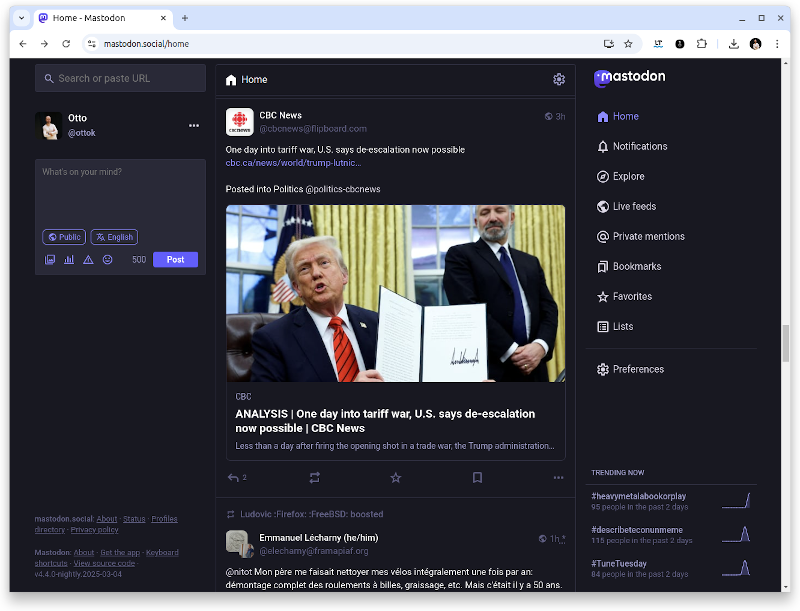 Mastodon was created in 2016 by
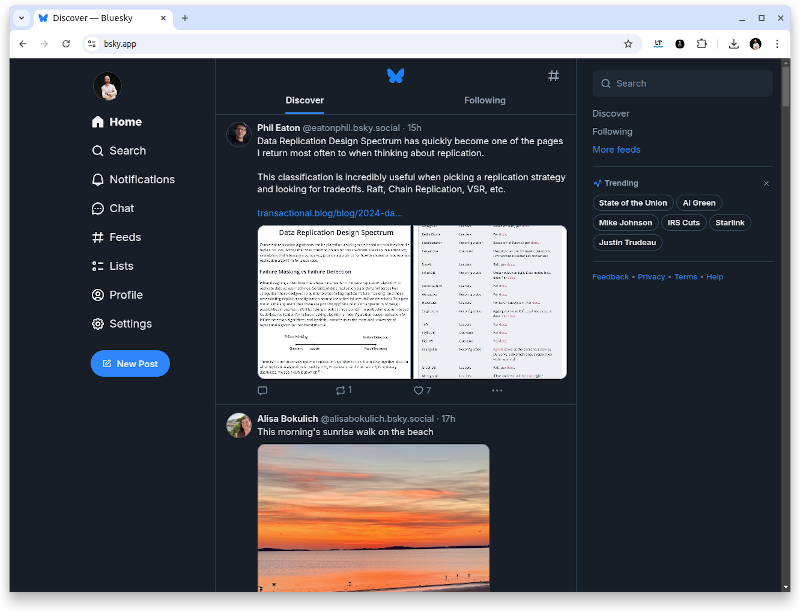 Interestingly,
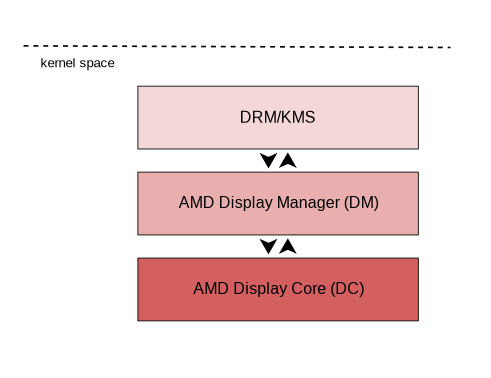 The DRM/KMS framework provides the atomic API for color management through KMS
properties represented by
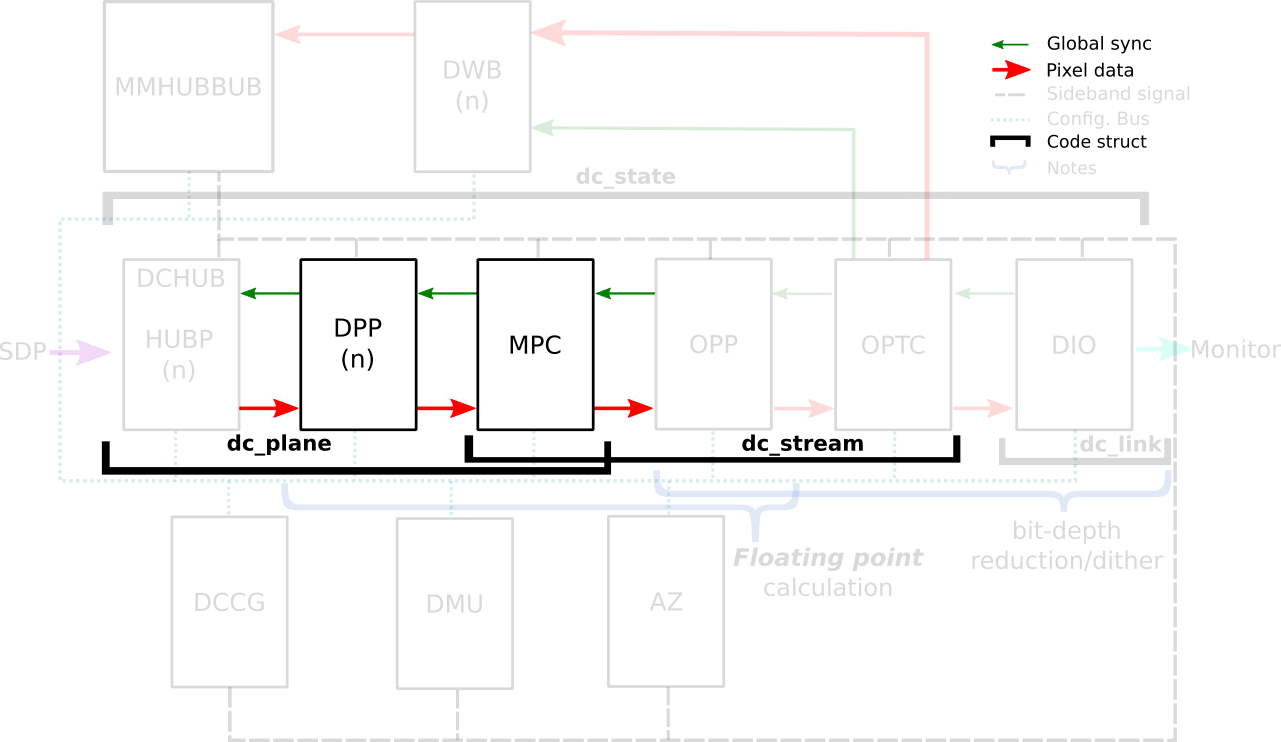
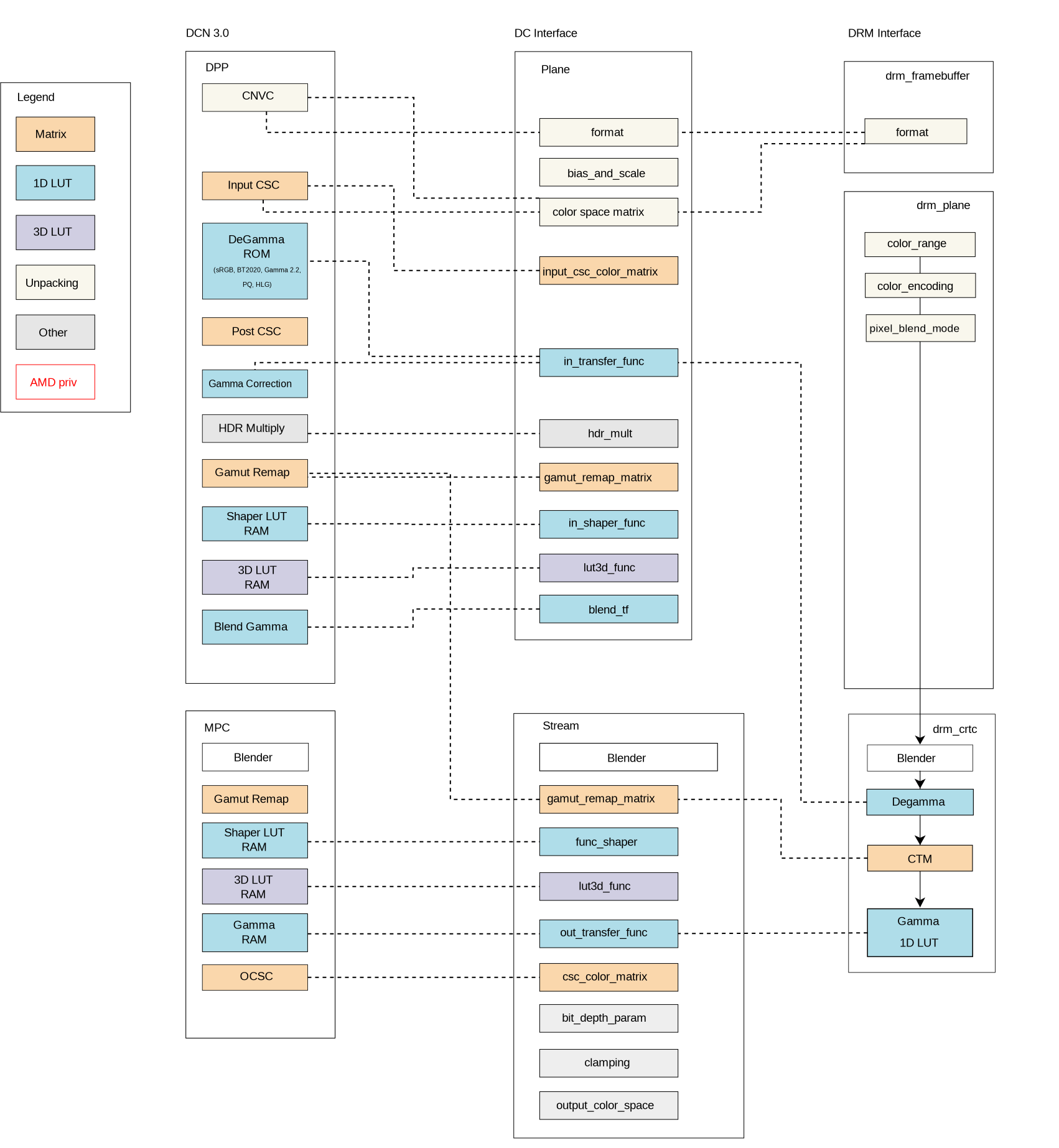
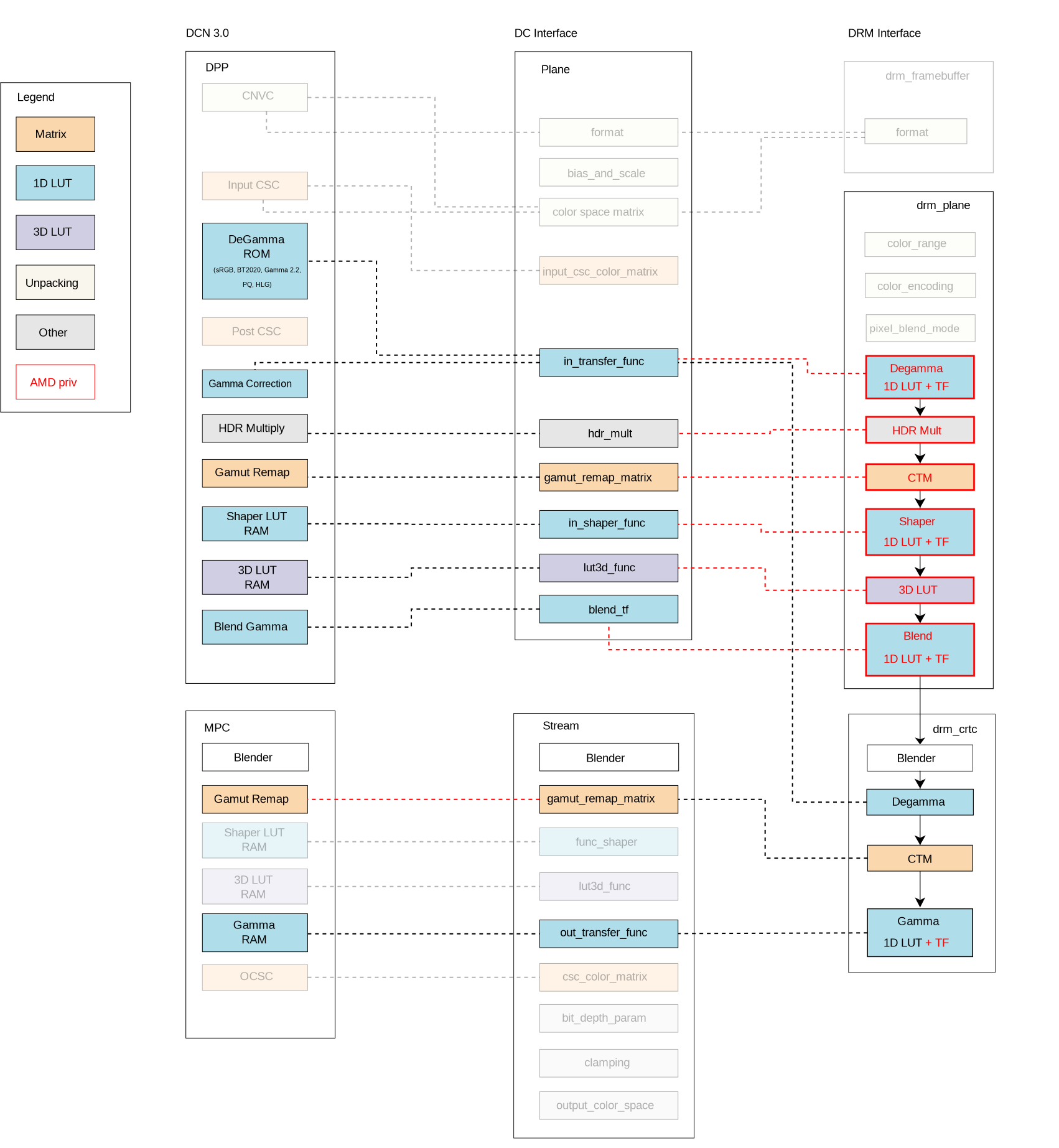



 What happened in the
