Search Results: "duck"

18 August 2026

Andy Simpkins: My first go at tracking down a kernel bug

A couple of weekends back, I upgraded my home sever. It failed to restart after running apt dist-upgrade The only update that was performed was to the kernel, it went from 6.12.88+deb13-amd64 to 6.12.100+deb13-amd64. I had previously performed an apt-get upgrade, and rebooted the machine, so I was pretty sure that this was to blame. This blog entry (is a late) attempt to document how I went about finding a fix for this issue so that next time I don t need as much hand holding as I did this time around :-) (1)
Having my machine not boot following an upgrade is pretty rare, but has happened before. Usually it is because I have done something wrong so as always confirming I haven t broken something by accident is always my first step I plugged in a keyboard an monitor to the machine and watched it boot. Being a server this takes a long time (I guess because at this stage of system initialisation we want to test things sequentially) Watching the system boot I see the usual BIOS/UEFI stages for this machine, followed by the grub menu and the the local screen showed:
            Loading Linux 6.12.100+deb13-amd64 ...
            Loading initial ramdisk ...
Nothing else. That was it. OK that looks like I have a broken system all right, and at very early stage of the boot process process. (2)
Breaking into the grub menu and removing the quiet option yields a little more information (but not much):
            Loading Linux 6.12.100+deb13-amd64  
            Loading initial ramdisk ...
            
            	EFI stub: Loaded initrd from LINUX_EFI_INITRD_MEDIA_GUID d
            	evice path
            		EFI stub: Measured initrd data into PCR 9
and nothing else. (3) Initial debugging (4) Triage Start looking for where the fault first occurred. At this point I needed help, and given that Sledge was visiting I asked if he would sanity check what I was doing. His initial thoughts were that that /boot had run out of space, but replaying my step (3) with him acting as a rubber duck showed that this was something other than PBKAC Sledge had a quick look, then informed me that between kernel images 6.12.88+deb13 and 6.12.100+deb13 Debian stable has only had shipped .90 .94 .95 and .96 kernels. We could easily try them all: OK I now have the first kernel image that doesn t boot on my system, time to raise a bug

Up until now I have been walking to my garage where the server is located and standing in front of a rack
with a monitor and keyboard plugged into the machine. However this machine supports IPMI so I spent a little time getting that up and running so that I can continue from the relative comfort of my desk (with lights, a chair and not needing to hold the keyboard with one hand)
Great I can now grab screen shots from the confort of my desk (unfortunatly they are only screen shots not text files, but at least we can seen the early stage of boot, Post, grub menu and then initramfs before system log happens) (5) Collating information for the initial bug report Sledge had mentioned my problem in irc/#debain-kernal where iam_tj suggested that we try appending
debug earlycon=efifb to the kernal command line. This yielded 15 seconds worth of messages before the system locked up the last few messages being (vmlinuz-6.12.96+deb13-amd64):

[ 14.663477] RCU Tasks: Setting shift to 5 and lim to 1 rcu_task_cb_adjust=1 rcu_task_cpu_ids=20.
[ 14.750474] RCU Tasks Rude: Setting shift to 5 and lim to 1 rcu_task_cb_adjust=1 rcu_task_cpu_ids=20.
[ 14.838024] RCU Tasks Trace: Setting shift to 5 and lim to 1 rcu_task_cb_adjust=1 rcu_task_cpu_ids=20.
[ 14.929752] NR_IRQS: 524544, nr_irqs: 584, preallocated irqs: 16
[ 15.016814] rcu: srcu_init: Setting srcu_struct sizes based on contention.
[ 15.104011] Console: colour dummy device 80 25
[ 15.191236] printk: legacy console [tty0] enabled
[ 15.278249] printk: legacy bootconsole [efifb0] disabled Booting the working kernel with the same kernel options yields the SAME messages with slightly differing times, but then continues to login prompt:

 [   14.697466] RCU Tasks: Setting shift to 5 and lim to 1 rcu_task_cb_adjust=1 rcu_task_cpu_ids=20.
 [   14.784936] RCU Tasks Rude: Setting shift to 5 and lim to 1 rcu_task_cb_adjust=1 rcu_task_cpu_ids=20.
 [   14.872067] RCU Tasks Trace: Setting shift to 5 and lim to 1 rcu_task_cb_adjust=1 rcu_task_cpu_ids=20.
 [   14.964000] NR_IRQS: 524544, nr_irqs: 584, preallocated irqs: 16
 [   15.051482] rcu: srcu_init: Setting srcu_struct sizes based on contention.
 [   15.226079] printk: legacy console [tty0] enabled
 [   15.313751] printk: legacy bootconsole [efifb0] disabled
 [   15.400831] ACPI: Core revision 20240827
 [   15.401415] clocksource: hpet: mask: 0xffffffff max_cycles: 0xffffffff, max_idle_ns: 79635855245 ns
 [   15.401464] APIC: Switch to symmetric I/O mode setup
 
... and so on
iam_tj also suggested adding keep_bootcon with debug earlycon=efifb keep_bootcon on vmlinuz-6.12.96+deb13-amd64:
We get a LOT further and we see a crash / trace-back:
[ 34.285342] BUG: kernel NULL pointer dereference, address: 0000000000000000
I raised bug #1143721 and followed it up with screen captures of the boot sequence (captured from the IPMI client) and files containing the output of dmidecode, lscpu and lspci to kive the kernel team as much information as possible:
[6.12.96+deb13-amd64 debug earlycon=efifb keep_bootcon.tar.gz (application/gzip, attachment)]
[dmidecode.txt (text/plain, attachment)]
[lscpu.txt (text/plain, attachment)]
[lspci.txt (text/plain, attachment)]
(6) Tracking down the bug Git Bisect The problem with this type of bug is that it is hardware (class) specific, whilst the kernel doesn t boot on my system, it clearly has worked on machines used by the kernel team, the Debian test and build infrastructure, (otherwise this kernel would never have been released) and everyone else who has upgraded to the newer kernel before I did (otherwise we would be drowning in fails to boot bug reports). Carnil s excellent response to my bug: Message #15 (and help in IRC) provided me with a detailed step by step guide in how to track down the individual git commit that fails on my system. I had already (with Sledge s suggestion) made a clone of the stable branch, but was struggling to follow the steps in the Debian Linux Kernel Handbook to re-build a duplicate kernel because I didn t understand how to obtain the same configuration that Debian used to build the kernel; Carnil s email provided me the missing steps (Highlighted).
git clone --single-branch -b linux-6.12.y https://git.kernel.org/pub/scm/linux/kernel/git/stable/linux-stable.git
cd linux-stable
git checkout v6.12.95
cp /boot/config-$(uname -r) .config
yes ''   make localmodconfig
make savedefconfig
mv defconfig arch/x86/configs/my_def
test 6.12.96 to ensure this is "bad"
git checkout v6.12.96
make my_defconfig
make -j $(nproc) bindeb-pkg
  install the resulting .deb package and confirm it fails to boot and triggers the NULL pointer dereference.
Right I can now start to Bisect the problem:
git bisect start
git bisect good v6.12.95
git bisect bad v6.12.96
Rather than use the half step point s git bisect suggested I was advised in irc to jump straight to the a given commit that from the git log was suspected as the culprit:

git checkout 977855894bca4b87afa50d21e3f3e85a5a0e901f
build and install .
fails
git bisect bad

git checkout 977855894bca4b87afa50d21e3f3e85a5a0e901f~1 ## ~1 is the commit beforehand
build and install .
fails
git bisect good The entire test tree can shown with git bisect log and this was submitted as an email to the bug report, we have found our smoking gun :-) Finally I would like to thank Carnil, Iam_tj for their time patience and fantastic support in guiding me through finding this regression. Right now kernel bugs are coming in thick and fast with a lot of AI assisted bug hunting, the increased numbers of bugs mean that the kernel team are especially busy. Hopefully our paths will cross and I ll be able to buy you some beers (or whatever) soon. thank you. Sledge also deserves thanks for putting up with me and pointing me in the right direction (as ever). Lucky for me that he lives nearby so I can provide beers on a regular basis :-)

17 May 2026

Otto Kek l inen: Balancing persistence vs pivoting is grit a virtue or wasteful?

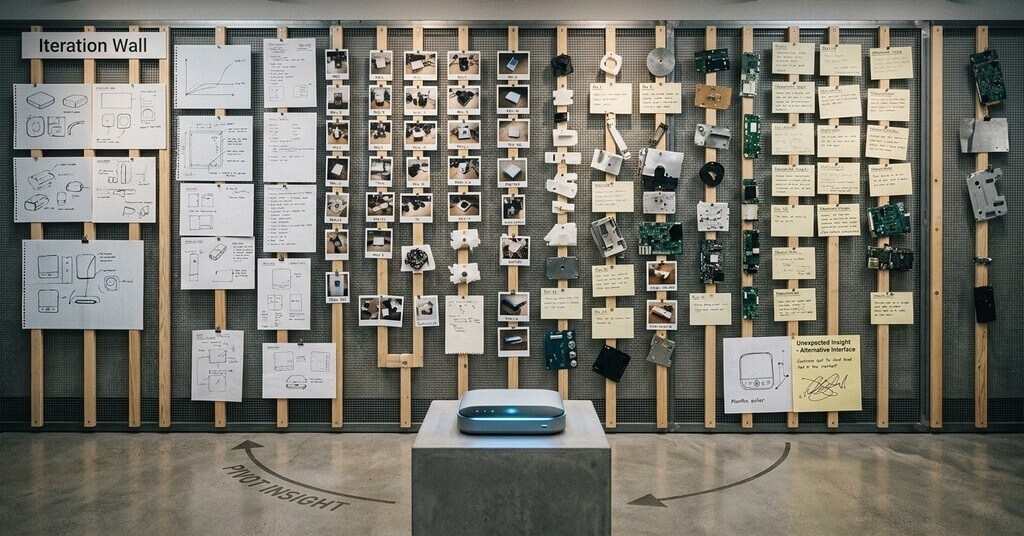
Featured image of post Balancing persistence vs pivoting   is grit a virtue or wasteful?Being persistent, sticking to a plan and showing up to work every day is generally valued highly across all cultures as virtuous behavior. It is obvious that anything of value and worth achieving is also not easy, but requires significant and recurring effort. Learning a new language, winning a sports competition or building a successful business are all typical scenarios where grit plays a central role above everything else. However, sometimes the virtue of tenacity can result in just a waste of energy. The question is then: how does one recognize that true progress is being blocked by stubbornness and a pivot would be the correct decision, as opposed to being close to breakthrough where doing more of the same would actually be the right choice?

What is persistence actually? To think clearly about this topic, one must first grasp the concept of grit and what it looks like in practice. Research by psychologist Angela Duckworth on grit shows that sustained effort in the face of setbacks separates high achievers from those who quit too soon. Entrepreneurs who iterated through dozens of failed prototypes or writers who revised manuscripts for years understand this truth. Persistence builds resilience, deep expertise, and the kind of compounding results that shortcuts cannot deliver. It also protects against the distraction of shiny new ideas that pull focus from what actually works. Persistence is about:
  1. Believing in an outcome and working towards it despite people around you not sharing the belief, and despite your own work and experiments not being successful.
  2. Continuing to hold the belief and sticking to the decision despite other ideas, solutions and competing alternatives surfacing.
  3. The more time passes, the firmer the conviction becomes. Time, money, and emotional energy invested in a failing direction create psychological pressure to continue (sunk-cost fallacy).
Simply following through on a plan or upholding a contract is not true persistence. Grit is a personal trait one can cultivate to actually become more energized to do something precisely because it turns out to be harder than expected.

Pivoting: a calculated choice The opposite of being persistent is giving up. Pivoting is not about giving up, but about redirecting the energy and momentum towards a new goal. Pivoting requires coming to the realization that you were wrong, and going through the painful process of discovering a new truth. Ideas tend to be abundant, and doing something new isn t hard as such. The hard part is to abandon a previously held belief and adopt a new one with equal conviction. To have that conviction you need to have data and metrics. This is also the key to how to decide between persisting vs pivoting at any moment in time.

Key metrics of success Any decision is only as good as the information available at the time it was made. To be set up for success one needs to start by deciding on what the actual goal is, what one values and how progress is measured. Key metrics are usually easiest to discover by working backwards from the goal. If you want to build an electric car, you might decide that the goal is to have a car that costs 30,000 euros and can drive 300 km on one charge. From that goal you can break down what the cost structure should be, what volume of production is needed to break even, what raw materials are needed and what the battery chemistry needs to achieve to meet the goal. That can further be broken down into a rate of progress. Suppose the plan requires battery energy density to reach 150 Wh/kg to be viable. If the state of the art starts at 100 Wh/kg and funding lasts a maximum of five years, the team needs at least an 8% improvement every year (1.08^5 100 Wh/kg 150 Wh/kg). This can then be used as a guideline. Sometimes progress is not steady, but happens in jumps. Even in those cases there should be a trajectory to benchmark the jumps against. In an online business, the key metric could, for example, be one of these:
  • 7- or 30-day retention rate: Do new users who try the service actually like it?
  • Weekly or monthly active users: Is usage trending up?
  • Feature adoption rate: In an existing service, how many users are using the new feature?
  • Product-Market Fit Score (from Sean Ellis test): Percentage of users who say they would be very disappointed if the product disappeared. Above 40% is a strong early indicator. A number below that (after multiple iterations) is a good data point to pivot.
  • Revenue run rate or burn rate: The most generic metric everything eventually boils down to. Healthy markets reward good products.
Weekly metrics are better than monthly, as they make the feedback loop faster and allow you to get validation quickly and do minor course corrections along the way. A complete pivot should, however, be based on long-term data, driven by the key metric and supported by additional data points. Metrics are also needed because they can t be bribed or convinced to be anything other than what they are. Listening to other people is good, but just relying on the opinion of others is extremely dangerous because people are biased either for you or against you depending on whether they see you as a trusted leader or an outcast. Key metrics are of course domain-specific and everyone needs to come up with their own. However, you must have some key metric. You can t have the excuse that what you are doing can t be measured. If you are part of a larger organization and you need to advocate for a difficult decision for example, to kill your darlings when facing a pivot you need to have the metrics to back up your views, and those metrics need to have been established way before as something the organization values, and not cherry-picked just for this one decision. It does not matter if you are on a personal improvement journey, running a political campaign, inventing a new product, or growing a business you need to have some metric you can check at any given time to see if things are improving fast enough to predict success. Metrics can and should also be used in daily work to validate that you are on the correct path, and to optimize execution.

Famous examples of persistence and pivoting that led to breakthroughs In all of the cases below it is of course in hindsight easy to say they made the right decision. However, take a minute to try to imagine yourself in their shoes at the time of the decision. What metrics might they have had available to support their decision? What would you have wanted to measure or find out if you were in the same situation?
  • Frustrated that his vacuum lost suction, James Dyson spent five years and built thousands of failed prototypes in a backyard shed. He remortgaged his home, lived on savings, and faced rejection from every major manufacturer who wanted to protect their bag-replacement business. The 5,127th prototype based on an idea from a sawmill with a cyclone finally worked. Launched in 1993, the Dyson DC01 became Britain s best-selling vacuum within two years.
  • As a single mother on welfare in the mid-1990s, J.K. Rowling finished her manuscript for Harry Potter and the Philosopher s Stone while battling depression and poverty. She hand-typed copies and mailed them to publishers. Twelve rejected it outright, with comments like children s books about magic don t sell. She nearly quit multiple times but kept revising and submitting. Bloomsbury finally accepted it after the CEO s eight-year-old daughter read the first chapter and demanded the rest. The series has since sold hundreds of millions of copies worldwide.
  • Founded in 1997 as a mail-order DVD rental service, Netflix added unlimited subscriptions in 1999 to compete with Blockbuster. By 2007, broadband growth and declining DVD sales signaled a shift. CEO Reed Hastings pivoted aggressively toward streaming, investing in bandwidth deals and original content while de-emphasizing physical media. The move faced skepticism, but eventually changed the whole culture of how entertainment is consumed.
  • YouTube launched in 2005 as a video-dating site. Founders offered money to women who uploaded dating videos, but almost no one did. Meanwhile, users uploaded random clips. The team recognized the mismatch and pivoted within months to a general-purpose video-sharing platform with easy uploading. Google bought it just 18 months later.
  • Instagram began in 2010 as Burbn, a location-based check-in app that let users post plans, earn points, and share photos. Co-founders Kevin Systrom and Mike Krieger quickly noticed users ignored most features and mainly used it for photo-sharing. They made the tough call: scrap everything else. Within weeks, they rebuilt the app around clean, simple photography with filters. The pivot launched as Instagram in October 2010. It gained 1 million users in two months and was acquired by Facebook just 18 months later.

Insanity or conviction? English has several proverbs that warn against excessive persistence, such as banging your head against the wall . Insanity is commonly defined as Doing the same thing over and over again and expecting different results. In Finland, the national identity is practically built on the concept of sisu . It means much more than just grit . The word is derived from the word for inside or guts and represents an unexplained, almost superhuman force that makes one stoically take action despite seemingly impossible odds and somehow succeed anyway. It became a defining national mythos during the Winter War (1939 1940), where a force 10 times larger than the Finnish army tried to invade the country but was stopped and Finland just barely managed to keep its independence. The word sisu transitioned from a character trait to a pillar of national survival. I think Finns survived because the more you believe in persistence, the more likely you are to persist. I view persistence as a religion that requires faith, while pivoting is a science where you derive the truth from the numbers. When in doubt, I would always choose persistence over pivoting. Perhaps it is because of my genetic tendency towards having sisu , but I would also rather keep on going a bit more and try one more time before giving up and pivoting in order to get more data, so that when I pivot, I know it is absolutely the right thing to do at that point. Depending on the situation, the costs of postponing the pivot vary. Of course, if the main metric is the burn rate and a company is running out of money, a pivot must be done early enough that the remaining runway is enough to execute the pivot, and then some more. In some situations a business idea might simply be ahead of its time. If that is the conviction and the key metrics support it, the best way to navigate the situation is to cut down on costs and wait for competitors to appear, help build general awareness, and then ramp up again to ride the wave. Remember that success does not come from grit alone there is always an element of timing and luck as well. But if you are not persistent and stop showing up every day, you won t be able to seize the opportunities if and when they arise.

Failure is the likely outcome you have to avoid it at any cost One must also realize that most attempts end in failure. Failure is the baseline, and success is the exception. To reach a breakthrough, one must be stubbornly persistent. In particular, if you are a leader, you need to be so high in conviction that it almost becomes an aura that radiates to those around you. Postponing the decision to pivot allows you to get a bit more data for the decision, so that once you pivot, you have full belief in the new direction. Once you pivot, there is no looking back, otherwise you will undermine morale and most certainly fail with the new thing as people will execute it with hesitation. Failure is statistically always the more likely outcome. Most things end in failure and we never hear about them. If someone on your team does not believe in what you are doing, it is very easy for them to prove that something is a failure by spreading negativity, putting in less effort (perhaps unconsciously due to lack of conviction) and thus actually contributing to a self-fulfilling failure. In most areas of life, ideas are cheap and the only thing that matters is execution. To be good at executing, you need to be good at making decisions. When drafting plans it is good to have alternatives and a lot of consideration. However, when execution starts, there is no room for doubt, otherwise the chances of success decrease. Therefore, the best way of balancing persistence vs pivoting is to
  1. plan well ahead,
  2. establish the key metrics,
  3. have thresholds established for what would trigger a pivot, and
  4. do everything you can to move the metrics in the direction you want them to go.
Finally, if you decide to pivot, you must do so only with very high conviction, as you can t undo a pivot, and you should not be doing multiple pivots in a row either. If you are fully convinced yourself about the pivot, you will also be able to convince others about it, and carry the momentum.

6 February 2026

Birger Schacht: Status update, January 2026

January was a slow month, I only did three uploads to Debian unstable: I was very happy to see the new dfsg-new-queue and that there are more hands now processing the NEW queue. I also finally got one of the packages accepted that I uploaded after the Trixie release: wayback which I uploaded last August. There has been another release since then, I ll try to upload that in the next few days. There was a bug report for carl asking for Windows support. carl used the xdg create for looking up the XDG directories, but xdg does not support windows systems (and it seems this will not change) The reporter also provided a PR to replace the dependency with the directories crate which more system agnostic. I adapted the PR a bit and merged it and released version 0.6.0 of carl. At my dayjob I refactored django-grouper. django-grouper is a package we use to find duplicate objects in our data. Our users often work with datasets of thousands of historical persons, places and institutions and in projects that run over years and ingest data from multiple sources, it happens that entries are created several times. I wrote the initial app in 2024, but was never really happy about the approach I used back then. It was based on this blog post that describes how to group spreadsheet text cells. It uses sklearns TfidfVectorizer with a custom analyzer and the library sparse_dot_topn for creating the matrix. All in all the module to calculate the clusters was 80 lines and with sparse_dot_topn it pulled in a rather niche Python library. I was pretty sure that this functionality could also be implemented with basic sklearn functionality and it was: we are now using DictVectorizer because in a Django app we are working with objects that can be mapped to dicts anyway. And for clustering the data, the app now uses the DBSCAN algorithm (with the manhattan distance as metric). The module is now only half the size and the whole app lost one dependency! I released those changes as version 0.3.0 of the app. At the end of January together with friends I went to Brussels to attend FOSDEM. We took the night train but there were a couple of broken down trains so the ride took 26 hours instead of one night. It is a good thing we had a one day buffer and FOSDEM only started on Saturday. As usual there were too many talks to visit, so I ll have to watch some of the recordings in the next few weeks. Some examples of talks I found interesting so far:

2 December 2025

Dirk Eddelbuettel: duckdb-mlpack 0.0.5: Added kmeans, version helpers, documentation

A new release of the still-recent duckdb extension for mlpack, the C++ header-only library for machine learning, was merged into the duckdb community extensions repo today, and has been updated at its duckdb mlpack extension page. This release 0.0.5 adds one new method: kmeans clustering. We also added two version accessors for both mlpack and armadillo. We found during the work on random forests (added in 0.0.4) that the multithreaded random number generation was not quite right in the respective upstream codes. This has by now been corrected in armadillo 15.2.2 as well as the trunk version of mlpack so if you build with those, and set a seed, then your forests and classification will be stable across reruns. We added a second state variable mlpack_silent that can be used to suppress even the minimal prediction quality summary some methods show, and expanded the documentation. For more details, see the repo for code, issues and more, and the extension page for more about this duckdb community extension.

This post by Dirk Eddelbuettel originated on his Thinking inside the box blog. If you like this or other open-source work I do, you can sponsor me at GitHub.

11 November 2025

Dirk Eddelbuettel: duckdb-mlpack 0.0.4: Added random forest and logistic regression

A new release of the budding duckdb extension for mlpack, the C++ header-only library for machine learning, was merged into the duckdb community extensions repo today, and has been updated at its duckdb mlpack extension page. This release 0.0.4 adds two new methods (random forests, and regularized logistic regression), reworked the interface a little to now consistently provide fit (or train) and predict methods, adds a new internal state variable mlpack_verbose which can trigger (or suppress) verbose mode directly from SQL, expanded the documentation and added more unit tests. For more details, see the repo for code, issues and more, and the extension page for more about this duckdb community extension.

This post by Dirk Eddelbuettel originated on his Thinking inside the box blog. If you like this or other open-source work I do, you can sponsor me at GitHub.

3 November 2025

Dirk Eddelbuettel: duckdb-mlpack 0.0.3: macOS binaries, unit tests, more outputs

A littler two weeks a short post announced the duckdb-mlpack as ML quacks : combining the powerful C++ machine learning library mlpack with the amazing analytical database engine duckdb. About a week ago another short post covered first extensions. We actually followed-up with release 0.0.3 days later, and never posted about it so this short note catches up. In release 0.0.3, we provide macOS binaries: following a known issue with one of the components, we apply a simple patch to enable the build. Next up are wasm and windows, if you know your way around these platforms please get in touch. Release 0.0.3 also added first unit tests, serializes the coefficients from the (regularized) linear regression into the output table. See see two previous posts linked above for details and background, the repo for code, issues and more, and the extension page for more about this duckdb community extension.

This post by Dirk Eddelbuettel originated on his Thinking inside the box blog. If you like this or other open-source work I do, you can sponsor me at GitHub.

26 October 2025

Dirk Eddelbuettel: duckdb-mlpack 0.0.2: mlpack is now a duckdb community extension

A couple of days ago in a short post, I announced duckdb-mlpack as ML quacks : combining the powerful C++ machine learning library mlpack with the amazing analytical database engine duckdb. See that post for more background. The duckdb-mlpack package is now a community extension joining an impressive list of existing extensions. This means duckdb builds and distributes duckdb-mlpack for all supported platforms allowing users to just install the resulting (signed) binary. (We currently only support Linux in both arm64 and amd64, adding macOS should be straightforward once we sort one build issue out. Windows and WASM should work too, with a little love and polish, as both duckdb and mlpack support them.) Given the binary build, a simple
INSTALL mlpack FROM community;
LOAD mlpack;
installs and loads the package. By the duckdb convention the code is stored per-user and per-version, so the first line needs to be executed only once per duckdb release used. The second line is then per session. We also extended the capabilities of duckdb-mlpack. While still a MVP stressing minimal viable product, the two supported methods adaBoost and (regularized) linear regression both serialize and store their model object permitting rapid prediction on new data as shown in the adaBoost example:
-- Perform adaBoost (using weak learner 'Perceptron' by default)
-- Read 'features' into 'X', 'labels' into 'Y', use optional parameters
-- from 'Z', and prepare model storage in 'M'
CREATE TABLE X AS SELECT * FROM read_csv("https://eddelbuettel.github.io/duckdb-mlpack/data/iris.csv");
CREATE TABLE Y AS SELECT * FROM read_csv("https://eddelbuettel.github.io/duckdb-mlpack/data/iris_labels.csv");
CREATE TABLE Z (name VARCHAR, value VARCHAR);
INSERT INTO Z VALUES ('iterations', '50'), ('tolerance', '1e-7');
CREATE TABLE M (json VARCHAR);

-- Train model for 'Y' on 'X' using parameters 'Z', store in 'M'
CREATE TEMP TABLE A AS SELECT * FROM mlpack_adaboost("X", "Y", "Z", "M");

-- Count by predicted group
SELECT COUNT(*) as n, predicted FROM A GROUP BY predicted;

-- Model 'M' can be used to predict
CREATE TABLE N (x1 DOUBLE, x2 DOUBLE, x3 DOUBLE, x4 DOUBLE);
-- inserting approximate column mean values
INSERT INTO N VALUES (5.843, 3.054, 3.759, 1.199);
-- inserting approximate column mean values, min values, max values
INSERT INTO N VALUES (5.843, 3.054, 3.759, 1.199), (4.3, 2.0, 1.0, 0.1), (7.9, 4.4, 6.9, 2.5);
-- and this predict one element each
SELECT * FROM mlpack_adaboost_pred("N", "M");
Ryan and I have some ideas for where to go from here, ideally towards autogenerating bindings for most (if not all) methods as is done for the mlpack language bindings. Anybody interested and willing to help should reach out to us.

This post by Dirk Eddelbuettel originated on his Thinking inside the box blog. If you like this or other open-source work I do, you can sponsor me at GitHub.

17 October 2025

Dirk Eddelbuettel: ML quacks: Combining duckdb and mlpack

A side project I have been working on a little since last winter and which explores extending duckdb with mlpack is now public at the duckdb-mlpack repo. duckdb is an excellent small (as in runs as a self-contained binary ) database engine with both a focus on analytical payloads (OLAP rather than OLTP) and an impressive number of already bolted-on extensions (for example for cloud data access) delivered as a single-build C++ executable (or of course as a library used from other front-ends). mlpack is an excellent C++ library containing many/most machine learning algorithms, also built in a self-contained manner (or library) making it possible to build compact yet powerful binaries, or to embed (as opposed to other ML framework accessed from powerful but not lightweight run-times such as Python or R). The compact build aspect as well as the common build tools (C++, cmake) make these two a natural candidate for combining them. Moreover, duckdb is a champion of data access, management and control and the complementary machine learning insights and predictions offered by mlpack are fully complementary and hence fit this rather well. duckdb also has a very robust and active extension system. To use it, one starts from a template repository and its use this template button, runs a script and can then start experimenting. I have now grouped my initial start and test functions into a separate repository duckdb-example-extension to keep the duckdb-mlpack one focused on the extend to mlpack aspect. duckdb-mlpack is right an MVP , i.e. a minimally viable product (or demo). It just runs the adaboost classifier but does so on any dataset fitting the rectangular setup with columns of features (real valued) and a final column (integer valued) of labels. I had hope to use two select queries for both features and then labels but it turns a table function (returning a table of data from a query) can only run one select *. So the basic demo, also on the repo README is now to run the following script (where the SELECT * FROM mlpack_adaboost((SELECT * FROM D)); is the key invocation of the added functionality):
#!/bin/bash

cat <<EOF   build/release/duckdb
SET autoinstall_known_extensions=1;
SET autoload_known_extensions=1; # for httpfs

CREATE TEMP TABLE Xd AS SELECT * FROM read_csv("https://mlpack.org/datasets/iris.csv");
CREATE TEMP TABLE X AS SELECT row_number() OVER () AS id, * FROM Xd;
CREATE TEMP TABLE Yd AS SELECT * FROM read_csv("https://mlpack.org/datasets/iris_labels.csv");
CREATE TEMP TABLE Y AS SELECT row_number() OVER () AS id, CAST(column0 AS double) as label FROM Yd;
CREATE TEMP TABLE D AS SELECT * FROM X INNER JOIN Y ON X.id = Y.id;
ALTER TABLE D DROP id;
ALTER TABLE D DROP id_1;
CREATE TEMP TABLE A AS SELECT * FROM mlpack_adaboost((SELECT * FROM D));

SELECT COUNT(*) as n, predicted FROM A GROUP BY predicted;
EOF
to produce the following tabulation / group by:
./sampleCallRemote.sh
Misclassified: 1
 
    n     predicted  
  int64     int32    
 
     50           0  
     49           1  
     51           2  
 
$
(Note that this requires the httpfs extension. So when you build from a freshly created extension repository you may be ahead of the most recent release of duckdb by a few commits. It is easy to check out the most recent release tag (or maybe the one you are running for your local duckdb binary) to take advantage of the extensions you likely already have for that version. So here, and in the middle of October 2025, I picked v1.4.1 as I run duckdb version 1.4.1 on my box.) There are many other neat duckdb extensions. The core ones are regrouped here while a list of community extensions is here and here. For this (still more minimal) extension, I added a few TODO items to the README.md: Please reach out if you are interested in working on any of this.

This post by Dirk Eddelbuettel originated on his Thinking inside the box blog. If you like this or other open-source work I do, you can now sponsor me at GitHub.

22 September 2025

Vincent Bernat: Akvorado release 2.0

Akvorado 2.0 was released today! Akvorado collects network flows with IPFIX and sFlow. It enriches flows and stores them in a ClickHouse database. Users can browse the data through a web console. This release introduces an important architectural change and other smaller improvements. Let s dive in!
$ git diff --shortstat v1.11.5
 493 files changed, 25015 insertions(+), 21135 deletions(-)

New outlet service The major change in Akvorado 2.0 is splitting the inlet service into two parts: the inlet and the outlet. Previously, the inlet handled all flow processing: receiving, decoding, and enrichment. Flows were then sent to Kafka for storage in ClickHouse:
Akvorado flow processing before the change: flows are received and processed by the inlet, sent to Kafka and stored in ClickHouse
Akvorado flow processing before the introduction of the outlet service
Network flows reach the inlet service using UDP, an unreliable protocol. The inlet must process them fast enough to avoid losing packets. To handle a high number of flows, the inlet spawns several sets of workers to receive flows, fetch metadata, and assemble enriched flows for Kafka. Many configuration options existed for scaling, which increased complexity for users. The code needed to avoid blocking at any cost, making the processing pipeline complex and sometimes unreliable, particularly the BMP receiver.1 Adding new features became difficult without making the problem worse.2 In Akvorado 2.0, the inlet receives flows and pushes them to Kafka without decoding them. The new outlet service handles the remaining tasks:
Akvorado flow processing after the change: flows are received by the inlet, sent to Kafka, processed by the outlet and inserted in ClickHouse
Akvorado flow processing after the introduction of the outlet service
This change goes beyond a simple split:3 the outlet now reads flows from Kafka and pushes them to ClickHouse, two tasks that Akvorado did not handle before. Flows are heavily batched to increase efficiency and reduce the load on ClickHouse using ch-go, a low-level Go client for ClickHouse. When batches are too small, asynchronous inserts are used (e20645). The number of outlet workers scales dynamically (e5a625) based on the target batch size and latency (50,000 flows and 5 seconds by default). This new architecture also allows us to simplify and optimize the code. The outlet fetches metadata synchronously (e20645). The BMP component becomes simpler by removing cooperative multitasking (3b9486). Reusing the same RawFlow object to decode protobuf-encoded flows from Kafka reduces pressure on the garbage collector (8b580f). The effect on Akvorado s overall performance was somewhat uncertain, but a user reported 35% lower CPU usage after migrating from the previous version, plus resolution of the long-standing BMP component issue.

Other changes This new version includes many miscellaneous changes, such as completion for source and destination ports (f92d2e), and automatic restart of the orchestrator service (0f72ff) when configuration changes to avoid a common pitfall for newcomers. Let s focus on some key areas for this release: observability, documentation, CI, Docker, Go, and JavaScript.

Observability Akvorado exposes metrics to provide visibility into the processing pipeline and help troubleshoot issues. These are available through Prometheus HTTP metrics endpoints, such as /api/v0/inlet/metrics. With the introduction of the outlet, many metrics moved. Some were also renamed (4c0b15) to match Prometheus best practices. Kafka consumer lag was added as a new metric (e3a778). If you do not have your own observability stack, the Docker Compose setup shipped with Akvorado provides one. You can enable it by activating the profiles introduced for this purpose (529a8f). The prometheus profile ships Prometheus to store metrics and Alloy to collect them (2b3c46, f81299, and 8eb7cd). Redis and Kafka metrics are collected through the exporter bundled with Alloy (560113). Other metrics are exposed using Prometheus metrics endpoints and are automatically fetched by Alloy with the help of some Docker labels, similar to what is done to configure Traefik. cAdvisor was also added (83d855) to provide some container-related metrics. The loki profile ships Loki to store logs (45c684). While Alloy can collect and ship logs to Loki, its parsing abilities are limited: I could not find a way to preserve all metadata associated with structured logs produced by many applications, including Akvorado. Vector replaces Alloy (95e201) and features a domain-specific language, VRL, to transform logs. Annoyingly, Vector currently cannot retrieve Docker logs from before it was started. Finally, the grafana profile ships Grafana, but the shipped dashboards are broken. This is planned for a future version.

Documentation The Docker Compose setup provided by Akvorado makes it easy to get the web interface up and running quickly. However, Akvorado requires a few mandatory steps to be functional. It ships with comprehensive documentation, including a chapter about troubleshooting problems. I hoped this documentation would reduce the support burden. It is difficult to know if it works. Happy users rarely report their success, while some users open discussions asking for help without reading much of the documentation. In this release, the documentation was significantly improved.
$ git diff --shortstat v1.11.5 -- console/data/docs
 10 files changed, 1873 insertions(+), 1203 deletions(-)
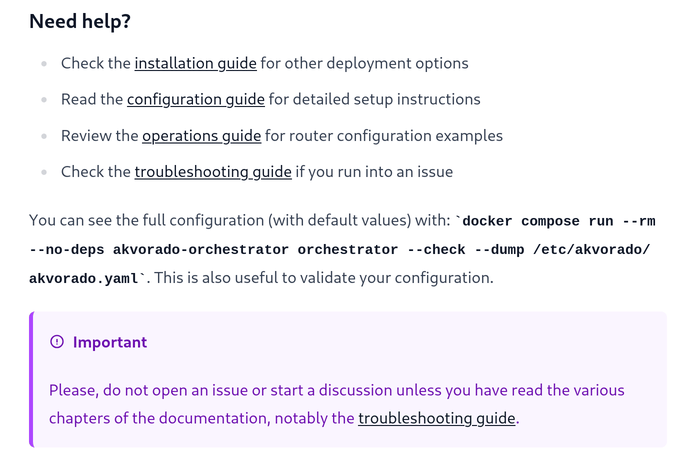
The documentation was updated (fc1028) to match Akvorado s new architecture. The troubleshooting section was rewritten (17a272). Instructions on how to improve ClickHouse performance when upgrading from versions earlier than 1.10.0 was added (5f1e9a). An LLM proofread the entire content (06e3f3). Developer-focused documentation was also improved (548bbb, e41bae, and 871fc5). From a usability perspective, table of content sections are now collapsable (c142e5). Admonitions help draw user attention to important points (8ac894).
Admonition in Akvorado documentation to ask a user not to open an issue or start a discussion before reading the documentation
Example of use of admonitions in Akvorado's documentation

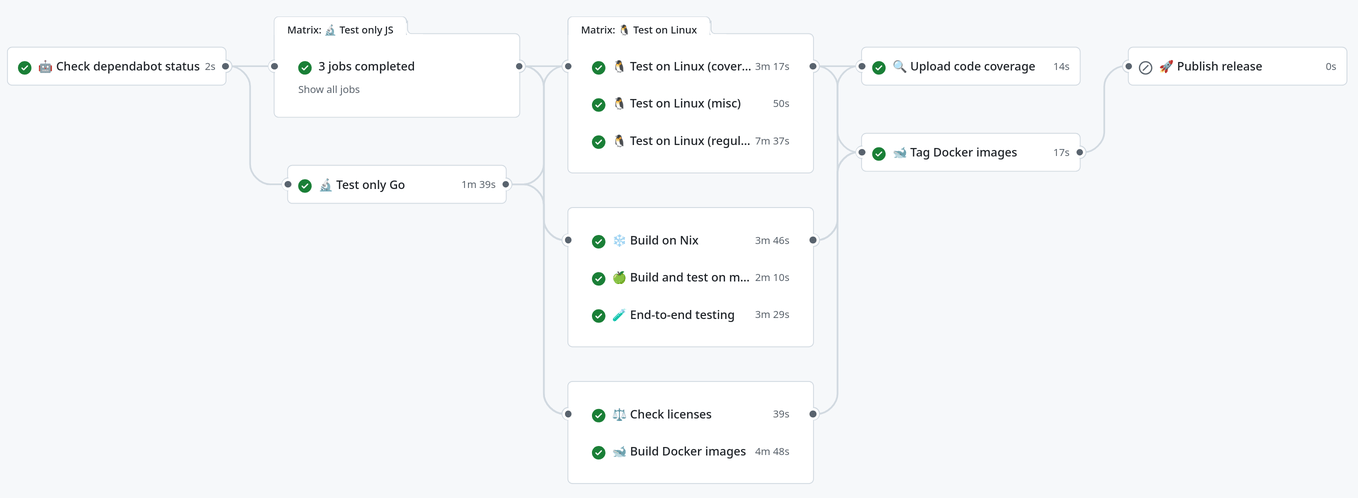
Continuous integration This release includes efforts to speed up continuous integration on GitHub. Coverage and race tests run in parallel (6af216 and fa9e48). The Docker image builds during the tests but gets tagged only after they succeed (8b0dce).
GitHub workflow for CI with many jobs, some of them running in parallel, some not
GitHub workflow to test and build Akvorado
End-to-end tests (883e19) ensure the shipped Docker Compose setup works as expected. Hurl runs tests on various HTTP endpoints, particularly to verify metrics (42679b and 169fa9). For example:
## Test inlet has received NetFlow flows
GET http://127.0.0.1:8080/prometheus/api/v1/query
[Query]
query: sum(akvorado_inlet_flow_input_udp_packets_total job="akvorado-inlet",listener=":2055" )
HTTP 200
[Captures]
inlet_receivedflows: jsonpath "$.data.result[0].value[1]" toInt
[Asserts]
variable "inlet_receivedflows" > 10
## Test inlet has sent them to Kafka
GET http://127.0.0.1:8080/prometheus/api/v1/query
[Query]
query: sum(akvorado_inlet_kafka_sent_messages_total job="akvorado-inlet" )
HTTP 200
[Captures]
inlet_sentflows: jsonpath "$.data.result[0].value[1]" toInt
[Asserts]
variable "inlet_sentflows" >=   inlet_receivedflows  

Docker Akvorado ships with a comprehensive Docker Compose setup to help users get started quickly. It ensures a consistent deployment, eliminating many configuration-related issues. It also serves as a living documentation of the complete architecture. This release brings some small enhancements around Docker: Previously, many Docker images were pulled from the Bitnami Containers library. However, VMWare acquired Bitnami in 2019 and Broadcom acquired VMWare in 2023. As a result, Bitnami images were deprecated in less than a month. This was not really a surprise4. Previous versions of Akvorado had already started moving away from them. In this release, the Apache project s Kafka image replaces the Bitnami one (1eb382). Thanks to the switch to KRaft mode, Zookeeper is no longer needed (0a2ea1, 8a49ca, and f65d20). Akvorado s Docker images were previously compiled with Nix. However, building AArch64 images on x86-64 is slow because it relies on QEMU userland emulation. The updated Dockerfile uses multi-stage and multi-platform builds: one stage builds the JavaScript part on the host platform, one stage builds the Go part cross-compiled on the host platform, and the final stage assembles the image on top of a slim distroless image (268e95 and d526ca).
# This is a simplified version
FROM --platform=$BUILDPLATFORM node:20-alpine AS build-js
RUN apk add --no-cache make
WORKDIR /build
COPY console/frontend console/frontend
COPY Makefile .
RUN make console/data/frontend
FROM --platform=$BUILDPLATFORM golang:alpine AS build-go
RUN apk add --no-cache make curl zip
WORKDIR /build
COPY . .
COPY --from=build-js /build/console/data/frontend console/data/frontend
RUN go mod download
RUN make all-indep
ARG TARGETOS TARGETARCH TARGETVARIANT VERSION
RUN make
FROM gcr.io/distroless/static:latest
COPY --from=build-go /build/bin/akvorado /usr/local/bin/akvorado
ENTRYPOINT [ "/usr/local/bin/akvorado" ]
When building for multiple platforms with --platform linux/amd64,linux/arm64,linux/arm/v7, the build steps until the highlighted line execute only once for all platforms. This significantly speeds up the build. Akvorado now ships Docker images for these platforms: linux/amd64, linux/amd64/v3, linux/arm64, and linux/arm/v7. When requesting ghcr.io/akvorado/akvorado, Docker selects the best image for the current CPU. On x86-64, there are two choices. If your CPU is recent enough, Docker downloads linux/amd64/v3. This version contains additional optimizations and should run faster than the linux/amd64 version. It would be interesting to ship an image for linux/arm64/v8.2, but Docker does not support the same mechanism for AArch64 yet (792808).

Go This release includes many changes related to Go but not visible to the users.

Toolchain In the past, Akvorado supported the two latest Go versions, preventing immediate use of the latest enhancements. The goal was to allow users of stable distributions to use Go versions shipped with their distribution to compile Akvorado. However, this became frustrating when interesting features, like go tool, were released. Akvorado 2.0 requires Go 1.25 (77306d) but can be compiled with older toolchains by automatically downloading a newer one (94fb1c).5 Users can still override GOTOOLCHAIN to revert this decision. The recommended toolchain updates weekly through CI to ensure we get the latest minor release (5b11ec). This change also simplifies updates to newer versions: only go.mod needs updating. Thanks to this change, Akvorado now uses wg.Go() (77306d) and I have started converting some unit tests to the new test/synctest package (bd787e, 7016d8, and 159085).

Testing When testing equality, I use a helper function Diff() to display the differences when it fails:
got := input.Keys()
expected := []int 1, 2, 3 
if diff := helpers.Diff(got, expected); diff != ""  
    t.Fatalf("Keys() (-got, +want):\n%s", diff)
 
This function uses kylelemons/godebug. This package is no longer maintained and has some shortcomings: for example, by default, it does not compare struct private fields, which may cause unexpectedly successful tests. I replaced it with google/go-cmp, which is stricter and has better output (e2f1df).

Another package for Kafka Another change is the switch from Sarama to franz-go to interact with Kafka (756e4a and 2d26c5). The main motivation for this change is to get a better concurrency model. Sarama heavily relies on channels and it is difficult to understand the lifecycle of an object handed to this package. franz-go uses a more modern approach with callbacks6 that is both more performant and easier to understand. It also ships with a package to spawn fake Kafka broker clusters, which is more convenient than the mocking functions provided by Sarama.

Improved routing table for BMP To store its routing table, the BMP component used kentik/patricia, an implementation of a patricia tree focused on reducing garbage collection pressure. gaissmai/bart is a more recent alternative using an adaptation of [Donald Knuth s ART algorithm][] that promises better performance and delivers it: 90% faster lookups and 27% faster insertions (92ee2e and fdb65c). Unlike kentik/patricia, gaissmai/bart does not help efficiently store values attached to each prefix. I adapted the same approach as kentik/patricia to store route lists for each prefix: store a 32-bit index for each prefix, and use it to build a 64-bit index for looking up routes in a map. This leverages Go s efficient map structure. gaissmai/bart also supports a lockless routing table version, but this is not simple because we would need to extend this to the map storing the routes and to the interning mechanism. I also attempted to use Go s new unique package to replace the intern package included in Akvorado, but performance was worse.7

Miscellaneous Previous versions of Akvorado were using a custom Protobuf encoder for performance and flexibility. With the introduction of the outlet service, Akvorado only needs a simple static schema, so this code was removed. However, it is possible to enhance performance with planetscale/vtprotobuf (e49a74, and 8b580f). Moreover, the dependency on protoc, a C++ program, was somewhat annoying. Therefore, Akvorado now uses buf, written in Go, to convert a Protobuf schema into Go code (f4c879). Another small optimization to reduce the size of the Akvorado binary by 10 MB was to compress the static assets embedded in Akvorado in a ZIP file. It includes the ASN database, as well as the SVG images for the documentation. A small layer of code makes this change transparent (b1d638 and e69b91).

JavaScript Recently, two large supply-chain attacks hit the JavaScript ecosystem: one affecting the popular packages chalk and debug and another impacting the popular package @ctrl/tinycolor. These attacks also exist in other ecosystems, but JavaScript is a prime target due to heavy use of small third-party dependencies. The previous version of Akvorado relied on 653 dependencies. npm-run-all was removed (3424e8, 132 dependencies). patch-package was removed (625805 and e85ff0, 69 dependencies) by moving missing TypeScript definitions to env.d.ts. eslint was replaced with oxlint, a linter written in Rust (97fd8c, 125 dependencies, including the plugins). I switched from npm to Pnpm, an alternative package manager (fce383). Pnpm does not run install scripts by default8 and prevents installing packages that are too recent. It is also significantly faster.9 Node.js does not ship Pnpm but it ships Corepack, which allows us to use Pnpm without installing it. Pnpm can also list licenses used by each dependency, removing the need for license-compliance (a35ca8, 42 dependencies). For additional speed improvements, beyond switching to Pnpm and Oxlint, Vite was replaced with its faster Rolldown version (463827). After these changes, Akvorado only pulls 225 dependencies.

Next steps I would like to land three features in the next version of Akvorado:
  • Add Grafana dashboards to complete the observability stack. See issue #1906 for details.
  • Integrate OVH s Grafana plugin by providing a stable API for such integrations. Akvorado s web console would still be useful for browsing results, but if you want to build and share dashboards, you should switch to Grafana. See issue #1895.
  • Move some work currently done in ClickHouse (custom dictionaries, GeoIP and IP enrichment) back into the outlet service. This should give more flexibility for adding features like the one requested in issue #1030. See issue #2006.

I started working on splitting the inlet into two parts more than one year ago. I found more motivation in recent months, partly thanks to Claude Code, which I used as a rubber duck. Almost none of the produced code was kept:10 it is like an intern who does not learn.

  1. Many attempts were made to make the BMP component both performant and not blocking. See for example PR #254, PR #255, and PR #278. Despite these efforts, this component remained problematic for most users. See issue #1461 as an example.
  2. Some features have been pushed to ClickHouse to avoid the processing cost in the inlet. See for example PR #1059.
  3. This is the biggest commit:
    $ git show --shortstat ac68c5970e2c   tail -1
    231 files changed, 6474 insertions(+), 3877 deletions(-)
    
  4. Broadcom is known for its user-hostile moves. Look at what happened with VMWare.
  5. As a Debian developer, I dislike these mechanisms that circumvent the distribution package manager. The final straw came when Go 1.25 spent one month in the Debian NEW queue, an arbitrary mechanism I don t like at all.
  6. In the early years of Go, channels were heavily promoted. Sarama was designed during this period. A few years later, a more nuanced approach emerged. See notably Go channels are bad and you should feel bad.
  7. This should be investigated further, but my theory is that the intern package uses 32-bit integers, while unique uses 64-bit pointers. See commit 74e5ac.
  8. This is also possible with npm. See commit dab2f7.
  9. An even faster alternative is Bun, but it is less available.
  10. The exceptions are part of the code for the admonition blocks, the code for collapsing the table of content, and part of the documentation.

1 August 2025

Paul Wise: FLOSS Activities July 2025

Focus This month I didn't have any particular focus. I just worked on issues in my info bubble.

Changes

Sponsors All work was done on a volunteer basis.

26 July 2025

Matthew Palmer: Object deserialization attacks using Ruby's Oj JSON parser

tl;dr: there is an attack in the wild which is triggering dangerous-but-seemingly-intended behaviour in the Oj JSON parser when used in the default and recommended manner, which can lead to everyone s favourite kind of security problem: object deserialization bugs! If you have the oj gem anywhere in your Gemfile.lock, the quickest mitigation is to make sure you have Oj.default_options = mode: :strict somewhere, and that no library is overwriting that setting to something else.

Prologue As a sensible sysadmin, all the sites I run send me a notification if any unhandled exception gets raised. Mostly, what I get sent is error-handling corner cases I missed, but now and then things get more interesting. In this case, it was a PG::UndefinedColumn exception, which looked something like this:
PG::UndefinedColumn: ERROR:  column "xyzzydeadbeef" does not exist
This is weird on two fronts: firstly, this application has been running for a while, and if there was a schema problem, I d expect it to have made itself apparent long before now. And secondly, while I don t profess to perfection in my programming, I m usually better at naming my database columns than that. Something is definitely hinky here, so let s jump into the mystery mobile!

The column name is coming from outside the building! The exception notifications I get sent include a whole lot of information about the request that caused the exception, including the request body. In this case, the request body was JSON, and looked like this:
 "name":":xyzzydeadbeef", ... 
The leading colon looks an awful lot like the syntax for a Ruby symbol, but it s in a JSON string. Surely there s no way a JSON parser would be turning that into a symbol, right? Right?!? Immediately, I thought that that possibly was what was happening, because I use Sequel for my SQL database access needs, and Sequel treats symbols as database column names. It seemed like too much of a coincidence that a vaguely symbol-shaped string was being sent in, and the exact same name was showing up as a column name. But how the flying fudgepickles was a JSON string being turned into a Ruby symbol, anyway? Enter Oj.

Oj? I barely know aj A long, long time ago, the standard Ruby JSON library had a reputation for being slow. Thus did many competitors flourish, claiming more features and better performance. Strong amongst the contenders was oj (for Optimized JSON ), touted as The fastest JSON parser and object serializer . Given the history, it s not surprising that people who wanted the best possible performance turned to Oj, leading to it being found in a great many projects, often as a sub-dependency of a dependency of a dependency (which is how it ended up in my project). You might have noticed in Oj s description that, in addition to claiming fastest , it also describes itself as an object serializer . Anyone who has kept an eye on the security bug landscape will recall that object deserialization is a rich vein of vulnerabilities to mine. Libraries that do object deserialization, especially ones with a history that goes back to before the vulnerability class was well-understood, are likely to be trouble magnets. And thus, it turns out to be with Oj. By default, Oj will happily turn any string that starts with a colon into a symbol:

>> require "oj"
>> Oj.load(' "name":":xyzzydeadbeef","username":"bob","answer":42 ')
=>  "name"=>:xyzzydeadbeef, "username"=>"bob", "answer"=>42 

How that gets exploited is only limited by the creativity of an attacker. Which I ll talk about more shortly but first, a word from my rant cortex.

Insecure By Default is a Cancer While the object of my ire today is Oj and its fast-and-loose approach to deserialization, it is just one example of a pervasive problem in software: insecurity by default. Whether it s a database listening on 0.0.0.0 with no password as soon as its installed, or a library whose default behaviour is to permit arbitrary code execution, it all contributes to a software ecosystem that is an appalling security nightmare. When a user (in this case, a developer who wants to parse JSON) comes across a new piece of software, they have by definition no idea what they re doing with that software. They re going to use the defaults, and follow the most easily-available documentation, to achieve their goal. It is unrealistic to assume that a new user of a piece of software is going to do things the right way , unless that right way is the only way, or at least the by-far-the-easiest way. Conversely, the developer(s) of the software is/are the domain experts. They have knowledge of the problem domain, through their exploration while building the software, and unrivalled expertise in the codebase. Given this disparity in knowledge, it is tantamount to malpractice for the experts the developer(s) to off-load the responsibility for the safe and secure use of the software to the party that has the least knowledge of how to do that (the new user). To apply this general principle to the specific case, take the Using section of the Oj README. The example code there calls Oj.load, with no indication that this code will, in fact, parse specially-crafted JSON documents into Ruby objects. The brand-user user of the library, no doubt being under pressure to Get Things Done, is almost certainly going to look at this Using example, get the apparent result they were after (a parsed JSON document), and call it a day. It is unlikely that a brand-new user will, for instance, scroll down to the Further Reading section, find the second last (of ten) listed documents, Security.md , and carefully peruse it. If they do, they ll find an oblique suggestion that parsing untrusted input is never a good idea . While that s true, it s also rather unhelpful, because I d wager that by far the majority of JSON parsed in the world is untrusted , in one way or another, given the predominance of JSON as a format for serializing data passing over the Internet. This guidance is roughly akin to putting a label on a car s airbags that driving at speed can be hazardous to your health : true, but unhelpful under the circumstances. The solution is for default behaviours to be secure, and any deviation from that default that has the potential to degrade security must, at the very least, be clearly labelled as such. For example, the Oj.load function should be named Oj.unsafe_load, and the Oj.load function should behave as the Oj.safe_load function does presently. By naming the unsafe function as explicitly unsafe, developers (and reviewers) have at least a fighting chance of recognising they re doing something risky. We put warning labels on just about everything in the real world; the same should be true of dangerous function calls. OK, rant over. Back to the story.

But how is this exploitable? So far, I ve hopefully made it clear that Oj does some Weird Stuff with parsing certain JSON strings. It caused an unhandled exception in a web application I run, which isn t cool, but apart from bombing me with exception notifications, what s the harm? For starters, let s look at our original example: when presented with a symbol, Sequel will interpret that as a column name, rather than a string value. Thus, if our save an update to the user code looked like this:

# request_body has the JSON representation of the form being submitted
body = Oj.load(request_body)
DB[:users].where(id: user_id).update(name: body["name"])

In normal operation, this will issue an SQL query along the lines of UPDATE users SET name='Jaime' WHERE id=42. If the name given is Jaime O Dowd , all is still good, because Sequel quotes string values, etc etc. All s well so far. But, imagine there is a column in the users table that normally users cannot read, perhaps admin_notes. Or perhaps an attacker has gotten temporary access to an account, and wants to dump the user s password hash for offline cracking. So, they send an update claiming that their name is :admin_notes (or :password_hash). In JSON, that ll look like "name":":admin_notes" , and Oj.load will happily turn that into a Ruby object of "name"=>:admin_notes . When run through the above update the user code fragment, it ll produce the SQL UPDATE users SET name=admin_notes WHERE id=42. In other words, it ll copy the contents of the admin_notes column into the name column which the attacker can then read out just by refreshing their profile page.

But Wait, There s More! That an attacker can read other fields in the same table isn t great, but that s barely scratching the surface. Remember before I said that Oj does object serialization ? That means that, in general, you can create arbitrary Ruby objects from JSON. Since objects contain code, it s entirely possible to trigger arbitrary code execution by instantiating an appropriate Ruby object. I m not going to go into details about how to do this, because it s not really my area of expertise, and many others have covered it in detail. But rest assured, if an attacker can feed input of their choosing into a default call to Oj.load, they ve been handed remote code execution on a platter.

Mitigations As Oj s object deserialization is intended and documented behaviour, don t expect a future release to make any of this any safer. Instead, we need to mitigate the risks. Here are my recommended steps:
  1. Look in your Gemfile.lock (or SBOM, if that s your thing) to see if the oj gem is anywhere in your codebase. Remember that even if you don t use it directly, it s popular enough that it is used in a lot of places. If you find it in your transitive dependency tree anywhere, there s a chance you re vulnerable, limited only by the ingenuity of attackers to feed crafted JSON into a deeply-hidden Oj.load call.
  2. If you depend on oj directly and use it in your project, consider not doing that. The json gem is acceptably fast, and JSON.parse won t create arbitrary Ruby objects.
  3. If you really, really need to squeeze the last erg of performance out of your JSON parsing, and decide to use oj to do so, find all calls to Oj.load in your code and switch them to call Oj.safe_load.
  4. It is a really, really bad idea to ever use Oj to deserialize JSON into objects, as it lacks the safety features needed to mitigate the worst of the risks of doing so (for example, restricting which classes can be instantiated, as is provided by the permitted_classes argument to Psych.load). I d make it a priority to move away from using Oj for that, and switch to something somewhat safer (such as the aforementioned Psych). At the very least, audit and comment heavily to minimise the risk of user-provided input sneaking into those calls somehow, and pass mode: :object as the second argument to Oj.load, to make it explicit that you are opting-in to this far more dangerous behaviour only when it s absolutely necessary.
  5. To secure any unsafe uses of Oj.load in your dependencies, consider setting the default Oj parsing mode to :strict, by putting Oj.default_options = mode: :strict somewhere in your initialization code (and make sure no dependencies are setting it to something else later!). There is a small chance that this change of default might break something, if a dependency is using Oj to deliberately create Ruby objects from JSON, but the overwhelming likelihood is that Oj s just being used to parse ordinary JSON, and these calls are just RCE vulnerabilities waiting to give you a bad time.

Is Your Bacon Saved? If I ve helped you identify and fix potential RCE vulnerabilities in your software, or even just opened your eyes to the risks of object deserialization, please help me out by buying me a refreshing beverage. I would really appreciate any support you can give. Alternately, if you d like my help in fixing these (and many other) sorts of problems, I m looking for work, so email me.

1 July 2025

Paul Wise: FLOSS Activities June 2025

Focus This month I didn't have any particular focus. I just worked on issues in my info bubble.

Changes

Issues

Review

Sponsors All work was done on a volunteer basis.

4 April 2025

Gunnar Wolf: Naming things revisited

How long has it been since you last saw a conversation over different blogs syndicated at the same planet? Well, it s one of the good memories of the early 2010s. And there is an opportunity to re-engage! I came across Evgeni s post naming things is hard in Planet Debian. So, what names have I given my computers? I have had many since the mid-1990s I also had several during the decade before that, but before Linux, my computers didn t hve a formal name. Naming my computers something nice Linux gave me. I have forgotten many. Some of the names I have used:

5 March 2025

Dirk Eddelbuettel: #46: Adding arm64 to r2u

Welcome to post 46 in the $R^4 series! r2u, introduced less than three years ago in post #37, has become a runaway success. When I last tabulated downloads in early January, we were already at 33 million downloads of binary CRAN packages across the three Ubuntu LTS releases we support. These were exclusively for the amd64 platform of standard (Intel or AMD made) x64_64 cpus. Now we are happy to announce that arm64 support has been added and is available!

Why arm64? The arm64 platform is already popular on (cloud) servers and is being pushed quite actively by the cloud vendors. AWS calls their cpu graviton , GCS calls it axion . General servers call the cpu ampere ; on laptop / desktops it is branded snapdragon or cortex or something else. Apple calls their variant M1, M2, up to M4 by now (and Linux support exists for the brave, it is less straightforward). What these have in common is a generally more favourable power consumed to ops provided ratio. That makes these cheaper to run or rent on cloud providers. And in laptops they tend to last longer on a single charge too. Distributions such as Debian, Ubuntu, Fedora had arm64 for many years. In fact, the CRAN binaries of R, being made as builds at launchpad.net long provided arm64 in Michael s repo, we now also mirror these to CRAN. Similarly, Docker has long supported containers. And last but not least two issue tickets (#40, #55) had asked a while back.

So Why Now? Good question. I still do not own any hardware with it, and I have not (yet?) bothered with the qemu-based emulation layer. The real difference maker was the recent availability of GitHub Actions instances of ubuntu-24.04-arm (and now apparently also for 22.04). So I started some simple experiments which made it clear this was viable.

What Does It Mean for a CRAN Repo? Great question. As is commonly known, of the (currently) 22.1k CRAN packages, a little under 5k are compiled . Why does this matter? Because the Linux distributions know what they are doing. The 17k (give or take) packages that do not contain compiled code can be used as is (!!) on another platform. Debian and Ubuntu call these builds binary: all as they work all platforms as is . The others go by binary: any and will work on any platform for which they have been built. So we are looking at roughly 5k new binaries.

So How Many Are There? As I write this in early March, roughly 4.5k of the 5k. Plus the 17.1k binary: all and we are looking at near complete coverage!

So What Is The Current State? Pretty complete. Compare to the amd64 side of things, we do not (yet ?) have BioConductor support; this may be added. A handful of packages do not compile because their builds seem to assume Linux so must be amd64 and fail over cpu instructions. Similarly, a few packages want to download binary build blobs (my own Rblpapi among them) but none exist for arm64. Such is life. We will try to fix builds as time permits and report build issues to the respective upstream repos. Help in that endeavour would be most welcome. But all the big and slow compiles one may care about (hello duckdb, hello arrow, ) are there. Which is pretty exciting!

How Does One Get Started? In GitHub Actions, just pick ubuntu-24.04-arm as the platform, and use the r-ci or r2u-setup actiions. A first test yaml exists worked (though this last version had the arm64 runner commented out again). (And no, arm64 was not faster than amd64. More tests needed.) For simple tests, Docker. The rocker/r-ubuntu:24.04 container exists for arm64 (see here), and one can add r2u support as is done in this Dockerfile which is used by the builds and available as eddelbuettel/r2u_build:noble. I will add the standard rocker/r2u:24.04 container (or equally rocker/r2u:noble) in a day or two, I had not realised I wasn t making them for arm64. One a real machine such as a cloud instance or a proper instance, just use the standard r2u script for noble aka 24.04 available here. The key lines are the two lines
echo "deb [arch=amd64,arm64] https://r2u.stat.illinois.edu/ubuntu noble main" \
    > /etc/apt/sources.list.d/cranapt.list

# ...

echo "deb [arch=amd64,arm64] https://cloud.r-project.org/bin/linux/ubuntu noble-cran40/" \
     > /etc/apt/sources.list.d/cran_r.list
creating the apt entry and which are now arm64-aware. After that, apt works as usual, and of course r2u works as usual thanks also to bspm so you can just do, say
install.packages(c("tidyverse", "brms", "rstan", "sf", "terra"))
and enjoy the binaries rolling in. So give it a whirl if you have access to such hardware. We look forward to feedback, suggestes, feature requests or bug reports. Let us know how it goes!

This post by Dirk Eddelbuettel originated on his Thinking inside the box blog. If you like this or other open-source work I do, you can now sponsor me at GitHub.

12 January 2025

Bastian Venthur: Investigating the popularity of Python build backends over time (II)

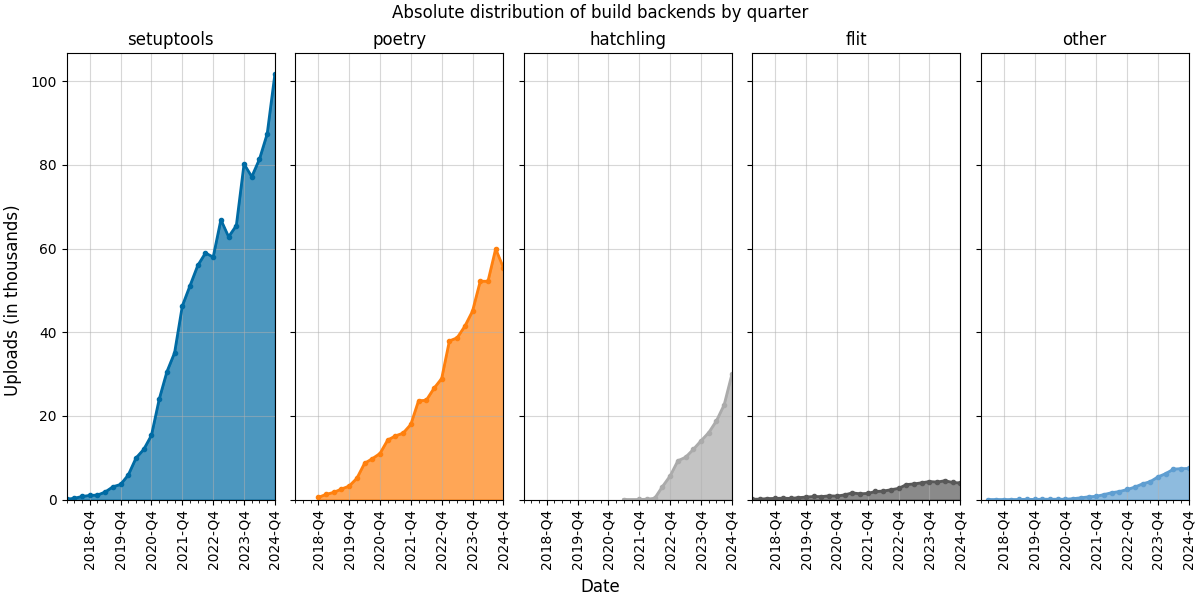
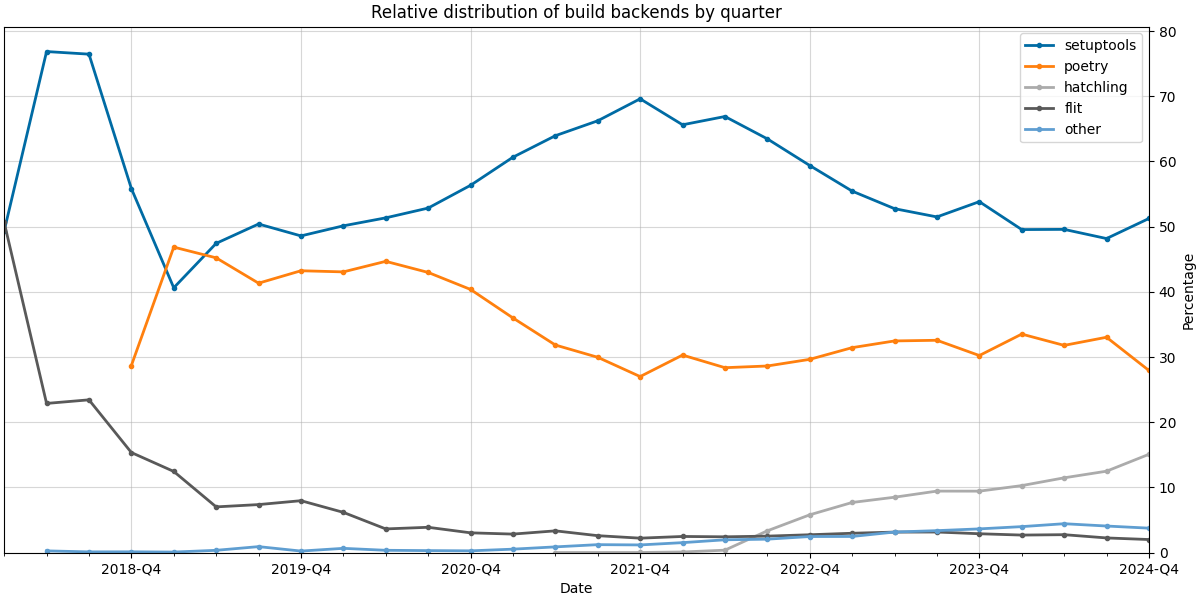
Last year, I analyzed the popularity of build backends used in pyproject.toml files over time. This post is the update for 2024. Analysis Like last year, I m using Tom Forbes fantastic dataset containing information about every file within every release uploaded to PyPI. To get the current dataset, I followed the same process as in last year s analysis, so I won t repeat all the details here. Instead, I ll highlight the main steps: Downloading all the parquet files took roughly a week due to GitHub s rate limiting. Tom suggested leveraging the Git v2 protocol to fetch the data directly. This approach could bypass rate limiting and complete the download of all pyproject.toml files in just 20 minutes(!). However, I couldn t find sufficient documentation that would help me to implement this method, so this will have to wait until next year s analysis. Once all the data is downloaded, I perform some preprocessing: Results I modified the plots a bit from last year to make them easier to read. Most notably, I binned the data into quarters to make the plots less noisy, and secondly, I stopped stacking the relative distribution plots to make the percentages directly readable. The first plot shows the absolute number of uploads (in thousands) by quarter and build backend. Absolute distribution of build backends by quarter The second plot shows the relative distribution of build backends by quarter. Relative distribution of build backends by quarter In 2024, we observe that: The script for downloading and analyzing the data is available in my GitHub repository. If someone has insights or examples on implementing the Git v2 protocol to download the pyproject.toml file given the repository URL and its hash, I d love to hear from you!

24 November 2024

Edward Betts: A mini adventure at MiniDebConf Toulouse

A mini adventure at MiniDebConf Toulouse Last week, I ventured to Toulouse, for a delightful mix of coding, conversation, and crepes at MiniDebConf Toulouse, part of the broader Capitole du Libre conference, akin to the more well-known FOSDEM but with a distinctly French flair. This was my fourth and final MiniDebConf of the year. no jet bridge My trek to Toulouse was seamless. I hopped on a bus from my home in Bristol to the airport, then took a short flight. I luxuriated in seat 1A, making me the first to disembark a mere ten minutes later, I was already on the bus heading to my hotel.

Exploring the Pink City pink img 29 duck shop Once settled, I wasted no time exploring the charms of Toulouse. Just a short stroll from my hotel, I found myself beside a tranquil canal, its waters mirroring the golden hues of the trees lining its banks. Autumn in Toulouse painted the city in warm oranges and reds, creating a picturesque backdrop that was a joy to wander through. Every corner of the street revealed more of the city's rich cultural tapestry and striking architecture. Known affectionately as 'La Ville Rose' (The Pink City) for its unique terracotta brickwork, Toulouse captivated me with its blend of historical allure and vibrant modern life.

MiniDebCamp FabLab sign laptop setup Prior to the main event, the MiniDebCamp provided two days of hacking at Artilect FabLab a space as creative as it was welcoming. It was a pleasure to reconnect with familiar faces and forge new friendships.
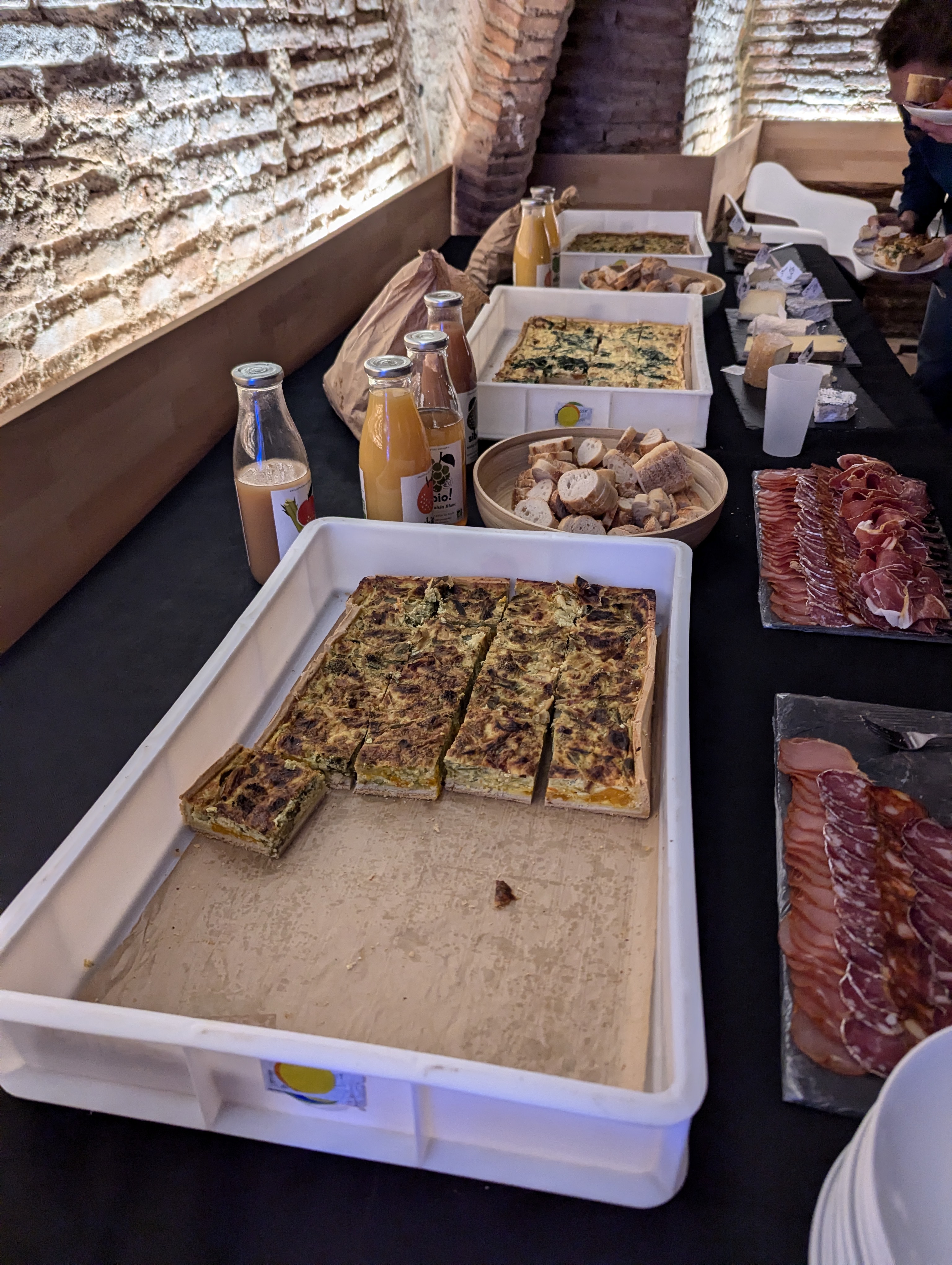
Culinary delights lunch 1 img 14 img 15 img 16 img 17 cakes The hospitality was exceptional. Our lunches boasted a delicious array of quiches, an enticing charcuterie board, and a superb selection of cheeses, all perfectly complemented by exquisite petite fours. Each item was not only a feast for the eyes but also a delight for the palate.
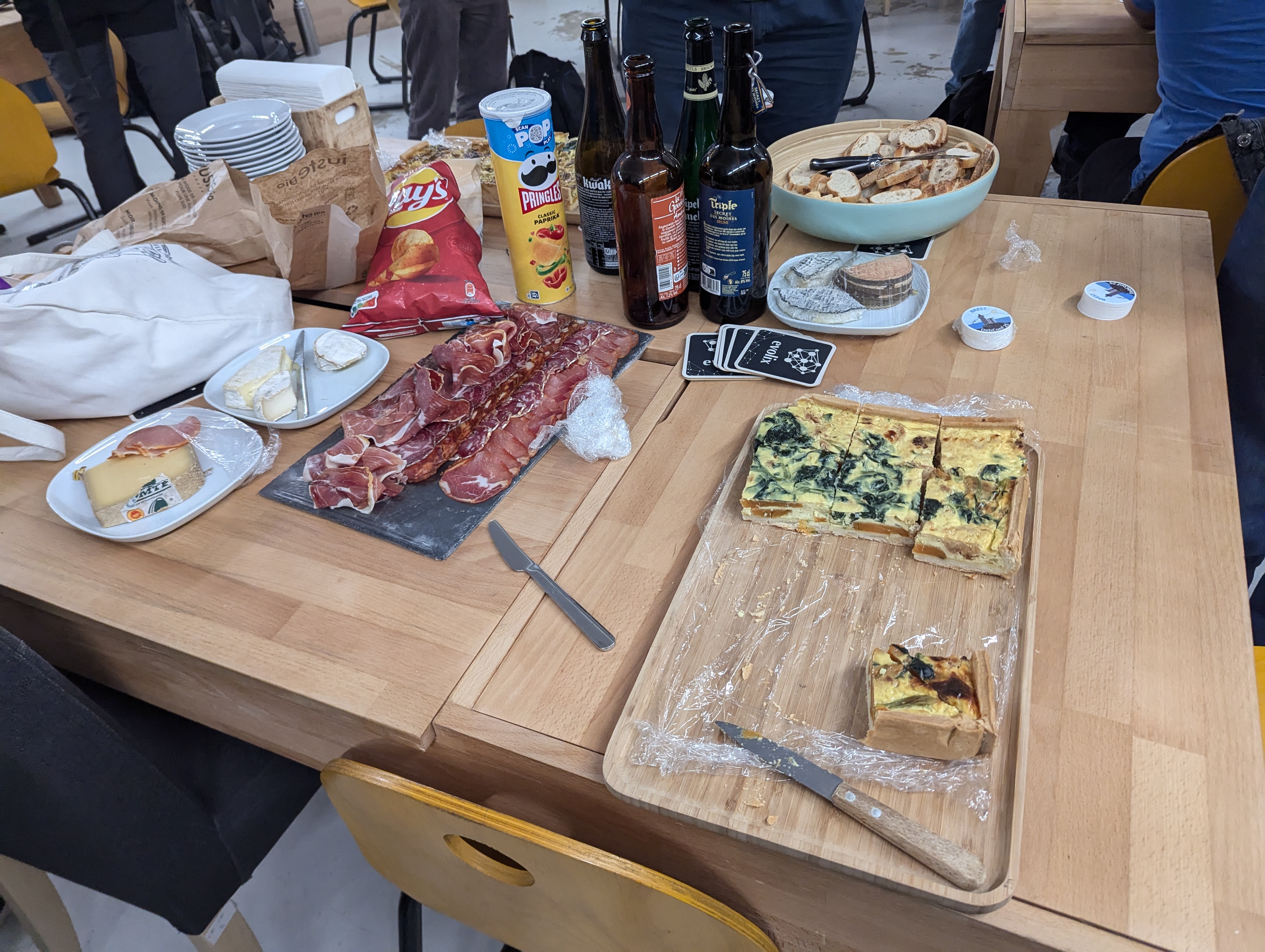
Wine and cheese wine and cheese 1 wine and cheese 2 Leftovers from these gourmet feasts fuelled our impromptu cheese and wine party on Thursday evening a highlight where informal chats blended seamlessly with serious software discussions.


The river at night night river 1 night river 2 night river 3 night river 4 The enchantment of Toulouse doesn't dim with the setting sun; instead, it transforms. My evening strolls took me along the banks of the Garonne, under a sky just turning from twilight to velvet blue. The river, a dark mirror, perfectly reflected the illuminated grandeur of the city's architecture. Notably, the dome of the H pital de La Grave stood out, bathed in a warm glow against the night sky. This architectural gem, coupled with the soft lights of the bridge and the serene river, created a breathtaking scene that was both tranquil and awe-inspiring.

Capitole du Libre making crepes The MiniDebConf itself, part of the larger Capitole du Libre event, was a fantastic immersion into the world of free software. Unlike the ticket-free FOSDEM, this conference required QR codes for entry and even had bag searches, adding an unusual layer of security for a software conference. Highlights included the crepe-making by the organisers, reminiscent of street food scenes from larger festivals. The availability of crepes for MiniDebConf attendees and the presence of food trucks added a festive air, albeit with the inevitable long queues familiar to any festival-goer.

v l Toulouse bike cyclocity The city's bike rental system was a boon easy to use with handy bike baskets perfect for casual city touring. I chose pedal power over electric, finding it a pleasant way to navigate the streets and absorb the city's vibrant atmosphere.

Markets market flatbreads Toulouse's markets were a delightful discovery. From a spontaneous visit to a market near my hotel upon arrival, to cycling past bustling marketplaces, each day presented new local flavours and crafts to explore. The Za'atar flatbread from a Syrian stall was a particularly memorable lunch pick.

La brasserie Les Arcades img 25 img 26 img 27 Our conference wrapped up with a spontaneous gathering at La Brasserie Les Arcades in Place du Capitole. Finding a caf that could accommodate 30 of us on a Sunday evening without a booking felt like striking gold. What began with coffee and ice cream smoothly transitioned into dinner, where I enjoyed a delicious braised duck leg with green peppercorn sauce. This meal rounded off the trip with lively conversations and shared experiences.

The journey back home img 30 img 31 img 32 img 33 Returning from Toulouse, I found myself once again in seat 1A, offering the advantage of being the first off the plane, both on departure and arrival. My flight touched down in Bristol ahead of schedule, and within ten minutes, I was on the A1 bus, making my way back into the heart of Bristol.

Anticipating DebConf 25 in Brittany My trip to Toulouse for MiniDebConf was yet another fulfilling experience; the city was delightful, and the talks were insightful. While I frequently travel, these journeys are more about continuous learning and networking than escape. The food in Toulouse was particularly impressive, a highlight I've come to expect and relish on my trips to France. Looking ahead, I'm eagerly anticipating DebConf in Brest next year, especially the opportunity to indulge once more in the excellent French cuisine and beverages.

7 September 2024

Paul Wise: FLOSS Activities August 2024

Focus This month I didn't have any particular focus. I just worked on issues in my info bubble.

Changes

Issues
  • Regressions in adequate (1 2 3 4)

Review
  • Debian publicity: reviewed Debian birthday post

Administration
  • Debian servers: contributed to a review of current Debian Partners

Communication
  • Respond to queries from Debian users and contributors on IRC

Sponsors All work was done on a volunteer basis.

6 June 2024

Paul Wise: FLOSS Activities May 2024

Focus This month I didn't have any particular focus. I just worked on issues in my info bubble.

Changes

Issues

Review
  • Debian BTS usertags: changes for the month

Administration
  • Debian wiki: approve accounts

Communication
  • Respond to queries from Debian users and contributors on the mailing lists and IRC

Sponsors All work was done on a volunteer basis.

27 May 2024

Thomas Koch: Rebuild search with trust

Posted on January 20, 2024
Finally there is a thing people can agree on: Apparently, Google Search is not good anymore. And I m not the only one thinking about decentralization to fix it: Honey I federated the search engine - finding stuff online post-big tech - a lightning talk at the recent chaos communication congress The speaker however did not mention, that there have already been many attempts at building distributed search engines. So why do I think that such an attempt could finally succeed? My definition of success is:
A mildly technical computer user (able to install software) has access to a search engine that provides them with superior search results compared to Google for at least a few predefined areas of interest.
The exact algorithm used by Google Search to rank websites is a secret even to most Googlers. Still it is clear, that it relies heavily on big data: billions of queries, a comprehensive web index and user behaviour data. - All this is not available to us. A distributed search engine however can instead rely on user input. Every admin of one node seeds the node ranking with their personal selection of trusted sites. They connect their node with nodes of people they trust. This results in a web of (transitive) trust much like pgp. For comparison, imagine you are searching for something in a world without computers: You ask the people around you. They probably forward your question to their peers. I already had a look at YaCy. It is active, somewhat usable and has a friendly maintainer. Unfortunately I consider the codebase to show its age. It takes a lot of time for a newcomer to find their way around and it contains a lot of cruft. Nevertheless, YaCy is a good example that a decentralized search software can be done even by a small team or just one person. I myself started working on a software in Haskell and keep my notes here: Populus:DezInV. Since I m learning Haskell along the way, there is nothing there to see yet. Additionally I took a yak shaving break to learn nix. By the way: DuckDuckGo is not the alternative. And while I would encourage you to also try Yandex for a second opinion, I don t consider this a solution.

25 March 2024

Jonathan Dowland: a bug a day

I recently became a maintainer of/committer to IkiWiki, the software that powers my site. I also took over maintenance of the Debian package. Last week I cut a new upstream point release, 3.20200202.4, and a corresponding Debian package upload, consisting only of a handful of low-hanging-fruit patches from other people, largely to exercise both processes. I've been discussing IkiWiki's maintenance situation with some other users for a couple of years now. I've also weighed up the pros and cons of moving to a different static-site-generator (a term that describes what IkiWiki is, but was actually coined more recently). It turns out IkiWiki is exceptionally flexible and powerful: I estimate the cost of moving to something modern(er) and fashionable such as Jekyll, Hugo or Hakyll as unreasonably high, in part because they are surprisingly rigid and inflexible in some key places. Like most mature software, IkiWiki has a bug backlog. Over the past couple of weeks, as a sort-of "palate cleanser" around work pieces, I've tried to triage one IkiWiki bug per day: either upstream or in the Debian Bug Tracker. This is a really lightweight task: it can be as simple as "find a bug reported in Debian, copy it upstream, tag it upstream, mark it forwarded; perhaps taking 5-10 minutes. Often I'll stumble across something that has already been fixed but not recorded as such as I go. Despite this minimal level of work, I'm quite satisfied with the cumulative progress. It's notable to me how much my perspective has shifted by becoming a maintainer: I'm considering everything through a different lens to that of being just one user. Eventually I will put some time aside to scratch some of my own itches (html5 by default; support dark mode; duckduckgo plugin; use the details tag...) but for now this minimal exercise is of broader use.

Next.