Search Results: "daniel"

22 November 2026

Daniel Baumann: Debian: Modernizing iperf/iperf3 and introducing fireperf

Recently I spend some time on modernizing the packaging of the Internet Protocol bandwidth measuring tools iperf and iperf3 in Debian, as well as uploading fireperf to Debian.
Modernizing iperf

TL;DR: If you want to run your own iperf server,
run sudo apt install -yU iperf-server and you re done

Previously, src:iperf only built iperf. If you wanted to run an iperf server, you had to do it on your own, i.e. there was no systemd service for that. Apart from tidying the Debian package, src:iperf now builds the new iperf-client and iperf-server packages, the latter contains the systemd and ufw integration. iperf-server runs with a dynamic systemd user and systemd service hardening. The iperf package is now a transitional package, that also cleans up any leftovers from before the package split into iperf-client and iperf-server (e.g. when upgrading from trixie to forky). For historical reasons, iperf2 is packaged in debian as iperf, not iperf2. Now the iperf packages have provides for iperf2, iperf2-client, and iperf2-server respectively (so they can be installed by these names too). Updated iperf packages are available in sid, and backports for trixie are available at Debian Fast Forward. It might make sense in the future
  • given that iperf2 and iperf3 are completely different tools with different advantages and disadvantages depending on the use-case
  • therefore the one is not replacing the other (iperf2 in general is the better tool than iperf3, eventhough the common misconception is that iperf3 is supposedly better than iperf2 because the number 3 is greater than the number 2)
to maybe rename iperf to iperf2 to match both upstream naming and also to harmonize the packaging of iperf2 with other distributions.
Modernizing iperf3

TL;DR: If you want to run your own iperf3 server,
run sudo apt install -yU iperf3-server and you re done

Previously, src:iperf3 only built iperf3. If you wanted to run an iperf3 server, iperf3 had a debconf yes/no question which would then start one iperf3 server on the default port 5201. Apart from tidying the Debian package, src:iperf3 now builds the new iperf3-client and iperf3-server packages, the latter contains the systemd and ufw integration. iperf3-server runs with a dynamic systemd user instead of the previous local system account, and has systemd service hardening. Since iperf3 (contrary to iperf, also see here and here for iperv vs. iperf3) does not allow using multiple connections on the same port, you have to run multiple iperf3 servers, each on their own port, in order to serve more than one client at the time. The old debconf question for enabling a single iperf3 server has been removed as well as the obsolete sysvinit integration. In order to allow running multiple iperf3 servers at the same time (but on different ports), iperf3-server now contains a systemd service template so you can enable multiple iperf3 servers (e.g. 3 servers on subsequent port numbers, but you can run as many as you want on any ports you like) either manually with:

sudo systemctl enable --now iperf3-server@5201
sudo systemctl enable --now iperf3-server@5202
sudo systemctl enable --now iperf3-server@5203

or by using debconf interactively to do it automatically for you (which defaults to one instance on port 5201):

sudo dpkg-reconfigure -p low iperf3-server

or by using debconf non-interactively to do it automatically for you:

TMPFILE="$(mktemp)"
echo "iperf3 iperf3-server ports string 5201 5202 5203" > $ TMPFILE
cat "$ TMPFILE " sudo debconf-set-selections
dpkg-reconfigure -fnoninteractive -pcritical iperf3-server
rm -f "$ TMPFILE "

The iperf3 package is now a transitional package, that also cleans up any leftovers from before the package split into iperf3-client and iperf3-server. Updated iperf3 packages are available in sid, and backports for trixie are available at Debian Fast Forward.
Introducing fireperf

TL;DR: If you want a nicer iperf/iperf3 client,
run sudo apt install -yU fireperf-client

TL;DR: If you want to run your own fireperf server,
run sudo apt install -yU fireperf-server
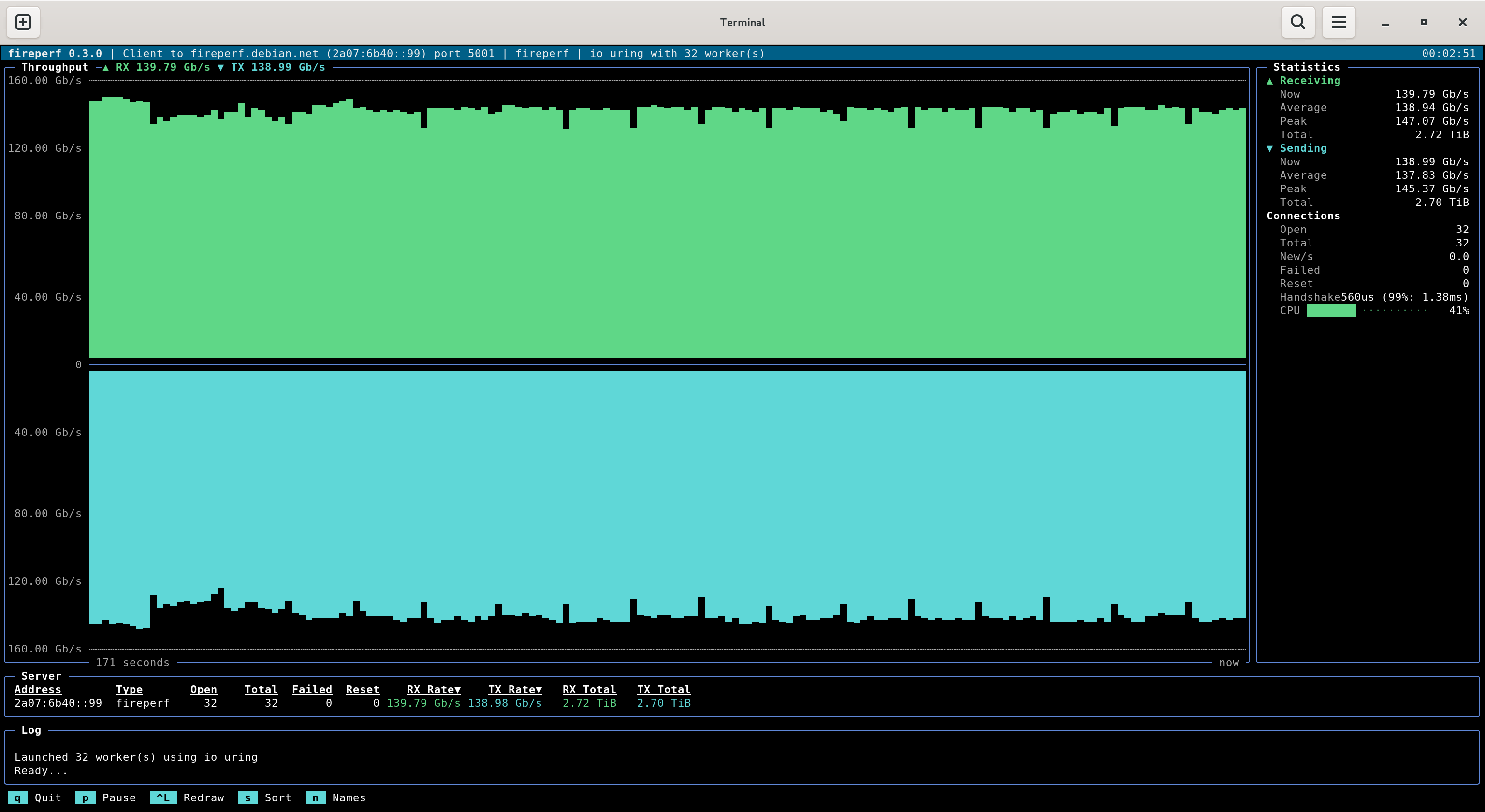
Introducing fireperf Image: fireperf interactive terminal interface
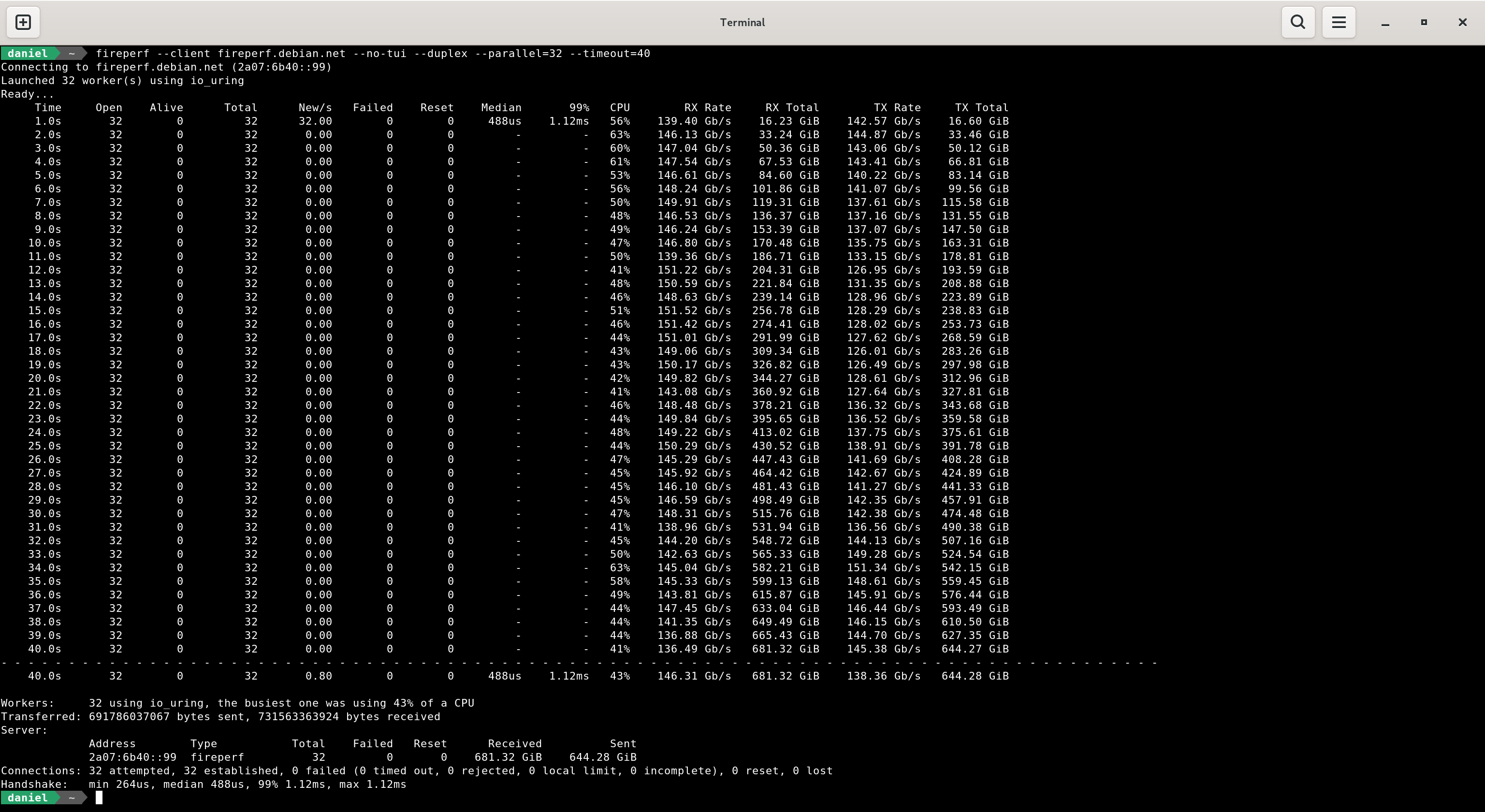
Introducing fireperf Image: fireperf non-interactive terminal interface
fireperf is a modern take on the iperf3 network performance and stress-testing tool under the IPFire project umbrella:
  • measures upload or download individually, or concurrent upload and download
  • allows to serve many clients in parallel (on the same port)
  • allows to use many workers in parallel (for maxing out bandwith of servers with LACP instead of ECMP)
  • allows to use and track many connection sessions in parallel (for maxing out firewalls)
  • can also be used as a client for both iperf and iperf3 (autodetecting the target)
  • can also be used as a iperf3 server
  • can output results in JSON
  • has a live graph (ncurses)
  • uses less CPU ressources on both the client and the server (io_uring, zerocopy, )
fireperf packages are in sid, and backports for trixie are available at Debian Fast Forward. Happy bandwidth measuring!

16 October 2026

Dirk Eddelbuettel: RcppSimdJson 0.1.17 on CRAN: Updates

A brand new release 0.1.17 of the RcppSimdJson package is now on CRAN, and has been built for r2u and on r-universe. RcppSimdJson wraps the fantastic and genuinely impressive simdjson library by Daniel Lemire and collaborators. Via very clever algorithmic engineering to obtain largely branch-free code, coupled with modern C++ and newer compiler instructions, it results in parsing gigabytes of JSON parsed per second which is quite mindboggling. The best-case performance is faster than CPU speed as use of parallel SIMD instructions and careful branch avoidance can lead to less than one cpu cycle per byte parsed; see the video of the talk by Daniel Lemire at QCon. This release is a small increment relative to the 0.1.6 release last week that got us (upstream) version 5.0.2 with many notable changes and sizeable speed gains on all fronts, including the interface from R. However, this failed to compile at CRAN on macOS x86_64 as the machine is setup for only partial support of C++20: no ranges, no concepts. So we now test, and fall back to C++17 if the test compilation fails. Upstream, meanwhile, already got to 5.0.5 which is included. It also gets us improved handling of disabling pragmas which we hope will survive CRAN checks. The brief NEWS entry for this release follows.

Changes in version 0.1.17 [unreleased] (2026-10-xx)
  • Compilation starts with a C++20 feature test; if this fails C++17 is used (Dirk in #111 fixing #110)
  • simdjson was upgraded to version 5.0.5 (Daniel in #112)

Courtesy of my CRANberries, there is also a diffstat report for this release. For questions, suggestions, or issues please use the issue tracker at the GitHub repo.

This post by Dirk Eddelbuettel originated on his Thinking inside the box blog. If you like this or other open-source work I do, you can now sponsor me at GitHub.

Freexian Collaborators: Monthly report about Debian Long Term Support, September 2026 (by Santiago Ruano Rinc n)

The Debian LTS Team, funded by Freexian s Debian LTS offering, is pleased to report its activities for September.

Activity summary During the month of September, 20 contributors have been paid to work on Debian LTS (links to individual contributor reports are located below). The team released 41 DLAs fixing 1854 CVEs. In September, the Debian LTS Team was back to focusing on a single release: Debian 12 ( bookworm ). Debian 11 ( bullseye ) reached the end of its Long Term Support on 31 August 2026, and Freexian now provides its security maintenance under the Extended LTS offer. It is important to highlight the hard work done behind the scenes of the Front Desk fellows, whose role was fulfilled during September by Emilio, Emmanuel, Sylvain, Thorsten and Utkarsh. Besides the very high activity doing daily triage on dozens of packages and CVEs, Front Desk fellows spent much of their time answering questions and coordinating with people outside the Freexian team about update proposals. The team published several notable updates:
  • jbig2dec (DLA-4779-1), prepared by Andreas Henriksson, fixes CVE-2026-38076, where missing input checks could lead to a denial of service. It is to note that this library is used by different tools, such as ghostscript.
  • linux-6.12 (DLA-4788-1), uploaded by Ben Hutchings, fixing 414 CVEs in the bookworm backport of Linux kernel version 6.12.
  • lxml (DLA-4799-1), prepared by Guilhem Moulin, fixes four vulnerabilities in this widely used python XML/HTML library. The issues may yield to exposing local files.
  • nginx (DLA-4784-1), issued by Carlos Henrique Lima Melara ( charles ), fixing three memory-safety bugs in this popular web server and reverse proxy, which may result in denial of service, memory disclosure or potentially the execution of arbitrary code.
  • openssl (DLA-4795-1), by Arnaud Rebillout, fixing six vulnerabilities, including an out-of-bounds heap write in CMS decryption and an authentication tag verification bypass in ChaCha20-Poly1305/AES-OCB decryption. This update brings bookworm to OpenSSL 3.0.22, the last upstream release of the 3.0 series, which was reached its upstream EOL on 7 Sep 2026. Further fixes will be backported by the Debian LTS Team from more recent releases.
  • redis DLA-4794-1, by Chris Lamb, fixing vulnerabilities that could yield to arbitrary code execution
Contributions from other Debian fellows beyond the Freexian LTS Team:
  • Thomas Goirand, Keystone released by Emilio as DLA-4767-1
  • Thomas also prepared glance and swift updates, whose respective DLA-4800-1 and DLA-4801-1 were issued by Charles
  • Matthew Vernon uploaded a pcre2 security update, and Emilio issued its DLA-4772-1
  • Otto Kek l inen uploaded a xz-utils update, released as DLA-4783-1 by Sylvain
  • Salvatore Bonaccorso published a linux (6.1) update released as DLA-4777-1
  • Xavier Guimard prepared a lemonldap-ng, released as DLA-4797-1. Additionally, Sylvain sent DLA-4734-1 at the beginning of the month for the upload made on August.
  • Xavier also released DLA-4766-1 for cyrus-imapd.
  • Simon Quigley uploaded DLA-4803-1 to fix multiple issues in ruby-oj.
  • Finally, Ivo Marino proposed bookworm updates for cjose, git-lfs, caddy, libgit2, libwebsockets, libssh and unbound. Some of Ivo s proposals are still pending for a review.
Thank you so much to the developers above for these valuable contributions. The LTS Team has also contributed with updates to the latest Debian releases for the following packages:
  • ruby-jwt, prepared by Abhijith and released as DSA-6547-1
  • urwid, proposed for a point-release update by Abhijith (#1148950)
  • puma, proposed for a point-release update by Abhijith (#1149582)
  • tomcat10, and tomcat9 (which is actually backported to released suites) by Bastien
  • nodejs, prepared by Bastien and released as (DSA-6517-1).
If you benefit from Debian, especially throughout its full 5-year lifecycle, please consider becoming a sponsor of Debian LTS. You can find more information here: https://www.freexian.com/lts/debian/.

Individual Debian LTS contributor reports

Thanks to our sponsors Sponsors that joined recently are in bold.

15 October 2026

Matthew Garrett: Epic's EAC2 v2 seems fairly easily bypassable

Epic just announced the upcoming version 2 of their Linux implementation of Easy Anti-Cheat. It s based on using the Linux eBPF security module to monitor what s happening, and then a bunch of extra infrastructure to make sure this can t be bypassed. The core part of this is requiring secure boot be enabled (ensuring that modified kernels can t be used), using measured boot to verify that secure boot is enabled and which keys are used (to prevent you from just signing your own modified kernel), and then doing remote attestation, a mechanism where the TPM generates a signed copy of the boot measurements and passes that off to a server which verifies it came from a real TPM, verifies that you have secure boot enabled and are using the right keys, and presumably then allows you into the game. This is all fine as long as you can prove that the measurements provided are real, and that s actually a lot harder than you might think. First, we can simply make up our own quote signed with our own key and say that it came from a TPM. This is avoided by every TPM having an Endorsement Key (or EK) and an associated certificate, with that certificate being signed by the TPM vendor. If you have a list of all the legitimate TPM vendors and their CA keys, you can verify that the measurements came from a real TPM. Easy enough. So we need to get the measurements from a real TPM, and the one on our motherboard contains the measurements that were generated by the firmware and bootloader, and we can t reset those at runtime without resetting the TPM, which oh huh there s actually nothing stopping us from doing that at runtime, as long as we have access to the hardware. Many desktop boards have the TPM on a small plugin module with a standard pinout that includes a reset pin. Simply short that to ground briefly and the TPM is back in its initial state, and userland can write whatever measurements it wants to it. Boot a modified kernel which lies to the eBPF code? As long as you replay the expected log values from a boot with secure boot on and a trusted kernel, the TPM will still happily provide a legitimate set of measurements that ll satisfy the checker. What if the TPM is less accessible, either because it s mounted directly to the motherboard or it s inside the CPU or chipset? That s going to be trickier. But here s the thing. The quote needs to come from a TPM, but not necessarily the TPM on your motherboard. TPMs these days are usually connected via the Serial Peripheral Interface, usually referred to as SPI. Microchip make a USB to SPI bridge, and there s a Linux driver. Wire one of those up with an appropriate header and you can plug in an easily available TPM module intended for plugging into a motherboard, and now we tell the kernel to ignore the motherboard TPM and make /dev/tpmrm0 point at the USB one and program it with a set of trusted measurements and once again everything is going to look just fine (yes obviously the eBPF code can look for this, but we re running a modified kernel so we can just lie to the eBPF code). Remote attestation on PCs just doesn t work that well in environments where you can t associate a specific TPM with a specific system, which is basically everywhere except enterprises. But maybe that doesn t matter and cheaters wouldn t be willing to spend the $20 or so it d take to produce one of these things? That would seem somewhat surprising, but it s not impossible. And obviously any server-side cheat detection that triggers could then block that specific TPM, meaning they d need to go and get another TPM, and maybe that ends up being enough to discourage people from bothering. From a practical level, this may be sufficient. But at a technical level? It s not great.

9 October 2026

Dirk Eddelbuettel: RcppSimdJson 0.1.16 on CRAN: Much Faster Again!

A brand new release 0.1.16 of the RcppSimdJson package is now on CRAN, has been built for r2u, and is updated on r-universe. RcppSimdJson wraps the fantastic and genuinely impressive simdjson library by Daniel Lemire and collaborators. Via very clever algorithmic engineering to obtain largely branch-free code, coupled with modern C++ and newer compiler instructions, it results in parsing gigabytes of JSON parsed per second which is quite mindboggling. The best-case performance is faster than CPU speed as use of parallel SIMD instructions and careful branch avoidance can lead to less than one cpu cycle per byte parsed; see the video of the talk by Daniel Lemire at QCon. This version updates to the recent 5.0.2 upstream release with improved performance. Given the strong focus on performance, this release also alters some of the R and C++ interfaces to be more direct. Rcpp generally aims for a balance between readable / maintainable code and good performance; this moves the dial closer to strong performance gains. As Daniel noted in a table in the (main) PR for this release, this now consistently beats yyjsonr, and improves considerably over the previous release of this package. I had made some smaller interim upgrades earlier (without a CRAN releases), and made a number of minor standard packaging updates. The short NEWS entry for this release follows.

Changes in version 0.1.16 (2026-10-09)
  • simdjson was upgraded to versions 4.6.1 and 4.6.3 (Dirk in #100 and #102 fixing #99 and #101)
  • simdjson was upgraded to version 5.0.2 (Daniel in #104)
  • A number of small tweaks to the Rcpp interface were made too (Daniel in #104)
  • Diagnostics for gcc and clang are not suppressed per CRAN Policy (Dirk in #106 closing #105)
  • The continuous integration matrix was extended to g++ version 15 and 16 (Dirk in #108 closing #107)
  • A few minor packaging nags were address (Dirk in #109)

Courtesy of my CRANberries, there is also a diffstat report for this release. For questions, suggestions, or issues please use the issue tracker at the GitHub repo.

This post by Dirk Eddelbuettel originated on his Thinking inside the box blog. If you like this or other open-source work I do, you can now sponsor me at GitHub.

30 September 2026

Dirk Eddelbuettel: RcppFastFloat 0.0.6 on CRAN: New Upstream

A new release of RcppFastFloat just arrived on CRAN, and has been built for r2u. The package wraps fast_float, another nice library by Daniel Lemire. For details, see the arXiv preprint or published paper showing that one can convert character representations of numbers into floating point at rates at or exceeding one gigabyte per second. This release updates the underlying fast_float library version to the current version 8.3.0, and also updates a number of the standard packaging details.

Changes in version 0.0.6 (2026-09-29)
  • Update to upstream release 8.3.0 (Daniel Lemire in #6)
  • Standard package maintenace adding README badge, updating URL, updating continuous integration, and adding an aspell dictionary
  • Completed help page for as_double example with @return tag

Courtesy of my CRANberries, there is also a diffstat report for this release. For questions, suggestions, or issues please use the issue tracker at the GitHub repo.

This post by Dirk Eddelbuettel originated on his Thinking inside the box blog. If you like this or other open-source work I do, you can now sponsor me at GitHub.

20 September 2026

Freexian Collaborators: Monthly report about Debian Long Term Support, August 2026 (by Thorsten Alteholz)

The Debian LTS Team, funded by Freexian s Debian LTS offering, is pleased to report its activities for August.

Activity summary During the month of August, 19 contributors have been paid to work on Debian LTS (links to individual contributor reports are located below). The team released 58 DLAs fixing 1885 CVEs. Debian 11 ( bullseye ), which has reached the end of its Long Term Support on 31 August 2026, will now get security support from Freexian under the Extended LTS offer. The team published several notable updates:
  • chromium (DLA 4710-1), uploaded by Emilio, to fix 375 security flaws in bookworm, including issues that could lead to arbitrary code execution. Further DLA 4728-1, uploaded by Emilio as well, fixed additional 41 security issues in bookworm and DLA 4739-1 fixed 5 issues. Last but not least, DLA 4749-1 fixed another 15 issues and DLA 4758-1 fixed another 7 issues.
  • ruby2.7 (DLA 4716-1), uploaded by Abhijith, to fix four security flaws in bookworm, including issues that could lead to arbitrary code execution.
  • several DLAs (DLA 4717-1, DLA 4720-1, DLA 4723-1, DLA 4724-1, DLA 4745-1) have been uploaded by Ben and Emilio to fix myriad security flaws in different versions of the linux kernel (5.10.262-1, 6.1.180-1, 6.12.100-1~deb12u1, 6.12.101-1~deb12u1) in bullseye and bookworm.
  • 7zip (DLA 4718-1) and p7zip (DLA 4719-1), uploaded by Sylvain, to fix multiple security flaws in bookworm and bullseye, including issues that could yield to remote code execution.
  • ca-certificates (DLA 4726-1), uploaded by Bastien to add some new trusted certificates to bookworm and bullseye, but also remove some untrusted ones.
  • thunderbird (DLA 4727-1 and DLA 4754-1), uploaded by Emilio to fix 35 and 31 issues in bookworm and bullseye.
  • nss (DLA 4729-1), uploaded by Jochen to fix a vulnerability in bookworm and bullseye that could yield to arbitrary code execution.
  • libgd2 (DLA 4731-1), uploaded by Guilhem to fix a vulnerability in bookworm and bullseye that could yield to arbitrary code execution if a malformed GIF file is processed.
  • xorg-server (DLA 4737-1 and DLA 4738-1), uploaded by Arnaud to fix several vulnerabilities in bookworm and bullseye.
  • postgresql-15 (DLA 4740-1), uploaded by Carlos Henrique Lima Melara to fix 26 vulnerabilities in bookworm.
  • unzip (DLA 4741-1), uploaded by Andrej to fix a vulnerability in bookworm and bullseye that could yield to arbitrary code execution.
  • firefox-esr (DLA 4750-1), uploaded by Emilio to fix 31 vulnerabilities in bookworm and bullseye that could potentially result in arbitrary code execution, privilege escalation or information disclosure.
  • nvidia-graphics-drivers (DLA 4752-1 and DLA 4753-1), uploaded by Tobias to fix lots of vulnerabilities in bookworm and bullseye.
  • roundcube (DLA 4760-1), uploaded by Guilhem to fix ten vulnerabilities in bookworm and bullseye that could potentially result in remote code execution or information disclosure.
Contributions from outside the LTS Team: We are greatly thankful for the contributions from people outside the LTS Team:
  • Salvatore Bonaccorso released a libyaml-syck-perl security update (DLA 4730-1), to fix a denial of service and potentially arbitrary code execution.
  • Thomas Goirand released a neutron security update (DLA 4735-1).
  • Thomas Goirand released an ironic security update (DLA 4743-1).
  • Thomas Goirand released a designate security update (DLA 4751-1), to fix a denial of service or DNS hijacking.
The LTS Team has also contributed with updates to the latest Debian releases:
  • xrdp (DSA 6469-1), prepared by Abhijith to address privilege escalation and arbitrary code execution related flaws.
Other contributions: Besides the work on security updates, different documentation and tooling changes were needed. This work was mainly done by Sylvain.

Individual Debian LTS contributor reports

Thanks to our sponsors Sponsors that joined recently are in bold.

7 September 2026

Daniel Lange: Getting AVIF thumbnails in XFCE4 thunar (Debian Trixie)

The AVIF image format gets more and more popular in the web dev community, so I needed to teach XFCE4's thunar (file manager) and Ristretto (image viewer) to thumbnail these. Luckily that is not too hard: Debian Trixie separates its gdk-pixbuf libraries slightly differently than previous versions. That's why it is not "automatically there". Ensure you have the libavif-gdk-pixbuf plugin and the tumbler service (which XFCE uses to process thumbnails):
sudo apt --update install libavif-gdk-pixbuf tumbler
Thunar has likely tried (and failed) to load your AVIF files before you installed the package, it will have saved a blank or "broken image" placeholder in a thumbnail cache directory. It will not attempt to regenerate them unless you clear this cache:
# Clear the thumbnail cache
rm -rf ~/.cache/thumbnails/*

# Force-quit thunar and the tumblerd background service
thunar -q
pkill tumblerd
Tumbled will restart on its own when it is needed. When you open thunar again and navigate to your image directory ... your AVIF images will now generate thumbnails automatically like the other image format did already. Avif thumbnails in thunar

Vincent Bernat: Sidenotes with CSS anchor positioning

I am a heavy user of sidenotes:1 they keep optional content next to the text instead of sending the reader to the bottom of the page and back. Tufte CSS renders them without JavaScript but only accepts inline content. CSS anchor positioning, now supported by recent browsers,2 is an elegant alternative. Sidenotes can hold several blocks, still without JavaScript, and fall back below the paragraph referencing them on narrow viewports and older browsers. In 2023, Eric Meyer demonstrated this technique in Nuclear Anchored Sidenotes. The main improvement over other solutions is that the notes can sit anywhere in the HTML document. You can place them after the paragraph referencing them, as regular block elements for text browsers, screen readers, feed readers, and reader mode to render them properly:
Sidenotes rendered in Lynx appear after the paragraph they are called from.
Rendering in Lynx, a text browser
When the viewport is too narrow or the browser does not support CSS anchor positioning, you can style them so the reader can skip them or glance at them without losing their position in the text:
Sidenotes rendered on a narrow viewport appear with a distinctive typography after the paragraph they are called from.
Rendering below the paragraph on a narrow viewport
Once the viewport is large enough, they appear in the margin, at the same vertical position as the matching reference mark, unless they would collide with a previous sidenote, as in the example below:3
Sidenotes rendered on a large viewport appear in the margin. There are two of them. The first one is vertically aligned with the matching reference mark, while the second is rendered below as it would collide with the first otherwise.
Rendering in the margin on a large viewport
The gist of CSS anchoring is to position an element relative to another element the anchor. For the sidenotes, the anchor is the reference mark. I use the following markup, with a data attribute to specify the anchor name:
<sup id="fnref:YYY" data-anchor="--lf-sn-YYY">
  <a href="#sidenote-YYY">1</a>
</sup>
The matching note is an <aside> element carrying the same data attribute for the anchor name. We put it after the paragraph holding the reference mark:
<aside role="note" id="sidenote-YYY" data-anchor="--lf-sn-YYY">
  <sup>1</sup>
  <p>A first paragraph.</p>
  <p>A second paragraph.</p>
</aside>
On a narrow viewport or when the browser is too old for CSS anchoring, we style the sidenote, which stays below its paragraph, with a muted color:
aside[role="note"]  
  margin-block: 1rlh;
  color: #444;
 
On a wide viewport and when the browser is recent enough, we move the sidenote to the right margin:
@supports (anchor-name: attr(data-anchor type(<custom-ident>)))  
  @media (min-width: 72rem)  
    main  
      position: relative;
      sup[data-anchor]  
        anchor-name: attr(data-anchor type(<custom-ident>));
        /*   anchor-name: --lf-sn-YYY */
       
      aside[role="note"][data-anchor]  
        anchor-name: --lf-sidenote;
        position: absolute;
        position-anchor: attr(data-anchor type(<custom-ident>));
        /*   position-anchor: --lf-sn-YYY */
        top: max(anchor(top), anchor(--lf-sidenote bottom, -1rlh) + 1rlh);
        left: 100%;
        margin: 0 2rem;
        width: 18rem;
        color: inherit;


attr() extracts the anchor name for the reference mark from the data-anchor attribute. It returns a string, unless we specify a CSS unit or a type, like here: the browser parses the data attribute as a custom identifier, which anchor-name validates as a dashed identifier, a custom identifier starting with two dashes.4 The note itself is absolutely positioned past the right edge of the main block. It selects the matching reference mark as its anchor with position-anchor set to the value of the data-anchor attribute. Each note is also an anchor named --lf-sidenote. We use it to keep the next note from colliding with this one. The anchor() CSS function lets us position the note s top edge relative to its anchor: anchor(top) aligns the top edge of the note with the top edge of the reference mark. It can also take another anchor as a parameter: anchor(--lf-sidenote bottom) would align the top edge of the note with the bottom edge of the closest preceding anchor named --lf-sidenote so the previous note.5 Like attr(), anchor() accepts a fallback value as its second parameter and use it when the named anchor does not exist. The top property handles three cases, illustrated in the following diagram:
Diagram of three sidenotes anchored to their reference marks. The first one is aligned with the top of its own reference mark, as no note comes before it. The second one would overlap the first, so it takes the bottom of the first note as anchor and sits one line below it. The third one comes far enough down the page to align with its own reference mark again.
The three cases for the vertical position of a note
  1. The first note s top edge aligns with the top edge of its reference mark: as there is no previous note, anchor(--lf-sidenote bottom, -1rlh) + 1rlh resolves to 0 and max() returns anchor(top).
  2. When the reference mark of a later note sits above the bottom of the previous note, plus some vertical space, the note goes below the previous one to avoid a collision. max() returns anchor(--lf-sidenote bottom) + 1rlh.
  3. Otherwise, the note s top edge aligns with the reference mark s top edge, as max() returns anchor(top).

Have a look at the complete stylesheet, which also adapts the reference mark to the location of the note: a arrow when the note sits below the paragraph, a arrow when it moves to the margin. Gwern s Sidenotes In Web Design lists more implementations and their trade-offs. Some bloggers aim to write a post in 30 minutes. I planned to publish three web-related articles this weekend. Instead, I spent an inordinate amount of time elsewhere: about 15 commits on the build system, a pull request to update CSS highlighting for nested selectors in Pygments, and a small correction to MDN s article on the anchor() CSS function. The SVG illustration took a bit less than an hour and the article itself a handful of hours. The attr() function came in after I thought inline style looks ugly, isn t there a better way? But, hey, I still think this is worth it!

  1. My PhD advisor told me this is unwise.
  2. The first bits of anchor positioning are supported from Chrome 125 (May 2024), Firefox 147 (January 2026), and Safari 26 (September 2025). Before Safari 26.5, sidenotes may collide due to a bug in how dependency chains are handled. You can detect this situation with some JavaScript. It is, however, not needed in the solution described here as we depend on a more recent feature.
  3. If you noticed the runt in the first note, I share your pain and lament that Firefox does not implement text-wrap: pretty.
  4. Typed attr() is supported from Chrome 133 (February 2025), Firefox 155 (September 2026), and Safari 27 (September 2026). Check Una Kravets article for details. To support more browsers, you can inline the anchor name and the position anchor directly in the HTML:
    <sup id=" " style="anchor-name: --lf-sn- ">
      <a href="#sidenote- ">1</a>
    </sup>
    
    Managing Anchor Associations With Data Attributes and Advanced attr(), by Daniel Schwarz, explores CSS anchors and typed attr() in more detail.
  5. The exact rule for the target anchor element is more complex: if an ancestor of [the note] satisfies the following conditions, return the nearest such element to [the note]. Otherwise, return the last element in tree order that satisfies the conditions. One of these conditions is that [the candidate] is an acceptable anchor element for [the note], which requires that [the candidate] is laid out strictly before [the note], where the relevant clause is that [the candidate] is either not absolutely positioned or occurs earlier in the flat tree order than [the note].

24 August 2026

Freexian Collaborators: Monthly report about Debian Long Term Support, July 2026 (by Santiago Ruano Rinc n)

The Debian LTS Team, funded by Freexian s Debian LTS offering, is pleased to report its activities for July.

Activity summary During the month of July, 23 contributors have been paid to work on Debian LTS (links to individual contributor reports are located below). The team released 52 DLAs fixing 2159 CVEs. In July, the Debian Stable Release Managers published the last point release of Debian 12 ( bookworm ), after which the Debian LTS team took full responsibility of Debian 12. This completes the handover from the Security Team, that took place in June. This also marks the second month in a row where the Debian LTS has been focusing on two simultaneous Debian releases. Other than Debian 12, the team is maintaining Debian 11 ( bullseye ), which will reach the end of its Long Term Support on 31 August 2026. After that date, Freexian will continue the security support under the Extended LTS offer. The team published several notable updates:
  • jq (DLA 4662-1 and DLA 4661-1) prepared by Andreas Henriksson in collaboration with Jochen Sprickerhof, addressing multiple vulnerabilities.
  • Several updates for the different linux supported versions prepared by Ben Hutchings, in collaboration with Emilio Pozuelo Monfort. Other than the regular security advisories: DLA 4664-1, DLA 4665-1, DLA 4671-1, DLA 4688-1, and DLA 4700-1, Ben started preparing packages of 6.12 via bookworm-backports.
  • nginx (DLA 4667-1), updated for bookworm by Carlos Henrique Lima Melara, as a follow up of the bullseye update (DLA 4660-1), that was prepared in June.
  • grub2/bullseye (DLA 4685-1), prepared by Emilio. Other than addressing several security issues, this DLA was needed for being able to update the shim boot loader.
  • samba (DLA 4692-1), uploaded by Markus Koschany, to fix several security flaws in bullseye, including issues that could yield to remote code execution.
  • imagemagick (DLA 4680-1 and DLA 4696-1), prepared by Bastien Roucari s, addressing several issues that could lead to denial of service, information disclosure or potentially arbitrary code execution in some scenarios.
  • poppler (DLA 4709-1), by Guilhem Moulin, fixing several vulnerabilities.
  • nss (DLA-4694-1), by Jochen, fixing flaws that may result in or denial of service or potentially the execution of arbitrary code.
Contributions from outside the LTS Team: The LTS Team has also contributed with updates to the latest Debian releases:
  • Bastien also proposed two updates for imagemagick. The first one released as DSA 6383-1, and the second as a trixie point update proposal (#1142554).
  • python-httplib2 by Emmanuel Arias, and released by the security team as DSA 6441-1 in August.
  • hplip (DSA 6402-1), prepared by Thorsten Alteholz, to address privilege escalation and arbitrary code execution related flaws.
  • libnfs trixie update (#1142351), by Thorsten
  • patool update for trixie #1141607, by Abhijith PA
Other contributions: Besides the work on security updates, different documentation and tooling changes were needed, especially in the context of the Debian 12 handover. This work was mainly done by Sylvain Beucler.

Individual Debian LTS contributor reports

Thanks to our sponsors Sponsors that joined recently are in bold.

2 August 2026

Russell Coker: Packet Edit Meme and Debian SE Linux

There s yet another Linux kernel exploit based on container functions, here s the result when run as user_t on a SE Linux system:
$ ./packet_edit_meme 
[*] target /bin/su as uid 1000; entry at file offset 0x4340; shellcode 48 bytes
unshare: Permission denied
[-] page-cache corruption failed
Here is the audit log entry for this failure:
type=AVC msg=audit(1785640621.498:1843): avc:  denied    create   for  pid=1770 comm="packet_edit_mem" scontext=user_u:user_r:user_t:s0 tcontext=user_u:user_r:user_t:s0 tclass=user_namespace permissive=0
Here s the result of running it from the unconfined_t domain:
$ ./packet_edit_meme 
[*] target /bin/su as uid 1001; entry at file offset 0x4340; shellcode 48 bytes
[+] su entry overwritten; exec'ing su -> interactive root shell
# id
uid=0(root) gid=0(root) groups=0(root),1001(test2) context=unconfined_u:unconfined_r:unconfined_t:s0-s0:c0.c1023
# 
Daniel Baumann wrote a blog post describing how this is fixed for Debian systems without SE Linux.

22 July 2026

Freexian Collaborators: Monthly report about Debian Long Term Support, June 2026 (by Thorsten Alteholz)

The Debian LTS Team, funded by [Freexian s Debian LTS offering] (https://www.freexian.com/lts/debian/), is pleased to report its activities for June.

Activity summary During the month of June, 20 contributors have been paid to work on Debian LTS (links to individual contributor reports are located below). The team released 48 DLAs fixing 231 CVEs. Debian 12 ( bookworm ) has been handed over to the LTS Team on June 11th. During this handover Sylvain helped to update relevant tools and documentation. If you benefit from Debian, especially during the full 5-year lifecycle, please consider subscribing as a sponsor of Debian LTS: https://www.freexian.com/lts/debian/. Moreover, Debian 11 ( bullseye ) will reach the end of the Debian LTS period on August 31st. After that, Freexian will continue the security support under the Extended LTS offer. The team published several notable updates:
  • haveged update (DLA-4616-1), prepared by Thorsten, to address local privilege escalation.
  • tomcat9 update (DLA-4619-1), prepared by Markus, to address, among others, an authentication bypass.
  • apache2 update (DLA-4620-1), prepared by Bastien, to address a HTTP/2 bomb.
  • apache2 update (DLA-4629-1), prepared by Bastien, to address, among others, remote code execution and privilege escalation.
  • libinput update (DLA-4626-1), prepared by Santiago, to address local privilege escalation and arbitrary code execution.
  • asterisk update (DLA-4631-1), prepared by Thorsten, to address, among others, wrong processing of invalid or untrusted certificates.
  • nginx update (DLA-4634-1), prepared by Charles, to address a remote code execution and denial of service.
  • firefox-esr update (DLA-4635-1), prepared by Emilio, to address dozens of CVEs, among other things, related to arbitrary code execution and privilege escalation.
  • thunderbird update (DLA-4636-1), prepared by Emilio, to address dozens of CVEs, among other things, related to arbitrary code execution.
  • chromium update (DLA-4654-1), prepared by Emilio, to address dozens of CVEs, among other things, related to arbitrary code execution.
Contributions from outside the LTS Team: We are greatly thankful for the contributions from people outside the LTS Team:
  • Salvatore Bonaccorso prepared a libhttp-daemon-perl update, that was released by Santiago as DLA-4639-1.
  • Salvatore also directly uploaded libgd-perl DLA-4638-1 and libconfig-inifiles-perl DLA-4637-1.
  • Peter Palfrader prepared a tor update, that was released by Santiago as DLA-4656-1.
  • Pieter Lenaerts prepared a beets update, that was released by Emmanuel as DLA-4641-1.
  • Noah Meyerhans prepared a cloud-init update DLA-4645-1.
The LTS Team has also contributed with updates to the latest Debian releases:
  • Besides publishing DLA-4642-1 for package u-boot Andreas also prepared an NMU for an upload to sid and prepared a stable-proposed-update (SPU) bug for trixie, which was already acknowledged by a stable release manager (SRM).
  • Andreas also prepared an upload of package atril for trixie, which was handled by the security team as DSA-6349-1.
  • Besides publishing DLA-4620-1 for package apache Bastien also prepared an upload for trixie, which was handled by the security team as DSA-6323-1.
  • Tobi uploaded package mesa to trixie and bookworm.
  • Thorsten fixed some (not security related but RC) issues in package dahdi-linux. This was in preparation to fix lots of security issues in asterisk. Unfortunately the maintainer ignored the corresponding debdiff and prefered to upload a new upstream version. Anyway, the concerns of the security team about security support of asterisk could be overcome and asterisk can migrate to tesing and again be part of a Debian release.

Individual Debian LTS contributor reports

Thanks to our sponsors Sponsors that joined recently are in bold.

11 July 2026

Reproducible Builds: Reproducible Builds in June 2026

Welcome to the June 2026 report from the Reproducible Builds project! In these reports, we outline the most important things that we have been up to over the past month. As a quick recap about what problem our project intends to solve, whilst anyone may inspect the source code of free software for malicious flaws, almost all software is distributed to end users as pre-compiled binaries. The motivation behind the reproducible builds effort is to ensure no flaws have been introduced during this compilation process by promising identical results are always generated from a given source, thus allowing multiple third-parties to come to a consensus on whether a build was compromised or not. If you are interested in contributing to the project, please visit our Contribute page on our website. In this month s report, we cover:

  1. Only installing reproducible packages with repro-threshold
  2. Distribution work
  3. diffoscope development
  4. From our mailing list
  5. Documentation updates
  6. Patches
  7. Four new scholarly papers


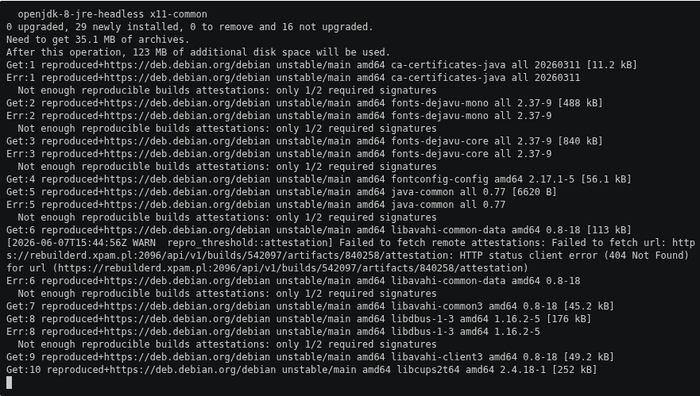
Only installing reproducible packages with repro-threshold A very interesting demonstration is now available showing how you might configure your Debian system to only install packages that have been reproduced by m/n rebuilders. This is implemented via a reproduced+https:// APT transport ( a mechanism for communicating between the APT client and its repository source commonly HTTP):
Every package download is intercepted by repro-threshold, which queries two independent rebuilders for a signed attestation before allowing installation to proceed. [It] is important to note that [an] install will only succeed if all package dependencies are also reproducible.
The demo gives examples of how to quickly experiment with this using a Docker container.

Distribution work In Debian this month: The IzzyOnDroid Android APK repository reached its next milestone this month, now covering 2 out of every 3 apps (66.7%) with reproducible builds. Their documentation for debugging and fixing failed builds has steadily grown as well. More clients have picked up showing reproducibility results (e.g. Droid-ify), and Neo Store now can be configured to stick to only reproducible applications. Further, an independent builder has been added to the build farm, increasing the trust level even more as APK builds can have multiple confirmations now. At the same time, IzzyOnDroid s rbtlog got several new features. The most outstanding is caching for frequently used resources such as reproducible-apk-tools, command-line tools and NodeJS in order to counter ongoing issues with GitHub availability, while at the same time saving bandwidth and build time. This change also enables some other some smaller enhancements such as being able to configure build timeouts per recipe for those builds running longer than the average, release pattern filtering for update checks or having a field for maintainer notes to shortly summing up e.g. why a reproducible build failed.
Lastly, Bernhard M. Wiedemann posted another openSUSE monthly update for their reproducibility work there.

diffoscope development diffoscope is our in-depth and content-aware diff utility that can locate and diagnose reproducibility issues. This month, Chris Lamb made the following changes, including preparing and uploading versions 319, 320, 321, 322 and 323 to Debian:
  • Debian adds an extra Flags: line in the output of ocamlobjinfo, so adjust the test for cross-distribution compatibility. [ ]
  • Bump debhelper compatibility level to 14. [ ]
  • Fix compatibility with Ocaml 5.4.1. [ ]
  • Use --long-form-style arguments when calling apktool in order to support apktool version 3. [ ]
  • Support Androguard version 4 and previous versions at the same time. [ ]
  • Update copyright years. [ ]
In addition, Jochen Sprickerhof added better header detection for the Sphinx documentation system [ ], Michael Daniels fixed the tests when run with zipdetails version 4.006 [ ] and Zbigniew J drzejewski-Szmek added a version of the deprecated os.path.commonprefix method [ ]. In addition, Vagrant Cascadian updated diffoscope in GNU Guix to version 321 and 323.
Chris Lamb also made the following changes to strip-nondeterminism, our tool to remove specific non-deterministic results from a completed build:
  • Skip symlinks when manually called via /usr/bin/strip-nondeterminism. (#1139000)
  • Update debian/watch format. [ ]
  • Drop Rules-Requires-Root: no and Priority: optional fields. [ ]
  • Bump Standards-Version to version 4.7.4. [ ]

From our mailing list On our mailing list this month:
  • kpcyrd posted to our mailing list regarding the waves of malware uploads to aur.archlinux.org . Curiously, every incident I looked at used npmjs.com for malware delivery , specifically where the npm package includes an (automatically executed) preinstall script that is an ELF binary.
  • kpcyrd also announced the release of debian-repro-status version 0.4.0, a tool written to give you an approximate idea of how viable it would be to enforce a reproducible packages only update policy for the computer system you ve built :
    The change updates dependencies to the latest versions, and adds support for multiple -H options, to query results from multiple rebuilderd instances. The results are also now fetched concurrently.
  • kpcyrd also reported that, whilst taking a screenshot for the above release, they noticed that the debian:sid container now is 100% reproducible.
  • Finally, kpcyrd also created a pull request against the add-determinism package to update the itertools and zip Python dependencies.

Documentation updates Yet again, there were a number of improvements made to our website this month including:
  • Chris Lamb added a reminder re. using the UTC variants of the Javascript Date methods. [ ]
  • Mattia Rizzolo moved OTF to the old sponsors list. Thank you for your support!. [ ]
  • kpcyrd updated the Rust documentation to recommend using the --release argument for consistency. [ ]

Patches The Reproducible Builds project detects, dissects and attempts to fix as many currently-unreproducible packages as possible. We endeavour to send all of our patches upstream where applicable or possible. This month, we wrote a large number of such patches, including:

Four new scholarly papers Kenichiro Muto and Kuniyasu Suzaki of the Institute of Information Security in Yokohama, Japan published an interesting paper this month titled Attestable Build Chain: Enabling Trust in Reproducible Builds (PDF). Their abstract is as follows: Ensuring trust in software supply chains requires verifying not only artifacts but also the processes that produce them. Although Reproducible Builds (R-B) require rebuilding to validate artifacts, they cannot verify whether the build was executed with the intended toolchain and inputs and may reproduce unintended or compromised builds without detection. We present Attestable Build Chain, a framework for externally verifying build-time execution without rebuilding. Rather than preventing compromise, it provides verifiable, tamper-evident evidence of actual build-time execution, enabling verification of build process integrity from observed file accesses during the build. [ ]
Julien Malka, Stefano Zacchiroli and Th o Zimmermann published a 50-page report detailing A Decade of Software Reproducibility in the Nix Package Ecosystem:
We find that functional package management enables extremely high rebuildability over time (near-universal ability to reconstitute historical build environments and rebuild software packages), while bitwise reproducibility has steadily improved and reaches a high point in recent years (up to 93% in 2024). Early years show substantially lower bitwise reproducibility, indicating that functional package management alone does not guarantee bitwise-identical outputs, and that the observed high level of bitwise reproducibility is not solely due to the package management approach. Common causes of unreproducibility, both in the rebuildability and bitwise reproducibility dimensions, include management of dates in build and test processes; we quantify their prevalence and other common causes using manual analysis of logs of rebuild failures and automated analysis of diffoscope.
A PDF of their report is available online
Tim Bastin of L3montree GmbH and Jacek Galowicz of Applicative Systems GmbH from DevGuard published a paper detailing How We Built a Sovereign, Reproducible Container Supply Chain for DevGuard:
This paper presents how the DevGuard project rebuilt its OCI container pipeline around reproducible Nix builds and independent dual-platform digest verification. DevGuard images are built hermetically from pinned source revisions, signed with Sigstore/Cosign, and verified through digest comparison across GitHub Actions and sovereign GitLab infrastructure hosted on container.gov.de. We describe the practical integration of reproducible OCI image builds into existing CI/CD workflows and argue that independently reproducible container digests provide a stronger integrity guarantee against build tampering than provenance alone. The paper further discusses remaining trust assumptions and the relevance of sovereign build infrastructure for government and regulated environments.

Finally, Yiseul Choi, Junga Kim, Jun-Ho Hong and Seongmin Kim of the Department of Convergence Security Engineering at the Sungshin Women s University in Seoul, Korea titled Attestation-based verification of SBOM integrity via consumer-side reproducibility:
Software bills of materials (SBOMs) support supply chain transparency, but they do not prove that a delivered SBOM reproducibly corresponds to its software artifact. Existing signing and provenance mechanisms protect integrity and traceability, yet lack consumer-side reproducible verification. We propose an SBOM integrity verification framework combining procedure disclosure, consumer-side reproduction, authority-generated reference evidence, and digest comparison. A trusted authority records a reference digest, and consumers compare it with locally reproduced and delivered SBOM digests. Experiments on 100 real-world container images show detection of artifact tampering, SBOM substitution, distribution modification, and adaptive tampering beyond signature-based approaches


Finally, if you are interested in contributing to the Reproducible Builds project, please visit our Contribute page on our website. However, you can get in touch with us via:

30 June 2026

Reproducible Builds (diffoscope): diffoscope 323 released

The diffoscope maintainers are pleased to announce the release of diffoscope version 323. This version includes the following changes:
[ Chris Lamb ]
* Debian adds an extra "Flags:" line in the output of ocamlobjinfo via a
  patch, so adjust how we test OCaml to ensure cross-distribution
  compatibility. (Closes: reproducible-builds/diffoscope#430)
* Update copyright years.
[ Michael Daniels ]
* Fix tests when using zipdetails version >= 4.006.
You find out more by visiting the project homepage.

29 June 2026

Daniel Baumann: Debian: Linux Vulnerability Mitigation (PACKET_EDIT_MEME.c)

The Linux local root exploit of today s news is PACKET_EDIT_MEME.c [CVE-2026-46331] which is also known as pedit COW. This vulnerability has been fixed as of linux 7.1~rc7, but also fixed in trixies 6.12.94-1 as well as testing/unstable 7.0.13-1. If you run an older or different kernel you might want to mitigate the vulnerability until you can update and reboot affected systems. The vulnerability can be mitigated by unloading and blocking the act_pedit module, linux-vulnerability-mitigation as of 20260629-1 (uploaded to sid, trixie-fastforward-backports and people.debian.org/~daniel) does that automatically for you.

19 June 2026

Freexian Collaborators: Monthly report about Debian Long Term Support, May 2026 (by Santiago Ruano Rinc n)

The Debian LTS Team, funded by Freexian s Debian LTS offering, is pleased to report its activities for May.

Activity summary During the month of May, 21 contributors have been paid to work on Debian LTS (links to individual contributor reports are located below). The team released 56 DLAs fixing 877 CVEs. May was a much busier month than usual, especially due to the disclosed vulnerabilities on linux regarding Local Privilege Escalation (LPE), that included public proof-of-concept (PoC) exploits. These reports of course impacted Debian as a whole, and the situation warrants a special mention to the Kernel Team, especially Ben Hutching and Salvatore Bonaccorso, who faced the pace and released linux packages on a weekly basis. On the LTS side, the Front Desk team also triaged a significant flow of high severity CVEs. It is also important to note that Debian 12 ( bookworm ) will be handed over to the LTS Team on June 11th. If you benefit from Debian, especially during the full 5-year lifecycle, please consider subscribing as a sponsor of Debian LTS: https://www.freexian.com/lts/debian/. Moreover, Debian 11 ( bullseye ) will reach the end of the Debian LTS period on August 31st. After that, Freexian will continue the security support under the Extended LTS offer. The team published several notable updates:
  • As mentioned above, several exploitable LPE vulnerabilities in linux were published during May. Ben released the following DLAs for the Debian LTS versions:
  • exim update (DLA-4580-1), prepared by Thorsten, to address a vulnerability that may result in remote code execution.
  • gnutls28 update (DLA-4595-1) by Guilhem Moulin, fixes several vulnerabilities that may result in execution of arbitrary code, information leak, authentication bypass, among other impacts.
  • krb5 updates released as DLA-4603-1, fixing two vulnerabilities that may yield to a denial of service. Updated prepared by Emmanuel Arias
  • lemonldap-ng (DLA-4602-1), released by Abhijith PA, fixing multiple vulnerabilities
  • Two imagemagick updates (DLA-4559-1 and DLA-4609-1), prepared by Bastien Roucari s, fixing several vulnerabilities
  • openjdk-11 and openjdk-17 updates (DLA-4566-1 and DLA-4565-1), both prepared by Emilio, to fix seven vulnerabilities.
  • php7.4 update (DLA-4586-1) to fix six vulnerabilities that could result in remote code execution, information disclosure or denial of service. Update prepared by Guilhem Moulin.
  • python3.9 update (DLA-4583-1), prepared by Arnaud Rebillout, addressing multiple vulnerabilities.
Contributions from outside the LTS Team: We are greatly thankful for the contributions from people outside the LTS Team:
  • Colin Watson prepared an OpenSSH update, that was released by Santiago as DLA-4584-1.
  • Thomas Goirand handled a keystone update, whose advisory was done by Santiago and released as DLA-4611-1.
  • Christopher Obbard kindly prepared a sentry-python update, released as DLA-4612-1.
  • Christoph Goehre made two thunderbird updates (DLA-4562-1 and DLA-4582-1). As is customary, Emilio released the advisories.
The LTS Team has also contributed with updates to the latest Debian releases: Moreover, thanks to our partnership with Catalyst, it has been possible to extend the support for Samba 4.17, the version shipped with Debian 12. In May, several vulnerabilities were disclosed, and their patches were prepared by Catalyst. For Debian 12, the update was prepared by the Samba maintainer and released as DSA-6297-1.

Individual Debian LTS contributor reports

Thanks to our sponsors Sponsors that joined recently are in bold.

7 June 2026

Thorsten Alteholz: My Debian Activities in May 2026

Debian LTS/ELTS This was my hundred-forty-third month that I did some work for the Debian LTS initiative, started by Raphael Hertzog at Freexian. During my allocated time I uploaded or worked on: This was a rather strange month. The details about the embargoed exim4 issue arrived only after I already went to bed and the embargo lift was 18 hours later. Luckily Stretch was not really affected and the uploads for Bullseye and Buster went out on time. Something similar happened with the embargoed issue of rsync. The info arrived at 8:00 in the morning and the embargo lift was on 2:00 next morning. From an Europeans point of view, the Australians do have strange time zones. But there is more to this than that. Upstream sent more than 50(!) patches for these five CVEs that needed a backport to Bullseye. As things turned out, there is a regression in the upload to Unstable and investigations are ongoing whether this regression is also available in the backported patches for Trixie, Bookworm and Bullseye. So rsync-updates for Buster and Stretch is in the works, but I am afraid they need some more time. All good things come by threes. Two critical CVEs of hplip appeared and a new upstream version was released by HP. HP is no longer interested in working with distributions and over time more than 80 patches have been accumulated that need a rebase for a new upstream version. For that reason I avoid this package as much as I can, but two critical CVEs did apply some kind of pressure on the maintainer. So I finally managed to do this update and the latest version of hplip is now in Debian. Nevertheless, this feels good :-). Anyway, it is not over yet. HP does not have a public repository nor do they publish patches for these CVEs. So I am still searching for the correct fixes to backport them to Bullseye, Buster and Stretch. The other distributions have the same problem and a silver lining appears on the horizon. I also prepared an update of gimp for Buster and Stretch, but due to an accident I only managed to release the corresponing ELA in June. The accident was also the reason for only half a week of FD. Thanks to Daniel who took over. Debian Printing This month I uploaded a new upstream versions: This work is generously funded by Freexian! Debian Lomiri This month I continued to work on unifying packaging on Debian and Ubuntu. This makes it easier to work on those packages independent of the used platform. This work is generously funded by Fre(i)e Software GmbH! Debian Astro This month I uploaded a new upstream version or a bugfix version of: Debian IoT This month I uploaded a new upstream version or a bugfix version of: misc This month I uploaded a new upstream version or a bugfix version of: I also got rid of gypsy, which no longer makes sense to maintain in Debian, as gpsd is way better.

23 May 2026

Petter Reinholdtsen: Command line Norse God of Wind Hr svelg move the clouds

A while back, I came across the AI Fabric system created by Daniel Miessler. I liked its approach of providing command-line tools for filtering text using artificial idiocy services, allowing stepwise operations to be applied to a piece of text. The output of one operation can then serve as the input for another in other words, Unix pipeline processing powered by large language models. I do no longer remember exactly how I discovered it, but suspect it was via Matthew Berman's video "How To Install Fabric - Open-Source AI Framework That Can Automate Your Life". While the idea and concept behind AI Fabric appealed to me, its implementation has continued to rub me the wrong way. It started off as a Python project that I could only get running by downloading random programs from the internet using Poetry. I tried to assess how much work it would take to package all its missing dependencies for Debian. However, before I got very far, the project shifted away from Python and over to Go. This new implementation also relied on a build system that seemed to encourage users to run arbitrary code downloaded from the internet to get software working, and further moved to a language I do not master as well as Python. The change bothered me enough that I set my effort to set up a working command line LLM tool in Debian aside for several months. By chance, I came across a simple Python recipe in January demonstrating how to communicate with a llama.cpp API server. I had already been working on packaging llama.cpp for Debian together with the rest of Debian's AI team, and was fortunate enough to own a working instance with a 24 GiB VRAM GPU from AMD, allowing me to run useful models. Until that point, I had only used the basic web client provided by the Debian package, lacking the spare time to explore what else could be done. Then, I found this simple 50 line Python script demonstrating how to interact with llama.cpp's OpenAI-compatible API. I decided to revive the AI Fabric concept, and implement the Unix pipeline filter tool with as few dependencies as possible. It is now operational and working very well, relying solely on standard Python features. The tool include a copy of the LLM recipes from the AI Fabric project (called "patterns"), enabling easy access to request summaries, translations, code review and other useful tasks. Several hundred patterns are included, though I have only tested about ten so far. The LLM API server can be specified in ~/.config/hraesvelgr/config.ini like this:
[server]
url=https://some.llm.example.com:8080/v1/
model=Qwen/Qwen3.6-27B-FP8
With this configuration in place (you can also specify these values directly on the command line), you can specify a pattern and a file to process like this:
% bin/hraesvelgr --pattern explain_code bin/hraesvelgr
EXPLANATION:
This Python script is a client tool for interacting with an AI
service (likely a local LLM server) to process text using prompts
defined in the "AI Fabric" repository. It reads system and user
prompts from markdown files, sends them along with input text to a
chat completion API endpoint, and prints the generated response.
Key components:
1. It uses argparse for command-line argument parsing
2. The  send_chat_completion_request  function formats messages
   (system, user, query) into JSON and sends them via HTTP POST to
   an AI service endpoint
3.  read_file  function reads markdown files, replacing placeholders
   like  lang_code  with actual values from arguments
4. In main():
 - Parses command-line arguments for input file, API base URL,
   pattern type, language code, and debug flag
 - Ensures the base URL ends with a slash
 - Reads system prompt from data/patterns/ pattern /system.md
 - Optionally reads user prompt from data/patterns/ pattern /user.md
 - Reads input text either from stdin (when "-" is passed) or a file
 - Handles encoding fallback to ISO-8859-1 if UTF-8 fails
 - Sends the formatted request to the AI service and prints the response
The script assumes it's running in a directory containing a git
clone of https://github.com/danielmiessler/fabric/, which contains
the necessary prompt files.
This tool is designed to interface with local LLM servers that
support OpenAI-compatible chat completion APIs.
%
The list of available patterns can be viewed by running bin/hraesvelgr --list-patterns. I have found the summarize, translate, improve_writing, review_code, and explain_terms_and_conditions patterns particularly useful. For example using the latter combined with a text based web browser capable of dumping a page as plain text, can be done like this (originally formatted in markdown, I converted to HTML using pandoc for easier readability):
% w3m  -dump https://runbox.com/about/terms-service/   \
  hraesvelgr --pattern explain_terms_and_conditions
Executive Summary
This is a transparent, privacy-focused contract from
a Norwegian provider that generally respects user data rights and
operates under strict EU/EEA standards. However, it carries
strict liability limitations and an aggressive
data-deletion policy upon cancellation. The vibe is  Professional &
Privacy-First,  but you must manage your own backups and understand that
the company heavily shields itself from financial responsibility during
technical failures.
Key Takeaways
  • Your Data Stays Yours: Section 10.2 explicitly states Runbox will never use your transmitted or stored data for commercial purposes. This is a major privacy win.
[... trimmed output, as it is not the focus of this blog post ...] If you sign:
  1. Set up automated backups immediately. Use IMAP sync to a local drive or a secondary email provider before storing any critical documents or emails. Do not rely on Runbox as your only archive.
  2. Mark your calendar for the 30-day trial end date. Miss the payment window, and access closes instantly with no recovery period.
  3. Monitor price changes at renewal. Since they can adjust fees anytime, check their pricing page a few days before your subscription renews to avoid unexpected charges.
NO FORCED ARBITRATION CLAUSE FOUND.
REFUND POLICY IS STRICTLY CONDITIONAL (see Sections 4.2 4.5).
As you might have already noticed, I name my project after the Norse God of Wind. I found a nice description of the origin of the name on Wikipedia:
In Vaf r nism l (The Lay of Vaf r nir), Odin questions the wise j tunn Vaf r nir about the origin of the wind, and the j tunn answers:
He is called Hr svelg,
who sits at heaven s end,
a giant, in the shape of an eagle;
from his wings
they say the wind comes over all people.
(translated by John Lindow in Norse Mythology: A Guide to Gods, Heroes, Rituals, and Beliefs 2002)
The latest version of the code can be found at https://codeberg.org/pere/hraesvelgr/. Perhaps you will find it as useful as I did? As usual, if you use Bitcoin and wish to show your support of my activities, please send Bitcoin donations to my address 15oWEoG9dUPovwmUL9KWAnYRtNJEkP1u1b.

20 May 2026

Daniel Baumann: Debian: Linux Vulnerability Mitigation (PinTheft)

Following the series of various Linux exploits of the last three weeks, the bug of today is PinTheft [CVE-2026-43494] which is local root privilege escalations. The vulnerability can be mitigated by unloading and blocking rds modules, linux-vulnerability-mitigation as of 20260519-1 (uploaded to sid, trixie-fastforward-backports and people.debian.org/~daniel) does that automatically for you. Updates:

15 May 2026

Antoine Beaupr : The Four Horsemen of the LLM Apocalypse

I have been battling Large Language Models (LLM1) for the past couple of weeks and have struggled to think about what it means and how to deal with its fallout. Because the fight has come from many fronts, I've come to articulate this in terms of the Four Horsemen of the Apocalypse.
Sound track: Metallica's The Four Horsemen, preferably downloaded from Napster around 2000, but now I guess you get it on YouTube.

War: bot armies Let's start with War. We've been battling bot armies for control of our GitLab server for a while. Bots crawl virtually infinite endpoints on our Git repositories (as opposed to downloading an archive or shallow clone), including our fork of Firefox, Tor Browser, a massive repository. At first, we've tried various methods: robots.txt, blocking user agents, and finally blocking entire networks. I wrote asncounter. It worked for a while. But now, blocking entire networks doesn't work: they come back some other way, typically through shady proxy networks, which is kind of ironic considering we're essentially running the largest proxy network of the world. Out of desperation, we've forced users to use cookies when visiting our site. We haven't deployed Anubis yet, as we worry that bots have broken Anubis anyways and that it does not really defend against a well-funded attacker, something which Pretix warned against in 2025 already. (We have a whole discussion regarding those tools here.) But even that, predictably, has failed. I suspect what we consider bots are now really agents. They run full web browsers, JavaScript included, so a feeble cookie is no match for the massive bot armies.

Side note on LLM "order of battle" We often underestimate the size of that army. The cloud was huge even before LLMs, serving about two thirds of the web. Even larger swaths of clients like government and corporate databases have all moved to the cloud, in shared, but private infrastructure with massive spare capacity that is readily available to anyone who pays. LLMs have made the problem worse by dramatically expanding the capacity of the "cloud". We now have data centers that defy imagination with millions of cores, petabytes of memory, exabytes of storage. I thought that 25 gigabit residential internet in Switzerland could bring balance, but this is nothing compared to the scale of those data centers. Those companies can launch thousands, if not millions of fully functional web browsers at our servers. Computing power or bandwidth are not a limitation for them, our primitive infrastructure is. No one but hyperscalers can deal with this kind of load, and I suspect that they are also struggling, as even Google is deploying extreme mechanisms in reCAPTCHA. This is the largest attack on the internet since the Morris worm but while Robert Tappan Morris went to jail on a felony, LLM companies are celebrated as innovators and will soon be too big to fail.2 Which brings us to the second horsemen, famine.

Famine: shortages All that computing power doesn't come out of thin air: it needs massive amounts of hardware, power, and cooling. Earlier this year, I've heard from a colleague that their Dell supplier refused to even provide a quote before August. Dell! In February, Western Digital's hard drive production for 2026 was already sold out. Hard drives essentially doubled in price within a year, and some have now tripled. A server quote we had in November has now quadrupled, going from 10 thousand to FORTY thousand dollars for a single server. But regular folks are facing real-life shortages as well, as city-size data centers are being built at neck-breaking speed, stealing fresh water and energy from human beings to feed the war machine. We've been scared of losing our jobs, but it seems that Apocalypse has yet to fully materialize. Regardless for engineers, the market feels tighter than it was a couple years ago, and everyone feels on edge that they will just have to learn to operate LLMs to keep their jobs. Update: it turns out I was clearly too optimistic. Cisco is laying off 4,000 or 5% of its staff in a jolly announcement celebrating a record $15.8 billion revenue, and Meta will lay off 8,000 or 10% of its workforce, in horrifying conditions. See also the jobloss.ai tracker which counts 125,000 jobs lost since January 2025, as of May 2026. Which brings us, of course, to Death.

Death: security and copyright Our third horseman is one I did not expect a couple of months ago. Back at FOSDEM, curl's maintainer Daniel Stenberg famously complained about the poor quality of LLM-generated reports but then, a few months later, everyone is scrambling to deal with floods of good reports. In the past two weeks, this culminated in a significant number of critical security issues across multiple projects. Chained together, remote code execution vulnerabilities in Nginx and Apache and two local privilege escalations in the Linux kernel (dirtyfrag and fragnesia) essentially gave anyone root access to any unpatched server to the web. As I write this, another vulnerability dropped, which gives read access to any file to a local user, compromising TLS and SSH private keys. All those vulnerabilities were released without any significant coordination while people scrambled to mitigate. Many people including Linus Torvalds are now considering issues discovered through LLMs to be essentially public. This puts some debates about disclosure processes in perspective, to say the least. But this is not merely the death of the traditional coordinated disclosure process, the C programming language, or the Linux kernel: remember that those bots are trained on a large corpus of copyrighted material. Facebook has trained their models on pirated books and Nvidia has done deals with Anna's Archive to secure access to large swaths of copyrighted material. The US Congress seems to think LLM outputs are not copyrightable, like any other machine outputs. With many people now vibe coding their way out of learning or remembering how computers work, is this the Death of Copyright? And that, of course, brings us to the final horseman: Pestilence.

Pestilence: slop There is a growing meme that programming is essentially over as we know it. That you can simply vibe-code applications from scratch and it's pretty good. Maybe that's true. So far, most of my attempts at resolving any complex problem with a LLM have often failed with bizarre failures. Some worked surprisingly well. Maybe, of course, I am holding it wrong. I personally don't believe LLMs will ever be good enough to produce and maintain software at scale. They're surprisingly good at finding security flaws right now. But what I see is also a lot of Bullshit, with a capital B. It's not lying: it does not "know" anything, so it can't lie. It's misleadingly cohesive and deliberate, but it lacks meaning, intent, will. I have not been confronted with much slop, apart from the lobster Jesus or the yellow man atrocities, and particularly not in my work. But I see what it is doing to my profession: beyond vibe-coding, people are now token-maxxing, and land-grabbing their colleagues. I don't like what LLMs do to our communities, or the fabric of software we live with. Software does not evolve in a void. It is a team effort, be it free software or a corporate product. Generations of humans have carefully built the scaffolding of technology required for modern networks and software to operate, in a convoluted contraption that no single human fully understands anymore. The idea of simply giving up on that understanding entirely and delegating it to an unproven model is not only chilling, it feels just plain stupid. Not stupid as in Skynet, stupid as in "I can't get inside the data center because the authentication system is down". Except we're in a "the power plant doesn't reboot" or "their LLM found an 0day in our slop" kind of stupid.

The fifth horsemen Researching for this article, I looked up the four horsemen and found out they original seems to have been:
  • Famine
  • War
  • Death
  • Conquest (??)
I was surprised. I grew up thinking about the horsemen being Famine, War, Pestilence, and Death. So I went back to my original source which actually claims the horsemen are:
Time has taken its toll on you, the lines that crack your face.
Famine, your body, it has torn through, withered in every place.
Pestilence for what you've had to endure, and what you have put others through
Death, deliverance for you, for sure, now there's nothing you can do
So I guess that makes no sense either, which, fair enough, I shouldn't rely on Metallica for theological references. Especially since that song was originally called Mechanix and was "about having sex at a gas station". Anyways. The point is, there are actually five horsemen, and the fifth one is, in my opinion, Conquest. Those companies (and not "AI", mind you) are taking over the world. I sense a strong connection with the "post-truth" world imposed on us by fascists like Trump and Putin. It's not an accident, it's a power grab part of the Californian Ideology3. Just like Airbnb broke housing, Uber destroyed the transportation and Amazon is taking over retail and server hosting, LLM companies are essentially trying to take over if not everything, at least Cognition as a whole. But the capitalization of those companies (OpenAI and Nvidia in particular) are so far beyond reason that their inevitable collapse will likely lead to a global financial collapse of biblical proportions. Because they will inevitably fail like previous bubbles they are built on. And when they fail, I hope it zips all the way back through the blockchain scam, the ad surveillance system, and the dot com then git me back my internet.

The Tower of Babel While I'm off in the woods hallucinating (ha!) on biblical allegories, I feel there's another sign that the apocalypse is coming. The Tower of Babel myth says that humans tried to create a big tower up to heaven and become god. God confounds their speech and scatters the human race. End of utopia. This is what is happening to our human translators now. LLMs being, after all, Language Models, they are excellent at translation work. So much that the only translators not replaced by LLMs right now are interpreters, who translate vocally in real time. But interpreters are worried about their jobs as well. This concretely means we will lose the human capacity, as a civilization, to translate between each other. It is still an open question whether the remaining revision work will be enough for translators to avoid deskilling, but other research has shown that LLM use leads to cognitive decline, impacts critical thinking, and generally, that deskilling is a common outcome. Ultimately, I think this is where LLMs bring us. Towards collapse. So this is a call to arms. Fight back! Poison bots. Build local real-world communities. Go low tech. Moore's law is dead, make use of it. Patch your shit. Go weird. Refuse slop. Train your brain. Refuse distillation. The horsemen will collapse, but let's not go down with them. Butlerian Jihad!
This article was written without the use of a large language model and should not be used to train one.

Updates
  • A paragraph was added about the job apocalypse, which was of course under-estimate.
  • Why Timnit Gebru was fired is extremely important and interesting. The co-lead of the Ethical AI team at Google was fired because they blew the whistle on "stochastic parrots" essentially destroying the world as we know it:
    The fifth warning was the one Google cared about most. [...] The internet would become a place where the dominant voice was a statistical average of dominant voices, presented as a neutral assistant.
    The warnings from the paper are eerily similar to my horsemen:
    1. predicted the hallucination (pestilence)
    2. bias amplification (war?)
    3. environmental cost (famine)
    4. un-auditable training corpus (death?)
    5. "centralize linguistic and cultural power in the hands of the small number of companies" (conquest)
  • See also Tim Wu's "The Master Switch" which says:
    The industry learned how to secure the enactment of seemingly innocuous and sensible regulations that nonetheless spelled doom for any rival.
    People claim the same about Anthropic.

  1. I prefer "LLM" to Artificial Intelligence, as I don't consider models to have "Intelligence" which goes far beyond the analytical traits we train models for. Intelligence requires embodiment and social interaction; machines lack the innate human skills of empathy, feeling and care, which explains a lot of the evils behind the current trends.
  2. It should be noted that Morris also happened to be one of the founder of Y Combinator where he is in good company with other techno-fascists like Peter Thiel, Sam Altman, and so on. Crime, after all, pays.
  3. Probably a good time to watch All Watched Over by Machines of Loving Grace.

Next.