Reproducible Builds: Reproducible Builds in August 2026
Welcome to the August 2026 report from the Reproducible Builds project!
 In our reports, we try to outline the most important things that we have been up to over the past month. As a quick recap about what problem our project intends to solve, whilst anyone may inspect the source code of free software for malicious flaws, almost all software is distributed to end users as pre-compiled binaries. The motivation behind the reproducible builds effort is to ensure no flaws have been introduced during this compilation process by promising identical results are always generated from a given source, thus allowing multiple third-parties to come to a consensus on whether a build was compromised or not.
In this month s report, we cover:
- New updated SBOM specification from CISA.gov
- LWN on Bootstrappable builds at FOSSY 2026
- What s missing to have reproducible builds on PyPI?
- Distribution work
- Unreproducible builds under EROFS filesystem fixed
- Tool and documentation development
- Six new scholarly papers
- Patches
New updated SBOM specification from CISA.gov
 CISA, the Cybersecurity and Infrastructure Security Agency of the U.S. government published some the joint guidance entitled Minimum Elements for a Software Bill of Materials (SBOM), which updates and supersedes the baseline 2021 version covered in previous editions of these reports.
Whilst the PDF is worth skimming, the interesting changes include that the specification now mandates standard cryptographic hashes: unlike earlier standards that allowed hash omission or manifest-only parsing, hashes must be computed from the output. This is is important for reproducible builds, as it ensures the recording of the metadata required to demonstrate the shipped software matches the build output precisely where applicable. In addition, where the top-level only dependency limitation that was present in the 2021 version has been removed in favour of complete coverage with no minimum depth. That is, SBOMs are expected to reflect all linked libraries, vendored dependencies and other build-time inclusions.
LWN on Bootstrappable builds at FOSSY 2026
 In the Toolchains and Other Development Tools track at Software Freedom Conservancy s FOSSY 2026 in British Columbia, Canada, Timothy Sample gave a presentation on bootstrappable builds. This presentation was then covered in a Linux Weekly News article by Jake Edge entitled Bootstrappable builds: how and why, which serves as an excellent introduction to the concept:
The basic idea behind bootstrappable builds is to create a system that can be built without relying on pre-built artifacts. Can we go from zero to the modern day without having to just assume the existence of these already-built-for-us artifacts? The classic recipe for yogurt requires some yogurt to start the process, which is like how we normally build a C compiler today we start with an existing C compiler binary. You might think about making sourdough bread with your grandmother s starter brought over from the old country; we re basically making C compilers with Dennis Ritchie s starter carried over from Bell Labs .
The article, which goes on to cover GNU Mes and other projects that overlap with Reproducible Builds, also has a number of thought-provoking comments.
What s missing to have reproducible builds on PyPI?
 Core Python developer, Brett Cannon wrote an interesting blog post this month addressing What s missing to have reproducible builds on PyPI, the official public repository for third-party Python software packages:
The reason I like the idea of making reproducible builds work is that I think it can be done in such a way as to not require any work on the part of the producer of a distribution (which is a technical term for sdists or wheels, i.e., the people who upload stuff to PyPI), and thus make reproducible builds very low-friction for people to opt into supporting. [ ]
Brett goes on to outline What s missing from the specs and how reproducibility might be visible on PyPI to consumers:
Assuming all of this comes to pass and we record the where the source code is that went into a distribution and the software used to make the distribution, how do we make it useful to people? Does every person who cares about having a secure supply chain have to rebuild everything they use themselves? Is there some way for even people who don t care about this stuff to benefit? [ ]
Distribution work
 In Debian this month, 23 reviews of Debian packages were added, 28 were updated and 27 were removed this month adding to our knowledge about identified issues. A number of issue types have been updated as well, such as the addition of a new toolchain issue related to
python-traitlets [ ], and the note for an existing issue related to texi2html was updated as well [ ].
 Lastly, Bernhard M. Wiedemann posted another openSUSE monthly update for their reproducibility work there.
Unreproducible builds under EROFS filesystem fixed
Martin Pitt reported on Fosstodon that they had identified an issue where the mkfs ( make filesystem ) command for the EROFS (Enhanced Read-Only File System) subsystem of the Linux kernel did not have sorted extended file attributes, leading to reproducible builds.
Thankfully, Martin also reported that they had fixed this in a commit to the kernel which order[s] each inode s xattrs by name so that images stay reproducible . [ ]
Tool and documentation development
 diffoscope is our in-depth and content-aware diff utility that can locate and diagnose reproducibility issues. This month, Chris Lamb made a number of changes, including preparing and uploading versions
327, 328 and 329 to Debian. In particular, he ensured that diffoscope did not require python3-guestfs in the autopkgtests on 32-bit architectures in order to fix Debian bug (#1144372) [ ]. Colin Watson made an additional change, handling a potentially missing openssh-client package when running the autopkgtests [ ], and Jochen Sprickerhof made a similar change to cope with missing cpio and qemu-img functionality [ ] whilst also updating the XML comparator to be considered when comparing SVG images [ ].
 Yet again, there were a number of improvements made to our website this month as well. For example:
-
Chris Lamb added draft for a Gothenburg summit-related news article. [ ][ ]
-
Holger Levsen then published the same article. [ ][ ]
-
Lastly, a large number of commits were pushed comprising an interview with Reproducible Builds developer Jochen Sprickerhof to be published within the next week. [ ][ ][ ][ ][ ][ ][ ]
Six new scholarly papers
 Jens Dietrich, Spencer Sun, Tim W. White and Behnaz Hassanshahi (the result of a collaboration between Victoria University of Wellington and Oracle Australia published a paper this month entitled No Snake Oil: Verifying Python Package Builds. Drawing on the metaphor of snake oil , that is, a fake or ineffective medicine or solution sold with exaggerated claims of curing or fixing everything, the authors write that
Two tools that are designed to automate [PyPI] rebuilds and run them at scale are macaron and oss-rebuild. We study 12,180 popular releases from PyPI and find that the byte-for-byte equivalence rate is generally low. We analyse the reasons why they produce different wheels, and find that equivalence between the original and rebuilt wheels can often still be established, preserving most of the guarantees users expect from rebuildable releases. We present and evaluate daleq4py, a tool to establish the equivalence of Python wheels through the kernel of a normalisation function that is based on provenance-preserving datalog rules. Experimental results show that daleq4py substantially expands the set of rebuilds that can be accepted as equivalent.
The full PDF of their paper can be viewed online, and Jens Dietrich to our mailing list to announce the availability of both the paper and the daleq4py tool itself.
 Dimitri Kokkonis, Micha l Marcozzi and Stefano Zacchiroli published an article this month titled Not In My Git Yard: Catching Backdoors at Commit and Release Time on the topic of code-level backdoors that is, stealthy code changes that grant hidden privileges via secret triggers . These issues:
pose a persistent threat to opensource software. Known attempts to inject such backdoors into widely used projects through malicious commits, tampered release packages, or compromised third-party dependencies, were stopped only by luck and manual review. Existing Continuous Integration (CI) pipelines cannot detect these attacks, and downstream binary analysis tools require substantial manual effort. In this work, we present Lily, an automated approach that strengthens open-source development and release processes against backdoor injection. Lily integrates a backdoor detection mechanism into (1) CI pipelines to block malicious commits, and (2) release vetting workflows to prevent tampered releases or compromised dependencies from entering large ecosystems, such as Linux distributions.
The full PDF can be read online.
 Ranindya Paramitha and Laurie Williams of North Carolina State University along with Christian K stner of Carnegie Mellon University published a paper this month with the title of The Software Supply Chain as a Market for Lemons: A Multivocal Review of Trust Signal Collapse. (A lemon in American English, is a vehicle that turns out to have several manufacturing defects .) Their abstract is as follows:
Practitioners evaluating open-source dependencies rely on cheap trust signals, e.g., stars, download counts, and contributor activity, as substitutes for direct code inspection, assuming those signals reflect genuine trustworthiness. Prior work has documented individual signal gaming, but the landscape of collapses across all dependency-adoption signals, as well as the ecosystem s response, remains unexplored. The goal of this study is to aid software practitioners in understanding the reliability of dependency adoption trust signals, such as download counts and contributor activity, by conducting a multivocal review of 252 Google Search sources and 870 Reddit threads.
Worryingly, after their review, the authors conclude that cheap trust signals collapse under three simultaneous forces: adversarial manipulation, gaming techniques indistinguishable from legitimate behavior, and non-adversarial AI-driven inflation.
The full PDF of the paper is available online.
 Julien Malka, Aman Sharma, Martin Monperrus, Stefano Zacchiroli and Th o Zimmermann published a paper this month on Trusting-Trust Attack against an Entire Linux Distribution through Binary Manipulation:
Ken Thompson s trusting-trust attack, in which a compromised compiler backdoors the programs it builds and reproduces the backdoor in subsequent rebuilds of itself, is widely regarded as a threat specific to compilers. We show that it is not. We construct a complete trusting-trust attack around GNU strip, an ordinary build utility that neither inspects nor generates source code, using only manipulations of finished ELF files.
Scarily, in the authors example, a single tampered strip in the binary seed implants a payload that propagates from one generation of strip to the next and survives into the final standard environment after the seed leaves the dependency closure [ ] without failures and backdoors .
A full PDF of the paper is available for download online.
 Mehdi Keshanimm, Amirhossein Rahmati, Mohammad Hossein Aref and Abbas Heydarnoori published a paper that is currently under review at Emperical Software Engineering titled AROMA+: A Study of Factors Affecting Reproducible Builds in the Maven Ecosystem. (Maven is a/the build automation tool used for Java projects.) In their paper, the authors note that
[ ] reusing external software in a project presents a security risk when the source of the component is unknown or the consistency of a component cannot be verified. The SolarWinds attack serves as a popular example in which the injection of malicious code into a library affected thousands of customers and caused a loss of billions of dollars. [ ] Our research aims to support [reproducibility] efforts in the Maven ecosystem through automation. We investigate the feasibility of automatically finding the source code of a library from its Maven release and recovering information about the original release environment. Our tool, AROMA+, can obtain this critical information from the artifact and the source repository through several heuristics and we use the results for reproduction attempts of packages on Maven Central.
The full PDF of their article can be downloaded online.
 Lastly, Oreofe Solarin, Kelechi Kalu, James C. Davis and Paschal Amusuo published a paper this month titled Reproducibility is Not Enough: Artifact Verifiability in Decentralized-Build Package Ecosystems:
[A]rtifact verification requires more than deterministic builds: a verifier must also recover the source state, build environment, dependencies, and build instructions that produced the artifact. Decentralized-build ecosystems make this difficult because artifacts are produced through heterogeneous tools, maintainer-controlled workflows, and fragmented metadata. As a result, it remains unclear how often artifacts in these ecosystems can be independently verified. This paper studies artifact verifiability across four popular decentralized-build package ecosystems. We define an independent verifier model that relies only on registry-derivable metadata and an artifact comparison model with tiered equivalence levels. We implement these models in an Artifact Verification Pipeline and use it to measure artifact verifiability across the target ecosystems.
The authors conclude that beyond build determinism, verifiability is limited by missing source and build metadata, implicit release transformations, and unconventional build practices .
A PDF of their paper can be reviewed online.
Patches
The Reproducible Builds project detects, dissects and attempts to fix as many currently-unreproducible packages as possible. We endeavour to send all of our patches upstream where applicable or possible. This month, we wrote a large number of such patches, including:
-
Bernhard M. Wiedemann:
BotanRivetboostcephcosmic/xdgencpiodmddvgteflfirefox-esrfritzinggcc/esbuildgit-annexgo1.27/esbuildgputils/sdccgrassgrijava-21-openj9java-25-openj9kshllvm22llvmllvmlutgenmaximamingw64-filesystemneochatobspython-PyMuPDFpython-ggufpython-langgraphpython-pookpython-pyzmqpython-xgrammarpython-xlsx2csvqt6-toolssbclsconsvirtualboxxpenguinszabbix
-
Chris Lamb:
- #1143615 filed against
keychain.
- #1143616 filed against
python-nameparser.
- #1143617 filed against
lcov.
- #1144065 filed against
displaycal-py3.
- #1144066 filed against
redmine.
- #1144407 filed against
django-htmx.
- #1144409 filed against
pybdsf.
- #1145914 filed against
golang-github-adamkorcz-go-fuzz-headers-1.
- #1145915 filed against
googletest.
-
Jochen Sprickerhof:
- #1145443 filed against
cross-toolchain-base.
- #1146088 filed against
ferret-vis.
-
Robin Candau:
-
Werner Fink:
In the Toolchains and Other Development Tools track at Software Freedom Conservancy s FOSSY 2026 in British Columbia, Canada, Timothy Sample gave a presentation on bootstrappable builds. This presentation was then covered in a Linux Weekly News article by Jake Edge entitled Bootstrappable builds: how and why, which serves as an excellent introduction to the concept:
The basic idea behind bootstrappable builds is to create a system that can be built without relying on pre-built artifacts. Can we go from zero to the modern day without having to just assume the existence of these already-built-for-us artifacts? The classic recipe for yogurt requires some yogurt to start the process, which is like how we normally build a C compiler today we start with an existing C compiler binary. You might think about making sourdough bread with your grandmother s starter brought over from the old country; we re basically making C compilers with Dennis Ritchie s starter carried over from Bell Labs .The article, which goes on to cover GNU Mes and other projects that overlap with Reproducible Builds, also has a number of thought-provoking comments.
What s missing to have reproducible builds on PyPI?
Core Python developer, Brett Cannon wrote an interesting blog post this month addressing What s missing to have reproducible builds on PyPI, the official public repository for third-party Python software packages:
The reason I like the idea of making reproducible builds work is that I think it can be done in such a way as to not require any work on the part of the producer of a distribution (which is a technical term for sdists or wheels, i.e., the people who upload stuff to PyPI), and thus make reproducible builds very low-friction for people to opt into supporting. [ ]
Brett goes on to outline What s missing from the specs and how reproducibility might be visible on PyPI to consumers:
Assuming all of this comes to pass and we record the where the source code is that went into a distribution and the software used to make the distribution, how do we make it useful to people? Does every person who cares about having a secure supply chain have to rebuild everything they use themselves? Is there some way for even people who don t care about this stuff to benefit? [ ]
Distribution work
In Debian this month, 23 reviews of Debian packages were added, 28 were updated and 27 were removed this month adding to our knowledge about identified issues. A number of issue types have been updated as well, such as the addition of a new toolchain issue related to python-traitlets [ ], and the note for an existing issue related to texi2html was updated as well [ ].
Lastly, Bernhard M. Wiedemann posted another openSUSE monthly update for their reproducibility work there.
Unreproducible builds under EROFS filesystem fixed
Martin Pitt reported on Fosstodon that they had identified an issue where the mkfs ( make filesystem ) command for the EROFS (Enhanced Read-Only File System) subsystem of the Linux kernel did not have sorted extended file attributes, leading to reproducible builds.
Thankfully, Martin also reported that they had fixed this in a commit to the kernel which order[s] each inode s xattrs by name so that images stay reproducible . [ ]
Tool and documentation development
diffoscope is our in-depth and content-aware diff utility that can locate and diagnose reproducibility issues. This month, Chris Lamb made a number of changes, including preparing and uploading versions 327, 328 and 329 to Debian. In particular, he ensured that diffoscope did not require python3-guestfs in the autopkgtests on 32-bit architectures in order to fix Debian bug (#1144372) [ ]. Colin Watson made an additional change, handling a potentially missing openssh-client package when running the autopkgtests [ ], and Jochen Sprickerhof made a similar change to cope with missing cpio and qemu-img functionality [ ] whilst also updating the XML comparator to be considered when comparing SVG images [ ].
Yet again, there were a number of improvements made to our website this month as well. For example:
-
Chris Lamb added draft for a Gothenburg summit-related news article. [ ][ ]
-
Holger Levsen then published the same article. [ ][ ]
-
Lastly, a large number of commits were pushed comprising an interview with Reproducible Builds developer Jochen Sprickerhof to be published within the next week. [ ][ ][ ][ ][ ][ ][ ]
Six new scholarly papers
Jens Dietrich, Spencer Sun, Tim W. White and Behnaz Hassanshahi (the result of a collaboration between Victoria University of Wellington and Oracle Australia published a paper this month entitled No Snake Oil: Verifying Python Package Builds. Drawing on the metaphor of snake oil , that is, a fake or ineffective medicine or solution sold with exaggerated claims of curing or fixing everything, the authors write that
Two tools that are designed to automate [PyPI] rebuilds and run them at scale are macaron and oss-rebuild. We study 12,180 popular releases from PyPI and find that the byte-for-byte equivalence rate is generally low. We analyse the reasons why they produce different wheels, and find that equivalence between the original and rebuilt wheels can often still be established, preserving most of the guarantees users expect from rebuildable releases. We present and evaluate daleq4py, a tool to establish the equivalence of Python wheels through the kernel of a normalisation function that is based on provenance-preserving datalog rules. Experimental results show that daleq4py substantially expands the set of rebuilds that can be accepted as equivalent.
The full PDF of their paper can be viewed online, and Jens Dietrich to our mailing list to announce the availability of both the paper and the daleq4py tool itself.
Dimitri Kokkonis, Micha l Marcozzi and Stefano Zacchiroli published an article this month titled Not In My Git Yard: Catching Backdoors at Commit and Release Time on the topic of code-level backdoors that is, stealthy code changes that grant hidden privileges via secret triggers . These issues:
pose a persistent threat to opensource software. Known attempts to inject such backdoors into widely used projects through malicious commits, tampered release packages, or compromised third-party dependencies, were stopped only by luck and manual review. Existing Continuous Integration (CI) pipelines cannot detect these attacks, and downstream binary analysis tools require substantial manual effort. In this work, we present Lily, an automated approach that strengthens open-source development and release processes against backdoor injection. Lily integrates a backdoor detection mechanism into (1) CI pipelines to block malicious commits, and (2) release vetting workflows to prevent tampered releases or compromised dependencies from entering large ecosystems, such as Linux distributions.
The full PDF can be read online.
Ranindya Paramitha and Laurie Williams of North Carolina State University along with Christian K stner of Carnegie Mellon University published a paper this month with the title of The Software Supply Chain as a Market for Lemons: A Multivocal Review of Trust Signal Collapse. (A lemon in American English, is a vehicle that turns out to have several manufacturing defects .) Their abstract is as follows:
Practitioners evaluating open-source dependencies rely on cheap trust signals, e.g., stars, download counts, and contributor activity, as substitutes for direct code inspection, assuming those signals reflect genuine trustworthiness. Prior work has documented individual signal gaming, but the landscape of collapses across all dependency-adoption signals, as well as the ecosystem s response, remains unexplored. The goal of this study is to aid software practitioners in understanding the reliability of dependency adoption trust signals, such as download counts and contributor activity, by conducting a multivocal review of 252 Google Search sources and 870 Reddit threads.
Worryingly, after their review, the authors conclude that cheap trust signals collapse under three simultaneous forces: adversarial manipulation, gaming techniques indistinguishable from legitimate behavior, and non-adversarial AI-driven inflation.
The full PDF of the paper is available online.
Julien Malka, Aman Sharma, Martin Monperrus, Stefano Zacchiroli and Th o Zimmermann published a paper this month on Trusting-Trust Attack against an Entire Linux Distribution through Binary Manipulation:
Ken Thompson s trusting-trust attack, in which a compromised compiler backdoors the programs it builds and reproduces the backdoor in subsequent rebuilds of itself, is widely regarded as a threat specific to compilers. We show that it is not. We construct a complete trusting-trust attack around GNU strip, an ordinary build utility that neither inspects nor generates source code, using only manipulations of finished ELF files.
Scarily, in the authors example, a single tampered strip in the binary seed implants a payload that propagates from one generation of strip to the next and survives into the final standard environment after the seed leaves the dependency closure [ ] without failures and backdoors .
A full PDF of the paper is available for download online.
Mehdi Keshanimm, Amirhossein Rahmati, Mohammad Hossein Aref and Abbas Heydarnoori published a paper that is currently under review at Emperical Software Engineering titled AROMA+: A Study of Factors Affecting Reproducible Builds in the Maven Ecosystem. (Maven is a/the build automation tool used for Java projects.) In their paper, the authors note that
[ ] reusing external software in a project presents a security risk when the source of the component is unknown or the consistency of a component cannot be verified. The SolarWinds attack serves as a popular example in which the injection of malicious code into a library affected thousands of customers and caused a loss of billions of dollars. [ ] Our research aims to support [reproducibility] efforts in the Maven ecosystem through automation. We investigate the feasibility of automatically finding the source code of a library from its Maven release and recovering information about the original release environment. Our tool, AROMA+, can obtain this critical information from the artifact and the source repository through several heuristics and we use the results for reproduction attempts of packages on Maven Central.
The full PDF of their article can be downloaded online.
Lastly, Oreofe Solarin, Kelechi Kalu, James C. Davis and Paschal Amusuo published a paper this month titled Reproducibility is Not Enough: Artifact Verifiability in Decentralized-Build Package Ecosystems:
[A]rtifact verification requires more than deterministic builds: a verifier must also recover the source state, build environment, dependencies, and build instructions that produced the artifact. Decentralized-build ecosystems make this difficult because artifacts are produced through heterogeneous tools, maintainer-controlled workflows, and fragmented metadata. As a result, it remains unclear how often artifacts in these ecosystems can be independently verified. This paper studies artifact verifiability across four popular decentralized-build package ecosystems. We define an independent verifier model that relies only on registry-derivable metadata and an artifact comparison model with tiered equivalence levels. We implement these models in an Artifact Verification Pipeline and use it to measure artifact verifiability across the target ecosystems.
The authors conclude that beyond build determinism, verifiability is limited by missing source and build metadata, implicit release transformations, and unconventional build practices .
A PDF of their paper can be reviewed online.
Patches
The Reproducible Builds project detects, dissects and attempts to fix as many currently-unreproducible packages as possible. We endeavour to send all of our patches upstream where applicable or possible. This month, we wrote a large number of such patches, including:
-
Bernhard M. Wiedemann:
BotanRivetboostcephcosmic/xdgencpiodmddvgteflfirefox-esrfritzinggcc/esbuildgit-annexgo1.27/esbuildgputils/sdccgrassgrijava-21-openj9java-25-openj9kshllvm22llvmllvmlutgenmaximamingw64-filesystemneochatobspython-PyMuPDFpython-ggufpython-langgraphpython-pookpython-pyzmqpython-xgrammarpython-xlsx2csvqt6-toolssbclsconsvirtualboxxpenguinszabbix
-
Chris Lamb:
- #1143615 filed against
keychain.
- #1143616 filed against
python-nameparser.
- #1143617 filed against
lcov.
- #1144065 filed against
displaycal-py3.
- #1144066 filed against
redmine.
- #1144407 filed against
django-htmx.
- #1144409 filed against
pybdsf.
- #1145914 filed against
golang-github-adamkorcz-go-fuzz-headers-1.
- #1145915 filed against
googletest.
-
Jochen Sprickerhof:
- #1145443 filed against
cross-toolchain-base.
- #1146088 filed against
ferret-vis.
-
Robin Candau:
-
Werner Fink:
In Debian this month, 23 reviews of Debian packages were added, 28 were updated and 27 were removed this month adding to our knowledge about identified issues. A number of issue types have been updated as well, such as the addition of a new toolchain issue related to python-traitlets [ ], and the note for an existing issue related to texi2html was updated as well [ ].
Lastly, Bernhard M. Wiedemann posted another openSUSE monthly update for their reproducibility work there.
Unreproducible builds under EROFS filesystem fixed
Martin Pitt reported on Fosstodon that they had identified an issue where the mkfs ( make filesystem ) command for the EROFS (Enhanced Read-Only File System) subsystem of the Linux kernel did not have sorted extended file attributes, leading to reproducible builds.
Thankfully, Martin also reported that they had fixed this in a commit to the kernel which order[s] each inode s xattrs by name so that images stay reproducible . [ ]
Tool and documentation development
diffoscope is our in-depth and content-aware diff utility that can locate and diagnose reproducibility issues. This month, Chris Lamb made a number of changes, including preparing and uploading versions 327, 328 and 329 to Debian. In particular, he ensured that diffoscope did not require python3-guestfs in the autopkgtests on 32-bit architectures in order to fix Debian bug (#1144372) [ ]. Colin Watson made an additional change, handling a potentially missing openssh-client package when running the autopkgtests [ ], and Jochen Sprickerhof made a similar change to cope with missing cpio and qemu-img functionality [ ] whilst also updating the XML comparator to be considered when comparing SVG images [ ].
Yet again, there were a number of improvements made to our website this month as well. For example:
-
Chris Lamb added draft for a Gothenburg summit-related news article. [ ][ ]
-
Holger Levsen then published the same article. [ ][ ]
-
Lastly, a large number of commits were pushed comprising an interview with Reproducible Builds developer Jochen Sprickerhof to be published within the next week. [ ][ ][ ][ ][ ][ ][ ]
Six new scholarly papers
Jens Dietrich, Spencer Sun, Tim W. White and Behnaz Hassanshahi (the result of a collaboration between Victoria University of Wellington and Oracle Australia published a paper this month entitled No Snake Oil: Verifying Python Package Builds. Drawing on the metaphor of snake oil , that is, a fake or ineffective medicine or solution sold with exaggerated claims of curing or fixing everything, the authors write that
Two tools that are designed to automate [PyPI] rebuilds and run them at scale are macaron and oss-rebuild. We study 12,180 popular releases from PyPI and find that the byte-for-byte equivalence rate is generally low. We analyse the reasons why they produce different wheels, and find that equivalence between the original and rebuilt wheels can often still be established, preserving most of the guarantees users expect from rebuildable releases. We present and evaluate daleq4py, a tool to establish the equivalence of Python wheels through the kernel of a normalisation function that is based on provenance-preserving datalog rules. Experimental results show that daleq4py substantially expands the set of rebuilds that can be accepted as equivalent.
The full PDF of their paper can be viewed online, and Jens Dietrich to our mailing list to announce the availability of both the paper and the daleq4py tool itself.
Dimitri Kokkonis, Micha l Marcozzi and Stefano Zacchiroli published an article this month titled Not In My Git Yard: Catching Backdoors at Commit and Release Time on the topic of code-level backdoors that is, stealthy code changes that grant hidden privileges via secret triggers . These issues:
pose a persistent threat to opensource software. Known attempts to inject such backdoors into widely used projects through malicious commits, tampered release packages, or compromised third-party dependencies, were stopped only by luck and manual review. Existing Continuous Integration (CI) pipelines cannot detect these attacks, and downstream binary analysis tools require substantial manual effort. In this work, we present Lily, an automated approach that strengthens open-source development and release processes against backdoor injection. Lily integrates a backdoor detection mechanism into (1) CI pipelines to block malicious commits, and (2) release vetting workflows to prevent tampered releases or compromised dependencies from entering large ecosystems, such as Linux distributions.
The full PDF can be read online.
Ranindya Paramitha and Laurie Williams of North Carolina State University along with Christian K stner of Carnegie Mellon University published a paper this month with the title of The Software Supply Chain as a Market for Lemons: A Multivocal Review of Trust Signal Collapse. (A lemon in American English, is a vehicle that turns out to have several manufacturing defects .) Their abstract is as follows:
Practitioners evaluating open-source dependencies rely on cheap trust signals, e.g., stars, download counts, and contributor activity, as substitutes for direct code inspection, assuming those signals reflect genuine trustworthiness. Prior work has documented individual signal gaming, but the landscape of collapses across all dependency-adoption signals, as well as the ecosystem s response, remains unexplored. The goal of this study is to aid software practitioners in understanding the reliability of dependency adoption trust signals, such as download counts and contributor activity, by conducting a multivocal review of 252 Google Search sources and 870 Reddit threads.
Worryingly, after their review, the authors conclude that cheap trust signals collapse under three simultaneous forces: adversarial manipulation, gaming techniques indistinguishable from legitimate behavior, and non-adversarial AI-driven inflation.
The full PDF of the paper is available online.
Julien Malka, Aman Sharma, Martin Monperrus, Stefano Zacchiroli and Th o Zimmermann published a paper this month on Trusting-Trust Attack against an Entire Linux Distribution through Binary Manipulation:
Ken Thompson s trusting-trust attack, in which a compromised compiler backdoors the programs it builds and reproduces the backdoor in subsequent rebuilds of itself, is widely regarded as a threat specific to compilers. We show that it is not. We construct a complete trusting-trust attack around GNU strip, an ordinary build utility that neither inspects nor generates source code, using only manipulations of finished ELF files.
Scarily, in the authors example, a single tampered strip in the binary seed implants a payload that propagates from one generation of strip to the next and survives into the final standard environment after the seed leaves the dependency closure [ ] without failures and backdoors .
A full PDF of the paper is available for download online.
Mehdi Keshanimm, Amirhossein Rahmati, Mohammad Hossein Aref and Abbas Heydarnoori published a paper that is currently under review at Emperical Software Engineering titled AROMA+: A Study of Factors Affecting Reproducible Builds in the Maven Ecosystem. (Maven is a/the build automation tool used for Java projects.) In their paper, the authors note that
[ ] reusing external software in a project presents a security risk when the source of the component is unknown or the consistency of a component cannot be verified. The SolarWinds attack serves as a popular example in which the injection of malicious code into a library affected thousands of customers and caused a loss of billions of dollars. [ ] Our research aims to support [reproducibility] efforts in the Maven ecosystem through automation. We investigate the feasibility of automatically finding the source code of a library from its Maven release and recovering information about the original release environment. Our tool, AROMA+, can obtain this critical information from the artifact and the source repository through several heuristics and we use the results for reproduction attempts of packages on Maven Central.
The full PDF of their article can be downloaded online.
Lastly, Oreofe Solarin, Kelechi Kalu, James C. Davis and Paschal Amusuo published a paper this month titled Reproducibility is Not Enough: Artifact Verifiability in Decentralized-Build Package Ecosystems:
[A]rtifact verification requires more than deterministic builds: a verifier must also recover the source state, build environment, dependencies, and build instructions that produced the artifact. Decentralized-build ecosystems make this difficult because artifacts are produced through heterogeneous tools, maintainer-controlled workflows, and fragmented metadata. As a result, it remains unclear how often artifacts in these ecosystems can be independently verified. This paper studies artifact verifiability across four popular decentralized-build package ecosystems. We define an independent verifier model that relies only on registry-derivable metadata and an artifact comparison model with tiered equivalence levels. We implement these models in an Artifact Verification Pipeline and use it to measure artifact verifiability across the target ecosystems.
The authors conclude that beyond build determinism, verifiability is limited by missing source and build metadata, implicit release transformations, and unconventional build practices .
A PDF of their paper can be reviewed online.
Patches
The Reproducible Builds project detects, dissects and attempts to fix as many currently-unreproducible packages as possible. We endeavour to send all of our patches upstream where applicable or possible. This month, we wrote a large number of such patches, including:
-
Bernhard M. Wiedemann:
BotanRivetboostcephcosmic/xdgencpiodmddvgteflfirefox-esrfritzinggcc/esbuildgit-annexgo1.27/esbuildgputils/sdccgrassgrijava-21-openj9java-25-openj9kshllvm22llvmllvmlutgenmaximamingw64-filesystemneochatobspython-PyMuPDFpython-ggufpython-langgraphpython-pookpython-pyzmqpython-xgrammarpython-xlsx2csvqt6-toolssbclsconsvirtualboxxpenguinszabbix
-
Chris Lamb:
- #1143615 filed against
keychain.
- #1143616 filed against
python-nameparser.
- #1143617 filed against
lcov.
- #1144065 filed against
displaycal-py3.
- #1144066 filed against
redmine.
- #1144407 filed against
django-htmx.
- #1144409 filed against
pybdsf.
- #1145914 filed against
golang-github-adamkorcz-go-fuzz-headers-1.
- #1145915 filed against
googletest.
-
Jochen Sprickerhof:
- #1145443 filed against
cross-toolchain-base.
- #1146088 filed against
ferret-vis.
-
Robin Candau:
-
Werner Fink:
diffoscope is our in-depth and content-aware diff utility that can locate and diagnose reproducibility issues. This month, Chris Lamb made a number of changes, including preparing and uploading versions 327, 328 and 329 to Debian. In particular, he ensured that diffoscope did not require python3-guestfs in the autopkgtests on 32-bit architectures in order to fix Debian bug (#1144372) [ ]. Colin Watson made an additional change, handling a potentially missing openssh-client package when running the autopkgtests [ ], and Jochen Sprickerhof made a similar change to cope with missing cpio and qemu-img functionality [ ] whilst also updating the XML comparator to be considered when comparing SVG images [ ].
Yet again, there were a number of improvements made to our website this month as well. For example:
- Chris Lamb added draft for a Gothenburg summit-related news article. [ ][ ]
- Holger Levsen then published the same article. [ ][ ]
- Lastly, a large number of commits were pushed comprising an interview with Reproducible Builds developer Jochen Sprickerhof to be published within the next week. [ ][ ][ ][ ][ ][ ][ ]
Six new scholarly papers
Jens Dietrich, Spencer Sun, Tim W. White and Behnaz Hassanshahi (the result of a collaboration between Victoria University of Wellington and Oracle Australia published a paper this month entitled No Snake Oil: Verifying Python Package Builds. Drawing on the metaphor of snake oil , that is, a fake or ineffective medicine or solution sold with exaggerated claims of curing or fixing everything, the authors write that
Two tools that are designed to automate [PyPI] rebuilds and run them at scale are macaron and oss-rebuild. We study 12,180 popular releases from PyPI and find that the byte-for-byte equivalence rate is generally low. We analyse the reasons why they produce different wheels, and find that equivalence between the original and rebuilt wheels can often still be established, preserving most of the guarantees users expect from rebuildable releases. We present and evaluate daleq4py, a tool to establish the equivalence of Python wheels through the kernel of a normalisation function that is based on provenance-preserving datalog rules. Experimental results show that daleq4py substantially expands the set of rebuilds that can be accepted as equivalent.
The full PDF of their paper can be viewed online, and Jens Dietrich to our mailing list to announce the availability of both the paper and the daleq4py tool itself.
Dimitri Kokkonis, Micha l Marcozzi and Stefano Zacchiroli published an article this month titled Not In My Git Yard: Catching Backdoors at Commit and Release Time on the topic of code-level backdoors that is, stealthy code changes that grant hidden privileges via secret triggers . These issues:
pose a persistent threat to opensource software. Known attempts to inject such backdoors into widely used projects through malicious commits, tampered release packages, or compromised third-party dependencies, were stopped only by luck and manual review. Existing Continuous Integration (CI) pipelines cannot detect these attacks, and downstream binary analysis tools require substantial manual effort. In this work, we present Lily, an automated approach that strengthens open-source development and release processes against backdoor injection. Lily integrates a backdoor detection mechanism into (1) CI pipelines to block malicious commits, and (2) release vetting workflows to prevent tampered releases or compromised dependencies from entering large ecosystems, such as Linux distributions.
The full PDF can be read online.
Ranindya Paramitha and Laurie Williams of North Carolina State University along with Christian K stner of Carnegie Mellon University published a paper this month with the title of The Software Supply Chain as a Market for Lemons: A Multivocal Review of Trust Signal Collapse. (A lemon in American English, is a vehicle that turns out to have several manufacturing defects .) Their abstract is as follows:
Practitioners evaluating open-source dependencies rely on cheap trust signals, e.g., stars, download counts, and contributor activity, as substitutes for direct code inspection, assuming those signals reflect genuine trustworthiness. Prior work has documented individual signal gaming, but the landscape of collapses across all dependency-adoption signals, as well as the ecosystem s response, remains unexplored. The goal of this study is to aid software practitioners in understanding the reliability of dependency adoption trust signals, such as download counts and contributor activity, by conducting a multivocal review of 252 Google Search sources and 870 Reddit threads.
Worryingly, after their review, the authors conclude that cheap trust signals collapse under three simultaneous forces: adversarial manipulation, gaming techniques indistinguishable from legitimate behavior, and non-adversarial AI-driven inflation.
The full PDF of the paper is available online.
Julien Malka, Aman Sharma, Martin Monperrus, Stefano Zacchiroli and Th o Zimmermann published a paper this month on Trusting-Trust Attack against an Entire Linux Distribution through Binary Manipulation:
Ken Thompson s trusting-trust attack, in which a compromised compiler backdoors the programs it builds and reproduces the backdoor in subsequent rebuilds of itself, is widely regarded as a threat specific to compilers. We show that it is not. We construct a complete trusting-trust attack around GNU strip, an ordinary build utility that neither inspects nor generates source code, using only manipulations of finished ELF files.
Scarily, in the authors example, a single tampered strip in the binary seed implants a payload that propagates from one generation of strip to the next and survives into the final standard environment after the seed leaves the dependency closure [ ] without failures and backdoors .
A full PDF of the paper is available for download online.
Mehdi Keshanimm, Amirhossein Rahmati, Mohammad Hossein Aref and Abbas Heydarnoori published a paper that is currently under review at Emperical Software Engineering titled AROMA+: A Study of Factors Affecting Reproducible Builds in the Maven Ecosystem. (Maven is a/the build automation tool used for Java projects.) In their paper, the authors note that
[ ] reusing external software in a project presents a security risk when the source of the component is unknown or the consistency of a component cannot be verified. The SolarWinds attack serves as a popular example in which the injection of malicious code into a library affected thousands of customers and caused a loss of billions of dollars. [ ] Our research aims to support [reproducibility] efforts in the Maven ecosystem through automation. We investigate the feasibility of automatically finding the source code of a library from its Maven release and recovering information about the original release environment. Our tool, AROMA+, can obtain this critical information from the artifact and the source repository through several heuristics and we use the results for reproduction attempts of packages on Maven Central.
The full PDF of their article can be downloaded online.
Lastly, Oreofe Solarin, Kelechi Kalu, James C. Davis and Paschal Amusuo published a paper this month titled Reproducibility is Not Enough: Artifact Verifiability in Decentralized-Build Package Ecosystems:
[A]rtifact verification requires more than deterministic builds: a verifier must also recover the source state, build environment, dependencies, and build instructions that produced the artifact. Decentralized-build ecosystems make this difficult because artifacts are produced through heterogeneous tools, maintainer-controlled workflows, and fragmented metadata. As a result, it remains unclear how often artifacts in these ecosystems can be independently verified. This paper studies artifact verifiability across four popular decentralized-build package ecosystems. We define an independent verifier model that relies only on registry-derivable metadata and an artifact comparison model with tiered equivalence levels. We implement these models in an Artifact Verification Pipeline and use it to measure artifact verifiability across the target ecosystems.
The authors conclude that beyond build determinism, verifiability is limited by missing source and build metadata, implicit release transformations, and unconventional build practices .
A PDF of their paper can be reviewed online.
Patches
The Reproducible Builds project detects, dissects and attempts to fix as many currently-unreproducible packages as possible. We endeavour to send all of our patches upstream where applicable or possible. This month, we wrote a large number of such patches, including:
-
Bernhard M. Wiedemann:
BotanRivetboostcephcosmic/xdgencpiodmddvgteflfirefox-esrfritzinggcc/esbuildgit-annexgo1.27/esbuildgputils/sdccgrassgrijava-21-openj9java-25-openj9kshllvm22llvmllvmlutgenmaximamingw64-filesystemneochatobspython-PyMuPDFpython-ggufpython-langgraphpython-pookpython-pyzmqpython-xgrammarpython-xlsx2csvqt6-toolssbclsconsvirtualboxxpenguinszabbix
-
Chris Lamb:
- #1143615 filed against
keychain.
- #1143616 filed against
python-nameparser.
- #1143617 filed against
lcov.
- #1144065 filed against
displaycal-py3.
- #1144066 filed against
redmine.
- #1144407 filed against
django-htmx.
- #1144409 filed against
pybdsf.
- #1145914 filed against
golang-github-adamkorcz-go-fuzz-headers-1.
- #1145915 filed against
googletest.
-
Jochen Sprickerhof:
- #1145443 filed against
cross-toolchain-base.
- #1146088 filed against
ferret-vis.
-
Robin Candau:
-
Werner Fink:
macaron and oss-rebuild. We study 12,180 popular releases from PyPI and find that the byte-for-byte equivalence rate is generally low. We analyse the reasons why they produce different wheels, and find that equivalence between the original and rebuilt wheels can often still be established, preserving most of the guarantees users expect from rebuildable releases. We present and evaluate daleq4py, a tool to establish the equivalence of Python wheels through the kernel of a normalisation function that is based on provenance-preserving datalog rules. Experimental results show that daleq4py substantially expands the set of rebuilds that can be accepted as equivalent.
-
Bernhard M. Wiedemann:
BotanRivetboostcephcosmic/xdgencpiodmddvgteflfirefox-esrfritzinggcc/esbuildgit-annexgo1.27/esbuildgputils/sdccgrassgrijava-21-openj9java-25-openj9kshllvm22llvmllvmlutgenmaximamingw64-filesystemneochatobspython-PyMuPDFpython-ggufpython-langgraphpython-pookpython-pyzmqpython-xgrammarpython-xlsx2csvqt6-toolssbclsconsvirtualboxxpenguinszabbix
-
Chris Lamb:
- #1143615 filed against
keychain. - #1143616 filed against
python-nameparser. - #1143617 filed against
lcov. - #1144065 filed against
displaycal-py3. - #1144066 filed against
redmine. - #1144407 filed against
django-htmx. - #1144409 filed against
pybdsf. - #1145914 filed against
golang-github-adamkorcz-go-fuzz-headers-1. - #1145915 filed against
googletest.
- #1143615 filed against
-
Jochen Sprickerhof:
- #1145443 filed against
cross-toolchain-base. - #1146088 filed against
ferret-vis.
- #1145443 filed against
- Robin Candau:
- Werner Fink:
If you are interested in contributing to the project, please visit our Contribute page on our website.
 A new release of our














 Screenshot of Wikipedia edit metadata on Special:RecentChanges with RCFilters enabled. Highlighted edits with a colored circle to the left side of other metadata are flagged by ORES. Different circle and highlight colors (white, yellow, orange, and red in the figure) correspond to different levels of confidence that the edit is damaging. RCFilters does not specifically flag edits by new accounts or unregistered editors, but does support filtering changes by editor types.
 Charts showing the probability that an edit will be reverted as a function of ORES scores in the neighborhood of the discontinuous threshold that triggers the RCfilters flag. The jump in the increase in reversion chances is larger for registered editors compared to unregistered editors at both thresholds.
 Here are my favourite books and movies that I read and watched throughout 2025.


 Toolboxes and Hammers Be YouEveryone has a story. We all started from somewhere, and we re all going somewhere.Ten years ago this summer, I first heard of Ubuntu. It took me time to learn how to properly pronounce the word, although I m glad I learned that early on. I was less fortunate when it came to the pronunciation of the acronym for the Ubuntu Code of Conduct. I had spent time and time again breaking my computer, and I d wanted to start fresh.I ve actually talked about this in an interview before, which you can find here (skip to 5:02 6:12 for my short explanation, I m in orange):
 I'm going to
 My trek to Toulouse was seamless. I hopped on a bus from my home in Bristol to the airport, then took a short flight. I luxuriated in seat 1A, making me the first to disembark a mere ten minutes later, I was already on the bus heading to my hotel.


 Once settled, I wasted no time exploring the charms of Toulouse. Just a short stroll from my hotel, I found myself beside a tranquil canal, its waters mirroring the golden hues of the trees lining its banks. Autumn in Toulouse painted the city in warm oranges and reds, creating a picturesque backdrop that was a joy to wander through. Every corner of the street revealed more of the city's rich cultural tapestry and striking architecture. Known affectionately as 'La Ville Rose' (The Pink City) for its unique terracotta brickwork, Toulouse captivated me with its blend of historical allure and vibrant modern life.

 Prior to the main event, the MiniDebCamp provided two days of hacking at
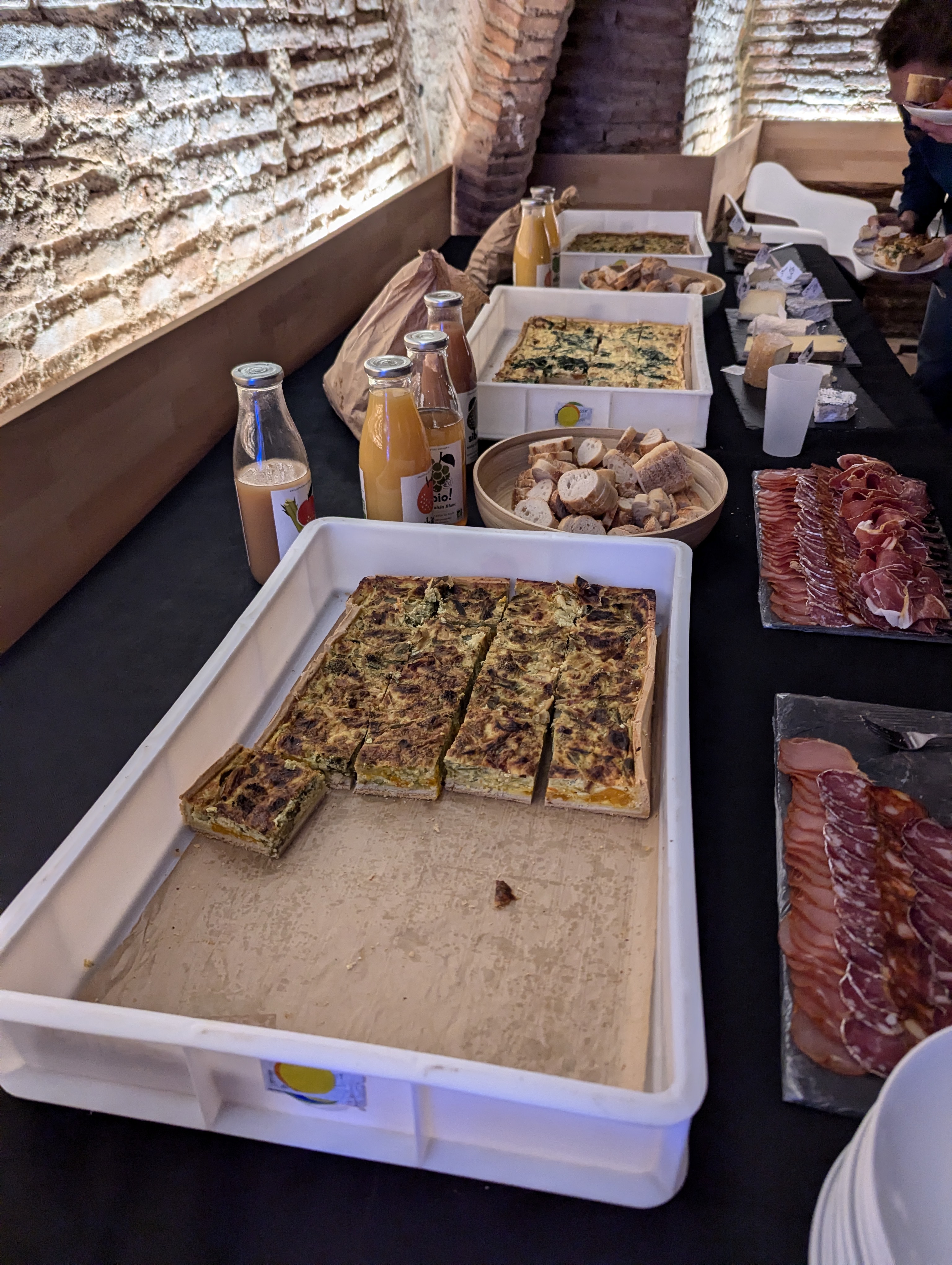


 The hospitality was exceptional. Our lunches boasted a delicious array of quiches, an enticing charcuterie board, and a superb selection of cheeses, all perfectly complemented by exquisite petite fours. Each item was not only a feast for the eyes but also a delight for the palate.
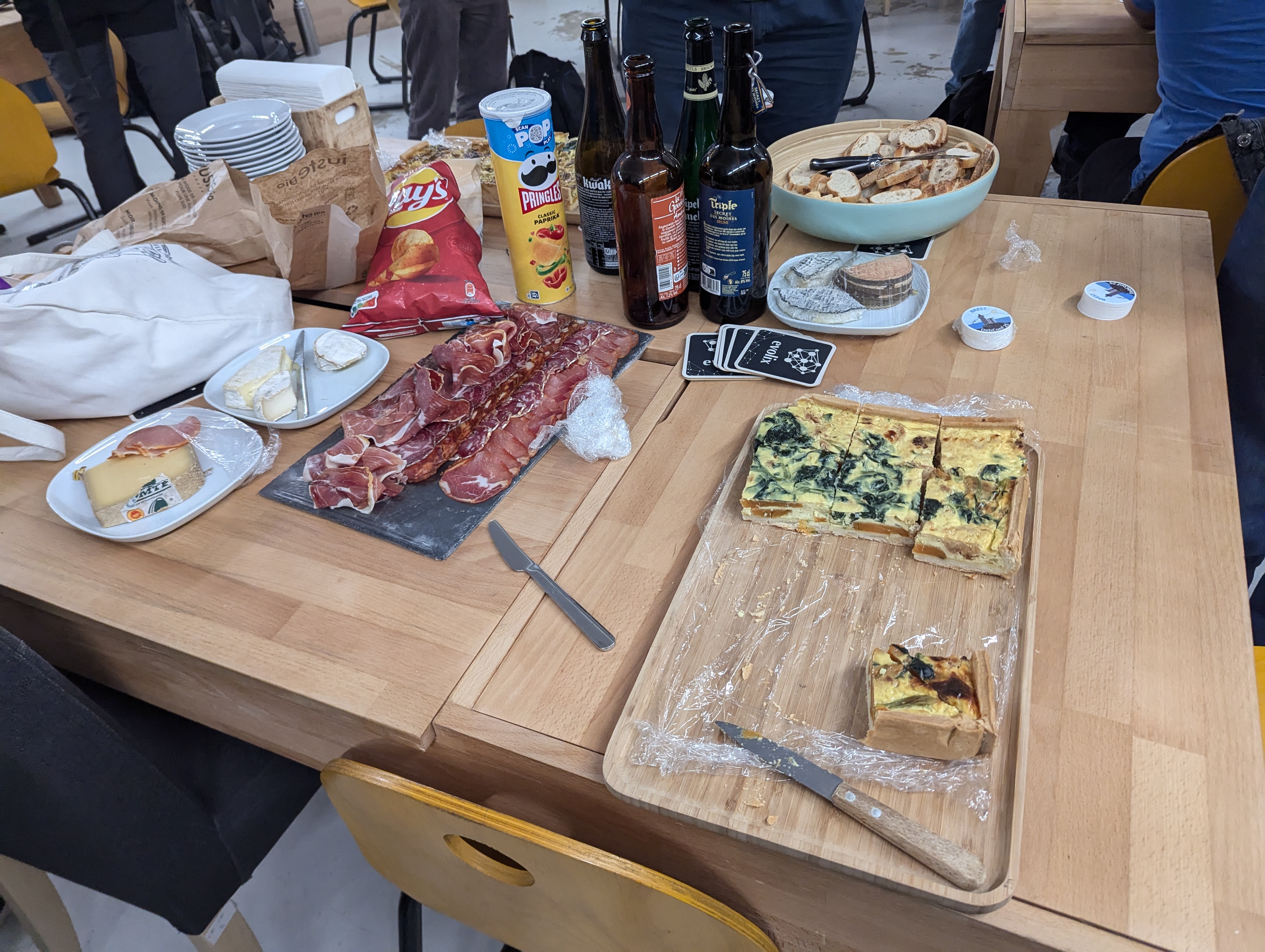
 Leftovers from these gourmet feasts fuelled our impromptu cheese and wine party on Thursday evening a highlight where informal chats blended seamlessly with serious software discussions.



 The enchantment of Toulouse doesn't dim with the setting sun; instead, it transforms. My evening strolls took me along the banks of the Garonne, under a sky just turning from twilight to velvet blue. The river, a dark mirror, perfectly reflected the illuminated grandeur of the city's architecture. Notably, the dome of the
 The MiniDebConf itself, part of the larger Capitole du Libre event, was a fantastic immersion into the world of free software. Unlike the ticket-free FOSDEM, this conference required QR codes for entry and even had bag searches, adding an unusual layer of security for a software conference.
Highlights included the crepe-making by the organisers, reminiscent of street food scenes from larger festivals. The availability of crepes for MiniDebConf attendees and the presence of food trucks added a festive air, albeit with the inevitable long queues familiar to any festival-goer.

 The city's

 Toulouse's markets were a delightful discovery. From a spontaneous visit to a market near my hotel upon arrival, to cycling past bustling marketplaces, each day presented new local flavours and crafts to explore.
The


 Our conference wrapped up with a spontaneous gathering at La Brasserie Les Arcades in Place du Capitole. Finding a caf that could accommodate 30 of us on a Sunday evening without a booking felt like striking gold. What began with coffee and ice cream smoothly transitioned into dinner, where I enjoyed a delicious braised duck leg with green peppercorn sauce. This meal rounded off the trip with lively conversations and shared experiences.


 Returning from Toulouse, I found myself once again in seat 1A, offering the advantage of being the first off the plane, both on departure and arrival. My flight touched down in Bristol ahead of schedule, and within ten minutes, I was on the A1 bus, making my way back into the heart of Bristol.


 A short status update of what happened on my side last month. A broken
gcovr in Debian triggered a bit of busy work but 0.39.0 came out
nicely nevertheless. We also reduced build time quiet a bit in phosh
and phoc.