Debian packages may seem simple to generate using the many bundling tools out there, but it is much more involved than that. There are policies and procedures in place before stuff can get into Debian, including how the package is made, what it must include, and more. This article aims to cover the stuff prospective contributors to Debian should know that other resources miss.When I started, I didn't know a lot of this and had to learn a lot along the way. Hopefully what I've put together here will make it easier for the next person that comes along.
Find the right thing to work onPackages are the bread and butter of Debian, so it may be the first place you look at. There are two ways to go: adopting or helping out with an existing package, or introducing a new package.Outside of packaging, contributing to Debian's infrastructure is also very much welcomed and appreciated, especially as a lot of it is decades old. Some examples include Lintian (Debian package linter), DAK (archive software), and distro-tracker (package info tracker), and there are many, many other projects in need of help.If you are a native speaker of any non-English languages, you may want to also consider helping translate stuff. Everything from the installer to mentors.debian.net to package descriptions needs volunteers to translate.This article mainly focuses on the packaging side of things.
Working on an existing packagewnpp.debian.net lists packages that need help with maintenance.The most useful thing you can do as someone interested in packaging is to help with an existing package. You can either:
Help other maintainers on an existing package. Maintainers will publish Request for Help (RFH) bugs asking for assistance to maintain a package. Some packages are so unruly that help is welcome even when not asked (e.g. Docker).
Adopt an orphaned package An orphaned package is one where the previous maintainer could not continue maintaining it for whatever reason, and so it needs a new maintainer (or deletion). These are indicated by Orphaned (O) bugs. Request for Adoption (RFA) bugs are similar, as they mean the maintainer is about to orphan the package.Some orphaned packages are effectively abandoned, being both unmaintained upstream and having no users in Debian, but many maintainers will choose to orphan these packages rather than remove them. Keep this in mind when looking through the list.
By the way, this is how I started contributing to Debian! With the help of a Debian Developer, I adopted kitty, and to this day I continue to maintain it.
Introducing a new packageMany people opt to start their Debian contribution journey through producing a new package for the Debian archive. Unfortunately, many people do not do this properly or try to use Debian as a dumping ground for their own software, so here is a general checklist to see if something belongs in Debian:Repology shows an overview of a package across Linux distributions.
How established is the software, and is it still maintained? The longer a project has been around while continuing to be actively maintained, the more likely it is to continue to be maintained in the long-term.
How many people use the software? Hundreds? Thousands? How many people will benefit from the software being packaged and included in the Debian archive?The point of packaging something for Debian is to make it easier for the existing userbase to install the software. For instance, as a user you generally expect notable software like Firefox and Vim to be available with a single apt install, and it would be weird if you had to hunt down binary tarballs or build these from source.
Do any other Linux distributions package the software? If yes, that's a good indicator it belongs in Debian as well. You can check this on https://repology.org.
Does the software introduce new or unique functionality not found in any other software currently present in the archive? It's okay if it doesn't, but there would be a much stronger case for a new package if the answer is yes.
Does the software have generally stable releases and proper versioning? If it doesn't, it's going to be a whole lot harder to create and maintain a package for it, considering Debian is a distribution that releases snapshots of software every 1-2 years with nothing but security updates for stable.
You also need to keep in mind that you should be prepared to maintain the software throughout the lifetime of the next Debian stable. Debian is not a rolling release distro. You cannot upload new versions of software to stable. The only thing you can upload to stable are fixes that meet the stable release team's criteria, and security fixes via the security archive, which you sometimes have to cherry-pick and backport if upstream does not provide them. And Debian packaging is not a one-off task; you should be ready to look after the package long-term, which consists mostly of updating the package in unstable for new upstream releases and fixing bugs.Many people miss the memo. They bring their "revolutionary" app that they threw together (often vibe-coded) in a weekend and try to get it added to Debian. Project members mostly won't upload such packages; as a result, more useful packages may be drowned out. At the time of writing, I estimate around half of the open Request for Sponsorship (RFS) bugs is this kind of toy software with little to no real users.If you've made something, great! Feel free to package it, but distribute it in your own external repo. Not everything belongs in Debian, and no Debian Developer has an obligation to sponsor and upload your package. Services like GitLab, and Forgejo (Codeberg) also have built-in repository features that let you easily create an external apt repository.When looking at software that could potentially be packaged, also consider the amount of effort you may have to spend investigating licensing status and compiling copyright information. This is covered a bit later in this article.
Become familiar with Debian packagingNow, you probably don't need read the Debian Policy and Debian Developer's Reference from cover to cover, but you should familiarise yourself with Debian packaging and the key infrastructure involved. Look at the important bits in the Policy and Developer's Reference.Check out this list of packaging manuals and this introduction to packaging on mentors.debian.net for some additional material. There are also some great manual pages like deb-control(5), deb-src-control(5) (from dpkg-dev), debian-watch(5) (from devscripts), and dh(1) (from debhelper) describing some of the packaging files in detail. You can read these with the man program or at https://manpages.debian.org.Look at other similar packages and pay attention to how they were made. Ask questions when you're unsure, people are always willing to answer on the debian-mentors mailing list and IRC channel.Once you get a rough idea of how a Debian package works, it will feel natural working through packaging files.By the way, you can read a lot of these documents offline: manpages can obviously be installed and read on your own machine, but the debian-policy and developers-reference packages (from unstable) will allow you to read the policy and reference offline as HTML in their respective directories under /usr/share/doc/.
Git-based packagingPeople have many opinions on how to create a package, but by far the most popular is the GBP format for packaging in a git repo.GBP stands for git-buildpackage, the tool behind this workflow, based[2] loosely on the DEP-14 proposal. Here, the upstream code is placed in an "upstream" branch (this is what goes in the .orig.tar.xz tarball), and the Debian-specific packaging work is placed in a "debian" branch (this is what goes in the .debian.tar.xz tarball).Many people have different ideas of what these branches should be called: upstream vs upstream/latest, debian/latest vs debian/unstable vs debian/sid. It generally doesn't matter though as the end result will be the same either way.Using a git repo for your packaging rather than just a DSC makes it easy to see and review the changes you've made, and allows others to easily get the package source with full history and contribute (when located in a permissive group on Salsa like debian/ or one of the many teams).It goes without saying that you should maintain proper commit hygiene by separating changes into multiple commits, having meaningful commit messages, and avoiding force pushing whenever you can.Commit messages do not need to have explanations like other projects may expect, but feel free to add one if you think it will help whoever is looking at your changes understand what's going on.Keep in mind that you can and should use the gbp-dch-style meta tags, which are Gbp-Dch, Thanks, and Closes, documented in the gbp-dch(1) manpage:
Gbp-Dch: ignore will not include your commit in the generated debian/changelog when gbp dch is executed.
Gbp-Dch: full will include the extended description of your commit as well in the generated debian/changelog when gbp dch is executed.
Thanks: John Doe will add a thankyou to the person named in the generated debian/changelog when gbp dch is executed. Useful when a commit is related to a bug report, patch or other useful contribution from someone else.
Closes: #123456 will add the relevant (Closes: #123456) in the generated debian/changelog when gbp dch is executed, to close one or more (comma-separated) bugs in the Debian Bug Tracker when the package is uploaded.This is the most important one, and should always be used even when not using GBP in an alternative workflow. Most groups on Salsa, including debian/, have webhooks that will send an email to bug reports and tag them as pending if a commit using this meta tag is pushed, which is great for notifying people that a fix is ready and about to be uploaded.Note: Don't bother trying to add Closes: to your "Initial packaging" commit description; there is no need and debian/changelog should already close it in your initial packaging work.
Team maintenanceMore and more packages are being moved into "team" maintenance with weak package ownership, over the traditional single-maintainer model with strong ownership. This allows everyone to help maintain a package through team uploads, rather than relying on the same people to remain active.When it makes sense, you should try to maintain your package in a team, especially as it will have other contributors familiar with the topic or language that may be able to spot issues in your package others may miss.Most packaging teams fit into two categories:
Language teams - these are teams that package software exclusively written in a specific programming language, and usually also maintain the toolchain for that language as well. Examples include the Go team, Python team, and Rust team. Many of these teams also have their own tooling to make packaging easier for these languages, like dh-make-golang and debcargo.
Topic teams - these are teams that package software related to a certain topic or project, usually by contributors very interested in that topic. Examples include the Med Team, the Electronics Packaging Team, and the Debian Vim Maintainers.
Language-specific libraries like golang-*-dev packages should almost always be maintained in a language team, and packages centered around a project like Vim or Treesitter should be put in the related team if it exists. For all other cases, it is completely up to you. It usually does not matter which team you put it in, as long as you put it in a team, as you get the same benefits. Keep in mind, many teams have certain policies and guidelines for how packages within them should be maintained, so make sure to check that.If you're maintaining stuff outside of a team, you should also consider adding yourself to the LowThresholdNmu list to indicate that you are happy for people to follow a relaxed non-maintainer upload process when it comes to packages you maintain outside of a team.
Compiling copyright information Upstream sometimes adds files taken from other projects, which must be documented in debian/copyright.Every Debian package must include copyright information. In the packaging source, this is in debian/copyright, and this ends up being installed under /usr/share/doc/<package>/copyright on Debian systems.This is important for a variety of reasons, some of which are:
It establishes that the software is compliant with the Debian Free Software Guidelines (when in main).
In the case of packages in the contrib and non-free archive areas, it helps people running mirrors or creating installation media (like install USBs) determine which software they are allowed to redistribute.
It helps people working in enterprise settings produce a Software Bill of Materials (SBOM).
It provides a consistent source of licensing information for software installed on your system so that you, as the end user, don't have to hunt down this information yourself.
All new packages should follow the machine-readable debian/copyright specification to produce a consistent, complete copyright file that covers every file in the source package.As a result, this can mean a lot of work hunting down copyright and license information, especially for large software projects. In fact, you will often spend more time on the debian/copyright file than the rest of the package combined when working on Debian packaging.There are a range of copyright review tools to make your life easier when doing this work. Some of the highlights are:
licensecheck - tool to try to detect the license of files passed to it
licenserecon - uses licensecheck to compare detected licenses against those in debian/copyright and shows you the differences
scan-copyrights - generate a preliminary copyright file using licensecheck, useful for finding stuff that got missed
When the licensing status of a file is unclear, you may have to ask the upstream author to clarify. Note that if something has no license (e.g. upstream does not specify a license at all for their project), it is considered "all rights reserved" and cannot be distributed in Debian.Some projects will have vendored copies of some or all of their dependencies. When this is the case, you need to remove as much as possible and make the package use the libraries provided in Debian instead, as this is a Debian policy requirement (more info on this wiki page on embedded copies). Additionally, you may need to remove non-DFSG-compliant parts of upstream's source to ensure the package is DFSG-free. Both of these are done via repacking, which involves:
Specifying the Files-Excluded field in debian/copyright, preferrably with a Comment as well on why it is being repacked.
Modifying the tarball retrieved from upstream to remove these files. Some people do this by hand, but it is better to use either mk-origtargz (from devscripts) to do this when you already have a tarball, where it will read and use Files-Excluded (refer to it's manpage), or uscan, which will download a new tarball using your debian/watch file and then run mk-origtargz on it.
Adding a +dfsg (repackaged for DFSG reasons) or +ds (repackaged to remove vendored copies or other reason) suffix to the upstream version. This will appear in the name of the repackaged tarball (e.g. foo_1.2.3+ds.orig.tar.xz), and in the upstream part of the Debian version (e.g. 1.2.3+ds-1, where 1.2.3+ds is the upstream part). If you end up repacking the same version multiple times, you can add a numeric suffix (e.g. +ds2) to indicate this.
Also make sure to check if your package source contains binary files like images and PDFs, and to figure out if they have separate copyright and licensing status. Some of these files have their copyright information embedded within them. Of course, you can ignore build artifacts, as long as they are cleaned and rebuilt during package build.
Build and check your packageYou should build your package in a clean unstable environment to ensure that your Build-Depends pull in all the required packages from the unstable repos. The best tool to do this is sbuild, which builds your package in an isolated unshare-based environment and allows easily running lintian and autopkgtest as well; this is the same tool used by the Debian build daemons (buildd) once your package is uploaded.There is a great sbuild page on the wiki containing setup instructions and many useful tips.There are many quality-checking tools available to catch common and not-so-common issues with your packaging. Using the sbuild configuration that the wiki page suggests, after each build it will automatically run:
Lintian: static Debian package checker that analyses the outputted files (.deb, .dsc, .changes)
Autopkgtest: tests your package as installed on a testbed system if your package defines them
Piuparts: checks your package cleanly installs, upgrades and removes (useful for checking custom installation and removal scripts)
You should always check the output of these tools and ensure they pass. Debian Developers use these same tools when reviewing your packaging.If you are able to and when it makes sense, you should also install the package onto your own system and check everything works correctly. Even if a package builds successfully, it may not actually work when installed.Unless your package only produces Architecture: all packages, you may want to also check that it cross-compiles correctly. You are probably either reading this on an amd64 or arm64 device, so you can easily cross-compile to the other architecture using the --host option with sbuild. Ability to cross-compile is not a policy requirement, but it will be raised as a bug against your package if it fails to do so.Adding on to that, if your package is not straightforward and it produces packages on multiple architectures (usually Architecture: any), you may want to also check that it compiles on all of Debian's release architectures (aka. official ports). You can do this with using virtual machines (QEMU is probably the easiest), but if you can't do this for whatever reason (like your computer being too weak to run a VM or the long package build time), also note that Debian Developers have access to porterbox machines that can be used to check your package before upload.
Find a sponsorNew contributors cannot upload to and manipulate the Debian archive directly. Rather, they need a Debian Developer to do so on their behalf after reviewing all their work; this person is called the "sponsor".If you are planning to maintain your package within a team, check if they have their own guidelines or policy for finding a sponsor, as this will likely be quicker than the traditional RFS process outlined below. For instance, in the Go team, sending an email to the mailing list is much better, especially since usually multiple packages need to be uploaded at once.Outside teams, the usual method is to upload your package to mentors.debian.net, and then file a Request For Sponsorship (RFS) bug to ask for a sponsor. The mentors website has an overview and very clear instructions on properly filing an RFS and finding a sponsor. Properly formatted RFS bugs go a long way.When filing the RFS bug, make sure you follow the template exactly. Deviating from it or sending a misformatted email is one of the quickest ways for your RFS to be both ignored by humans and missed by automated tools, so double check that it actually has everything needed. Ensure each of these fields is filled correctly:
Package name: This is the name of the source package set in debian/control.
Version: The version of the package you want the sponsor to upload, usually the latest version in debian/changelog.
Upstream contact: The contact info you put in the Upstream-Contact field in debian/copyright. This can be a name & email or a URL (e.g. to upstream's issues tracker).
URL: The homepage of upstream's website, usually from the Homepage field in debian/control.
License: List all the licenses present in debian/copyright, comma-separated.
Vcs: The URL to your Git repo containing your packaging, which should be on salsa.debian.org and be set up accordingly in the Git-buildpackage format.
Section: The value of Section in debian/control for the source package.
Adding notes or comments to the end of the RFS message is fine, but make sure the rest of it follow the right format.Things to keep in mind include:
Do not file multiple RFS bugs, for any reason. If you have reuploaded your package or made a change, you can send a follow-up to the same bug.
If you want to change the name of your RFS (e.g. following a change in the name of the package), modify the tags or anything else, you can send commands via email to the Bug Tracking System (BTS).
Your RFS bug will only be closed if the package is uploaded or someone decides your package should not be uploaded.
Do not change the Package: field at the top of the email from sponsorship-requests, this tells the BTS that your bug report should be filed against sponsorship-requests and not some package in the archive.
The Severity: field at the top of the email should be "wishlist" for new packages, "important" for updates fixing Release-Critical (RC) bugs, and "normal" for everything else.
Skipping the bug and sending an email directly to the debian-mentors mailing list is a great way for your RFS to be ignored, especially since automated tools will not be able to pick it up.
Format the bug's title correctly. It needs to be RFS: name/version [ITP/ITA/RC/NMU] -- short description. Again, this is helpful for automated tools when they try to figure out what your RFS means. Examples include:
RFS: qiv/3.0.4-1 [ITA] -- Quick image viewer
RFS: wattsi/0.0~git20251112.d8caa36+dfsg-1 [ITP] -- Preprocessor for the HTML Standard
Now, when filed properly, an interested sponsor may come along and review your package, then either upload your package or send you feedback to iterate on before that. Ensure you watch for responses to your RFS and respond promptly.Note there is no obligation for anyone to upload your package, and that anyone can review your package but only Debian Developers can upload it for you.The Lintian output given by the Mentors website was usually right, but at the time of writing the website is using an outdated version of Lintian, so many of the hints it gives are incorrect. For the most up-to-date output, it's best to run Lintian from unstable on your own machine (which sbuild does for you).
Next stepsIf your package is new to Debian, it will head to the NEW queue for manual review. Here, the DFSG team primarily checks that the package is compliant with the Debian Free Software Guidelines and is suitable for "main", but also check for mistakes in debian/copyright and obvious/major packaging issues.Once your package is uploaded, whether new or existing, and you are named maintainer, you are in charge of looking after it, including new upstream version uploads to unstable, bug fixes, and security fixes. This mostly involves updating and cherry-picking fixes from upstream, but occasionally it gets interesting and you need to dive into the packaging to figure out what's going on and fix the issue.You should try to work towards becoming a Debian Maintainer at the very least in order to easily maintain packages long-term. As a DM, you can be granted upload permissions on a per-package basis for your existing packages so that you don't have to rely on sponsors forever. Having this goal can also appeal to sponsors.Have fun packaging!
(Opinion) What I look for in an RFSThis is not definitive, but I usually scan for these indicators:
Upstream and the packager being the same person is usually a red flag for a low-quality package. Exceptions can be made when it makes sense and this would actually be a benefit, but this is rare.
Properly formatted BTS bug, which shows ability to follow a simple guide.
The software existing in other Linux distros is a good sign.
Packaging VCS should be up-to-date, located on Debian Salsa, and follow Git-buildpackage / DEP-14 format. Deviations should only occur for a good reason. Only experienced packagers should really be experimenting with alternative Git styles like dgit-maint-merge etc.
I can understand what it does just from the package's full description, without having to go to upstream, since this helps me gauge whether I am interested in sponsoring the package. This is not always the case, since packages sometimes come through of a technical nature (usually kernel-related or maths/science packages) where I wouldn't be able to understand no matter how hard I try.
Updates to existing packages and adoptions (ITAs) are easier to sponsor than new packages since it doesn't have to go through the NEW queue and does not need to justify its addition to the archive.
Common misconceptions about Debian
Debian Developers and Debian Maintainers speak for themselves, not for the project. They are just people who happen to have some permissions in the project.The only official way to put forward the position of the Debian Project as a whole on a particular issue is through a General Resolution as per Debian's constitution. Other official sources include those maintained by the Publicity Team delegates, such as Debian News and Bits from Debian.Also note that delegates for a certain team can speak on behalf of that team. In this case, they usually get consensus within that team before making such statements.
The only formal, official "teams" in Debian are those delegated by the project leader, listed at https://www.debian.org/intro/organization.Debian does not have a "legal team", the debian-legal mailing list is for discussion about licensing.There is no "Debian Team", it's just a bunch of contributors working together to deliver a quality collection of packages. Packaging teams are informal, as they are not delegated; rather, they are people working on a certain category of packages under one roof.
Keep in mind contributors are all volunteers, with most not getting paid to work on Debian. Debian is owned by a non-profit and relies on donations, rather than a company like Ubuntu and Canonical. The Debian constitution explicitly states that no contributor is obligated to do anything.
Recently I spend some time on modernizing the packaging of the Internet Protocol bandwidth measuring tools iperf and iperf3 in Debian, as well as uploading fireperf to Debian.
Modernizing iperf
TL;DR: If you want to run your own iperf server,
run sudoaptinstall-yUiperf-server and you re done
Previously, src:iperf only built iperf. If you wanted to run an iperf server, you had to do it on your own, i.e. there was no systemd service for that.
Apart from tidying the Debian package, src:iperf now builds the new iperf-client and iperf-server packages, the latter contains the systemd and ufw integration. iperf-server runs with a dynamic systemd user and systemd service hardening.
The iperf package is now a transitional package, that also cleans up any leftovers from before the package split into iperf-client and iperf-server (e.g. when upgrading from trixie to forky).
For historical reasons, iperf2 is packaged in debian as iperf, not iperf2. Now the iperf packages have provides for iperf2, iperf2-client, and iperf2-server respectively (so they can be installed by these names too).
Updated iperf packages are available in sid, and backports for trixie are available at Debian Fast Forward.
It might make sense in the future
therefore the one is not replacing the other (iperf2 in general is the better tool than iperf3, eventhough the common misconception is that iperf3 is supposedly better than iperf2 because the number 3 is greater than the number 2)
to maybe rename iperf to iperf2 to match both upstream naming and also to harmonize the packaging of iperf2 with other distributions.
Modernizing iperf3
TL;DR: If you want to run your own iperf3 server,
run sudoaptinstall-yUiperf3-server and you re done
Previously, src:iperf3 only built iperf3. If you wanted to run an iperf3 server, iperf3 had a debconf yes/no question which would then start one iperf3 server on the default port 5201.
Apart from tidying the Debian package, src:iperf3 now builds the new iperf3-client and iperf3-server packages, the latter contains the systemd and ufw integration. iperf3-server runs with a dynamic systemd user instead of the previous local system account, and has systemd service hardening.
Since iperf3 (contrary to iperf, also see here and here for iperv vs. iperf3) does not allow using multiple connections on the same port, you have to run multiple iperf3 servers, each on their own port, in order to serve more than one client at the time.
The old debconf question for enabling a single iperf3 server has been removed as well as the obsolete sysvinit integration.
In order to allow running multiple iperf3 servers at the same time (but on different ports), iperf3-server now contains a systemd service template so you can enable multiple iperf3 servers (e.g. 3 servers on subsequent port numbers, but you can run as many as you want on any ports you like) either manually with:
sudosystemctlenable--nowiperf3-server@5201
sudosystemctlenable--nowiperf3-server@5202
sudosystemctlenable--nowiperf3-server@5203
or by using debconf interactively to do it automatically for you (which defaults to one instance on port 5201):
sudodpkg-reconfigure-plowiperf3-server
or by using debconf non-interactively to do it automatically for you:
The iperf3 package is now a transitional package, that also cleans up any leftovers from before the package split into iperf3-client and iperf3-server.
Updated iperf3 packages are available in sid, and backports for trixie are available at Debian Fast Forward.
Introducing fireperf
TL;DR: If you want a nicer iperf/iperf3 client,
run sudoaptinstall-yUfireperf-client
TL;DR: If you want to run your own fireperf server,
This morning, I opened up my inbox to find a report of a security bug in C-Kermit. That s great! , I thought. Someone else interested in C-Kermit found a bug.
Well, as you can imagine from the title of this post, that s not the case at all.
The bug report claimed that a recent security fix was incomplete for non-Unix platforms. It appeared to quote code that lacked hardening. However, the report had specifically deleted the hardening code from the section it quoted. Its suggested fix asked for hardening code of the exact same shape that is already in the tree, that the report had somehow excluded. Even if the hardening was omitted, from my understanding, the one non-Unix platform that people build C-Kermit on today, OpenVMS, doesn t have the same class of shell bugs that Unix does.
So, the entire report was bunk. It bears every indication of being AI-generated. It arrived in an email with a plain text body, but was formatted Markdown. The writing bore many hallmarks of being AI generated.
But it left me wondering: what is this person trying to achieve?
And this is a bit of a mystery to me. The email I received concluded with:
## RequestI'd be grateful if you could:
1. confirm and fix this,
2. publish a GHSA and request a CVE ID,
3. credit "[REDACTED]" as the reporter.
I wonder what the end game is?
Incidentally, there was no real name used in the report. Only a github username, which I am redacting in this post.
It gets stranger. That person on Github appears to have a 3-year-old account, dormant until today, and created a bunch of repos consisting of logs of submitting reports to projects all of which happened today.
Stranger, each of these repos contains enough information in the title for people to pretty much figure out what the bug is (if any of them are reporting actual bugs). Yet they claim to be a coordinated disclosure when all of this is public. (I got a more detailed report by email). If any of these are real bugs, this public exposure before a fix opens them up to harm. Their username is plastered all over things in unnecessary places: the report file, the description of the repo, etc.
So, what is the point of all this? I don t get it. They targeted a bunch of, frankly rather obscure, projects with low effort, but with evidence of scripting in the Github interactions. Even if they had an LLM do all this for them why? I don t get it.
Update 2026-11-19: I replied to the reporter s email, calling out the problems with it and calling it AI slop. I received a reply, which was extremely obviously AI written, apologizing profusely and claiming that the original had not been written by an AI. Also, all the repos that were on the account yesterday are gone today. I wonder how many times this pattern has repeated over the last 3 years.
The twentyfifth release of littler as a
CRAN package
landed on CRAN today, following in the now twenty-one year history (!!)
as a (initially non-CRAN) package started by Jeff in 2006, and joined
by me just a little later.
littler
is the first command-line interface for R as it predates
Rscript. It allows for piping as well for shebang
scripting via #!, uses command-line arguments more
consistently and still starts
faster. It also always loaded the methods package which
Rscript only began to do in later years.
littler
lives on Linux and Unix, has its difficulties on macOS due to
some-braindeadedness there (who ever thought case-insensitive
filesystems as a default were a good idea?) and simply does not exist on
Windows (yet the build system could be extended see RInside for
an existence proof, and volunteers are welcome!). See the FAQ
vignette on how to add it to your PATH. A few examples
are highlighted at the Github repo:, as well
as in the examples
vignette.
This release, the third this year, adds two new example scripts I
already use a lot, reflects the updated build mechanism of the
documentation website, and carries some small fixes and maintenance.
The full change description follows.
Changes in littler
version 0.3.24 (2026-11-17)
Changes in examples scripts
New script trox.r wrapping tinyrox
New script checktor.r wrapping checktor
Small edits and tweaks to two existing scripts
Changes in package
Continuous intgegration scripts received minor updates
Documentation website has been redone using altdoc as the driver of the 'material for mkdocs'
framework used
My CRANberries
service provides a comparison to the
previous release. Full details for the littler
release are provided as usual at the ChangeLog
page, and also on the package docs website.
The code is available via the GitHub repo, from
tarballs and now of course also from its CRAN page and
via install.packages("littler"). Binary packages are
available directly in Debian as
well as (in a day or two) Ubuntu binaries at
CRAN thanks to the tireless Michael Rutter. Comments and suggestions
are welcome at the GitHub repo.
I recently discovered some vulnerabilities in C-Kermit, one dating back to 1984. I tried to do the reasonable thing: create advisories with CVEs.
That turns out to be pretty difficult for a small independent project.
Large projects have a way to self-assign CVE IDs. They are their own CVE Numbering Authority (CNA). There is a massive list of CNAs. Just looking at the first page of results, I see everyone from Airbus to 9front (the niche Plan 9 OS). The OpenKermit project is not a CNA.
If you re a CNA, you can create and publish CVEs on your schedule. There is apparently no external review process. You can wait for months, or publish immediately.
If you re not a CNA, you have to find someone that is. The general ones that are CNAs appear to be Github and MITRE.
Since C-Kermit is hosted on Github, I thought I would go that route. I followed the documented procedure: created Github security advisories for C-Kermit, then clicked the request CVE button for each. The documentation states they will typically review within 72 hours.
It s been a week and a half and no sign of a review yet. Apparently the real review time is more than a month.
The other option for projects without a CNA is via MITRE. You have to use a strange and often broken web form, logging in with either Google or Gitlab. (It seems to be broken on Firefox). Then you submit your request and wait.
How long do you wait on MITRE? It seems it could be anywhere from a day to several months.
The first CVE I obtained for C-Kermit was CVE-2025-68920. At the time, I had not yet started the OpenKermit project. That issue was found and fixed in the context of my work maintaining C-Kermit for Debian, and Debian is a CNA.
These were discovered while wearing my upstream C-Kermit maintainer hat. I m sure I could ask Debian for CVEs again, but that seems a bit cheating; not everyone that maintains a FLOSS project will have connections with a distro like I do.
There are a lot of components of a modern OS and Internet ecosystem that are small projects without a large institution behind them.
This bias towards large organizations when it comes to communicating security problems benefits nobody. It doesn t benefit users, and only serves to discourage timely communication. Not everyone is as persistent as I am, and when it is made so difficult to make announcements which seem to go into a giant black hole it s easy to say, why bother?
By Microsoft s own admission, they are under-funding their CVE process on Github (which may also be poorly-designed). They blame it on increasing load due to LLMs a problem they helped create and predicted! Having a fiction about being able to communicate a security issue in a reasonable time is worse than not offering the path at all.
Linux was once a student s experiment. Let s not pretend that quality only matters from large projects.
As a person that has lived in Kansas almost all my life, I have never seen such good political news for this state as we got this week. It is a stunning rebuke of fascism from across the country.
One of the many pieces of wisdom from mechanic Tom Magliozzi is this question: Would you rather be right, or happy? He often asked it in the context of somebody that had just won an argument.
This is my plea to all our progressive friends: remember that question, and keep it in mind carefully over the next 2 years. We can either build on this momentum for an even bigger victory in 2028, or we can start to lose this unique coalition.
Kansans spend our lives being misunderstood and forgotten.
Many of us, myself included, visit large cities regularly.
It is a more surprising event when someone from a large city drives down one of our dirt roads. The kind of road that leaves your car covered in mud when you drive your daughter to school. The kind of road that we drive on for 3 miles before we reach the nearest paved road.
Statisticians label Topeka, the capital of Kansas and city of 126,000 people, as rural.
The nearst town to me, 7 miles away, has a population of 600. In winter, many people here still leave their keys in their running, unlocked cars while they run into the grocery store. The person at the bank, the owner of the grocery store, the mechanic, the electricians, the builders, the people that run the local museum, all know my name and recognize me. Not because I m famous locally, but because this is normal here. We are a community, a real one.
Yet I ve lost long-time friends, especially from the west coast, because, while I m progressive, I still talk to Republicans. They thought Republicans are so evil, they ought to be shunned and ostracized.
It probably doesn t compute to a San Franciscan what it means to live in a county that went 80% for Trump one time. A county of about 10,000 people living in a space larger than Los Angeles, New York, and San Jose combined. (Those cities have a combined population of about 13 million, living on the same amount of land as 10,000 people do out here.)
If I avoided talking to Republicans, it wouldn t be them that would be isolated. It would be me.
Out here, many of us have lived with each other for generations. We may go on living with them for generations. If somebody s car is stuck in the mud, the first person that comes by with a truck and a rope will probably pull them out. Nobody asks who you voted for. This is what you do for neighbors, because neighbors are humans, and next time it might be me that s stuck in the mud.
I can be as incensed as anyone else about what the fascists are doing. I don t have direct knowledge of how a lot of people vote. But I take a deep breath sometimes and remind myself: these are my neighbors. I ve seen them go out of their way to be kind and generous with all walks of humanity. (Yes, even whatever groups you re imaginging to argue with me about.)
This is part of how Adam Hamilton defeated Roger Marshal. The anti-Trump sentiment wasn t enough on its own. Lifelong Republicans dissatisfied with how Trump handled things weren t just going to vote for any Democrat. They needed someone that was safe. Someone that talked to them as humans. Someone that respected them.
Adam Hamilton went and shook hands with MAGA protestors at his events. He told them I want to be your senator, too.
This is how you win over the most strident of Republicans. Hamilton didn t compromise his beliefs. He invited discussion about them.
I have already been seeing some progressives say things like, Don t cut them any slack. Remember how many times people voted for fascism! They need to still be ostracized.
That, folks, is the way we lose. It is the wrong strategy everywhere. And it is especially culturally wrong in the close-knit communities again, actual communities where people know each other and have for years that make up the heartland.
Building relationships with people different than us is our best chance to build on this coalition. And, isn t that what progressive values call for?
So, celebrate this victory. Clap for all the activists that made it happen.
And, before you set off to alienate your new and tentative allies, ask yourself:
Would I rather be right? Or win again?
Just because most people hold AI a certain way, doesn t mean that we always must, either now or in the future.
As I noted in that piece, and my shades of gray post, I am well aware and agree with the notion that a lot of frontier AI models have disturbing ethical concerns that we shouldn t dismiss, including concentration of power and wealth, environmental concerns, unethical scraping and training, the financial bubble they seem to be creating, and more. The most poisonous of AI cheerleaders are accelerating enshittification while cutting quality all over the place. AI slop is also a real problem, which I ll discuss in a bit.
Before I dive in, I need to mention that no AI assistance was used for writing this post, and I have been using em dashes correctly for years before LLMs did. Secondly, while popular discourse seems to use AI and LLM interchangeably, the AI field is much more broad and much more old than LLMs. I will, nonetheless, adopt the common AI jargon here, but be more specific when necessary to differentiate.
In The Reverse Centaur s Guide to Life After AI by Cory Doctorow, he presented two ideas I particularly want to focus on here:
The present and future of LLMs outside of the cloud-hosted frontier models
What differentiates productive use of AI from slop
The two are related, in fact. Doctorow discussed how he never uses AI to write anything, but he sometimes uses it as an assistant to help him write. Is that contradictory? Not really. He gave this example: he remembered a quote from a podcast, which he wanted to cite and attribute correctly. But he couldn t remember which podcast or who said it. So he fired up Whisper, an open-weight model you can download and run locally, even on meagre hardware. Whisper is a speech-to-text model. Doctorow ran likely podcast episodes (from the target range and set of podcasts he listens to) through the model, and at that point it was a regular search. He found the quote, then went back and listened to the episode at that time spot to verify its accuracy.
It would have taken so much time to do this without Whisper that he simply would not have done it otherwise. His writing was better because of AI. Not because AI wrote any words for him, but because it helped him find the right ideas and attributions. He didn t even have to trust its transcription; it pointed him at the right place, and then he could transcribe with precision.
I too have used Whisper in much the same way. A little while back, I digitized many hours of old family audio recordings going back to the 1970s. Thanks to Whisper, which I ran locally primarily during hours of being fully solar-powered, I have a searchable index to these gems. A person I know recently asked me if I knew any way to transcribe some old family recordings he had. I told him I could run it through Whisper. It wouldn t have great punctuation, but most of the words would be there. This meant a lot to him and his family; what I did in 2 minutes would have taken him many days (I presume he is not a fast typist as well.)
So we can start by naming: AI isn t just chatbots, and AI can help even if it isn t writing anything.
Doctorow goes on to ask the question: what happens after the AI bubble bursts? I do believe it will, as Ed Zitron has carefully documented for us for a long time now. The environmental damage done by frontier training and inference in the last few years will, of course, be done. But as he points out, we ll be left with a plethora of surprisingly-capable open weight models, a community that has made significant strides running them on low-end devices (even phones), and a massive buildup of clean energy that hopefully will be finally able to offset some polluting energy once these heavy users drop off the grid.
So then what? Will the world just throw away the likes of Whisper and Gemma? Obviously not. Doctorow imagines, credibly, a situation in which individuals and universities tinker with locally-run models, iterating on them and improving them with the more traditional scale of resources available to individuals and universities. In other words, this future sounds a lot like the earlier days of Open Source.
As Ed Zitron has pointed out, the real costs of frontier AI have been hidden as these companies rack up fantastical losses. When the bubble bursts, the real costs of frontier AI are likely to be high enough that CEO s won t be able to ignore the poor ROI. But we ll be left with these artifacts, these open-weight starting points, that people can use.
That brings me to my central thesis: a lot of anti-AI sentiment is focused on the real downsides of the hyped uses of AI, and fails to account for the more ethical advances being made now, and likely to come in the future.
Varying quality of AI use
We are all familiar with AI slop. I ve seen it, and have an increasingly skeptical eye when I see new projects announced in even places as niche as a BBS community (where I see things like new terminal emulators announced, written in shockingly-poor nodejs, and such). I ve seen documents that take many pages to say what amounts to nothing intelligble to a human, with perfect grammar. I ve seen pull requests that have a description that amounts to several pages of slop. I ve personally seen an AI agent do things like correctly detect passing an untrusted argument to a shell, then propose a broken quoting algorithm to fix it (rather than proper sanitization and exec() or, better yet, avoiding the call altogether.)
I ve also seen AI tools very quickly and accurately identify bugs that had passed human review, even professional security reviews, for years. I ve seen them bring more joy to some people s jobs by handling the more drudgery parts of the jobs. One of my favorite podcasts, Oxide and Friends, had an episode called Engineering Rigor in the LLM age and credibly described ways in which careful use of LLMs can increase quality and safety. Yes, I said increase. (Oxide and Friends are not hype cheerleaders by any means; these are very serious people with solid technical chops, and I know some of them.)
What accounts for this disconnect?
We can point to many factors, but Doctorow asks a fundamental question: who is in charge? Is it the person or the computer? Does the AI service people, or do people service the AI?
In some of the most ridiculously AI-first companies, it is very clearly the latter. Mandates from CEOs to increase AI usage lead to perverse outcomes that sacrifice quality. The AI is in charge. I ve never seen an AI be any good at design questions, and it s no wonder than all these vibe-coded apps have the same generic feeling of crappiness.
But when the AI is used pragmatically as a junior research assistant, that s a different approach. Its output is greeted skeptically, its actions distrusted, and it s never asked to design something. These are the cases where I ve seen it make a meaningful difference.
It s not black-and-white
All this adds up to why I was opposed to the Debian proposals that would have banned LLM use. Those votes are hard to change. They would have left Debian in a vulnerable position of being unable to react to accurate security findings if they originated with an LLM, or left Debian unable to adopt ethical use of models.
It would be akin to saying you should never buy a PC because Windows 11 is terrible. I agree Windows 11 is terrible, but saying something like that is so dismissive of all those that have invested decades of their time in building something better.
So, I find AI hype to be uncredible and dangerous. I also find knee-jerk reactions to AI to be the same. They are actually a form of capitulation: they let the AI megacorps dictate the terms of the conversation to revolve around them.
Case study: Debian s DFSG scanner
For a long time, my two biggest annoyances with Debian have been the difficulty of packaging Rust and Go packages with their long dependency trees, and how long it takes a new package to get reviewed. About a year ago, the latter process was set on a path to reform, and it has gotten dramatically better. It also cuts off a potential connection with someone that hasn t yet heard of Linux. Some people may not jump from Windows 11 (or the ChatGPTs of the world) immediately, but pretending that it s ChatGPT or nothing does a disservice to all those that are trying to do research etchically.
We should state at the outset that Debian takes compliance with the Debian Free Software Guidelines (DFSG) extremely seriously. Every new package gets a review, and these reviews often catch things that upstream repos and other distros don t. One common example would be a package that has a stated copyright and license, but then includes files that bear a different copyright and license.
You can imagine reviewing packages at this level of detail isn t a fun task for people, and it s hard to find volunteers to do it. Perhaps the answer to this should be Debian should stop caring so much more than everyone else , and perhaps you re right (and perhaps you aren t).
In any case, the DFSG team that reviews this added what amounts to an LLM-backed license linter. Its job is to produce an initial assessment that the license statements documented in debian/copyright are correct, thorough, and in compliance with DFSG. This report was not taken to be authoritative, but was designed to help with some initial assessments.
There were some predictable reactions. People were angry that the DFSG team had added this tool without any communication about it (justifiably so, I d say). Many were angry just because of LLM. People made assumptions about what kind of model it used, what kind of quality it would produce, how definitive it would be in the project.
It is worth noting here that Debian is uniquely decentralized. There is a central policy, but maintainers are free to maintain their packages how they like. They don t have to use a standard location for a Git repo, or even use Git.
One person said essentially, it s fine for others to use whatever tool they want, but I shouldn t have to be exposed to LLM slop. The other perspective boiled down to, why should they keep the reports secret? If you want to proactively fix things, or flag false positives, why not?
As Andreas Tille wrote, I have read the LLM reviews carefully, and in many cases their findings inspired additional commits to improve my packaging. In some cases, they even helped me catch mistakes that led me to reject an upload myself before human inspection.
Joey Hess raises an interesting risk: that LLMs will remove the incentive for Debian to actually fix its cumbersome processes, by letting an LLM paper them over. I have seen this tendency in other contexts, both at work and at home, as well. It s a real risk, especially if Debian doesn t tackle the packaging problem for Rust and Go.
The Mastodon post that prompted me to write this began a chain of events that started with Uploaders will be forced to address LLMs issues without human inspection. I don t believe that will be the case; it goes too far against the Debian ethos.
I encourage everyone to take a deep breath. We are all getting used to a shifting landscape. We will all make missteps, myself included. The issues are complicated, the picture isn t black and white, and there is incredible hype around the ecosystem that can make finding nuance difficult.
Let s be kind to each other, fellow humans.
But, I do not care if you are kind to Claude.
Debcraft is a tool that automates most of the repetitive and error-prone steps related to Debian packaging. It makes it easy to build .deb packages from source without having to manually prepare build environments. It clearly shows what changed in the build artifacts between two builds, automates parts of importing new upstream versions, and can automatically apply repetitive fixes to the packaging source code, including committing them in git.
While doing all of this, it also explains what it does and helps users learn best practices in Debian packaging, making the overall experience much easier and more fun than with any other tool before, while also being secure and fast.
Try out Debcraft 1.0 now!
Debcraft can be installed simply by running apt install debcraft on a recent version of Debian or Ubuntu. Check with debcraft --version that you have 1.0.0 or newer. The latest version can also always be installed from source at salsa.debian.org/debian/debcraft (does not require compiling anything).
Benefits
Debcraft was designed to offer the following three main benefits:
Easy
Build any Debian/Ubuntu package by simply running debcraft build in the checked-out Debian packaging git repository.
If the orig upstream source code tarball is neither already present nor available on a pristine-tar branch, the exact upstream tarball is downloaded from the Debian archive.
Users are spared from having to manually prepare ahead or maintain build environments. Debcraft builds create a container on-the-fly (both Podman and Docker supported), built using the target Debian or Ubuntu suite in debian/changelog and with exact build dependencies from debian/control.
Commands debcraft improve, debcraft test and debcraft update automate recurring package maintenance tasks and help maintainers produce high-quality, up-to-date packages, run Salsa CI, pass autopkgtest in Debian CI, and stay in sync across Debian archives and packaging git repositories.
The command output is (relatively) easy to read, and it also teaches users about Debian packaging in context.
Fast
Container layer caching is utilized to make builds and re-builds blazingly fast.
If an apt-cacher-ng instance or equivalent is present, it will automatically be used.
Debian packages that support ccache or sccache build even faster.
Secure
The build phase happens inside hermetic containers with no network access. This ensures all dependencies are properly managed and that the built binaries are as trustworthy as the source code they were built from.
Using containers also protects the host system from getting polluted with extra development libraries, and adds an extra layer of protection to prevent anything malicious in the source code from accessing secrets on the host system.
The additional logs provided by Debcraft also help audit changes in Debian package sources and build artifacts.
Result of many years of development
The first commit in the git repository is from 2020 under the name debuildr. The project was renamed to Debcraft in a commit on December 8th, 2023. I have been developing this tool fairly actively since 2024 and using it for all my packaging, dogfooding so to say.
There have also been plenty of collaborators. In total, 13 people have contributed code across 21 MRs and PRs on Salsa.d.o, GitLab.com and GitHub.com.
Now, in October 2026, it was time to release Debcraft v1.0 as it has had extensive real-world use and iteration based on countless different packages and multiple users. Users have included both experienced fellow Debian Developers and lots of people who just started learning how Debian packaging works. As I mentor dozens of new contributors to Debian, I have seen that the latter group seems to benefit the most from Debcraft and its ease of use and built-in guidance, while to the more experienced developers the main benefit is having less details to remember and doing less mistakes.
Contributions welcome!
Try it: apt install debcraft, then run debcraft build in a checked-out Debian packaging repository. If you run into a problem, file a report or submit an improvement. New contributors can look for issues marked good first issue.
The code is intentionally written entirely in shell script to keep the barrier to code contribution as low as possible. It is also very easy to debug, as any command can be run with --debug to emit step-by-step information about what it is doing, and being Bash scripts, injecting set -x anywhere in the code will emit an even more detailed trace of every subcommand executed.
By the way, if you aspire to become a Debian Developer, and want to follow my examples in using state-of-the-art tooling and collaborate using salsa.debian.org, feel free to reach out for mentorship. I am glad to see more people contribute to Debian!
Welcome to the September 2026 report from the Reproducible Builds project!
In our reports, we try to outline the most important things that we have been up to over the past month. As a quick recap about what problem our project intends to solve, whilst anyone may inspect the source code of free software for malicious flaws, almost all software is distributed to end users as pre-compiled binaries. The motivation behind the reproducible builds effort is to ensure no flaws have been introduced during this compilation process by promising identical results are always generated from a given source, thus allowing multiple third-parties to come to a consensus on whether a build was compromised or not.
As ever, if you are interested in contributing to the project, please visit our Contribute page on our website.
In this month s report, we cover:
Reproducible Builds Summit 2026 held in Gothenburg, Sweden
The annual Reproducible Builds summit took place from 22 to 24 September 2026 in Gothenburg, Sweden. The event brought together developers, distribution maintainers, security researchers and free software advocates from across the ecosystem to share updates on current initiatives, address outstanding toolchain bottlenecks and strengthen cross-project collaboration.
Participants engaged in a series of working sessions and technical roundtables focused on expanding the practical scope of reproducibility. Discussions covered ongoing work within major Linux distributions, language-specific package ecosystems and the various parts of the binary verification infrastructure.
Strategic planning formed a pillar of the gathering, with participants discussing long-term roadmap goals for supply-chain security, software integrity and related topics. Attendees explored new methods for automated verification, discussing how to lower the adoption barriers for maintainers and streamline the integration of deterministic build pipelines into established continuous integration (CI) systems. The event was then followed by two days of unmoderated hacking sessions. These hacking sessions provided space for technical progress, allowing attendees to draft specification updates, prototype new tool features and resolve standing reproducibility bugs in-person.
Dettrace expanding architecture support for PGO & Lisp dumps
Bernhard M. Wiedemann announced major updates to dettrace, porting the tool across most architectures supported by Debian and openSUSE. The release addresses key stability issues, passing test suites across these targets and making it ready for production build pipelines.
These improvements enable deterministic builds when utilising Profile-Guided Optimisations (PGO), removing the need to sacrifice runtime performance for reproducibility. Additionally, dettrace can now be applied to (notoriously difficult-to-reproduce) Lisp and Scheme memory dumps, including environments such as CLISP, SBCL, Scheme 48, Racket and GNU Emacs.
Trusted Execution Environments (TEEs) have become a cornerstone of modern cloud computing, providing strong confidentiality and integrity guarantees for both code and data. A critical component of this trust model is remote attestation, which enables external entities to verify the authenticity and integrity of code executing within a TEE through cryptographic measurements. However, the effectiveness of remote attestation fundamentally depends on the verifier s ability to trace the reported measurement back to the original source code - a property that can only be guaranteed through reproducible builds. []
SOURCE_DATE_EPOCH specification updates
Bernhard M. Wiedemann shared a number of proposals regarding updating the SOURCE_DATE_EPOCH specification following discussions at a project summit. Seven distinct proposed changes have been submitted as merge requests on Salsa.
Bernhard s proposed modifications are independent of one another, allowing for any combination to be merged depending on community feedback. Bernhard noted that one proposal may see the most debate, and could still benefit from further refinement before reaching consensus. Community members are invited to review and provide feedback on the individual merge requests by 1 December 2026. Input can be submitted via reactions or comments on Salsa, directly by email to Bernhard or the mailing list.
The specification was first published in 2015 and updated in 2017.
Reproducible Builds at SeaGL 2026
Reproducible Builds will be present at SeaGL in Seattle, WA, on October 23rd & 24th. Come chat with us in person!
Founded in 2013, SeaGL is a free, grassroots technical summit dedicated to spreading awareness and knowledge about free source software, hardware and culture.
New Code of Conduct (CoC) for the Reproducible Builds project
Mattia Rizzolo announced the official launch of a Code of Conduct for the Reproducible Builds project. This follows work and community discussions originally initiated in 2024, incorporating feedback gathered over email and during project summits, as well as with input from the Software Freedom Conservancy.
The new Code of Conduct establishes guidelines emphasising mutual respect among project contributors. It also defines a formalised process for submitting and handling complaints regarding community misconduct, ensuring transparent governance across project spaces. Along with the core policy document, an accompanying Code of Conduct FAQ has been published to outline the rationale behind adopting the guidelines.
Supporter Spotlight: Jochen Sprickerhof
As a reminder, another supporter spotlight interview was published featuring long-time Debian and Reproducible Builds contributor Jochen Sprickerhof, highlighting his work on package verification and project infrastructure.
Jonathan Starr from the Institute of Open Science Practices (IOSP) posted with an announcement of its upcoming 2026 workshop series in Leiden in the Netherlands. This free-to-attend event aims to build a participant-owned data storage consortium, allowing community members to publish datasets, code and knowledge objects alongside algorithms designed to evaluate trust and value. The event features a dedicated Community Track for talks and discussions, a tool showcase and an opening session on resilient data storage.
Following up on IRC discussions regarding profile-guided optimization (PGO) on build servers, kpcyrd created a demonstration repository showing how PGO profiling can introduce non-determinism into output binaries. The demo highlights how runtime randomness (specifically, the randomised keys used in HashMaps to prevent denial-of-service attacks) causes varying bucket collision rates during test runs. These structural variances alter execution weights on underlying code branches, prompting the compiler to generate differing final assembly output for builds that would otherwise be perfectly reproducible if PGO was disabled. Rather than abandoning PGO performance gains, kpcyrd suggested treating generated profiling data as a documented build input or recorded environment artifact (similar to .buildinfo files), rather than regenerating profiles dynamically on the fly during build execution.
Tool and documentation development
diffoscope is our in-depth and content-aware diff utility that can locate and diagnose reproducibility issues. This month, Chris Lamb made a number of changes, including preparing and uploading versions 330, 331 and 332 to Debian. In particular, Chris committed support for radare2 versions greater than 5.9.0 [] based on input from Guillaume Girol [], and committed support for .nar files via Guix. [][].
Chris later modified diffoscope to not Build-Depend on the Debian package of GNU Guix, as its status in the Debian bug tracking system would transitively render diffoscope as being overly buggy for the next stable release []. Similarly, he adjusted the Build-Depends on the apksigcopier package as it has been removed from Debian testing [] and, finally, he updated a number of copyright years [][].
Vagrant Cascadian updated diffoscope in GNU Guix to version 332.
reprotest is our tool for building the same source code twice in different environments and then checking the binaries produced by each build for any differences. This month, reprotest version 0.7.33 was uploaded to Debian by Holger Levsen with the following changes:
Sergei Tachenov fixed the fileordering test on all filesystems, including the likes of ZFS, which could return a different order across two builds due to build being done in a different directory [].
Holger Levsen bumped the Standards-Version to 4.7.4, reflected that Priority: optional is the default now [], fixed the old Free Software Foundation address [] and bumped the debhelper compat level to 14 after confirming there are only desired changes [].
rebuilderd, our server designed monitor the official package repositories of Linux distributions and attempt to reproduce the observed results there; it powers, amongst other things, reproduce.debian.net. This month, Bernhard M. Wiedemann submitted a pull request to rebuilderd that refactors RPM repository metadata handling. The change extracts rpm-md parsing out of the Fedora-specific scheduler module and into a shared one.
Lastly, there were a number of improvements made to our website this month as well. For example:
Chris Lamb:
Added a note re. TZ=UTC vs. TZ=UTC0 to the Timezones page. [][][]
Patches
The Reproducible Builds project detects, dissects and attempts to fix as many currently-unreproducible packages as possible. We endeavour to send all of our patches upstream where applicable or possible. This month, we wrote a large number of such patches, including:
Vagrant Cascadian also performed a number of Non-Maintainer Uploads (NMUs) and Quality Assurance (QA) uploads in Debian for several packages with outstanding reproducibility issues. These included molttemplate, buddy, xfonts-nexus, fte and lifelines.
At the time of this writing, that leaves 130 submitted patches, with only 61 outstanding submitted patches that older than a year in the Debian bug tracking system. This number is only 26 if we exclude any low-priority build path issues.
If you are interested in contributing to the Reproducible Builds project, please visit our Contribute page on our website. However, you can get in touch with us via:
As a casual user of Gmail, I find its ability to recognize when I ve received
tickets, invoices, and flight confirmations, and to display this
information in a structured way, very useful. Flights appear directly in Google
Calendar, parcel delivery statuses are tracked, and reservations are easy to
find at a glance.
However, my main email address is not Gmail, and I don t want to migrate
to Gmail for a number of reasons (privacy, data sovereignty, vendor lock-in).
At the same time, I missed having that automatic extraction: having flight and
train bookings appear in my calendar without manual copy-pasting, keeping track
of incoming parcels, and having invoices neatly organized.
JSON-LD and schema.org
There is an established standard format for structured data called
JSON-LD, which is used by Google and other search
engines to extract structured data from web pages. JSON-LD represents linked
data using JSON, and it can be embedded directly in HTML documents.
Email messages can also contain structured data in the form of JSON-LD,
which can link the information in the email to external data sources. There are
standardized schemas for structured data in email messages, such as the
schema.org vocabulary, which defines types and
properties for describing entities including flight reservations, train trips,
hotel bookings, parcel deliveries, and invoices.
For example, an email containing a flight reservation might embed the following
JSON-LD snippet:
1 2 3 4 5 6 7 8 91011121314151617181920212223
"@context":"https://schema.org","@type":"FlightReservation","reservationNumber":"ABC123","underName":"@type":"Person","name":"John Doe" ,"reservationFor":"@type":"Flight","flightNumber":"AA123","departureAirport":"@type":"Airport","name":"John F. Kennedy International Airport" ,"arrivalAirport":"@type":"Airport","name":"Los Angeles International Airport" ,"departureTime":"2026-11-01T10:00:00-05:00","arrivalTime":"2026-11-01T13:00:00-08:00"
When this is present, reading email data is clean and straightforward. The
reality, however, is that only a fraction of vendors actually include
schema.org markup in their emails. Most airlines, train operators, couriers, and
web shops still send regular HTML or plain-text messages with arbitrary layouts
that change over time.
Mailsift
To bridge this gap on my own infrastructure, I built mailsift. Written in Rust, it is a daemon and CLI
tool that monitors incoming email, extracts structured information, and routes
it to standard files and services.
Rather than locking data into an internal database, mailsift embraces the Unix
philosophy: it delegates extraction to small, isolated programs and files the
resulting structured artifacts into standard formats and protocols:
Calendar events & reservations: Turned into iCalendar (.ics) events and
pushed directly to a CalDAV server (such as Xandikos)
or stored in a local directory.
Bills & invoices: Extracted as structured JSON records, organized by year,
and optionally synced to a personal finance manager like Firefly III.
Parcels: Extracted as delivery records keyed by tracking number, merged
across status update emails, and optionally registered with tracking APIs like 17track or Karrio.
Tickets & boarding passes: Saved as PDFs, Apple Wallet passes (.pkpass),
or images, accompanied by JSON metadata sidecars linking them to the booking.
Receipts & orders: Filed as JSON records, synced over WebDAV, or forwarded
via email.
How extractors work
Mailsift decouples the pipeline that handles emails from the logic that parses
individual vendors. It discovers extractors from a directory of manifests.
The contract between mailsift and an extractor is deliberately simple:
Input: The raw RFC822 message is fed to the extractor on stdin.
Execution: The extractor runs in a fresh, temporary working directory,
with a strict timeout (typically 10 seconds).
Output: The extractor writes zero or more named artifact files into its
working directory and exits 0.
Extractors can be written in any programming language. In practice, most are
small Python scripts that parse HTML with regexes or BeautifulSoup, using a
small helper library (mailsift_extractor) that handles Unicode normalization
and HTML body stripping.
Filtering and DKIM verification
Spawning a subprocess for every single email in an active inbox would be
wasteful. Each extractor therefore has a YAML manifest declaring prefiltering criteria:
Before running an extractor, mailsift evaluates the message headers and MIME
structure - possibly converting it to an IMAP filter. If the sender domain or
subject doesn t match, or the required MIME parts are missing, the extractor is
skipped immediately.
Crucially, the manifest can also require a valid DKIM signature via
require_dkim. Mailsift inspects the Authentication-Results: header
produced by the receiving mail server. This guarantees that an extractor only
processes messages that genuinely originated from the vendor s domain,
preventing forged emails from injecting fake calendar events or bills.
Generic vs. vendor extractors
Extractors fall into two categories:
Generic extractors: schema-ld inspects the HTML for any
<script type="application/ld+json"> blocks conforming to schema.org
reservations. Another extractor, ics-passthrough, extracts standard
iCalendar attachments.
Vendor-specific extractors: For vendors that don t include structured
markup, dedicated extractors parse the message text. For instance, the
easyjet extractor looks for booking references and flight tables,
producing a standard FlightReservation artifact:
The collection of extractors is maintained in a separate repository,
mailsift-extractors, and
currently includes nearly 60 extractors covering airlines (British Airways, KLM,
EasyJet, Transavia, Eurostar), transport (NS, SNCF Connect, FlixBus), package
carriers (Royal Mail, DPD, DHL, UPS, Evri, PostNL), online orders, and utility bills.
Handling forwarded mail
In real life, travel bookings or receipts are often forwarded by family,
friends, or colleagues. By default, forwarded mail would fail sender checks, and
DKIM signatures on inline forwards are broken by mail clients.
Mailsift handles this via a trusted_forwarders configuration. When an email
arrives from a trusted forwarder, mailsift unwraps the forwarded message:
Attachment forwards: If the original email was attached as
message/rfc822, mailsift extracts the original message and re-evaluates
the vendor s DKIM signature on the inner message.
Inline forwards: Mailsift reconstructs a synthetic RFC822 message from the
client s forwarded quotation header block and quotes, deriving a deterministic
Message-ID.
This means hotel confirmations or flight tickets forwarded by a partner still
end up in the family calendar automatically.
Running mailsift
Mailsift fits into existing email setups in several ways:
Dovecot Sieve
For local delivery, Sieve provides an elegant integration using the
sieve_extprograms plugin. Because Sieve runs during local delivery after
Dovecot has validated DKIM and added Authentication-Results:,
require_dkim checks work as expected:
12
require["vnd.dovecot.pipe"];pipe:copy"mailsift";
The :copy flag ensures the email continues to the user s inbox while a copy
is piped through mailsift.
IMAP watching
If you don t run your own mail server, or want to process mail on an existing
remote mailbox, imap-scan connects over IMAP:
With --watch, mailsift uses IMAPIDLE (RFC 2177) to wait for new messages
and process them as they arrive. It supports standard passwords, Kerberos (SASLGSSAPI), and OAuth2 (XOAUTH2) for providers like Gmail and Microsoft 365 via
an interactive mailsift imap-auth flow.
Other modes
Postfix Milter: mailsift milter runs as an MTA filter, processing
messages in real-time as they pass through Postfix.
Maildir scan: mailsift maildir-scan walks an on-disk Maildir folder,
useful for backfilling historical mail.
Replay: mailsift replay message.eml runs extractors on a single
saved message file, which is invaluable when writing or testing an extractor.
Web UI and RESTAPI
In addition to routing data to CalDAV and disk, mailsift includes an optional
read-only web dashboard (mailsift web):
$ mailsiftweb--listen127.0.0.1:8088
The dashboard provides an overview of upcoming trips, arriving packages,
unpaid bills, and recent orders. It rescans the artifact directories on request,
so it stays in sync with incoming mail without needing a separate database.
JSON endpoints (such as /api/parcels.json or /api/bills.json) are also
available for custom status scripts or home automation dashboards.
Status and getting involved
Mailsift has been running reliably on my mail server for over a year, and having
flights, hotel bookings, and train journeys seamlessly sync into my calendar
without relying on proprietary cloud services has been very satisfying.
The project is free software under the GPL-3.0:
Adding support for new vendors only requires writing a small YAML manifest and a
Python script with a couple of regexes. If you have vendors you d like to
extract data from, contributions of new extractors are very welcome!
After ranting and railing about LLMs or "AI" as the optimists (or
accelerationists?) call it, I figured it might be important to
be a little more honest about my use of LLMs and how I think about it
more practically in the world.
The Debian vote context
This is not a coming out. I am not using LLMs on a daily basis, and
this blog is, again, written out of my cold dead hands in a dying
world, with over-engineered hardware and (to a certain extent, hi
Emacs!) software, powered by 100% green energy built on stolen land.
There is a vote going on in Debian. If you're unfamiliar with it,
you can catch up at LWN. So far I've essentially said "LLM is
bad" which is not a very balanced or useful opinion. Obviously, people
are using LLMs, sometimes unknowing or unwillingly, and we need to
take that into account. Furthermore, there has been many different
blog posts on Debian planet about this. Some that I found
balanced, good summaries, even if I didn't fully agreewith
them, at least some did the basic civil service of being
short. But others were just not only Wrong but also so long
that I couldn't finish that I just had to write something.1
This is not an explanation of the ballots, nor how I will vote. This
vote is Debian's failure of framing that debate in a reasonable way:
we have 8 options on the ballot with many duplicates. We have failed
to do the hard work of summarizing and aggregating options into a
meaningful set. I doubt the final vote will represent a readable
position we can rally around.
I have not read the twomonths of debates on the topic
either. Normally, before voting, I take a cursory look at the debate
to see points of view I might have missed. But in this case, it will
just make me sad, add noise, and I'm already pretty sure on where I
stand on this.
So let me describe how I use LLMs and how I think they fit in our
work, as computer engineers and hobbyists.
My LLM use
Debian Packaging
An astute reader has pointed out that I maintain a package in
Debian made to use Anthropic. It's actually multiple packages:
As I previously explained in response, I am not entirely
comfortable with this work: it's a compromise. In fact, I first
uploaded llm to the contrib section of Debian, where we keep
software that depends on other non-free software, but I was told that,
since yt-dlp was in main, llm belonged there as well.
So I moved it to main, alongside similarly controversial tools
like llama.cpp or the python-openai library.
OpenAI and Anthropic usage
An important part of my work is technology watch. I keep tabs on
thousands of (new and old) software projects, follow news, and
generally try to keep my skills up to date. It's a pretty impossible
race, especially as I grow older, but I still think I'm doing the
right choices in my job.
Testing large language models is part of that work. At first, I was
using ChatGPT's web interface, but it was annoying to copy-paste
things into a browser, so I looked for different interfaces.
For a while I tried gptel, a "simple, extensible LLM client for
Emacs" but I found it kind of terrifying. Giving a LLM control over an
Emacs buffer seems like a security nightmare, so I stopped doing
that.
So I use the llm command-line tool to talk to Anthropic's API. I
started that in the summer of 2025, when I bought 20$USD of API
credits. Before that, I paid for a ChatGPT subscription and then
OpenAI credits, which expired and sent me over to Anthropic, which
seemed then to have better ethics.
As it turns out, Anthropic is also happy to work for the US military
(which is a big red line for me). Anthropic also won't let you talk
about the genocide in Gaza, it is destroying physical books,
and is blackmailing us to use their product for security
coverage.
Needless to say, Anthropic and "Claude" are not my friends, but they
seem like the lesser evil in current "frontier models". So I have
renewed, a couple of weeks ago, another 20$USD of API credits with
Anthropic.
Actual prompts and responses
So what does 20$ give you at Anthropic anyways? What am I using LLMs
for and how?
The neat thing with llm is that everything is logged in a sqlite
database, so there are some answers that are easy to get:
> llm logs status
Logging is ON for all prompts
Found log database at /home/anarcat/.config/io.datasette.llm/logs.db
Number of threads logged:   7
Number of turns logged:     12
Number of legacy conversations: 543
Number of legacy responses: 970
Database file size:         9.61MB
That is 10MB of logs, with about a thousand prompts.
My logs go back to 2024-03-07, a little over two years ago, and
include a mix of Anthropic and OpenAI responses. I used it more in
2024 than 2025, and if the trend continues, I will have used it less
in 2026 again:
It looks like about 10 prompts per month right now, down from a peak
of about 60 per month in 2024. It's pretty difficult to analyze those
actual logs to get more patterns and I won't run the prompts through a
model again to process them.
How I'm using models now
At first, I was using it partly for benchmarking model's capabilities,
like Simon Willison does with his pelicans, clearly not trusting
its output. But I was impressed by the capacities of the Claude Opus
4.5 model when it wrote this script in January. Impressed, but
also scared: it's the first time I felt I could delegate the entirety
of my programming to a model. Just run the code, if it works, it
works, right?
So what do I use it now? As an example, here are the 10 last prompts
in my history:
there is now Claude 5, and a fable model, maybe you know about it?
impress me
not impressive, i already know all of this
chat
in postfix, i have a 300k mailing that happens regularly here. normally, it delivers within about...
is there a way i could have drained the maildrop queue faster without removing the milter?
the problem was that rspamd was timing out on the FUZZY_CALLBACK check. how do i disable that?
how do i disable all spam checks? i just want rspamd to add dkim signatures
how do the default_destination_concurrency_limit and initial_destination_concurrency settings int...
mic check
The first one was me trying to confirm which model I am using, which
is not always obvious when going through the whole llm stack I've
been using. The following two are an attempt at seeing what the model
is capable of and I was "not impressed", to which Claude answered that
I have a "high bar", which, fair enough.
The chat is me failing to use a command line, which shows that
perhaps I need to readjust that "high bar", again.
The next five are a rather embarrassing debacle in a large Postfix
mailing that went sideways, and where I couldn't find an actual
Postfix expert of my level to help. The fabled Claude Fable 5 answered
rather correctly, but dangerously, that I could empty the queue by
disabling the non_smtpd_milters. What Fable (and myself) did not
realize is that the milter was also adding DKIM signatures, so while the
mailing was expedited, it was done without those precious signatures,
which got us promptly blocked at Gmail. We have recovered since, and,
thanks to the model and reading the Postfix manual for the
hundredth time, that pickup(8) is single-threaded and that we
needed to review the architecture of that mailing (and our spam
filters) a bit. Many tickets ensued.
The last one is a test I did to make sure my last uploads of
llm-anthropic and its dependency worked correctly.
Note that the above excludes 5 questions I asked Anthropic while
writing this article, where I asked for synonyms and "what nanometer
scale are arduino processors built from? how is an arduino CPU
printed?", a question which Wikipedia furiously evades providing a
good answer.
Those prompts are pretty typical of my LLM use: I'm testing the models
to see if they work at all, but also, out of desperation, I fire off a
prompt after I fire off questions to colleagues or search engines (in
that order). It's often weird edge cases like the Prometheus query
language, Python's matplotlib, LaTeX, Elisp, optimizations, and so on.
I use models for translation a lot. Being fully bilingual, it is
common for me to think of a word in French or English and fail to find
exactly the right word for that in the other language. Models help
with that, and are also useful to find synonyms. Those are low-token
uses that seem pretty innocuous to me, but I realize the irony of this
after writing about the tower of
Babel.
What I am not using models for
I am not using models to write prose.
I am not using models to read prose. If it's generated with LLMs, I
stop reading.
I am not using models to write code, with the exception of that single
Python script above.
I am generally not using models to review code, with exceptions. If
I get stuck on a hard problem, I might feed a piece of code to the
model. I repeatedly fed asncounter into Claude to try to fix a
performance regression I had introduced. It found micro-optimizations
that taught me a thing or two about Python's internal implementations,
but overall, it was mostly a waste of time. This was in June 2025, so
perhaps now models would fare better. I have not tried again.
I am not using LLMs to do Debian packaging. When I can, I manually
review the diffs of packages I upload into Debian, still, by hand.
I do this for the reasons outlined in The Four Horsemen of the LLM
Apocalypse, because I refuse to be
complicit in the:
aggressive and illegal scraping of the servers I steward
world-wide computer hardware shortage (making it, by the way,
nearly impossible to run presumably clean local models) and the
attack on our job conditions (also discussed in
The people vs the AI overlords)
death of copyright and free software
complication and enshifitication of everything, and the
destruction of our communities
the imperialist Nerd Reich that wants to take over the world
Like I reluctantly use Intel computers, I do fire off a prompt. But
I still hold on to the dream that we can build communities of
practice that hold human knowledge collectively and not offload
that as a utility to some megalomaniac billionaire.
Their LLM use I am forced into
So that's me. Clearly, I'm going against the grain here. Everywhere I
look, I see LLM-generated code and projects. Slop and botnets have
flooded the web.
I use Wadamesh, clearly vibe-coded, because it's the best
graphical interface for MeshCore that runs on portable devices. I wish
it was made by a human, in a community I could participate in, but it
isn't, and I don't.
I package the above llm toolset, which is more and more
vibe-coded, but I still review the diffs. And I have to say: I
trust Simon here. The code is verbose as hell, feels overengineered,
and llm feels slow, but it generally works, and Simon is still at
the gate.
The Anthropic SDK is another thing entirely. The 0.91.0 to 0.120
upload, for example, was nuts:
I explicitly did not review that entire diff. It feels like there's a
lot of garbage there to just have a shim between a proprietary API and
Python. But this is the hand I've been dealt.
Larger projects LLM use
LLMs are being used in the Linux kernel, Firefox, rsync, Rust, and
other places. I don't feel good about this, particularly in Rust, but
they at least made a decent policy. I am glad GCC made a policy
against LLM contributions and I support the human Emacs
project.
We need to have a set of foundational tools that are "clean" in the
sense that they are built upon a community of people that understand
how they are built.
Maybe that's naive or even impossible. The Linux kernel and GCC, in
particular, are massive projects that have long grown past the scale
of a single person's understanding. But the theory was that a
community of humans can understand collectively.
Now we seem to be throwing up our hands and giving up on
that community. That LLMs will just fix the problem, whatever it
is. But we're all just one rug pull away from being completely
incapable of managing those projects. The argument there is that we'll
just switch to local models, but no one is actually doing that.
All I see is people use local models as a corner case
(for privacy) or as in theory, but in reality, everyone uses the
centralized frontier models right now. We just can't fallback.
We're in the same situation we were, a decade or two ago, when
Microsoft decided it would kill free office alternatives by making
Office free for non-profits. It worked: thousands, if not millions of
schools, community groups and individuals stopped looking for
alternatives (including free software but also "piracy") for Office
and embraced what seemed like a generous offer.
Now Microsoft pulled the plug and Over 170,000 Nonprofits Lost All
Their Data.
I'm afraid the rug pull on LLMs will be much worse: never mind that
Linus won't be able to use his tireless helper to fix obscure kernel
bugs; we're looking at a collapse of the economy so large that we are
already talking about bailing out the companies responsible.
In a sense, the most striking thing about the Debian vote is it has
actually no option to completely refuse upstream LLM contributions. It
seems the community has taken it for granted that it's now impossible
to build Debian entirely without LLMs. We lost the battle even without
a fight, it seems.
A plea for small
If it has really become impossible for us to manage the complexity we
have built, maybe it's time to stop and think about what we're doing
in the first place. We're struggling to even bootstrap our
current toolchain!
This is one of the things I like the most about working on the mesh:
it's low tech, small Arduino devices that is built with decades-old
semiconductor processes that is understandable by human
beings.
Maybe the answer lies more in single-purpose devices like those
communicators and simpler multi-purpose computers than what we have
now, which is what the permacomputing movement is about.
Small is beautiful, let's scale it down.
and yes, I'm sorry this has gotten this long, I hope you will
forgive those 3000 words.
Two Debian Days in one week
The Debian Project was officially founded by Ian Murdock on August
16, 1993. The Debian community celebrates its birthday, Debian Day,
on or around this date every year. This year, I had the chance to attend
two of them: one in Jo o Pessoa, Para ba, and another in Bras lia, the
capital of Brazil.
Jo o Pessoa
In Jo o Pessoa, we had a two-day event. The first day was dedicated
entirely to workshops, and I ran a packaging workshop for newcomers.
It was the first time I had been responsible for a workshop, and it
was a great experience. We didn't have a lot of time, so I decided to
start with a 30-minute talk explaining a few things about Debian. For
example, I made this image to explain the packaging workflow:
This image was based on The
Debian Administrator's Handbook, and I think the participants really
enjoyed learning about this workflow. When I showed the slide with this
image, it was the moment when I received the most questions.
After the talk, I explained my way of working and what they were
going to do. The hardest part was setting up the environment, since my
approach uses sbuild + gbp. They were running different Debian releases
and, because of my inexperience with workshops, I had some of them
configure sbuild with unshare, even though it is only available in
stable through backports.
Some of them even managed to learn how to use backports, while others
decided to start again using the "old" way.
One thing that helped a lot was the Debian Brasil
Wiki. It has all the instructions for configuring sbuild in
Portuguese, along with great examples. The Brazilian wiki is an
opinionated version of the Debian Wiki. We generally prefer to use it
for the convenience of having the exact workflow we follow, as well as
an up-to-date Portuguese version of our process.
If you want to learn more about the Brazilian community, you can find
more details in the schedules from previous DebConfs. We almost always
had a talk about the community and its activities.
In the end, everyone successfully set up their development
environment, and all six participants made their first contribution to
Debian. If you take a look at my upload
tracking page, you will see that every upload made on August 15,
2026 was a sponsored upload from this event. One of them appear twice in
the list because I sponsored the upload and also made some other
changes.
I also asked all of them to put this in their changelog:
* My first contribution!
The idea was to make it clear to other people that they were only
working on small Lintian issues as a way of learning and understanding
the process. By the way, I made a UDD
query to find packages with the following Lintian tag:
redundant-rules-requires-root-no-field. To fix this issue,
they only had to remove one line from the debian/control
file.
It is obvious that these uploads are not particularly useful. I call
them "motivational uploads" because my goal is to help newcomers
understand the process and immediately give them the reward of having
made a contribution to Debian.
I'll try to keep in touch with them. My plan is to hold another
session, this time remotetly, to help them continue contributing to
Debian. In fact, I already have another package prepared by one of them
waiting for my review.
The second day was a full-day event featuring a bunch of talks from
the local community. I gave a talk explaining the new members
process.
I was the only Debian Developer at the event, and I think having a DD
there made a real difference. Being there to answer questions, and
simply being present, makes Debian feel more tangible and accessible to
people.
A big shout-out to Rafael Rocha, who put in a lot of work to make
this event happen, with the help of many volunteers who contributed
along the way.
Bras lia
One thing I really like about Debian Days is that each place has its
own way of doing things. In Jo o Pessoa, we had a MiniDebConf-like
event, while in Bras lia, we had something smaller but still very
valuable. We decided to keep things simple: talk to a few students at
the University of Bras lia (UnB) and then go somewhere to eat and have a
few drinks.
A bit of history
For those who don't know, the DebConf 19 was held in
Curitiba, Brazil. After the event, Arthur Diniz got really excited about
Debian and decided to go back to his University, UnB, to share his
experience and encourage more people to contribute to Debian.
I attended one of his talks, thanks to Joenio Costa, who invited
Arthur to give the talk. Joenio was also my professor at the time and a
Debian contributor. I really liked what Arthur had to say about free
software, and he did a great job of presenting the Debian community as a
friendly and welcoming place.
So I decided to attend local meetings of the Debian Bras lia
community, which had been inactive for a long time. Lucas Kanashiro was
the Debian Developer who answered our questions and, as I mentioned
earlier, simply being there made Debian feel more tangible.
Everything stopped when the pandemic began. Then, towards the end of
2020, I saw a message in the Debian Bras lia channel saying that the
meetings were back, this time remotely. I was hesitant to join because,
back in 2019, I hadn't managed to make a packaging contribution, even
with their help. I had eventually given up on the process. So this time,
I decided to join the meeting with something already prepared for
review. I watched all of Eriberto's packaging videos, picked a random
package, and joined the meeting.
I remember Kanashiro being excited that someone had just shown up
with something ready for review. At the time, it was only the second
meeting since Debian Bras lia had come back online, and none of the
newcomers had started working on contributions yet.
During the same meeting, he also convinced us, the newcomers, to give
a talk about Debian just three days later.
The MiniDebConf Online Brazil
2020 was happening on Sunday, and the meeting was on the Thursday
before it. Since he has great convincing skills, I went along with the
idea and prepared
the talk with Francisco Ferreira.
That was the rebirth of the Debian Bras lia community.
Since then, we have maintained a close connection with the University
of Bras lia, and today, at least seven Debian Developers are from UnB,
whether as former students or former professors.
The reason I told this story is that, even though the Debian Day we
held in Bras lia was smaller, it is part of something that has been
working for us for several years: staying close to an University. We've
managed to attract and retain many people who share the same values and
interests.
I've hope you all had a great Debian Day. If you're reading this and
aren't part of the Debian community but would like to join, get in
touch!
As I am writing this, there is a vote ongoing in the Debian
project on how to deal with AI in general and AI-assisted contributions to Debian specifically. Massive discussions
have happened in debian-vote and other locations. I have also asked
questions there and offered my perspective. IMHO now is the time to summarize that, after all the discussions
that I've had with people on multiple sides of this debate both online and offline, and explain how I will be
voting and why. Hopefully that will be helpful to someone else as well. None of this has been compiled with AI
assistance, but only because I think that forming opinions is not something where AI can really be helpful.
Spellcheck was used though.
So, first I will describe how I see each of the 8 proposals, then what my vote will be, and then a bit more
detail on the reasoning and thinking behind this. WARNING - this went long.
Proposal A(1) - Action: ban all AI-assisted contributions via Social Contract amendment, except from upstreams
(so not rolling back the Linux kernel and other software to "pure", pre-AI state). Claims that copyright/licensing
status is unclear, quality is bad, community is being destroyed, web resources see extra load and that training
consumes "staggering" resources. Needs 2/3rd majority to pass. - IMHO worst and most inconsistent. If copyright
and licensing of AI products is unclear, then be consistent - ban ALL software with AI contributions, fork Linux
kernel and other software from pre-AI versions, reject all security fixes of issues found with AI. Quality section
lists problems that have not existed in the real world since at least a year of rapid AI coding development. Community
section assumes that now all Debian contributions will be drive-by AI slop and no one will learn anything anymore.
Ethics section mixes up effects of badly configured systems (AI web load is no different from load from a badly
configured Perl script) with claimed "resource" usage without any context, taking on trust project ambitions of
startups and assuming exponential growth. And then concludes that delivering less is in the interest of our
users somehow.
Proposal B(2) - Action: allow AI-assisted contributions, with conditions of: legality, accountability, disclosure,
no uncoordinated bulk actions, privacy. Concerns on quality and legal status as well as environmental impact
and scraper load are noted, but not really addressed beyond labelling them as concerns. - IMHO it is an ok starting
position as it establishes that each contributing person must still be fully responsible for their
contribution (both legally and technically) and for that has to also understand (and review) what they submit.
Disclosure lets others know to watch out for other classes of problems when code was changed with AI assistance.
Prior discussion for bulk changes just says that the (already established) practice should not be neglected
just because now large changes are easier to do. And the privacy part warns against accidentally sending private or
confidential data (like a not yet published security bug) to a public service where it could become public.
Personally I would have liked a stronger statement to encourage use of environmentally responsible AI services
and local AI tools. Possibly a preference for open-weight models with a clear path forward to preferring truly
free AI models, when such a category of products could be clearly delineated and established.
Proposal C(3) - Action: reject AI-assisted contributions at Code of Conduct level. Claims all the world's evils come
from LLMs and that "Ethical and safe use of this technology is almost impossible". Goes as far as banning any
use of LLMs even in Debian mailing list emails and Debian Planet blog posts - if you do, it's a CoC violation
and may result in exclusion from the project. Additionally mandates the disclosure of the usage ... presumably
to ban you more efficiently for it. - IMHO truly a dictatorial nightmare option. Zero actual reasoning or
basis for such a decision. Zero sources. Nothing claimed in this option's rationale is even close to reality and
nothing claimed there is in any way related to the actual technology being discussed. Like, an "LLM" does not
automagically commit "fraud" when you use it, like this proposal claims, as if that was a well-known fact.
LLMs are not all "owned by horrible people and companies". Even if some include a (prominent Debian user,
long-time supporter and sponsor) Google into "horrible companies" (which is what this proposal implies!),
there are plenty of LLMs owned by all kinds of companies all over the world and there are plenty of open-weight
LLMs that are not really owned by anyone. Most invasive and dishonest option on the ballot.
Proposal D(4) - Action: allow AI-assisted contributions, with conditions of: legality, accountability,
disclosure, privacy. IMHO same as B, just shorter. Adds a "we don't recommend" towards others developing software
with AI assistance. Seems pretty weird to add that and then immediately accept Debian contributors doing so.
Assumes that the bulk change bit of B is implied as AI is just tooling, so bulk changes should be pre-discussed
just like today - so no change and thus no point in mentioning that. Fair. D is a bit more explicit on expected
technical details - like that the "person" submitting the change is supposed to sign it, not AI. Notable is
the complete absence of resource usage or the environment from concerns. IMHO it would be better to have that
and also recommendations on how to avoid causing environmental damage when using AI.
Proposal E(5) - Action: no action as such - AI-assisted contributions must follow the same rules as all other
contributions and those rules are sufficient. IMHO despite its length this is a very well-worded position
statement that describes how and why AI-assisted contributions already work perfectly fine in the Debian context
when all the same rules that apply to all contributions are also consistently applied to AI-assisted
contributions. It describes how the same legality, accountability, no bulk change and privacy requirements
are already in place and still apply and how AI-assisted contributions can and must still satisfy them. I could
add again that some guidance would be nice here for both legal and environmental decisions when using AI,
but in this case it does not really belong in this proposal itself. We as Debian do not have a document that
requires that our non-AI-assisted contributions be made with only sustainably sourced electricity, for example.
So why should AI be special one way or another? IMHO Debian should have a datacenter sustainability policy,
regardless of the AI discussion.
Proposal F(6) - Action: discourage AI, but allow it based on existing processes (similar idea to E). Dances a bit
around the question of disclosure of AI use (as a courtesy) and accepting that some people may still ban
all contributions where any AI was involved in any way. Which in turn discourages disclosure to avoid pointless
rejection of valuable contributions (like security patches). IMHO this option is ok, but so watered down that
it is bound to bring up further discussions and conflicts on details.
Proposal G(7) - Action: ban non-humans from directly contributing to Debian. IMHO - another bizarre and
self-contradictory option. It bans all Debian interactions with AI assistance, including email messages to
Debian mailing lists and (supposedly) blog posts on Planet Debian. It "reminds" people who "use such tools
assistively" of the DFSG and Social Contract - isn't that a threat of a ban and expulsion similar to C? The
proposal does take pains to delineate where a contribution comes from AI as output (bad) vs when you are
assisted by AI in the process of exploring, researching or maybe even reviewing the code, but you
actually type all the code yourself and use the AI just as a taskmaster with a whip (good). And just like A
or C it completely ignores how this inherently evil and unstable AI-generated code becomes perfectly fine and
good as soon as someone develops that outside of the Debian project. Even if the same person then packages
it for Debian the next day. It is hypocritical, unsustainable and ignores the needs of our users. Just like
C it also bans someone writing an email or bug report in their native language and using a modern translation
tool or service (that uses LLMs nowadays for better grammatical clarity) to translate that to English before
sending it to a Debian mailing list or BTS. Heavy-handed and invasive. And the only reasoning provided
for this is some unnamed "concerns" of "extra work" being borne by "other people"? Kind of does not feel
right to bear such draconian restrictions for some unspecified concerns.
Proposal H(8) - Action: condemn usage, but not actually ban anything. And then it goes on to claim
(without any evidence or elaboration) that LLM usage accelerates the destruction of "planet earth" (sic).
IMHO this proposal is at the same time the loudest ("The planet is burning") and also the one that demands the
least action. It dances a really twisty line between raising "significant" concerns in all areas and even
claiming that use of LLMs destroys the planet, flies by explicit condemnation of LLM usage and then suddenly
collapses with not condemning LLM users and swinging to lamentations that it is actually impossible to impose
policies on LLM usage or even detect when an LLM was used (which kind of directly contradicts bad quality
claims from A, C and G) and lands on "encouraging" contributors not to use LLMs (where practical) and otherwise
do nothing else. It's like this is a 5th draft that started off with the rationale and total ban like in C,
but then got defanged so far that its action side no longer matches the rationale stated.
With all the above considered I will vote like this (earlier options are preferred over later options):
Proposal E(5) - solid hack of integrating AI into already existing Debian rules and conventions
Proposal B(2) - explicit and detailed
Proposal D(4) - lower because of discouragement to others on what we agreed to do ourselves
Proposal F(6) - I am not a fan of dancing around with disclosures
Further discussion(9) - I do not want any option below this to succeed as they would do more harm than good
Proposal H(8) - loud, but not doing anything actually
Proposal A(1) - at least this one does not set rules for emails
Proposal G(7) - at least this one allows an AI overseer to tell you what to write with your own fingers
Proposal C(3) - the most draconic and invasive one that explicitly wants to kick people out of the project
Details on rationale
Hypocrisy - I find any proposal that would ban AI-assisted contributions to Debian, but at the same time not
ban including AI-assisted contributions from upstream projects to be inherently hypocritical. If LLMs
and AI are the very incarnation of evil (a puppy-killing machine, as the analogy went in some emails), then
any rational proposal would involve excluding any and ALL code contaminated by this evil from the project. What
does it matter if puppies were killed in writing the debian subfolder of the source code or the src subfolder?
No proposals went there because everyone knows that such a ban would be the death of the relevance of the project
for the future. Debian would be frozen on some old version of the Linux kernel forever and other software would be
falling to the same problem too, for example as projects on GitHub start enabling AI-supported reviews with patch
suggestions. Soon the "development" of Debian could just be stopped as there is nothing to develop without any
upstreams.
Assumptions - a lot of proposals mention various "concerns" with at most one word, like "practical" or "community"
without an explanation of what exactly they mean by that. The proposers assumed that everyone lives in the same info
bubble as they do and already know everything that they mean and already agree to that. That is false.
Proposal A was a positive stand-out in this area. Debian has contributors all over the world with very different
exposure to different information sources and very different world views. If you want to convince the project as a
whole that LLMs are bad because of "ethics", then you do really need to explain what you mean by that and give
links to sources, at least as well as Proposal A did. All other proposals were really weak in this area.
Copyright - the question on how copyright law interacts with training LLMs and their outputs is still not settled
law. The closest legal statements we have so far are that - just because an LLM is trained on copyrighted material
does not make that LLM itself be a derivative work of the training data (you, however, cannot just create and
distribute a "library" of copyrighted materials just because you plan to train LLMs on it). The output of the LLM
might not be subject to copyright law at all, like a photo taken by a monkey. It would then be public domain and
thus can be modified and then licensed by the user of the LLM. It might also be a derived work of the context
of the inference (so for software - if you refactor a GPL project, the refactoring itself is likely GPL too).
Any stricter interpretations would break a lot of existing copyright doctrine, such as raising questions like:
"does the output of any programmer now become a derived work of the programming manual books they read in college?".
In any case it is really not up to Debian to legislate the nuances of copyright law. And I strongly disagree with
the concept that an author can tell me how I am allowed to use the learnings that I gained by reading their work.
That is not how either copyright or society works. I can look at 10 pictures of a sunset and draw my own,
inspired by the ones I saw. No one can forbid me that expression. The same must be true for a machine learning and
replicating patterns.
Ethics - I've re-read all proposals and emails and the only real specifically ethical concern I could find was
the complaint that some LLMs (or their training farms) are running their web scrapers too aggressively and that
causes extra load on services. Like that is not an LLM problem. Scraping the web is not an inherent part of
the LLM training or inference process. It's just a few misconfigured scripts. We saw the exact same thing in the
early days of web search engine proliferation. Then we banned/blocked the misconfigured engines and the
survivors learned that obeying robots.txt is one of the rules for surviving. Literally the exact same problem
and it will be solved the same way. Did we ban all search engines back then just because some of them were
misconfigured? No.
Some claims (like in Proposal C) are just bombastic hyperbole ("hazards to users' mental health", "fraud", ...)
and on top of that have zero relevance to the topic at hand - AI-assisted contributions to Debian. What
"hazard to users' mental health" is created when a Coderabbit spots that a lock is not taken before accessing
a resource in a particular function and suggests an AI-generated patch to fix it? What "fraud" is committed by
this? There is no sane answer. I get that some people are very busy fighting some culture wars and sometimes,
some AI-bros happen to be on the other side of one such war, so it is useful to label everything coming
from the AI sphere as "bad" in all possible and impossible ways. You do you. In private. Why pull Debian into
that? Why force your position on everyone else in the project? Why deny everyone in the project access to
useful tooling, just because you have strong feelings about some of the people promoting some of those tools?
This seems to me a repeating pattern here - blaming the technology as a whole or blaming all providers
of this type of technology for failings (ethical or technical) of some of those providers. Like refusing
to wear all shoes and condemning all shoemakers and sellers, just because some American billionaires figured
out a way to make and sell cheap shoes by killing puppies. Not refusing and condemning those providers,
but condemning all for the actions of a few.
Resource usage - this is a big topic for many and it has reasonable points to it. The LLM and AI technology
has no inherent need to be damaging to the environment in any way for it to function. It does not need to
burn oil or dig up cobalt. It does not need to sacrifice a ton of water to the Gods. It is perfectly
possible to run AI (both inference and training) purely from green, electrical energy and cool data centers
in equally sustainable ways, like with simple air-source heat pumps (also known as air conditioning) or even
use it beneficially (many data centers are used for heating surrounding buildings via district heating).
However, some AI companies do use non-green power for their data centers, some do use locally-limited
fresh water for evaporative cooling (evaporated water still rains down as rain, it is not really lost, but
that may happen in another location so lack of water can still happen locally). Some even run unlicensed
natural gas turbines in their data centers to provide them with power. And those specific providers can
and should be shunned and condemned. Not the other ones, who are doing the right things. Not the technology
or its users or its outputs.
There is a very wide spectrum of options on how an AI system could be powered: starting from local execution
on already existing private hardware powered by one's own local solar power (good), to a data center stuffed with
borrowed AI-only cards powered by a gas turbine or coal power station that operates solely to supply this
data center (bad). Proposals that talk about ecological impact, but do not even consider where on that (very
wide) spectrum to draw the line between "good", "acceptable", "discouraged" and "bad" well, I cannot see
those proposals being actually serious about the environment to begin with. It feels like they just refer
to it for points.
And if we go into the power question deeper, well the grid dynamics and economics become very, very complex and
often also non-intuitive. Like, all large software companies with data centers (that also happen to provide
AI services), like Google, Meta, Apple, Microsoft and others do actually care about sustainability (in part
because their customers care and vote with their wallets) and so all of them use 100% green energy for their
data centers (including AI data centers) .... "on an annual scale". Wait, what does that mean?
Well, the electrical grid is special - the amount of electricity produced and consumed on the whole electrical
grid together has to match almost exactly every second. If there is just a single second where there is
significantly more energy consumed from the grid than is produced, the frequency will plummet and you get
a brownout and risk a grid collapse. The same is true in reverse - that causes a voltage swell. So grid operators
manage energy flows every second and command power stations to increase and decrease generation all the time.
Some power stations are easier to regulate dynamically than others. In the end, all that means is that
even if your data center has a contract for 100% green energy with your power company, at some seconds
across the year there might not be enough green energy in the grid to fully supply ALL people and companies
that have 100% green energy contracts. This gets compensated in other seconds, so that across the year
("on an annual scale") for each kWh that your data center pulled from the grid, the same amount of kWh of
100% green energy flows into the grid. But it might not happen at the exact same second. Pedantic
companies, like Google, take that discrepancy and count that as CO2 emissions for themselves. And then
they and the power companies (they have contracts with) invest billions into new green energy projects,
better grids and better batteries so that eventually this discrepancy goes down to zero. In this way
green AI data centers with their increasing consumption of green energy are actually doing a lot
of good work in making our electrical grid more green. They are making more resources than they are
consuming. And that is just the tip of the iceberg. This is a deep topic that really abhors generalizations
like "more consumption = bad".
I've heard similar discussions in the context of electric cars - "so you got an electric car? you'd have fewer
emissions if you drove no car at all!". That might be so. And I would also reduce my emissions to zero
if I stopped breathing, but I really do not want that kind of thinking to be propagated further, especially
when impressionable young people are around who may take it to its logical (but wrong!) conclusion. Instead
I talk about how early adopters use electric cars to gather experience and achieve volume to start the
network effects working. Once network effects of many electric cars on the roads are sufficient, it becomes
an economically logical choice to get an electric car. People who cannot avoid having a car start
to switch over. And at the point of mass switchover the reduction of emissions is so massive that those
early adopters failing to go all the way to riding a bicycle becomes a rounding error.
But surely that does not apply to LLMs? They are only increasing consumption and bring no benefit?
Benefit - and here we have to actually talk about benefits. Because you cannot make any cost-benefit
analysis if you do not actually fully investigate the benefits. Are there environmental benefits from
running those AI models? Yes, in a lot of very diverse ways. Hard to measure, however. There are projects
that are easy to quantify - like that Google AI project on contrail avoidance. An advanced, special model
trained and executed in Google AI data centers was able to predict where in the air contrails would be
produced and could generate proposed course adjustments to commercial flights to avoid specific heights
in specific locations at specific times. This stopped these aircraft from creating contrails and those
contrails did not make a further contribution to global warming. That benefit in a year was many times higher than
the environmental cost of training and running that AI model. And it can keep running for many years
accumulating further benefits.
On a personal scale, I've had problems that I bashed my head (and computer
and CI resources) against without much success years ago solved with a few minutes of compute. Having
a good enough candidate solution quickly is much cheaper from a resource perspective than spending days
trying different things, running my PC for it, trying different patches on CI executions, doing different
rebuilds. I've seen very significant benefits in AI-assisted development in enterprise environments
where code way more complex than what is in Debian (especially in Debian tools and packaging) gets
analysed, reviewed, modified or even refactored or rewritten in another language with AI assistance.
And it generally works. The commonly mentioned "hallucinations" are a thing of last year in the coding
context. Nowadays the AIs work in special coding harnesses and use real tools as foundational facts.
You cannot "hallucinate" an API call or parameter if you have to run and pass the unit tests and
integration tests by your harness before you can return "success" to the caller. I've personally
seen high-level AI models read very complex software projects across multiple repositories and point
out a very specific design consideration that was encoded in the code logic, but never mentioned in
comments or documentation. It was so obscure that even I did not immediately know what it was
talking about (and I wrote that code). Only on close inspection of code interaction across three repos
did I remember that there was indeed that bug 2 years ago that I fixed by doing the change that
this AI picked up (it wasn't in the history of this git repo due to repo migration). It mentioned
this because it was very relevant to the task I initially gave it to review.
These LLMs in a proper harness with proper system instructions and usage approach are not just fancy
spell checkers or auto-complete. They function more like very advanced pattern matchers. They have learned
millions of patterns from training data. When they look at the code, they see hundreds or thousands of
overlapping patterns. When you ask them to make or change something, they pull out a pattern (or ten)
from their training and apply those patterns to the context of your program. You get something that
looks just like the surrounding code, same style choices, same language, same comment voice, but it
implements something new there, based on other patterns learned. If you've studied design patterns
in your CS class, this will be familiar. But people can learn and remember maybe 20-30 patterns, while
an LLM can have a million patterns and can combine them when needed. So it takes a pattern of
Python code, pattern of standalone script, pattern of parsing command line parameters, pattern of
classes, pattern for background threads, pattern for file tree traversing, pattern for pipes, ... and
squishes them together to make a solution for your query. And then tries to debug it with compilation,
tests and execution until it works as expected. Even if there is zero LLM development going forward, it
will take many years to fully appreciate the benefits we can extract from the already trained models.
They don't even have to be retrained - for existing languages they just keep working. For new
language variations, like a new Python version, you can feed the changelog into context and they will
be able to work with a Python version that they never saw in training. And patterns are mostly abstract,
so not really specific to any language - human or programming.
This is another big enabler that LLMs have created that we have not really explored yet. LLMs have
created really free software. People can actually create software that is perfectly suited just
for them and no one else. They don't even have to know how to program and don't even need to speak
English. I've seen people writing prompts in their native language and LLMs creating and then adjusting
web apps or Android/iPhone apps and deploying them to the user's own phone. It was too buggy to work last
year, but this year it is actually very functional for simpler use-cases. And the code looks just
fine too - I've seen external contractors in a business setting deliver far worse. If you start with
a good initial system prompt, the project will have architecture documentation, use-case documentation,
unit tests, integration tests, deployment harness, testing and production deployments, audit logs,
monitoring, clear git commits, CI validation on commit, ... Modern AI systems have the capabilty
to deliver software freedom to people who are not coders. I really can not overstate the consequences
this may have on the world.
Community - I find the concerns that new people will be using LLMs so much that they will no longer
be understanding the actual code they are contributing a bit regressive. I don't see any significant
difference between this and people relying on compilers, on high-level languages or on debhelper.
Writing modern debhelper packaging feels more like writing configuration and not writing code. It
takes really significant effort to dig down through layers of abstraction to find what actually
is being executed in debian/rules. AI does not really make this worse. In fact, I find that AI
can make it much easier to understand arcane syntax because you can ask an LLM to explain what is
happening in any part of the code and it will do a pretty good job of it, digging down through
the layers of abstraction for you. All the pro-AI proposals include the requirement that each
human contributor needs to understand and stand behind their AI-assisted contribution and I
believe that is a good requirement and also a sufficient requirement. Modern LLMs not only produce
clear and concise code, but they are also capable of producing good comments explaining why the
code is how it is, good commit messages explaining the change and reason behind it and also
making corresponding changes to test suites and documentation. You know - the housekeeping stuff
that is often skipped because it slows down the actual feature development, but then its lack
becomes a problem for future contributors. Responsible use of AI assistance is a great chance
to actually strengthen our community and make our software easier to maintain.
That said, I have no qualms about flat-out rejecting contributions that do not make sense. And
it does not matter if they are made with or without AI assistance. If the contributor will not
explain their patch, it might be they do not understand what their AI produced or it could be
that the contribution is deliberately hiding a backdoor being planted. It is also quite common
for a contribution of a new feature to be rejected because the author/maintainer does not believe
that it is a good fit for the project. Featuritis is a real disease. AI or not. There have always
been drive-by contributions to various projects. They will continue to exist. Each of them should
be evaluated on its merits - is this feature valuable to our users and is the added complexity
(if any) worth the functionality? A lot of security bug reports are "drive-by" contributions as
well. And many of them nowadays are discovered, exploited and patched with AI assistance. We
could reject them, but that just leaves us holding the bag on the now-known exploits.
And the New Maintainer process should be able to figure out if an upcoming Developer has actually
understood the nuances of Debian packaging or not. A contributor with upload rights to the
archive has to be able to create a basic package with no support tooling (maybe even without
using debhelper?) and be able to understand and modify more complex packages (possibly with
tooling support). IMHO that is a separate discussion that is worth having, involving experts from
the educational sector.
Conclusion
IMHO the Debian project should not restrict what tooling individual contributors use to contribute.
Expecting high-quality contributions and that contributors understand what they are contributing
(as a first level of review) is enough.
However, Debian should provide its contributors (internal or external) with guidance on how
to contribute in the best way possible. That could include:
information on which AI services have Terms and Conditions that make them problematic for free
software development, legally speaking
information on which AI services do (or do not) achieve a sufficient level of sustainability to be
worth recommending (and then do the same for other data centers we already use)
information on which local AI models were trained in sustainable ways
base-level prompts to set technical expectations on various types of contributions, like bug
reports or patches to packaging or translations
default configuration for AI-assisted code reviews on Salsa that projects could enable and
supplement with their own instructions on top
In addition to that it would be helpful for Debian, as a project, to reach out to AI service
providers to:
encourage them to improve sustainability (where needed)
investigate and fix problems causing excessive scraping load on systems
provide AI resources for Debian usage, for example in CI infrastructure or to provide equal
development support opportunities for Debian developers who cannot afford paid AI services
improve coding outputs of their models in the Debian context if/when systematic deficiencies
in the output are found by us
For human developers, using coding LLMs magnifies their difference in skill levels.
I am one that rarely thinks things are always black and white. Back in March, I wrote Artifial Intelligence: Shades of Gray. Since then, I ve had more of a chance to experiment with LLMs myself. I also happen to work for an employer that is taking a very pragmatic approach to LLMs: teams and individuals use it as they see fit, but if they are causing considerable expense, they have to justify it.
In various settings, I have seen the egregious examples of AI slop we all know about. As I wrote in March, I have seen it both waste more time than it saves, and save a ton of time.
I have come to see that, as a tool, it is most valuable when it is running under the supervision of an experienced engineer. It is at its worst when it has no such supervision; the vibe coding and other low-quality slop we see.
A coding agent is like a junior developer or research assistant. When properly supervised, they help projects move along more quickly by letting a senior developer focus on the more difficult, less mundane aspects of the project. But one couldn t expect a junior developer to consistently deliver high-quality code and architecture on their own.
Let s put a pin in this idea and look at the story in Debian.
LLM use in Debian
There is a vote happening in Debian around the use of LLMs. In typical Debian fashion, there are 8 options to choose from, many of them similar. Most of these proposals acknowledge there are different types of tasks done in Debian, but the proposals don t differentiate between them well. Let me do so here. These are some of the LLM-relevant tasks people in Debian perform:
Packaging upstream software for Debian (by far the largest task)
Writing Debian-specific code (eg, apt or the Debian installer)
Maintaining Debian infrastructure (build systems, for instance)
Writing documentation and translations
I m going to focus my remarks here on packaging upstream software for Debian, since this is by far the most time-consuming developer task project-wide.
It matters to our users that we get this right, and packaging quality is one of the things that sets Debian apart from other distros. Packaging things for Debian requires knowledge of some specific tools, such as debhelper, that aren t widely used anywhere else. In most cases, it is fairly rote time-consuming work. In other words, by its design, it requires people with senior-level skills to do grunt work.
I can t overstate how massive a burden this grunt work is. I maintain some packages for Go and Rust. By Debian policy, all of those packages dependencies must also exist as Debian packages, and be used to build against. When upstream adopts a newer version of some library, it can unleash cascading dependencies that can take hours to sort out. Worse, the Rust team and the Go team use entirely different ways of managing packages (Go uses one Git repo per package, while Rust has a monorepo with specialized scripts to import Cargo packages and generate Debian ones). On top of that, we can t just modify things like usual; we have to use quilt. And on top of that, I m also a backports maintainer, so all the work (and usually even more) has to be done there also.
Now let s pull on that pin from the earlier conversation. This is exactly the kind of scenario that a well-supervised coding LLM is most effective in. I could see a seasoned developer saving hours, maybe even days, by turning over the mundane tasks of managing trees of cascading dependencies over to a coding tool and verifying and directing the process. (Yes, I have been using em-dashes for years; LLMs have copied people like me, not the other way around! This post was not written with any AI assistance.)
Actually, this is almost a dream scenario for a coding assistant. The result is time-consuming to formulate but easy to review, which is the opposite of the way these things often go.
I can assure you with 100% certainty that humans aren t adding a lot of value in this process. It would be wrong to believe that a human is carefully reading every line of code in dozens of updated or new library packages. The problem set is too big, the time too short, and the code too varied and complex.
Coding agents seem to be most effective when there are strong test suites that they can test changes against. Debian builds, especially of modern packages, tend to have this property. Many packages have test suites that are run during build. And, if the package builds in an isolated environment (and especially if its downstream dependencies do also), then there is a decent chance that it s fairly correct. Maybe needing some manual tweaking here and there, but generally a successful build is a reasonable indicator.
You can argue that it would make more sense for Debian to just include dependencies in source packages, along with some version information to support security rebuilds, and I d tend to agree with you. But we are where we are. This would be one of the more significant leaps forward in developer productivity, but it complicates things like copyright reviews.
Where are LLMs run? What is the environmental impact?
Most of the proposals seem to make the assumption that LLMs must always run in some large, hosted datacenter. As I noted in my March article, I have had credible results on even an older GPU running on solar power.
That said, it is undeniable that LLMs are fueling a datacenter boom, and this in turn is producing a significant new demand for resources. Most notably for the global scale: electricity, which is sometimes generated using carbon-emitting technologies.
Bill McKibben, who has been a leading voice in the fight against climate change since the 1980s, has made some interesting points recently: he s noted that solar power is the fastest kind of generation we can build, and a number of large AI companies are investing heavily in solar, even to the point of fully offsetting new datacenter s needs. On the other hand, he s also noted that some companies are buying inefficient and dirty gas turbines. It is decidedly a mixed bag. The heavy investment in solar can have knock-on positive effects for infrastructure. Obviously, not every picture here is rosy. This analysis doesn t touch on the real land and water use situation, either.
On the other hand, if an LLM allows me to do in an hour what I would have done in a day, that s a day of not heating or cooling the work area generally not sustaining a human for the purpose of writing code for Debian. HVAC energy consumption dwarfs my GPU, and I d imagine probably also the slice of LLM energy used.
Holistically, I would have to conclude the picture is mixed. It is possible to use LLMs in a pretty green way, and also in a pretty dirty way.
Assuming Conditions Never Change
A flaw in most of these proposals is they assume that the conditions at this present moment will always hold. In fact, that the conditions at the present moment will not continue is something both AI cheerleaders and AI skeptics agree on.
For instance:
Ed Zitron has done a ton of research into the financing side of AI, and has concluded that the current model is unsustainable and headed for a significant bubble burst. I m not positioned to personally evaluate those claims, but if that happens, what is the result? Perhaps it is a steeply increasing cost of inference for the frontier models, slower pace of training/evolution for them, etc.
In a recent episode of Oxide and Friends, Simon Willison discussed the open weight models that are now available. They have been making remarkable strides in efficiency and capabilities, to the point where $50,000 of hardware can now run high-end open weight models with capabilities that are at least in the same ballpark as the American frontier models. This puts running high-end models locally squarely within reach of universities and small- to medium-sized businesses, with power requirements that can be met with standard commercial solar and wind installations.
The lack of nuance in the more restrictive proposals is particularly concerning. Proposal A doesn t allow the use or assitance of LLMs . So it bans my solar-powered GPU. It bans using LLMs to find security issues. It bans all sorts of things that don t seem to be ban-worthy, alongside the things that do. And it codifies it in the very hard-to-change social contract.
That proposal, and some like it, seem to imply that all LLM output is bad. I grant you that AI slop is a real and legitimate concern, and many Open Source projects have to deal with it. On the other hand, we have all seen first-hand how the security of the Linux kernel has benefited dramatically from AI analysis. It is certain that black hats are using these tools. If we refuse to use modern security tools, our security will be compromised (and what is the environmental and social impact of THAT?)
I find the statement Generative AI is characterized by producing output of a nature that would ordinarily be produced and consumed by humans to be particularly interesting. The same was once said of compilers.
The Real Concerns
You might think from reading this that I am some AI cheerleader. I m not. I share the ethics of the FLOSS movement, and have for decades. I abhor the power and lack of ethics that many big names in the field are running with at the moment. I ve had to put up Anubis on this blog, for instance.
I have personally experienced the effects of AI slop, especially at review time. This is a real problem, though I don t think the more draconian policies are likely to help (the looser you must disclose stand a fighting chance, but I m not sure they would help, either.) Done poorly, AI threatens developer burnout by overwhelming them with poor code and verbose but useless explanations. Done well, AI can help prevent developer burnout by automating tedious and low-value tasks.
Shouldn t our goal be that humans submit work to Debian, using tools they prefer, and take responsibility for it? Does it matter if someone uses ed, vim, emacs, or vscode? If they use LSP or just run gcc manually? I d say we benefit from the diversity. Wouldn t we be better off to benefit from the diversity here, and judge work as we always have: on its merits, not what tools were used to create it?
Fundamentally, a GR is a long and arduous process. It s not easy to reverse later. Amending the Social Contract is even longer and more arduous (I should know; I may have been the first one to try). The LLM landscape is fast-moving. None of us can really predict where it will be in a year. Will the current market leading companies even still exist? Will it be at all credible to refuse to use AI-assisted security tools? What is the most effective way to deal with AI slop? What level of utility will we be able to achieve with models run locally?
Some of these proposals would make sense if drafted in some way short of a GR, which would allow more maneuverability as the landscape changes.
Brief analysis of the options
Considering the proposals:
Proposal A: seeks to amend the social contract, which I am opposed to for reasons already laid out above. It names some real concerns about AI that I agree with, but implies that all LLM uses and models are guilty of the problems, which is not the case with all of the claims. It also sets us behind the curve on security and stability by forbidding the use or assistance of those tools, even if run by others. It requires us to ignore reports of actual security bugs, or correct fixes, if those reports were generated with the assistance of an LLM, which I find to be absolutely untenable.
Proposal B: This is the AI with accountability approach. It notes the real concerns with LLMs without painting with an overbroad brush. It strikes me as level-headed and sensible.
Proposal C: It paints with an over-broad brush and makes some non-binding requests. Then it winds up largely like proposal B, though while it is worded more strongly, has fewer binding requirements (for instance, it lacks proposal B s prohibition on transmitting sensitive information to untrusted providers)
Proposal D: Seems broadly similar to proposal B, an AI with accountability approach. I m not really clear why we need both.
Proposal E: Largely the status quo. It is like proposals B and D in that it says humans are accountable for their contributions. It encourages disclosure of LLM use, but does not mandate it. Like proposal B, it prohibits disclosing sensitive information to third-party AI services. Note that both proposals B and D have an appropriate nuance: a local model is fine, a third-party one is not.
Proposal F: This seems really similar to proposal E. I m not sure why we have these two.
Proposal G: Disallows the output of generative AI as direct contributions to Debian. This is something of a weakened proposal A; it doesn t seek to amend the social contract, nor does it ban all use; it simply bans the use as a direct contribution.
Proposal H: Ban due to climate impacts. How is this even an argument is disrespectful to reasoned conversation. I have already noted that LLMs can be and are used in ways that are not climate-harming. It explicitly contains no binding requirements at all, and is effectively a rant. While I agree with the sentiment that climate change is an urgent problem, and that some LLMs are exacerbating it, I disagree with that all LLM usage does so and therefore disagree with the conclusion.
In favor of nuance
I find that black-and-white thinking is almost always something to be avoided. I see it too often. I see it in politics, I see it in our software, I see it in discussions around AI. Are there deeply unethical things happening in AI? Absolutely. Are they doing some impressive things? Also yes.
We have accepted this nuance in other areas. For instance, almost all the hardware Debian runs on has closed-source hardware, and has components manufactured or assembled in countries with some of the worst human rights records on the planet. I m not saying this is a great state of affairs. It is something we should speak up about and act upon. But the worse state of affairs would be no Debian because the hardware is impure .
Welcome to the July 2026 report from the Reproducible Builds project!
In our reports, we try to outline the most important things that we have been up to over the past month. As a quick recap about what problem our project intends to solve, whilst anyone may inspect the source code of free software for malicious flaws, almost all software is distributed to end users as pre-compiled binaries. The motivation behind the reproducible builds effort is to ensure no flaws have been introduced during this compilation process by promising identical results are always generated from a given source, thus allowing multiple third-parties to come to a consensus on whether a build was compromised or not.
If you are interested in contributing to the project, please visit the Contribute page on our website.
In this month s report, we cover:
Tool development
diffoscope is our in-depth and content-aware diff utility that can locate and diagnose reproducibility issues. This month, Chris Lamb made the following changes, including preparing and uploading versions 324, 325 and 326 to Debian:
Fix tests to work with zipdetails 4.0008. (#1141359)
Bump debhelper compatibility level to 13. []
Update copyright years. []
In addition, Paul Spooren made changes to allow trailing garbage in Gzip files [] and Vagrant Cascadian added an external tool reference for the pedump binary to use the mono package under GNU Guix. []
disorderfs is our FUSE-based filesystem that deliberately introduces non-determinism into system calls to reliably flush out reproducibility issues. This month, Christelle Gloor added the option to sort by ctime as returned by the lstat(2)syscall. [], which Chris Lamb uploaded whilst bumping the Standards-Version to version 4.7.4 []. Bernhard Wiedemann also updated disorderfs to version 0.7.0 in openSUSE.
Yet again, there were a number of improvements made to our website this month as well. For example, Chris Lamb, by request of Digital Ocean, changed the target of a referral link so that they can manage incoming referrers [] and pushed a number of changes to the Tools page [].
Distribution work
In Debian this month, 32 reviews of Debian packages were added, 26 were updated and a total of 21 were removed this month, adding to our extensive knowledge about identified issues.
A number of issue types were added by Chris Lamb, including:
We present VCAligner, a content-based alignment methodology that constructs inverted indexes over VCS histories to precisely map released artifacts to their originating commits, independent of fragile version tags. We evaluated VCAligner on a dataset of 2,984 verifiable PyPI packages derived from the 4,000 most-downloaded projects linked to public GitHub upstreams. Our results reveal a critical weakness in conventional tag-based heuristics: while they appear effective on 85% of the dataset, the residual 15% failure rate generates a catastrophic downstream audit workload of over 10.3 million commits. In contrast, VCAligner reduces this burden by two orders of magnitude ( 158 ), bounding the total workload to under 65,000 commits. Furthermore, we provide the large-scale characterization of Packaging Noise, classifying artifact divergence into structural additions (Path Phantoms) and content mutations (Blob Phantoms), thereby isolating the distinct attack surfaces of malicious injection and code tampering.
Python has become the default language for interacting with AI, with packages being distributed through registries like the Python Package Index (PyPI). This creates a need to analyse supply chains comprising such packages. One such analysis is to rebuild packages in order to identify compromised builds injecting malware. Independent rebuilds in hardened environments have the added advantage that they can generate and record provenance in order to increase the trustworthiness of packages. Two tools that are designed to automate such rebuilds and run them at scale are macaron and oss-rebuild. We study 12,180 popular releases from PyPI and find that the byte-for-byte equivalence rate is generally low. We analyse the reasons why they produce different wheels, and find that equivalence between the original and rebuilt wheels can often still be established, preserving most of the guarantees users expect from rebuildable releases. We present and evaluate daleq4py, a tool to establish the equivalence of Python wheels through the kernel of a normalisation function that is based on provenance-preserving datalog rules. Experimental results show that daleq4py substantially expands the set of rebuilds that can be accepted as equivalent. Although only 15.4% of macaron rebuilds and 19.1% of oss-rebuild rebuilds are byte-for-byte identical to the published PyPI wheels, daleq4py establishes wheel equivalence for 60.2% and 78.9% of source-equivalent rebuilds, respectively.
The security of open source applications benefits considerably from the possibility of rebuilding their source and verifying the output. F-Droid, a prominent distribution for open source Android applications, systematically rebuilds them from source and tests their bitwise reproducibility at app publishing time. However, F-Droid offers no guarantee that app reproducibility will continue to hold in the future. As software ecosystems evolve, reproducibility may degrade, with potential negative consequences for software preservation and security. We present the first empirical study of build reproducibility in the F-Droid app ecosystem. Analyzing historical reproducibility logs, we find that the overall bitwise reproducibility rate has been steadily increasing over time (as new versions of apps are published). We then evaluate how reproducibility holds in time for fixed app versions, by attempting to rebuild 18 904 app versions that F-Droid had previously confirmed bitwise reproducible, published between September 2018 and February 2026, achieving an 83% rebuild success rate, and identify missing dependencies as the dominant cause of failure, accounting for 76% of non-rebuildable cases. Among successfully rebuilt apps, 94% are also bitwise reproducible-i.e., they still yield bitwise identical artifacts upon rebuild. Together, these results show that while bitwise reproducibility largely holds for apps that can be rebuilt, rebuildability itself is highly sensitive to temporal decay.
Patches
The Reproducible Builds project detects, dissects and attempts to fix as many currently-unreproducible packages as possible. We endeavour to send all of our patches upstream where applicable or possible. This month, we wrote a large number of such patches, including:
Reproducible builds remove trust in the builder: anyone re-derives the same artifact from the same source, byte for byte. The same shape applies one layer over, to a retained record. Most record-keeping regimes (the EU AI Act s Article 12 logging is the current example) require that events be recorded and logs retained, but not that a retained log be verifiable, by a party who was not present, as unaltered and existing when claimed. That leaves an integrity obligation resting on trusting the party being audited.
Finally, if you are interested in contributing to the Reproducible Builds project, please visit our Contribute page on our website. However, you can get in touch with us via:
1981 was a different time for computing. It was expensive (both hardware and software), and it was far from a given that machines from one vendor would be able to talk to those from another. In fact, Columbia University had just such a problem, so in 1981, Frank da Cruz and Bill Catchings designed a serial protocol they called Kermit. Because of the many quirks of the DEC-20 and IBM mainframes, the Kermit protocol was highly adaptable from the start: able to handle systems that had trouble processing more than 96 bytes of data at once, able to transfer 8-bit files over 7-bit links, able to translate between character sets (ASCII and EBCDIC then; now also various Unicodes), and of course, handling of error-prone serial links.
Kermit spread rapidly; by 1982, Kermit had been ported to MS-DOS and Unix. Eventually, C-Kermit (an implementation of Kermit in C) became the flagship Kermit. It gained TCP support, an interactive CLI, a powerful scripting language (with features from the shell, Lisp, and expect), and optimizations for today s high-speed links, such as jumbo packets, sliding windows, and streaming modes. Along the way, Kermit flew on the International Space Station, ran data collection from sensors during hurricanes, and many other uses including postal systems, Boeing 787 manufacturing, and more.
Today, I use it as a powerful ssh wrapper (letting me easily transfer files through multiple nested ssh, sudo, su, etc. commands), a BBS client, to exchange data with me HP 48GX calculator, and so on. It s also used today to transmit firmware updates to embedded devices. And, of course, anyone that works with vintage systems is likely to use Kermit at some point.
It wouldn t be until the late 1990s that the TCP/IP stack was finally adopted by most OS vendors, establishing something of a common basis for communication. Of course, we assume this today. Though transferring large files between OSs (say, Linux, Windows, MacOS, Android, iPad, etc.) is still a challenge, even though they all speak TCP/IP! I find that the easiest way to get large files from two computers is to spin up Kermit (see ckwin for a Windows fork of C-Kermit) and just set up a TCP connection over the LAN. In fact, I added a new show interfaces command in C-Kermit 11, making it easy to see your system s local IPs.
For most of its history, Columbia s Kermit project was self-funded. Columbia charged for commercial use, which limited its inclusion in Linux distributions. In 2011, 30 years after its founding, Columbia canceled the Kermit Project and released C-Kermit as Open Source under a BSD license. Frank da Cruz, who had still been working with the Kermit project all those years, volunteered to continue maintaining Kermit outside Columbia, and continued development with alpha and beta releases through his retirement from the project in 2025.
I dive into this C codebase
As Debian maintainer of Kermit, I noticed some areas where it wasn t matching modern expectations. One area was, not surprising for a project of its age, security. Another area was that its character set or line-ending conversions are usually not desired now; we are used to byte-identical binary transfers, and the defaults caused confusion and even some rare instances of data corruption. So I started making a few patches last year.
I ve worked with old C codebases before, such as Varnish. I ve generally hated it. You usually find a mix of bad and terrible practices, unclear memory management, and so forth.
But I ve been living in the C-Kermit codebase for a few months now, and I enjoy it. Yes, this thing is still designed to build on VMS, OS/2, and with compilers that haven t heard of ANSI and those that require modern practices. (That em-dash was mine; I knew how to use them before LLMs existed and I m not going to stop just because LLMs have copied people like me! No AI was used for this post.)
The there is an elegance in all of that. As I worked, I fixed a bunch more potential security issues, both with memory safety and with protecting against a malicious remote in roughly the same manner that some patches to scp did a few years back. I added IPv6 support, of course conditionally compiled because some systems C-Kermit builds on have never heard of IPv6 and never will. (And, of course, with fallback algorithms at runtime for systems that have IPv6 support but not IPv6 connectivity.)
I added unit tests and Python-based end-to-end tests, running nearly 2000 test cases in total. Along the way, I found and fixed a number of bugs going back decades. I learned about FIONREAD being broken on macOS, about NetBSD s bugs in the pty driver, and fixed bugs in the Kermit protocol implementation itself. I added compatibility tests with the gkermit and ekermit (embedded) implementations, as well as the last full release, C-Kermit 9.0.302 from 2011 (which was difficult to get compiled on a modern system).
There is an extensive changelog describing all the improvements in C-Kermit 11.
C-Kermit development had never really used a VCS at any point, though Kermit veteran Jeffrey Altman imported historical releases into a Git repo, along with some patches that hadn t made it into a release (which I also pulled in.) There was a lot of disabled code behind #ifdef COMMENT, along with commentary describing why it was no longer used. With Git, we would now generally just remove the old code and explain why in a commit message. I went through and did so with a lot of it, meaning that, at last check, C-Kermit actually has fewer lines of code now than it used to.
Towards a new release
It became apparent pretty quickly that I was making more changes than would make sense as a Debian patch series. Not only that, but they would be more widely applicable to more than just Debian and Ubuntu users. As Linux and BSD distributions were running everything from the last non-beta release (2011 s 9.0.302) to the last beta release (about 1.5 years ago), depending on their different policies about running betas, even sharing patches in a useful fashion was going to be quite difficult.
So, I spun up a project at Open Kermit to coordinate future development in the open and keep Kermit going.
With modern CI, I run that test suite on Linux (x86_64 and arm64), macOS, FreeBSD, NetBSD, and OpenBSD. It builds binary releases on all those platforms, plus a statically-linked Linux binary built with musl libc.
You can download the latest C-Kermit release, and of course contribute to C-Kermit and its website.
Dedication
Frank da Cruz was directly involved with Kermit for 44 years. I m not aware of any other Open Source project founder being involved for so long. Richard Stallman started working on GNU Emacs in 1984, 3 years after Frank started working on Kermit, but Richard hasn t been in that role since around 2008.
Accordingly, C-Kermit 11 bears this dedication:
I dedicate this release of C-Kermit to Frank da Cruz.
Frank was directly involved with Kermit for 44 years, from its initial design in 1981 all the way through 2025. He maintained Kermit as an Open Source project after Columbia University ended its sponsorship. I know of no other Open Source project where the founder remains so personally involved for so long.
When Kermit was begun, transfers between different hardware and operating systems were difficult or impossible. Frank helped build a bridge. Kermit glued systems together, from the International Space Station to pocket calculators, and set a new standard for interoperability. It continues to do so.
Kermit is still one of the quietly-working pillars of computing today, enabling everything from firmware upgrades to radios. And, yes, it still reliably transfers files over serial lines.
As we start to spend a lot of time in the Kermit codebase, we do so standing on the shoulders of a giant. Thanks, Frank, for your decades of work on Kermit.
John Goerzen, July 2026
(no, this isn't a blog post about Joy Division songs)Last time I wrote about Interzone, I was discussing issue #294, the
first published under new management in a paperback-sized format
("JB6"). The format and presentation of the magazine was fantastic: it fit in a
lot of my pockets, and was packed with 15 stories as well as the regular
columns, in full colour with fantastic layouts and illustrations. Sadly there
was only one more physical issue before Interzone was forced to become a
digital-only publication.
IZ issues 294 and 295
I don't want to dwell on the sad necessity to move to digital. Interzone
continues on, celebrating the milestone issue #300 in 2024. Subscriptions
are managed via Patreon.
Issue #305 just came out.
Instead I wanted to write a small bit about how I engaged with the paper
magazine, and the difficulties I've had trying to engage with not just
Interzone but any magazine-style publication in a digital context.
With most fiction, I read linearly: start the beginning and read to the end, in
order. That works well for me with e-readers. But for magazines (and
most non-fiction) I don't, I jump around: usually starting with the
table of contents, I might pick a short column to start, or jump into the
middle of the "book reviews" section to read about a specific book. I might
skip sections entirely. I find it very difficult to read like this with an
e-reader. I think this is partly because I reference the depth of the
paper book or magazine, its thickness, to orient myself. But it's also partly
the limitations of e-ink.
My tick-list for an issue of IZ
For print-Interzone, I used to start by inserting a small piece of paper
inside the cover (the delivery slip was ideal). On this I listed the stories
within and ticked them off when I read them (sometimes I double-ticked if I
really liked a story). That helped me to remember, perhaps months or years
later, whether I'd read all the stories or not, and which I liked.
I could do something similar on some e-readers: the Remarkable for
instance. But it's far from convenient to do on most e-ink devices.
Interzone digital is available as both ePUB, the most common format for e-books, and PDF. For reading on my
regular Kobo e-reader, PDFs don't work very well at all. I think this is
generally true of most e-readers.
Interzone was (and is) a well-designed magazine. The value of it was not
just the content of the text, but the context: how the stories were
presented; the accompanying art (most often colour in recent decades),
but also the typesetting. ePUB
doesn't specify much of that stuff
exactly: it leaves that up to the client and the client's preferences.
And there's a lot of advantages to that:
Prefer a different font face or size? No problem. And
most importantly for accessibility:
If reading in ePUB makes Interzone available to more readers then that's
a great thing. But sadly a lot is lost, IMHO.
IZ #305 on iPad Mini
The solution I'm trying is to read the PDF version on the iPad Mini I
resurrected earlier in the year.
Despite being an Internet tablet, since it's not really usable for browsing the
web anymore it's strangely still a distraction-free device. In fact it's pretty
much single-purpose for reading Interzone and the odd other book which benefits
from being read as PDF. I can appreciate the stylistic choices made in the
page-setting as they were intended; I can quickly jump around the issue without
waiting for an e-ink refresh; I get full colour; and whilst it would be tiring
to read for a long time on the iPad screen, for the length of articles or
stories in a magazine, this isn't a problem.
It's not a solution for tracking what I've read (that version of ipadOS is too
old to support clumsily scrawling on PDF pages with your fingers, at least in
the Books app) but it otherwise seems to work well, so I'll see how it goes.
Welcome to the June 2026 report from the Reproducible Builds project!
In these reports, we outline the most important things that we have been up to over the past month. As a quick recap about what problem our project intends to solve, whilst anyone may inspect the source code of free software for malicious flaws, almost all software is distributed to end users as pre-compiled binaries. The motivation behind the reproducible builds effort is to ensure no flaws have been introduced during this compilation process by promising identical results are always generated from a given source, thus allowing multiple third-parties to come to a consensus on whether a build was compromised or not.
If you are interested in contributing to the project, please visit our Contribute page on our website.
In this month s report, we cover:
Only installing reproducible packages with repro-threshold
A very interesting demonstration is now available showing how you might configure your Debian system to only install packages that have been reproduced by m/n rebuilders.
This is implemented via a reproduced+https://APT transport ( a mechanism for communicating between the APT client and its repository source commonly HTTP):
Every package download is intercepted by repro-threshold, which queries two independent rebuilders for a signed attestation before allowing installation to proceed. [It] is important to note that [an] install will only succeed if all package dependencies are also reproducible.
The demo gives examples of how to quickly experiment with this using a Docker container.
Various OpenJDK packages were also uploaded to Debian, including the fix for JDK-8385738 ( Javadoc does not produce reproducible output ) (for example). [][][]
The reason pages on reproduce.debian.net, such as the one for ppc64el, now feature links labeled with the bug emoji (i.e. ) which links to the categorized issues packages have been tagged with in the reproducible-notes.git repo.
Indeed, 25 reviews of Debian packages were added, 31 were updated and 33 were removed this month adding to our extensive knowledge about identified issues. Two issue types were updated as well. [][]
The IzzyOnDroid Android APK repository reached its next milestone this month, now covering 2 out of every 3 apps (66.7%) with reproducible builds. Their documentation for debugging and fixing failed builds has steadily grown as well. More clients have picked up showing reproducibility results (e.g. Droid-ify), and Neo Store now can be configured to stick to only reproducible applications. Further, an independent builder has been added to the build farm, increasing the trust level even more as APK builds can have multiple confirmations now.
At the same time, IzzyOnDroid s rbtlog got several new features. The most outstanding is caching for frequently used resources such as reproducible-apk-tools, command-line tools and NodeJS in order to counter ongoing issues with GitHub availability, while at the same time saving bandwidth and build time. This change also enables some other some smaller enhancements such as being able to configure build timeouts per recipe for those builds running longer than the average, release pattern filtering for update checks or having a field for maintainer notes to shortly summing up e.g. why a reproducible build failed.
Lastly, Bernhard M. Wiedemann posted another openSUSEmonthly update for their reproducibility work there.
diffoscope development
diffoscope is our in-depth and content-aware diff utility that can locate and diagnose reproducibility issues. This month, Chris Lamb made the following changes, including preparing and uploading versions 319, 320, 321, 322 and 323 to Debian:
Debian adds an extra Flags: line in the output of ocamlobjinfo, so adjust the test for cross-distribution compatibility. []
Bump debhelper compatibility level to 14. []
Fix compatibility with Ocaml 5.4.1. []
Use --long-form-style arguments when calling apktool in order to support apktool version 3. []
Support Androguard version 4 and previous versions at the same time. []
Update copyright years. []
In addition, Jochen Sprickerhof added better header detection for the Sphinx documentation system [], Michael Daniels fixed the tests when run with zipdetails version 4.006 [] and Zbigniew J drzejewski-Szmek added a version of the deprecated os.path.commonprefix method [].
In addition, Vagrant Cascadian updated diffoscope in GNU Guix to version 321 and 323.
Chris Lamb also made the following changes to strip-nondeterminism, our tool to remove specific non-deterministic results from a completed build:
Skip symlinks when manually called via /usr/bin/strip-nondeterminism. (#1139000)
Update debian/watch format. []
Drop Rules-Requires-Root: no and Priority: optional fields. []
kpcyrd posted to our mailing list regarding the waves of malware uploads to aur.archlinux.org . Curiously, every incident I looked at used npmjs.com for malware delivery , specifically where the npm package includes an (automatically executed) preinstall script that is an ELF binary.
kpcyrd also announced the release of debian-repro-status version 0.4.0, a tool written to give you an approximate idea of how viable it would be to enforce a reproducible packages only update policy for the computer system you ve built :
The change updates dependencies to the latest versions, and adds support for multiple -H options, to query results from multiple rebuilderd instances. The results are also now fetched concurrently.
kpcyrd also reported that, whilst taking a screenshot for the above release, they noticed that the debian:sidcontainer now is 100% reproducible.
Documentation updates
Yet again, there were a number of improvements made to our website this month including:
Chris Lamb added a reminder re. using the UTC variants of the Javascript Date methods. []
Mattia Rizzolo moved OTF to the old sponsors list. Thank you for your support!. []
kpcyrd updated the Rust documentation to recommend using the --release argument for consistency. []
Patches
The Reproducible Builds project detects, dissects and attempts to fix as many currently-unreproducible packages as possible. We endeavour to send all of our patches upstream where applicable or possible. This month, we wrote a large number of such patches, including:
Four new scholarly papers
Kenichiro Muto and Kuniyasu Suzaki of the Institute of Information Security in Yokohama, Japan published an interesting paper this month titled Attestable Build Chain: Enabling Trust in Reproducible Builds (PDF). Their abstract is as follows:
Ensuring trust in software supply chains requires verifying not only artifacts but also the processes that produce them. Although Reproducible Builds (R-B) require rebuilding to validate artifacts, they cannot verify whether the build was executed with the intended toolchain and inputs and may reproduce unintended or compromised builds without detection. We present Attestable Build Chain, a framework for externally verifying build-time execution without rebuilding. Rather than preventing compromise, it provides verifiable, tamper-evident evidence of actual build-time execution, enabling verification of build process integrity from observed file accesses during the build. []
Julien Malka, Stefano Zacchiroli and Th o Zimmermann published a 50-page report detailing A Decade of Software Reproducibility in the Nix Package Ecosystem:
We find that functional package management enables extremely high rebuildability over time (near-universal ability to reconstitute historical build environments and rebuild software packages), while bitwise reproducibility has steadily improved and reaches a high point in recent years (up to 93% in 2024). Early years show substantially lower bitwise reproducibility, indicating that functional package management alone does not guarantee bitwise-identical outputs, and that the observed high level of bitwise reproducibility is not solely due to the package management approach. Common causes of unreproducibility, both in the rebuildability and bitwise reproducibility dimensions, include management of dates in build and test processes; we quantify their prevalence and other common causes using manual analysis of logs of rebuild failures and automated analysis of diffoscope.
This paper presents how the DevGuard project rebuilt its OCI container pipeline around reproducible Nix builds and independent dual-platform digest verification. DevGuard images are built hermetically from pinned source revisions, signed with Sigstore/Cosign, and verified through digest comparison across GitHub Actions and sovereign GitLab infrastructure hosted on container.gov.de. We describe the practical integration of reproducible OCI image builds into existing CI/CD workflows and argue that independently reproducible container digests provide a stronger integrity guarantee against build tampering than provenance alone. The paper further discusses remaining trust assumptions and the relevance of sovereign build infrastructure for government and regulated environments.
Software bills of materials (SBOMs) support supply chain transparency, but they do not prove that a delivered SBOM reproducibly corresponds to its software artifact. Existing signing and provenance mechanisms protect integrity and traceability, yet lack consumer-side reproducible verification. We propose an SBOM integrity verification framework combining procedure disclosure, consumer-side reproduction, authority-generated reference evidence, and digest comparison. A trusted authority records a reference digest, and consumers compare it with locally reproduced and delivered SBOM digests. Experiments on 100 real-world container images show detection of artifact tampering, SBOM substitution, distribution modification, and adaptive tampering beyond signature-based approaches
Finally, if you are interested in contributing to the Reproducible Builds project, please visit our Contribute page on our website. However, you can get in touch with us via:
This is a bug fix and minor feature release over INN 2.7.3, and the
upgrade should be painless. You can download the new release from
ISC or
my personal INN pages. The latter also has
links to the full changelog and the other INN documentation.
For the full list of changes, see the
INN 2.7.4 NEWS file.
As always, thanks to Julien LIE for preparing this release and doing most
of the maintenance work on INN!
 wnpp.debian.net lists packages that need help with maintenance.
 Repology shows an overview of a package across Linux distributions.
 Upstream sometimes adds files taken from other projects, which must be documented in debian/copyright.
 Properly formatted RFS bugs go a long way.
 wnpp.debian.net lists packages that need help with maintenance.
 Repology shows an overview of a package across Linux distributions.
 Upstream sometimes adds files taken from other projects, which must be documented in debian/copyright.
 Properly formatted RFS bugs go a long way.
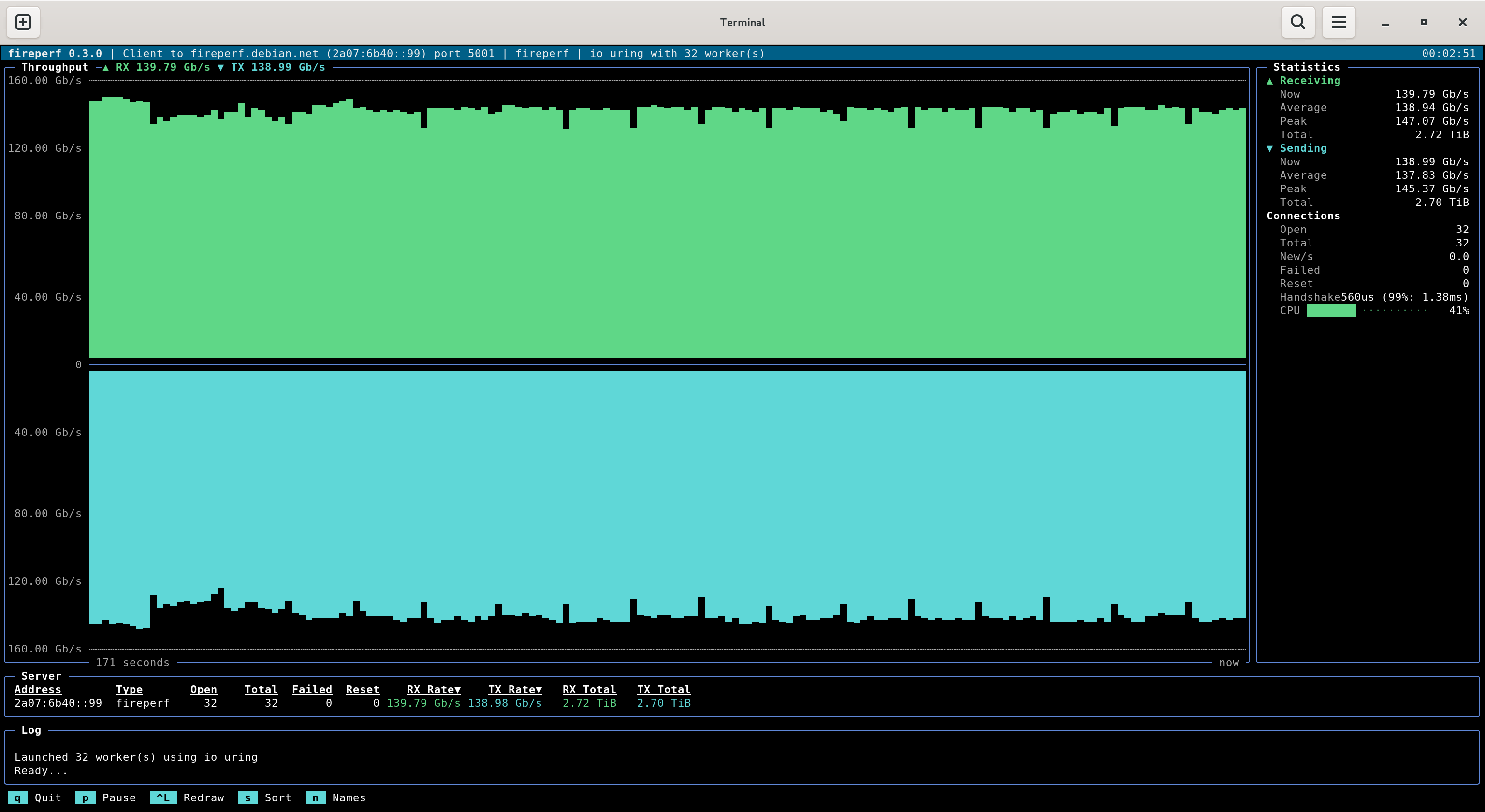
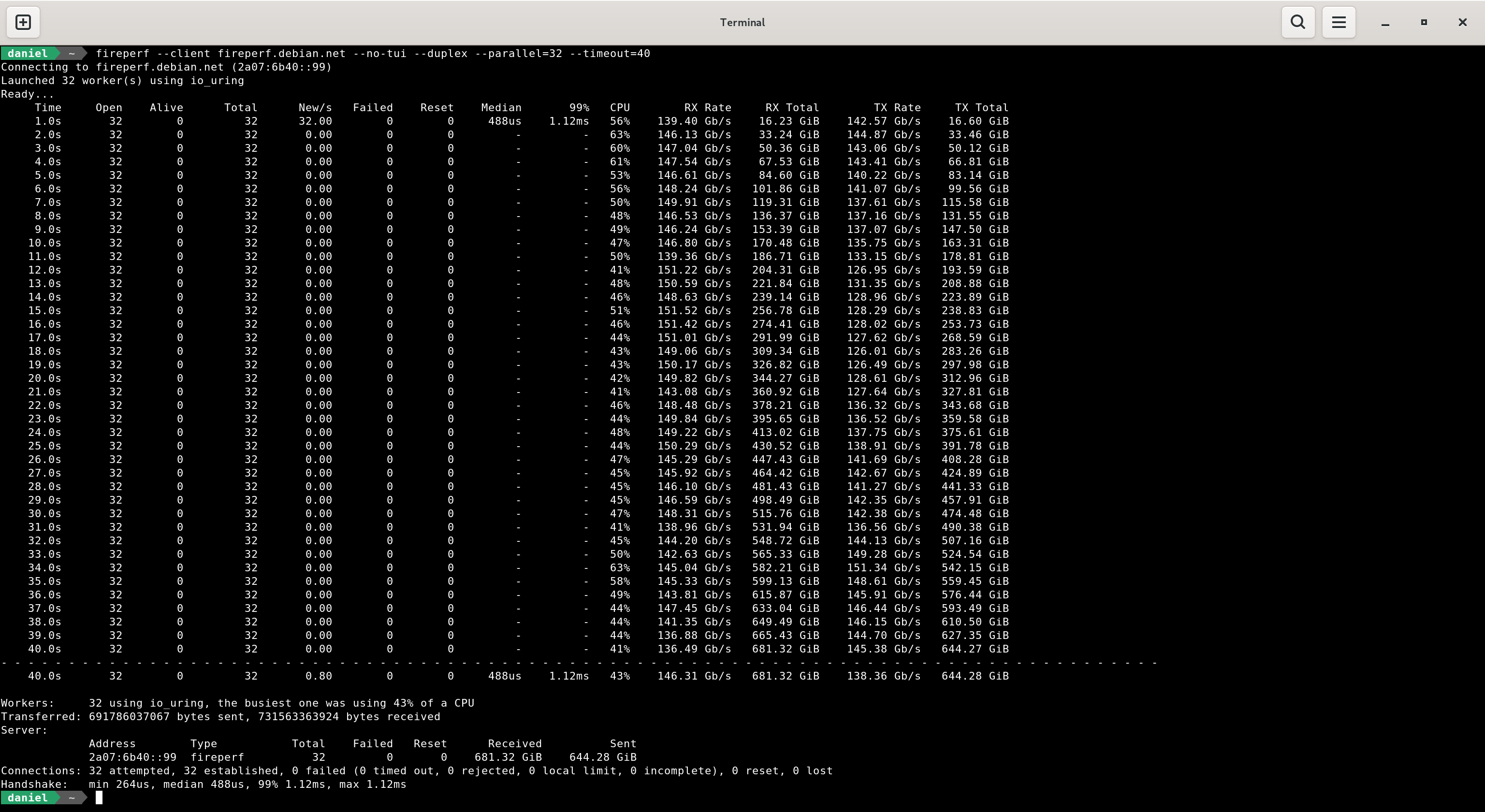


 The twentyfifth release of

 Debcraft is a tool that automates most of the repetitive and error-prone steps related to Debian packaging. It makes it easy to build
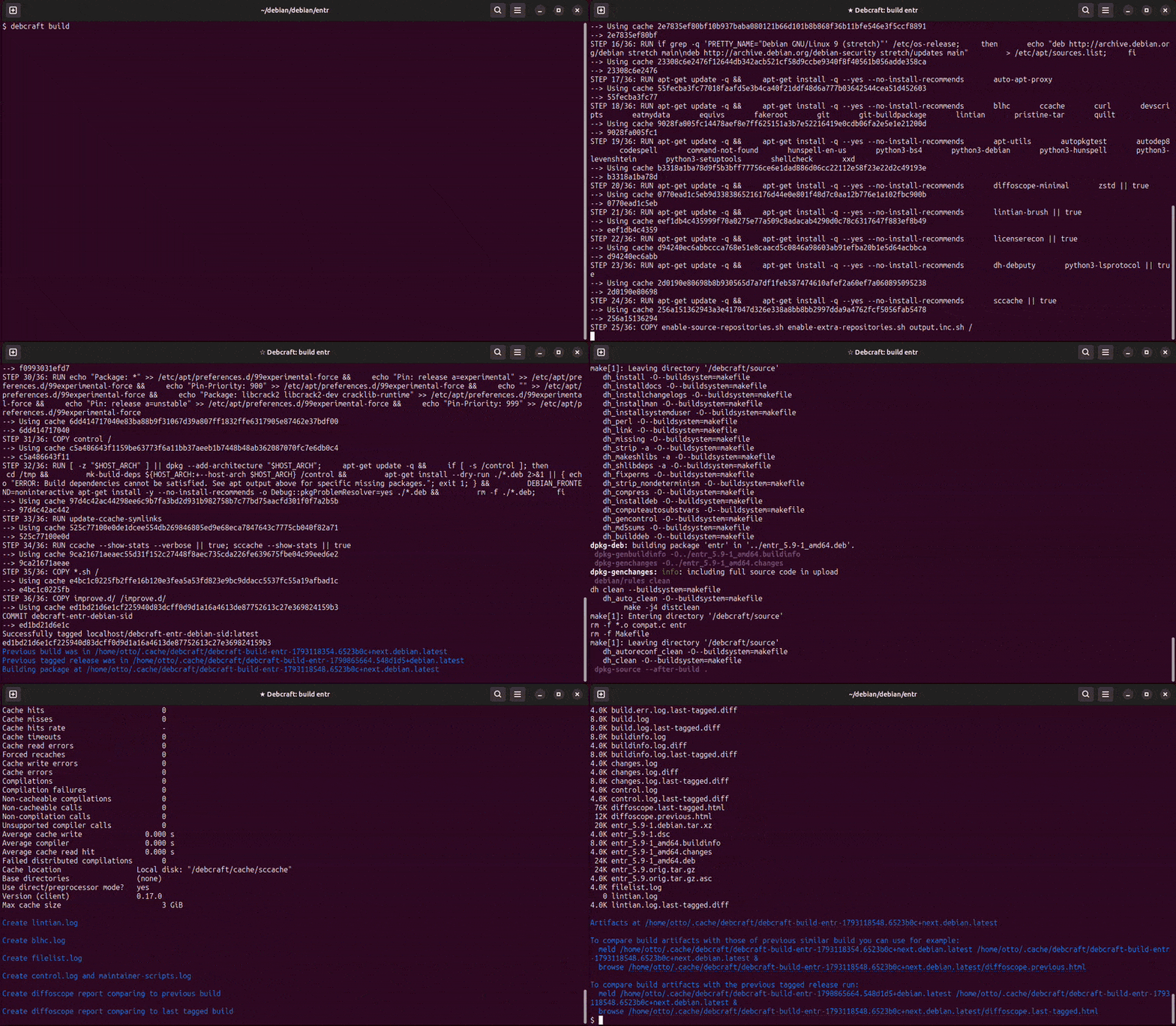

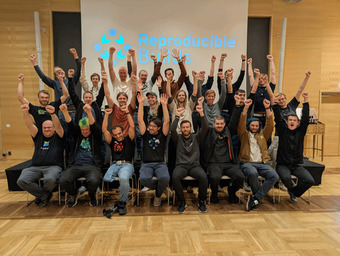



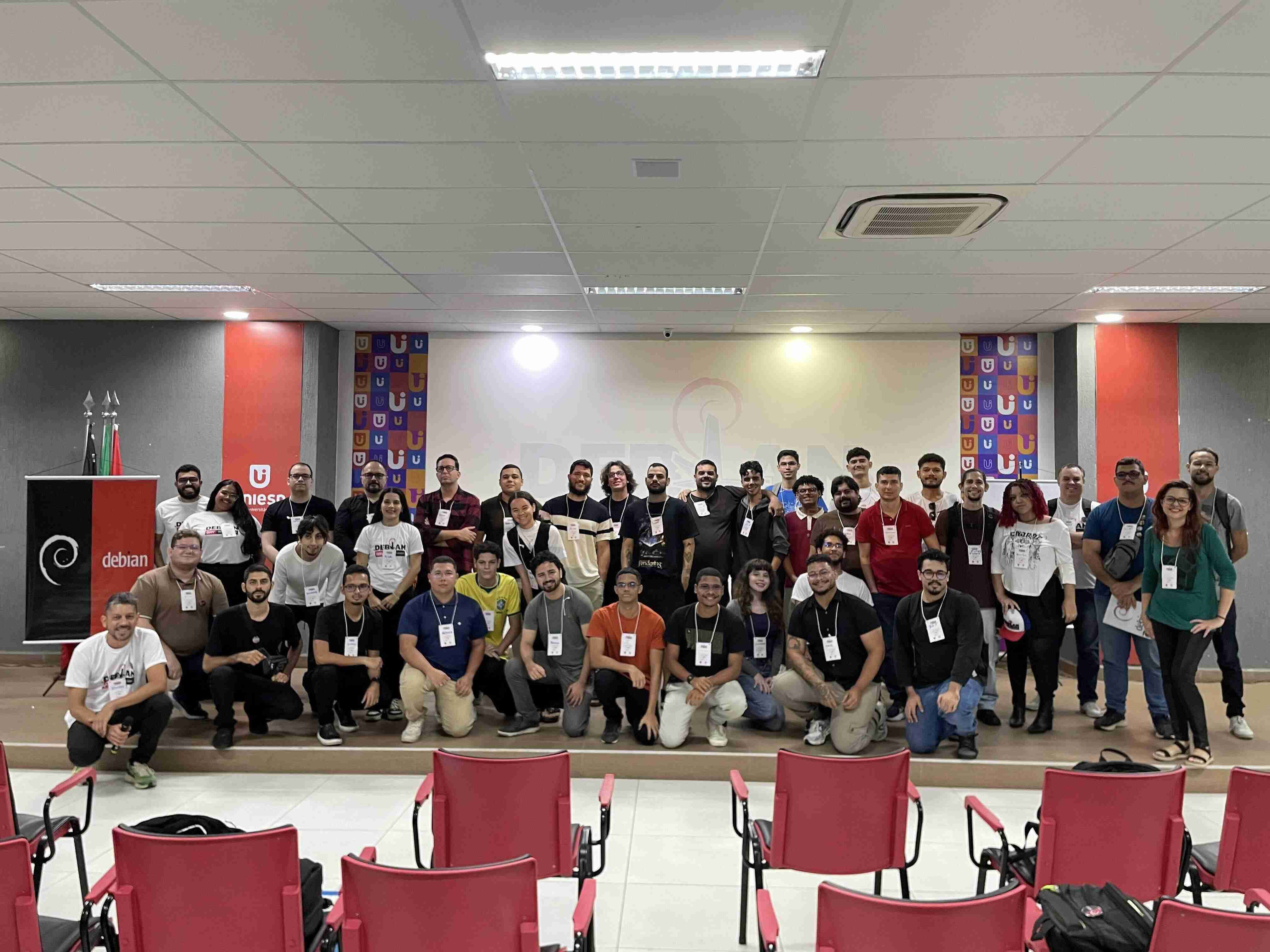 In Jo o Pessoa, we had a two-day event. The first day was dedicated
entirely to workshops, and I ran a packaging workshop for newcomers.
It was the first time I had been responsible for a workshop, and it
was a great experience. We didn't have a lot of time, so I decided to
start with a 30-minute talk explaining a few things about Debian. For
example, I made this image to explain the packaging workflow:
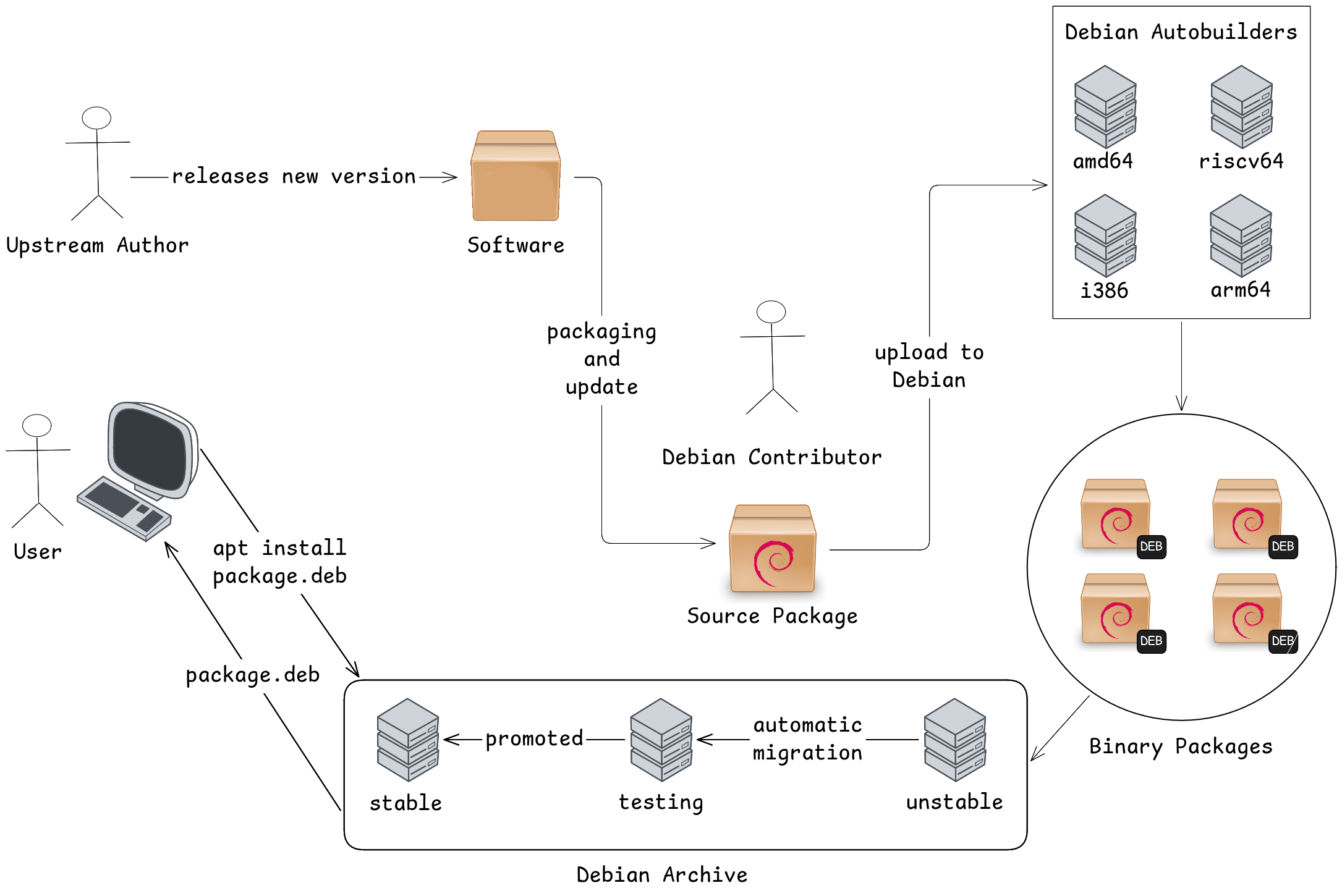 This image was based on
 One thing I really like about Debian Days is that each place has its
own way of doing things. In Jo o Pessoa, we had a MiniDebConf-like
event, while in Bras lia, we had something smaller but still very
valuable. We decided to keep things simple: talk to a few students at
the University of Bras lia (UnB) and then go somewhere to eat and have a
few drinks.
 As I am writing this, there is a




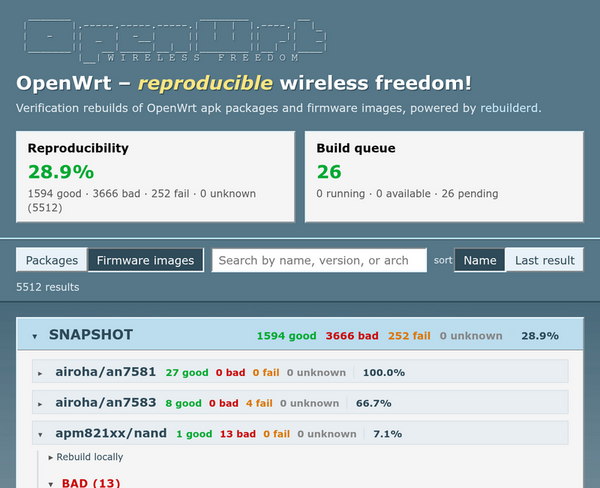
 (no, this isn't a blog post about Joy Division songs)