Search Results: "ah"

23 November 2026

Juan Manuel M ndez Rey: The Bub's Brothers: a 21 year old ITP comes back to play

Great to see that someone is trying to make that old project survive! Armin Rigo, author of The Bub s Brothers, 2026 Something I wasn t expecting to ever hear about again, TBH. Good to hear. David Gowers, who redrew its graphics in 2007 it works! :) Alex Myczko, Debian Developer, 2026, after the first game over the Internet in years

Chapter 1: A Mac game, cloned for the network (2003) In November 1997 Sebastian Wegner, known as McSebi, released Bub & Bob for the Mac as shareware, his own take on Taito s arcade classic Bubble Bobble. Two dragons, bubbles, monsters trapped inside them, fruit everywhere. On 31 January 2003 Armin Rigo, one of the founders of PyPy, made the first commit of a network clone of McSebi s game, written in Python. The old site said it plainly: This version is a direct clone of the MacOS game Bub & Bob of McSebi , and thanked him: Thanks Sebi for all the cool graphics and sounds! It didn t stay a one-man project for long. Gio, Odie, Michel-St phane and Armin wrote levels in Python, paxed improved the random levels, and David Gowers redrew the graphics in 2007. And in 2005 McSebi did something that turned out to matter a lot: he put his graphics and sounds under the Artistic License. The last commit is from 12 October 2013. Then silence. The Bub's Brothers 1.6.2: seven dragons on a board of the Compact levels Seven players on version 1.6.2, the last release. Screenshot: screenshots.debian.net.

Chapter 2: Ten years in Debian (2005 to 2019) In 2005 a Debian Developer filed an ITP, an Intent To Package , for the game (#308148). It reached the archive in February 2008, and for more than ten years apt install bubbros got you a LAN party in one command. A ten-player network game of The Bub's Brothers in Debian, around 2008, with tarzeau on the scoreboard Around 2008, in Debian: a ten-player game over the network. Look for tarzeau on the scoreboard: that s Alex. Screenshot: screenshots.debian.net. Then Python 2 reached its end. In October 2018 someone asked for a move to python3-pygame (#912480). Nobody did it. On 30 September 2019 the game left Debian, and the removal bug says why in four words: python2 removal; dead upstream (#936248).

Chapter 3: A Debian Developer with a long memory (2026) That Debian Developer was Alex Myczko, and he never forgot the game. In 2021 he imported it from SourceForge into his own GitHub repository, and in 2024 Christopher Bock sent a first automatic conversion to Python 3. Then, in 2026, I wrote my first post on Planet Debian, about rescuing old software. Alex read it, got in touch, and asked if I fancied porting the game to Python 3. Of course I did. Bringing old games and software back is what I enjoy most. I spent 20 years tracking down the authors of Conquer, a 1987 Unix game, until it became free software, and I adopted xwpe, a 1993 programming editor. A game people loved, thrown out only because the language under it moved on? That s my kind of project. At some point I asked him on GitHub whether that 2005 ITP was his. His answer: yeah that was me .
  • 2005: Alex files the ITP.
  • 2019: python2 removal; dead upstream .
  • 2026: yeah that was me .

Chapter 4: Bringing it back (2026) Alex reviewed and merged everything in his repository and tagged the releases, 2.0 up to 2.3. Along the way anzz1 joined in with a lot of fixes, from sharper scaling to releasing the keys after a rewind. Most of the port was the usual Python 2 to 3 work. A few problems were properly fun, though.

The Time Machine One bonus is a clock that rewinds the game. On Python 2 it relied on statesaver.c, a C module whose own comment brags This one can copy running generators and their frames! . It did exactly that, poking straight into CPython s frame structures:
f2->f_lasti = f->f_lasti;
f2->f_iblock = f->f_iblock;
memcpy(f2->f_blockstack, f->f_blockstack, sizeof(PyTryBlock)*f->f_iblock);
There s no way to port that. Those structures are private and change with every Python release, and PyPy can t copy generators either. Without the module the game just printed statesaver module not compiled, no clock bonus . So now the game simply plays the past again. When a board starts it saves a checkpoint of plain data: players, dragons, monsters, bonus state, and the state of the three random generators it uses. Every input from the network (keys, players joining or leaving) is logged with the pass number it arrived in. To rewind, the game rebuilds the board from the checkpoint and runs it forward again, with the sound off, up to the moment you land on.
cp['random'] = random.getstate()
cp['bonusrandom'] = (bonuses.random, bonuses.random.getstate())
cp['localrandom'] = bonuses.DustStar.localrandom.getstate()
That only works if the game is fully deterministic, so there s a test for it. It runs a server with two scripted players and hashes the screen and the game state after every pass. Two runs with different PYTHONHASHSEED values must give identical hashes. A rewind recomputes 1,644 passes, and the 602 passes that follow must match a run that never went back. (commit)

Bytes on the wire The network protocol glued message codes, which were str, onto struct.pack output. Python 3 says no to that, so the server died building the very first icon. Now everything on the wire is bytes, and message() raises TypeError if you hand it a str instead of guessing an encoding:
-MSG_DEF_PLAYFIELD = "p"
+MSG_DEF_PLAYFIELD = b"p"
-        limit = ord(data[0]) + 1
+        limit = data[0] + 1      # indexing bytes gives an int
Then there s division. I walked the syntax tree for every / in the code, 82 of them, and 13 divided two ints and needed //. One of them, '>'*(width/2-2), blew up only when you loaded a level without wind. The nice part: the protocol didn t change, so a Python 2 client still plays against a Python 3 server, and the other way round. (commit)

The clicks that missed To join a game you click a dragon. Alex tried it on Wayland and wrote: i saw graphics, heard music, but no input worked . The GTK client read the mouse on the top-level window. With client-side decorations, the window s coordinates include the title bar and the shadow, so on GNOME, KDE and Weston every click landed 26 pixels to the right and 60 lower. The dragons sit at the bottom of the screen, so your click landed below the playfield and nobody could join. The fix was to read the mouse on the drawing area instead:
-    w.connect("button-press-event", self.button_press_event)
+    self.area.connect("button-press-event", self.button_press_event)
(PR #8)

Wayland and full screen The client picked the first display driver that loaded, and X11 was first in the list, even with no X server around. Now X11 goes last. Full screen asked for a 656x400 video mode, and Wayland compositors never let an app change the mode: Sway left it in a window, others drew a tiny playfield in a corner. pygame 2 s SCALED flag fixed full screen. For a resized or maximized window the game now scales the picture itself, keeping the proportions. To stop this from breaking again there are display tests with real input: X11, Weston, Sway, KDE and GNOME, each in its own headless session. Most of them get input from xdotool. One gotcha: you must not pass --window, because then the events are synthetic, and Weston s X11 backend throws those away. GNOME has no X input at all, so there the test drives the mouse through Mutter s RemoteDesktop interface over D-Bus. Each test clicks a dragon, presses keys, and checks that the game saw them and that the picture fills the window. With the old code, the GTK client fails on Weston, KDE and GNOME. (commit) Then Alex wrote from Hyprland: fullscreen works now. and also input works (i only had completely forgotten how it works, clicking dragon, then keys for left/right/jump/bubble :) we should setup an internet server, and have some fun

The dead server The public list of games used to live on codespeak.net, the server from the early PyPy days, which is long gone. The game could hang or spit errors trying to reach it. Now the server is a setting, and there s a systemd unit to run your own. Alex set one up at bubble.aiei.ch, then wrote it works! :) , and: @vejeta what about you join? So I joined, and we played over the Internet, 13 years after the last commit. The Bub's Brothers Internet server list on Alex's meta-server, with a running server The Internet server list is back, on Alex s meta-server. I blurred the server s address.

Chapter 5: Where did the music come from? Debian wants to know the licence of every file, and the game has seven subgames, each with its own tune. Nobody knew where those tunes came from. The old CVS log named just one: Red Baron music. The others only said things like ext6. I compared them against a big pile of game soundtracks and module music, and all I learned was that each tune sounds like the game its subgame copies: Arkanoid, Pac-Man, Galaga, Tetris, Lemmings. That much I could have guessed. I asked Armin. I have absolutely no idea any more where the music came from. Fair enough, it had been more than twenty years. Then he read a draft about the game, and something clicked: I m pretty sure they are all extracts of music from OCRemix.org. That was the clue. OverClocked ReMix is a huge fan site of video game remixes. I took every remix posted there before the tunes were committed, about 1,200, and slid each loop along them with a spectrum correlation, at a few playback speeds, then checked the hits on the raw waveform. Four of them matched: Black Block by DJComet for Arkanoid (played a semitone lower), 64-bit by Peterrian Productions for Pac-Man, MkVaffQuasi Ultimix by MkVaff for Tetris, and DABOMB by alk for Lemmings. Every second of each loop scores 0.94 or more against its remix, and under 0.3 against the rest. The script is in the repo, so anyone can check. The Tetris one surprised me. The old README said it was recorded from the game, the Game Boy Tetris. It isn t. MkVaff s remix just opens with a Game Boy imitation good enough to fool everybody for twenty years. Galaga was missing. It wasn t among the remixes OCRemix still publishes, and that turned out to be the hint: the site has withdrawn quite a few remixes over the years. MusicBrainz keeps a list of them, and an old mirror of the removed files survives in the Wayback Machine. In there was Galagzee by zee-roh. Waveform correlation 0.98, against 0.014 for a random control. Gone from the site, but the Internet Archive still had it. Red Baron was the one the log already named, but which Red Baron? Not the sequels, and not Snoopy vs. the Red Baron either, that one is in another key. A fingerprint search found YouTube recordings of the title music of the 1990 DOS game by Dynamix that clearly matched the tune, but not the recording. So I booted the game in DOSBox with AdLib sound and listened to the title screen. Same melody, same tempo, a different arrangement. Somebody arranged it, and we ll probably never know who. When I showed Armin, he also thought it might come from that 1990 game. And then there s ext6, a rock loop for the subgame called Tron, which was later rewritten into a snake game (that name sent me down the wrong path for a while). I searched every OCRemix, current and withdrawn, the old versions on archive.org, the whole VGMix archive, a long list of game music bands from Minibosses to Machinae Supremacy, the music of free games in Debian, Tron soundtracks, Armagetron. Even Shazam. Nothing. If you recognise it, please tell us. OverClocked ReMix only allows unmodified, non-commercial copies, and the other sounds have no known author. So the original tunes and the seven subgame sound effects moved to a nonfree/ folder, and the game got free replacements with the same file names. I picked them by ear, over three rounds, to fit each subgame: CC0 and CC-BY tracks from OpenGameArt by Eric Matyas, HydroGene, Cleyton Kauffman, OwlishMedia and Jonathan Shaw. For Tetris there s Korobeiniki, the old folk tune, generated by a small script, so it can be rebuilt from source. The sound effects I made from scratch with a little synthesizer script. If the original files are installed the game plays them, and if not it plays the free ones. PROVENANCE.md lists where every file comes from. Everything else has a clear licence. The code is MIT. McSebi s graphics, sounds, music and levels are under the Artistic License he granted in 2005, in answer to the first ITP. David Gowers put his 2007 graphics under the Artistic License 2.0, and Armin confirmed the Python levels are MIT. That leaves three fan-made level packs with no licence we can find. The Debian package ships only the free part, and a separate package in contrib, bubbros-nonfree-installer (#1153895), downloads the original tunes and those levels for you. If you made one of those level packs, or know who did, please tell us.

Come and play We need testers. You need Python 3 and pygame (python3-pygame on Debian):
git clone https://github.com/alexmyczko/bubbros.git
cd bubbros
BROWSER=firefox BUBBROS_METASERVER=bubble.aiei.ch python3 BubBob.py
The game opens a control page in your browser. From there you start a game or join one from the Internet list, and the game window opens. Click a dragon, then use the keys for left, right, jump and bubble. bubble.aiei.ch is Alex s own server, and he plans to keep it running. Tell us what breaks, and on which desktop, in the issues. And if you know your way around Debian, the package is waiting to get back into the archive (ITP #1153735). The Bub's Brothers control page in the browser: new game, local games and Internet games The control page that opens in your browser. Two dragons on board 3 of The Bub's Brothers, with bubbles, monsters and an E letter bubble Two players on board 3, on Python 3.

What I take away from it An old ITP is a kind of promise, and this one was kept 21 years later. McSebi s two lines from 2005 are the only reason his graphics can ship in Debian today, so if you write something, say what licence it s under. The game worked fine on X11 and failed on the desktops people actually use now, and only testing on those desktops showed why. And above all, this is a game made by people. Armin, McSebi, David, Odie, paxed, Gio and Michel-St phane made it. Now Alex, anzz1, Christopher Bock and I have picked it up where they left it. If you like this kind of story, Conquer is the long one: a 1987 Usenet game, and twenty years of chasing its authors until it became free software.
What game would you bring back, and who would you want to play it with?

C.J. Collier: Why Perl Lost the Cloud Era, and How Native gRPC, Protobuf, and GenAI SDKs Can Bring It Back

Disclaimer: The opinions stated here are my own, not those of my employer.

Every so often, someone asks why Perl once the undisputed duct tape of the Internet faded from mainstream greenfield software development. Was there a single cultural flashpoint that canceled Perl? Was it the fifteen-year wait for Perl 6? Or did Damian Conway s Perl Best Practices, Perl::Critic, and CPAN s Kwalitee metrics simply arrive too late?

Having spent time recently building a modern Protocol Buffers and gRPC cloud client stack for Perl, I ve come to a simple conclusion: languages don t fade solely because of syntax debates. They decline when the friction of talking to the current generation of infrastructure outweighs the language s natural strengths.

Here is a look back at why Perl lost momentum during the 2000s enterprise shift and why the GenAI and gRPC era offers an unexpected opening for a modern Perl resurgence.


1. What Actually Drove Perl s Decline?

Perl wasn t sidelined by a single societal scandal. Rather, several technical, historical, and organizational forces converged between 2000 and 2012:

TIMTOWTDI vs. Readability at Scale

Designed by Larry Wall a linguist by training Perl embraced natural-language expressiveness under the motto There s More Than One Way To Do It (TIMTOWTDI). Context sensitivity, topicalizers ($_), and compact regex idioms made Perl extraordinarily fast for an individual developer or sysadmin to write. Seat a hundred engineers in a shared codebase without shared guardrails, however, and TIMTOWTDI produces divergent dialects.

As software teams scaled in the late 1990s and 2000s, engineering leadership increasingly favored Python s counter-philosophy ( There should be one and preferably only one obvious way to do it ), prioritizing uniform, easily reviewable code over expressive flexibility. Tellingly, the public Google Style Guides repository maintains official prose guides for C++, C#, Go, Java, JavaScript, Python, Shell, and TypeScript while omitting Perl altogether, leaving open-source Google Perl projects to codify standards directly in executable .perlcriticrc and .perltidyrc configurations alongside core perlstyle and Perl Best Practices.

The Perl 6 (Raku) Waiting Game & Ecosystem Shifts

If one historical event hurt Perl s momentum above all else, it was the Perl 6 transition. Announced in 2000 as an ambitious, backward-incompatible redesign, Perl 6 took 15 years to reach a stable specification (ultimately renaming to Raku in 2019 as a distinct sister language). During that 2000 2015 window, much of the industry assumed Perl 5 was in maintenance mode even as Perl 5 underwent a major renaissance between 2007 and 2012 (Modern Perl, Perl 5.10+, Moose, Moo, PSGI/Plack, and cpanminus).

Meanwhile, Perl s traditional strongholds migrated elsewhere: CGI.pm and mod_perl gave way to PHP, Ruby on Rails, and Django; cloud and DevOps tooling (Puppet, Chef, Ansible, Docker, Kubernetes, Terraform) coalesced around Ruby, Python, and Go; and scientific computing shifted from Perl s 1990s bioinformatics dominance to Python s C-extension ecosystem (NumPy, SciPy, Pandas, PyTorch). Even the 2020 debates over a proposed jump to Perl 7 which never came to fruition, ultimately giving way to the Perl Steering Council and steady incremental modernization via use v5.36 and use v5.40 happened long after that 2000s market shift.

Why Perl Best Practices, Perl::Critic, and Kwalitee Didn t Reverse the Trend Alone

Damian Conway s Perl Best Practices (2005), static analysis via Perl::Critic (built on PPI), formatting via Perl::Tidy, and CPAN s Kwalitee metrics (Module::CPANTS::Analyse) solved many of the readability complaints associated with 1990s Perl. Enforce strict Perl::Critic policies and modern conventions, and Perl code becomes remarkably clear and intentional. Yet four structural factors kept those tools from reversing the broader industry trend:

  • Opt-in discipline vs. language defaults: Unlike Python s indentation grammar or Go s gofmt, clean Perl relies on opt-in team toolchain discipline and two Modern Perl teams can still choose different object dialects (blessed hashes, Moose, Moo, or Perl 5.38+ Corinna class blocks).
  • Static analysis limits ( Only perl can parse Perl ): Because BEGIN blocks, prototypes, and symbol-table manipulation make Perl 5 undecidable to parse statically in full generality, PPI excels at lint policies but cannot easily power the deep static type checking and automated million-line AST refactorings that enterprise monorepos rely on.
  • What Kwalitee actually measures: Coined as a tongue-in-cheek pun on Quality ( it looks like quality, it sounds like quality, but it s not quite quality ), Kwalitee measures CPAN distribution hygiene metadata, licenses, POD, use strict, and test suites making CPAN extraordinarily reliable, without addressing application-scale type safety.
  • The 2005 2011 timing gap: By the time Modern Perl matured, major tech companies had already locked in build systems, hermetic toolchains, and RPC code generators for Python and Java, leaving little appetite to fund parallel infrastructure for a second dynamic scripting language.

2. The Real Blocker Today: The Protobuf & gRPC Chasm

If you write Perl 5.36 5.40+ today with native subroutine signatures, try/catch, builtin booleans, Moo or Corinna class blocks, and strict Perl::Critic gates the language itself is clean, fast, and expressive.

The real wall a modern Perl engineer hits isn t syntax. It s infrastructure integration.

Over the past decade, cloud databases and AI services standardized on Protocol Buffers (Proto3 / Edition 2024) and gRPC over HTTP/2, using automated generators like GAPIC to ship official client libraries for Python, Go, Java, TypeScript, C#, Ruby, and PHP. Perl was left off that list. Even major commercial libraries such as the Google Ads API Perl Client Library had to build custom HTTP/1.1 REST/JSON wrappers because Perl lacked an official upb Protobuf runtime and native gRPC stack.

When calling Cloud Spanner or an LLM requires hand-rolling OAuth2 token flows, REST wrappers, and JSON payload builders for every service, Perl loses its greatest superpower: getting complex things done fast.


3. Closing the Gap: A Modular Cloud & AI Stack for Perl

To test whether modern API ergonomics can revitalize Perl for cloud and AI engineering, I ve been building an open-source modular stack (published on CPAN and GitHub) that brings first-class Protocol Buffers, gRPC, DBI drivers, and automated client generation to Perl:

Architecture diagram of the modular Perl Cloud, gRPC, and GenAI client stackFigure 1: Open-source Protocol Buffers, gRPC, and automated client-generation stack for Perl.

With this stack in place, querying Cloud Spanner over native gRPC in Perl requires zero hand-rolled REST boilerplate:

use strict;
use warnings;
use Google::Cloud::Spanner::V1;
use Google::Auth;
# 1. Initialize Application Default Credentials (ADC)
my $auth = Google::Auth->default();
# 2. Initialize Spanner Client over gRPC transport
my $spanner = Google::Cloud::Spanner::V1->new(
    credentials => $auth,
);
# 3. Execute SQL Query
my $result = $spanner->execute_sql(
    database => 'projects/my-proj/instances/my-inst/databases/my-db',
    sql      => 'SELECT 1 AS alive',
);

And calling Gemini via Google::Ai::Generativelanguage::V1 with automatic nested hashref-to-Protobuf coercion feels just as ergonomic as Python or Go:

use strict;
use warnings;
use Google::Ai::Generativelanguage::V1;
use Google::Auth;
my $gemini = Google::Ai::Generativelanguage::V1->new(
    credentials => Google::Auth->default(),
);
my $response = $gemini->generate_content(
    model    => 'models/gemini-2.5-pro',
    contents => [
         
            role  => 'user',
            parts => [   text => 'Summarize this stack trace in three bullets.'   ],
         ,
    ],
);

4. What This Means for Debian Developers and Systems Administrators

Nowhere is this gap and the opportunity to close it more tangible than on Debian.

While greenfield web startups may have moved on from Perl, Debian remains one of the largest, healthiest Modern Perl ecosystems on the planet. Core project tooling dpkg-dev (Dpkg::*), debhelper, lintian, devscripts (uscan, dch, debuild), debconf, and po4a is written in Perl, backed by more than 4,000 lib*-perl packages maintained by the Debian Perl Group (pkg-perl). And Debian 13 (trixie) ships Perl v5.40.1 right in base, giving every Debian machine native subroutine signatures, lexical try/catch, and builtin booleans out of the box.

Yet until now, a Debian developer or systems administrator who wanted to interface with Google Cloud from an existing Perl tool had to either install the multi-hundred-megabyte Python-bundled google-cloud-cli (gcloud / bq) just to shell out and scrape stdout, or rewrite working Perl automation into another language.

Having a native Perl gRPC, Protobuf, and Auth stack and pairing it with native Debian packaging changes day-to-day life on Debian in four concrete ways:

1. Keyless IAM Auth on Debian Cloud VMs

When running official Debian Cloud images on Compute Engine, GKE (with Workload Identity), or Cloud Run, Google::Auth->default() speaks directly to the local GCE metadata server (metadata.google.internal) to fetch and cache short-lived OAuth2 tokens for the attached IAM service account. Sysadmins no longer need to deploy long-lived service-account JSON keys into /etc/ or shell out to gcloud auth print-access-token inside cron jobs and systemd units.

2. Moving Beyond local::lib (and venv) to Native pkg-perl Packages

Right now, before these distributions land in the Debian archive, installing them cleanly from CPAN without polluting /usr requires local::lib (e.g., cpanm --local-lib=~/perl5) which is the exact Perl counterpart to maintaining an isolated Python venv on Debian 12 (bookworm) and Debian 13 (trixie) under PEP 668 (EXTERNALLY-MANAGED). Even under local::lib, keeping cloud RPC calls in-process avoids pulling in the ~500 MB google-cloud-cli bundle or splitting an existing Perl daemon across two runtimes.

The real goal on Debian, however, is eliminating per-user overlay trees altogether via native .deb packages maintained with the Debian Perl Group (pkg-perl) so administrators can install libgoogle-auth-perl, libgoogle-grpc-perl, and service clients straight from apt with dpkg verification, sbuild reproducibility, and autopkgtest-pkg-perl coverage.

3. Alignment with Debian s Packaged Libraries & Policy

Most of the runtime and build prerequisites already ship in Debian main (verified on trixie), making native packaging straightforward:

  • libssl-dev backs Google::Auth s XS crypto bindings, and libnghttp2-dev provides the shared system C library for Google::gRPC s C/XS HTTP/2 engine while libprotocol-http2-perl (already in Debian main) powers the 100% pure-Perl HTTP/2 fallback.
  • libmoo-perl, libtype-tiny-perl, libfuture-perl, liblog-any-perl, libperl-critic-perl, and perltidy are all available via apt today.
  • Draft placeholder before publishing: Add links to the WNPP ITP bugs and Salsa / pkg-perl packaging repositories (including coordinating upb packaging details under Debian Policy 4.13 for Protobuf).

4. Practical Workflows for DDs and Sysadmins

On a Debian 13 (trixie) host running Perl v5.40, streaming structured fleet telemetry to BigQuery or triaging failed sbuild / autopkgtest logs with Gemini fits naturally into idiomatic modern Perl using native v5.40 signatures and try/catch without a single shell-out:

#!/usr/bin/perl
use v5.40;
use Google::Auth;
use Google::Cloud::Bigquery::V2;
use Sys::Hostname qw(hostname);
sub record_package_audit ($pkg, $version, $status)  
    my $bq = Google::Cloud::Bigquery::V2->new(
        credentials => Google::Auth->default(), # GCE metadata server / ADC
    );
    try  
        $bq->insert_all(
            project_id => 'my-debian-fleet',
            dataset_id => 'ops_telemetry',
            table_id   => 'dpkg_audits',
            rows       => [
                 
                    json =>  
                        host    => hostname(),
                        package => $pkg,
                        version => $version,
                        status  => $status,
                     ,
                 ,
            ],
        );
     
    catch ($err)  
        warn "BigQuery telemetry insert failed: $errn";


Whether it is archiving buildd and QA metrics into BigQuery, storing distributed coordination state in Cloud Spanner, or summarizing 10,000-line FTBFS ( Fails To Build From Source ) logs via Google::Ai::Generativelanguage::V1, Debian maintainers and sysadmins can keep their automation in a single, auditable, dpkg-managed language rather than splitting glue code across Perl, bash, jq, and Python virtualenvs.


5. Why the GenAI Era Plays to Perl s Strengths and the Headwinds Ahead

In classical machine learning, Python s lead was anchored by in-process C/C++ tensor libraries (NumPy, PyTorch). In the LLM and AI Agent era, however, the heavy matrix math happens remotely behind an RPC endpoint. What happens on the client side?

  • Ingesting gigabytes of messy, compressed distributed-system event logs and diagnostic traces.
  • Running high-speed regular expressions and text distillation pipelines.
  • Validating structured outputs and coercing hashrefs into strict request schemas via Type::Tiny.
  • Orchestrating Unix CLI tools, SQL queries, and concurrent gRPC calls.

That is Perl s historic wheelhouse. Just as importantly, thousands of enterprises and veteran SREs still maintain battle-tested brownfield Perl systems; drop-in CPAN clients for Spanner, BigQuery, and Gemini let teams modernize those systems in place rather than forcing a costly rewrite into Python or Go simply to call a gRPC API.

Two realistic headwinds remain:

  1. The AI code-generation feedback loop: Modern LLM coding assistants are trained overwhelmingly on recent Python, TypeScript, Go, and Rust code, and can default to dated 2000s Perl idioms if left unguided. Embedding automated 00_critic.t, 00_tidy.t, and 00_pod.t author tests backed by concrete .perlcriticrc and .perltidyrc rulesets directly into generated Module::Starter::Protobuf skeletons turns out to be an ideal counterweight, acting as an automated guardrail that keeps AI-assisted Perl clean and idiomatic.
  2. The education and hiring pipeline: Universities and bootcamps standardized on Python and JavaScript over the past 15 years, so greenfield staffing decisions will continue to favor larger hiring pools.

Will ergonomic gRPC and GenAI SDKs make universities teach Perl 101 again? Unlikely. Will they make Perl a high-leverage powerhouse again for engineers and organizations who value its text-processing and Unix orchestration strengths? Without question because in an API-driven world, a language is only as alive as the services it can talk to natively.

21 November 2026

Matthias Geiger: Using inkscape to draw high-quality electrical diagrams

For my thesis paper I had the need to have high-quality diagrams as images to include in my LaTeX document. While TiKz provides a neat way to do so, sometimes it does not cut it, especially if you want to have a certain degree of flexibility or add some signal forms. Furthermore, writing TikZ (CircuitTikz in this case) can be rather convoluted. While solutions such as the online designer exist, IMO a plain drawing is just better. Inkscape to the rescue Fortunately, inkscape has all we need to produce high-quality circuit diagrams. Install it via apt, and then first add the electrical symbols library:
git clone  https://github.com/upb-lea/Inkscape_electric_Symbols
mkdir -p .config/inkscape/symbols
cp Inkscape_electric_Symbols/Inkscape_Symbols_all.svg .config/inkscape/symbols
Then open inkscape. The newly added symbols can be found at Objects->Symbols (or press CTRL+Shift+Y). To efficiently draw, press "#" to enable the grid, and set "Enable snapping". This makes it easier to align the objects to the grid. Afterwards, one can just drag and drop symbols from the menu onto the drawing area, and construct a transmission line like this: transmission-line Function plotting The best part is inkscape also supports plotting signals that follow a mathematical expression. This comes especially in handy if you need to have some signal next to a circuit part. This can be done via Extensions->Render->Function plotter. It is a bit convoluted, since you first need to draw a rectangle, which is then converted to a plot. In this example, I drew a fourier transform of a square wave with five terms: 4/pi*(sin(x)+1/3*sin(3*x)+1/5*sin(5*x)+1/7*sin(7*x)+1/9*sin(9*x)) Then set some defaults: Check "Remove rectangle"; uncheck "Cut with rectangle", "draw axes" and "Add endpoints on x-axis". For the scaling, I chose an x range of -0.5 to 0.5, checked "multiply x values by 2 pi", an y range of -1 to 1, and 100 data points. I also unchecked isotropic scaling and polar coordinates. The end result (with some inkscape coercing) is a nice jittery rectangluar waveform: square-wave Overall, this is pretty nice and allows for high-quality images. Once the svg is finished, it can easily be exported as png. I recommend a DPI of 300.

13 November 2026

Amin Bandali: Building GNU Emacs from source

In the recent years, I've been configuring and building GNU Emacs from source, specifically the master branch of the emacs.git repository. Doing so allows me to use and test latest Emacs features, test my Emacs Lisp code with the laest developments in Emacs, and easily contribute my own changes to Emacs. Before we start, I recommend reading the INSTALL file in the Emacs source repository for building Emacs from source tarballs, and also INSTALL.REPO for details about building Emacs from its source repository. The information provided here were built upon the details documented in those files. When in doubt, consult those files as the main, authoritative source of information for how to build Emacs from source. Installing build dependencies To build GNU Emacs from its source repository, we first need to install the various required tools and build dependencies of Emacs. On Debian-based systems, this can be done using apt. First, we need to add the source packages for the current release of our Debian-based distribution in apt's configuration by adding the corresponding deb-src lines in an apt source list file. For currently existing and older Debian releases, that would be done by adding a corresponding deb-src line for each deb line in /etc/apt/sources.list, such as:
deb http://deb.debian.org/debian/ trixie main
deb-src http://deb.debian.org/debian/ trixie main
In systems with recent apt versions with so-called modernized sources that might look editing a file like /etc/apt/sources.list.d/debian.sources and adding deb-src to the Types lines:
Types: deb deb-src
URIs: http://deb.debian.org/debian/
Suites: trixie
Components: main
Signed-By: /usr/share/keyrings/debian-archive-keyring.gpg
Then run sudo apt update to have apt download package information from the configured sources. We can now run sudo apt build-dep emacs to have apt download and install the build dependencies of Emacs. Debian-based distributions have packages for a few different configurations of Emacs, like emacs-pgtk with PGTK support for Wayland, and emacs-nox for Emacs without GUI support, which we can use with apt build-dep to download the specific dependencies of those configurations. Cloning the Emacs source repository After installing Git using sudo apt install git if not already installed, we're now ready to clone the Emacs source repository from GNU Savannah:
git clone https://https.git.savannah.gnu.org/git/emacs.git
We can add --depth 1 to make a shallow clone of the repository, if we don't care about having a complete log of previous commits to the Emacs repository (shallow clones are much faster). If cloning over HTTPS is slow, we can try cloning over Git's own protocol (with the caveat that the repository is cloned over an insecure channel) or over SSH if we have a Savannah account, using one of the following URLs instead of the one above:
git://git.git.savannah.gnu.org/emacs.git
ssh://git.savannah.gnu.org/srv/git/emacs.git
Configuring the Emacs build We now change to the Emacs repository directory we just cloned, and run the autogen.sh script once to generate the configure script, which we will use to configure Emacs to our liking:
cd emacs
./autogen.sh
To configure Emacs, the simplest approach is to run configure without any additional options, to have it use the defaults. We can get a list of available configuration options by running:
./configure --help
As I rebuild Emacs frequently, I normally don't "install" it, but for a typical setup, we'll want to specify the installation directory using --prefix, e.g.:
./configure --prefix=$HOME/.local
Later, make install will install Emacs under the specified directory. By default, some of the files (such as *.el) will be compressed during installation. We can prevent that using --without-compress-install. For my builds, I always use these configuration options:
--without-gconf
--without-gsettings
--without-gpm
--with-native-compilation
As I don't use the GNOME desktop, the GConf and GSettings integrations are always more trouble than useful for me, so I disable them. Further, I disable the GPM support, since I never use the mouse when using Emacs in the terminal. Lastly, I explicitly enable native compilation support. In Wayland environments, I usually use PGTK:
--with-pgtk
And in X11 environments (e.g. EXWM), I either use the Lucid toolkit:
--with-x-toolkit=lucid --with-xaw3d
Or no toolkit at all:
--with-x-toolkit=no --without-xaw3d
Later after building Emacs, we can view the configuration options in Emacs by inspecting the system-configuration-options variable. Building Emacs After running ./configure, we can now finally build Emacs by running make. The first build will take a while, since all of Emacs is being built from scratch. Subsequent builds will generally be faster. We can optionally run make install to install Emacs into the prefix specified earlier, or the default /usr/local. Note that this step might require using sudo if our user doesn't have write permission for the prefix. Running Emacs After building Emacs, we run it either from the install location if we ran make install earlier, or directly from the source repository. Currently, Emacs's build system makes a symlink to the latest built binary in the repository at src/emacs, and for emacsclient and other auxiliary binaries under the lib-src directory. When skipping make install, we might still want to be able to easily launch Emacs from anywhere by typing emacs. We can do that by making symlinks to emacs and its auxiliary binaries inside a directory in our $PATH, such as $HOME/.local/bin, like so:
cd $HOME/.local/bin
ln -s $HOME/src/emacs/src/emacs .
for e in \
 ebrowse emacsclient etags make-docfile\
 make-fingerprint hexl rcs2log; do\
  ln -s $HOME/src/emacs/lib-src/$e .; done
For non-install setups like this, I augment Info-directory-list in my init file with the location of the info manuals in the repository to make them known to Emacs:
(defvar Info-directory-list) 
(with-eval-after-load 'info 
  (setq 
   Info-directory-list
    (,@Info-directory-list
     ,(expand-file-name
       (convert-standard-filename "info/")
       source-directory)
     "/usr/share/info/"))) 
Updating Emacs We can pull in the latest changes in the Emacs repository using git pull, then rebuild our Emacs by running make. Occasionally, rebuilds may fail due to bad interaction of changes with leftover build artifacts. In such cases, the easiest thing to do would be a make bootstrap for an almost-from-scratch build. On even rarer occasions, make bootstrap might also fail. We would then want to run git clean -xdf to remove every file that's not tracked by Git, as if we freshly cloned the repository. In such cases, we would need to configure the build again using ./configure and provide the desired options before running make again. Further reading Protesilaos's similar post from early 2025 was part of the inspiration for writing and sharing my version: https://protesilaos.com/codelog/2025-03-22-emacs-build-source-debian/ Lastly, to reiterate, Emacs's own INSTALL and INSTALL.REPO files for building from source: https://cgit.git.savannah.gnu.org/cgit/emacs.git/tree/INSTALL
https://cgit.git.savannah.gnu.org/cgit/emacs.git/tree/INSTALL.REPO Take care, and so long for now.

11 November 2026

Colin Watson: Free software activity in October 2026

My Debian contributions this month were all sponsored by Freexian. You can also support my work directly via Liberapay or GitHub Sponsors. OpenSSH I upgraded both openssh and openssh-gssapi from 10.5p1 to 10.6p1, started generating MLDSA44-ED25519 host keys by default now that upstream no longer considers them experimental, and fixed a problem where switching between the normal and GSS-API variants followed by purging the old packages caused some configuration files to disappear. Python packaging New upstream versions: Other build/test failures: Since lots of Python modules use Rust extensions nowadays, we often have to help with upgrades of Rust packages. I did some of this: Other bugs: One of my hobbies is typesetting ( engraving ) music, sometimes for my own use, sometimes for teaching, and sometimes for my choir. I ve used LilyPond for a long time and have got pretty used to it. My workflow was a bit cumbersome, though, usually involving side-by-side editor and PDF viewer windows with some ad-hoc Makefiles and editor macros. I recently discovered the Frescobaldi frontend to LilyPond, and decided I liked it enough to switch over to it. It was already packaged in Debian, but it had a missing desktop entry and icon and missing translations; I fixed those based on a patch set by Joachim Wiedorn. My upload introduced a testing migration problem, which I also fixed. Rust packaging I upgraded rust-jiter and rust-smallvec to new upstream versions for a new version of pydantic-core. The rust-smallvec upgrade caused an FTBFS in rust-saphyr-parser-bw, which I fixed. I packaged rust-cargo-cyclonedx for a new version of python-maturin. This needed some porting to work with a new version of rust-cargo-metadata, which I contributed upstream. I improved the dev/list-rdeps.sh tool used by the Rust team to check build-depends too, which should make it easier for that team to remember Python packages in transitions. Code reviews

9 November 2026

Vincent Bernat: Performance evolution of route lookup on Linux

In previous articles, I explained how the Linux kernel implements IPv4 and IPv6 routing tables, and I showed the performance improvement of route lookups from Linux 2.6.32 to 4.16 for IPv4 including the impact of the Meltdown and Spectre mitigations as well as from Linux 2.6.39 to 4.18 for IPv6. This article updates the numbers through Linux 7.3 and investigates the perpetrator responsible for the performance regressions! I ran the following benchmarks on an AMD EPYC 8024P, a Zen 4c CPU, rented from Scaleway, running at 2.4 GHz with CPU boost disabled. I compiled the kernels with GCC 10.2: this version can compile older kernels as well as the current ones.

IPv6
Performance evolution of IPv6 route lookups from Linux 4.14 to 7.3
Performance evolution of IPv6 route lookups. Versions with an asterisk have SRSO mitigation disabled.
I tested four scenarios:
  • a recent full view with about 260,000 prefixes,
  • a full view from 2017 with about 40,000 prefixes,
  • a set of 40,000 /48 prefixes, such that 2 lookups out of 3 match, and
  • a set of 40,000 random /128 prefixes, such that 1 lookup out of 400 matches.
In Linux 4.15, Wei Wang improved the lookup performance by replacing the read-write lock with an RCU and a spinlock in commit 66f5d6ce53e6. In Linux 4.18, David Ahern improved the data structures used by route lookup. In Linux 5.9, Brian Vazquez removed expensive indirect calls in commit 55cced4f813b. The major 200 ns regression introduced in Linux 6.5 wiped out all these improvements. This version implements a mitigation for "Speculative Return Stack Overflow," a vulnerability affecting AMD processors, in commit fb3bd914b3ec. This mitigation adds about 20 cycles on each function return. It was backported to older kernels (5.10, 5.15, 6.1, and 6.4). To keep the results legible, I disabled the mitigation for these versions with spec_rstack_overflow=off on the kernel command-line. You can check the vulnerabilities impacting your CPU and their mitigations with lscpu. Some mitigations may depend on the microcode or on the firmware.1
$ lscpu   grep '^Vuln'
Vulnerability Gather data sampling:      Not affected
Vulnerability Indirect target selection: Not affected
Vulnerability Itlb multihit:             Not affected
Vulnerability L1tf:                      Not affected
Vulnerability Mds:                       Not affected
Vulnerability Meltdown:                  Not affected
Vulnerability Mmio stale data:           Not affected
Vulnerability Reg file data sampling:    Not affected
Vulnerability Retbleed:                  Not affected
Vulnerability Spec rstack overflow:      Mitigation; Safe RET
Vulnerability Spec store bypass:         Mitigation; Speculative Store Bypass disabled via prctl
Vulnerability Spectre v1:                Mitigation; usercopy/swapgs barriers and __user pointer sanitization
Vulnerability Spectre v2:                Mitigation; Retpolines; IBPB conditional; IBRS_FW; STIBP always-on; RSB filling; PBRSB-eIBRS Not affected; BHI Not affected
Vulnerability Srbds:                     Not affected
Vulnerability Tsa:                       Vulnerable: Clear CPU buffers attempted, no microcode
Vulnerability Tsx async abort:           Not affected
Vulnerability Vmscape:                   Mitigation; IBPB before exit to userspace

IPv4
Performance evolution of IPv4 route lookups from Linux 4.14 to 7.3
Performance evolution of IPv4 route lookups. Versions with an asterisk have SRSO mitigation disabled.
I tested three scenarios:
  • a recent full view with more than 1,000,000 prefixes,
  • a subset of a full view from 2017 with 500,000 prefixes, and
  • a set of 500,000 contiguous /32 prefixes.
The 30 ns impact of the mitigation for SRSO in Linux 6.5 is smaller than for IPv6 because IPv4 route lookups traverse fewer functions: around 4 function calls for IPv4 compared to 25 for IPv6. In Linux 5.11, I introduced a regression in commit c0c5a60f0f13 after fixing the behavior of net.ipv4.conf.all.ignore_routes_with_linkdown!2 As a result, the ip_ignore_linkdown() function spends around 5 additional cycles to return a result as it needs to follow three additional pointers. fib_lookup() eventually calls it in the following code:
if (ip_ignore_linkdown(nhc->nhc_dev) &&
    nhc->nhc_flags & RTNH_F_LINKDOWN &&
    !(fib_flags & FIB_LOOKUP_IGNORE_LINKSTATE))
    return false;
If we reorder the conditions, we avoid calling ip_ignore_linkdown() for the most common case where the link isn't down:
if (nhc->nhc_flags & RTNH_F_LINKDOWN &&
    !(fib_flags & FIB_LOOKUP_IGNORE_LINKSTATE) &&
    ip_ignore_linkdown(nhc->nhc_dev))
    return false;
Here's the distribution of lookup times before applying the patch on top of net-next:3
min=128 max=4657 count=994104 95th=134 90th=133 50th=132 mad=0
    value                                                        count
      128                                                          120
      129                                                         2232
      130                                                       25224
      131                                         264264
      132               516480
      133        126864
      134        21624
The lighter shade depicts the cumulative distribution function. After applying the patch, the median improved from 132 to 126 cycles:4
min=124 max=208839 count=994104 95th=128 90th=127 50th=126 mad=0
    value                                                        count
      124                                                          576
      125                                                      49440
      126                        584904
      127         284592
      128        45288

Impact of mitigations To reduce the impact of mitigations, you can disable all of them with mitigations=off, disable only a specific one like with spec_rstack_overflow=off, or protect against only some attack vectors with mitigations=auto,no_user_kernel, starting from Linux 6.17. The impact is also quite different depending on the CPU. For example, on a Xeon W-2295, an Intel desktop CPU from 2020, the impact of the mitigations is only a few cycles for IPv4, and less than 3% for IPv6. The main contributor is the mitigation for the Indirect Target Selection vulnerability, which is fixed since the Sapphire Rapids architecture.
If we set aside the regressions introduced by the mitigations against CPU attacks, the performance of IPv4 is declining slowly over time while IPv6 has improved in the past and is currently stable. If routing performance is important, you have several options: choose a different CPU like an AMD Zen 5 CPU, a fourth generation Xeon CPU, or maybe an ARM Neoverse V2; disable some or all the mitigations; bypass routing with XDP/eBPF;5 or offload routing to the network card.

Note Maytham Alsudany reviewed a first draft of this article. Any errors are still mine!


  1. The microcode was out of date on my machine as I forgot to install the amd64-microcode package. As it only impacts TSA, our benchmark is unaffected. Spectre v2 mitigation did not enable automatic IBRS, because of SEV-SNP being enabled in the firmware. With automatic IBRS, the impact of SRSO should be smaller.
  2. Despite ipvX in its title, the commit only changes the behavior of the IPv4 code. The IPv6 version overwrites the value of each device in addrconf_fixup_linkdown().
  3. Linux 7.5 will be the first stable release including this fix.
  4. At 2.4 GHz, one cycle is about 0.42 ns.
  5. This requires avoiding bpf_fib_lookup(), which relies on the same kernel lookup.

26 October 2026

Otto Kek l inen: Debcraft v1.0 released: Easy, fast and secure way to build Debian packages

Featured image of post Debcraft v1.0 released: Easy, fast and secure way to build Debian packagesDebcraft is a tool that automates most of the repetitive and error-prone steps related to Debian packaging. It makes it easy to build .deb packages from source without having to manually prepare build environments. It clearly shows what changed in the build artifacts between two builds, automates parts of importing new upstream versions, and can automatically apply repetitive fixes to the packaging source code, including committing them in git. While doing all of this, it also explains what it does and helps users learn best practices in Debian packaging, making the overall experience much easier and more fun than with any other tool before, while also being secure and fast.
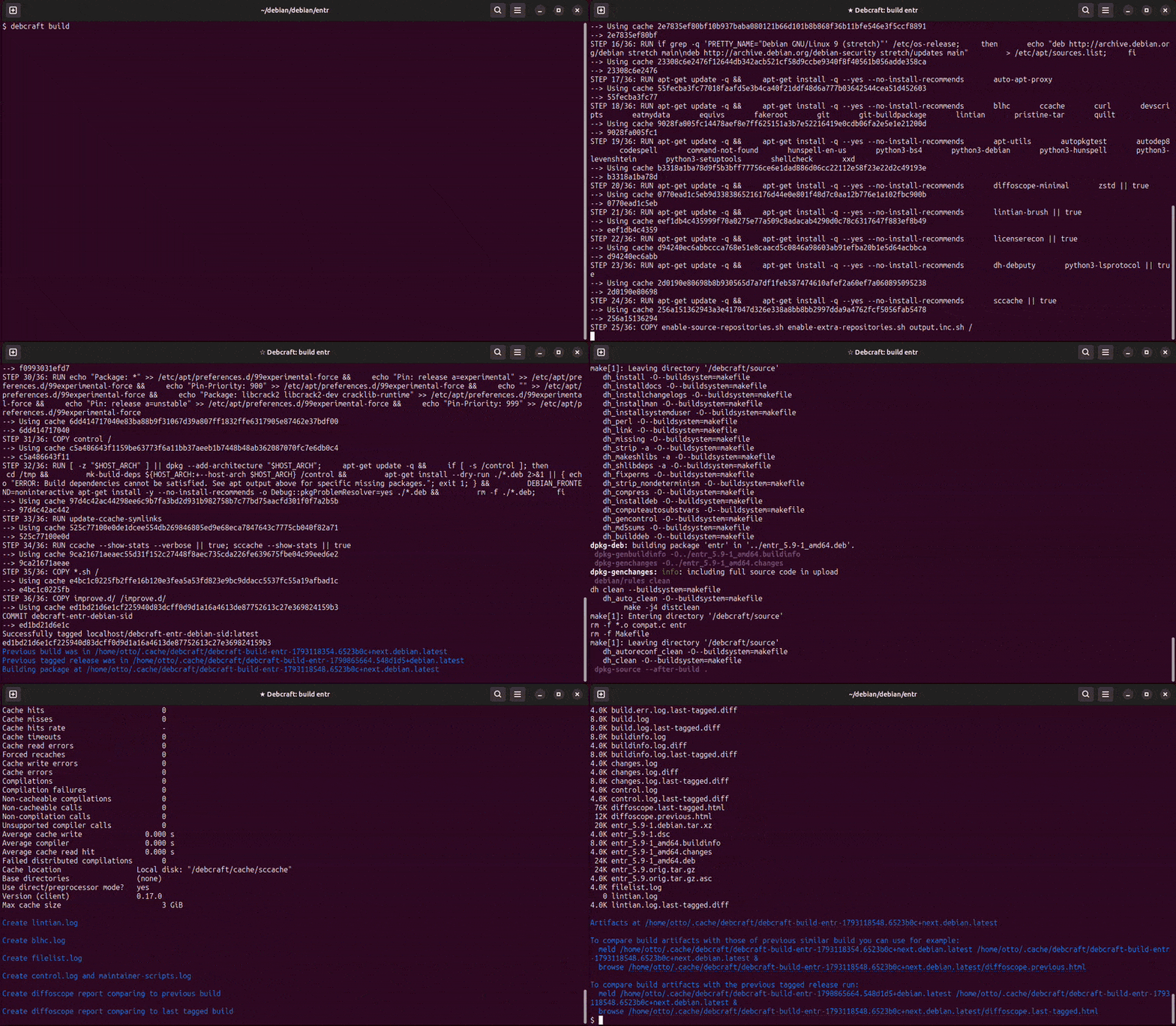
Try out Debcraft 1.0 now! Debcraft can be installed simply by running apt install debcraft on a recent version of Debian or Ubuntu. Check with debcraft --version that you have 1.0.0 or newer. The latest version can also always be installed from source at salsa.debian.org/debian/debcraft (does not require compiling anything). Running debcraft build in a Debian packaging git repository for the entr package

Benefits Debcraft was designed to offer the following three main benefits:

Easy
  • Build any Debian/Ubuntu package by simply running debcraft build in the checked-out Debian packaging git repository.
  • If the orig upstream source code tarball is neither already present nor available on a pristine-tar branch, the exact upstream tarball is downloaded from the Debian archive.
  • Users are spared from having to manually prepare ahead or maintain build environments. Debcraft builds create a container on-the-fly (both Podman and Docker supported), built using the target Debian or Ubuntu suite in debian/changelog and with exact build dependencies from debian/control.
  • Commands debcraft improve, debcraft test and debcraft update automate recurring package maintenance tasks and help maintainers produce high-quality, up-to-date packages, run Salsa CI, pass autopkgtest in Debian CI, and stay in sync across Debian archives and packaging git repositories.
  • The command output is (relatively) easy to read, and it also teaches users about Debian packaging in context.

Fast
  • Container layer caching is utilized to make builds and re-builds blazingly fast.
  • If an apt-cacher-ng instance or equivalent is present, it will automatically be used.
  • Debian packages that support ccache or sccache build even faster.

Secure
  • The build phase happens inside hermetic containers with no network access. This ensures all dependencies are properly managed and that the built binaries are as trustworthy as the source code they were built from.
  • Using containers also protects the host system from getting polluted with extra development libraries, and adds an extra layer of protection to prevent anything malicious in the source code from accessing secrets on the host system.
  • The additional logs provided by Debcraft also help audit changes in Debian package sources and build artifacts.
See the Debcraft README.md for details on how this was implemented. I also previously wrote Debcraft - Easiest way to modify and build Debian packages, which explains the motivation and design in more detail.

Result of many years of development The first commit in the git repository is from 2020 under the name debuildr. The project was renamed to Debcraft in a commit on December 8th, 2023. I have been developing this tool fairly actively since 2024 and using it for all my packaging, dogfooding so to say. There have also been plenty of collaborators. In total, 13 people have contributed code across 21 MRs and PRs on Salsa.d.o, GitLab.com and GitHub.com. Now, in October 2026, it was time to release Debcraft v1.0 as it has had extensive real-world use and iteration based on countless different packages and multiple users. Users have included both experienced fellow Debian Developers and lots of people who just started learning how Debian packaging works. As I mentor dozens of new contributors to Debian, I have seen that the latter group seems to benefit the most from Debcraft and its ease of use and built-in guidance, while to the more experienced developers the main benefit is having less details to remember and doing less mistakes.

Contributions welcome! Try it: apt install debcraft, then run debcraft build in a checked-out Debian packaging repository. If you run into a problem, file a report or submit an improvement. New contributors can look for issues marked good first issue. The code is intentionally written entirely in shell script to keep the barrier to code contribution as low as possible. It is also very easy to debug, as any command can be run with --debug to emit step-by-step information about what it is doing, and being Bash scripts, injecting set -x anywhere in the code will emit an even more detailed trace of every subcommand executed.
By the way, if you aspire to become a Debian Developer, and want to follow my examples in using state-of-the-art tooling and collaborate using salsa.debian.org, feel free to reach out for mentorship. I am glad to see more people contribute to Debian!

16 October 2026

Freexian Collaborators: Monthly report about Debian Long Term Support, September 2026 (by Santiago Ruano Rinc n)

The Debian LTS Team, funded by Freexian s Debian LTS offering, is pleased to report its activities for September.

Activity summary During the month of September, 20 contributors have been paid to work on Debian LTS (links to individual contributor reports are located below). The team released 41 DLAs fixing 1854 CVEs. In September, the Debian LTS Team was back to focusing on a single release: Debian 12 ( bookworm ). Debian 11 ( bullseye ) reached the end of its Long Term Support on 31 August 2026, and Freexian now provides its security maintenance under the Extended LTS offer. It is important to highlight the hard work done behind the scenes of the Front Desk fellows, whose role was fulfilled during September by Emilio, Emmanuel, Sylvain, Thorsten and Utkarsh. Besides the very high activity doing daily triage on dozens of packages and CVEs, Front Desk fellows spent much of their time answering questions and coordinating with people outside the Freexian team about update proposals. The team published several notable updates:
  • jbig2dec (DLA-4779-1), prepared by Andreas Henriksson, fixes CVE-2026-38076, where missing input checks could lead to a denial of service. It is to note that this library is used by different tools, such as ghostscript.
  • linux-6.12 (DLA-4788-1), uploaded by Ben Hutchings, fixing 414 CVEs in the bookworm backport of Linux kernel version 6.12.
  • lxml (DLA-4799-1), prepared by Guilhem Moulin, fixes four vulnerabilities in this widely used python XML/HTML library. The issues may yield to exposing local files.
  • nginx (DLA-4784-1), issued by Carlos Henrique Lima Melara ( charles ), fixing three memory-safety bugs in this popular web server and reverse proxy, which may result in denial of service, memory disclosure or potentially the execution of arbitrary code.
  • openssl (DLA-4795-1), by Arnaud Rebillout, fixing six vulnerabilities, including an out-of-bounds heap write in CMS decryption and an authentication tag verification bypass in ChaCha20-Poly1305/AES-OCB decryption. This update brings bookworm to OpenSSL 3.0.22, the last upstream release of the 3.0 series, which was reached its upstream EOL on 7 Sep 2026. Further fixes will be backported by the Debian LTS Team from more recent releases.
  • redis DLA-4794-1, by Chris Lamb, fixing vulnerabilities that could yield to arbitrary code execution
Contributions from other Debian fellows beyond the Freexian LTS Team:
  • Thomas Goirand, Keystone released by Emilio as DLA-4767-1
  • Thomas also prepared glance and swift updates, whose respective DLA-4800-1 and DLA-4801-1 were issued by Charles
  • Matthew Vernon uploaded a pcre2 security update, and Emilio issued its DLA-4772-1
  • Otto Kek l inen uploaded a xz-utils update, released as DLA-4783-1 by Sylvain
  • Salvatore Bonaccorso published a linux (6.1) update released as DLA-4777-1
  • Xavier Guimard prepared a lemonldap-ng, released as DLA-4797-1. Additionally, Sylvain sent DLA-4734-1 at the beginning of the month for the upload made on August.
  • Xavier also released DLA-4766-1 for cyrus-imapd.
  • Simon Quigley uploaded DLA-4803-1 to fix multiple issues in ruby-oj.
  • Finally, Ivo Marino proposed bookworm updates for cjose, git-lfs, caddy, libgit2, libwebsockets, libssh and unbound. Some of Ivo s proposals are still pending for a review.
Thank you so much to the developers above for these valuable contributions. The LTS Team has also contributed with updates to the latest Debian releases for the following packages:
  • ruby-jwt, prepared by Abhijith and released as DSA-6547-1
  • urwid, proposed for a point-release update by Abhijith (#1148950)
  • puma, proposed for a point-release update by Abhijith (#1149582)
  • tomcat10, and tomcat9 (which is actually backported to released suites) by Bastien
  • nodejs, prepared by Bastien and released as (DSA-6517-1).
If you benefit from Debian, especially throughout its full 5-year lifecycle, please consider becoming a sponsor of Debian LTS. You can find more information here: https://www.freexian.com/lts/debian/.

Individual Debian LTS contributor reports

Thanks to our sponsors Sponsors that joined recently are in bold.

14 October 2026

Reproducible Builds: Reproducible Builds in September 2026

Welcome to the September 2026 report from the Reproducible Builds project! In our reports, we try to outline the most important things that we have been up to over the past month. As a quick recap about what problem our project intends to solve, whilst anyone may inspect the source code of free software for malicious flaws, almost all software is distributed to end users as pre-compiled binaries. The motivation behind the reproducible builds effort is to ensure no flaws have been introduced during this compilation process by promising identical results are always generated from a given source, thus allowing multiple third-parties to come to a consensus on whether a build was compromised or not. As ever, if you are interested in contributing to the project, please visit our Contribute page on our website. In this month s report, we cover:

  1. Reproducible Builds Summit 2026 held in Gothenburg, Sweden
  2. dettrace expanding architecture support for PGO & Lisp dumps
  3. They don t care about this!
  4. SOURCE_DATE_EPOCH specification updates
  5. Reproducible Builds at SeaGL 2026
  6. New Code of Conduct (CoC)
  7. Supporter Spotlight: Jochen Sprickerhof
  8. Mailing list news
  9. Tool and documentation development
  10. Patches

Reproducible Builds Summit 2026 held in Gothenburg, Sweden The annual Reproducible Builds summit took place from 22 to 24 September 2026 in Gothenburg, Sweden. The event brought together developers, distribution maintainers, security researchers and free software advocates from across the ecosystem to share updates on current initiatives, address outstanding toolchain bottlenecks and strengthen cross-project collaboration. Participants engaged in a series of working sessions and technical roundtables focused on expanding the practical scope of reproducibility. Discussions covered ongoing work within major Linux distributions, language-specific package ecosystems and the various parts of the binary verification infrastructure. Strategic planning formed a pillar of the gathering, with participants discussing long-term roadmap goals for supply-chain security, software integrity and related topics. Attendees explored new methods for automated verification, discussing how to lower the adoption barriers for maintainers and streamline the integration of deterministic build pipelines into established continuous integration (CI) systems. The event was then followed by two days of unmoderated hacking sessions. These hacking sessions provided space for technical progress, allowing attendees to draft specification updates, prototype new tool features and resolve standing reproducibility bugs in-person.

Dettrace expanding architecture support for PGO & Lisp dumps Bernhard M. Wiedemann announced major updates to dettrace, porting the tool across most architectures supported by Debian and openSUSE. The release addresses key stability issues, passing test suites across these targets and making it ready for production build pipelines. These improvements enable deterministic builds when utilising Profile-Guided Optimisations (PGO), removing the need to sacrifice runtime performance for reproducibility. Additionally, dettrace can now be applied to (notoriously difficult-to-reproduce) Lisp and Scheme memory dumps, including environments such as CLISP, SBCL, Scheme 48, Racket and GNU Emacs.

They don t care about this Annika Wilde, Marco Gutfleisch, Felix Reichmann, Anirban Chakraborty, Yuval Yarom, M. Angela Sasse and Ghassan Karame published a paper this month entitled They don t care about this : A Systematic Study of Trusted Execution Environments Build Reproducibility in the Wild:
Trusted Execution Environments (TEEs) have become a cornerstone of modern cloud computing, providing strong confidentiality and integrity guarantees for both code and data. A critical component of this trust model is remote attestation, which enables external entities to verify the authenticity and integrity of code executing within a TEE through cryptographic measurements. However, the effectiveness of remote attestation fundamentally depends on the verifier s ability to trace the reported measurement back to the original source code - a property that can only be guaranteed through reproducible builds. [ ]
The full PDF can be read online.

SOURCE_DATE_EPOCH specification updates Bernhard M. Wiedemann shared a number of proposals regarding updating the SOURCE_DATE_EPOCH specification following discussions at a project summit. Seven distinct proposed changes have been submitted as merge requests on Salsa. Bernhard s proposed modifications are independent of one another, allowing for any combination to be merged depending on community feedback. Bernhard noted that one proposal may see the most debate, and could still benefit from further refinement before reaching consensus. Community members are invited to review and provide feedback on the individual merge requests by 1 December 2026. Input can be submitted via reactions or comments on Salsa, directly by email to Bernhard or the mailing list. The specification was first published in 2015 and updated in 2017.

Reproducible Builds at SeaGL 2026 Reproducible Builds will be present at SeaGL in Seattle, WA, on October 23rd & 24th. Come chat with us in person! Founded in 2013, SeaGL is a free, grassroots technical summit dedicated to spreading awareness and knowledge about free source software, hardware and culture.

New Code of Conduct (CoC) for the Reproducible Builds project Mattia Rizzolo announced the official launch of a Code of Conduct for the Reproducible Builds project. This follows work and community discussions originally initiated in 2024, incorporating feedback gathered over email and during project summits, as well as with input from the Software Freedom Conservancy. The new Code of Conduct establishes guidelines emphasising mutual respect among project contributors. It also defines a formalised process for submitting and handling complaints regarding community misconduct, ensuring transparent governance across project spaces. Along with the core policy document, an accompanying Code of Conduct FAQ has been published to outline the rationale behind adopting the guidelines.

Supporter Spotlight: Jochen Sprickerhof As a reminder, another supporter spotlight interview was published featuring long-time Debian and Reproducible Builds contributor Jochen Sprickerhof, highlighting his work on package verification and project infrastructure.

Mailing list news On our mailing list this month:
  • Jonathan Starr from the Institute of Open Science Practices (IOSP) posted with an announcement of its upcoming 2026 workshop series in Leiden in the Netherlands. This free-to-attend event aims to build a participant-owned data storage consortium, allowing community members to publish datasets, code and knowledge objects alongside algorithms designed to evaluate trust and value. The event features a dedicated Community Track for talks and discussions, a tool showcase and an opening session on resilient data storage.
  • Following up on IRC discussions regarding profile-guided optimization (PGO) on build servers, kpcyrd created a demonstration repository showing how PGO profiling can introduce non-determinism into output binaries. The demo highlights how runtime randomness (specifically, the randomised keys used in HashMaps to prevent denial-of-service attacks) causes varying bucket collision rates during test runs. These structural variances alter execution weights on underlying code branches, prompting the compiler to generate differing final assembly output for builds that would otherwise be perfectly reproducible if PGO was disabled. Rather than abandoning PGO performance gains, kpcyrd suggested treating generated profiling data as a documented build input or recorded environment artifact (similar to .buildinfo files), rather than regenerating profiles dynamically on the fly during build execution.
  • An autonomous AI agent (!), posted a controlled build result and reproducer demonstrating that pre-creating an obj directory in libmilter source trees prevents kernel-release path leaks (obj.Linux.<release>.x86_64) into debugging symbols. kpcyrd followed up with a helpful reply.
  • Alexander Sosedkin inquired on the mailing list about the preferred approach for sourcing pinned translation files to create reproducible GnuTLS release tarballs, asking whether external hosting should provide versioned downloads, or if projects ought to use Git submodules, dedicated side-repositories or some other mechanism.

Tool and documentation development diffoscope is our in-depth and content-aware diff utility that can locate and diagnose reproducibility issues. This month, Chris Lamb made a number of changes, including preparing and uploading versions 330, 331 and 332 to Debian. In particular, Chris committed support for radare2 versions greater than 5.9.0 [ ] based on input from Guillaume Girol [ ], and committed support for .nar files via Guix. [ ][ ]. Chris later modified diffoscope to not Build-Depend on the Debian package of GNU Guix, as its status in the Debian bug tracking system would transitively render diffoscope as being overly buggy for the next stable release [ ]. Similarly, he adjusted the Build-Depends on the apksigcopier package as it has been removed from Debian testing [ ] and, finally, he updated a number of copyright years [ ][ ]. Vagrant Cascadian updated diffoscope in GNU Guix to version 332.
reprotest is our tool for building the same source code twice in different environments and then checking the binaries produced by each build for any differences. This month, reprotest version 0.7.33 was uploaded to Debian by Holger Levsen with the following changes:
  • Sergei Tachenov fixed the fileordering test on all filesystems, including the likes of ZFS, which could return a different order across two builds due to build being done in a different directory [ ].
  • Holger Levsen bumped the Standards-Version to 4.7.4, reflected that Priority: optional is the default now [ ], fixed the old Free Software Foundation address [ ] and bumped the debhelper compat level to 14 after confirming there are only desired changes [ ].
  • Vagrant Cascadian updated *reprotest* to version 0.7.33 in GNU Guix.

rebuilderd, our server designed monitor the official package repositories of Linux distributions and attempt to reproduce the observed results there; it powers, amongst other things, reproduce.debian.net. This month, Bernhard M. Wiedemann submitted a pull request to rebuilderd that refactors RPM repository metadata handling. The change extracts rpm-md parsing out of the Fedora-specific scheduler module and into a shared one.
Lastly, there were a number of improvements made to our website this month as well. For example:

Patches The Reproducible Builds project detects, dissects and attempts to fix as many currently-unreproducible packages as possible. We endeavour to send all of our patches upstream where applicable or possible. This month, we wrote a large number of such patches, including: Vagrant Cascadian also performed a number of Non-Maintainer Uploads (NMUs) and Quality Assurance (QA) uploads in Debian for several packages with outstanding reproducibility issues. These included molttemplate, buddy, xfonts-nexus, fte and lifelines. At the time of this writing, that leaves 130 submitted patches, with only 61 outstanding submitted patches that older than a year in the Debian bug tracking system. This number is only 26 if we exclude any low-priority build path issues.

If you are interested in contributing to the Reproducible Builds project, please visit our Contribute page on our website. However, you can get in touch with us via:

Freexian Collaborators: Debian Contributions: New experimental backend for autopkgtest using pconr, DebConf site visit and more! (by Anupa Ann Joseph)

Debian Contributions: 2026-09 Contributing to Debian is part of Freexian s mission. This article covers the latest achievements of Freexian and their collaborators. All of this is made possible by organizations subscribing to our Long Term Support contracts and consulting services.

DebConf site visit, by Stefano Rivera In preparation for DebConf 27, Stefano Rivera, Nattie Mayer-Hutchings, and Jongmin Kim from the DebConf Committee visited Asahikawa Japan. A contingent of the local team gathered to tour the venues with us, discuss plans, and meet the local organizations assisting the event. We held a press conference at the city hall that got some coverage. A few potential day-trip options were explored. Photos from the site visit.

autopkgtest-virt-pconr, by Helmut Grohne Following the creation of the pconr module that provides a basis for unschroot and a more secure containment for mmdebstrap, an experimental autopkgtest backend autopkgtest-virt-pconr is now available. It fits a spot between autopkgtest-virt-unshare and more fully fledged containers as it does not require much infrastructure like setting up incus or lxc but still provides a containment running an initsystem. Due to the use of erofs as base image format, it boots and reverts quickly. This development also required fixing concurrency issues in asyncvarlink and even shed light on a matching bug in systemd that was promptly fixed upstream.

Miscellaneous contributions
  • Carles reviewed and submitted six Catalan po-debconf translations using po-debconf-manager. Improved po-debconf-manager s workflow for updating translations.
  • Carles reviewed, translated or updated webwml Catalan translations for security and CD pages. He also fixed issues that prevented building webwml, deleted orphaned translation pages, etc. and experimented with a more global HTML tidying up experiment.
  • Carles refactored check-relations adding capacity to ignore concrete from_package -> to_package specific relations and more flexibility around ignores. Detects unused ignore rules as well.
  • Carles improved some Wiki pages (LibreOffice, Framework amongst some other ones)
  • Thorsten did an hplip upload to replace an expired certificate of HP. This certificate is used to sign new upstream releases and modules that can be downloaded later. Afterwards work on a new upstream version started.
  • Thorsten also struggles with autopkgtest problems of the new upstream version of cups. Work is still ongoing.
  • Antonio loaded the video recording URLs into the MiniDebConf Winterthur 2026 website, and deployed the website for MiniDebConf Curitiba 2027 (still very early work in progress at this point).
  • Antonio uploaded debci 4.3, autodep8 0.31, gem2deb 2.2.10, ruby-sass 3.7.4-7, init-system-helpers 1.69+nmu2 and 1.69+nmu3.
  • Antonio worked on several topics around Debian CI maintenance, reliability and performance.
  • Stefano updated the autopkgtests for cPython packages in Debian to support setuptools 80.
  • Stefano uploaded pypy 8.
  • Stefano helped to get DebConf 26 reimbursement claims processed, and worked on some of the resulting issues in debian-reimbursements.
  • Emilio managed various transitions.
  • Emilio worked on the rustc-web/trixie bootstrap for armel, using the rustc 1.95 version from trixie-backports. This will be needed by the upcoming clamav security updates.
  • Helmut sent patches for 11 cross build failures.
  • Helmut introduced a new build profile to libcap-ng to keep architecture cross bootstrap working.
  • Helmut uploaded debvm_0.5.5 introducing support for Hurd thanks to a lot of work by Johannes Schauer Marin Rodrigues.
  • Colin worked with OpenSSH upstream to reduce the linkage of /usr/sbin/sshd, hardening it a little further.
  • Colin upgraded to new security releases of groff and parted.
  • Colin upgraded 50 Python packages to new upstream versions, and fixed over 40 RC bugs in the Python team.
  • Santiago continued mentoring Aryan Karamtoth with the GSoC project about introducing livepatching support for linux. This mentoring is done in collaboration with Emmanuel Arias. In particular, Santiago explored different requirements for providing binary modules for the same kernel packages used by Debian, that require a matching version number.
  • Anupa joined Jean-Pierre Giraud to prepare the files for point release announcement for Debian 13.7.

8 October 2026

Thorsten Alteholz: My Debian Activities in September 2026

Debian LTS/ELTS This was my hundred-forty-seventh month that I did some work for the Debian LTS initiative, started by Raphael Hertzog at Freexian. During my allocated time I uploaded or worked on:
  • [DLA 4804-1] libsmpp34 security update to fix one CVE in Bookworm related to an out of bound read.
  • [#1149107] trixie-pu of libsmpp34 has been created and wait for review by the release team.
  • [DLA 4805-1] mkvtoolnix security update to fix one CVE in Bookworm related to a heap buffer overflow.
  • [DLA 4806-1] pgextwlist security update to fix one CVE in Bookworm related to substituting extension schemas or owners matching [ $ \].
  • [ELA-1837-1] mkvtoolnix gimp security update to fix one CVE in Bullseye to a heap buffer overflow.
  • [osmo-iuh] upload to fix a CVE related to a reachable assertion in Sid.
Besides doing these uploads, the month was filled with unscheduled meetings, discussions and explanations, all basically around the role of FD. During my week of FD duties, I had to become familiar with new tools. As there are several things that FD has to do over and over again, I tried to automate this a bit. My experiments went well and I think this can be used to make FD duties less repetitive. I also continued my work on cups and hplip and I am confident that I can do uploads in October. Last but not least I spend some time on security-master to assist others (especially the kernel team) with uploads to Bookworm and Bullseye. In case you need to get a complete clone of the security-tracker, using the option deepen n might be of help. Unfortunately in case you choosed n too high and some kind of error appears, something gets into a mess and you need to start almost from the beginning (some objects are still present and are used again). If you want to run a script, a value of 10 might be a good choice. You don t have to deepen back to the beginning. At some point in time you can just unshallow and get the whole rest. Afterwards doing a git gc is highly recommended.

Debian Printing This month I uploaded a new upstream version or a bugfix version of:
  • hplip to unstable, to fix an expired certificate and some bugs.
This work is generously funded by Freexian!

Debian Lomiri Unfortunately this month my work did not make any progress. Nevertheless, in case of any work done, this would have been generously funded by Fre(i)e Software GmbH!

Debian Astro Unfortunately I had no time to work in this category this month.

Debian IoT Unfortunately I had no time to work in this category this month.

Debian Mobcom This month I uploaded a new upstream version or a bugfix version of:

misc This month I uploaded a new upstream version or a bugfix version of:

6 October 2026

Russell Coker: A Power Case for a FOSS Phone

The Problem I want to use a FOSS phone running Debian as my daily driver and not use a non-free OS on my phone. GrapheneOS [1] is a FOSS rebuild of Android, it s a great project and I commend them for what they are doing. But I want a system where I have access to all the bits and where I can ssh in to it and manage it in the same way as all other Linux systems. Android is free software but it s a closed design and the phones are expected to be appliances not full peers on the network. The Android native terminal emulator (AKA Linux development environment) is a nice feature, a VM with a default of 1GB of RAM but it s still separate from the main OS. KDE Connect [2] is a system for KDE talking to phones, it is a great project and allows convenient interaction between a Linux PC and a phone. But in addition to that I d like the option to ssh to my phone to send an SMS or have one sent from a cron job. I blogged about using the basic functions of Kdeconnect from the command-line [3]. I have had ongoing issues with the battery not lasting long enough on the PinePhonePro (PPP) and the Librem 5 (L5) which makes them unusable for my purposes. For a phone running Droidian I can have an open ssh session (with keep-alive packets) running overnight on Wifi without any problems while for the PPP or L5 an hour of reading an ebook (the least demanding use of a phone) will use most of the battery. I sent my FuriPhone back for warranty repair and it s been almost a month with no follow up, so I need to have another option. The Aim The aim of this post is to develop a rough design for a battery case for either a L5 or a PPP, I have both phones and they are both capable of doing what I want apart from battery life. Also designing a case that basically works for both phones and has two variations of the CAD file for 3D printing is good to allow collaboration with people who use either phone. Protecting the phone from damage when dropped is also a core feature. I investigated commercial options. There are some reports of cases for other phones working, someone reported a PPP working well with a battery case for a Samsung S20 Ultra. The OtterBox uniVERSE Case for Samsung Galaxy XCover Pro is reported to fit the PPP so probably battery cases for the XCover Pro will also work. There are also universal power cases which have spring clips to fit a wide range of phone sizes, but they are much larger than other options and probably increase the risk of damage if the phone is dropped. At this stage I m planning out the rough specs of a case that can be 3D printed to protect a phone while being easy to change the cells. The process of changing cells should be quick, easy, and not risk breaking anything. The hardware required should be affordable ($100AU plus some 3D printing seems reasonable) and should not require significant skills to assemble. After recent experiments with Thinkpad repair I ve determined that I am not good at electronics by today s standards so I plan to avoid anything difficult in that regard. Battery Options There are phone cases with batteries built in for the more common phones. A quick search on AliExpress turned up options for recent Pixel phones. They aren t as common as they used to be as Android phones and iPhones generally have good battery life nowadays. Of course there aren t such options for less common phones like the L5 and PPP. It is cheap and easy to buy a portable battery for charging phones, but that s a separate bulky device and unless the connector is inside a protective case it leaves the phone vulnerable to catastrophic damage if dropped. So can a suitable battery case be designed and 3D printed? Cheap Batteries According to Wikipedia the 18650 LiIon cell is the most commonly used LiIon battery, that is 18mm in diameter and 65mm in length. For a phone case thinner batteries would be more convenient but economies of scale make the 18650 cheap to buy new and commonly available on the second hand market. The current prices on AliExpress (in Australian dollars) are about $8 per cell when buying 10 at a time. Most of the cells on AliExpress don t have wires attached so they can be swapped in a carrier the way AA batteries are used, but the cells are symmetrical (no bump for positive) so the user has to take care of polarity. Chargers are around $22 for a 4 cell charger or $52 for a 12 cell charger. I ve seen prices as low as $1 per cell on the second hand market, I haven t investigated the amount of usable capacity in such cells. Probably the prices for chargers I ve found aren t the best available but they are good enough to start the design. 10 cells and a 4 cell charger is about $100. That s about 130Wh while a 74Wh USB-C battery pack costs about $50. So the price per Wh is OK. I have read about an attempt to do this for the L5 with two of the batteries designed for the L5 in a case attached to it, so you have 3*L5 batteries. It s an interesting approach but those batteries have poor value for money when compared to 18650 ($29US for 4500mAh compared to $8 for 3500mAh) and they also don t ship them outside the US at this time. The 18650 batteries are available everywhere cheaply and have multiple uses. How They Fit According to my measurements the PPP is 76mm wide and the L5 is 73mm wide. That s wide enough for 3*18mm or 4*18mm cells side by side arranged parallel to the long side of the phone or one 65mm long cell going across the phone with the necessary spring and wires. The L5 is about 151mm long and the PPP is about 5mm longer. So that means that for just the cells we could have 2 cells in a row in parallel to the long side of the phone giving a 2*3 or 2*4 array or we could have a row of 8 cells parallel to the short side of the phone. A quick search for controllers for a battery of LiIon cells that outputs USB-PD turned up one of the smaller ones as 40*28mm, here is the AliExpress page [4]. So that means we could have a maximum of about 4 cells and the controller while leaving space for the camera. Looking at other similar items it seems that most of them take a large portion of the 73mm width available and take a bit less than 30mm height. The price range for DC-DC voltage converters ranges from about $3 to $20, the one I linked to is currently $8. The mass of 18650 cells is around 45g so 4 of them would be about 180g before counting the weight of the case and electronics. A L5 weighs 262g and a PPP weighs 220g so 180g of battery will make a significant difference, not an impossible difference but holding a PPP while reading an ebook is already annoying. Maybe the case could be designed to be easier to hold, a loop of wool attached to the top could be used to suspend the phone from one finger while the rest of the hand just keeps it steady. In a default configuration the L5 has a 4500mAh 3.8V battery and the PPP has a 3000mAh 3.8V battery. The 18650 cells have up to 4000mAh with 3500mAh being common. So 4 such cells could multiply the battery life of a PPP by a factor of 5 or a L5 by 4. That would not be enough to last for a whole day without charging so they need to be easy to swap. A 3 cell battery seems like a good option, 135g of batteries so the project overall wouldn t even double the weight of the phone with battery case. As it doesn t seem possible to put in enough cells to last a day of reasonable use (running a web browser, checking email, reading wikipedia, and having some IM systems checking for notifications) there doesn t seem to be a benefit in trying to stuff the maximum number of cells in. Going to 4 or 5 cells doesn t provide much benefit over 3 while increasing the weight and making the design more difficult. The modules for DC Voltage conversion often have configuration for the number of cells to be used so it wouldn t be difficult to print a new case and reconfigure the Voltage converter. Design A case needs to provide protection as well as hold the batteries. The lack of cases for the L5 and PPP is a problem even without the extra weight of a battery pack increasing the kinetic energy of falling phone. Ideally a drop from 1M on to concrete would not cause any damage to the phone, destruction of the case is OK as it would be 3D printed and can be rebuilt easily. I think that a case where the phone slides in from the top would be best. To change cells one would slide the phone out and the cells would be immediately accessible with no divider between the phone and the cells. Sliding the phone in would hold the cells against the back of the case and as there is a gap of about 3mm on each side of the PPP between the display area and the edge of the phone there s plenty of space for the case to wrap around it at the sides and bottom. At the top there would have to be some sort of plastic clip. The PPP only has buttons on the top right so the case can be snug on all sides apart from the top right. The L5 has switches at the top left and buttons at the top right so whatever clips on to the top would really need some strength to cover the fall flat on face case. The USB C plug would need to be held in place well enough to allow the phone to easily slide on to it but also be weak enough that it would move if a drop forced the phone out of the case. Thingiverse has a design for a L5 case [5] (with several derivatives) and a design for a PPP case [6]. Those cases could be used as starting points and then changed to store batteries and the voltage change circuit board. I have just learned that it s possible to use rubberised material in a 3D printer which is apparently what those designs are for. If a case was printed with rubberised material the top could just stick in place after being pushed in. Potential for Excessive Excitement Having an exploding device in your pocket would be the exciting in a bad way. My initial idea was to have multiple 18650 cells in series. The problem is that if the cells have different capacity levels then one can run out before the rest and get to a deep discharge state which at a minimum causes damage to the cell. One way of minimising risk is to have only a single cell in use at one time, here is a converter for a single cell to 5V [7]. It is possible to run multiple cells in parallel by simply wiring them together, but it s recommended to make sure that the voltage difference between cells is less than 0.2V to avoid high current when connecting. The arrangement of cells is often referred to as nS or nP to refer to n cells in series or parallel. Aliexpress has a range of 1S to 6S devices. Some of the 2S devices have a connector for the mid point which permits separate voltage monitoring for both cells but there doesn t seem to be anything equivalent for 3S or more. They also don t appear to have anything to specifically manage 2P or 3P arrangements at the moment (they had a 3P board on sale when I looked into this last year). Conclusion This is a bigger project than I expected when I first started investigating it. I ve played with FreeCAD which seems OK but will take a lot of learning and practice. Then I need to do more investigation into the DC-DC converters to find one that works well and is unlikely to start a fire. I will look into other phone options as well and keep chasing Furilabs people about my phone replacement.

5 October 2026

Utkarsh Gupta: FOSS Activities in September 2026

Here s my monthly but brief update about the activities I ve done in the FOSS world.

Debian
Whilst I didn t have much time, here are still a few things that I worked on:
  • Sponsored ubuntu-dev-tools/0.214 for Florent Skia Jacquet, which updates seeded-in-ubuntu to use the new per-series indexer (LP: #2160240).
  • Assisted a few folks in getting their patches submitted via Salsa.
  • Mentoring for newcomers.
  • Moderation of -project mailing list.

Ubuntu
I joined Canonical to work on Ubuntu full-time back in February 2021.
  • With 26.10 in Feature Freeze, wore my Release team hat to:
    • Review and approve a bunch of Feature Freeze Exceptions, including the Go 1.27 transition, Qt 6.11.2, rust-coreutils 0.12.0, devscripts 2.6.12, kdump-tools moving to dracut, and a few GCE packages.
    • Point linux-entra-sso to the SRU team, as it didn t need an FFe at all, and milestone a couple of bugs for 26.10.
  • Continued to push for infrastructure improvements:
    • Made ubuntu-cdimage more resilient to Launchpad hiccups (MP).
    • Taught generate-freeze-block in ubuntu-archive-tools a couple of new options (--skip-update and --series) and better error handling (MP).
    • Bumped the arm64 generic non-cloud image to 4.5G in livecd-rootfs and uploaded it as 26.10.16; also sponsored the follow-up 26.10.17 for Chlo .
  • Sponsored aevol/9.4.0-2ubuntu1 for Matthieu, fixing an FTBFS with GCC 15 s LTO (LP: #2167811).
  • Reviewed quite a lot of MPs - britney hints, meta-release, ubuntu-release-tools, ubuntu-archive-tools, ubuntu-cdimage, livecd-rootfs, ubuntu-seeds, and so on.
  • Enabled upgrades to 26.04 LTS.
  • Released 26.10 Beta and announced it on Discourse.
  • Did Archive Admin, DMB, and Release team duties as usual.

Debian (E)LTS
This month I have worked 33.5 hours on Debian Long Term Support (LTS) and on its sister Extended LTS project and did the following things: (A quick note that I did quite a lot of the work during my work as Frontdesk that went on till 4th Oct, so 33.50 hours include the work I did till 4th October 2026.)

Released Security Updates
  • node-lodash: Prototype pollution in _.unset and _.omit (plus a bypass of the initial fix for it), and code injection via the imports option of _.template.
    • [LTS]: Fixed CVE-2025-13465, CVE-2026-2950, and CVE-2026-4800 via 4.17.21+dfsg+~cs8.31.198.20210220-9+deb12u1 for bookworm. This has been released as DLA 4820-1.
    • This is the bookworm follow-up to DLA 4663-1 that I carried over from July. The update had been sitting prepared and tested on debusine, so once the upstream discussion wrapped up, it went straight out. It also carries an extra patch to the lodash-cli dependency map - without it, the regenerated lodash.template module throws assignWith is not defined at runtime, which node-gulp-util s autopkgtest caught.
  • libpng1.6: Use-after-free of zlib input in png_read_end() after incomplete zTXt, iTXt, or iCCP decompression, which could result in denial of service.

Work in Progress
  • libpng1.6: The same CVE-2026-46675.
    • [ELTS]: Claimed in ela-needed; the same upstream fix applies to all three ELTS suites, so this should go out shortly.

Other Activities
  • [E/LTS] Did my front-desk week from 28-09 to 04-10.
    • Over the week I did roughly:
      • Triage of 524 unique CVEs across 192 source packages and all four suites. And 1 automated ELTS end-of-life sweep.
      • Additional data is now part of the front-desk job too, so 75 commits record it for 179 CVEs across 71 packages.
    • Newly queued 22 source packages - 13 in dla-needed (apache2, chromium, firefox-esr, libnet-idn-encode-perl, libpng1.6, node-shell-quote, nvidia-graphics-drivers, openssl, pcre2, php-mongodb, php8.2, social-auth-core, and wpa) and 16 in ela-needed (apache2, firefox-esr, gegl, lemonldap-ng, libnet-idn-encode-perl, libpng1.6, libwebsockets, nsd, nvidia-graphics-drivers, pcre2, php7.0, php7.3, php7.4, rar, unrar-nonfree, and wpa), 7 of them in both. Also widened 3 ELTS entries to bullseye - antiword, ocaml, and openvswitch.
    • Most of the interesting work was again in the <not-affected> verdicts: 217 of 263 (83%, across 57 packages) rest on showing that the vulnerable code or feature isn t in the source we ship. Another 17 cover incomplete upstream fixes that we either never shipped or shipped with the follow-up already in (expat, libxml2, node-tar, and pyjwt). 15 come from bundled components we don t ship - node-ajv again, which uses uri-js and not fast-uri, and nvidia-open, which doesn t ship the NGX updater. And 13 are vendor- or platform-specific - openssh s CVE-2026-55654 lives only in a Red Hat GSSAPI patch, and the netdata and PHP ones only affect Windows.
    • Did 4 rounds of newly supported bullseye packages (33 packages overall), plus libmail-mboxparser-perl for buster - 34 in all. The existing CVE data mostly held up; the real finds were discovery gaps. One interesting gotcha: sid renamed stunnel4 to stunnel, and two new CVEs were associated only with the new name, so they never showed up for trixie, bookworm, or any ELTS suite. I also sorted the 180 Triage needed entries (57 packages) from elts-eol by where each was already handled, and triaged for ELTS the 100 that trixie or bookworm had already decided; the rest come next. And I imported 79 package-level lines for the older source names ELTS still ships (tomcat8, php7.0/7.3/7.4, netty-3.9, openssl1.0, python2.7/3.5/3.7, and pypy).
    • Caught some inconsistencies in released advisories: DLA 4801-1 (swift) was missing a CVE, ELA 1831-1 (redis) listed the wrong one, and DLA 4808-1 (network-manager-l2tp) listed CVE-2026-75883 - an ID that was renamed and then reassigned to an unrelated ppp issue. I fixed all three in the tracker s advisory lists.
    • Made the Security team and the uploaders aware of regressions from our own updates:
      • libde265: the CVE-2026-49337 fix in DLA 4789-1/ELA 1828-1 (and DSA 6413-1) misses upstream s follow-up commit.
      • libxml2 CVE-2026-76781 and policykit-1 CVE-2026-85498 were introduced by our own back-ports; the policykit-1 one is harmless.
      • expat: the CVE-2025-59375 backport in DLA 4807-1 is compiled out, because XML_GE is never defined.
      • xen: DLA 4818-1 s XSA-491 fix makes XSA-510 reachable.
      • gegl: the CVE-2026-2049/2050 back-port in ELA 1650-1 rejects valid RLE .hdr files.
      • log4cxx: DLA 4322-1 broke UTF-8 in JSONLayout output. That one is functional, not security.
    • Helped correct a set of triages and let the Debian Security team know:
      • ruby-json CVE-2026-71847: the vulnerable code was never in a released Debian version.
      • openssh CVE-2026-55654: only affects a Red Hat-specific GSSAPI patch.
      • three libxml2 issues that don t affect trixie either.
      • the stunnel4 rename above.
      • trixie <no-dsa> lines on jsch, node-qs, and ruby-loofah, where trixie s version doesn t have the vulnerable feature at all.
    • Independently found a security issue in rclone and reported it privately upstream through a GitHub security advisory. Upstream already had a report for the same issue, so they folded mine into the existing advisory and credited me as a co-reporter.
    • Also found some bugs in the additional-data tooling, e.g. cve-ad --package P --severity tbd wipes the CVE-level severity, and the schema doesn t validate package-level entries at all.
  • [E/LTS] Monitored discussions on mailing lists, IRC, and all the documentation updates.
  • [E/LTS] Attended the monthly LTS meeting on IRC. Meeting notes here.

Until next time.
:wq for today.

30 September 2026

Ludovic Rousseau: macOS Golden Gate and smart cards status

I will compare this version of macOS with the previous one, Tahoe, which I presented in macOS Tahoe and smart cards status. /images/2026/09/macOS-GoldenGate.png
CCID
    $ grep -A 1 CFBundleShortVersionString /usr/libexec/SmartCardServices/drivers/ifd-ccid.bundle/Contents/Info.plist
            <key>CFBundleShortVersionString</key>
            <string>1.5.1</string>
There has been no change since the release of macOS Sonoma in 2023. The version of my CCID driver included in macOS is still 1.5.1.
Apple Open Source The Open Source components included in macOS can be found at <https://opensource.apple.com/releases/> The Open Source components for Golden Gate 27.0 are not yet available. The SmartcardCCID software is available at https://github.com/apple-oss-distributions/SmartcardCCID. The git history shows that the code has not been modified since September 2024.
New readers supported since release 1.5.1 Since the release 1.5.1 of my CCID driver in November 2022, many new readers have been added. The latest version is 1.8.4 (released in September 2026).
  • 1.8.4
    • THALES PKI Transaction Pad
  • 1.8.3
    • Broadcom Corp 58200 0x5884
    • Broadcom Corp 58200 0x5885
    • Broadcom Corp 58200 0x5886
    • Broadcom Corp 58200 0x5887
    • Circle CIR135 ICC
    • DigiFlow LLP. KAZTOKEN
    • HID Global Crescendo NFC Reader
    • HID Global OMNIKEY Plug
    • HID Global OMNIKEY SE Plug
    • Neowave LinkeoC-PRO
    • Swissbit iShield Key 2 Pro
  • 1.8.0
    • GLSolutions NM61 PC/SC
    • Identiv uTrust FIDO2 Security Key
    • Kensington VeriMark NFC+ USB-C Security Key
    • MARX CryptoTech LP Tokey 3 FIDO
    • mCore Contact-Reader
    • mCore Contactless-Reader
    • mCore DualSlot-Reader
    • Pol Henarejos Pico Fido
    • Pol Henarejos Pico HSM
    • Pol Henarejos Pico OpenPGP
    • Richmond Technologies CO. LLC AEGIS PRO4 Smart Card Reader
    • SCR Prime
  • 1.7.1
    • ACS APG8201-B2
    • BUDGET E-ID BUD001
    • CHERRY Smart Board 1150
    • CryptnoxCR CryptnoxCR
    • Diebold Nixdorf PN7362au CCID
    • FT BioPass FIDO2 Pro
    • Nitrokey Nitrokey Passkey
  • 1.7.0
    • GIGA-TMS NFC CCID Reader
    • Identiv Identiv SmartOS Reader
    • SEC1210URT, single slot variant of SEC1210 serial
    • TOKEN2 FIDO2 Security Key(0013),PIN+ Mini with OTP + PGP
    • TOKEN2 FIDO2 Security Key(0014),PIN+ Mini with FIDO + PGP
    • TOKEN2 FIDO2 Security Key(0015),PIN+ Mini with PGP
    • TOKEN2 FIDO2 Security Key(0016),PIN+ Mini with OTP + PGP + FIDO
    • TOKEN2 FIDO2 Security Key(0023),PIN+ Series with OTP + PGP
    • TOKEN2 FIDO2 Security Key(0024),PIN+ Series with FIDO + PGP
    • TOKEN2 FIDO2 Security Key(0025),PIN+ Series with PGP
    • TOKEN2 FIDO2 Security Key(0203),Bio3 Dual with OTP + PGP
    • TOKEN2 FIDO2 Security Key(0204),Bio3 Dual with FIDO + PGP
    • TOKEN2 FIDO2 Security Key(0205),Bio3 Dual with PGP
    • TOKEN2 FIDO2 Security Key(0206),Bio3 Dual with OTP + PGP + FIDO
    • TOKEN2 Molto2 (older version)
    • VIX TECHNOLOGY SECURE READER
  • 1.6.2
    • Arculus AuthentiKey
    • BHDC Reader-HHD02
    • CHERRY Smart Terminal 1150
    • HSIC CCID-Reader
    • Ledger Flex
    • SYC USB CCID Reader
    • Thales RF CR2000
    • TOKEN2 FIDO2 Security Key(0026)
  • 1.6.0
    • Aladdin R.D. JCR SecurBio
    • AvidCard CAC Smart Card Reader
    • FujitsuTechnologySolutions GmbH Dual Smartcard Reader D321
    • Ledger Stax
    • NXP Pegoda 3
    • authenton #1- CTAP2.1
  • 1.5.5
    • Alpha-Project ANGARA Token
    • Broadcom Corp 58200 (idProduct: 0x5864)
    • Broadcom Corp 58200 (idProduct: 0x5865)
    • Imprivata USB CCID
    • KAPELSE eS-KAP-Ad
    • Kapelse inSide
    • KAPELSE KAP-Care
    • KAPELSE KAP-eCV
    • KAPELSE KAP-GO
    • KAPELSE KAP-LINK2
    • Kapelse KAP-Move
    • Kapelse Ti-Kap
    • rf IDEAS USB CCID
    • SIMHUB pcsc reader
  • 1.5.3
    • ACS ACR1552 1S CL Reader
    • ACS ACR1552 CL Reader
    • ACS ACR1581
    • ACS ACR40T ICC Reader
    • ACS ACR40U ICC Reader
    • ACS WalletMate 1S CL Reader
    • Aktiv Rutoken SCR 3101 NFC Reader
    • CIRIGHT ONE PASS U2F
    • Dexon Tecnologias Digitais LTDA eSmartDX
    • Excelsecu Card reader
    • GHI NC001
    • Identiv uTrust Token Flex
    • SpringCard M519 with idProduct: 0x6212
    • SpringCard M519 with idProduct: 0x621A
    • WCMi SD5931
  • 1.5.2
    • KAPELSE KAP-LINK
    • LDU LANDI
    • Sensyl SSC-HV Reader
    • TOKEN2 MFA NFC Reader
    • TOKEN2 Molto2
    • Thales RF Reader
Due to SIP (System Integrity Protection, https://support.apple.com/guide/security/secb7ea06b49/web) it is difficult to update the configuration of the installed CCID driver (version 1.5.1). If you have one of the 96 readers listed above, and the Apple driver is not working for you, installing an updated version of my CCID driver is the only option.
Apple CCID driver
$ defaults read /Library/Preferences/com.apple.security.smartcard.plist
 
        Logging = 0;
 
The Apple CCID driver is used by default. If you want or need to use my CCID driver instead, simply follow follow the instructions at Apple's own CCID driver in Sonoma.
Known bugs The page listing the bugs I found in macOS Sonoma can be found under macOS Sonoma and smart cards: known bugs. Apple has not informed me that any of these bugs have been fixed in Golden Gate (or Tahoe). I therefore assume that the bugs are still present. I have just verified that the issue involving SCardControl() (macOS Sonoma bug: SCardControl() (part 2)) is still present. Its behaviour is slightly different now though, so I assume Apple has changed some of the code. If you have a pinpad reader and want to use the Secure PIN Entry feature, you should switch to using my CCID driver.
Conclusion As I mentioned in my article about macOS Tahoe, if you encounter any issues with your smart card on macOS Golden Gate, I recommend switching from the Apple driver to my CCID driver and checking again.

24 September 2026

Russell Coker: Links September 2026

Bjorn Stahl of the Arcan project wrote an insightful blog post The Day of a new Command-Line Interface: Shell [1]. He does a really good job of identifying problems and strategies for dealing with them, the UI of the results isn t suitable to what I do though. Using sqlite as an executable format (replacement for ELF) is one of the wildest ideas I ve seen in a while, it might actually have some good use cases too [2]. Andrew Dana Hudson wrote an interesting LongNow article about SciFi s focus on space travel when it seems unlikely [3]. TheDriven has an informative article about the Hands Off Our Fuel astroturf campaign that uses farmers as the face of an attempt to give tax exemptions to mining companies [4]. The Conversation has an interesting article about the new Chinese regulations restricting access to AI systems to prevent emotional dependence and prevent minors from having virtual partners or relatives [5]. Elana Hashman wrote an informative blog post about Python virtualenvs, has useful information for people who aren t Python experts and just need to get stuff done [6]. We need more systems in the NTP pool, I would consider doing this if I had a server with an IP address that won t change and no risk of bandwidth throttling [7]. Cory Doctorow has some interesting thoughts on the CEO fetish for AI even though it is almost never doing any good [8]. Steve Rose wrote an insightful article for The Guardian about the tech fascists of Silicon Valley [9]. Jacqui Lambie calls Pauline Hanson an angry little woman and a bloody coward , One Nation hate the rule of law [10]. The Conversation has an interesting article about Regime Change, the book about Trump by Maggie Haberman and Jonathan Swan [11]. Elvira Barry wrote an insightful article about the many failures of the Russian legal system, it s interesting to note that ALL those failures match things that the Trump regime is doing [12]. Pyotr Kurzin Geopolitics YouTube channel has an interesting interview about continental vs maritime powers in the context of what the US and Russia are doing [13]. Maxinomica has an interesting video about how China obtained a monopoly on rare earth metals and what happens next [14]. Anarcat wrote an insightful blog post The people vs the AI overlords about the problems that AI software development is bringing [15]. John Goerzen wrote an interesting blog post discussing the issues related to LLM use in FOSS projects [16]. Cybernews has an article about an exploit for Samsung, Xiaomi, Oppo, and OnePlus phones due to bad OEM kernel drivers and bad OEM API proxies, no company should release devices with proprietry drivers [17]. Scott Santens wrote an insightful article about how retraining fails laid-off workers and why UBI is needed when workers get replaced by LLMs [18]. libroot has some information on the Snowden archive and why so little of it has been used by journalists, we need more answers about this [19]. Drew Devault s list of Weird little guys of FOSS is interesting history about some people who are best avoided [20].

20 September 2026

Vincent Bernat: Bot-free self-hosted analytics with GoatCounter on NixOS

In 2016, I removed Google Analytics from this blog to avoid being complicit in feeding the biggest machine for harvesting personal data. Instead, I relied on GoAccess to analyze my server logs.1 For the past couple of years, the statistics have made no sense, despite my attempts to filter bots: AI scrapers inflate the number of visitors to around 2,000 per day. Eventually, I settled on GoatCounter, an open-source, privacy-friendly web analytics platform. I replaced the JavaScript client to filter bots more aggressively and added a CSS fallback. To improve reliability, I implemented a local proxy running on each of the five web servers serving this blog. The rest of this post details how these pieces fit together and how I deploy them on NixOS.

Why GoatCounter? GoatCounter does not collect personal data: instead of storing the reader s IP address or relying on cookies, it creates a session identifier valid for 8 hours from the user agent and the IP address. Its feature set is modest but sufficient for a blog. If you want to look at the interface, GoatCounter s author runs a public instance for his site. A hosted version lets you try it before running your own instance. With a single binary and an SQLite database, GoatCounter is one of the lightest self-hosted solutions. Privacy-friendly alternatives, in increasing order of complexity, include Umami, Plausible, and Rybbit.
GoatCounter dashboard showing some statistics from my blog, including an article on the spanning tree protocol with 1,224 views for the past week, the referrers, and the breakdown of browsers (52% Chrome, 32% Firefox, with 16% for Firefox 155 and 6% for Firefox 156)

Custom JavaScript client GoatCounter includes a small JavaScript client 2,189 bytes minified and gzipped. It ships some features I don t use: a visitor counter, tracking clicks, configurable settings, etc. I replace it with this function to register a hit:
const count = (  event, title   =  ) =>  
  const params = new URLSearchParams( 
    p: event   location.pathname,
    t: title   document.title,
    r: document.referrer,
    q: location.search,
    s: document.documentElement.clientWidth,
    e: !!event,
    rnd: Math.random().toString(36).slice(2, 7),
   );
  fetch( /count?$ params  ,   keepalive: true  ).catch(() =>  );
 ;
To filter bots,2 I go the extra mile by requiring a user interaction an idea I stole from Bear Blog.
let sendHit = () => (sendHit = () =>  , count());
["touchmove", "mousemove", "keydown", "pointerdown"].forEach((eventName) =>
  document.addEventListener(eventName, sendHit,  
    once: true,
    passive: true,
   ),
);
If a reader has disabled JavaScript in their browser, I record the hit using a CSS image. The :hover pseudo-class loads it only after an interaction, another trick stolen from Bear Blog. About 2% of my visitors fit into this bucket.3
<!DOCTYPE html>
<html lang="en" class="nojs">
  <head>
    <script>
      // The JavaScript code for this blog requires ES6
      if ("noModule" in HTMLScriptElement.prototype)
        document.documentElement.classList.remove("nojs");
    </script>
  </head>
  <body>
  <!-- ... -->
    <style>
      .nojs body:hover  
        border-width: 0;
        border-image: url('/count?p=/en/blog/2026-kpi-goodhart&t=Building...&r=NoJS&e=false');
       
    </style>
  </body>
</html>
Where GoAccess reported around 2,000 visitors a day, GoatCounter counts fewer than 200 humans.4 I assume AI scrapers use a low-effort approach: if the content is available without barriers, as on this blog, they don t spawn a complex mechanized browser that could trigger a page view. Even crawlers running JavaScript, like Googlebot with its headless Chromium, do not interact with the page and never trigger the events I listen to. The interaction-based proof of humanity I use is likely to keep working.5

Local proxy Five servers across the world in Europe and in North America serve the content of this website, but GoatCounter runs on only one of them. To avoid losing track of visitors when GoatCounter is down, I run a local proxy listening on the same /count endpoint. On each server, it stores the hits in memory with a buffer large enough to survive several days of downtime. It sends them in batches to the upstream backend using the /api/v0/count authenticated endpoint.
Servers on a map. web02 is in Paris, web03 in Helsinki, web04 in Nuremberg, web05 in Ashburn, web06 in Chicago.
I proposed the code for the proxy in pull request #909. GoatCounter s maintainer declined to maintain so much code for such a niche use case. As a fellow open-source developer, I often hold the same position for my own projects: a one-time contributor effort may translate into a long-term maintainer commitment. I expose the endpoint for the proxy on the domain of this website to evade ad blockers. This sounds like I don t respect the reader s choice, but as GoatCounter is privacy-friendly, I find it acceptable.
location = /count  
  access_log off;
  proxy_pass http://127.0.0.3:8087/count;
  proxy_pass_request_headers off;
  proxy_set_header Accept-Language $http_accept_language;
  proxy_set_header User-Agent $http_user_agent;
  proxy_set_header X-Real-Ip $remote_addr;
 

Deploying on NixOS My web servers run NixOS, a declarative Linux distribution with built-in configuration management. I manage this small fleet with Colmena, a stateless deployment tool for NixOS. My configuration is available on GitHub.

Deploying applications in containers For better isolation, each application runs inside an ephemeral lightweight container, powered by systemd-nspawn. Each container runs a stripped-down NixOS instance. A module wraps NixOS s containers options to avoid repeating the same options for each application.6 The containers share their network namespace with the host: the additional isolation is not worth the increased complexity. For a smaller footprint, I also disable a few non-essential services.
  config, lib, ...  :
let
  cfg = config.luffy.containers;
in
 
  # User-configurable settings for our custom module
  options.luffy.containers = lib.mkOption  
    default =    ;
    description = "Ephemeral containers sharing the host network.";
    type = lib.types.attrsOf (lib.types.submodule  
      options =  
        config = lib.mkOption  
          type = lib.types.deferredModule;
          default =    ;
          description = "NixOS configuration of the container.";
         ;
       ;
     );
   ;
  # Translate our options to NixOS containers
  config =  
    containers = lib.mapAttrs
      (name: container:  
        ephemeral = true;
        autoStart = true;
        privateNetwork = false;
        extraFlags = [ "--resolv-conf=replace-host" ];
        config =  
          imports = [ container.config ];
          networking.firewall.enable = false;
          system.stateVersion = config.system.stateVersion;
          systemd.services =  
            console-getty.enable = false;
            systemd-logind.enable = false;
            systemd-oomd.enable = false;
           ;
         ;
       )
      cfg;
   ;
 
To configure a GoatCounter instance running in a container and listening on 127.0.0.4:8088, we import the module7 and declare the container in the config.luffy.containers attribute set:
  pkgs, config, ...  :  
  imports = [ ./modules/container.nix ];
  config.luffy.containers.goatcounter =  
    config =  
      services.goatcounter =  
        enable = true;
        address = "127.0.0.4";
        port = 8088;
        proxy = true;
       ;
     ;
   ;
 
As the containers are ephemeral, we need to keep persistent data in directories on the host. We add a mounts option and ask NixOS s containers to expose the configured directories through the bindMounts option.
  config, lib, ...  :
let
  cfg = config.luffy.containers;
in
 
  options.luffy.containers = lib.mkOption  
    type = lib.types.attrsOf (lib.types.submodule  
      options =  
        mounts = lib.mkOption  
          type = lib.types.listOf lib.types.str;
          default = [ ];
          description = "Host directories mounted read-write at the same place.";
         ;
       ;
     );
   ;
  config =  
    containers = lib.mapAttrs
      (name: container:  
        bindMounts =
          lib.genAttrs container.mounts (path:   hostPath = path; isReadOnly = false;  );
       )
      cfg;
   ;
 
For example, to persist GoatCounter s database in the /var/db/goatcounter directory on the host, we add the directory to the mounts option and alter the service definition to tell GoatCounter where the database is.
  config, ...  :
let
  databaseDirectory = "/var/db/goatcounter";
in  
  config.luffy.containers.goatcounter =  
    mounts = [ databaseDirectory ];
    config =  
      services.goatcounter =  
        extraArgs = [ "-db=sqlite+$ databaseDirectory /db.sqlite" ];
       ;
     ;
   ;
 
A container may also need some secrets. Colmena can upload secrets without storing them in the Nix store. We add a keys option to our containers. It takes an attribute set mapping secret names to the commands to populate them. Then, the module declares the required secrets to Colmena in the deployment.keys option, makes the container depend on the presence of the secrets, and exposes them to the container.
  config, lib, ...  :
let
  cfg = config.luffy.containers;
in
 
  options.luffy.containers = lib.mkOption  
    type = lib.types.attrsOf (lib.types.submodule  
      options =  
        keys = lib.mkOption  
          type = lib.types.attrsOf (lib.types.listOf lib.types.str);
          default =    ;
          description = "Secrets, as a command to run locally. They are mounted in /etc.";
         ;
       ;
     );
   ;
  config =  
    # Colmena uploads each secret in  /var/keys  and make them available
    # to the group "keys".
    deployment.keys = lib.concatMapAttrs
      (_: container: lib.mapAttrs
        (_: keyCommand:  
          inherit keyCommand;
          group = "keys";
          permissions = "0640";
          destDir = "/var/keys";
         )
        container.keys)
      cfg;
    # The container can only start if the required secrets are available.
    systemd.services = lib.mapAttrs'
      (name: container:
        let
          units = map (key: "$ key -key.service") (lib.attrNames container.keys);
        in
        lib.nameValuePair "container@$ name "  
          requires = units;
          after = units;
         )
      cfg;
    # Mount each secret inside the container.
    containers = lib.mapAttrs
      (name: container:  
        bindMounts = lib.mapAttrs'
          (key: _: lib.nameValuePair "/etc/$ key "  
            hostPath = "/var/keys/$ key ";
            isReadOnly = true;
           )
          container.keys;
       )
      cfg;
   ;
 
For example, GoatCounter needs credentials to download the GeoIP database. I provide a local command to fetch the secret from my password manager and expose it inside the container through the /etc/goatcounter.env environment file.
  pkgs, config, ...  : 
let
  keyCommand = variable: [
    "$ pkgs.runtimeShell "
    "-c"
    "pass show personal/nixops/secrets   grep '^$ variable ='"
  ];
in  
  config.luffy.containers.goatcounter =  
    keys."goatcounter.env" = keyCommand "GOATCOUNTER_GEODB";
    config =  
      systemd.services.goatcounter.serviceConfig =  
        EnvironmentFile = "/etc/goatcounter.env";
        SupplementaryGroups = [ "keys" ];
       ;
     ;
   ;
 

GoatCounter server Nixpkgs already packages GoatCounter. By overriding the src and vendorHash attributes, I reuse its definition for my custom version with the proxy:
  goatcounter, fetchFromGitHub  :
goatcounter.overrideAttrs (_:  
  src = fetchFromGitHub  
    owner = "vincentbernat";
    repo = "goatcounter";
    rev = "feature/proxy";
    hash = "sha256-dJRlQlFu3tjcEgabT1LEbyFrasJlhmYu4L/T7EkoNcY=";
   ;
  vendorHash = "sha256-c9Q5OrbZR+q6pD3SgPPWe8JUzcZco1AVUKGaV61k5DE=";
 )
I wrote a NixOS module to encapsulate GoatCounter: the container definition, the service definition, and the secrets. The module accepts the following options: package, serve.enable, serve.listenAddress, serve.port, and serve.databaseFile. I already detailed the container configuration in the previous section. In the end, I chose not to reuse the GoatCounter module from NixOS: it s small, so it s better to insulate my module from unexpected future changes.
  config, pkgs, lib, ...  :
let
  cfg = config.luffy.goatcounter;
  databaseDirectory = builtins.dirOf cfg.serve.databaseFile;
  chown = "$ pkgs.coreutils /bin/chown -R";
in  
  config.luffy.containers.goatcounter =  
    config.systemd.services.goatcounter =  
      description = "GoatCounter Web Analytics";
      wantedBy = [ "multi-user.target" ];
      serviceConfig =  
        EnvironmentFile = "/etc/goatcounter.env";
        SupplementaryGroups = [ "keys" ];
        DynamicUser = true;
        Restart = "always";
        ExecStart = lib.escapeShellArgs [
          (lib.getExe cfg.package)
          "serve"
          "-listen=$ cfg.serve.listenAddress :$ toString cfg.serve.port "
          "-tls=none"
          "-db=sqlite+$ cfg.serve.databaseFile "
          "-automigrate"
        ];
        # Transfer database ownership to dynamically assigned user "goatcounter".
        ExecStartPre = "+$ chown  goatcounter:goatcounter $ databaseDirectory ";
        ReadWritePaths = databaseDirectory;
       ;
     ;
   ;
 
The following snippet configures GoatCounter to listen on 127.0.0.4:8088:
 
  luffy.goatcounter =  
    serve =  
      enable = true;
      listenAddress = "127.0.0.4";
      port = 8088;
     ;
   ;
 
The last step is to configure nginx to expose GoatCounter on the Internet. I disable the /count endpoint as the local proxy handles it.
  config, ...  :
let
  cfg = config.luffy.goatcounter.serve;
in
 
  services.nginx.virtualHosts."goatcounter.luffy.cx" =  
    forceSSL = true;
    locations =  
      "/" =  
        proxyPass = "http://$ cfg.listenAddress :$ toString cfg.port ";
       ;
      "= /count".extraConfig = ''
        return 404;
      '';
     ;
   ;
 

GoatCounter proxy The same NixOS module configures the local proxy, with the following options: proxy.enable, proxy.listenAddress, proxy.port, and proxy.site the site receiving the batches of page views. The local proxy has no persistent data, but it needs the API key to authenticate to the main GoatCounter instance: its container uses the keys option but not the mounts option.
  config, pkgs, lib, ...  :
let
  cfg = config.luffy.goatcounter;
  keyCommand = _: [ " " ];
in
 
  config.luffy.containers.goatcounter-proxy =  
    keys."goatcounter-proxy.env" = keyCommand "GOATCOUNTER_API_KEY";
    config.systemd.services.goatcounter =  
      description = "GoatCounter Proxy.";
      wantedBy = [ "multi-user.target" ];
      serviceConfig =  
        EnvironmentFile = "/etc/goatcounter-proxy.env";
        SupplementaryGroups = [ "keys" ];
        DynamicUser = true;
        Restart = "always";
        ExecStart = lib.escapeShellArgs [
          (lib.getExe cfg.package)
          "proxy"
          "-site=$ cfg.proxy.site "
          "-listen=$ cfg.proxy.listenAddress :$ toString cfg.proxy.port "
          "-ratelimit=10/1"  # 10 requests per second per IP
        ];
       ;
     ;
   ;
 
For each server, I enable the local proxy with the following snippet. The nginx configuration shown earlier exposes the /count endpoint under the same domain as my blog.
 
  luffy.goatcounter =  
    proxy =  
      enable = true;
      site = "goatcounter.luffy.cx";
      listenAddress = "127.0.0.3";
      port = 8087;
     ;
   ;
 

Backup of the SQLite database with Litestream Litestream is a streaming replication tool for SQLite databases. It compresses the changes committed to the write-ahead log (WAL) next to the database and sends them to a remote destination. I encapsulate its configuration in a NixOS module, which takes an attribute set databases mapping a name to the path of the database to back up. Litestream also runs in a container. I mount the databases to replicate, as well as the secrets to push the backups to a Hetzner storage box using SFTP:
  config, pkgs, lib, ...  :
let
  cfg = config.luffy.litestream;
  databaseDirs = lib.unique (map builtins.dirOf (builtins.attrValues cfg.databases));
in
 
  config = lib.mkIf (cfg.databases !=    )  
    luffy.containers.litestream =  
      mounts = databaseDirs;
      keys."litestream.env" = [
        "$ pkgs.runtimeShell "
        "-c"
        "pass show personal/nixops/secrets   grep '^SQLITE_BACKUP_'"
      ];
     ;
   ;
 
Inside the container, I configure Litestream through NixOS s services.litestream options:
  • full snapshots every day, kept for 15 days,
  • three levels of compaction for transaction files: 5 minutes, 30 minutes, and 3 hours,
  • auto-recovery,8
  • replica stored in a directory matching the host name, and
  • credentials read from /etc/litestream.env and exposed through variable expansion.
  config, pkgs, lib, ...  :
let
  cfg = config.luffy.litestream;
in
 
  config.luffy.containers.litestream =  
    config =  
      # The databases belong to dynamically allocated users, whose UID is
      # not known here, so Litestream runs as root.
      systemd.services.litestream.serviceConfig =  
        User = lib.mkForce "root";
        Group = lib.mkForce "root";
       ;
      # Use NixOS service.
      services.litestream =  
        enable = true;
        environmentFile = "/etc/litestream.env";
        settings =  
          auto-recover = true;
          snapshot =  
            interval = "24h";
            retention = "360h";
           ;
          levels = [
              interval = "5m";  
              interval = "30m";  
              interval = "3h";  
          ];
          dbs = lib.mapAttrsToList
            (name: path:  
              inherit path;
              replica =  
                type = "sftp";
                host = "\$ SQLITE_BACKUP_HOST ";
                user = "\$ SQLITE_BACKUP_USER ";
                password = "\$ SQLITE_BACKUP_PASSWORD ";
                host-key = "\$ SQLITE_BACKUP_HOSTKEY ";
                path = "$ config.networking.hostName /$ name ";
               ;
             )
            cfg.databases;
         ;
       ;
     ;
   ;
 
To back up GoatCounter s database, I declare a goatcounter attribute in luffy.litestream.databases, set to the database path:
  config, ...  :
let
  cfg = config.luffy.goatcounter.serve;
in
 
  luffy.litestream.databases.goatcounter = cfg.databaseFile;
 
On the SFTP server, we can inspect Litestream s work, with the compacted transactions and the full snapshots:
  ls web02/goatcounter/ltx
web02/goatcounter/ltx/0
web02/goatcounter/ltx/1
web02/goatcounter/ltx/2
web02/goatcounter/ltx/3
web02/goatcounter/ltx/9
  ls -lh web02/goatcounter/ltx/1
29.1K Sep  5 01:25 0000000000003f2a-0000000000003f2b.ltx
72.4K Sep  5 02:03 0000000000003f2c-0000000000003f2d.ltx
63.3K Sep  5 02:24 0000000000003f2e-0000000000003f2f.ltx
[ ]
  ls -lh web02/goatcounter/ltx/9
 8.5M Sep  5 02:00 0000000000000001-0000000000003f2b.ltx
 8.5M Sep  6 02:03 0000000000000001-0000000000004008.ltx
 8.6M Sep  7 02:03 0000000000000001-00000000000043a8.ltx
[ ]
We can restore the database from the backup with a few shell commands. First, we stop the containers. Then, we move the damaged database away, invoke litestream restore from the right environment, and restart the containers.9
# systemctl stop container@goatcounter container@litestream
# mv /var/db/goatcounter/db.sqlite ,.old 
# ( . /etc/nixos-containers/litestream.conf ; 
>   set -a ; . /var/keys/litestream.env ; set +a ;
>   $SYSTEM_PATH/sw/bin/litestream \
>     restore -config $SYSTEM_PATH/etc/litestream.yml /var/db/goatcounter/db.sqlite)
# ls -lh /var/db/goatcounter/db.sqlite
-rw-r--r-- 1 root root 20M Sep 20 07:33 /var/db/goatcounter/db.sqlite
# systemctl start container@goatcounter container@litestream

Ten years after removing Google Analytics, JavaScript-based analytics is back on this blog, but without storing cookies or IP addresses, and without involving a third party. I still write for myself first, notably because it lets me dig into a topic and refer back to it years later. But knowing a bit more about my fellow human readers is a nice bonus, even the ones disabling JavaScript.

  1. Nginx scrambles IP addresses before storing them, thanks to the ipscrub nginx module.
  2. GoatCounter already filters some bots based on the user agent or the IP address. But AI scrapers lie about their user agent and hide behind residential proxies.
  3. Without JavaScript, I cannot send the real referrer. I insert NoJS instead.
  4. I am missing the humans reading the RSS feed. I am not comfortable adding a tracking pixel, and bots are likely to fetch it, compromising the statistics. I ll live without counting these readers.
  5. In February 2025, I tested another CSS-only approach without the interaction trick: each page loaded an empty image as a background. Over a month, it recorded up to ten times fewer page views than the nginx logs, even after removing user agents identifying as bots. Compared to this experiment, GoatCounter counts about three times fewer views, 18 months later. As the time ranges differ, this is not an apples-to-apples comparison, but it gives a hint about how efficient bot filtering is.
  6. A NixOS module is a function receiving the configuration of the whole system as config and returning three attributes:
    • imports adds other modules to import,
    • options declares user-configurable settings, each with a type and a default value, and
    • config sets values for options declared by any module, like containers from NixOS.
    If a module does not need to declare options, you can return the config attribute set directly. When a module does not require any argument, you can define it as an attribute set instead.
  7. Most of the time, you don t need an explicit import. NixOS automatically imports the modules shipped with Nixpkgs. For my own modules, some machinery also imports them automatically.
  8. Litestream warns against using the auto-recover option as it can cause data loss. But I don t properly monitor my servers and I prefer uninterrupted backups to a slight chance of losing the last few records.
  9. In my case, the process is slow: around 20 minutes for a 20 MiB database. You can test by restoring to a copy with the -o option, but you still need to stop the Litestream container.

Freexian Collaborators: Monthly report about Debian Long Term Support, August 2026 (by Thorsten Alteholz)

The Debian LTS Team, funded by Freexian s Debian LTS offering, is pleased to report its activities for August.

Activity summary During the month of August, 19 contributors have been paid to work on Debian LTS (links to individual contributor reports are located below). The team released 58 DLAs fixing 1885 CVEs. Debian 11 ( bullseye ), which has reached the end of its Long Term Support on 31 August 2026, will now get security support from Freexian under the Extended LTS offer. The team published several notable updates:
  • chromium (DLA 4710-1), uploaded by Emilio, to fix 375 security flaws in bookworm, including issues that could lead to arbitrary code execution. Further DLA 4728-1, uploaded by Emilio as well, fixed additional 41 security issues in bookworm and DLA 4739-1 fixed 5 issues. Last but not least, DLA 4749-1 fixed another 15 issues and DLA 4758-1 fixed another 7 issues.
  • ruby2.7 (DLA 4716-1), uploaded by Abhijith, to fix four security flaws in bookworm, including issues that could lead to arbitrary code execution.
  • several DLAs (DLA 4717-1, DLA 4720-1, DLA 4723-1, DLA 4724-1, DLA 4745-1) have been uploaded by Ben and Emilio to fix myriad security flaws in different versions of the linux kernel (5.10.262-1, 6.1.180-1, 6.12.100-1~deb12u1, 6.12.101-1~deb12u1) in bullseye and bookworm.
  • 7zip (DLA 4718-1) and p7zip (DLA 4719-1), uploaded by Sylvain, to fix multiple security flaws in bookworm and bullseye, including issues that could yield to remote code execution.
  • ca-certificates (DLA 4726-1), uploaded by Bastien to add some new trusted certificates to bookworm and bullseye, but also remove some untrusted ones.
  • thunderbird (DLA 4727-1 and DLA 4754-1), uploaded by Emilio to fix 35 and 31 issues in bookworm and bullseye.
  • nss (DLA 4729-1), uploaded by Jochen to fix a vulnerability in bookworm and bullseye that could yield to arbitrary code execution.
  • libgd2 (DLA 4731-1), uploaded by Guilhem to fix a vulnerability in bookworm and bullseye that could yield to arbitrary code execution if a malformed GIF file is processed.
  • xorg-server (DLA 4737-1 and DLA 4738-1), uploaded by Arnaud to fix several vulnerabilities in bookworm and bullseye.
  • postgresql-15 (DLA 4740-1), uploaded by Carlos Henrique Lima Melara to fix 26 vulnerabilities in bookworm.
  • unzip (DLA 4741-1), uploaded by Andrej to fix a vulnerability in bookworm and bullseye that could yield to arbitrary code execution.
  • firefox-esr (DLA 4750-1), uploaded by Emilio to fix 31 vulnerabilities in bookworm and bullseye that could potentially result in arbitrary code execution, privilege escalation or information disclosure.
  • nvidia-graphics-drivers (DLA 4752-1 and DLA 4753-1), uploaded by Tobias to fix lots of vulnerabilities in bookworm and bullseye.
  • roundcube (DLA 4760-1), uploaded by Guilhem to fix ten vulnerabilities in bookworm and bullseye that could potentially result in remote code execution or information disclosure.
Contributions from outside the LTS Team: We are greatly thankful for the contributions from people outside the LTS Team:
  • Salvatore Bonaccorso released a libyaml-syck-perl security update (DLA 4730-1), to fix a denial of service and potentially arbitrary code execution.
  • Thomas Goirand released a neutron security update (DLA 4735-1).
  • Thomas Goirand released an ironic security update (DLA 4743-1).
  • Thomas Goirand released a designate security update (DLA 4751-1), to fix a denial of service or DNS hijacking.
The LTS Team has also contributed with updates to the latest Debian releases:
  • xrdp (DSA 6469-1), prepared by Abhijith to address privilege escalation and arbitrary code execution related flaws.
Other contributions: Besides the work on security updates, different documentation and tooling changes were needed. This work was mainly done by Sylvain.

Individual Debian LTS contributor reports

Thanks to our sponsors Sponsors that joined recently are in bold.

15 September 2026

Freexian Collaborators: Debian Contributions: Security-tracker git performance, OpenSSH GSS-API split, Incus replacing lxc in Debian CI and more! (by Anupa Ann Joseph)

Debian Contributions: 2026-08 Contributing to Debian is part of Freexian s mission. This article covers the latest achievements of Freexian and their collaborators. All of this is made possible by organizations subscribing to our Long Term Support contracts and consulting services.

Replacing lxc with Incus for Debian CI, by Antonio Terceiro At the beginning of this month, the default backend for tests was changed to incus-lxc, leaving only a few dozen packages explicitly configured to run as lxc. Those packages got bug reports filed and once those bugs are fixed they will be migrated over to incus-lxc. This marks an important milestone for Debian CI, as the low level of isolation between the worker host OS and the OS under test when using lxc was a significant source of instability in our platform. Common causes for test failures when comparing runs under plain lxc with runs with incus-lxc are documented in the wiki page linked from the bug reports.

security-tracker git performance, by Helmut Grohne Developers working with Debian s security-tracker have reported degrading performance for a while. The options for solving this are few with repository sizes now reaching 30GB for a repository whose working tree is a mere 60MB. While there have been a number of proposals for changing the storage layout, Helmut evaluated options not requiring such changes. Much of the problem hinges on the 50MB data/CVE/list file that is updated in most commits. Efficiency hinges on representing its content in git packs. Practically, git frequently fails to represent its content as a delta and stores a full copy that is typically compressed to 12MB. Add a few thousand 12MB full blobs and you quickly have a large repository. In particular, the copy at salsa.debian.org stores many such full blobs, so pulling from it consumes significant bandwidth. One might think that running git gc helps, but its utility is limited here. When git stores objects in packs, it stores the history in reverse. It starts with the current version and represents older objects as differences (deltas) to more recent objects. A delta effectively is a sequence of copying ranges from a base object and insertion of new content. Given that humans tend to add content over time, those additions are often represented as deletions. The crux here is finding that base object. Given that the data/CVE/list file is large, finding it involves comparing quite a few versions of it with each other. This requires both a significant amount of RAM and CPU time. How many objects git considers for this comparison is controlled with the --window option. It is beneficial if the base object does not come from a direct child commit but skips over commits. In doing so, long chains of deltas are avoided. The --depth option controls the maximum chain length. In this search, git combines all objects into a single window to facilitate file renames. As such, it tends to compare data/CVE/list with data/DSA/list, data/DLA/list and others. This is less than helpful and tends to evict all data/CVE/list versions from the comparison window such that a new full blob of it becomes required. Since the security-tracker repository rarely renames files, we can ask git to instead consider one window per filename via --path-walk. Once doing so, it becomes quite a bit better at finding suitable deltas. The technique is less applicable to older history (2025 and earlier), but given a lot of RAM and a bit of partitioning, git gc can shrink that as well. Combining these techniques, we can shrink the repository into 700MB and keep new growth somewhat under control. Temporarily, Helmut is providing a proof-of-concept mirror at git://git.subdivi.de/~helmut/security-tracker.git using these techniques. Avoid pulling from it directly as it does not provide a secure transport. While it does reduce the amount of data being downloaded, it does not resolve a number of related problems. After downloading, a git client will still expend considerable amounts of CPU on verifying received deltas and attempting to git blame data/CVE/list is not improved in any way. Still, there is work on integrating some of the improvements back into salsa.

OpenSSH GSS-API split, by Colin Watson In an option review Colin did in 2024, shortly after the xz-utils backdoor, he explained that having GSS-API authentication and key exchange support in the main OpenSSH packages is problematic. The key exchange patch is large and intrusive. Even linking to the necessary libraries isn t without risk: as the Ebury malware attack demonstrated way back in 2009, each extra library linked into security-critical daemons such as sshd (or nowadays into its privilege-separated helper programs) can modify the behaviour of the daemon even if you aren t doing anything that would involve calling into that library. Of course some of that risk remains, but as Damien Miller wrote, minimizing the number of libraries that end up in the address space of sshd and friends is still valuable. This split is now complete in testing. As of openssh 1:10.4p1-5, the OpenSSH client and server are built without GSS-API authentication and key exchange support. If you need those features, install openssh-client-gssapi or openssh-server-gssapi instead, as appropriate. Debian 13 (trixie) already has packages with those names that just depend on the regular openssh-client and openssh-server so that you can pre-emptively install them, as documented in the release notes. The new openssh-*-gssapi packages have relatively tight dependencies on openssh-common, in order for the testing migration system to ensure that we can t forget to keep them up to date. This will mean a bit more ongoing work on each new upstream version, but it should be manageable.

Catching up on DebConf video publication, by Stefano Rivera DebConf 25 videos suffered terribly from a bug in voctomix that stopped us from being able to publish the videos immediately after the conference. Ivo De Decker did some work on the videos earlier this year, fixing enough of the audio problems to make the videos at least intelligible. While at MiniDebConf Winterthur Stefano published all the videos from 2025 and 2026 to PeerTube and YouTube. DebConf 25 and DebConf 26 videos as well as all the videos from miniconfs that had got caught up in the backlog were published.

Miscellaneous contributions
  • Carles used po-debconf-manager to review and submit Catalan translations for six packages.
  • Carles prepared a prototype of building webwml and running tidy (linter) in Salsa.
  • Carles created different webwml merge requests with different fixes: invalid links to different architectures, 404s to external sites, fixed templates with invalid URL to favicon.ico, making USE_SAMPLE_FILES=1 to avoid fetching external files, typos in English, etc.
  • Carles updated the LibreOffice Wiki page.
  • Emilio managed several transitions, such as glibc 2.43, perl 5.42, kdepim, nginx, gnome-desktop 51, python3.14-only, and many others.
  • Emilio updated libxfont to 2.0.9, xorg-server to 21.1.24, xwayland to 24.1.13, and fixed a FTBFS bug in terminator.
  • Antonio deployed the website for MiniDebConf Beijing 2026, and archived the Hamburg 2026 and Kanpur 2026 MiniDebConf websites.
  • Antonio released auto-apt-proxy 18, adding new features and fixing bugs; that needed a followup 18.1 release to fix an issue identified in the testing migration tests.
  • Antonio did several Salsa maintenance tasks, including his first platform security update and investigating an issue that was causing the background tasks to be severely delayed, imparting the site usability.
  • Thorsten tried to fix some bugs in hplip and cups. Unfortunately this did not result in an upload this month, but stay tuned!
  • Helmut continued to report undeclared file conflicts and correspond about them.
  • Helmut reviewed and merged Johannes Schauer Marin Rodrigues work on adding hurd support to debvm.
  • Helmut fixed a pile of minor issues in the support libraries underpinning unschroot.
  • Helmut adapted rebootstrap to archive regressions and improved its handling of non-default gcc versions.
  • Helmut fixed the rendering of decompressed logs at crossqa.debian.net.
  • Helmut sent patches for two cross build failures.
  • Colin deployed the fix for Invalid link rel= canonical on bugs.debian.org. In the process he found a few bugs in recent undeployed code and fixed them.
  • Santiago continued helping Aryan Karamtoth with the GSoC project on introducing livepatching support for linux. Several challenges have been identified in the recent couple of months, and Santiago is trying to guide Aryan to address them and design the solution. The mentoring is done in collaboration with Emmanuel Arias.
  • Lucas onboarded a co-maintainer for Valkey.
  • Lucas has started to work on a draft for the Debian Outreach project for onboarding newcomers interested in Debian packaging via a video course.
  • Stefano worked on the after-math of DebConf 26, handling the bursary expense reimbursement process and winding down the conference finances.
  • Stefano uploaded Python 3.15 RC 1 to Debian unstable.
  • Stefano did some budgeting and travel planning for the DebConf 27 site-visit in Asahikawa, Japan. The DebConf committee sends a couple of members to meet with the local team and view the venue together, in advance of the next DebConf.

11 September 2026

Reproducible Builds: Reproducible Builds in August 2026

Welcome to the August 2026 report from the Reproducible Builds project! In our reports, we try to outline the most important things that we have been up to over the past month. As a quick recap about what problem our project intends to solve, whilst anyone may inspect the source code of free software for malicious flaws, almost all software is distributed to end users as pre-compiled binaries. The motivation behind the reproducible builds effort is to ensure no flaws have been introduced during this compilation process by promising identical results are always generated from a given source, thus allowing multiple third-parties to come to a consensus on whether a build was compromised or not. In this month s report, we cover:

  1. New updated SBOM specification from CISA.gov
  2. LWN on Bootstrappable builds at FOSSY 2026
  3. What s missing to have reproducible builds on PyPI?
  4. Distribution work
  5. Unreproducible builds under EROFS filesystem fixed
  6. Tool and documentation development
  7. Six new scholarly papers
  8. Patches

New updated SBOM specification from CISA.gov CISA, the Cybersecurity and Infrastructure Security Agency of the U.S. government published some the joint guidance entitled Minimum Elements for a Software Bill of Materials (SBOM), which updates and supersedes the baseline 2021 version covered in previous editions of these reports. Whilst the PDF is worth skimming, the interesting changes include that the specification now mandates standard cryptographic hashes: unlike earlier standards that allowed hash omission or manifest-only parsing, hashes must be computed from the output. This is is important for reproducible builds, as it ensures the recording of the metadata required to demonstrate the shipped software matches the build output precisely where applicable. In addition, where the top-level only dependency limitation that was present in the 2021 version has been removed in favour of complete coverage with no minimum depth. That is, SBOMs are expected to reflect all linked libraries, vendored dependencies and other build-time inclusions.

LWN on Bootstrappable builds at FOSSY 2026 In the Toolchains and Other Development Tools track at Software Freedom Conservancy s FOSSY 2026 in British Columbia, Canada, Timothy Sample gave a presentation on bootstrappable builds. This presentation was then covered in a Linux Weekly News article by Jake Edge entitled Bootstrappable builds: how and why, which serves as an excellent introduction to the concept:
The basic idea behind bootstrappable builds is to create a system that can be built without relying on pre-built artifacts. Can we go from zero to the modern day without having to just assume the existence of these already-built-for-us artifacts? The classic recipe for yogurt requires some yogurt to start the process, which is like how we normally build a C compiler today we start with an existing C compiler binary. You might think about making sourdough bread with your grandmother s starter brought over from the old country; we re basically making C compilers with Dennis Ritchie s starter carried over from Bell Labs .
The article, which goes on to cover GNU Mes and other projects that overlap with Reproducible Builds, also has a number of thought-provoking comments.

What s missing to have reproducible builds on PyPI? Core Python developer, Brett Cannon wrote an interesting blog post this month addressing What s missing to have reproducible builds on PyPI, the official public repository for third-party Python software packages:
The reason I like the idea of making reproducible builds work is that I think it can be done in such a way as to not require any work on the part of the producer of a distribution (which is a technical term for sdists or wheels, i.e., the people who upload stuff to PyPI), and thus make reproducible builds very low-friction for people to opt into supporting. [ ]
Brett goes on to outline What s missing from the specs and how reproducibility might be visible on PyPI to consumers:
Assuming all of this comes to pass and we record the where the source code is that went into a distribution and the software used to make the distribution, how do we make it useful to people? Does every person who cares about having a secure supply chain have to rebuild everything they use themselves? Is there some way for even people who don t care about this stuff to benefit? [ ]

Distribution work In Debian this month, 23 reviews of Debian packages were added, 28 were updated and 27 were removed this month adding to our knowledge about identified issues. A number of issue types have been updated as well, such as the addition of a new toolchain issue related to python-traitlets [ ], and the note for an existing issue related to texi2html was updated as well [ ]. Lastly, Bernhard M. Wiedemann posted another openSUSE monthly update for their reproducibility work there.

Unreproducible builds under EROFS filesystem fixed Martin Pitt reported on Fosstodon that they had identified an issue where the mkfs ( make filesystem ) command for the EROFS (Enhanced Read-Only File System) subsystem of the Linux kernel did not have sorted extended file attributes, leading to reproducible builds. Thankfully, Martin also reported that they had fixed this in a commit to the kernel which order[s] each inode s xattrs by name so that images stay reproducible . [ ]

Tool and documentation development diffoscope is our in-depth and content-aware diff utility that can locate and diagnose reproducibility issues. This month, Chris Lamb made a number of changes, including preparing and uploading versions 327, 328 and 329 to Debian. In particular, he ensured that diffoscope did not require python3-guestfs in the autopkgtests on 32-bit architectures in order to fix Debian bug (#1144372) [ ]. Colin Watson made an additional change, handling a potentially missing openssh-client package when running the autopkgtests [ ], and Jochen Sprickerhof made a similar change to cope with missing cpio and qemu-img functionality [ ] whilst also updating the XML comparator to be considered when comparing SVG images [ ].
Yet again, there were a number of improvements made to our website this month as well. For example:
  • Chris Lamb added draft for a Gothenburg summit-related news article. [ ][ ]
  • Holger Levsen then published the same article. [ ][ ]
  • Lastly, a large number of commits were pushed comprising an interview with Reproducible Builds developer Jochen Sprickerhof to be published within the next week. [ ][ ][ ][ ][ ][ ][ ]

Six new scholarly papers Jens Dietrich, Spencer Sun, Tim W. White and Behnaz Hassanshahi (the result of a collaboration between Victoria University of Wellington and Oracle Australia published a paper this month entitled No Snake Oil: Verifying Python Package Builds. Drawing on the metaphor of snake oil , that is, a fake or ineffective medicine or solution sold with exaggerated claims of curing or fixing everything, the authors write that
Two tools that are designed to automate [PyPI] rebuilds and run them at scale are macaron and oss-rebuild. We study 12,180 popular releases from PyPI and find that the byte-for-byte equivalence rate is generally low. We analyse the reasons why they produce different wheels, and find that equivalence between the original and rebuilt wheels can often still be established, preserving most of the guarantees users expect from rebuildable releases. We present and evaluate daleq4py, a tool to establish the equivalence of Python wheels through the kernel of a normalisation function that is based on provenance-preserving datalog rules. Experimental results show that daleq4py substantially expands the set of rebuilds that can be accepted as equivalent.
The full PDF of their paper can be viewed online, and Jens Dietrich to our mailing list to announce the availability of both the paper and the daleq4py tool itself.
Dimitri Kokkonis, Micha l Marcozzi and Stefano Zacchiroli published an article this month titled Not In My Git Yard: Catching Backdoors at Commit and Release Time on the topic of code-level backdoors that is, stealthy code changes that grant hidden privileges via secret triggers . These issues:
pose a persistent threat to opensource software. Known attempts to inject such backdoors into widely used projects through malicious commits, tampered release packages, or compromised third-party dependencies, were stopped only by luck and manual review. Existing Continuous Integration (CI) pipelines cannot detect these attacks, and downstream binary analysis tools require substantial manual effort. In this work, we present Lily, an automated approach that strengthens open-source development and release processes against backdoor injection. Lily integrates a backdoor detection mechanism into (1) CI pipelines to block malicious commits, and (2) release vetting workflows to prevent tampered releases or compromised dependencies from entering large ecosystems, such as Linux distributions.
The full PDF can be read online.
Ranindya Paramitha and Laurie Williams of North Carolina State University along with Christian K stner of Carnegie Mellon University published a paper this month with the title of The Software Supply Chain as a Market for Lemons: A Multivocal Review of Trust Signal Collapse. (A lemon in American English, is a vehicle that turns out to have several manufacturing defects .) Their abstract is as follows:
Practitioners evaluating open-source dependencies rely on cheap trust signals, e.g., stars, download counts, and contributor activity, as substitutes for direct code inspection, assuming those signals reflect genuine trustworthiness. Prior work has documented individual signal gaming, but the landscape of collapses across all dependency-adoption signals, as well as the ecosystem s response, remains unexplored. The goal of this study is to aid software practitioners in understanding the reliability of dependency adoption trust signals, such as download counts and contributor activity, by conducting a multivocal review of 252 Google Search sources and 870 Reddit threads.
Worryingly, after their review, the authors conclude that cheap trust signals collapse under three simultaneous forces: adversarial manipulation, gaming techniques indistinguishable from legitimate behavior, and non-adversarial AI-driven inflation. The full PDF of the paper is available online.
Julien Malka, Aman Sharma, Martin Monperrus, Stefano Zacchiroli and Th o Zimmermann published a paper this month on Trusting-Trust Attack against an Entire Linux Distribution through Binary Manipulation:
Ken Thompson s trusting-trust attack, in which a compromised compiler backdoors the programs it builds and reproduces the backdoor in subsequent rebuilds of itself, is widely regarded as a threat specific to compilers. We show that it is not. We construct a complete trusting-trust attack around GNU strip, an ordinary build utility that neither inspects nor generates source code, using only manipulations of finished ELF files.
Scarily, in the authors example, a single tampered strip in the binary seed implants a payload that propagates from one generation of strip to the next and survives into the final standard environment after the seed leaves the dependency closure [ ] without failures and backdoors . A full PDF of the paper is available for download online.
Mehdi Keshanimm, Amirhossein Rahmati, Mohammad Hossein Aref and Abbas Heydarnoori published a paper that is currently under review at Emperical Software Engineering titled AROMA+: A Study of Factors Affecting Reproducible Builds in the Maven Ecosystem. (Maven is a/the build automation tool used for Java projects.) In their paper, the authors note that
[ ] reusing external software in a project presents a security risk when the source of the component is unknown or the consistency of a component cannot be verified. The SolarWinds attack serves as a popular example in which the injection of malicious code into a library affected thousands of customers and caused a loss of billions of dollars. [ ] Our research aims to support [reproducibility] efforts in the Maven ecosystem through automation. We investigate the feasibility of automatically finding the source code of a library from its Maven release and recovering information about the original release environment. Our tool, AROMA+, can obtain this critical information from the artifact and the source repository through several heuristics and we use the results for reproduction attempts of packages on Maven Central.
The full PDF of their article can be downloaded online.
Lastly, Oreofe Solarin, Kelechi Kalu, James C. Davis and Paschal Amusuo published a paper this month titled Reproducibility is Not Enough: Artifact Verifiability in Decentralized-Build Package Ecosystems:
[A]rtifact verification requires more than deterministic builds: a verifier must also recover the source state, build environment, dependencies, and build instructions that produced the artifact. Decentralized-build ecosystems make this difficult because artifacts are produced through heterogeneous tools, maintainer-controlled workflows, and fragmented metadata. As a result, it remains unclear how often artifacts in these ecosystems can be independently verified. This paper studies artifact verifiability across four popular decentralized-build package ecosystems. We define an independent verifier model that relies only on registry-derivable metadata and an artifact comparison model with tiered equivalence levels. We implement these models in an Artifact Verification Pipeline and use it to measure artifact verifiability across the target ecosystems.
The authors conclude that beyond build determinism, verifiability is limited by missing source and build metadata, implicit release transformations, and unconventional build practices . A PDF of their paper can be reviewed online.

Patches The Reproducible Builds project detects, dissects and attempts to fix as many currently-unreproducible packages as possible. We endeavour to send all of our patches upstream where applicable or possible. This month, we wrote a large number of such patches, including:

If you are interested in contributing to the project, please visit our Contribute page on our website.

8 September 2026

Paul Tagliamonte: IP over Avian Carriers (Part 12/12)

This post is part of a series called "Pigeon". If this is the first post you've found, it'd be worth reading the intro post first and then looking over all posts in the series.
The final step to all of this was to tie together all my PHY RF code, Link layer parsers, and my background with operating systems to make this all feel like a normal thing my computer should be doing. At the end of the day, I want my host system to know how to talk with a pigeon daemon, so I don t have to reimplement basically everything else. My ability to use normal tools like curl or ping6 is pretty important here, so I need to reach for my old friend, the TUN interface. The TAP/TUN interface allows the kernel to route ethernet frames (TAP) or ip packets (TUN) to a userspace program responsible for handling delivery and reception avoiding the need for a kernelspace driver for something that can be handled in userland.
wondering if doing this violates FCC Part 97 rules? I wrote up notes on my test setup for exactly this question, but the short answer is "no"!
I m no stranger to playing with TAP/TUN, so this was pretty easy to snap together although this time I avoided the whole ethernet proxying thing (to side-step lossy translations, maintaining two sets of mac address tables, and handle proxying NDP/ARP messages) it was kinda a bad idea last time so I just used TUN and straight IP for now. While implementing this, I decided I d make a key assertion about all pigeon networks namely, all pigeon IPv6 networks are a /64 in size, no more, no less. The reason why I m doing this here is that, since pigeond does still does need a MAC address for the pigeon layer 2 protocol, we can write our daemon to always use SLAAC to set the TUN IP address without any new information. Which leads us to a bit of an aside, but I have a point, I swear. A few years ago, my recreational RF adventures have lead me down a path where I decided to engage with ARIN to solve (once and for all) the massive headache I was running into with IPv6 numbering (really: always renumbering) my multi-site radio processing networks. It s a lot of work to keep running correctly, but it s solved a huge amount of problems for me. The only internal thing we really need to outline for this post is that, at the highest level, my network (paultag.net) is split into an IP plan that looks roughly like:
Prefix Description
/44my full allocation of IP space
/4815 "regions"
/5464 "sites" per region. A "site" is assigned to a physical or logical location.
/641024 subnets per site. A subnet used by directly attached devices.
For this exercise, I used IP space from paultag.net s experimental region ( region 8 ), named side.band (2602:810:6008::/48) to connect my RF lab ( site 1 - 2602:810:6008:400::/54), and my two pigeon-specific subnets, subnet 0 (2602:810:6008:400::/64) and subnet 1 (2602:810:6008:401::/64) to my wider network. The first subnet ( subnet 0 ) is a simple ethernet network to enable my RF-only nodes to communicate with the side.band gateway. The second subnet ( subnet 1 ) is an RF-only pigeon network local to my lab.

back to radios With all that set up, I assigned my first two nodes their MAC addresses, and set up the local RF only network segment. The nodes I brought online were the following:
Callsign IP
K3XEC/MN2602:810:6008:401:8e1f:64ff:fe35:4001
K3XEC/TH2602:810:6008:401:8e1f:64ff:fe35:4002

testing the pigeon network And with that, I could begin to test that the host operating systems and RF links could properly exchange data locally from SDR to SDR. We can use ping6 to see if a plain-ole ICMPv6 ping round trips between hosts correctly:
$ ping6 2602:810:6008:401:8e1f:64ff:fe35:4001
PING 2602:810:6008:401:8e1f:64ff:fe35:4001 (2602:810:6008:401:8e1f:64ff:fe35:4001) 56 data bytes
64 bytes from 2602:810:6008:401:8e1f:64ff:fe35:4001: icmp_seq=1 ttl=64 time=426 ms
64 bytes from 2602:810:6008:401:8e1f:64ff:fe35:4001: icmp_seq=2 ttl=64 time=397 ms
64 bytes from 2602:810:6008:401:8e1f:64ff:fe35:4001: icmp_seq=3 ttl=64 time=419 ms
64 bytes from 2602:810:6008:401:8e1f:64ff:fe35:4001: icmp_seq=4 ttl=64 time=418 ms
64 bytes from 2602:810:6008:401:8e1f:64ff:fe35:4001: icmp_seq=5 ttl=64 time=436 ms
64 bytes from 2602:810:6008:401:8e1f:64ff:fe35:4001: icmp_seq=6 ttl=64 time=391 ms
64 bytes from 2602:810:6008:401:8e1f:64ff:fe35:4001: icmp_seq=7 ttl=64 time=397 ms
And it does! Latency is horrid (and there s a bunch of tx artifacts that cause issues for us) but both of those things are problems for later. Let s see how it handles a TCP connection by firing off a quick cURL across the Pigeon network:
$ curl http://[2602:810:6008:401:8e1f:64ff:fe35:4001]:8000/testing.txt
The rock dove (Columba livia), also known as the common pigeon or rock pigeon
(but see also Petrophassa), is a member of the bird family Columbidae (doves
and pigeons).
As expected, our remote end here running the server reports the correct peer IP address, which is another indication (beyond the log messages and blinking LEDs) that we re routing over our TUN interface.
Serving HTTP on 2602:810:6008:401:8e1f:64ff:fe35:4001 port 8000 (http://[2602:810:6008:401:8e1f:64ff:fe35:4001]:8000/) ...
2602:810:6008:401:8e1f:64ff:fe35:4002 - - [28/May/2026 12:53:21] "GET /testing.txt HTTP/1.1" 200 -
That worked? First shot! Nice! It s pretty slow and seems like we have a lot of packet loss, but it does, however, beg the question can it nethack?

nethack! Yes! It can nethack! No clickbait here. The way I went about this one is a bit anit-cimatic I set up a nethack server (using inetd in this case) on one of the hosts pigeon0 network interface, and hit that port over RF from the other: However, when playing it, it becomes very obvious (as you can likely see) that there s a fair amount of packet loss (understandable) and probably some packet collisions taking place.

iperf Let s try and put a number to exactly how bad the bandwidth and packet loss is by running iperf between the two pigeon hosts over rf:
$ iperf -c 2602:810:6008:401:8e1f:64ff:fe35:4002
------------------------------------------------------------
Client connecting to 2602:810:6008:401:8e1f:64ff:fe35:4002, TCP port 5001
TCP window size: 16.0 KByte (default)
------------------------------------------------------------
[ 1] local 2602:810:6008:401:: port 58248 connected with 2602:810:6008:401:8e1f:64ff:fe35:4002 port 5001
[ ID] Interval Transfer Bandwidth
[ 1] 0.0000-20.2348 sec 76.8 KBytes 31.1 Kbits/sec
Shockingly, not nearly as bad as I thought it was going to be. Given I ve spent exactly zero time making this operate to a level that I would call acceptable, this is a very fucking solid start. I expect I could get that number up if I spent a few weeks on it it s just not been a priority at any point yet (and the first time I ve instrumented it, even!). This ll be good enough to get started. Let s see what else we can pull off here.

IP multicast to some rtl-sdrs Back when I designed what I wanted Mode A to look like, I intentionally picked a signal bandwidth that could be received by an rtl-sdr so let s put that to use. It may go without saying, but just to say it the rtl-sdr can not transmit, so this will be capable of receiving pigeon frames but not sending any in reply. However, this means I can use a bunch of low-cost computers (raspberry pi-class), and low-cost SDRs (rtl-sdr) and still receive IP traffic from transmitting pigeon network stations. This could be a lot of fun for things like fountain coding a data stream, or adapting multicast streaming protocols to work over RF links. Anywho, I swapped my far end to an rtl-sdr (one config file change!), and figured I d start with some (basic) multicast traffic, transmitting the time once a second:
$ while [ true ]; do
 echo $(date +%s) \
   socat - UDP6-DATAGRAM:[ff02::114%pigeon0]:62804
 sleep 1
done
If I had more time to burn, I was planning on bridging APRS traffic to UDP multicast within a pigeon network subnet. However, since I m already 4 years late on this blog post, I figured this would be enough for now (and you can imagine that fun project in this space if you so wish!) I fired up pigeond again (except this time connected to an rtl-sdr), and was pleasantly surprised to be greeted by some decoded traffic right off the bat:
  [k3xec/mn] 8c:1f:64:35:40:02   00:00:00:00:00:00 ipv6 fe80::23ee:2969:53f7:b332   ff02::114 17 (UDP - User Datagram)
  [k3xec/mn] 8c:1f:64:35:40:02   00:00:00:00:00:00 ipv6 fe80::23ee:2969:53f7:b332   ff02::114 17 (UDP - User Datagram)
  [k3xec/mn] 8c:1f:64:35:40:02   00:00:00:00:00:00 ipv6 fe80::23ee:2969:53f7:b332   ff02::114 17 (UDP - User Datagram)
  [k3xec/mn] 8c:1f:64:35:40:02   00:00:00:00:00:00 ipv6 fe80::23ee:2969:53f7:b332   ff02::114 17 (UDP - User Datagram)
Of course, I took a tcpdump to confirm for completeness sake that the traffic actually made it out of our TUN interface:
$ tcpdump -i pigeon0
22:39:34.808705 IP6 (flowlabel 0x92a0e, hlim 1, next-header UDP (17), payload length 19) fe80::23ee:2969:53f7:b332.35911 > ff02::114.62804: [udp sum ok] UDP, length 11
22:39:36.429887 IP6 (flowlabel 0x4dc84, hlim 1, next-header UDP (17), payload length 19) fe80::23ee:2969:53f7:b332.50026 > ff02::114.62804: [udp sum ok] UDP, length 11
22:39:39.365977 IP6 (flowlabel 0x224d5, hlim 1, next-header UDP (17), payload length 19) fe80::23ee:2969:53f7:b332.36308 > ff02::114.62804: [udp sum ok] UDP, length 11
22:39:40.944889 IP6 (flowlabel 0x4721c, hlim 1, next-header UDP (17), payload length 19) fe80::23ee:2969:53f7:b332.35003 > ff02::114.62804: [udp sum ok] UDP, length 11
Looks great! tcpdump is showing multicast packets show up (as we assumed they would), on the pigeon0 interface, on the machine connected to an rtl-sdr. Of course, any replies will get sent to the bit bucket, but it can definitely decode things just fine! Very fucking cool. Well right, ok! Let s go back to two rx/tx radios, and see what we can do with our newfound network stack over ham radio frequencies let s try to do some fun (and traditional!) ham radio things with it!

Crossing the english channel in a bathtub Ok, ok. I decided to bury the lede a bit here I didn t mention that the side.band network is currently BGP announced. Although we haven t used it this does mean that we re most of the way to sending packets to the wider internet, and we should be able to just fix a few routing tables, and see packets begin to flow. After tweaking the local routing tables (and restarting pigeond for good measure), I decided to test my newfound connectivity by pinging something over our new network transport.

ping github Why don t we start with the world s premier software engineering platform, operated by one of the largest companies in the world, GitHub! After all, they have an all knowing (and, apparently, arguably sentiant?) AI on hand to instantly and automatically fix any stray reliability issues in the background, so we should definitely see replies right off the bat:
$ ping6 github.com
ping6: github.com: Address family for hostname not supported
Wait, oh no that can t be right? After all, it s 2026, and both Google and CloudFlare (in North America) are reporting over half of all traffic they see is IPv6 and GitHub still doesn t support IPv6? Definitely not, this is for sure a bug with my code or network.

lets ping something that supports ipv6 instead That being said, just for completeness sake, since that error is also given when there s no IPv6 DNS record, let s go ahead and double check with Hurricane Electric too, you know, just to be sure.
$ ping6 he.net
PING he.net (2001:470:0:503::2) 56 data bytes
64 bytes from he.net (2001:470:0:503::2): icmp_seq=1 ttl=53 time=514 ms
64 bytes from he.net (2001:470:0:503::2): icmp_seq=2 ttl=53 time=230 ms
64 bytes from he.net (2001:470:0:503::2): icmp_seq=3 ttl=53 time=248 ms
64 bytes from he.net (2001:470:0:503::2): icmp_seq=4 ttl=53 time=246 ms
64 bytes from he.net (2001:470:0:503::2): icmp_seq=5 ttl=53 time=265 ms
64 bytes from he.net (2001:470:0:503::2): icmp_seq=6 ttl=53 time=240 ms
Well, shit. Right, OK, i ll be damned. 18 years in and GitHub still can t crack that nut.

cURL works! Right, anyway, yes, back on track good news! Our uplink is up and routing, and wait, holy shit! Check it out! pigeon is exchanging packets with the internet and no one is any the wiser! Literlaly amazing. Let s try a cURL across the internet now (although no TLS allowed, so, http only for now):
$ curl -6 -I http://facebook.com
HTTP/1.1 301 Moved Permanently
Location: https://facebook.com/
Content-Type: text/plain
Server: proxygen-bolt
Connection: keep-alive
Content-Length: 0

IRC works, too Sweeeeet. That all works! Forget HTTP, let s do some other 90 s era stuff, it s high-time to log into IRC with a quick /connect -notls, and see what s going on in the #debian-hams channel pleased that I got online fairly quickly, and was able to even talk to myself!

THE GOPHERSPACE Naturally, let s keep this train of nostalga running, and give the 2026 gopherspace a shot. I know the kind folks over at tilde.town (hello, townies!) have a robust gopherspace, so let s give it a dial! Let s try and see if we can load vilmibm s slug over gopher: Yes! I forgot to make this one a video, so no gif. I did wind up having a bit if trouble with a few gopher clients and IPv6 support I may send some patches if I can find the time.

So, what s next? Alright, that s it. I have a few more fun ideas but they re going to have to wait for another day. Carrying IP is fun and all but kinda not the point behind pigeon, after all. Rather than trying to make this into a thing , I m planning on exploring the loose ends first different types of modulation schemes (like QAM-NUC), implementing LDPC error correction and some layer 2 logic into the pigeond (like switching traffic, and gain control). I also plan on spending some time with my (currently, very basic) simulator to better dial in tradeoffs throughout the stack. Since, structurally, pigeon is something I feel like I can work with, I m hoping i ll be able to find the time for some (much smaller!) followup posts without it taking 4 years this time. If I do, they ll show up under the pigeon tag and I ll be sure to update this post with a link below (and the intro post). I m hoping that this series (which was supposed to be one post) was helpful to someone out there if it was, feel free to reach out and let me know!

Next.