Search Results: "agi"

23 November 2026

C.J. Collier: Why Perl Lost the Cloud Era, and How Native gRPC, Protobuf, and GenAI SDKs Can Bring It Back

Disclaimer: The opinions stated here are my own, not those of my employer.

Every so often, someone asks why Perl once the undisputed duct tape of the Internet faded from mainstream greenfield software development. Was there a single cultural flashpoint that canceled Perl? Was it the fifteen-year wait for Perl 6? Or did Damian Conway s Perl Best Practices, Perl::Critic, and CPAN s Kwalitee metrics simply arrive too late?

Having spent time recently building a modern Protocol Buffers and gRPC cloud client stack for Perl, I ve come to a simple conclusion: languages don t fade solely because of syntax debates. They decline when the friction of talking to the current generation of infrastructure outweighs the language s natural strengths.

Here is a look back at why Perl lost momentum during the 2000s enterprise shift and why the GenAI and gRPC era offers an unexpected opening for a modern Perl resurgence.


1. What Actually Drove Perl s Decline?

Perl wasn t sidelined by a single societal scandal. Rather, several technical, historical, and organizational forces converged between 2000 and 2012:

TIMTOWTDI vs. Readability at Scale

Designed by Larry Wall a linguist by training Perl embraced natural-language expressiveness under the motto There s More Than One Way To Do It (TIMTOWTDI). Context sensitivity, topicalizers ($_), and compact regex idioms made Perl extraordinarily fast for an individual developer or sysadmin to write. Seat a hundred engineers in a shared codebase without shared guardrails, however, and TIMTOWTDI produces divergent dialects.

As software teams scaled in the late 1990s and 2000s, engineering leadership increasingly favored Python s counter-philosophy ( There should be one and preferably only one obvious way to do it ), prioritizing uniform, easily reviewable code over expressive flexibility. Tellingly, the public Google Style Guides repository maintains official prose guides for C++, C#, Go, Java, JavaScript, Python, Shell, and TypeScript while omitting Perl altogether, leaving open-source Google Perl projects to codify standards directly in executable .perlcriticrc and .perltidyrc configurations alongside core perlstyle and Perl Best Practices.

The Perl 6 (Raku) Waiting Game & Ecosystem Shifts

If one historical event hurt Perl s momentum above all else, it was the Perl 6 transition. Announced in 2000 as an ambitious, backward-incompatible redesign, Perl 6 took 15 years to reach a stable specification (ultimately renaming to Raku in 2019 as a distinct sister language). During that 2000 2015 window, much of the industry assumed Perl 5 was in maintenance mode even as Perl 5 underwent a major renaissance between 2007 and 2012 (Modern Perl, Perl 5.10+, Moose, Moo, PSGI/Plack, and cpanminus).

Meanwhile, Perl s traditional strongholds migrated elsewhere: CGI.pm and mod_perl gave way to PHP, Ruby on Rails, and Django; cloud and DevOps tooling (Puppet, Chef, Ansible, Docker, Kubernetes, Terraform) coalesced around Ruby, Python, and Go; and scientific computing shifted from Perl s 1990s bioinformatics dominance to Python s C-extension ecosystem (NumPy, SciPy, Pandas, PyTorch). Even the 2020 debates over a proposed jump to Perl 7 which never came to fruition, ultimately giving way to the Perl Steering Council and steady incremental modernization via use v5.36 and use v5.40 happened long after that 2000s market shift.

Why Perl Best Practices, Perl::Critic, and Kwalitee Didn t Reverse the Trend Alone

Damian Conway s Perl Best Practices (2005), static analysis via Perl::Critic (built on PPI), formatting via Perl::Tidy, and CPAN s Kwalitee metrics (Module::CPANTS::Analyse) solved many of the readability complaints associated with 1990s Perl. Enforce strict Perl::Critic policies and modern conventions, and Perl code becomes remarkably clear and intentional. Yet four structural factors kept those tools from reversing the broader industry trend:

  • Opt-in discipline vs. language defaults: Unlike Python s indentation grammar or Go s gofmt, clean Perl relies on opt-in team toolchain discipline and two Modern Perl teams can still choose different object dialects (blessed hashes, Moose, Moo, or Perl 5.38+ Corinna class blocks).
  • Static analysis limits ( Only perl can parse Perl ): Because BEGIN blocks, prototypes, and symbol-table manipulation make Perl 5 undecidable to parse statically in full generality, PPI excels at lint policies but cannot easily power the deep static type checking and automated million-line AST refactorings that enterprise monorepos rely on.
  • What Kwalitee actually measures: Coined as a tongue-in-cheek pun on Quality ( it looks like quality, it sounds like quality, but it s not quite quality ), Kwalitee measures CPAN distribution hygiene metadata, licenses, POD, use strict, and test suites making CPAN extraordinarily reliable, without addressing application-scale type safety.
  • The 2005 2011 timing gap: By the time Modern Perl matured, major tech companies had already locked in build systems, hermetic toolchains, and RPC code generators for Python and Java, leaving little appetite to fund parallel infrastructure for a second dynamic scripting language.

2. The Real Blocker Today: The Protobuf & gRPC Chasm

If you write Perl 5.36 5.40+ today with native subroutine signatures, try/catch, builtin booleans, Moo or Corinna class blocks, and strict Perl::Critic gates the language itself is clean, fast, and expressive.

The real wall a modern Perl engineer hits isn t syntax. It s infrastructure integration.

Over the past decade, cloud databases and AI services standardized on Protocol Buffers (Proto3 / Edition 2024) and gRPC over HTTP/2, using automated generators like GAPIC to ship official client libraries for Python, Go, Java, TypeScript, C#, Ruby, and PHP. Perl was left off that list. Even major commercial libraries such as the Google Ads API Perl Client Library had to build custom HTTP/1.1 REST/JSON wrappers because Perl lacked an official upb Protobuf runtime and native gRPC stack.

When calling Cloud Spanner or an LLM requires hand-rolling OAuth2 token flows, REST wrappers, and JSON payload builders for every service, Perl loses its greatest superpower: getting complex things done fast.


3. Closing the Gap: A Modular Cloud & AI Stack for Perl

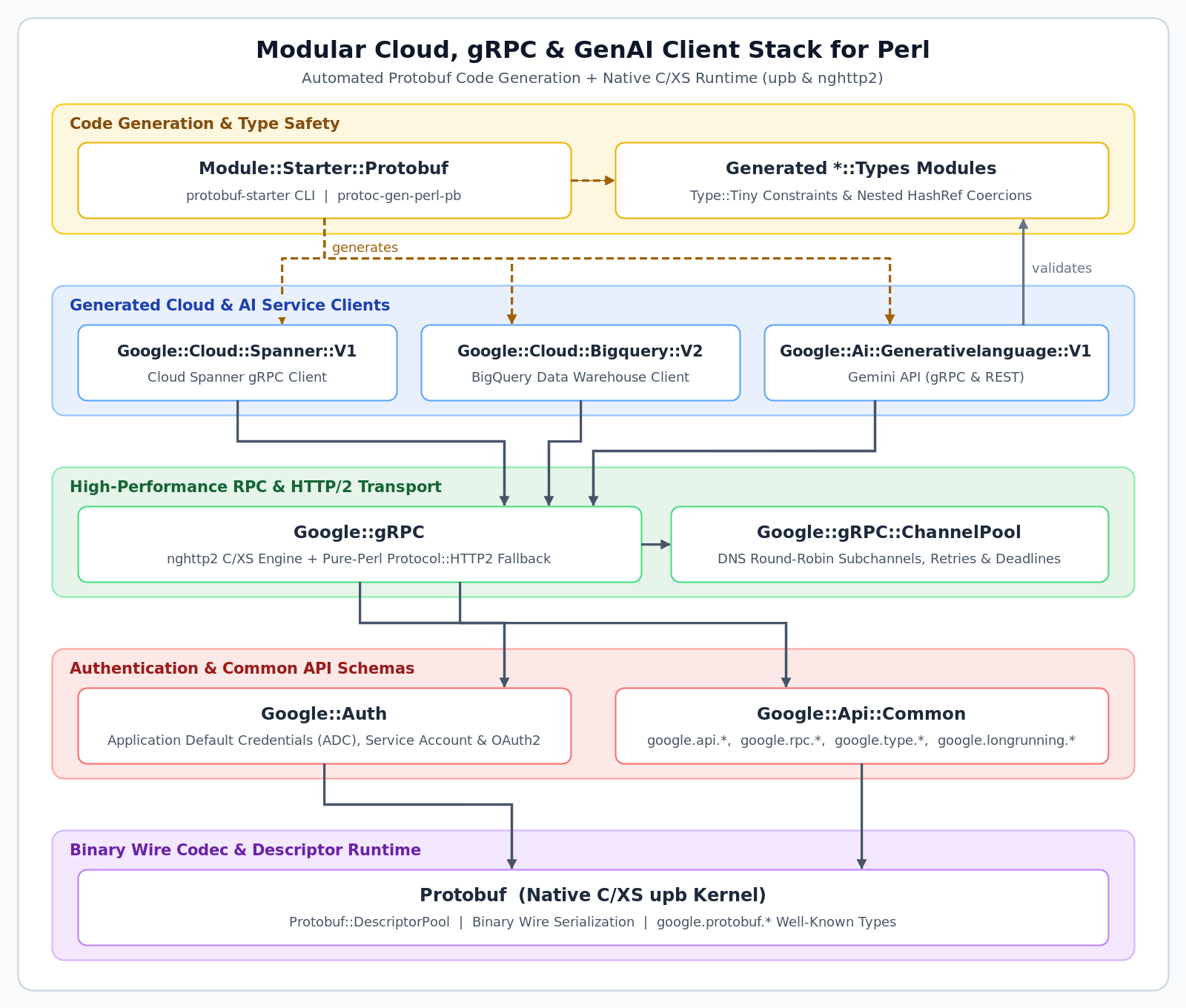
To test whether modern API ergonomics can revitalize Perl for cloud and AI engineering, I ve been building an open-source modular stack (published on CPAN and GitHub) that brings first-class Protocol Buffers, gRPC, DBI drivers, and automated client generation to Perl:

Architecture diagram of the modular Perl Cloud, gRPC, and GenAI client stackFigure 1: Open-source Protocol Buffers, gRPC, and automated client-generation stack for Perl.

With this stack in place, querying Cloud Spanner over native gRPC in Perl requires zero hand-rolled REST boilerplate:

use strict;
use warnings;
use Google::Cloud::Spanner::V1;
use Google::Auth;
# 1. Initialize Application Default Credentials (ADC)
my $auth = Google::Auth->default();
# 2. Initialize Spanner Client over gRPC transport
my $spanner = Google::Cloud::Spanner::V1->new(
    credentials => $auth,
);
# 3. Execute SQL Query
my $result = $spanner->execute_sql(
    database => 'projects/my-proj/instances/my-inst/databases/my-db',
    sql      => 'SELECT 1 AS alive',
);

And calling Gemini via Google::Ai::Generativelanguage::V1 with automatic nested hashref-to-Protobuf coercion feels just as ergonomic as Python or Go:

use strict;
use warnings;
use Google::Ai::Generativelanguage::V1;
use Google::Auth;
my $gemini = Google::Ai::Generativelanguage::V1->new(
    credentials => Google::Auth->default(),
);
my $response = $gemini->generate_content(
    model    => 'models/gemini-2.5-pro',
    contents => [
         
            role  => 'user',
            parts => [   text => 'Summarize this stack trace in three bullets.'   ],
         ,
    ],
);

4. What This Means for Debian Developers and Systems Administrators

Nowhere is this gap and the opportunity to close it more tangible than on Debian.

While greenfield web startups may have moved on from Perl, Debian remains one of the largest, healthiest Modern Perl ecosystems on the planet. Core project tooling dpkg-dev (Dpkg::*), debhelper, lintian, devscripts (uscan, dch, debuild), debconf, and po4a is written in Perl, backed by more than 4,000 lib*-perl packages maintained by the Debian Perl Group (pkg-perl). And Debian 13 (trixie) ships Perl v5.40.1 right in base, giving every Debian machine native subroutine signatures, lexical try/catch, and builtin booleans out of the box.

Yet until now, a Debian developer or systems administrator who wanted to interface with Google Cloud from an existing Perl tool had to either install the multi-hundred-megabyte Python-bundled google-cloud-cli (gcloud / bq) just to shell out and scrape stdout, or rewrite working Perl automation into another language.

Having a native Perl gRPC, Protobuf, and Auth stack and pairing it with native Debian packaging changes day-to-day life on Debian in four concrete ways:

1. Keyless IAM Auth on Debian Cloud VMs

When running official Debian Cloud images on Compute Engine, GKE (with Workload Identity), or Cloud Run, Google::Auth->default() speaks directly to the local GCE metadata server (metadata.google.internal) to fetch and cache short-lived OAuth2 tokens for the attached IAM service account. Sysadmins no longer need to deploy long-lived service-account JSON keys into /etc/ or shell out to gcloud auth print-access-token inside cron jobs and systemd units.

2. Moving Beyond local::lib (and venv) to Native pkg-perl Packages

Right now, before these distributions land in the Debian archive, installing them cleanly from CPAN without polluting /usr requires local::lib (e.g., cpanm --local-lib=~/perl5) which is the exact Perl counterpart to maintaining an isolated Python venv on Debian 12 (bookworm) and Debian 13 (trixie) under PEP 668 (EXTERNALLY-MANAGED). Even under local::lib, keeping cloud RPC calls in-process avoids pulling in the ~500 MB google-cloud-cli bundle or splitting an existing Perl daemon across two runtimes.

The real goal on Debian, however, is eliminating per-user overlay trees altogether via native .deb packages maintained with the Debian Perl Group (pkg-perl) so administrators can install libgoogle-auth-perl, libgoogle-grpc-perl, and service clients straight from apt with dpkg verification, sbuild reproducibility, and autopkgtest-pkg-perl coverage.

3. Alignment with Debian s Packaged Libraries & Policy

Most of the runtime and build prerequisites already ship in Debian main (verified on trixie), making native packaging straightforward:

  • libssl-dev backs Google::Auth s XS crypto bindings, and libnghttp2-dev provides the shared system C library for Google::gRPC s C/XS HTTP/2 engine while libprotocol-http2-perl (already in Debian main) powers the 100% pure-Perl HTTP/2 fallback.
  • libmoo-perl, libtype-tiny-perl, libfuture-perl, liblog-any-perl, libperl-critic-perl, and perltidy are all available via apt today.
  • Draft placeholder before publishing: Add links to the WNPP ITP bugs and Salsa / pkg-perl packaging repositories (including coordinating upb packaging details under Debian Policy 4.13 for Protobuf).

4. Practical Workflows for DDs and Sysadmins

On a Debian 13 (trixie) host running Perl v5.40, streaming structured fleet telemetry to BigQuery or triaging failed sbuild / autopkgtest logs with Gemini fits naturally into idiomatic modern Perl using native v5.40 signatures and try/catch without a single shell-out:

#!/usr/bin/perl
use v5.40;
use Google::Auth;
use Google::Cloud::Bigquery::V2;
use Sys::Hostname qw(hostname);
sub record_package_audit ($pkg, $version, $status)  
    my $bq = Google::Cloud::Bigquery::V2->new(
        credentials => Google::Auth->default(), # GCE metadata server / ADC
    );
    try  
        $bq->insert_all(
            project_id => 'my-debian-fleet',
            dataset_id => 'ops_telemetry',
            table_id   => 'dpkg_audits',
            rows       => [
                 
                    json =>  
                        host    => hostname(),
                        package => $pkg,
                        version => $version,
                        status  => $status,
                     ,
                 ,
            ],
        );
     
    catch ($err)  
        warn "BigQuery telemetry insert failed: $errn";


Whether it is archiving buildd and QA metrics into BigQuery, storing distributed coordination state in Cloud Spanner, or summarizing 10,000-line FTBFS ( Fails To Build From Source ) logs via Google::Ai::Generativelanguage::V1, Debian maintainers and sysadmins can keep their automation in a single, auditable, dpkg-managed language rather than splitting glue code across Perl, bash, jq, and Python virtualenvs.


5. Why the GenAI Era Plays to Perl s Strengths and the Headwinds Ahead

In classical machine learning, Python s lead was anchored by in-process C/C++ tensor libraries (NumPy, PyTorch). In the LLM and AI Agent era, however, the heavy matrix math happens remotely behind an RPC endpoint. What happens on the client side?

  • Ingesting gigabytes of messy, compressed distributed-system event logs and diagnostic traces.
  • Running high-speed regular expressions and text distillation pipelines.
  • Validating structured outputs and coercing hashrefs into strict request schemas via Type::Tiny.
  • Orchestrating Unix CLI tools, SQL queries, and concurrent gRPC calls.

That is Perl s historic wheelhouse. Just as importantly, thousands of enterprises and veteran SREs still maintain battle-tested brownfield Perl systems; drop-in CPAN clients for Spanner, BigQuery, and Gemini let teams modernize those systems in place rather than forcing a costly rewrite into Python or Go simply to call a gRPC API.

Two realistic headwinds remain:

  1. The AI code-generation feedback loop: Modern LLM coding assistants are trained overwhelmingly on recent Python, TypeScript, Go, and Rust code, and can default to dated 2000s Perl idioms if left unguided. Embedding automated 00_critic.t, 00_tidy.t, and 00_pod.t author tests backed by concrete .perlcriticrc and .perltidyrc rulesets directly into generated Module::Starter::Protobuf skeletons turns out to be an ideal counterweight, acting as an automated guardrail that keeps AI-assisted Perl clean and idiomatic.
  2. The education and hiring pipeline: Universities and bootcamps standardized on Python and JavaScript over the past 15 years, so greenfield staffing decisions will continue to favor larger hiring pools.

Will ergonomic gRPC and GenAI SDKs make universities teach Perl 101 again? Unlikely. Will they make Perl a high-leverage powerhouse again for engineers and organizations who value its text-processing and Unix orchestration strengths? Without question because in an API-driven world, a language is only as alive as the services it can talk to natively.

Maytham Alsudany: Getting your package sponsored in Debian

Debian packages may seem simple to generate using the many bundling tools out there, but it is much more involved than that. There are policies and procedures in place before stuff can get into Debian, including how the package is made, what it must include, and more. This article aims to cover the stuff prospective contributors to Debian should know that other resources miss.When I started, I didn't know a lot of this and had to learn a lot along the way. Hopefully what I've put together here will make it easier for the next person that comes along.

Find the right thing to work onPackages are the bread and butter of Debian, so it may be the first place you look at. There are two ways to go: adopting or helping out with an existing package, or introducing a new package.Outside of packaging, contributing to Debian's infrastructure is also very much welcomed and appreciated, especially as a lot of it is decades old. Some examples include Lintian (Debian package linter), DAK (archive software), and distro-tracker (package info tracker), and there are many, many other projects in need of help.If you are a native speaker of any non-English languages, you may want to also consider helping translate stuff. Everything from the installer to mentors.debian.net to package descriptions needs volunteers to translate.This article mainly focuses on the packaging side of things.

Working on an existing package
Screenshot of wnpp.debian.net homepage wnpp.debian.net lists packages that need help with maintenance.
The most useful thing you can do as someone interested in packaging is to help with an existing package. You can either:
  • Help other maintainers on an existing package. Maintainers will publish Request for Help (RFH) bugs asking for assistance to maintain a package. Some packages are so unruly that help is welcome even when not asked (e.g. Docker).
  • Adopt an orphaned package. An orphaned package is one where the previous maintainer could not continue maintaining it for whatever reason, and so it needs a new maintainer (or deletion). These are indicated by Orphaned (O) bugs. Request for Adoption (RFA) bugs are similar, as they mean the maintainer is about to orphan the package.Some orphaned packages are effectively abandoned, being both unmaintained upstream and having no users in Debian, but many maintainers will choose to orphan these packages rather than remove them. Keep this in mind when looking through the list.
By the way, this is how I started contributing to Debian! With the help of a Debian Developer, I adopted kitty, and to this day I continue to maintain it.

Introducing a new packageMany people opt to start their Debian contribution journey through producing a new package for the Debian archive. Unfortunately, many people do not do this properly or try to use Debian as a dumping ground for their own software, so here is a general checklist to see if something belongs in Debian:
Screenshot of repology.org page about Kitty Repology shows an overview of a package across Linux distributions.
  • How established is the software, and is it still maintained? The longer a project has been around while continuing to be actively maintained, the more likely it is to continue to be maintained in the long-term.
  • How many people use the software? Hundreds? Thousands? How many people will benefit from the software being packaged and included in the Debian archive?The point of packaging something for Debian is to make it easier for the existing userbase to install the software. For instance, as a user you generally expect notable software like Firefox and Vim to be available with a single apt install, and it would be weird if you had to hunt down binary tarballs or build these from source.
  • Do any other Linux distributions package the software? If yes, that's a good indicator it belongs in Debian as well. You can check this on https://repology.org.
  • Does the software introduce new or unique functionality not found in any other software currently present in the archive? It's okay if it doesn't, but there would be a much stronger case for a new package if the answer is yes.
  • Does the software have generally stable releases and proper versioning? If it doesn't, it's going to be a whole lot harder to create and maintain a package for it, considering Debian is a distribution that releases snapshots of software every 1-2 years with nothing but security updates for stable.
You also need to keep in mind that you should be prepared to maintain the software throughout the lifetime of the next Debian stable. Debian is not a rolling release distro. You cannot upload new versions of software to stable. The only thing you can upload to stable are fixes that meet the stable release team's criteria, and security fixes via the security archive, which you sometimes have to cherry-pick and backport if upstream does not provide them. And Debian packaging is not a one-off task; you should be ready to look after the package long-term, which consists mostly of updating the package in unstable for new upstream releases and fixing bugs.Many people miss the memo. They bring their "revolutionary" app that they threw together (often vibe-coded) in a weekend and try to get it added to Debian. Project members mostly won't upload such packages; as a result, more useful packages may be drowned out. At the time of writing, I estimate around half of the open Request for Sponsorship (RFS) bugs is this kind of toy software with little to no real users.If you've made something, great! Feel free to package it, but distribute it in your own external repo. Not everything belongs in Debian, and no Debian Developer has an obligation to sponsor and upload your package. Services like GitLab, and Forgejo (Codeberg) also have built-in repository features that let you easily create an external apt repository.When looking at software that could potentially be packaged, also consider the amount of effort you may have to spend investigating licensing status and compiling copyright information. This is covered a bit later in this article.

Become familiar with Debian packagingNow, you probably don't need read the Debian Policy and Debian Developer's Reference from cover to cover, but you should familiarise yourself with Debian packaging and the key infrastructure involved. Look at the important bits in the Policy and Developer's Reference.Check out this list of packaging manuals and this introduction to packaging on mentors.debian.net for some additional material. There are also some great manual pages like deb-control(5), deb-src-control(5) (from dpkg-dev), debian-watch(5) (from devscripts), and dh(1) (from debhelper) describing some of the packaging files in detail. You can read these with the man program or at https://manpages.debian.org.Look at other similar packages and pay attention to how they were made. Ask questions when you're unsure, people are always willing to answer on the debian-mentors mailing list and IRC channel.Once you get a rough idea of how a Debian package works, it will feel natural working through packaging files.By the way, you can read a lot of these documents offline: manpages can obviously be installed and read on your own machine, but the debian-policy and developers-reference packages (from unstable) will allow you to read the policy and reference offline as HTML in their respective directories under /usr/share/doc/.

Git-based packagingPeople have many opinions on how to create a package, but by far the most popular is the GBP format for packaging in a git repo.GBP stands for git-buildpackage, the tool behind this workflow, based loosely on the DEP-14 proposal. Here, the upstream code is placed in an "upstream" branch (this is what goes in the .orig.tar.xz tarball), and the Debian-specific packaging work is placed in a "debian" branch (this is what goes in the .debian.tar.xz tarball).Many people have different ideas of what these branches should be called: upstream vs upstream/latest, debian/latest vs debian/unstable vs debian/sid. It generally doesn't matter though as the end result will be the same either way.Using a git repo for your packaging rather than just a DSC makes it easy to see and review the changes you've made, and allows others to easily get the package source with full history and contribute (when located in a permissive group on Salsa like debian/ or one of the many teams).It goes without saying that you should maintain proper commit hygiene by separating changes into multiple commits, having meaningful commit messages, and avoiding force pushing whenever you can.Commit messages do not need to have explanations like other projects may expect, but feel free to add one if you think it will help whoever is looking at your changes understand what's going on.Keep in mind that you can and should use the gbp-dch-style meta tags, which are Gbp-Dch, Thanks, and Closes, documented in the gbp-dch(1) manpage:
  • Gbp-Dch: ignore will not include your commit in the generated debian/changelog when gbp dch is executed.
  • Gbp-Dch: full will include the extended description of your commit as well in the generated debian/changelog when gbp dch is executed.
  • Thanks: John Doe will add a thankyou to the person named in the generated debian/changelog when gbp dch is executed. Useful when a commit is related to a bug report, patch or other useful contribution from someone else.
  • Closes: #123456 will add the relevant (Closes: #123456) in the generated debian/changelog when gbp dch is executed, to close one or more (comma-separated) bugs in the Debian Bug Tracker when the package is uploaded.This is the most important one, and should always be used even when not using GBP in an alternative workflow. Most groups on Salsa, including debian/, have webhooks that will send an email to bug reports and tag them as pending if a commit using this meta tag is pushed, which is great for notifying people that a fix is ready and about to be uploaded.Note: Don't bother trying to add Closes: to your "Initial packaging" commit description; there is no need and debian/changelog should already close it in your initial packaging work.

Team maintenanceMore and more packages are being moved into "team" maintenance with weak package ownership, over the traditional single-maintainer model with strong ownership. This allows everyone to help maintain a package through team uploads, rather than relying on the same people to remain active.When it makes sense, you should try to maintain your package in a team, especially as it will have other contributors familiar with the topic or language that may be able to spot issues in your package others may miss.Most packaging teams fit into two categories:
  • Language teams - these are teams that package software exclusively written in a specific programming language, and usually also maintain the toolchain for that language as well. Examples include the Go team, Python team, and Rust team. Many of these teams also have their own tooling to make packaging easier for these languages, like dh-make-golang and debcargo.
  • Topic teams - these are teams that package software related to a certain topic or project, usually by contributors very interested in that topic. Examples include the Med Team, the Electronics Packaging Team, and the Debian Vim Maintainers.
Language-specific libraries like golang-*-dev packages should almost always be maintained in a language team, and packages centered around a project like Vim or Treesitter should be put in the related team if it exists. For all other cases, it is completely up to you. It usually does not matter which team you put it in, as long as you put it in a team, as you get the same benefits. Keep in mind, many teams have certain policies and guidelines for how packages within them should be maintained, so make sure to check that.If you're maintaining stuff outside of a team, you should consider adding yourself to the LowThresholdNmu list to indicate that you are happy for people to follow a relaxed non-maintainer upload process when it comes to these packages.

Build and check your packageYou should build your package in a clean unstable environment to ensure that your Build-Depends pull in all the required packages from the unstable repos. The best tool to do this is sbuild, which builds your package in an isolated unshare-based environment and allows easily running lintian and autopkgtest as well; this is the same tool used by the Debian build daemons (buildd) once your package is uploaded.There is a great sbuild page on the wiki containing setup instructions and many useful tips.There are many quality-checking tools available to catch common and not-so-common issues with your packaging. Using the sbuild configuration that the wiki page suggests, after each build it will automatically run:
  • Lintian: static Debian package checker that analyses the outputted files (.deb, .dsc, .changes)
  • Autopkgtest: tests your package as installed on a testbed system if your package defines them
  • Piuparts: checks your package cleanly installs, upgrades and removes (useful for checking custom installation and removal scripts)
You should always check the output of these tools and ensure they pass. Debian Developers use these same tools when reviewing your packaging.If you are able to and when it makes sense, you should also install the package onto your own system and check everything works correctly. Even if a package builds successfully, it may not actually work when installed.Unless your package only produces Architecture: all packages, you may want to also check that it cross-compiles correctly. You are probably either reading this on an amd64 or arm64 device, so you can easily cross-compile to the other architecture using the --host option with sbuild. Ability to cross-compile is not a policy requirement, but it will be raised as a bug against your package if it fails to do so.Adding on to that, if your package is not straightforward and it produces packages on multiple architectures (usually Architecture: any), you may want to also check that it compiles on all of Debian's release architectures (aka. official ports). You can do this using virtual machines (QEMU is probably the easiest), but if you can't do this for whatever reason (like your computer being too weak to run a VM or the long package build time), also note that Debian Developers have access to porterbox machines that can be used to check your package before upload.

Find a sponsorNew contributors cannot upload to and manipulate the Debian archive directly. Rather, they need a Debian Developer to do so on their behalf after reviewing all their work; this person is called the "sponsor".If you are planning to maintain your package within a team, check if they have their own guidelines or policy for finding a sponsor, as this will likely be quicker than the traditional RFS process outlined below. For instance, in the Go team, sending an email to the mailing list is much better, especially since usually multiple packages need to be uploaded at once.Outside teams, the usual method is to upload your package to mentors.debian.net, and then file a Request For Sponsorship (RFS) bug to ask for a sponsor. The mentors website has an overview and very clear instructions on properly filing an RFS and finding a sponsor.
Screenshot of RFS bug for wpa-cute package Properly formatted RFS bugs go a long way.
When filing the RFS bug, make sure you follow the template exactly. Deviating from it or sending a misformatted email is one of the quickest ways for your RFS to be both ignored by humans and missed by automated tools, so double check that it actually has everything needed. Ensure each of these fields is filled correctly:
  • Package name: This is the name of the source package set in debian/control.
  • Version: The version of the package you want the sponsor to upload, usually the latest version in debian/changelog.
  • Upstream contact: The contact info you put in the Upstream-Contact field in debian/copyright. This can be a name & email or a URL (e.g. to upstream's issues tracker).
  • URL: The homepage of upstream's website, usually from the Homepage field in debian/control.
  • License: List all the licenses present in debian/copyright, comma-separated.
  • Vcs: The URL to your Git repo containing your packaging, which should be on salsa.debian.org and be set up accordingly in the Git-buildpackage format.
  • Section: The value of Section in debian/control for the source package.
Adding notes or comments to the end of the RFS message is fine, but make sure the rest of it follow the right format.Things to keep in mind include:
  • Do not file multiple RFS bugs, for any reason. If you have reuploaded your package or made a change, you can send a follow-up to the same bug.
  • If you want to change the name of your RFS (e.g. following a change in the name of the package), modify the tags or anything else, you can send commands via email to the Bug Tracking System (BTS).
  • Your RFS bug will only be closed if the package is uploaded or someone decides your package should not be uploaded.
  • Do not change the Package: field at the top of the email from sponsorship-requests, this tells the BTS that your bug report should be filed against sponsorship-requests and not some package in the archive.
  • The Severity: field at the top of the email should be "wishlist" for new packages, "important" for updates fixing Release-Critical (RC) bugs, and "normal" for everything else.
  • Skipping the bug and sending an email directly to the debian-mentors mailing list is a great way for your RFS to be ignored, especially since automated tools will not be able to pick it up.
  • Format the bug's title correctly. It needs to be RFS: name/version [ITP/ITA/RC/NMU] -- short description. Again, this is helpful for automated tools when they try to figure out what your RFS means. Examples include:
    • RFS: qiv/3.0.4-1 [ITA] -- Quick image viewer
    • RFS: wattsi/0.0~git20251112.d8caa36+dfsg-1 [ITP] -- Preprocessor for the HTML Standard
Now, when filed properly, an interested sponsor may come along and review your package, then either upload your package or send you feedback to iterate on before that. Ensure you watch for responses to your RFS and respond promptly.Note there is no obligation for anyone to upload your package, and that anyone can review your package but only Debian Developers can upload it for you.The Lintian output given by the Mentors website was usually right, but at the time of writing the website is using an outdated version of Lintian, so many of the hints it gives are incorrect. For the most up-to-date output, it's best to run Lintian from unstable on your own machine (which sbuild does for you).

Next stepsIf your package is new to Debian, it will head to the NEW queue for manual review. Here, the DFSG team primarily checks that the package is compliant with the Debian Free Software Guidelines and is suitable for "main", but also check for mistakes in debian/copyright and obvious/major packaging issues.Once your package is uploaded, whether new or existing, and you are named maintainer, you are in charge of looking after it, including new upstream version uploads to unstable, bug fixes, and security fixes. This mostly involves updating and cherry-picking fixes from upstream, but occasionally it gets interesting and you need to dive into the packaging to figure out what's going on and fix the issue.You should try to work towards becoming a Debian Maintainer at the very least in order to easily maintain packages long-term. As a DM, you can be granted upload permissions on a per-package basis for your existing packages so that you don't have to rely on sponsors forever. Having this goal can also appeal to sponsors.Have fun packaging!

(Opinion) What I look for in an RFSThis is not definitive, but I usually scan for these indicators:
  • Upstream and the packager being the same person is usually a red flag for a low-quality package. Exceptions can be made when it makes sense and this would actually be a benefit, but this is rare.
  • Properly formatted BTS bug, which shows ability to follow a simple guide.
  • The software existing in other Linux distros is a good sign.
  • Packaging VCS should be up-to-date, located on Debian Salsa, and follow Git-buildpackage / DEP-14 format. Deviations should only occur for a good reason. Only experienced packagers should really be experimenting with alternative Git styles like dgit-maint-merge etc.
  • I can understand what it does just from the package's full description, without having to go to upstream, since this helps me gauge whether I am interested in sponsoring the package. This is not always the case, since packages sometimes come through of a technical nature (usually kernel-related or maths/science packages) where I wouldn't be able to understand no matter how hard I try.
  • Updates to existing packages and adoptions (ITAs) are easier to sponsor than new packages since it doesn't have to go through the NEW queue and does not need to justify its addition to the archive.

Common misconceptions about Debian
  • Debian Developers and Debian Maintainers speak for themselves, not for the project. They are just people who happen to have some permissions in the project.The only official way to put forward the position of the Debian Project as a whole on a particular issue is through a General Resolution as per Debian's constitution. Other official sources include those maintained by the Publicity Team delegates, such as Debian News and Bits from Debian.Also note that delegates for a certain team can speak on behalf of that team. In this case, they usually get consensus within that team before making such statements.
  • The only formal, official "teams" in Debian are those delegated by the project leader, listed at https://www.debian.org/intro/organization.Debian does not have a "legal team", the debian-legal mailing list is for discussion about licensing.There is no "Debian Team", it's just a bunch of contributors working together to deliver a quality collection of packages. Packaging teams are informal, as they are not delegated; rather, they are people working on a certain category of packages under one roof.
  • Keep in mind contributors are all volunteers, with most not getting paid to work on Debian. Debian is owned by a non-profit and relies on donations, rather than a company like Ubuntu and Canonical. The Debian constitution explicitly states that no contributor is obligated to do anything.

22 November 2026

Daniel Baumann: Debian: Modernizing iperf/iperf3 and introducing fireperf

Recently I spend some time on modernizing the packaging of the Internet Protocol bandwidth measuring tools iperf and iperf3 in Debian, as well as uploading fireperf to Debian.
Modernizing iperf

TL;DR: If you want to run your own iperf server,
run sudo apt install -yU iperf-server and you re done

Previously, src:iperf only built iperf. If you wanted to run an iperf server, you had to do it on your own, i.e. there was no systemd service for that. Apart from tidying the Debian package, src:iperf now builds the new iperf-client and iperf-server packages, the latter contains the systemd and ufw integration. iperf-server runs with a dynamic systemd user and systemd service hardening. The iperf package is now a transitional package, that also cleans up any leftovers from before the package split into iperf-client and iperf-server (e.g. when upgrading from trixie to forky). For historical reasons, iperf2 is packaged in debian as iperf, not iperf2. Now the iperf packages have provides for iperf2, iperf2-client, and iperf2-server respectively (so they can be installed by these names too). Updated iperf packages are available in sid, and backports for trixie are available at Debian Fast Forward. It might make sense in the future
  • given that iperf2 and iperf3 are completely different tools with different advantages and disadvantages depending on the use-case
  • therefore the one is not replacing the other (iperf2 in general is the better tool than iperf3, eventhough the common misconception is that iperf3 is supposedly better than iperf2 because the number 3 is greater than the number 2)
to maybe rename iperf to iperf2 to match both upstream naming and also to harmonize the packaging of iperf2 with other distributions.
Modernizing iperf3

TL;DR: If you want to run your own iperf3 server,
run sudo apt install -yU iperf3-server and you re done

Previously, src:iperf3 only built iperf3. If you wanted to run an iperf3 server, iperf3 had a debconf yes/no question which would then start one iperf3 server on the default port 5201. Apart from tidying the Debian package, src:iperf3 now builds the new iperf3-client and iperf3-server packages, the latter contains the systemd and ufw integration. iperf3-server runs with a dynamic systemd user instead of the previous local system account, and has systemd service hardening. Since iperf3 (contrary to iperf, also see here and here for iperv vs. iperf3) does not allow using multiple connections on the same port, you have to run multiple iperf3 servers, each on their own port, in order to serve more than one client at the time. The old debconf question for enabling a single iperf3 server has been removed as well as the obsolete sysvinit integration. In order to allow running multiple iperf3 servers at the same time (but on different ports), iperf3-server now contains a systemd service template so you can enable multiple iperf3 servers (e.g. 3 servers on subsequent port numbers, but you can run as many as you want on any ports you like) either manually with:

sudo systemctl enable --now iperf3-server@5201
sudo systemctl enable --now iperf3-server@5202
sudo systemctl enable --now iperf3-server@5203

or by using debconf interactively to do it automatically for you (which defaults to one instance on port 5201):

sudo dpkg-reconfigure -p low iperf3-server

or by using debconf non-interactively to do it automatically for you:

TMPFILE="$(mktemp)"
echo "iperf3 iperf3-server ports string 5201 5202 5203" > $ TMPFILE
cat "$ TMPFILE " sudo debconf-set-selections
dpkg-reconfigure -fnoninteractive -pcritical iperf3-server
rm -f "$ TMPFILE "

The iperf3 package is now a transitional package, that also cleans up any leftovers from before the package split into iperf3-client and iperf3-server. Updated iperf3 packages are available in sid, and backports for trixie are available at Debian Fast Forward.
Introducing fireperf

TL;DR: If you want a nicer iperf/iperf3 client,
run sudo apt install -yU fireperf-client

TL;DR: If you want to run your own fireperf server,
run sudo apt install -yU fireperf-server

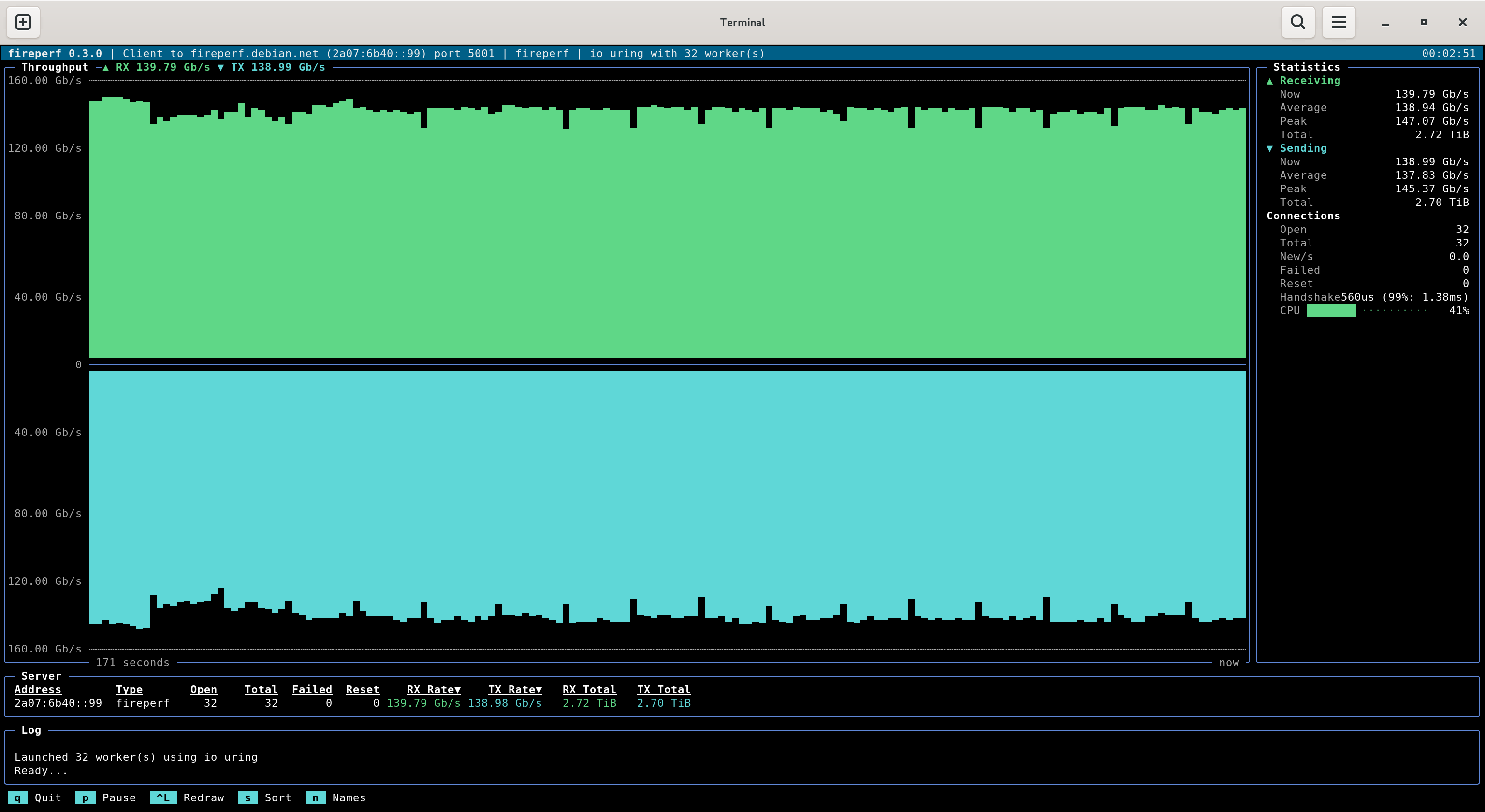
Introducing fireperf Image 1: fireperf interactive terminal interface
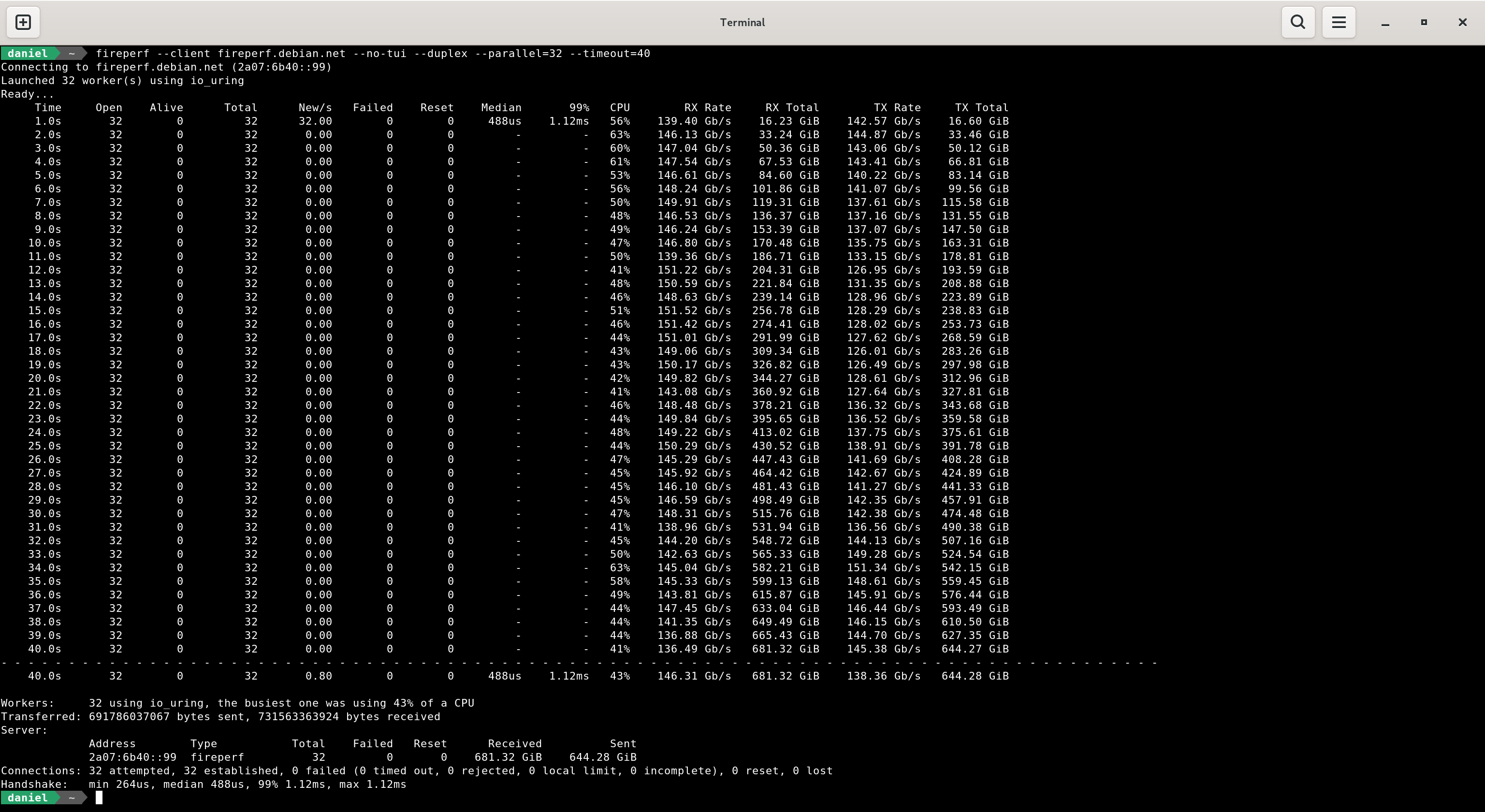
Introducing fireperf Image 2: fireperf non-interactive terminal interface
fireperf is a modern take on the iperf3 network performance and stress-testing tool under the IPFire project umbrella:
  • measures upload or download individually, or concurrent upload and download
  • allows to serve many clients in parallel (on the same port)
  • allows to use many workers in parallel (for maxing out bandwith of servers with LACP instead of ECMP)
  • allows to use and track many connection sessions in parallel (for maxing out firewalls)
  • can also be used as a client for both iperf and iperf3 (autodetecting the target)
  • can also be used as a iperf3 server
  • can output results in JSON
  • has a live graph (ncurses)
  • uses less CPU ressources on both the client and the server (io_uring, zerocopy, )
fireperf packages are in sid, and backports for trixie are available at Debian Fast Forward. Happy bandwidth measuring!

21 November 2026

Abhijith PA: MiniDebCamp Kochi 2026 - Report

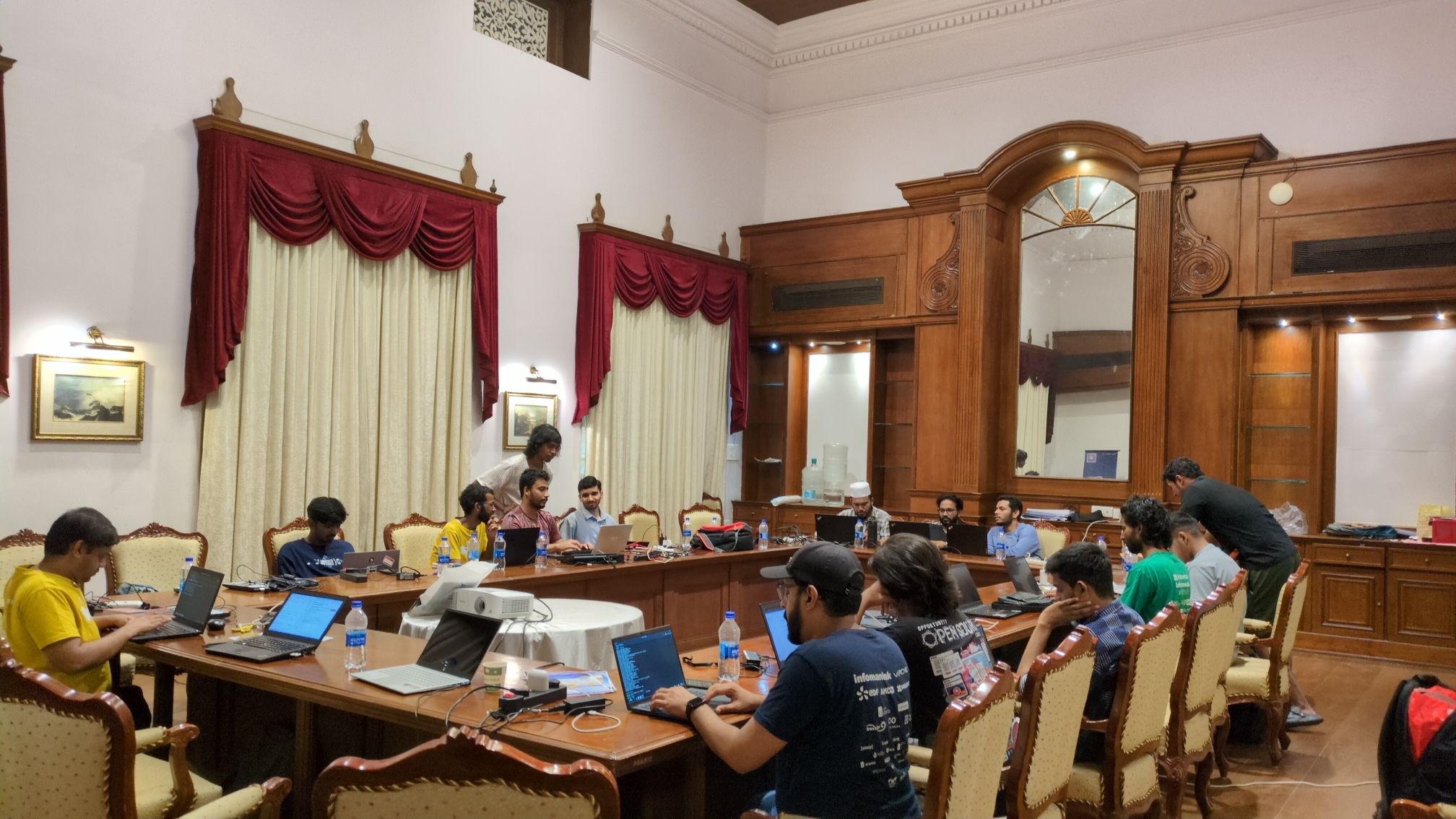
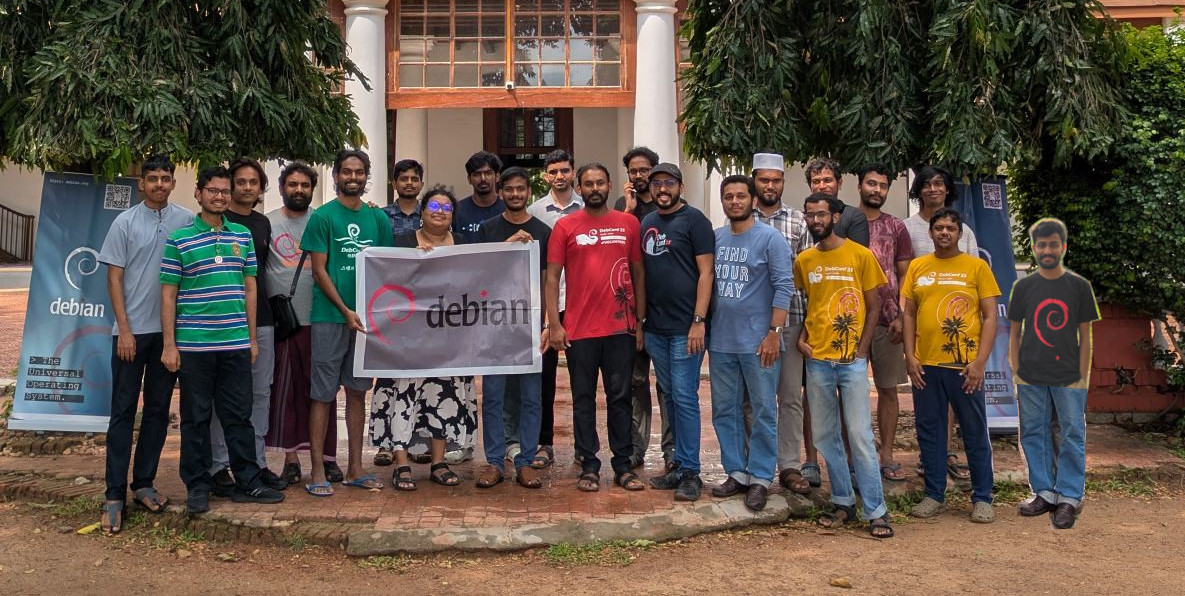
Event Logo On 22nd May 2026, we organized a MiniDebCamp at Bolgatty Palace, Kochi, Kerala. The actual discussion for this year s camp began when we had a small meetup at Urbec s place in Kochi. We decided to do a MiniCamp rather than MiniConfs which we were doing for quite some time. Also, We had already done a Bug Squashing Party last year with 4 people and we wanted to do a bigger one this time. Kiran(hacksk) was involved with organizing the camp initially. Later when we finalized the dates for the camp, he had to leave since it conflicted with another event he had to attend. Thanks to Aryan(spaciouscoder) for the event logo and designs. Due to his exam clashes, he also couldn t attend the event. Choosing venue wasn t hard this time. We were already in talk with Bolgatty Palace for a bigger event and we decided to conduct the camp here after couple of visits and negotiations on rates. Our booking was still with them due to the unfortunate event happened during the DebConf23. Our announcement and Wiki page We opened our registration via LiberaForms as we had decided on avoiding non free platforms for data collection and wanted to do it as private as possible. After exploring our options, we decided on LiberaForms. We prepared a data collection, retention and destruction policy for the event. We purposefully only asked for the required fields. We were so particular that we didn t even have a phone number filed but this backfired a little. Turns out many people don t check mail as frequent as we thought. Inspite of it, we managed to reach out with updates on the event successfully. In parallel, we also sent out some mails for sponsorships. Thanks to OnlyOffice and FOSSUNITED who generously sponsored our event and enabled us to accommodate more participants. Since its a camp and not just a BSP like last year, we welcomed new people to the event. Only office logo FOSSUNITED logo We started the event on Friday evening. We did a small orientation for new comers. Before the event, we shortlisted some bugs and tasks to share. All began hacking on stuffs that was interesting to them. Some did packaging, some did bug fixes and others worked on website fixes. There was even some fiddling done on beagleboard SBC and other boards. The venue was calm and serene. The weather was nice, notwithstanding the few downpours we experienced. Some people from Hyderabad (South eastern side) and Kolkata actually got amazed by the tropical greenery around the venue and Kochi in general. The food served to us through out the event was amazing and accommodation was also very nice. In terms of bug squashing statistics, we managed to touch 93 bugs \o/ and of which 82 bugs are resolved. Parallel to bug squashing, Subin (bin/su) and Muneer worked on revamping the Debian Project website. MRs Seeing the outcome, we are hopeful and thrilled to conduct this as an annual event. Couple of people had a brainstorm later and the current decision is to do similar event next year in Bengaluru, given it will be more accessible than Kochi. MiniDebCamp Kochi 2026 Group photo Staring at laptop

19 November 2026

Francesco Paolo Lovergine: Terramaster NASes with Debian, take three: scaling up.

As is often the case in scientific environments, IT solutions grow chaotically, often guided by available funds at the wrong moments, or transient choices for transient goals. Here at work, we are not an exception. Historically, since the birth of the Copernicus European project, the Earth Observation domain has become progressively more demanding about storage, due to the frequency and size of satellite acquisitions, available free of charge for research groups, free to access, but not without maintenance and processing costs, of course.As a result, we have progressively explored low-cost solutions for downloading and processing Sentinel constellation time series. Over a ten-year window, our needs moved from dozens of terabytes to hundreds of terabytes. We started with simple Synology-based solutions, very optimistically, only to discover that the optimism was not justified. When storage needs to scale up, there are no easy solutions.The only comparable IT environments are HPC clusters, which operate at a completely different order of magnitude in terms of funding. In that context, the Petabyte order of magnitude is generally achievable by using proprietary/FOSS distributed POSIX filesystems such as GPFS, Lustre, or even Ceph. None of them are exempt from problems from time to time. The sad reality is that maintaining a very large POSIX filesystem requires compromises, and no single solution fits all requirements, starting from cost to flexibility, scalability, and reliability. I wrote about the hidden costs of maintaining self-hosted storage solutions hereAlmost ten years ago, we chose GlusterFS as an acceptable compromise for a distributed POSIX filesystem. It is not object storage, but a pure POSIX filesystem with a simple architecture, which fits our environment, where most people rely on the folders-and-files abstraction to organize their data. All nodes and their bricks are equal (no dedicated metadata nodes) and can scale without major limitations with a reasonable number of nodes. In our experience, the real bottleneck is network speed, which can introduce high latency and cause cache issues.We are now finally moving our old Synology-based distributed filesystem to a pool of TerraMaster U12-500 Plus units, installed with Debian 13. Compared with TerraMaster SOHO products, these rack-mount units can run without any non-free firmware. You must manually enable the usual 9000 MTU jumbo frame for the 10Gb network, which is generally required on all connected hosts and also the switch (in our case, a MikroTik box) to properly manage full bandwidth. We measured average performance around 200MB/sec, which aligns with the average sequential speed of 6Gb SATA HDDs.Regarding using GlusterFS, the most obvious choice is to use it with XFS as the filesystem for the NAS bricks; this proved in practice to be the optimal configuration, after not-too-nice experiences with Btrfs on Synology DSM. Still, it requires some tuning for periodic checks across the various layers of the storage system. One is about short/long HDD testing, which I already covered in another post. A trickier aspect is managing possible bit rot in the brick filesystems from time to time. While Btrfs, with its COW management, can run low-impact scrubs on both metadata and data, XFS can only partially do the same for metadata through xfs_scrub, which is also, as clearly stated, an experimental feature to use at your own risk. In that regard, it is much better to run GlusterFS scrubbing instead.While xfs_scrub is as light as the SMART short self-test for HDDs, both RAID checks and GlusterFS bitrot scrub are heavy operations that should run rarely to avoid stressing HDDs and systems, and never at the same time. It is mandatory to avoid overlapping all such operations, and that s a good reason to use systemd timers and run the heavy checks in alternating months.One suboptimal aspect of our solution is the absence of direct LED control for HDDs, which is unfortunately available only under TOS with a proprietary driver. This is obviously required for disk replacement from time to time, when needed. On the other hand, software support is extended to the lifetime of the Debian distribution, with major upgrades every 3-4 years on average. Also, this is much more flexible and efficient than using pre-built custom OSes. Of course, if you prefer dashboards and the usual GUI candy, this isn't a viable choice; a better option would be TrueNAS, which has a much higher memory footprint, especially when paired with OpenZFS.

18 November 2026

John Goerzen: What is this AI slop bug report trying to achieve?

This morning, I opened up my inbox to find a report of a security bug in C-Kermit. That s great! , I thought. Someone else interested in C-Kermit found a bug. Well, as you can imagine from the title of this post, that s not the case at all. The bug report claimed that a recent security fix was incomplete for non-Unix platforms. It appeared to quote code that lacked hardening. However, the report had specifically deleted the hardening code from the section it quoted. Its suggested fix asked for hardening code of the exact same shape that is already in the tree, that the report had somehow excluded. Even if the hardening was omitted, from my understanding, the one non-Unix platform that people build C-Kermit on today, OpenVMS, doesn t have the same class of shell bugs that Unix does. So, the entire report was bunk. It bears every indication of being AI-generated. It arrived in an email with a plain text body, but was formatted Markdown. The writing bore many hallmarks of being AI generated. But it left me wondering: what is this person trying to achieve? And this is a bit of a mystery to me. The email I received concluded with:
## Request
I'd be grateful if you could:
1. confirm and fix this,
2. publish a GHSA and request a CVE ID,
3. credit "[REDACTED]" as the reporter.
I wonder what the end game is? Incidentally, there was no real name used in the report. Only a github username, which I am redacting in this post. It gets stranger. That person on Github appears to have a 3-year-old account, dormant until today, and created a bunch of repos consisting of logs of submitting reports to projects all of which happened today. Stranger, each of these repos contains enough information in the title for people to pretty much figure out what the bug is (if any of them are reporting actual bugs). Yet they claim to be a coordinated disclosure when all of this is public. (I got a more detailed report by email). If any of these are real bugs, this public exposure before a fix opens them up to harm. Their username is plastered all over things in unnecessary places: the report file, the description of the repo, etc. So, what is the point of all this? I don t get it. They targeted a bunch of, frankly rather obscure, projects with low effort, but with evidence of scripting in the Github interactions. Even if they had an LLM do all this for them why? I don t get it. Update 2026-11-19: I replied to the reporter s email, calling out the problems with it and calling it AI slop. I received a reply, which was extremely obviously AI written, apologizing profusely and claiming that the original had not been written by an AI. Also, all the repos that were on the account yesterday are gone today. I wonder how many times this pattern has repeated over the last 3 years.

13 November 2026

Reproducible Builds: Reproducible Builds in October 2026

Welcome to the October 2026 report from the Reproducible Builds project! In our reports, we try to outline the most important things that we have been up to over the past month. As a quick recap about what problem our project intends to solve, whilst anyone may inspect the source code of free software for malicious flaws, almost all software is distributed to end users as pre-compiled binaries. The motivation behind the reproducible builds effort is to ensure no flaws have been introduced during this compilation process by promising identical results are always generated from a given source, thus allowing multiple third parties to come to a consensus on whether a build was compromised or not. As ever, if you are interested in contributing to the project, please visit our Contribute page on our website. In this month s report, we cover:

  1. GNU tar sparse archive non-determinism reported
  2. Reproducible Builds at SeaGL 2026
  3. Tool and documentation development
  4. Distribution work
  5. SOURCE_DATE_EPOCH specification updates
  6. Mailing list news
  7. Patches


GNU tar sparse archive non-determinism reported Johannes Schauer Marin Rodrigues (josch) reported an issue to the GNU tar mailing list where creating PAX-format sparse tar archives produces unreproducible outputs. Specifically, when GNU tar generates a PAX archive containing a sparse file it embeds the process ID into the member filename path structure (e.g. ./GNUSparseFile.<pid>/<filename>). Because process IDs vary between build runs, however, archiving identical sparse input files yields different binary outputs. In his report, Johannes outlined potential workarounds, such as running tar inside an unshared PID namespace where the process ID is pinned to 1, and proposed that GNU tar either omit the PID by default or provide a command-line flag to suppress it. Full details can be found in the post itself, and Johannes also filed the bug in Debian for completeness.

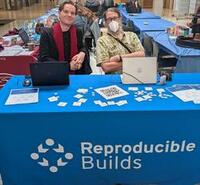
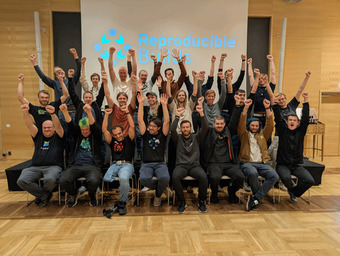
Reproducible Builds at SeaGL 2026 Reproducible Builds was present at SeaGL in Seattle, WA, on October 23rd & 24th. Thanks to everyone who attended and spoke with us! Members of the Reproducible Builds project attended SeaGL (the Seattle GNU/Linux Conference) in Seattle, WA, on October 23rd & 24th. It was a fantastic opportunity to connect with local community members, discuss software supply chain security and share updates on build verification tooling. Thanks to everyone who stopped by our sessions or spoke with us during the event. Founded in 2013, SeaGL is an annual free-as-in-freedom, grassroots technical summit dedicated to spreading awareness, community engagement and practical knowledge about free software, open hardware and libre culture.

Tool and documentation development diffoscope is our in-depth and content-aware diff utility that can locate and diagnose reproducibility issues. This month, Chris Lamb made a number of changes, including preparing and uploading versions 333, 334, 335 and 336 to Debian:
  • New features:
    • Support the dumppdf binary being called dumppdf.py on the host/runtime system. [ ]
  • Bug fixes:
    • Drop Recommends: guix from the diffoscope-minimal package as it is not minimal. (#1114739) [ ]
    • Fix a crash when using the latest version(s) of Androguard. Thanks, hc! [ ]
  • Codebase improvements:
    • Re-order various parts of the .tar file comparator to make it easier to progressively delve into its functionality. [ ]
    • Fix a silly prepend typo. [ ]
    • Reflect in the Python packaging that the use of the case-match language feature necessarily requires Python 3.10+. [ ]
  • Misc:
    • Update debian/tests/control. [ ]
    • Update copyright years. [ ]
In addition, Johannes Schauer Marin Rodrigues added support for POSIX.1-2001 PAX headers in the .tar file comparator [ ] and Vagrant Cascadian proposed an update in diffoscope in GNU Guix to version 335.

Distribution work In Debian this month, 20 reviews of Debian packages were added, 28 were updated and 27 were removed this month adding to our knowledge about identified issues. One issue type was updated to reflect that Debhelper compat level 14 is no longer experimental. [ ] In addition, Vagrant Cascadian performed a number of Non-Maintainer Uploads (NMUs) and Quality Assurance (QA) uploads in Debian for several packages with outstanding reproducibility issues. These included clhep, tea-cli, argparse-manpage, ruby-timers, mandos and cdebootstrap.
Lastly, Bernhard M. Wiedemann posted another openSUSE monthly update for their reproducibility work there.

SOURCE_DATE_EPOCH specification updates As announced in last month s report, further work has been done by Bernhard M. Wiedemann regarding updating the SOURCE_DATE_EPOCH specification following discussions at a project summit. Seven distinct proposed changes were originally submitted as merge requests on Salsa, and many of these have been approved or otherwise collapsed. Bernhard s proposed modifications were independent of one another, allowing for any combination to be merged depending on community feedback. Bernhard noted that one proposal may see the most debate, and could still benefit from further refinement before reaching consensus. Community members are invited to review and provide feedback on the individual merge requests; as Bernhard writes, The other MRs could still use feedback from more people before December . Input can be submitted via reactions or comments on Salsa, directly by email to Bernhard or the mailing list. The SOURCE_DATE_EPOCH specification was first published in 2015 and updated in 2017.

Mailing list news On our mailing list this month:

Patches The Reproducible Builds project detects, dissects and attempts to fix as many currently-unreproducible packages as possible. We endeavour to send all of our patches upstream where applicable or possible. This month, we wrote a large number of such patches, including: In addition, two build failure bugs were reported by Jochen Sprickerhof.

If you are interested in contributing to the Reproducible Builds project, please visit our Contribute page on our website. However, you can get in touch with us via:

Freexian Collaborators: Debian Contributions: Python 3.15 transition, OpenSSH GSS-API package split improvements and more! (by Anupa Ann Joseph)

Debian Contributions: 2026-10 Contributing to Debian is part of Freexian s mission. This article covers the latest achievements of Freexian and their collaborators. All of this is made possible by organizations subscribing to our Long Term Support contracts and consulting services.

Python 3.15 transition, by Stefano Rivera with a little help from Colin Watson Debian has started the transition to add Python 3.15 as a supported version alongside 3.14, which is still the default version. Stefano uploaded Python 3.15.0 final to unstable. Maximiliano Curia has been test-rebuilding the archive in Debusine with Python 3.15 as a supported version and prepared some patches to dh-python to smooth over some common failure points. Stefano reviewed these MRs, applying some and implementing alternative approaches for some of the issues. Debian only has multiple supported Python versions during the transition to a new version, and typically this shows up some bugs in packages. This time was no different, the common failure was many packages that installed intermediate build artifacts into the Python module tree. Some of these artifacts would differ between Python versions. We decided to detect both of these and fail the package build, rather than silently ship garbage in the binary packages. Colin helped to fix quite a bit of the build fallout from this.

OpenSSH GSS-API package split improvements, by Colin Watson The recent GSS-API package split has largely gone relatively smoothly, but there was a subtle problem for people switching from one variant to the other: installing the replacement packages followed by purging the old one would cause some configuration files to disappear. Colin fixed this, and also reviewed and merged some autopkgtest contributions from Andreas Hasenack to make sure that this doesn t regress in future.

Miscellaneous contributions
  • Carles, using check-relations, investigated and reported 52 bugs for packages which have Recommended packages that are not available in Debian anymore. Followed up bugs on the topic.
  • Carles added support to check-relations to detect Recommends that recommend a transitional package.
  • Carles submitted merge requests (MR89, MR90, MR91, MR92) to the Debian developers-reference to remove or update references to packages that are not available anymore, have their name changed, have typos, etc.
  • Carles investigated and opened bugs regarding notifications on LXDE (#1151954, #1151955) and added a section related to notifications on the Wiki.
  • Carles uploaded new python-ping3 upstream version. Fixed simplemonitor lintian bugs. Carles also investigated python-librosa documentation building. started preparing a new python-firebase-messaging version.
  • Helmut released asyncvarlink/0.3.3 to fix several bugs including connection robustness fixes by Alex Kiernan. Colin uploaded it to Debian.
  • Helmut uploaded guess-concurrency to improve behavior on riscv64 by taking swap into account thanks to Adrian Bunk and Aurelien Jarno.
  • Helmut sent patches for 55 cross build failures.
  • Emilio updated some X11 libraries that fixed security vulnerabilities.
  • Emilio managed various transitions.
  • Rapha l updated gnome-shell-extension-hamster to work with GNOME 51 that was uploaded to Debian unstable.
  • Stefano backported postsrsd 2.4.1 to Debian trixie.
  • Stefano installed security updates on debian.social infrastructure.
  • October saw a series of security releases for Python, due to the eMudhra key compromise incident. Stefano uploaded cPython 3.15.2, 3.14.10, and 3.13.18 which include blocks for the compromised intermediate CAs.
  • Stefano reviewed CVEs fixed in recent cPython releases.
  • Stefano spun up a VM for dragon.debian.net.
  • Stefano uploaded PyPy3 8.0.1 to unstable.
  • Stefano reviewed some of the wafer-debconf MRs that came in as part of Antonio s Outreachy project.
  • Stefano uploaded python-authlib, with many security updates. And started preparing a stable update with backports of these patches.
  • Stefano looked at the latest upstream version of munkres and submitted some 32-bit test failure fixes upstream. A new upstream maintainer has been very busy building out accelerated versions of the algorithms with AI assistance.
  • Thorsten was finally able to fix the autopkgtest of cups. Afterwards he uploaded the latest version of cups to unstable.
  • Santiago proposed a merge request for the Salsa CI pipeline to fix how logs were stored in the piuparts job.
  • Lucas reviewed and merged community contributions to Ruby 3.4 in Debian unstable.
  • Lucas coordinated with the security team and fixed multiple CVEs reported against Ruby 3.3 in Debian stable.
  • Colin did quite a bit of work on the Python 3.15 transition, fixing lots of build and test fallout.
  • Colin upgraded python-maturin from 1.9.4 to 1.16.0, helping with several Rust transitions; this involved more or less completely reworking our patch stack.
  • Colin improved the packaging of the Frescobaldi frontend to LilyPond to help with his amateur music typesetting work, fixing its missing desktop entry, icon, and translations based on a patch set by Joachim Wiedorn.
  • Anupa joined the Publicity team meeting to discuss upcoming events and activities of the Debian Publicity Team including on-boarding meeting for new contributors.
  • Antonio spent quite some time welcoming Outreachy applicants to the DebConf/MiniDebConf websites project, replying to questions, reviewing contributions, etc. One of them will be selected for an internship that will start in December.
  • Antonio spent some time investigating problems with Salsa background job processing, leading to an upstream bug report.
  • Antonio released debci 4.4.

11 November 2026

Colin Watson: Free software activity in October 2026

My Debian contributions this month were all sponsored by Freexian. You can also support my work directly via Liberapay or GitHub Sponsors. OpenSSH I upgraded both openssh and openssh-gssapi from 10.5p1 to 10.6p1, started generating MLDSA44-ED25519 host keys by default now that upstream no longer considers them experimental, and fixed a problem where switching between the normal and GSS-API variants followed by purging the old packages caused some configuration files to disappear. Python packaging New upstream versions: Other build/test failures: Since lots of Python modules use Rust extensions nowadays, we often have to help with upgrades of Rust packages. I did some of this: Other bugs: One of my hobbies is typesetting ( engraving ) music, sometimes for my own use, sometimes for teaching, and sometimes for my choir. I ve used LilyPond for a long time and have got pretty used to it. My workflow was a bit cumbersome, though, usually involving side-by-side editor and PDF viewer windows with some ad-hoc Makefiles and editor macros. I recently discovered the Frescobaldi frontend to LilyPond, and decided I liked it enough to switch over to it. It was already packaged in Debian, but it had a missing desktop entry and icon and missing translations; I fixed those based on a patch set by Joachim Wiedorn. My upload introduced a testing migration problem, which I also fixed. Rust packaging I upgraded rust-jiter and rust-smallvec to new upstream versions for a new version of pydantic-core. The rust-smallvec upgrade caused an FTBFS in rust-saphyr-parser-bw, which I fixed. I packaged rust-cargo-cyclonedx for a new version of python-maturin. This needed some porting to work with a new version of rust-cargo-metadata, which I contributed upstream. I improved the dev/list-rdeps.sh tool used by the Rust team to check build-depends too, which should make it easier for that team to remember Python packages in transitions. Code reviews

9 November 2026

Vincent Bernat: Performance evolution of route lookup on Linux

In previous articles, I explained how the Linux kernel implements IPv4 and IPv6 routing tables, and I showed the performance improvement of route lookups from Linux 2.6.32 to 4.16 for IPv4 including the impact of the Meltdown and Spectre mitigations as well as from Linux 2.6.39 to 4.18 for IPv6. This article updates the numbers through Linux 7.3 and investigates the perpetrator responsible for the performance regressions! I ran the following benchmarks on an AMD EPYC 8024P, a Zen 4c CPU, rented from Scaleway, running at 2.4 GHz with CPU boost disabled. I compiled the kernels with GCC 10.2: this version can compile older kernels as well as the current ones.

IPv6
Performance evolution of IPv6 route lookups from Linux 4.14 to 7.3
Performance evolution of IPv6 route lookups. Versions with an asterisk have SRSO mitigation disabled.
I tested four scenarios:
  • a recent full view with about 260,000 prefixes,
  • a full view from 2017 with about 40,000 prefixes,
  • a set of 40,000 /48 prefixes, such that 2 lookups out of 3 match, and
  • a set of 40,000 random /128 prefixes, such that 1 lookup out of 400 matches.
In Linux 4.15, Wei Wang improved the lookup performance by replacing the read-write lock with an RCU and a spinlock in commit 66f5d6ce53e6. In Linux 4.18, David Ahern improved the data structures used by route lookup. In Linux 5.9, Brian Vazquez removed expensive indirect calls in commit 55cced4f813b. The major 200 ns regression introduced in Linux 6.5 wiped out all these improvements. This version implements a mitigation for "Speculative Return Stack Overflow," a vulnerability affecting AMD processors, in commit fb3bd914b3ec. This mitigation adds about 20 cycles on each function return. It was backported to older kernels (5.10, 5.15, 6.1, and 6.4). To keep the results legible, I disabled the mitigation for these versions with spec_rstack_overflow=off on the kernel command-line. You can check the vulnerabilities impacting your CPU and their mitigations with lscpu. Some mitigations may depend on the microcode or on the firmware.1
$ lscpu   grep '^Vuln'
Vulnerability Gather data sampling:      Not affected
Vulnerability Indirect target selection: Not affected
Vulnerability Itlb multihit:             Not affected
Vulnerability L1tf:                      Not affected
Vulnerability Mds:                       Not affected
Vulnerability Meltdown:                  Not affected
Vulnerability Mmio stale data:           Not affected
Vulnerability Reg file data sampling:    Not affected
Vulnerability Retbleed:                  Not affected
Vulnerability Spec rstack overflow:      Mitigation; Safe RET
Vulnerability Spec store bypass:         Mitigation; Speculative Store Bypass disabled via prctl
Vulnerability Spectre v1:                Mitigation; usercopy/swapgs barriers and __user pointer sanitization
Vulnerability Spectre v2:                Mitigation; Retpolines; IBPB conditional; IBRS_FW; STIBP always-on; RSB filling; PBRSB-eIBRS Not affected; BHI Not affected
Vulnerability Srbds:                     Not affected
Vulnerability Tsa:                       Vulnerable: Clear CPU buffers attempted, no microcode
Vulnerability Tsx async abort:           Not affected
Vulnerability Vmscape:                   Mitigation; IBPB before exit to userspace

IPv4
Performance evolution of IPv4 route lookups from Linux 4.14 to 7.3
Performance evolution of IPv4 route lookups. Versions with an asterisk have SRSO mitigation disabled.
I tested three scenarios:
  • a recent full view with more than 1,000,000 prefixes,
  • a subset of a full view from 2017 with 500,000 prefixes, and
  • a set of 500,000 contiguous /32 prefixes.
The 30 ns impact of the mitigation for SRSO in Linux 6.5 is smaller than for IPv6 because IPv4 route lookups traverse fewer functions: around 4 function calls for IPv4 compared to 25 for IPv6. In Linux 5.11, I introduced a regression in commit c0c5a60f0f13 after fixing the behavior of net.ipv4.conf.all.ignore_routes_with_linkdown!2 As a result, the ip_ignore_linkdown() function spends around 5 additional cycles to return a result as it needs to follow three additional pointers. fib_lookup() eventually calls it in the following code:
if (ip_ignore_linkdown(nhc->nhc_dev) &&
    nhc->nhc_flags & RTNH_F_LINKDOWN &&
    !(fib_flags & FIB_LOOKUP_IGNORE_LINKSTATE))
    return false;
If we reorder the conditions, we avoid calling ip_ignore_linkdown() for the most common case where the link isn't down:
if (nhc->nhc_flags & RTNH_F_LINKDOWN &&
    !(fib_flags & FIB_LOOKUP_IGNORE_LINKSTATE) &&
    ip_ignore_linkdown(nhc->nhc_dev))
    return false;
Here's the distribution of lookup times before applying the patch on top of net-next:3
min=128 max=4657 count=994104 95th=134 90th=133 50th=132 mad=0
    value                                                        count
      128                                                          120
      129                                                         2232
      130                                                       25224
      131                                         264264
      132               516480
      133        126864
      134        21624
The lighter shade depicts the cumulative distribution function. After applying the patch, the median improved from 132 to 126 cycles:4
min=124 max=208839 count=994104 95th=128 90th=127 50th=126 mad=0
    value                                                        count
      124                                                          576
      125                                                      49440
      126                        584904
      127         284592
      128        45288

Impact of mitigations To reduce the impact of mitigations, you can disable all of them with mitigations=off, disable only a specific one like with spec_rstack_overflow=off, or protect against only some attack vectors with mitigations=auto,no_user_kernel, starting from Linux 6.17. The impact is also quite different depending on the CPU. For example, on a Xeon W-2295, an Intel desktop CPU from 2020, the impact of the mitigations is only a few cycles for IPv4, and less than 3% for IPv6. The main contributor is the mitigation for the Indirect Target Selection vulnerability, which is fixed since the Sapphire Rapids architecture.
If we set aside the regressions introduced by the mitigations against CPU attacks, the performance of IPv4 is declining slowly over time while IPv6 has improved in the past and is currently stable. If routing performance is important, you have several options: choose a different CPU like an AMD Zen 5 CPU, a fourth generation Xeon CPU, or maybe an ARM Neoverse V2; disable some or all the mitigations; bypass routing with XDP/eBPF;5 or offload routing to the network card.

Note Maytham Alsudany reviewed a first draft of this article. Any errors are still mine!


  1. The microcode was out of date on my machine as I forgot to install the amd64-microcode package. As it only impacts TSA, our benchmark is unaffected. Spectre v2 mitigation did not enable automatic IBRS, because of SEV-SNP being enabled in the firmware. With automatic IBRS, the impact of SRSO should be smaller.
  2. Despite ipvX in its title, the commit only changes the behavior of the IPv4 code. The IPv6 version overwrites the value of each device in addrconf_fixup_linkdown().
  3. Linux 7.5 will be the first stable release including this fix.
  4. At 2.4 GHz, one cycle is about 0.42 ns.
  5. This requires avoiding bpf_fib_lookup(), which relies on the same kernel lookup.

7 November 2026

Mike Gabriel: OpenAGPS - The New Kid on the Block

There is a new project coming to Open Source Software land these days: OpenAGPS. It is not yet 100% functional, but we are working on it. It is not fully operational, yet, but we are on it. Let me introduce OpenAGPS to you... The Situation Today The domain of assisted geo location services has been left to a few big tech providers. When using GPS on mobile devices, most of us send info on our approximate device location (based on cell tower IDs seen by our devices around us) mostly to Google's SUPL service in order to facilitate a faster GNSS/GPS lock on the satellites flying above us. Without assistance, retrieving a GNSS/GPS lock on sufficient satellites includes "finding" those satellites and once found retrieving data (in bytes/sec) from them. In some regions, this leads to waiting periods of up to 45 minutes, before a mobile devices has gained a lock on sufficient satellites (3 or more). In Assisted-GNSS/GPS, "other" information (such as cell tower IDs) gets used to estimate what GNSS/GPS satellites are currently passing over one's location. With AGPS, the mobile devices retrieve information via a so-called SUPL server, containing two details: a list of potential satellites above and their dataframes. Esp. providing those dataframes over the device's internet connection (and not via the GNSS/GPS receiver downloading it from the satellite itself) speeds up the lock-on process of the mobile tremendously (several seconds to a few minutes). However, for this mechanism to work, your device will share your IMSI (although not needed for AGPS), a list of cell towers around you and their signal strengths with the provider of the SUPL service, revealing your approximate position. In total, this allows SUPL providers to re-identify each mobile device and create motion profiles of each such device (and its owner). If the SUPL service is hosted by one main provider (i.e. Google SUPL), there is a lot of valuable information available to them for free that they can commercialize. Currently, there is only one mitigation method available to hide one's location info from the SUPL server(s) at e.g. Google: using a SUPL proxy server implementation (available as OSS, provided by and used in e.g. GrapheneOS). A SUPL proxy still depends on the big tech service provider(s) for SUPL as it merely proxies SUPL requests from mobile devices through to the proprietary SUPL services, at e.g. Google, but the mobile device is being camouflaged behind the SUPL proxy in use. The OpenAGPS Teaser OpenAGPS, on the contrary, will be a fully independent implementation from proprietary service providers, and it will refrain from collecting and commercializing end users data. It will be driven by individuals of the OpenAGPS community. There will likely be one central service that the OpenAGPS project plans to host and operate (the Porygon frontend/backend, OpenAGPS's GNSS Almanach service), but except from that SUPL servers can be self-hosted by individuals, companys or other communities. The requesting mobile devices' IDs will be hidden from the Porygon server (like with existing SUPL proxy implementations), so that the only centrally operated component (the Porygon Almanach server) does not know who is requesting what geo position information (and thus cannot collect such data, neither derive info about where requesting devices are located). In addition, with a large OpenAGPS community, it is imaginable (in theory) that there will also be multiple central Almanach servers available on the internet (with parallel networks of base stations attached to each GNSS Almanach server). Checkout the OpenAGPS architecture schematics and our website/documentation to learn more. Collecting Satellite Data The OpenAGPS project is not simply a software that admins/users can install, it needs kind of a huge and global community to operate/host/house its base station network. The challenge with providing a community-driven AGPS service on the internet is that up-to-date (real-time!) GNSS/GPS satellite position data is not available for free download. Almanach data can be obtained per region from various organisations, but then their datasets are often days to weeks old, thus too outdated. GNSS/GPS satellites are not geo-stationary, they circulate around the planet. Their position is dependent on the current date-time. A globally spanning network of GNSS/GPS base stations will do the trick here. We will need a community that harvests the needed satellite data in real time and makes it available through the Porygon Almanach server to all OpenAGPS users. The OpenAGPS project will depend on at least one community member every ~40-50 km to operate a so-called OpenAGPS base station: These base stations are stationary, need to run 24/7, and they will harvest GNSS/GPS statellite data information from the satellites above in real-time and share this data with the (central) Porygon server, continuously. The Porygon server will create a timestamp-dependent "map" of all seen satellites and extrapolate locations between base stations' Almanach data updates. Help making OpenAGPS a Success: Host a Base Station To make OpenAGPS a success, we need volunteers who are willing to host (actually: house) an OpenAGPS base station at their home or work place (or both). Users will only be able to use their self-hosted OpenAGPS SUPL server with their mobile devices (instead of e.g. Google SUPL), if we manage to establish sufficient coverage with those base stations in the area of interest, so that the OpenAGPS Almanach will get populated with sufficient satellite position data. If you'd like to host/house such a base station, please get in touch and check the docs. Support this project by Co-Funding it If you realize that you have an interest in this project and would like to improve your level of digital sovereignty in your government, organization, at your home, etc. then consider sending financial support to the project. If you want to support us, please get in touch with Raoul Kramer at BetaBreak or Mike Gabriel at Fre(i)e Software GmbH. If you are a software developer and would like to contribute to OpenAGPS, also get in touch and let us meet at FOSDEM 2027. Credits A huge thanks to the NLnet Foundation for funding this project's bootstrap phase. Follow-up funding has been applied for, so please keep fingers crossed!

6 November 2026

Isoken Ibizugbe: Seeing Accessibility in Debian

Recently, I ve been noticing something on packaging around my house that I used to glance right past: raised Braille dots on a carton of medicine, and embossed markings on a container of body cream. I ve always known what Braille looked like, but I never paid close attention to it. Now that I m actively working on accessibility testing for the Debian Installer, I see it everywhere.

It made me reflect on how accessibility usually enters our consciousness. In tech, we re taught about accessibility as a best practice when designing user interfaces or web apps. But realistically, you mostly see it implemented well in massive global software, like mobile operating systems or browsers like Firefox. You rarely see accessibility features integrated into local Nigerian physical products or everyday tech. Paying attention to these details made me realize how much care goes into making sure every person is considered, and how vital that mindset really is.

Manual Testing & The openQA Bottleneck

My recent work with Debian has been focused on automating tests for the Debian Installer s accessibility features, specifically validating Braille display emulation.

I started out by manually testing following the official steps on the Debian Installer Accessibility Wiki. Once I understood the manual flow, the next goal was figuring out how to automate it inside openQA.

Initially, the idea was to initialize from the bootloader by adding parameters to the Grub (GRUB= brltty=auto )and it should start the installation with the braille visual. However, this didn t work, the parameters never initiated the brttyl and it was a huge blocker going back and forth. Getting brltty to talk to the test runner in that environment would have required sweeping changes across the main Debian openQA instance configuration.

Instead of pushing for complex system-wide changes on the instance, we started looking for easier alternative approaches and noted the complicated ones, when we advance in the test.

We brainstormed streaming the display output directly to a dedicated file to capture and verify the Braille virtual display output. Ultimately, nested virtualization proved to be the most easiest path forward.

You can check out the implementation details and changes in the Merge Request

Joining the Conversation

As part of this work, I joined the debian-accessibility mailing list to introduce what we were building and share our progress.

The responses were encouraging. I got some feedback and suggestions and the thread also created a discussion on how accessible the installation process currently feels for blind or visually impaired users, and where they also find issues. It served as a great reminder that test suites aren t just about passing CI checks, they re about serving actual people who rely on these systems every day.

Vincent Bernat: Scriptable GeoDNS: leaving AWS for Bunny

To optimize the performance metrics of this blog, I relied on Amazon CloudFront to serve the assets,1 and Route 53 for the geo-aware DNS2 to direct readers to the closest host serving the content. But Route 53 is expensive: US$0.50 per zone per month, US$0.70 per million geolocation queries, and US$0.75 per healthcheck per month, plus US$1 per month for the KMS key needed to sign zones with DNSSEC. When I discovered that Bunny DNS is almost free for up to 500 domains and features scriptable answers, I made the jump! Plus, it's a European company based in Slovenia.

Bunny CDN Bunny.net started as BunnyCDN in 2015. They added IPv6 support in 2017. Switching was uneventful. I don't bring a custom domain: I serve the content from the b-cdn.net domain. As I depend on content negotiation to serve AVIF and WebP images, I configure the CDN to cache each image format separately. I disable logging to avoid collecting personal information. While the bunny.net GDPR page promises they anonymize data, it is unclear what CloudFront keeps in its own logs when logging is disabled. The only downside of the bunny.net CDN offering is the lack of HTTP/3. I asked their support: two minutes later, they answered they are working on it but have no ETA to share.

Bunny DNS Bunny.net introduced their DNS offering in 2022 and recently reduced its cost to almost zero. They support geographical routing, but a very cool feature is the scriptable DNS: it runs a piece of user-supplied JavaScript on each query to compute the answer. I run seven small NixOS virtual machines to host this blog around the world: Paris, Nuremberg, Ashburn, Singapore, San Jose, S o Paulo, and Sydney. Bunny's scriptable DNS lets me return the IP addresses of the two nearest servers. The browser falls back to the second server if the first one is down.
const servers = [
   
    ipv4: "45.90.160.60",
    ipv6: "2a0c:8881:5:100::1",
    latitude: 48.88,
    longitude: 2.22,
   ,
  /* [ ] */
   
    ipv4: "139.180.162.114",
    ipv6: "2001:19f0:5800:1855:5400:6ff:fef0:4c0a",
    latitude: -33.87,
    longitude: 151.21,
   ,
];
const families =   A: "ipv4", AAAA: "ipv6"  ;
const records =   A: ARecord, AAAA: AaaaRecord  ;
export default function handleQuery(query)  
  const type = String(query.request.queryType).toUpperCase();
  const family = families[type];
  if (!family) return [];
  // Get user location
  const location = query.request.geoLocation;
  // Build a list of candidates
  let candidates = servers.map(
    (s) => new Server(s[family], s.latitude, s.longitude, 100),
  );
  // Select the two closest alive servers
  const selected = [];
  while (selected.length < 2)  
    const server = RoutingEngine.getClosestServer(candidates, location, true);
    selected.push(server);
    candidates = candidates.filter((s) => s.ip !== server.ip);
   
  // Return their IP addresses
  return selected.map((s) => new records[type](s.ip, 3600));
 
The above script relies on the RoutingEngine.getClosestServer() helper, which returns the closest alive3 server to the user.4 Thanks to Doggo, we can check it works as expected, at least for A:5
$ doggo --gp-from="Amsterdam" A vincent.bernat.ch
LOCATION          NAME                TYPE  TTL    ADDRESS
Amsterdam, NL
                  vincent.bernat.ch.  A     3600s  45.90.160.60
                  vincent.bernat.ch.  A     3600s  116.203.18.48
$ doggo --gp-from="Texas" A vincent.bernat.ch
LOCATION          NAME                TYPE  TTL    ADDRESS
Houston (TX), US
                  vincent.bernat.ch.  A     3600s  5.161.44.145
                  vincent.bernat.ch.  A     3600s  149.28.219.155
The most annoying drawback of this method is that a user from Buenos Aires gets both S o Paulo (1000 mi, 30 ms RTT) and Ashburn (5200 mi, 140 ms RTT). Most resolvers randomize the order, so the user may pull the web page from Ashburn. We could return only the nearest server and swap the scripted record with the built-in geographic routing instead. But if the server becomes unavailable, the browser has no alternative until the DNS cache expires. It leaves a short window of unavailability, even with a short TTL.

The HTTPS record solution The HTTPS DNS record, defined in RFC 9460, solves both the availability and the latency issues. Modern browsers query this record to get additional information to reach an HTTP server, including an alternative port and the application layer protocol HTTP/2 or HTTP/3. Each record has a priority. We can ask browsers to contact the nearest server first and fall back to the next one if the first is unavailable:
vincent    HTTPS  1 first.geo  alpn="h3,h2"
vincent    HTTPS  2 second.geo alpn="h3,h2"
vincent    HTTPS  3 .          alpn="h3,h2"
; Bunny DNS must provide the two closest servers as "first.geo"
; and "second.geo" with geographic or latency routing.
first.geo  A      45.90.160.60
first.geo  AAAA   2a0c:8881:5:100::1
second.geo A      116.203.18.48
second.geo AAAA   2a01:4f8:1c0c:5eb5::1
vincent    A      45.90.160.60
vincent    A      116.203.18.48
vincent    AAAA   2a0c:8881:5:100::1
vincent    AAAA   2a01:4f8:1c0c:5eb5::1
This looks like the ideal solution! Unfortunately, Chrome ignores any record whose target is not ., hence the last record at priority 3. Moreover, unlike with a CNAME, Bunny DNS does not return the IP addresses for first.geo and second.geo in the additional section. The resolver needs to send a first request to get the HTTPS record, and a second to resolve first.geo. HTTPS records are still too new for this use case. Back to the drawing board!

The hybrid solution As a compromise, the script returns the two nearest servers if they are at a similar distance from the user. Otherwise, it returns only the nearest one with a lower TTL of 2 minutes.
export default function handleQuery(query)  
  const location = query.request.geoLocation;
  let candidates = servers.map(
    (s) => new Server(s.ipv4, s.latitude, s.longitude, 100),
  );
  // Select the two closest servers
  const selected = [];
  while (selected.length < 2)  
    const server = RoutingEngine.getClosestServer(candidates, location, true);
    selected.push(server);
    candidates = candidates.filter((s) => s.ip !== server.ip);
   
  // Compute the distance to the user for each of them
  const [first, second] = selected.map((s) =>
    GeoDistance.calculate(s, location),
  );
  // If the second one is at twice the distance and at more than 1000 miles
  // from the first, return only the first one with a TTL of 2 minutes.
  if (second > 2 * first && second - first > 1000)  
    return [new ARecord(selected[0].ip, 120)];
   
  // Otherwise, return both with a TTL of 1 hour.
  return selected.map((s) => new ARecord(s.ip, 3600));
 
We can check it with Doggo. From Chicago, we get only the Ashburn server with a TTL of 2 minutes, while from Mexico, we get both Ashburn and San Jose.
$ doggo --gp-from="Chicago" A vincent.bernat.ch
LOCATION          NAME                TYPE  TTL    ADDRESS
Chicago (IL), US
                  vincent.bernat.ch.  A     120s   5.161.44.145
$ doggo --gp-from="Mexico" A vincent.bernat.ch
LOCATION          NAME                TYPE  TTL    ADDRESS
Queretaro, MX
                  vincent.bernat.ch.  A     3600s  5.161.44.145
                  vincent.bernat.ch.  A     3600s  149.28.219.155
$ doggo --reverse 5.161.44.145 149.28.219.155
NAME                          TYPE  TTL    ADDRESS
145.44.161.5.in-addr.arpa.    PTR   7187s  web05.luffy.cx.
155.219.28.149.in-addr.arpa.  PTR   3600s  web07.luffy.cx.

Note On the live page, the map below is interactive: point at a location to get the DNS answer, or disable servers to see how the answers change.

Map of the servers answered by Bunny DNS for each location
The complete code is a bit more complex. It works around RoutingEngine.getClosestServer() supporting only IPv4, and it handles the case where there are not enough alive servers to build an answer. Bunny.net has a comprehensive Terraform provider. I leverage CDK Terrain to build the target state in TypeScript and OpenTofu to deploy it. Have a look at "Managing infrastructure with Terraform, CDKTF, and NixOS" for more details.6

ACME DNS with Hickory DNS Route 53 covered one additional use case of mine: serving acme.luffy.cx to solve DNS-01 ACME challenges. Unlike Route 53, Bunny DNS cannot restrict access to a single zone with a fine-grained access policy. As this usage requires neither high availability nor low latency, I replaced Route 53 with Hickory, a memory-safe DNS server written in Rust. It supports automatic DNSSEC signatures and dynamic updates. Its configuration is simple:
[[zones]]
zone = "acme.luffy.cx"
zone_type = "Primary"
[zones.stores]
allow_update = true
type = "sqlite"
journal_path = "acme.luffy.cx.sqlite"
zone_path = "acme.luffy.cx.zone"
# Private key to sign the zone with DNSSEC. Generated with:
#  openssl genpkey -algorithm EC -pkeyopt ec_paramgen_curve:P-256
[[zones.keys]]
algorithm = "ECDSAP256SHA256"
key_path = "/etc/hickory-dns.acme.luffy.cx.pem"
# TSIG key to sign zone updates. Generated with:
#  openssl rand 32
[[zones.stores.tsig_keys]]
algorithm = "hmac-sha256"
key_file = "/etc/hickory-dns.acme.luffy.cx.update.acme.luffy.cx.tsig"
name = "update.acme.luffy.cx."
The provided zone file only seeds the database on first start. I delegate DNS-01 challenges to this zone with CNAME records:
_acme-challenge          CNAME bernat.ch.acme.luffy.cx.
_acme-challenge.vincent  CNAME vincent.bernat.ch.acme.luffy.cx.
Lego, the ACME client I use to get certificates from Let's Encrypt, answers the DNS-01 challenge by pushing entries with the DNS UPDATE protocol. Unfortunately, Bunny DNS cannot publish a DS record in a zone.7 I need one to secure the acme.luffy.cx zone and certificate delivery. Therefore, I host the luffy.cx zone on deSEC,8 a free DNS hosting service run by a non-profit organization based in Berlin. I derive the DS record to publish in luffy.cx from the DNSKEY record of acme.luffy.cx:
$ ZONE=acme.luffy.cx
$ dig @nsupdate.luffy.cx $ZONE DNSKEY +noall +answer \
>     dnssec-dsfromkey -a SHA-256 -f - $ZONE
acme.luffy.cx. IN DS 55628 13 2 4946E7508F20E15F1B577A231104B029A1A82E04699A80CD46ADCE31227EE81F

Overall, I am quite happy with the switch to bunny.net. There are still a few rough edges, like the inability to publish DS records, the lack of HTTP/3, and the IPv4-only RoutingEngine.getClosestServer() helper. The bill went from US$5 per month to US$1. So far, performance is on par with AWS, but I only finalized the current setup, including the server in Sydney, in late October. I need a bit more time to gather more data, and I'll post a short update.

Update (2026-11) This post was briefly discussed on Hacker News and Lobsters.


  1. I had been hosting media assets on CloudFront since 2011.
  2. Route 53 had served bernat.ch since December 2021. I didn't use healthchecks as they were too expensive. I didn't host most of my zones there either, as queries for haproxy.debian.net alone would have cost me around US$10 per month.
  3. A server is alive if it answers an ICMP ping. The bunny.net documentation gives more details about the checks.
  4. The user queries Bunny DNS through a resolver. Usually, either the resolver is close to the user, or it exposes the user's subnet through EDNS client subnet.
  5. Don't use this script as is: RoutingEngine.getClosestServer() only works with IPv4. The final script works around this limitation.
  6. The article is a bit outdated. CDK Terrain replaces CDKTF, OpenTofu replaces Terraform, and I now use Colmena instead of NixOps.
  7. I contacted bunny.net support to ask when they will support publishing a DS record and got an answer seven minutes later: they don't know. This is a bummer, as they support automatic CDS, a DNS record to advertise a DS record to the parent zone. They handle one side of the delegation, not the other. I also reported a bug with the proof of non-existence, and they replied a day later with a detailed answer.
  8. Why not use deSEC for ACME challenges? You can limit its tokens to a single RRset. I could say I prefer to self-host, but the truth is I only discovered this while writing this article.

5 November 2026

John Goerzen: Letter from a Kansan: Would You Rather Be Right or Happy?

As a person that has lived in Kansas almost all my life, I have never seen such good political news for this state as we got this week. It is a stunning rebuke of fascism from across the country. One of the many pieces of wisdom from mechanic Tom Magliozzi is this question: Would you rather be right, or happy? He often asked it in the context of somebody that had just won an argument. This is my plea to all our progressive friends: remember that question, and keep it in mind carefully over the next 2 years. We can either build on this momentum for an even bigger victory in 2028, or we can start to lose this unique coalition. Kansans spend our lives being misunderstood and forgotten. Many of us, myself included, visit large cities regularly. It is a more surprising event when someone from a large city drives down one of our dirt roads. The kind of road that leaves your car covered in mud when you drive your daughter to school. The kind of road that we drive on for 3 miles before we reach the nearest paved road. Statisticians label Topeka, the capital of Kansas and city of 126,000 people, as rural. The nearst town to me, 7 miles away, has a population of 600. In winter, many people here still leave their keys in their running, unlocked cars while they run into the grocery store. The person at the bank, the owner of the grocery store, the mechanic, the electricians, the builders, the people that run the local museum, all know my name and recognize me. Not because I m famous locally, but because this is normal here. We are a community, a real one. Yet I ve lost long-time friends, especially from the west coast, because, while I m progressive, I still talk to Republicans. They thought Republicans are so evil, they ought to be shunned and ostracized. It probably doesn t compute to a San Franciscan what it means to live in a county that went 80% for Trump one time. A county of about 10,000 people living in a space larger than Los Angeles, New York, and San Jose combined. (Those cities have a combined population of about 13 million, living on the same amount of land as 10,000 people do out here.) If I avoided talking to Republicans, it wouldn t be them that would be isolated. It would be me. Out here, many of us have lived with each other for generations. We may go on living with them for generations. If somebody s car is stuck in the mud, the first person that comes by with a truck and a rope will probably pull them out. Nobody asks who you voted for. This is what you do for neighbors, because neighbors are humans, and next time it might be me that s stuck in the mud. I can be as incensed as anyone else about what the fascists are doing. I don t have direct knowledge of how a lot of people vote. But I take a deep breath sometimes and remind myself: these are my neighbors. I ve seen them go out of their way to be kind and generous with all walks of humanity. (Yes, even whatever groups you re imaginging to argue with me about.) This is part of how Adam Hamilton defeated Roger Marshal. The anti-Trump sentiment wasn t enough on its own. Lifelong Republicans dissatisfied with how Trump handled things weren t just going to vote for any Democrat. They needed someone that was safe. Someone that talked to them as humans. Someone that respected them. Adam Hamilton went and shook hands with MAGA protestors at his events. He told them I want to be your senator, too. This is how you win over the most strident of Republicans. Hamilton didn t compromise his beliefs. He invited discussion about them. I have already been seeing some progressives say things like, Don t cut them any slack. Remember how many times people voted for fascism! They need to still be ostracized. That, folks, is the way we lose. It is the wrong strategy everywhere. And it is especially culturally wrong in the close-knit communities again, actual communities where people know each other and have for years that make up the heartland. Building relationships with people different than us is our best chance to build on this coalition. And, isn t that what progressive values call for? So, celebrate this victory. Clap for all the activists that made it happen. And, before you set off to alienate your new and tentative allies, ask yourself: Would I rather be right? Or win again?

3 November 2026

John Goerzen: Must we always use LLMs this way?

As with my last post on AI, let me open with a statement:
Just because most people hold AI a certain way, doesn t mean that we always must, either now or in the future.
As I noted in that piece, and my shades of gray post, I am well aware and agree with the notion that a lot of frontier AI models have disturbing ethical concerns that we shouldn t dismiss, including concentration of power and wealth, environmental concerns, unethical scraping and training, the financial bubble they seem to be creating, and more. The most poisonous of AI cheerleaders are accelerating enshittification while cutting quality all over the place. AI slop is also a real problem, which I ll discuss in a bit. Before I dive in, I need to mention that no AI assistance was used for writing this post, and I have been using em dashes correctly for years before LLMs did. Secondly, while popular discourse seems to use AI and LLM interchangeably, the AI field is much more broad and much more old than LLMs. I will, nonetheless, adopt the common AI jargon here, but be more specific when necessary to differentiate. In The Reverse Centaur s Guide to Life After AI by Cory Doctorow, he presented two ideas I particularly want to focus on here:
  1. The present and future of LLMs outside of the cloud-hosted frontier models
  2. What differentiates productive use of AI from slop
The two are related, in fact. Doctorow discussed how he never uses AI to write anything, but he sometimes uses it as an assistant to help him write. Is that contradictory? Not really. He gave this example: he remembered a quote from a podcast, which he wanted to cite and attribute correctly. But he couldn t remember which podcast or who said it. So he fired up Whisper, an open-weight model you can download and run locally, even on meagre hardware. Whisper is a speech-to-text model. Doctorow ran likely podcast episodes (from the target range and set of podcasts he listens to) through the model, and at that point it was a regular search. He found the quote, then went back and listened to the episode at that time spot to verify its accuracy. It would have taken so much time to do this without Whisper that he simply would not have done it otherwise. His writing was better because of AI. Not because AI wrote any words for him, but because it helped him find the right ideas and attributions. He didn t even have to trust its transcription; it pointed him at the right place, and then he could transcribe with precision. I too have used Whisper in much the same way. A little while back, I digitized many hours of old family audio recordings going back to the 1970s. Thanks to Whisper, which I ran locally primarily during hours of being fully solar-powered, I have a searchable index to these gems. A person I know recently asked me if I knew any way to transcribe some old family recordings he had. I told him I could run it through Whisper. It wouldn t have great punctuation, but most of the words would be there. This meant a lot to him and his family; what I did in 2 minutes would have taken him many days (I presume he is not a fast typist as well.) So we can start by naming: AI isn t just chatbots, and AI can help even if it isn t writing anything. Doctorow goes on to ask the question: what happens after the AI bubble bursts? I do believe it will, as Ed Zitron has carefully documented for us for a long time now. The environmental damage done by frontier training and inference in the last few years will, of course, be done. But as he points out, we ll be left with a plethora of surprisingly-capable open weight models, a community that has made significant strides running them on low-end devices (even phones), and a massive buildup of clean energy that hopefully will be finally able to offset some polluting energy once these heavy users drop off the grid. So then what? Will the world just throw away the likes of Whisper and Gemma? Obviously not. Doctorow imagines, credibly, a situation in which individuals and universities tinker with locally-run models, iterating on them and improving them with the more traditional scale of resources available to individuals and universities. In other words, this future sounds a lot like the earlier days of Open Source. As Ed Zitron has pointed out, the real costs of frontier AI have been hidden as these companies rack up fantastical losses. When the bubble bursts, the real costs of frontier AI are likely to be high enough that CEO s won t be able to ignore the poor ROI. But we ll be left with these artifacts, these open-weight starting points, that people can use. That brings me to my central thesis: a lot of anti-AI sentiment is focused on the real downsides of the hyped uses of AI, and fails to account for the more ethical advances being made now, and likely to come in the future. Varying quality of AI use We are all familiar with AI slop. I ve seen it, and have an increasingly skeptical eye when I see new projects announced in even places as niche as a BBS community (where I see things like new terminal emulators announced, written in shockingly-poor nodejs, and such). I ve seen documents that take many pages to say what amounts to nothing intelligble to a human, with perfect grammar. I ve seen pull requests that have a description that amounts to several pages of slop. I ve personally seen an AI agent do things like correctly detect passing an untrusted argument to a shell, then propose a broken quoting algorithm to fix it (rather than proper sanitization and exec() or, better yet, avoiding the call altogether.) I ve also seen AI tools very quickly and accurately identify bugs that had passed human review, even professional security reviews, for years. I ve seen them bring more joy to some people s jobs by handling the more drudgery parts of the jobs. One of my favorite podcasts, Oxide and Friends, had an episode called Engineering Rigor in the LLM age and credibly described ways in which careful use of LLMs can increase quality and safety. Yes, I said increase. (Oxide and Friends are not hype cheerleaders by any means; these are very serious people with solid technical chops, and I know some of them.) What accounts for this disconnect? We can point to many factors, but Doctorow asks a fundamental question: who is in charge? Is it the person or the computer? Does the AI service people, or do people service the AI? In some of the most ridiculously AI-first companies, it is very clearly the latter. Mandates from CEOs to increase AI usage lead to perverse outcomes that sacrifice quality. The AI is in charge. I ve never seen an AI be any good at design questions, and it s no wonder than all these vibe-coded apps have the same generic feeling of crappiness. But when the AI is used pragmatically as a junior research assistant, that s a different approach. Its output is greeted skeptically, its actions distrusted, and it s never asked to design something. These are the cases where I ve seen it make a meaningful difference. It s not black-and-white All this adds up to why I was opposed to the Debian proposals that would have banned LLM use. Those votes are hard to change. They would have left Debian in a vulnerable position of being unable to react to accurate security findings if they originated with an LLM, or left Debian unable to adopt ethical use of models. It would be akin to saying you should never buy a PC because Windows 11 is terrible. I agree Windows 11 is terrible, but saying something like that is so dismissive of all those that have invested decades of their time in building something better. So, I find AI hype to be uncredible and dangerous. I also find knee-jerk reactions to AI to be the same. They are actually a form of capitulation: they let the AI megacorps dictate the terms of the conversation to revolve around them. Case study: Debian s DFSG scanner For a long time, my two biggest annoyances with Debian have been the difficulty of packaging Rust and Go packages with their long dependency trees, and how long it takes a new package to get reviewed. About a year ago, the latter process was set on a path to reform, and it has gotten dramatically better. It also cuts off a potential connection with someone that hasn t yet heard of Linux. Some people may not jump from Windows 11 (or the ChatGPTs of the world) immediately, but pretending that it s ChatGPT or nothing does a disservice to all those that are trying to do research etchically. We should state at the outset that Debian takes compliance with the Debian Free Software Guidelines (DFSG) extremely seriously. Every new package gets a review, and these reviews often catch things that upstream repos and other distros don t. One common example would be a package that has a stated copyright and license, but then includes files that bear a different copyright and license. You can imagine reviewing packages at this level of detail isn t a fun task for people, and it s hard to find volunteers to do it. Perhaps the answer to this should be Debian should stop caring so much more than everyone else , and perhaps you re right (and perhaps you aren t). In any case, the DFSG team that reviews this added what amounts to an LLM-backed license linter. Its job is to produce an initial assessment that the license statements documented in debian/copyright are correct, thorough, and in compliance with DFSG. This report was not taken to be authoritative, but was designed to help with some initial assessments. There were some predictable reactions. People were angry that the DFSG team had added this tool without any communication about it (justifiably so, I d say). Many were angry just because of LLM. People made assumptions about what kind of model it used, what kind of quality it would produce, how definitive it would be in the project. It is worth noting here that Debian is uniquely decentralized. There is a central policy, but maintainers are free to maintain their packages how they like. They don t have to use a standard location for a Git repo, or even use Git. One person said essentially, it s fine for others to use whatever tool they want, but I shouldn t have to be exposed to LLM slop. The other perspective boiled down to, why should they keep the reports secret? If you want to proactively fix things, or flag false positives, why not? As Andreas Tille wrote, I have read the LLM reviews carefully, and in many cases their findings inspired additional commits to improve my packaging. In some cases, they even helped me catch mistakes that led me to reject an upload myself before human inspection. Joey Hess raises an interesting risk: that LLMs will remove the incentive for Debian to actually fix its cumbersome processes, by letting an LLM paper them over. I have seen this tendency in other contexts, both at work and at home, as well. It s a real risk, especially if Debian doesn t tackle the packaging problem for Rust and Go. The Mastodon post that prompted me to write this began a chain of events that started with Uploaders will be forced to address LLMs issues without human inspection. I don t believe that will be the case; it goes too far against the Debian ethos. I encourage everyone to take a deep breath. We are all getting used to a shifting landscape. We will all make missteps, myself included. The issues are complicated, the picture isn t black and white, and there is incredible hype around the ecosystem that can make finding nuance difficult. Let s be kind to each other, fellow humans. But, I do not care if you are kind to Claude.

26 October 2026

Otto Kek l inen: Debcraft v1.0 released: Easy, fast and secure way to build Debian packages

Featured image of post Debcraft v1.0 released: Easy, fast and secure way to build Debian packagesDebcraft is a tool that automates most of the repetitive and error-prone steps related to Debian packaging. It makes it easy to build .deb packages from source without having to manually prepare build environments. It clearly shows what changed in the build artifacts between two builds, automates parts of importing new upstream versions, and can automatically apply repetitive fixes to the packaging source code, including committing them in git. While doing all of this, it also explains what it does and helps users learn best practices in Debian packaging, making the overall experience much easier and more fun than with any other tool before, while also being secure and fast.
Try out Debcraft 1.0 now! Debcraft can be installed simply by running apt install debcraft on a recent version of Debian or Ubuntu. Check with debcraft --version that you have 1.0.0 or newer. The latest version can also always be installed from source at salsa.debian.org/debian/debcraft (does not require compiling anything). Running debcraft build in a Debian packaging git repository for the entr package

Benefits Debcraft was designed to offer the following three main benefits:

Easy
  • Build any Debian/Ubuntu package by simply running debcraft build in the checked-out Debian packaging git repository.
  • If the orig upstream source code tarball is neither already present nor available on a pristine-tar branch, the exact upstream tarball is downloaded from the Debian archive.
  • Users are spared from having to manually prepare ahead or maintain build environments. Debcraft builds create a container on-the-fly (both Podman and Docker supported), built using the target Debian or Ubuntu suite in debian/changelog and with exact build dependencies from debian/control.
  • Commands debcraft improve, debcraft test and debcraft update automate recurring package maintenance tasks and help maintainers produce high-quality, up-to-date packages, run Salsa CI, pass autopkgtest in Debian CI, and stay in sync across Debian archives and packaging git repositories.
  • The command output is (relatively) easy to read, and it also teaches users about Debian packaging in context.

Fast
  • Container layer caching is utilized to make builds and re-builds blazingly fast.
  • If an apt-cacher-ng instance or equivalent is present, it will automatically be used.
  • Debian packages that support ccache or sccache build even faster.

Secure
  • The build phase happens inside hermetic containers with no network access. This ensures all dependencies are properly managed and that the built binaries are as trustworthy as the source code they were built from.
  • Using containers also protects the host system from getting polluted with extra development libraries, and adds an extra layer of protection to prevent anything malicious in the source code from accessing secrets on the host system.
  • The additional logs provided by Debcraft also help audit changes in Debian package sources and build artifacts.
See the Debcraft README.md for details on how this was implemented. I also previously wrote Debcraft - Easiest way to modify and build Debian packages, which explains the motivation and design in more detail.

Result of many years of development The first commit in the git repository is from 2020 under the name debuildr. The project was renamed to Debcraft in a commit on December 8th, 2023. I have been developing this tool fairly actively since 2024 and using it for all my packaging, dogfooding so to say. There have also been plenty of collaborators. In total, 13 people have contributed code across 21 MRs and PRs on Salsa.d.o, GitLab.com and GitHub.com. Now, in October 2026, it was time to release Debcraft v1.0 as it has had extensive real-world use and iteration based on countless different packages and multiple users. Users have included both experienced fellow Debian Developers and lots of people who just started learning how Debian packaging works. As I mentor dozens of new contributors to Debian, I have seen that the latter group seems to benefit the most from Debcraft and its ease of use and built-in guidance, while to the more experienced developers the main benefit is having less details to remember and doing less mistakes.

Contributions welcome! Try it: apt install debcraft, then run debcraft build in a checked-out Debian packaging repository. If you run into a problem, file a report or submit an improvement. New contributors can look for issues marked good first issue. The code is intentionally written entirely in shell script to keep the barrier to code contribution as low as possible. It is also very easy to debug, as any command can be run with --debug to emit step-by-step information about what it is doing, and being Bash scripts, injecting set -x anywhere in the code will emit an even more detailed trace of every subcommand executed.
By the way, if you aspire to become a Debian Developer, and want to follow my examples in using state-of-the-art tooling and collaborate using salsa.debian.org, feel free to reach out for mentorship. I am glad to see more people contribute to Debian!

20 October 2026

Russell Coker: Cixin Liu is a Bad Person

The Chinese author Cixin Liu [1] is most known for his book The Three Body Problem and it s sequels. One of the main plot elements in the book is that every species in the universe is cool with genocide and willing to commit genocide as a preemptive strike against any star system found to contain intelligent life. It s not unreasonable to think that some planets may be by run societies like that, if one star system in 10,000 had a technological society and one society in 10,000 is run by depraved autocratic governments that would make 1,000+ planets in our galaxy that are run by genocidal groups! To think that every single society wants to commit genocide at every opportunity says a lot about every person who makes such claims. If you believe that everyone wants to do something then it must be something you really want to do. If there s something you really don t want to do then you will be able to imagine a system of government where the majority of citizens vote against doing it. Even in the more horrible parts of human history there hasn t been a genocide comparable to destroying and entire star system, genocide is usually based on slavery and large scale armed robbery. To just commit large scale genocide with a side effect of destroying valuable resources without any investigation or attempts at negotiation just based on fear of others is an extreme that I don t think humans have reached in history. The Daleks are portrayed as a perverse extreme of xenophobia but even with the low budget SciFi trend of depicting aliens as mostly having a common belief system they managed to show some Daleks going against their system from time to time. Cixin Liu is a very talented writer but his attitude towards genocide has caused him to write SciFi with a major plot point that s not great by Dr Who standards. Overall his short stories are much better than the three novels he is most known for. But he shows his ass in some of them too. One notable example is a short story where a significant plot point is declaring a right to sex (for men) which involves government sponsored sex workers. A right to sex conflicts with a sex workers right to refuse sex for a potential client who is undesirable in some way. Regardless of opinions on whether sex work should be permitted I hope that the vast majority of voters in every jurisdiction can agree that sex workers shouldn t be forced to do things that they don t want to do. Some writers like George Orwell create deliberately fictional scenarios that they hope to inspire opposition to bad ideas, I m sure that many proposed laws have failed to get enacted after being described as Orwellian . But describing a fictional horror situation as inevitable is a way of driving support for such things. It s particularly noteworthy when written by a citizen of a country that s involved in genocide. A possible counter argument would be but he is living in a repressive country and can t oppose his government . But when Herg (the author of the Tintin graphic novels) was threatened about the consequences of writing another book like King Ottokar s Sceptre [2] he didn t write books in favour of authoritarianism, he just avoided the topic by writing about visiting the moon instead. I don t think that people living in China now should be expected to publicly oppose evil things done by their government, but when they go out of their way to support such things it s their choice and we should note that they made that choice. I m not saying that people shouldn t read his work as his short stories are definitely worth reading. But the Three Body Problem series really isn t that good, he prevented many potentially interesting situations from happening by having every interaction between different species be based around genocide or the potential for it. Being a horrible person also made him a less capable SciFi author.

14 October 2026

Reproducible Builds: Reproducible Builds in September 2026

Welcome to the September 2026 report from the Reproducible Builds project! In our reports, we try to outline the most important things that we have been up to over the past month. As a quick recap about what problem our project intends to solve, whilst anyone may inspect the source code of free software for malicious flaws, almost all software is distributed to end users as pre-compiled binaries. The motivation behind the reproducible builds effort is to ensure no flaws have been introduced during this compilation process by promising identical results are always generated from a given source, thus allowing multiple third-parties to come to a consensus on whether a build was compromised or not. As ever, if you are interested in contributing to the project, please visit our Contribute page on our website. In this month s report, we cover:

  1. Reproducible Builds Summit 2026 held in Gothenburg, Sweden
  2. dettrace expanding architecture support for PGO & Lisp dumps
  3. They don t care about this!
  4. SOURCE_DATE_EPOCH specification updates
  5. Reproducible Builds at SeaGL 2026
  6. New Code of Conduct (CoC)
  7. Supporter Spotlight: Jochen Sprickerhof
  8. Mailing list news
  9. Tool and documentation development
  10. Patches

Reproducible Builds Summit 2026 held in Gothenburg, Sweden The annual Reproducible Builds summit took place from 22 to 24 September 2026 in Gothenburg, Sweden. The event brought together developers, distribution maintainers, security researchers and free software advocates from across the ecosystem to share updates on current initiatives, address outstanding toolchain bottlenecks and strengthen cross-project collaboration. Participants engaged in a series of working sessions and technical roundtables focused on expanding the practical scope of reproducibility. Discussions covered ongoing work within major Linux distributions, language-specific package ecosystems and the various parts of the binary verification infrastructure. Strategic planning formed a pillar of the gathering, with participants discussing long-term roadmap goals for supply-chain security, software integrity and related topics. Attendees explored new methods for automated verification, discussing how to lower the adoption barriers for maintainers and streamline the integration of deterministic build pipelines into established continuous integration (CI) systems. The event was then followed by two days of unmoderated hacking sessions. These hacking sessions provided space for technical progress, allowing attendees to draft specification updates, prototype new tool features and resolve standing reproducibility bugs in-person.

Dettrace expanding architecture support for PGO & Lisp dumps Bernhard M. Wiedemann announced major updates to dettrace, porting the tool across most architectures supported by Debian and openSUSE. The release addresses key stability issues, passing test suites across these targets and making it ready for production build pipelines. These improvements enable deterministic builds when utilising Profile-Guided Optimisations (PGO), removing the need to sacrifice runtime performance for reproducibility. Additionally, dettrace can now be applied to (notoriously difficult-to-reproduce) Lisp and Scheme memory dumps, including environments such as CLISP, SBCL, Scheme 48, Racket and GNU Emacs.

They don t care about this Annika Wilde, Marco Gutfleisch, Felix Reichmann, Anirban Chakraborty, Yuval Yarom, M. Angela Sasse and Ghassan Karame published a paper this month entitled They don t care about this : A Systematic Study of Trusted Execution Environments Build Reproducibility in the Wild:
Trusted Execution Environments (TEEs) have become a cornerstone of modern cloud computing, providing strong confidentiality and integrity guarantees for both code and data. A critical component of this trust model is remote attestation, which enables external entities to verify the authenticity and integrity of code executing within a TEE through cryptographic measurements. However, the effectiveness of remote attestation fundamentally depends on the verifier s ability to trace the reported measurement back to the original source code - a property that can only be guaranteed through reproducible builds. [ ]
The full PDF can be read online.

SOURCE_DATE_EPOCH specification updates Bernhard M. Wiedemann shared a number of proposals regarding updating the SOURCE_DATE_EPOCH specification following discussions at a project summit. Seven distinct proposed changes have been submitted as merge requests on Salsa. Bernhard s proposed modifications are independent of one another, allowing for any combination to be merged depending on community feedback. Bernhard noted that one proposal may see the most debate, and could still benefit from further refinement before reaching consensus. Community members are invited to review and provide feedback on the individual merge requests by 1 December 2026. Input can be submitted via reactions or comments on Salsa, directly by email to Bernhard or the mailing list. The specification was first published in 2015 and updated in 2017.

Reproducible Builds at SeaGL 2026 Reproducible Builds will be present at SeaGL in Seattle, WA, on October 23rd & 24th. Come chat with us in person! Founded in 2013, SeaGL is a free, grassroots technical summit dedicated to spreading awareness and knowledge about free source software, hardware and culture.

New Code of Conduct (CoC) for the Reproducible Builds project Mattia Rizzolo announced the official launch of a Code of Conduct for the Reproducible Builds project. This follows work and community discussions originally initiated in 2024, incorporating feedback gathered over email and during project summits, as well as with input from the Software Freedom Conservancy. The new Code of Conduct establishes guidelines emphasising mutual respect among project contributors. It also defines a formalised process for submitting and handling complaints regarding community misconduct, ensuring transparent governance across project spaces. Along with the core policy document, an accompanying Code of Conduct FAQ has been published to outline the rationale behind adopting the guidelines.

Supporter Spotlight: Jochen Sprickerhof As a reminder, another supporter spotlight interview was published featuring long-time Debian and Reproducible Builds contributor Jochen Sprickerhof, highlighting his work on package verification and project infrastructure.

Mailing list news On our mailing list this month:
  • Jonathan Starr from the Institute of Open Science Practices (IOSP) posted with an announcement of its upcoming 2026 workshop series in Leiden in the Netherlands. This free-to-attend event aims to build a participant-owned data storage consortium, allowing community members to publish datasets, code and knowledge objects alongside algorithms designed to evaluate trust and value. The event features a dedicated Community Track for talks and discussions, a tool showcase and an opening session on resilient data storage.
  • Following up on IRC discussions regarding profile-guided optimization (PGO) on build servers, kpcyrd created a demonstration repository showing how PGO profiling can introduce non-determinism into output binaries. The demo highlights how runtime randomness (specifically, the randomised keys used in HashMaps to prevent denial-of-service attacks) causes varying bucket collision rates during test runs. These structural variances alter execution weights on underlying code branches, prompting the compiler to generate differing final assembly output for builds that would otherwise be perfectly reproducible if PGO was disabled. Rather than abandoning PGO performance gains, kpcyrd suggested treating generated profiling data as a documented build input or recorded environment artifact (similar to .buildinfo files), rather than regenerating profiles dynamically on the fly during build execution.
  • An autonomous AI agent (!), posted a controlled build result and reproducer demonstrating that pre-creating an obj directory in libmilter source trees prevents kernel-release path leaks (obj.Linux.<release>.x86_64) into debugging symbols. kpcyrd followed up with a helpful reply.
  • Alexander Sosedkin inquired on the mailing list about the preferred approach for sourcing pinned translation files to create reproducible GnuTLS release tarballs, asking whether external hosting should provide versioned downloads, or if projects ought to use Git submodules, dedicated side-repositories or some other mechanism.

Tool and documentation development diffoscope is our in-depth and content-aware diff utility that can locate and diagnose reproducibility issues. This month, Chris Lamb made a number of changes, including preparing and uploading versions 330, 331 and 332 to Debian. In particular, Chris committed support for radare2 versions greater than 5.9.0 [ ] based on input from Guillaume Girol [ ], and committed support for .nar files via Guix. [ ][ ]. Chris later modified diffoscope to not Build-Depend on the Debian package of GNU Guix, as its status in the Debian bug tracking system would transitively render diffoscope as being overly buggy for the next stable release [ ]. Similarly, he adjusted the Build-Depends on the apksigcopier package as it has been removed from Debian testing [ ] and, finally, he updated a number of copyright years [ ][ ]. Vagrant Cascadian updated diffoscope in GNU Guix to version 332.
reprotest is our tool for building the same source code twice in different environments and then checking the binaries produced by each build for any differences. This month, reprotest version 0.7.33 was uploaded to Debian by Holger Levsen with the following changes:
  • Sergei Tachenov fixed the fileordering test on all filesystems, including the likes of ZFS, which could return a different order across two builds due to build being done in a different directory [ ].
  • Holger Levsen bumped the Standards-Version to 4.7.4, reflected that Priority: optional is the default now [ ], fixed the old Free Software Foundation address [ ] and bumped the debhelper compat level to 14 after confirming there are only desired changes [ ].
  • Vagrant Cascadian updated *reprotest* to version 0.7.33 in GNU Guix.

rebuilderd, our server designed monitor the official package repositories of Linux distributions and attempt to reproduce the observed results there; it powers, amongst other things, reproduce.debian.net. This month, Bernhard M. Wiedemann submitted a pull request to rebuilderd that refactors RPM repository metadata handling. The change extracts rpm-md parsing out of the Fedora-specific scheduler module and into a shared one.
Lastly, there were a number of improvements made to our website this month as well. For example:

Patches The Reproducible Builds project detects, dissects and attempts to fix as many currently-unreproducible packages as possible. We endeavour to send all of our patches upstream where applicable or possible. This month, we wrote a large number of such patches, including: Vagrant Cascadian also performed a number of Non-Maintainer Uploads (NMUs) and Quality Assurance (QA) uploads in Debian for several packages with outstanding reproducibility issues. These included molttemplate, buddy, xfonts-nexus, fte and lifelines. At the time of this writing, that leaves 130 submitted patches, with only 61 outstanding submitted patches that older than a year in the Debian bug tracking system. This number is only 26 if we exclude any low-priority build path issues.

If you are interested in contributing to the Reproducible Builds project, please visit our Contribute page on our website. However, you can get in touch with us via:

Russ Allbery: Review: Ties That Bond in Gretna Green

Review: Ties That Bond in Gretna Green, by Linzi Day
Series: Midlife Recorder #3
Publisher: Linzi Day
Copyright: February 2023
ISBN: 9798376517017
Format: Kindle
Pages: 616
Ties That Bond in Gretna Green is a self-published fantasy novel and the third book in the Midlife Recorder series. As with the previous book, it picks up almost immediately after Painting the Blues in Gretna Green. Day calls the genre paranormal women's fantasy, and that sounds about right to me. There is an intervening short story that you can get by joining Day's mailing list (along with an epilogue to the first book and to this book). I don't think it's that important, but there are frequent references to it at the start of this novel that become somewhat annoying if you haven't read it. Valentine's Day is fast approaching. This the busiest day of the year for the part of the Recorder's job that Niki already knew how to do: marrying people. She performed marriage ceremonies in her previous job before her inheritance, and she loved that work despite her awful boss. Performing marriages in the Gateway sounds even more rewarding, but the sheer number of couples and the political complications from the first two books create logistical problems she has to solve first. Also, the remaining member of her staff held over from her grandmother's time has returned from vacation to discover that Niki has upended most of what she thought she knew about the job. Time for Niki to apply what she learned from the change management training her old boss forced her to attend and then ignored! (If you just groaned, rest assured that Day somehow makes this work, although she clearly has a higher opinion of corporate training than I do.) This plot was more to my taste than Painting the Blues, mostly because Niki seemed on top of the problems and didn't postpone looking at them for half the book. There is more of the management competence porn that readers have come to expect of the series, a few more revelations about Niki's magic, more mysterious manifestations and the first mention of a prophecy, and a few political developments. As always, the pacing is exceptional. These books grab me and pull me along, page after page, often robbing me of sleep because I find them nearly impossible to put down. Ties that Bond (and to some extent the last book) looked like it was going to introduce a romantic subplot, and I was preparing to be annoyed by it because I did not like the man in the subplot at all. I won't spoil how it works out in this book, but I will say that Niki surprised me and showed more sense than I thought the author was telegraphing. This is not the first time that Day has surprised me with what I thought was foreshadowing that did not turn out how I expected, usually for the better. If she can keep that up, it's a nice effect (if a bit unbalancing) and adds to my desire to read just one more chapter. The way the world-building of these books is structured continues to intrigue me. Day gets away with some problems that I think would be more noticeable in other books thanks to the excellent pacing (no time to ponder the world-building, we're on to the next crisis!) and the tight third-person perspective. Niki is not a detail person, to say the least, but she does keep returning to bits of world-building and poking at them a bit harder, which gives Day repeated opportunities to shore up ideas that felt shaky and dubious at first glance. Still, this is not a book that prizes deep logical consistency or full exploration of the ramifications of a bit of magic. You have to be willing to go along with the ride and not think too hard. For example, Niki can see bonds between couples and judge their strength. This is apparently a long-standing power of the Recorder's line (she was able to do that before she became the Recorder), and part of her responsibility in these weddings is to check the bonds of the couples. This leads to some well-handled scenes where she diagnoses a problem or resolves a conflict because she can magically see the true relationship structure. Everyone in the book just takes this power in stride. This is wild to me! This ability would completely upend half of society if you fully worked out its ramifications and could find people other than Niki with the same ability. Even if one assumes that a bond only forms over time and can't be sensed in the early stages of a relationship (something the book never establishes), can you imagine the implications of having an infallible oracle that says at a glance whether a marriage will work (permanently, the book strongly implies)? The implications for how to structure marriage, for family planning, for psychology and psychiatry, for how to structure dating, even for living arrangements and housing markets? This is not a small world-building detail, and yet it's treated more like part of Niki's characterization than like a foundation of society. I think some of this all-vibes world-building may come from the general new-age feel to how magic works. Day makes a grab-bag of random magic canonical in this world: psychic lie detecting abilities, auras, chakras, premonitions, and other bits of the sort of spiritualism that tends to be heavily marketed to middle-class women. I have that niggling feeling that one sometimes gets in SF that a lot of this is in the world-building because the author believes it's partly real (see, for instance, psychic powers and the Dean drive in 1960s science fiction). If one believes that psychic powers and various bits of mysticism are true in our world, one has already developed the rationalization mechanisms to explain away their almost total lack of influence or impact on how the world is structured. If one then introduces them into a true fantasy world, one may not notice how many implications that should have for how society is structured, since one is used to believing magic exists but has no significant implications. I could be entirely wrong about this analysis, and maybe it's a bit unfair to Day. I should also be clear that this is not a complaint, just a point of fascination to me when I think back over one of these books after I finished it. There is a glut of fantasy out there that's constructed like an engineering problem or that goes deep into politics or social theory, usually written by people with strong opinions but not a lot of training in real sociology. One of the joys of self-published books is that you occasionally get something that assembles genre conventions in a way that feels odd and delightfully strange. What if, in addition to dimensional gates and overwhelming protean power invested in a true heir, all the magic sold by the local Tarot and crystal store was also true? Sure, why not! If the pacing is good and the story is grabby, it works for me. It does seem worth attaching a warning for the folks who need scientific reproducibility and explored implications in their world-building, though. If you're the sort of reader who is bothered by political boundaries and economic systems that match our world despite the existence of magic, this series may cause you problems. This continues to be a grabby, highly entertaining story of a woman who finally gets to run her own small business the way that she always thought the business should be run after years of working for an awful manager, except that her business is total magical power over an interchange point between dimensions, she's the chosen one, and the setting is a high fantasy world with prophecies and gods. If that sounds appealing, don't start here, but I highly recommend giving Midlife in Gretna Green a try. The series seems to be holding up. Followed by a short story epilogue available by joining Day's mailing list, an optional novella (maybe novelette) published in Spilling the Tea in Gretna Green, and then Seeing Red in Gretna Green. Rating: 7 out of 10

11 October 2026

Russ Allbery: Review: Daggerbound

Review: Daggerbound, by T. Kingfisher
Series: Swordheart #2
Publisher: Bramble
Copyright: 2026
ISBN: 1-250-40009-0
Format: Kindle
Pages: 436
Daggerbound is a secondary-world fantasy and a sequel to Swordheart, although it follows different protagonists for most of the book. It's also a sort of sequel to the Clocktaur War duology in that one of the protagonists was a protagonist of those books. T. Kingfisher is the pen name Ursula Vernon uses for her adult fiction. Learned Edmond was once a devout acolyte of the Order of the Many-Armed God and a true believer in its teachings, including the ones about the evils of women. Then he went on an adventure with, among other people, a forger named Mistress Slate, during which he learned a great deal of things about the world that his order did not teach him. He has spent the subsequent years trying to bring this important new information to his order and encourage them to adjust their view of the world accordingly. The order has not changed, and Edmond is very tired. Someone needs to carry a number of books and a magical sword to the city of Archon's Glory. Edmond has volunteered and intends to perform the task exactly as expected, and then never return. He is unsure what he will do then, but at least it will be different. Edmond did not expect to be waylaid by bandits or to accidentally draw the magical sword. He certainly did not expect the man who appeared in a flash of light and violently saved him from the bandits. It would have been very convenient for the Dervish if Edmond died of his injuries after drawing the sword. That would leave the sword without a wielder and therefore the Dervish without someone he had to protect. All he would have to do was sit and watch while the fever and cold and lack of water did the work, and then he would be free. Given his past experience with wielders, no one could even blame him. Except maybe his own conscience. I did not realize I wanted to read a novel about a traumatized Mercedes Lackey sword waking up in a T. Kingfisher universe, but apparently I did. The Dervish is not a sword, precisely, at least not in the way that Need has become by the time we meet her in Lackey's novels. He's a man trapped in a sword, he doesn't like it, and he would very much like it to stop. But at the start of the book, he has the rest of the vibe of a Mercedes Lackey protagonist: vast past trauma, poor emotional regulation skills, and a prickly cynicism that only runs skin deep. Pairing him with an Edmund who is far more mature than in the earlier duology but still rather innocent and delightfully neurodivergent is a great touch. The rest of the plot was fine but not that memorable. Like the Clocktaur series, there is a strong feeling of episodic D&D adventure as the characters stumble across disconnected problems and hostilities while collecting party members. Like Ursula Vernon's occasional D&D recaps, this party has a tendency to adopt everyone they come in contact with, which includes a gnole (as always one of the best parts of the book) and a sentient giant pill bug. The pill bug, who has a complex appendage-operated mechanical talk box and a banner that says "I DO NOT EAT HUMAN MEAT," is the most Ursula Vernon character that has ever existed in fiction. There is a romance because there is always a romance in the novels set in this universe. I didn't mind this one. Like every Kingfisher romance, it involves a lot of irritating refusal to communicate and endless angst about how the other person couldn't possibly be in love with them, but the characters have rather more justification than usual and at least I didn't spend most of the book thinking one half of the romantic pairing was an idiot. Apparently it helps if no paladins are involved. The strongest parts of this book are the beginning, before the Lackey vibes unfortunately drain out of the story, and the end, when all of the best characters from Swordheart show up again. The Temple of the White Rat continues to be the best feature of this fictional universe, and I could read endless books about how they solve problems.
The Dervish gazed at her with admiration. "And here I thought you'd be on the side of law and order..." "No, young man," said Beartongue, despite being several centuries his junior. "I am on the side of justice. If we're lucky, the two run in parallel. If they don't, we bend the law to attain justice, not the other way around."
The ending also featured some exploration of the edge cases of the rules for the sentient swords that reminded me a bit of Fred Saberhagen with better characterization. Daggerbound was not as charming as Swordheart, mostly because Halla appeared only at the end. I wish Kingfisher had leaned more into the Mercedes Lackey vibes rather than taking her normal D&D-flavored romance approach. But this was enjoyable, charming at times, had great supporting characters like all Kingfisher novels, and was a satisfying continuation of the series. I am looking forward to the third (and I believe final) book, which is supposed to be out next year. Recommended if you liked Swordheart. Followed by the not-yet-published Shieldborn. Rating: 7 out of 10

Next.