For over ten years, the only way I have had of knowing what our solar
panels are doing has been an impulse monitor on the generation meter,
counting the flashes of its LED. It has always been a bit flaky due
to battery changes or loose connections, and there has never been a
way to see solar generation alongside the energy used by the rest of
the house. This week I have fixed that, by building a small ESPHome
sensor which talks directly to the inverter. I am still reeling
slightly: with AI assistance, it took under a week from idea to
working implementation, and it is a project I would certainly never
have attempted otherwise. The result is
zeversolar-esphome.
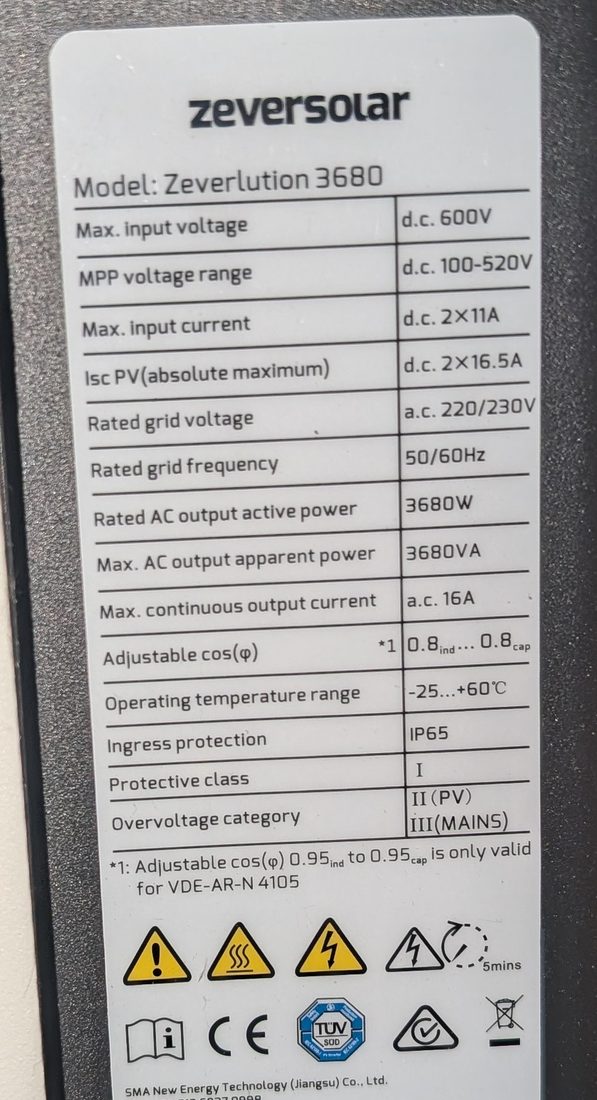
The inverter is a Zeversolar Zeverlution 3680, which has an RS485 port
but no Wi-Fi or Ethernet module. It doesn t speak Modbus; it uses
Eversolar s own master/slave protocol, which nobody has officially
documented but which several people have reverse-engineered over the
years (credit to
eversolar-monitor,
Heliograph and
others).
Manufacturer support for Eversolar/Zeversolar inverters apparently
ended in December 2019 when the company went out of business.
The rating plate on my inverter.
A while ago I had looked into what ports were available on this
inverter with a view to connecting some sort of monitoring, but I had
abandoned it as too hard . While working on some Home Assistant
configuration, Claude suggested the idea again, but similarly wrote it
off initially. I encouraged it to explore a bit further, and supplied
the model number of the inverter, at which point the picture got a lot
more promising. After a bit of back-and-forth about hardware, we
settled on an M5Stack Atom Lite on an Atomic RS485
Base. The
main attraction was that it already comes in a case, so I didn t need
to design (or, more likely, bodge) an enclosure.
While I waited for the parts to arrive, Claude wrote the firmware: an
ESPHome external
component built
around a small, dependency-free C++ driver, with host-side unit tests
against byte captures that other people had published from other
models. I found it slightly surreal to have a tested protocol driver
before owning any hardware to run it on.
Cables
The parts came before the tools I needed to get into the inverter
safely (a DC clamp meter and a T25 screwdriver bit), so in the
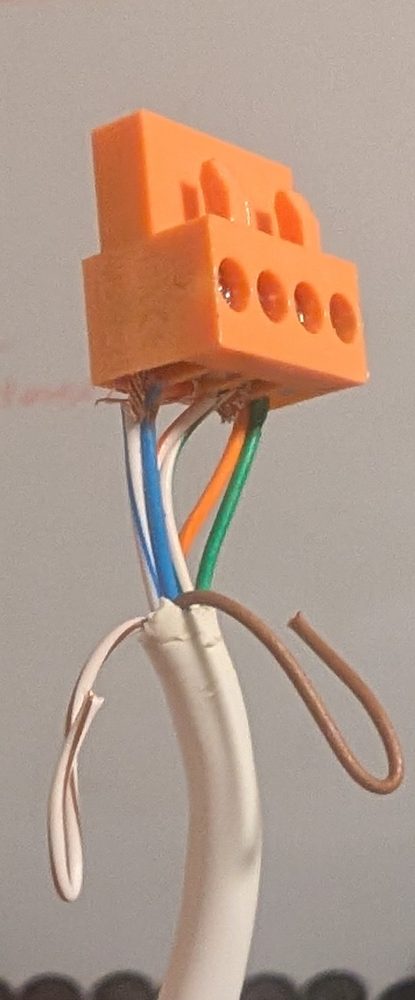
meantime I made up an RS485 cable - this uses an RJ45 connection at
one end, and some custom wiring at the other. My first attempt was
with some CAT 6, but (as Claude had pointed out and I had ignored) its
solid-core conductors are much harder to twist together. So I gave up
and sacrificed an old CAT 5e patch lead instead, which went much
better.
The custom end of the cable, before being taped up.
The risky bit
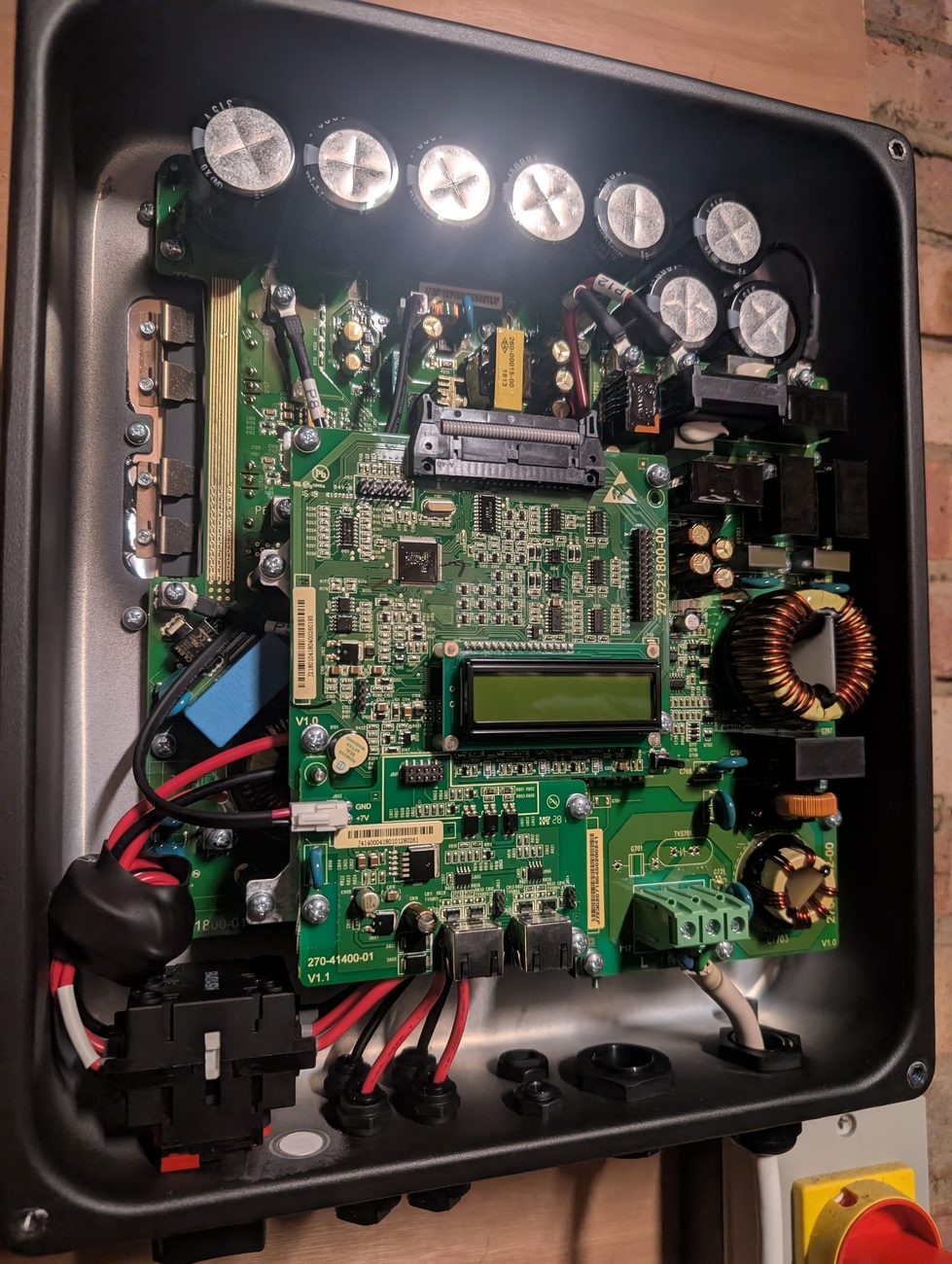
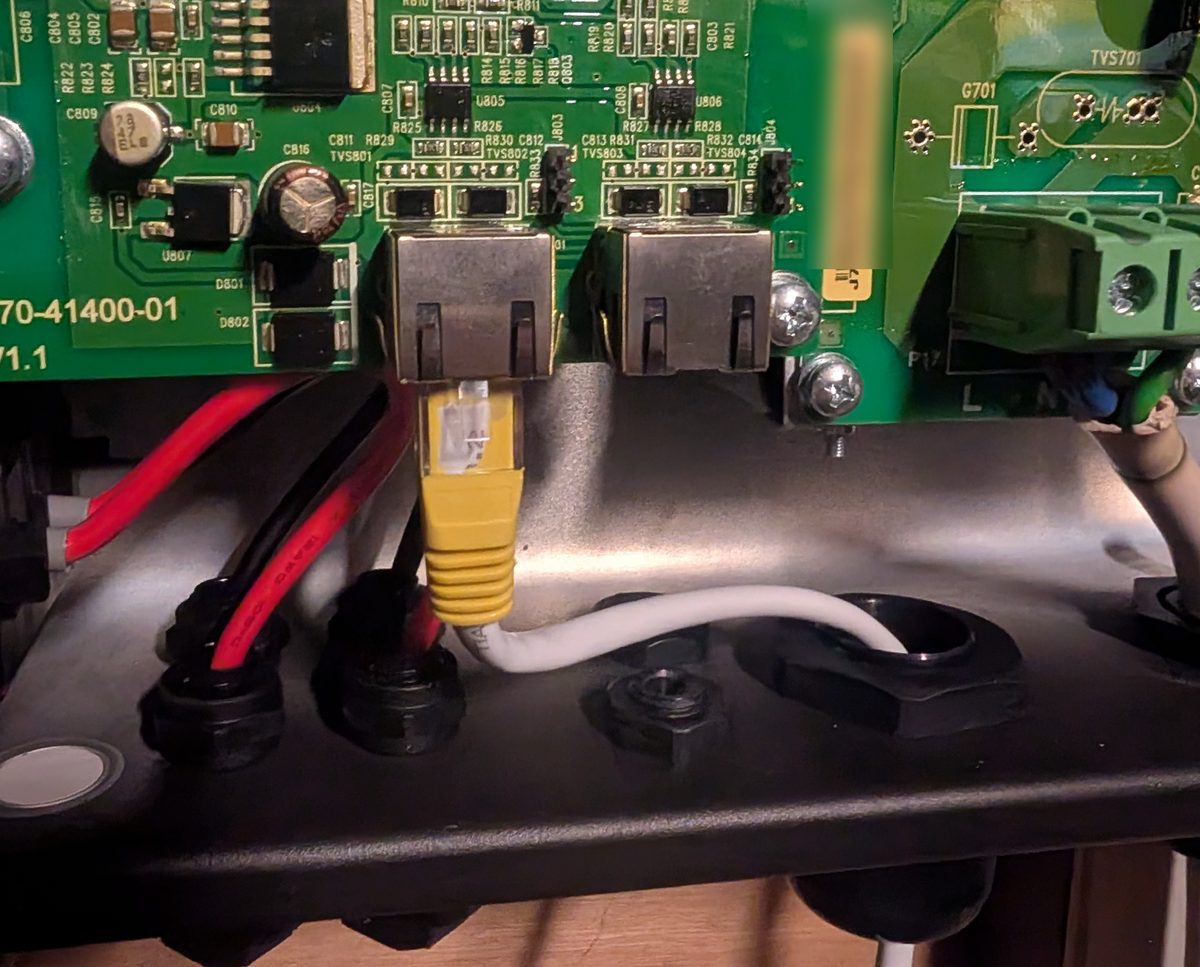
On a Zeverlution, the RJ45 sockets are inside the wiring compartment,
which means taking the cover off to install the monitor. The manual
addresses this part to qualified electricians. So the step I was most
nervous about was not the software at all, but safely isolating the
inverter.
Inside the inverter, with the cover off.
I did this with appropriate caution, following the instructions from
the manual carefully, and also waiting until after dark just in case.
Now that I understand how the DC clips from the panels work, I can see
how to do this safely during daytime too but hopefully this won t
be necessary.
Plugged in, and threaded through the cable gland.
Warning: if you re not confident, I would always advise to get an
electrician to do this bit. Do what I say, not what I do.
Debugging over Wi-Fi
Once the device was installed, the nice thing about ESPHome is that I
never need to go back in the loft again to update it it reflashes
over Wi-Fi. I ve taken full advantage of this for debugging, and for
reading the wire protocol directly from the logs.
The finished device. Green means generating.
Separately, I ve used Claude to integrate the new sensors into Home
Assistant. Solar generation finally sits in the Energy dashboard
next to the rest of the house s usage, which was the whole point.
Reflections
This was a fun, quick project, and it solved a problem that has eluded
me for a decade. I want to be honest about how much of that is down
to the AI: I would not have attempted any of this on my own. I could
not have told you the protocol existed, never mind implemented it. My
contribution was everything involving a screwdriver, and ordering some
hardware.
My hobby: following GOV.UK to look for interesting announcements.
Today was an update on the MOD s Rapid AI Delivery
Taskforce
which was previously announced in June during London Tech
Week.
I like this line: Success is measured in operational advantage delivered, not technology demonstrated. To me it recalls Working software is the primary measure of progress from Principles behind the Agile Manifesto if you understand working to mean working in production . Which I do.
For anyone interested in suggesting ideas to the taskforce, the four
operational challenge areas include:
Understanding and decision advantage
Electromagnetic and information advantage
Planning and automation
Autonomous systems
Yesterday s announcement of UK access to Ukraine s Avengers AI Labs
database
seems incredibly relevant to that last point.
Machine assistance for handling and interpreting huge volumes of data
would probably benefit decision advantage and interpretation of a
crowded EM spectrum, but this is hopefully(?) more than just LLMs. Of
course, there s more to AI than large language models right?
I worry that planning and automation might amount to generating
large amounts of
text
faster . Nothing could possibly go wrong with this.
When you pass an AWS certification exam, sometimes it can extend the
life of related lesser AWS certifications. But I could not find an
illustration of exactly which ones, so here s an up-to-date diagram:
Figure: Renewal relationships between AWS certifications.
Each arrow is a renews relation there s no obligation to pass
lesser exams before the harder ones, but you could also follow the
arrows backwards if you want to learn easier material before sitting
the more difficult exams.
I have made two important simplifications to the graph:
The Advanced Networking Specialty certification is being
retired soon, so I ve omitted it entirely. The last date to take that
exam is 25th August 2026. But Specialty certs don t renew anything
else anyway.
I have left out transitive relationships in order to simplify the
graph so e.g. if you pass a Solutions Architect Professional
exam, it also renews any Cloud Practitioner certificate you might
hold, even if you do not currently hold the relevant Associate
certificate.
You also have the option of sitting each exam again to renew of
course, and there s a new scheme to maintain various certs via AWS
Skill Builder which can extend them by one year rather than three.
You are what you eat but perhaps this is even more true of our
information diet. It is hard to strike a balance between remaining a
well-informed citizen versus spending hours ingesting unnecessary news
about issues and events we can t affect. But I m increasingly
convinced that my hours lost to doomscrolling are down to design
choices by web publishers rather than a failure of individual
willpower.
We have created an obesogenic information environment
I don t think it is just me I think our information environment has
been progressively altered over time as news sites look to maximize
engagement. Even outside of social media, the invisible hand of the
market for eyeballs forces sites to optimize for browse time or risk
irrelevance.
Even as newspapers find it increasingly difficult to fund good
journalism through advertising in an online world, especially local
journalism, they need to keep readers on their sites, clicking through
as many articles as possible. Clickbait headlines, urgent flashing
live icons to draw the attention, and many opportunities to leap from
one article to another, and another.
But this design approach even extends to news organisations with a
different funding model, like BBC News, which is a public service
(state-owned but arms-length) organisation funded through a mandatory
television licence a matter of controversy in some quarters. And
it extends even to sites where I pay a subscription fee; I might get
adverts removed, but I am still bombarded with the same design
philosophy; too many opportunities to be pulled away from what I m
reading towards some other unrelated article.
Even if I try and limit my exposure to algorithmic discovery of new
news, via RSS feeds or similar, if I m reading the full article in a
browser then I am prompted to read more stuff that I didn t intend.
This defeats the benefit of curating a set of feeds, because you still
get dragged away to random articles.
Only 44% of BBC News is news
To show you what I mean, I m going to pick on the BBC, although I
love them dearly and the same issue very much applies elsewhere.
I ve taken a screenshot of a random BBC News
article in mobile
view (my preferred doomscrolling user access device), and measured
approximately what proportion of the full length of the page is taken
up by each section. This is a fairly in-depth news article, so I
reckon if anything the figures would be worse than this on shorter
articles.
(These numbers will not sum to 100% for reasons which are obvious if
you look at the crossbars. Also they re approximations.)
Less than half of the page (44% if you exclude the inline related
links) is actual news text/images; the rest are links trying to help
you find the next thing to read/watch. I do not want this.
I m sure this A/B tests well in terms of reader figures, but it
sometimes leaves me exhausted it must take subconscious mental
energy to ignore, or I spend too much time trying to keep on top of
things.
And remember, this is a publicly-funded site that does not rely on
advertising!
Blocking out the noise
If you are technically-minded, you can use an ad-blocker such as
uBlock Origin to take back some control. Applying the following lines
as a custom filter (Settings > My filters) brutally cuts out almost
all of these links:
Caveat emptor: I have not road-tested this for more than half an
hour, so who knows what consequences this could have on your web
browsing. In particular, international readers outside the UK will
likely be redirected to bbc.com, the commercial arm of the BBC, where
these rules will need adapting.
Is it unethical to use an ad-blocker to remove these links? I would
argue not. I am not depriving the BBC of any revenue, because I pay
my licence fee. I might reduce the amount of time I spend on their
website, but if anything the subjectively better experience might
encourage me to consume more news from them, not less. In other
circumstances (outside the UK for instance, where the BBC relies on
advertising), the balance might be different.
Product managers, please find better metrics
I lament the state of the internet in 2026. I now can t unsee these
innocuous related stories links as a mechanism to grab my attention,
and it s gone too far.
If you are a normal person just browsing the news and looking to
discover the latest important stories relatively quickly, I can see
that these types of links might actually be useful for discovery; but
I m actually reasonably sure that I m not going to miss out on
anything major. You still have the option of the news home page if
you want to be presented with more news for example, and it feels
natural to go back to there when you ve run out of stories to consume.
But it shouldn t be down to individual responsibility to ignore or
geekily block these types of link; news sites with alternative funding
models should find better metrics for engagement than hours spent on
site how about optimizing for customer mental wellbeing, or
minimizing time required to catch up with the news? There s no need
to maximize clicks and eyeballs. This is a societal level issue,
because we are all going mad with news over-engagement.
Product managers, over to you.
I am somewhat jet-lagged, having returned from Washington DC just
before the 250th anniversary celebrations which will be happening
today. I was part of a delegation sent by my employer to the AWS
Summit there this week, partly to kindle interactions between PA
Consulting and Jacobs who have recently taken a 100% share in
PA.
Much of our conference time was spent in meetings with AWS executives
impressing the facts of the Jacobs/PA partnership upon them, and
discussing plans to broaden our collaboration in different sectors.
So I spent even less time than usual at conference keynotes, talks
etc.
This was my first time to DC, and I did find some time to see some
sights unfortunately the White House is rather fenced off at the
moment following the UFC match, but I did make it to the Capitol and
the Washington Monument in the heat.
Last Sunday a select few of us attended the baseball in
Baltimore rather than the game, the
thing that stood out for me was the military jets flying in formation
over the stadium every few minutes, and the block-booked seats for the
Navy in uniform, who were having a great time! This is obviously a
hearts-and-minds thing, but it provides a stark contrast with the UK
I can t think of a time I ve seen uniformed military at the
football (soccer) or cricket for example. Or Union Jacks flying at
shopping centres.
Speaking of soccer, England just about beat DR Congo while I was out
there, but it was a close-run thing as we were 1-0 down at half time.
I can t claim to be following the World Cup too closely, but I
overheard comments (from US passers-by) that made clear it would have
had a significant reputational impact on our standing in the world had
we lost.
Another highlight for me was the Church of the Ascension and
St. Agnes, where I was able to get my fix of
Anglican plainchant and four-part harmony for the week. At morning
prayer, I noted they use God save this land rather than God save
the King during the responses I ve since found other sources
online that choose God save the State . It s strange to think that
the words of the BCP dating back to 1549/1662 are a point of
continuity since well before the 1776 declaration of independence, and
yet are still adapted and used in worship today.
The seL4 organisation on GitHub uses
git-repo to manage
multiple source repositories, and so there are a large number of
projects to get your head around when figuring out the ecosystem.
As an experiment, I have taken the various manifest files across the
org, and constructed a graph based on how frequently each pair of
repositories is mentioned in a manifest together. See below:
[This may render badly when syndicated outside of my blog; and also
on small screens. And probably large screens. I ve attempted to make
sure there s a non-JS fallback
on my site with JS enabled, if you hover over a node, it should
highlight connected nodes.]
The colouring of the nodes is mostly manual; I experimented with graph
clustering algorithms but have not found a satisfactory result so far.
Still, some clusters are obvious:
Kernel the seL4 microkernel proper. This often but not
always co-exists with the main cluster of core libraries, but it
is pulled away slightly by the verification and microkit
manifests.
Verification the verification repositories (l4v, HOL,
graph-refine, polyml, isabelle) form a very distinct group.
These are connected only to the seL4 microkernel itself, which is
the only component formally verified.
Microkit microkit is a newer operating system framework
that does not use CAmkES, so stands apart from the rest of the
pack. I chose to scope this work to the seL4 org, so the LionsOS
ecosystem and sDDF which are maintained by Trustworthy Systems are
not shown. Also not linked is rust-sel4, because this modern
world isn t using git-repo in the main to manage its repositories.
RefOS I d not come across refos before, but it appears to
be an example OS from 2021 built on the seL4 kernel.
It s quite hard to pull apart the CAmkES framework and the core
libraries; there are definitely some which are more associated with VM
management, but the overall shape of this co-occurence data is a messy
ball in the middle with some outliers in orbit. One observation is
that camkes is correctly identified as more peripheral than
camkes-tool, which contains the actual core CAmkES code.
Reflecting on this approach, in hindsight I m surprised that using
co-occurences worked as well as it did there was no attempt to
actually inspect the code and find direct mentions of other code
e.g. library header dependencies. As the newer microkit effort
largely eschews git-repo, better results might be found by actually
taking that more detailed approach, so that graph edges could
represent real dependencies between two packages. Additionally, this
could allow diving into the various libraries held in the different
libs repos, to get a more granular graph of relationships between
them.
However, I think I spent more time on making it possible to render
graphviz graphs easily on my blog than actually gaining any insight
into the codebase!
I have proposed the deletion of an obsolete
script,
but it makes me feel complicated feelings so I m going to try and
express those. This particular script was written in 2014, but the
concept goes back much further before git was invented.
When I started university in 2003, I seem to remember the computing
society used to run tutorials for first-year students on how to use
Apache Subversion for your group project a vast upgrade on CVS (or
worse, no version control at all). Back then, the idea of viewing
your changesets in a web browser was relatively new while it was
possible to look at an SVN repository through a web UI, features were
limited unless you installed something compicated like
Trac.
Figure 1: Data flow when distributing commits via a mailing list
Perhaps because reading email on your desktop computer (I don t think
I could afford an IBM ThinkPad?) was the only vaguely real-time
notification system available at the time (except I guess SMS, which
cost 10p per text), a common pattern seemed to be to use a
post-commit
hook
to send every single commit to a mailing list, named something like
foo-commits . Indeed, for a long time Fedora had an scm-commits list
which appears to be a topic of recent
discussion.
I can t really explain why people wanted to have every commit sent
to a mailing list except as a way of getting notified of activity I
can t believe people would import raw patches from those lists, ala
LKML, rather than run actual version control commands to fetch the new
source directly. Maybe you d have to go back to NNTP for this.
I do like the vendor-neutrality of the everything-as-text approach,
building on the open ecosystem of SMTP. But I doubt we d see a
widespread resurgence of commit lists now most code hosting must
allow anyone to subscribe to email notifications, I assume, and I
don t see a huge benefit in a mailing list archive of commit messages.
In the case of seL4, I m even more confused about why this script was
committed in 2014, shortly after the kernel was put on GitHub. I can
only assume it was imported from previous infrastructure. I do know
that the implementation is quite Python 2 heavy, with the conversion
between unicode and bytes featuring heavily. So rather than risk
breaking its logic with patching, I think it s time to thank it for
its service and let go.
I have been looking at seL4 some more recently, and had a small
patch
merged today to remove a legacy Python module from a helper script.
(I was trying to run the script on a system without that module
installed, and it was almost easier to patch it out.)
However, the more I think about this code and how it s used, the more
it seems wrong on at least five other levels.
The patch itself is quite uninteresting; this script was importing the
past module (part of future?) to use the xrange function.
Python 2 used to have separate xrange and range functions, where
range returned a list in memory while xrange generated an
iterator. Because this seL4 script is iterating over a large range of
values, it s important the list is not generated in-memory. But
Python 3 removed the xrange function and just has range return an
object, so it s trivial to avoid the module import.
Having thought carefully some more about the specific line, there s
surely an off-by-one error in it - range iterates over 0 to n-1, so
this line shouldn t be subtracting one if it s looking to test all
32-bit values:
for i in range(2**32-1):
But then again, this is being used for a sanity check of a magic bit
shift algorithm that speeds up division operations to convert CPU
ticks to microseconds on 32-bit arm platforms. Surely if the
algorithm s good, it shouldn t be necessary to validate it
exhaustively against every possible 32-bit value?
Also, 32 bits isn t enough, because this is 64-bit division.
include/api/types.h shows that ticks_t is always a uint64_t, so
if this were a proof by exhaustion it should run to 2**64 (though that
would take infeasibly long).
As discussed in issue
#1352, lots of people have
been running this code with the wrong divisor anyway. But because the
bit shift path is only used on 32-bit platforms, it s not clear to me
that there s even any point in specifying CLK_SHIFT/MAGIC on platforms
which are 64-bit only (e.g. the tx2 port).
And to follow this rabbit hole to the very end, in comments on PR
#1435
and issue #1509 it s clear
that the future of this code is to remove it, as it s 1. unnecessarily
clever (on 64-bit platforms the equivalent code just uses a division,
so performance can t be that important), and 2. the entire concept of
converting to microseconds breaks the seL4 principle of not
abstracting away details of the hardware.
So this has left me unclear on whether my small patch was a good thing
or not, but I certainly learnt something about this corner of seL4
timer handling. And I ve ordered a copy of Hacker s Delight on the
recommendation of a code comment.
While watching the Vienna New Year s
Concert
today, reading about its perhaps somewhat problematic
origins,
I was struck by the observation that the Strauss family s polkas were
seen as pop music during their lifetime, not as serious as proper
classical composers, and so it took some time before the Vienna
Philharmonic would actually play their work.
(Perhaps the space-themed interval today and the ballet dancers
pretending to be a steam train were a continuation of the true spirit
of this? It felt very Eurovision.)
I can t decide if it s remarkable that this year was the first time a
female composer (Constanze
Geiger) was
represented at this concert, or if that is what you get when you
set up a tradition of playing mainly Strauss?
Recently I revisited my previous
interest in
seL4 - a fast, highly assured operating
system microkernel for building secure systems.
The seL4 Microkit
tutorial
uses a simple Wordle game example to teach the basics of seL4 Microkit
(formerly known as the seL4 Core Platform), which is a framework for
creating static embedded systems on top of the seL4 microkernel.
Microkit is also at the core of LionsOS, a new
project to make seL4 accessible to a wider audience.
The tutorial is easy to follow, needing few prerequisites beyond a
QEMU emulator and an AArch64 cross-compiler toolchain (Microkit being
limited to 64-bit ARM systems currently). Use of an emulator makes
for a quick test-debug cycle with a couple of Makefile targets, so
time is spent focusing on walking through the Microkit concepts rather
than on tooling issues.
This is an unusually good learning experience, probably because of the
academic origins of the project itself. The
Di taxis documentation framework would class
this as truly a tutorial rather than a how-to guide - you do
learn a lot by implementing the exercises.
It can be incredibly easy for a frontend developer to accidentally
write a client-side cross-site-scripting (DOM-XSS) security issue, and
yet these are hard for security teams to detect. Vulnerability
scanners are slow, and suffer from false positives. Can smarter
collaboration between development, operations and security teams
provide a way to eliminate these problems altogether?
Google claims that Trusted
Types has all but eliminated
DOM-XSS exploits on those of their sites which have implemented
it. Let s find out how this can work!
DOM-XSS vulnerabilities are easy to write, but hard for security teams to catch
It is very easy to accidentally introduce a client-side XSS problem.
As an example of what not to do, suppose you are setting an element s
text to the current URL, on the client side:
// Don't do this
para.innerHTML = location.href;
Unfortunately, an attacker can now manipulate the URL (and e.g. send
this link in a phishing email), and any HTML tags they add will be
interpreted by the user s browser. This could potentially be used by
the attacker to send private data to a different server.
Detecting DOM-XSS using vulnerability scanning tools is challenging -
typically this requires crawling each page of the website and
attempting to detect problems such as the one above, but there is a
significant risk of false positives, especially as the complexity of
the logic increases.
There are already ways to avoid these exploits developers
should validate untrusted input before making use of it. There are
libraries such as DOMPurify
which can help with sanitization.1
However, if you are part of a security team with responsibility for
preventing these issues, it can be complex to understand whether you
are at risk. Different developer teams may be using different
techniques and tools. It may be impossible for you to work closely
with every developer so how can you know that the frontend
team have used these libraries correctly?
Trusted Types closes the DevSecOps feedback loop for DOM-XSS, by allowing Ops and Security to verify good Developer practices
Trusted Types enforces sanitization in the browser2, by requiring
the web developer to assign a particular kind of JavaScript object
rather than a native string to .innerHTML and other dangerous
properties. Provided these special types are created in an
appropriate way, then they can be trusted not to expose XSS
problems.
This approach will work with whichever tools the frontend developers have
chosen to use, and detection of issues can be rolled out by
infrastructure engineers without requiring frontend code changes.
Content Security Policy allows enforcement of security policies in the browser itself
Because enforcing this safer approach in the browser for all websites
would break backwards-compatibility, each website must opt-in through
Content Security Policy headers.
Content Security Policy (CSP) is a mechanism that allows web pages
to restrict what actions a browser should execute on their page, and a
way for the site to receive reports if the policy is violated.
Figure 1: Content-Security-Policy browser communication
This is revolutionary, because it allows servers to receive feedback
in real time on errors that may be appearing in the browser s console.
Trusted Types can be rolled out incrementally, with continuous feedback
Web.dev s article on Trusted Types
explains how to safely roll out the feature using the features of CSP itself:
Deploy a CSP collector if you haven t already
Switch on CSP reports without enforcement (via Content-Security-Policy-Report-Only headers)
Iteratively review and fix the violations
Switch to enforcing mode when there are a low enough rate of reports
Static analysis in a continuous integration pipeline is also sensible
you want to prevent regressions shipping in new releases
before they trigger a flood of CSP reports. This will also give you a
chance of finding any low-traffic vulnerable pages.
Smart security teams will use techniques like Trusted Types to eliminate entire classes of bugs at a time
Rather than playing whack-a-mole with unreliable vulnerability
scanning or bug bounties, techniques such as Trusted Types are truly
in the spirit of Secure by Design build high quality in from
the start of the engineering process, and do this in a way which
closes the DevSecOps feedback loop between your Developer, Operations
and Security teams.
Sanitization libraries are especially needed when the examples
become more complex, e.g. if the application must manipulate the
input. DOMPurify version 1.0.9 also added Trusted Types support, so
can still be used to help developers adopt this feature.
Trusted Types has existed in Chrome and Edge since 2020, and
should soon be coming to
Firefox
as well. However, it s not necessary to wait for Firefox or Safari to
add support, because the large market share of Chrome and Edge will
let you identify and fix your site s DOM-XSS issues, even if you do
not set enforcing mode, and users of all browsers will benefit. Even
so, it is great that Mozilla is now on board.
This post was possibly inspired by my daughter s homework assignment
to interview an old person about technology change. Guess who s old
now?
Sometimes I look back at how life used to be, and remember what it was
like. There are two key nostalgia points for me: before internet, and
before smartphones.
Before the internet
Before the internet, there were computers. There were always computers
in my life, they were just less fancy, with mainly text and fewer
graphics at first. These days we adapt our user interfaces to look
more like DOS and call it retro , although claiming it s more
efficient that way. Sometimes it is. The written word is a
fundamental mode of human communication it resonates.
Some of my earliest programming memories were typing lines of BASIC
code into some sort of BBC Micro, usually not successfully. Most of
my computer learning was largely theoretical, through Usborne
books (now
available online! Thanks internet for reducing the marginal cost of
publishing to approximately zero) but without the benefit of a
computer of my own.
I went for a walk this morning, with a slight bite to the air, and
bought a newspaper, like the old person I am (I m leaning in).
Imagine that - a physical paper full of news. When I was an
inquisitive sixth-former, TheGuardian cost 50 pence
today it was 2.80. This increase far outstrips the rate of
inflation, which would bring it to around 90 pence. No, this must
surely reflect the drop in circulation of the physical edition, and
the rise in advertisement-filled web content.
Before smartphones
As the internet became mainstream, I remember dial-up, and
Freeserve, and even the
tail end of USENET, and IRC.
This was still a time when email was a thing you had to be at your
desk to check. Feature phones were very useful, but it was still
possible to get lost. My university halls had a shared land-line
phone on each floor.
And I wrote on the internet. I remember commenting on blogs, and I
think my writing was better back then; more free, less inhibited.
I do find myself giving less attention to news squeezed into the small
form-factor of a mobile phone. Chat messages and notification pings.
I m not convinced this is great progress for humanity.
At ArgoCon today, Thomas Fricke gave a nice talk on Cloud Native
Deployments in Air Gapped
Environments
describing container vulnerability scanning in the German energy
sector and since he didn t mention data diodes, and since some of
my colleagues at Oakdoor/PA Consulting make data
diodes for a living, I thought this might be interesting to write
about!
It s one thing to have an air-gapped system, but eventually in order
to be useful you re going to have to move data into it, and this is
going to need something better than just plugging a USB stick into
your critical system. Just ask Iran how well this
goes.
Eight years after Stuxnet, the UK National Cyber Security Centre
published the NCSC Safely Importing Data
Pattern -
but I found this a bit cryptic on first reading, because it s not
clear what type of systems the pattern applies to, and deliberately uses
technology-neutral language. Also, this was published around the same
time GDPR was being implemented, mentions sensitive or personal
data , and claims to be aimed at small to medium organisations - but
I don t know how many small businesses implement a
MILS
security architecture. So without picking up on the mention of data
diode , you can be left scratching your head about how to actually
implement the pattern.
One answer using Oakdoor components:
PySISL, a Python library which you use to transform the data into a very simple format called SISL
an Oakdoor Import Diode, which can verify the syntax of SISL in hardware, and prevent any data moving back the other way
then some more PySISL code to validate the semantics of SISL on the high side and reconstruct the original format
The Oakdoor diodes themselves are quite interesting - they re
electrical rather than optical like most data diodes. The other thing
I d always wondered is how on earth you could even establish a TCP
handshake across one - the answer is, you can t, so you use a
UDP-based protocol like TFTP for file transfer.
In this way, you build the transform/verify and protocol break that
the NCSC pattern requires.
Congratulations, you can now import your documents to your otherwise
air-gapped system without also importing malicious code, and without
risking data exfiltration.
Note carefully that the Safely Importing Data pattern makes no
guarantees about the integrity of your documents - they could be
severely modified going through this process. For the same reason, I
anticipate challenges applying this pattern to software binaries.
As I am sure everyone is aware, there is a growing interest in [SBOMs] as a
way of improving software security and resilience. In the last two years, the
US through the Exec Order, the EU through the proposed Cyber Resilience Act
(CRA) and this month the UK has issued a consultation paper looking at
software security and SBOMs appear very prominently in each
publication. []
Tim Retout wrote a blog post discussing AlmaLinux in the context of CentOS, RHEL and supply-chain security in general []:
Alma are generating and publishing Software Bill of Material (SBOM) files for
every package; these are becoming a requirement for all software sold to the
US federal government. What s more, they are sending these SBOMs to a third
party (CodeNotary) who store them in some sort of
Merkle tree system to make it
difficult for people to tamper with later. This should theoretically allow
end users of the distribution to verify the supply chain of the packages they
have installed?
Debian
Vagrant Cascadian noted that the Debian bookworm distribution has finally surpassed bullseye for reproducibility: 96.1% vs. 96.0%, despite having over 3500 more packages in the distribution.
Roland Clobus posted his latest update of the status of reproducible Debian ISO images noting that all major desktops build reproducibly with bullseye, bookworm and sid, with the caveat that when non-free firmware is activated, some non-reproducible files are generated .
23 reviews of Debian packages were added, 24 were updated and 20 were removed this month adding to our knowledge about identified issues. A new issue was added and identified by Chris Lamb [], and the timestamps_embedded_in_manpages_by_node_marked_man issue has been marked as resolved [].
Lastly, FC Stegerman reported two issues on Google s own issue tracker: one related to a non-deterministic Dependency Info Block [] and another about a virtual entry added by the signflinger tool causing unexpected differences between signed and unsigned APKs [].
diffoscopediffoscope is our in-depth and content-aware diff utility. Not only can it locate and diagnose reproducibility issues, it can provide human-readable diffs from many kinds of binary formats.
This month, Chris Lamb released versions 235 and 236; Mattia Rizzolo later released version 237.
Contributions include:
Chris Lamb:
Fix compatibility with PyPDF2 (re. issue #331) [][][].
Fix compatibility with ImageMagick version 7.1 [].
Require at least version 23.1.0 to run the Black source code tests [].
Update debian/tests/control after merging changes from others [].
Don t write test data during a test [].
Update copyright years [].
Merged a large number of changes from others.
Akihiro Suda edited the .gitlab-ci.yml configuration file to ensure that versioned tags are pushed to the container registry [].
Daniel Kahn Gillmor provided a way to migrate from PyPDF2 to pypdf (#1029741).
Efraim Flashner updated the tool metadata for isoinfo on GNU Guix [].
FC Stegerman added support for Android resources.arsc files [], improved a number of file-matching regular expressions [][] and added support for Android dexdump []; they also fixed a test failure (#1031433) caused by Debian s black package having been updated to a newer version.
updated the autopkgtest configuration to only install aapt and dexdump on architectures where they are available [], making sure that the latest diffoscope release is in a good fit for the upcoming Debian bookworm freeze.
reprotestReprotest version 0.7.23 was uploaded to both PyPI and Debian unstable, including the following changes:
Holger Levsen improved a lot of documentation [][][], tidied the documentation as well [][], and experimented with a new --random-locale flag [].
Vagrant Cascadian adjusted reprotest to no longer randomise the build locale and use a UTF-8 supported locale instead [ ] (re. #925879, #1004950), and to also support passing --vary=locales.locale=LOCALE to specify the locale to vary [].
Upstream patches
The Reproducible Builds project detects, dissects and attempts to fix as many currently-unreproducible packages as possible. We endeavour to send all of our patches upstream where appropriate. This month, we wrote a large number of such patches, including:
Testing framework
The Reproducible Builds project operates a comprehensive testing framework (available at tests.reproducible-builds.org) in order to check packages and other artifacts for reproducibility. In February, the following changes were made by Holger Levsen:
Add three new OSUOSL nodes [][][] and decommission the osuosl174 node [].
Change the order of listed Debian architectures to show the 64-bit ones first [].
Reduce the frequency that the Debian package sets and dd-list HTML pages update [].
Sort Tested suite consistently (and Debian unstable first) [].
Update the Jenkins shell monitor script to only query disk statistics every 230min [] and improve the documentation [][].
Other development work
disorderfs version 0.5.11-3 was uploaded by Holger Levsen, fixing a number of issues with the manual page [][][].
Bernhard M. Wiedemann published another monthly report about reproducibility within openSUSE.
If you are interested in contributing to the Reproducible Builds project, please visit the Contribute page on our website. You can get in touch with us via:
At CentOS Connect yesterday, Jack Aboutboul and Javier Hernandez
presented a talk about AlmaLinux and SBOMs
[video],
where they are exploring a novel supply-chain security effort in the
RHEL ecosystem.
Now, I have unfortunately ignored the Red Hat ecosystem for a long
time, so if you are in a similar position to me: CentOS used to
produce debranded rebuilds of RHEL; but Red Hat changed the project
round so that CentOS Stream now sits in between Fedora Rawhide and
RHEL releases, allowing the wider community to try out/contribute to
RHEL builds before their release. This is credited with making early
RHEL point releases more stable, but left a gap in the market for
debranded rebuilds of RHEL; AlmaLinux and Rocky Linux are two
distributions that aim to fill that gap.
Alma are generating and publishing Software Bill of Material (SBOM)
files for every package; these are becoming a requirement for all
software sold to the US federal government. What s more, they are
sending these SBOMs to a third party (CodeNotary) who store them in
some sort of Merkle tree system
to make it difficult for people to tamper with later. This should
theoretically allow end users of the distribution to verify the supply
chain of the packages they have installed?
I am currently unclear on the differences between CodeNotary/ImmuDB
vs. Sigstore/Rekor, but there s an SBOM devroom at FOSDEM tomorrow so
maybe I ll soon be learning that. This also makes me wonder if a
Sigstore-based approach would be more likely to be adopted by
Fedora/CentOS/RHEL, and whether someone should start a CentOS Software
Supply Chain Security SIG to figure this out, or whether such an
effort would need to live with the build system team to be properly
integrated. It would be nice to understand the supply-chain story for
CentOS and RHEL.
As I write this, I m also reflecting that perhaps it would be helpful
to explain what happens next in the SBOM consumption process; i.e. can
this effort demonstrate tangible end user value, like enabling
AlmaLinux to integrate with a vendor-neutral approach to vulnerability
management? Aside from the value of being able to sell it to the US
government!
LWN reminds us that Git still uses SHA-1 by default.
Commit or tag signing is not a mitigation, and to understand why you need to
know a little about Git s internal structure.
Git internally looks rather like a content-addressable filesystem, with four
object types: tags, commits, trees and blobs.
Content-addressable means changing the content of an object changes the way
you address or reference it, and this is achieved using a cryptographic hash
function. Here is an illustration of the internal structure of an example
repository I created, containing two files (./foo.txt and ./bar/bar.txt)
committed separately, and then tagged:
You can see how trees represent directories, blobs represent files, and so
on. Git can avoid internal duplication of files or directories which remain
identical. The hash function allows very efficient lookup of each object
within git s on-disk storage.
Tag and commit signatures do not directly sign the files in the repository;
that is, the input to the signature function is the content of the tag/commit
object, rather than the files themselves. This is analogous to the way that
GPG signatures actually sign a cryptographic hash of your email, and there
was a time when this too defaulted to SHA-1. An attacker who can break that
hash function can bypass the guarantees of the signature function.
A motivated attacker might be able to replace a blob, commit or tree in a git
repository using a SHA-1 collision. Replacing a blob seems easier to me than a
commit or tree, because there is no requirement that the content of the files
must conform to any particular format.
There is one key technical mitigation to this in Git, which is the SHA-1DC algorithm;
this aims to detect and prevent known collision attacks. However, I will have
to leave the cryptanalysis of this to the cryptographers!
So, is this in your threat model? Do we need to lobby GitHub for SHA-256
support? Either way, I look forward to the future operational challenge of
migrating the entire world s git repositories across to SHA-256.
At the end of March, the source code to StackRox was released,
following the 2021 acquisition by Red Hat. StackRox is a Kubernetes security
tool which is now badged as Red Hat Advanced Cluster Security (RHACS),
offering features such as vulnerability management, validating cluster
configurations against CIS benchmarks, and some runtime behaviour analysis. In
fact, it s such a diverse range of features that I have trouble getting my head
round it from the product page or even the documentation.
Source code is available via the StackRox organisation on GitHub,
and the most obviously interesting repositories seem to be:
stackrox/scanner, the vulnerability
scanner, also in Go. From a first glance at the go.mod file, it does not seem
to share much code with Clair, which is
interesting.
stackrox/collector, the runtime
analysis component, in C++ but also with hooks into the kernel.
My initial curiosity has been around the collector , to better understand what
runtime behaviour the tool can actually pick up. I was intrigued to find that
the actual kernel component is a patched version of Falco s kernel module/eBPF probes;
a few features are disabled compared to Falco, e.g. page faults and signal events.
There s a list of supported syscalls in
driver/syscall_table.c,
which seems to have drifted slightly or be slightly behind the upstream Falco
version? In particular I note the absence of io_uring, but given RHACS is
mainly deployed on Linux 4.18 at the moment (RHEL 8) this is probably a
non-issue. (But relevant if anyone were to run it on newer kernels.)
That s as far as I ve got for now. Red Hat are making great efforts to reach
out to the community; there s a Slack channel,
and office hours recordings,
and a community hub to explore further. It s
great to see new free software projects created through acquisition in this
way - I m not sure I remember seeing a comparable example.
Public Service Announcement for anyone relying on Jenkins for
continuous deployment - the milestone step plugin as of version 1.3.1
will not function correctly if you could have more than two builds
running at once - older builds could get deployed after newer builds.
See JENKINS-46097.
A possible workaround is to add an initial milestone at the start
of the pipeline, which will then allow builds to be killed
early. (Builds are only killed early once they have passed their first
milestone.)
Going by the source history, I reckon this bug has been present
since the milestone-step plugin was created.
 The rating plate on my inverter.
 The custom end of the cable, before being taped up.
 Inside the inverter, with the cover off.
 Plugged in, and threaded through the cable gland.
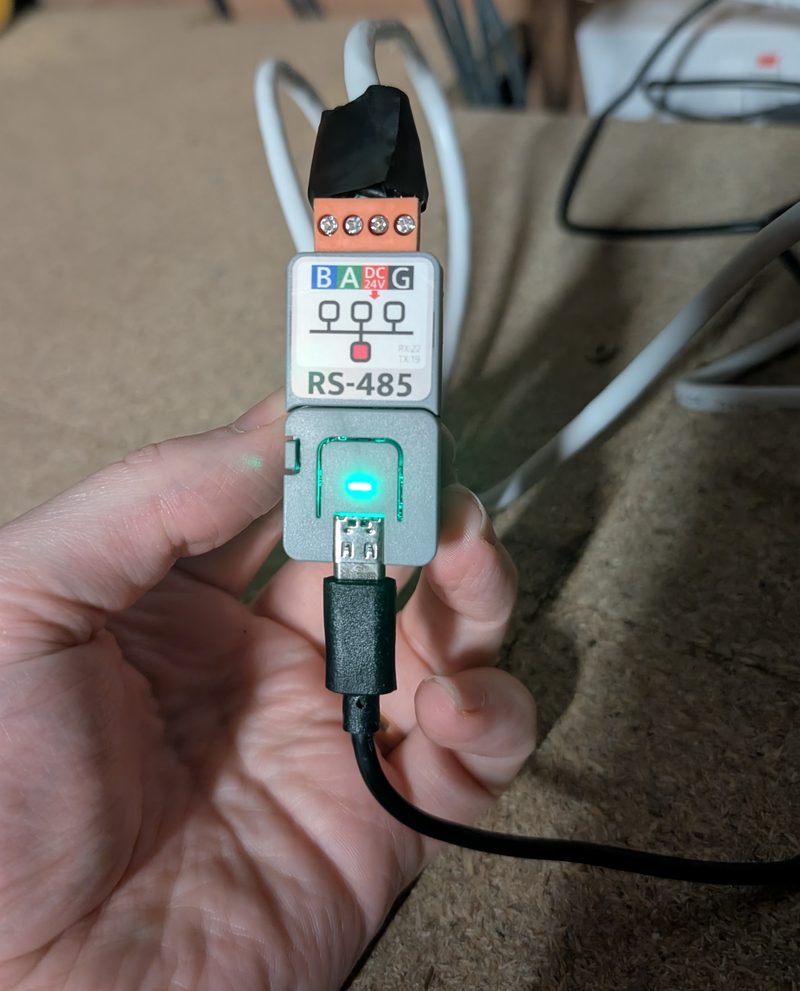 The finished device. Green means generating.
 Figure: Renewal relationships between AWS certifications.
Each arrow is a renews relation there s no obligation to pass
lesser exams before the harder ones, but you could also follow the
arrows backwards if you want to learn easier material before sitting
the more difficult exams.
I have made two important simplifications to the graph:
 (These numbers will not sum to 100% for reasons which are obvious if
you look at the crossbars. Also they re approximations.)
Less than half of the page (44% if you exclude the inline related
links) is actual news text/images; the rest are links trying to help
you find the next thing to read/watch. I do not want this.
I m sure this A/B tests well in terms of reader figures, but it
sometimes leaves me exhausted it must take subconscious mental
energy to ignore, or I spend too much time trying to keep on top of
things.
And remember, this is a publicly-funded site that does not rely on
advertising!
 [This may render badly when syndicated outside of my blog; and also
on small screens. And probably large screens. I ve attempted to make
sure there s a
 Figure 1: Data flow when distributing commits via a mailing list
Perhaps because reading email on your desktop computer (I don t think
I could afford an IBM ThinkPad?) was the only vaguely real-time
notification system available at the time (except I guess SMS, which
cost 10p per text), a common pattern seemed to be to use a
 Figure 1: Content-Security-Policy browser communication
This is revolutionary, because it allows servers to receive feedback
in real time on errors that may be appearing in the browser s console.








 You can see how trees represent directories, blobs represent files, and so
on. Git can avoid internal duplication of files or directories which remain
identical. The hash function allows very efficient lookup of each object
within git s on-disk storage.
Tag and commit signatures do not directly sign the files in the repository;
that is, the input to the signature function is the content of the tag/commit
object, rather than the files themselves. This is analogous to the way that
GPG signatures actually sign a cryptographic hash of your email, and there
was a time when this too defaulted to SHA-1. An attacker who can break that
hash function can bypass the guarantees of the signature function.
A motivated attacker might be able to replace a blob, commit or tree in a git
repository using a SHA-1 collision. Replacing a blob seems easier to me than a
commit or tree, because there is no requirement that the content of the files
must conform to any particular format.
There is one key technical mitigation to this in Git, which is the