Python 3.15 transition, by Stefano Rivera with a little help from Colin Watson
Debian has started the transition to add Python 3.15 as a supported version
alongside 3.14, which is still the default version. Stefano uploaded Python
3.15.0 final to unstable.
Maximiliano Curia has been test-rebuilding the archive
in Debusine with Python 3.15 as a supported version and prepared some patches
to dh-python to smooth over some common failure points. Stefano reviewed these
MRs, applying some and implementing alternative approaches for some of the issues.
Debian only has multiple supported Python versions during the transition to a
new version, and typically this shows up some bugs in packages. This time was
no different, the common failure was many packages that installed intermediate
build artifacts into the Python module tree. Some of these artifacts would
differ between Python versions. We decided to detect both of these and fail the
package build, rather than silently ship garbage in the binary packages. Colin
helped to fix quite a bit of the build fallout from this.
OpenSSH GSS-API package split improvements, by Colin Watson
The recent GSS-API package split
has largely gone relatively smoothly, but there was a subtle problem for people
switching from one variant to the other: installing the replacement packages
followed by purging the old one would
cause some configuration files to disappear.
Colin fixed this, and also reviewed and merged some autopkgtest contributions
from Andreas Hasenack to make sure that this doesn t regress in future.
Miscellaneous contributions
Carles, using check-relations,
investigated and reported 52 bugs for packages which have Recommended packages
that are not available in Debian anymore. Followed up bugs on the topic.
Carles added support to check-relations
to detect Recommends that recommend a transitional package.
Carles submitted merge requests
(MR89,
MR90,
MR91,
MR92)
to the Debian developers-reference
to remove or update references to packages that are not available anymore, have
their name changed, have typos, etc.
Carles investigated and opened bugs regarding notifications on LXDE
(#1151954,
#1151955)
and added a section related to notifications on the
Wiki.
Helmut released asyncvarlink/0.3.3
to fix several bugs including connection robustness fixes by Alex Kiernan. Colin
uploaded it to Debian.
Helmut uploaded guess-concurrency
to improve behavior on riscv64 by taking swap into account thanks to Adrian Bunk
and Aurelien Jarno.
Helmut sent patches for 55 cross build failures.
Emilio updated some X11 libraries that fixed security vulnerabilities.
Emilio managed various transitions.
Rapha l updated gnome-shell-extension-hamster to work with GNOME 51 that was
uploaded to Debian unstable.
Stefano backported postsrsd 2.4.1 to
Debian trixie.
Stefano installed security updates on debian.social infrastructure.
October saw a series of security releases for Python, due to the eMudhra key
compromise incident. Stefano uploaded cPython 3.15.2, 3.14.10, and 3.13.18 which
include blocks for the compromised intermediate CAs.
Stefano reviewed CVEs fixed in recent cPython releases.
Stefano reviewed some of the wafer-debconf MRs that came in as part of
Antonio s Outreachy project.
Stefano uploaded python-authlib, with many security updates. And started
preparing a stable update with backports of these patches.
Stefano looked at the latest upstream version of munkres and submitted some
32-bit test failure fixes upstream. A new upstream maintainer has been very busy
building out accelerated versions of the algorithms with AI assistance.
Thorsten was finally able to fix the autopkgtest of cups. Afterwards he
uploaded the latest version of cups to unstable.
Santiago proposed a merge request
for the Salsa CI pipeline to fix how logs were stored in the piuparts job.
Lucas reviewed and merged community contributions to Ruby 3.4 in Debian unstable.
Lucas coordinated with the security team and fixed multiple CVEs reported
against Ruby 3.3 in Debian stable.
Colin did quite a bit of work on the Python 3.15 transition, fixing lots of
build and test fallout.
Colin upgraded python-maturin from 1.9.4 to 1.16.0, helping with several Rust
transitions; this involved more or less completely reworking our patch stack.
Colin improved the packaging of the Frescobaldi
frontend to LilyPond to help with his amateur music
typesetting work, fixing its missing desktop entry, icon, and translations based
on a patch set by Joachim Wiedorn.
Anupa joined the Publicity team meeting to discuss upcoming events and
activities of the Debian Publicity Team including on-boarding meeting for new
contributors.
Antonio spent quite some time welcoming Outreachy
applicants to the DebConf/MiniDebConf websites project, replying to questions,
reviewing contributions, etc. One of them will be selected for an internship
that will start in December.
Antonio spent some time investigating problems with Salsa background job
processing, leading to an upstream bug report.
DebConf site visit, by Stefano Rivera
In preparation for DebConf 27, Stefano Rivera,
Nattie Mayer-Hutchings, and Jongmin Kim from the DebConf Committee visited
Asahikawa Japan. A contingent of the local team gathered to tour the venues
with us, discuss plans, and meet the local organizations assisting the event.
We held a press conference at the city hall that got
some coverage.
A few potential day-trip options were explored.
Photos from the site visit.
autopkgtest-virt-pconr, by Helmut Grohne
Following the creation of the pconr
module that provides a basis for
unschroot
and a more secure containment for mmdebstrap,
an experimental autopkgtest backend autopkgtest-virt-pconr
is now available. It fits a spot between autopkgtest-virt-unshare and more fully
fledged containers as it does not require much infrastructure like setting up
incus or lxc but still provides a containment running an initsystem. Due to the
use of erofs as base image format,
it boots and reverts quickly. This development also required fixing concurrency
issues in asyncvarlink and even shed
light on a matching bug in systemd
that was promptly fixed upstream.
Miscellaneous contributions
Carles reviewed and submitted six Catalan po-debconf translations using
po-debconf-manager.
Improved po-debconf-manager s workflow for updating translations.
Carles reviewed, translated or updated webwml
Catalan translations for security and CD pages. He also fixed issues that
prevented building webwml, deleted orphaned translation pages, etc. and
experimented with a more global HTML tidying up experiment.
Carles refactored check-relations
adding capacity to ignore concrete from_package -> to_package specific relations
and more flexibility around ignores. Detects unused ignore rules as well.
Carles improved some Wiki pages (LibreOffice,
Framework amongst some
other ones)
Thorsten did an hplip upload to replace an expired certificate of HP. This
certificate is used to sign new upstream releases and modules that can be
downloaded later. Afterwards work on a new upstream version started.
Thorsten also struggles with autopkgtest problems of the new upstream version
of cups. Work is still ongoing.
Antonio worked on several topics around Debian CI maintenance, reliability and
performance.
Stefano updated the autopkgtests for cPython packages in Debian to support
setuptools 80.
Stefano uploaded pypy 8.
Stefano helped to get DebConf 26 reimbursement claims processed, and worked on
some of the resulting issues in debian-reimbursements.
Emilio managed various transitions.
Emilio worked on the rustc-web/trixie bootstrap for armel, using the rustc
1.95 version from trixie-backports. This will be needed by the upcoming clamav
security updates.
Helmut sent patches for 11 cross build failures.
Helmut introduced a new build profile to libcap-ng to keep architecture cross
bootstrap working.
Helmut uploaded debvm_0.5.5
introducing support for Hurd thanks to a lot of work by Johannes Schauer Marin
Rodrigues.
Colin upgraded to new security releases of groff and parted.
Colin upgraded 50 Python packages to new upstream versions, and fixed over 40
RC bugs in the Python team.
Santiago continued mentoring Aryan Karamtoth with the GSoC project about
introducing livepatching support for linux. This mentoring is done in
collaboration with Emmanuel Arias. In particular, Santiago explored different
requirements for providing binary modules for the same kernel packages used by
Debian, that require a matching version number.
Anupa joined Jean-Pierre Giraud to prepare the files for point release
announcement for Debian 13.7.
Replacing lxc with Incus for Debian CI, by Antonio Terceiro
At the beginning of this month,
the default backend for tests was changed to incus-lxc,
leaving only a few dozen packages explicitly configured to run as lxc. Those
packages got bug reports filed
and once those bugs are fixed they will be migrated over to incus-lxc. This
marks an important milestone for Debian CI, as the low level of isolation
between the worker host OS and the OS under test when using lxc was a
significant source of instability in our platform. Common causes for test
failures when comparing runs under plain lxc with runs with incus-lxc are
documented in the wiki page
linked from the bug reports.
security-tracker git performance, by Helmut Grohne
Developers working with Debian s security-tracker
have reporteddegrading
performance for a while. The options for solving this are few with repository
sizes now reaching 30GB for a repository whose working tree is a mere 60MB.
While there have been a number of proposals for changing the storage layout,
Helmut evaluated options not requiring such changes. Much of the problem hinges
on the 50MB data/CVE/list file that is updated in most commits. Efficiency
hinges on representing its content in git packs.
Practically, git frequently fails to represent its content as a delta and stores
a full copy that is typically compressed to 12MB. Add a few thousand 12MB full
blobs and you quickly have a large repository. In particular, the copy at
salsa.debian.org stores many such full blobs, so pulling from it consumes
significant bandwidth.
One might think that running git gc helps, but its utility is limited here.
When git stores objects in packs, it stores the
history in reverse.
It starts with the current version and represents older objects as differences
(deltas) to more recent objects. A delta effectively is a sequence of copying
ranges from a base object and insertion of new content. Given that humans tend
to add content over time, those additions are often represented as deletions.
The crux here is finding that base object. Given that the data/CVE/list file
is large, finding it involves comparing quite a few versions of it with each
other. This requires both a significant amount of RAM and CPU time. How many
objects git considers for this comparison is controlled with the --window
option. It is beneficial if the base object does not come from a direct child
commit but skips over commits. In doing so, long chains of deltas are avoided.
The --depth option controls the maximum chain length.
In this search, git combines all objects into a single window to facilitate file
renames. As such, it tends to compare data/CVE/list with data/DSA/list,
data/DLA/list and others. This is less than helpful and tends to evict all
data/CVE/list versions from the comparison window such that a new full blob of
it becomes required. Since the security-tracker repository rarely renames files,
we can ask git to instead consider one window per filename
via --path-walk. Once doing so, it becomes quite a bit better at finding
suitable deltas. The technique is less applicable to older history (2025 and
earlier), but given a lot of RAM and a bit of partitioning, git gc can shrink
that as well. Combining these techniques, we can shrink the repository into
700MB and keep new growth somewhat under control.
Temporarily, Helmut is providing a proof-of-concept mirror at
git://git.subdivi.de/~helmut/security-tracker.git using these techniques.
Avoid pulling from it directly as it does not provide a secure transport. While
it does reduce the amount of data being downloaded, it does not resolve a number
of related problems. After downloading, a git client will still expend
considerable amounts of CPU on verifying received deltas and attempting to
git blame data/CVE/list is not improved in any way. Still, there is work on
integrating some of the improvements back into salsa.
OpenSSH GSS-API split, by Colin Watson
In an option review
Colin did in 2024, shortly after the xz-utils backdoor,
he explained that having GSS-API authentication and key exchange support in the
main OpenSSH packages is problematic. The key exchange patch is large and
intrusive. Even linking to the necessary libraries isn t without risk: as the
Ebury malware attack demonstrated
way back in 2009, each extra library linked into security-critical daemons such
as sshd (or nowadays into its privilege-separated helper programs) can modify
the behaviour of the daemon even if you aren t doing anything that would involve
calling into that library. Of course some of that risk remains, but as
Damien Miller wrote,
minimizing the number of libraries that end up in the address space of sshd
and friends is still valuable.
This split is now complete in testing. As of openssh 1:10.4p1-5, the OpenSSH
client and server are built without GSS-API authentication and key exchange
support. If you need those features, install openssh-client-gssapi or
openssh-server-gssapi instead, as appropriate. Debian 13 (trixie) already has
packages with those names that just depend on the regular openssh-client and
openssh-server so that you can pre-emptively install them, as
documented in the release notes.
The new openssh-*-gssapi packages have relatively tight dependencies on
openssh-common, in order for the testing migration system to ensure that we
can t forget to keep them up to date. This will mean a bit more ongoing work on
each new upstream version, but it should be manageable.
Catching up on DebConf video publication, by Stefano Rivera
DebConf 25 videos suffered terribly
from a bug in voctomix that
stopped us from being able to publish the videos immediately after the
conference. Ivo De Decker did some work on the videos earlier this year, fixing
enough of the audio problems to make the videos at least intelligible.
While at MiniDebConf Winterthur Stefano
published all the videos from 2025 and 2026 to PeerTube
and YouTube.
DebConf 25 and DebConf 26 videos as well as all the videos from miniconfs that
had got caught up in the backlog were published.
Miscellaneous contributions
Carles used po-debconf-manager
to review and submit Catalan translations for six packages.
Carles prepared a prototype
of building webwml and running tidy (linter) in Salsa.
Carles created different webwml
merge requests
with different fixes: invalid links to different architectures, 404s to external
sites, fixed templates with invalid URL to favicon.ico, making USE_SAMPLE_FILES=1
to avoid fetching external files, typos in English, etc.
Antonio did several Salsa maintenance tasks,
including his first platform security update and investigating an issue that was
causing the background tasks to be severely delayed, imparting the site usability.
Thorsten tried to fix some bugs in hplip and cups. Unfortunately this did not
result in an upload this month, but stay tuned!
Helmut continued to report undeclared file conflicts and correspond about them.
Helmut reviewed and merged Johannes Schauer Marin Rodrigues work on adding
hurd support to debvm.
Helmut fixed a pile of minor issues in the support libraries underpinning
unschroot.
Helmut adapted rebootstrap to archive regressions and improved its handling of
non-default gcc versions.
Santiago continued helping Aryan Karamtoth with the GSoC project on
introducing livepatching support for linux. Several challenges have been
identified in the recent couple of months, and Santiago is trying to guide Aryan
to address them and design the solution. The mentoring is done in collaboration
with Emmanuel Arias.
Lucas onboarded a co-maintainer for Valkey.
Lucas has started to work on a draft for the Debian Outreach project for
onboarding newcomers interested in Debian packaging via a video course.
Stefano worked on the after-math of DebConf 26, handling the bursary expense
reimbursement process and winding down the conference finances.
Stefano uploaded Python 3.15 RC 1 to Debian unstable.
Stefano did some budgeting and travel planning for the DebConf 27 site-visit
in Asahikawa, Japan. The DebConf committee sends a couple of members to meet
with the local team and view the venue together, in advance of the next DebConf.
About the project and me
Your program crashes. You open gdb and get ?? instead of a stack trace. So
you go find the right -dbgsym package, for the right version, for the right
architecture, install it, and start again.
Debuginfod removes that
entire detour: gdb asks a server for symbols by the build-ID baked into the
binary. Debusine already built packages, already produced -dbgsym files, and
already hosted the archives; it just couldn t answer the question.
This summer I made it answer. My project was to add debuginfod server
functionality to Debusine so that it not only hosts -dbgsym packages, but
also serves their debug symbols over the
debuginfod(8)
protocol. Debian developers can then debug binaries by setting a single URL
that gdb uses to fetch the matching debug symbols. This project took me
through design, backend work, an extraction pipeline on the worker, HTTP
serving, documentation, and testing from the first blueprint all the way to
a live demo on debusine.debian.net.
Initial planning and design changes
A design first, in
!3030.
The proposal submitted for GSoC 2026 was just an overview of how things will
work, but in reality there were a lot of design questions which needed to be
answered before starting with contribution. Debusine keeps development
blueprints in its docs tree, reviewed like code, it s basically a blueprint
of what feature or new changes are we going to make. I was assigned the work
item
#957,
which was basically about how the idea of implementing a debuginfod server
functionality inside Debusine was initially proposed by a fellow member
which later became a project idea under GSoC 2026. My developer blueprint
pinned down the four decisions everything else depends on: extraction
happens on the worker after the build, symbols are stored as artifacts keyed
by build-ID, they re published into suites alongside their binaries, and
they re served from the archive root rather than per-suite. Settling that up
front meant the design discussions happened in a document instead of across
three merged branches.
One of those arguments became its own fix. My wording implied symbols were
unpacked inside the isolated sbuild environment (the consequence was I was
handed a
bug to
be solved in the first week of contribution period), when they re actually
extracted afterwards on the worker, where the build output already sits, a
distinction that matters, because doing work inside the unshare environment
means extra tooling in the chroot and more ways to affect the build.
!3119
corrected it before the wrong model spread into the code.
A new artifact type
Artifacts
are a major concept in Debusine overall, so as per the developer blueprint
we introduced a new artifact which was
debian:debug-symbols.
It holds every .debug file from one -dbgsym package. Its data is a validated
list of lowercase 40-character build-IDs, and each file is stored under its
build-ID as the path, so answering what are the symbols for this ID? is a
direct lookup, with no path translation in the request handler. One artifact
per package rather than per file: a util-linux build would otherwise spray
hundreds of artifacts, collection items and relations across the database
for no benefit. For implementing debian:debug-symbols artifact, I changed
the main
models.py
file, along with that since it s a norm to write unit tests, all mentioned
under
!3088.
Publishing workflow and solving a bug
Extracting symbols is only useful if they reach the archive people actually
install from, so
!3180
taught package_publish to follow the relates-to relation: copying binaries
into a suite now brings their debug symbols along automatically, with
nothing extra for the publisher to configure. Each build-ID becomes its own
collection item, for example debugsym:hello_2.10-5_amd64_fcc9064 each
carrying the package name, version and architecture copied from the binary,
so the item is meaningful on its own without dereferencing anything.
Uniqueness is enforced at both the suite and archive level, because the
serving URLs are archive-wide and two suites must never disagree about what
a build-ID means: republishing an identical file is accepted quietly, while
two different files claiming the same ID is an error worth failing on. A
partial index on the build-ID keeps the eventual HTTP lookup fast.
That looked finished until symbols started arriving in target suites
disconnected from their binaries published, but unfindable, because copying
items between collections silently dropped their artifact relations, and
that relation is the only thing tying the two together. The fix sat one
level above my feature, in the generic CopyCollectionItems task that does
the copying, and since it was reusable infrastructure rather than anything
debuginfod-specific, Colin implemented it himself in
!3228.
My project needed it to work at all; every other Debusine feature that
copies items now gets it for free.
Endpoint and CI tests
With symbols in the archive,
!3212
added the part users actually touch: GET / scope / workspace /buildid/<build-id>/debuginfo looks the ID up across
every suite in that workspace s archive, streams the file, and sets the
X-DEBUGINFOD-FILE and X-DEBUGINFOD-SIZE headers the protocol expects. It
also handles the two things gdb actually does: a HEAD probe before
committing to a download, and ranged requests to pull individual ELF
sections instead of the whole file. Scoping it to the archive rather than
the suite is what lets one URL cover a whole workspace, so the developer
never has to know which suite their binary came from.
Every merge request above landed with unit tests, but those only tell you
that the pieces behave correctly. What Colin and I wanted was a real gdb
fetching real symbols from a real instance, so
!3261
adds an autopkgtest that builds a package, publishes it, checks the HTTP
headers, then sets DEBUGINFOD_URLS and makes gdb go and get the symbols,
wired into the CI integration tests so it runs on every change. It took me a
day to learn that skipping the signing worker doesn t simplify that test, it
just hangs until the 30-minute timeout, because update_suites needs signing
to produce a usable repository.
The last piece,
!3301
covers the new artifact, the suite and archive changes, the new archive URL,
and a how-to for using it. My first how-to draft explained how everything
worked and offered four ways to set DEBUGINFOD_URLS; the version that
shipped gives one recommended setup and gets out of the way. The same pass
trimmed the blueprint down to only what s still unimplemented, since a
design document describing merged code is just an obstacle for the next
reader.
What s left
Only one item on my original plan didn t land: an archive-level
build_debug_symbols switch, modelled on Launchpad s equivalent, letting an
archive skip building -dbgsym packages entirely by passing
DEB_BUILD_OPTIONS=noautodbgsym to sbuild. It was always the stretch goal
rather than core scope, landing the extract-publish-serve path solidly
mattered more than landing it broadly. The design is written up in the
blueprint, and I intend to implement it myself.
The other gaps were deliberately out of scope from the start, and the
blueprint says so. DWZ supplement files aren t ingested, so packages using
compressed debug info may render without the alternate strings table;
debugging still works, it s just less complete. Source-file serving runs
into the same Debian packaging limits that constrain debuginfod.debian.net
today, making it a design question rather than a coding one. Executable
serving, the metrics and metadata endpoints, and federation to upstream
debuginfod servers were excluded for similar reasons, none of them are
needed for Debusine s core use case, and each would have crowded out the
parts that are.
One open bug is left too. On the last day of the coding period, Stefano
Rivera found that publishing ledger and linux was failing, because I had
told the database that a build-ID identifies one exact debug file which
isn t true in Debian, since dh_dwz runs once per binary package, so when one
object ships in two binary packages their .debug files differ while
describing identical code. How to fix it is still an open discussion
#1582,
though it may not land before the formal end of the project.
None of that is a handoff. GSoC s timeline is ending, my involvement isn t,
I m carrying on with Debusine until both the build_debug_symbols switch and
DWZ supplement support are merged, and I expect to keep contributing beyond
that. This project got me familiar with a codebase I enjoy working in, and
the remaining pieces are mine to finish.
Thanks!
The biggest thanks go to my mentor, Colin Watson, whose reviews consistently
found the thing I hadn t thought about. He also gave me room to get things
wrong first and understand why, which taught me more than being handed the
answer would have.
Thanks as well to Rapha l Hertzog, Enrico Zini, Stefano Rivera, Carles Pina
i Estany and Helmut Grohne and everyone else around Debusine and Freexian
for reviews, comments and patience with my questions.
Special thanks to Freexian for developing Debusine in the open and for
giving me access to test on
debusine.debian.net.
Finally, thanks to the wider Debian community, whose build-ID and -dbgsym
conventions did most of the hard work before I arrived and to Google Summer
of Code for providing a platform and the time to do this properly.
DebConf 26 organization, by Lucas Kanashiro, Santiago Ruano Rinc n, Stefano Rivera and Antonio Terceiro
The 27th Annual Debian Conference was held in
Santa Fe, Argentina, and several Freexian fellows were quite busy by being
involved in the organization team.
Santiago continued helping with duties related to the local team, e.g.
preparing or proof-reading some announcements, reviewing the proposed food and
the menus for the different diet required.
During the conference, Kanashiro and Santiago also carried over tasks related
to the content of the conference, including updating the schedule as it became
necessary during the event.
Stefano worked within the core video team, setting up equipment in talk rooms
and coordinating the live video streaming. Stefano also supported the front desk
and local organisers as a website developer and conference book-keeper.
Antonio kept working on website maintenance, specially in support of the
content team. During DebConf he also ran a hands-on workshop to help interested
contributors get started with developing the DebConf websites.
d-i VLAN support, by Colin Watson
In environments that use IEEE 802.1Q VLANs,
some hosts (such as routers attached to trunk ports) may need to apply VLAN
tags themselves rather than relying on switches to do so. There has been a
long-running request to add support for these
to the Debian installer with a proposed patch set put together by several people
over the years, and a Freexian customer asked us to help get this over the line.
Colin reviewed the latest version of the patch set, applied a number of
corrections, added Netplan support, spent some time testing a variety of
possible paths through the installer, and landed this. There s also now
documentation
for this in the next version of the installation guide.
Carles, using po-debconf-manager:
reviewed 2 packages, submitted 2 packages
Carles organized Catalan translation update. Created a Debian Wiki
page to have an
overview of the work / coordination during next months.
Reviewed and submitted some pages.
Thorsten did another upload of hplip to fix RC bugs. He also spent some time
taking care of older bugs. Most of the time such bugs had been fixed in a
previous upload but haven t been closed in the BTS. He also uploaded a new
upstream version of foomatic-db. Last but not least, he gave some user support
with the package epson-inkjet-printer-escpr. There seems to be a new software
available for Epson printers. Unfortunately the license is not compatible with
DFSG and so this software will never make it into Debian.
During DebCamp 26, the Golang team had a
dedicated Sprint to
transition the Golang toolchain (namely on dh-golang) to make builds aware of
the module defined upstream with the aim of solving important issues. To help
in these efforts, Santiago made changes
in the Salsa CI pipeline and
documented on how to use it
to check if a package requires adjustments after the toolchain update.
Santiago continued co-mentoring Aryan Karamtoth on the Linux livepatching
project, specifically providing feedback about the implementation of
dlp-tools.
Stefano reviewed and merged a migration of Debian reimbursements from
wkhtmltopdf to weasyprint, unblocking an upgrade to Debian trixie.
Antonio has done quite some work on Debian CI, including rebuilding the
Debian CI armhf/armel worker VMs, and releasing
debci 4.2,
implementing a backup scheme, and several improvements to the codebase such as
improving the incus-lxc backend in preparation for switching to the upcoming
switch to using it by default as announced in the latest
bits from the ci.debian.net operators.
Emilio helped with transitions, particularly with Python 3.14 as default and
Perl 5.42. During the Perl transition, an issue was identified with how britney
schedules autopkgtests for binNMUs, and that testing was reverted for the time being.
Colin restructured openssh-* binary packages to better support the upcoming
GSS-API package split. This caused several autopkgtest regressions in other
packages because openssh-server no longer depends on openssh-client, all of
which have fixes either pending review or merged now.
Lucas started a discussion around the creation of a Debian packaging video
course for newcomers in the context of the Outreach team.
Lucas reviewed some contributions to ruby3.4 and provided feedback.
Anupa worked with Jean-Pierre Giraud on the point release announcements for
Debian 13.6 and Debian 12.15.
Anupa joined Jean-Pierre Giraud to prepare the Micronews for DebConf 26 press
coverage.
Python 3.14 as default transition, by Stefano Rivera
Debian has had Python 3.13 and 3.14 in unstable and testing since December
2025, with Python 3.13 as the default version (/usr/bin/python3 = 3.13). This
gave time for packages to implement support and detect issues in their test suites.
A slot to transition to 3.14 as default was requested from the release team
in March, and they indicated that we would
likely be able to schedule it in late June. In preparation, Stefano reviewed the
open bugs against Python interpreters and squashed some in uploads of the latest
point releases of Python: 3.13.14
and 3.14.6. Also in
June, Python 3.15.0 beta 2
and beta 3 released.
Stefano uploaded these to Debian experimental.
The 3.15 betas were reason to attempt to revive review
of a blocked upstream patch to
support Debian multiarch in stable ABI Python extensions, now that Python 3.15
is adding a new stable ABI abi3t.
DebConf 26 preparations, by Stefano Rivera, Antonio Terceiro, Lucas Kanashiro, Santiago Ruano Rinc n and Anupa Ann Joseph
DebConf 26, the annual Debian Developer
Conference, is being held in Santa Fe, Argentina, in July. Stefano Rivera,
Antonio Terceiro, Lucas Kanashiro, Santiago Ruano and Anupa Ann Joseph
contributed to the preparations for the event.
As usual, Stefano has been supporting the conference website and registration,
helping the local team to get accurate data on attendee numbers.
Antonio has been supporting the conference website and helping the content
team to put together the conference schedule.
Santiago has been helping the local team on different topics regarding logistics.
Anupa assisted with the accommodation arrangements for DebCamp and DebConf,
working alongside Nattie.
Lucas has been coordinating the conference schedule and communicating with
some speakers.
debvm, by Helmut Grohne
The debvm tool used for creating and
running ephemeral virtual machines saw a number of small improvements. The
requirement of having a filesystem label has been removed in favor of using a
uuid and /etc/fstab is no longer created. A memory balloon is enabled by
default and this enables qemu to automatically release free guest memory to the
host. Booting Ubuntu VMs regressed as a result of their use of uutils and has
been fixed. The --architecture flag is back to be able to better support Hurd,
which is a work-in-progress of Johannes Schauer Marin Rodrigues. Thanks to
Jochen Sprickerhof, you can more easily create VMs for autopkgtest-virt-qemu
using --hook-dir=/usr/share/mmdebstrap/hooks/autopkgtest-create-qemu. There
also are a few documentation and error message improvements. All of this is
pending in git waiting to be uploaded once development slows down. While booting
a machine from virtiofsd succeeded, turning the proof-of-concept into
production remains for later.
pconr, by Helmut Grohne
At DebConf25,
Helmut reported on a schroot
substitute called unschroot. The second iteration uses varlink
IPC to construct a container. That varlink API is now separated into a new
project called programmable container runtime.
It is meant to provide more flexibility in constructing containers than
established solutions such as the unshare command from util-linux, bubblewrap
or podman provide while still managing repetitive complexity such as process
orchestration for the developer. A new example that uses this infrastructure is
a better containment for mmdebstrap
eliminating chroot escape. There also is an
asyncvarlink/0.3.2 release
taking steps to become more maintainable in Debian to eventually get pconr into
Debian.
Miscellaneous contributions
Stefano did routine uploads (mostly new upstream versions) of python-pip,
python-pipx, hatchling, dh-python, beautifulsoup4, python-virtualenv,
python-mitogen.
Stefano uploaded a snowball mini-transition: snowball, snowball-data,
and pystemmer
Stefano responded
to a semi-escalation
to the Debian Technical Committee, after some communication between an upstream,
a bug reporter, and a Debian package maintainer went sideways and got heated.
Emilio managed several transitions, and filed bugs against the few remaining
GCC 13 rdeps.
Antonio did salsa maintenance work, debugging service issues, approving user
registrations, and processing support requests.
Antonio worked on Debian CI maintenance, including but not limited to
deploying new armhf and armel workers, fixing bugs and preparing an upcoming
release of debci.
Antonio did several maintenance tasks for MiniDebConf websites.
Antonio uploaded ruby-bunny, ruby-sinatra and ruby-mustermann, fixing a few
FTBFS bugs among them.
Carles using po-debconf-manager:
Reviewed Catalan translations for 5 packages, submitted 6 packages. Added a
draft blog/update
about the po-debconf-manager project.
Carles submitted a new Geeqie Catalan translation:
it had accumulated a large number of untranslated strings over the last 4 years.
Carles contributed to the Debian wiki: improved documentation for the
Framework Laptop and added a new section Battery charging control
(after doing some debugging and testing). He wrote a page about
Signal Desktop. Carles started looking
at testing/documenting Mailman2 -> Mailman3 migration.
Carles, in relation to the migration process, double checked old pages without
relevant information in the Debian wiki.
Thorsten did another upload of package hplip to fix some bugs.
In the context of the Google Summer of Code 2026 project, Santiago continued
co-mentoring Aryan Karamtoth, who is working on the Linux live-patching project.
As part of the team, Santiago guided Aryan to help design the different
workflows and to study the different tools available, including the
upstream klp-build
(that was introduced in v6.19), and compare it with SUSE s klp-build.
Colin clarified
the bug tracking system s documentation to indicate that maintainers may
sometimes reasonably ask users to file bugs upstream themselves.
Helmut continued maintaining rebootstrap working fixing build failures in
fontconfig, gettext and sqlite3 as well as changing the way packages from gcc
builds are installed to better serve a need reported by
Samuel Thibault.
Go default compatibility, by Helmut Grohne
At the MiniDebConf Hamburg, Andrew Lee
had prepared a talk on how Debian accidentally chooses Go compatibility.
Helmut joined Tobias Quathammer and Andrew Lee in looking into the problem.
Go has a compatibility system where modules declare a desired Go version to be
compatible with. This influences various features such as whether RSA keys
smaller than 1024 bits are accepted. Unfortunately, Debian s way of building Go
packages is unique in setting GO111MODULE=off, which practically implies a
very old compatibility version that enables a number of insecure settings. Most
Linux distributions use the default GO111MODULE=on and therefore consult a
go.mod file that often declares a sensible version. While doing so is the way
for Debian longer term, getting there involves major changes so we also sought
a more short term workaround. We developed a
patch to the Go compiler
that would enable it to pick up a compatibility version from the environment.
Tobias uploaded it to unstable. The next step is
communicating the declared compatibility version
from go.mod to the compiler via the new variable. Then, rebuilding the archive
resolves the immediate symptoms. This does not save us from having to perform
the larger transition to GO111MODULE=on, but this shortcut can be backported
to trixie.
Trimming build-essential, by Helmut Grohne
One of the harder problems of the architecture cross bootstrap is correctly
expressing the Build-Depends of glib during the toolchain bootstrap. It
implicitly depends on build-essential, which happens to depend on libc6-dev.
This poses a cycle. It applies even for cross building, because it is
interpreted for the host architecture and that there is no way of satisfying
this dependency during the toolchain bootstrap.
Given discussions at MiniDebConf Hamburg
with Jochen Sprickerhof and others, a seemingly stupid idea evolved: Let s
delete build-essential. What looks insane on the surface might deserve a
second look. Given how we moved away from C, C++ and autotools, what is in
build-essential no longer is required by much of the archive. With the rise of
debputy, debian/rules no longer has to be a makefile. While the task would
be huge, those packages relevant to architecture bootstrap could explicitly
support building without the implied dependency making their dependencies
explicit. In a number of cases, this amounts to issuing a dependency on
g++-for-host. This dependency requires the use of architecture-prefixed tools.
Therefore, Helmut wrote a debhelper change
that makes it always pass build tools to various build systems. This also
enables more packages to honour environment variables such as CC and CXX.
Python upstream engagement, by Stefano Rivera
Stefano attended PyCon US (at personal expense)
to improve upstream relations and ensure Debian s voice is heard where it needs
to be. On Friday there was a packaging summit
(notes) with good
discussion on the future of the wheel format, and some discussion of the new
abi3t shared library format for free-threaded python.
In preparation for the event, Stefano did a complete review of the current patch
stack.
Stefano s primary goal was to get some of Debian s patches merged during the
sprints, and results were mixed. Some trivial patches
(e.g. GH-150098, made progress
and merged, but the most consequential patch Debian is carrying
is still blocked. Stefano will
continue to try to drive progress on this.
Miscellaneous contributions
Carles worked on po-debconf-manager:
Reviewed Catalan translations for 6 packages, submitted 10 packages to
maintainers, and removed 3 packages from po-debconf-manager.
Carles worked on check-relations:
Continued improving the backend, including importing source package build
dependencies to better support analysis of Debian blends. Added support for
ignoring packages using regular expressions and source package names in response
to user feedback. Used the tool to report 5 new bugs and followed up on
previously reported issues.
Helmut sent a cross build patch on behalf of a customer.
Helmut uploaded debvm and guess_concurrency both featuring improved
reproducibility and documentation.
Helmut continued maintaining rebootstrap and made it correctly handle binNMUs
of gcc-defaults. Additionally, he poked at existing gcc patches giving answers,
rebasing or closing them.
Helmut supported the video team in Hamburg mixing audio.
Helmut continued to report undeclared file conflicts of various kinds and
corresponded with maintainers about them.
Antonio attended a debate during the Brazil Internet Forum
about the impacts of the child protection regulation (ECA Digital) on free
software operating systems.
Antonio worked on Debian CI to improve the system transparency for users. This
included listing any pending jobs explicitly in the job lists for each
package/architecture/suite page, as well as adding a
queue status page that users can check
for an estimate of test latency.
Antonio worked on several Debian CI maintenance tasks, including but not
limited to some monitoring improvements, replacing usage of fonts-font-awesome
with fonts-fork-awesome, and adding the ability in debci to configure a global
notice (which is being used in Debian CI to point to the system status pages).
Antonio started doing some tests related to the change of default Debian CI
backend from lxc to incus-lxc. This helped identify an omission in the creation
of incus-lxc images. It was missing dpkg-dev, which caused a few packages that
assumed its presence to fail. In the end, the incus-lxc backend will be fixed to
include dpkg-dev by default in the image, but that uncovered an undeclared
dependency in gem2deb (Ruby packaging helper) and in ruby-byebug, both
already fixed in unstable.
May included the discovery of several high-severity Linux kernel root
exploits. Stefano updated kernels and rebooted debian.social infrastructure
several times.
Stefano supported the Hamburg miniDebConf s
wafer website during the event, and set up an instance
for the 2027 edition too.
Stefano supported the bursary team issuing bursaries for
DebConf 26.
Stefano uploaded routine updates of python-pip, pystemmer, snowball-data,
snowball (making up a mini, uncoordinated snowball transition),
python-authlib, python-discovery, python-installer, python-mitogen,
python-pipx, python-cachecontrol, platformdirs, and python-virtualenv.
Stefano fixed a small number of bugs in dh-python, culminating in the
7.20260524 upload.
Thorsten finally managed to upload a new upstream version of hplip. He also
uploaded a new upstream version of epson-inkjet-printer-escpr. Last but not
least with the help of other contributors he could fix bugs in lprng.
Lucas and Santiago contributed significantly to the DebConf 26 Content team;
helping to organize the team, review and rate talk proposals.
Lucas also supported a packaging sprint held in India by rebuilding and
publishing the latest results of the Ruby 3.4 transition effort.
Santiago continued contributing to the efforts to organize DebConf 26,
especially supporting the local team with different tasks.
In collaboration with Emmanuel Arias, Santiago is mentoring Aryan Karamtoth,
a GSoC participant that is working to introduce linux live-patching support in
Debian. The GSoC project started in May, with community bonding and coding.
Santiago reviewed a merge request
to prepare the clang-extract package for debian. clang-extract is one of the
building blocks that will help to extract specific functions from large C code,
so only relevant code can be patched, without recompiling the whole original
basecode.
Anupa assisted Jean-Pierre Giraud with the point release announcements for
Debian 13.5 and Debian 12.14.
Colin backported various security fixes from OpenSSH 10.3 to all supported
releases (including LTS and ELTS).
Colin backported IP quality-of-service fixes to OpenSSH in trixie. The
situation there had been unsatisfactory for some time, and upstream reworked
their QoS support in OpenSSH 10.1 in a way that typically produces much better
results.
Colin imported new upstream versions of 26 Python packages, and fixed around
25 RC bugs for the Python team.
Activity summary
During the month of April, 21 contributors have been
paid to work on Debian LTS (links to individual
contributor reports are located below).
The team released 37 DLAs fixing 145 CVEs.
The team continued preparing security updates in its usual rhythm. Beyond the
updates targeting Debian 11 ( bullseye ), which is the current release under LTS,
the team also proposed updates for more recent releases (Debian 12 ( bookworm )
and Debian 13 ( trixie )), including Debian unstable.
We highlight several notable security updates here below.
Andrej Shadura prepared DLA 4525-1 for libyaml-syck-perl to fix a vulnerability related to a memory leak.
Andrej also prepared DLA 4551-1 for mbedtls to fix a leak of secrets.
Arnaud Rebillout prepared DLA 4532-1 for python3.9 to fix a use-after-free issue in several decompressors.
Arnaud also prepared DLA 4533-1 for systemd to fix multiple vulnerabilities, which might be also used to execute arbitrary code.
Bastien Roucari s prepared DLA 4529-1 for bind9 to fix a DNSSEC issues, which can cause the resolver to consume excessive CPU.
Bastien also prepared DLA 4539-1 for imagemagick to fix 21 vulnerabilities.
Emilio Pozuelo Monfort prepared DLA 4535-1 for openssh to fix a potentially execution of arbitrary code.
Jochen Sprickerhof prepared DLA 4524-1 for postgresql-13 to fix multiple vulnerabilities, which might be also used to execute arbitrary code.
Sylvain Beucler prepared DLA 4538-1 for perl to fix unauthorized access to data or arbitrary code execution.
Thorsten Alteholz prepared DLA 4545-1 for packagekit to fix a local privilege escalation.
Thorsten also prepared DLA 4544-1 for ntfs-3g to fix a local privilege escalation.
Tobias Frost prepared DLA 4521-1 for libpng1 to fix multiple vulnerabilities, which might be also used to execute arbitrary code.
Contributions from outside the LTS Team:
As usual, the thunderbird updates, released as DLA 4534-1 and DLA 4549-1, were prepared by its maintainer Christoph Goehre. This month 28 CVEs has been fixed. Thanks a lot for his continuous contributions. The DLAs have been sent by Emilio.
Thanks alot as well to Mathias Behrle for providing DLA 4543-1 for package simpleeval. The DLA has been sent by Santiago.
The LTS Team has also contributed with updates to the latest Debian releases:
Andreas Henriksson completed the upload of gvfs for trixie and bookworm
Ben Hutchings did uploads of several kernel packages to unstable and the corresponding backports repositories.
Sylvain took care of uploads of awstats to trixie and bookworm. He also did the same for 7zip-rar with an upload to bookworm-backports).
Some milestones in the lifecycle of two Debian releases are just around the corner. The support of Debian 12 will be handed over to the LTS team on June 11th 2026. After August 31st, support for Debian 11 will move from Debian LTS to ELTS managed by Freexian.
Regression Tracking
Debusine is a tool designed for Debian developers and Operating
System developers in general.
Debusine can run QA pipelines to check that Debian packages are ready to
upload.
This blog post describes the regression tracking mechanism that s
recently become available in Debusine QA pipelines.
The debian_pipeline workflow in Debusine can build, test, and upload
a package to the Debian archive (or any other repository, such as a
native Debusine APT repository).
The QA tests involve running the standard Debian QA utilities
(lintian, autopkgtest, piuparts, blhc) on the built artifacts.
In addition we can run the autopkgtests of every other package in the
archive that depends on the built package, like britney does for testing
migration in Debian.
Some of these other packages may have currently-failing autopkgtests
that have nothing to do with the changes in the upload under test.
For example:
Figuring out which of these failures are new (and thus worth
investigating) has been a manual process in Debusine until now.
We have just completed the basic functionality of the
regression_tracking=true feature, and have enabled it in the
upload-to-* workflows on debusine.debian.net.
With this enabled, you ll get a new QA tab on your debian_pipeline
workflows that shows the trend of each test:
This is determined by looking at recent task history for each task in
the debian:qa-results collection.
If there is no recent result for a given <package, version,
architecture>, then tasks are queued under the reference tests
qa workflow tree on the pipeline.
These reference tests are run by using the same tasks as the main qa
workflow, but without the addition of the package under test.
In fact, it uses the same qa workflow that we use to check the package,
but with a few different parameters to populate the regression tracking
results collection.
The debian:qa-results collection used for analyzing regressions is
specified to the debian_pipeline with the
regression_tracking_qa_results lookup parameter.
On debusine.debian.net we have configured a debian:qa-results
collection for sid that can be referenced and added to by tasks in
any workspace.
Regressions can be more subtle than a simple Success Failure.
If the number of autopkgtests that fail increases, or the number of
lintian tags emitted increases, those are also considered a regressions.
Using regression tracking now
It s enabled by default on most of the upload-to-* workflows on
debusine.debian.net.
To disable, pass -O debusine_workflow_data.enable_regression_tracking=false when you dput
an upload to debusine.
To use the regression-tracking in your own workflows, use a
debian_pipeline workflow that is configured with
enable_regression_tracking=true.
This will require a qa_suite to be specified, pointing to the
baseline suite.
We hope this will make it easier to check QA results for packages tested
on debusine.debian.net.
DebConf 26 Registration, by Stefano Rivera, Antonio Terceiro, and Santiago Ruano Rinc n
DebConf 26, to be held in Santa Fe Argentina
in July, has opened for registration and event proposals.
Stefano, Antonio, and Santiago all contributed to making this happen.
As always, some changes needed to be made to the registration system. Bigger
changes were planned, but we ran out of time to implement them for DebConf 26.
All 3 of us have had experience in hosting local DebConf events in the past and
have been advising the DebConf 26 local team.
Debian CI improvements, by Antonio Terceiro
Debian CI is the platform responsible for automated
testing of packages from the Debian archive, and its results are used by the
Debian Release team automation as Quality Assurance to control the migration of
packages from Debian unstable into testing, the base for the next Debian release.
Antonio started developing an incus backend,
and that prompted tworounds of
improvements to the platform, including but not limited to allowing user to
select a job execution backend (lxc, qemu) during the job submission, reducing
the part of testbed image creation that requires superuser privileges and other
refactorings and bug fixes. The platform API was also improved to
reduce disruption when reporting results
to the Release Team automation after service downtimes. Last, but not least, the
platform now has support for testing packages against variants of autopkgtest,
which will allow the Debian CI team to test new versions of autopkgtest before
making releases to avoid widespread regressions.
Miscellaneous contributions
Carles improved po-debconf-manager
while users requested features / found bugs. Improvements done - add packages
from unstable instead of just salsa.debian.org,
upgrade and merge templates of upgraded packages, finished adding typing
annotations, improved deleting packages: support multiple line texts, add
debug to see subprocess.run commands, etc.
Carles, using po-debconf-manager, reviewed 7 Catalan translations and sent
bug reports or MRs for 11 packages. Also reviewed the translations of
fortunes-debian-hints and submitted possible changes in the hints.
Carles resumed effort for checking relations (e.g. Recommends / Suggests)
between Debian packages. A new codebase
(still in early stages) was started with a new approach in order to detect,
report and track the broken relations.
Emilio drove several transitions, most notably the haskell transition and the
glibc/gcc-15/zlib transition for the s390 31-bit removal. This last one
included reviewing and requeueing lots of autopkgtests due to britney losing a
lot of results.
Emilio reviewed and uploaded poppler updates to experimental for a new transition.
Emilio reviewed, merged and deployed some performance improvements proposed
for the security-tracker.
Stefano prepared routine updates for pycparser, python-confuse,
python-cffi, python-mitogen, python-pip, wheel, platformdirs,
python-authlib, and python-virtualenv.
Stefano updated Python 3.13 and 3.14 to the latest point releases, including
security updates, and did some preliminary work for Python 3.15.
Stefano reviewed changes to dh-python and merged MRs.
Stefano did some debian.social sysadmin work, bridging additional IRC channels
to Matrix.
Stefano and Antonio, as DebConf Committee Members, reviewed the DebConf 27
bids and took part in selecting the Japanese bid
to host DebConf 27.
Helmut sent patches for 29 cross build failures.
Helmut continued to maintain rebootstrap addressing issues relating to
specific architectures (such as musl-linux-any, hurd-any or s390x)
or specific packages (such as binutils, brotli or fontconfig).
Helmut worked on diagnosing bugs such as rocblas#1126608,
python-memray#1126944upstream
and greetd#1129070 with varying success.
Antonio provided support for multiple MiniDebConfs whose websites run
wafer + wafer-debconf (the same stack as DebConf itself).
Santiago reviewed some Merge Requests for the Salsa CI pipeline, including
!703
and !704,
that aim to improve how the build source job is handled by Salsa CI. Thanks a
lot to Jochen for his work on this.
In collaboration with Emmanuel Arias, Santiago proposed a couple of projects
for the Google Summer of Code (GSoC) 2026 round. Santiago has been reviewing
applications and giving feedback to candidates.
Thorsten uploaded new upstream versions of ipp-usb, brlaser and gutenprint.
Rapha l updated publican
to fix an old bug that became release critical and that happened only when
building with the nocheck profile. Publican is a build dependency of the Debian s
Administrator Handbook and with that fix, the package is back into testing.
Rapha l implemented a small feature
in Debusine that makes it possible to refer to a collection in a parent
workspace even if a collection with the same name is present in the current
workspace.
Lucas updated the current status of ruby packages affecting the Ruby 3.4
transition after a bunch of updates made by team members. He will follow up on
this next month.
Lucas joined the Debian orga team for GSoC this year and tried to reach out
to potential mentors.
Lucas did some content work for MiniDebConf Campinas - Brazil.
Colin published minor security updates to bookworm and trixie for
CVE-2025-61984 and CVE-2025-61985
in OpenSSH, both of which allowed code execution via ProxyCommand in some
cases. The trixie update also included a fix for
mishandling of PerSourceMaxStartups.
Colin spotted and fixed a typo in the bug tracking system s spam-handling rules,
which in combination with a devscripts regression
caused bts forwarded commands to be discarded.
Colin ported 12 more Python packages away from using the deprecated (and now
removed upstream) pkg_resources module.
Anupa is co-organizing MiniDebConf Kanpur
with Debian India team. Anupa was responsible for preparing the schedule,
publishing it on the website, co-ordination with the fiscal host in addition to
attending meetings.
Anupa attended the Debian Publicity team online sprint which was a skill
sharing session.
dh-python development, by Stefano Rivera
In Debian we build our Python packages with the help of a debhelper-compatible
tool, dh-python. Before starting the
3.14 transition (that would rebuild many packages) we landed some updates to
dh-python to fix bugs and add features. This started
a month of attention
on dh-python, iterating through several bug fixes, and a couple of unfortunate
regressions.
dh-python is used by almost all packages containing Python (over 5000). Most
of these are very simple, but some are complex and use dh-python in unexpected
ways. It s hard to avoid almost any change (including obvious bug fixes) from
causing some unexpected knock-on behaviour. There is a fair amount of complexity
in dh-python, and some rather clever code, which can make it tricky to work on.
All of this means that good QA is important. Stefano spent some time
adding type annotations
and specialized types to make it easier to see what the code is doing and catch
mistakes. This has already made work on dh-python easier.
Now that Debusine has built-in repositories
and debdiff support, Stefano could quickly test the effects of changes on many
other packages. After each big change, he could upload dh-python to
a repository,
rebuild e.g. 50 Python packages with it, and see what differences appeared in
the output. Reviewing the diffs is still a manual process, but can be improved.
Stefano did a small test
on what it would take to replace direct setuptools setup.py calls with
PEP-517 (pyproject-style) builds. There is
more work to do here.
Python 3.14 transition, by Stefano Rivera (et al.)
In December the transition to add
Python 3.14 as a supported version started in Debian unstable. To do this, we
update the list of supported versions in python3-defaults,
and then start rebuilding modules with C extensions from the leaves inwards.
This had already been tested in a PPA and Ubuntu, so many of the biggest
blocking compatibility issues with 3.14 had already been found and fixed. But
there are always new issues to discover.
Thanks to a number of people in the Debian Python team, we got through the first
bit of the transition fairly quickly. There are still a number of
open bugs
that need attention and many failed tests
blocking migration to testing.
Python 3.14.1 released just after we started the transition, and very soon
after, a follow-up 3.14.2 release came out to address a regression. We ran into
another regression in
Python 3.14.2.
Ruby 3.4 transition, by Lucas Kanashiro (et al.)
The Debian Ruby team just started the preparation to move the default Ruby
interpreter version to 3.4. At the moment, ruby3.4 source package is already
available in experimental, also ruby-defaults added support to
Ruby 3.4. Lucas rebuilt all reverse dependencies against this new version of the
interpreter and published the results here.
Lucas also reached out to some stakeholders to coordinate the work.
Next steps are: 1) announcing the results to the whole team and asking for help
to fix packages failing to build against the new interpreter; 2) file bugs
against packages FTBFSing against Ruby 3.4 which are not fixed yet; 3) once we
have a low number of build failures against Ruby 3.4, ask the Debian Release
team to start the transition in unstable.
Surviving scraper traffic in Debian CI, by Antonio Terceiro
Like most of the open web, Debian Continuous Integration
has been struggling for a while to keep up with the insatiable hunger from data
scrapers everywhere. Solving this involved a lot of trial and error; the final
result seems to be stable, and consists of two parts.
First, all Debian CI data pages, except the direct links to test log files
(such as those provided by the Release Team s testing migration excuses), now
require users to be authenticated before being accessed. This means that the
Debian CI data is no longer publicly browseable, which is a bit sad. However,
this is where we are now.
Additionally, there is now a fail2ban powered firewall-level access limitation
for clients that display an abusive access pattern. This went through several
iterations, with some of them unfortunately blocking legitimate Debian
contributors, but the current state seems to strike a good balance between
blocking scrapers and not blocking real users. Please get in touch with the team
on the #debci OFTC channel if you are affected by this.
A hybrid dependency solver for crossqa.debian.net, by Helmut Grohne
crossqa.debian.net continuously cross builds
packages from the Debian archive. Like Debian s native build infrastructure, it
uses dose-builddebcheck to determine whether a package s dependencies can be
satisfied before attempting a build. About one third of Debian s packages fail
this check, so understanding the reasons is key to improving cross building.
Unfortunately, dose-builddebcheck stops after reporting the first problem and
does not display additional ones.
To address this, a greedy solver implemented in Python now examines each
build-dependency individually and can report multiple causes. dose-builddebcheck
is still used as a fall-back when the greedy solver does not identify any
problems. The report for bazel-bootstrap
is a lengthy example.
rebootstrap, by Helmut Grohne
Due to the changes suggested by Loongson earlier, rebootstrap now adds
debhelper to its final installability test and builds a few more packages
required for installing it. It also now uses a variant of build-essential that
has been markedMulti-Arch: same
(see foundational work
from last year).
This in turn made the use of a non-default GCC version more difficult and
required more work to make it work for gcc-16 from experimental. Ongoing
archive changes temporarily regressed building fribidi and dash.
libselinux and groff have received patches for architecture specific changes
and libverto has been NMUed to remove the glib2.0 dependency.
Miscellaneous contributions
Stefano did some administrative work on debian.social and debian.net
instances and Debian reimbursements.
Stefano did routine updates of python-authlib, python-mitogen, xdot.
Stefano spent several hours discussing Debian s Python package layout with the
PyPA upstream community. Debian has ended up with a very different on-disk
installed Python layout than other distributions, and this continues to cause
some frustration in many communities that have to have special workarounds to
handle it. This ended up impacting cross builds as Helmut discovered.
Zulip is not yet in Debian (RFP in #800052),
but Rapha l helped on the French translation as he is experimenting with that
discussion platform.
Antonio performed several routine Salsa maintenance tasks, including
fixing salsa-nm-sync,
the service that synchronizes project members data from LDAP to Salsa, which had
been broken since salsa.debian.org was upgraded to
trixie .
Antonio deployed a new amd64 worker host for Debian CI.
Carles reviewed and submitted 14 Catalan translations using
po-debconf-manager.
Carles improved po-debconf-manager: added delete-package command,
show-information now uses properly formatted output (YAML), it now attaches
the translation on the bug reports for which a merge request has been opened too
long.
Carles investigated why some packages appeared in po-debconf-manager but not
in the Debian l10n list.
Turns out that some packages had debian/po/templates.pot (appearing in
po-debconf-manager) but not the POTFILES.in file as expected.
Created a script
to find out which packages were in this or similar situation and
reported bugs.
Carles tested and documented how to set
up voices (mbrola and festival) if using Orca speech synthesizer. Commented
a few issues and possible improvements in the debian-accessibility list.
Helmut sent patches for 48 cross build failures and initiated discussions on
how to deal with two non-trivial matters. Besides Python mentioned above,
CMake introduced a cmake_pkg_config builtin which is
not aware of the host architecture. He also
forwarded a Meson patch upstream.
Thorsten uploaded a new upstream version of cups to fix a nasty bug that was
introduced by the latest security update.
Colin used Debusine to coordinate transitions for astroid and pygments,
and wrote up the astroid case
on his blog.
Emilio helped with various transitions, and provided a build fix for opencv
for the ffmpeg 8 transition.
Emilio tested the GNOME updates for trixie proposed updates (gnome-shell,
mutter, glib2.0).
Santiago helped to review the status of how to test different build profiles
in parallel on the same pipeline, using the test-build-profiles job. This means,
for example, to simultaneously test build profiles such as nocheck and nodoc
for the same git tree. Finally, Santiago provided
MR !685
to fix the documentation.
Anupa prepared a bits post for Outreachy interns
announcement
along with T ssia Cam es Ara jo and worked on publicity team tasks.
Debusine is a tool designed for Debian developers and Operating
System developers in general. This post describes how Debusine stores
and manages files.
Debusine has been designed to run a network of workers that can
perform various tasks that consume and produce artifacts .
The artifact itself is a collection of files structured into an
ontology of artifact types.
This generic architecture should be suited to many sorts of build & CI
problems.
We have implemented artifacts to support building a Debian-like
distribution, but the foundations of Debusine aim to be more general
than that.
For example a package build task takes a debian:source-package as
input and produces some debian:binary-packages and a
debian:package-build-log as output.
This generalized approach is quite different to traditional Debian APT
archive implementations, which typically required having the archive
contents on the filesystem.
Traditionally, most Debian distribution management tasks happen within
bespoke applications that cannot share much common infrastructure.
File Stores
Debusine s files themselves are stored by the File
Store layer.
There can be multiple file stores configured, with different policies.
Local storage is useful as the initial destination for uploads to
Debusine, but it has to be backed up manually and might not scale to
sufficiently large volumes of data.
Remote storage such as S3 is also available.
It is possible to serve a file from any store, with policies for which
one to prefer for downloads and uploads.
Administrators can set policies for which file stores to use at the
scope level, as well as policies for populating and draining stores
of files.
Artifacts
As mentioned above, files are collected into Artifacts. They combine:
a set of files with names (including potentially parent directories)
key-value data in a schema specified by the category and stored as a
JSON-encoded dictionary.
Within the stores, files are content-addressed: a file with a given
SHA-256 digest is only stored once in any given store, and may be
retrieved by that digest.
When a new artifact is created, its files are uploaded to Debusine as
needed.
Some of the files may already be present in the Debusine instance.
In that case, if the file is already part of the artifact s workspace,
then the client will not need to re-upload the file.
But if not, it must be reuploaded to avoid users obtaining unauthorized
access to existing file contents in another private workspace or
multi-tenant scope.
Because the content-addressing makes storing duplicates cheap, it s
common to have artifacts that overlap files.
For example a debian:upload will contain some of the same files as
the related debian:source-package as well as the .changes file.
Looking at the debusine.debian.net instance that we run, we can see
a content-addressing savings of 629 GiB across our (currently) 2 TiB
file store.
This is somewhat inflated by the Debian Archive import, that did not
need to bother to share artifacts between suites.
But it still shows reasonable real-world savings.
APT Repository Representation
Unlike a traditional Debian APT repository management tool, the source
package and binary packages are not stored directly in the pool of an
APT repository on disk on the debusine server.
Instead we abstract the repository into a debian:suitecollection within the Debusine database.
The collection contains the artifacts that make up the APT repository.
To ensure that it can be safely represented as a valid URL structure (or
files on disk) the suite collection maintains an index of the pool
filenames of its artifacts.
Suite collections can combine into a debian:archive collection that
shares a common file pool.
Debusine collections can keep an historical record of when things were
added and removed. This, combined with the database-backed
collection-driven repository representation makes it very easy to
provide APT-consumable snapshot views to every point in a repository s
history.
Expiry
While a published distribution probably wants to keep the full history
of all its package builds, we don t need to retain all of the output of
all QA tasks that were run. Artifacts can have an expiration delay
or inherit one from their workspace.
Once this delay has expired, artifacts which are not being held in any
collection are eligible to be automatically cleaned up.
QA work that is done in a workspace that has automatic artifact expiry,
and isn t publishing the results to an APT suite, will safely
automatically expire.
Daily Vacuum
A daily vacuum task handles all of the file periodic maintenance for
file stores.
It does some cleanup of working areas, a scan for unreferenced & missing
files, and enforces file store policies.
The policy work could be copying files for backup or moving files
between stores to keep them within size limits (e.g. from a local upload
store into a general cloud store).
In Conclusion
Debusine provides abstractions for low-level file storage and object
collections.
This allows storage to be scalable beyond a single filesystem and highly
available.
Using content-addressed storage minimizes data duplication within a
Debusine instance.
For Debian distributions, storing the archive metadata entirely in a
database made providing built-in snapshot support easy in Debusine.
Activity summary
During the month of October, 21 contributors have been
paid to work on Debian LTS (links to individual
contributor reports are located below).
The team released 37 DLAs fixing 893 CVEs.
The team has continued in its usual rhythm, preparing and uploading security
updates targeting LTS and ELTS, as well as helping with updates to oldstable,
stable, testing, and unstable. Additionally, the team received several
contributions of LTS uploads from Debian Developers outside the standing LTS
Team.
Notable security updates:
https-everywhere, prepared by Markus Koschany, deals with a problem created by ownership of the https-rulesets.org domain passing to a malware operator
openjdk-17 and openjdk-11, prepared by Emilio Pozuelo Monfort, fixes XML external entity and certificate validation vulnerabilities
intel-microcode, prepared by Tobias Frost, fixes a variety of privilege escalation and denial of service vulnerabilities
Notable non-security updates:
distro-info-data, prepared by Stefano Rivera, updates information concerning current and upcoming Debian and Ubuntu releases
Contributions from outside the LTS Team:
Lukas M rdian, a Debian Developer, provided an update of log4cxx
Andrew Ruthven, one of the request-tracker4 maintainers, provided an update of request-tracker4
Christoph Goehre, co-maintainer of thunderbird, provided an update of thunderbird
Beyond the typical LTS updates, the team also helped the Debian community more broadly:
Guilhem Moulin prepared oldstable/stable updates of libxml2, and an unstable update of libxml2.9
Bastien Roucari s prepared oldstable/stable updates of imagemagick
Daniel Leidert prepared an oldstable update of python-authlib, oldstable update of libcommons-lang-java and stable update of libcommons-lang3-java
Utkarsh Gupta prepared oldstable/stable/testing/unstable updates of ruby-rack
The LTS Team is grateful for the opportunity to contribute to making LTS a high quality for sponsors and users. We are also particularly grateful for the collaboration from others outside the time; their contributions are important to the success of the LTS effort.
Upstreaming cPython patches, by Stefano Rivera
Python 3.14.0 (final) released in early October, and Stefano uploaded it to
Debian unstable. The transition to support 3.14 has begun in Ubuntu, but hasn t
started in Debian, yet.
While build failures in Debian s non-release ports are typically not a concern
for package maintainers, Python is fairly low in the stack. If a new minor
version has never successfully been built for a Debian port by the time we start
supporting it, it will quickly become a problem for the port. Python 3.14 had
been failing to build on two Debian ports architectures (hppa and m68k), but
thankfully their porters provided patches. These were applied and uploaded, and
Stefano forwarded the hppa one upstream.
Getting it into shape for upstream approval took some work, and shook out
severalotherregressionsfor the Python hppa port.
Debugging these on slow hardware takes a while.
These two ports aren t successfully autobuilding 3.14 yet (they re both timing
out in tests), but they re at least manually buildable, which unblocks the ports.
Docutils 0.22 also landed in Debian around this time, and Python
needed some work to build its
docs with it. The upstream isn t quite comfortable with distros using newer
docutils, so there isn t a clear path forward for these patches, yet.
The start of the Python 3.15 cycle was also a good time to renew submission
attempts on our other outstanding python patches, most importantly
multiarch tuples for stable ABI extension filenames.
ansible-core autopkgtest robustness, by Colin Watson
The ansible-core package runs its integration tests via autopkgtest. For some
time, we ve seen occasional failures in the expect, pip, and
template_jinja2_non_native tests that usually go away before anyone has a
chance to look into them properly. Colin found that these were blocking an
openssh upgrade and so decided to track them down.
It turns out that these failures happened exactly when the libpython3.13-stdlib
package had different versions in testing and unstable. A setup script removed
/usr/lib/python3*/EXTERNALLY-MANAGED in order that pip can install system
packages for some of the tests, but if a package shipping that file were ever
upgraded then that customization would be undone, and the same setup script
removed apt pins in a way that caused problems when autopkgtest was invoked
in certain ways. In combination with this, one of the integration tests
attempted to disable system apt sources while testing the behaviour of the
ansible.builtin.apt module, but it failed to do so comprehensively enough and
so that integration test accidentally upgraded the testbed from testing to
unstable in the middle of the test. Chaos ensued.
Colin fixed this in Debian
and contributed the relevant part upstream.
Miscellaneous contributions
Carles kept working on the missing-relations (packages which Recommends or
Suggests packages that are not available in Debian). He improved the tooling to
detect Suggested packages
that are not available in Debian because they were removed (or changed names).
Carles improved po-debconf-manager
to send translations for packages that are not in Salsa. He also improved the UI
of the tool (using rich for some of the output).
Carles, using po-debconf-manager, reviewed and submitted 38 debconf template
translations.
Carles created a merge request
for distro-tracker to align text and input-field (postponed until distro-tracker
uses Bootstrap 5).
Rapha l updated gnome-shell-extension-hamster for GNOME 49. It is a GNOME
Shell integration for the Hamster time tracker.
Rapha l merged a couple of trivial merge requests, but he did not yet find the
time to properly review and test the bootstrap 5 related merge requests that are
still waiting on salsa.
Helmut sent patches for 20 cross build failures.
Helmut refactored debvm dropping support for running on bookworm . There
are two trixie features improving the operation. mkfs.ext4 can now consume a
tar archive to populate the filesystem via libarchive and dash now supports
set -o pipefail. Beyond this change in operation, a number of robustness and
quality issues have been resolved.
Thorsten fixed some bugs in the printing software and uploaded improved
versions of brlaser and ifhp. Moreover he uploaded a new upstream version of
cups.
Emilio updated xorg-server to the latest security release and helped with
various transitions.
Santiago supported the work on the DebConf 26 organisation, particularly
helping with an implemented method to count the votes to choose the conference
logo.
Stefano reviewed Python PEP-725 and
PEP-804, which hope to provide a mechanism
to declare external (e.g. APT) dependencies in Python packages. Stefano engaged
in discussion and provided feedback to the authors.
Stefano prepared for Berkeley DB removal in Python.
Stefano ported the backend to
reverse-depends to Python 3 (yes, it had been running on 2.7) and migrated it
to git from bzr.
Stefano updated miscellaneous packages, including beautifulsoup4,
mkdocs-macros-plugin, python-pipx.
Stefano uploaded an update to distro-info-data, including data for two
additional Debian derivatives: eLxr and Devuan.
Stefano prepared an update to dh-python, the python packaging tool, merging
several contributed patches and resolving some bugs.
Colin upgraded OpenSSH to 10.1p1, helped upstream to chase down some
regressions, and further upgraded to 10.2p1. This is also now in trixie-backports.
Colin fixed several build regressions with Python 3.14, scikit-learn 1.7, and
other transitions.
This week, some of the DebConf Video Team
met in Herefordshire (UK) for a
sprint. We didn't have
a sprint in 2024, and it was sorely needed, now.
At the sprint we made good progress towards using Voctomix 2 more
reliably, and made plans for our future hardware needs.
Attendees
Chris Boot (host)
Stefano Rivera
Kyle Robbertze
Carl Karsten
Nicolas Dandrimont
Voctomix 2
DebConf 25 was the first event that
the team used Voctomix version 2.
Testing it during DebCamp 25 (the week before DebConf), it seemed to
work reliably. But during the event, we hit repeated audio dropout
issues, that affected about
18 of our recordings (and live streams).
We had attempted to use Voctomix 2 at DebConf 24, and quickly rolled
back to version 1, on day 1 of the conference, when we hit similar
issues. We thought these issues would be resolved for DebConf 25, by
using more powerful (newer) mixing machines.
Trying to get to the bottom of these issues was the main focus of the
sprint. Nicolas brought 2 of Debian's cameras and the Framework laptop
that we'd used at the conference, so we could reproduce the problem.
It didn't take long to reproduce, in fact, we spent most of the week
trying any configuration changes we could think of to avoid it.
The issue we've been seeing feels like a gstreamer bug, rather than
something voctomix is doing incorrectly. If anything, configuration
changes are avoiding hitting it.
Finally, on the last night of the sprint, we managed to run voctomix all
night without the problem appearing. But... that isn't enough to feel
confident that the issue is avoided. More testing will be required.
Detecting audio breakage
Kyle worked on a way to report the audio quality in our Prometheus
exporter, so we can automatically detect this kind of audio breakage.
This was implemented in
helios our audio
level monitor, and lead to some related code refactoring.
Framework Laptops
Historically, the video team has relied on borrowed and rented computer
hardware at conferences for our (software) video mixing, streaming,
storage and encoding. Many years ago, we'd even typically have a local
Debian mirror and upload queue on site.
Our video mixing machines had to be desktop size computers with 2
Blackmagic Declink Mini
Recorder PCI-e
cards installed in them, to capture video from our cameras.
Now that we reliably have more Internet bandwidth than we really need,
at our conference venues, we can rely on offsite cloud servers. We only
need the video capture and mixing machines on site.
Blackmagic also has UltraStudio
Recorder
thunderbolt capture boxes that we can use with a laptop.
The project bought a couple of these and a Framework 13
AMD laptop to test at DebConf 25.
We used it in production at DebConf, in the "Petit Amphi" room, where it
seemed to work fairly well. It was very picky about thunderbolt cable
and port combinations, refusing to even boot when they were connected.
Since then, Framework firmware has fixed these issues, and in our
testing at the sprint, it worked almost perfectly. (One of the capture boxes
got into a broken
state,
and had to be unplugged and re-connected to fix it.)
We think these are the best option for the future, and plan to ask the
project to buy some more of them.
HDCP
Apple Silicon devices seem to like to HDCP-encrypt their HDMI output
whenever possible. This causes our HDMI capture hardware to display an
"Encrypted" error, rather than any useful image.
Chris experimented with a few different devices to strip HDCP from HDMI
video, at least 2 of them worked.
Spring Cleaning
Kyle dug through the open issues in our Salsa
repositories and cleaned
up some issues.
DebConf 25 Video Encoding
The core video team at DebConf 25 was a little under-staffed,
significantly overlapping with core conference organization, which
took priority.
That, combined with the Voctomix 2 audio dropout issues we'd hit, meant
that there was quite a bit of work left to be done to get the conference
videos properly encoded and released.
We found that the encodings had been done at the wrong resolution, which
forced a re-encode of all videos. In the process, we reviewed videos for
audio issues and made a list of the
ones
that need more work. We ran out of time and this work isn't done,
yet.
DebConf 26 Preparation
Kyle reviewed floorplans and photographs of the proposed DebConf
26 talk venues, and build up a list of A/V kit
that we'll need to hire.
Carl's Video Box
Carl uses much of the same stack as the video team, for many other
events in the US. He has experimenting with
using a Dell 7212 tablet in an all-in-one laser-cut box.
Carl demonstrated this box, which could perfect for small miniDebConfs,
at the sprint. Using voctomix 2 on the box requires some work, because
it doesn't use Blackmagic cards for video capture.
gst-fallbacksrc
Carl's box's needs lead to looking at
gstfallbacksrc.
This should let Voctomix 2 survive cameras (or network sources) going
away for a moment.
Matthias Geiger packaged it for us,
and it's now in Debian NEW. Thanks!
voctomix-outcasts
Carl cut a release of
voctomix-outcasts and
Stefano uploaded it to unstable.
Ansible Configuration
The videoteam's stack is deployed with Ansible, and almost everything we
do involves work on this stack. Carl upstreamed some of his features to
us, and we updated our voctomix2 configuration to take
advantage
of our experiments at the sprint.
Miscellaneous Voctomix contributions
We fixed a couple of minorbugs in voctomix.
More Nageru experimentation
In 2023, we tried to configure Nageru
(another live video mixer) for the video team's needs. Like voctomix
it needs some configuration and scaffolding to adapt it to your needs.
Practically, this means writing a "theme" in Lua that controls the
mixer.
The team still has a preference for Voctomix (as we're all very familiar
with it), but would like to have Nageru available as an option when we
need it. We
fixed
some minor issues in our theme, enough to get it running again, on the
Framework laptop. Much more work is needed to really make it a useable
option.
Thank you
Thanks to the Debian project for funding the costs of the sprint, and
Chris Boot's extended family for providing us with a no-cost sprint
venue.
Thanks to c3voc for developing and maintaining
voctomix, and helping us to debug issues in it.
Thank you to everyone in the videoteam who attended or helped out
remotely! And to employers who let us work on Debian on company time.
We'll likely need to keep working on our stack remotely, in the leadup
to DebConf 26, and/or have another sprint before then.
DebConf26 is already in the air in Argentina. Organizing DebConf26 give us the
opportunity to talk about Debian in our country again. This is not the first
time that Debian has come here, previously Argentina has hosted DebConf 8 in Mar
del Plata.
In August, Nattie Mayer-Hutchings and Stefano Rivera from DebConf Committee
visited the venue where the next DebConf will take place. They came to Argentina
in order to see what it is like to travel from Buenos Aires to Santa Fe (the
venue of the next DebConf). In addition, they were able to observe the layout
and size of the classrooms and halls, as well as the infrastructure available at
the venue, which will be useful for the Video Team.
But before going to Santa Fe, on the August 27th, we organized a meetup in
Buenos Aires at GCoop, where we hosted some talks:
Qu es Debian? - Pablo Gonzalez (sultanovich) / Emmanuel Arias
On August 28th, we had the opportunity to get to know the Venue. We walked around
the city and, obviously, sampled some of the beers from Santa Fe.
On August 29th we met with representatives of the University and local government
who were all very supportive. We are very grateful to them for opening
their doors to DebConf.
In the afternoon we met some of the local free software community at an event we
held in ATE Santa Fe. The event included several talks:
Qu es Debian? - Pablo (sultanovich) / Emmanuel Arias
Ciberrestauradores: Gestores de basura electr nica - Programa RAEES Acutis
Debian and DebConf (Stefano Rivera/Nattie Mayer-Hutchings)
Thanks to Debian Argentina, and all the people who will make DebConf26
possible.
Thanks to Nattie Mayer-Hutchings and Stefano Rivera for reviewing an earlier
version of this article.
Preparing for setup.py install deprecation, by Colin Watson
setuptools upstream will be removing the setup.py install command
on 31 October. While this may not trickle down immediately into Debian, it does
mean that in the near future nearly all Python packages will have to use
pybuild-plugin-pyproject (though they don t necessarily have to use
pyproject.toml; this is just a question of how the packaging runs the build
system). Some of the Python team talked about this a bit at DebConf, and Colin
volunteered to write up some notes
on cases where this isn t straightforward. This page will likely grow as the
team works on this problem.
Salsa CI, by Santiago Ruano Rinc n
Santiago fixed some pending issues in the MR that moves the pipeline to sbuild+unshare,
and after several months, Santiago was able to mark the MR as ready. Part of the
recent fixes include handling external repositories,
honoring the RELEASE autodetection from d/changelog
(thanks to Ahmed Siam for spotting the main reason of the issue), and fixing a
regression about the apt resolver for *-backports releases.
Santiago is currently waiting for a final review and approval from other members
of the Salsa CI team, and being able to merge it. Thanks to all the folks who
have helped testing the changes or provided feedback so far. If you want to test
the current MR, you need to include the following pipeline definition in your
project s CI config file:
As a reminder, this MR will make the Salsa CI pipeline build the packages more
similar to how it s built by the Debian official builders. This will also save
some resources, since the default pipeline will have one stage less (the
provisioning) stage, and will make it possible for more projects to be built on
salsa.debian.org (including large projects and
those from the OCaml ecosystem), etc. See the different issues being fixed in
the MR description.
Debian 13 trixie release, by Emilio Pozuelo Monfort
On August 9th, Debian 13 trixie was released, building on two years worth of
updates and bug fixes from hundreds of developers. Emilio helped coordinate the
release, communicating with several teams involved in the process.
DebConf 26 Site Visit, by Stefano Rivera
Stefano visited Santa Fe, Argentina, the site for DebConf 26
next year. The aim of the visit was to help build a local team and see the
conference venue first-hand. Stefano and Nattie represented the DebConf
Committee. The local team organized Debian meetups in Buenos Aires and Santa Fe,
where Stefano presented a talk
on Debian and DebConf. Venues were scouted
and the team met with the university management and local authorities.
Miscellaneous contributions
Rapha l updated tracker.debian.org after the
trixie release to add the new forky release in the set of monitored
distributions.
He also reviewed and deployed the work of Scott Talbert
showing open merge requests from salsa in the action needed panel.
Rapha l reviewed some DEP-3 changes
to modernize the embedded examples in light of the broad git adoption.
Rapha l configured new workflows
on debusine.debian.net to upload to trixie and
trixie-security, and officially announced the service
on debian-devel-announce, inviting Debian developers to try the service for
their next upload to unstable.
Carles created a merge request
for django-compressor upstream to fix an error when concurrent node processing
happened. This will allow removing a workaround
added in openstack-dashboard and avoid the same bug in other projects that use
django-compressor.
Carles prepared a system to detect packages that Recommends packages which
don t exist in unstable. Processed (either reported
or ignored due to mis-detected problems or temporary problems) 16% of the
reports. Will continue next month.
Carles got familiar and gave feedback for the freedict-wikdict package.
Planned contributions with the maintainer to improve the package.
Helmut responded to queries related to /usr-move.
Helmut adapted crossqa.d.n to the release of
trixie .
Helmut diagnosed sufficient failures in rebootstrap
to make it work with gcc-15.
Faidon discovered that the Multi-Arch hinter would emit confusing hints about
:any annotations. Helmut identified the root cause to be the handling of
virtual packages and fixed it.
Colin upgraded about 70 Python packages to new upstream versions, which is
around 10% of the backlog; this included a complicated Pydantic upgrade in
collaboration with the Rust team.
Colin fixed
a bug in debbugs that caused incoming emails to bugs.debian.org with certain
header contents to go missing.
Thorsten uploaded sane-airscan, which was already in experimental, to unstable.
Thorsten created a script to automate the upload of new upstream versions of
foomatic-db. The database contains information about printers and regularly gets
an update. Now it is possible to keep the package more up to date in Debian.
Stefano prepared updates to almost all of his packages that had new versions
waiting to upload to unstable. (beautifulsoup4, hatch-vcs, mkdocs-macros-plugin,
pypy3, python-authlib, python-cffi, python-mitogen, python-pip, python-pipx,
python-progress, python-truststore, python-virtualenv, re2, snowball, soupsieve).
Stefano uploaded two new python3.13 point releases to unstable.
Stefano updated distro-info-data in stable releases, to document the trixie
release and expected EoL dates.
Stefano did some debian.social sysadmin work (keeping up quotas with growing
databases and filesystems).
Stefano supported the Debian treasurers in processing some of the DebConf 25
reimbursements.
Lucas uploaded ruby3.4 to experimental. It was already approved by FTP masters.
Lucas uploaded ruby-defaults to experimental to add support for ruby3.4. It
will allow us to start triggering test rebuilds and catch any FTBFS with ruby3.4.
Lucas did some administrative work for Google Summer of Code (GSoC) and
replied to some queries from mentors and students.
Anupa helped to organize release parties for Debian 13 and Debian Day events.
Anupa did the live coverage for the Debian 13 release and prepared the Bits
post for the release announcement and 32nd Debian Day as part of the Debian
Publicity team.
Anupa attended a Debian Day event
organized by FOSS club SSET as a speaker.
Tobias Frost
did 4.0h (out of 0.0h assigned and 12.0h from previous period), thus carrying over 8.0h to the next month.
Utkarsh Gupta
did 16.0h (out of 22.75h assigned), thus carrying over 6.75h to the next month.
Evolution of the situation
In August, we released 27 DLAs.
The month of August marked the release of Debian 13 (codename trixie ). This is worth noting because it brought with it the return of the customary fast development pace of Debian unstable, which included several contributions from LTS Team members. More on that below.
Of the many security updates which were published (and a few non-security updates as well), some notable ones are highlighted here.
Notable security updates:
gnutls28 prepared by Adrian Bunk, fixes several potential denial of service vulnerabilities
apache2, prepared by Bastien Roucari s, fixes several vulnerabilities including a potential denial of service and SSL/TLS-related access control
mbedtls (original update, regression update) prepared by Andrej Shadura, fixes several potential denial of service and information disclosure vulnerabilities
openjdk-17, prepared by Emilio Pozuelo Monfort, fixes several vulnerabilities which could result in denial of service, information disclosure or weakened TLS connections
Notable non-security updates:
distro-info-data, prepared by Stefano Rivera, adds information concerning future Debian and Ubuntu releases
ca-certificates-java, prepared by Bastien Roucari s, fixes some bugs which could disrupt future updates
The LTS Team continues to welcome the collaboration of maintainers from across the Debian community. The contributions of maintainers from outside the LTS Team include: postgresql-13 (Christoph Berg), sope (Jordi Mallach), thunderbird (Carsten Schoenert), and iperf3 (Roberto Lumbreras).
Finally, LTS Team members also contributed updates of the following packages:
redis (to stable), prepared by Chris Lamb
firebird3.0 (to oldstable and stable), prepared by Adrian Bunk
node-tmp (to oldstable, stable, and unstable), prepared by Adrian Bunk
openjpeg2 (to oldstable, stable, and unstable), prepared by Adrian Bunk
apache2 (to oldstable), prepared by Bastien Roucari s
unbound (to oldstable), prepared by Guilhem Moulin
luajit (to oldstable), prepared by Guilhem Moulin
golang-github-gin-contrib-cors (to oldstable and stable), prepared by Thorsten Alteholz
libcoap3 (to stable), prepared by Thorsten Alteholz
libcommons-lang-java and libcommons-lang3-java (both to unstable), prepared by Daniel Leidert
python-flask-cors (to oldstable), prepared by Daniel Leidert
The LTS Team would especially like to thank our many longtime friends and sponsors for their support and collaboration.
Thanks to our sponsors
Sponsors that joined recently are in bold.
DebConf 25, by Stefano Rivera and Santiago Ruano Rinc n
In July, DebConf 25 was held in Brest, France.
Freexian was a gold sponsor and most of the Freexian team attended the event.
Many fruitful discussions were had amongst our team and within the Debian
community.
DebConf itself was organized by a local team in Brest, that included Santiago
(who now lives in Uruguay). Stefano was also deeply involved in the
organization, as a DebConf committee member, core video team, and the lead
developer for the conference website. Running the conference took an enormous
amount of work, consuming all of Stefano and Santiago s time for most of July.
Lucas Kanashiro was active in the DebConf content team, reviewing talks and
scheduling them. There were many last-minute changes to make during the event.
Anupa Ann Joseph was part of the Debian publicity team doing live coverage of
DebConf 25 and was part of the DebConf 25 content team reviewing the talks.
She also assisted the local team to procure the lanyards.
Recorded sessions presented by Freexian collaborators, often alongside other
friends in Debian, included:
OpenSSH upgrades, by Colin Watson
Towards the end of a release cycle, people tend to do more upgrade testing, and
this sometimes results in interesting problems. Manfred Stock reported
No new SSH connections possible during large part of upgrade to Debian Trixie ,
which would have affected many people upgrading from Debian 12 (bookworm), with
potentially severe consequences for people upgrading remote systems. In fact,
there were two independent problems that each led to much the same symptom:
As part of hardening the OpenSSH server, OpenSSH 9.8 split the monolithic
sshd listener process into two pieces: a minimal network listener (still
called sshd), and an sshd-session process dealing with each individual
session. Before this change, when sshd received an incoming connection, it
forked and re-executed itself with some special parameters to deal with it;
after this change, it forks and executes sshd-session instead, and sshd no
longer accepts the parameters it used to accept for this.
Debian package upgrades happen (roughly) in two phases: first we unpack the new
files onto disk, and then we run some configuration steps which usually include
things like restarting services. Normally this is fine, because the old service
keeps on working until it s restarted. In this case, unpacking the new files
onto disk immediately stopped new SSH connections from working: the old sshd
received the connection and tried to hand it off to a freshly-executed copy of
the new sshd binary on disk, which no longer supports this. This wasn t much
of a problem when upgrading OpenSSH on its own or with a small number of other
packages, but in release upgrades it left a large gap when you can t SSH to the
system any more, and if anything fails in that interval then you could be in
trouble.
After trying a couple of other approaches, Colin landed on the idea of having
the openssh-server package divert /usr/sbin/sshd to
/usr/sbin/sshd.session-split before the unpack step of an upgrade from before
9.8, then removing the diversion and moving the new file into place once it s
ready to restart the service. This reduces the period when new connections fail
to a minimum.
Most OpenSSH processes, including sshd, check for a compatible version of
the OpenSSL library when they start up. This check used to be very picky, among
other things requiring both the major and minor part of the version number to
match. OpenSSL 3 has a better versioning policy,
and so OpenSSH 9.4p1 relaxed this check.
Unfortunately, bookworm shipped with OpenSSH 9.2p1, so as soon as you unpacked
the new OpenSSL library during an upgrade, sshd stopped working. This
couldn t be fixed by a change in trixie; we needed to change bookworm in advance
of the upgrade so that it would tolerate newer versions of OpenSSL, and time was
tight if we wanted this to be available before the release of Debian 13.
Fortunately, there s a
stable-updates
mechanism for exactly this sort of thing, and the stable release managers kindly
accepted Colin s proposal to fix this there.
The net result is that if you apply updates to bookworm (including
stable-updates / bookworm-updates, which is enabled by default) before
starting the upgrade to trixie, everything should be fine.
Cross compilation collaboration, by Helmut Grohne
Supporting cross building in Debian packages touches lots of areas of the
archive and quite some of these matters reside in shared responsibility between
different teams. Hence, DebConf was an ideal opportunity to settle long-standing
issues.
The cross building bof
sparked lively discussions as a significant
fraction of developers employ cross builds to get their work done. In the
trixie release, about two thirds of the packages can satisfy their cross
Build-Depends and about half of the packages actually can be cross built.
Miscellaneous contributions
Rapha l Hertzog updated tracker.debian.org to remove
references to Debian 10 which was moved to
archive.debian.org, and had many fruitful discussions
related to Debusine during DebConf 25.
Carles Pina prepared some data, questions and information for the DebConf 25
l10n and i18n BoF.
Carles Pina demoed and discussed possible next steps for
po-debconf-manager
with different teams in DebConf 25. He also reviewed Catalan translations and
sent them to the packages.
Carles Pina started investigating a django-compressor bug:
reproduced the bug consistently and prepared a PR for django-compressor upstream
(likely more details next month). Looked at packaging
frictionless-py.
Stefano Rivera triaged Python CVEs against pypy3.
Stefano prepared an upload of a new upstream release of pypy3 to Debian
experimental (due to the freeze).
Stefano uploaded python3.14 RC1 to Debian experimental.
Thorsten Alteholz uploaded a new upstream version of sane-airscan to
experimental. He also started to work on a new upstream version of hplip.
Colin backported fixes for CVE-2025-50181
and CVE-2025-50182 in python-urllib3, and
fixed several other release-critical or important bugs in Python team packages.
Lucas uploaded ruby3.4 to experimental as a starting point for the
ruby-defaults transition that will happen after Trixie release.
Lucas coordinated with the Release team the fix of the remaining RC bugs
involving ruby packages, and got them all fixed.
Lucas, as part of the Debian Ruby team, kicked off discussions to improve
internal process/tooling.
Lucas, as part of the Debian Outreach team, engaged in multiple discussions
around internship programs we run and also what else we could do to improve
outreach in the Debian project.
Lucas joined the Local groups BoF during DebConf 25 and shared all the good
experiences from the Brazilian community and committed to help to document
everything to try to support other groups.
Helmut reiterated the multiarch policy proposal
with a lot of help from Nattie Mayer-Hutchings, Rhonda D Vine and Stuart Prescott.
Helmut finished his work on the process based unschroot prototype
that was the main feature of his talk (see above).
Helmut analyzed a multiarch-related glibcupgrade failure
induced by a /usr-move mitigation of systemd and sent a patch and regression
fix both of which reached trixie in time. Thanks to Aurelien Jarno and the
release team for their timely cooperation.
Helmut resurrected an earlier discussion about changing the semantics of
Architecture: all packages in a multiarch context in order to improve the
long-standing interpreter problem. With help from Tollef Fog Heen better
semantics were discovered and agreement was reached with Guillem Jover and
Julian Andres Klode to consider this change. The idea is to record a concrete
architecture for every Architecture: all package in the dpkg database and
enable choosing it as non-native.
It's Sunday and I'm now sitting in the train from Brest to Paris where I will be changing to Germany, on the way back from the annual Debian conference. A full week of presentations, discussions, talks and socializing is laying behind me and my head is still spinning from the intensity.
Pollito and the gang of DebConf mascots wearing their conference badges (photo: Christoph Berg)
Table of Contents
Sunday, July 13th
It started last Sunday with traveling to the conference. I got on the Eurostar in Duisburg and we left on time, but even before reaching Cologne, the train was already one hour delayed for external reasons, collecting yet another hour between Aachen and Liege for its own technical problems. "The train driver is working on trying to fix the problem." My original schedule had well over two hours for changing train stations in Paris, but being that late, I missed the connection to Brest in Montparnasse. At least in the end, the total delay was only one hour when finally arriving at the destination. Due to the French julliet quatorze fireworks approaching, buses in Brest were rerouted, but I managed to catch the right bus to the conference venue, already meeting a few Debian people on the way.
The conference was hosted at the IMT Atlantique Brest campus, giving the event a nice university touch. I arrived shortly after 10 in the evening and after settling down a bit, got on one of the "magic" buses for transportation to the camping site where half of the attendees where stationed. I shared a mobile home with three other Debianites, where I got a small room for myself.
Monday, July 14th
Next morning, we took the bus back to the venue with a small breakfast and the opening session where Enrico Zini invited me to come to his and Nicolas Dandrimont's session about Debian community governance and curation, which I gladly did. Many ideas about conflict moderation and community steering were floated around. I hope some of that can be put into effect to make flamewars on the mailing lists less heated and more directed. After that, I attended Olly Betts' "Stemming with Snowball" session, which is the stemmer used also in PostgreSQL. Text search is one of the areas in PostgreSQL that I never really looked closely at, including the integration into the postgresql-common package, so it was nice to get more information about that.
In preparation for the conference, a few of us Ham radio operators in Debian had decided to bring some radio gear to DebConf this year in order to perhaps spark more interest for our hobby among the fellow geeks. In the afternoon after the talks, I found a quieter spot just outside of the main hall and set up a shortwave antenna by attaching a 10m mast to one of the park benches there. The 40m band was still pretty much closed, but I could work a few stations from England, just across the channel from Bretagne, answering questions from interested passing-by Debian people between the contacts. Over time, the band opened and more European stations got into the log.
F/DF7CB in Brest (photo: Evangelos Ribeiro Tzaras)
Tuesday, July 15th
Tuesday started with Helmut Grohne's session about "Reviving (un)schroot". The schroot program has been Debian's standard way of managing build chroots for a long time, but it is more and more being regarded as obsolete with all kinds of newer containerization and virtualization technologies taking over. Since many bits of Debian infrastructure depend on schroot, and its user interface is still very useful, Helmut reimplemented it using Linux namespaces and the "unshare" systemcall. I had already worked with him at the Hamburg Minidebconf to replace the apt.postgresql.org buildd machinery with the new system, but we were not quite there yet (network isolation is nice, but we still sometimes need proper networking), so it was nice to see the effort is still progressing and I will give his new scripts a try when I'm back home.
Next, Stefano Rivera and Colin Watson presented Debusine, a new package repository and workflow management system. It looks very promising for anyone running their own repository, so perhaps yet another bit of apt.postgresql.org infrastructure to replace in the future. After that, I went to the Debian LTS BoF session by Santiago Ruano Rinc n and Bastien Roucari s - Debian releases plus LTS is what we are covering with apt.postgresql.org. Then there were bits from the DPL (Debian Project Leader), and a session moderated by Stefano Rivera interesting to me as a member of the Debian Technical Committee on the future structure of the packages required for cross-building in Debian, a topic which had been brought to TC a while ago. I am happy that we could resolve the issue without having to issue a formal TC ruling as the involved parties (kernel, glibc, gcc and the cross-build people) found a promising way forward themselves. DebConf is really a good way to get such issues unstuck.
Ten years ago at the 2015 Heidelberg DebConf, Enrico had given a seminal "Semi-serious stand-up comedy" talk, drawing parallels between the Debian Open Source community and the BDSM community - "People doing things consensually together". (Back then, the talk was announced as "probably unsuitable for people of all ages".) With his unique presentation style and witty insights, the session made a lasting impression on everyone attending. Now, ten years later (and he and many in the audience being ten years older), he gave an updated version of it. We are now looking forward to the sequel in 2035. The evening closed with the famous DebConf tradition of the Cheese & Wine party in a old fort next to the coast, just below the conference venue. Even when he's a fellow Debian Developer, Ham and also TC member, I had never met Paul Tagliamonte in person before, but we spent most of the evening together geeking out on all things Debian and Ham radio.
The northern coast of Ushant (photo: Christoph Berg)
Wednesday, July 16th
Wednesday already marked the end of the first half of the week, the day of the day trips. I had chosen to go to Ouessant island (Ushant in English) which marks the Western end of French mainland and hosts one of the lighthouses yielding the way into the English channel. The ferry trip included surprisingly big waves which left some participants seasick, but everyone recovered fast. After around one and a half hours we arrived, picked up the bicycles, and spent the rest of the day roaming the island. The weather forecast was originally very cloudy and 18 C, but over noon this turned into sunny and warm, so many got an unplanned sunburn. I enjoyed the trip very much - it made up for not having time visiting the city during the week. After returning, we spent the rest of the evening playing DebConf's standard game, Mao (spoiler alert: don't follow the link if you ever intend to play).
Having a nice day (photo: Christoph Berg)
Thursday, July 17th
The next day started with the traditional "Meet the Technical Committee" session. This year, we trimmed the usual slide deck down to remove the boring boilerplate parts, so after a very short introduction to the work of the committee by our chairman Matthew Vernon, we opened up the discussion with the audience, with seven (out of 8) TC members on stage. I think the format worked very well, with good input from attendees. Next up was "Don't fear the TPM" by Jonathan McDowell. A common misconception in the Free Software community is that the TPM is evil DRM hardware working against the user, but while it could be used in theory that way, the necessary TPM attestations seem to impossible to attain in practice, so that wouldn't happen anyway. Instead, it is a crypto coprocessor present in almost all modern computers that can be used to hold keys, for example to be used for SSH. It will also be interesting to research if we can make use of it for holding the Transparent Data Encryption keys for CYBERTEC's PostgreSQL Enterprise Edition.
Aigars Mahinovs then directed everyone in place for the DebConf group picture, and Lucas Nussbaum started a discussion about archive-wide QA tasks in Debian, an area where I did a lot of work in the past and that still interests me. Antonio Terceiro and Paul Gevers followed up with techniques to track archive-wide rebuilding and testing of packages and in turn filing a lot of bugs to track the problems. The evening ended with the conference dinner, again in the fort close by the coast. DebConf is good for meeting new people, and I incidentally ran into another Chris, who happened to be one of the original maintainers of pgaccess, the pre-predecessor of today's pgadmin. I admit still missing this PostgreSQL frontend for its simplicity and ability to easily edit table data, but it disappeared around 2004.
Friday, July 18th
On Friday, I participated in discussion sessions around contributors.debian.org (PostgreSQL is planning to set up something similar) and the New Member process which I had helped to run and reform a decade or two ago. Agathe Porte (also a Ham radio operator, like so many others at the conference I had no idea of) then shared her work on rust-rewriting the slower parts of Lintian, the Debian package linter. Craig Small talked about "Free as in Bytes", the evolution of the Linux procps free command. Over the time and many kernel versions, the summary numbers printed became better and better, but there will probably never be a version that suits all use cases alike. Later over dinner, Craig (who is also a TC member) and I shared our experiences with these numbers and customers (not) understanding them. He pointed out that for PostgreSQL and looking at used memory in the presence of large shared memory buffers, USS (unique set size) and PSS (proportional set size) should be more realistic numbers than the standard RSS (resident set size) that the top utility is showing by default.
Antonio Terceiro and Paul Gevers again joined to lead a session, now on ci.debian.net and autopkgtest, the test driver used for running tests on packages after then have been installed on a system. The PostgreSQL packages are heavily using this to make sure no regressions creep in even after builds have successfully completed and test re-runs are rescheduled periodically. The day ended with Bdale Garbee's electronics team BoF and Paul Tagliamonte and me setting up the radio station in the courtyard, again answering countless questions about ionospheric conditions and operating practice.
Saturday, July 19th
Saturday was the last conference day. In the first session, Nikos Tsipinakis and Federico Vaga from CERN announced that the LHC will be moving to Debian for the accelerator's frontend computers in their next "long shutdown" maintenance period in the next year. CentOS broke compatibility too often, and Debian trixie together with the extended LTS support will cover the time until the next long shutdown window in 2035, until when the computers should have all been replaced with newer processors covering higher x86_64 baseline versions. The audience was very delighted to hear that Debian is now also being used in this prestige project.
Ben Hutchings then presented new Linux kernel features. Particularly interesting for me was the support for atomic writes spanning more than one filesystem block. When configured correctly, this would mean PostgreSQL didn't have to record full-page images in the WAL anymore, increasing throughput and performance. After that, the Debian ftp team discussed ways to improve review of new packages in the archive, and which of their processes could be relaxed with new US laws around Open Source and cryptography algorithms export. Emmanuel Arias led a session on Salsa CI, Debian's Gitlab instance and standard CI pipeline. (I think it's too slow, but the runners are not under their control.) Julian Klode then presented new features in APT, Debian's package manager. I like the new display format (and a tiny bit of that is also from me sending in wishlist bugs).
In the last round of sessions this week, I then led the Ham radio BoF with an introduction into the hobby and how Debian can be used. Bdale mentioned that the sBitx family of SDR radios is natively running Debian, so stock packages can be used from the radio's touch display. We also briefly discussed his involvement in ARDC and the possibility to get grants from them for Ham radio projects. Finally, DebConf wrapped up with everyone gathering in the main auditorium and cheering the organizers for making the conference possible and passing Pollito, the DebConf mascot, to the next organizer team.
Pollito on stage (photo: Christoph Berg)
Sunday, July 20th
Zoom back to the train: I made it through the Paris metro and I'm now on the Eurostar back to Germany. It has been an intense week with all the conference sessions and meeting all the people I had not seen so long. There are a lot of new ideas to follow up on both for my Debian and PostgreSQL work. Next year's DebConf will take place in Santa Fe, Argentina. I haven't yet decided if I will be going, but I can recommend the experience to everyone!
The post The Debian Conference 2025 in Brest appeared first on CYBERTEC PostgreSQL Services & Support.

 One of those arguments became its own fix. My wording implied symbols were
unpacked inside the isolated sbuild environment (the consequence was I was
handed a


 Every merge request above landed with unit tests, but those only tell you
that the pieces behave correctly. What Colin and I wanted was a real gdb
fetching real symbols from a real instance, so

 The Debian LTS Team, funded by
 Figuring out which of these failures are new (and thus worth
investigating) has been a manual process in Debusine until now.
We have just completed the basic functionality of the
 This is determined by looking at recent task history for each task in
the
 This week, some of the
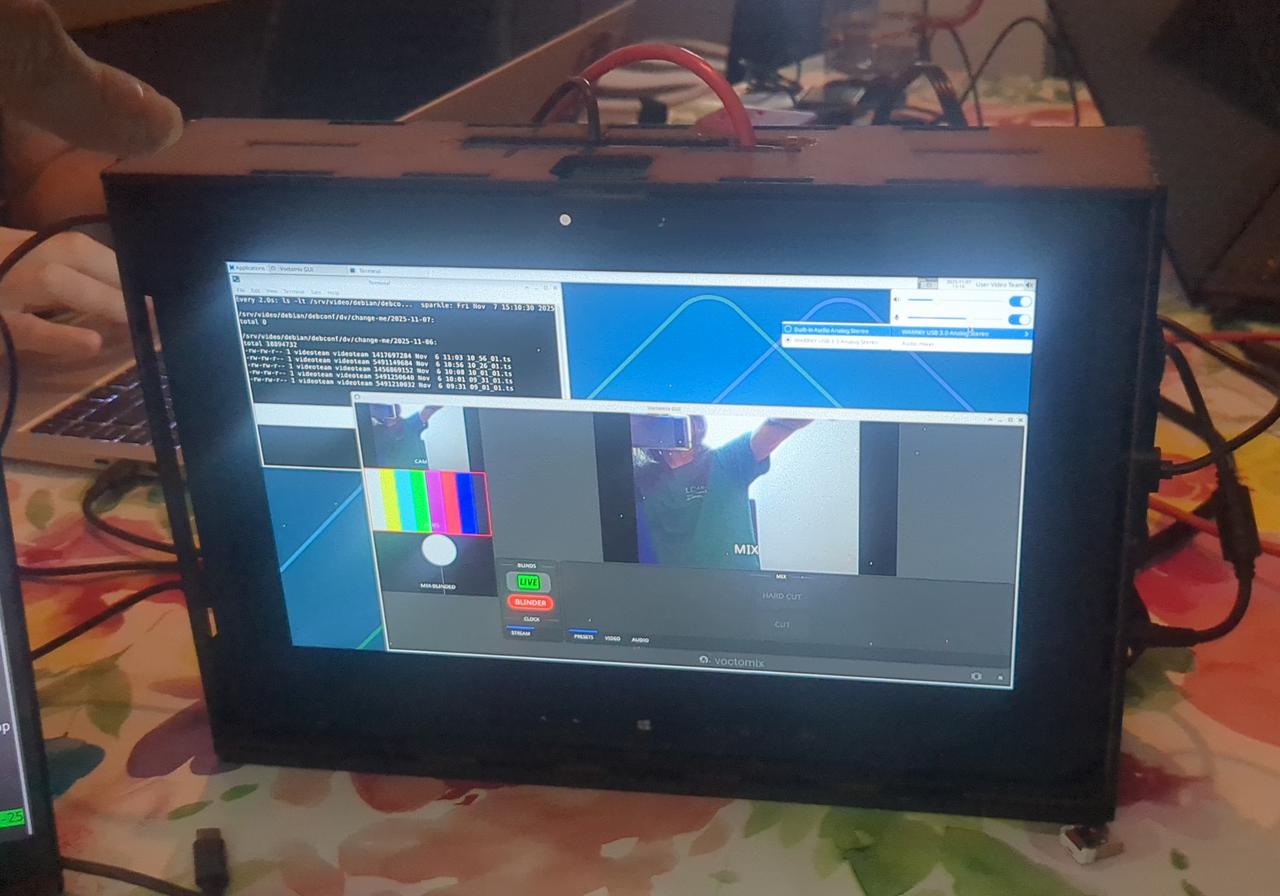
 gst-fallbacksrc
Carl's box's needs lead to looking at
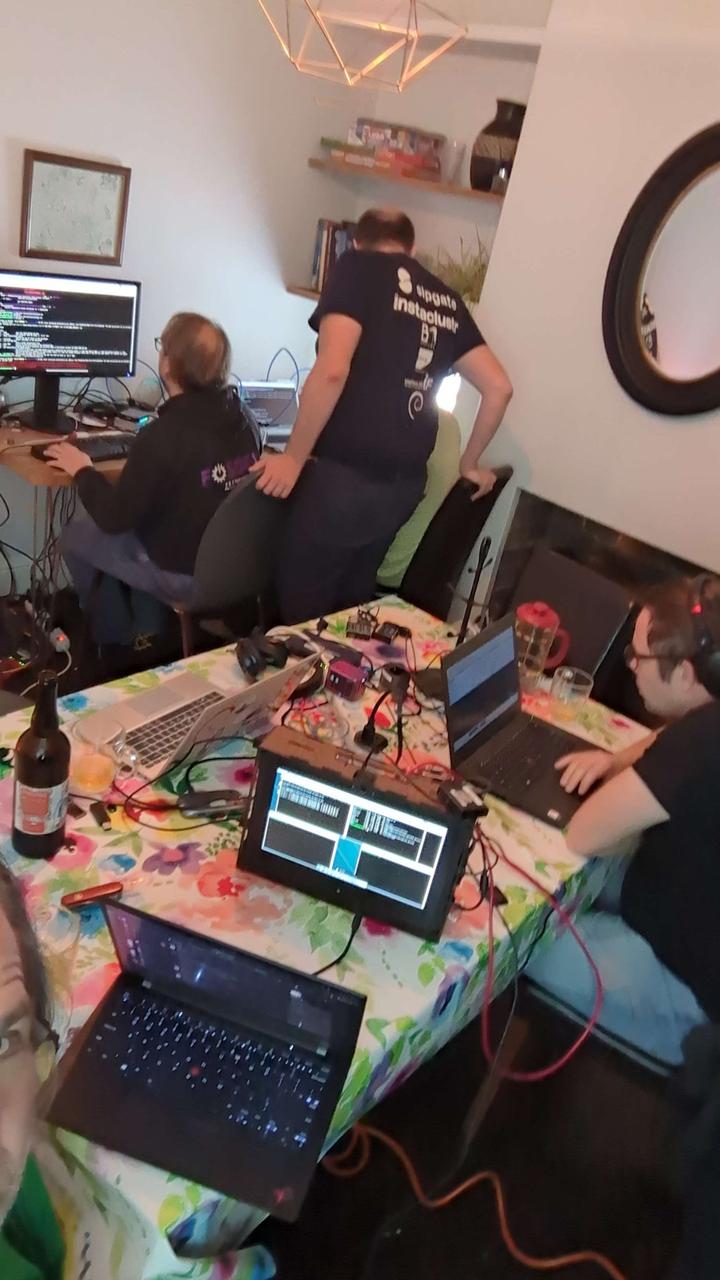
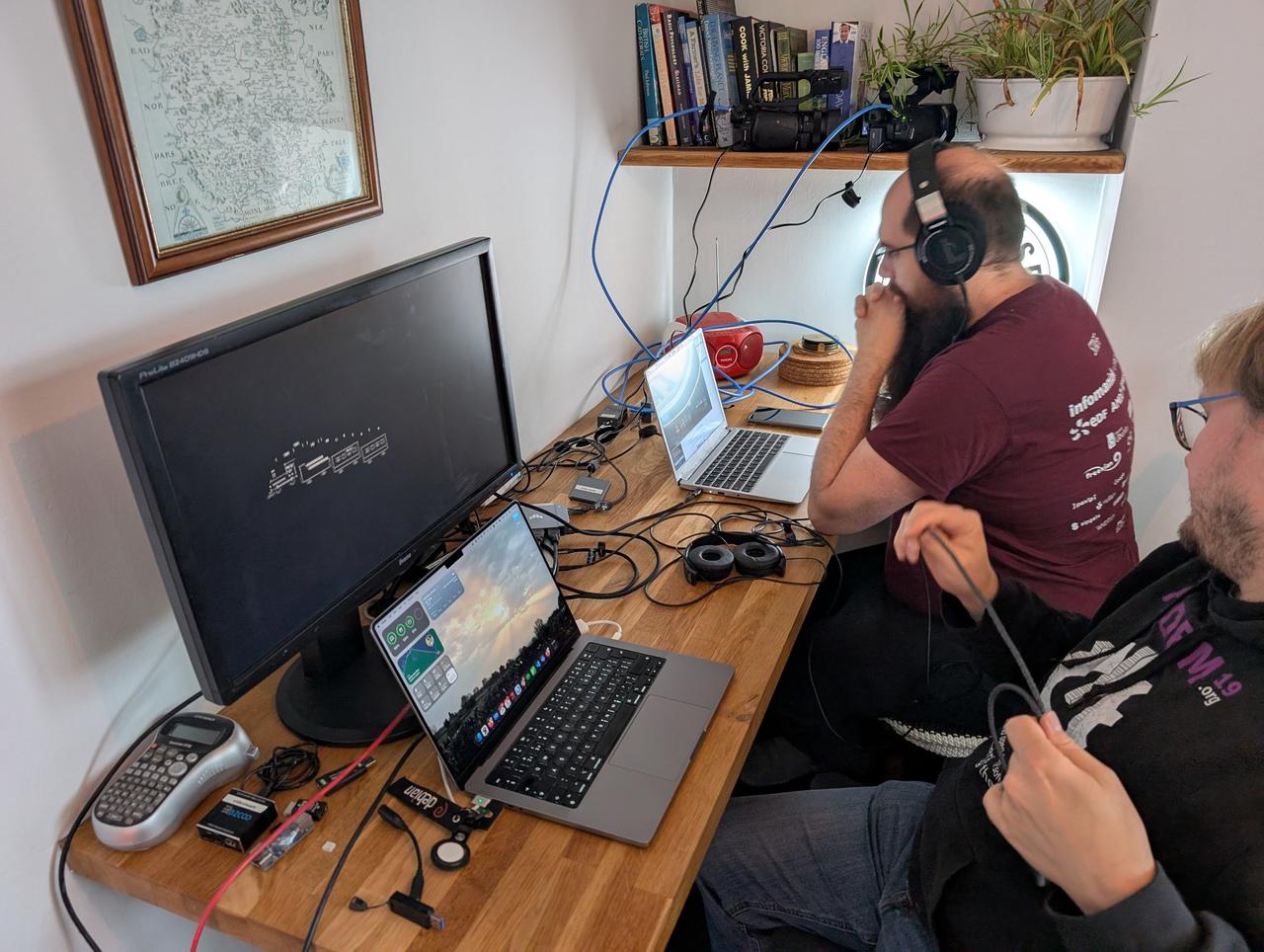
 DebConf26 is already in the air in Argentina. Organizing DebConf26 give us the
opportunity to talk about Debian in our country again. This is not the first
time that Debian has come here, previously Argentina has hosted DebConf 8 in Mar
del Plata.
In August, Nattie Mayer-Hutchings and Stefano Rivera from DebConf Committee
visited the venue where the next DebConf will take place. They came to Argentina
in order to see what it is like to travel from Buenos Aires to Santa Fe (the
venue of the next DebConf). In addition, they were able to observe the layout
and size of the classrooms and halls, as well as the infrastructure available at
the venue, which will be useful for the Video Team.
But before going to Santa Fe, on the August 27th, we organized a meetup in
Buenos Aires at
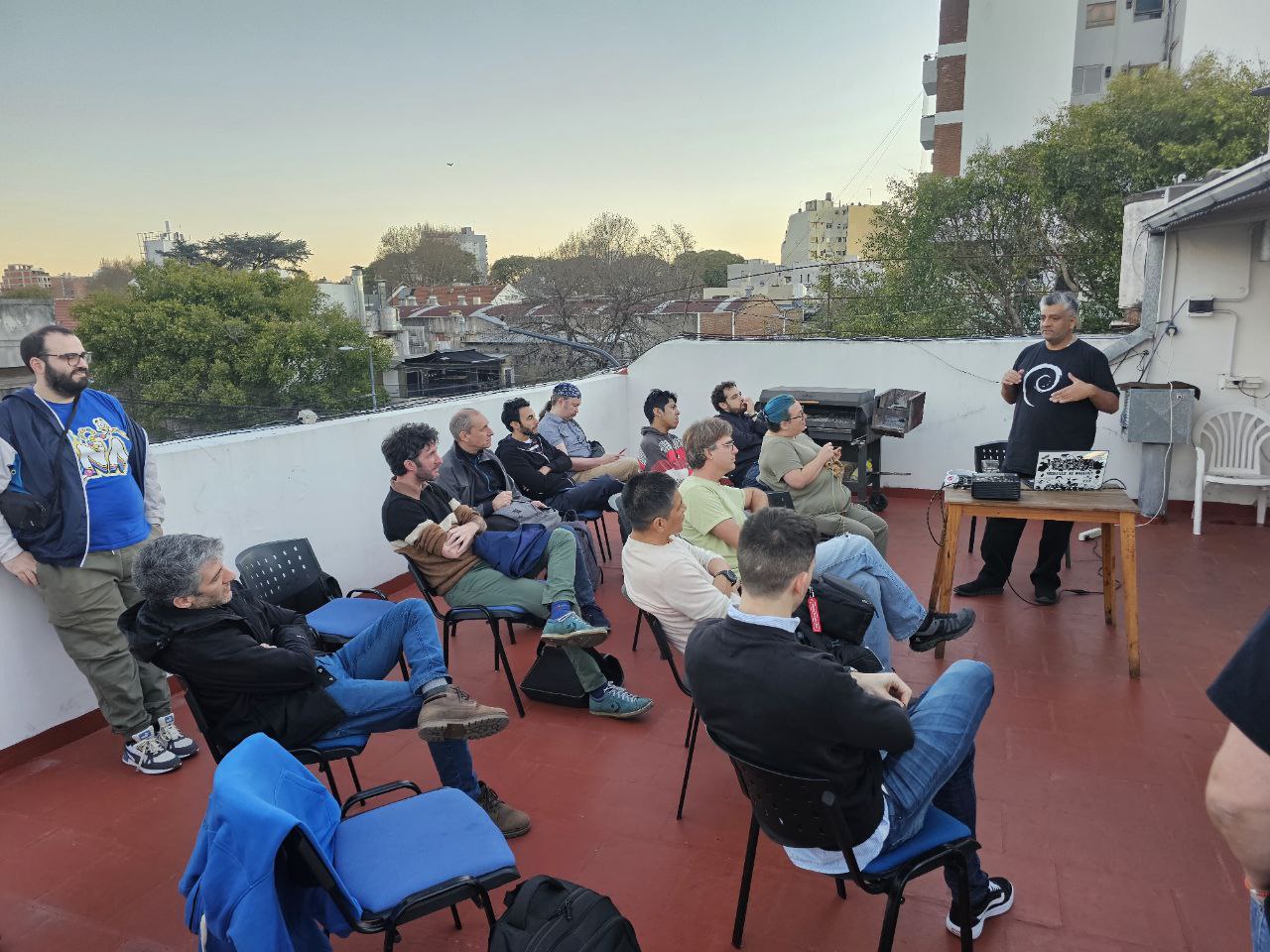 On August 28th, we had the opportunity to get to know the Venue. We walked around
the city and, obviously, sampled some of the beers from Santa Fe.
On August 29th we met with representatives of the University and local government
who were all very supportive. We are very grateful to them for opening
their doors to DebConf.
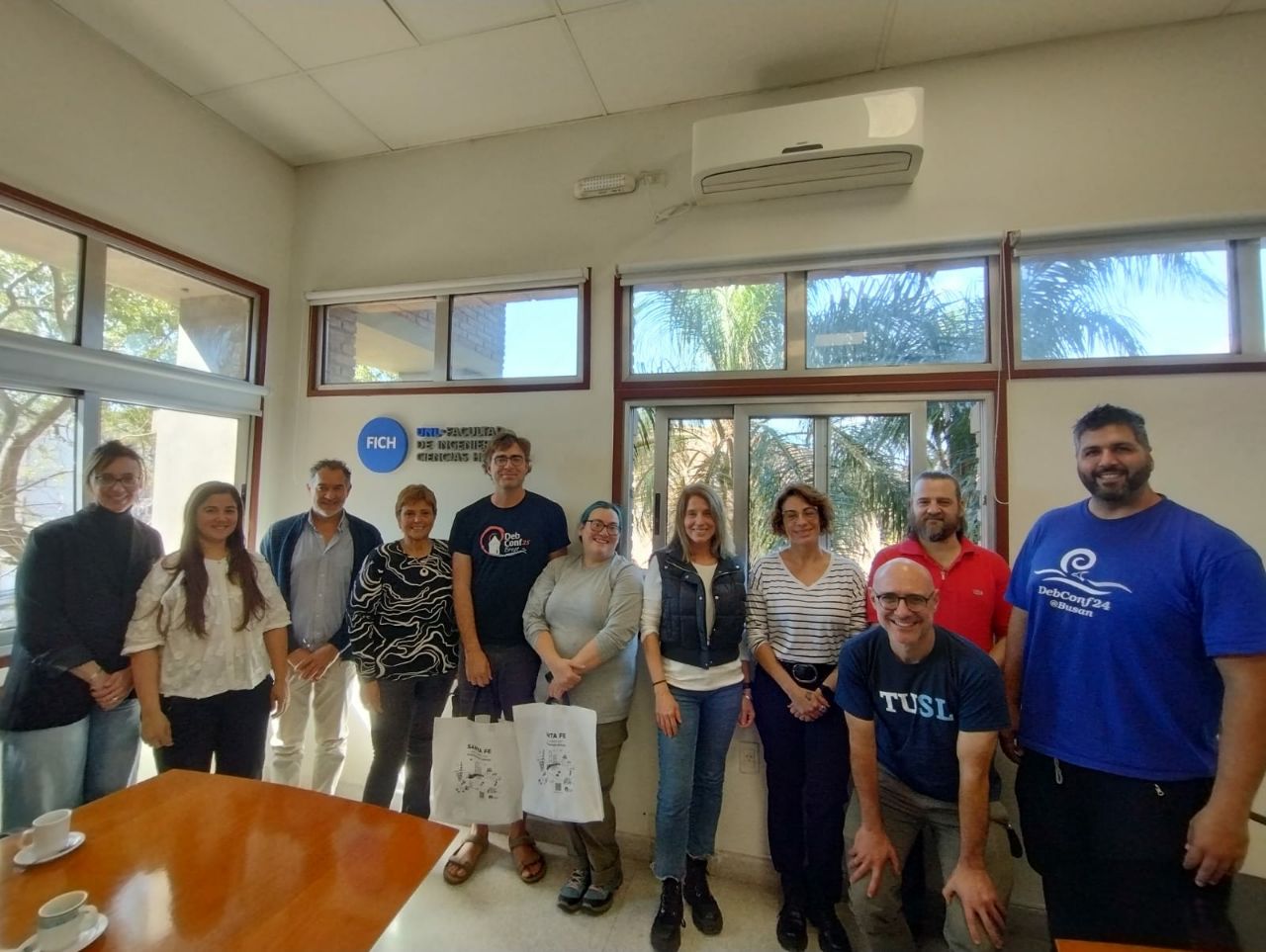 In the afternoon we met some of the local free software community at an event we
held in ATE
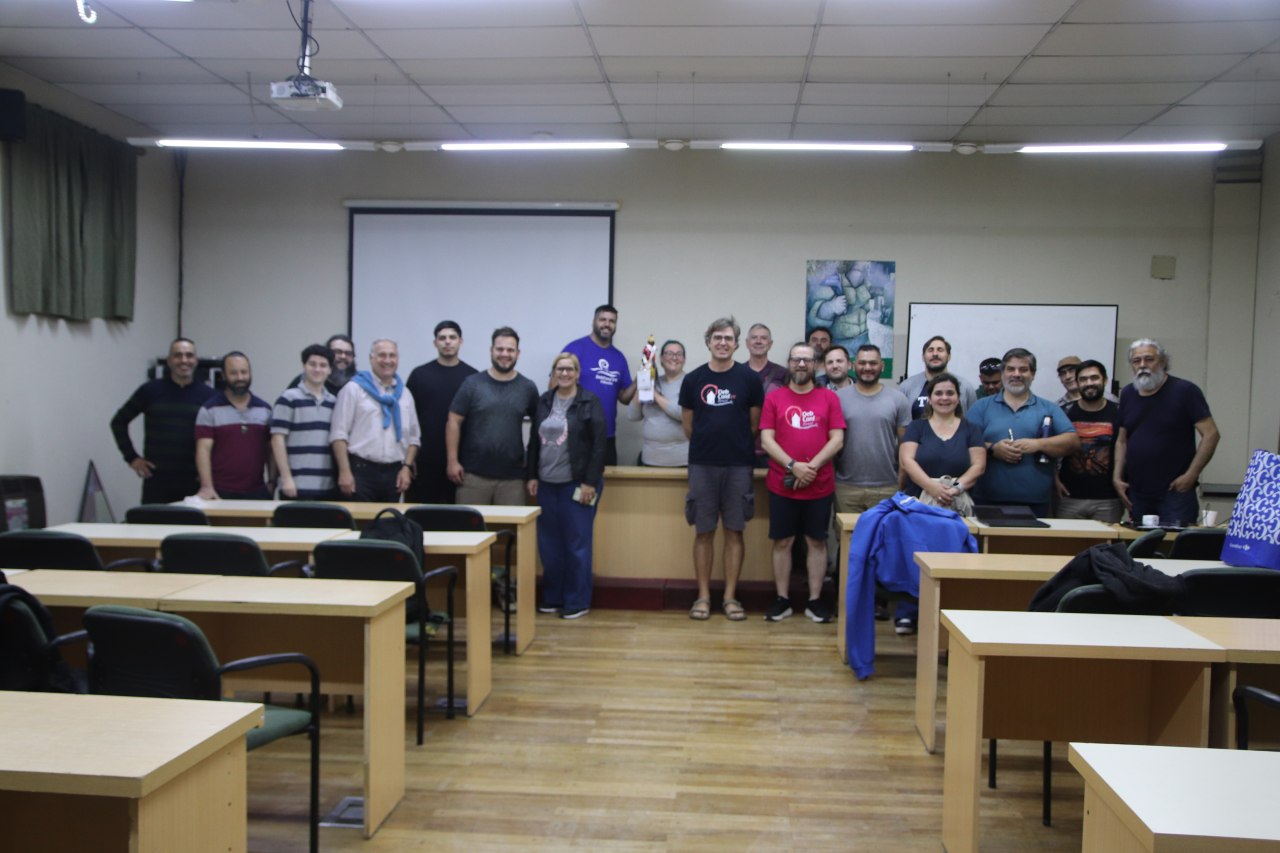 Thanks to Debian Argentina, and all the people who will make DebConf26
possible.
Thanks to Nattie Mayer-Hutchings and Stefano Rivera for reviewing an earlier
version of this article.
 It's Sunday and I'm now sitting in the train from Brest to Paris where I will be changing to Germany, on the way back from the
 Pollito and the gang of DebConf mascots wearing their conference badges (photo: Christoph Berg)
 F/DF7CB in Brest (photo: Evangelos Ribeiro Tzaras)
 The northern coast of Ushant (photo: Christoph Berg)
 Having a nice day (photo: Christoph Berg)
 Pollito on stage (photo: Christoph Berg)