As a graduate of a liberal arts university, I wound up, unsurprisingly, taking a
lot of classes in every possible academic discipline. Thinking back to the
person that I was going into university, I don t think I would have chosen to
take them after all, my degree was in the sciences; I d have been stoked to
do nothing more than wall-to-wall computer science until I ran out of
coursework and filled the rest of my hours with research and independent
studies with my professors (which, I guess I did actually do, just not as
much as I would have otherwise).
Even this blog s CSS theme (now 18 years old and starting to look it) was
something I wrote after receiving and repeatedly re-reading a tattered
third-hand copy of The Laws of Thought by George Boole. It was gifted to me
by a college friend majoring in philosophy while I was crashing at his rental
on the beach. He gave it to me because he knew I liked that shit and, while
it was definitely computer science in nature, I would not have read it
otherwise. I have vivid memories of sleeping on his la-z-boy surrounded by
towers of books he was working through. He went on to do incredible work,
getting his PhD, doing research, brilliant writing his death in 2023 has
robbed humanity of more time with him. The Laws of Thought sits behind me in
my office, and is one of my most valued possessions.
My friends mean more to me than I could ever express, and I definitely don t
show it enough. Each of my classes made me a more thoughtful person. My
professors made me a better, more well-rounded person and a person who
attempts to live up to the oft repeated credo of being men and women for
others . I did the best I could, even though I was never a particularly good
student. Without liberal arts, I don t think I would, dispositionally, have
been capable of pushing myself to this day to continue to learn on nights
and weekends, for no reason other than wanting to learn. I refuse to stop
expanding my perspective, and do my best to approach new problems with as much
humility and curiosity as I can muster.
Every few days for the last year or so, I have been thinking back to a reading
assignment from my junior year that, at the time, I thought was a borderline
throwaway filler assignment for the class. The reading is an essay from 1947 by
the french existentialist philosopher and libertarian marxist, Jean-Paul Sartre
(as some of the more erudite may have now already worked out given the blog s
title), Why Write? . I re-read it this week. It is not filler. I remember this
essay better than some of the classwork I considered more important at the
time.
Why Write?
Why Write? starts off by describing the ways in which writing trying to
communicate your thoughts, opinions, or feelings to others is an act of
projection. The writer will only ever draw from a place of their own
subjectivity writing is taking your person and putting it on display.
You re choosing what words to use, how to use them, pulling from knowledge
you ve accumulated (based on how you ve chosen to spend your time). Spending
any amount of your finite existence in order to convey a thought is, itself,
announcing to the world that you believe it to be a thought worth sharing.
Meanwhile, the act of reading is not simply turning letters into words.
Reading is engaging with the work, and understanding the work in a process
that looks more like what Sartre terms re-invention or discovery the
literary object, though realized through language, is never given in
language . It is not enough to read the words in a book end-to-end; you must,
as a reader, actively engage with the work to understand what is being
communicated by those words. Reading is to take the words on the page, and
exceed the mere words through what he calls directed creation . The reader
is re-inventing / discovering the writer s thoughts by following their
landmarks in the void .
And this all makes pretty good sense to me I know if someone is being
sarcastic because I know the writer; I have read their words and have read
into their words, allowing myself to be directed by the writer into
discovering the thought they have left me in their work. I understand that
their words are humorous, not irate. Knowing who the author of a work is
can completely change the point of a sentence. The fact I m writing about
Sartre at all, or that this very writing has been constrained for presentation
in this blog s CSS is only happening because of who I am, what things I ve
experienced in life, and what has made me, me. Sartre argues that this dyadic
coupling between writer and writing means that I, as a writer, can never truly
read my own writing. I will never be capable of reading my own work and
getting something out of it the work is already an extension of my own
person. I can discover no thought in my own works.
Of course, Sartre, as an existentialist, is honor bound to go one step further
here the reader, by participating in reading a work, is asserting their
own freedom. Every time a writer writes [ ] the writer appeals to the
reader s freedom to collaborate in the production of [their] work . The
creative act may only be complete if both writer and reader have recognized one
another and made a choice to do so. No one is compelled to complete the
creative act. The things you read matter. Reading something fundamentally
alters you as a person you can not simply un-read a thought. Everything you
read changes your universe. I have a hunch Sartre would find things like the
(original early 2010s era) tl;dr reply to obviously terrible writing
absolutely hilarious as a reader s expression of freedom (not to be confused
with modern 2020s era usage as shorthand for summary section ). Using your
freedom to choose to complete the writer s creative act (or not) is inherently
asserting your humanity.
I m a bit fuzzy on the specifics of this quote, but I think it was
sj who told me at one year s
Mystery Hunt that A puzzle is a contract between
puzzle author and puzzle solver, the author promises that the puzzle is
solvable if you re clever enough . The puzzle author and puzzle solver are
engaging in a collaborative production of the work that is only possible by
recognizing one another. Similarly, Sartre whatever connections [the
reader] may establish among the different parts of the book among the chapters
or the words [the reader] has a guarantee, namely, that they have been
expressly willed .
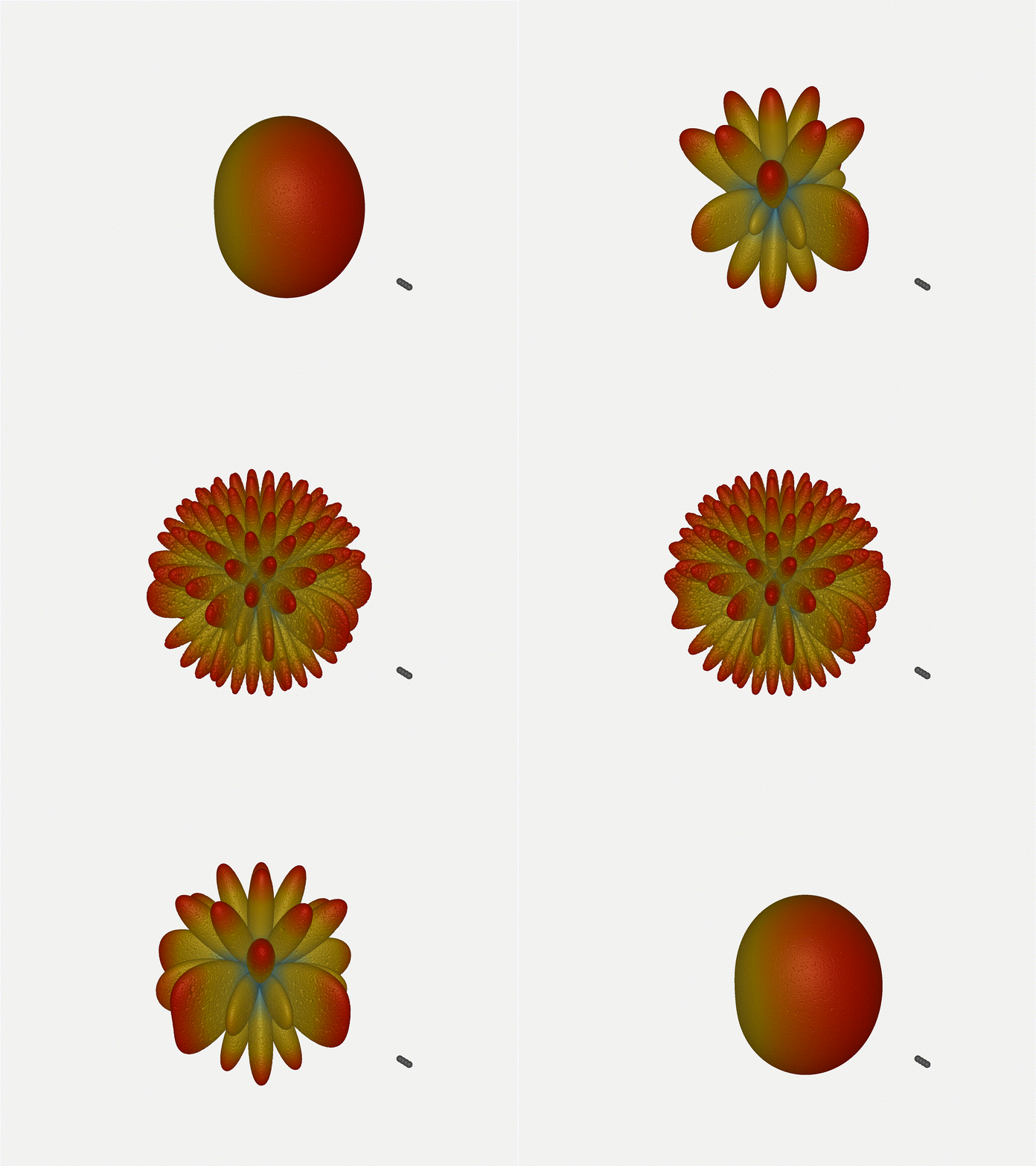
Wall Drawing #123
It follows, Sartre argues, that the act of writing, as a means to convey a
thought to a reader, may only be completed through the act of reading.
Reading can only be done by others; writing, therefore, only exists to be
read it can serve no other purpose. Writing and reading are two halves of
the same creative, collaborative act, only satisfied when both writer and
reader acknowledge one another. Combined, writing and reading are the act of
recognizing one another s humanity, thoughts, experiences, consciousness the
act of co-creation of thought is the critical aspect of writing and reading
reconstructing the author s perspective, thought, intent, point. The
co-creation is the point of both reading and writing.
Writing without anyone to read the work leaves the writer s bid for
co-creation unsatisfied and humanity unrecognized. No thought has been conveyed
to any reader, no one has understood the reason behind the landmarks in the
void you ve carefully placed, leaving you to either [ ] put down [your] pen
or despair . Writing is an appeal to the reader s freedom, and the nature of
that freedom is the writer can not control it never being understood is
always a possibility any time anyone sets out to write.
Nearly 12 years ago, I attempted to read the text on the git manpage
generator for the first time
I remember the exact feeling of my brain going into git manpage parsing
mode where every word was dragging git plumbing megaliths through the sand
from their far-flung homes. I can still feel the surface of my desk as I
instinctually started to trace out logical connections between git internals
referenced as I read along. It took me a good 20 seconds to realize what I was
reading made no sense. This website broke Sartre s writer-reader agreement I
was attempting to read this website, but there was nothing there. You can
mechanically read the git-man-page-generator, but you can never read it
it is not possible to read it. It was funny unsettling. Each grasp at a
real-looking image in front of me misses, my hand coming back empty. I
couldn t get enough of it. I must have tried to read a dozen generations in a
row. I had never had something quite that broken pass that far into my
consciousness before. Although I kept trying, it never did feel quite the same
as that first time; I think fundamentally, I couldn t forget that it was
random.
While never having anyone read your writing drives them to put down your
pen or despair , Sartre never had to contend with the opposite problem being
asked to read that which was not written. Reading that which was not
written does not merely leave someone unrecognized when a reader makes a
choice; instead, it is an inherent violation of the contract between reader
and writer. Not only is no humanity being recognized through attempting to
read words which were not written, but the reader, not the writer,
is the one who bears the burden of unexpected apophenia. The reader,
while engaging in co-creation, must now contort themselves to uphold their end
of the Sartrean agreement, scrutinizing text to ascribe consciousness,
thought and intent only to come back up with pareidolia-fueled echos of
one s own self and disfigured half-thoughts of others. The reality is, the
modern reader must now mechanically read most written work they come
across, scrutinizing text for any signs of thought before truly attempting
to read the work. Failing to do this correctly changes our person
each time it happens, a small part of us is irrevocably altered. Choosing to
engage in this ballet because you wish to do so is one thing this is
your right and freedom as a reader but passing words which were not
written as your own in an attempt to wrestle a reader s freedom of
co-creation from them is another entirely.
If you didn t write it, I don t want to read it (dw;dr). Send me your prompt instead.
I ve long been interested in hardware key material storage devices. I ve been
a fan of yubikeys (I still remember
when my fancy new NEO-N showed up), PIV
(and its associated
smattering of
additionalfields),
SaaS HSMs,
the kernel keyring, some tooling
I ve fairly satisfied with the design of at prior companies, and of course,
our dear friend, the TPM. All that is not even to mention the scores of exotic
hardware security modules one generally comes across from time to time when
you re keeping a sharp eye out that you wind up playing with.
The concept of storing private key material on a disk, or even having it in
RAM has always skeeved me out, so I have a natural inclination to hardware
modules, and how shifting keying material around can change your risks
and threat model(s) in interesting ways.
I don t remember when I first came across the
MIFARE DESFire EV3, but a few weeks ago
I did a deep-dive into the state of the art of authentication schemes using
ID cards. My complete overview of what tradeoffs exist is pretty extensive
(and likely not interesting to the vast majority of the world), but the tl;dr
wound up being one of use PIV or use MIFARE DESFire EV3 . I wound up
picking DESFire for a recent project, and figured it s worth talking
a bit about what I learned, share some thoughts, and some code. That code is
published on crates.io/desox, and docs,
as is our custom, may be found at
docs.rs/desox
DESFire supports DES (I m sure most readers saw that one coming), 3DES (I
didn t bother playing with 3DES at all) or AES-128 (AFAICT always use this?)
keying material. It s worth noting that the DESFire only supports symmetric
keys and is not designed for public key cryptography, and operates exclusively
using shared symmetric key material. The DESFire EV series use those keys and
related authentication schemes to interact with files stored on the on-chip
EEPROM (2k, 4k, 8k, and 16k versions exist), or applications (groups of files
and authentication keys).
Talking to a DESFire EV3
Interactions with the card are done over NFC (ISO/IEC 14443 Type A), and
commands to/from the card may be in the usual ISO/IEC 7816-4 APDU format, or
unencapsulated bytes sent to/from the card are sent using a fixed instruction
set and return code structure saving a few bytes per message. I ve opted to
use their undocumented and proprietary format I found it easier to work
with and with a maximum message of 60 bytes, the savings matter a lot.
While powered via NFC, the card maintains a small amount of state about the
connection between the reader and the card in its RAM, including if the
session is authenticated or unauthenticated. I ll dig into how authentication
happens later, but it s worth knowing that sessions can become authenticated
using one of the symmetric keys shared by the card and the reader. The vast
majority of the
DESFire commands
I know about tend to work while either authenticated or unauthenticated,
with a few exceptions (GetUid, ChangeKey, and ChangeKeySettings
for example).
In general, I found working with this card particularly pleasant. There is a
fair amount of backwards-compatible behavior and multiple methods of
communication that confuse things a bit, but overall, it was better than
average to integrate with. Kudos to the NXP team. If the docs on this chip
were public, things would be orders of magnitude easier it s not entirely
clear to my why they re keeping so much of the interface documentation under
NDA, but it s the largest knock against the chip, by far.
Authentication
I found a lot of really great resources outlining how the handshake and
protocol works for a DESFire EV3, especially from
Ridrix,
some public datasheetsThrRealRevK
and posts from AndroidCrypto.
The gist here is that, because the DESFire only does symmetric key operations,
the key exchange (a type of SKA Symmetric Key Agreement) uses symmetric keys
to establish a unique session key which is used to sign or encrypt data
exchanged between the reader and the card. I m not going to get too in-depth
here, since there s a ton of other resources out there to dig into but I
will do a quick high-level description to keep this post mostly self-contained.
The authentication protocol serves two main functions to verify that both
parties know the same shared secret, as well as to act as a SKA to construct a
new session shared secret key. Here s a quick overview of how a shared session
key is derived between the reader and the card using our symmetric keys
(AES-128 in the case below).
the reader requests to start authentication with the card (something like
AA 00 to start an AES Authentication handshake with keyslot 0x00).
The card will then reply with AF (a status code that indicates more data
is to follow), followed by 16 bytes (in the case of AES-128) of encrypted
(using CBC) data.
The hosts then decrypts this block with the symmetric key from keyslot 0,
returning the card s session nonce.
The host generates 16 bytes (usually random) for its session
nonce.
The host sends an instruction of AF (indicating a continuation of
the previous command), followed by 32 bytes of encrypted data. When decrypted,
the first 16 bytes are our nonce generated in step #4, followed by the 16 bytes
provided by the card, decrypted in step #3, except where every byte is shifted
to the left by one place (the 0th byte is copied to the end).
The card will reply with 00 indicating a successful operation, followed
by 16 bytes, which when decrypted, is our session nonce from step #4, shifted
to the left by one byte in the same way that we did in step #5 with the card s
nonce.
At this point, both the reader and card have confirmed the other party has
the same symmetric secret key. The session is now authenticated and a
session key is derived using the two nonce blocks. Two hashing keys (K1
and K2) are derived from this key, which is used to maintain an ongoing
CMAC hash of the messages
coming and going to/from the card.
From here on out, the session is authenticated , and responses from the card
which were previously plain will now contain a 8-byte CMAC signature,
which can be used to ensure that the replies in question come from the
active session.
In my implementation of the handshake
I opted to encode the handshake state into rust types, just so I wouldn t make
any mistakes. The Handshake type contains the session internals (session
nonce values, keying state, to include IV, etc). This means the authentication
flow (from within my code) uses the Handshake struct to generate the commands
to send to the card in order:
/// Create a new Handshake , and return the
/// start auth command (something like AA 00 )
fnHandshake::<Initial>::begin(
output: &mut [u8],
key: [u8; 16],
key_id: u8,
) -> (Self, &[u8]);
After we get a reply back from the card (the encrypted version of the card s
session nonce, sometimes called Rnd_B in code I ve seen), we transition
states from Initial into HalfOpen.
/// Given the card's encrypted response, generate
/// our session nonce and generate a reply
/// (something that starts with AF followed by
/// 32 bytes of encrypted data).
fnHandshake::<Initial>::rnd_b(
self,
output: &mut [u8],
input: &[u8]
) -> (Handshake::<HalfOpen>, &[u8]);
Now that we re HalfOpen , we re waiting to hear back from the card to ensure
that it, too, can byte-shift our provided nonce. Once we have the card s reply,
we can check it using our complete helper, transitioning from HalfOpen to
Successful.
/// Check to ensure that the card replied with
/// our nonce byte-shifted by one place, indicating
/// that they know the symmetric secret in
/// this key slot.
fnHandshake::<HalfOpen>::complete(
self,
input: &[u8]
) -> Handshake::<Successful>;
Once the Handshake is successful, the only thing left to do is consume
the Handshake struct and turn it into the shared session key by running
it through the key derivation function.
/// Consume the Handshake struct and return the
/// new shared session secret key.
fnHandshake::<Successful>::into_key(self) -> [u8; 16];
From here on out we can use this session key for the remainder of our
interactions with the card signing messages from (and sometimes to!) the
card, or encrypted messages to and from the card. This key is used in CBC block
mode, where the session IV is updated with the last block of the encrypted
data.
Unit Testing
A nice proprietary of the SKA scheme we re using as part of DESFire is that the
derived session key is actually deterministic if you control your nonce RNG
(ok, actually, pretty true for most key agreements, but anyway), which means it
is possible to capture traffic over the NFC interface, and replay the NFC I/O
with cooked RNGs and ensure byte-identical messages and keys are generated.
Within desox-rs this is called replay (I m creative), and I ve got a few
replay sessions checked into VCS, which exercise a signficant amount fo the API
surface. All were derived from an actual session with a real DESFire card, and
can be updated with a live card and a --cfg flag.
Each replay file is a set of lines (request-response transactions), each
containing two space-delimited hex encoded NFC messages. For instance,
here s an authentication handshake in replay format:
The code that generated that exchange came from the test stored adjacent
to that file a handshake with the default DES key (all zeros), and
an RndA value hardcoded to 32c28fdafd3960de.
Since the card s RndB is similarly unchanging (I m replaying this file every
time), this will always derive the same session key, which means messages
(including encrypted ones or CMAC signed responses) will be identical, as well.
If you re playing with the DESFire yourself, feel free to grab my replay
files if you need a
known good baseline.
By default this will run using the
MockBackend,
replaying each file expecting a byte-identical request, and responding with
the harcoded customary reply. If the code (or test!) needs to change, updating
the tests is done by swapping the MockBackend out for a real one. Since I
had to do this a bunch during development, running cargo test
with RUSTFLAGS="--cfg desox_replay_rw" will, on run, overwrite the replay
file(s) for the executed test(s), ensuring all line-protocol changes are
explicitly caught and reviewed.
Observations
Most commands, even ones which require authentication, are transmitted without
CMAC signature(s) or encryption. CMAC signatures from the reader to the card
are not really used (except for writes to a file which specifies communication
must be CMAC signed), ditto for encryption (although that one is used for key
change operations, in addition to file writes on files that specify encrypted
communication must be used). The vast majority of commands take a plain
request from the reader, and return a CMAC signed response.
By my eye, this means that a malicious reader, or something otherwise capable
of holding the card online after communication with an authentic reader is
complete are able to execute privilaged commands (since one can simply ignore
the CMAC signatures on responses), so long as the command doesn t require the
reader to provide CMAC signatures (or encryption), or allow the card to power
down.
Fun with DESFire
I ve played around a bit with ways to use the DESFire cards in interesting
configurations, given what they re capable of. Here s some half-baked thoughts
I had while mucking around with the cards these are all poorly thought out
sketches of some things we can do given the specific tradeoffs I see with the
DESFire card. It s also worth noting that I don t have any of the actual
documentation, and am not a cryptographic grown-up, so take these sketches with
a massive grain of salt.
The first thing that came to mind when implementing this is how the
authentication scheme can shift the boundary of what is and is not trusted
(assuming good secure keying, and provided the key slots and card/application
permissions are configured correctly). Rather than push the key material out to
the machine connected to the NFC reader ( reader machine ), I instead tried
turning the NFC reader and computer into something psuedo-untrusted by merely
having it pass messages from the card to a trusted remote system ( remote
machine ). This means that the reader machine is exchanging NFC data with the
card, but that data is being decrypted, encrypted and processed by the trusted
remote machine the reader is unable to derive the session key.
For each of these, I wind up needing to authenticate so there s still a few
latent risks, but these can mostly be mitigated by asking for a readbacks of
any changed file(s), setting key permissions carefully, and requesting the
card s UID via the encrypted channel all of which would require the
symmetric secrets (which undermine the whole security model if comprimised).
This general construction is also subject to a hostile takeover of the
untrusted reader machine , since most commands (including destructive ones!)
are sent in PLAIN mode the reader machine can wait until authentication
is complete and then inject commands into the card and simply ignore the CMAC
signatures on responses, severing ties with the remote machine. As such, we
also need to take steps to ensure that the key being used is not one that
allows any access beyond what is allowed. Here were some ideas I sketched out
off the back of this theory.
The second-factor
Given some established (and authenticated) connection, part of the initial
authentication flow may use the DESFire card to prove physical control over it
as part of a handshake. This can serve as a second factor during some
authentication flow, requiring physical card presence at a reader to fully
initialize a connection. This does have one glaring downside, however it s
phishable. To use this for real , we d need to take some steps to prevent
obvious MITM flows (XOR the NFC messages with the URI as seen by the client?),
but maybe there s something interesting there.
This also has a second interesting attribute when used as part of a physical
system authentication flow, this becomes a logical place to inject access
control, being able to determine if some person is permitted to operate some
device at that particular time (Is Joe current on his Laser Cutter
certifications?) I think of the ideas I landed on, while conceptually
interesting (using an employee id card as a 2FA token, it s very fast), this
one is the least likely to turn into something real.
The encrypted-cookie
This construction, when paired with an encrypted DESFire file, allows the
remote machine to read/write an encrypted cookie to the card storing
small amount of encrypted data that the remote machine can read/write, but
not the reader machine , since this uses an encrypted and authenticated
channel from the remote machine directly to the DESFire card, without any
intermediate hosts needing to be fully trusted. I keep calling this the
encrypted cookie in my head because it feels conceptually similar to how Ruby
on Rails and Laravel handles cookies.
We d need to take a few extra steps here (for instance, ensure that you read
the cookie back over the encrypted channel after writing to prevent a malicious
reader from dropping writes) to secure the system, but it feels like the
structure of this is definitely decent.
The takeover
This time, let s say the computer attached to the NFC reader ( reader machine )
is semi-trusted. For this scheme, our trusted remote machine and the
reader machine pass messages over the network to handle authentication to the
card (as above), where the handshake data is being decrypted, encrypted and
processed by the trusted remote machine as usual. However, once the
authentication handshake is complete and a session key has been derived, the
remote system return the session key to the reader machine , giving it a
one-time-use key and authenticated session to the card.
We need to be careful about global/application permissions and key access
control to files but in this construction, we can allow the reader machine
to take over privileged actions using a scope-limited DESFire key without
handing over the card s true keying material (preventing cloning of the card).
This can be helpful to ensure messages to/from the card are truely from the
card (verifying CMAC signatures), enables the reader machine to directly
read/write to/from encrypted file(s), but allows the symmetric key material to
remain in as few places as possible which is critical given compromising
that secret will undermine the security of the entire system.
This post is part of a series called "Pigeon". If this is the first post
you've found, it'd be worth reading the
intro post first and then looking over
all posts in the series.
The final step to all of this was to tie together all my PHY RF
code, Link layer parsers, and my
background with operating systems
to make this all feel like a normal thing my computer should be doing.
At the end of the day, I want my host system to know how to talk with a
pigeon daemon, so I don t have to reimplement basically everything else.
My ability to use normal tools like curl or ping6 is pretty important
here, so I need to reach for my old friend, the
TUN interface. The
TAP/TUN interface allows the kernel to route ethernet frames (TAP) or ip
packets (TUN) to a userspace program responsible for handling delivery and
reception avoiding the need for a kernelspace driver for something that
can be handled in userland.
wondering if doing this violates FCC Part 97 rules? I wrote up
notes on my test setup
for exactly this question, but the short answer is "no"!
I m nostranger to
playing with TAP/TUN, so this was pretty easy to snap together although this
time I avoided the whole ethernet proxying thing (to side-step lossy
translations, maintaining two sets of mac address tables, and handle proxying
NDP/ARP messages) it was kinda a bad idea last time so I just used TUN
and straight IP for now. While implementing this, I decided I d make a key
assertion about all pigeon networks namely, all pigeon IPv6 networks are a
/64 in size, no more, no less. The reason why I m doing this here is that,
since pigeond does still does need a MAC address for the pigeon layer 2
protocol, we can write our daemon to always use
SLAAC
to set the TUN IP address without any new information.
Which leads us to a bit of an aside, but I have a point, I swear. A few years
ago, my recreational RF adventures have lead me down a path where I decided to
engage with ARIN to solve (once and
for all) the massive headache I was running into with IPv6 numbering (really:
always renumbering) my multi-site radio processing networks. It s a lot
of work to keep running correctly, but it s solved a huge amount of
problems for me.
The only internal thing we really need to outline for this post is that, at
the highest level, my network (paultag.net) is split into an IP plan that
looks roughly like:
64 "sites" per region. A "site" is assigned to a physical or logical location.
/64
1024 subnets per site. A subnet used by directly attached devices.
For this exercise, I used IP space from paultag.net s experimental region
( region 8 ), named side.band (2602:810:6008::/48) to connect my RF lab
( site 1 - 2602:810:6008:400::/54), and my two pigeon-specific subnets,
subnet 0 (2602:810:6008:400::/64) and subnet 1 (2602:810:6008:401::/64)
to my wider network. The first subnet ( subnet 0 ) is a simple ethernet network
to enable my RF-only nodes to communicate with the side.band gateway. The
second subnet ( subnet 1 ) is an RF-only pigeon network local to my lab.
back to radios
With all that set up, I assigned my first two nodes their MAC addresses, and
set up the local RF only network segment. The nodes I brought online were the
following:
Callsign
IP
K3XEC/MN
2602:810:6008:401:8e1f:64ff:fe35:4001
K3XEC/TH
2602:810:6008:401:8e1f:64ff:fe35:4002
testing the pigeon network
And with that, I could begin to test that the host operating systems and RF
links could properly exchange data locally from SDR to SDR. We can use
ping6 to see if a plain-ole ICMPv6 ping round trips between hosts correctly:
$ ping6 2602:810:6008:401:8e1f:64ff:fe35:4001
PING 2602:810:6008:401:8e1f:64ff:fe35:4001 (2602:810:6008:401:8e1f:64ff:fe35:4001) 56 data bytes
64 bytes from 2602:810:6008:401:8e1f:64ff:fe35:4001: icmp_seq=1 ttl=64 time=426 ms
64 bytes from 2602:810:6008:401:8e1f:64ff:fe35:4001: icmp_seq=2 ttl=64 time=397 ms
64 bytes from 2602:810:6008:401:8e1f:64ff:fe35:4001: icmp_seq=3 ttl=64 time=419 ms
64 bytes from 2602:810:6008:401:8e1f:64ff:fe35:4001: icmp_seq=4 ttl=64 time=418 ms
64 bytes from 2602:810:6008:401:8e1f:64ff:fe35:4001: icmp_seq=5 ttl=64 time=436 ms
64 bytes from 2602:810:6008:401:8e1f:64ff:fe35:4001: icmp_seq=6 ttl=64 time=391 ms
64 bytes from 2602:810:6008:401:8e1f:64ff:fe35:4001: icmp_seq=7 ttl=64 time=397 ms
And it does! Latency is horrid (and there s a bunch of tx artifacts that
cause issues for us) but both of those things are problems for later. Let s
see how it handles a TCP connection by firing off a quick cURL across the
Pigeon network:
$ curl http://[2602:810:6008:401:8e1f:64ff:fe35:4001]:8000/testing.txt
The rock dove (Columba livia), also known as the common pigeon or rock pigeon
(but see also Petrophassa), is a member of the bird family Columbidae (doves
and pigeons).
As expected, our remote end here running the server reports the correct peer
IP address, which is another indication (beyond the log messages and blinking
LEDs) that we re routing over our TUN interface.
Serving HTTP on 2602:810:6008:401:8e1f:64ff:fe35:4001 port 8000 (http://[2602:810:6008:401:8e1f:64ff:fe35:4001]:8000/) ...
2602:810:6008:401:8e1f:64ff:fe35:4002 - - [28/May/2026 12:53:21] "GET /testing.txt HTTP/1.1" 200 -
That worked? First shot! Nice! It s pretty slow and seems like we have a
lot of packet loss, but it does, however, beg the question can it nethack?
nethack!
Yes! It can nethack! No clickbait here. The way I went about this one is a bit
anit-cimatic I set up a nethack server (using inetd in this case) on one
of the hosts pigeon0 network interface, and hit that port over RF from
the other:
However, when playing it, it becomes very obvious (as you can likely see) that
there s a fair amount of packet loss (understandable) and probably some packet
collisions taking place.
iperf
Let s try and put a number to exactly how bad the bandwidth and packet loss
is by running iperf between the two pigeon hosts over rf:
$ iperf -c 2602:810:6008:401:8e1f:64ff:fe35:4002
------------------------------------------------------------
Client connecting to 2602:810:6008:401:8e1f:64ff:fe35:4002, TCP port 5001
TCP window size: 16.0 KByte (default)
------------------------------------------------------------
[ 1] local 2602:810:6008:401:: port 58248 connected with 2602:810:6008:401:8e1f:64ff:fe35:4002 port 5001
[ ID] Interval Transfer Bandwidth
[ 1] 0.0000-20.2348 sec 76.8 KBytes 31.1 Kbits/sec
Shockingly, not nearly as bad as I thought it was going to be. Given I ve
spent exactly zero time making this operate to a level that I would call
acceptable, this is a very fucking solid start. I expect I could get that
number up if I spent a few weeks on it it s just not been a priority
at any point yet (and the first time I ve instrumented it, even!).
This ll be good enough to get started. Let s see what else we can pull
off here.
IP multicast to some rtl-sdrs
Back when I designed what I wanted Mode A to
look like, I intentionally picked a signal bandwidth that could be received
by an rtl-sdr so let s put that to use. It may go without saying,
but just to say it the rtl-sdr can not transmit, so this will be capable
of receiving pigeon frames but not sending any in reply.
However, this means I can use a bunch of low-cost computers (raspberry
pi-class), and low-cost SDRs (rtl-sdr) and still receive IP traffic from
transmitting pigeon network stations. This could be a lot of fun for things
like fountain coding a data
stream, or adapting multicast streaming protocols to work over RF links.
Anywho, I swapped my far end to an rtl-sdr (one config file change!), and
figured I d start with some (basic) multicast traffic, transmitting the time
once a second:
If I had more time to burn, I was planning on bridging
APRS traffic
to UDP multicast within a pigeon network subnet. However, since I m already 4
years late on this blog post, I figured this would be enough for now (and you
can imagine that fun project in this space if you so wish!)
I fired up pigeond again (except this time connected to an rtl-sdr),
and was pleasantly surprised to be greeted by some decoded traffic right
off the bat:
Looks great! tcpdump is showing multicast packets show up (as we assumed they
would), on the pigeon0 interface, on the machine connected to an rtl-sdr. Of
course, any replies will get sent to the
bit bucket, but it can definitely
decode things just fine! Very fucking cool.
Well right, ok! Let s go back to two rx/tx radios, and see what we can do with
our newfound network stack over ham radio frequencies let s try to do some
fun (and traditional!) ham radio things with it!
Winlink
Winlink is a ham radio mail relay system for ham radio
operators to send, receive or relay mail over the internet, or RF (usually HF
or VHF/2M). Winlink relays are accessible via whatever transport you can
find most commonly telnet (using the internet), ax.25 (usually 2m VHF)
or VARA HF (unsurprisingly, on HF). I use pat as my
Winlink client it s written in Go, doesn t require windows, and is just
generally nice to work with.
Let s try the easy thing first let s connect by proxying the Winlink server
into the pigeon network using socat (lightly edited to remove date/times)
$ pat connect pigeon
Connecting to WL2K (telnet)...
Connected to [2602:810:6008:401:8e1f:64ff:fe35:4002]:8772 (tcp)
[WL2K-5.0-B2FWIHJM$]
;PQ: 54509561
CMS>
>FC EM OLU6BP5HKMG2 240 205 0
>F> 95
FS Y
Remote accepted OLU6BP5HKMG2
Transmitting [Hello, World] [offset 0]
Hello, World: 100%
FF
>FQ
Disconnected.
$
Lo and behold, shortly after, I got this delightful message to my
email address, relayed in from WINLINK:
The only shame is I won t be able to check in to a winlink
wednesday using this scheme unless I further
proxy this message over AX.25 instead of relaying to Winlink s servers over
telnet (which, to be fair, is definitely also possible I just got lazy when
I glued this one together see note above about being 4 years late on this
post).
But, you know, connecting to a host that is using socat to proxy a
connection to an internet resource is interesting but you know what, fuck it
hang on, dear reader let s bang a hard left turn and just ship this thing
hard and directly connect it to the internet. Let s take our dinky,
home-built PHY and Layer 2 and see if we can wire it directly into the internet
something that, every time I go to think about it, reminds me of
Tim FitzHigham and his crapper.
Crossing the english channel in a bathtub
Ok, ok. I decided to bury the lede a bit here I didn t mention that the
side.band network is currently
BGP announced. Although we
haven t used it this does mean that we re most of the way to sending packets
to the wider internet, and we should be able to just fix a few routing
tables, and see packets begin to flow.
After tweaking the local routing tables (and restarting pigeond for good
measure), I decided to test my newfound connectivity by pinging something over
our new network transport.
ping github
Why don t we start with the world s premier software engineering platform,
operated by one of the largest companies in the world, GitHub! After all,
they have an all knowing (and, apparently, arguably sentiant?) AI on hand to
instantly and automatically fix any stray
reliability issues in the
background, so we should definitely see replies right off the bat:
$ ping6 github.com
ping6: github.com: Address family for hostname not supported
Wait, oh no that can t be right?
After all, it s 2026, and both
Google
and CloudFlare
(in North America) are reporting
over half of all traffic they see is IPv6 and GitHub still doesn t support
IPv6? Definitely not, this is for sure a bug with my code or network.
lets ping something that supports ipv6 instead
That being said, just for completeness sake, since that error is also given
when there s no IPv6 DNS record, let s go ahead and double check with
Hurricane Electric too, you know, just to be sure.
$ ping6 he.net
PING he.net (2001:470:0:503::2)56 data bytes
64 bytes from he.net (2001:470:0:503::2): icmp_seq=1 ttl=53 time=514 ms
64 bytes from he.net (2001:470:0:503::2): icmp_seq=2 ttl=53 time=230 ms
64 bytes from he.net (2001:470:0:503::2): icmp_seq=3 ttl=53 time=248 ms
64 bytes from he.net (2001:470:0:503::2): icmp_seq=4 ttl=53 time=246 ms
64 bytes from he.net (2001:470:0:503::2): icmp_seq=5 ttl=53 time=265 ms
64 bytes from he.net (2001:470:0:503::2): icmp_seq=6 ttl=53 time=240 ms
Well, shit. Right, OK, i ll be damned. 18 years in and GitHub still can t crack
that nut.
cURL works!
Right, anyway, yes, back on track good news! Our uplink is up and routing,
and wait, holy shit! Check it out! pigeon is
exchanging packets with the internet and no one is any the wiser!
Literlaly amazing. Let s try a cURL across the internet now (although no
TLS allowed, so, http only for now):
IRC works, too
Sweeeeet. That all works! Forget HTTP, let s do some other 90 s era
stuff, it s high-time to log into IRC with a quick /connect -notls, and see
what s going on in the #debian-hams channel pleased that I got online
fairly quickly, and was able to even talk to myself!
THE GOPHERSPACE
Naturally, let s keep this train of nostalga running, and give
the 2026 gopherspace a
shot.
I know the kind folks over at tilde.town (hello,
townies!) have a robust gopherspace, so let s give it a dial! Let s try and see
if we can load vilmibm s
slug over gopher:
Yes! I forgot to make this one a video, so no gif. I did wind up having a bit
if trouble with a few gopher clients and IPv6 support I may send some
patches if I can find the time.
So, what s next?
Alright, that s it. I have a few more fun ideas but they re going to have to
wait for another day. Carrying IP is fun and all but kinda not the point behind
pigeon, after all. Rather than trying to make this into a thing , I m planning
on exploring the loose ends first different types of modulation schemes
(like QAM-NUC), implementing LDPC error correction and some layer 2 logic
into the pigeond (like switching traffic, and gain control). I also plan
on spending some time with my (currently, very basic) simulator to better dial
in tradeoffs throughout the stack.
Since, structurally, pigeon is something I feel like I can work with, I m
hoping i ll be able to find the time for some (much smaller!) followup posts
without it taking 4 years this time. If I do, they ll show up under the
pigeon tag and I ll be sure to update this post with
a link below (and the intro post).
I m hoping that this series (which was supposed to be one post) was helpful
to someone out there if it was, feel free to reach out and let me know!
This post is part of a series called "Pigeon". If this is the first post
you've found, it'd be worth reading the
intro post first and then looking over
all posts in the series.
If you're looking for it, the intro to the Link (layer 2) that this belongs at a
high level and listing of the parts that make it up (including this one) is on
the link post.
Built-in to the pigeon link protocol is a message type called cal (short for,
you guessed it, calibration). A pigeon frame with a type of cal
(which is 0x02) carries a JSON encoded payload in the body, which can
either be a beacon, requesting signal reports in response,
or a report, describing the received beacons.
This serves a few interesting purposes firstly, network operators can better
understand the coverage footprint, propagation under different conditions, and
how gain impacts reception when tuning for the lowest practical power levels.
Secondly, this can be used (and I plan to eventually implement!) to construct
a mapping of minimum power level and peer mac address to dynamically control
the transmission power based on the destination station.
That being said, for now, all I ve used this for is getting a rough sense for
what gain value(s) make sense between two nodes (manually). In the future,
beyond all the fancy neighbor gain stuff, I plan to wire this into the daemon
to happen automatically, debouncing for beacon and report messages, such
that transmitting stations only beacon, and receiving stations only report a
max of once over some time period for a given peer.
Version
Given all the above, I do intend to make some massive changes to this protocol
(I promise to blog all about it) when I get around to hacking on switching
Layer 2 frames within a network segment. Just to avoid having to dig myself out
of a hole later, I m going to explicitly send (and check) the version field
to avoid having a big flag day switchover or needing to use a new linktype.
Version ID
Description
V1
this version of the cal protocol
Location
Both flavors of cal messages (beacon and report) may contain a location,
which is the location that the beacon was transmitted, or for or the location
where the beacon was heard for a response. This can be used to derive a
coverage map and to (operationally) better understand what stations should be
within range, and generally what gain level(s) are effective.
All fields assume WGS84 latitude and longitude values, and elevation is
distance, in meters, above the WGS84 ellipsoid NOT height above
sea level, or altitude above the ground.
Field
Description
lat
WGS84 Latitude
lon
WGS84 Longitude
elevation
height, in meters above the WGS84 ellipsoid
Sequence
Each beacon contains a Sequence identifier, which is used to communicate
which message number is being heard, and how many total were transmitted
by the originating station. The current approach with Beacon messages is to
transmit some number of Beacon messages at different gain levels, each
with a unique Sequence identifier.
Field
Description
number
beacon sequence number
total
total number of beacons transmitted
Gains
Recorded gain setting(s). For a Beacon this indicates the gain settings
(which, in spite of its name, includes things like amplifiers, or attenuators).
Changing this over different Beacon frames enables a better understanding
of what an appropriate gain level is for the transmitting station over time.
Field
Description
name
gain stage name
db
gain value, in dBm
Cal
All messages contained in a cal frame are of this type. The type field
communicates if this is a Beacon or Report message type.
Type
Description
beacon
sent intermittently by idle stations
report
reception report in response to a beacon
Beacon
A beacon message may be sent periodically by pigeon nodes capable of
transmitting to announce their prescience to peers and, implicitly, to receive
signal reports from nearby listeners who are capable and configured to transmit
reports.
The beacon JSON message is made up of the following fields:
Report
A report message may be sent in response to a beacon message by
pigeon nodes capable of receiving and transmitting to assist with setting the
lowest usable gain value, and to better understand the area of coverage and
propagation.
The report JSON message is made up of the following fields:
This post is part of a series called "Pigeon". If this is the first post
you've found, it'd be worth reading the
intro post first and then looking over
all posts in the series.
Now that we have a working Layer 1, we have a way to send a block of bits
from one place to anyone who cares to listen to us. This is very welcome
news, but we are now facing a new, different and just as fun question what
shape should that data take?
Need a bit more of a crash course on what "Layer 1" and "Layer 2" mean? No
problem, I wrote up short summary here to
help.
Given our incredibly limited functionality of our nodes, we could definitely
skip all this work and just stuff an IP packet into the link; but I decided
to not since I am (eventually) interested in adding some sort of
spanning tree-like
protocol to implement network
switching so not all nodes
need to communicate directly with all other nodes but that day is not today.
Given i m going to stub most of that out, let s take a look at what some
similar Layer 2 protocols use things like Ethernet or WiFi frames. Both
contain structured information regarding the transmitter, desired recipient,
type of data, and the higher-level data itself (such as IP packets). As a
result of attempting to learn from others, the Pigeon Layer 2 (called, simply,
link ) is also split into a fixed-length header, followed by the contents
described by the header.
The header is a fixed-length (23 byte) structure, which contains the source
MAC address (src mac), destination MAC address (dst mac), the ITU
coordinated ham radio callsign of the control operator of this message
(callsign), the type of payload to follow (type; defined below), and
the length of the data to follow the header (length as a 16 bit big-endian
unsigned integer).
The type field indicates how the payload is to be interpreted currently
I ve only defined 3 possible payload types so far:
Keen observers will perhaps infer that there used to be an Ipv4 type at
0x03 which is true however, i ve since removed it since i ve never once
used it and the codepath was more trouble than it was worth. As is my wont,
I ve optend to just lean into Ipv6-only IP transport it s easy enough to
shim ipv4 in, if someone REALLY wanted to using something like 64:ff9b:1::/48
and a bit of code in the transmitter/receiver (or even using something like
jool and unbound s
dns64-prefix
at the router). I don t think I ll bring it back, but just in case I have
to for some reason in the future, it s there.
Additionally, friends of the pod may also recognize that this structure is
basically the exact same structure as what I had in PACKRAT,
which, is also true. I started this project off maintaining interoperability in
the Layer 2 for pigeon and packrat, but at some point just gave up on it during
one of the many cleanups. I m hopeful I can maintain compatibility going
forward, and that won t have to muck with this header too much more. We ll see
what happens once I start to push the bounds of what is possible with pigeon.
Hopefully it feels like carrying IP data inside this frame to be a pretty
self-explanatory exercise the 0th byte of the payload is the 0th byte of
an IPv6 header (followed by all the usual stuff, like UDP or TCP header(s) and
any carried data, just like you d find anywhere else.
Pigeon s calabration protocol
This post is part of a series called "Pigeon". If this is the first post
you've found, it'd be worth reading the
intro post first and then looking over
all posts in the series.
If you're looking for it, the intro to the PHY (layer 1) that this belongs at a
high level and listing of the parts that make it up (including this one) is on
the phy post.
While developing Pigeon, I ve called the group of all the configuration of the
Layer 1 PHY parameters the Mode . I ve experimented with a few different
modes , but one in particular has been the most resilient to the innumerable
mistakes and bugs i ve wrought into existence and that is the first mode
I wrote down, Mode A . This is even (mostly) backwards compatible to my
original Go implementation of Pigeon Mode A (back in 2022) over the air,
and has largely withstood the problems I ve thrown at it.
I ve removed the bulk of the support I wrote out for other modes, but i m
likely to bring them back over time as I use pigeon to learn more (such as
Mode B (QAM-16), Mode C (QAM-16 NUC), and Mode AW which is the exact same
as Mode A, except 5MHz in bandwidth. More to come on those as I get further
along but for now let s braindump the parameters i ve picked out for Mode A:
The last bit to describe here is the
Subcarrier Plan. The plan is ordered
negative first (meaning the 0th bin in-memory is the most negative frequency
domain bin of the fft), and
within a Mode A OFDM symbol, there are 64
frequency domain bins (so, just to
make it explicit: 64 subcarrier usages that make up our Mode A
subcarrier plan ).
We ll follow the same structure and conventions that we went through in
the post all about OFDM Symbols which means,
we ll need to place our guard bins, data bins, and pilot bins. I ll include
a copy-paste-able version of the images to follow at the end.
Guard Bins
First up, let s place our guard bins.
As we ve already gone over, we re looking to clear some space right up against
the high and low end of the frequency range, so let s go ahead and do that:
I gave up the center bin (0 Hz) and 8 of the 64 bits on each side (1/4 of the
signal!) to give myself a bit of elbow room. This is perhaps definitely a bit
overkill, but it s been an extremely robust choice. If you multiply that
through, this accounts for 312.5 kHz of frequency domain padding at the high
and low end of the bandwidth, or 625.0 kHz of bandwidth which is not to be used.
Pilot Bins
Next up was the pilot bins. We ve already gone
over the purpose (and
use) of our pilots, but I ve found there to be an art
to the placement of the pilots. Interpolation between pilot bins has turned out
to be very reliable, but extrapolation, on the other hand, has been a major
pain, for reasons I don t fully understand yet.
My intent in placement was to pick out roughly even stretches of data bins
bracketed between pilots, with as few data subcarriers as practical outside
of a pilot (using extrapolation). I ve played a bit with my AGWN simulator(s),
as well as logging errors between two SDRs, and the configuration I have this
in has been fairly resillant (for whatever reason), and withstood a few rounds
of tweaking.
Data Bins
Almost as an afterthought all of the remaining bins become
data bins.
This puts the total number of data bins at 43, which, since Mode A carries data
in QPSK/QAM-4 (two bits per data subcarrier), means we can carry 86 bits of
data per OFDM symbol. That fairly modest capacity is largely due to the
modulation scheme (or fft size, but increasing that has been fraught) we re
using for Mode A but I ve made up for it by including 168 OFDM symbols
in a single burst in order to have enough data to carry IP traffic without
splitting the packet into two bursts.
With all that designed and on paper, we re ready to start to tackle the next
layer up our Layer 2, named, creatively, link .
Let s send some link layer data
Following along at home? Nice! As promised, I've put the full plan
copy-pasted from the pigeon source tree below so that no one has to feel
the need to transcribe this from the images above. Unlike most of the things
I've "left to the reader", manual transcription from images is not a
particularly useful task for anyone to do.
The following table is Mode A s OFDM Subcarrier Plan. This is in negative
first ordering (meaning the 0th member is the most negative fft bin,
and the Nth is the highest frequency fft bin).
Still following along at home? Nicer! I've put the
preamble sequence
promised previously
copy-pasted from the pigeon source tree below in case that's actually
important (I don't think it is, but...).
The following table is Mode A s frequency-domain preamble. This is, as above,
in negative first ordering. I don t actually think these values matter much
(at all)? but in case they do, here s what I have. I muck with these a lot
and haven t found many changes in quality of detection or frequency correction
yet.
This post is part of a series called "Pigeon". If this is the first post
you've found, it'd be worth reading the
intro post first and then looking over
all posts in the series.
If you're looking for it, the intro to the PHY (layer 1) that this belongs at a
high level and listing of the parts that make it up (including this one) is on
the phy post.
The time has come.
If you re following along at home, we now have all the basics we need to glue
these parts together and see what this looks like.
We re going to build the highest-level constructs for the PHY in code
something that takes some number of bytes in and writes out IQ samples fit for
transmit over the airwaves (we ll call this the Encoder), and something that
takes chunks of IQ samples in, writing out decoded bytes (which we ll call the
Decoder).
Encoder
Let s begin with the Encoder, since it s slightly less involved. I ve tried
to make this a bit more accessible by drawing a diagram out before describing
the order of operations, so that it s possible to follow along visually.
While the process here can look like a lot, it s really not that bad.
We begin by taking the incoming bytes, converting the bytes into bits, and chunk
those bits into parts which are sized to fit completely within an LDPC message. We will then
encode incoming data into LDPC messages, using our
configured LDPC Matrix (the table we appropriated from 802.3an). Next, we
apply whitning over all the bits in our
encoded (and packed) LDPC messages, using our configured whitening constant. In
the case of QPSK, pairs of bits will then be
modulated into a QAM subcarrier, where each
QAM point represents a range of bits in the message. We ll go through each of
those modulated IQ subcarriers, and
set each corresponding data subcarrier
in order, for each OFDM symbol contained in the pigeon Burst. The preamble configuration
is then used to generate (or, more likely, can be used at startup to precompute)
the Schmidl-Cox preamble, which is written to the
first IQ samples in our output IQ buffer. Finally, we will do a series of
inverse FFT operations to convert each
OFDM symbol to the time domain, including their cyclic prefix.
Let s take a look at doing that, but in code this time now:
// (lightly edited for clarity)
impl Encoder
../// Encode the provided bits into the output time-domain IQ samples.
fnencode(
&mut self,
dst: &mut [IQ],
src: &Vector,
) -> Result<Burst, Error>let src =letmut raw = Vector::new(self.fec.message_len());
// Set raw 's data bits, compute and set LDPC
// checkbits.
self.fec.add(&mut raw, src);
// Apply whitening, and return
raw.xor(&self.whitening)
;
// copy in the precomputed schmidl-cox preamble to dst
let preamble_len = self.preamble_iq.len();
dst[..preamble_len].copy_from_slice(&self.preamble_iq);
// allocate a new (frequency domain) 'Burst' container.
letmut burst = Burst::new(
&self.mode.ofdm.plan,
self.mode.ofdm.symbols
);
// modulate bits from 'src' as iq, and set each
// data subcarrier for each ofdm symbol in the
// burst.
self.burst_encoder.multiplex(&mut burst, &src);
// convert from frequency-domain data into time
// domain iq samples, writing out ofdm symbols
// and cyclic prefixes to dst .
self.burst_encoder
.transform(&mut dst[preamble_len..], &burst)?;
// normalize all IQ samples; the maximum magnitude
// in the IQ buffer may be very small, which weakens
// our transmitted signal. Scale all IQ samples such
// that the maximum IQ sample magnitude will be '1.0'.
dst.norm();
Ok(burst)
Using the Encoder should hopefully be fairly straightforward we ll
give it a bag of bytes, and get back some IQ samples that we can ask our
nearest SDR to transmit.
As for what happens on the other end?
Decoder
Next up is the mirror image of our Encoder the, imaginatively named,
Decoder. The Decoder is slightly more involved (since it has to find the
packet in the IQ stream, as well as correct for channel error(s)), so we ll do
the same thing as above start with a diagram. My hope is going over the
Encoder first helps us only really focus on the new stuff, otherwise it
should feel like running the Encoder backwards.
Here, we start with an incoming stream of IQ, where we will process
scan detections as they come in
from our Schmidl-Cox detector and burst Scanner. This will give us a snippit
of IQ, sized to exactly our Burst. We ll begin to correct our IQ samples by
first doing
frequency estimation and correction
in the time domain using our preamble and ofdm configuration. We ll then do
a series of inverse FFTs to extract each OFDM symbol
in our Burst, where we can then do
channel estimation and correction.
With the OFDM symbols (hopefully) good enough, we can now
map each data subcarrier back to bits, and
unapply whitning. The resulting
bits are then chunked back up into LDPC messages,
which are then checked, and concatanated data extracted. Finally the bits
are turned back into bytes, which are written to our output buffer.
However, before we get into the code to do this there s one last detail. We
know bursts won t overlap (if they do, it s likely not possible to recover
right now even though other PHYs can and do), so any time we see something we believe
to be a burst, we can skip ahead by the burst s (constant) length within
the IQ, and avoid trying to decode anything else in there.
The nice side-effect here is this also gives us an interesting property for the
Decoder namely, we know the maximum number of Burst detections we can
get for a given block of incoming IQ data if they were packed end-to-end and
we can pre-allocate the memory we need, avoiding allocations for every
demodulation attempt (which may or may not even be a valid Burst).
This pre-allocated block of memory to hold the burst s data is something that
I ve called a frame buffer internally. Each frame buffer contains exactly
sized buffers to hold decoded information from the burst an iq buffer
that is exactly the same number of samples required to encode the preamble
and data, exactly the number of bits needed to store pre and post FEC data,
pre-allocated byte array, etc.
Not shockingly, the code looks like this:
#[derive(Clone)]pubstructFrameBuffer/// Corrected IQ samples
pub samples: Samples,
/// post-correction OFDM burst
pub burst: Burst,
/// demodulated bits from the OFDM burst
pub bits: Vector,
/// demodulated bits from the OFDM burst,
/// after FEC, and cleaned
pub raw_bits: Vector,
/// Layer 2 contents of the Frame
pub contents: Vec<u8>,
Of course, that alone is handy but we need to use them. So let s go ahead
and do what we promised above each Decoder uses a fixed number of
pre-allocated FrameBuffers to store packets in-flight, packed into what
is, creatively, called FrameBuffers within my code.
As an aside, I likely should have called this a
Memory Pool, since that s the
commonand accepted
name for this design pattern but being stuck with unfortunate names is
the burden of those of us who stumble into sensible ideas over time. The only
nuance here is that I use the pools strictly sequentially we only save
the FrameBuffer if the LDPC checksum is correct, allowing us to only keep
track of how many successful packets we have and being able to get the valid
FrameBuffers, rather than storing a handle to each FrameBuffer as we go
a promise that most memory pools do not make, since blocks can usually be
taken and returned in any order.
Let s go ahead and do the whole Decoder dance now:
// (lightly edited for clarity)
impl Decoder
../// Process incoming IQ for Pigeon Bursts, and
/// demodulate them.
pubfndecode(
&mut self,
buf: &[IQ],
) -> Result<Vec<(Detection, &FrameBuffer)>, Error>letmut ret = Vec::new();
let mode = self.scanner.mode().clone();
// reset the "valid frame buffer count" back to 0
self.frames.reset();
// call the scanner and get scan detections for
// this block of iq ( buf )
for detection in self.scanner.scan(buf)
// for each detection, we're (only) going to process
// the iq snippit, but pass along the metadata
// such as SNR.
let ScanDetection
snippit,
snr,
range,
m,
= detection;
// grab the next free frame buffer to work within.
let frame_buffer = self.frames.next_mut();
// Copy the snippit into the frame buffer (a mutable
// location)
frame_buffer.samples.copy_from_slice(snippit);
// estimate the frequency offset based on the
// Burst's Schmidl-Cox preamble.
let preamble_fo = preamble::estimate_frequency_offset(
&mode.preamble,
mode.rate,
&frame_buffer.samples[..mode.preamble.samples()],
);
// Shift the IQ stream by the estimated frequency
// offset -- hopefully we're closer to 0Hz
frame_buffer.samples.shift(mode.rate, preamble_fo);
// estimate the frequency offset based on the
// each burst's **cyclic prefix** -- exactly like
// we did with the Burst Schmidl-Cox preamble,
// but this time on each OFDM symbol.
let ofdm_fo = ofdm::estimate_frequency_offset(
&mode.ofdm,
mode.rate,
&frame_buffer.samples[mode.preamble.samples()..],
);
// Shift the IQ stream closer yet; hopefully this
// is a very small nudge even closer still to 0Hz.
frame_buffer.samples.shift(mode.rate, ofdm_fo);
// Do a bunch of inverse fft operations for each
// OFDM symbol, filling the frequency-domain Symbol
// structs in frame_buffer.burst (Burst) struct.
//
// this will also do channel estimation and
// correction before returning.
self
.decoder
.transform(
&mut frame_buffer.burst,
&frame_buffer.samples[mode.preamble.samples()..],
)?;
// "demultiplex" each data subcarrier's frequency-domain
// IQ constellation point, setting the correct bit range.
self.decoder.demultiplex(
&mut frame_buffer.raw_bits,
&frame_buffer.burst
);
// unapply whitening by XOR-ing the buffer with
// the well-known whitening vector.
frame_buffer.raw_bits = frame_buffer.raw_bits.xor(
&self.whitening);
// verify that the LDPC message(s) are all correct,
// and if so, concatanate the the data bits (no check
// bits) to the bits vector.
if self.fec.decode(
&mut frame_buffer.bits,
&frame_buffer.raw_bits
).is_err()
// this is where invalid packets fail. we gave it a good go.
// next packet please.
continue;
// copy the raw bits out, as bytes, to the contents buffer.
frame_buffer.bits.copy_as_bytes(&mut frame_buffer.contents);
// store metadata/metrics on the demodulation.
ret.push(Detection
m,
snr,
index: range.start,
);
// save the contents of this frame buffer (don't
// reuse this buffer next go-around).
self.frames.save();
// We're going to take out the borrow on the frame at
// the end since we don't want to deal with telling the
// compiler via code gymnastics that the mut and non-mut
// borrows are OK since they're non-overlapping.
Ok(ret.into_iter().zip(self.frames.iter()).collect())
Phew. That was kinda a lot. In fact it s basically the whole thing. This
function is as close to how do you read an OFDM packet as it gets, and
perhaps the most important part of this whole series. Beyond that, though, this
is a huge conceptual unlock. This means we now have an incredibly powerful
primitive; the ability to take bytes and go to/from IQ samples over the air.
Let s talk about pigeon modes
It s true processing data from software defined radios can be a bit
complex
which tends to keep all but the most grizzled experts and bravest
souls from playing with it. While I wouldn t describe myself as either, I will
say that I ve stuck with it for longer than most would have expected of me.
One of the biggest takeaways I have from my adventures with software defined
radio is that there s a lot of cool crossover opportunity between RF and
nearly every other field of engineering.
Fairly early on, I decided on a very light metadata scheme to track SDR
captures, called rfcap. rfcap has withstood my test
of time, and I can go back to even my earliest captures and still make sense of
what they are IQ format, capture frequencies, sample rates, etc. A huge
part of this was the simplicity of the scheme (fixed-lengh header, byte-aligned
to supported capture formats), which made it roughly as easy to work with as a
raw file of IQ samples.
However, rfcap has a number of downsides. It s only a single, fixed-length
header. If the frequency of operation changed during the capture, that change
is not represented in the capture information. It s not possible to easily
represent mulit-channel coherent IQ streams, and additional metadata is
condemned to adjacent text files.
ARF (Archive of RF)
A few years ago, I needed to finally solve some of these shortcomings and tried
to see if a new format would stick. I sat down and wrote out my design goals
before I started figuring out what it looked like.
First, whatever I come up with must be capable of being streamed and processed
while being streamed. This includes streaming across the network or merely
written to disk as it s being created. No post-processing required. This is
mostly an artifact of how I ve built all my tools and how I intereact with my
SDRs. I use them extensively over the network (both locally, as well
as remotely by friends across my widerlan). This decision sometimes even
prompts me to do some crazy things from time
to time.
I need actual, real support for multiple IQ channels from my multi-channel SDRs
(Ettus, Kerberos/Kracken SDR, etc) for playing with things like
beamforming.
My new format must be capable of storing
multiple streams in a single capture file, rather than a pile of files in
a directory (and hope they re aligned).
Finally, metadata must be capable of being stored in-band. The initial set of
metadata I needed to formalize in-stream were Frequency Changes and
Discontinuities. Since then, ARF has grown a few more.
After getting all that down, I opted to start at what I thought the simplest
container would look like,
TLV
(tag-length-value) encoded packets. This is a fairly well trodden path,
and used by a bunch of existing protocols
weallknow
and
love.
Each ARF file (or stream) was a set of
encoded packets (sometimes called data units in other specs). This means that
unknown packet types may be skipped (since the length is included) and
additional data can be added after the existing fields without breaking
existing decoders.
Heads up!
Once this is posted, I'm not super likely to update this page. Once this
goes out, the latest stable copy of the ARF spec is maintained at
draft-tagliamonte-arf-00.txt.
This page may quickly become out of date, so if you're actually interested in
implementing this, I've put a lot of effort into making the draft
comprehensive, and I plan to maintain it as I edit the format.
Unlike a traditional TLV structure, I opted to add flags to the top-level
packet. This gives me a bit of wiggle room down the line, and gives me a
feature that I like from ASN.1 a critical bit. The critical bit indicates
that the packet must be understood fully by implementers, which allows future
backward incompatible changes by marking a new packet type as critical. This
would only really be done if something meaningfully changed the interpretation
of the backwards compatible data to follow.
Flag
Description
0x01
Critical (tag must be understood)
Within each Packet is a tag field. This tag indicates how the contents of the
value field should be interpreted.
In order to help with checking the basic parsing and encoding of this format,
the following is an example packet which should parse without error.
 00, // tag (0; no subpacket is 0 yet)
 00, // flags (0; no flags)
 00, 00 // length (0; no data)
 // data would go here, but there is none
Additionally, throughout the rest of the subpackets, there are a few unique and
shared datatypes. I document them all more clearly in the draft, but to quickly
run through them here too:
UUID
This field represents a globally unique idenfifer, as defined by RFC 9562, as
16 raw bytes.
Frequency
Data encoded in a Frequency field is stored as microhz (1 Hz is stored as
1000000, 2 Hz is stored as 2000000) as an unsigned 64 bit integer. This has a
minimum value of 0 Hz, and a maximum value of 18446744073709551615 uHz, or just
above 18.4 THz. This is a bit of a tradeoff, but it s a set of issues that I
would gladly contend with rather than deal with the related issues with storing
frequency data as a floating point value downstream. Not a huge factor, but as
an aside, this is also how my current generation SDR processing code (sparky)
stores Frequency data internally, which makes conversion between the two
natural.
IQ samples
ARF supports IQ samples in a number of different formats. Part of the idea here
is I want it to be easy for capturing programs to encode ARF for a specific
radio without mandating a single iq format representation. For IQ types with
a scalar value which takes more than a single byte, this is always paired
with a Byte Order field, to indicate if the IQ scalar values are little or
big endian.
ID
Name
Description
0x01
f32
interleaved 32 bit floating point scalar values
0x02
i8
interleaved 8 bit signed integer scalar values
0x03
i16
interleaved 16 bit signed integer scalar values
0x04
u8
interleaved 8 bit unsigned integer scalar values
0x05
f64
interleaved 64 bit floating point scalar values
0x06
f16
interleaved 16 bit floating point scalar values
Header
Each ARF file must start with a specific Header packet. The header contains
information about the ARF stream writ large to follow. Header packets are
always marked as critical .
magic
flags
start
guid
site guid
#st
In order to help with checking the basic parsing and encoding of this format,
the following is an example header subpacket (when encoded or decoded this
will be found inside an ARF packet as described above) which should parse
without error, with known values.
Stream Header
Immediately after the arf Header, some number of Stream Headers
follow. There must be exactly the same number of Stream Header packets as are
indicated by the num streams field of the Header. This has the nice effect of
enabling clients to read all the stream headers without requiring buffering of
unread packets from the stream.
id
flags
fmt
bo
rate
freq
guid
site
In order to help with checking the basic parsing and encoding of this format,
the following is an example stream header subpacket (when encoded or decoded
this will be found inside an ARF packet as described above) which should parse
without error, with known values.
Samples
Block of IQ samples in the format indicated by this stream s format and
byte_order field sent in the related Stream Header.
id
iq samples
In order to help with checking the basic parsing and encoding of this format,
the following is an samples subpacket (when encoded or decoded
this will be found inside an ARF packet as described above). The IQ values
here are notional (and are either 2 8 bit samples, or 1 16 bit sample,
depending on what the related Stream Header was).
01, // id
ab, cd, ab, cd, // iq samples
Frequency Change
The center frequency of the IQ stream has changed since the
Stream Header or last Frequency Change
has been sent. This is useful to capture IQ streams that are jumping
around in frequency during the duration of the capture, rather than
starting and stopping them.
id
frequency
In order to help with checking the basic parsing and encoding of this format,
the following is a frequency change subpacket (when encoded or decoded
this will be found inside an ARF packet as described above).
01, // id
00, 00, b5, e6, 20, f4, 80, 00 // frequency (200 MHz)
Discontinuity
Since the last Samples packet for this stream, samples have been dropped
or not encoded to this stream. This can be used for a stream that has
dropped samples for some reason, a large gap (radio was needed for something
else), or communicating iq snippits .
id
In order to help with checking the basic parsing and encoding of this format,
the following is a discontinuity subpacket (when encoded or decoded this will
be found inside an ARF packet as described above).
01, // id
Location
Up-to-date location as of this moment of the IQ stream, usually from a GPS.
This allows for in-band geospatial information to be marked in the IQ stream.
This can be used for all sorts of things (detected IQ packet snippits aligned
with a time and location or a survey of rf noise in an area)
The sys field indicates the Geodetic system to be used for the provided
latitude, longitude and elevation fields. The full list of supported
geodetic systems is currently just WGS84, but in case something meaningfully
changes in the future, it d be nice to migrate forward.
Unfortunately, being a bit of a coward here, the accuracy field is a bit of a
cop-out. I d really rather it be what we see out of kinematic state estimation
tools like a kalman filter, or at minimum, some sort of ellipsoid. This is
neither of those - it s a perfect sphere of error where we pick the largest
error in any direction and use that. Truthfully, I can t be bothered to model
this accurately, and I don t want to contort myself into half-assing something
I know I will half-ass just because I know better.
In order to help with checking the basic parsing and encoding of this format,
the following is a location subpacket (when encoded or decoded this will be
found inside an ARF packet as described above).
Vendor Extension
In addition to the fields I put in the spec, I expect that I may need custom
packet types I can t think of now. There s all sorts of useful data that could
be encoded into the stream, so I d rather there be an officially sanctioned
mechanism that allows future work on the spec without constraining myself.
Just an example, I ve used a custom subpacket to create test vectors, the data
is encoded into a Vendor Extension, followed by the IQ for the modulated
packet. If the demodulated data and in-band original data don t match, we ve
regressed. You could imagine in-band speech-to-text, antenna rotator azimuth
information, or demodulated digital sideband data (like FM HDR data) too. Or
even things I can t even think of!
id
data
In order to help with checking the basic parsing and encoding of this format,
the following is a vendor extension subpacket (when encoded or decoded this
will be found inside an ARF packet as described above).
Tradeoffs
The biggest tradeoff that I m not entirely happy with is limiting the length
of a packet to u16 65535 bytes. Given the u8 sample header, this limits us
to 8191 32 bit sample pairs at a time. I wound up believing that the overhead in
terms of additional packet framing is worth it because always encoding 4
byte lengths felt like overkill, and a dynamic length scheme ballooned
codepaths in the decoder that I was trying to keep as easy to change as
possible as I worked with the format.
Interested in future updates? Follow me on mastodon at
@paul@soylent.green. Posts about
hz.tools will be tagged
#hztools.
It s well known and universally agreed that radios are cool. Among the
contested field of coolest radios, Software Defined Radios (SDRs) are
definitely the most interesting to me. Out of all of my (entirely too many)
SDRs I own, the rtlsdr is still my #1. It s just good. It s a great price,
extremely capable, reliable, well-supported, and compact. Why bother with
anything else? Sure, it can t transmit, uses a (fairly weird) 8 bit unsigned
integer IQ representation,
limited sampling rate, limited frequency range but even with all that, it s
still the radio I will pack first. Don t get me wrong, I love my Ettus radios,
PlutoSDRs, HackRFs, my AirspyHF+ - they re great! I just always find myself
falling back to an rtl-sdr, every time.
Perhaps the best reason to use an rtlsdr is the absolutely mind-boggling
amount of cool stuff people have written for it. The rtlsdr API is super easy
to use, widely supported if you re building on top of existing radio processing
frameworks it s still a shock to me when something omits rtlsdr support.
sparky
Over the last 7 years, I ve been learning about radios I got my ham radio
license (de K3XEC), hackedonsomecoolstuff where I ve
learned how radios work by doing , and even was lucky enough to give my first
rf-centric talk at districtcon.
Embarrassingly, I still haven t gotten around to learning how the fancy stuff
like GNU Radio works. I m sure I m going to love
it when I do.
As part of this, I ve also cooked up some very unprofessional formats and
protocols I use for convenience. Locally, all my on-disk captures are stored in
rfcap or more recently arf,
while direct SDR access at my house is almost entirely a mix of
the widely used rtl-tcp protocol, and my
riq protocol (post on this coming soon). Both rtl-tcp and riq operate
over the network, so I don t have to bother with plugging things into USB ports,
and I can share my radios with my friends.
All of that work sits in my current generation of radio processing code,
sparky (a reference to
spark-gap transmitters),
which is a heap of Rust, supporting everything from no_std for embedded
experiments, conditional support for interfacing with all the radios I
own, and tokio-based async support in addition to blocking i/o
for highly concurrent daemons. This quickly advanced beyond my old Go-based
code (hz.tools/go-sdr), which I archived
so I can focus on learning. I still think Go is a great language to write RF
code in but I can t focus on that tech tree anymore.
Of course, this now poses a new problem no one supports my format(s) or
radio protocol(s), since, well, I m the only one using them. I ve committed a
fair amount of my hardware to this setup, and yanking it from the rack to try
something out does pose a bit of a pickle. This isn t a huge deal for learning,
but it does make it tedious to try out something from the internets.
librtlsdr.so
Thankfully, Rust has robust support for
wrap[ping itself] in a grotesque simulacra of C s skin and mak[ing its] flesh undulate,
which is an attractive nuisance if i ve ever seen one. Naturally, my ability
to restrain myself from engaging in ill-advised rf adventures is basically
zero, so it s time to do the thing any similarly situated person would do
reimplement the API and ABI of librtlsdr.so, backed with sparky instead.
Since enumeration of devices is going to be annoying (specifically, they re
over the network), I decided early-on to rely on an explicit list of
devices via a configuration file. I d rather only load that once so programs
don t get confused, so I opted to use a
CTOR
to run a stub when the ELF is linked at runtime.
Next, it s time to start with the basics. Opening and closing a handle using
rtlsdr_open and rtlsdr_close. Given we don t control the runtime, and the
rtl-sdr device handle is opaque (for good reason!), I opted to smuggle a rust
Box<Device> non-FFI safe heap-allocated struct through the device handle
pointer, and let C take ownership of the Box. No one should be looking in
there anyway.
With that in place, we can chip away at the API surface, translating calls
as best as we can. I won t bother listing it all, since it s not very
interesting but here s an example implementation of rtlsdr_set_sample_rate
and rtlsdr_get_sample_rate. These calls are translating from an rtl-sdr
frequency (which is a u32 containing the value as Hz) into a sparky Frequency
type, and invoking get_sample_rate or set_sample_rate on the device s
rust handle. Since each device implements the sparky Sdr trait, the actual
underlying device doesn t matter much here.
After repeating this process for the rest of the stubs I could (and otherwise
setting error conditions if the functionality is not supported), I was ready to
try it out. Within sparky, I patched my MockSDR (basically a Sdr traited
Mock type) to implement the same testmode IQ protocol that the RTL-SDR has, and
decided to see if rtl_test from apt without any changes could be fooled.
$ rtl_test
No supported devices found.
Great, cool. No devices plugged in. Looks great. Let s try it with my
librtlsdr.soLD_PRELOAD-ed into the binary first:
$ LD_PRELOAD=target/release/librtlsdr.so rtl_test
Found 1 device(s):
 0: hz.tools, mock sdr, SN: totally legit no tricks

Using device 0: sparky mock sdr
Supported gain values (0):
Sampling at 2048000 S/s.

Info: This tool will continuously read from the device, and report if
samples get lost. If you observe no further output, everything is fine.

Reading samples in async mode...
^CSignal caught, exiting!

User cancel, exiting...
Samples per million lost (minimum): 0
$
Outstanding. Even more outstandingly, if I change my testmode implementation to
skip samples, rtl_test correctly reports the errors I think it s showing
promise! On to try the real endgame here let s have our new librtlsdr.so
connect to an rtl-tcp endpoint and see if rtl_fm works:
LD_PRELOAD=target/release/librtlsdr.so \
 rtl_fm -d 1 -s 120k -E deemp -M fm -f 90.9M   \
 ffplay -f s16le -ar 120k -i -
Found 2 device(s):
 0: hz.tools, mock sdr, SN: totally legit no tricks
 1: hz.tools, rtl-tcp, SN: node2.rf.lan:1202

Using device 1: sparky rtltcp node2
Tuner gain set to automatic.
Tuned to 91170000 Hz.
Oversampling input by: 9x.
Oversampling output by: 1x.
Buffer size: 7.59ms
Sampling at 1080000 S/s.
Output at 120000 Hz.
And there it was! Not the best audio quality (mostly due to my inability to
correctly read the rtl_fm manpage to tune the filter and
downsample/oversampling rates to audio), but it s definitely passable.
I figured I d try something that was a bit more interesting next gqrx,
since it s super handy, I use it a ton, and will definitely amuse me to no
end. To my surprise and delight, LD_PRELOAD=target/release/librtlsdr.so gqrx
wound up running, and I saw my devices pop right up in the setting menu:
Huge. Huge. Amazing. It did crash as soon as I tried to actually use the
radio, but after fixing a few dangling bugs in the API surface (and some
assumptions I think some underlying gnuradio driver may be making that I need
to double check in the code), I was able to get a super solid stream of
broadcast fm radio, with gqrx being none the wiser. It thought it was
just talking to the device it knows as rtl=1.
Nice. I can t wait to try this with the rest of the rtl-sdr based tools I like
having around using my riq protocol next. I don t think that ll be worth a
post, but hopefully I ll get around to publishing details on that stack next.
epilogue
Well. That s it. End of story. A bit anti-climatic, sure. While this new shim
will provide me endless minutes of mild amusement, I could see using this to
expose my sparky testing utilities via librtlsdr.so my mock sdr driver
allows for replaying captures off disk, which could be interesting to make sure
that signals are still properly decoded after changes, or instrument
performance changes (via SNR, BER, packets observed, etc) on reference samples
I have on my NAS. Maybe that ll come in handy one day!
Truth be told, I m not sure I actually want to encourage anyone to do this for
real (although I think I ll definitely be using it on my LAN to see what
happens). I also don t have a repo to share I don t particularly feel with
dealing with the secondary effects of publishing sparky (and sparky-rtlsdr)
yet, since i m still getting my feet under me on the radio aspect of all this.
I ll be sure to post updates if anything changes with this here (tagged
sparky) and at
@paul@soylent.green.
I can t wait to post more about some of the odd sidequests (like this one!)
i ve completed over the last few years I ve been waiting to feel
confident that my work has matured and was withstood the new problems i ve
thrown at it, and it largely has.
It s my hope that these projects (and this project in particular) has provided
a glimpse into the world of software defined radio for my systems friends, and
a bit about systems for my radio friends. It s not all magic, and I hope
someone out there feels inclined to have some fun with radios themselves!
After years of thinking about and learning about how radios work, I figured it
was high-time to start to more aggressively share the things i ve been
learning. I had a ton of fun at DistrictCon
year 0, so it was a pretty natural place to pitch an RF-focused introductory
talk.
I was selected for Year 1, and able to give my first ever RF related talk about
how to set off restaurant pagers (including one on stage!) by reading and
writing IQ directly using a little bit of stdlib only Python.
This talk is based around the work I ve written about previously
(here, here and
here), but the all-in-one form factor was
something I was hoping would help encourage folks out there to take a look
under the hood of some of the gear around them.
(In case the iframe above isn t working, direct link to the YouTube video
recording is here)
I ve posted my slides from the talk at
PARCH.pdf to hopefully give folks some time
to flip through them directly.
All in all, the session was great It was truely humbling to see so many
folks interested in hearing me talk about radios. I had a bit of an own-goal in
picking a 20 minute form-factor, so the talk is paced wrong (it feels like it
went way too fast). Hopefully being able to see the slides and pause the video
is helpful.
We had a short ad-hoc session after where I brought two sets of pagers and my
power switch; but unfortunately we didn t have anyone who was able to trigger
any of the devices on their own (due to a mix of time between sessions and
computer set-up). Hopefully it was enough to get folks interested in trying
this on their own!
I ve written down a new rule (no name, sorry) that I ll be repeating to myself
and those around me. If you can replace DNS with key value store mapping
a name to an ip and it still makes sense, it was not, in fact, DNS. Feel
free to repeat it along with me.
Sure, the It s always DNS meme is funny the first few hundred times you see
it but what s less funny is when critical thinking ends because a DNS query
is involved. DNS failures are often the first observable problem because
it s one of the first things that needs to be done. DNS is fairly complicated,
implementation-dependent, and at times frustrating to debug but it is not
the operational hazard it s made out to be. It s at best a shallow take, and at
worst actively holding teams back from understanding their true operational
risks.
IP connectivity failures between a host and the rest of the network is not a
reason to blame DNS. This would happen no matter how you distribute the updated
name to IP mappings. Wiping out
all the records during the course of operations due to an automation bug
is not a reason to blame DNS. This, too, would happen no matter how you
distribute the name to IP mappings. Something made the choice to delete all the
mappings, and it did what you asked it to do
There s plenty of annoying DNS specific sharp edges to blame when things do
go wrong (like 8.8.8.8 and 1.1.1.1 disagreeing about resolving a domain
because of DNSSEC, or since we re on the topic, a
DNSSEC rollout bricking prod for hours)
for us to be cracking jokes anytime a program makes a DNS request.
We can do better.
It's Sunday and I'm now sitting in the train from Brest to Paris where I will be changing to Germany, on the way back from the annual Debian conference. A full week of presentations, discussions, talks and socializing is laying behind me and my head is still spinning from the intensity.
Pollito and the gang of DebConf mascots wearing their conference badges (photo: Christoph Berg)
Table of Contents
Sunday, July 13th
It started last Sunday with traveling to the conference. I got on the Eurostar in Duisburg and we left on time, but even before reaching Cologne, the train was already one hour delayed for external reasons, collecting yet another hour between Aachen and Liege for its own technical problems. "The train driver is working on trying to fix the problem." My original schedule had well over two hours for changing train stations in Paris, but being that late, I missed the connection to Brest in Montparnasse. At least in the end, the total delay was only one hour when finally arriving at the destination. Due to the French julliet quatorze fireworks approaching, buses in Brest were rerouted, but I managed to catch the right bus to the conference venue, already meeting a few Debian people on the way.
The conference was hosted at the IMT Atlantique Brest campus, giving the event a nice university touch. I arrived shortly after 10 in the evening and after settling down a bit, got on one of the "magic" buses for transportation to the camping site where half of the attendees where stationed. I shared a mobile home with three other Debianites, where I got a small room for myself.
Monday, July 14th
Next morning, we took the bus back to the venue with a small breakfast and the opening session where Enrico Zini invited me to come to his and Nicolas Dandrimont's session about Debian community governance and curation, which I gladly did. Many ideas about conflict moderation and community steering were floated around. I hope some of that can be put into effect to make flamewars on the mailing lists less heated and more directed. After that, I attended Olly Betts' "Stemming with Snowball" session, which is the stemmer used also in PostgreSQL. Text search is one of the areas in PostgreSQL that I never really looked closely at, including the integration into the postgresql-common package, so it was nice to get more information about that.
In preparation for the conference, a few of us Ham radio operators in Debian had decided to bring some radio gear to DebConf this year in order to perhaps spark more interest for our hobby among the fellow geeks. In the afternoon after the talks, I found a quieter spot just outside of the main hall and set up a shortwave antenna by attaching a 10m mast to one of the park benches there. The 40m band was still pretty much closed, but I could work a few stations from England, just across the channel from Bretagne, answering questions from interested passing-by Debian people between the contacts. Over time, the band opened and more European stations got into the log.
F/DF7CB in Brest (photo: Evangelos Ribeiro Tzaras)
Tuesday, July 15th
Tuesday started with Helmut Grohne's session about "Reviving (un)schroot". The schroot program has been Debian's standard way of managing build chroots for a long time, but it is more and more being regarded as obsolete with all kinds of newer containerization and virtualization technologies taking over. Since many bits of Debian infrastructure depend on schroot, and its user interface is still very useful, Helmut reimplemented it using Linux namespaces and the "unshare" systemcall. I had already worked with him at the Hamburg Minidebconf to replace the apt.postgresql.org buildd machinery with the new system, but we were not quite there yet (network isolation is nice, but we still sometimes need proper networking), so it was nice to see the effort is still progressing and I will give his new scripts a try when I'm back home.
Next, Stefano Rivera and Colin Watson presented Debusine, a new package repository and workflow management system. It looks very promising for anyone running their own repository, so perhaps yet another bit of apt.postgresql.org infrastructure to replace in the future. After that, I went to the Debian LTS BoF session by Santiago Ruano Rinc n and Bastien Roucari s - Debian releases plus LTS is what we are covering with apt.postgresql.org. Then there were bits from the DPL (Debian Project Leader), and a session moderated by Stefano Rivera interesting to me as a member of the Debian Technical Committee on the future structure of the packages required for cross-building in Debian, a topic which had been brought to TC a while ago. I am happy that we could resolve the issue without having to issue a formal TC ruling as the involved parties (kernel, glibc, gcc and the cross-build people) found a promising way forward themselves. DebConf is really a good way to get such issues unstuck.
Ten years ago at the 2015 Heidelberg DebConf, Enrico had given a seminal "Semi-serious stand-up comedy" talk, drawing parallels between the Debian Open Source community and the BDSM community - "People doing things consensually together". (Back then, the talk was announced as "probably unsuitable for people of all ages".) With his unique presentation style and witty insights, the session made a lasting impression on everyone attending. Now, ten years later (and he and many in the audience being ten years older), he gave an updated version of it. We are now looking forward to the sequel in 2035. The evening closed with the famous DebConf tradition of the Cheese & Wine party in a old fort next to the coast, just below the conference venue. Even when he's a fellow Debian Developer, Ham and also TC member, I had never met Paul Tagliamonte in person before, but we spent most of the evening together geeking out on all things Debian and Ham radio.
The northern coast of Ushant (photo: Christoph Berg)
Wednesday, July 16th
Wednesday already marked the end of the first half of the week, the day of the day trips. I had chosen to go to Ouessant island (Ushant in English) which marks the Western end of French mainland and hosts one of the lighthouses yielding the way into the English channel. The ferry trip included surprisingly big waves which left some participants seasick, but everyone recovered fast. After around one and a half hours we arrived, picked up the bicycles, and spent the rest of the day roaming the island. The weather forecast was originally very cloudy and 18 C, but over noon this turned into sunny and warm, so many got an unplanned sunburn. I enjoyed the trip very much - it made up for not having time visiting the city during the week. After returning, we spent the rest of the evening playing DebConf's standard game, Mao (spoiler alert: don't follow the link if you ever intend to play).
Having a nice day (photo: Christoph Berg)
Thursday, July 17th
The next day started with the traditional "Meet the Technical Committee" session. This year, we trimmed the usual slide deck down to remove the boring boilerplate parts, so after a very short introduction to the work of the committee by our chairman Matthew Vernon, we opened up the discussion with the audience, with seven (out of 8) TC members on stage. I think the format worked very well, with good input from attendees. Next up was "Don't fear the TPM" by Jonathan McDowell. A common misconception in the Free Software community is that the TPM is evil DRM hardware working against the user, but while it could be used in theory that way, the necessary TPM attestations seem to impossible to attain in practice, so that wouldn't happen anyway. Instead, it is a crypto coprocessor present in almost all modern computers that can be used to hold keys, for example to be used for SSH. It will also be interesting to research if we can make use of it for holding the Transparent Data Encryption keys for CYBERTEC's PostgreSQL Enterprise Edition.
Aigars Mahinovs then directed everyone in place for the DebConf group picture, and Lucas Nussbaum started a discussion about archive-wide QA tasks in Debian, an area where I did a lot of work in the past and that still interests me. Antonio Terceiro and Paul Gevers followed up with techniques to track archive-wide rebuilding and testing of packages and in turn filing a lot of bugs to track the problems. The evening ended with the conference dinner, again in the fort close by the coast. DebConf is good for meeting new people, and I incidentally ran into another Chris, who happened to be one of the original maintainers of pgaccess, the pre-predecessor of today's pgadmin. I admit still missing this PostgreSQL frontend for its simplicity and ability to easily edit table data, but it disappeared around 2004.
Friday, July 18th
On Friday, I participated in discussion sessions around contributors.debian.org (PostgreSQL is planning to set up something similar) and the New Member process which I had helped to run and reform a decade or two ago. Agathe Porte (also a Ham radio operator, like so many others at the conference I had no idea of) then shared her work on rust-rewriting the slower parts of Lintian, the Debian package linter. Craig Small talked about "Free as in Bytes", the evolution of the Linux procps free command. Over the time and many kernel versions, the summary numbers printed became better and better, but there will probably never be a version that suits all use cases alike. Later over dinner, Craig (who is also a TC member) and I shared our experiences with these numbers and customers (not) understanding them. He pointed out that for PostgreSQL and looking at used memory in the presence of large shared memory buffers, USS (unique set size) and PSS (proportional set size) should be more realistic numbers than the standard RSS (resident set size) that the top utility is showing by default.
Antonio Terceiro and Paul Gevers again joined to lead a session, now on ci.debian.net and autopkgtest, the test driver used for running tests on packages after then have been installed on a system. The PostgreSQL packages are heavily using this to make sure no regressions creep in even after builds have successfully completed and test re-runs are rescheduled periodically. The day ended with Bdale Garbee's electronics team BoF and Paul Tagliamonte and me setting up the radio station in the courtyard, again answering countless questions about ionospheric conditions and operating practice.
Saturday, July 19th
Saturday was the last conference day. In the first session, Nikos Tsipinakis and Federico Vaga from CERN announced that the LHC will be moving to Debian for the accelerator's frontend computers in their next "long shutdown" maintenance period in the next year. CentOS broke compatibility too often, and Debian trixie together with the extended LTS support will cover the time until the next long shutdown window in 2035, until when the computers should have all been replaced with newer processors covering higher x86_64 baseline versions. The audience was very delighted to hear that Debian is now also being used in this prestige project.
Ben Hutchings then presented new Linux kernel features. Particularly interesting for me was the support for atomic writes spanning more than one filesystem block. When configured correctly, this would mean PostgreSQL didn't have to record full-page images in the WAL anymore, increasing throughput and performance. After that, the Debian ftp team discussed ways to improve review of new packages in the archive, and which of their processes could be relaxed with new US laws around Open Source and cryptography algorithms export. Emmanuel Arias led a session on Salsa CI, Debian's Gitlab instance and standard CI pipeline. (I think it's too slow, but the runners are not under their control.) Julian Klode then presented new features in APT, Debian's package manager. I like the new display format (and a tiny bit of that is also from me sending in wishlist bugs).
In the last round of sessions this week, I then led the Ham radio BoF with an introduction into the hobby and how Debian can be used. Bdale mentioned that the sBitx family of SDR radios is natively running Debian, so stock packages can be used from the radio's touch display. We also briefly discussed his involvement in ARDC and the possibility to get grants from them for Ham radio projects. Finally, DebConf wrapped up with everyone gathering in the main auditorium and cheering the organizers for making the conference possible and passing Pollito, the DebConf mascot, to the next organizer team.
Pollito on stage (photo: Christoph Berg)
Sunday, July 20th
Zoom back to the train: I made it through the Paris metro and I'm now on the Eurostar back to Germany. It has been an intense week with all the conference sessions and meeting all the people I had not seen so long. There are a lot of new ideas to follow up on both for my Debian and PostgreSQL work. Next year's DebConf will take place in Santa Fe, Argentina. I haven't yet decided if I will be going, but I can recommend the experience to everyone!
The post The Debian Conference 2025 in Brest appeared first on CYBERTEC PostgreSQL Services & Support.
The Internet has changed a lot in the last 40+ years. Fads have come and gone.
Network protocols have been designed, deployed, adopted, and abandoned.
Industries have come and gone. The types of people on the internet have changed
a lot. The number of people on the internet has changed a lot, creating an
information medium unlike anything ever seen before in human history. There s a
lot of good things about the Internet as of 2025, but there s also an
inescapable hole in what it used to be, for me.
I miss being able to throw a site up to send around to friends to play with
without worrying about hordes of AI-feeding HTML combine harvesters DoS-ing my
website, costing me thousands in network transfer for the privilege. I miss
being able to put a lightly authenticated game server up and not worry too much
at night wondering if that process is now mining bitcoin. I miss being able
to run a server in my home closet. Decades of cat and mouse games have rendered
running a mail server nearly impossible. Those who are brave enough to try
are met with weekslong stretches of delivery failures and countless hours
yelling ineffectually into a pipe that leads from the cheerful lobby of some
disinterested corporation directly into a void somewhere 4 layers below ground
level.
I miss the spirit of curiosity, exploration, and trying new things. I miss
building things for fun without having to worry about being too successful,
after which security offices start demanding my supplier paperwork in
triplicate as heartfelt thanks from their engineering teams. I miss communities
that are run because it is important to them, not for ad revenue. I miss
community operated spaces and having more than four websites that are all full
of nothing except screenshots of each other.
Every other page I find myself on now has an AI generated click-bait title,
shared for rage-clicks all brought-to-you-by-our-sponsors completely covered
wall-to-wall with popup modals, telling me how much they respect my privacy,
with the real content hidden at the bottom bracketed by deceptive ads served by
companies that definitely know which new coffee shop I went to last month.
This is wrong, and those who have seen what was know it.
I can t keep doing it. I m not doing it any more. I reject the notion that
this is as it needs to be. It is wrong. The hole left in what the Internet used
to be must be filled. I will fill it.
What comes before part b?
Throughout the 2000s, some of my favorite memories were from LAN parties at my
friends places. Dragging your setup somewhere, long nights playing games,
goofing off, even building software all night to get something working being
able to do something fiercely technical in the context of a uniquely social
activity. It wasn t really much about the games or the projects it was an
excuse to spend time together, just hanging out. A huge reason I learned so
much in college was that campus was a non-stop LAN party we could freely
stand up servers, talk between dorms on the LAN, and hit my dorm room computer
from the lab. Things could go from individual to social in the matter of
seconds. The Internet used to work this way my dorm had public IPs handed out
by DHCP, and my workstation could serve traffic from anywhere on the internet.
I haven t been back to campus in a few years, but I d be surprised if this were
still the case.
In December of 2021, three of us got together and connected our houses together
in what we now call The Promised LAN. The idea is simple fill the hole we feel
is gone from our lives. Build our own always-on 24/7 nonstop LAN party. Build a
space that is intrinsically social, even though we re doing technical things.
We can freely host insecure game servers or one-off side projects without
worrying about what someone will do with it.
Over the years, it s evolved very slowly we haven t pulled any all-nighters.
Our mantra has become old growth , building each layer carefully. As of May
2025, the LAN is now 19 friends running around 25 network segments. Those 25
networks are connected to 3 backbone nodes, exchanging routes and IP traffic
for the LAN. We refer to the set of backbone operators as The Bureau of LAN
Management . Combined decades of operating critical infrastructure has
driven The Bureau to make a set of well-understood, boring, predictable,
interoperable and easily debuggable decisions to make this all happen.
Nothing here is exotic or even technically interesting.
Applications of trusting trust
The hardest part, however, is rejecting the idea that anything outside our own
LAN is untrustworthy nearly irreversible damage inflicted on us by the
Internet. We have solved this by not solving it. We strictly control
membership the absolute hard minimum for joining the LAN requires 10 years of
friendship with at least one member of the Bureau, with another 10 years of
friendship planned. Members of the LAN can veto new members even if all other
criteria is met. Even with those strict rules, there s no shortage of friends
that meet the qualifications but we are not equipped to take that many folks
on. It s hard to join -both socially and technically. Doing something malicious
on the LAN requires a lot of highly technical effort upfront, and it would
endanger a decade of friendship. We have relied on those human, social,
interpersonal bonds to bring us all together. It s worked for the last 4 years,
and it should continue working until we think of something better.
We assume roommates, partners, kids, and visitors all have access to The
Promised LAN. If they re let into our friends' network, there is a level of
trust that works transitively for us I trust them to be on mine. This LAN is
not for security , rather, the network border is a social one. Benign
hacking in the original sense of misusing systems to do fun and interesting
things is encouraged. Robust ACLs and firewalls on the LAN are, by definition,
an interpersonal not technical failure. We all trust every other network
operator to run their segment in a way that aligns with our collective values
and norms.
Over the last 4 years, we ve grown our own culture and fads around half of the
people on the LAN have thermal receipt printers with open access, for printing
out quips or jokes on each other s counters. It s incredible how much network
transport and a trusting culture gets you there s a 3-node IRC network, exotic
hardware to gawk at, radios galore, a NAS storage swap, LAN only email, and
even a SIP phone network of redphones .
DIY
We do not wish to, nor will we, rebuild the internet. We do not wish to, nor
will we, scale this. We will never be friends with enough people, as hard as we
may try. Participation hinges on us all having fun. As a result, membership
will never be open, and we will never have enough connected LANs to deal with
the technical and social problems that start to happen with scale. This is a
feature, not a bug.
This is a call for you to do the same. Build your own LAN. Connect it with
friends homes. Remember what is missing from your life, and fill it in. Use
software you know how to operate and get it running. Build slowly. Build your
community. Do it with joy. Remember how we got here. Rebuild a community space
that doesn t need to be mediated by faceless corporations and ad revenue. Build
something sustainable that brings you joy. Rebuild something you use daily.
Bring back what we re missing.
About 90% of my Debian contributions this month were
sponsored by Freexian.
You can also support my work directly via
Liberapay.
Request for OpenSSH debugging help
Following the OpenSSH work described below, I have an open
report about the sshd server sometimes
crashing when clients try to connect to it. I can t reproduce this myself,
and arm s-length debugging is very difficult, but three different users have
reported it. For the time being I can t pass it upstream, as it s entirely
possible it s due to a Debian patch.
Is there anyone reading this who can reproduce this bug and is capable of
doing some independent debugging work, most likely involving bisecting
changes to OpenSSH? I d suggest first seeing whether a build of the
unmodified upstream 10.0p2 release exhibits the same bug. If it does, then
bisect between 9.9p2 and 10.0p2; if not, then bisect the list of Debian
patches. This would be extremely helpful, since at the moment it s a bit
like trying to look for a needle in a haystack from the next field over by
sending instructions to somebody with a magnifying glass.
OpenSSH
I upgraded the Debian packaging to OpenSSH
10.0p1 (now designated
10.0p2
by upstream due to a mistake in the release process, but they re the same
thing), fixing CVE-2025-32728. This also
involved a diffoscope bug report due to
the version number change.
I enabled the new --with-linux-memlock-onfault configure option to protect
sshd against being swapped out, but this turned out to cause test failures
on riscv64, so I disabled it again there. Debugging this took some time
since I needed to do it under emulation, and in the process of setting up a
testbed I added riscv64 support to
vmdb2.
In coordination with the wtmpdb
maintainer, I enabled the new Y2038-safe native wtmpdb support in OpenSSH,
so wtmpdb last now reports the correct tty.
I fixed a couple of packaging bugs:
dput-ng
Since we added dput-ng integration to
Debusine
recently, I wanted to make sure that it was in good condition in trixie, so
I fixed dput-ng: will FTBFS during trixie support
period. Previously a similar bug had been
fixed by just using different Ubuntu release names in tests; this time I
made the tests independent of the current supported release data returned by
distro_info, so this shouldn t come up again.
We also ran into dput-ng: override doesn t override profile
parameters, which needed somewhat more
extensive changes since it turned out that that option had never worked. I
fixed this after some discussion with Paul Tagliamonte to make sure I
understood the background properly.
man-db
I released man-db
2.13.1. This just
included various small fixes and a number of translation updates, but I
wanted to get it into trixie in order to include a contribution to increase
the MAX_NAME constant,
since that was now causing problems for some pathological cases of manual
pages in the wild that documented a very large number of terms.
debmirror
I fixed one security bug: debmirror prints credentials with
progress.
Python team
I upgraded these packages to new upstream versions:
I dropped a stale build-dependency from
python-aiohttp-security that kept it out
of testing (though unfortunately too late for the trixie freeze).
I fixed or helped to fix various other build/test failures:
I packaged python-typing-inspection,
needed for a new upstream version of pydantic.
I
documented
the architecture field in debian/tests/autopkgtest-pkg-pybuild.conf
files.
I fixed other odds and ends of bugs:
Some of you may remember that I recently felt a bit underwhelmed
by the last pager I reverse engineered the Retekess TD-158,
mostly due to how intuitive their design decions were. It was pretty easy
to jump to conclusions because they had made some pretty good decisions on
how to do things.
I figured I d spin the wheel again and try a new pager system this time I
went for a SU-68G-10 pager, since I recognized the form factor as another
fairly common unit I ve seen around town. Off to Amazon I went, bought a set,
and got to work trying to track down the FCC filings on this model. I
eventually found what seemed to be the right make/model, and it, once again,
indicated that this system should be operating in the 433 MHz ISM band likely
using OOK modulation. So, figured I d start with the center of the band (again)
at 433.92 MHz, take a capture, test my luck, and was greeted with a now very
familiar sight.
Same as the last goarounds, except the premable here is a 0 symbol followed
by 6-ish symbol durations of no data, followed by 25 bits of a packet. Careful
readers will observe 26 symbols above after the preamble I did too! The last
0 in the screenshot above is not actually a part of the packet rather,
it s part of the next packet s preamble. Each packet is packed in pretty tight.
By Hand Demodulation
Going off the same premise as last time, I figured i d give it a manual demod
and see what shakes out (again). This is now the third time i ve run this play,
so check out either of my prior twoposts for a
better written description of what s going on here I ll skip all the details
since i d just be copy-pasting from those posts into here. Long story short, I
demodulated a call for pager 1, call for pager 10, and a power off command.
What
Bits
Call 1
1101111111100100100000000
Call 10
1101111111100100010100000
Off
1101111111100111101101110
A few things jump out at me here the first 14 bits are fixed (in my case,
11011111111001), which means some mix of preamble, system id, or other
system-wide constant. Additionally, The last 9 bits also look like they are our
pager the 1 and 10 pager numbers (LSB bit order) jump right out
(100000000 and 010100000, respectively). That just leaves the two remaining
bits which look to be the action 00 for a Call , and 11 for a Power
off . I don t super love this since command has two bits rather than one, the
base station ID seems really long, and a 9-bit Pager ID is just weird. Also,
what is up with that power-off pager id? Weird. So, let s go and see what we
can do to narrow down and confirm things by hand.
Testing bit flips
Rather than call it a day at that, I figure it s worth a bit of diligence to
make sure it s all correct so I figured we should try sending packets to
my pagers and see how they react to different messages after flipping bits
in parts of the packet.
I implemented a simple base station for the pagers using my Ettus B210mini, and
threw together a simple OOK modulator and transmitter program which allows me
to send specifically crafted test packets on frequency. Implementing the base
station is pretty straightforward, because of the modulation of the signal
(OOK), it s mostly a matter of setting a buffer to 1 and 0 for where the
carrier signal is on or off timed to the sample rate, and sending that off to
the radio. If you re interested in a more detailed writeup on the steps
involved, there s a bit more in my christmas tree post.
First off, I d like to check the base id. I want to know if all the bits in
what I m calling the base id are truly part of the base station ID, or
perhaps they have some other purpose (version, preamble?). I wound up following
a three-step process for every base station id:
Starting with an unmodified call packet for the pager under test:
Flip the Nth bit, and transmit the call. See if the pager reacts.
Hold SET , and pair the pager with the new packet.
Transmit the call. See if the pager reacts.
After re-setting the ID, transmit the call with the physical base station,
see if the pager reacts.
Starting with an unmodified off packet for the pager system
Flip the Nth bit, transmit the off, see if the pager reacts.
What wound up happening is that changing any bit in the first 14 bits meant
that the packet no longer worked with any pager until it was re-paired, at
which point it begun to work again. This likely means the first 14 bits are
part of the base station ID and not static between base stations, or some
constant like a version or something. All bits appear to be used.
I repeated the same process with the command bits, and found that only 11
and 00 caused the pagers to react for the pager ids i ve tried.
I repeated this process one last time with the pager id bits this time, and
found the last bit in the packet isn t part of the pager ID, and can be either
a 1 or a 0 and still cause the pager to react as if it were a 0. This means
that the last bit is unknown but it has no impact on either a power off or
call, and all messages sent by my base station always have a 0 set. It s not
clear if this is used by anything likely not since setting a bit there
doesn t result in any change of behavior I can see yet.
Final Packet Structure
After playing around with flipping bits and testing, the final structure
I was able to come up with based on behavior I was able to observe from
transmitting hand-crafted packets and watching pagers buzz:
base id
command
pager id
???
Commands
The command section bit comes in two flavors either a call or an off
command.
Type
Id (2 bits)
Description
Call
00
Call the pager identified by the id in pager id
Off
11
Request pagers power off, pager id is always 10110111
As for the actual RF PHY characteristics, here s my best guesses at what s
going on with them:
What
Description
Center Frequency
433.92 MHz
Modulation
OOK
Symbol Duration
1300us
Bits
25
Preamble
325us of carrier, followed by 8800us of no carrier
I m not 100% on the timings, but they appear to be close enough to work
reliabily. Same with the center frequency, it s roughly right but there
may be a slight difference i m missing.
Lingering Questions
This was all generally pretty understandable another system that had some
good decisions, and wasn t too bad to reverse engineer. This was a bit more fun
to do, since there was a bit more ambiguity here, but still not crazy. At least
this one was a bit more ambiguous that needed a bit of followup to confirm
things, which made it a bit more fun.
I am left with a few questions, though which I m kinda interested in
understanding, but I ll likely need a lot more data and/or original source:
Why is the command two bits here? This was a bit tough to understand because
of the number of bits they have at their disposal given the one last bit at
the end of the packet that doesn t seem to do anything, there s no reason this
couldn t have been a 16 bit base station id, and an 8 bit pager id along with a
single bit command (call or off).
When sending an off why is power off that bit pattern? Other pager IDs
don t seem to work with off , so it has some meaning, but I m not sure what
that is. You press and hold 9 on the physical base station, but the code winds
up coming out to 0xED, 237 or maybe -19 if it s signed. I can t quite
figure out why it s this value. Are there other codes?
Finally what s up with the last bit? Why is it 25 bits and not 24? It must
take more work to process something that isn t 8 bit aligned and all for
something that s not being used!
I can t remember exactly the joke I was making at the time in my
work s slack instance (I m sure it wasn t particularly
funny, though; and not even worth re-reading the thread to work out), but it
wound up with me writing a UEFI binary for the punchline. Not to spoil the
ending but it worked - no pesky kernel, no messing around with userland . I
guess the only part of this you really need to know for the setup here is that
it was a Severance joke,
which is some fantastic TV. If you haven t seen it, this post will seem perhaps
weirder than it actually is. I promise I haven t joined any new cults. For
those who have seen it, the payoff to my joke is that I wanted my machine to
boot directly to an image of
Kier Eagan.
As for how to do it I figured I d give the uefi
crate a shot, and see how it is to use,
since this is a low stakes way of trying it out. In general, this isn t the
sort of thing I d usually post about except this wound up being easier and
way cleaner than I thought it would be. That alone is worth sharing, in the
hopes someome comes across this in the future and feels like they, too, can
write something fun targeting the UEFI.
First thing s first gotta create a rust project (I ll leave that part to you
depending on your life choices), and to add the uefi crate to your
Cargo.toml. You can either use cargo add or add a line like this by hand:
uefi = version = "0.33", features = ["panic_handler", "alloc", "global_allocator"]
We also need to teach cargo about how to go about building for the UEFI target,
so we need to create a rust-toolchain.toml with one (or both) of the UEFI
targets we re interested in:
Unfortunately, I wasn t able to use the
image crate,
since it won t build against the uefi target. This looks like it s
because rustc had no way to compile the required floating point operations
within the image crate without hardware floating point instructions
specifically. Rust tends to punt a lot of that to libm usually, so this isnt
entirely shocking given we re nostd for a non-hardfloat target.
So-called softening requires a software floating point implementation that
the compiler can use to polyfill (feels weird to use the term polyfill here,
but I guess it s spiritually right?) the lack of hardware floating point
operations, which rust hasn t implemented for this target yet. As a result, I
changed tactics, and figured I d use ImageMagick to pre-compute the pixels
from a jpg, rather than doing it at runtime. A bit of a bummer, since I need
to do more out of band pre-processing and hardcoding, and updating the image
kinda sucks as a result but it s entirely manageable.
This will take our input file (kier.jpg), resize it to get as close to the
desired resolution as possible while maintaining aspect ration, then convert it
from a jpg to a flat array of 4 byte RGBA pixels. Critically, it s also
important to remember that the size of the kier.full.jpg file may not actually
be the requested size it will not change the aspect ratio, so be sure to
make a careful note of the resulting size of the kier.full.jpg file.
Last step with the image is to compile it into our Rust bianary, since we
don t want to struggle with trying to read this off disk, which is thankfully
real easy to do.
Remember to use the width and height from the final kier.full.jpg file as the
values for KIER_WIDTH and KIER_HEIGHT. KIER_PIXEL_SIZE is 4, since we
have 4 byte wide values for each pixel as a result of our conversion step into
RGBA. We ll only use RGB, and if we ever drop the alpha channel, we can drop
that down to 3. I don t entirely know why I kept alpha around, but I figured it
was fine. My kier.full.jpg image winds up shorter than the requested height
(which is also qemu s default resolution for me) which means we ll get a
semi-annoying black band under the image when we go to run it but it ll
work.
Anyway, now that we have our image as bytes, we can get down to work, and
write the rest of the code to handle moving bytes around from in-memory
as a flat block if pixels, and request that they be displayed using the
UEFI GOP. We ll just need to hack up a container
for the image pixels and teach it how to blit to the display.
/// RGB Image to move around. This isn't the same as an
/// image::RgbImage , but we can associate the size of
/// the image along with the flat buffer of pixels.
structRgbImage/// Size of the image as a tuple, as the
/// (width, height)
size: (usize, usize),
/// raw pixels we'll send to the display.
inner: Vec<BltPixel>,
impl RgbImage
/// Create a new RgbImage .
fnnew(width: usize, height: usize) -> Self
RgbImage
size: (width, height),
inner: vec![BltPixel::new(0, 0, 0); width * height],
/// Take our pixels and request that the UEFI GOP
/// display them for us.
fnwrite(&self, gop: &mut GraphicsOutput) -> Result
gop.blt(BltOp::BufferToVideo
buffer: &self.inner,
src: BltRegion::Full,
dest: (0, 0),
dims: self.size,
)
impl Index<(usize, usize)>for RgbImage
typeOutput= BltPixel;
fnindex(&self, idx: (usize, usize)) -> &BltPixellet (x, y) = idx;
&self.inner[y * self.size.0+ x]
impl IndexMut<(usize, usize)>for RgbImage
fnindex_mut(&mut self, idx: (usize, usize)) -> &mut BltPixel
let (x, y) = idx;
&mut self.inner[y * self.size.0+ x]
We also need to do some basic setup to get a handle to the UEFI
GOP via the UEFI crate (using
uefi::boot::get_handle_for_protocol
and
uefi::boot::open_protocol_exclusive
for the GraphicsOutput
protocol), so that we have the object we need to pass to RgbImage in order
for it to write the pixels to the display. The only trick here is that the
display on the booted system can really be any resolution so we need to do
some capping to ensure that we don t write more pixels than the display can
handle. Writing fewer than the display s maximum seems fine, though.
fnpraise() -> Result
let gop_handle = boot::get_handle_for_protocol::<GraphicsOutput>()?;
letmut gop = boot::open_protocol_exclusive::<GraphicsOutput>(gop_handle)?;
// Get the (width, height) that is the minimum of
// our image and the display we're using.
let (width, height) = gop.current_mode_info().resolution();
let (width, height) = (width.min(KIER_WIDTH), height.min(KIER_HEIGHT));
letmut buffer = RgbImage::new(width, height);
for y in0..height
for x in0..width
let idx_r = ((y * KIER_WIDTH) + x) * KIER_PIXEL_SIZE;
let pixel =&mut buffer[(x, y)];
pixel.red = KIER[idx_r];
pixel.green = KIER[idx_r +1];
pixel.blue = KIER[idx_r +2];
buffer.write(&mut gop)?;
Ok(())
Not so bad! A bit tedious we could solve some of this by turning
KIER into an RgbImage at compile-time using some clever Cow and
const tricks and implement blitting a sub-image of the image but this
will do for now. This is a joke, after all, let s not go nuts. All that s
left with our code is for us to write our main function and try and boot
the thing!
#[entry]fnmain() -> Status
uefi::helpers::init().unwrap();
praise().unwrap();
boot::stall(100_000_000);
Status::SUCCESS
If you re following along at home and so interested, the final source is over at
gist.github.com.
We can go ahead and build it using cargo (as is our tradition) by targeting
the UEFI platform.
Testing the UEFI Blob
While I can definitely get my machine to boot these blobs to test, I figured
I d save myself some time by using QEMU to test without a full boot.
If you ve not done this sort of thing before, we ll need two packages,
qemu and ovmf. It s a bit different than most invocations of qemu you
may see out there so I figured it d be worth writing this down, too.
$ doas apt install qemu-system-x86 ovmf
qemu has a nice feature where it ll create us an EFI partition as a drive and
attach it to the VM off a local directory so let s construct an EFI
partition file structure, and drop our binary into the conventional location.
If you haven t done this before, and are only interested in running this in a
VM, don t worry too much about it, a lot of it is convention and this layout
should work for you.
With all this in place, we can kick off qemu, booting it in UEFI mode using
the ovmf firmware, attaching our EFI partition directory as a drive to
our VM to boot off of.
If all goes well, soon you ll be met with the all knowing gaze of
Chosen One, Kier Eagan. The thing that really impressed me about all
this is this program worked first try it all went so boringly
normal. Truly, kudos to the uefi crate maintainers, it s incredibly
well done.
Booting a live system
Sure, we could stop here, but anyone can open up an app window and see a
picture of Kier Eagan, so I knew I needed to finish the job and boot a real
machine up with this. In order to do that, we need to format a USB stick.
BE SURE /dev/sda IS CORRECT IF YOU RE COPY AND PASTING. All my drives
are NVMe, so BE CAREFUL if you use SATA, it may very well be your
hard drive! Please do not destroy your computer over this.
$ doas fdisk /dev/sda
Welcome to fdisk (util-linux 2.40.4).
Changes will remain in memory only, until you decide to write them.
Be careful before using the write command.
Command (m for help): n
Partition type
p primary (0 primary, 0 extended, 4 free)
e extended (container for logical partitions)
Select (default p): p
Partition number (1-4, default 1):
First sector (2048-4014079, default 2048):
Last sector, +/-sectors or +/-size K,M,G,T,P  (2048-4014079, default 4014079):
Created a new partition 1 of type 'Linux' and of size 1.9 GiB.
Command (m for help): t
Selected partition 1
Hex code or alias (type L to list all): ef
Changed type of partition 'Linux' to 'EFI (FAT-12/16/32)'.
Command (m for help): w
The partition table has been altered.
Calling ioctl() to re-read partition table.
Syncing disks.
Once that looks good (depending on your flavor of udev you may or
may not need to unplug and replug your USB stick), we can go ahead
and format our new EFI partition (BE CAREFUL THAT /dev/sda IS YOUR
USB STICK) and write our EFI directory to it.
$ doas mkfs.fat /dev/sda1
$ doas mount /dev/sda1 /mnt
$ cp -r esp/efi /mnt
$ find /mnt
/mnt
/mnt/efi
/mnt/efi/boot
/mnt/efi/boot/bootx64.efi
Of course, naturally, devotion to Kier shouldn t mean backdooring your system.
Disabling Secure Boot runs counter to the Core Principals, such as Probity, and
not doing this would surely run counter to Verve, Wit and Vision. This bit does
require that you ve taken the step to enroll a
MOK and know how
to use it, right about now is when we can use sbsign to sign our UEFI binary
we want to boot from to continue enforcing Secure Boot. The details for how
this command should be run specifically is likely something you ll need to work
out depending on how you ve decided to manage your MOK.
I figured I d leave a signed copy of boot2kier at
/boot/efi/EFI/BOOT/KIER.efi on my Dell XPS 13, with Secure Boot enabled
and enforcing, just took a matter of going into my BIOS to add the right
boot option, which was no sweat. I m sure there is a way to do it using
efibootmgr, but I wasn t smart enough to do that quickly. I let er rip,
and it booted up and worked great!
It was a bit hard to get a video of my laptop, though but lucky for me, I
have a Minisforum Z83-F sitting around (which, until a few weeks ago was running
the annual http server to control my christmas tree
) so I grabbed it out of the christmas bin, wired it up to a video capture
card I have sitting around, and figured I d grab a video of me booting a
physical device off the boot2kier USB stick.
Attentive readers will notice the image of Kier is smaller then the qemu booted
system which just means our real machine has a larger GOP display
resolution than qemu, which makes sense! We could write some fancy resize code
(sounds annoying), center the image (can t be assed but should be the easy way
out here) or resize the original image (pretty hardware specific workaround).
Additionally, you can make out the image being written to the display before us
(the Minisforum logo) behind Kier, which is really cool stuff. If we were real
fancy we could write blank pixels to the display before blitting Kier, but,
again, I don t think I care to do that much work.
But now I must away
If I wanted to keep this joke going, I d likely try and find a copy of the
original
video when Helly 100%s her file
and boot into that or maybe play a terrible midi PC speaker rendition of
Kier, Chosen One, Kier after
rendering the image. I, unfortunately, don t have any friends involved with
production (yet?), so I reckon all that s out for now. I ll likely stop playing
with this the joke was done and I m only writing this post because of how
great everything was along the way.
All in all, this reminds me so much of building a homebrew kernel to boot a
system into but like, good, though, and it s a nice reminder of both how
fun this stuff can be, and how far we ve come. UEFI protocols are light-years
better than how we did it in the dark ages, and the tooling for this is SO
much more mature. Booting a custom UEFI binary is miles ahead of trying to
boot your own kernel, and I can t believe how good the uefi crate is
specifically.
Praise Kier! Kudos, to everyone involved in making this so delightful .
In basically every engineering organization I ve ever regarded as particularly
high functioning, I ve sat through one specific recurring conversation which is
not a conversation about complexity . Things are good or bad because they
are or aren t complex, architectures needs to be redone because it s too
complex some refactor of whatever it is won t work because it s too complex.
You may have even been a part of some of these conversations or even been
the one advocating for simple light-weight solutions. I ve done it. Many times.
Rarely, if ever, do we talk about complexity within its rightful context
complexity for whom. Is a solution complex because it s complex for the
end user? Is it complex if it s complex for an API consumer? Is it complex if
it s complex for the person maintaining the API service? Is it complex if it s
complex for someone outside the team maintaining it to understand?
Complexity within a problem domain I ve come to believe, is fairly zero-sum
there s a fixed amount of complexity in the problem to be solved, and you can
choose to either solve it, or leave it for those downstream of you
to solve that problem on their own.
That being said, while I believe there is a lower bound in complexity to
contend with for a problem, I do not believe there is an upper bound to the
complexity of solutions possible. It is always possible, and in fact, very
likely that teams create problems for themselves while trying to solve a
problem. The rest of this post is talking to the lower bound. When getting
feedback on an early draft of this blog post, I ve been informed that Fred
Brooks coined a term for what I call lower bound complexity Essential
Complexity , in the paper
No Silver Bullet Essence and Accident in Software Engineering ,
which is a better term and can be used interchangeably.
Complexity Culture
In a large enough organization, where the team is high functioning enough to
have and maintain trust amongst peers, members of the team will specialize.
People will begin to engage with subsets of the work to be done, and begin to
have their efficacy measured against that part of the organization s problems.
Incentives shift, and over time it becomes increasingly likely that two
engineers may have two very different priorities when working on the same
system together. Someone accountable for uptime and tasked with responding to
outages will begin to resist changes. Someone accountable for rapidly
delivering features will resist gates between them and their users. Companies
(either wittingly or unwittingly) will deal with this by tasking engineers with
both production (feature development) and operational tasks (maintenance), so
the difference in incentives isn t usually as bad as it could be.
When we get a bunch of folks from far-flung corners of an organization in a
room, fire up a slide deck and throw up some aspirational to-be architecture
diagram in order to get a sign-off to solve some problem (be it someone needs a
credible promotion packet, new feature needs to get delivered, or the system
has begun to fail and needs fixing), the initial reaction will, more often than
I d like, start to devolve into a discussion of how this is going to introduce
a bunch of complexity, going to be hard to maintain, why can t you make it
less complex?
Right around here is when I start to try and contextualize the conversation
happening around me understand what complexity is that being discussed, and
understand who is taking on that burden. Think about who should be owning
that problem, and work through the tradeoffs involved. Is it best solved here,
or left to consumers (be them other systems, developers, or users). Should
something become an API call s optional param, taking on all the edge-cases and
on, or should users have to implement the logic using the data you
return (leaving everyone else to take on all the edge-cases and maintenance)?
Should you process the data, or require the user to preprocess it for you?
Frequently it s right to make an active and explicit decision to simplify and
leave problems to be solved downstream, since they may not actually need to be
solved or perhaps you expect consumers will want to own the specifics of
how the problem is solved, in which case you leave lots of documentation and
examples. Many other times, especially when it s something downstream consumers
are likely to hit, it s best solved internal to the system, since the only
thing that can come of leaving it unsolved are bugs, frustration and
half-correct solutions. This is a grey-space of tradeoffs, not a clear decision
tree. No one wants the software manifestation of a katamari ball or a junk
drawer, nor does anyone want a half-baked service unable to handle the simplest
use-case.
Head-in-sand as a Service
Popoffs about how complex something is, are, to a first approximation, best
understood as meaning complicated for the person making comments . A lot of
the #thoughtleadership believe that an AWS hosted EKS k8s cluster running
images built by CI talking to an AWS hosted PostgreSQL RDS is not complex.
They re right. Mostly right. This is less complex less complex for them.
It s not, however, without complexity and its own tradeoffs it s just
complexity that they do not have to deal with. Now they don t have to
maintain machines that have pesky operating systems or hard drive failures.
They don t have to deal with updating the version of k8s, nor ensuring the
backups work. No one has to push some artifact to prod manually. Deployments
happen unattended. You click a button and get a cluster.
On the other hand, developers outside the ops function need to deal with
troubleshooting CI, debugging access control rules encoded in turing complete
YAML, permissions issues inside the cluster due to whatever the fuck a service
mesh is, everyone needs to learn how to use some k8s tools they only actually
use during a bad day, likely while doing some x.509 troubleshooting to
connect to the cluster (an internal only endpoint; just port forward it) not
to mention all sorts of rules to route packets to their project (a single
repo s binary being run in 3 containers on a single vm host).
Beyond that, there s the invisible complexity complexity on the interior of
a service you depend on. I think about the dozens of teams maintaining the EKS
service (which is either run on EC2 instances, or alternately, EC2 instances in
a trench coat, moustache and even more shell scripts), the RDS service (also
EC2 and shell scripts, but this time accounting for redundancy, backups,
availability zones), scores of hypervisors pulled off the shelf (xen, kvm)
smashed together with the ones built in-house (firecracker, nitro, etc)
running on hardware that has to be refreshed and maintained continuously. Every
request processed by network ACL rules, AWS IAM rules, security group rules,
using IP space announced to the internet wired through IXPs directly into ISPs.
I don t even want to begin to think about the complexity inherent in how those
switches are designed. Shitloads of complexity to solve problems you may or
may not have, or even know you had.
What s more complex? An app running in an in-house 4u server racked in the
office s telco closet in the back running off the office Verizon line, or an
app running four hypervisors deep in an AWS datacenter? Which is more complex
to you? What about to your organization? In total? Which is more prone to
failure? Which is more secure? Is the complexity good or bad? What type of
Complexity can you manage effectively? Which threaten the system? Which
threaten your users?
COMPLEXIVIBES
This extends beyond Engineering. Decisions regarding what tools are we able to
use be them existing contracts with cloud providers, CIO mandated SaaS
products, a list of the only permissible open source projects will incur
costs in terms of expressed complexity . Pinning open source projects to a
fixed set makes SBOM production less complex . Using only one SaaS provider s
product suite (even if its terrible, because it has all the types of tools you
need) makes accreditation less complex . If all you have is a contract with
Pauly T s lowest price technically acceptable artisinal cloudary and
haberdashery, the way you pay for your compute is less complex for the CIO
shop, though you will find yourself building your own hosted database template,
mechanism to spin up a k8s cluster, and all the operational and technical
burden that comes with it. Or you won t and make it everyone else s problem in
the organization. Nothing you can do will solve for the fact that you must
now deal with this problem somewhere because it was less complicated for the
business to put the workloads on the existing contract with a cut-rate vendor.
Suddenly, the decision to reduce complexity because of an existing contract
vehicle has resulted in a huge amount of technical risk and maintenance burden
being onboarded. Complexity you would otherwise externalize has now been taken
on internally. With a large enough organizations (specifically, in this case,
i m talking about you, bureaucracies), this is largely ignored or accepted as
normal since the personnel cost is understood to be free to everyone involved.
Doing it this way is more expensive, more work, less reliable and less
maintainable, and yet, somehow, is, in a lot of ways, less complex to the
organization. It s particularly bad with bureaucracies, since screwing up a
contract will get you into much more trouble than delivering a broken product,
leaving basically no reason for anyone to care to fix this.
I can t shake the feeling that for every story of technical mandates gone
awry, somewhere just
out of sight there s a decisionmaker optimizing for what they believe to be the
least amount of complexity least hassle, fewest unique cases, most
consistency as they can. They freely offload complexity from their
accreditation and risk acceptance functions through mandates. They will never
have to deal with it. That does not change the fact that someone does.
TC;DR (TOO COMPLEX; DIDN T REVIEW)
We wish to rid ourselves of systemic Complexity after all, complexity is
bad, simplicity is good. Removing upper-bound own-goal complexity ( accidental
complexity in Brooks s terms) is important, but once you hit the lower bound
complexity, the tradeoffs become zero-sum. Removing complexity from one part of
the system means that somewhere else maybe outside your organization or in a
non-engineering function must grow it back. Sometimes, the opposite is the
case, such as when a previously manual business processes is automated. Maybe that s a
good idea. Maybe it s not. All I know is that what doesn t help the situation
is conflating complexity with everything we don t like legacy code,
maintenance burden or toil, cost, delivery velocity.
Complexity is not the same as proclivity to failure. The most reliable
systems I ve interacted with are unimaginably complex, with layers of internal
protection to prevent complete failure. This has its own set of costs which
other people have written about extensively.
Complexity is not cost. Sometimes the cost of taking all the complexity
in-house is less, for whatever value of cost you choose to use.
Complexity is not absolute. Something simple from one perspective may
be wildly complex from another. The impulse to burn down complex sections of
code is helpful to have generally, but
sometimes things are complicated for a reason,
even if that reason exists outside your codebase or organization.
Complexity is not something you can remove without introducing complexity
elsewhere. Just as not making a decision is a decision itself; choosing to
require someone else to deal with a problem rather than dealing with it
internally is a choice that needs to be considered in its full context.
Next time you re sitting through a discussion and someone starts to talk about
all the complexity about to be introduced, I want to pop up in the back of your
head, politely asking what does complex mean in this context? Is it lower
bound complexity? Is this complexity desirable? Is what they re saying mean
something along the lines of I don t understand the problems being solved, or
does it mean something along the lines of this problem should be solved
elsewhere? Do they believe this will result in more work for them in a way that
you don t see? Should this not solved at all by changing the bounds of what we
should accept or redefine the understood limits of this system? Is the perceived
complexity a result of a decision elsewhere? Who s taking this complexity on,
or more to the point, is failing to address complexity required by the problem
leaving it to others? Does it impact others? How specifically? What are you
not seeing?
What can change?
What should change?
It s been a while since I played with something new been stuck in a bit of a
rut with radios recently - working on refining and debugging stuff I mostly
understand for the time being. The other day, I was out getting some food and I
idly wondered how the restaurant pager system worked. Idle curiosity gave way
to the realization that I, in fact, likely had the means and ability to answer
this question, so I bought the first set of the most popular looking restaurant
pagers I could find on eBay, figuring it d be a fun multi-week adventure.
Order up!
I wound up buying a Retekess brand TD-158 Restaurant Pager System (they looked
like ones I d seen before and seemed to be low-cost and popular), and quickly
after, had a pack of 10 pagers and a base station in-hand. The manual stated
that the radios operated at 433 MHz (cool! can do! Love a good ISM band
device), and after taking an inital read through the manual for tips on the
PHY, I picked out a few interesting things. First is that the base station ID
was limited to 0-999, which is weird because it means the limiting factor is
likely the base-10 display on the base station, not the protocol we need
enough bits to store 999 at least 10 bits. Nothing else seemed to catch my
eye, so I figured may as well jump right to it.
Not being the type to mess with success, I did exactly the same thing as I did
in my christmas tree post, and took a capture at 433.92MHz
since it was in the middle of the band, and immediately got deja-vu. Not only
was the signal at 433.92MHz, but throwing the packet into inspectrum gave
me the identical plot of the OOK encoding scheme.
Not just similar identical. The only major difference was the baud rate and
bit structure of the packets, and the only minor difference was the existence
of what I think is a wakeup preamble packet (of all zeros), rather than a
preamble symbol that lasted longer than usual PHY symbol (which makes this
pager system a bit easier to work with than my tree, IMHO).
Getting down to work, I took some measurements to determine what the symbol
duration was over the course of a few packets, I was able to determine the
symbol rate was somewhere around 858 microseconds (0.000858 seconds per
symbol), which is a weird number, but maybe I m slightly off or there s some
larger math I m missing that makes this number satisfyingly round (internal
low cost crystal clock or something? I assume this is some hardware constrait
with the pager?)
Anyway, good enough. Moving along, let s try our hand at a demod let s just
assume it s all the same as the chrismas tree post and demod ones and zeros
the same way here. That gives us 26 bits:
00001101110000001010001000
Now, I know we need at least 10 bits for the base station ID, some number
of bits for the pager ID, and some bits for the command. This was a capture
of me hitting call from a base station ID of 55 to a pager with the ID of
10, so let s blindly look for 10 bit chunks with the numbers we re looking for:
0000110111 0000001010 001000
Jeez. First try. 10 bits for the base station ID (55 in binary is
0000110111), 10 bits for the pager ID (10 in binary is 0000001010), which
leaves us with 6 bits for a command (and maybe something else too?) which is
8 here. Great, cool, let s work off that being the case and revisit it if
we hit bugs.
Besides our data packet, there s also a preamble packet that I ll add in,
in case it s used for signal detection or wakeup or something which is
fairly easy to do since it s the same packet structure as the above, just
all zeros. Very kind of them to leave it with the same number of bits and
encoding scheme it s nice that it can live outside the PHY.
Once I got here, I wrote a quick and dirty modulator, and was able to ring up
pagers! Unmitigated success and good news only downside was that it took me
a single night, and not the multi-week adventure I was looking for. Well, let s
finish the job and document what we ve found for the sake of completeness.
Boxing everything up
My best guess on the packet structure is as follows:
base id
argument
command
For a call or F2 operation, the argument is the Pager s ID code,
but for other commands it s a value or an enum, depending. Here s a table
of my by-hand demodulation of all the packet types the base station
produces:
Type
Cmd Id
Description
Call
8
Call the pager identified by the id in argument
Off
60
Request any pagers on the charger power off when power is removed, argument is all zero
F2
40
Program a pager to the specified Pager ID (in argument) and base station
F3
44
Set the reminder duration in seconds specified in argument
F4
48
Set the pager's beep mode to the one in argument (0 is disabled, 1 is slow, 2 is medium, 3 is fast)
F5
52
Set the pager's vibration mode to the one in argument (0 is disabled, 1 is enabled)
Kitchen s closed for the night
I m not going to be publishing this code since I can t think of a good use
anyone would have for this besides folks using a low cost SDR and annoying
local resturants; but there s enough here for folks who find this interesting
to try modulating this protocol on their own hardware if they want to buy their
own pack of pagers and give it a shot, which I do encourage! It s fun! Radios
are great, and this is a good protocol to hack with it s really nice.
All in all, this wasn t the multi-week adventure I was looking for, this was
still a great exercise and a fun reminder that I ve come a far way from when
I ve started. It felt a lot like cheating since I was able to infer a lot about
the PHY because I d seen it before, but it was still a great time. I may grab a
few more restaurant pagers and see if I can find one with a more exotic PHY to
emulate next. I mean why not, I ve already got the
thermalprinter
libraries
working
Years ago, at what I think I remember was DebConf 15, I hacked for a while
on debhelper to
write build-ids to debian binary control files,
so that the build-id (more specifically, the ELF note
.note.gnu.build-id) wound up in the Debian apt archive metadata.
I ve always thought this was super cool, and seeing as how Michael Stapelberg
blogged
some great pointers around the ecosystem, including the fancy new debuginfod
service, and the
find-dbgsym-packages
helper, which uses these same headers, I don t think I m the only one.
At work I ve been using a lot of rust,
specifically, async rust using tokio. To try and work on
my style, and to dig deeper into the how and why of the decisions made in these
frameworks, I ve decided to hack up a project that I ve wanted to do ever
since 2015 write a debug filesystem. Let s get to it.
Back to the Future
Time to admit something. I really love Plan 9. It s
just so good. So many ideas from Plan 9 are just so prescient, and everything
just feels right. Not just right like, feels good like, correct. The
bit that I ve always liked the most is 9p, the network protocol for serving
a filesystem over a network. This leads to all sorts of fun programs, like the
Plan 9 ftp client being a 9p server you mount the ftp server and access
files like any other files. It s kinda like if fuse were more fully a part
of how the operating system worked, but fuse is all running client-side. With
9p there s a single client, and different servers that you can connect to,
which may be backed by a hard drive, remote resources over something like SFTP, FTP, HTTP or even purely synthetic.
The interesting (maybe sad?) part here is that 9p wound up outliving Plan 9
in terms of adoption 9p is in all sorts of places folks don t usually expect.
For instance, the Windows Subsystem for Linux uses the 9p protocol to share
files between Windows and Linux. ChromeOS uses it to share files with Crostini,
and qemu uses 9p (virtio-p9) to share files between guest and host. If you re
noticing a pattern here, you d be right; for some reason 9p is the go-to protocol
to exchange files between hypervisor and guest. Why? I have no idea, except maybe
due to being designed well, simple to implement, and it s a lot easier to validate the data being shared
and validate security boundaries. Simplicity has its value.
As a result, there s a lot of lingering 9p support kicking around. Turns out
Linux can even handle mounting 9p filesystems out of the box. This means that I
can deploy a filesystem to my LAN or my localhost by running a process on top
of a computer that needs nothing special, and mount it over the network on an
unmodified machine unlike fuse, where you d need client-specific software
to run in order to mount the directory. For instance, let s mount a 9p
filesystem running on my localhost machine, serving requests on 127.0.0.1:564
(tcp) that goes by the name mountpointname to /mnt.
Linux will mount away, and attach to the filesystem as the root user, and by default,
attach to that mountpoint again for each local user that attempts to use
it. Nifty, right? I think so. The server is able
to keep track of per-user access and authorization
along with the host OS.
WHEREIN I STYX WITH IT
Since I wanted to push myself a bit more with rust and tokio specifically,
I opted to implement the whole stack myself, without third party libraries on
the critical path where I could avoid it. The 9p protocol (sometimes called
Styx, the original name for it) is incredibly simple. It s a series of client
to server requests, which receive a server to client response. These are,
respectively, T messages, which transmit a request to the server, which
trigger an R message in response (Reply messages). These messages are
TLV payload
with a very straight forward structure so straight forward, in fact, that I
was able to implement a working server off nothing more than a handful of man
pages.
Later on after the basics worked, I found a more complete
spec page
that contains more information about the
unix specific variant
that I opted to use (9P2000.u rather than 9P2000) due to the level
of Linux specific support for the 9P2000.u variant over the 9P2000
protocol.
MR ROBOTO
The backend stack over at zoo is rust and tokio
running i/o for an HTTP and WebRTC server. I figured I d pick something
fairly similar to write my filesystem with, since 9P can be implemented
on basically anything with I/O. That means tokio tcp server bits, which
construct and use a 9p server, which has an idiomatic Rusty API that
partially abstracts the raw R and T messages, but not so much as to
cause issues with hiding implementation possibilities. At each abstraction
level, there s an escape hatch allowing someone to implement any of
the layers if required. I called this framework
arigato which can be found over on
docs.rs and
crates.io.
/// Simplified version of the arigato File trait; this isn't actually
/// the same trait; there's some small cosmetic differences. The
/// actual trait can be found at:
///
/// https://docs.rs/arigato/latest/arigato/server/trait.File.html
trait File
/// OpenFile is the type returned by this File via an Open call.
typeOpenFile: OpenFile;
/// Return the 9p Qid for this file. A file is the same if the Qid is
/// the same. A Qid contains information about the mode of the file,
/// version of the file, and a unique 64 bit identifier.
fnqid(&self) -> Qid;
/// Construct the 9p Stat struct with metadata about a file.
async fnstat(&self) -> FileResult<Stat>;
/// Attempt to update the file metadata.
async fnwstat(&mut self, s: &Stat) -> FileResult<()>;
/// Traverse the filesystem tree.
async fnwalk(&self, path: &[&str]) -> FileResult<(Option<Self>, Vec<Self>)>;
/// Request that a file's reference be removed from the file tree.
async fnunlink(&mut self) -> FileResult<()>;
/// Create a file at a specific location in the file tree.
async fncreate(
&mut self,
name: &str,
perm: u16,
ty: FileType,
mode: OpenMode,
extension: &str,
) -> FileResult<Self>;
/// Open the File, returning a handle to the open file, which handles
/// file i/o. This is split into a second type since it is genuinely
/// unrelated -- and the fact that a file is Open or Closed can be
/// handled by the arigato server for us.
async fnopen(&mut self, mode: OpenMode) -> FileResult<Self::OpenFile>;
/// Simplified version of the arigato OpenFile trait; this isn't actually
/// the same trait; there's some small cosmetic differences. The
/// actual trait can be found at:
///
/// https://docs.rs/arigato/latest/arigato/server/trait.OpenFile.html
trait OpenFile
/// iounit to report for this file. The iounit reported is used for Read
/// or Write operations to signal, if non-zero, the maximum size that is
/// guaranteed to be transferred atomically.
fniounit(&self) -> u32;
/// Read some number of bytes up to buf.len() from the provided
/// offset of the underlying file. The number of bytes read is
/// returned.
async fnread_at(
&mut self,
buf: &mut [u8],
offset: u64,
) -> FileResult<u32>;
/// Write some number of bytes up to buf.len() from the provided
/// offset of the underlying file. The number of bytes written
/// is returned.
fnwrite_at(
&mut self,
buf: &mut [u8],
offset: u64,
) -> FileResult<u32>;
Thanks, decade ago paultag!
Let s do it! Let s use arigato to implement a 9p filesystem we ll call
debugfs that will serve all the debug
files shipped according to the Packages metadata from the apt archive. We ll
fetch the Packages file and construct a filesystem based on the reported
Build-Id entries. For those who don t know much about how an apt repo
works, here s the 2-second crash course on what we re doing. The first is to
fetch the Packages file, which is specific to a binary architecture (such as
amd64, arm64 or riscv64). That architecture is specific to a
component (such as main, contrib or non-free). That component is
specific to a suite, such as stable, unstable or any of its aliases
(bullseye, bookworm, etc). Let s take a look at the Packages.xz file for
the unstable-debugsuite, maincomponent, for all amd64 binaries.
This will return the Debian-style
rfc2822-like headers,
which is an export of the metadata contained inside each .deb file which
apt (or other tools that can use the apt repo format) use to fetch
information about debs. Let s take a look at the debug headers for the
netlabel-tools package in unstable which is a package named
netlabel-tools-dbgsym in unstable-debug.
So here, we can parse the package headers in the Packages.xz file, and store,
for each Build-Id, the Filename where we can fetch the .deb at. Each
.deb contains a number of files but we re only really interested in the
files inside the .deb located at or under /usr/lib/debug/.build-id/,
which you can find in debugfs under
rfc822.rs. It s
crude, and very single-purpose, but I m feeling a bit lazy.
Who needs dpkg?!
For folks who haven t seen it yet, a .deb file is a special type of
.ar file, that contains (usually)
three files inside debian-binary, control.tar.xz and data.tar.xz.
The core of an .ar file is a fixed size (60 byte) entry header,
followed by the specified size number of bytes.
[8 byte .ar file magic]
[60 byte entry header]
[N bytes of data]
[60 byte entry header]
[N bytes of data]
[60 byte entry header]
[N bytes of data]
...
First up was to implement a basic ar parser in
ar.rs. Before we get
into using it to parse a deb, as a quick diversion, let s break apart a .deb
file by hand something that is a bit of a rite of passage (or at least it
used to be? I m getting old) during the Debian nm (new member) process, to take
a look at where exactly the .debug file lives inside the .deb file.
$ ar x netlabel-tools-dbgsym_0.30.0-1+b1_amd64.deb
$ ls
control.tar.xz debian-binary
data.tar.xz netlabel-tools-dbgsym_0.30.0-1+b1_amd64.deb
$ tar --list -f data.tar.xz   grep '.debug$'
./usr/lib/debug/.build-id/e5/9f81f6573dadd5d95a6e4474d9388ab2777e2a.debug
Since we know quite a bit about the structure of a .deb file, and I had to
implement support from scratch anyway, I opted to implement a (very!) basic
debfile parser using HTTP Range requests. HTTP Range requests, if supported by
the server (denoted by a accept-ranges: bytes HTTP header in response to an
HTTP HEAD request to that file) means that we can add a header such as
range: bytes=8-68 to specifically request that the returned GET body be the
byte range provided (in the above case, the bytes starting from byte offset 8
until byte offset 68). This means we can fetch just the ar file entry from
the .deb file until we get to the file inside the .deb we are interested in
(in our case, the data.tar.xz file) at which point we can request the body
of that file with a final range request. I wound up writing a struct to
handle a read_at-style API surface in
hrange.rs, which
we can pair with ar.rs above and start to find our data in the .deb remotely
without downloading and unpacking the .deb at all.
After we have the body of the data.tar.xz coming back through the HTTP
response, we get to pipe it through an xz decompressor (this kinda sucked in
Rust, since a tokioAsyncRead is not the same as an http Body response is
not the same as std::io::Read, is not the same as an async (or sync)
Iterator is not the same as what the xz2 crate expects; leading me to read
blocks of data to a buffer and stuff them through the decoder by looping over
the buffer for each lzma2 packet in a loop), and tarfile parser (similarly
troublesome). From there we get to iterate over all entries in the tarfile,
stopping when we reach our file of interest. Since we can t seek, but gdb
needs to, we ll pull it out of the stream into a Cursor<Vec<u8>> in-memory
and pass a handle to it back to the user.
From here on out its a matter of
gluing together a File traited struct
in debugfs, and serving the filesystem over TCP using arigato. Done
deal!
A quick diversion about compression
I was originally hoping to avoid transferring the whole tar file over the
network (and therefore also reading the whole debug file into ram, which
objectively sucks), but quickly hit issues with figuring out a way around
seeking around an xz file. What s interesting is xz has a great primitive
to solve this specific problem (specifically, use a block size that allows you
to seek to the block as close to your desired seek position just before it,
only discarding at most block size - 1 bytes), but data.tar.xz files
generated by dpkg appear to have a single mega-huge block for the whole file.
I don t know why I would have expected any different, in retrospect. That means
that this now devolves into the base case of How do I seek around an lzma2
compressed data stream ; which is a lot more complex of a question.
Thankfully, notoriously brilliant tianon was
nice enough to introduce me to Jon Johnson
who did something super similar adapted a technique to seek inside a
compressed gzip file, which lets his service
oci.dag.dev
seek through Docker container images super fast based on some prior work
such as soci-snapshotter, gztool, and
zran.c.
He also pulled this party trick off for apk based distros
over at apk.dag.dev, which seems apropos.
Jon was nice enough to publish a lot of his work on this specifically in a
central place under the name targz
on his GitHub, which has been a ton of fun to read through.
The gist is that, by dumping the decompressor s state (window of previous
bytes, in-memory data derived from the last N-1 bytes) at specific
checkpoints along with the compressed data stream offset in bytes and
decompressed offset in bytes, one can seek to that checkpoint in the compressed
stream and pick up where you left off creating a similar block mechanism
against the wishes of gzip. It means you d need to do an O(n) run over the
file, but every request after that will be sped up according to the number
of checkpoints you ve taken.
Given the complexity of xz and lzma2, I don t think this is possible
for me at the moment especially given most of the files I ll be requesting
will not be loaded from again especially when I can just cache the debug
header by Build-Id. I want to implement this (because I m generally curious
and Jon has a way of getting someone excited about compression schemes, which
is not a sentence I thought I d ever say out loud), but for now I m going to
move on without this optimization. Such a shame, since it kills a lot of the
work that went into seeking around the .deb file in the first place, given
the debian-binary and control.tar.gz members are so small.
The Good
First, the good news right? It works! That s pretty cool. I m positive
my younger self would be amused and happy to see this working; as is
current day paultag. Let s take debugfs out for a spin! First, we need
to mount the filesystem. It even works on an entirely unmodified, stock
Debian box on my LAN, which is huge. Let s take it for a spin:
And, let s prove to ourselves that this actually mounted before we go
trying to use it:
$ mount   grep build-id
192.168.0.2 on /usr/lib/debug/.build-id type 9p (rw,relatime,aname=unstable-debug,access=user,trans=tcp,version=9p2000.u,port=564)
Slick. We ve got an open connection to the server, where our host
will keep a connection alive as root, attached to the filesystem provided
in aname. Let s take a look at it.
$ ls /usr/lib/debug/.build-id/
00 0d 1a 27 34 41 4e 5b 68 75 82 8E 9b a8 b5 c2 CE db e7 f3
01 0e 1b 28 35 42 4f 5c 69 76 83 8f 9c a9 b6 c3 cf dc E7 f4
02 0f 1c 29 36 43 50 5d 6a 77 84 90 9d aa b7 c4 d0 dd e8 f5
03 10 1d 2a 37 44 51 5e 6b 78 85 91 9e ab b8 c5 d1 de e9 f6
04 11 1e 2b 38 45 52 5f 6c 79 86 92 9f ac b9 c6 d2 df ea f7
05 12 1f 2c 39 46 53 60 6d 7a 87 93 a0 ad ba c7 d3 e0 eb f8
06 13 20 2d 3a 47 54 61 6e 7b 88 94 a1 ae bb c8 d4 e1 ec f9
07 14 21 2e 3b 48 55 62 6f 7c 89 95 a2 af bc c9 d5 e2 ed fa
08 15 22 2f 3c 49 56 63 70 7d 8a 96 a3 b0 bd ca d6 e3 ee fb
09 16 23 30 3d 4a 57 64 71 7e 8b 97 a4 b1 be cb d7 e4 ef fc
0a 17 24 31 3e 4b 58 65 72 7f 8c 98 a5 b2 bf cc d8 E4 f0 fd
0b 18 25 32 3f 4c 59 66 73 80 8d 99 a6 b3 c0 cd d9 e5 f1 fe
0c 19 26 33 40 4d 5a 67 74 81 8e 9a a7 b4 c1 ce da e6 f2 ff
Outstanding. Let s try using gdb to debug a binary that was provided by
the Debian archive, and see if it ll load the ELF by build-id from the
right .deb in the unstable-debug suite:
$ gdb -q /usr/sbin/netlabelctl
Reading symbols from /usr/sbin/netlabelctl...
Reading symbols from /usr/lib/debug/.build-id/e5/9f81f6573dadd5d95a6e4474d9388ab2777e2a.debug...
(gdb)
Yes! Yes it will!
$ file /usr/lib/debug/.build-id/e5/9f81f6573dadd5d95a6e4474d9388ab2777e2a.debug
/usr/lib/debug/.build-id/e5/9f81f6573dadd5d95a6e4474d9388ab2777e2a.debug: ELF 64-bit LSB shared object, x86-64, version 1 (SYSV), dynamically linked, interpreter *empty*, BuildID[sha1]=e59f81f6573dadd5d95a6e4474d9388ab2777e2a, for GNU/Linux 3.2.0, with debug_info, not stripped
The Bad
Linux s support for 9p is mainline, which is great, but it s not robust.
Network issues or server restarts will wedge the mountpoint (Linux can t
reconnect when the tcp connection breaks), and things that work fine on local
filesystems get translated in a way that causes a lot of network chatter for
instance, just due to the way the syscalls are translated, doing an ls, will
result in a stat call for each file in the directory, even though linux had
just got a stat entry for every file while it was resolving directory names.
On top of that, Linux will serialize all I/O with the server, so there s no
concurrent requests for file information, writes, or reads pending at the same
time to the server; and read and write throughput will degrade as latency
increases due to increasing round-trip time, even though there are offsets
included in the read and write calls. It works well enough, but is
frustrating to run up against, since there s not a lot you can do server-side
to help with this beyond implementing the 9P2000.L variant (which, maybe is
worth it).
The Ugly
Unfortunately, we don t know the file size(s) until we ve actually opened the
underlying tar file and found the correct member, so for most files, we don t
know the real size to report when getting a stat. We can t parse the tarfiles
for every stat call, since that d make ls even slower (bummer). Only
hiccup is that when I report a filesize of zero, gdb throws a bit of a
fit; let s try with a size of 0 to start:
$ ls -lah /usr/lib/debug/.build-id/e5/9f81f6573dadd5d95a6e4474d9388ab2777e2a.debug
-r--r--r-- 1 root root 0 Dec 31 1969 /usr/lib/debug/.build-id/e5/9f81f6573dadd5d95a6e4474d9388ab2777e2a.debug
$ gdb -q /usr/sbin/netlabelctl
Reading symbols from /usr/sbin/netlabelctl...
Reading symbols from /usr/lib/debug/.build-id/e5/9f81f6573dadd5d95a6e4474d9388ab2777e2a.debug...
warning: Discarding section .note.gnu.build-id which has a section size (24) larger than the file size [in module /usr/lib/debug/.build-id/e5/9f81f6573dadd5d95a6e4474d9388ab2777e2a.debug]
[...]
This obviously won t work since gdb will throw away all our hard work because
of stat s output, and neither will loading the real size of the underlying
file. That only leaves us with hardcoding a file size and hope nothing else
breaks significantly as a result. Let s try it again:
$ ls -lah /usr/lib/debug/.build-id/e5/9f81f6573dadd5d95a6e4474d9388ab2777e2a.debug
-r--r--r-- 1 root root 954M Dec 31 1969 /usr/lib/debug/.build-id/e5/9f81f6573dadd5d95a6e4474d9388ab2777e2a.debug
$ gdb -q /usr/sbin/netlabelctl
Reading symbols from /usr/sbin/netlabelctl...
Reading symbols from /usr/lib/debug/.build-id/e5/9f81f6573dadd5d95a6e4474d9388ab2777e2a.debug...
(gdb)
Much better. I mean, terrible but better. Better for now, anyway.
Kilroy was here
Do I think this is a particularly good idea? I mean; kinda. I m probably going
to make some fun 9parigato-based filesystems for use around my LAN, but I
don t think I ll be moving to use debugfs until I can figure out how to
ensure the connection is more resilient to changing networks, server restarts
and fixes on i/o performance. I think it was a useful exercise and is a pretty
great hack, but I don t think this ll be shipping anywhere anytime soon.
Along with me publishing this post, I ve pushed up all my repos; so you
should be able to play along at home! There s a lot more work to be done
on arigato; but it does handshake and successfully export a working
9P2000.u filesystem. Check it out on on my github at
arigato,
debugfs
and also on crates.io
and docs.rs.
At least I can say I was here and I got it working after all these years.
Interested in future updates? Follow me on mastodon at
@paul@soylent.green. Posts about
hz.tools will be tagged
#hztools.
If you're on the Fediverse, I'd very much appreciate boosts on
my toot!
While working on hz.tools, I started to move my beamforming
code from 2-D (meaning, beamforming to some specific angle on the X-Y plane for
waves on the X-Y plane) to 3-D. I ll have more to say about that once I get
around to publishing the code as soon as I m sure it s not completely wrong,
but in the meantime I decided to write a simple simulator to visually
check the beamformer against the textbooks. The results were pretty rad,
so I figured I d throw together a post since it s interesting all on its
own outside of beamforming as a general topic.
I figured I d write this in Rust, since I ve been using Rust as my primary
language over at zoo, and it s a good chance
to learn the language better.
This post has some large GIFs
It make take a little bit to load depending
on your internet connection. Sorry about that, I'm not clever enough to
do better without doing tons of complex engineering work. They may be
choppy while they load or something. I tried to compress an ensmall them,
so if they're loaded but fuzzy, click on them to load a slightly larger
version.
This post won t cover the basics of how
phased arrays work
or the specifics of calculating the phase offsets for each antenna,
but I ll dig into how I wrote a simple simulator and how I wound up
checking my phase offsets to generate the renders below.
Assumptions
I didn t want to build a general purpose RF simulator, anything particularly
generic, or something that would solve for any more than the things right
in front of me. To do this as simply (and quickly all this code took about
a day to write, including the beamforming math) I had to reduce the
amount of work in front of me.
Given that I was concerend with visualizing what the antenna pattern would look
like in 3-D given some antenna geometry, operating frequency and configured
beam, I made the following assumptions:
All anetnnas are perfectly isotropic they receive a signal that is
exactly the same strength no matter what direction the signal originates
from.
There s a single point-source isotropic emitter in the far-field (I modeled
this as being 1 million meters away 1000 kilometers) of the antenna system.
There is no noise, multipath, loss or distortion in the signal as it travels
through space.
Antennas will never interfere with each other.
2-D Polar Plots
The last time I wrote something like this,
I generated 2-D GIFs which show a radiation pattern, not unlike the
polar plots you d see on a microphone.
These are handy because it lets you visualize what the directionality of
the antenna looks like, as well as in what direction emissions are
captured, and in what directions emissions are nulled out. You can see
these plots
on spec sheets for antennas in both 2-D and 3-D form.
Now, let s port the 2-D approach to 3-D and see how well it works out.
Writing the 3-D simulator
As an EM wave travels through free space, the place at which you sample
the wave controls that phase you observe at each time-step. This means,
assuming perfectly synchronized clocks, a transmitter and receiver exactly
one RF wavelength apart will observe a signal in-phase, but a transmitter
and receiver a half wavelength apart will observe a signal 180 degrees
out of phase.
This means that if we take the distance between our point-source and
antenna element, divide it by the wavelength, we can use the fractional
part of the resulting number to determine the phase observed. If we
multiply that number (in the range of 0 to just under 1) by
tau, we can generate a complex number by taking the
cos and sin of the multiplied phase (in the range of 0 to tau), assuming
the transmitter is emitting a carrier wave at a static amplitude and all
clocks are in perfect sync.
At this point, given some synthetic transmission point and each antenna, we
know what the expected complex sample would be at each antenna. At this point,
we can adjust the phase of each antenna according to the beamforming
phase offset configuration, and add up every sample in order to determine
what the entire system would collectively produce a sample as.
let beamformed_phases: Vec<Complex>= ...;
let magnitude = beamformed_phases
.iter()
.zip(observed_phases.iter())
.map((beamformed, observed) observed * beamformed)
.reduce(acc, el acc + el)
.unwrap()
.abs();
Armed with this information, it s straight forward to generate some number
of (Azimuth, Elevation) points to sample, generate a transmission point
far away in that direction, resolve what the resulting Complex sample would be,
take its magnitude, and use that to create an (x, y, z) point at
(azimuth, elevation, magnitude). The color attached two that point is
based on its distance from (0, 0, 0). I opted to use the
Life Aquatic
table for this one.
After this process is complete, I have a
point cloud of
((x, y, z), (r, g, b)) points. I wrote a small program using
kiss3d to render point cloud using tons of
small spheres, and write out the frames to a set of PNGs, which get compiled
into a GIF.
Now for the fun part, let s take a look at some radiation patterns!
1x4 Phased Array
The first configuration is a phased array where all the elements are
in perfect alignment on the y and z axis, and separated by some
offset in the x axis. This configuration can sweep 180 degrees (not
the full 360), but can t be steared in elevation at all.
Let s take a look at what this looks like for a well constructed
1x4 phased array:
And now let s take a look at the renders as we play with the configuration of
this array and make sure things look right. Our initial quarter-wavelength
spacing is very effective and has some outstanding performance characteristics.
Let s check to see that everything looks right as a first test.
Nice. Looks perfect. When pointing forward at (0, 0), we d expect to see a
torus, which we do. As we sweep between 0 and 360, astute observers will notice
the pattern is mirrored along the axis of the antennas, when the beam is facing
forward to 0 degrees, it ll also receive at 180 degrees just as strong. There s
a small sidelobe that forms when it s configured along the array, but
it also becomes the most directional, and the sidelobes remain fairly small.
Long compared to the wavelength (1 )
Let s try again, but rather than spacing each antenna of a wavelength
apart, let s see about spacing each antenna 1 of a wavelength apart instead.
The main lobe is a lot more narrow (not a bad thing!), but some significant
sidelobes have formed (not ideal). This can cause a lot of confusion when doing
things that require a lot of directional resolution unless they re compensated
for.
Going from ( to 5 )
The last model begs the question - what do things look like when you separate
the antennas from each other but without moving the beam? Let s simulate moving
our antennas but not adjusting the configured beam or operating frequency.
Very cool. As the spacing becomes longer in relation to the operating frequency,
we can see the sidelobes start to form out of the end of the antenna system.
2x2 Phased Array
The second configuration I want to try is a phased array where the elements
are in perfect alignment on the z axis, and separated by a fixed offset
in either the x or y axis by their neighbor, forming a square when
viewed along the x/y axis.
Let s take a look at what this looks like for a well constructed
2x2 phased array:
Let s do the same as above and take a look at the renders as we play with the
configuration of this array and see what things look like. This configuration
should suppress the sidelobes and give us good performance, and even give us
some amount of control in elevation while we re at it.
Sweet. Heck yeah. The array is quite directional in the configured direction,
and can even sweep a little bit in elevation, a definite improvement
from the 1x4 above.
Long compared to the wavelength (1 )
Let s do the same thing as the 1x4 and take a look at what happens when the
distance between elements is long compared to the frequency of operation
say, 1 of a wavelength apart? What happens to the sidelobes given this
spacing when the frequency of operation is much different than the physical
geometry?
Mesmerising. This is my favorate render. The sidelobes are very fun to
watch come in and out of existence. It looks absolutely other-worldly.
Going from ( to 5 )
Finally, for completeness' sake, what do things look like when you separate the
antennas from each other just as we did with the 1x4? Let s simulate moving our
antennas but not adjusting the configured beam or operating frequency.
Very very cool. The sidelobes wind up turning the very blobby cardioid into
an electromagnetic dog toy. I think we ve proven to ourselves that using
a phased array much outside its designed frequency of operation seems like
a real bad idea.
Future Work
Now that I have a system to test things out, I m a bit more confident that
my beamforming code is close to right! I d love to push that code over
the line and blog about it, since it s a really interesting topic on its own.
Once I m sure the code involved isn t full of lies, I ll put it up on the
hztools org, and post about it here and on
mastodon.
 As a graduate of a liberal arts university, I wound up, unsurprisingly, taking a
lot of classes in every possible academic discipline. Thinking back to the
person that I was going into university, I don t think I would have chosen to
take them after all, my degree was in the sciences; I d have been stoked to
do nothing more than wall-to-wall computer science until I ran out of
coursework and filled the rest of my hours with research and independent
studies with my professors (which, I guess I did actually do, just not as
much as I would have otherwise).
Even this blog s CSS theme (now 18 years old and starting to look it) was
something I wrote after receiving and repeatedly re-reading a tattered
third-hand copy of The Laws of Thought by George Boole. It was gifted to me
by a college friend majoring in philosophy while I was crashing at his rental
on the beach. He gave it to me because he knew I liked that shit and, while
it was definitely computer science in nature, I would not have read it
otherwise. I have vivid memories of sleeping on his la-z-boy surrounded by
towers of books he was working through. He went on to do incredible work,
getting his PhD, doing research, brilliant writing his death in 2023 has
robbed humanity of more time with him. The Laws of Thought sits behind me in
my office, and is one of my most valued possessions.
My friends mean more to me than I could ever express, and I definitely don t
show it enough. Each of my classes made me a more thoughtful person. My
professors made me a better, more well-rounded person and a person who
attempts to live up to the oft repeated credo of being men and women for
others . I did the best I could, even though I was never a particularly good
student. Without liberal arts, I don t think I would, dispositionally, have
been capable of pushing myself to this day to continue to learn on nights
and weekends, for no reason other than wanting to learn. I refuse to stop
expanding my perspective, and do my best to approach new problems with as much
humility and curiosity as I can muster.
Every few days for the last year or so, I have been thinking back to a reading
assignment from my junior year that, at the time, I thought was a borderline
throwaway filler assignment for the class. The reading is an essay from 1947 by
the french existentialist philosopher and libertarian marxist, Jean-Paul Sartre
(as some of the more erudite may have now already worked out given the blog s
title), Why Write? . I re-read it this week. It is not filler. I remember this
essay better than some of the classwork I considered more important at the
time.
 However, when playing it, it becomes very obvious (as you can likely see) that
there s a fair amount of packet loss (understandable) and probably some packet
collisions taking place.
 After tweaking the local routing tables (and restarting

 Yes! I forgot to make this one a video, so no gif. I did wind up having a bit
if trouble with a few gopher clients and IPv6 support I may send some
patches if I can find the time.
 Given i m going to stub most of that out, let s take a look at what some
similar Layer 2 protocols use things like Ethernet or WiFi frames. Both
contain structured information regarding the transmitter, desired recipient,
type of data, and the higher-level data itself (such as IP packets). As a
result of attempting to learn from others, the Pigeon Layer 2 (called, simply,
 I gave up the center bin (0 Hz) and 8 of the 64 bits on each side (1/4 of the
signal!) to give myself a bit of elbow room. This is perhaps definitely a bit
overkill, but it s been an extremely robust choice. If you multiply that
through, this accounts for 312.5 kHz of frequency domain padding at the high
and low end of the bandwidth, or 625.0 kHz of bandwidth which is not to be used.
 My intent in placement was to pick out roughly even stretches of data bins
bracketed between pilots, with as few data subcarriers as practical outside
of a pilot (using extrapolation). I ve played a bit with my AGWN simulator(s),
as well as logging errors between two SDRs, and the configuration I have this
in has been fairly resillant (for whatever reason), and withstood a few rounds
of tweaking.
 This puts the total number of data bins at 43, which, since Mode A carries data
in QPSK/QAM-4 (two bits per data subcarrier), means we can carry 86 bits of
data per OFDM symbol. That fairly modest capacity is largely due to the
modulation scheme (or fft size, but increasing that has been fraught) we re
using for Mode A but I ve made up for it by including
 While the process here can look like a lot, it s really not that bad.
We begin by taking the incoming bytes, converting the bytes into bits, and chunk
those bits into parts which are sized to fit completely within an LDPC message. We will then
 Here, we start with an incoming stream of IQ, where we will process
 Not shockingly, the code looks like this:
 As an aside, I likely should have called this a
 Huge. Huge. Amazing. It did crash as soon as I tried to actually use the
radio, but after fixing a few dangling bugs in the API surface (and some
assumptions I think some underlying gnuradio driver may be making that I need
to double check in the code), I was able to get a super solid stream of
broadcast fm radio, with gqrx being none the wiser. It thought it was
just talking to the device it knows as
 Nice. I can t wait to try this with the rest of the rtl-sdr based tools I like
having around using my
 It's Sunday and I'm now sitting in the train from Brest to Paris where I will be changing to Germany, on the way back from the
 Pollito and the gang of DebConf mascots wearing their conference badges (photo: Christoph Berg)
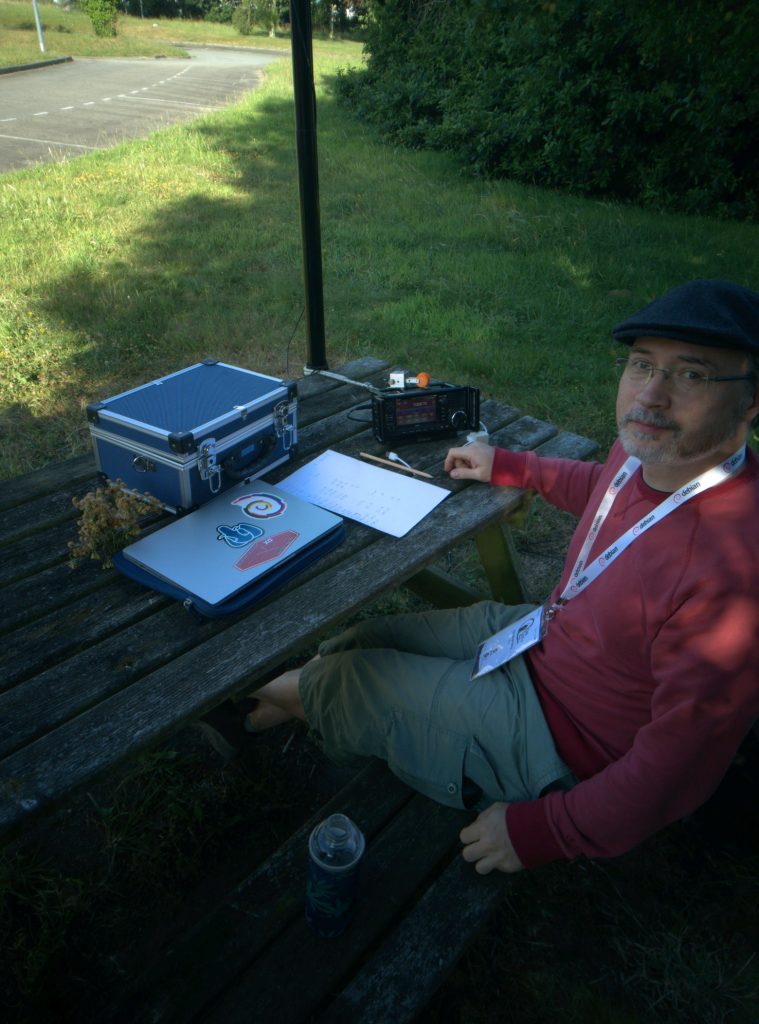 F/DF7CB in Brest (photo: Evangelos Ribeiro Tzaras)
 The northern coast of Ushant (photo: Christoph Berg)
 Having a nice day (photo: Christoph Berg)
 Pollito on stage (photo: Christoph Berg)
 About 90% of my Debian contributions this month were
 Same as the last goarounds, except the premable here is a
 Not just similar identical. The only major difference was the baud rate and
bit structure of the packets, and the only minor difference was the existence
of what I think is a wakeup preamble packet (of all zeros), rather than a
preamble symbol that lasted longer than usual PHY symbol (which makes this
pager system a bit easier to work with than my tree, IMHO).
Getting down to work, I took some measurements to determine what the symbol
duration was over the course of a few packets, I was able to determine the
symbol rate was somewhere around
 Once I got here, I wrote a quick and dirty modulator, and was able to ring up
pagers! Unmitigated success and good news only downside was that it took me
a single night, and not the multi-week adventure I was looking for. Well, let s
finish the job and document what we ve found for the sake of completeness.
 And now let s take a look at the renders as we play with the configuration of
this array and make sure things look right. Our initial quarter-wavelength
spacing is very effective and has some outstanding performance characteristics.
Let s check to see that everything looks right as a first test.
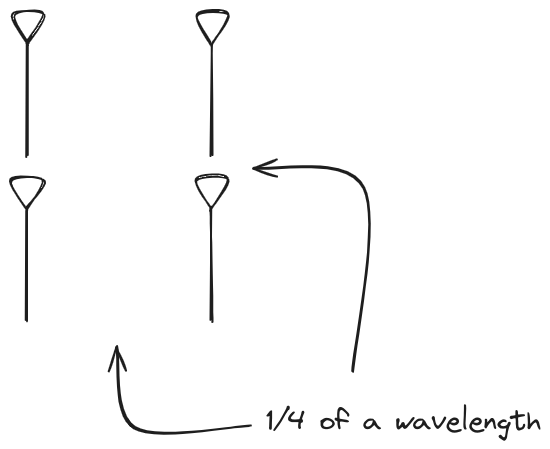 Let s do the same as above and take a look at the renders as we play with the
configuration of this array and see what things look like. This configuration
should suppress the sidelobes and give us good performance, and even give us
some amount of control in elevation while we re at it.