I ve been a Debian user since 1999, and a Debian developer since 2000. Given recent events it s worth thinking about why that that is, and why I haven t switched to something else in the past quarter century.
My first Linux distro was Slackware, off a CD in a book, some time in the mid 90s. After starting university I ran SUSE for a while, then moved to RedHat (both back before they had commercial variants significantly different to what was available freely). The main motivation for switching was package management; I was running a machine at home, and a machine at university. Keeping track of what was installed on each, and what versions, was getting annoying with Slackware. Most of the folk I knew were running RedHat, and I mostly played with SUSE because I m contrary before realising it was different enough that I couldn t easily make use of 3rd party RPMs.
I came to Debian via friends in Cambridge, who spoke highly of it. The first Debian machine I installed was fourier, the initial host for Black Cat Networks, and I never looked back.
(For additional context I should also point out I have contributed, in the distant past, to, and run, OpenWRT, OpenEmbedded, and FreeBSD.)
I d like to try and work out what is it I get from Debian that I d need in anything else. Originally I tried to order the requirements in some sort of priority, but it s sometimes hard to work out what I d drop if I had to compromise somewhere, so it s a somewhat loose ordering.
Stable releases, with security support
I run Linux in lots of places, from remote servers/VMs, to my house router, to my desktop/laptop. Some of those I don t want to be updating regularly with new software releases, I need something I can be sure is going to keep working, but will get necessary security + critical updates. A rolling distro that provides security via the latest upstream release doesn t provide that guarantee. Equally there need to be regular stable releases, or things become too stale. (The one time I considered moving away from Debian was during the 3 year Sarge / 3.1 release cycle. I think if things hadn t improved I d have jumped ship to Ubuntu at the time.)
A good selection of packages
One of the reasons I moved from RedHat to Debian was the wide range of packages available as part of the standard OS. Pulling it all into the distro helps with quality control, compared to random 3rd party packages. A centralised bug system and repository is a win too. Perhaps packages at all is something I should list, but I take it as a given if you re running a distro. I need to know what I have installed on my machine, what version that software is, what files it owns, and what it depends on.
Free Software
This is important to me. I ll make pragmatic compromises about software I run on my systems if it makes sense, but I want to start from a place that does not require anything non-free. I ve run a company on Debian, and I ve worked on numerous products that ran it under the hood. The DFSG give me confidence I can do that.
Smooth upgrades
Debian s ability to upgrade a system smoothly is one of the reasons I first moved to it. The first upgrade I did was remotely on a machine sitting on a 2Mb/s leased line. I was nervous doing the reboot at the end, but it came back fine. At the time the equivalent procedure with RedHat involved rebooting into the OS installer to do the upgrade.
I know things have moved on since then, and really it should all be scripted, and machines should be cattle not pets, but for personal use I run a small enough number of machines that having the upgrade path between releases is a must have.
Community
The original pull of the Debian community was the knowledge I could get involved, and upload packages that were missing that I was using. That s how I first got involved, uploading things Black Cat used, which made life easier for us in the long run. I don t have time to maintain all the software I use myself, and I don t want to be beholden to a commercial entity to do so for me, so a distribution that allows me to help out where I can as part of the community seems to me to be the right way to do things.
Architecture support
Perhaps less important, especially when I started using Debian, but these days I have amd64, arm64, armhf, and riscv machines. Everything except for the risvc box is doing something useful, and would need replaced if I couldn t keep running it, and I expect RISC-V to transition into that state in the next few years as the hardware improves.
Binary packages
I ran a FreeBSD desktop for some time. It might have been the way I was holding it, but binary package installs were generally not something reliable, especially after the initial install, and I ended up building things from ports from source quite often. That worked incredibly well (I used to think people who raved about Gentoo really should just go do it properly and use FreeBSD), but I don t want to spend time compiling things, especially on some of my machines (my router should not need a compiler, for example).
Ultimately I don t want to have to actively think about the Linux distribution I use. Debian has mostly given me that; I know it will generally be suitable for most environments I want to use it in (embedded situations where OpenWRT or OpenEmbedded are better choices being the exception, but that s less frequent these days), and I can rely on getting timely security updates (thanks to all those who work on that within Debian!). I m not sure there s currently an alternative that would suit my needs? I d love to hear if there s something I should look at, even if I m not necessary making a move just yet!
I built my current house server back in 2019. It had an upgrade from the original Ryzen 2700 to a 5700G in late 2021, but otherwise is still running with the original setup. Back in November it developed some erratic behaviour (initially manifesting as problems with the TPM, which is ironic as I ve spent a bunch of time at my day job trying to improve TPM reliability), culminating in unreliable reboots. I had a limited amount of ability to swap parts out, but ultimately decided it was a motherboard issue (thinking perhaps VRM problems), found a replacement locally, and everything seemed fine.
Until May.
At that point I rebooted the machine for a Debian point release, and it failed to come back. Fans would spin, but there was no sign of actual life. I ended up pressing a temporary machine into service (that could at least run the Home Assistant container, and a few other critical bits) while I tried to work out what was wrong. I d kept the previous motherboard, and still had the Ryzen 2700, so I did a bunch of swaps (and obtained a motherboard buzzer to try and get some indication about whether there were useful beep codes being emitted), and ultimately came to the conclusion that the CPU had died.
I m not quite clear what happened here. I played it safe and replaced the PSU at the same time, in case that was the original cause back in November and ultimately damaged the CPU, but both old + new motherboards worked just fine with the 2700.
That left a decision about what to do. This previous server was from 2013, so this machine has now lasted longer than that and I could justifiably upgrade. However when I went to look at what the equivalent modern machine would be it s only a couple of generations later (Zen 5 vs Zen 3), and 64GB RAM alone would have set me back ~ 1k. For not a lot of gain. So I ended up buying a replacement Ryzen 5700G, hopefully allowing me to put off thinking about an upgrade until Zen 6 is out, and RAM prices are saner (though I understand that might take a couple of years).
It s not the first time I ve had a faulty PSU be the cause of a dead machine, but it was a pretty frustrating experience.
I had intended that the next release of onak, my OpenPGP keyserver, would be 0.7.0, and include OpenPGP v6 support (RFC9580). However events conspired to make a 0.6.5 release a really good idea.
Firstly, I threw an LLM at the code base and asked it to review it. This isn t intended to be a post about LLMs, but there s a considerable amount of pressure at work to be AI native . I m very much an AI sceptic, so I figured throwing it at a code base I know well might be an interesting exercise. It did find a bunch of embarrassing mistakes, but I don t think there was anything earth shattering that a human reviewer wouldn t have pulled me on. The problem is with a hobby project with a single user there s no actual review of my work.
I also enabled GitHub s security scanning. It mostly complained about format strings, and those were easy enough to fix up.
Next I threw AFLplusplus at the code. I d previously tried American Fuzzy Lop, but not in some time. AFL++ found a whole bunch of places I should really have checked available buffer lengths and wasn t doing so. It really is an incredibly easy tool to get up and running.
valgrind is also a tool I ve used before, and rate highly. Thankfully it didn t find anything in my testing this time.
Finally I threw a few more automated tests into the mix and discovered something has changed around dynamic linking such that the libonak symbols in the dynamic key database backends were using private copies, rather than the main binary. This caused problems with seeing the correct configuration settings in some instances.
All in all this release is not my proudest moment; a bunch of the issues fixed should never have made it to a release.
(Also, just to explicitly state it, all the actual code in this release was artisanly crafted by me, in vim. The only involvement of an LLM was for a review pass.)
Available locally or via GitHub.
0.6.5 - 27th June 2026
Lots of fixes/improvements around length checking
Added extra basic tests for maxpaths/sixdegrees/CGI
Correctly end transactions in the stacked backend
Ensure the file backend avoids stale key data on updates
Fix decoding of v2/3 signature creation times
Fix EdDSA signature parsing when r < 249 bits long
Fix migration of bools from old to new config style
Fix parsing of new config details for DB parameters
Fix problems with linking + dynamic backends
Fix RSA-SHA2-384 signature checking
Fix sixdegrees parsing of keyids with high bit set
Given we ve entered a new year it s time for my annual recap of my Free Software activities for the previous calendar year. For previous years see 2019, 2020, 2021, 2022, 2023 + 2024.
Conferences
My first conference of the year was FOSDEM. I d submitted a talk proposal about system attestation in production environments for the attestation devroom, but they had a lot of good submissions and mine was a bit more this is how we do it rather than here s some neat Free Software that does it . I m still trying to work out how to make some of the bits we do more open, but the problem is a lot of the neat stuff is about taking internal knowledge about what should be running and making sure that s the case, and what you end up with if you abstract that is a toolkit that still needs a lot of work to get something useful.
I d more luck at DebConf25 where I gave a talk (Don t fear the TPM) trying to explain how TPMs could be useful in a Debian context. Naturally the comments section descended into a discussion about UEFI Secure Boot, which is a separate, if related, thing. DebConf also featured the usual catch up with fellow team members, hanging out with folk I hadn t seen in ages, and generally feeling a bit more invigorated about Debian.
Other conferences I considered, but couldn t justify, were All Systems Go! and the Linux Plumbers Conference. I ve no doubt both would have had a bunch of interesting and relevant talks + discussions, but not enough this year.
I m going to have to miss FOSDEM this year, due to travel later in the month, and I m uncertain if I m going to make DebConf (for a variety of reasons). That means I don t have a Free Software conference planned for 2026. Ironically FOSSY moving away from Portland makes it a less appealing option (I have Portland friends it would be good to visit). Other than potential Debian MiniConfs, anything else European I should consider?
Debian
I continue to try and keep RetroArch in shape, with 1.22.2+dfsg-1 (and, shortly after, 1.22.2+dfsg-2 - git-buildpackage in trixie seems more strict about Build-Depends existing in the outside environment, and I keep forgetting I need Build-Depends-Arch and Build-Depends-Indep to be pretty much the same with a minimal Build-Depends that just has enough for the clean target) getting uploaded in December, and 1.20.0+dfsg-1, 1.20+dfsg-2 + 1.20+dfsg-3 all being uploaded earlier in the year. retroarch-assets had 1.20.0+dfsg-1 uploaded back in April. I need to find some time to get 1.22.0 packaged. libretro-snes9x got updated to 1.63+dfsg-1.
sdcc saw 4.5.0+dfsg-1, 4.5.0+dfsg-2, 4.5.0+dfsg-3 (I love major GCC upgrades) and 4.5.0-dfsg-4 uploads. There s an outstanding bug around a LaTeX error building the manual, but this turns out to be a bug in the 2.5 RC for LyX. Huge credit to Tobias Quathamer for engaging with this, and Pavel Sanda + J rgen Spitzm ller from the LyX upstream for figuring out the issue + a fix.
Pulseview saw 0.4.2-4 uploaded to fix issues with the GCC 15 + CMake upgrades. I should probably chase the sigrok upstream about new releases; I think there are a bunch of devices that have gained support in git without seeing a tagged release yet.
I did an Electronics Team upload for gputils 1.5.2-2 to fix compilation with GCC 15.
While I don t do a lot with storage devices these days if I can help it I still pay a little bit of attention to sg3-utils. That resulted in 1.48-2 and 1.48-3 uploads in 2025.
libcli got a 1.10.7-3 upload to deal with the libcrypt-dev split out.
Finally I got more up-to-date versions of libtorrent (0.15.7-1) and rtorrent (also 0.15.7-1) uploaded to experimental. There s a ppc64el build failure in libtorrent, but having asked on debian-powerpc this looks like a flaky test/code and I should probably go ahead and upload to unstable.
I sponsored some uploads for Michel Lind - the initial uploads of plymouth-theme-hot-dog, and the separated out pykdumpfile package.
Recognising the fact I wasn t contributing in a useful fashion to the Data Protection Team I set about trying to resign in an orderly fashion - see Andreas call for volunteers that went out in the last week. Shout out to Enrico for pointing out in the past that we should gracefully step down from things we re not actually managing to do, to avoid the perception it s all fine and no one else needs to step up. Took me too long to act on it.
The Debian keyring team continues to operate smoothly, maintaining our monthly release cadence with a 3 month rotation ensuring all team members stay familiar with the process, and ensure their setups are still operational (especially important after Debian releases). I handled the 2025.03.23, 2025.06.24, 2025.06.27, 2025.09.18, 2025.12.08 + 2025.12.26 pushes.
Linux
TPM related fixes were the theme of my kernel contributions in 2025, all within a work context. Somewerejust cleanups, but severalfixedrealissues that were causing us issues. I ve also tried to be more proactive about reviewing diffs in the TPM subsystem; it feels like a useful way to contribute, as well as making me more actively pay attention to what s going on there.
Personal projects
I did some work on onak, my OpenPGP keyserver. That resulted in a 0.6.4 release, mainly driven by fixes for building with more recent CMake + GCC versions in Debian. I ve got a set of changes that should add RFC9580 (v6) support, but there s not a lot of test keys out there at present for making sure I m handling things properly. Equally there s a plan to remove Berkeley DB from Debian, which I m completely down with, but that means I need a new primary backend. I ve got a draft of LMDB support to replace that, but I need to go back and confirm I ve got all the important bits implemented before publishing it and committing to a DB layout. I d also like to add sqlite support as an option, but that needs some thought about trying to take proper advantage of its features, rather than just treating it as a key-value store.
(I know everyone likes to hate on OpenPGP these days, but I continue to be interested by the whole web-of-trust piece of it, which nothing else I m aware of offers.)
That about wraps up 2025. Nothing particularly earth shaking in there, more a case of continuing to tread water on the various things I m involved. I highly doubt 2026 will be much different, but I think that s ok. I scratch my own itches, and if that helps out other folk too then that s lovely, but not the primary goal.
I bought a NanoKVM. I d heard some of the stories about how terrible it was beforehand, and some I didn t learn about until afterwards, but at 52, including VAT + P&P, that seemed like an excellent bargain for something I was planning to use in my home network environment.
Let s cover the bad press first. apalrd did a video, entitled NanoKVM: The S stands for Security (Armen Barsegyan has a write up recommending a PiKVM instead that lists the objections raised in the video). Matej Kova i wrote an article about the hidden microphone on a Chinese NanoKVM. Various other places have picked up both of these and still seem to be running with them, 10 months later.
Next, let me explain where I m coming from here. I have over 2 decades of experience with terrible out-of-band access devices. I still wince when I think of the Sun Opteron servers that shipped with an iLOM that needed a 32-bit Windows browser in order to access it (IIRC some 32 bit binary JNI blob). It was a 64 bit x86 server from a company who, at the time, still had a major non-Windows OS. Sheesh. I do not assume these devices are fit for exposure to the public internet, even if they come from reputable vendors. Add into that the fact the NanoKVM is very much based on a development board (the LicheeRV Nano), and I felt I knew what I was getting into here.
And, as a TL;DR, I am perfectly happy with my purchase. Sipeed have actually dealt with a bunch of apalrd s concerns (GitHub ticket), which I consider to be an impressive level of support for this price point. Equally the microphone is explained by the fact this is a 52 device based on a development board. You re giving it USB + HDMI access to a host on your network, if you re worried about the microphone then you re concentrating on the wrong bit here.
I started out by hooking the NanoKVM up to my Raspberry Pi classic, which I use as a serial console / network boot tool for working on random bits of hardware. That meant the NanoKVM had no access to the outside world (the Pi is not configured to route, or NAT, for the test network interface), and I could observe what went on. As it happens you can do an SSH port forward of port 80 with this sort of setup and it all works fine - no need for the NanoKVM to have any external access, and it copes happily with being accessed as http://localhost:8000/ (though you do need to choose MJPEG as the video mode, more forwarding or enabling HTTPS is needed for an H.264 WebRTC session).
IPv6 is enabled in the kernel. My test setup doesn t have a router advertisements configured, but I could connect to the web application over the v6 link-local address that came up automatically.
My device reports:
Image version:              v1.4.1
Application version:        2.2.9
That s recent, but the GitHub releases page has 2.3.0 listed as more recent.
Out of the box it s listening on TCP port 80. SSH is not running, but there s a toggle to turn it on and the web interface offers a web based shell (with no extra authentication over the normal login). On first use I was asked to set a username + password. Default access, as you d expect from port 80, is HTTP, but there s a toggle to enable HTTPS. It generates a self signed certificate - for me it had the CN localhost but that might have been due to my use of port forwarding. Enabling HTTPS does not disable HTTP, but HTTP just redirects to the HTTPS URL.
As others have discussed it does a bunch of DNS lookups, primarily for NTP servers but also for cdn.sipeed.com. The DNS servers are hard coded:
This is actually restored on boot from /boot/resolv.conf, so if you want changes to persist you can just edit that file. NTP is configured with a standard set of pool.ntp.org services in /etc/ntp.conf (this does not get restored on reboot, so can just be edited in place). I had dnsmasq on the Pi setup to hand out DNS + NTP servers, but both were ignored (though actually udhcpc does write the DNS details to /etc/resolv.conf.dhcp).
My assumption is the lookup to cdn.sipeed.com is for firmware updates (as I bought the NanoKVM cube it came fully installed, so no need for a .so download to make things work); when working DNS was provided I witness attempts to connect to HTTPS. I ve not bothered digging further into this. I did go grab the latest.zip being served from the URL, which turned out to be v2.2.9, matching what I have installed, not the latest on GitHub.
I note there s an iptables setup (with nftables underneath) that s not fully realised - it seems to be trying to allow inbound HTTP + WebRTC, as well as outbound SSH, but everything is default accept so none of it gets hit. Setting up a default deny outbound and tweaking a little should provide a bit more reassurance it s not going to try and connect out somewhere it shouldn t.
It looks like updates focus solely on the KVM application, so I wanted to take a look at the underlying OS. This is buildroot based:
The kernel reports itself as 5.10.4-tag-. Somewhat ancient, but actually an LTS kernel. Except we re now up to 5.10.247, so it obviously hasn t been updated in some time.
TBH, this is what I expect (and fear) from embedded devices. They end up with some ancient base OS revision and a kernel with a bunch of hacks that mean it s not easily updated. I get that the margins on this stuff are tiny, but I do wish folk would spend more time upstreaming. Or at least updating to the latest LTS point release for their kernel.
The SSH client/daemon is full-fat OpenSSH:
~ # sshd -V
OpenSSH_9.6p1, OpenSSL 3.1.4 24 Oct 2023
There are a number of CVEs fixed in later OpenSSL 3.1 versions, though at present nothing that looks too concerning from the server side. Yes, the image has tcpdump + aircrack installed. I m a little surprised at aircrack (the device has no WiFi and even though I know there s a variant that does, it s not a standard debug tool the way tcpdump is), but there s a copy of GNU Chess in there too, so it s obvious this is just a kitchen-sink image. FWIW it looks like the buildroot config is here.
Sadly the UART that I believe the bootloader/kernel are talking to is not exposed externally - the UART pin headers are for UART1 + 2, and I d have to open up the device to get to UART0. I ve not yet done this (but doing so would also allow access to the SD card, which would make trying to compile + test my own kernel easier).
In terms of actual functionality it did what I d expect. 1080p HDMI capture was fine. I d have gone for a lower resolution, but I think that would have required tweaking on the client side. It looks like the 2.3.0 release allows EDID tweaking, so I might have to investigate that. The keyboard defaults to a US layout, which caused some problems with the symbol until I reconfigured the target machine not to expect a GB layout.
There s also the potential to share out images via USB. I copied a Debian trixie netinst image to /data on the NanoKVM and was able to select it in the web interface and have it appear on the target machine easily. There s also the option to fetch direct from a URL in the web interface, but I was still testing without routable network access, so didn t try that. There s plenty of room for images:
The NanoKVM also appears as an RNDIS USB network device, with udhcpd running on the interface. IP forwarding is not enabled, and there s no masquerading rules setup, so this doesn t give the target host access to the management LAN by default. I guess it could be useful for copying things over to the target host, as a more flexible approach than a virtual disk image.
One thing to note is this makes for a bunch of devices over the composite USB interface. There are 3 HID devices (keyboard, absolute mouse, relative mouse), the RNDIS interface, and the USB mass storage. I had a few occasions where the keyboard input got stuck after I d been playing about with big data copies over the network and using the USB mass storage emulation. There is a HID-only mode (no network/mass storage) to try and help with this, and a restart of the NanoKVM generally brought things back, but something to watch out for. Again I see that the 2.3.0 application update mentions resetting the USB hardware on a HID reset, which might well help.
As I stated at the start, I m happy with this purchase. Would I leave it exposed to the internet without suitable firewalling? No, but then I wouldn t do so for any KVM. I wanted a lightweight KVM suitable for use in my home network, something unlikely to see heavy use but that would save me hooking up an actual monitor + keyboard when things were misbehaving. So far everything I ve seen says I ve got my money s worth from it.
21 years ago today I wrote my first blog post. Did I think I d still be writing all this time later? I ve no idea to be honest. I ve always had the impression my readership is small, and people who mostly know me in some manner, and I post to let them know what I m up to in more detail than snippets of IRC conversation can capture. Or I write to make notes for myself (I frequently refer back to things I ve documented here). I write less about my personal life than I used to, but I still occasionally feel the need to mark some event.
From a software PoV I started out with Blosxom, migrated to MovableType in 2008, ditched that, when the Open Source variant disappeared, for Jekyll in 2015 (when I also started putting it all in git). And have stuck there since. The static generator format works well for me, and I outsource comments to Disqus - I don t get a lot, I can t be bothered with the effort of trying to protect against spammers, and folk who don t want to use it can easily email or poke me on the Fediverse. If I ever feel the need to move from Jekyll I ll probably take a look at Hugo, but thankfully at present there s no push factor to switch.
It s interesting to look at my writing patterns over time. I obviously started keen, and peaked with 81 posts in 2006 (I ve no idea how on earth that happened), while 2013 had only 2. Generally I write less when I m busy, or stressed, or unhappy, so it s kinda interesting to see how that lines up with various life events.
During that period I ve lived in 10 different places (well, 10 different houses/flats, I think it s only 6 different towns/cities), on 2 different continents, working at 6 different employers, as well as a period where I was doing my Masters in law. I ve travelled around the world, made new friends, lost contact with folk, started a family. In short, I have lived, even if lots of it hasn t made it to these pages.
At this point, do I see myself stopping? No, not really. I plan to still be around, like Flameeyes, to the end. Even if my posts are unlikely to hit the frequency from back when I started out.
A bit delayed in terms of an announcement, but last month I tagged a new version of onak, my OpenPGP compatible keyserver. It s been 2 years since the last release, and this is largely a bunch of minor fixes to make compilation under Debian trixie with more recent CMake + GCC versions happy.
OpenPGP v6 support, RFC9580, hasn t made it. I ve got a branch which adds it, but a lack of keys to do any proper testing with, and no X448 support implemented, mean I m not ready to include it in a release yet. The plan is that ll land for 0.7.0 (along with some backend work), but no idea when that might be.
Available locally or via GitHub.
That starts us listening for connections from Home Assistant on port 10700, uses the openWakeWord instance on localhost port 10400, uses aplay/arecord to talk to the local microphone and speaker, and gives us some debug output so we can see what s going on.
And it turns out we need the debug. This setup is a bit too flaky for it to have ended up in regular use in our household. I ve had some problems with reliable audio setup; you ll note the Python is calling out to other tooling to grab audio, which feels a bit clunky to me and I don t think is the actual problem, but the main audio for this host is hooked up to the TV (it s a media box), so the setup for the voice assistant needs to be entirely separate. That means not plugging into Pipewire or similar, and instead giving direct access to wyoming-satellite. And sometimes having to deal with how to make the mixer happy + non-muted manually.
I ve also had some issues with the USB microphone + speaker; I suspect a powered USB hub would help, and that s on my list to try out.
When it does work I have sometimes found it necessary to speak more slowly, or enunciate my words more clearly. That s probably something I could improve by switching from the base.en to small.en whisper.cpp model, but I m waiting until I sort out the audio hardware issue before poking more.
Finally, the wake word detection is a little bit sensitive sometimes, as I mentioned in the previous post. To be honest I think it s possible to deal with that, if I got the rest of the pieces working smoothly.
This has ended up sounding like a more negative post than I meant it to. Part of the issue in a resolution is finding enough free time to poke things (especially as it involves taking over the living room and saying Hey Jarvis a lot), part of it is no doubt my desire to actually hook up the pieces myself and understand what s going on. Stay tuned and see if I ever manage to resolve it all!
People keep asking me when I ll write the next instalment of my local voice assistant journey. I didn t mean for it to be so long since the last one, things have been busier than I d like. Anyway. Last time we d built Tensorflow, so now it s time to sort out openWakeWord. As a reminder we re trying to put a local voice satellite on my living room Debian media machine.
The point of openWakeWord is to run on the machine the microphone is connected to, listening for the wake phrase ( Hey Jarvis in my case), and only then calling back to the central server to do a speech to text operation. It s wrapped up for Wyoming as wyoming-openwakeword.
Of course I ve packaged it up - available at https://salsa.debian.org/noodles/wyoming-openwakeword. Trixie only released yesterday, so I m still running all of this on bookworm. That means you need python3-wyoming from Trixie - 1.6.0-1 will install fine without needing rebuilt - and the python3-tflite-runtime we built last time.
Like the other pieces I m not sure about how this could land in Debian; it s unclear to me that the pre-trained models provided would be accepted in main.
As usual I start it with with a systemd unit file dropped in /etc/systemd/service/wyoming-openwakeword.service:
I m still playing with the threshold level. It defaults to 0.5, but the device lives under the TV and seems to get a bit confused by it sometimes. There s some talk about using speex for noise suppression, but I haven t explored that yet (it s yet another Python module to bind to the C libraries I d have to look at).
This is a short one; next post is actually building the local satellite on top to tie everything together.
It's Sunday and I'm now sitting in the train from Brest to Paris where I will be changing to Germany, on the way back from the annual Debian conference. A full week of presentations, discussions, talks and socializing is laying behind me and my head is still spinning from the intensity.
Pollito and the gang of DebConf mascots wearing their conference badges (photo: Christoph Berg)
Table of Contents
Sunday, July 13th
It started last Sunday with traveling to the conference. I got on the Eurostar in Duisburg and we left on time, but even before reaching Cologne, the train was already one hour delayed for external reasons, collecting yet another hour between Aachen and Liege for its own technical problems. "The train driver is working on trying to fix the problem." My original schedule had well over two hours for changing train stations in Paris, but being that late, I missed the connection to Brest in Montparnasse. At least in the end, the total delay was only one hour when finally arriving at the destination. Due to the French julliet quatorze fireworks approaching, buses in Brest were rerouted, but I managed to catch the right bus to the conference venue, already meeting a few Debian people on the way.
The conference was hosted at the IMT Atlantique Brest campus, giving the event a nice university touch. I arrived shortly after 10 in the evening and after settling down a bit, got on one of the "magic" buses for transportation to the camping site where half of the attendees where stationed. I shared a mobile home with three other Debianites, where I got a small room for myself.
Monday, July 14th
Next morning, we took the bus back to the venue with a small breakfast and the opening session where Enrico Zini invited me to come to his and Nicolas Dandrimont's session about Debian community governance and curation, which I gladly did. Many ideas about conflict moderation and community steering were floated around. I hope some of that can be put into effect to make flamewars on the mailing lists less heated and more directed. After that, I attended Olly Betts' "Stemming with Snowball" session, which is the stemmer used also in PostgreSQL. Text search is one of the areas in PostgreSQL that I never really looked closely at, including the integration into the postgresql-common package, so it was nice to get more information about that.
In preparation for the conference, a few of us Ham radio operators in Debian had decided to bring some radio gear to DebConf this year in order to perhaps spark more interest for our hobby among the fellow geeks. In the afternoon after the talks, I found a quieter spot just outside of the main hall and set up a shortwave antenna by attaching a 10m mast to one of the park benches there. The 40m band was still pretty much closed, but I could work a few stations from England, just across the channel from Bretagne, answering questions from interested passing-by Debian people between the contacts. Over time, the band opened and more European stations got into the log.
F/DF7CB in Brest (photo: Evangelos Ribeiro Tzaras)
Tuesday, July 15th
Tuesday started with Helmut Grohne's session about "Reviving (un)schroot". The schroot program has been Debian's standard way of managing build chroots for a long time, but it is more and more being regarded as obsolete with all kinds of newer containerization and virtualization technologies taking over. Since many bits of Debian infrastructure depend on schroot, and its user interface is still very useful, Helmut reimplemented it using Linux namespaces and the "unshare" systemcall. I had already worked with him at the Hamburg Minidebconf to replace the apt.postgresql.org buildd machinery with the new system, but we were not quite there yet (network isolation is nice, but we still sometimes need proper networking), so it was nice to see the effort is still progressing and I will give his new scripts a try when I'm back home.
Next, Stefano Rivera and Colin Watson presented Debusine, a new package repository and workflow management system. It looks very promising for anyone running their own repository, so perhaps yet another bit of apt.postgresql.org infrastructure to replace in the future. After that, I went to the Debian LTS BoF session by Santiago Ruano Rinc n and Bastien Roucari s - Debian releases plus LTS is what we are covering with apt.postgresql.org. Then there were bits from the DPL (Debian Project Leader), and a session moderated by Stefano Rivera interesting to me as a member of the Debian Technical Committee on the future structure of the packages required for cross-building in Debian, a topic which had been brought to TC a while ago. I am happy that we could resolve the issue without having to issue a formal TC ruling as the involved parties (kernel, glibc, gcc and the cross-build people) found a promising way forward themselves. DebConf is really a good way to get such issues unstuck.
Ten years ago at the 2015 Heidelberg DebConf, Enrico had given a seminal "Semi-serious stand-up comedy" talk, drawing parallels between the Debian Open Source community and the BDSM community - "People doing things consensually together". (Back then, the talk was announced as "probably unsuitable for people of all ages".) With his unique presentation style and witty insights, the session made a lasting impression on everyone attending. Now, ten years later (and he and many in the audience being ten years older), he gave an updated version of it. We are now looking forward to the sequel in 2035. The evening closed with the famous DebConf tradition of the Cheese & Wine party in a old fort next to the coast, just below the conference venue. Even when he's a fellow Debian Developer, Ham and also TC member, I had never met Paul Tagliamonte in person before, but we spent most of the evening together geeking out on all things Debian and Ham radio.
The northern coast of Ushant (photo: Christoph Berg)
Wednesday, July 16th
Wednesday already marked the end of the first half of the week, the day of the day trips. I had chosen to go to Ouessant island (Ushant in English) which marks the Western end of French mainland and hosts one of the lighthouses yielding the way into the English channel. The ferry trip included surprisingly big waves which left some participants seasick, but everyone recovered fast. After around one and a half hours we arrived, picked up the bicycles, and spent the rest of the day roaming the island. The weather forecast was originally very cloudy and 18 C, but over noon this turned into sunny and warm, so many got an unplanned sunburn. I enjoyed the trip very much - it made up for not having time visiting the city during the week. After returning, we spent the rest of the evening playing DebConf's standard game, Mao (spoiler alert: don't follow the link if you ever intend to play).
Having a nice day (photo: Christoph Berg)
Thursday, July 17th
The next day started with the traditional "Meet the Technical Committee" session. This year, we trimmed the usual slide deck down to remove the boring boilerplate parts, so after a very short introduction to the work of the committee by our chairman Matthew Vernon, we opened up the discussion with the audience, with seven (out of 8) TC members on stage. I think the format worked very well, with good input from attendees. Next up was "Don't fear the TPM" by Jonathan McDowell. A common misconception in the Free Software community is that the TPM is evil DRM hardware working against the user, but while it could be used in theory that way, the necessary TPM attestations seem to impossible to attain in practice, so that wouldn't happen anyway. Instead, it is a crypto coprocessor present in almost all modern computers that can be used to hold keys, for example to be used for SSH. It will also be interesting to research if we can make use of it for holding the Transparent Data Encryption keys for CYBERTEC's PostgreSQL Enterprise Edition.
Aigars Mahinovs then directed everyone in place for the DebConf group picture, and Lucas Nussbaum started a discussion about archive-wide QA tasks in Debian, an area where I did a lot of work in the past and that still interests me. Antonio Terceiro and Paul Gevers followed up with techniques to track archive-wide rebuilding and testing of packages and in turn filing a lot of bugs to track the problems. The evening ended with the conference dinner, again in the fort close by the coast. DebConf is good for meeting new people, and I incidentally ran into another Chris, who happened to be one of the original maintainers of pgaccess, the pre-predecessor of today's pgadmin. I admit still missing this PostgreSQL frontend for its simplicity and ability to easily edit table data, but it disappeared around 2004.
Friday, July 18th
On Friday, I participated in discussion sessions around contributors.debian.org (PostgreSQL is planning to set up something similar) and the New Member process which I had helped to run and reform a decade or two ago. Agathe Porte (also a Ham radio operator, like so many others at the conference I had no idea of) then shared her work on rust-rewriting the slower parts of Lintian, the Debian package linter. Craig Small talked about "Free as in Bytes", the evolution of the Linux procps free command. Over the time and many kernel versions, the summary numbers printed became better and better, but there will probably never be a version that suits all use cases alike. Later over dinner, Craig (who is also a TC member) and I shared our experiences with these numbers and customers (not) understanding them. He pointed out that for PostgreSQL and looking at used memory in the presence of large shared memory buffers, USS (unique set size) and PSS (proportional set size) should be more realistic numbers than the standard RSS (resident set size) that the top utility is showing by default.
Antonio Terceiro and Paul Gevers again joined to lead a session, now on ci.debian.net and autopkgtest, the test driver used for running tests on packages after then have been installed on a system. The PostgreSQL packages are heavily using this to make sure no regressions creep in even after builds have successfully completed and test re-runs are rescheduled periodically. The day ended with Bdale Garbee's electronics team BoF and Paul Tagliamonte and me setting up the radio station in the courtyard, again answering countless questions about ionospheric conditions and operating practice.
Saturday, July 19th
Saturday was the last conference day. In the first session, Nikos Tsipinakis and Federico Vaga from CERN announced that the LHC will be moving to Debian for the accelerator's frontend computers in their next "long shutdown" maintenance period in the next year. CentOS broke compatibility too often, and Debian trixie together with the extended LTS support will cover the time until the next long shutdown window in 2035, until when the computers should have all been replaced with newer processors covering higher x86_64 baseline versions. The audience was very delighted to hear that Debian is now also being used in this prestige project.
Ben Hutchings then presented new Linux kernel features. Particularly interesting for me was the support for atomic writes spanning more than one filesystem block. When configured correctly, this would mean PostgreSQL didn't have to record full-page images in the WAL anymore, increasing throughput and performance. After that, the Debian ftp team discussed ways to improve review of new packages in the archive, and which of their processes could be relaxed with new US laws around Open Source and cryptography algorithms export. Emmanuel Arias led a session on Salsa CI, Debian's Gitlab instance and standard CI pipeline. (I think it's too slow, but the runners are not under their control.) Julian Klode then presented new features in APT, Debian's package manager. I like the new display format (and a tiny bit of that is also from me sending in wishlist bugs).
In the last round of sessions this week, I then led the Ham radio BoF with an introduction into the hobby and how Debian can be used. Bdale mentioned that the sBitx family of SDR radios is natively running Debian, so stock packages can be used from the radio's touch display. We also briefly discussed his involvement in ARDC and the possibility to get grants from them for Ham radio projects. Finally, DebConf wrapped up with everyone gathering in the main auditorium and cheering the organizers for making the conference possible and passing Pollito, the DebConf mascot, to the next organizer team.
Pollito on stage (photo: Christoph Berg)
Sunday, July 20th
Zoom back to the train: I made it through the Paris metro and I'm now on the Eurostar back to Germany. It has been an intense week with all the conference sessions and meeting all the people I had not seen so long. There are a lot of new ideas to follow up on both for my Debian and PostgreSQL work. Next year's DebConf will take place in Santa Fe, Argentina. I haven't yet decided if I will be going, but I can recommend the experience to everyone!
The post The Debian Conference 2025 in Brest appeared first on CYBERTEC PostgreSQL Services & Support.
To build our local voice satellite on a Debian system rather than using the ATOM Echo device we need something that can handle the wake word component; the piece that means we only send audio to the Home Assistant server for processing by whisper.cpp when we ve detected someone is trying to talk to us.
openWakeWord seems to be one of the better ways to do this, and is well supported. However. It relies on TensorFlow Lite (now LiteRT) which is a complicated mess of machine learning code. tflite-runtime is available from PyPI, but that s prebuilt and we re trying to avoid that.
Despite, on initial impressions, it looking quite complicated to deal with building TensorFlow - Bazel is an immediate warning - it turns out to be incredibly simple to build your own .deb:
This is hiding an awful lot of complexity, however. In particular the number of 3rd party projects that are being downloaded in the background (and compiled, to be fair, rather than using binary artefacts).
We can build the main C++ wrapper .so directly with cmake, allowing us to investigate a bit more:
Looking at the output we can see that pthreadpool, FXdiv, FP16 + PSimd are all downloaded, and seem to have ways to point to a local copy. That seems positive.
However, there are even more hidden dependencies, which we can see if we look in the _deps/ subdirectory of the build tree. These don t appear to be as easy to override, and not all of them have packages already in Debian.
First, the ones that seem to be available:
abseil-cpp,
cpuinfo,
eigen,
farmhash,
flatbuffers,
gemmlowp,
ruy +
xnnpack
(lots of credit to the Debian Deep Learning Team for these, and in particular Mo Zhou)
Dependencies I couldn t see existing packages for are: OouraFFT, ml_dtypes & neon2sse.
At this point I just used the package I built with the initial steps above. I live in hope someone will eventually package this properly for Debian, or that I ll find the time to try and help out, but that s not going to be today.
I wish upstream developers made it easier to use system copies of their library dependencies. I wish library developers made it easier to build and install system copies of their work. pkgconf is not new tech these days (pkg-config appears to date back to 2000), and has decent support in CMake. I get that there can be issues with incompatibilities even in minor releases, or awkwardness in doing builds of multiple connected projects, but at least give me the option to do so.
Having setup an ATOM Echo Voice Satellite and hooked it up to Home Assistant we now need to actually do something with the captured audio. Home Assistant largely deals with voice assistants using the Wyoming Protocol, which describes itself as essentially JSONL + PCM audio. It works nicely in terms of meaning everything can exist as separate modules that then just communicate over network sockets, and there are a whole bunch of Python implementations of the pieces necessary.
The first bit I looked at was speech to text; how do I get what I say to the voice satellite into something that Home Assistant can try and parse? There is a nice self contained speech recognition tool called whisper.cpp, which is a low dependency implementation of inference using OpenAI s Whisper model. This is wrapped up for Wyoming as part of wyoming-whisper-cpp. Here we get into something that unfortunately seems common in this space; the repo contains a forked copy of whisper.cpp with enough differences that I couldn t trivially make it work with regular whisper.cpp. That means missing out on new development, and potential improvements (the fork appears to be at v1.5.4, upstream is up to v1.7.5 at the time of writing). However it was possible to get up and running easily enough.
[I note there is a Wyoming Whisper API client that can use the whisper.cpp server, and that might be a cleaner way to go in the future, especially if whisper.cpp ends up in Debian.]
I stated previously I wanted all of this to be as clean an installed on Debian stable as possible. Given most of this isn t packaged, that s meant I ve packaged things up as I go. I m not at the stage anything is suitable for upload to Debian proper, but equally I ve tried to make them a reasonable starting point. No pre-built binaries available, just Salsa git repos. https://salsa.debian.org/noodles/wyoming-whisper-cpp in this case. You need python3-wyoming from trixie if you re building for bookworm, but it doesn t need rebuilt.
You need a Whisper model that s been converts to ggml format; they can be found on Hugging Face. I ve ended up using the base.en model. I found small.en gave more accurate results, but took a little longer, when doing random testing, but it doesn t seem to make much of a difference for voice control rather than plain transcribing.
[One of the open questions about uploading this to Debian is around the use of a prebuilt AI model. I don t know what the right answer is here, and whether the voice infrastructure could ever be part of Debian proper, but the current discussion on the interpretation of the DFSG on AI models is very relevant.]
I run this in the same container as my Home Assistant install, using a systemd unit file dropped in /etc/systemd/system/wyoming-whisper-cpp.service:
It needs the Wyoming Protocol integration enabled in Home Assistant; you can Add Entry and enter localhost + 10030 for host + port and it ll get added. Then in the Voice Assistant configuration there ll be a whisper.cpp option available.
Text to speech turns out to be weirdly harder. The right answer is something like Wyoming Piper, but that turns out to be hard on bookworm. I ll come back to that in a future post. For now I took the easy option and used the built in Google Translate option in Home Assistant. That needed an extra stanza in configuration.yaml that wasn t entirely obvious:
media_source:
With this, and the ATOM voice satellite, I could now do basic voice control of my Home Assistant setup, with everything except the text-to-speech piece happening locally! Things such as Hey Jarvis, turn on the study light work out of the box. I haven t yet got into defining my own phrases, partly because I know some of the things I want ( What time is it? ) are already added in later Home Assistant versions than the one I m running.
Overall I found this initially complicated to setup given my self-imposed constraints about actually understanding the building blocks and compiling them myself, but I ve been pretty impressed with the work that s gone into it all. Next step, running a voice satellite on a Debian box.
Back when I setup my home automation I ended up with one piece that used an external service: Amazon Alexa. I d rather not have done this, but voice control is extremely convenient, both for us, and guests. Since then Home Assistant has done a lot of work in developing the capability of a local voice assistant - 2023 was their Year of Voice. I ve had brief looks at this in the past, but never quite had the time to dig into setting it up, and was put off by the fact a lot of the setup instructions were just Download our prebuilt components . While I admire the efforts to get Home Assistant fully packaged for Debian I accept that s a tricky proposition, and settle for running it in a venv on a Debian stable container. Voice requires a lot more binary components, and I want to have voice satellites in more than one location, so I set about trying to understand a bit better what I was deploying, and actually building the binary bits myself.
This is the start of a write-up of that. I ll break it into a bunch of posts, trying to cover one bit in each, because otherwise this will get massive. Let s start with some requirements:
All local processing; no call-outs to external services
Ability to have multiple voice satellites in the house
A desire to do wake word detection on the satellites, to avoid lots of network audio traffic all the time
As clean an install on a Debian stable based system as possible
Binaries built locally
No need for a GPU
My house server is an AMD Ryzen 7 5700G, so my expectation was that I d have enough local processing power to be able to do this. That turned out to be a valid assumption - speech to text really has come a long way in recent years. I m still running Home Assistant 2024.3.3 - the last one that supports (but complains about) Python 3.11. Trixie has started the freeze process, so once it releases I ll look at updating the HA install. For now what I have has turned out to be Good Enough, but I know there have been improvements upstream I m missing.
Finally, before I get into the details, I should point out that if you just want to get started with a voice assistant on Home Assistant and don t care about what s under the hood, there are a bunch of more user friendly details on Home Assistant s site itself, and they have pre-built images you can just deploy.
My first step was sorting out a voice satellite . This is the device that actually has a microphone and speaker and communicates with the main Home Assistant setup. I d seen the post about a $13 voice assistant, and as a result had an ATOM Echo sitting on my desk I hadn t got around to setting up.
Here, we ignore a bit about delving into exactly what s going on under the hood, even if we re compiling locally. This is a constrained embedded device and while I m familiar with the ESP32 IDF build system I just accepted that using ESPHome and letting it do it s thing was the quickest way to get up and running. It is possible to do this all via the web with a pre-built image, but I wanted to change the wake word to Hey Jarvis rather than the default Okay Nabu , and that was a good reason to bother doing a local build. We ll get into actually building a voice satellite on Debian in later posts.
I started with the default upstream assistant config and tweaked it a little for my setup:
diff of my configuration tweaks
(I note that the current upstream config has moved on a bit since I first did this, but I double checked the above instructions still work at the time of writing. I end up pinning ESPHome to the right version below due to that.)
It turns out to be fairly easy to setup ESPHome in a venv and get it to build + flash the image for you:
Instructions for building + flashing ESPHome to ATOM Echo
noodles@sevai:~$ python3 -m venv esphome-atom-echo
noodles@sevai:~$ . esphome-atom-echo/bin/activate
(esphome-atom-echo) noodles@sevai:~$ cd esphome-atom-echo/
(esphome-atom-echo) noodles@sevai:~/esphome-atom-echo$  pip install esphome==2024.12.4
Collecting esphome==2024.12.4
  Using cached esphome-2024.12.4-py3-none-any.whl (4.1 MB)

Successfully installed FontTools-4.57.0 PyYAML-6.0.2 appdirs-1.4.4 attrs-25.3.0 bottle-0.13.2 defcon-0.12.1 esphome-2024.12.4 esphome-dashboard-20241217.1 freetype-py-2.5.1 fs-2.4.16 gflanguages-0.7.3 glyphsLib-6.10.1 glyphsets-1.0.0 openstep-plist-0.5.0 pillow-10.4.0 platformio-6.1.16 protobuf-3.20.3 puremagic-1.27 ufoLib2-0.17.1 unicodedata2-16.0.0
(esphome-atom-echo) noodles@sevai:~/esphome-atom-echo$ esphome compile assistant.yaml
INFO ESPHome 2024.12.4
INFO Reading configuration assistant.yaml...
INFO Updating https://github.com/esphome/esphome.git@pull/5230/head
INFO Updating https://github.com/jesserockz/esphome-components.git@None

Linking .pioenvs/study-atom-echo/firmware.elf
/home/noodles/.platformio/packages/toolchain-xtensa-esp32@8.4.0+2021r2-patch5/bin/../lib/gcc/xtensa-esp32-elf/8.4.0/../../../../xtensa-esp32-elf/bin/ld: missing --end-group; added as last command line option
RAM:   [=         ]  10.6% (used 34632 bytes from 327680 bytes)
Flash: [========  ]  79.8% (used 1463813 bytes from 1835008 bytes)
Building .pioenvs/study-atom-echo/firmware.bin
Creating esp32 image...
Successfully created esp32 image.
esp32_create_combined_bin([".pioenvs/study-atom-echo/firmware.bin"], [".pioenvs/study-atom-echo/firmware.elf"])
Wrote 0x176fb0 bytes to file /home/noodles/esphome-atom-echo/.esphome/build/study-atom-echo/.pioenvs/study-atom-echo/firmware.factory.bin, ready to flash to offset 0x0
esp32_copy_ota_bin([".pioenvs/study-atom-echo/firmware.bin"], [".pioenvs/study-atom-echo/firmware.elf"])
==================================================================================== [SUCCESS] Took 130.57 seconds ====================================================================================
INFO Successfully compiled program.
(esphome-atom-echo) noodles@sevai:~/esphome-atom-echo$ esphome upload --device /dev/serial/by-id/usb-Hades2001_M5stack_9552AF8367-if00-port0 assistant.yaml
INFO ESPHome 2024.12.4
INFO Reading configuration assistant.yaml...
INFO Updating https://github.com/esphome/esphome.git@pull/5230/head
INFO Updating https://github.com/jesserockz/esphome-components.git@None

INFO Upload with baud rate 460800 failed. Trying again with baud rate 115200.
esptool.py v4.7.0
Serial port /dev/serial/by-id/usb-Hades2001_M5stack_9552AF8367-if00-port0
Connecting....
Chip is ESP32-PICO-D4 (revision v1.1)
Features: WiFi, BT, Dual Core, 240MHz, Embedded Flash, VRef calibration in efuse, Coding Scheme None
Crystal is 40MHz
MAC: 64:b7:08:8a:1b:c0
Uploading stub...
Running stub...
Stub running...
Configuring flash size...
Auto-detected Flash size: 4MB
Flash will be erased from 0x00010000 to 0x00176fff...
Flash will be erased from 0x00001000 to 0x00007fff...
Flash will be erased from 0x00008000 to 0x00008fff...
Flash will be erased from 0x00009000 to 0x0000afff...
Compressed 1470384 bytes to 914252...
Wrote 1470384 bytes (914252 compressed) at 0x00010000 in 82.0 seconds (effective 143.5 kbit/s)...
Hash of data verified.
Compressed 25632 bytes to 16088...
Wrote 25632 bytes (16088 compressed) at 0x00001000 in 1.8 seconds (effective 113.1 kbit/s)...
Hash of data verified.
Compressed 3072 bytes to 134...
Wrote 3072 bytes (134 compressed) at 0x00008000 in 0.1 seconds (effective 383.7 kbit/s)...
Hash of data verified.
Compressed 8192 bytes to 31...
Wrote 8192 bytes (31 compressed) at 0x00009000 in 0.1 seconds (effective 813.5 kbit/s)...
Hash of data verified.
Leaving...
Hard resetting via RTS pin...
INFO Successfully uploaded program.
And then you can watch it boot (this is mine already configured up in Home Assistant):
Watching the ATOM Echo boot
$ picocom --quiet --imap lfcrlf --baud 115200 /dev/serial/by-id/usb-Hades2001_M5stack_9552AF8367-if00-port0
I (29) boot: ESP-IDF 4.4.8 2nd stage bootloader
I (29) boot: compile time 17:31:08
I (29) boot: Multicore bootloader
I (32) boot: chip revision: v1.1
I (36) boot.esp32: SPI Speed      : 40MHz
I (40) boot.esp32: SPI Mode       : DIO
I (45) boot.esp32: SPI Flash Size : 4MB
I (49) boot: Enabling RNG early entropy source...
I (55) boot: Partition Table:
I (58) boot: ## Label            Usage          Type ST Offset   Length
I (66) boot:  0 otadata          OTA data         01 00 00009000 00002000
I (73) boot:  1 phy_init         RF data          01 01 0000b000 00001000
I (81) boot:  2 app0             OTA app          00 10 00010000 001c0000
I (88) boot:  3 app1             OTA app          00 11 001d0000 001c0000
I (96) boot:  4 nvs              WiFi data        01 02 00390000 0006d000
I (103) boot: End of partition table
I (107) esp_image: segment 0: paddr=00010020 vaddr=3f400020 size=58974h (362868) map
I (247) esp_image: segment 1: paddr=0006899c vaddr=3ffb0000 size=03400h ( 13312) load
I (253) esp_image: segment 2: paddr=0006bda4 vaddr=40080000 size=04274h ( 17012) load
I (260) esp_image: segment 3: paddr=00070020 vaddr=400d0020 size=f5cb8h (1006776) map
I (626) esp_image: segment 4: paddr=00165ce0 vaddr=40084274 size=112ach ( 70316) load
I (665) boot: Loaded app from partition at offset 0x10000
I (665) boot: Disabling RNG early entropy source...
I (677) cpu_start: Multicore app
I (677) cpu_start: Pro cpu up.
I (677) cpu_start: Starting app cpu, entry point is 0x400825c8
I (0) cpu_start: App cpu up.
I (695) cpu_start: Pro cpu start user code
I (695) cpu_start: cpu freq: 160000000
I (695) cpu_start: Application information:
I (700) cpu_start: Project name:     study-atom-echo
I (705) cpu_start: App version:      2024.12.4
I (710) cpu_start: Compile time:     Apr 18 2025 17:29:39
I (716) cpu_start: ELF file SHA256:  1db4989a56c6c930...
I (722) cpu_start: ESP-IDF:          4.4.8
I (727) cpu_start: Min chip rev:     v0.0
I (732) cpu_start: Max chip rev:     v3.99
I (737) cpu_start: Chip rev:         v1.1
I (742) heap_init: Initializing. RAM available for dynamic allocation:
I (749) heap_init: At 3FFAE6E0 len 00001920 (6 KiB): DRAM
I (755) heap_init: At 3FFB8748 len 000278B8 (158 KiB): DRAM
I (761) heap_init: At 3FFE0440 len 00003AE0 (14 KiB): D/IRAM
I (767) heap_init: At 3FFE4350 len 0001BCB0 (111 KiB): D/IRAM
I (774) heap_init: At 40095520 len 0000AAE0 (42 KiB): IRAM
I (781) spi_flash: detected chip: gd
I (784) spi_flash: flash io: dio
I (790) cpu_start: Starting scheduler on PRO CPU.
I (0) cpu_start: Starting scheduler on APP CPU.
[I][logger:171]: Log initialized
[C][safe_mode:079]: There have been 0 suspected unsuccessful boot attempts
[D][esp32.preferences:114]: Saving 1 preferences to flash...
[D][esp32.preferences:143]: Saving 1 preferences to flash: 0 cached, 1 written, 0 failed
[I][app:029]: Running through setup()...
[C][esp32_rmt_led_strip:021]: Setting up ESP32 LED Strip...
[D][template.select:014]: Setting up Template Select
[D][template.select:023]: State from initial (could not load stored index): On device
[D][select:015]: 'Wake word engine location': Sending state On device (index 1)
[D][esp-idf:000]: I (100) gpio: GPIO[39]  InputEn: 1  OutputEn: 0  OpenDrain: 0  Pullup: 0  Pulldown: 0  Intr:0
[D][binary_sensor:034]: 'Button': Sending initial state OFF
[C][light:021]: Setting up light 'M5Stack Atom Echo 8a1bc0'...
[D][light:036]: 'M5Stack Atom Echo 8a1bc0' Setting:
[D][light:041]:   Color mode: RGB
[D][template.switch:046]:   Restored state ON
[D][switch:012]: 'Use listen light' Turning ON.
[D][switch:055]: 'Use listen light': Sending state ON
[D][light:036]: 'M5Stack Atom Echo 8a1bc0' Setting:
[D][light:047]:   State: ON
[D][light:051]:   Brightness: 60%
[D][light:059]:   Red: 100%, Green: 89%, Blue: 71%
[D][template.switch:046]:   Restored state OFF
[D][switch:016]: 'timer_ringing' Turning OFF.
[D][switch:055]: 'timer_ringing': Sending state OFF
[C][i2s_audio:028]: Setting up I2S Audio...
[C][i2s_audio.microphone:018]: Setting up I2S Audio Microphone...
[C][i2s_audio.speaker:096]: Setting up I2S Audio Speaker...
[C][wifi:048]: Setting up WiFi...
[D][esp-idf:000]: I (206) wifi:
[D][esp-idf:000]: wifi driver task: 3ffc8544, prio:23, stack:6656, core=0
[D][esp-idf:000]:
[D][esp-idf:000][wifi]: I (1238) system_api: Base MAC address is not set
[D][esp-idf:000][wifi]: I (1239) system_api: read default base MAC address from EFUSE
[D][esp-idf:000][wifi]: I (1274) wifi:
[D][esp-idf:000][wifi]: wifi firmware version: ff661c3
[D][esp-idf:000][wifi]:
[D][esp-idf:000][wifi]: I (1274) wifi:
[D][esp-idf:000][wifi]: wifi certification version: v7.0
[D][esp-idf:000][wifi]:
[D][esp-idf:000][wifi]: I (1286) wifi:
[D][esp-idf:000][wifi]: config NVS flash: enabled
[D][esp-idf:000][wifi]:
[D][esp-idf:000][wifi]: I (1297) wifi:
[D][esp-idf:000][wifi]: config nano formating: disabled
[D][esp-idf:000][wifi]:
[D][esp-idf:000][wifi]: I (1317) wifi:
[D][esp-idf:000][wifi]: Init data frame dynamic rx buffer num: 32
[D][esp-idf:000][wifi]:
[D][esp-idf:000][wifi]: I (1338) wifi:
[D][esp-idf:000][wifi]: Init static rx mgmt buffer num: 5
[D][esp-idf:000][wifi]:
[D][esp-idf:000][wifi]: I (1348) wifi:
[D][esp-idf:000][wifi]: Init management short buffer num: 32
[D][esp-idf:000][wifi]:
[D][esp-idf:000][wifi]: I (1368) wifi:
[D][esp-idf:000][wifi]: Init dynamic tx buffer num: 32
[D][esp-idf:000][wifi]:
[D][esp-idf:000][wifi]: I (1389) wifi:
[D][esp-idf:000][wifi]: Init static rx buffer size: 1600
[D][esp-idf:000][wifi]:
[D][esp-idf:000][wifi]: I (1399) wifi:
[D][esp-idf:000][wifi]: Init static rx buffer num: 10
[D][esp-idf:000][wifi]:
[D][esp-idf:000][wifi]: I (1419) wifi:
[D][esp-idf:000][wifi]: Init dynamic rx buffer num: 32
[D][esp-idf:000][wifi]:
[D][esp-idf:000]: I (1441) wifi_init: rx ba win: 6
[D][esp-idf:000]: I (1441) wifi_init: tcpip mbox: 32
[D][esp-idf:000]: I (1450) wifi_init: udp mbox: 6
[D][esp-idf:000]: I (1450) wifi_init: tcp mbox: 6
[D][esp-idf:000]: I (1460) wifi_init: tcp tx win: 5760
[D][esp-idf:000]: I (1471) wifi_init: tcp rx win: 5760
[D][esp-idf:000]: I (1481) wifi_init: tcp mss: 1440
[D][esp-idf:000]: I (1481) wifi_init: WiFi IRAM OP enabled
[D][esp-idf:000]: I (1491) wifi_init: WiFi RX IRAM OP enabled
[C][wifi:061]: Starting WiFi...
[C][wifi:062]:   Local MAC: 64:B7:08:8A:1B:C0
[D][esp-idf:000][wifi]: I (1513) phy_init: phy_version 4791,2c4672b,Dec 20 2023,16:06:06
[D][esp-idf:000][wifi]: I (1599) wifi:
[D][esp-idf:000][wifi]: mode : sta (64:b7:08:8a:1b:c0)
[D][esp-idf:000][wifi]:
[D][esp-idf:000][wifi]: I (1600) wifi:
[D][esp-idf:000][wifi]: enable tsf
[D][esp-idf:000][wifi]:
[D][esp-idf:000][wifi]: I (1605) wifi:
[D][esp-idf:000][wifi]: Set ps type: 1
[D][esp-idf:000][wifi]:
[D][wifi:482]: Starting scan...
[D][esp32.preferences:114]: Saving 1 preferences to flash...
[D][esp32.preferences:143]: Saving 1 preferences to flash: 1 cached, 0 written, 0 failed
[W][micro_wake_word:151]: Wake word detection can't start as the component hasn't been setup yet
[D][esp-idf:000][wifi]: I (1646) wifi:
[D][esp-idf:000][wifi]: Set ps type: 1
[D][esp-idf:000][wifi]:
[W][component:157]: Component wifi set Warning flag: scanning for networks

[I][wifi:617]: WiFi Connected!

[D][wifi:626]: Disabling AP...
[C][api:026]: Setting up Home Assistant API server...
[C][micro_wake_word:062]: Setting up microWakeWord...
[C][micro_wake_word:069]: Micro Wake Word initialized
[I][app:062]: setup() finished successfully!
[W][component:170]: Component wifi cleared Warning flag
[W][component:157]: Component api set Warning flag: unspecified
[I][app:100]: ESPHome version 2024.12.4 compiled on Apr 18 2025, 17:29:39

[C][logger:185]: Logger:
[C][logger:186]:   Level: DEBUG
[C][logger:188]:   Log Baud Rate: 115200
[C][logger:189]:   Hardware UART: UART0
[C][esp32_rmt_led_strip:187]: ESP32 RMT LED Strip:
[C][esp32_rmt_led_strip:188]:   Pin: 27
[C][esp32_rmt_led_strip:189]:   Channel: 0
[C][esp32_rmt_led_strip:214]:   RGB Order: GRB
[C][esp32_rmt_led_strip:215]:   Max refresh rate: 0
[C][esp32_rmt_led_strip:216]:   Number of LEDs: 1
[C][template.select:065]: Template Select 'Wake word engine location'
[C][template.select:066]:   Update Interval: 60.0s
[C][template.select:069]:   Optimistic: YES
[C][template.select:070]:   Initial Option: On device
[C][template.select:071]:   Restore Value: YES
[C][gpio.binary_sensor:015]: GPIO Binary Sensor 'Button'
[C][gpio.binary_sensor:016]:   Pin: GPIO39
[C][light:092]: Light 'M5Stack Atom Echo 8a1bc0'
[C][light:094]:   Default Transition Length: 0.0s
[C][light:095]:   Gamma Correct: 2.80
[C][template.switch:068]: Template Switch 'Use listen light'
[C][template.switch:091]:   Restore Mode: restore defaults to ON
[C][template.switch:057]:   Optimistic: YES
[C][template.switch:068]: Template Switch 'timer_ringing'
[C][template.switch:091]:   Restore Mode: always OFF
[C][template.switch:057]:   Optimistic: YES
[C][factory_reset.button:011]: Factory Reset Button 'Factory reset'
[C][factory_reset.button:011]:   Icon: 'mdi:restart-alert'
[C][captive_portal:089]: Captive Portal:
[C][mdns:116]: mDNS:
[C][mdns:117]:   Hostname: study-atom-echo-8a1bc0
[C][esphome.ota:073]: Over-The-Air updates:
[C][esphome.ota:074]:   Address: study-atom-echo.local:3232
[C][esphome.ota:075]:   Version: 2
[C][esphome.ota:078]:   Password configured
[C][safe_mode:018]: Safe Mode:
[C][safe_mode:020]:   Boot considered successful after 60 seconds
[C][safe_mode:021]:   Invoke after 10 boot attempts
[C][safe_mode:023]:   Remain in safe mode for 300 seconds
[C][api:140]: API Server:
[C][api:141]:   Address: study-atom-echo.local:6053
[C][api:143]:   Using noise encryption: YES
[C][micro_wake_word:051]: microWakeWord:
[C][micro_wake_word:052]:   models:
[C][micro_wake_word:015]:     - Wake Word: Hey Jarvis
[C][micro_wake_word:016]:       Probability cutoff: 0.970
[C][micro_wake_word:017]:       Sliding window size: 5
[C][micro_wake_word:021]:     - VAD Model
[C][micro_wake_word:022]:       Probability cutoff: 0.500
[C][micro_wake_word:023]:       Sliding window size: 5
[D][api:103]: Accepted 192.168.39.6
[W][component:170]: Component api cleared Warning flag
[W][component:237]: Component api took a long time for an operation (58 ms).
[W][component:238]: Components should block for at most 30 ms.
[D][api.connection:1446]: Home Assistant 2024.3.3 (192.168.39.6): Connected successfully
[D][ring_buffer:034]: Created ring buffer with size 2048
[D][micro_wake_word:399]: Resetting buffers and probabilities
[D][micro_wake_word:195]: State changed from IDLE to START_MICROPHONE
[D][micro_wake_word:107]: Starting Microphone
[D][micro_wake_word:195]: State changed from START_MICROPHONE to STARTING_MICROPHONE
[D][esp-idf:000]: I (11279) I2S: DMA Malloc info, datalen=blocksize=1024, dma_buf_count=4
[D][micro_wake_word:195]: State changed from STARTING_MICROPHONE to DETECTING_WAKE_WORD
That s enough to get a voice satellite that can be configured up in Home Assistant; you ll need the ESPHome Integration added, then for the noise_psk key you use the same string as I have under api/encryption/key in my diff above (obviously do your own, I used dd if=/dev/urandom bs=32 count=1 base64 to generate mine).
If you re like me and a compulsive VLANer and firewaller even within your own network then you need to allow Home Assistant to connect on TCP port 6053 to the ATOM Echo, and also allow access to/from UDP port 6055 on the Echo (it ll send audio from that port to Home Assistant, then receive back audio to the same port).
At this point you can now shout Hey Jarvis, what time is it? at the Echo, and the white light will turn flashing blue (indicating it s heard the wake word). Which means we re ready to teach Home Assistant how to do something with the incoming audio.
I am told, by friends who have spent time at Google, about the reason Google Reader finally disappeared. Apparently it had become a 20% Project for those who still cared about it internally, and there was some major change happening to one of it upstream dependencies that was either going to cause a significant amount of work rearchitecting Reader to cope, or create additional ongoing maintenance burden. It was no longer viable to support it as a side project, so it had to go. This was a consequence of an internal culture at Google where service owners are able to make changes that can break downstream users, and the downstream users are the ones who have to adapt.
My experience at Meta goes the other way. If you own a service or other dependency and you want to make a change that will break things for the users, it s on you to do the migration, or at the very least provide significant assistance to those who own the code. You don t just get to drop your new release and expect others to clean up; doing that tends to lead to changes being reverted. The culture flows the other way; if you break it, you fix it (nothing is someone else s problem).
There are pluses and minuses to both approaches. Users having to drive the changes to things they own stops them from blocking progress. Service/code owners having to drive the changes avoids the situation where a wildly used component drops a new release that causes a lot of high priority work for folk in order to adapt.
I started thinking about this in the context of Debian a while back, and a few incidents since have resulted in my feeling that we re closer to the Google model than the Meta model. Anyone can upload a new version of their package to unstable, and that might end up breaking all the users of it. It s not quite as extreme as rolling out a new service, because it s unstable that gets affected (the clue is in the name, I really wish more people would realise that), but it can still result in release critical bugs for lots other Debian contributors.
A good example of this are toolchain changes. Major updates to GCC and friends regularly result in FTBFS issues in lots of packages. Now in this instance the maintainer is usually diligent about a heads up before the default changes, but it s still a whole bunch of work for other maintainers to adapt (see the list of FTBFS bugs for GCC 15 for instance - these are important, but not serious yet). Worse is when a dependency changes and hasn t managed to catch everyone who might be affected, so by the time it s discovered it s release critical, because at least one package no longer builds in unstable.
Commercial organisations try to avoid this with a decent CI/CD setup that either vendors all dependencies, or tracks changes to them and tries rebuilds before allowing things to land. This is one of the instances where a monorepo can really shine; if everything you need is in there, it s easier to track the interconnections between different components. Debian doesn t have a CI/CD system that runs for every upload, allowing us to track exact causes of regressions. Instead we have Lucas, who does a tremendous job of running archive wide rebuilds to make sure we can still build everything. Unfortunately that means I am often unfairly grumpy at him; my heart sinks when I see a bug come in with his name attached, because it often means one of my packages has a new RC bug where I m going to have to figure out what changed elsewhere to cause it. However he s just (very usefully) surfacing an issue someone else created, rather than actually being the cause of the problem.
I don t know if I have a point to this post. I think it s probably that I wish folk in Free Software would try and be mindful of the incompatible changes they might introducing, and the toil they create for other volunteer developers, often not directly visible to the person making the change. The approach done by the Debian toolchain maintainers strikes me as a good balance; they do a bunch of work up front to try and flag all the places that might need to make changes, far enough in advance of the breaking change actually landing. However they don t then allow a tardy developer to block progress.
[I d like to stop writing posts like this. I ve been trying to work out what to say now for nearly 2 months (writing the mail to -private to tell the Debian project about his death is one of the hardest things I ve had to write, and I bottled out and wrote something that was mostly just factual, because it wasn t the place), and I ve decided I just have to accept this won t be the post I want it to be, but posted is better than languishing in drafts.]
Last weekend I was in Portland, for the Celebration of Life of my friend Steve, who sadly passed away at the start of the year. It wasn t entirely unexpected, but that doesn t make it any easier.
I ve struggled to work out what to say about Steve. I ve seen many touching comments from others in Debian about their work with him, but what that s mostly brought home to me is that while I met Steve through Debian, he was first and foremost my friend rather than someone I worked with in Debian. And so everything I have to say is more about that friendship (and thus feels a bit self-centred).
My first memory of Steve is getting lost with him in Porto Alegre, Brazil, during DebConf4. We d decided to walk to a local mall to meet up with some other folk (I can t recall how they were getting there, but it wasn t walking), ended up deep in conversation (ISTR it was about shared library transititions), and then it took a bit longer than we expected. I don t know how that managed to cement a friendship (neither of us saw it as the near death experience others feared we d had), but it did.
Unlike others I never texted Steve much; we d occasionally chat on IRC, but nothing major. That didn t seem to matter when we actually saw each other in person though, we just picked up like we d seen each other the previous week. DebConf became a recurring theme of when we d see each other. Even outside DebConf we went places together. The first time I went somewhere in the US that wasn t the Bay Area, it was to Portland to see Steve. He, and his family, came to visit me in Belfast a couple of times, and I did road trip from Dublin to Cork with him. He took me to a volcano.
Steve saw injustice in the world and actually tried to do something about it. I still have a copy of the US constitution sitting on my desk that he gave me. He made me want to be a better person.
The world is a worse place without him in it, and while I am better for having known him, I am sadder for the fact he s gone.
I watch a lot of films. Since completing the IMDB Top 250 back in 2016 I ve kept an eye on it, and while I don t go out of my way to watch the films that newly appear in it I generally sit at over 240 watched. I should note I don t consider myself a film buff/critic, however. I watch things for enjoyment, and a lot of the time that s kicking back and relaxing and disengaging my brain. So I don t get into writing reviews, just high level lists of things I ve watched, sometimes with a few comments.
With that in mind, let s talk about Christmas movies. Yes, I appreciate it s the end of January, but generally during December we watch things that have some sort of Christmas theme. New ones if we can find them, but also some of what we consider classics . This almost always starts with Scrooged after we ve put up the tree. I don t always like Bill Murray (I couldn t watch The Life Aquatic with Steve Zissou and I think Lost in Translation is overrated), but he s in a bunch of things I really like, and Scrooged is one of those.
I don t care where you sit on whether Die Hard is a Christmas movie or not, it s a good movie and therefore regularly gets a December watch. Die Hard 2 also fits into that category of sequel at least as good as the original , though Helen doesn t agree. We watched it anyway, and I finally made the connection between the William Sadler hotel scene and Michael Rooker s in Mallrats.
It turns out I m a Richard Curtis fan. Love Actually has not aged well; most times I watch it I find something new questionable about it, and I always end up hating Alan Rickman for cheating on Emma Thompson, but I do like watching it. He had a new one, That Christmas, out this year, so we watched it as well.
Another new-to-us film this year was Spirited. I generally like Ryan Reynolds, and Will Ferrell is good as long as he s not too overboard, so I had high hopes. I enjoyed it, but for some reason not as much as I d expected, and I doubt it s getting added to the regular watch list.
Larry doesn t generally like watching full length films, but he (and we), enjoyed The Grinch, which I actually hadn t seen before. He s not as fussed on The Muppet Christmas Carol, but we watched it every year, generally on Christmas or Boxing Day. Favourite thing I saw on the Fediverse in December was Do you know there s a book of The Muppet Christmas Carol, and they don t mention that there s muppets in it once?
There are a various other light hearted Christmas films we regularly watch. This year included The Holiday (I have so many issues with even just the practicalities of a short notice house swap), and Last Christmas (lots of George Michael music, what s not to love? Also it was only on this watch through that we realised the lead character is the Mother of Dragons).
We started, but could not finish, Carry On. I saw it described somewhere as copaganda, and that feels accurate. It does not accurately reflect any of my interactions with TSA at airports, especially during busy periods.
Things we didn t watch this year, but are regularly in the mix, include Fatman, Violent Night (looking forward to the sequel, hopefully this year), and Lethal Weapon. Klaus is kinda at the other end of the spectrum, but very touching, and we ve watched it a couple of years now.
Given what we seem to like, any suggestions for other films to add? It s nice to have enough in the mix that we get some variety every year.
I tailed off on blog posts towards the end of the year; I blame a bunch of travel (personal + business), catching the flu, then December being its usual busy self. Anyway, to try and start off the year a bit better I thought I d do my annual recap of my Free Software activities.
For previous years see 2019, 2020, 2021, 2022 + 2023.
Conferences
In 2024 I managed to make it to FOSDEM again. It s a hectic conference, and I know there are legitimate concerns about it being a super spreader event, but it has the advantage of being relatively close and having a lot of different groups of people I want to talk to / see talk at it. I m already booked to go this year as well.
I spoke at All Systems Go in Berlin about Using TPMs at scale for protecting keys. It was nice to actually be able to talk publicly about some of the work stuff my team and I have been working on. I d a talk submission in for FOSDEM about our use of attestation and why it s not necessarily the evil some folk claim, but there were a lot of good talks submitted and I wasn t selected. Maybe I ll find somewhere else suitable to do it.
BSides Belfast may or may not count - it s a security conference, but there s a lot of overlap with various bits of Free software, so I feel it deserves a mention.
I skipped DebConf for 2024 for a variety of reasons, but I m expecting to make DebConf25 in Brest, France in July.
Debian
Most of my contributions to Free software continue to happen within Debian.
In 2023 I d done a bunch of work on retrogaming with Kodi on Debian, so I made an effort to try and keep those bits more up to date, even if I m not actually regularly using them at present. RetroArch got 1.18.0+dfsg-1 and 1.19.1+dfsg-1 uploads. libretro-core-info got associated 1.18.0-1 and 1.19.0-1 uploads too. I note 1.20.0 has been released recently, so I ll have to find some time to build the appropriate DFSG tarball and update it.
rcheevos saw 11.2.0-1, 11.5.0-1 + 11.6.0-1 uploaded.
kodi-game-libretro itself had 20.2.7-1 uploaded, then 21.0.7-1. Latest upstream is 22.1.0, but that s tracking Kodi 22 and we re still on Kodi 21 so I plan to follow the Omega branch for now. Which I ve just noticed had a 21.0.8 release this week.
Finally in the games space I uploaded mgba 0.10.3+dfsg-1 and 0.10.3+dfsg-2 for Ryan Tandy, before realising he was already a Debian Maintainer and granting him the appropriate ACL access so he can upload it himself; I ve had zero concerns about any of his packaging.
The Debian Electronics Packaging Team continues to be home for a bunch of packages I care about. There was nothing big there, for me, in 2024, but a few bits of cleanup here and there.
I seem to have become one of the main uploaders for sdcc - I have some interest in the space, and the sigrok firmware requires it to build, so I at least like to ensure it s in half decent state. I uploaded 4.4.0+dfsg-1, 4.4.0+dfsg-2, and, just in time to count for 2024, 4.4.0+dfsg-3.
The sdcc 4.4 upload lead to some compilation issues for sigrok-firmware-fx2laf so I uploaded 0.1.7-2 fixing that, then 0.1.7-3 doing some further cleanups.
OpenOCD had 0.12.0-2 uploaded to disable the libgpiod backend thanks to incompatible changes upstream. There were some in-discussion patches with OpenOCD upstream at the time, but they didn t seem to be ready yet so I held off on pulling them in. 0.12.0-3 fixed builds with more recent versions of jimtcl. It looks like the next upstream release is about a year away, so Trixie will in all probability ship with 0.12.0 as well.
libjaylink had a new upstream release, so 0.4.0-1 was uploaded. libserialsport also had a new upstream release, leading to 0.1.2-1.
I finally cracked and uploaded sg3-utils 1.48-1 into experimental. I m not the primary maintainer, but 1.46 is nearly 4 years old now and I wanted to get it updated in enough time to shake out any problems before we get to a Trixie freeze.
Outside of team owned packages, libcli had compilation issues with GCC 14, leading to 1.10.7-2. I also added a new package, sedutil1.20.0-2 back in April; it looks fairly unmaintained upstream (there s been some recent activity, but it doesn t seem to be release quality), but there was an outstanding ITP and I ve some familiarity with the space as we ve been using it at work as part of investigating TCG OPAL encryption.
I continue to keep an eye on Debian New Members, even though I m mostly inactive as an application manager - we generally seem to have enough available recently. Mostly my involvement is via Front Desk activities, helping out with queries to the team alias, and contributing to internal discussions.
Finally the 3 month rotation for Debian Keyring continues to operate smoothly. I dealt with 2023.03.24, 2023.06.24, 2023.09.22 + 2023.11.24.
Linux
I d a single kernel contribution this year, to Clean up TPM space after command failure. That was based on some issues we saw at work. I ve another fix in progress that I hope to submit in 2025, but it s for an intermittent failure so confirming the fix is necessary + sufficient is taking a little while.
Personal projects
I didn t end up doing much in the way of externally published personal project work in 2024.
Despite the release of OpenPGP v6 in RFC 9580 I did not manage to really work on onak. I started on the v6 support, but have not had sufficient time to complete anything worth pushing external yet.
listadmin3 got some minor updates based on external feedback / MRs. It s nice to know it s useful to other folk even in its basic state.
That wraps up 2024. I ve got no particular goals for this year at present. Ideally I d get v6 support into onak, and it would be nice to implement some of the wishlist items people have provided for listadmin3, but I ll settle for making sure all my Debian packages are in reasonable state for Trixie.
 I ve been a Debian user since 1999, and a Debian developer since 2000. Given recent events it s worth thinking about why that that is, and why I haven t switched to something else in the past quarter century.
My first Linux distro was Slackware, off a CD in a book, some time in the mid 90s. After starting university I ran SUSE for a while, then moved to RedHat (both back before they had commercial variants significantly different to what was available freely). The main motivation for switching was package management; I was running a machine at home, and a machine at university. Keeping track of what was installed on each, and what versions, was getting annoying with Slackware. Most of the folk I knew were running RedHat, and I mostly played with SUSE because I m contrary before realising it was different enough that I couldn t easily make use of 3rd party RPMs.
I came to Debian via friends in Cambridge, who spoke highly of it. The first Debian machine I installed was
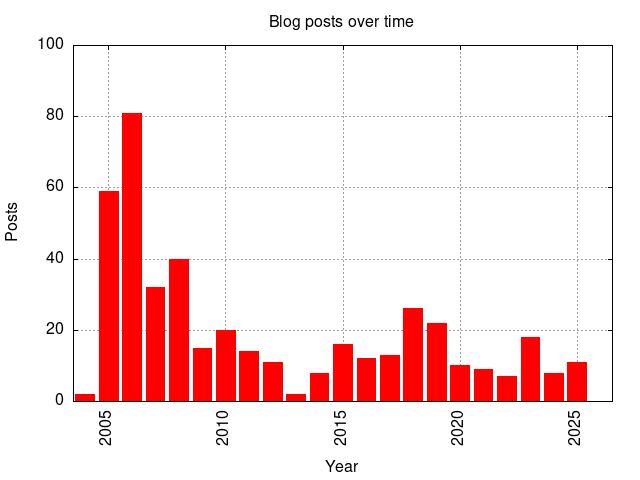 During that period I ve lived in 10 different places (well, 10 different houses/flats, I think it s only 6 different towns/cities), on 2 different continents, working at 6 different employers, as well as a period where I was doing my Masters in law. I ve travelled around the world, made new friends, lost contact with folk, started a family. In short, I have lived, even if lots of it hasn t made it to these pages.
At this point, do I see myself stopping? No, not really. I plan to still be around, like
 It's Sunday and I'm now sitting in the train from Brest to Paris where I will be changing to Germany, on the way back from the
 Pollito and the gang of DebConf mascots wearing their conference badges (photo: Christoph Berg)
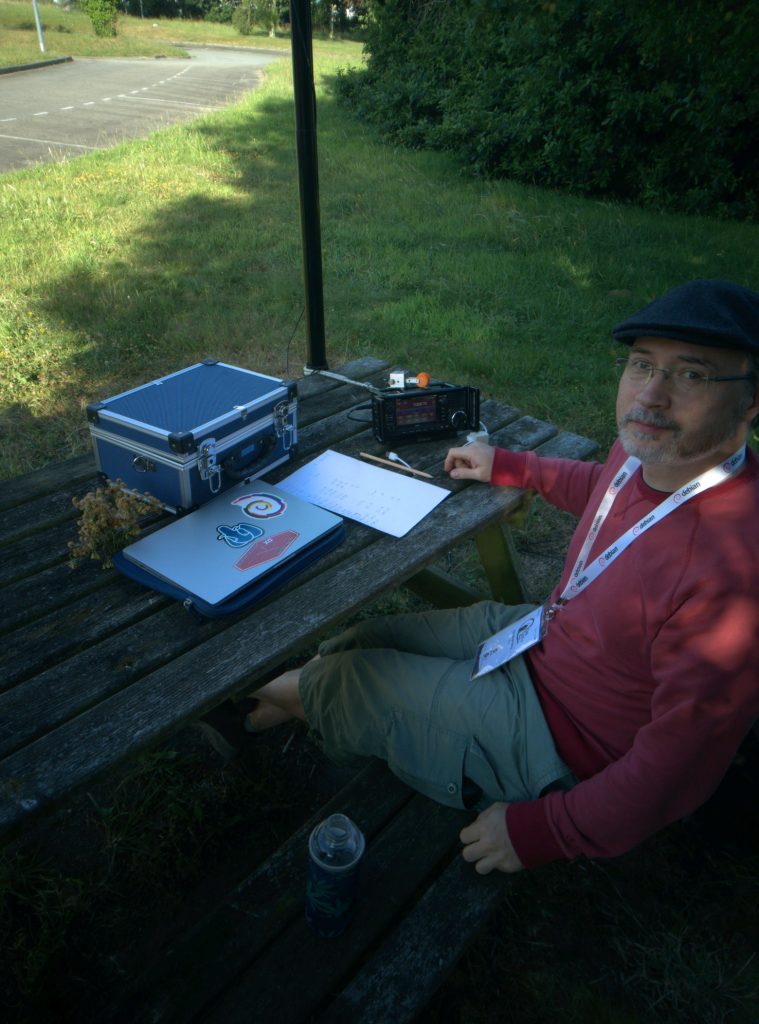 F/DF7CB in Brest (photo: Evangelos Ribeiro Tzaras)
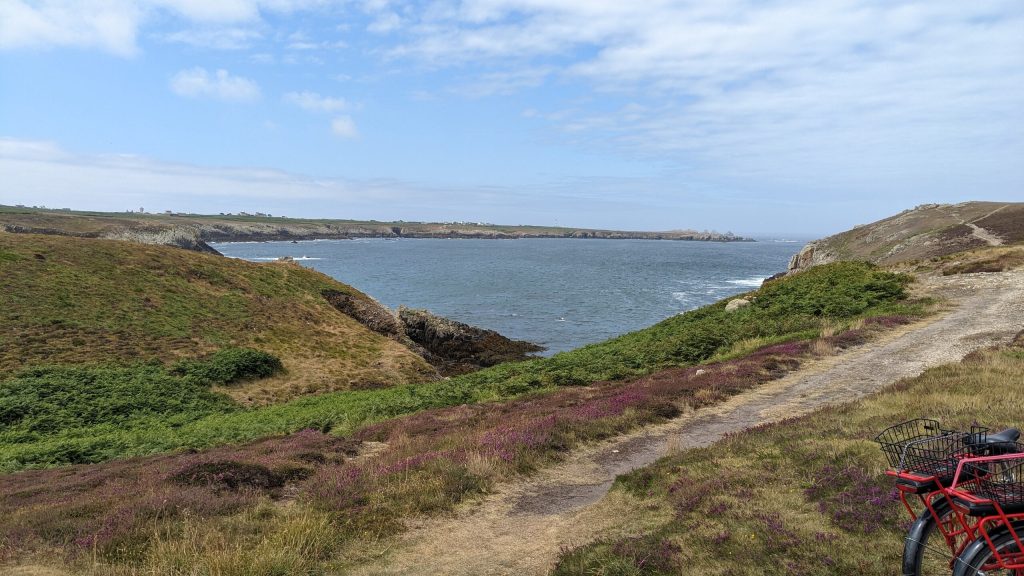 The northern coast of Ushant (photo: Christoph Berg)
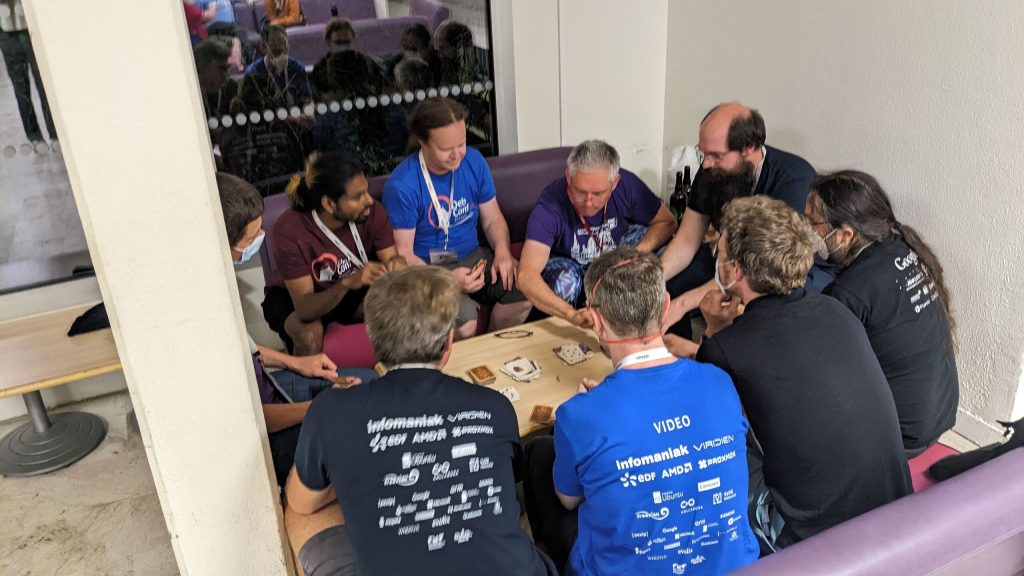 Having a nice day (photo: Christoph Berg)
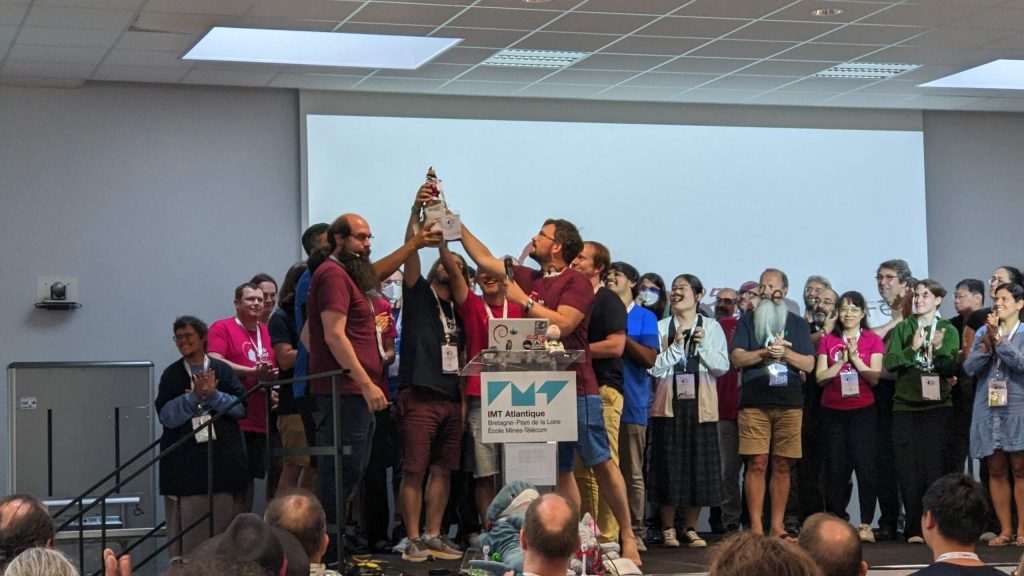 Pollito on stage (photo: Christoph Berg)