Search Results: "Enrico Zini"

26 October 2026

Enrico Zini: Sandboxing pre-commit

pre-commit is a tool that is often a prerequisite for contributing to Python upstream projects. It installs as a git pre-commit hook and runs various checks on commit, using tools installed in a set of virtualenvs that it automatically manages. In other words, it is a Remote Code Execution engine running with the permissions of your own user, and with read and write access to all your information (including, say, ~/.ssh or ~/.netrc). If you are lucky, and for as long as you're lucky, it will perform useful tasks on your code. The recent eMudhra certificate situation, where I learnt how Python, as well as several other ecosystems, likes to embed CA certificate bundles in virtualenvs, caused my tolerance for this to lower to a point where I felt the need to limit pre-commit's reach. However, I didn't want to end up with another containerized OS tree that it's then my responsibility to manage, and I tried to go the bubblewrap way, so that the environment where pre-commit runs will get the same security updates as the rest of my system. The result is a pre-commit wrapper script that: Here's a breakdown of the bwrap options I used so far. Set up usual filesystem expectations:
    --ro-bind /usr /usr \
    --symlink usr/bin /bin \
    --symlink usr/lib64 /lib64 \
    --symlink usr/lib /lib \
    --proc /proc \
    --dev /dev \
Make the working directory and pre-commit's environments storage available and writable:
    --bind $ CURDIR  "$GUEST_DIR" \
    --bind ~/.cache/pre-commit "/home/$ USER /.cache/pre-commit" \
    --chdir "$GUEST_DIR" \
Forward git's configuration:
    --ro-bind /etc/gitconfig /etc/gitconfig \
    --ro-bind ~/.gitconfig /home/$ USER /.gitconfig \
Make .git writable (pre-commit needs to stash, for example), but use a tmpfs overlay so that the writes don't persist:
    --overlay-src "$CURDIR/.git" \
    --tmp-overlay "$GUEST_DIR/.git" \
Remove access to everything except the above. Prevent keystroke injection at the terminal. Propagate ^C.
    --unshare-all \
    --new-session \
    --die-with-parent
If network is needed:
    --share-net \
    --ro-bind /etc/resolv.conf /etc/resolv.conf \
    --ro-bind /etc/ssl/certs/ca-certificates.crt /etc/ssl/certs/ca-certificates.crt
To run it, you can set up the wrapper script to run with a higher priority in $PATH, but you need to edit .git/hooks/pre-commit to remove the first branch of the if that, frustratingly, tries to run it as python3 -m pre_commit. I'm looking forward to a time where it becomes stadard practice to manage user commands this way: why should a desktop solitaire game have access to ~/.ssh? Or network? Why is it still normal, in 2026, to run a Desktop system like that?

8 September 2026

Enrico Zini: Financial risks in 2026

I asked the banker who is my reference at the bank something like this:
Give that we are talking about the consequences of the tantrum of a fascist foreign government, what happened to them (who are also people close and dear to me), in some future can very well happen to me. Suddenly my risk profile shot up under the roof. What do you suggest me to do? Should I find a trusted source of gold bullions to bury under the cellar at home?
The answer was something like this:
Sadly YES, given that the USA have a sort of financial monopoly they can entitle themselves to arbitrarily define a person/organization as a terrorist without any trial or judicial course, and as a consequence apply sanctions that cannot be effectively counteracted, not even abroad.
I didn't have this in my 2026 bingo card, but here we are.
For more details, see: For some broader context on this kind of actions from the USA, see also:

7 September 2026

Freexian Collaborators: Debusine can now hand you debug symbols! (by Jugal Patel)

Contributor: Jugal Patel (Jugal59)
Organization: Debian
Project: Provide debuginfod server
Mentor: Colin Watson

About the project and me Your program crashes. You open gdb and get ?? instead of a stack trace. So you go find the right -dbgsym package, for the right version, for the right architecture, install it, and start again. Debuginfod removes that entire detour: gdb asks a server for symbols by the build-ID baked into the binary. Debusine already built packages, already produced -dbgsym files, and already hosted the archives; it just couldn t answer the question. This summer I made it answer. My project was to add debuginfod server functionality to Debusine so that it not only hosts -dbgsym packages, but also serves their debug symbols over the debuginfod(8) protocol. Debian developers can then debug binaries by setting a single URL that gdb uses to fetch the matching debug symbols. This project took me through design, backend work, an extraction pipeline on the worker, HTTP serving, documentation, and testing from the first blueprint all the way to a live demo on debusine.debian.net.

Initial planning and design changes A design first, in !3030. The proposal submitted for GSoC 2026 was just an overview of how things will work, but in reality there were a lot of design questions which needed to be answered before starting with contribution. Debusine keeps development blueprints in its docs tree, reviewed like code, it s basically a blueprint of what feature or new changes are we going to make. I was assigned the work item #957, which was basically about how the idea of implementing a debuginfod server functionality inside Debusine was initially proposed by a fellow member which later became a project idea under GSoC 2026. My developer blueprint pinned down the four decisions everything else depends on: extraction happens on the worker after the build, symbols are stored as artifacts keyed by build-ID, they re published into suites alongside their binaries, and they re served from the archive root rather than per-suite. Settling that up front meant the design discussions happened in a document instead of across three merged branches. Provide debuginfod server work item and all my merged PRs till now One of those arguments became its own fix. My wording implied symbols were unpacked inside the isolated sbuild environment (the consequence was I was handed a bug to be solved in the first week of contribution period), when they re actually extracted afterwards on the worker, where the build output already sits, a distinction that matters, because doing work inside the unshare environment means extra tooling in the chroot and more ways to affect the build. !3119 corrected it before the wrong model spread into the code. Bug raised for inconsistent wordings in developer blueprint

A new artifact type Artifacts are a major concept in Debusine overall, so as per the developer blueprint we introduced a new artifact which was debian:debug-symbols. It holds every .debug file from one -dbgsym package. Its data is a validated list of lowercase 40-character build-IDs, and each file is stored under its build-ID as the path, so answering what are the symbols for this ID? is a direct lookup, with no path translation in the request handler. One artifact per package rather than per file: a util-linux build would otherwise spray hundreds of artifacts, collection items and relations across the database for no benefit. For implementing debian:debug-symbols artifact, I changed the main models.py file, along with that since it s a norm to write unit tests, all mentioned under !3088. sbuild task output showing the new debian:debug-symbols artifact

Publishing workflow and solving a bug Extracting symbols is only useful if they reach the archive people actually install from, so !3180 taught package_publish to follow the relates-to relation: copying binaries into a suite now brings their debug symbols along automatically, with nothing extra for the publisher to configure. Each build-ID becomes its own collection item, for example debugsym:hello_2.10-5_amd64_fcc9064 each carrying the package name, version and architecture copied from the binary, so the item is meaningful on its own without dereferencing anything. Uniqueness is enforced at both the suite and archive level, because the serving URLs are archive-wide and two suites must never disagree about what a build-ID means: republishing an identical file is accepted quietly, while two different files claiming the same ID is an error worth failing on. A partial index on the build-ID keeps the eventual HTTP lookup fast. That looked finished until symbols started arriving in target suites disconnected from their binaries published, but unfindable, because copying items between collections silently dropped their artifact relations, and that relation is the only thing tying the two together. The fix sat one level above my feature, in the generic CopyCollectionItems task that does the copying, and since it was reusable infrastructure rather than anything debuginfod-specific, Colin implemented it himself in !3228. My project needed it to work at all; every other Debusine feature that copies items now gets it for free.

Endpoint and CI tests With symbols in the archive, !3212 added the part users actually touch: GET / scope / workspace /buildid/<build-id>/debuginfo looks the ID up across every suite in that workspace s archive, streams the file, and sets the X-DEBUGINFOD-FILE and X-DEBUGINFOD-SIZE headers the protocol expects. It also handles the two things gdb actually does: a HEAD probe before committing to a download, and ranged requests to pull individual ELF sections instead of the whole file. Scoping it to the archive rather than the suite is what lets one URL cover a whole workspace, so the developer never has to know which suite their binary came from. Fetching debug files from debusine.debian.net Every merge request above landed with unit tests, but those only tell you that the pieces behave correctly. What Colin and I wanted was a real gdb fetching real symbols from a real instance, so !3261 adds an autopkgtest that builds a package, publishes it, checks the HTTP headers, then sets DEBUGINFOD_URLS and makes gdb go and get the symbols, wired into the CI integration tests so it runs on every change. It took me a day to learn that skipping the signing worker doesn t simplify that test, it just hangs until the 30-minute timeout, because update_suites needs signing to produce a usable repository. The last piece, !3301 covers the new artifact, the suite and archive changes, the new archive URL, and a how-to for using it. My first how-to draft explained how everything worked and offered four ways to set DEBUGINFOD_URLS; the version that shipped gives one recommended setup and gets out of the way. The same pass trimmed the blueprint down to only what s still unimplemented, since a design document describing merged code is just an obstacle for the next reader. Setting debuginfod url for gdb and debugging session!

What s left Only one item on my original plan didn t land: an archive-level build_debug_symbols switch, modelled on Launchpad s equivalent, letting an archive skip building -dbgsym packages entirely by passing DEB_BUILD_OPTIONS=noautodbgsym to sbuild. It was always the stretch goal rather than core scope, landing the extract-publish-serve path solidly mattered more than landing it broadly. The design is written up in the blueprint, and I intend to implement it myself. The other gaps were deliberately out of scope from the start, and the blueprint says so. DWZ supplement files aren t ingested, so packages using compressed debug info may render without the alternate strings table; debugging still works, it s just less complete. Source-file serving runs into the same Debian packaging limits that constrain debuginfod.debian.net today, making it a design question rather than a coding one. Executable serving, the metrics and metadata endpoints, and federation to upstream debuginfod servers were excluded for similar reasons, none of them are needed for Debusine s core use case, and each would have crowded out the parts that are. One open bug is left too. On the last day of the coding period, Stefano Rivera found that publishing ledger and linux was failing, because I had told the database that a build-ID identifies one exact debug file which isn t true in Debian, since dh_dwz runs once per binary package, so when one object ships in two binary packages their .debug files differ while describing identical code. How to fix it is still an open discussion #1582, though it may not land before the formal end of the project. None of that is a handoff. GSoC s timeline is ending, my involvement isn t, I m carrying on with Debusine until both the build_debug_symbols switch and DWZ supplement support are merged, and I expect to keep contributing beyond that. This project got me familiar with a codebase I enjoy working in, and the remaining pieces are mine to finish.

Thanks! The biggest thanks go to my mentor, Colin Watson, whose reviews consistently found the thing I hadn t thought about. He also gave me room to get things wrong first and understand why, which taught me more than being handed the answer would have. Thanks as well to Rapha l Hertzog, Enrico Zini, Stefano Rivera, Carles Pina i Estany and Helmut Grohne and everyone else around Debusine and Freexian for reviews, comments and patience with my questions. Special thanks to Freexian for developing Debusine in the open and for giving me access to test on debusine.debian.net. Finally, thanks to the wider Debian community, whose build-ID and -dbgsym conventions did most of the hard work before I arrived and to Google Summer of Code for providing a platform and the time to do this properly.

6 September 2026

Enrico Zini: Migrating away from .org/.net/.com domains

After having witnessed how easy it is for good people to lose a .org domain over a fascist tantrum (you can follow the Autistici/Inventati story here and here), I've started moving all my infrastructure to differently managed TLDs. enricozini.org and enricozini.com will keep being functional for the time being, as dropping a domain makes it available for squatting and impersonation. These new domains are now online, with working web and emails: It will take ages to migrate countless accounts that are tied to my primary email address, so better start early. Waiting to see what will happen with .meow domains, which I supported despite not identifying as a cat.

5 August 2026

Enrico Zini: Gnome refusing to suspend

I'm tired, I want to do go bed. I click "sleep" on gnome shell, nothing happens. Swearwords. I want to go to bed. I might have want to put my laptop in a bag and run to catch a train. I hate when this happens. systemd-inhibit --list --mode=block doesn't help much:
$ systemd-inhibit --list --mode=block
WHO    UID  USER   PID  COMM            WHAT                                                     WHY                        MODE
enrico 1000 enrico 3042 gsd-power       handle-lid-switch                                        External monitor attached  block
enrico 1000 enrico 3037 gsd-media-keys  handle-power-key:handle-suspend-key:handle-hibernate-key GNOME handling keypresses  block
enrico 1000 enrico 2878 gnome-session-b sleep                                                    user session inhibited     block
After much googling I found out about gnome-session-inhibit:
$ gnome-session-inhibit  --list
mutter: idle-inhibit (idle)
/usr/lib/chromium/chromium: Playing audio (suspend)
Found the right tab in chromium, paused playing, sleep works again. My sleep was a good half an hour overdue, and all I got for it was to write this blog post. Of course Gnome could have shown me its inhibitor list instead of doing nothing, since it has that information, but it didn't. What I really would expect is that if I intentionally click a suspend button, audio and video playing wouldn't inhibit the suspend. Maybe in a future version of Gnome?

15 May 2026

Freexian Collaborators: Debian Contributions: Detecting undeclared file conflicts, contributors.debian.org mini-sprint, security-tracker performance and more! (by Anupa Ann Joseph)

Debian Contributions: 2026-04 Contributing to Debian is part of Freexian s mission. This article covers the latest achievements of Freexian and their collaborators. All of this is made possible by organizations subscribing to our Long Term Support contracts and consulting services.

Undeclared file conflicts, by Helmut Grohne The duplication checker, the Multi-Arch hinter, and the /usr-move analyzer share significant parts of their code. While the /usr-move transition is complete, the other tools needed a bit of love. Helmut added Python type annotations, slightly improved the performance of the duplication website and shared more code between these tools. Building upon this Helmut looked into file conflicts of various kinds such as unrelated packages installing overlapping files, file type conflicts, mismatching directory metadata and shared files of Multi-Arch: same packages with varying content. Implementing reliable detection proved to be difficult due to the amount of corner cases. So Helmut semi-manually filed bugs. In that process, it became apparent that binNMUs do not reproduce SOURCE_DATE_EPOCH across architectures and therefore some shared files embedding the build date would vary in content. Additionally, a significant number of reports required further correspondence.

contributors.debian.org mini-sprint, by Enrico Zini Enrico Zini met with Mattia Rizzolo to continue the work started at DebConf 25 on crediting contributions done via salsa, and to catch up with accumulated site issues. Building on the same kind of infrastructure used to notify tag2upload, salsa.debian.org triggers a webping on pushes and merge request activity, which causes a small JSON payload to be queued in a private directory on contributors.debian.org. We worked on processing, filtering and aggregating the files in the queue into a private, staging database table. When configuring a data source on the site, it is now possible to configure automated submission of contributions from information in the staging table. This makes it significantly simpler to credit contributors for all teams that use Salsa as their code repository and coordination tool, as the site can take care of the data mining for you. See more details in the sprint report posted to debian-devel-announce.

MiniDebConf Campinas, by Lucas Kanashiro, Santiago Ruano Rinc n and Antonio Terceiro MiniDebConf Campinas was held between April 23rd and 25th, at the State University of Campinas, and was preceded by a MiniDebcamp between April 20th and 22nd. Freexian was Gold sponsor for the event, and Freexian collaborators were active contributors to the conference success. Lucas and Santiago delivered a talk about Debian LTS during MiniDebConf Campinas 2026, where they described how the LTS project benefits Debian users and developers, while strengthening Debian itself. Lucas and Antonio delivered a talk about internship programs in Debian during MiniDebConf Campinas 2026, with the goal of getting students interested in working in and with Debian. Lucas took part in the MiniDebConf Campinas content team, reviewing/accepting talks and building the schedule. Antonio led a session where he invited the audience to weigh in on current controversies in Debian. The session presented playful elements as colored signs to denote agree/disagree, and was not recorded, to help people feel more comfortable about speaking up. He might be convinced to lead a similar session at the next DebConf. Antonio also organized a debate to discuss the consequences of new Brazilian regulation for the protection of children and adolescents in digital spaces for Debian and other free operating systems, but also for the free software community in general. This session was very fruitful and will lead into further actions, as one of the main outcomes was the realization that the free software community must follow the discussion leading up to similar regulations more closely to avoid being caught by surprise when they come into effect.

security-tracker performance, by Helmut Grohne and Emilio Pozuelo Monfort Prompted by spontaneous influx of web requests on Freexian s security-tracker back in February, we considered the options for managing that demand. One of our mitigations was making it faster. To that end, Helmut sent two MRs towards improving the situation. There are four notable improvements. The use of Python s str.translate generally speeds up rendering of larger templates. Indexing the CVE names avoids a costly sequential table scan. Avoiding FFI calls while sorting and reducing the queryset speeds up the source package view. Emilio reviewed and deployed the changes on to the Debian instance. Together these changes provide a twofold speedup on both Freexian s and Debian s instance on average.

dput-ng data loss bug, by Colin Watson Ian Jackson (not affiliated with Freexian) reported that dput-ng could lose data when using the local install method, which could cause misleading results in tests of other packages; they also filed an initial merge request to fix it. Colin improved this to isolate its tests properly, and uploaded it.

Miscellaneous contributions
  • Lucas coordinated the src:valkey update to version 9 in unstable with a potential co-maintainer.
  • Lucas provided a security update for src:valkey targeting trixie .
  • Thorsten did two uploads of foo2zjs, one to fix a bug and one to improve packaging. As there have been several CVEs published for cups he also did an upload of a new upstream version. Unfortunately this introduces a regression and another upload was needed to take care of a crash. The patch for one CVE also broke a test script, which is used by lots of printing packages in Debian. As a result some autopkgtest runs failed. This could be fixed as well and the only remaining issue that needs some more investigation is related to cups-pdf. It is also worth mentioning that some issues related to the apparmor configuration of cups could be resolved.
  • Helmut sent patches for 11 cross build failures.
  • Helmut sent a MR for enabling the new mainline YT6801 ethernet Linux driver and it is now working fine with Debian s 7.x kernels.
  • Helmut upgraded a crossqa.debian.net autobuilder to trixie .
  • Carles using po-debconf-manager, improved Catalan translations: reviewed 2 packages, submitted 3 packages, deleted 5 packages.
  • Carles did further code developments for check-relations: steps towards making it production ready when the initial round of reports are analyzed. New show-package (information) command, improvements for report_missing cases, added support for ignoring packages for specific reasons, added unit tests, added CI. Used it to open 39 new bugs. Also followed up different open bugs
  • Rapha l completed the French translation of Zulip for the release of version 12.0. Zulip is a nice 100% free software threaded communication platform for distributed teams.
  • Stefano did routine uploads of python-pipx, python-mitogen, platformdirs, python-authlib, python-discovery, distro-info-data, python-virtualenv, python-certifi, python-wheel, pypy3.
  • Stefano uploaded distro-info-data updates to stable and oldstable proposed updates, with the latest Ubuntu release.
  • Stefano took part in DebConf 26 preparation meetings.
  • Stefano prepared DebConf s online video streaming infrastructure for MiniDebConf Campinas, and configured the Debian reimbursement system to handle their travel bursary claims.
  • Stefano helped MiniDebConf Hamburg prepare their website for 2027.
  • Stefano did some sysadmin work on debian.social infrastructure.
  • Stefano reviewed Matthias python3.15 packaging and rebased his work on top of it.
  • Antonio implemented several improvements to the Debian CI platform, including but not limited to adding support for dark mode, dropping compatibility with ActiveRecord < 7 which is no longer shipped in Debian stable, and generating content-based links to static assets, in two parts.
  • Antonio debugged a general slowness in salsa, caused by loss of IPv6 connectivity between the salsa host and the remote object storage in the cloud , which is a problem due to an open upstream bug in gitlab.
  • Santiago reviewed different changes to the Salsa CI pipeline, including the new uscan test job, prepared by Tha s Rebou as Araujo, and the final review to introduce faketime testing, made by quila Macedo.
  • Santiago continued helping the DebConf 26 local team to prepare the conference.
  • Emilio updated libxpm to address a security issue.
  • Colin finished upgrading groff to 1.24.1; 1.24.0 and 1.24.1 were the first upstream releases since 2023 and had extensive changes, so this took some time to get right.
  • Colin released bookworm and trixie fixes for CVE-2026-3497 in openssh, and issued the corresponding BSA-130 for trixie-backports.
  • Colin upgraded openssh to 10.3p1.
  • Anupa worked on the accounting tasks for MiniDebConf Kanpur and prepared and submitted a report to the fiscal host.

25 November 2025

Freexian Collaborators: How we implemented a dark mode in Debusine (by Enrico Zini)

Having learnt that Bootstrap supports color modes, we decided to implement an option for users to enable dark mode in Debusine. By default, the color mode is selected depending on the user browser preferences. If explicitly selected, we use a cookie to store the theme selection so that a user can choose different color modes in different browsers. The work is in merge request !2401 and minimizes JavaScript dependencies like we do in other parts of debusine.

A view to select the theme First is a simple view to configure the selected theme and store it in a cookie. If auto is selected, then the cookie is deleted to delegate theme selection to JavaScript:
class ThemeSelectionView(View):
    """Select and save the current theme."""

    def post(
        self, request: HttpRequest, *args: Any, **kwargs: Any  # noqa: U100
    ) -> HttpResponse:
        """Set the selected theme."""
        value = request.POST.get("theme", "auto")
        next_url = request.POST.get("next", None)
        if next_url is None:
            next_url = reverse("homepage:homepage")
        response = HttpResponseRedirect(next_url)
        if value == "auto":
            response.delete_cookie("theme")
        else:
            response.set_cookie(
                "theme", value, httponly=False, max_age=dt.timedelta(days=3650)
            )
        return response
The main base view of Debusine reads the value from the cookie and makes it available to the templates:
      def get_context_data(self, **kwargs: Any) -> dict[str, Any]:
          ctx = super().get_context_data(**kwargs)
          ctx["theme"] = self.request.COOKIES.get("theme", None)
          # ...
          return ctx
The base template will use this value to set data-bs-theme on the main <html> element, and that s all that is needed to select the color mode in Bootstrap:
<html lang="en" % if theme %  data-bs-theme="  theme  " % endif % >
The view uses HTTP POST as it changes state, so theme selection happens in a form:
<form id="footer-theme" class="col-auto" method="post"
      action=" % url "theme-selection" % ">
     % csrf_token % 
    <input type="hidden" name="next" value="  request.get_full_path  ">
    Theme:
    <button type="submit" name="theme" value="dark">dark</button>
     
    <button type="submit" name="theme" value="light">light</button>
     
    <button type="submit" name="theme" value="auto">auto</button>
</form>
Since we added the theme selection buttons in the footer, we use CSS to render the buttons in the same way as the rest of the footer links. Bootstrap has a set of CSS variables that can be used to easily in sync with the site theme, and they are especially useful now that the theme is configurable:
footer button  
    background: none;
    border: none;
    margin: 0;
    padding: 0;
    color: var(--bs-link-color);
 

Theme autoselection Bootstrap would support theme autoselection via browser preferences, but that requires rebuilding its Sass sources. Alternatively, one can use JavaScript:
 % if not theme % 
    <script blocking="render">
    (function()  
        let theme = window.matchMedia('(prefers-color-scheme: dark)').matches ? 'dark' : 'light';
        let [html] = document.getElementsByTagName("html");
        html.setAttribute("data-bs-theme", theme);
     )();
    </script>
 % endif % 
This reads the color scheme preferences and sets the data-bs-theme attribute on <html>. The script is provided inline as it needs to use blocking="render" to avoid flashing a light background at the beginning of page load until the attribute is set. Given that this is a render-blocking snippet, as an extra optimization it is not added to the page if a theme has been set.

Bootstrap CSS fixes We were making use of the bootstrap btn-light class in navbars to highlight elements on hover, and that doesn t work well with theme selection. Lacking a button class that does the right thing across themes, we came up with a new CSS class that uses variables to define a button with hover highlight that works preserving the underlying color:
:root[data-bs-theme=light]  
    --debusine-hover-layer: rgb(0 0 0 / 20%);
    --debusine-hover-color-multiplier: 0.8;
    --debusine-disabled-color-multiplier: 1.5;
 
:root[data-bs-theme=dark]  
    --debusine-hover-layer: rgb(255 255 255 / 20%);
    --debusine-hover-color-multiplier: 1.2;
    --debusine-disabled-color-multiplier: 0.5;
 

/* Button that preserves the underlying color scheme */
.btn-debusine  
  --bs-btn-hover-color: rgb(from var(--bs-btn-color) calc(r * var(--debusine-hover-color-multiplier)) calc(g * var(--debusine-hover-color-multiplier)) calc(b * var(--debusine-hover-color-multiplier)));
  --bs-btn-hover-bg: var(--debusine-hover-layer);
  --bs-btn-disabled-color: rgb(from var(--bs-btn-color) calc(r * var(--debusine-disabled-color-multiplier)) calc(g * var(--debusine-disabled-color-multiplier)) calc(b * var(--debusine-disabled-color-multiplier)));
  --bs-btn-disabled-bg: var(--bs-btn-bg);
  --bs-btn-disabled-border-color: var(--bs-btn-border-color);
 

Dark mode! This was a nice integration exercise with many little tricks, like how to read color scheme preferences from the browser, render form buttons as links, use bootstrap variables, prevent a flashing background, handle cookies in Django. And Debusine now has a dark mode!

12 September 2025

Freexian Collaborators: Using JavaScript in Debusine without depending on JavaScript (by Enrico Zini)

Debusine is a tool designed for Debian developers and Operating System developers in general. This posts describes our approach to the use of JavaScript, and some practical designs we came up with to integrate it with Django with minimal effort.

Debusine web UI and JavaScript Debusine currently has 3 user interfaces: a client on the command line, a RESTful API, and a Django-based Web UI. Debusine s web UI is a tool to interact with the system, and we want to spend most of our efforts in creating a system that works and works well, rather than chasing the latest and hippest of the frontend frameworks for the web. Also, Debian as a community has an aversion to having parts of the JavaScript ecosystem in the critical path of its core infrastructure, and in our professional experience this aversion is not at all unreasonable. This leads to having some interesting requirements for the web UI, that (rather surprisingly, one would think) one doesn t usually find advertised in many projects:
  • Straightforward to create and maintain.
  • Well integrated with Django.
  • Easy to package in Debian, with as little vendoring as possible, which helps mitigate supply chain attacks
  • Usable without JavaScript whenever possible, for progressive enhancement rather than core functionality.
The idea is to avoid growing the technical complexity and requirements of the web UI, both server-side and client-side, for functionality that is not needed for this kind of project, with tools that do not fit well in our ecosystem. Also, to limit the complexity of the JavaScript portions that we do develop, we choose to limit our JavaScript browser supports to the main browser versions packaged in Debian Stable, plus recent oldstable. This makes JavaScript easier to write and maintain, and it also makes it less needed, as modern HTML plus modern CSS interfaces can go a long way with less scripting interventions. We recently encoded JavaScript practices and tradeoffs in a JavaScript Practices chapter of Debusine s documentation.

How we use JavaScript From the start we built the UI using Bootstrap, which helps in having responsive layouts that can also work on mobile devices. When we started having large select fields, we introduced Select2 to make interaction more efficient, and which degrades gracefully to working HTML. Both Bootstrap and Select2 are packaged in Debian. Form validation is done server-side by Django, and we do not reimplement it client-side in JavaScript, as we prefer the extra round trip through a form submission to the risk of mismatches between the two validations. In those cases where a UI task is not at all possible without JavaScript, we can make its support mandatory as long as the same goal can be otherwise achieved using the debusine client command.

Django messages as Bootstrap toasts Django has a Messages framework that allows different parts of a view to push messages to the user, and it is useful to signal things like a successful form submission, or warnings on unexpected conditions. Django messages integrate well with Bootstrap toasts, which use a recognisable notification language, are nicely dismissible and do not invade the rest of the page layout. Since toasts require JavaScript to work, we added graceful degradation. to Bootstrap alerts Doing so was surprisingly simple: we handle the toasts as usual, and also render the plain alerts inside a <noscript> tag. This is precisely the intended usage of the <noscript> tag, and it works perfectly: toasts are displayed by JavaScript when it s available, or rendered as alerts when not. The resulting Django template is something like this:
<div aria-live="polite" aria-atomic="true" class="position-relative">
    <div class="toast-container position-absolute top-0 end-0 p-3">
     % for message in messages % 
        <div class="toast" role="alert" aria-live="assertive" aria-atomic="true">
            <div class="toast-header">
                <strong class="me-auto">  message.level_tag capfirst  </strong>
                <button type="button"
                        class="btn-close"
                        data-bs-dismiss="toast"
                        aria-label="Close"></button>
            </div>
            <div class="toast-body">  message  </div>
        </div>
     % endfor % 
    </div>
</div>
<!--   -->
 % if messages % 
<noscript>
     % for message in messages % 
        <div class="alert alert-primary" role="alert">
              message  
        </div>
     % endfor % 
</noscript>
 % endif % 
We have a webpage to test the result.

JavaScript incremental improvement of formsets Debusine is built around workspaces, which are, among other things, containers for resources. Workspaces can inherit from other workspaces, which act as fallback lookups for resources. This allows, for example, to maintain an experimental package to be built on Debian Unstable, without the need to copy the whole Debian Unstable workspace. A workspace can inherit from multiple others, which are looked up in order. When adding UI to configure workspace inheritance, we faced the issue that plain HTML forms do not have a convenient way to perform data entry of an ordered list. We initially built the data entry around Django formsets, which support ordering using an extra integer input field to enter the ordering position. This works, and it s good as a fallback, but we wanted something more appropriate, like dragging and dropping items to reorder them, as the main method of interaction. Our final approach renders the plain formset inside a <noscript> tag, and the JavaScript widget inside a display: none element, which is later shown by JavaScript code. As the workspace inheritance is edited, JavaScript serializes its state into <form type='hidden'> fields that match the structure used by the formset, so that when the form is submitted, the view performs validation and updates the server state as usual without any extra maintenance burden. Serializing state as hidden form fields looks a bit vintage, but it is an effective way of preserving the established data entry protocol between the server and the browser, allowing us to do incremental improvement of the UI while minimizing the maintenance effort.

More to come Debusine is now gaining significant adoption and is still under active development, with new features like personal archives coming soon. This will likely mean more user stories for the UI, so this is a design space that we are going to explore again and again in the coming future. Meanwhile, you can try out Debusine on debusine.debian.net, and follow its development on salsa.debian.org!

3 September 2025

Enrico Zini: CAdES signatures on Debian

CAdES is a digital signature standard that is used and sometimes mandated, by the Italian Public Administration. To be able to do my job, I own a Carta Nazionale dei Servizi (CNS) with which I can generate legally binding signatures. Now comes the problem of finding a software to do it. Infocamere Firma4NG InfoCamere are distributing a software called Firma4NG, with a Linux option, which, I'm pleased to say, seems to work just fine. Autofirma AutoFirma is a Java software for digital signatures distributed by the Spanish government, which has a Linux version. It is licensed as GPL-2+ EUPL-1.1, and the source seems to be here. While my Spanish is decent I lack jargon for this specific field, and I didn't manage to make it work with my CNS. Autogram Andrej Shadura pointed me to Autogram, a Slovakian software for digital signatures, licensed under the EUPL-1.2. The interface is still only in Slovakian, so tried it but I didn't go very far in trying to make it work. OpenSSL In trixie, openssl is almost, but not quite, able to do it. Here's as far as I've got. Install opensc
apt install opensc
Test if you can access the smart card with:
pkcs11-tool --list-objects [-l]
You can find other pkcs11-tool examples here Set up a pkcs11 provider for openssl
apt install pkcs11-provider
Edit /etc/ssl/openssl.cnf:
[pkcs11_sect]
module = /usr/lib/x86_64-linux-gnu/ossl-modules/pkcs11.so
pkcs11-module-path = /usr/lib/x86_64-linux-gnu/pkcs11/opensc-pkcs11.so
default_algorithms = ALL
activate = 1
Test with openssl list -providers You can check if openssl can see keys on the card:
openssl pkey -in 'pkcs11:id=%01' -pubin -pubout -text
See PKCS11 URI documentation here. Install the PKCS11 engine for openssl
apt install libengine-pkcs11-openssl
It looks like providers replaced engines, and this would not be needed, but I couldn't find a way to convince openssl to work without this. Sign a document
openssl cms -nodetach -binary -cades -outform DER -in filename -out filename.p7m -sign -signer 'pkcs11:id=%01' -keyform engine -engine pkcs11
It verifies correctly using the Austrian verification system. All the Italian verification systems I tried, however, complain that, although the signature is valid, the certificate is emitted by an unqualified CA and the certificate revocation information cannot be found. PAdES When signing PDF files, the PAdES standard is sometimes accepted. LibreOffice is able to generate PAdES signatures using the "File / Digital signatures " menu, and provided the smart card is in the reader it is able to use it. Both LibreOffice and Okular can verify that the signature is indeed there. However, when trying to validate the signature using Italian validators, I get the same complaints about unqualified CAs and missing revocation information. Wall of shame Dike GoSign Infocert (now Tinexta) used to distribute a software called "Dike GoSign" that worked on Ubuntu, which I used on a completely isolated VM, and it was awful but it worked. I had to regenerate the VM for it, and discovered that the version they distribute now will refuse to work unless one signs in online with a Tinexta account. From the same company that asks you to install their own root certifiactes to use their digital signature system. Gross. Dropped. Aruba Sign Aruba used to distribute a software called Aruba Sign, which also worked on Ubuntu. Ubuntu support has been discontinued, and they now only offer support for Windows or Mac. Yuck. Dropped.

29 July 2025

Christoph Berg: The Debian Conference 2025 in Brest

It's Sunday and I'm now sitting in the train from Brest to Paris where I will be changing to Germany, on the way back from the annual Debian conference. A full week of presentations, discussions, talks and socializing is laying behind me and my head is still spinning from the intensity.
Pollito and the gang of DebConf mascots wearing their conference badgesPollito and the gang of DebConf mascots wearing their conference badges (photo: Christoph Berg)
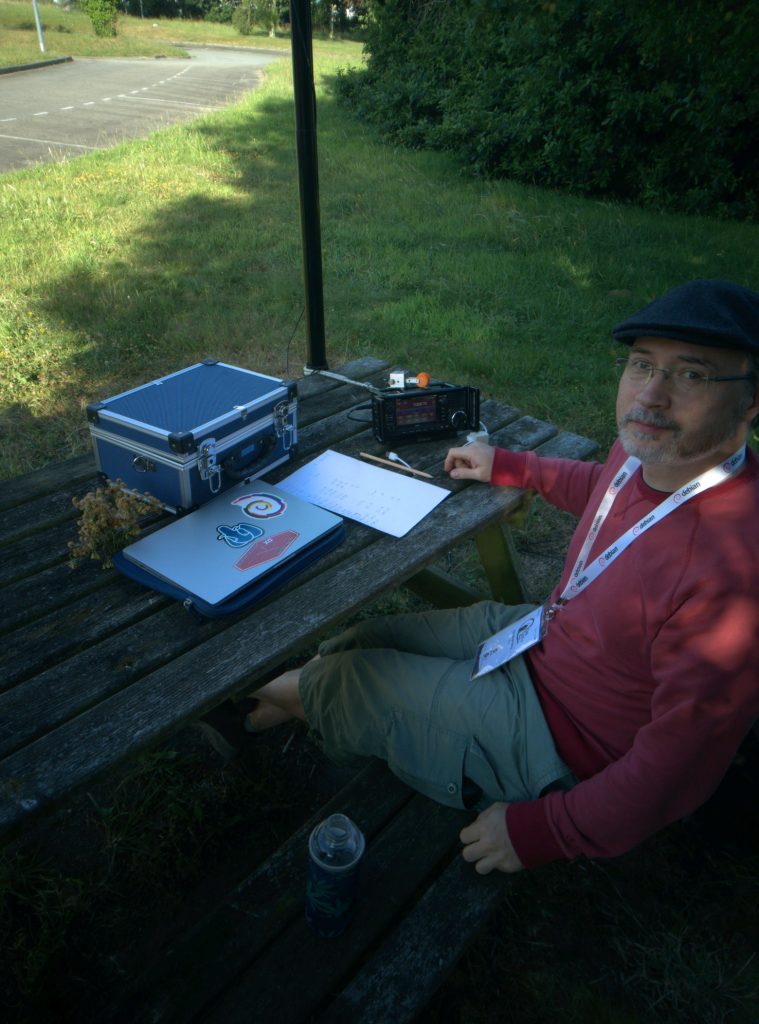
Sunday, July 13th It started last Sunday with traveling to the conference. I got on the Eurostar in Duisburg and we left on time, but even before reaching Cologne, the train was already one hour delayed for external reasons, collecting yet another hour between Aachen and Liege for its own technical problems. "The train driver is working on trying to fix the problem." My original schedule had well over two hours for changing train stations in Paris, but being that late, I missed the connection to Brest in Montparnasse. At least in the end, the total delay was only one hour when finally arriving at the destination. Due to the French julliet quatorze fireworks approaching, buses in Brest were rerouted, but I managed to catch the right bus to the conference venue, already meeting a few Debian people on the way. The conference was hosted at the IMT Atlantique Brest campus, giving the event a nice university touch. I arrived shortly after 10 in the evening and after settling down a bit, got on one of the "magic" buses for transportation to the camping site where half of the attendees where stationed. I shared a mobile home with three other Debianites, where I got a small room for myself. Monday, July 14th Next morning, we took the bus back to the venue with a small breakfast and the opening session where Enrico Zini invited me to come to his and Nicolas Dandrimont's session about Debian community governance and curation, which I gladly did. Many ideas about conflict moderation and community steering were floated around. I hope some of that can be put into effect to make flamewars on the mailing lists less heated and more directed. After that, I attended Olly Betts' "Stemming with Snowball" session, which is the stemmer used also in PostgreSQL. Text search is one of the areas in PostgreSQL that I never really looked closely at, including the integration into the postgresql-common package, so it was nice to get more information about that. In preparation for the conference, a few of us Ham radio operators in Debian had decided to bring some radio gear to DebConf this year in order to perhaps spark more interest for our hobby among the fellow geeks. In the afternoon after the talks, I found a quieter spot just outside of the main hall and set up a shortwave antenna by attaching a 10m mast to one of the park benches there. The 40m band was still pretty much closed, but I could work a few stations from England, just across the channel from Bretagne, answering questions from interested passing-by Debian people between the contacts. Over time, the band opened and more European stations got into the log.
F/DF7CB in Brest (photo: Evangelos Ribeiro Tzaras)
Tuesday, July 15th Tuesday started with Helmut Grohne's session about "Reviving (un)schroot". The schroot program has been Debian's standard way of managing build chroots for a long time, but it is more and more being regarded as obsolete with all kinds of newer containerization and virtualization technologies taking over. Since many bits of Debian infrastructure depend on schroot, and its user interface is still very useful, Helmut reimplemented it using Linux namespaces and the "unshare" systemcall. I had already worked with him at the Hamburg Minidebconf to replace the apt.postgresql.org buildd machinery with the new system, but we were not quite there yet (network isolation is nice, but we still sometimes need proper networking), so it was nice to see the effort is still progressing and I will give his new scripts a try when I'm back home. Next, Stefano Rivera and Colin Watson presented Debusine, a new package repository and workflow management system. It looks very promising for anyone running their own repository, so perhaps yet another bit of apt.postgresql.org infrastructure to replace in the future. After that, I went to the Debian LTS BoF session by Santiago Ruano Rinc n and Bastien Roucari s - Debian releases plus LTS is what we are covering with apt.postgresql.org. Then there were bits from the DPL (Debian Project Leader), and a session moderated by Stefano Rivera interesting to me as a member of the Debian Technical Committee on the future structure of the packages required for cross-building in Debian, a topic which had been brought to TC a while ago. I am happy that we could resolve the issue without having to issue a formal TC ruling as the involved parties (kernel, glibc, gcc and the cross-build people) found a promising way forward themselves. DebConf is really a good way to get such issues unstuck. Ten years ago at the 2015 Heidelberg DebConf, Enrico had given a seminal "Semi-serious stand-up comedy" talk, drawing parallels between the Debian Open Source community and the BDSM community - "People doing things consensually together". (Back then, the talk was announced as "probably unsuitable for people of all ages".) With his unique presentation style and witty insights, the session made a lasting impression on everyone attending. Now, ten years later (and he and many in the audience being ten years older), he gave an updated version of it. We are now looking forward to the sequel in 2035. The evening closed with the famous DebConf tradition of the Cheese & Wine party in a old fort next to the coast, just below the conference venue. Even when he's a fellow Debian Developer, Ham and also TC member, I had never met Paul Tagliamonte in person before, but we spent most of the evening together geeking out on all things Debian and Ham radio.
The northern coast of Ushant (photo: Christoph Berg)
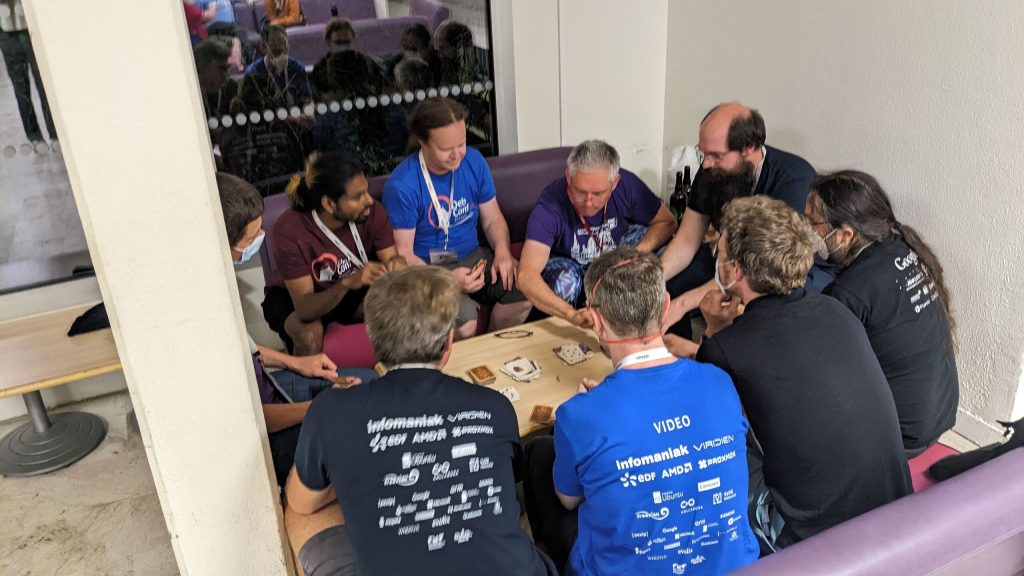
Wednesday, July 16th Wednesday already marked the end of the first half of the week, the day of the day trips. I had chosen to go to Ouessant island (Ushant in English) which marks the Western end of French mainland and hosts one of the lighthouses yielding the way into the English channel. The ferry trip included surprisingly big waves which left some participants seasick, but everyone recovered fast. After around one and a half hours we arrived, picked up the bicycles, and spent the rest of the day roaming the island. The weather forecast was originally very cloudy and 18 C, but over noon this turned into sunny and warm, so many got an unplanned sunburn. I enjoyed the trip very much - it made up for not having time visiting the city during the week. After returning, we spent the rest of the evening playing DebConf's standard game, Mao (spoiler alert: don't follow the link if you ever intend to play).
Having a nice day (photo: Christoph Berg)
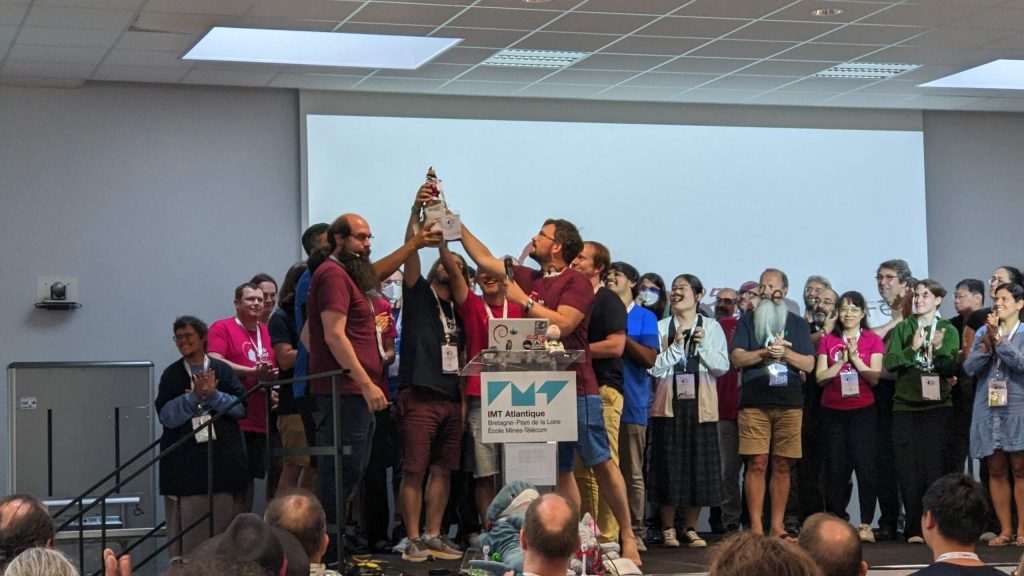
Thursday, July 17th The next day started with the traditional "Meet the Technical Committee" session. This year, we trimmed the usual slide deck down to remove the boring boilerplate parts, so after a very short introduction to the work of the committee by our chairman Matthew Vernon, we opened up the discussion with the audience, with seven (out of 8) TC members on stage. I think the format worked very well, with good input from attendees. Next up was "Don't fear the TPM" by Jonathan McDowell. A common misconception in the Free Software community is that the TPM is evil DRM hardware working against the user, but while it could be used in theory that way, the necessary TPM attestations seem to impossible to attain in practice, so that wouldn't happen anyway. Instead, it is a crypto coprocessor present in almost all modern computers that can be used to hold keys, for example to be used for SSH. It will also be interesting to research if we can make use of it for holding the Transparent Data Encryption keys for CYBERTEC's PostgreSQL Enterprise Edition. Aigars Mahinovs then directed everyone in place for the DebConf group picture, and Lucas Nussbaum started a discussion about archive-wide QA tasks in Debian, an area where I did a lot of work in the past and that still interests me. Antonio Terceiro and Paul Gevers followed up with techniques to track archive-wide rebuilding and testing of packages and in turn filing a lot of bugs to track the problems. The evening ended with the conference dinner, again in the fort close by the coast. DebConf is good for meeting new people, and I incidentally ran into another Chris, who happened to be one of the original maintainers of pgaccess, the pre-predecessor of today's pgadmin. I admit still missing this PostgreSQL frontend for its simplicity and ability to easily edit table data, but it disappeared around 2004. Friday, July 18th On Friday, I participated in discussion sessions around contributors.debian.org (PostgreSQL is planning to set up something similar) and the New Member process which I had helped to run and reform a decade or two ago. Agathe Porte (also a Ham radio operator, like so many others at the conference I had no idea of) then shared her work on rust-rewriting the slower parts of Lintian, the Debian package linter. Craig Small talked about "Free as in Bytes", the evolution of the Linux procps free command. Over the time and many kernel versions, the summary numbers printed became better and better, but there will probably never be a version that suits all use cases alike. Later over dinner, Craig (who is also a TC member) and I shared our experiences with these numbers and customers (not) understanding them. He pointed out that for PostgreSQL and looking at used memory in the presence of large shared memory buffers, USS (unique set size) and PSS (proportional set size) should be more realistic numbers than the standard RSS (resident set size) that the top utility is showing by default. Antonio Terceiro and Paul Gevers again joined to lead a session, now on ci.debian.net and autopkgtest, the test driver used for running tests on packages after then have been installed on a system. The PostgreSQL packages are heavily using this to make sure no regressions creep in even after builds have successfully completed and test re-runs are rescheduled periodically. The day ended with Bdale Garbee's electronics team BoF and Paul Tagliamonte and me setting up the radio station in the courtyard, again answering countless questions about ionospheric conditions and operating practice. Saturday, July 19th Saturday was the last conference day. In the first session, Nikos Tsipinakis and Federico Vaga from CERN announced that the LHC will be moving to Debian for the accelerator's frontend computers in their next "long shutdown" maintenance period in the next year. CentOS broke compatibility too often, and Debian trixie together with the extended LTS support will cover the time until the next long shutdown window in 2035, until when the computers should have all been replaced with newer processors covering higher x86_64 baseline versions. The audience was very delighted to hear that Debian is now also being used in this prestige project. Ben Hutchings then presented new Linux kernel features. Particularly interesting for me was the support for atomic writes spanning more than one filesystem block. When configured correctly, this would mean PostgreSQL didn't have to record full-page images in the WAL anymore, increasing throughput and performance. After that, the Debian ftp team discussed ways to improve review of new packages in the archive, and which of their processes could be relaxed with new US laws around Open Source and cryptography algorithms export. Emmanuel Arias led a session on Salsa CI, Debian's Gitlab instance and standard CI pipeline. (I think it's too slow, but the runners are not under their control.) Julian Klode then presented new features in APT, Debian's package manager. I like the new display format (and a tiny bit of that is also from me sending in wishlist bugs). In the last round of sessions this week, I then led the Ham radio BoF with an introduction into the hobby and how Debian can be used. Bdale mentioned that the sBitx family of SDR radios is natively running Debian, so stock packages can be used from the radio's touch display. We also briefly discussed his involvement in ARDC and the possibility to get grants from them for Ham radio projects. Finally, DebConf wrapped up with everyone gathering in the main auditorium and cheering the organizers for making the conference possible and passing Pollito, the DebConf mascot, to the next organizer team.
Pollito on stage (photo: Christoph Berg)
Sunday, July 20th Zoom back to the train: I made it through the Paris metro and I'm now on the Eurostar back to Germany. It has been an intense week with all the conference sessions and meeting all the people I had not seen so long. There are a lot of new ideas to follow up on both for my Debian and PostgreSQL work. Next year's DebConf will take place in Santa Fe, Argentina. I haven't yet decided if I will be going, but I can recommend the experience to everyone! The post The Debian Conference 2025 in Brest appeared first on CYBERTEC PostgreSQL Services & Support.

6 May 2025

Enrico Zini: Python-like abspath for c++

Python's os.path.abspath or Path.absolute are great: you give them a path, which might not exist, and you get a path you can use regardless of the current directory. os.path.abspath will also normalize it, while Path will not by default because with Paths a normal form is less needed. This is great to normalize input, regardless of if it's an existing file you're needing to open, or a new file you're needing to create. In C++17, there is a filesystem library with methods with enticingly similar names, but which are almost, but not quite, totally unlike Python's abspath. Because in my C++ code I need to normalize input, regardless of if it's an existing file I'm needing to open or a new file I'm needing to create, here's an apparently working Python-like abspath for C++ implemented on top of the std::filesystem library:
std::filesystem::path abspath(const std::filesystem::path& path)
 
    // weakly_canonical is defined as "the result of calling canonical() with a
    // path argument composed of the leading elements of p that exist (as
    // determined by status(p) or status(p, ec)), if any, followed by the
    // elements of p that do not exist."
    //
    // This means that if no lead components of the path exist then the
    // resulting path is not made absolute, and we need to work around that.
    if (!path.is_absolute())
        return abspath(std::filesystem::current_path() / path);
    // This is further and needlessly complicated because we need to work
    // around https://gcc.gnu.org/bugzilla/show_bug.cgi?id=118733
    unsigned retry = 0;
    while (true)
     
        std::error_code code;
        auto result = std::filesystem::weakly_canonical(path, code);
        if (!code)
         
            // fprintf(stderr, "%s: ok in %u tries\n", path.c_str(), retry+1);
            return result;
         
        if (code == std::errc::no_such_file_or_directory)
         
            ++retry;
            if (retry > 50)
                throw std::system_error(code);
         
        else
            throw std::system_error(code);
     
    // Alternative implementation that however may not work on all platforms
    // since, formally, "[std::filesystem::absolute] Implementations are
    // encouraged to not consider p not existing to be an error", but they do
    // not mandate it, and if they did, they might still be affected by the
    // undefined behaviour outlined in https://gcc.gnu.org/bugzilla/show_bug.cgi?id=118733
    //
    // return std::filesystem::absolute(path).lexically_normal();
 
I added it to my wobble code repository, which is the thin repository of components I use to ease my C++ systems programming.

9 January 2025

Freexian Collaborators: Debian Contributions: Tracker.debian.org updates, Salsa CI improvements, Coinstallable build-essential, Python 3.13 transition, Ruby 3.3 transition and more! (by Anupa Ann Joseph, Stefano Rivera)

Debian Contributions: 2024-12 Contributing to Debian is part of Freexian s mission. This article covers the latest achievements of Freexian and their collaborators. All of this is made possible by organizations subscribing to our Long Term Support contracts and consulting services.

Tracker.debian.org updates, by Rapha l Hertzog Profiting from end-of-year vacations, Rapha l prepared for tracker.debian.org to be upgraded to Debian 12 bookworm by getting rid of the remnants of python3-django-jsonfield in the code (it was superseded by a Django-native field). Thanks to Philipp Kern from the Debian System Administrators team, the upgrade happened on December 23rd. Rapha l also improved distro-tracker to better deal with invalid Maintainer fields which recently caused multiples issues in the regular data updates (#1089985, MR 105). While working on this, he filed #1089648 asking dpkg tools to error out early when maintainers make such mistakes. Finally he provided feedback to multiple issues and merge requests (MR 106, issues #21, #76, #77), there seems to be a surge of interest in distro-tracker lately. It would be nice if those new contributors could stick around and help out with the significant backlog of issues (in the Debian BTS, in Salsa).

Salsa CI improvements, by Santiago Ruano Rinc n Given that the Debian buildd network now relies on sbuild using the unshare backend, and that Salsa CI s reproducibility testing needs to be reworked (#399), Santiago resumed the work for moving the build job to use sbuild. There was some related work a few months ago that was focused on sbuild with the schroot and the sudo backends, but those attempts were stalled for different reasons, including discussions around the convenience of the move (#296). However, using sbuild and unshare avoids all of the drawbacks that have been identified so far. Santiago is preparing two merge requests: !568 to introduce a new build image, and !569 that moves all the extract-source related tasks to the build job. As mentioned in the previous reports, this change will make it possible for more projects to use the pipeline to build the packages (See #195). Additional advantages of this change include a more optimal way to test if a package builds twice in a row: instead of actually building it twice, the Salsa CI pipeline will configure sbuild to check if the clean target of debian/rules correctly restores the source tree, saving some CPU cycles by avoiding one build. Also, the images related to Ubuntu won t be needed anymore, since the build job will create chroots for different distributions and vendors from a single common build image. This will save space in the container registry. More changes are to come, especially those related to handling projects that customize the pipeline and make use of the extract-source job.

Coinstallable build-essential, by Helmut Grohne Building on the gcc-for-host work of last December, a notable patch turning build-essential Multi-Arch: same became feasible. Whilst the change is small, its implications and foundations are not. We still install crossbuild-essential-$ARCH for cross building and due to a britney2 limitation, we cannot have it depend on the host s C library. As a result, there are workarounds in place for sbuild and pbuilder. In turning build-essential Multi-Arch: same, we may actually express these dependencies directly as we install build-essential:$ARCH instead. The crossbuild-essential-$ARCH packages will continue to be available as transitional dummy packages.

Python 3.13 transition, by Colin Watson and Stefano Rivera Building on last month s work, Colin, Stefano, and other members of the Debian Python team fixed 3.13 compatibility bugs in many more packages, allowing 3.13 to now be a supported but non-default version in testing. The next stage will be to switch to it as the default version, which will start soon. Stefano did some test-rebuilds of packages that only build for the default Python 3 version, to find issues that will block the transition. The default version transition typically shakes out some more issues in applications that (unlike libraries) only test with the default Python version. Colin also fixed Sphinx 8.0 compatibility issues in many packages, which otherwise threatened to get in the way of this transition.

Ruby 3.3 transition, by Lucas Kanashiro The Debian Ruby team decided to ship Ruby 3.3 in the next Debian release, and Lucas took the lead of the interpreter transition with the assistance of the rest of the team. In order to understand the impact of the new interpreter in the ruby ecosystem, ruby-defaults was uploaded to experimental adding ruby3.3 as an alternative interpreter, and a mass rebuild of reverse dependencies was done here. Initially, a couple of hundred packages were failing to build, after many rounds of rebuilds, adjustments, and many uploads we are down to 30 package build failures, of those, 21 packages were asked to be removed from testing and for the other 9, bugs were filled. All the information to track this transition can be found here. Now, we are waiting for PHP 8.4 to finish to avoid any collision. Once it is done the Ruby 3.3 transition will start in unstable.

Miscellaneous contributions
  • Enrico Zini redesigned the way nm.debian.org stores historical audit logs and personal data backups.
  • Carles Pina submitted a new package (python-firebase-messaging) and prepared updates for python3-ring-doorbell.
  • Carles Pina developed further po-debconf-manager: better state transition, fixed bugs, automated assigning translators and reviewers on edit, updating po header files automatically, fixed bugs, etc.
  • Carles Pina reviewed, submitted and followed up the debconf templates translation (more than 20 packages) and translated some packages (about 5).
  • Santiago continued to work on DebConf 25 organization related tasks, including handling the logo survey and results. Stefano spent time on DebConf 25 too.
  • Santiago continued the exploratory work about linux livepatching with Emmanuel Arias. Santiago and Emmanuel found a challenge since kpatch won t fully support linux in trixie and newer, so they are exploring alternatives such as klp-build.
  • Helmut maintained the /usr-move transition filing bugs in e.g. bubblewrap, e2fsprogs, libvpd-2.2-3, and pam-tmpdir and corresponding on related issues such as kexec-tools and live-build. The removal of the usrmerge package unfortunately broke debootstrap and was quickly reverted. Continued fallout is expected and will continue until trixie is released.
  • Helmut sent patches for 10 cross build failures and worked with Sandro Knau on stuck Qt/KDE patches related to cross building.
  • Helmut continued to maintain rebootstrap removing the need to build gnu-efi in the process.
  • Helmut collaborated with Emanuele Rocca and Jochen Sprickerhof on an interesting adventure in diagnosing why gcc would FTBFS in recent sbuild.
  • Helmut proposed supporting build concurrency limits in coreutils s nproc. As it turns out nproc is not a good place for this functionality.
  • Colin worked with Sandro Tosi and Andrej Shadura to finish resolving the multipart vs. python-multipart name conflict, as mentioned last month.
  • Colin upgraded 48 Python packages to new upstream versions, fixing four CVEs and a number of compatibility bugs with recent Python versions.
  • Colin issued an openssh bookworm update with a number of fixes that had accumulated over the last year, especially fixing GSS-API key exchange which had been quite broken in bookworm.
  • Stefano fixed a minor bug in debian-reimbursements that was disallowing combination PDFs containing JAL tickets, encoded in UTF-16.
  • Stefano uploaded a stable update to PyPy3 in bookworm, catching up with security issues resolved in cPython.
  • Stefano fixed a regression in the eventlet from his Python 3.13 porting patch.
  • Stefano continued discussing a forwarded patch (renaming the sysconfigdata module) with cPython upstream, ending in a decision to drop the patch from Debian. This will need some continued work.
  • Anupa participated in the Debian Publicity team meeting in December, which discussed the team activities done in 2024 and projects for 2025.

7 January 2025

Enrico Zini: Debugging printing to a remote printer

I upgraded to Debian testing/trixie, and my network printer stopped appearing in print dialogs. These are notes from the debugging session. Check firewall configuration I tried out kde, which installed plasma-firewall, which installed firewalld, which closed by default the ports used for printing. For extra fun, appindicators are not working in Gnome and so firewall-applet is currently useless, although one can run firewall-config manually, or use the command line that might be more user friendly than the UI. Step 1: change the zone for the home wifi to "Home":
firewall-cmd  --zone home --list-interfaces
firewall-cmd  --zone home --add-interface wlp1s0
Step 2: make sure the home zone can print:
firewall-cmd --zone home --list-services
firewall-cmd --zone home --add-service=ipp
firewall-cmd --zone home --add-service=ipp-client
firewall-cmd --zone home --add-service=mdns
I searched and searched but I could not find out whether ipp is needed, ipp-client is needed, or both are needed. Check if avahi can see the printer Is the printer advertised correctly over mdns? When it didn't work:
$ avahi-browse -avrt
= wlp1s0 IPv6 Brother HL-2030 series @ server                UNIX Printer         local
   hostname = [server.local]
   address = [...ipv6 address...]
   port = [0]
   txt = []
= wlp1s0 IPv4 Brother HL-2030 series @ server                UNIX Printer         local
   hostname = [server.local]
   address = [...ipv4 address...]
   port = [0]
   txt = []
$ avahi-browse -rt _ipp._tcp
[empty]
When it works:
$ avahi-browse -avrt
= wlp1s0 IPv6 Brother HL-2030 series @ server                Secure Internet Printer local
   hostname = [server.local]
   address = [...ipv6 address...]
   port = [631]
   txt = ["printer-type=0x1046" "printer-state=3" "Copies=T" "TLS=1.2" "UUID= " "URF=DM3" "pdl=application/octet-stream,application/pdf,application/postscript,image/jpeg,image/png,image/pwg-raster,image/urf" "product=(HL-2030 series)" "priority=0" "note=" "adminurl=https://server.local.:631/printers/Brother_HL-2030_series" "ty=Brother HL-2030 series, using brlaser v6" "rp=printers/Brother_HL-2030_series" "qtotal=1" "txtvers=1"]
= wlp1s0 IPv6 Brother HL-2030 series @ server                UNIX Printer         local
   hostname = [server.local]
   address = [...ipv6 address...]
   port = [0]
   txt = []
= wlp1s0 IPv4 Brother HL-2030 series @ server                Secure Internet Printer local
   hostname = [server.local]
   address = [...ipv4 address...]
   port = [631]
   txt = ["printer-type=0x1046" "printer-state=3" "Copies=T" "TLS=1.2" "UUID= " "URF=DM3" "pdl=application/octet-stream,application/pdf,application/postscript,image/jpeg,image/png,image/pwg-raster,image/urf" "product=(HL-2030 series)" "priority=0" "note=" "adminurl=https://server.local.:631/printers/Brother_HL-2030_series" "ty=Brother HL-2030 series, using brlaser v6" "rp=printers/Brother_HL-2030_series" "qtotal=1" "txtvers=1"]
= wlp1s0 IPv4 Brother HL-2030 series @ server                UNIX Printer         local
   hostname = [server.local]
   address = [...ipv4 address...]
   port = [0]
   txt = []
$ avahi-browse -rt _ipp._tcp
+ wlp1s0 IPv6 Brother HL-2030 series @ server                Internet Printer     local
+ wlp1s0 IPv4 Brother HL-2030 series @ server                Internet Printer     local
= wlp1s0 IPv4 Brother HL-2030 series @ server                Internet Printer     local
   hostname = [server.local]
   address = [...ipv4 address...]
   port = [631]
   txt = ["printer-type=0x1046" "printer-state=3" "Copies=T" "TLS=1.2" "UUID= " "URF=DM3" "pdl=application/octet-stream,application/pdf,application/postscript,image/jpeg,image/png,image/pwg-raster,image/urf" "product=(HL-2030 series)" "priority=0" "note=" "adminurl=https://server.local.:631/printers/Brother_HL-2030_series" "ty=Brother HL-2030 series, using brlaser v6" "rp=printers/Brother_HL-2030_series" "qtotal=1" "txtvers=1"]
= wlp1s0 IPv6 Brother HL-2030 series @ server                Internet Printer     local
   hostname = [server.local]https://bugs.debian.org/cgi-bin/bugreport.cgi?bug=1092109
   address = [...ipv6 address...]
   port = [631]
   txt = ["printer-type=0x1046" "printer-state=3" "Copies=T" "TLS=1.2" "UUID= " "URF=DM3" "pdl=application/octet-stream,application/pdf,application/postscript,image/jpeg,image/png,image/pwg-raster,image/urf" "product=(HL-2030 series)" "priority=0" "note=" "adminurl=https://server.local.:631/printers/Brother_HL-2030_series" "ty=Brother HL-2030 series, using brlaser v6" "rp=printers/Brother_HL-2030_series" "qtotal=1" "txtvers=1"]
Check if cups can see the printer From CUPS' Using Network Printers:
$ /usr/sbin/lpinfo --include-schemes dnssd -v
network dnssd://Brother%20HL-2030%20series%20%40%20server._ipp._tcp.local/cups?uuid= 
Debugging session interrupted At this point, the printer appeared. It could be that: In the end, debugging failed successfully, and this log now remains as a reference for possible further issues.

5 January 2025

Enrico Zini: ncdu on files to back up

I use borg and restic to backup files in my system. Sometimes I run a huge download or clone a large git repo and forget to mark it with CACHEDIR.TAG, and it gets picked up slowing the backup process and wasting backup space uselessly. I would like to occasionally audit the system to have an idea of what is a candidate for backup. ncdu would be great for this, but it doesn't know about backup exclusion filters. Let's teach it then. Here's a script that simulates a backup and feeds the results to ncdu:
#!/usr/bin/python3
import argparse
import os
import sys
import time
import stat
import json
import subprocess
import tempfile
from pathlib import Path
from typing import Any
FILTER_ARGS = [
    "--one-file-system",
    "--exclude-caches",
    "--exclude",
    "*/.cache",
]
BACKUP_PATHS = [
    "/home",
]
class Dir:
    """
    Dispatch borg output into a hierarchical directory structure.
    borg prints a flat file list, ncdu needs a hierarchical JSON.
    """
    def __init__(self, path: Path, name: str):
        self.path = path
        self.name = name
        self.subdirs: dict[str, "Dir"] =  
        self.files: list[str] = []
    def print(self, indent: str = "") -> None:
        for name, subdir in self.subdirs.items():
            print(f" indent name: /")
            subdir.print(indent + " ")
        for name in self.files:
            print(f" indent name ")
    def add(self, parts: tuple[str, ...]) -> None:
        if len(parts) == 1:
            self.files.append(parts[0])
            return
        subdir = self.subdirs.get(parts[0])
        if subdir is None:
            subdir = Dir(self.path / parts[0], parts[0])
            self.subdirs[parts[0]] = subdir
        subdir.add(parts[1:])
    def to_data(self) -> list[Any]:
        res: list[Any] = []
        st = self.path.stat()
        res.append(self.collect_stat(self.name, st))
        for name, subdir in self.subdirs.items():
            res.append(subdir.to_data())
        dir_fd = os.open(self.path, os.O_DIRECTORY)
        try:
            for name in self.files:
                try:
                    st = os.lstat(name, dir_fd=dir_fd)
                except FileNotFoundError:
                    print(
                        "Possibly broken encoding:",
                        self.path,
                        repr(name),
                        file=sys.stderr,
                    )
                    continue
                if stat.S_ISDIR(st.st_mode):
                    continue
                res.append(self.collect_stat(name, st))
        finally:
            os.close(dir_fd)
        return res
    def collect_stat(self, fname: str, st) -> dict[str, Any]:
        res =  
            "name": fname,
            "ino": st.st_ino,
            "asize": st.st_size,
            "dsize": st.st_blocks * 512,
         
        if stat.S_ISDIR(st.st_mode):
            res["dev"] = st.st_dev
        return res
class Scanner:
    def __init__(self) -> None:
        self.root = Dir(Path("/"), "/")
        self.data = None
    def scan(self) -> None:
        with tempfile.TemporaryDirectory() as tmpdir_name:
            mock_backup_dir = Path(tmpdir_name) / "backup"
            subprocess.run(
                ["borg", "init", mock_backup_dir.as_posix(), "--encryption", "none"],
                cwd=Path.home(),
                check=True,
            )
            proc = subprocess.Popen(
                [
                    "borg",
                    "create",
                    "--list",
                    "--dry-run",
                ]
                + FILTER_ARGS
                + [
                    f" mock_backup_dir ::test",
                ]
                + BACKUP_PATHS,
                cwd=Path.home(),
                stderr=subprocess.PIPE,
            )
            assert proc.stderr is not None
            for line in proc.stderr:
                match line[0:2]:
                    case b"- ":
                        path = Path(line[2:].strip().decode())
                    case b"x ":
                        continue
                    case _:
                        raise RuntimeError(f"Unparsable borg output:  line!r ")
                if path.parts[0] != "/":
                    raise RuntimeError(f"Unsupported path:  path.parts!r ")
                self.root.add(path.parts[1:])
    def to_json(self) -> list[Any]:
        return [
            1,
            0,
             
                "progname": "backup-ncdu",
                "progver": "0.1",
                "timestamp": int(time.time()),
             ,
            self.root.to_data(),
        ]
    def export(self):
        return json.dumps(self.to_json()).encode()
def main():
    parser = argparse.ArgumentParser(
        description="Run ncdu to estimate sizes of files to backup."
    )
    parser.parse_args()
    scanner = Scanner()
    scanner.scan()
    # scanner.root.print()
    res = subprocess.run(["ncdu", "-f-"], input=scanner.export())
    sys.exit(res.returncode)
if __name__ == "__main__":
    main()

28 December 2024

Enrico Zini: Disable spellchecker popup on Android

On Android, there's a spellchecker popup that occasionally appears over the keyboard, getting very annoyingly in the way. See for example this unanswered question with screenshots. It looks like a feature of the keyboard, but it's not, and so I looked and I looked and I could not find how to turn it off. The answer is to look for how to disable the spellchecker in the keyboard section of the android system settings, not in the android keyboard app settings. See for example this answer on stackexchange.

4 December 2024

Enrico Zini: How to right click

I climbed on top of a mountain with a beautiful view, and when I started readying my new laptop for a work call (as one does on top of mountains), I realised that I couldn't right click and it kind of spoiled the mood. Clicking on the bottom right corner of my touchpad left-clicked. Clicking with two fingers left-clicked. Alt-clicking, Super-clicking, Control-clicking, left clicked. Here's there are two ways to simulate mouse buttons with touchpads in Wayland: Skippable digression:
I'm not sure why Gnome insists in following Macs for defaults, which is what people with non-Mac hardware are less likely to be used to. In my experience, Macs are as arbitrarily awkward to use as anything else, but they managed to build a community where if you don't understand how it works you get told you're stupid. All other systems (including Gnome) have communities where instead you get told (as is generally the case) that the system design is stupid, which at least gives you some amount of validation in your suffering. Oh well.
How to configure right click Surprisingly, this is not available in Gnome Shell settings. It can be found in gnome-tweaks: under "Keyboard & Mouse", "Mouse Click Emulation", one can choose between "Fingers" or "Area". I tried both and went for "Area": I use right-drag a lot to resize windows, and I couldn't find a way, at least with this touchpad, to make it work consistently in "Fingers" mode.

30 November 2024

Enrico Zini: New laptop setup

My new laptop Framework (Framework Laptop 13 DIY Edition (AMD Ryzen 7040 Series)) arrived, all the hardware works out of the box on Debian Stable, and I'm very happy indeed. This post has the notes of all the provisioning steps, so that I can replicate them again if needed. Installing Debian 12 Debian 12's installer just worked, with Secure Boot enabled no less, which was nice. The only glitch is an argument with the guided partitioner, which was uncooperative: I have been hit before by a /boot partition too small, and I wanted 1G of EFI and 1G of boot, while the partitioner decided that 512Mb were good enough. Frustratingly, there was no way of changing that, nor I found how to get more than 1G of swap, as I wanted enough swap to fit RAM for hybernation. I let it install the way it pleased, then I booted into grml for a round of gparted. The tricky part of that was resizing the root btrfs filesystem, which is in an LV, which is in a VG, which is in a PV, which is in LUKS. Here's a cheatsheet. Shrink partitions: note that I used an increasing size because I don't trust that each tool has a way of representing sizes that aligns to the byte. I'd be happy to find out that they do, but didn't want to find out the hard way that they didn't. Resize with gparted: Move and resize partitions at will. Shrinking first means it all takes a reasonable time, and you won't have to wait almost an hour for a terabyte-sized empty partition to be carefully moved around. Don't ask me why I know. Regrow partitions: Setup gnome When I get a new laptop I have a tradition of trying to make it work with Gnome and Wayland, which normally ended up in frustration and a swift move to X11 and Xfce: I have a lot of long-time muscle memory involved in how I use a computer, and it needs to fit like prosthetics. I can learn to do a thing or two in a different way, but any papercut that makes me break flow and I cannot fix will soon become a dealbreaker. This applies to Gnome as present in Debian Stable. General Gnome settings tips I can list all available settings with:
gsettings list-recursively
which is handy for grepping things like hotkeys. I can manually set a value with:
gsettings set <schema> <key> <value>
and I can reset it to its default with:
gsettings reset <schema> <key>
Some applications like Gnome Terminal use "relocatable schemas", and in those cases you also need to specify a path, which can be discovered using dconf-editor:
gsettings set <schema>:<path> <key> <value>
Install appindicators First thing first: app install gnome-shell-extension-appindicator, log out and in again: the Gnome Extension manager won't see the extension as available until you restart the whole session. I have no idea why that is so, and I have no idea why a notification area is not present in Gnome by default, but at least now I can get one. Fix font sizes across monitors My laptop screen and monitor have significantly different DPIs, so:
gsettings set org.gnome.mutter experimental-features "['scale-monitor-framebuffer']"
And in Settings/Displays, set a reasonable scaling factor for each display. Disable Alt/Super as hotkey for the Overlay Seeing all my screen reorganize and reshuffle every time I accidentally press Alt leaves me disoriented and seasick:
gsettings set org.gnome.mutter overlay-key ''
Focus-follows-mouse and Raise-or-lower My desktop is like my desktop: messy and cluttered. I have lots of overlapping window and I switch between them by moving the focus with the mouse, and when the visible part is not enough I have a handy hotkey mapped to raise-or-lower to bring forward what I need and send back what I don't need anymore. Thankfully Gnome can be configured that way, with some work: This almost worked, but sometimes it didn't do what I wanted, like I expected to find a window to the front but another window disappeared instead. I eventually figured that by default Gnome delays focus changes by a perceivable amount, which is evidently too slow for the way I move around windows. The amount cannot be shortened, but it can be removed with:
gsettings set org.gnome.shell.overrides focus-change-on-pointer-rest false
Mouse and keyboard shortcuts Gnome has lots of preconfigured sounds, shortcuts, animations and other distractions that I do not need. They also either interfere with key combinations I want to use in terminals, or cause accidental window moves or resizes that make me break flow, or otherwise provide sensory overstimulation that really does not work for me. It was a lot of work, and these are the steps I used to get rid of most of them. Disable Super+N combinations that accidentally launch a questionable choice of programs:
for i in  seq 1 9 ; do gsettings set org.gnome.shell.keybindings switch-to-application-$i '[]'; done
Gnome-Shell settings: gnome-tweak-tool settings: Gnome Terminal settings: Thankfully 10 years ago I took notes on how to customize Gnome Terminal, and they're still mostly valid: Other hotkeys that got in my way and had to disable the hard way:
for n in  seq 1 12 ; do gsettings set org.gnome.mutter.wayland.keybindings switch-to-session-$n '[]'; done
gsettings set org.gnome.desktop.wm.keybindings move-to-workspace-down '[]'
gsettings set org.gnome.desktop.wm.keybindings move-to-workspace-up '[]'
gsettings set org.gnome.desktop.wm.keybindings panel-main-menu '[]'
gsettings set org.gnome.desktop.interface menubar-accel '[]'
Note that even after removing F10 from being bound to menubar-accel, and after having to gsetting binding to F10 as is:
$ gsettings list-recursively grep F10
org.gnome.Terminal.Legacy.Keybindings switch-to-tab-10 '<Alt>F10'
I still cannot quit Midnight Commander using F10 in a terminal, as that moves the focus in the window title bar. This looks like a Gnome bug, and a very frustrating one for me. Appearance Gnome-Shell settings: gnome-tweak-tool settings: Gnome Terminal settings: Other decluttering and tweaks Gnome Shell Settings: Set a delay between screen blank and lock: when the screen goes blank, it is important for me to be able to say "nope, don't blank yet!", and maybe switch on caffeine mode during a presentation without needing to type my password in front of cameras. No UI for this, but at least gsettings has it:
gsettings set org.gnome.desktop.screensaver lock-delay 30
Extensions I enabled the Applications Menu extension, since it's impossible to find less famous applications in the Overview without knowing in advance how they're named in the desktop. This stole a precious hotkey, which I had to disable in gsettings:
gsettings set org.gnome.shell.extensions.apps-menu apps-menu-toggle-menu '[]'
I also enabled: I didn't go and look for Gnome Shell extentions outside what is packaged in Debian, as I'm very wary about running JavaScript code randomly downloaded from the internet with full access over my data and desktop interaction. I also took care of checking that the Gnome Shell Extensions web page complains about the lacking "GNOME Shell integration" browser extension, because the web browser shouldn't be allowed to download random JavaScript from the internet and run it with full local access. Yuck. Run program dialog The default run program dialog is almost, but not quite, totally useless to me, as it does not provide completion, not even just for executable names in path, and so it ends up being faster to open a new terminal window and type in there. It's possible, in Gnome Shell settings, to bind a custom command to a key. The resulting keybinding will now show up in gsettings, though it can be located in a more circuitous way by grepping first, and then looking up the resulting path in dconf-editor:
gsettings list-recursively grep custom-key
org.gnome.settings-daemon.plugins.media-keys custom-keybindings ['/org/gnome/settings-daemon/plugins/media-keys/custom-keybindings/custom0/']
I tried out several run dialogs present in Debian, with sad results, possibly due to most of them not being tested on wayland: Both gmrun and xfrun4 seem like workable options, with xfrun4 being customizable with convenient shortcut prefixes, so xfrun4 it is. TODO I'll try to update these notes as I investigate. Conclusion so far I now have something that seems to work for me. A few papercuts to figure out still, but they seem manageable. It all feels a lot harder than it should be: for something intended to be minimal, Gnome defaults feel horribly cluttered and noisy to me, continuosly getting in the way of getting things done until tamed into being out of the way unless called for. It felt like a device that boots into flashy demo mode, which needs to be switched off before actual use. Thankfully it can be switched off, and now I have notes to do it again if needed. gsettings oddly feels to me like a better UI than the interactive settings managers: it's more comprehensive, more discoverable, more scriptable, and more stable across releases. Most of the Q&A I found on the internet with guidance given on the UI was obsolete, while when given with gsettings command lines it kept being relevant. I also have the feeling that these notes would be easier to understand and follow if given as gsettings invocations instead of descriptions of UI navigation paths. At some point I'll upgrade to Trixie and reevaluate things, and these notes will be a useful checklist for that. Fingers crossed that this time I'll manage to stay on Wayland. If not, I know that Xfce is still there for me, and I can trust it to be both helpful and good at not getting in the way of my work.

27 October 2024

Enrico Zini: Typing decorators for class members with optional arguments

This looks straightforward and is far from it. I expect tool support will improve in the future. Meanwhile, this blog post serves as a step by step explanation for what is going on in code that I'm about to push to my team.
Let's take this relatively straightforward python code. It has a function printing an int, and a decorator that makes it argument optional, taking it from a global default if missing:
from unittest import mock
default = 42
def with_default(f):
    def wrapped(self, value=None):
        if value is None:
            value = default
        return f(self, value)
    return wrapped
class Fiddle:
    @with_default
    def print(self, value):
        print("Answer:", value)
fiddle = Fiddle()
fiddle.print(12)
fiddle.print()
def mocked(self, value=None):
    print("Mocked answer:", value)
with mock.patch.object(Fiddle, "print", autospec=True, side_effect=mocked):
    fiddle.print(12)
    fiddle.print()
It works nicely as expected:
$ python3 test0.py
Answer: 12
Answer: 42
Mocked answer: 12
Mocked answer: None
It lacks functools.wraps and typing, though. Let's add them. Adding functools.wraps Adding a simple @functools.wraps, mock unexpectedly stops working:
# python3 test1.py
Answer: 12
Answer: 42
Mocked answer: 12
Traceback (most recent call last):
  File "/home/enrico/lavori/freexian/tt/test1.py", line 42, in <module>
    fiddle.print()
  File "<string>", line 2, in print
  File "/usr/lib/python3.11/unittest/mock.py", line 186, in checksig
    sig.bind(*args, **kwargs)
  File "/usr/lib/python3.11/inspect.py", line 3211, in bind
    return self._bind(args, kwargs)
           ^^^^^^^^^^^^^^^^^^^^^^^^
  File "/usr/lib/python3.11/inspect.py", line 3126, in _bind
    raise TypeError(msg) from None
TypeError: missing a required argument: 'value'
This is the new code, with explanations and a fix:
# Introduce functools
import functools
from unittest import mock
default = 42
def with_default(f):
    @functools.wraps(f)
    def wrapped(self, value=None):
        if value is None:
            value = default
        return f(self, value)
    # Fix:
    # del wrapped.__wrapped__
    return wrapped
class Fiddle:
    @with_default
    def print(self, value):
        assert value is not None
        print("Answer:", value)
fiddle = Fiddle()
fiddle.print(12)
fiddle.print()
def mocked(self, value=None):
    print("Mocked answer:", value)
with mock.patch.object(Fiddle, "print", autospec=True, side_effect=mocked):
    fiddle.print(12)
    # mock's autospec uses inspect.getsignature, which follows __wrapped__ set
    # by functools.wraps, which points to a wrong signature: the idea that
    # value is optional is now lost
    fiddle.print()
Adding typing For simplicity, from now on let's change Fiddle.print to match its wrapped signature:
      # Give up with making value not optional, to simplify things :(
      def print(self, value: int   None = None) -> None:
          assert value is not None
          print("Answer:", value)
Typing with ParamSpec
# Introduce typing, try with ParamSpec
import functools
from typing import TYPE_CHECKING, ParamSpec, Callable
from unittest import mock
default = 42
P = ParamSpec("P")
def with_default(f: Callable[P, None]) -> Callable[P, None]:
    # Using ParamSpec we forward arguments, but we cannot use them!
    @functools.wraps(f)
    def wrapped(self, value: int   None = None) -> None:
        if value is None:
            value = default
        return f(self, value)
    return wrapped
class Fiddle:
    @with_default
    def print(self, value: int   None = None) -> None:
        assert value is not None
        print("Answer:", value)
mypy complains inside the wrapper, because while we forward arguments we don't constrain them, so we can't be sure there is a value in there:
test2.py:17: error: Argument 2 has incompatible type "int"; expected "P.args"  [arg-type]
test2.py:19: error: Incompatible return value type (got "_Wrapped[P, None, [Any, int   None], None]", expected "Callable[P, None]")  [return-value]
test2.py:19: note: "_Wrapped[P, None, [Any, int   None], None].__call__" has type "Callable[[Arg(Any, 'self'), DefaultArg(int   None, 'value')], None]"
Typing with Callable We can use explicit Callable argument lists:
# Introduce typing, try with Callable
import functools
from typing import TYPE_CHECKING, Callable, TypeVar
from unittest import mock
default = 42
A = TypeVar("A")
# Callable cannot represent the fact that the argument is optional, so now mypy
# complains if we try to omit it
def with_default(f: Callable[[A, int   None], None]) -> Callable[[A, int   None], None]:
    @functools.wraps(f)
    def wrapped(self: A, value: int   None = None) -> None:
        if value is None:
            value = default
        return f(self, value)
    return wrapped
class Fiddle:
    @with_default
    def print(self, value: int   None = None) -> None:
        assert value is not None
        print("Answer:", value)
if TYPE_CHECKING:
    reveal_type(Fiddle.print)
fiddle = Fiddle()
fiddle.print(12)
# !! Too few arguments for "print" of "Fiddle"  [call-arg]
fiddle.print()
def mocked(self, value=None):
    print("Mocked answer:", value)
with mock.patch.object(Fiddle, "print", autospec=True, side_effect=mocked):
    fiddle.print(12)
    fiddle.print()
Now mypy complains when we try to omit the optional argument, because Callable cannot represent optional arguments:
test3.py:32: note: Revealed type is "def (test3.Fiddle, Union[builtins.int, None])"
test3.py:37: error: Too few arguments for "print" of "Fiddle"  [call-arg]
test3.py:46: error: Too few arguments for "print" of "Fiddle"  [call-arg]
typing's documentation says:
Callable cannot express complex signatures such as functions that take a variadic number of arguments, overloaded functions, or functions that have keyword-only parameters. However, these signatures can be expressed by defining a Protocol class with a call() method:
Let's do that! Typing with Protocol, take 1
# Introduce typing, try with Protocol
import functools
from typing import TYPE_CHECKING, Protocol, TypeVar, Generic, cast
from unittest import mock
default = 42
A = TypeVar("A", contravariant=True)
class Printer(Protocol, Generic[A]):
    def __call__(_, self: A, value: int   None = None) -> None:
        ...
def with_default(f: Printer[A]) -> Printer[A]:
    @functools.wraps(f)
    def wrapped(self: A, value: int   None = None) -> None:
        if value is None:
            value = default
        return f(self, value)
    return cast(Printer, wrapped)
class Fiddle:
    # function has a __get__ method to generated bound versions of itself
    # the Printer protocol does not define it, so mypy is now unable to type
    # the bound method correctly
    @with_default
    def print(self, value: int   None = None) -> None:
        assert value is not None
        print("Answer:", value)
if TYPE_CHECKING:
    reveal_type(Fiddle.print)
fiddle = Fiddle()
# !! Argument 1 to "__call__" of "Printer" has incompatible type "int"; expected "Fiddle"
fiddle.print(12)
fiddle.print()
def mocked(self, value=None):
    print("Mocked answer:", value)
with mock.patch.object(Fiddle, "print", autospec=True, side_effect=mocked):
    fiddle.print(12)
    fiddle.print()
New mypy complaints:
test4.py:41: error: Argument 1 to "__call__" of "Printer" has incompatible type "int"; expected "Fiddle"  [arg-type]
test4.py:42: error: Missing positional argument "self" in call to "__call__" of "Printer"  [call-arg]
test4.py:50: error: Argument 1 to "__call__" of "Printer" has incompatible type "int"; expected "Fiddle"  [arg-type]
test4.py:51: error: Missing positional argument "self" in call to "__call__" of "Printer"  [call-arg]
What happens with class methods, is that the function object has a __get__ method that generates a bound versions of itself. Our Printer protocol does not define it, so mypy is now unable to type the bound method correctly. Typing with Protocol, take 2 So... we add the function descriptor methos to our Protocol! A lot of this is taken from this discussion.
# Introduce typing, try with Protocol, harder!
import functools
from typing import TYPE_CHECKING, Protocol, TypeVar, Generic, cast, overload, Union
from unittest import mock
default = 42
A = TypeVar("A", contravariant=True)
# We now produce typing for the whole function descriptor protocol
#
# See https://github.com/python/typing/discussions/1040
class BoundPrinter(Protocol):
    """Protocol typing for bound printer methods."""
    def __call__(_, value: int   None = None) -> None:
        """Bound signature."""
class Printer(Protocol, Generic[A]):
    """Protocol typing for printer methods."""
    # noqa annotations are overrides for flake8 being confused, giving either D418:
    # Function/ Method decorated with @overload shouldn't contain a docstring
    # or D105:
    # Missing docstring in magic method
    #
    # F841 is for vulture being confused:
    #   unused variable 'objtype' (100% confidence)
    @overload
    def __get__(  # noqa: D105
        self, obj: A, objtype: type[A]   None = None  # noqa: F841
    ) -> BoundPrinter:
        ...
    @overload
    def __get__(  # noqa: D105
        self, obj: None, objtype: type[A]   None = None  # noqa: F841
    ) -> "Printer[A]":
        ...
    def __get__(
        self, obj: A   None, objtype: type[A]   None = None  # noqa: F841
    ) -> Union[BoundPrinter, "Printer[A]"]:
        """Implement function descriptor protocol for class methods."""
    def __call__(_, self: A, value: int   None = None) -> None:
        """Unbound signature."""
def with_default(f: Printer[A]) -> Printer[A]:
    @functools.wraps(f)
    def wrapped(self: A, value: int   None = None) -> None:
        if value is None:
            value = default
        return f(self, value)
    return cast(Printer, wrapped)
class Fiddle:
    # function has a __get__ method to generated bound versions of itself
    # the Printer protocol does not define it, so mypy is now unable to type
    # the bound method correctly
    @with_default
    def print(self, value: int   None = None) -> None:
        assert value is not None
        print("Answer:", value)
fiddle = Fiddle()
fiddle.print(12)
fiddle.print()
def mocked(self, value=None):
    print("Mocked answer:", value)
with mock.patch.object(Fiddle, "print", autospec=True, side_effect=mocked):
    fiddle.print(12)
    fiddle.print()
It works! It's typed! And mypy is happy!

Next.