Search Results: "Chris Lamb"

13 November 2026

Reproducible Builds: Reproducible Builds in October 2026

Welcome to the October 2026 report from the Reproducible Builds project! In our reports, we try to outline the most important things that we have been up to over the past month. As a quick recap about what problem our project intends to solve, whilst anyone may inspect the source code of free software for malicious flaws, almost all software is distributed to end users as pre-compiled binaries. The motivation behind the reproducible builds effort is to ensure no flaws have been introduced during this compilation process by promising identical results are always generated from a given source, thus allowing multiple third parties to come to a consensus on whether a build was compromised or not. As ever, if you are interested in contributing to the project, please visit our Contribute page on our website. In this month s report, we cover:

  1. GNU tar sparse archive non-determinism reported
  2. Reproducible Builds at SeaGL 2026
  3. Tool and documentation development
  4. Distribution work
  5. SOURCE_DATE_EPOCH specification updates
  6. Mailing list news
  7. Patches


GNU tar sparse archive non-determinism reported Johannes Schauer Marin Rodrigues (josch) reported an issue to the GNU tar mailing list where creating PAX-format sparse tar archives produces unreproducible outputs. Specifically, when GNU tar generates a PAX archive containing a sparse file it embeds the process ID into the member filename path structure (e.g. ./GNUSparseFile.<pid>/<filename>). Because process IDs vary between build runs, however, archiving identical sparse input files yields different binary outputs. In his report, Johannes outlined potential workarounds, such as running tar inside an unshared PID namespace where the process ID is pinned to 1, and proposed that GNU tar either omit the PID by default or provide a command-line flag to suppress it. Full details can be found in the post itself, and Johannes also filed the bug in Debian for completeness.

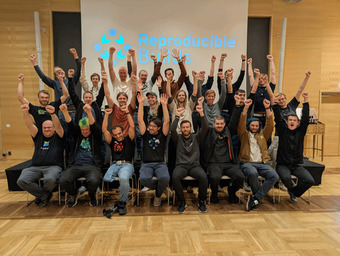
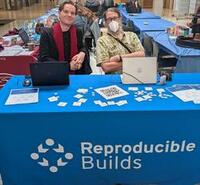
Reproducible Builds at SeaGL 2026 Reproducible Builds was present at SeaGL in Seattle, WA, on October 23rd & 24th. Thanks to everyone who attended and spoke with us! Members of the Reproducible Builds project attended SeaGL (the Seattle GNU/Linux Conference) in Seattle, WA, on October 23rd & 24th. It was a fantastic opportunity to connect with local community members, discuss software supply chain security and share updates on build verification tooling. Thanks to everyone who stopped by our sessions or spoke with us during the event. Founded in 2013, SeaGL is an annual free-as-in-freedom, grassroots technical summit dedicated to spreading awareness, community engagement and practical knowledge about free software, open hardware and libre culture.
Tool and documentation development diffoscope is our in-depth and content-aware diff utility that can locate and diagnose reproducibility issues. This month, Chris Lamb made a number of changes, including preparing and uploading versions 333, 334, 335 and 336 to Debian:
  • New features:
    • Support the dumppdf binary being called dumppdf.py on the host/runtime system. [ ]
  • Bug fixes:
    • Drop Recommends: guix from the diffoscope-minimal package as it is not minimal. (#1114739) [ ]
    • Fix a crash when using the latest version(s) of Androguard. Thanks, hc! [ ]
  • Codebase improvements:
    • Re-order various parts of the .tar file comparator to make it easier to progressively delve into its functionality. [ ]
    • Fix a silly prepend typo. [ ]
    • Reflect in the Python packaging that the use of the case-match language feature necessarily requires Python 3.10+. [ ]
  • Misc:
    • Update debian/tests/control. [ ]
    • Update copyright years. [ ]
In addition, Johannes Schauer Marin Rodrigues added support for POSIX.1-2001 PAX headers in the .tar file comparator [ ] and Vagrant Cascadian proposed an update in diffoscope in GNU Guix to version 335.

Distribution work In Debian this month, 20 reviews of Debian packages were added, 28 were updated and 27 were removed this month adding to our knowledge about identified issues. One issue type was updated to reflect that Debhelper compat level 14 is no longer experimental. [ ] In addition, Vagrant Cascadian performed a number of Non-Maintainer Uploads (NMUs) and Quality Assurance (QA) uploads in Debian for several packages with outstanding reproducibility issues. These included clhep, tea-cli, argparse-manpage, ruby-timers, mandos and cdebootstrap.
Lastly, Bernhard M. Wiedemann posted another openSUSE monthly update for their reproducibility work there.

SOURCE_DATE_EPOCH specification updates As announced in last month s report, further work has been done by Bernhard M. Wiedemann regarding updating the SOURCE_DATE_EPOCH specification following discussions at a project summit. Seven distinct proposed changes were originally submitted as merge requests on Salsa, and many of these have been approved or otherwise collapsed. Bernhard s proposed modifications were independent of one another, allowing for any combination to be merged depending on community feedback. Bernhard noted that one proposal may see the most debate, and could still benefit from further refinement before reaching consensus. Community members are invited to review and provide feedback on the individual merge requests; as Bernhard writes, The other MRs could still use feedback from more people before December . Input can be submitted via reactions or comments on Salsa, directly by email to Bernhard or the mailing list. The SOURCE_DATE_EPOCH specification was first published in 2015 and updated in 2017.

Mailing list news On our mailing list this month:

Patches The Reproducible Builds project detects, dissects and attempts to fix as many currently-unreproducible packages as possible. We endeavour to send all of our patches upstream where applicable or possible. This month, we wrote a large number of such patches, including: In addition, two build failure bugs were reported by Jochen Sprickerhof.

If you are interested in contributing to the Reproducible Builds project, please visit our Contribute page on our website. However, you can get in touch with us via:

Reproducible Builds (diffoscope): diffoscope 339 released

The diffoscope maintainers are pleased to announce the release of diffoscope version 339. This version includes the following changes:
[ Jay Burstin ]
* Rework including .zip-related differences for .odt files.
[ Chris Lamb ]
* Add some comments to recent OdtFile changes.
* Update copyright years.
You find out more by visiting the project homepage.

9 November 2026

Reproducible Builds (diffoscope): diffoscope 338 released

The diffoscope maintainers are pleased to announce the release of diffoscope version 338. This version includes the following changes:
[ Chris Lamb ]
* Binutils no longer shows the top-level directory; update expected test output.
  (Closes: #1151752)
You find out more by visiting the project homepage.

5 November 2026

Reproducible Builds (diffoscope): diffoscope 337 released

The diffoscope maintainers are pleased to announce the release of diffoscope version 337. This version includes the following changes:
[ Chris Lamb ]
* Mark that the test_nupkg_compressed_files test requires the tlsh Python
* module. (Closes: #1151752)
You find out more by visiting the project homepage.

30 October 2026

Reproducible Builds (diffoscope): diffoscope 336 released

The diffoscope maintainers are pleased to announce the release of diffoscope version 336. This version includes the following changes:
[ Chris Lamb ]
* Drop Recommends: guix from the diffoscope-minimal package.
  (Closes: #1114739)
You find out more by visiting the project homepage.

23 October 2026

Reproducible Builds (diffoscope): diffoscope 335 released

The diffoscope maintainers are pleased to announce the release of diffoscope version 335. This version includes the following changes:
[ Chris Lamb ]
* Support the dumppdf binary being called dumppdf.py on the host system.
* Update copyright years.
* Fix a silly "prepend" typo.
You find out more by visiting the project homepage.

16 October 2026

Reproducible Builds (diffoscope): diffoscope 334 released

The diffoscope maintainers are pleased to announce the release of diffoscope version 334. This version includes the following changes:
[ Chris Lamb ]
* Fix a crash when using the latest versions of Androguard. Thanks, hc!
  (Closes: reproducible-builds/diffoscope#434)
You find out more by visiting the project homepage.

Freexian Collaborators: Monthly report about Debian Long Term Support, September 2026 (by Santiago Ruano Rinc n)

The Debian LTS Team, funded by Freexian s Debian LTS offering, is pleased to report its activities for September.
Activity summary During the month of September, 20 contributors have been paid to work on Debian LTS (links to individual contributor reports are located below). The team released 41 DLAs fixing 1854 CVEs. In September, the Debian LTS Team was back to focusing on a single release: Debian 12 ( bookworm ). Debian 11 ( bullseye ) reached the end of its Long Term Support on 31 August 2026, and Freexian now provides its security maintenance under the Extended LTS offer. It is important to highlight the hard work done behind the scenes of the Front Desk fellows, whose role was fulfilled during September by Emilio, Emmanuel, Sylvain, Thorsten and Utkarsh. Besides the very high activity doing daily triage on dozens of packages and CVEs, Front Desk fellows spent much of their time answering questions and coordinating with people outside the Freexian team about update proposals. The team published several notable updates:
  • jbig2dec (DLA-4779-1), prepared by Andreas Henriksson, fixes CVE-2026-38076, where missing input checks could lead to a denial of service. It is to note that this library is used by different tools, such as ghostscript.
  • linux-6.12 (DLA-4788-1), uploaded by Ben Hutchings, fixing 414 CVEs in the bookworm backport of Linux kernel version 6.12.
  • lxml (DLA-4799-1), prepared by Guilhem Moulin, fixes four vulnerabilities in this widely used python XML/HTML library. The issues may yield to exposing local files.
  • nginx (DLA-4784-1), issued by Carlos Henrique Lima Melara ( charles ), fixing three memory-safety bugs in this popular web server and reverse proxy, which may result in denial of service, memory disclosure or potentially the execution of arbitrary code.
  • openssl (DLA-4795-1), by Arnaud Rebillout, fixing six vulnerabilities, including an out-of-bounds heap write in CMS decryption and an authentication tag verification bypass in ChaCha20-Poly1305/AES-OCB decryption. This update brings bookworm to OpenSSL 3.0.22, the last upstream release of the 3.0 series, which was reached its upstream EOL on 7 Sep 2026. Further fixes will be backported by the Debian LTS Team from more recent releases.
  • redis DLA-4794-1, by Chris Lamb, fixing vulnerabilities that could yield to arbitrary code execution
Contributions from other Debian fellows beyond the Freexian LTS Team:
  • Thomas Goirand, Keystone released by Emilio as DLA-4767-1
  • Thomas also prepared glance and swift updates, whose respective DLA-4800-1 and DLA-4801-1 were issued by Charles
  • Matthew Vernon uploaded a pcre2 security update, and Emilio issued its DLA-4772-1
  • Otto Kek l inen uploaded a xz-utils update, released as DLA-4783-1 by Sylvain
  • Salvatore Bonaccorso published a linux (6.1) update released as DLA-4777-1
  • Xavier Guimard prepared a lemonldap-ng, released as DLA-4797-1. Additionally, Sylvain sent DLA-4734-1 at the beginning of the month for the upload made on August.
  • Xavier also released DLA-4766-1 for cyrus-imapd.
  • Simon Quigley uploaded DLA-4803-1 to fix multiple issues in ruby-oj.
  • Finally, Ivo Marino proposed bookworm updates for cjose, git-lfs, caddy, libgit2, libwebsockets, libssh and unbound. Some of Ivo s proposals are still pending for a review.
Thank you so much to the developers above for these valuable contributions. The LTS Team has also contributed with updates to the latest Debian releases for the following packages:
  • ruby-jwt, prepared by Abhijith and released as DSA-6547-1
  • urwid, proposed for a point-release update by Abhijith (#1148950)
  • puma, proposed for a point-release update by Abhijith (#1149582)
  • tomcat10, and tomcat9 (which is actually backported to released suites) by Bastien
  • nodejs, prepared by Bastien and released as (DSA-6517-1).
If you benefit from Debian, especially throughout its full 5-year lifecycle, please consider becoming a sponsor of Debian LTS. You can find more information here: https://www.freexian.com/lts/debian/.

Individual Debian LTS contributor reports

Thanks to our sponsors Sponsors that joined recently are in bold.

14 October 2026

Reproducible Builds: Reproducible Builds in September 2026

Welcome to the September 2026 report from the Reproducible Builds project! In our reports, we try to outline the most important things that we have been up to over the past month. As a quick recap about what problem our project intends to solve, whilst anyone may inspect the source code of free software for malicious flaws, almost all software is distributed to end users as pre-compiled binaries. The motivation behind the reproducible builds effort is to ensure no flaws have been introduced during this compilation process by promising identical results are always generated from a given source, thus allowing multiple third-parties to come to a consensus on whether a build was compromised or not. As ever, if you are interested in contributing to the project, please visit our Contribute page on our website. In this month s report, we cover:

  1. Reproducible Builds Summit 2026 held in Gothenburg, Sweden
  2. dettrace expanding architecture support for PGO & Lisp dumps
  3. They don t care about this!
  4. SOURCE_DATE_EPOCH specification updates
  5. Reproducible Builds at SeaGL 2026
  6. New Code of Conduct (CoC)
  7. Supporter Spotlight: Jochen Sprickerhof
  8. Mailing list news
  9. Tool and documentation development
  10. Patches

Reproducible Builds Summit 2026 held in Gothenburg, Sweden The annual Reproducible Builds summit took place from 22 to 24 September 2026 in Gothenburg, Sweden. The event brought together developers, distribution maintainers, security researchers and free software advocates from across the ecosystem to share updates on current initiatives, address outstanding toolchain bottlenecks and strengthen cross-project collaboration. Participants engaged in a series of working sessions and technical roundtables focused on expanding the practical scope of reproducibility. Discussions covered ongoing work within major Linux distributions, language-specific package ecosystems and the various parts of the binary verification infrastructure. Strategic planning formed a pillar of the gathering, with participants discussing long-term roadmap goals for supply-chain security, software integrity and related topics. Attendees explored new methods for automated verification, discussing how to lower the adoption barriers for maintainers and streamline the integration of deterministic build pipelines into established continuous integration (CI) systems. The event was then followed by two days of unmoderated hacking sessions. These hacking sessions provided space for technical progress, allowing attendees to draft specification updates, prototype new tool features and resolve standing reproducibility bugs in-person.

Dettrace expanding architecture support for PGO & Lisp dumps Bernhard M. Wiedemann announced major updates to dettrace, porting the tool across most architectures supported by Debian and openSUSE. The release addresses key stability issues, passing test suites across these targets and making it ready for production build pipelines. These improvements enable deterministic builds when utilising Profile-Guided Optimisations (PGO), removing the need to sacrifice runtime performance for reproducibility. Additionally, dettrace can now be applied to (notoriously difficult-to-reproduce) Lisp and Scheme memory dumps, including environments such as CLISP, SBCL, Scheme 48, Racket and GNU Emacs.

They don t care about this Annika Wilde, Marco Gutfleisch, Felix Reichmann, Anirban Chakraborty, Yuval Yarom, M. Angela Sasse and Ghassan Karame published a paper this month entitled They don t care about this : A Systematic Study of Trusted Execution Environments Build Reproducibility in the Wild:
Trusted Execution Environments (TEEs) have become a cornerstone of modern cloud computing, providing strong confidentiality and integrity guarantees for both code and data. A critical component of this trust model is remote attestation, which enables external entities to verify the authenticity and integrity of code executing within a TEE through cryptographic measurements. However, the effectiveness of remote attestation fundamentally depends on the verifier s ability to trace the reported measurement back to the original source code - a property that can only be guaranteed through reproducible builds. [ ]
The full PDF can be read online.

SOURCE_DATE_EPOCH specification updates Bernhard M. Wiedemann shared a number of proposals regarding updating the SOURCE_DATE_EPOCH specification following discussions at a project summit. Seven distinct proposed changes have been submitted as merge requests on Salsa. Bernhard s proposed modifications are independent of one another, allowing for any combination to be merged depending on community feedback. Bernhard noted that one proposal may see the most debate, and could still benefit from further refinement before reaching consensus. Community members are invited to review and provide feedback on the individual merge requests by 1 December 2026. Input can be submitted via reactions or comments on Salsa, directly by email to Bernhard or the mailing list. The specification was first published in 2015 and updated in 2017.

Reproducible Builds at SeaGL 2026 Reproducible Builds will be present at SeaGL in Seattle, WA, on October 23rd & 24th. Come chat with us in person! Founded in 2013, SeaGL is a free, grassroots technical summit dedicated to spreading awareness and knowledge about free source software, hardware and culture.

New Code of Conduct (CoC) for the Reproducible Builds project Mattia Rizzolo announced the official launch of a Code of Conduct for the Reproducible Builds project. This follows work and community discussions originally initiated in 2024, incorporating feedback gathered over email and during project summits, as well as with input from the Software Freedom Conservancy. The new Code of Conduct establishes guidelines emphasising mutual respect among project contributors. It also defines a formalised process for submitting and handling complaints regarding community misconduct, ensuring transparent governance across project spaces. Along with the core policy document, an accompanying Code of Conduct FAQ has been published to outline the rationale behind adopting the guidelines.

Supporter Spotlight: Jochen Sprickerhof As a reminder, another supporter spotlight interview was published featuring long-time Debian and Reproducible Builds contributor Jochen Sprickerhof, highlighting his work on package verification and project infrastructure.

Mailing list news On our mailing list this month:
  • Jonathan Starr from the Institute of Open Science Practices (IOSP) posted with an announcement of its upcoming 2026 workshop series in Leiden in the Netherlands. This free-to-attend event aims to build a participant-owned data storage consortium, allowing community members to publish datasets, code and knowledge objects alongside algorithms designed to evaluate trust and value. The event features a dedicated Community Track for talks and discussions, a tool showcase and an opening session on resilient data storage.
  • Following up on IRC discussions regarding profile-guided optimization (PGO) on build servers, kpcyrd created a demonstration repository showing how PGO profiling can introduce non-determinism into output binaries. The demo highlights how runtime randomness (specifically, the randomised keys used in HashMaps to prevent denial-of-service attacks) causes varying bucket collision rates during test runs. These structural variances alter execution weights on underlying code branches, prompting the compiler to generate differing final assembly output for builds that would otherwise be perfectly reproducible if PGO was disabled. Rather than abandoning PGO performance gains, kpcyrd suggested treating generated profiling data as a documented build input or recorded environment artifact (similar to .buildinfo files), rather than regenerating profiles dynamically on the fly during build execution.
  • An autonomous AI agent (!), posted a controlled build result and reproducer demonstrating that pre-creating an obj directory in libmilter source trees prevents kernel-release path leaks (obj.Linux.<release>.x86_64) into debugging symbols. kpcyrd followed up with a helpful reply.
  • Alexander Sosedkin inquired on the mailing list about the preferred approach for sourcing pinned translation files to create reproducible GnuTLS release tarballs, asking whether external hosting should provide versioned downloads, or if projects ought to use Git submodules, dedicated side-repositories or some other mechanism.

Tool and documentation development diffoscope is our in-depth and content-aware diff utility that can locate and diagnose reproducibility issues. This month, Chris Lamb made a number of changes, including preparing and uploading versions 330, 331 and 332 to Debian. In particular, Chris committed support for radare2 versions greater than 5.9.0 [ ] based on input from Guillaume Girol [ ], and committed support for .nar files via Guix. [ ][ ]. Chris later modified diffoscope to not Build-Depend on the Debian package of GNU Guix, as its status in the Debian bug tracking system would transitively render diffoscope as being overly buggy for the next stable release [ ]. Similarly, he adjusted the Build-Depends on the apksigcopier package as it has been removed from Debian testing [ ] and, finally, he updated a number of copyright years [ ][ ]. Vagrant Cascadian updated diffoscope in GNU Guix to version 332.
reprotest is our tool for building the same source code twice in different environments and then checking the binaries produced by each build for any differences. This month, reprotest version 0.7.33 was uploaded to Debian by Holger Levsen with the following changes:
  • Sergei Tachenov fixed the fileordering test on all filesystems, including the likes of ZFS, which could return a different order across two builds due to build being done in a different directory [ ].
  • Holger Levsen bumped the Standards-Version to 4.7.4, reflected that Priority: optional is the default now [ ], fixed the old Free Software Foundation address [ ] and bumped the debhelper compat level to 14 after confirming there are only desired changes [ ].
  • Vagrant Cascadian updated *reprotest* to version 0.7.33 in GNU Guix.

rebuilderd, our server designed monitor the official package repositories of Linux distributions and attempt to reproduce the observed results there; it powers, amongst other things, reproduce.debian.net. This month, Bernhard M. Wiedemann submitted a pull request to rebuilderd that refactors RPM repository metadata handling. The change extracts rpm-md parsing out of the Fedora-specific scheduler module and into a shared one.
Lastly, there were a number of improvements made to our website this month as well. For example:

Patches The Reproducible Builds project detects, dissects and attempts to fix as many currently-unreproducible packages as possible. We endeavour to send all of our patches upstream where applicable or possible. This month, we wrote a large number of such patches, including: Vagrant Cascadian also performed a number of Non-Maintainer Uploads (NMUs) and Quality Assurance (QA) uploads in Debian for several packages with outstanding reproducibility issues. These included molttemplate, buddy, xfonts-nexus, fte and lifelines. At the time of this writing, that leaves 130 submitted patches, with only 61 outstanding submitted patches that older than a year in the Debian bug tracking system. This number is only 26 if we exclude any low-priority build path issues.

If you are interested in contributing to the Reproducible Builds project, please visit our Contribute page on our website. However, you can get in touch with us via:

9 October 2026

Reproducible Builds (diffoscope): diffoscope 333 released

The diffoscope maintainers are pleased to announce the release of diffoscope version 333. This version includes the following changes:
[ Johannes Schauer Marin Rodrigues ]
* Add support for showing differences in POSIX.1-2001 PAX headers within .tar
  files.
[ Chris Lamb ]
* Re-order various parts of the tar comparator to make it easier to
  progressively delve into its functionality.
* Reflect that the use of the "case-match" language feature requires at least
  Python 3.10+. This can be worked around if it causes problems - let us know.
* Update various copyright years.
You find out more by visiting the project homepage.

28 September 2026

Reproducible Builds (diffoscope): diffoscope 332 released

The diffoscope maintainers are pleased to announce the release of diffoscope version 332. This version includes the following changes:
[ Chris Lamb ]
* Do not Build-Depend on GNU Guix. Thanks to Vagrant and Holger for the
  reports. (Closes: #1149132)
[ Guillaume Girol ]
* Update more tests to support new versions of Radare.
  (Closes: reproducible-builds/diffoscope#432)
You find out more by visiting the project homepage.

25 September 2026

Reproducible Builds (diffoscope): diffoscope 331 released

The diffoscope maintainers are pleased to announce the release of diffoscope version 331. This version includes the following changes:
[ Chris Lamb ]
* Support radare2 >= 5.9.0. (Closes: reproducible-builds/diffoscope#432)
* Update debian/tests/control.
* Update copyright years.
[ Christopher Baines ]
* Add support for .nar files via Guix.
You find out more by visiting the project homepage.

21 September 2026

Reproducible Builds (diffoscope): diffoscope 330 released

The diffoscope maintainers are pleased to announce the release of diffoscope version 330. This version includes the following changes:
[ Chris Lamb ]
* Don't Build-Depend on apksigcopier as it has been removed from testing.
  (Closes: #1146852)
You find out more by visiting the project homepage.

20 September 2026

Freexian Collaborators: Monthly report about Debian Long Term Support, August 2026 (by Thorsten Alteholz)

The Debian LTS Team, funded by Freexian s Debian LTS offering, is pleased to report its activities for August.

Activity summary During the month of August, 19 contributors have been paid to work on Debian LTS (links to individual contributor reports are located below). The team released 58 DLAs fixing 1885 CVEs. Debian 11 ( bullseye ), which has reached the end of its Long Term Support on 31 August 2026, will now get security support from Freexian under the Extended LTS offer. The team published several notable updates:
  • chromium (DLA 4710-1), uploaded by Emilio, to fix 375 security flaws in bookworm, including issues that could lead to arbitrary code execution. Further DLA 4728-1, uploaded by Emilio as well, fixed additional 41 security issues in bookworm and DLA 4739-1 fixed 5 issues. Last but not least, DLA 4749-1 fixed another 15 issues and DLA 4758-1 fixed another 7 issues.
  • ruby2.7 (DLA 4716-1), uploaded by Abhijith, to fix four security flaws in bookworm, including issues that could lead to arbitrary code execution.
  • several DLAs (DLA 4717-1, DLA 4720-1, DLA 4723-1, DLA 4724-1, DLA 4745-1) have been uploaded by Ben and Emilio to fix myriad security flaws in different versions of the linux kernel (5.10.262-1, 6.1.180-1, 6.12.100-1~deb12u1, 6.12.101-1~deb12u1) in bullseye and bookworm.
  • 7zip (DLA 4718-1) and p7zip (DLA 4719-1), uploaded by Sylvain, to fix multiple security flaws in bookworm and bullseye, including issues that could yield to remote code execution.
  • ca-certificates (DLA 4726-1), uploaded by Bastien to add some new trusted certificates to bookworm and bullseye, but also remove some untrusted ones.
  • thunderbird (DLA 4727-1 and DLA 4754-1), uploaded by Emilio to fix 35 and 31 issues in bookworm and bullseye.
  • nss (DLA 4729-1), uploaded by Jochen to fix a vulnerability in bookworm and bullseye that could yield to arbitrary code execution.
  • libgd2 (DLA 4731-1), uploaded by Guilhem to fix a vulnerability in bookworm and bullseye that could yield to arbitrary code execution if a malformed GIF file is processed.
  • xorg-server (DLA 4737-1 and DLA 4738-1), uploaded by Arnaud to fix several vulnerabilities in bookworm and bullseye.
  • postgresql-15 (DLA 4740-1), uploaded by Carlos Henrique Lima Melara to fix 26 vulnerabilities in bookworm.
  • unzip (DLA 4741-1), uploaded by Andrej to fix a vulnerability in bookworm and bullseye that could yield to arbitrary code execution.
  • firefox-esr (DLA 4750-1), uploaded by Emilio to fix 31 vulnerabilities in bookworm and bullseye that could potentially result in arbitrary code execution, privilege escalation or information disclosure.
  • nvidia-graphics-drivers (DLA 4752-1 and DLA 4753-1), uploaded by Tobias to fix lots of vulnerabilities in bookworm and bullseye.
  • roundcube (DLA 4760-1), uploaded by Guilhem to fix ten vulnerabilities in bookworm and bullseye that could potentially result in remote code execution or information disclosure.
Contributions from outside the LTS Team: We are greatly thankful for the contributions from people outside the LTS Team:
  • Salvatore Bonaccorso released a libyaml-syck-perl security update (DLA 4730-1), to fix a denial of service and potentially arbitrary code execution.
  • Thomas Goirand released a neutron security update (DLA 4735-1).
  • Thomas Goirand released an ironic security update (DLA 4743-1).
  • Thomas Goirand released a designate security update (DLA 4751-1), to fix a denial of service or DNS hijacking.
The LTS Team has also contributed with updates to the latest Debian releases:
  • xrdp (DSA 6469-1), prepared by Abhijith to address privilege escalation and arbitrary code execution related flaws.
Other contributions: Besides the work on security updates, different documentation and tooling changes were needed. This work was mainly done by Sylvain.

Individual Debian LTS contributor reports

Thanks to our sponsors Sponsors that joined recently are in bold.

11 September 2026

Reproducible Builds: Reproducible Builds in August 2026

Welcome to the August 2026 report from the Reproducible Builds project! In our reports, we try to outline the most important things that we have been up to over the past month. As a quick recap about what problem our project intends to solve, whilst anyone may inspect the source code of free software for malicious flaws, almost all software is distributed to end users as pre-compiled binaries. The motivation behind the reproducible builds effort is to ensure no flaws have been introduced during this compilation process by promising identical results are always generated from a given source, thus allowing multiple third-parties to come to a consensus on whether a build was compromised or not. In this month s report, we cover:

  1. New updated SBOM specification from CISA.gov
  2. LWN on Bootstrappable builds at FOSSY 2026
  3. What s missing to have reproducible builds on PyPI?
  4. Distribution work
  5. Unreproducible builds under EROFS filesystem fixed
  6. Tool and documentation development
  7. Six new scholarly papers
  8. Patches

New updated SBOM specification from CISA.gov CISA, the Cybersecurity and Infrastructure Security Agency of the U.S. government published some the joint guidance entitled Minimum Elements for a Software Bill of Materials (SBOM), which updates and supersedes the baseline 2021 version covered in previous editions of these reports. Whilst the PDF is worth skimming, the interesting changes include that the specification now mandates standard cryptographic hashes: unlike earlier standards that allowed hash omission or manifest-only parsing, hashes must be computed from the output. This is is important for reproducible builds, as it ensures the recording of the metadata required to demonstrate the shipped software matches the build output precisely where applicable. In addition, where the top-level only dependency limitation that was present in the 2021 version has been removed in favour of complete coverage with no minimum depth. That is, SBOMs are expected to reflect all linked libraries, vendored dependencies and other build-time inclusions.

LWN on Bootstrappable builds at FOSSY 2026 In the Toolchains and Other Development Tools track at Software Freedom Conservancy s FOSSY 2026 in British Columbia, Canada, Timothy Sample gave a presentation on bootstrappable builds. This presentation was then covered in a Linux Weekly News article by Jake Edge entitled Bootstrappable builds: how and why, which serves as an excellent introduction to the concept:
The basic idea behind bootstrappable builds is to create a system that can be built without relying on pre-built artifacts. Can we go from zero to the modern day without having to just assume the existence of these already-built-for-us artifacts? The classic recipe for yogurt requires some yogurt to start the process, which is like how we normally build a C compiler today we start with an existing C compiler binary. You might think about making sourdough bread with your grandmother s starter brought over from the old country; we re basically making C compilers with Dennis Ritchie s starter carried over from Bell Labs .
The article, which goes on to cover GNU Mes and other projects that overlap with Reproducible Builds, also has a number of thought-provoking comments.

What s missing to have reproducible builds on PyPI? Core Python developer, Brett Cannon wrote an interesting blog post this month addressing What s missing to have reproducible builds on PyPI, the official public repository for third-party Python software packages:
The reason I like the idea of making reproducible builds work is that I think it can be done in such a way as to not require any work on the part of the producer of a distribution (which is a technical term for sdists or wheels, i.e., the people who upload stuff to PyPI), and thus make reproducible builds very low-friction for people to opt into supporting. [ ]
Brett goes on to outline What s missing from the specs and how reproducibility might be visible on PyPI to consumers:
Assuming all of this comes to pass and we record the where the source code is that went into a distribution and the software used to make the distribution, how do we make it useful to people? Does every person who cares about having a secure supply chain have to rebuild everything they use themselves? Is there some way for even people who don t care about this stuff to benefit? [ ]

Distribution work In Debian this month, 23 reviews of Debian packages were added, 28 were updated and 27 were removed this month adding to our knowledge about identified issues. A number of issue types have been updated as well, such as the addition of a new toolchain issue related to python-traitlets [ ], and the note for an existing issue related to texi2html was updated as well [ ]. Lastly, Bernhard M. Wiedemann posted another openSUSE monthly update for their reproducibility work there.

Unreproducible builds under EROFS filesystem fixed Martin Pitt reported on Fosstodon that they had identified an issue where the mkfs ( make filesystem ) command for the EROFS (Enhanced Read-Only File System) subsystem of the Linux kernel did not have sorted extended file attributes, leading to reproducible builds. Thankfully, Martin also reported that they had fixed this in a commit to the kernel which order[s] each inode s xattrs by name so that images stay reproducible . [ ]

Tool and documentation development diffoscope is our in-depth and content-aware diff utility that can locate and diagnose reproducibility issues. This month, Chris Lamb made a number of changes, including preparing and uploading versions 327, 328 and 329 to Debian. In particular, he ensured that diffoscope did not require python3-guestfs in the autopkgtests on 32-bit architectures in order to fix Debian bug (#1144372) [ ]. Colin Watson made an additional change, handling a potentially missing openssh-client package when running the autopkgtests [ ], and Jochen Sprickerhof made a similar change to cope with missing cpio and qemu-img functionality [ ] whilst also updating the XML comparator to be considered when comparing SVG images [ ].
Yet again, there were a number of improvements made to our website this month as well. For example:
  • Chris Lamb added draft for a Gothenburg summit-related news article. [ ][ ]
  • Holger Levsen then published the same article. [ ][ ]
  • Lastly, a large number of commits were pushed comprising an interview with Reproducible Builds developer Jochen Sprickerhof to be published within the next week. [ ][ ][ ][ ][ ][ ][ ]

Six new scholarly papers Jens Dietrich, Spencer Sun, Tim W. White and Behnaz Hassanshahi (the result of a collaboration between Victoria University of Wellington and Oracle Australia published a paper this month entitled No Snake Oil: Verifying Python Package Builds. Drawing on the metaphor of snake oil , that is, a fake or ineffective medicine or solution sold with exaggerated claims of curing or fixing everything, the authors write that
Two tools that are designed to automate [PyPI] rebuilds and run them at scale are macaron and oss-rebuild. We study 12,180 popular releases from PyPI and find that the byte-for-byte equivalence rate is generally low. We analyse the reasons why they produce different wheels, and find that equivalence between the original and rebuilt wheels can often still be established, preserving most of the guarantees users expect from rebuildable releases. We present and evaluate daleq4py, a tool to establish the equivalence of Python wheels through the kernel of a normalisation function that is based on provenance-preserving datalog rules. Experimental results show that daleq4py substantially expands the set of rebuilds that can be accepted as equivalent.
The full PDF of their paper can be viewed online, and Jens Dietrich to our mailing list to announce the availability of both the paper and the daleq4py tool itself.
Dimitri Kokkonis, Micha l Marcozzi and Stefano Zacchiroli published an article this month titled Not In My Git Yard: Catching Backdoors at Commit and Release Time on the topic of code-level backdoors that is, stealthy code changes that grant hidden privileges via secret triggers . These issues:
pose a persistent threat to opensource software. Known attempts to inject such backdoors into widely used projects through malicious commits, tampered release packages, or compromised third-party dependencies, were stopped only by luck and manual review. Existing Continuous Integration (CI) pipelines cannot detect these attacks, and downstream binary analysis tools require substantial manual effort. In this work, we present Lily, an automated approach that strengthens open-source development and release processes against backdoor injection. Lily integrates a backdoor detection mechanism into (1) CI pipelines to block malicious commits, and (2) release vetting workflows to prevent tampered releases or compromised dependencies from entering large ecosystems, such as Linux distributions.
The full PDF can be read online.
Ranindya Paramitha and Laurie Williams of North Carolina State University along with Christian K stner of Carnegie Mellon University published a paper this month with the title of The Software Supply Chain as a Market for Lemons: A Multivocal Review of Trust Signal Collapse. (A lemon in American English, is a vehicle that turns out to have several manufacturing defects .) Their abstract is as follows:
Practitioners evaluating open-source dependencies rely on cheap trust signals, e.g., stars, download counts, and contributor activity, as substitutes for direct code inspection, assuming those signals reflect genuine trustworthiness. Prior work has documented individual signal gaming, but the landscape of collapses across all dependency-adoption signals, as well as the ecosystem s response, remains unexplored. The goal of this study is to aid software practitioners in understanding the reliability of dependency adoption trust signals, such as download counts and contributor activity, by conducting a multivocal review of 252 Google Search sources and 870 Reddit threads.
Worryingly, after their review, the authors conclude that cheap trust signals collapse under three simultaneous forces: adversarial manipulation, gaming techniques indistinguishable from legitimate behavior, and non-adversarial AI-driven inflation. The full PDF of the paper is available online.
Julien Malka, Aman Sharma, Martin Monperrus, Stefano Zacchiroli and Th o Zimmermann published a paper this month on Trusting-Trust Attack against an Entire Linux Distribution through Binary Manipulation:
Ken Thompson s trusting-trust attack, in which a compromised compiler backdoors the programs it builds and reproduces the backdoor in subsequent rebuilds of itself, is widely regarded as a threat specific to compilers. We show that it is not. We construct a complete trusting-trust attack around GNU strip, an ordinary build utility that neither inspects nor generates source code, using only manipulations of finished ELF files.
Scarily, in the authors example, a single tampered strip in the binary seed implants a payload that propagates from one generation of strip to the next and survives into the final standard environment after the seed leaves the dependency closure [ ] without failures and backdoors . A full PDF of the paper is available for download online.
Mehdi Keshanimm, Amirhossein Rahmati, Mohammad Hossein Aref and Abbas Heydarnoori published a paper that is currently under review at Emperical Software Engineering titled AROMA+: A Study of Factors Affecting Reproducible Builds in the Maven Ecosystem. (Maven is a/the build automation tool used for Java projects.) In their paper, the authors note that
[ ] reusing external software in a project presents a security risk when the source of the component is unknown or the consistency of a component cannot be verified. The SolarWinds attack serves as a popular example in which the injection of malicious code into a library affected thousands of customers and caused a loss of billions of dollars. [ ] Our research aims to support [reproducibility] efforts in the Maven ecosystem through automation. We investigate the feasibility of automatically finding the source code of a library from its Maven release and recovering information about the original release environment. Our tool, AROMA+, can obtain this critical information from the artifact and the source repository through several heuristics and we use the results for reproduction attempts of packages on Maven Central.
The full PDF of their article can be downloaded online.
Lastly, Oreofe Solarin, Kelechi Kalu, James C. Davis and Paschal Amusuo published a paper this month titled Reproducibility is Not Enough: Artifact Verifiability in Decentralized-Build Package Ecosystems:
[A]rtifact verification requires more than deterministic builds: a verifier must also recover the source state, build environment, dependencies, and build instructions that produced the artifact. Decentralized-build ecosystems make this difficult because artifacts are produced through heterogeneous tools, maintainer-controlled workflows, and fragmented metadata. As a result, it remains unclear how often artifacts in these ecosystems can be independently verified. This paper studies artifact verifiability across four popular decentralized-build package ecosystems. We define an independent verifier model that relies only on registry-derivable metadata and an artifact comparison model with tiered equivalence levels. We implement these models in an Artifact Verification Pipeline and use it to measure artifact verifiability across the target ecosystems.
The authors conclude that beyond build determinism, verifiability is limited by missing source and build metadata, implicit release transformations, and unconventional build practices . A PDF of their paper can be reviewed online.

Patches The Reproducible Builds project detects, dissects and attempts to fix as many currently-unreproducible packages as possible. We endeavour to send all of our patches upstream where applicable or possible. This month, we wrote a large number of such patches, including:

If you are interested in contributing to the project, please visit our Contribute page on our website.

24 August 2026

Freexian Collaborators: Monthly report about Debian Long Term Support, July 2026 (by Santiago Ruano Rinc n)

The Debian LTS Team, funded by Freexian s Debian LTS offering, is pleased to report its activities for July.

Activity summary During the month of July, 23 contributors have been paid to work on Debian LTS (links to individual contributor reports are located below). The team released 52 DLAs fixing 2159 CVEs. In July, the Debian Stable Release Managers published the last point release of Debian 12 ( bookworm ), after which the Debian LTS team took full responsibility of Debian 12. This completes the handover from the Security Team, that took place in June. This also marks the second month in a row where the Debian LTS has been focusing on two simultaneous Debian releases. Other than Debian 12, the team is maintaining Debian 11 ( bullseye ), which will reach the end of its Long Term Support on 31 August 2026. After that date, Freexian will continue the security support under the Extended LTS offer. The team published several notable updates:
  • jq (DLA 4662-1 and DLA 4661-1) prepared by Andreas Henriksson in collaboration with Jochen Sprickerhof, addressing multiple vulnerabilities.
  • Several updates for the different linux supported versions prepared by Ben Hutchings, in collaboration with Emilio Pozuelo Monfort. Other than the regular security advisories: DLA 4664-1, DLA 4665-1, DLA 4671-1, DLA 4688-1, and DLA 4700-1, Ben started preparing packages of 6.12 via bookworm-backports.
  • nginx (DLA 4667-1), updated for bookworm by Carlos Henrique Lima Melara, as a follow up of the bullseye update (DLA 4660-1), that was prepared in June.
  • grub2/bullseye (DLA 4685-1), prepared by Emilio. Other than addressing several security issues, this DLA was needed for being able to update the shim boot loader.
  • samba (DLA 4692-1), uploaded by Markus Koschany, to fix several security flaws in bullseye, including issues that could yield to remote code execution.
  • imagemagick (DLA 4680-1 and DLA 4696-1), prepared by Bastien Roucari s, addressing several issues that could lead to denial of service, information disclosure or potentially arbitrary code execution in some scenarios.
  • poppler (DLA 4709-1), by Guilhem Moulin, fixing several vulnerabilities.
  • nss (DLA-4694-1), by Jochen, fixing flaws that may result in or denial of service or potentially the execution of arbitrary code.
Contributions from outside the LTS Team: The LTS Team has also contributed with updates to the latest Debian releases:
  • Bastien also proposed two updates for imagemagick. The first one released as DSA 6383-1, and the second as a trixie point update proposal (#1142554).
  • python-httplib2 by Emmanuel Arias, and released by the security team as DSA 6441-1 in August.
  • hplip (DSA 6402-1), prepared by Thorsten Alteholz, to address privilege escalation and arbitrary code execution related flaws.
  • libnfs trixie update (#1142351), by Thorsten
  • patool update for trixie #1141607, by Abhijith PA
Other contributions: Besides the work on security updates, different documentation and tooling changes were needed, especially in the context of the Debian 12 handover. This work was mainly done by Sylvain Beucler.

Individual Debian LTS contributor reports

Thanks to our sponsors Sponsors that joined recently are in bold.

14 August 2026

Reproducible Builds (diffoscope): diffoscope 328 released

The diffoscope maintainers are pleased to announce the release of diffoscope version 328. This version includes the following changes:
[ Chris Lamb ]
* Don't require python3-guestfs in the autopkgtests on 32-bit architectures.
  (Closes: #1144372)
[ Jochen Sprickerhof ]
* Use the XML comparators for SVG vector image files. (Closes: #1144242)
You find out more by visiting the project homepage.

9 August 2026

Reproducible Builds: Reproducible Builds in July 2026

Welcome to the July 2026 report from the Reproducible Builds project! In our reports, we try to outline the most important things that we have been up to over the past month. As a quick recap about what problem our project intends to solve, whilst anyone may inspect the source code of free software for malicious flaws, almost all software is distributed to end users as pre-compiled binaries. The motivation behind the reproducible builds effort is to ensure no flaws have been introduced during this compilation process by promising identical results are always generated from a given source, thus allowing multiple third-parties to come to a consensus on whether a build was compromised or not. If you are interested in contributing to the project, please visit the Contribute page on our website. In this month s report, we cover:

  1. Tool development
  2. Distribution work
  3. Three new scholarly papers
  4. Patches
  5. Misc news

Tool development diffoscope is our in-depth and content-aware diff utility that can locate and diagnose reproducibility issues. This month, Chris Lamb made the following changes, including preparing and uploading versions 324, 325 and 326 to Debian:
  • Fix tests to work with zipdetails 4.0008. (#1141359)
  • Bump debhelper compatibility level to 13. [ ]
  • Update copyright years. [ ]
In addition, Paul Spooren made changes to allow trailing garbage in Gzip files [ ] and Vagrant Cascadian added an external tool reference for the pedump binary to use the mono package under GNU Guix. [ ]
disorderfs is our FUSE-based filesystem that deliberately introduces non-determinism into system calls to reliably flush out reproducibility issues. This month, Christelle Gloor added the option to sort by ctime as returned by the lstat(2) syscall. [ ], which Chris Lamb uploaded whilst bumping the Standards-Version to version 4.7.4 [ ]. Bernhard Wiedemann also updated disorderfs to version 0.7.0 in openSUSE.
Yet again, there were a number of improvements made to our website this month as well. For example, Chris Lamb, by request of Digital Ocean, changed the target of a referral link so that they can manage incoming referrers [ ] and pushed a number of changes to the Tools page [ ].

Distribution work In Debian this month, 32 reviews of Debian packages were added, 26 were updated and a total of 21 were removed this month, adding to our extensive knowledge about identified issues. A number of issue types were added by Chris Lamb, including:
  • python_towncrier_build_date [ ][ ]
  • log_files_installed_in_package [ ]
  • fontforge_varies_by_timezone [ ][ ]
Chris also added a further note for the build_date_in_manpage_generated_by_spf13_cobra issue. [ ]
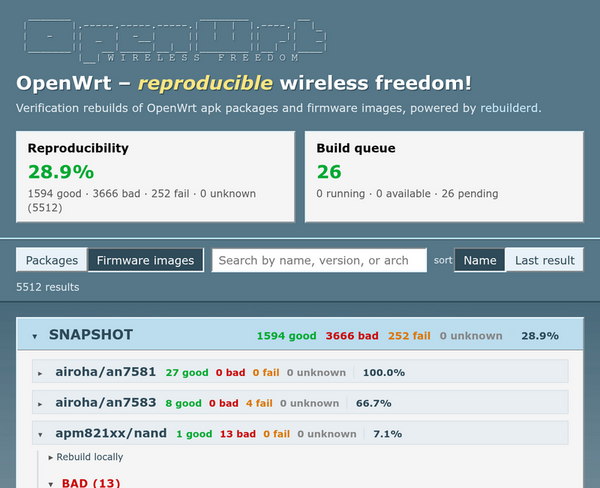
In addition, there is a new page showing verification rebuilds of OpenWrt APK packages and firmware images, powered by rebuilderd:

Three new scholarly papers Yan Li, Nan Jiang, Qihang Zhou, Shaowen Xu, Yamin Xie and Xiaoqi Jia of the Chinese Academy of Sciences published a paper titled VCAligner: Aligning Source Distribution Versions with Upstream Git Commits to Secure Supply Chain:
We present VCAligner, a content-based alignment methodology that constructs inverted indexes over VCS histories to precisely map released artifacts to their originating commits, independent of fragile version tags. We evaluated VCAligner on a dataset of 2,984 verifiable PyPI packages derived from the 4,000 most-downloaded projects linked to public GitHub upstreams. Our results reveal a critical weakness in conventional tag-based heuristics: while they appear effective on 85% of the dataset, the residual 15% failure rate generates a catastrophic downstream audit workload of over 10.3 million commits. In contrast, VCAligner reduces this burden by two orders of magnitude ( 158 ), bounding the total workload to under 65,000 commits. Furthermore, we provide the large-scale characterization of Packaging Noise, classifying artifact divergence into structural additions (Path Phantoms) and content mutations (Blob Phantoms), thereby isolating the distinct attack surfaces of malicious injection and code tampering.

Jens Dietrich and Spencer Sun from the Victoria University of Wellington together with Tim W. White and Behnaz Hassanshahi from Oracle Inc pre-published their paper No Snake Oil: Verifying Python Package Builds (PDF):
Python has become the default language for interacting with AI, with packages being distributed through registries like the Python Package Index (PyPI). This creates a need to analyse supply chains comprising such packages. One such analysis is to rebuild packages in order to identify compromised builds injecting malware. Independent rebuilds in hardened environments have the added advantage that they can generate and record provenance in order to increase the trustworthiness of packages. Two tools that are designed to automate such rebuilds and run them at scale are macaron and oss-rebuild. We study 12,180 popular releases from PyPI and find that the byte-for-byte equivalence rate is generally low. We analyse the reasons why they produce different wheels, and find that equivalence between the original and rebuilt wheels can often still be established, preserving most of the guarantees users expect from rebuildable releases. We present and evaluate daleq4py, a tool to establish the equivalence of Python wheels through the kernel of a normalisation function that is based on provenance-preserving datalog rules. Experimental results show that daleq4py substantially expands the set of rebuilds that can be accepted as equivalent. Although only 15.4% of macaron rebuilds and 19.1% of oss-rebuild rebuilds are byte-for-byte identical to the published PyPI wheels, daleq4py establishes wheel equivalence for 60.2% and 78.9% of source-equivalent rebuilds, respectively.

Denise Nanni, Julien Malka, Stefano Zacchiroli and Th o Zimmermann from T l com Paris together with Gabriele D Angelo from the University of Bologna pre-published their paper Understanding Build Reproducibility in the F-Droid Ecosystem (PDF), which was accepted at the 2026 ACM Conference on Reproducibility and Replicability:
The security of open source applications benefits considerably from the possibility of rebuilding their source and verifying the output. F-Droid, a prominent distribution for open source Android applications, systematically rebuilds them from source and tests their bitwise reproducibility at app publishing time. However, F-Droid offers no guarantee that app reproducibility will continue to hold in the future. As software ecosystems evolve, reproducibility may degrade, with potential negative consequences for software preservation and security. We present the first empirical study of build reproducibility in the F-Droid app ecosystem. Analyzing historical reproducibility logs, we find that the overall bitwise reproducibility rate has been steadily increasing over time (as new versions of apps are published). We then evaluate how reproducibility holds in time for fixed app versions, by attempting to rebuild 18 904 app versions that F-Droid had previously confirmed bitwise reproducible, published between September 2018 and February 2026, achieving an 83% rebuild success rate, and identify missing dependencies as the dominant cause of failure, accounting for 76% of non-rebuildable cases. Among successfully rebuilt apps, 94% are also bitwise reproducible-i.e., they still yield bitwise identical artifacts upon rebuild. Together, these results show that while bitwise reproducibility largely holds for apps that can be rebuilt, rebuildability itself is highly sensitive to temporal decay.

Patches The Reproducible Builds project detects, dissects and attempts to fix as many currently-unreproducible packages as possible. We endeavour to send all of our patches upstream where applicable or possible. This month, we wrote a large number of such patches, including:

Misc news On our mailing list this month, Colin Winter of Markovian Protocol wrote to our mailing list on the topic of Reproducible verification for retained logs:
Reproducible builds remove trust in the builder: anyone re-derives the same artifact from the same source, byte for byte. The same shape applies one layer over, to a retained record. Most record-keeping regimes (the EU AI Act s Article 12 logging is the current example) require that events be recorded and logs retained, but not that a retained log be verifiable, by a party who was not present, as unaltered and existing when claimed. That leaves an integrity obligation resting on trusting the party being audited.
(Full thread)

Finally, if you are interested in contributing to the Reproducible Builds project, please visit our Contribute page on our website. However, you can get in touch with us via:

22 July 2026

Freexian Collaborators: Monthly report about Debian Long Term Support, June 2026 (by Thorsten Alteholz)

The Debian LTS Team, funded by [Freexian s Debian LTS offering] (https://www.freexian.com/lts/debian/), is pleased to report its activities for June.

Activity summary During the month of June, 20 contributors have been paid to work on Debian LTS (links to individual contributor reports are located below). The team released 48 DLAs fixing 231 CVEs. Debian 12 ( bookworm ) has been handed over to the LTS Team on June 11th. During this handover Sylvain helped to update relevant tools and documentation. If you benefit from Debian, especially during the full 5-year lifecycle, please consider subscribing as a sponsor of Debian LTS: https://www.freexian.com/lts/debian/. Moreover, Debian 11 ( bullseye ) will reach the end of the Debian LTS period on August 31st. After that, Freexian will continue the security support under the Extended LTS offer. The team published several notable updates:
  • haveged update (DLA-4616-1), prepared by Thorsten, to address local privilege escalation.
  • tomcat9 update (DLA-4619-1), prepared by Markus, to address, among others, an authentication bypass.
  • apache2 update (DLA-4620-1), prepared by Bastien, to address a HTTP/2 bomb.
  • apache2 update (DLA-4629-1), prepared by Bastien, to address, among others, remote code execution and privilege escalation.
  • libinput update (DLA-4626-1), prepared by Santiago, to address local privilege escalation and arbitrary code execution.
  • asterisk update (DLA-4631-1), prepared by Thorsten, to address, among others, wrong processing of invalid or untrusted certificates.
  • nginx update (DLA-4634-1), prepared by Charles, to address a remote code execution and denial of service.
  • firefox-esr update (DLA-4635-1), prepared by Emilio, to address dozens of CVEs, among other things, related to arbitrary code execution and privilege escalation.
  • thunderbird update (DLA-4636-1), prepared by Emilio, to address dozens of CVEs, among other things, related to arbitrary code execution.
  • chromium update (DLA-4654-1), prepared by Emilio, to address dozens of CVEs, among other things, related to arbitrary code execution.
Contributions from outside the LTS Team: We are greatly thankful for the contributions from people outside the LTS Team:
  • Salvatore Bonaccorso prepared a libhttp-daemon-perl update, that was released by Santiago as DLA-4639-1.
  • Salvatore also directly uploaded libgd-perl DLA-4638-1 and libconfig-inifiles-perl DLA-4637-1.
  • Peter Palfrader prepared a tor update, that was released by Santiago as DLA-4656-1.
  • Pieter Lenaerts prepared a beets update, that was released by Emmanuel as DLA-4641-1.
  • Noah Meyerhans prepared a cloud-init update DLA-4645-1.
The LTS Team has also contributed with updates to the latest Debian releases:
  • Besides publishing DLA-4642-1 for package u-boot Andreas also prepared an NMU for an upload to sid and prepared a stable-proposed-update (SPU) bug for trixie, which was already acknowledged by a stable release manager (SRM).
  • Andreas also prepared an upload of package atril for trixie, which was handled by the security team as DSA-6349-1.
  • Besides publishing DLA-4620-1 for package apache Bastien also prepared an upload for trixie, which was handled by the security team as DSA-6323-1.
  • Tobi uploaded package mesa to trixie and bookworm.
  • Thorsten fixed some (not security related but RC) issues in package dahdi-linux. This was in preparation to fix lots of security issues in asterisk. Unfortunately the maintainer ignored the corresponding debdiff and prefered to upload a new upstream version. Anyway, the concerns of the security team about security support of asterisk could be overcome and asterisk can migrate to tesing and again be part of a Debian release.

Individual Debian LTS contributor reports

Thanks to our sponsors Sponsors that joined recently are in bold.

17 July 2026

Reproducible Builds (diffoscope): diffoscope 325 released

The diffoscope maintainers are pleased to announce the release of diffoscope version 325. This version includes the following changes:
[ Chris Lamb ]
* Fix tests to work with zipdetails 4.0008. (Closes: #1141359)
* Downgrade debhelper compatibility level to 13 for now.
* Update copyright years.
You find out more by visiting the project homepage.

Next.