Although I never submitted to it, I made several appearances in the now-defunct quote database on bash.org (QDB). I m dealing with a broken keyboard now, and went to dig hard to find this classic in the Wayback machine. I thought I would put it back on the web:
<mako> my letter "eye" stopped worng
<luca> k, too?
<mako> yeah
<luca> sounds like a mountain dew spill
<mako> and comma
<mako> those three
<mako> ths s horrble
<luca> tme for a new eyboard
<luca> 've successfully taen my eyboard apart and fxed t by cleanng t wth alcohol
<mako> stop mang fun of me
<mako> ths s a laptop!
We seem to be entering an AI apocalypse of sorts, they aren t going to kill us or even take our jobs. What they are doing is destroying the Internet commons by filling it with rubbish. This isn t even real AI, just pattern matching and prediction systems, mostly LLMs.
The Problem
Scott Shambaugh s saga of being attacked and defamed by an OpenClaw AI bot is interesting and raises some disturbing possibilities for future online discussion [1]. Imagine what it would be like if everyone who was in any way notable for free software work had 100 such bots going after them.
Dania Dumas wrote an insightful blog post about why OpenClaw is impossible to secure and why it won t go away [2].
Bruce Schneier and Nathan E. Sanders wrote an insightful article about the AI generated text arms race [3] primarily concentrating on situations in which text that was assumed to be written by humans but was actually written in bulk by bots was performing a DOS attack on people who were reviewing it. There are many situations such as book publishing and publishing letters to the editor of newspapers where getting new material from unknown people is an important part of the job but where there are also people making low quality submissions that are almost a DOS attack at the best of times.
Currently the email spam problem continues to get worse and when LLM use increases it will get significantly worse. Email encryption isn t viable [4]. The PGP web of trust never really worked well as it s too difficult for most users.
The amount of AI generated content that s being recommended to users on platforms like YouTube and Facebook is steadily increasing and the amount of LLM generated commentary that purports to be from real people on Twitter and Facebook is also increasing. Here s an informative blog post by Erich Schubert about this [5].
Potential Solutions
Surrender?
One option and possibly the default option is to surrender to this and just let everything we built on the Internet over decades get destroyed. Whether to surrender is a decision that can be made on a per-service basis.
Twitter is pretty much useless anyway, I quit Twitter because Elon deliberately made it suck [6]. In my opinion this is not surrendering to what s being done there, I m just stopping wasting time on it and using better options. I used to have about 300 followers on Twitter and I don t think that many of them would ever choose to stop following me, so I presume that about 1/3 of the people following me have decided to totally quit Twitter and delete their accounts. I also presume that some of the remainder have done the same as me and just kept a mostly inactive account. If Elon suddenly stopped being a stupid asshole it probably wouldn t change anything as the value of the system was connections to others. Some people will consider my abandonment of Twitter as surrender and I accept that it s not an unreasonable opinion. I think that the possibly 100 Twitter followers of mine who deleted their accounts surrendered.
Facebook has been becoming a worse service, it s business model is becoming increasingly exploitative and it s interface is designed to be addictive. It s probably best avoided unless you really need it. The only good thing about Facebook at the moment is that Facebook Marketplace doesn t take a cut on sales and there are some really good deals on computers if you know what to look for. Unfortunately Facebook has a large number of users who are from marginalised communities and have no other alternatives for communication. It would be good to get them migrated to other platforms.
We could just give up on a lot of general communications services and have everyone accept that good content is drowned out by rubbish and have the Internet become divided between people who accept the rubbish and those who cease using large portions of the Internet environment to avoid it.
Using Non Commercial Services
Lemmy is a good FOSS federated alternative to Reddit which also covers some of the uses of Facebook. It needs more users to get critical mass but is still quite usable. A post that might get a dozen comments on Reddit may get 1 comment on Lemmy but that one comment will be a good one. Reddit doesn t appear to be attacked much by LLM generated content at least not yet. Even if the Reddit model proves to be resilient to LLM attack the Lemmy software can be used to replace some things that are done on Facebook,
Mastodon is a good FOSS federated replacement for Twitter, it has a decent user-base including some VIPs. While it is aimed at the Twitter use case it can also cover a significant part of the Facebook use case.
There are some other FOSS social media programs which could take over other parts of the commercial social media environment.
Generally commercially run Internet services will have a financial incentive to allow the problems to get worse so we need to rely on FOSS software, non-commercial implementations, and government services.
Web Search
For a long time Google has had a monopoly on web search, but now they default to including an AI Overview at the start of the results which is sometimes useful but also sometimes very wrong. You can use the search URL https://www.google.com/search?q=%s&udm=web to get google results without rubbish. But I presume that they will break that if it gets too popular.
Searxng is a AGPL licensed metasearch engine that aggregates results from other engines, here s the Searxng source [7] and here s a list of Searxng instances if you want to try one [8].
Even using meta search engines like Searxng won t help if the original data is overloaded with spam, but alleviating the problem is a good temporary measure.
Web of Trust for the Web?
I ve idly considered the possibility of having some sort of rating system for web pages that uses a web of trust so that you can securely use trust ratings of friends of friends etc. But given all the difficulties in using a web of trust for signing GPG key for software developers (the demographic that is most skilled at doing such things) it doesn t seem viable.
Should we surrender the idea of having a usable public web?
In the early days of the web (before Google) it was standard practice to rely on recommendations from other people or from trusted sites to find other sites, that could be considered to be an informal web of trust. We could go back to that sort of usage pattern if Google and many of the big sites get overwhelmed by LLM generated spam.
Wikipedia
I believe that Wikipedia will be at the front lines of this battle. It s model has always included anonymous contributions. Benjamin Mako Hill wrote an interesting blog post about research he did with Kaylea Champion into Wikipedia pages on taboo topics which have a larger portion of contributors choosing to be anonymous than non-taboo pages [9]. Wikipedia also has a long history of being abused for various reasons, one that I witnessed was someone putting false content into Wikipedia pages to immediately cite them in support of their facebook arguments. That sort of thing can be dealt with at human scale but a large scale attack by bots is a different problem to solve. Also with the recent developments in AI developing multiple web sites entirely populated for the purpose of supporting one fake entry in Wikipedia is plausible.
The upside of these attacks that I predict is that they will attract the attention of all the people who have skills related to developing counter-measures. While LLM bots are filling the inboxes of publishers with rubbish and messing up the stackoverflow comments section not a lot of people are bothered, but once the attacks on Wikipedia get serious everyone will take notice.
National AI
Bruce Schneier and Nathan E. Sanders wrote an interesting blog post about nationalised public AI [10]. While that won t directly address this issue it will get the right technology in the hands of people who can use it in the right way.
Conclusion
This is going to be a difficult problem to solve, more difficult than the email spam problem we have been unable to solve after 30 years of working on it.
This is also a very important problem, we are currently in an age where we have access to information that most people couldn t even dream of 30 years ago. We also have disinformation that combines some of the worst aspects of authoritarian regimes throughout history combined with the worst aspects of cult brainwashing. If we lose access to the information but the disinformation remains (or get worse) then the result will be terrible.
I don t have great ideas for solving this. I have outlined some small ideas to mitigate things and I hope that others can expand on them.
Please write comments with any good ideas you have, or even ideas that don t totally suck. A problem this difficult is not going to be solved in a blog comment, but a blog comment might point in the right direction.
Note: I have not published blog posts about my academic papers over the past few years. To ensure that my blog contains a more comprehensive record of my published papers and to surface them for folks who missed them, I will periodically (re) publish blog posts about some older published projects. This post draws material from a previously published post by Kaylea Champion on the Community Data Science Blog.
Taboo subjects such as sexuality and mental health are as important to discuss as they are difficult to raise in conversation. Although many people turn to online resources for information on taboo subjects, censorship and low-quality information are common in search results. In two papers I recently published at CSCW both led by Kaylea Champion we presented a series of analyses showing how taboo shapes the process of collaborative knowledge building on English Wikipedia.
The first study is a quantitative analysis showing that articles on taboo subjects are much more popular and are the subject of more vandalism than articles on non-taboo topics. In surprising news, we also found that they were edited more often and were of higher quality!
Short video of Kaylea s presentation of the work given at Wikimania in August 2023.
The first challenge we faced in conducting this work was identifying taboo articles. Kaylea had a brilliant idea for a new computational approach to doing so without relying on our individual intuitions about what qualifies as taboo (something we understood would be highly specific to our own culture, class, etc). Her approach was to make use of an insight from linguistics: people develop euphemisms as ways to talk about taboos (i.e., think about all the euphemisms we ve devised for death, or sex, or menstruation, or mental health).
We used this insight to build a new machine-learning classifier based on English Wiktionary definitions. If a sense of a word was tagged as euphemistic, we treated the words in the definition as indicators of taboo. The end result was a series of words and phrases that most powerfully differentiate taboo from non-taboo. We then did a simple match between those words and phrases and the titles of Wikipedia articles. The topics were taboo enough that we were a little uncomfortable discussing them in our meetings! We built a comparison sample of articles whose titles are words that, like our taboo articles, appear in Wiktionary definitions.
In the first paper, we used this new dataset to test a series of hypotheses about how taboo shapes collaborative production in Wikipedia. Our initial hypotheses were based on the idea that taboo information is often in high demand but that Wikipedians might be reluctant to associate their names (or usernames) with taboo topics. The result, we argued, would be articles that were in high demand but of low quality.
We found that taboo articles are thriving on Wikipedia! In summary, we found that in comparison to non-taboo articles:
Taboo articles are more popular (as expected).
Taboo articles receive more contributions (contrary to expectations).
Taboo articles receive more low-quality contributions (as expected).
Taboo articles are higher quality (contrary to expectations).
Taboo article contributors are more likely to contribute without an account (as expected), and have less experience (as expected), but that accountholders are more likely to make themselves more identifiable by having a user page, disclosing their gender, and making themselves emailable (all three of these are contrary to expectation!).
Image of the estimated qualiy of articles of the four articles in the second mixed-methods paper. Extreme dips reflect periods of frequent vandalism.
Kaylea attempted to understand these somewhat confusing results by designing a fantastic mixed-methods analysis that sought to unpack some of the nuance missing in the quantitative analysis by delving deep into the life histories of four articles on English Wikipedia: two on taboo topics related to women s anatomy (Clitoris and Menstration) and two nontaboo articles chosen for comparison (Cell membrance and Philip Pullman).
Although the findings from the analysis can be difficult to summarize succinctly (as with many qualitative studies), we showed how the taboo example articles success was hard-won amid real challenges and attacks. The paper describes how challenges were overcome through resilient leadership, often provided by a single dedicated individual. The paper provides a template for how taboo can be and frequently is overcome by dedicated Wikipedians in ways that provide useful knowledge resources in real demand.
For more details, visualizations, statistics, and more, we hope you ll take a look at our papers, both linked below.
The full citation for the papers are: (1) Champion, Kaylea, and Benjamin Mako Hill. 2023. Taboo and Collaborative Knowledge Production: Evidence from Wikipedia. Proceedings of the ACM on Human-Computer Interaction 7 (CSCW2): 299:1-299:25. https://doi.org/10.1145/3610090. (2) Champion, Kaylea, and Benjamin Mako Hill. 2024. Life Histories of Taboo Knowledge Artifacts. Proceedings of the ACM: Human-Computer Interaction 8 (CSCW2): 505:1-505:32. https://doi.org/10.1145/3687044.
Note: I have not published blog posts about my academic papers over the past few years. To ensure that my blog contains a more comprehensive record of my published papers and to surface these for folks who missed them, I will be periodically (re)publishing blog posts about some older published projects. This post is closely based on a previously published post by Zarine Kharazian on the Community Data Science Blog.For nearly a decade, the Croatian language version of Wikipedia was run by a cabal of far-right nationalists who edited articles in ways that promoted fringe political ideas and involved cases of historical revisionism related to the Usta e regime, a fascist movement that ruled the Nazi puppet state called the Independent State of Croatia during World War II. This cabal seized complete control of the encyclopedia s governance, banned and blocked those who disagreed with them, and operated a network of fake accounts to create the appearance of grassroots support for their policies.
Thankfully, Croatian Wikipedia appears to be an outlier. Though both the Croatian and Serbian language editions have been documented to contain nationalist bias and historical revisionism, Croatian Wikipedia seems unique among Wikipedia editions in the extent to which its governance institutions were captured by a small group of users.
The situation in Croatian Wikipedia was well documented and is now largely fixed, but we still know very little about why it was taken over, while other language editions seem to have rebuffed similar capture attempts. In a paper published in the Proceedings of the ACM: Human-Computer Interaction (CSCW), Zarine Kharazian, Kate Starbird, and I present an interview-based study that provides an explanation for why Croatian was captured while several other editions facing similar contexts and threats fared better.
Short video presentation of the work given at Wikimania in August 2023.
Based on insights from interviews with 15 participants from both the Croatian and Serbian Wikipedia projects and from the broader Wikimedia movement, we arrived at three propositions that, together, help explain why Croatian Wikipedia succumbed to capture while Serbian Wikipedia did not:
Perceived Value as a Target. Is the project worth expending the effort to capture?
Bureaucratic Openness. How easy is it for contributors outside the core founding team to ascend to local governance positions?
Institutional Formalization. To what degree does the project prefer personalistic, informal forms of organization over formal ones?
The conceptual model from our paper, visualizing possible institutional configurations among Wikipedia projects that affect the risk of governance capture.
We found that both Croatian and Serbian Wikipedias were attractive targets for far-right nationalist capture due to their sizable readership and resonance with national identity. However, we also found that the two projects diverged early in their trajectories in how open they remained to new contributors ascending to local governance positions and in the degree to which they privileged informal relationships over formal rules and processes as the project s organizing principles. Ultimately, Croatian s relative lack of bureaucratic openness and rules constraining administrator behavior created a window of opportunity for a motivated contingent of editors to seize control of the governance mechanisms of the project.
Though our empirical setting was Wikipedia, our theoretical model may offer insight into the challenges faced by self-governed online communities more broadly. As interest in decentralized alternatives to Facebook and X (formerly Twitter) grows, communities on these sites will likely face similar threats from motivated actors. Understanding the vulnerabilities inherent in these self-governing systems is crucial to building resilient defenses against threats like disinformation.
For more details on our findings, take a look at the published version of our paper.
Citation for the full paper: Kharazian, Zarine, Kate Starbird, and Benjamin Mako Hill. 2024. Governance Capture in a Self-Governing Community: A Qualitative Comparison of the Croatian, Serbian, Bosnian, and Serbo-Croatian Wikipedias. Proceedings of the ACM on Human-Computer Interaction 8 (CSCW1): 61:1-61:26. https://doi.org/10.1145/3637338.
This blog post and the paper it describes are collaborative work by Zarine Kharazian, Benjamin Mako Hill, and Kate Starbird.
Note: I have not published blog posts about my academic papers over the past few years. To ensure that my blog contains a more comprehensive record of my published papers and to surface these for folks who missed them, I will be periodically (re)publishing blog posts about some older published projects.
It seems natural to think of online communities competing for the time and attention of their participants. Over the last few years, I ve worked with a team of collaborators led by Nathan TeBlunthuis to use mathematical and statistical techniques from ecology to understand these dynamics. What we ve found surprised us: competition between online communities is rare and typically short-lived.
When we started this research, we figured competition would be most likely among communities discussing similar topics. As a first step, we identified clusters of such communities on Reddit. One surprising thing we noticed in our Reddit data was that many of these communities that used similar language also had very high levels of overlap among their users. This was puzzling: why were the same groups of people talking to each other about the same things in different places? And why don t they appear to be in competition with each other for their users time and activity?
We didn t know how to answer this question using quantitative methods. As a result, we recruited and interviewed 20 active participants in clusters of highly related subreddits with overlapping user bases (for example, one cluster was focused on vintage audio).
We found that the answer to the puzzle lay in the fact that the people we talked to were looking for three distinct things from the communities they worked in:
The ability to connect to specific information and narrowly scoped discussions.
The ability to socialize with people who are similar to themselves.
Attention from the largest possible audience.
Critically, we also found that these three things represented a trilemma, and that no single community can meet all three needs. You might find two of the three in a single community, but you could never have all three.
Figure from No Community Can Do Everything: Why People Participate in Similar Online Communities depicts three key benefits that people seek from online communities and how individual communities tend not to optimally provide all three. For example, large communities tend not to afford a tight-knit homophilous community.
The end result is something I recognize in how I engage with online communities on platforms like Reddit. People tend to engage with a portfolio of communities that vary in size, specialization, topical focus, and rules. Compared with any single community, such overlapping systems can provide a wider range of benefits. No community can do everything.
This work was published as a paper at CSCW: TeBlunthuis, Nathan, Charles Kiene, Isabella Brown, Laura (Alia) Levi, Nicole McGinnis, and Benjamin Mako Hill. 2022. No Community Can Do Everything: Why People Participate in Similar Online Communities. Proceedings of the ACM on Human-Computer Interaction 6 (CSCW1): 61:1-61:25. https://doi.org/10.1145/3512908.
This work was supported by the National Science Foundation (awards IIS-1908850, IIS-1910202, and GRFP-2016220885). A full list of acknowledgements is in the paper.
Note: I have not published blog posts about my academic papers over the past few years. To ensure that my blog contains a more comprehensive record of my published papers and to surface these for folks who missed them, I will be periodically (re)publishing blog posts about some older published projects. This post is closely based on a previously published post by Kaylea Champion on the Community Data Science Blog.Many individuals use Tor to reduce their visibility to widespread internet surveillance.
One popular approach to protecting our privacy online is to use the Tor network. Tor protects users from being identified by their IP address, which can be tied to a physical location. However, if you d like to contribute to Wikipedia using Tor, you ll run into a problem. Although most IP addresses can edit without an account, Tor users are blocked from editing.
Tor users attempting to contribute to Wikipedia are shown a screen that informs them that they are not allowed to edit Wikipedia.Other research by my team has shown that Wikipedia s attempt to block Tor is imperfect and that some people have been able to edit despite the ban. As part of this work, we built a dataset of more than 11,000 contributions to Wikipedia via Tor and used quantitative analysis to show that contributions from Tor were of about the same quality as contributions from other new editors and other contributors without accounts. Of course, given the unusual circumstances Tor-based contributors face, we wondered whether a deeper look at the content of their edits might reveal more about their motives and the kinds of contributions they seek to make. Kaylea Champion (then a student, now faculty at UW Bothell) led a qualitative investigation to explore these questions.
Given the challenges of studying anonymity seekers, we designed a novel forensic qualitative approach inspired by techniques common in computer security and criminal investigation. We applied this new technique to a sample of 500 editing sessions and categorized each session based on what the editor seemed to be intending to do.
Most of the contributions we found fell into one of the two following categories:
Many contributions were quotidian attempts to add to the encyclopedia. Tor-based editors added facts, fixed typos, and updated train schedules. There s no way to know whether these individuals knew they were just getting lucky in their ability to edit or were patiently reloading to evade the ban.
Second, we found harassing comments and vandalism. Unwelcome conduct is common in online environments, and it is sometimes more common when the likelihood of being identified decreases. Some of the harassing comments we observed were direct responses to being banned as a Tor user.
Although these were most of what we observed, we also found evidence of several types of contributor intent:
We observed activism: when a contributor tried to draw attention to journalistic accounts of environmental and human rights abuses committed by a mining company, only to have editors linked to the mining company repeatedly remove their edits. Another example involved an editor trying to diminish the influence of proponents of alternative medicine.
We also observed quality maintenance activities when editors used Wikipedia s rules on appropriate sourcing to remove personal websites being cited in conspiracy theories.
We saw edit wars with Tor editors participating in a back-and-forth removal and replacement of content as part of a dispute, in some cases countering the work of an experienced Wikipedia editor whom even other experienced editors had gauged to be biased.
Finally, we saw Tor-based editors participating in non-article discussions, such as investigations into administrator misconduct and protests against the Wikipedia platform s mistrust of Tor editors.
An exploratory mapping of our themes in terms of the value a type of contribution represents to the Wikipedia community and the importance of anonymity in facilitating it. Anonymity-protecting tools play a critical role in facilitating contributions on the right side of the figure, while edits on the left are more likely to occur even when anonymity is impossible. Contributions toward the top reflect valuable forms of participation in Wikipedia, while edits at the bottom reflect damage.
In all, these themes led us to reflect on how the risks individuals face when contributing to online communities sometimes diverge from the risks the communities face in accepting their work. Expressing minoritized perspectives, maintaining community standards even when you may be targeted by the rulebreaker, highlighting injustice, or acting as a whistleblower can be very risky for an individual, and may not be possible without privacy protections. Of course, in platforms seeking to support the public good, such knowledge and accountability may be crucial.
This work was published as a paper at CSCW: Kaylea Champion, Nora McDonald, Stephanie Bankes, Joseph Zhang, Rachel Greenstadt, Andrea Forte, and Benjamin Mako Hill. 2019. A Forensic Qualitative Analysis of Contributions to Wikipedia from Anonymity Seeking Users. Proceedings of the ACM on Human-Computer Interaction. 3, CSCW, Article 53 (November 2019), 26 pages. https://doi.org/10.1145/3359155
This project was conducted by Kaylea Champion, Nora McDonald, Stephanie Bankes, Joseph Zhang, Rachel Greenstadt, Andrea Forte, and Benjamin Mako Hill. This work was supported by the National Science Foundation (awards CNS-1703736 and CNS-1703049) and included the work of two undergraduates supported through an NSF REU supplement.
Note: I have not published blog posts about my academic papers over the past few years. To ensure that my blog contains a more comprehensive record of my published papers and to surface these for folks who missed them, I will be periodically (re)publishing blog posts about some older published projects. This particular post is closely based on a previously published post by Nate TeBlunthuis from the Community Data Science Blog.
Many online platforms are adopting AI and machine learning as a tool to maintain order and high-quality information in the face of massive influxes of user-generated content. Of course, AI algorithms can be inaccurate, biased, or unfair. How do signals from AI predictions shape the fairness of online content moderation? How can we measure an algorithmic flagging system s effects?
In our paper published at CSCW, Nate TeBlunthuis, together with myself and Aaron Halfaker, analyzed the RCFilters system: an add-on to Wikipedia that highlights and filters edits that a machine learning algorithm called ORES identifies as likely to be damaging to Wikipedia. This system has been deployed on large Wikipedia language editions and is similar to other algorithmic flagging systems that are becoming increasingly widespread. Our work measures the causal effect of being flagged in the RCFilters user interface.
Screenshot of Wikipedia edit metadata on Special:RecentChanges with RCFilters enabled. Highlighted edits with a colored circle to the left side of other metadata are flagged by ORES. Different circle and highlight colors (white, yellow, orange, and red in the figure) correspond to different levels of confidence that the edit is damaging. RCFilters does not specifically flag edits by new accounts or unregistered editors, but does support filtering changes by editor types.
Our work takes advantage of the fact that RCFilters, like many algorithmic flagging systems, create discontinuities in the relationship between the probability that a moderator should take action and whether a moderator actually does. This happens because the output of machine learning systems like ORES is typically a continuous score (in RCFilters, an estimated probability that a Wikipedia edit is damaging), while the flags (in RCFilters, the yellow, orange, or red highlights) are either on or off and are triggered when the score crosses some arbitrary threshold. As a result, edits slightly above the threshold are both more visible to moderators and appear more likely to be damaging than edits slightly below. Even though edits on either side of the threshold have virtually the same likelihood of truly being damaging, the flagged edits are substantially more likely to be reverted. This fact lets us use a method called regression discontinuity to make causal estimates of the effect of being flagged in RCFilters.
Charts showing the probability that an edit will be reverted as a function of ORES scores in the neighborhood of the discontinuous threshold that triggers the RCfilters flag. The jump in the increase in reversion chances is larger for registered editors compared to unregistered editors at both thresholds.
To understand how this system may affect the fairness of Wikipedia moderation, we estimate the effects of flagging on edits on different groups of editors. Comparing the magnitude of these estimates lets us measure how flagging is associated with several different definitions of fairness. Surprisingly, we found evidence that these flags improved fairness for categories of editors that have been widely perceived as troublesome particularly unregistered (anonymous) editors. This occurred because flagging has a much stronger effect on edits by the registered than on edits by the unregistered.
We believe that our results are driven by the fact that algorithmic flags are especially helpful for finding damage that can t be easily detected otherwise. Wikipedia moderators can see the editor s registration status in the recent changes, watchlists, and edit history. Because unregistered editors are often troublesome, Wikipedia moderators attention is often focused on their contributions, with or without algorithmic flags. Algorithmic flags make damage by registered editors (in addition to unregistered editors) much more detectable to moderators and so help moderators focus on damage overall, not just damage by suspicious editors. As a result, the algorithmic flagging system decreases the bias that moderators have against unregistered editors.
This finding is particularly surprising because the ORES algorithm we analyzed was itself demonstrably biased againstunregistered editors (i.e., the algorithm tended to greatly overestimate the probability that edits by these editors were damaging). Despite the fact that the algorithms were biased, their introduction could still lead to less biased outcomes overall.
Our work shows that although it is important to design predictive algorithms to avoid such biases, it is equally important to study fairness at the level of the broader sociotechnical system. Since we first published a preprint of our paper, a follow-up piece by Leijie Wang and Haiyi Zhu replicated much of our work and showed that differences between different Wikipedia communities may be another important factor driving the effect of the system. Overall, this work suggests that social signals and social context can interact with algorithmic signals, and together these can influence behavior in important and unexpected ways.
The full citation for the paper is: TeBlunthuis, Nathan, Benjamin Mako Hill, and Aaron Halfaker. 2021. Effects of Algorithmic Flagging on Fairness: Quasi-Experimental Evidence from Wikipedia. Proceedings of the ACM on Human-Computer Interaction 5 (CSCW): 56:1-56:27. https://doi.org/10.1145/3449130.
We have also released replication materials for the paper, including all the data and code used to conduct the analysis and compile the paper itself.
A concerned nutritional epidemiologist in Tokyo realizes that if you are what you eat, that means
It s a similar situation in Seoul, albeit with less oil and more confidence.
I realize that because I have several chairs, the phrase my chair is ambiguous. To reduce confusion, I will refer to the head of my academic department as my office chair going forward.
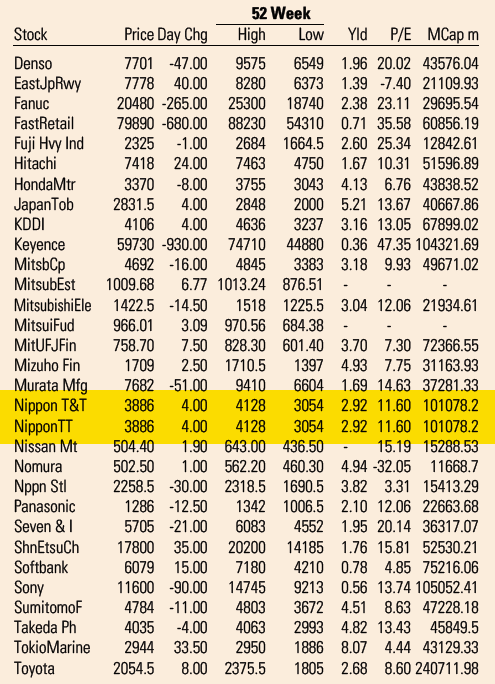
Market Data section of the Financial Times US Edition print edition from May 5, 2021.
If you ve flipped through printed broadsheet newspapers, you ve probably seen pages full of tiny text listing prices and other market information for stocks and commodities. And you ve almost certainly just turned the page. Anybody interested in this market prices today will turn to the internet where these numbers are available in real time and where you don t need to squint to find what you need. This is presumably why many newspapers have stopped printing these types of pages or dramatically reduced the space devoted to them. Major financial newspapers however like the Financial Times (FT) still print multiple pages of market data daily. But does anybody read them?
The answer appears to be no. How do I know? I noticed an error in the FT s Market Data page that anybody looking in the relevant section of the page would have seen. And I have seen it reproduced every single day for the last 18 months.
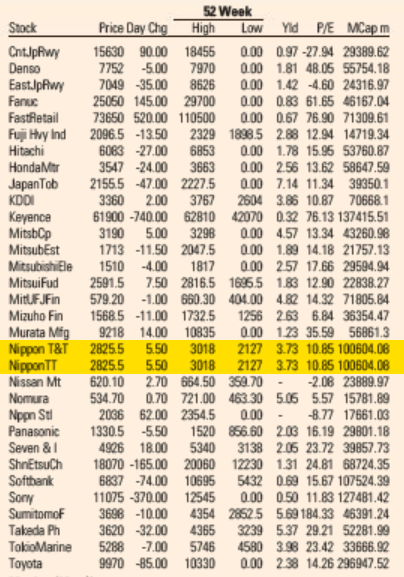
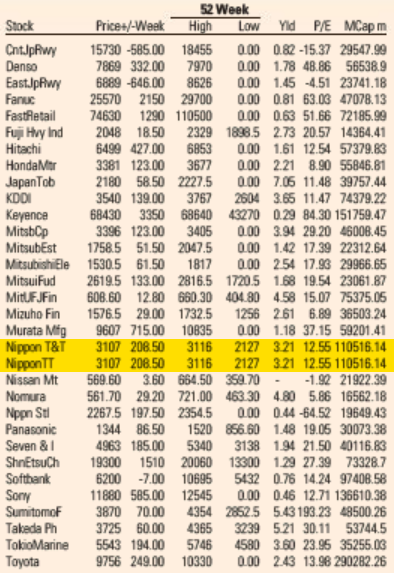
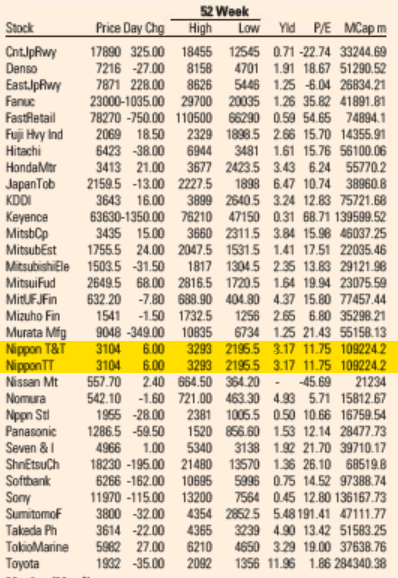
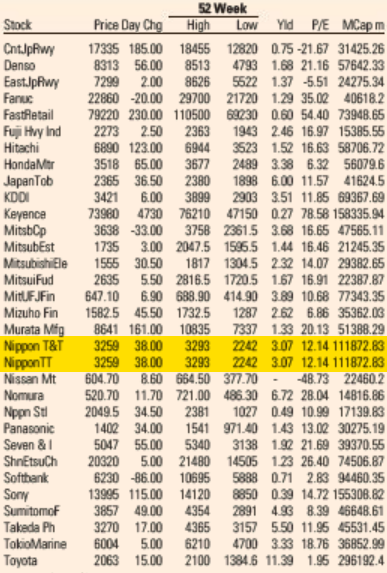
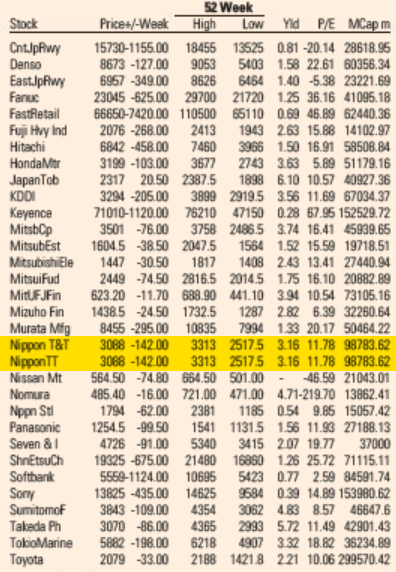
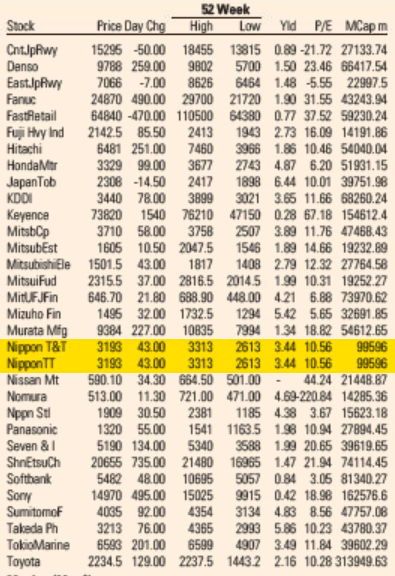
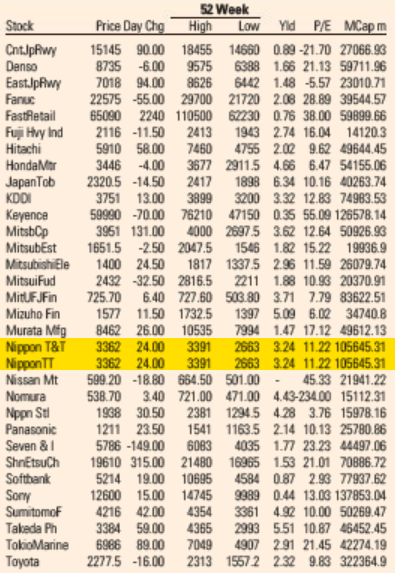
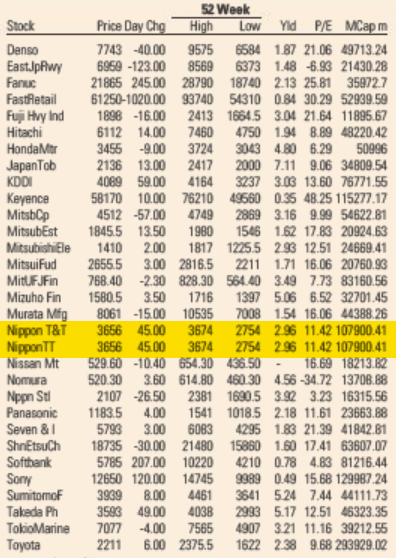
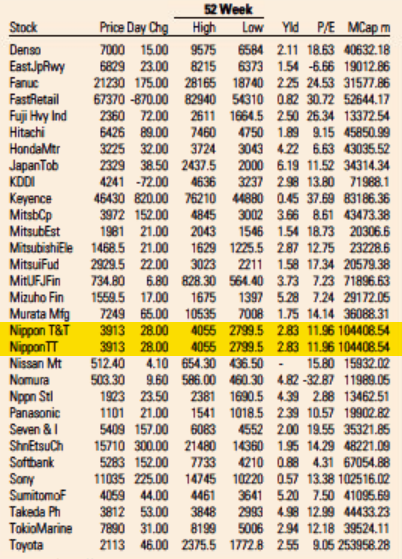
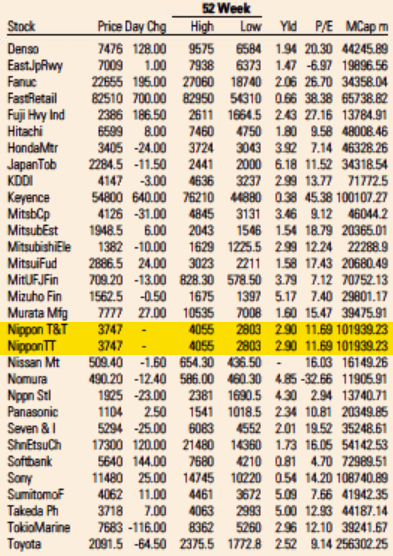
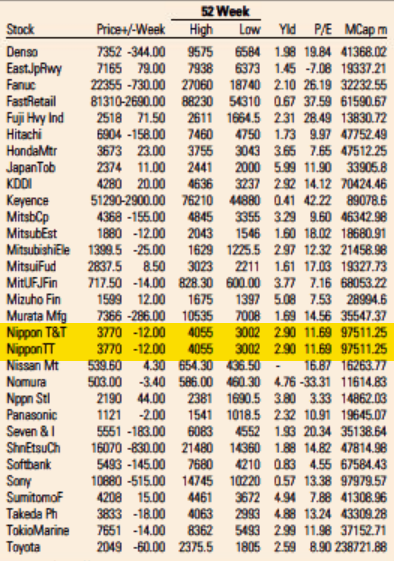
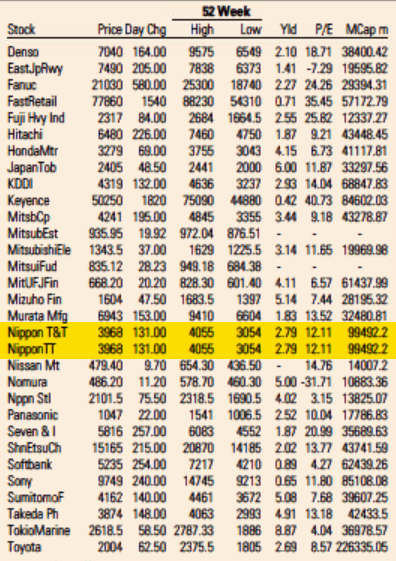
In early May last year, I noticed that the Japanese telecom giant Nippon Telegraph and Telephone (NTT) was listed twice on the FT s list of the 500 largest global companies: once as Nippon T&T and also as Nippon TT. One right above the other. All the numbers are identical. Clearly a mistake.
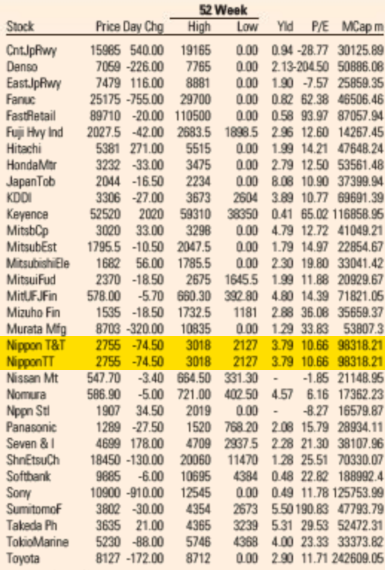
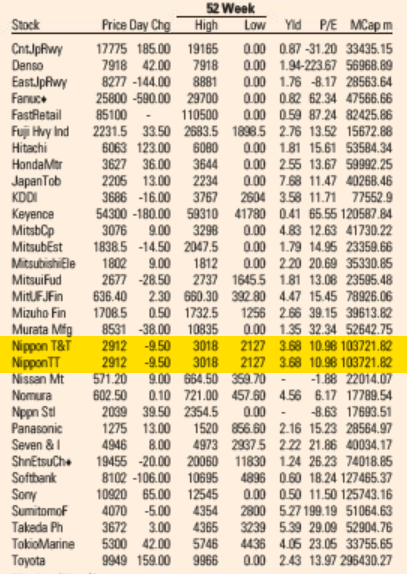
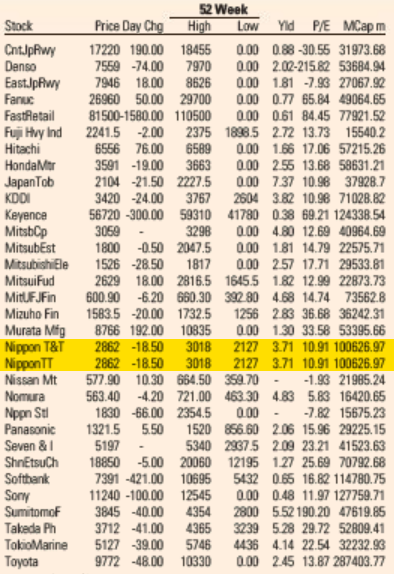
Reproduction of the FT Market Data section showing a subset of Japanese companies from the FT 500 list of global companies. The duplicate lines are highlighted in yellow. This page is from today s paper (November 26, 2022).
Wondering if it was a one-off error, I looked at a copy of the paper from about a week before and saw that the error did not exist then. I looked at a copy from one day before and saw that it did. Since the issue was apparently recurring, but new at the time, I figured someone at the paper would notice and fix it quickly. I was wrong. It has been 18 months now and the error has been reproduced every single day.
Looking through the archives, it seems that the first day the error showed up was May 5, 2021. I ve included a screenshot from the electronic paper version from that day and from the fifth of every month since then (or the sixth if the paper was not printed on the fifth) that shows that the error is reproduced every day. A quick look in the archives suggests it not only appears in the US edition but also in the UK, European, Asian, and Middle East editions. All of them.
Why does this matter? The FTprints over 112,000 copies of its paper, six days a week. This duplicate line takes up almost no space, of course, so it s not a big deal on its own. But devoting two full broadsheet pages to market data that is out date as soon as it is printed much of which nobody appears to be reading doesn t seem like a great use of resources. There s an argument to made that papers like the FT print these pages not because they are useful but because doing so is a signal of the publications identities as serious financial papers. But that hardly seems like a good enough reason on its own if nobody is looking at them. It seems well past time for newspapers to stop wasting paper and ink on these pages.
I respect that some people think that printing paper newspapers at all is wasteful when one can just read the material online. Plenty of people disagree, of course. But who will disagree with a call to stop printing material that evidence suggests is not being seen by anybody? If an error this obvious can exist for so long, it seems clear that nobody not even anybody at the FT itself is reading it.
Should online communities require people to create accounts before participating?
This question has been a source of disagreement among people who start or manage online communities for decades. Requiring accounts makes some sense since users contributing without accounts are a common source of vandalism, harassment, and low quality content. In theory, creating an account can deter these kinds of attacks while still making it pretty quick and easy for newcomers to join. Also, an account requirement seems unlikely to affect contributors who already have accounts and are typically the source of most valuable contributions. Creating accounts might even help community members build deeper relationships and commitments to the group in ways that lead them to stick around longer and contribute more.
In a new paper published in Communication Research, I worked with Aaron Shaw provide an answer. We analyze data from natural experiments that occurred when 136 wikis on Fandom.com started requiring user accounts. Although we find strong evidence that the account requirements deterred low quality contributions, this came at a substantial (and usually hidden) cost: a much larger decrease in high quality contributions. Surprisingly, the cost includes lost contributions from community members who had accounts already, but whose activity appears to have been catalyzed by the (often low quality) contributions from those without accounts.
A version of this post was first posted on the Community Data Science blog.
The full citation for the paper is: Hill, Benjamin Mako, and Aaron Shaw. 2020. The Hidden Costs of Requiring Accounts: Quasi-Experimental Evidence from Peer Production. Communication Research, 48 (6): 771 95. https://doi.org/10.1177/0093650220910345.
If you do not have access to the paywalled journal, please check out this pre-print or get in touch with us. We have also released replication materials for the paper, including all the data and code used to conduct the analysis and compile the paper itself.
Ever considered doing research about online communities, free culture/software, and peer production full time? It s PhD admission season and my research group the Community Data Science Collective is doing an open-to-anyone Q&A about PhD admissions this Friday November 5th. We ve got room in the session and its not too late to sign up to join us!
The session will be a good opportunity to hear from and talk to faculty recruiting students to our various programs at the University of Washington, Purdue, and Northwestern and to talk with current and previous students in the group.
I am hoping to admit at least one new PhD advisee to the Department of Communication at UW this year (maybe more) and am currently co-advising (and/or have previously co-advised) students in UW s Allen School of Computer Science & Engineering, Department of Human-Centered Design & Engineering, and Information School.
One thing to keep in mind is that my primary/home department Communication has a deadline for PhD applications of November 15th this year.
The registration deadline for the Q&A session is listed as today but we ll do what we can to sneak you in even if you register late. That said, please do register ASAP so we can get you the link to the session!
I first started using Debian sometime in the mid 90s and started contributing as a developer and package maintainer more than two decades years ago. My first very first scholarly publication, collaborative work led by Martin Michlmayr that I did when I was still an undergrad at Hampshire College, was about quality and the reliance on individuals in Debian. To this day, many of my closest friends are people I first met through Debian. I met many of them at Debian s annual conference DebConf.
Given my strong connections to Debian, I find it somewhat surprising that although all of my academic research has focused on peer production, free culture, and free software, I haven t actually published any Debian related research since that first paper with Martin in 2003!
So it felt like coming full circle when, several days ago, I was able to sit in the virtual DebConf audience and watch two of my graduate student advisees Kaylea Champion and Wm Salt Hale present their research about Debian at DebConf21.
Salt presented his masters thesis work which tried to understand the social dynamics behind organizational resilience among free software projects. Kaylea presented her work on a new technique she developed to identifying at risk software packages that are lower quality than we might hope given their popularity (you can read more about Kaylea s project in our blog post from earlier this year).
If you missed either presentation, check out the blog post my research collective put up or watch the videos below. If you want to hear about new work we re doing including work on Debian you should follow our research group blog, and/or follow or engage with us in the Fediverse (@communitydata@social.coop), or on Twitter (@comdatasci).
And if you re interested in joining us perhaps to do more research on FLOSS and/or Debian and/or a graduate degree of your own? please be in touch with me directly!
In exciting professional news, it was recently announced that I got an National Science Foundation CAREER award! The CAREER is the US NSF s most prestigious award for early-career faculty. In addition to the recognition, the award involves a bunch of money for me to put toward my research over the next 5 years. The Department of Communication at the University of Washington has put up a very nice web page announcing the thing. It s all very exciting and a huge honor. I m very humbled.
The grant will support a bunch of new research to develop and test a theory about the relationship between governance and online community lifecycles. If you ve been reading this blog for a while, you ll know that I ve been involved in a bunch of research to describe how peer production communities tend to follow common patterns of growth and decline as well as a studies that show that many open communities become increasingly closed in ways that deter lots of the kinds contributions that made the communities successful in the first place.
Over the last few years, I ve worked with Aaron Shaw to develop the outlines of an explanation for why many communities because increasingly closed over time in ways that hurt their ability to integrate contributions from newcomers. Over the course of the work on the CAREER, I ll be continuing that project with Aaron and I ll also be working to test that explanation empirically and to develop new strategies about what online communities can do as a result.
In addition to supporting research, the grant will support a bunch of new outreach and community building within the Community Data Science Collective. In particular, I m planning to use the grant to do a better job of building relationships with community participants, community managers, and others in the platforms we study. I m also hoping to use the resources to help the CDSC do a better job of sharing our stuff out in ways that are useful as well doing a better job of listening and learning from the communities that our research seeks to inform.
There are many to thank. The proposed work was the direct research of the work I did as the Center for Advanced Studies in the Behavioral Sciences at Stanford where I got to spend the 2018-2019 academic year in Claude Shannon s old office and talking through these ideas with an incredible range of other scholars over lunch every day. It s also the product of years of conversations with Aaron Shaw and Yochai Benkler. The proposal itself reflects the excellent work of the whole CDSC who did the work that made the award possible and provided me with detailed feedback on the proposal itself.
I wrote this blog post with Kaylea Champion and a version of this post was originally posted on the Community Data Science Collective blog.
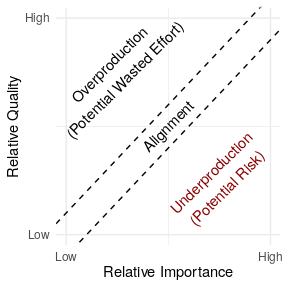
Critical software we all rely on can silently crumble away beneath us. Unfortunately, we often don t find out software infrastructure is in poor condition until it is too late. Over the last year or so, I have been supporting Kaylea Champion on a project my group announced earlier to measure software underproduction a term we use to describe software that is low in quality but high in importance.
Underproduction reflects an important type of risk in widely used free/libre open source software (FLOSS) because participants often choose their own projects and tasks. Because FLOSS contributors work as volunteers and choose what they work on, important projects aren t always the ones to which FLOSS developers devote the most attention. Even when developers want to work on important projects, relative neglect among important projects is often difficult for FLOSS contributors to see.
Given all this, what can we do to detect problems in FLOSS infrastructure before major failures occur? Kaylea Champion and I recently published a paper laying out our new method for measuring underproduction at the IEEE International Conference on Software Analysis, Evolution and Reengineering (SANER) 2021 that we believe provides one important answer to this question.
Conceptual diagram showing how our conception of underproduction relates to quality and importance of software.
In the paper, we describe a general approach for detecting underproduced software infrastructure that consists of five steps: (1) identifying a body of digital infrastructure (like a code repository); (2) identifying a measure of quality (like the time to takes to fix bugs); (3) identifying a measure of importance (like install base); (4) specifying a hypothesized relationship linking quality and importance if quality and importance are in perfect alignment; and (5) quantifying deviation from this theoretical baseline to find relative underproduction.
To show how our method works in practice, we applied the technique to an important collection of FLOSS infrastructure: 21,902 packages in the Debian GNU/Linux distribution. Although there are many ways to measure quality, we used a measure of how quickly Debian maintainers have historically dealt with 461,656 bugs that have been filed over the last three decades. To measure importance, we used data from Debian s Popularity Contest opt-in survey. After some statistical machinations that are documented in our paper, the result was an estimate of relative underproduction for the 21,902 packages in Debian we looked at.
One of our key findings is that underproduction is very common in Debian. By our estimates, at least 4,327 packages in Debian are underproduced. As you can see in the list of the most underproduced packages again, as estimated using just one more measure many of the most at risk packages are associated with the desktop and windowing environments where there are many users but also many extremely tricky integration-related bugs.
These 30 packages have the highest level of underproduction in Debian according to our analysis.
We hope these results are useful to folks at Debian and the Debian QA team. We also hope that the basic method we ve laid out is something that others will build off in other contexts and apply to other software repositories.
Paper Citation: Kaylea Champion and Benjamin Mako Hill. 2021. Underproduction: An Approach for Measuring Risk in Open Source Software. In Proceedings of the IEEE International Conference on Software Analysis, Evolution and Reengineering (SANER 2021). IEEE.
Contact Kaylea Champion (kaylea@uw.edu) with any questions or if you are interested in following up.

 Although I never submitted to it, I made several appearances in the now-defunct quote database on bash.org (QDB). I m dealing with a broken keyboard now, and went to dig hard to find this classic in the Wayback machine. I thought I would put it back on the web:
 Image of the estimated qualiy of articles of the four articles in the second mixed-methods paper. Extreme dips reflect periods of frequent vandalism.
 The conceptual model from our paper, visualizing possible institutional configurations among Wikipedia projects that affect the risk of governance capture.


 Screenshot of Wikipedia edit metadata on Special:RecentChanges with RCFilters enabled. Highlighted edits with a colored circle to the left side of other metadata are flagged by ORES. Different circle and highlight colors (white, yellow, orange, and red in the figure) correspond to different levels of confidence that the edit is damaging. RCFilters does not specifically flag edits by new accounts or unregistered editors, but does support filtering changes by editor types.
 Charts showing the probability that an edit will be reverted as a function of ORES scores in the neighborhood of the discontinuous threshold that triggers the RCfilters flag. The jump in the increase in reversion chances is larger for registered editors compared to unregistered editors at both thresholds.